Understanding list price vs market value vs appraised value is the quickest way to stop feeling whiplash when three different people hand you three different numbers for the same house. One figure is what you hope to ask. Another is what buyers will probably pay. A third is what a lender’s appraiser is willing to put in a report. They are cousins, not twins, and they are allowed to disagree.
Most sellers meet this problem at a bad moment. An online estimate says one thing, an agent’s pricing opinion says another, and then a buyer’s lender orders an appraisal that lands somewhere else entirely. It is natural to assume somebody got it wrong. Usually nobody did. Each number answers a slightly different question, uses different evidence, and serves a different audience. Keeping list price vs market value vs appraised value straight is half the battle.
This guide explains list price vs market value vs appraised value in plain language: who creates each number, what data sits behind it, why they drift apart, and what you can sensibly do when they do. We use clearly labelled round figures to show the arithmetic. They are teaching examples, not predictions about your home, your lender or your neighborhood.
One honest limit up front. Appraisal standards, lender rules, disclosure customs and local market behavior differ from place to place, and nothing here can see your property. Treat this as a map for asking sharper questions. For the broader picture of setting an asking price, our cornerstone guide on how to price a house to sell pulls the whole pricing process together. That is the practical heart of list price vs market value vs appraised value.
Key takeaways
- List price is a decision, not a measurement. It is the number you and your agent choose to advertise, and it is meant to attract buyers and shape negotiation.
- Market value is an estimate of what a willing buyer and seller would agree on. It is best thought of as a range built from recent, similar sales, not a fixed figure.
- Appraised value is an opinion prepared for a lender. It is a written estimate by a licensed professional, tied to a specific date and a specific purpose.
- The three can legitimately differ. Timing, condition, data quality and who is asking all move the result, so a gap is a prompt to check evidence, not proof of error.
- Prepare for the gap before it appears. Gather your comparable evidence, improvement records and a plan for a low appraisal before you accept an offer.
If your real question is simply “what is my place worth,” start with our walk-through of how much your house is worth, then come back here to understand why the other two numbers behave differently.
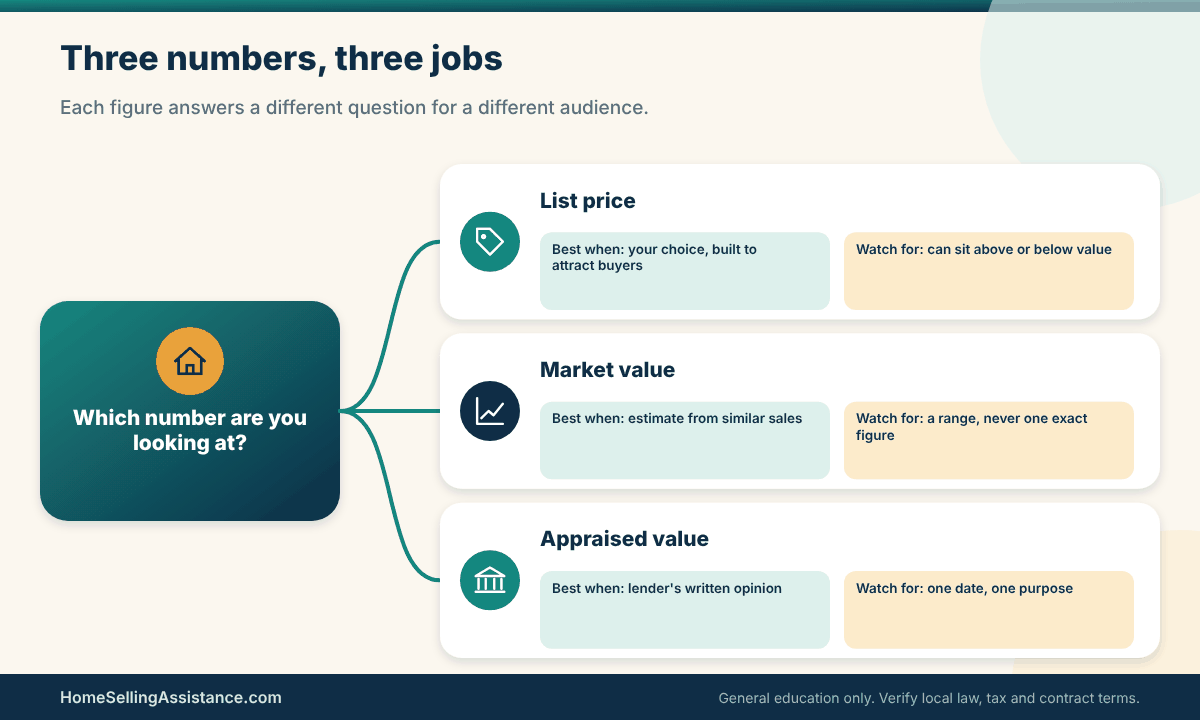
List price vs market value vs appraised value: three numbers, three jobs
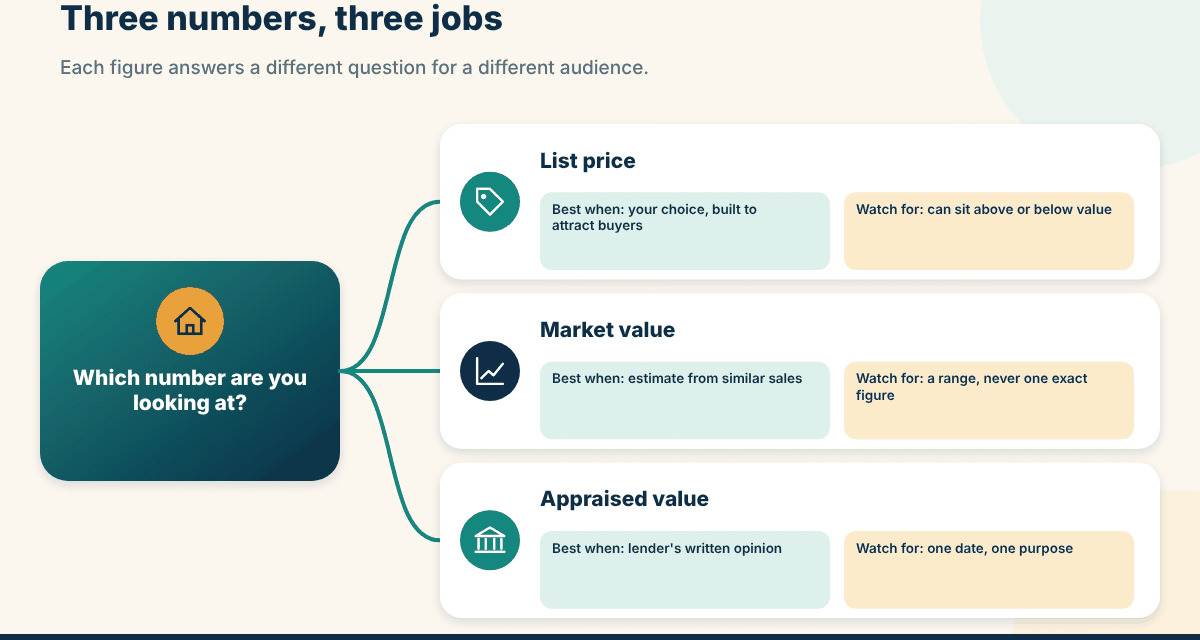
It helps to think of each figure as a tool with its own job description. A hammer and a screwdriver both belong in the toolbox, but you would not blame the screwdriver for failing to drive a nail. In the same way, list price vs market value vs appraised value are not competing answers to one question. They are three answers to three questions that happen to share a dollar sign.
What each number claims to measure
Your list price claims nothing about truth. It is a strategic choice. You pick it to start conversations, to land in the right search filters, and to signal how flexible you might be. A seller who needs a quick sale may list at a figure designed to draw several offers. A seller who can wait may test the upper end of what the evidence allows.
Market value is a concept more than a number. In everyday terms it means the price a reasonably informed buyer and a reasonably informed seller would agree on, with neither under pressure, after the home has been exposed to the market for a sensible period. Because no one can run that experiment in advance, anyone who states market value is making an estimate.
Appraised value is the most formal of the three. A licensed or certified appraiser inspects the property, studies comparable sales, adjusts for differences and writes an opinion of value as of a stated date. The report exists mainly because a lender wants independent support for the loan it is about to make. It is not a promise of what you will receive, and it is not a bidding instruction to the buyer.
Evidence to gather: who produced each number and when
Before you compare the figures, label them. For every number you have been given, write down who produced it, what date it applies to, what it was meant to accomplish and what evidence it cites. An online estimate generated by software last month is a different animal from an agent’s written pricing opinion prepared this week, and both differ from an appraisal ordered by a buyer’s lender.
Also note what each source is paid for. Software estimates are free to you and designed to attract attention. Agents are usually paid if the home sells. Appraisers are paid for the report, whether the sale closes or not, and in most mortgage transactions the lender arranges the order so the appraiser stays independent of the people negotiating. None of that makes any source dishonest. It simply tells you which incentives to keep in mind.
A scenario, an exception, and your next step: the kitchen-table disagreement
Picture a seller with three papers on the table. Illustrative numbers: an online estimate of 410,000, an agent’s suggested list price of 435,000, and a neighbor who swears the place is worth 450,000 because the house across the street “went for that.” Each figure feels solid until you ask what stands behind it.
The next step is to line up the evidence, not to pick the number you like. Ask the agent which sales support the suggested price and how they were adjusted. Look up the neighbor’s sale and check size, condition and date. The one exception worth remembering is a truly unusual home, where every estimate gets shakier and a professional on-site opinion matters more than any software output.
It also helps to say the question out loud: which of these numbers am I actually trying to use right now? If you are choosing an asking price, list price vs market value vs appraised value matters in a particular order. Market value evidence comes first, because it tells you what is plausible. Your list price follows as a strategy built on that evidence. The appraised value arrives later, as a check on the financing, and you should plan for it without letting it dictate the start.
Many sellers reverse that order and anchor on a number they heard early, such as an online estimate or a neighbor’s story. Anchoring is human, and it is hard to undo once a figure has settled in your head. A useful trick is to write the three headings, list price, market value and appraised value, on a sheet of paper and leave the appraised line blank until a lender actually orders one. That keeps the comparison honest.
The data that supports each figure
All three numbers ultimately lean on the same raw material: what similar homes have actually sold for, what is currently under contract and what is still sitting unsold. What differs is how carefully the material is filtered and how much human judgment is applied. Software leans on records and algorithms. Agents add showings, feedback and local feel. Appraisers add a physical inspection and a standardized way of adjusting for differences.
That shared foundation is why the three numbers often land fairly close together in an active, uniform neighborhood. It is also why they scatter when the foundation is shaky: few sales, unusual houses, rapidly changing prices or incomplete public records. When your local data is thin, the disagreement between the numbers is a symptom of thin data, not of a careless professional.
Evidence to gather: comparable sales, pending sales and active listings
Closed sales are the strongest evidence because the price is final and the terms are known. Pending sales show where buyers are heading right now, although the final price is usually not public yet. Active listings show your competition and the ceiling sellers are testing, but they prove nothing about what buyers will pay. A good analysis uses all three and weighs them differently.
Ask for sales that are close in distance, similar in size and style, and recent enough to reflect current conditions. What counts as recent or close depends heavily on local activity, so there is no universal cutoff. In a busy suburb a few months and a few blocks may be plenty. In a rural area the sensible window can stretch much further. Our guide to adjusting comps for your home’s value shows how differences between homes get priced in.
Where the data runs thin: unusual homes and quiet months
Some properties simply have few true twins. A converted barn, a home with an unusual floor plan, a large lot in a neighborhood of small ones or a luxury property in a modest area all strain the method. When there is no close comparable, analysts must reach further in distance or time and make larger adjustments, and each stretch adds uncertainty.
Quiet seasons and fast-moving markets create a similar problem. If few homes sold recently, the evidence may be stale. If prices are rising or falling quickly, even a sale from a few weeks ago may no longer describe today. In either case, treat any single figure with extra caution and lean on a range, supported by pending activity and recent buyer feedback.
Why the numbers disagree without anyone being wrong
Once you accept that each figure answers a different question, the gaps stop looking like mistakes. A list price can sit above market value because the seller is leaving room to negotiate. An appraisal can land below the contract price because the appraiser found fewer supportive sales than the buyers’ enthusiasm suggested. Market value can shift while a deal is pending. Each story is ordinary. Sellers who understand list price vs market value vs appraised value negotiate with fewer surprises.
The challenge is separating signal from false precision. A figure like 437,250 looks exact, but it is only as accurate as the evidence beneath it. The sections below explain what the evidence can honestly tell you and which property-specific details can quietly bend the comparison. Seen this way, list price vs market value vs appraised value is a question of evidence.
What the evidence can actually show
Evidence in real estate shows direction and range far better than it shows a single exact price. If five reasonable comparable sales cluster between two figures, you can be fairly confident the true market value lives somewhere in that band. You cannot be confident about the last few thousand dollars, because individual buyers pay different amounts for reasons no spreadsheet captures. Each of these details can widen or narrow the gap in list price vs market value vs appraised value.
The table below lays out the main claims you will encounter in a pricing conversation and what each one can and cannot support. Use it as a checklist when someone hands you a number. Ask which row the number belongs to, what evidence sits behind it and what the limitation means for the decision in front of you. This is why list price vs market value vs appraised value rarely produces one tidy answer.
| Claim | Metric or source | What it supports | Limitation | Seller implication |
|---|---|---|---|---|
| “Your home is worth about X” | Automated online estimate | A rough starting range | Cannot see condition or upgrades | Use as a prompt, never as a price |
| “List at X” | Agent’s pricing opinion | A marketing strategy and positioning | Reflects judgment and incentives | Ask which sales justify it |
| “Similar homes sold for X” | Closed comparable sales | Strongest evidence of past buyer behavior | Past, and never identical | Check dates, distance, condition |
| “Buyers are paying X now” | Pending sales and showing feedback | Current direction of demand | Final prices often unknown | Adjust strategy if feedback shifts |
| “The home appraised at X” | Lender’s appraisal report | Support for a specific loan amount | One opinion on one date | Review the comps cited for errors |
| “It sold for X” | Final closed contract price | The real, proven market price | Reflects those buyers only | Becomes evidence for future sales |
Notice that only the last row is a fact, and even that fact describes a single transaction between two particular people. Every other row is an estimate with a known weakness. That does not make the estimates useless. It means you should hold them loosely and look for agreement between independent sources before relying on any single one.
Reading a range instead of a single figure
A practical habit is to turn every number into a range before you use it. If an agent suggests 435,000, ask what the realistic low and high would be based on the same evidence, and what would have to be true for the home to reach each end. The answer often reveals that the ceiling depends on condition, timing or a specific buyer type.
Ranges also keep you honest about appraisals. An appraisal that comes in a few percent below your hope might sit comfortably inside the range you already knew about. One that lands far outside it deserves a closer look at the comparable sales the appraiser used. Our article on the difference between a CMA and an appraisal explains why those two documents are built differently. Hold list price vs market value vs appraised value loosely until the evidence agrees.
Another way to use ranges is to compare them across the three categories. Your market value range comes from comparable sales. Your list price sits somewhere inside or slightly above it, depending on strategy. The appraised value, when it arrives, either lands inside the range, which is the usual outcome in a steady market, or outside it, which is a signal to investigate. Seeing list price vs market value vs appraised value as overlapping bands rather than points removes much of the drama.
If the bands overlap a lot, you have little to worry about. If they barely touch, ask why. Perhaps your list price assumes buyers will value a feature that the sales data cannot confirm. Perhaps the comparable sales are older than they seem. The answer shapes what you do next, whether that is staying put, adjusting the price or preparing documents for a possible review.
A scenario: two appraisals of the same house
Imagine two appraisers inspect the same home in the same month and report values a modest distance apart, say 420,000 and 428,000 in our illustrative example. Neither is necessarily careless. One may have weighted a sale on the next street more heavily, while the other leaned on a larger home with an adjustment for size. Both can defend their reasoning.
For a seller, the lesson is that appraisal is a judgment exercise with a tolerance built in. If a number is surprising, the productive step is to read which sales were used and why, not to assume the report is wrong or right. Differences between reasonable professionals are normal. Differences that trace back to a factual error, such as the wrong square footage, are fixable. Think of list price vs market value vs appraised value as a set of questions, not answers.

Property and neighborhood confounders
A confounder is anything that muddies a comparison by changing the price for reasons other than the one you are studying. Two homes that look identical on paper can sell for different amounts because one has a quieter street, a newer roof or a better layout. Because algorithms and even busy professionals compress those differences into a few adjustments, small details can open real gaps between the numbers.
Local quirks add another layer. Assessment practices, school boundaries, flood maps, homeowner association rules and new construction nearby all influence what buyers will pay, and none of them are visible in a simple price-per-square-foot calculation. If you want to see how crude that shortcut can be, read our piece on price per square foot and home value.
Evidence to gather: condition, upgrades, permits and lot features
Start with what is unique about your property and document it. Make a list of improvements with dates and receipts, including roof, mechanical systems, kitchens, bathrooms, windows and additions. Note whether work was permitted, because unpermitted additions are often excluded from square footage by appraisers and may raise questions with buyers. Plan around list price vs market value vs appraised value before the first showing.
Then record what is not visible in photos: lot shape and usable yard, noise sources, parking, flood zone status, easements and whether the home backs to something buyers dislike. Appraisers and agents will find most of this on their own, but the person who knows the house best should make sure nothing valuable is missed. A neat one-page summary helps every professional who touches the file.
When timing and local quirks bend the comparison
Timing is the most underrated confounder. A home that appraised in March can be a different proposition by June if rates, inventory or buyer mood changed. Appraisals describe a specific date, and market value is always moving. That is why a sale agreed at today’s price can still meet an appraisal built from sales that closed months earlier.
Local quirks work in quieter ways. A neighborhood with a handful of recent investor purchases may show prices that do not reflect owner-occupant demand. A new development nearby may pull buyers away or raise the whole area. Ask a local professional which of these forces apply to your street, and expect honest answers to include some uncertainty. Revisit list price vs market value vs appraised value whenever the market shifts.
The second table gathers common assumptions about your property and market, the effect you can expect, the confounder that might distort it and what to verify locally. It is a thinking tool, not a forecast, and every effect shown is directional. Actual size depends on your local market and cannot be known from a general article.
| Market or property assumption | Expected effect | Confounder | What to verify locally |
|---|---|---|---|
| Prices rising quickly | Appraisal may trail contract price | Comparable sales are older | Dates and trend of recent closings |
| Prices flat or softening | List price may need to move toward value | Stale asking prices nearby | Price changes on competing listings |
| Recent kitchen or bath update | May support the higher end of a range | Quality varies; buyers differ | Whether comps had similar updates |
| Deferred maintenance | May pull value below tidy neighbors | Repair estimates vary widely | Contractor quotes, inspection findings |
| Unusual layout or oversized lot | Wider spread between estimates | Few true comparables | Whether any close match sold recently |
| Few recent sales nearby | More uncertainty in every number | Distant or older comps used | Pending sales and agent feedback |
| Strong buyer competition | Offers may exceed estimates | Appraisal still needs support | Lender and appraiser local practice |
Use the table by picking the two or three rows that match your situation and writing down what you will check for each. If you cannot find a way to verify an assumption, treat it as unproven and keep your plan flexible. The goal is not to remove uncertainty, only to know where it sits and how large it might be.
Turning list price vs market value vs appraised value into a seller decision
Knowing why the numbers differ is useful only if it changes what you do. The practical question is how to set and defend a price when you know that list price vs market value vs appraised value will never line up perfectly. The answer is to plan for the gaps instead of hoping they will not appear, and to decide in advance how much flexibility you have.
Your own situation matters more than any rule of thumb. A seller with a hard deadline and a seller with all the time in the world should treat the same evidence differently. So should a seller with a large mortgage balance compared with one who owns the home outright. The sections below show how to connect the evidence to your own constraints. A clear view of list price vs market value vs appraised value keeps you calm when numbers move.
What the gap means for your price strategy
When you list above your best estimate of market value, you are betting that a buyer will value the home more than the evidence suggests, or that you will negotiate down from a high anchor. Sometimes that works. Often the cost is time on the market, a stale listing and a later price reduction. Our guide to overpricing a house to sell covers that trade-off in detail. Apply the same habit to list price vs market value vs appraised value whenever a new figure appears.
When you list below, you are buying attention and speed, and possibly multiple offers, at the risk of leaving money behind. That approach is not automatically smart or foolish. It depends on how competitive your market is and what you need from the sale. We discuss the logic in underpricing a house as a strategy, including the situations where it backfires. Remember that list price vs market value vs appraised value measures three different things.
Calculation: testing a list price against buyer financing
Here is a simple way to test any list price against the appraisal risk. Suppose, with illustrative round numbers, a buyer agrees to pay 440,000 and plans to put down 10 percent in cash and borrow the rest. If the appraisal comes back at 440,000 or higher, the loan works as planned. If it comes back at 425,000, the lender will typically base the loan on the lower figure. That context explains much of the confusion around list price vs market value vs appraised value.
That leaves a 15,000 shortfall between the contract price and the appraised figure. In the usual arrangement the buyer must cover it with more cash, the price must come down, or the deal must change in some other way. Doing this arithmetic before you list tells you how much cushion buyers might need and how a low number would ripple through your net proceeds. Good records make list price vs market value vs appraised value far easier to reconcile.
Lenders set their own rules about how they use an appraisal and what loan amounts they allow, and those rules differ by loan type and lender. Do not assume the example above matches your buyer’s loan. Ask your agent or the buyer’s lender how an appraisal shortfall would be handled under their program. If you want to see how the price flows into your real take-home, our article on home sale net proceeds walks through the subtractions.
It is worth stressing that the gap between contract price and appraisal is only one slice of the picture. The same list price vs market value vs appraised value logic applies to offers from cash buyers, who may still request an appraisal to confirm their own judgment, and to buyers using different loan programs, whose lenders set their own rules about valuation. A conversation with the buyer’s agent early in the negotiation can tell you which situation you are in.
For your own planning, run the calculation for three plausible contract prices rather than one: a low, a middle and a high figure from your range. Look at what each would mean if the appraisal landed a modest amount lower. Sellers who do this exercise tend to feel less surprised later, because they have already imagined the unpleasant version and decided how they would respond to it. Few lessons about list price vs market value vs appraised value are more useful than this one.
A scenario: list above value, below value, or at it
Take three sellers with the same house, each with an illustrative market value range of 430,000 to 445,000. The first lists at 465,000, hopes for a bidding war and waits. The second lists at 429,000, draws a flurry of showings and receives several offers. The third lists at 439,000 and gets two reasonable offers within a couple of weeks. Keeping list price vs market value vs appraised value straight is half the battle.
No outcome here is guaranteed, and each seller could have been unlucky or lucky. What matters is what each had to be right about. The first needed buyers to see extra value. The second needed the competition to push the price up rather than just compress the timeline. The third needed only that the evidence was reasonable. Choose the assumption you are most comfortable defending. That is the practical heart of list price vs market value vs appraised value.
Quick scenario
A seller accepts an offer at 440,000 and the appraisal arrives at 430,000 (illustrative numbers). Before reacting, the seller and agent review the report, find that a finished basement was left out of the square footage, and send documentation to the lender through the proper channel. The value may or may not change, but checking for factual errors was the right first move and cost almost nothing.
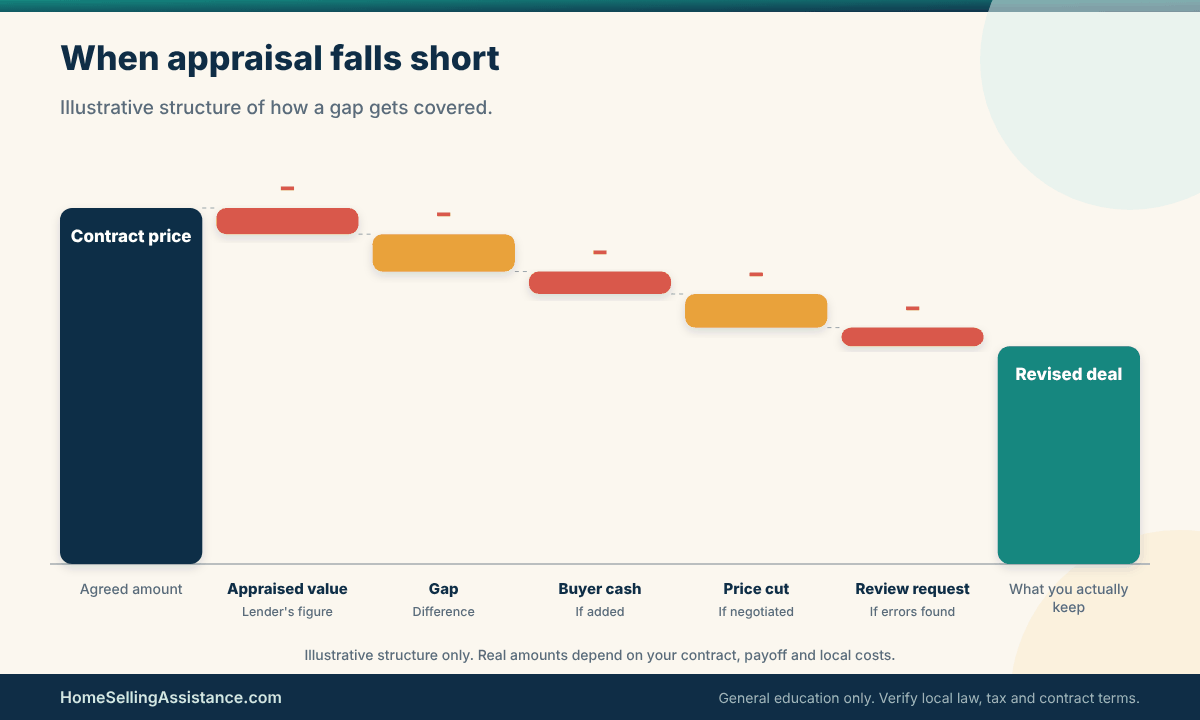
When an appraisal comes in below the contract price, and when to ask for local help
A low appraisal is one of the most stressful moments in a sale, partly because it arrives after you have mentally spent the money. Take a breath first. A low number does not automatically mean the deal is dead. It means the parties now have a problem to solve, and there are several standard ways to solve it, each with a different cost to you.
How much leverage you have depends on the contract, the market and the buyer’s finances. If you want a fuller walk-through of your choices, see your options after a low appraisal and the related piece on appraisal gap issues for sellers. Here we focus on preparing and responding calmly.
Before and after the appraisal: documents, options and local help
You usually cannot sit in on the appraisal or steer the result, and you should never try to pressure an appraiser. What you can do is make sure the appraiser has accurate information. A tidy list of improvements with approximate dates, copies of permits where relevant, a note of any recent upgrades and the correct measurements can all help the appraiser form a fair opinion.
Whether the appraiser can accept your materials, and how, depends on the lender and the appraiser’s own practices. Often the listing agent hands over a summary through the usual channel before the visit. Keep the tone factual. Marketing language does not help here, and anything that sounds like pressure can backfire. Accuracy is the entire point.
If the number falls short. The common paths after a low appraisal are limited in number. The buyer can bring more cash to cover the gap. The two sides can renegotiate the price, often meeting somewhere in between. The seller can ask the lender to reconsider the value if the report contains factual errors or missed comparables. The buyer may order a second appraisal, or the deal may end if the contract allows it.
Each path has costs and timing consequences, and which ones are available depends on your contract’s appraisal language and the buyer’s loan program. Our overview of reconsideration of value explains the review process, and the page on contingencies, inspections and appraisals gathers related guides. Always check your signed contract before choosing a response.
It also helps to know what not to do. Do not assume the buyer will cover any gap. Do not accept a reduction before you have checked the report for mistakes. And do not let a single number make you forget that the buyer, who likes your house enough to sign a contract, usually still wants to buy it. Calm, documented conversations tend to go better than reactive ones.
There comes a point where more reading does not improve the answer, and a local, current, property-specific opinion does. Spotting that point early saves money and stress. Before you reach it, though, it helps to know what questions remain open and how to ask for help in a way that produces reasoning you can actually check. Sellers who understand list price vs market value vs appraised value negotiate with fewer surprises.
No general article can price your house. Even the best framework only narrows the question. A few things always need local, current and property-specific input, and recognizing them early saves you from relying on guesses. Think of this section as the boundary between what you can sort out at your kitchen table and what deserves a professional’s eyes. Seen this way, list price vs market value vs appraised value is a question of evidence.
The boundary is not a sales pitch for hiring anyone in particular. Some sellers do an excellent job with public sales data and careful reading. Others prefer an agent, an appraiser or a combination. Whichever route you choose, you remain the decision maker, and a good professional will welcome questions about the evidence behind a recommendation. Each of these details can widen or narrow the gap in list price vs market value vs appraised value.
What to ask an agent or appraiser for. When you talk with an agent about list price vs market value vs appraised value, ask for a short written package. It should include the closed sales used, the adjustments made for differences, the pending and active listings that compete with you, and the logic connecting all of that to the suggested price. You are looking for reasoning you can follow, not a confident number alone.
If you are considering a paid appraisal before listing, read what it can and cannot do in our guide on whether a pre-listing appraisal is worth it. Whichever professional you use, ask about their experience with homes like yours, how current their local data is and how they would explain a gap between their number and someone else’s. This is why list price vs market value vs appraised value rarely produces one tidy answer.
Red flags in valuation pitches. Be cautious about any pitch that promises a specific sale price, guarantees a quick sale at a high number, or tells you the market value without looking at the home. Be equally careful with an unusually high suggested list price offered mainly to win your listing, or a very low cash offer presented as the only realistic option. Both can distort your picture of value. A clear view of list price vs market value vs appraised value keeps you calm when numbers move.
Another warning sign is pressure to decide quickly on valuation alone. A real estimate can wait a day or two while you check the evidence. Compare any investor or instant-offer figure against a fully marketed sale, keeping in mind the trade-offs of speed and convenience, which we cover in iBuyer vs realtor for sellers. If a number cannot be explained, it should not drive your choice. Apply the same habit to list price vs market value vs appraised value whenever a new figure appears.
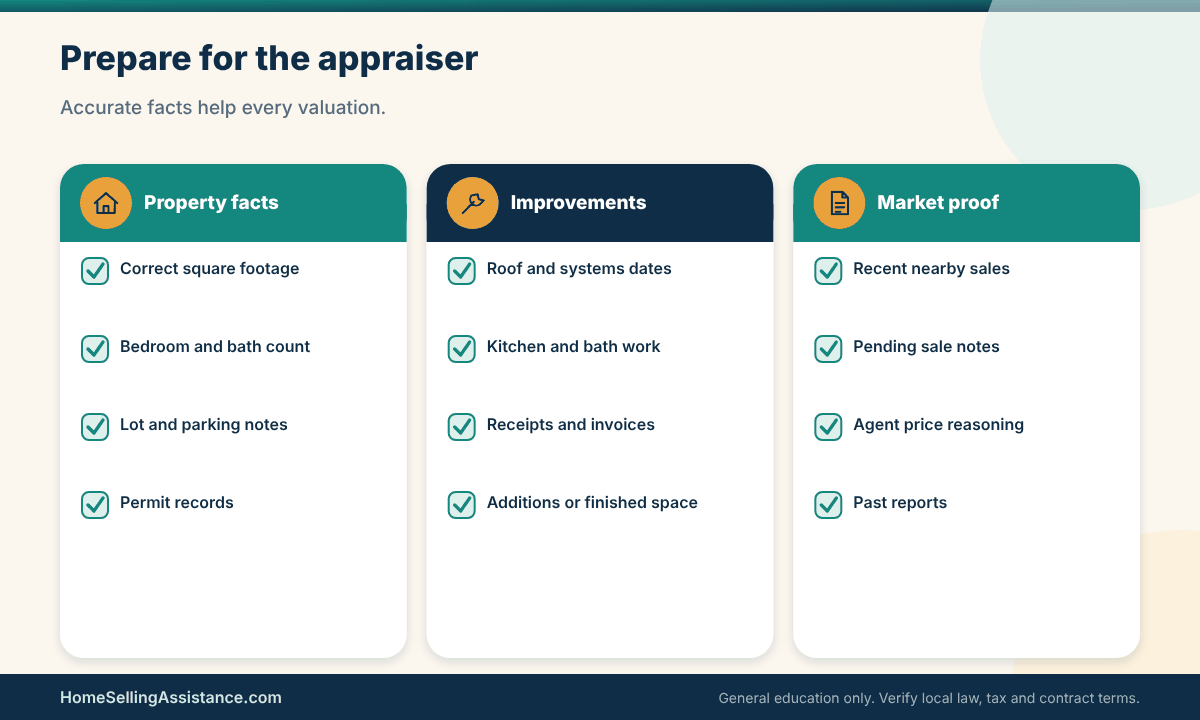
Here is a practical routine for bringing the three numbers into one coherent picture. The point of the routine is to replace anxiety with a sequence of small, checkable steps. You will not eliminate uncertainty, but you will know what you relied on, what you checked and what you would do if the numbers moved against you. Remember that list price vs market value vs appraised value measures three different things.
Start before you list, revisit once offers arrive and revisit again if an appraisal is ordered. Each pass uses the same habits: label the source, convert to a range, check the comparables and ask what could change. After a few passes the habit becomes automatic, and the three numbers stop feeling like rivals. Consumer guidance from the Consumer Financial Protection Bureau is a useful neutral source on how lenders and appraisals fit into a mortgage.

A seven-day plan for reconciling list price vs market value vs appraised value. Day one, collect every number you have seen and write down its source and date. Day two, pull the closed sales, pending sales and active listings most similar to your home and check the dates and distances. Day three, list your improvements and gather receipts and permits. Day four, ask one or two local professionals for written reasoning, not just a figure.
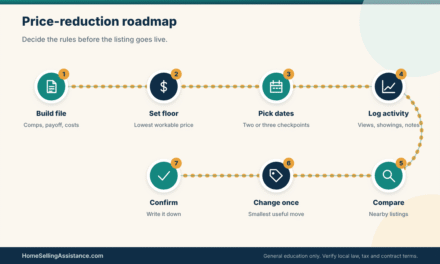
Day five, convert everything into a realistic range and note what would push you toward each end. Day six, run the appraisal-gap arithmetic on a few possible contract prices and decide how you would respond to a shortfall. Day seven, set your list price and write down your trigger points for review, such as the number of showings or weeks without an offer. Our guide to price reduction strategy helps with that last step.
A scenario, an exception and your next step
Suppose a seller follows the routine and ends with an illustrative range of 428,000 to 442,000, lists at 439,000 and receives an offer at 436,000. The appraisal arrives at 431,000. Because the seller already did the gap arithmetic, the conversation with the buyer is short and practical, and the parties settle on a modest price adjustment without drama. That context explains much of the confusion around list price vs market value vs appraised value.
The exception is a market that moves unusually fast, where even careful ranges go stale within weeks. In that case, refresh the evidence more often and keep your agent or advisor in the loop. Your next step, whatever your situation, is to turn one of the checklist items into a calendar entry today, so the plan does not stay in your head. Good records make list price vs market value vs appraised value far easier to reconcile.
It is easy to treat a pricing plan as a one-time event, but list price vs market value vs appraised value keeps shifting through the life of a listing. A showing schedule that produces no offers is new evidence about market value. A multiple-offer weekend is new evidence in the other direction. An appraisal is new evidence from a third angle. Each deserves a short pause to ask what it changes and what it confirms.
Finally, keep your expectations modest and your records tidy. No process removes all uncertainty about list price vs market value vs appraised value, and any source that claims to is overselling. What you can do is show your work: the sources, the dates, the ranges and the reasoning. If you ever need to explain a decision to a co-owner, a lender, a buyer or your future self, that paper trail is worth more than a confident number.
Frequently asked questions about list price vs market value vs appraised value
What is the main difference between list price vs market value vs appraised value?
List price is the number you advertise, market value is the estimated price a willing buyer and seller would agree on, and appraised value is a professional’s written opinion prepared for a lender. Only the first is a pure decision. The other two are estimates with different evidence and purposes, which is why they can differ even when everyone is acting in good faith.
Can my house sell for more than its appraised value?
It can, but the buyer usually has to cover the difference in some way, often with additional cash if a mortgage is involved. Appraised value limits what many lenders will finance, not what a buyer may agree to pay. Cash buyers, who do not need a lender’s appraisal, are not bound by it at all, although they may still choose to order one.
Should I list at market value or a little above it?
There is no universal answer, and anyone who offers a fixed formula is oversimplifying. Listing near the center of your evidence range tends to be easier to defend, while listing above it relies on buyers seeing extra value. Consider how long you can wait, how competitive your area is and how the price would look beside nearby homes.
Why did the online estimate differ so much from the appraisal?
Online estimates rely on public records and statistical models that cannot see condition, upgrades or the quirks of your lot. Appraisers inspect the property and adjust for differences by hand. If the gap is large, check the facts used by each, such as square footage and bedroom count, and look for recent sales the software may have missed.
Is an appraisal the same as a comparative market analysis?
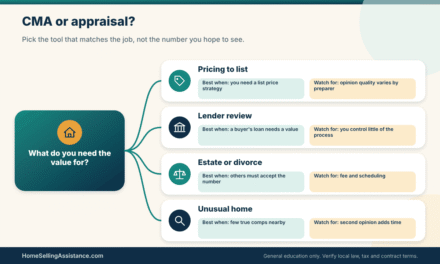
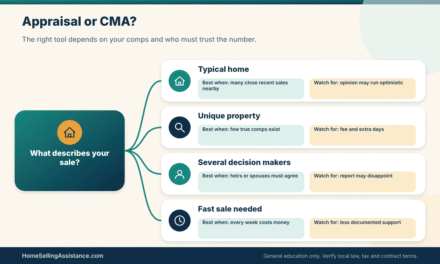
No. A comparative market analysis is typically prepared by an agent to help set a price and may reflect marketing strategy, while an appraisal is a formal opinion prepared under professional standards for a lender. Our guide to CMA vs appraisal compares the two in depth, including who normally pays and who sees the result.
What happens if the appraisal comes in low?
The parties usually have a few choices: the buyer adds cash, the price is renegotiated, the report is questioned if it contains errors, or the contract ends if it allows. Which options are available depends on your signed contract and the buyer’s loan. Read the appraisal language in your agreement early, before a problem appears.
Can I challenge an appraisal I disagree with?
Buyers, working through their lenders, can often request a review when they believe the report contains factual errors or overlooked comparable sales. Sellers generally do not file the request directly and should work through their agent and the buyer’s side. Lender procedures differ, so ask what documentation they accept and how long a review typically takes.
Do I need a pre-listing appraisal?
Not necessarily. Some sellers find it reassuring to have an independent opinion, particularly for unusual homes, while others rely on agent analysis. A seller’s appraisal does not bind a buyer’s lender, which will usually order its own. Weigh the cost against how much uncertainty it would actually remove for your situation.
Does a higher list price leave room to negotiate?
It may, but it can also reduce showings if buyers filter you out or compare you with cheaper homes. Online searches use price brackets, so a number slightly above a round threshold can change who sees the listing. Review how nearby homes were priced and how long they took to sell before deciding how much room to build in.
Who should I trust for the most reliable number?
No single source deserves blind trust. The most reliable picture comes from several independent sources that roughly agree, backed by recent comparable sales you can verify yourself. A licensed local agent or appraiser can add current knowledge, and neutral resources such as the National Association of Realtors publish context, though never a forecast for your street.
The takeaway on the three numbers
Once you treat list price vs market value vs appraised value as three tools with three jobs, the disagreements become information instead of alarms. Gather evidence, think in ranges, prepare for an appraisal gap and ask for reasoning, not just numbers. For wider context, browse our pricing and home value guides and the closing costs and net proceeds library. This article is general education, not legal, tax or financial advice.