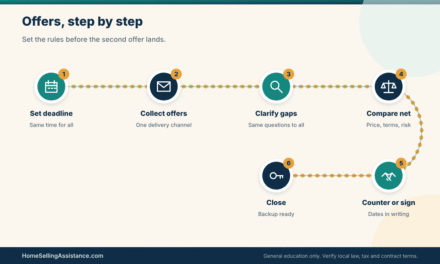
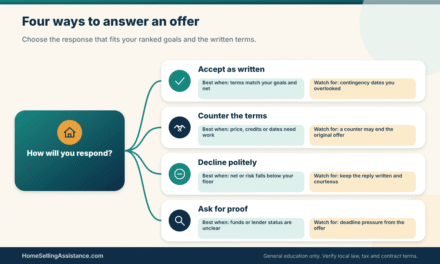
Weighing a cash offer vs financed offer seller decision looks simple on paper, because one buyer says “cash” and the other says “loan,” but the real choice is between two different bundles of price, timing, paperwork and risk, and the label on the front of the offer tells you very little about how the bundle will behave.
Most sellers meet the cash offer vs financed offer seller question the same way. Two offers arrive within a day of each other. One is higher, with a mortgage behind it. The other is a little lower, with money already in the bank and a promise of a quick closing. Friends and relatives will tell you that cash is king. An agent might tell you to take the higher number. Both pieces of advice are sometimes right and sometimes expensive.
This cash offer vs financed offer seller guide walks through how each type of offer works from the seller’s side of the table, what proof you can ask for, where each one tends to break, and how to compare them with your own numbers instead of a slogan. It sits inside our larger framework on how to evaluate a home offer, which is a good place to start if you want the full picture of price, terms and buyer strength together.
A note on honesty before we begin. Contracts, escrow customs, attorney involvement, deposit handling and contingency lengths all vary by state and even by county. Any dollar figures below are round, clearly illustrative numbers meant to show how the arithmetic works, not predictions about your house, your buyer or your lender. When a rule matters to your deal, confirm it with your agent, your attorney or your title company.
Key takeaways
- “Cash” describes how the buyer pays, not how safe the deal is. A cash buyer can still have inspection rights, a shaky source of funds or a habit of renegotiating late, so the offer deserves the same scrutiny as any other.
- “Financed” does not mean weak. A well-qualified buyer with a strong lender, a solid deposit and short deadlines can be more dependable than a cash buyer who cannot document anything.
- Compare net proceeds, not headline prices. A lower cash price can leave you with the same or more money once carrying costs, repair credits, concessions and the risk of a re-trade are counted.
- Documents beat promises. Ask for current proof of funds, a lender letter that names the loan type, and a contract that spells out every contingency and every date.
- Appraisal and financing contingencies are the main differences. Those two clauses give a financed buyer ways to exit or renegotiate that a true cash buyer usually does not have.
- Your situation picks the winner. In any cash offer vs financed offer seller choice, a firm move-out date, a home that needs work, a hot or slow market and your tolerance for uncertainty all change which route fits.

What a cash offer vs financed offer seller comparison is really trying to solve
Before comparing anything, it helps to say plainly what each route is for. A buyer who pays cash is trying to remove lender steps from the transaction. A buyer who finances is trying to buy a home they could not otherwise afford to pay for in one transfer. Neither goal is good or bad. They simply put different people, documents and deadlines between your signature and your funds.
The seller’s own goal is usually some blend of three things: money in hand, a closing date that works with the next move, and as little drama as possible in between. Every term in the contract either serves those goals or threatens them. That is the lens we will use for every cash offer vs financed offer seller comparison in the rest of this article. If you also want to see how other offer terms stack up, our piece on highest offer vs best offer covers the wider comparison.
How a cash offer works from the seller’s side of the table
In a cash purchase the buyer pays the full price from their own resources, so no mortgage lender reviews the buyer’s income, orders an appraisal or imposes loan conditions on the property. The money may come from savings, the sale of another home, an investment account, a gift, a business sale or a family arrangement. The contract still goes through the same basic stages: offer, acceptance, deposit, due diligence, title work, signing and funding.
What disappears is the lender. What stays is everything else. The buyer can still ask for inspections if the contract allows it. The title company still searches the records, clears liens and prepares closing documents. You still owe whatever your mortgage payoff, taxes, prorations and fees come to. The deal can still stall over a survey problem, an unrecorded easement or a missing signature from a co-owner.
Cash also comes in more than one flavor, and in a cash offer vs financed offer seller comparison that decides how much weight the word deserves. An individual who is buying a home to live in is different from an investor buying for resale, and both are different from a company that sets a price and expects a discount for speed. We cover that last group in our guide to a cash offer for a house, because the economics there are different from an ordinary buyer who simply happens to have the money.
Evidence to gather: proof of funds, source of money, and who is signing
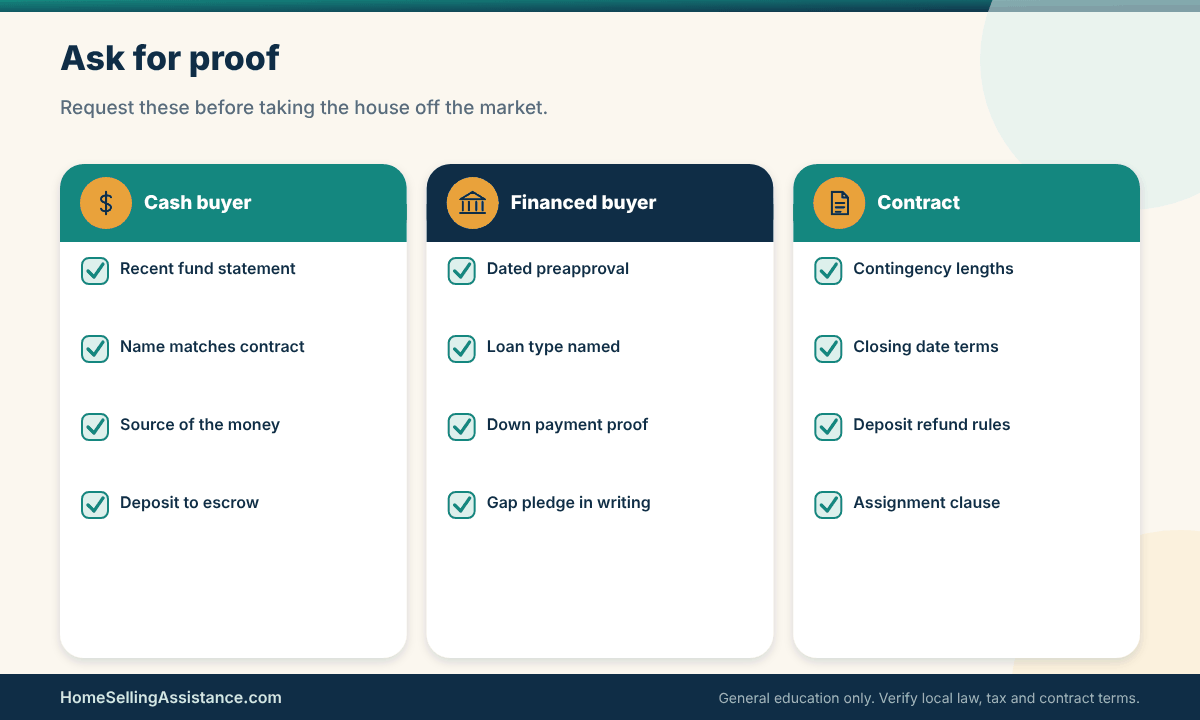
The first document to request is a current proof of funds. A reasonable version is a recent statement or a letter on letterhead from a bank or brokerage that shows the account holder’s name and an available balance at least equal to the purchase price plus closing costs. It should be recent enough that the money could not have moved since. Screenshots of an app, redacted beyond usefulness, or a balance that sits well below the price are not proof of anything.
Next, check the names. The person or entity on the statement should match the buyer named in the contract. If an LLC is buying, ask who has authority to sign for it and whether the funds sit in the company’s account or someone else’s. If the money is a gift or a loan from a relative, ask how and when it will arrive, because that is a financing arrangement dressed as cash.
Finally, ask how the buyer plans to deliver the deposit and the balance. Earnest money should go to a title company, escrow company or attorney trust account named in the contract, not to an individual. Our walkthrough on proof of funds from a cash buyer goes further on what a credible document looks like, and our piece on how to verify a cash home buyer covers the background checks that sit alongside it.
Do not be shy about any of this, because a fair cash offer vs financed offer seller comparison depends on equal paperwork from both sides. A serious cash buyer expects to document funds and usually has the papers ready. Reluctance is information. If a buyer who claims to have plenty of money gets irritated by a routine request, treat the irritation as a data point before you take the house off the market for them.
Where a cash offer can still go sideways, and what to do next
A cash contract is only as firm as its terms. Here is a common pattern: the buyer offers a strong price, waives nothing in writing, and then uses a long inspection period to ask for a large reduction after you have stopped showing the house. The money was real. The price was not. That is a re-trade, and it can happen under any form of payment.
Another pattern is the buyer whose funds are tied up. They may be waiting on the sale of another property, a business distribution or a transfer from overseas that takes weeks to clear. The offer is labeled cash, but timing depends on something outside the contract. If that is the case, you need to know the dependency in advance and decide whether you can live with it.
Your next step in either case is to read the contract for what it actually promises, since a cash offer vs financed offer seller choice rests on terms, not labels. Look at the inspection or due-diligence period length, whether the buyer can cancel for any reason, how the deposit is treated if they do, the closing date and what happens if they miss it. Our article on earnest money for sellers explains why the deposit terms tell you as much as the price does.
A short example with round numbers. Suppose a cash buyer offers an amount that is ten thousand dollars below your financed alternative, closes in two weeks and has a seven-day inspection window. If your carrying costs are modest and the house is in good shape, the gap might be worth paying for speed. If the inspection window is thirty days and the buyer has already hinted at repairs, that ten thousand may be the smallest number in the story.
How a financed offer works from preapproval to funding
A financed offer brings a lender into the transaction. The buyer applies for a mortgage, the lender reviews income, assets, credit and debts, and then the lender orders an appraisal to confirm that the home supports the loan amount. Underwriting checks the file, the title company clears the property, and the loan funds at closing. Each step has its own timeline, and the lender’s calendar often sets the closing date more than either party does.
That sounds like a lot of places for trouble, and it is more places than cash has, which is why the cash offer vs financed offer seller question deserves a careful look. But most financed deals close, and the reason is that a good lender and a prepared buyer remove most of the uncertainty before the offer ever reaches you. The difference between a strong financed offer and a weak one comes down to how much of that review has already happened by the time you read the offer.
The buyer’s financing contingency is the clause that matters most to you. It usually gives the buyer a defined period to secure a loan and a right to cancel, sometimes with the deposit returned, if they cannot. Our guide to the financing contingency from a seller’s view explains how those periods work and how to shorten or tighten them in a counter.
Evidence to gather: the lender letter, loan type, and down payment
Ask for a preapproval letter, not just a prequalification. The difference is that a preapproval generally means the lender has looked at documents such as pay records, bank statements and a credit report, while a prequalification can rest on what the buyer reports. Even a preapproval is not a final loan commitment, but it is a meaningful step.
The letter should name the lender, state the loan amount or purchase price range, mention the loan type, and be dated recently. Pay attention to the loan type. Conventional, FHA, VA and other programs have different property condition standards, different rules about who can pay which closing costs, and different timing. Some programs place requirements on the home itself, which can matter if your house has peeling paint, an old roof or a missing handrail.
Then look at the down payment and the money behind it. A buyer putting down a larger share of the price is less exposed to a low appraisal and has more of their own money at risk if they walk away. A buyer putting down a small share and asking for seller-paid costs is leaning more heavily on the loan. Neither is wrong. They are different risk profiles, and our article on seller concessions shows how requests for credits change the real value of an offer.
Finally, in a cash offer vs financed offer seller review, ask your agent how familiar the lender is. A loan officer at a local institution with a track record of closing on time is a different proposition from an online lender nobody on your side has dealt with. You are not judging the lender’s character. You are asking whether the schedule they promise is one they usually keep.
A common financed-offer snag, an exception, and your next step
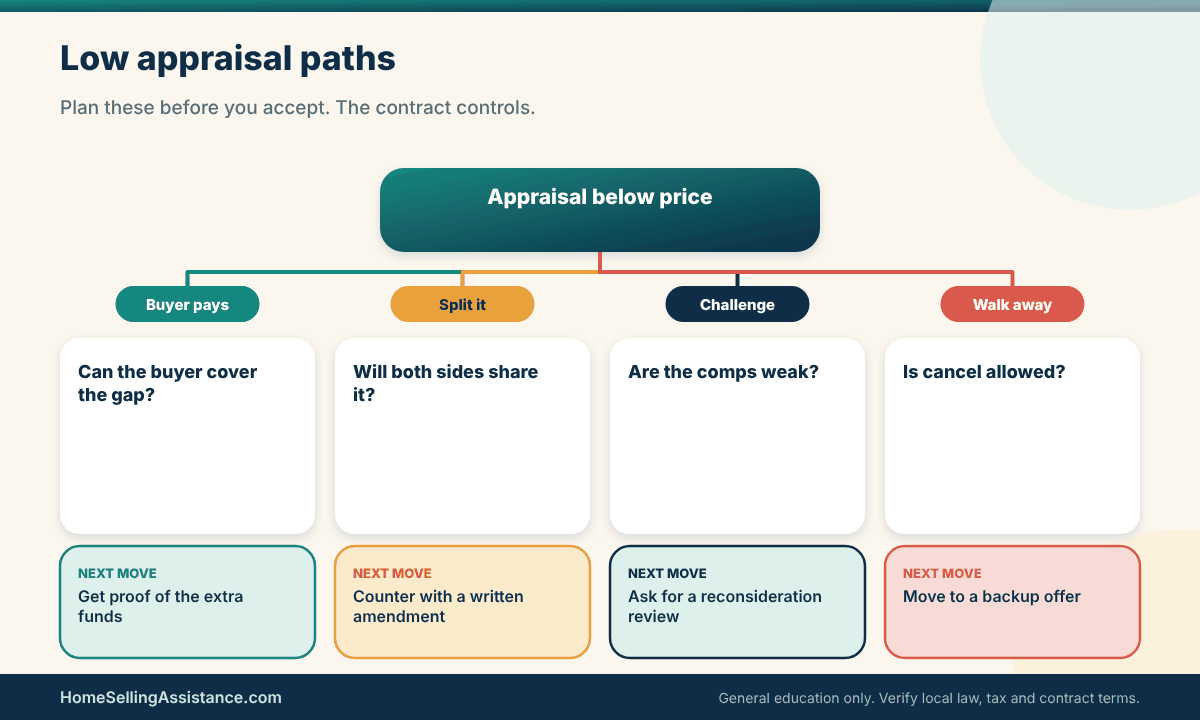
The classic snag is the appraisal. The lender will only lend against the appraised value, so if the appraiser comes in below the contract price, someone has to close the gap. The buyer might pay the difference in cash, ask you to lower the price, split it with you, or cancel if the contract allows. Our article on appraisal gap for sellers and the companion on low appraisal options lay out these paths in detail.
There is an exception worth knowing about for any cash offer vs financed offer seller decision. Some financed buyers include an appraisal gap commitment, a written promise to cover a shortfall up to a stated amount from their own funds. That commitment, if backed by documented savings, narrows the difference between a financed offer and a cash one considerably. It does not eliminate it, but it moves the risk from “will the appraisal hold” to “can the buyer pay the gap,” which is easier to verify.
Another snag is a change in the buyer’s circumstances between acceptance and closing. A new debt, a job change or a large unexplained deposit can trigger extra questions from underwriting. Lenders often re-verify employment and credit shortly before closing. A buyer who is warned about that and behaves accordingly rarely has trouble. A buyer who opens a new credit card for furniture sometimes does.
Your next step in a cash offer vs financed offer seller situation is to set the contract up so that the financing timeline is short, visible and documented. Ask for proof that the loan application was submitted by a specific date, the appraisal ordered by another, and a written update at each milestone. These are ordinary requests that good agents make routinely, and they turn a vague promise of financing into a schedule you can watch.

Compare the trade-offs in a cash offer vs financed offer seller decision
With both routes defined, we can line up the cash offer vs financed offer seller trade-offs against what you actually care about. We will do it in two passes. The first pass covers the things you can measure fairly directly: price, net proceeds, time, control over the process, contingencies and the workload that lands on you. The second pass covers the risks that are harder to see, such as legal exposure, financing failure, delay and what you do if the deal collapses.
One principle runs through both passes of the cash offer vs financed offer seller comparison. A comparison only works if you put every offer into the same units. That usually means a net figure, a calendar and a list of conditions, all built from the contract as written and not from the conversation around it.
Price, net proceeds, timing, contingencies, and workload side by side
The table below puts the two routes next to each other across the factors that tend to move a seller’s decision. Use this cash offer vs financed offer seller table as a checklist for questions to ask your agent and as a prompt to find the real numbers in each contract. The cells describe patterns, not rules, because individual offers vary in ways no table can capture.
| Factor | Cash offer | Financed offer | What to check | Execution risk |
|---|---|---|---|---|
| Price and net proceeds | Often lower headline, fewer credits | Often higher headline, more credit requests | Net sheet for each offer | Re-trade or appraisal gap |
| Time to close | Can be short if title is clear | Set by lender and appraisal calendar | Closing date and extension terms | Delays from underwriting |
| Appraisal | Usually none required by a lender | Required by the lender | Gap commitment in writing | Low value forces a reset |
| Contingencies | Inspection and title may remain | Financing, appraisal and inspection | Length of every contingency | More exit points |
| Proof required | Statement of funds and source | Preapproval and down payment proof | Dates, names and balances | Fake or stale documents |
| Workload for you | Fewer lender requests | More lender and appraiser access | Showing windows and updates | Missed deadlines |
Read the table by columns first, then by rows. Down the “cash” column you see fewer moving parts, which is the whole attraction. Down the “financed” column you see more people involved, which creates more chances for delay but also more outside checking of the buyer’s finances. The last column reminds you that every route has its own way of failing.
The picture below shows the same idea as a map of the decision, so you can see where the two routes split and what each one asks you to watch.
Notice what the cash offer vs financed offer seller table does not say. It does not say cash always wins on speed, because a cash buyer with a long inspection window and a distant closing date can be slower than a pre-underwritten financed buyer. It does not say financed offers always pay more, because a buyer asking for a credit equal to the price difference has handed you no extra money. The columns are starting points, and your documents settle the rest.
Evidence to gather: your net sheet under each offer
Build a simple net sheet for each offer when you weigh a cash offer vs financed offer seller choice. Start with the contract price. Subtract your mortgage payoff, any liens, the commission or fees you have agreed to pay, title and escrow charges, transfer taxes where they apply, and prorations for property taxes and association dues. Then add or subtract anything the offer changes: a repair credit, a buyer closing-cost request, a rent-back, a home warranty or a different closing date that shifts your carrying costs.
An illustrative example, using round numbers only. Offer A is cash at four hundred thousand dollars with no credits and a closing in three weeks. Offer B is financed at four hundred and fifteen thousand dollars, with a request for seven thousand dollars in closing-cost help and a closing in six weeks. Before any other adjustment, the difference between them has shrunk from fifteen thousand to eight thousand dollars.
Now add the time. If your mortgage payment, utilities, insurance and upkeep add up to a few thousand dollars a month in this example, three extra weeks of ownership costs real money, and it also carries the chance that something goes wrong in those weeks. Maybe the remaining gap still favors the financed offer. Maybe it does not. The point is to see the number rather than guess it, and our guide to home sale net proceeds shows how to build a fuller version.
Where do the inputs come from? Ask your title or escrow company for an estimated settlement statement, request a payoff quote from your lender, and pull the most recent property tax bill. If you are working with an agent, ask for a net sheet for each offer in writing. Treat the output as an estimate and revisit it when the contract changes, since a counteroffer can shift the totals by more than you expect.
Scenario: when the higher price loses to the cleaner offer
In a typical cash offer vs financed offer seller case, picture a seller with a home in good condition and a buyer who wants to finance with a low down payment. The offer is higher, but it comes with a request for closing-cost help, a modest deposit, a long financing period and an appraisal contingency. The second offer is cash, a little lower, with a short inspection window and a larger deposit.
On net proceeds alone the cash offer vs financed offer seller options may look close once the credit request is subtracted. On risk they are not close at all. The financed offer has several places where it can stall or shrink, and the cash offer has fewer. For a seller who needs certainty, such as someone with a purchase of their own closing the same week, the cleaner offer may be the better one even at the lower price.
The exception is the seller who has room to wait. If you have no deadline, your carrying costs are low and a backup offer is available, accepting the financed offer with tight terms and a backup behind it can capture the higher price with a safety net. Our piece on backup offers for sellers explains how that second position works.
Your next step in a case like this is to counter, not just accept or reject. You can ask the financed buyer to shorten the financing and appraisal periods, raise the deposit, reduce the credit request or offer a written appraisal gap commitment. You can ask the cash buyer to shorten the inspection period or raise the deposit. Our guide to counteroffer strategy walks through how to change terms without losing a good buyer.
Legal, financing, execution, market-exposure, and fallback risk in a cash offer vs financed offer seller choice
Risk in a cash offer vs financed offer seller decision comes in several different kinds, and it helps to separate them. Legal risk is about what the contract lets each side do. Financing risk is about whether the money will actually arrive. Execution risk is about whether the people involved will do their jobs on time. Market-exposure risk is about what happens to your sale if the house sits off the market while you wait. Fallback risk is about what you can do if the deal falls apart.
A cash offer reduces financing risk and often reduces execution risk, but it does not touch legal risk, which sits in the contract. A financed offer carries more financing and execution risk, but it often has more verification built in, because a lender has looked at the buyer. Neither is risk free, and neither is automatically riskier.
The honest cash offer vs financed offer seller comparison is not “which has less risk” but “which risks can I tolerate, and which can I reduce through the contract?” The sections below take that second question seriously.
Evidence to gather: deposit terms, deadlines, and contract remedies
Start with the deposit, which is the first term to compare in a cash offer vs financed offer seller review. How large is it, who holds it, and under what conditions does the buyer get it back? A bigger deposit held by a neutral third party shows commitment. A tiny deposit that the buyer can recover for almost any reason shows very little. Your state and your local contract forms govern how disputes over a deposit are handled, so check with your agent or attorney and read the clause yourself.
Then list every deadline. Write down the date by which the buyer must complete inspections, apply for the loan, receive the appraisal, remove contingencies and close. For a cash buyer the list is shorter. For a financed buyer it is longer. Put each date in a calendar the day you sign, and ask your agent to confirm in writing when each one has passed.
Finally, look at the remedies. What happens if the buyer misses the closing date? Can you give notice and cancel? Can the buyer extend? Is there a daily charge for delay? Many standard forms leave the answers to a notice-and-cure process with specific time limits, and the details differ by state. Our guide to the contingencies, inspections and appraisals library explains how those clauses interact.
If the buyer is a company or an investor, add one more item: the right to assign the contract. Some contracts let the buyer transfer their position to someone else, sometimes for a fee. That is not necessarily a problem, but you should know it is possible and decide whether you want it allowed. Our article on fake cash buyer warning signs describes how this clause is sometimes misused.
Scenario: planning the fallback before you accept
In a cash offer vs financed offer seller scenario, take a seller who accepts a financed offer and, three weeks later, learns the appraisal came in low. The buyer says they cannot cover the difference, the contract has an appraisal contingency, and the buyer asks for a lower price. The seller now has a decision, and they are making it with the house off the market and showings paused.
That seller is in a much better position if they planned ahead. Perhaps they asked for an appraisal gap commitment. Perhaps they accepted a backup offer. Perhaps they chose a lender with a short appraisal timeline. Perhaps they simply knew their bottom line before the call. Planning does not prevent the problem, but it turns a crisis into a decision.
The same kind of fallback applies to cash. If a cash buyer walks away during inspection, you want to know whether your agent kept a list of earlier interested buyers, whether the house remains fresh in the market’s eyes and how many days it has already spent listed. Our article on days on market explains why a long listing history can change how buyers view a house.
Your next step in any cash offer vs financed offer seller decision is to write a one-page fallback plan before you sign. It should list your lowest acceptable price, the longest delay you can absorb, who your backup buyer is, and which dates trigger which actions. If your lender or buyer’s lender fails, what to do when buyer financing falls through is the companion article for the recovery steps.
Use seller scenarios instead of a universal winner for the cash offer vs financed offer seller question
If you have read this far, you have probably noticed that no rule makes one side of the cash offer vs financed offer seller debate win every time. That is not a dodge. It reflects how the factors interact. A fast closing is worth a great deal to one seller and almost nothing to another. A higher price is decisive for a seller with equity to protect and secondary for one who is trying to escape carrying costs.
So instead of a verdict on cash offer vs financed offer seller choices, we offer a way to match the choice to the person making it. The table below lists common seller situations, the route that often fits, the reason, the trade-off and the one fact that would change the answer. After it, two longer scenarios show how to apply the thinking. For more on how to weigh the whole contract, our offers and negotiation library collects the related articles.
| Situation | Route often favored | Reason | Trade-off | Fact that changes it |
|---|---|---|---|---|
| Firm move-out date and a purchase closing | Cash or strong pre-underwritten loan | Fewer steps that can slip | Possible lower price | Buyer cannot document funds |
| Home needs repairs a lender may question | Cash with a short inspection window | Avoids loan condition standards | Buyer may price in repairs | Loan program has no repair rules |
| Strong demand and no deadline | Financed with tight terms and a backup | May capture a higher price | More exit points | Appraisal likely to fall short |
| High carrying costs each month | Fastest verified route | Delay erodes the price gap | Gives up some price | Gap is larger than the carrying cost |
| Buyer wants a long closing | Either, with a deposit and extension fee | Time is the real cost | You carry the house longer | Buyer offers rent-back or fee |
| Weak or thin proof from a cash buyer | Verified financed offer | Lender has checked the buyer | Appraisal and lender timing | Funds are verified directly |
Use this cash offer vs financed offer seller table like this. Find the row closest to your life, read across to see the usual lean, and then check the final column against your documents. If the fact in the last column is true for your deal, the lean flips. If you cannot tell whether it is true, that is the question to answer before you accept anything.
A caution about the shortcuts in a table. They help you ask better questions, but they are not predictions. A strong financed buyer with a big deposit may beat a weak cash buyer on every measure. A cash buyer with documents in hand and a short window may beat any financed buyer, even one with a higher price. The offer in front of you matters more than the category it belongs to.
Scenario one: the seller with a firm move-out date and a purchase to close
Imagine a seller who has bought a new home and must close on it in about five weeks. If the sale of the old house slips past that date, the seller may need a bridge arrangement, a short-term rental, a storage plan or an extension from the other side. Each of those costs money and adds stress, and some of them cannot be arranged at all on short notice.
For this seller, the cash offer vs financed offer seller answer is the offer most likely to close on or before the date, at a price that still works. That might be cash. It might equally be a financed offer from a buyer with a verified preapproval, a large deposit, a short appraisal window and a lender with a good record. If you are in this situation yourself, our article on selling a house before buying another covers the timing trade-offs in more depth.
Evidence to gather: your hard dates and what slipping would cost
In a cash offer vs financed offer seller comparison, write down the date you must be out, the date your purchase closes and what happens if either moves. Ask your lender about any rate lock expiry. Ask the seller of your next home whether an extension is possible and at what price. Estimate the cost of a short-term rental, storage and a second moving day, because these numbers set the value of speed.
Then compare each offer’s closing date with those dates, and add a cushion. A cash buyer who promises two weeks but needs title work that takes four is not a two-week buyer. A financed buyer who promises thirty days but whose lender is known to run late is not a thirty-day buyer either. Ask your agent and your title company what they have seen from each party.
If the cost of slipping is high, say in the form of losing your next home or paying a large penalty, the number you should compare is the price difference minus the expected cost of delay, weighted by how likely delay is. You cannot know that probability exactly, but you can compare the two buyers’ documents and track records and make an honest judgment.
Also check whether your own mortgage payoff will be quick. Request a payoff statement, ask whether any prepayment terms apply and make sure every owner on the title is available to sign. A closing delayed by a co-owner who is travelling is no better than one delayed by a lender.
Scenario, exception, and next step for the deadline-driven seller
Suppose the cash offer is five thousand dollars below the financed offer in this example, and the financed buyer is only putting down a small amount. The financed offer has a thirty-five-day closing and an appraisal contingency. The cash buyer offers twenty-one days, a larger deposit and a seven-day inspection period. Counting a possible rental extension for the seller, the cash buyer looks stronger.
Now the exception to the cash offer vs financed offer seller lean. If the financed buyer’s lender has already completed underwriting, the appraisal has been ordered, and the buyer offers a written appraisal gap commitment backed by savings, the financed offer might beat the cash offer on both price and reliability. Do not decide on the label alone. Ask the questions, collect the documents and compare the results.
The next step in this cash offer vs financed offer seller case is to respond to both buyers in writing, ask each for the documents that would settle your concerns, and give a short deadline for replies. If both are strong, you may have a multiple-offer situation, and our guide to handling multiple offers explains how to communicate fairly and keep every buyer on equal footing.
One more practical point for this scenario: keep a record of every message and every document you receive. If something changes later, such as a buyer who suddenly asks for a delay, a written trail helps your agent and your attorney understand what was promised. It also keeps you honest with yourself about how much risk you accepted when you signed.

Scenario two: the seller with time, a strong market, and a home in good condition
Now picture someone in the opposite position. They have already moved, the home is vacant and well kept, their carrying costs are manageable and local demand has brought several interested buyers. This seller can afford to wait a little, which changes the calculation. The question becomes how to extract the best price without taking on avoidable risk.
For this seller, the cash offer vs financed offer seller math may favor a financed offer at a higher price, provided the buyer is strong and the contract is tight. The fact that the buyer needs a lender is not a reason to reject them. It is a reason to ask for a short financing period, a solid deposit, proof of the down payment and an appraisal gap commitment. Strong demand gives you room to ask.
That said, a seller with time can be too relaxed. A house that sits through a failed contract loses some of its newness. The cost of a cancelled deal is not just the delay, but also what buyers read into it. That is part of why a strong financed offer needs real support behind it.
Evidence to gather: comparable sales, demand signals, and appraisal risk
Ask your agent for recent comparable sales and their sale-to-list pattern, and read them yourself before settling a cash offer vs financed offer seller question. The appraiser will rely on similar closed sales, not on the number of showings you had. If the contract price is well above the most recent comparable sales, the chance of a low appraisal rises, and a financed buyer’s reliance on the lender matters more. Our explanation of CMA vs appraisal shows why those two numbers differ.
Look at demand honestly too. How many showings did you have, how many offers, and how many of the buyers asked for a second visit? A pile of curious visitors is different from a pile of qualified buyers with offers on paper. If there is only one serious buyer, you have less leverage than the room feels like.
For market context, a national source such as the National Association of Realtors publishes housing data, but national figures are not a forecast for your street. Use local listing and sale data for pricing and use national data only as background.
If you are not sure how the lender’s appraisal might compare with your price, ask your agent how similar homes in your area have fared with appraisals recently. Their answer is local knowledge, not a guarantee, but it is more useful than a general rule. Our guide to pre-listing appraisals explains one way sellers test the number in advance.
Scenario, exception, and next step for the patient seller
In this example the seller receives a financed offer at a higher price and a cash offer at a modest discount. The financed buyer has twenty percent down in documented savings, a strong lender letter and a short appraisal period. The cash buyer has provided a bank letter but wants a longer inspection period. The seller can afford to wait three extra weeks.
Here the cash offer vs financed offer seller decision may lean to the financed offer, particularly if it comes with a gap commitment and a backup is arranged. The exception is a home that is likely to appraise low, or a buyer whose paperwork is thin. In that case the cash offer, even at a lower price, might protect the sale better than the higher number would.
The next step in this cash offer vs financed offer seller case is to counter with tight terms and see how each buyer responds. A buyer who agrees to shorter deadlines and a bigger deposit has shown commitment. A buyer who resists every change has shown something too. Treat the negotiation as the first test of how the buyer will behave when something unexpected comes up during escrow.
Whatever you decide in your cash offer vs financed offer seller choice, remember that scams and wire fraud can appear in any sale, whether cash or financed. If anyone asks you to change payment instructions by email or text, verify by calling a known number first. The Consumer Financial Protection Bureau offers general consumer information, and the FBI’s Internet Crime Complaint Center accepts reports of wire fraud.
Quick scenario
A seller receives two offers: cash with a fourteen-day close and a financed offer five thousand dollars higher with a thirty-day close. Illustratively, if the seller’s monthly carrying costs are close to two thousand dollars, the extra sixteen days cost about one thousand dollars, so the price difference is only part of the story. If the financed buyer also asks for a four-thousand-dollar credit, the gap is gone before any risk is counted.
Frequently asked questions about cash offer vs financed offer seller choices
Is a cash offer always better for a seller, or does the cash offer vs financed offer seller choice depend on the deal?
No. A cash offer removes the lender, which can reduce delay and appraisal risk, but it does not remove inspections, title issues or a buyer who tries to renegotiate. A lower cash price can also leave you with less money than a stronger financed offer. In a cash offer vs financed offer seller comparison, the better offer is the one that gives you the best net result with the fewest risks you cannot accept.
How do I know a cash buyer really has the money?
Ask for a recent bank or brokerage statement or a letter on letterhead showing the buyer’s name and an available balance that covers the price and closing costs. Check that the name matches the contract and ask where the money came from. Your agent and title company can help you review the document, and you can call the institution using a number you look up yourself.
Can a financed buyer be more reliable than a cash buyer?
Yes, in some cases. A buyer with a fully documented preapproval, a large down payment, a short appraisal window and a lender with a good record can be a safer bet than a cash buyer who cannot prove funds or who asks for a long inspection period. Reliability comes from the documents and the contract terms, not from the payment method.
What happens if the appraisal comes in low on a financed offer?
The lender will usually only lend against the appraised value, so the buyer, the seller or both must deal with the gap. Common paths include the buyer paying the difference, a price reduction, a split, a challenge to the appraisal or cancellation if the contract allows it. Your contract’s appraisal clause determines your options, so read it before the appraisal is ordered.
Does a cash buyer still need an inspection period?
Not necessarily, but many cash buyers still want one. Without a lender, the buyer decides how much inspection they want and what they will negotiate, so the contract should state the period clearly. A short window with a clear process for repair requests protects you from a late re-trade that could erase the cash advantage.
How much earnest money should I expect?
There is no universal figure. Customary amounts vary by state, local market and contract form. What matters is that the deposit is meaningful to the buyer, held by a neutral third party and subject to clear terms about when it is returned or kept. Ask your agent what is typical locally and compare each offer against that norm.
Should I accept a lower cash offer to close faster?
In a cash offer vs financed offer seller comparison, only if the speed is worth more to you than the price difference, once credits and carrying costs are counted. Build a net sheet for each offer and add up the monthly cost of owning the house through each closing date. If the faster closing saves more than the price gap, or if it protects a purchase of your own, it may make sense. If not, a stronger financed offer can be better.
Can I ask a financed buyer to cover an appraisal gap?
You can ask, and many buyers will agree to a written appraisal gap commitment up to a stated amount if they have the savings to back it. It makes the offer more attractive and reduces the chance of a renegotiation. Ask for evidence of the funds, because a promise with no money behind it is not much of a protection.
What if I get both a cash and a financed offer on the same day?
Treat them equally in any cash offer vs financed offer seller review. Ask each buyer for the same documents, give the same deadline for responses and compare them using net proceeds, timing, deposits and contingencies. Your agent can help you communicate fairly with all parties. State rules and professional standards may affect how offers are shared, so ask how it works locally.
Do I need an attorney for this decision?
It depends on your state and your situation. In some states attorneys routinely handle closings, and in others title companies do. If the contract has unusual terms, if a buyer is a company or if a dispute arises, a real estate attorney can explain your rights under local law. This article is general education, not legal advice.
Decide with documents, not labels
The cash offer vs financed offer seller decision comes down to documented money, a realistic calendar and the risks you can live with. Build a net sheet for each offer, ask for proof of funds or a preapproval letter, read every contingency and plan your fallback before you sign. This article is general education, not legal, tax or financial advice, and your state, contract and title company will have the final word on how your sale works.