To adjust comps home value estimates fairly, you take the prices that similar homes actually sold for and nudge each one, up or down, until it describes your house instead of the neighbor’s. The nudging is the hard part, and it is also where sellers and even professionals drift into fake precision: a stack of tidy dollar figures that look scientific and rest on very little.
Here is the situation most sellers are in. You found three or four sold homes nearby. One has a finished basement and yours does not. Another sits on a bigger lot. A third closed five months ago, before rates moved. You can see that none of them is a twin of your house, so you wonder how much to knock off or add on, and you search for a rule. Someone online says a bedroom is worth a flat amount.
Someone else says a renovated kitchen always returns a fixed share of its cost. Wanting to adjust comps home value figures sensibly is a perfectly reasonable response to that mess.
Neither rule holds up. Buyers in one neighborhood pay a lot for a garage and shrug at a pool, while the next town over reverses the order. So the honest way to adjust comps home value is to learn how your local market priced each difference, to be open about how sure you are, and to end with a range rather than a single number. That is the approach we take here, step by step, with worked examples built on round illustrative figures that are not predictions for your property.
This article is general education. It does not replace a broker price opinion, a comparative market analysis, or an appraisal, and local custom varies a great deal. Where a live quote or a professional opinion is needed, we say so and explain what to ask for. If you want the bigger pricing picture first, our guide on how to price a house to sell puts this skill in context. Think of this page as a practical way to adjust comps home value estimates without overselling your own certainty.
Key takeaways
- Adjust the comp toward your house, never the reverse. If the sold home has something yours lacks, its price comes down; if yours has something extra, the comp price goes up.
- Prefer fewer, smaller adjustments. A comp that needs many large corrections is a weak comp, and the best evidence is usually the sale that needs the least fixing.
- Value comes from local sales, not rules of thumb. Paired sales, agent knowledge and appraisal-style reasoning beat any flat dollar figure for a bedroom, bath or lot.
- Dates and conditions matter as much as features. An old sale, a distressed sale or a seller-paid concession can distort a price before you adjust anything.
- Finish with a range and a reason. A sensitivity range tells you how much the answer moves when your assumptions move, which is more honest than one confident figure.
- Some questions need a professional. Condition ratings, lender-facing value and contract terms call for a CMA, an appraisal or your own documents.
How to adjust comps home value: the method in plain steps
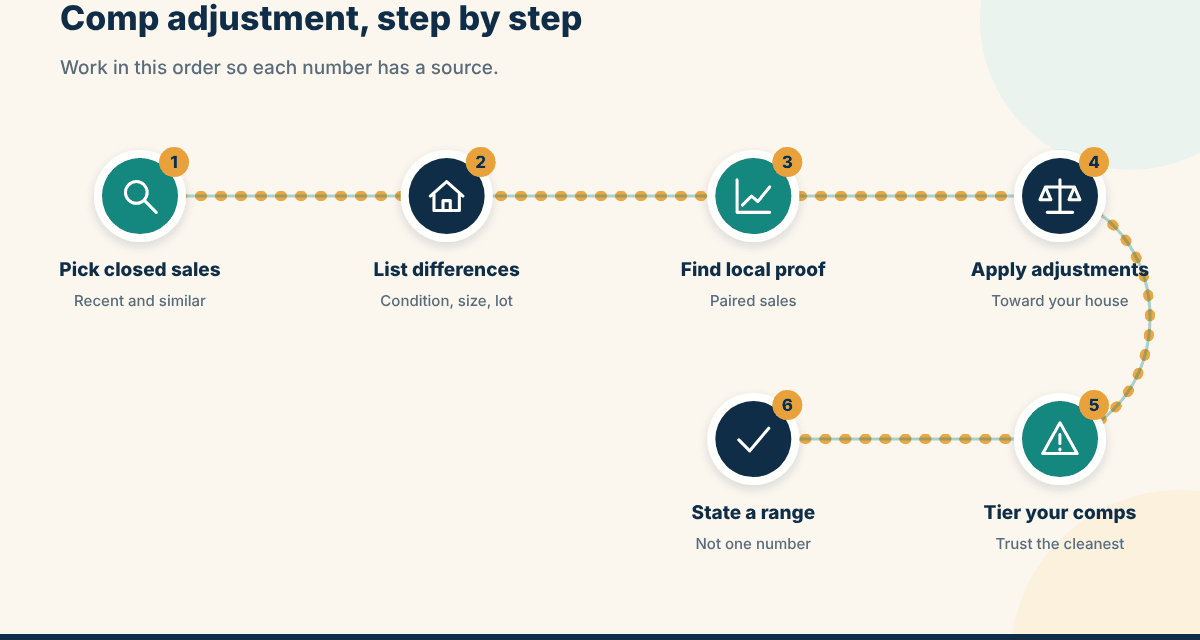
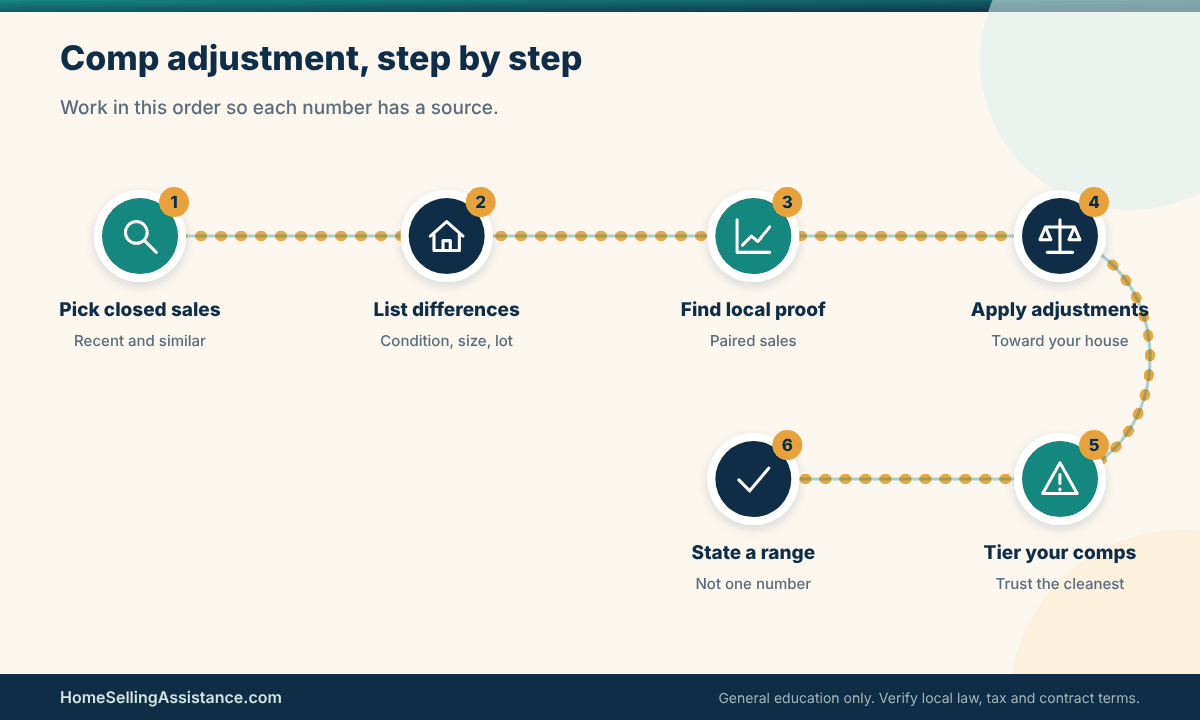
Before any arithmetic, it helps to see the whole method as a short sequence. You choose a handful of closed sales that resemble your home. You list every meaningful difference between each sale and your property. You decide what the local market paid for each difference. You apply those amounts to the sale price, and you compare the adjusted results. The picture above shows that order, and the rest of this section explains each stage. Seen this way, you adjust comps home value numbers in a repeatable order rather than by gut feel.
The logic is the same one appraisers use in what is called the sales comparison approach. You are not asking what a house is worth in the abstract. You are asking what buyers recently paid for houses that were close substitutes, and what a buyer would have paid had the substitute matched yours exactly. The method is simple to describe and slippery to execute, because each adjustment is a judgment about buyer behavior, not a measurement. Once you see the logic, it becomes easier to adjust comps home value results the way professionals reason.
A good habit is to treat the process like a lab notebook. Write down what you assumed, where each fact came from, and when it was true. When you later explain your number to an agent, a buyer or an appraiser, the notebook lets you show how you got there instead of defending a feeling. It also makes errors easy to find, which matters more than it sounds. A notebook like this is the quiet backbone of any attempt to adjust comps home value inputs responsibly.
Inputs and assumptions you should write down first
Start with the target. Which house are you valuing, and as of what date? That sounds obvious, but a seller who is thinking about listing next spring and a seller who needs a number for a refinance this week are asking different questions, because the market moves between those dates. Write the effective date at the top of your page, then describe your property in the same terms a buyer would use: finished living area, bedrooms and baths, lot, garage, age, updates and general condition.
Without that anchor date, any effort to adjust comps home value results has nothing solid to stand on.
Next come the assumptions about the market itself. Are prices in your area rising, flat or slipping? Are homes taking longer to sell than they did a year ago? Are buyers asking for concessions? You do not need a forecast. You need a plain statement such as “sales in my area seemed steady over the past six months, per my agent’s notes,” because that statement decides whether an older comp needs a time adjustment at all. Those few lines do more for your attempt to adjust comps home value figures than any spreadsheet.
Then list what you are treating as fixed. Maybe you assume your house is in average condition for its age, that the neighborhood boundary on the east side matters, and that a nearby school zone line does or does not change what buyers pay. Each of these is an assumption you may later revise. Putting them on paper now keeps them from sneaking into your numbers disguised as facts, which is how fake precision usually starts.
Evidence to gather: closed sales, not wishes
The raw material is closed sales: the recorded price, the closing date and the property facts. Active listings tell you what sellers hope for, and pending sales tell you that a price was agreed but not whether the deal survived inspection, financing and appraisal. Both are useful for context. Neither is a sale. When you adjust comps home value figures, anchor on what closed, and treat the rest as supporting color. Starting with closed sales is the first rule for anyone who wants to adjust comps home value figures honestly.
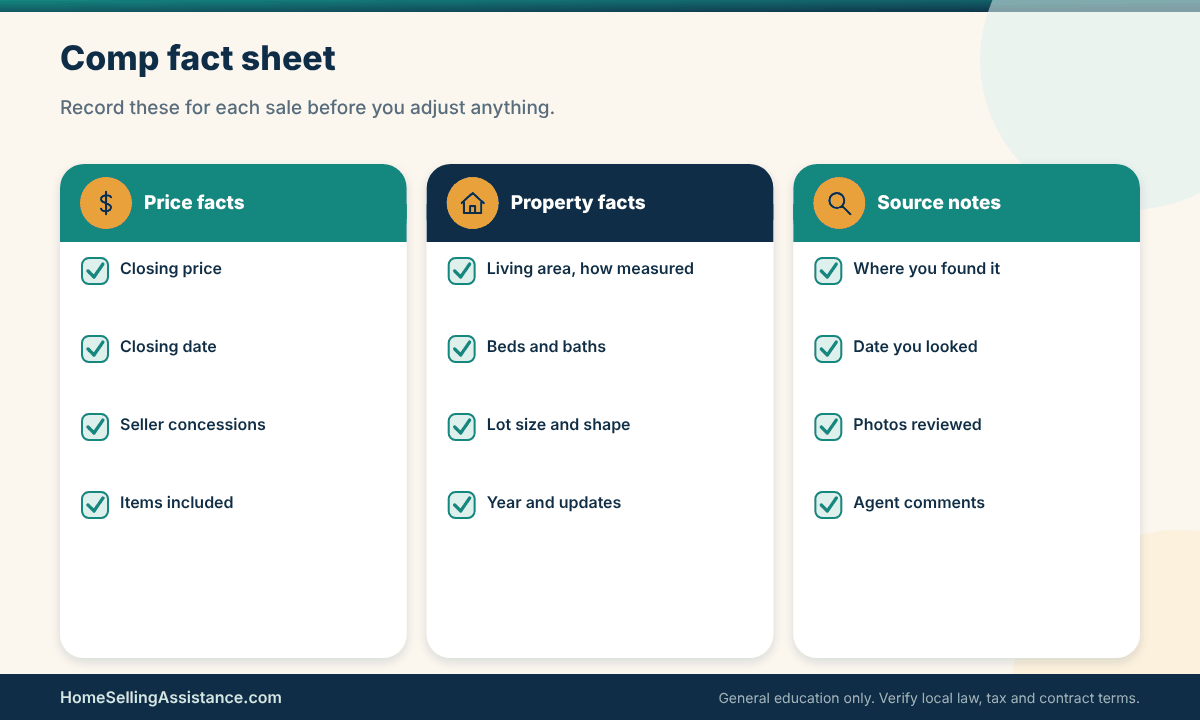
Gather the basics for each candidate sale. You want the closing price, the closing date, finished square footage and how it was measured, bedroom and bath counts, lot size, year built, garage and parking, and any notes on condition or updates. You also want to know whether the price included seller-paid closing help or other concessions, because a price that quietly included a credit is not the same as a clean price. The comparison of a CMA and an appraisal explains who normally pulls these records and how each professional treats them.
Here is a simple filter many careful sellers use. Keep a sale if it is recent enough for your market, close enough that the same buyers would have considered both homes, and similar in type and size. Drop a sale if it was a family transfer, a foreclosure sale in a market where those are rare, a sale with obvious unusual terms, or a home with a feature your house does not share in any form.
Fewer good comps beat a long list of mediocre ones. A filter like this keeps the effort to adjust comps home value results focused on evidence that deserves your time.
A scenario, an exception, and your next step on assumptions
Picture a seller we will call Dana, with a three-bedroom ranch of average condition. Dana writes that the market is roughly steady, that her house has a one-car garage, and that the street behind hers feels like the same neighborhood. A week later her agent mentions that the street behind sits in a different school zone and that buyers there have been paying more. Dana’s third assumption just broke, and she is glad she wrote it down.
The exception to watch for is an assumption that feels so natural you forget it is one. People assume that the nearest sale is the best sale. Often it is, but a house two blocks away across a busy road or a boundary line can be a worse comp than a house a mile away on a similar street. Distance is a starting guess, not a rule, and your notes should say why you kept or dropped each candidate.
Your next step is small. Write one sentence per assumption, add a note about how you could check it, and flag the two assumptions that would change your answer most if they were wrong. Those two will resurface when we build a sensitivity range later. For now, resist the urge to calculate; a clean list of assumptions saves more money than a clever formula.
Data source and date: where the sales come from and how old is too old
Where a number came from changes how much you can trust it. A sale price pulled from a public record or an MLS sold report is a different quality of evidence from a figure on a free estimate website, and both differ from a price a neighbor remembers over the fence. When you adjust comps home value inputs, label every fact with its source and the date you looked, because records get corrected, square footage gets re-measured, and sales get reclassified. Provenance is the unglamorous half of any effort to adjust comps home value estimates.
There is also a timing problem hidden in the data itself. A sale closes weeks after the buyer and seller agreed on the price, so the closing date lags the real market moment. In a fast-moving market that lag can be enough to matter. A sale that closed in March may reflect negotiations from January, and a sale that closed last week may reflect what buyers were willing to pay a couple of months ago.
The practical takeaway is to keep two dates in mind for every comp: the closing date you can read, and the likely agreement date you can estimate. When the market is calm, the difference is a footnote. When it is moving, ask a local professional how much the gap matters, and note the answer instead of guessing.
Evidence to check: the sale record, not the listing
Listing descriptions are marketing, and they drift from the facts. A listing may round square footage up, count a converted garage as living space, or call a half-finished basement “finished.” The sold record, the county’s property data and the original listing photos together tell a better story. When two sources disagree, the disagreement itself is information, and it deserves a note rather than a quiet pick of the more flattering number. Cleaning up the facts first makes it far easier to adjust comps home value numbers later.
Square footage deserves special care because so many adjustments hang on it. Some counties measure from exterior walls, some from interior walls, and some count only above-grade space. Basements, attics and additions are often handled differently from one source to the next. If your comp lists 1,900 square feet and your house lists 1,900, check that both numbers were measured the same way before you treat them as equal.
Our article on price per square foot and home value covers why that single number misleads so often. Skipping this check is a common way people adjust comps home value figures on shaky ground.
Finally, look for what the price included. Furniture, appliances, a lot split, a leaseback after closing, a seller-paid rate buydown or closing credits can all push the recorded price away from the plain value of the house. You rarely get the whole story from public data, which is one reason an agent who attended or reviewed those sales earns their keep. Ask what each sale included, and write the answer beside the comp.
Scenario: a stale comp in a moving market
Suppose your best comp sold seven months ago for a round $400,000, and your agent says prices in your area have been creeping up since then. Do you use $400,000 as is, or bump it? The cautious answer is that you do not invent a monthly percentage. You ask for the actual sales trend in your neighborhood and price range, check whether newer, closer comps exist, and consider using the old sale only as a loose upper or lower bound. Dates like this are exactly why you adjust comps home value results with caution rather than by habit.
The exception is a market with very few sales. In a small town or a rural area, a seven-month-old comp may be the best you have, and waiting for newer data is not realistic. Then the right move is to widen your uncertainty, not to sharpen it. You would say the old sale supports a value somewhere around a stated figure, with a wider range than you would use in a busy suburb, and you would flag it for a professional to review.
Your next step is to build two lists: comps that are recent enough to use directly, and comps that are older and need a time adjustment or a cautionary note. Many sellers find that sorting this way reveals that they have only two or three truly usable sales, which is a valuable thing to learn before you set a price. If you want a wider view, how much is my house worth walks through the main estimate types side by side.
Normalizing your options so every comp speaks the same language
Once you have a set of usable sales, the goal changes from collecting to translating. Each comp is a different house, so you convert it into the price it would likely have brought if it had matched yours. That is what normalizing means. The comps become comparable not because they are identical, but because you have accounted for the differences in a consistent, written way. This is the heart of how you adjust comps home value results in practice.
There is a useful way to think about the direction of every adjustment. Imagine you are the buyer standing in the comp house, and you are asked to take your own house instead. If your house is worse in some way, the comp’s price must come down to reflect what you would give up; if your house is better, the comp price goes up. Keep that picture handy, because mixing up the direction is the single most common arithmetic mistake in homemade comp work.
Many people who try to adjust comps home value figures at home trip over exactly this point.
The table below organizes the main claims you will make while doing this, the evidence behind each, what that evidence can really support, where it falls short and what it means for you as a seller. Use it as a checklist for your own notes. If you cannot fill in the evidence column for a claim, that claim is a guess and should be labeled as one.
| Claim you might make | Metric or source | What it supports | Limitation | Seller implication |
|---|---|---|---|---|
| This comp is a fair substitute | MLS sold record, photos, property data | Using it as a starting point | Photos hide wear, smell and layout flow | Keep it only if a buyer would cross-shop both homes |
| Extra bedroom is worth a stated amount | Paired sales in the same area | A local, not universal, figure | Few clean pairs exist | Treat the amount as a range, not a rule |
| Larger lot adds value | Sales that differ mostly by lot | Direction and rough size of effect | Usable acreage, slope and shape vary | Do not credit raw acres without usability |
| Updated kitchen lifts price | Agent notes, pending and closed updated sales | That buyers value condition | Cost of work is not the value added | Never assume you recover renovation cost |
| Market moved since the sale | Local sold-price trend by month | A time adjustment, if any | Thin data in slow months | Ask for the trend instead of picking a rate |
| Price included concessions | Settlement statement or agent knowledge | A cleaner effective price | Rarely public | Ask the listing side what was credited |
Notice how often the limitation column says some version of “not universal” or “thin data.” That is not a flaw in the table. It is the honest state of comparable sales work. When you read the seller implication column back to yourself, you will see a theme: prefer evidence that came from your market, label what you could not verify, and avoid treating any single figure as settled.

Like-for-like inputs when you adjust comps home value
Four families of differences cover most of what you will adjust: condition, size, lot and features. Condition covers age of systems, finishes, wear and recent updates. Size covers finished living area, room count and layout. Lot covers acreage, shape, slope, privacy and location on the street. Features cover garages, basements, pools, outdoor spaces, views and similar extras. Go through each comp and mark every family where it differs from your home. Sorting differences into these families keeps your effort to adjust comps home value figures organized.
Not every difference deserves a dollar figure. Tiny differences, such as a slightly different closet layout, are usually left alone because any number you assign would be noise. A good working rule is to adjust only what a buyer would clearly notice and pay differently for. That keeps the process honest and keeps your comp sheet from filling with invented line items that make the result look more exact than it is. Restraint is a skill when you adjust comps home value inputs.
When you do adjust, tie each figure to a source. The best source is a paired sale, which is a comparison of two similar homes that differ mainly in one feature. If a house with a finished basement sold for noticeably more than a nearly identical house without one, the gap is a clue about what that basement was worth in that market at that time. One pair is a clue. Several pairs begin to look like evidence.
Evidence to gather: how paired sales reveal a feature’s worth
Paired sale analysis sounds technical but works the way a thoughtful neighbor would think. Find two recent sales that were nearly identical except for one feature. Subtract the lower price from the higher. The gap is a rough indication of what buyers paid for the feature, assuming nothing else differed and the sales were close in date. In real life something else always differs, so the result is a guide, not a measurement. Even a rough pair can improve how you adjust comps home value inputs.
Because clean pairs are rare, appraisers and agents often build a feel for adjustments over many sales and many months. That experience is worth asking about. A seller can reasonably ask a listing agent, “What did buyers seem to pay for a finished basement or a third garage bay on recent sales around here, and what is the range?” An honest answer will include a range and a caveat. An answer that comes out as a single confident number, with no sales behind it, deserves a follow-up question.
Be careful with online rules of thumb that put a flat dollar value on a bedroom, a bath or a square foot of finished space. They are national or regional averages stretched over very different markets. If your local evidence and an online rule disagree, trust the local evidence and note the disagreement. The difference between list price, market value and appraised value shows why each of those numbers answers a different question. Shortcuts like these are the most common reason people adjust comps home value figures badly.
Scenario: two similar houses, one dated kitchen
Here is an illustrative case with round figures, not a forecast. Your comp sold for $400,000 and has a freshly remodeled kitchen. Your kitchen is original and works fine but looks its age. Your agent believes that, in your neighborhood, buyers priced the remodel at somewhere between $10,000 and $20,000 above a dated kitchen. You cannot pinpoint it, so you carry the range forward instead of choosing $15,000 and pretending to know.
That choice has a consequence. With the comp adjusted down for the kitchen, you end up with an adjusted value between $380,000 and $390,000 from this single comp. Presenting that as “$385,000” would feel tidy, but the tidy number hides the fact that the comp supports a ten-thousand-dollar window. Keeping the window visible is exactly how you adjust comps home value results without drifting into false precision.
There are exceptions. In some markets buyers overlook a dated kitchen entirely when everything else is strong, so the gap can be small. In others it is a dealbreaker. Your next step is to ask two or three agents or appraisers what they saw on recent sales, check whether any updated and dated pairs exist nearby, and decide whether to carry a narrow or wide range. If your own kitchen is the question, a related read is renovating before selling versus selling as is.
Risk and uncertainty adjustments for a messy comp set
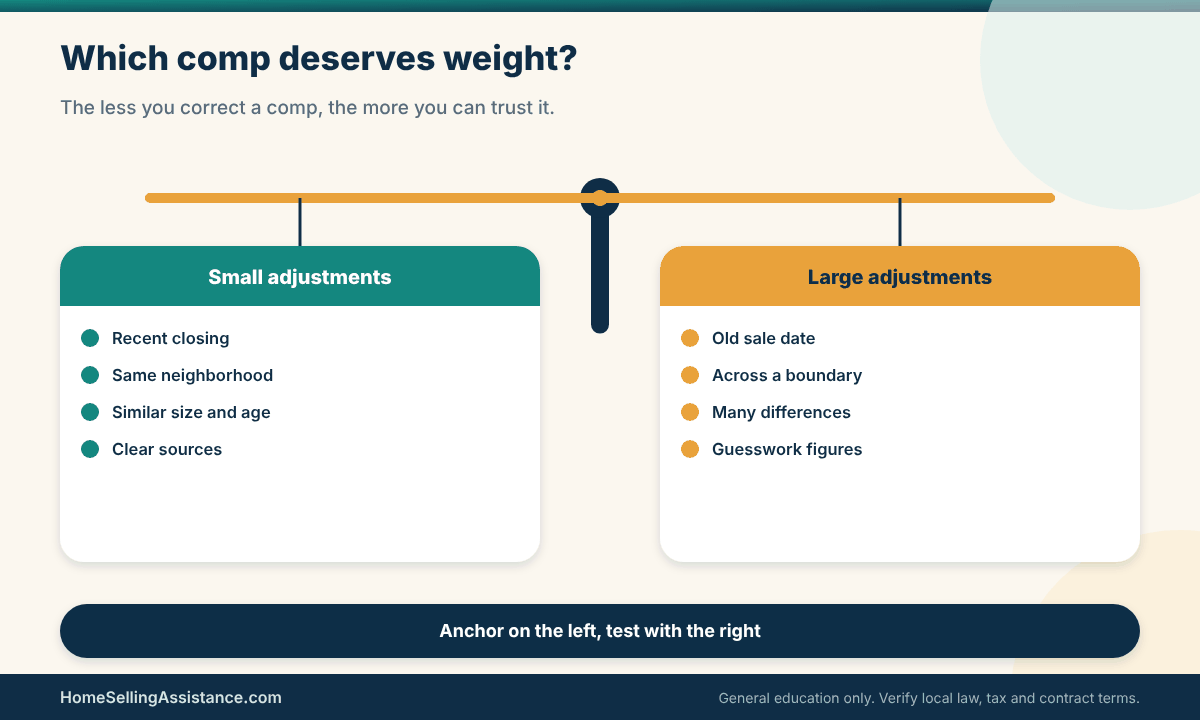
Every comp carries some risk that it does not tell the truth about your house. The sale might have been rushed, the buyer might have overpaid for a reason you cannot see, or the property might have had a quirk the photos hid. Risk adjustments are not dollar line items so much as decisions about how much weight each comp deserves. A comp you trust a great deal should anchor your range. A comp you trust a little should shape the edges. Weighting is a quiet but essential part of how you adjust comps home value figures.
One way to express this is to sort your comps into tiers. The first tier is closed, recent, close in distance and similar in type, with only small adjustments needed. The second tier needs a few meaningful adjustments or is somewhat older. The third tier is background context: useful to know about, unsafe to lean on. Writing the tier beside each comp forces you to admit which ones are carrying your conclusion.
Uncertainty also comes from the adjustments themselves. If you adjusted a comp by a total that is a large share of its price, then the final number depends more on your adjustments than on the sale. That is a signal to be cautious. The table-free rule of thumb is simple: the more you had to correct a comp, the less it should count.
Evidence: how many adjustments is too many?
Appraisers have their own internal sense of when a comp has been stretched too far. Many lenders and review processes look at the total and the largest single adjustment to judge whether a comp was a sensible choice, though the exact thresholds are internal guidelines that differ among lenders and are not something to quote as fixed rules. For a seller, the takeaway is qualitative. If a comp needed big corrections in several directions, look for a better comp before trusting it. That caution applies to any seller who tries to adjust comps home value figures at home.
A related warning concerns adjustments that cancel each other out. Suppose a comp is much larger than your home but sits on a smaller lot, has a nicer kitchen and a worse location. You subtract for size, add for lot, subtract for kitchen and add for location, and the net comes out near zero. The arithmetic looks calm, but four large guesses are hiding behind that quiet total. Net adjustments can understate how shaky a comp is, so always look at the gross figure too.
Keep a simple log: for each comp, list the adjustments with a plus or minus sign and the source behind each. Then glance at the biggest ones. If your largest adjustment rests on no evidence at all, mark it as a guess. A short log like this also makes it easy to show an agent or an appraiser what you did, and to hear where they see things differently. The pricing and home value category collects more guides that help with this kind of cross-checking.
Scenario: when your best comp is across a boundary
Imagine the closest and most similar sale to your house sits just across a school boundary, and local buyers care about that boundary. The sale is recent, the home is nearly identical, and the price is a round $420,000. On the other side of the line, comparable houses seem to sell for less, though you are not sure by how much. Do you use the $420,000 sale, drop it, or adjust it?
An honest answer is that it depends on what the market data shows. Check whether there is a visible price gap on each side of the boundary in recent sales. If there is, that gap is your location adjustment, and you carry it as a range. If the gap is small or unclear, the comp may still be usable, but you should give it a lower tier and lean more on sales from your own side of the line. What you should not do is ignore the boundary because the comp is conveniently close.
There is a fair housing point worth stating plainly. Adjusting for location features that buyers weigh, such as school zones, commute times or noise, is a valuation question. Characterizing neighborhoods by who lives there is not, and it is neither appropriate nor lawful to treat the makeup of a community as a value factor. If you want to read the official framing, the HUD fair housing resources explain the basics. Keep your adjustments tied to the property and its location features, never to people.
Your next step in a case like this is to ask your agent or appraiser to explain the boundary effect with recent sales in hand, then record the answer as a range. If you are still unsure after that, mark the comp as lower tier and say so in your notes. You can also read about how a selling agent frames price conversations in questions to ask a listing agent about price.
Preventing false precision when you adjust comps home value
False precision is the habit of reporting a number with more certainty than the evidence supports. A figure like $412,350 sounds more reliable than “around $410,000,” but if your inputs were rounded, estimated and partly guessed, the extra digits are decoration. They also tempt you to defend a number emotionally, because it looks like the product of careful work, when it is really the product of a few assumptions. Avoiding that trap is the main reason to learn to adjust comps home value figures carefully.
You can feel the problem in how comps are often presented. A neat grid of adjustments with a final adjusted price down to the dollar looks authoritative. The grid is a good way to organize thinking, and appraisers use similar layouts. But anyone reading it should understand that each adjustment line carries a margin of error, and those margins add up. A final number that looks exact is almost never exact. It is a trap that catches anyone who tries to adjust comps home value figures too confidently.
The remedy is not to avoid numbers. It is to attach honesty to them. Round to a sensible level, show a range, name the assumptions that would move the range, and state what you could not verify. That approach is more useful to you as a seller because it tells you how much room there is to price boldly, how much cushion to build in, and where a professional opinion would earn its fee. Our guide on overpricing a house to sell shows what tends to happen when precision-looking math produces a number that buyers do not accept.
Building a sensitivity range instead of one magic number
A sensitivity range answers a simple question: if my assumptions are a bit off, how much does my answer change? You find out by changing one assumption at a time and watching the result. Raise the kitchen adjustment, lower it, and see what happens to the adjusted value. Do the same with the time adjustment, the size adjustment and the lot adjustment. The ones that move the answer most are where you should spend your research effort. Running this test is what separates a careful attempt to adjust comps home value figures from a lucky guess.
This does not require software. A pencil and a clean sheet are enough. For each comp, write a low and a high version of each adjustment based on your evidence, then add them up to get a low and a high adjusted price for that comp. Do this across your tier-one and tier-two comps and look for the overlap. The place where several ranges overlap is the most defensible part of your answer, and the edges are where uncertainty lives.
Be prepared for the range to feel wider than you hoped. That is not a failure. A range that spans, say, a few percent of the price in a busy market is a reasonable result, and a much wider range in a thin market is simply the market telling you it is hard to price. A seller who sees that early can plan: price within the range, review activity, and be ready to adjust, rather than defending a single figure.
Evidence to gather: what actually moves the range
To decide which assumptions to stress-test, ask which ones rest on thin evidence. A time adjustment built on a handful of monthly sales is shakier than one built on dozens. A condition adjustment based on photos is shakier than one based on a walk-through. A lot adjustment where lots differ in slope and shape is shakier than one where lots are identical rectangles. Rank your assumptions by how weak their evidence is, and test the weakest ones first when you adjust comps home value ranges.
Testing the weak links is the smartest use of your time when you adjust comps home value ranges.
It also helps to separate market-wide assumptions from property-specific ones. Market-wide assumptions, such as whether prices have moved since the sale, affect every comp the same way. Property-specific ones, such as how much the finished basement is worth, affect only some. If a market-wide assumption is off, your whole range shifts together. If a property-specific one is off, only a few comps wobble. Knowing which kind of error you face tells you whether to ask for more market data or more property detail. The distinction matters whenever you adjust comps home value ranges for a real listing decision.
The table below lays out common assumptions, the effect each tends to have, a confounder that can mislead you and what to verify locally. Treat it as a prompt for your own research rather than a source of figures. The expected effects are directional on purpose, because the sizes depend on your market and your house, and any number we printed here would invite exactly the false precision we are trying to avoid.
| Assumption | Expected effect | Confounder to watch | What to verify locally |
|---|---|---|---|
| Market is steady since the sale | No time adjustment needed | Seasonal swings can look like trends | Monthly sold-price trend for similar homes |
| Dated kitchen costs buyers a discount | Comp with remodel adjusts downward | Other updates arrive in the same sale | Updated and original-condition pairs nearby |
| Finished basement adds value | Comp with basement adjusts downward | Ceiling height, egress and permits differ | Whether basement area counts as living area locally |
| Larger lot adds value | Comp with bigger lot adjusts downward | Slope, easements and shape reduce use | Usable area and what nearby lots sold for |
| Garage matters to buyers | Comp with more bays adjusts downward | Local weather and parking habits vary | Sales with and without garages in the area |
| Seller concessions were minor | Prices read as clean | Hidden credits lower the true price | Agent confirmation of credits on each comp |
| Square footage numbers match | Size adjustment stays small | Different measuring methods | Measurement source for every comp |
To use the table, copy the rows that apply to your comps, then fill in your own evidence beside each. When a row has no evidence, shade it in your mind as a guess. If three or four of your largest adjustments land in guess territory, take that as a message: your range should be wide, and your next move is more data, not more arithmetic. If everything has solid support, a tighter range is justified.
Scenario: turning adjustments into a working range
Let us walk through a simplified, illustrative example. You have three tier-one comps with raw sale prices of $395,000, $400,000 and $410,000. After adjusting each for size, condition and lot using low and high figures, the adjusted results span roughly $390,000 to $398,000 for the first, $388,000 to $402,000 for the second and $392,000 to $400,000 for the third. These are round numbers for illustration only and do not describe any real market. The example shows how a seller can adjust comps home value ranges and still stay humble.
Look for the overlap: the zone from about $392,000 to $398,000 sits inside all three ranges. That is your most supported zone. The outer edges, $388,000 and $402,000, come from just one comp each, so they are less certain. A sensible conclusion is that your home’s indicated value is around the mid-$390,000s, with a plausible window of a few thousand dollars on either side, and you would say that rather than quoting $395,200.
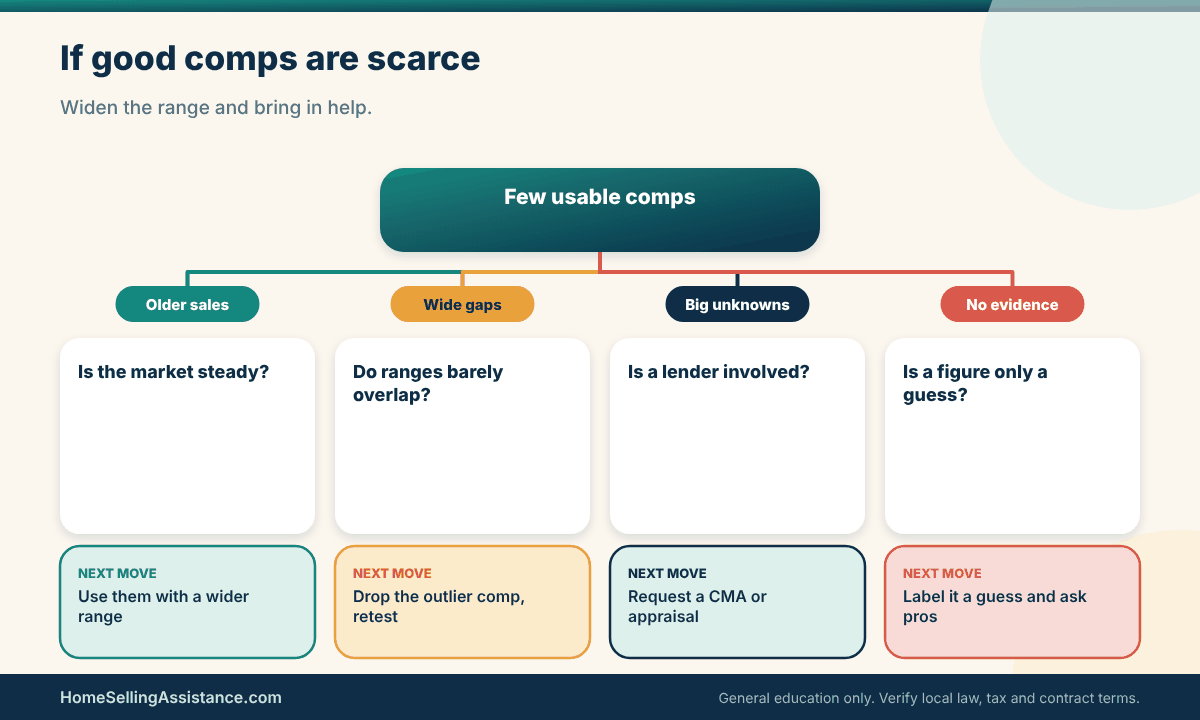
The exception is when ranges barely overlap or do not overlap at all. Then something is wrong: a comp that does not belong, a missing adjustment or a market change you did not account for. Your next step is to find the culprit, perhaps by dropping the comp whose range sits furthest from the rest and seeing whether the others agree. If they do not, get a professional opinion before pricing. Our pricing guide on how to price a house to sell shows how to move from a value range to a list price.
What requires a live quote, CMA, appraisal, policy or contract
A homemade comp analysis has real limits, and it helps to know where they are. Several questions cannot be answered from public records and your own notes. What will a lender’s appraiser conclude? What will a specific buyer’s loan allow? What are the real fees, payoff amounts and closing terms on your sale? These depend on documents and professionals, and no worksheet replaces them. Knowing the limits is part of learning how to adjust comps home value figures responsibly.
The simplest way to organize the handoff is to ask what kind of answer you need. If you need a market-based price range for listing, a comparative market analysis from a licensed agent is the usual tool. If you need a formal, lender-facing opinion of value, an appraisal by a licensed appraiser is the tool. If you need a figure for taxes, an estate or a divorce, you need the relevant professional and the relevant documents. Understanding which is which prevents you from asking a worksheet to do a job it cannot do.
Remember also that your analysis feeds into decisions that have contract consequences: the price you list at, the offers you accept and the terms you negotiate. The contract, the listing agreement and the settlement statement are what actually govern money changing hands. Before relying on any estimate, read those documents or have a qualified professional explain them, and ask your state real estate commission or an attorney where local rules apply.
Source to request: a CMA, an appraisal or a quote
A comparative market analysis is typically prepared by a real estate agent and can be informal. It usually shows comparable sales, active competition and a suggested price range. A good one explains its adjustments and tier choices rather than listing a single number. Ask to see the sold comps and the reasoning, and ask which ones the agent trusts most and why. If the agent’s range is far outside yours, that gap is worth a conversation, not an argument. A CMA is a natural companion when you adjust comps home value figures for a listing decision.
An appraisal is prepared by a licensed or certified appraiser, often for a lender, and follows professional standards and the lender’s requirements. It is generally a snapshot of value as of a date for a stated purpose. If you are considering paying for one before listing, our piece on whether a pre-listing appraisal is worth it sets out the trade-offs. If a buyer’s lender orders one later, see your options after a low appraisal.
Live quotes matter when a number depends on a current third party. Payoff amounts come from your lender, title and escrow charges from the title or closing company, and some fees from the contract itself. These change by day and by provider, which is why this article does not give figures for them. For general consumer guidance on appraisals and closing costs, the Consumer Financial Protection Bureau is a reliable starting point. Quotes complement, rather than replace, your own effort to adjust comps home value figures.
Scenario: when your estimate and the appraisal disagree
Suppose your homemade analysis points to a value in the mid-$390,000s, and a buyer’s appraisal comes back lower, with the contract price at $400,000. Nothing in this article tells you who is right. It tells you what to do next. Request the appraisal’s comparable sales and adjustments through your agent, check them against your own notes, and look for factual errors such as wrong square footage or a missed update. A disagreement like this is common when people adjust comps home value figures independently.
Appraisals can contain mistakes, and there are processes for asking a lender to reconsider a value, which vary by lender and loan type. Appraisers can also be right in ways you did not anticipate, such as weighing a comp you discounted. Either way, your records help: a clear log of comps, sources and adjustments lets you have a precise conversation. Related reading: how an appraisal gap works for sellers. Careful notes from your effort to adjust comps home value figures make that conversation far more productive.
Your next step is to decide, with your agent or attorney, whether to renegotiate, wait for a reconsideration, ask the buyer to cover a gap, or move on to a backup. Each path has contract consequences, so check your agreement and local practice before acting. The goal of your homemade analysis was never to win an argument with an appraiser. It was to arrive at that conversation informed, calm and prepared.
Frequently asked questions about adjust comps home value
What does it mean to adjust comps home value estimates?
It means taking the closed sale prices of similar homes and correcting each one for differences from your house, such as condition, size, lot and features. The corrected prices show what each comp might have brought if it matched yours. You then compare the results and look for the range where they agree. The method is a way to organize judgment, not a formula that produces certainty.
Should I add or subtract when the comp is better than my house?
Subtract. If the sold home has a feature yours lacks, such as a finished basement or a remodeled kitchen, the comp’s price includes value your house does not have, so the adjustment lowers it. If your house has something the comp lacks, you add to the comp. Picturing yourself trading the comp house for yours helps keep the direction straight.
Is there a standard dollar amount for a bedroom, bath or garage?
No. What buyers pay for a feature varies by neighborhood, price range and moment in the market. Online rules of thumb are averages stretched across very different places and can mislead you. Local paired sales and the experience of agents and appraisers who work your area are a much better guide, and they usually come as ranges.
How old can a comparable sale be?
There is no universal cutoff. In a busy, steady market, sales from a few months back can still be good evidence, while in a fast-moving market even recent sales can age quickly. In thin markets, you may need to use older sales with a wider margin for error. Ask a local professional how far back is reasonable for your area and write down the answer.
Can I adjust comps home value figures myself, or do I need a professional?
You can do a thoughtful first pass yourself and learn a lot from it. Public records, sold data and your own notes go a long way toward understanding your market. For a formal price recommendation or a lender-facing opinion, you need a licensed agent or appraiser. Many sellers do both: their own analysis first, then a professional opinion to test it.
Why not just use price per square foot?
Price per square foot hides differences in lot, condition, layout and location, and it depends on how area is measured. It can be a useful rough check when homes are very similar, but it is a poor substitute for adjusting individual comps. Smaller homes often sell for more per square foot than larger ones, which is one reason the simple method misleads.
What if I only have one or two good comps?
Then say so, and widen your range rather than tightening it. Use the comps you trust most, include nearby listings and pending sales as context, and consider asking a local professional for additional data. A thin comp set is a reason for humility in your pricing, and it may be a reason to plan for a price review after the first weeks on the market.
Do renovation costs equal the value they add?
Not automatically. Buyers pay for what a home is worth to them, not for what you spent, and the return on improvements varies by project, quality and market. When you adjust comps home value results for condition, use what buyers actually paid for updated homes locally, not your contractor invoices. Ask an agent which updates mattered on recent sales.
What should I do if my estimate and the appraisal differ?
Get the appraisal’s comparable sales and adjustments, compare them with your own, and look for factual errors or missed information. Your agent, attorney or lender can explain options for asking for reconsideration, which vary by lender and loan type. Your contract controls what happens next, so review it before choosing to renegotiate, wait or move on.
Where can I learn more about fair and accurate valuation?
The National Association of Realtors publishes consumer-oriented resources, and state real estate commissions can explain local licensing and practice. You can start with the NAR website for general information. Keep valuation tied to the property and its location features, and follow fair housing rules in every conversation about buyers or neighborhoods.
A calm way to finish
To adjust comps home value figures well, you do not need perfect data. You need honest labels: what you measured, what you assumed, when it was true and how sure you are. Keep the adjustments small, keep the range visible, and let professionals handle what only a license, a live quote or a contract can settle. This article is general education, not legal, tax or financial advice, and local rules and markets vary, so confirm the details with qualified people before you act.