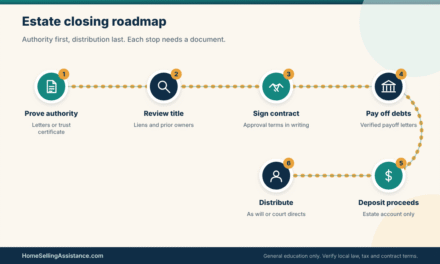
An executor selling house property is doing something very different from an ordinary homeowner putting a sign in the yard: the person on the signature line does not own the home in the usual sense, the authority to sell comes from a court or a document rather than from a deed, and every step has to make sense to a title company that was not there when the person died.
If you have just been named executor, you are probably grieving, juggling a day job, and holding a ring of keys to a house that feels both familiar and strangely off limits. Nobody hands you a manual. Relatives start asking when the house will be listed, a neighbor mentions a cash buyer, and a mailbox full of tax bills and utility notices keeps growing. The pressure to act quickly is real, and so is the risk of acting before you have the authority to do so. A careful executor selling house plan starts with paperwork, not photographs.
This guide walks through the executor selling house decision in the order that tends to prevent trouble: first working out who owns what and which document controls, then translating those rules into a workable seller routine, and finally building a checklist you can verify before you sign. It sits inside our wider guide to selling an inherited house, and it stays focused on the executor’s seat in particular.
One honest limit before we start. Probate law is state law, and sometimes county law, so the details here are the shape of the problem rather than the answer for your court. Where we use numbers they are round, labelled examples. Where rules differ, we tell you where to look. Nothing below replaces a conversation with a probate attorney licensed where the home sits.
Key takeaways
- Authority comes first. A will naming you is not the same as court-issued authority; most buyers and title companies want to see the court’s paperwork before they will close.
- State rules decide the path. Some estates sell with little court involvement, others need notice, a hearing or confirmation, and the only reliable way to know is to check your own court and attorney.
- Offers are only as good as your ability to deliver. Accepting a contract you cannot legally perform exposes you, and sometimes the estate, to claims.
- Disclosure still applies. You may know less about the home than a living owner, but you must still share what you know, and “as is” language does not erase that duty.
- Paper is protection. Keep copies of letters, orders, inventories, offers, and every communication with heirs so you can show that you acted carefully and in good faith.
- Verify before signing. Certified court documents, a title commitment and written confirmation from your attorney are worth more than any online summary, including this one.
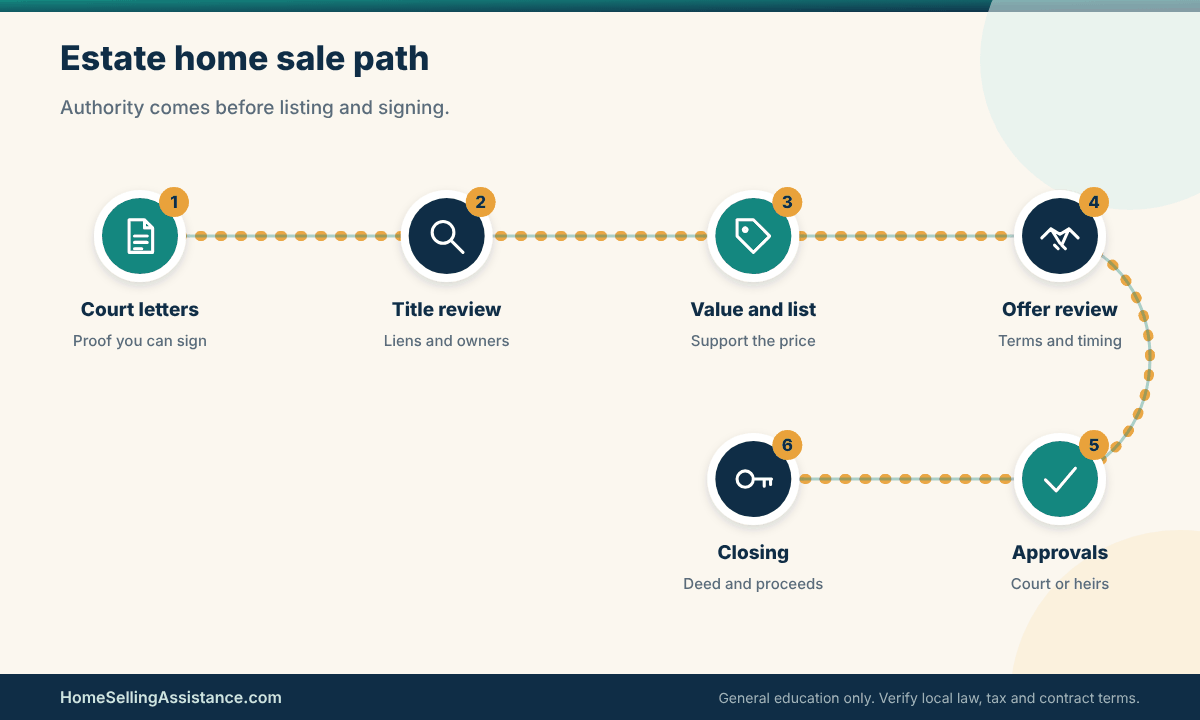
Before any executor selling house decision: confirm who owns the home, who signs, and which document controls
The first job in any executor selling house plan is not marketing. It is establishing a clear chain from the person who died to the person who can sign a deed. Skip that chain and every later step sits on sand. The picture above shows the sequence we follow in this guide, from proving your authority through to closing and the final accounting.
Who really has the authority to sign: executor, administrator, or someone else
In everyday talk about an executor selling house property, people use the word executor loosely. Strictly, an executor is the person named in a will to carry out its instructions. If there is no will, or the named person cannot or will not serve, a court appoints an administrator, and many states use the broader term personal representative for both roles. Trusts add another layer: a successor trustee may sell trust property with no probate at all. Which role you hold determines which papers prove your authority.
Ownership matters just as much. A home titled solely in the decedent’s name usually passes through probate. A home owned jointly with right of survivorship, or placed in a living trust, or covered by a transfer-on-death deed in states that allow them, may never enter the estate. In those cases an executor selling house property may find there is nothing for them to sell, and the person with authority is the surviving owner or trustee instead.
Evidence to gather: letters, the will, the death certificate, and the deed
Start with the deed in your executor selling house file. Request a copy from the county recorder or clerk, not from a family drawer, because the recorded version shows exactly how title is held and whether any liens, mortgages or easements were recorded against it. Read the names, the vesting language (such as joint tenants, tenants in common, or a trust), and the date. If the deed names two owners and only one has died, the estate may own only a portion of the home.
Next, gather the will, certified copies of the death certificate, and the court document that appoints you. Courts call it letters testamentary, letters of administration, letters of authority, or something similar, depending on the state. Ask for several certified copies of the letters, since title companies, banks and buyers each keep one. Certification dates matter too: many closing agents want letters issued within a recent window, which they will state themselves.
A tidy file also makes the executor selling house workload lighter later. Also gather the paper trail on money tied to the house: the latest mortgage statement, property tax bills, homeowners insurance declarations, HOA statements if any, and utility accounts. They help you understand what the estate owes and what the house costs each month while it sits empty. Our piece on an inherited house with a mortgage covers the lender side in more depth.
Finally, make a one-page ownership summary in plain words: who died and when, how title was held, which document appoints you, what court and case number apply, and who the heirs or beneficiaries are. Sharing it with your attorney early catches mismatches, such as a deed name spelled differently from the will, which can stall a closing for weeks.
A scenario, an exception, and your next step: the named executor who has no letters yet
Picture a daughter named as executor in her father’s will. A cash buyer sees the house on a drive-by, knocks on the door, and offers a round number if she signs this week. She has the will, but she has not filed it with the court, and no judge has appointed her. Can she sign a purchase contract?
In most states, not safely. Until the court issues letters, the named executor generally lacks formal power over estate assets, and a deed signed without that power can be challenged later. A buyer’s title insurer will usually refuse to insure it. The common exception is a home that is not part of the probate estate at all, such as one held in a trust she is trustee of, which follows different rules.
The next step in this scenario is plain and unglamorous. She files the will and a petition with the probate court, asks her attorney how long appointment usually takes in that county, and tells the buyer the house can be discussed once she has authority. A serious buyer can wait or sign a contract that is explicitly conditioned on court appointment. An impatient one may walk, and that is a fair price for staying on safe ground.
A second exception is worth knowing. A word on co-executors belongs here. When a will names two people, the court usually appoints both, and an executor selling house contract may need both signatures unless the will or state law says one can act alone. Agree early on who talks to the agent, who talks to the attorney and who keeps the estate binder, and put that division in an email so nobody is surprised later.
Some states allow certain small estates to transfer property through a simplified affidavit or summary procedure, without formal appointment, but real estate is often excluded or subject to lower value limits. Whether the home qualifies is a question for the court clerk’s self-help desk or your attorney, never a guess.
Federal rules, state probate law, and local court habits for an executor selling house transactions
Federal law touches an executor selling house transaction in a few narrow places and leaves the heart of probate to the states. That split is the single most useful thing to understand early, because it explains why an online article from another state, or a friend’s story from another county, may be useless to you.
What federal rules touch the sale, and what they leave alone
Several federal rules still apply to any executor selling house transaction. The lead-based paint rule requires sellers of homes built before 1978 to give buyers the federal pamphlet and disclose known lead hazards; the EPA explains the details on its lead real estate disclosure page. Fair housing law applies to how the home is marketed and who is offered terms, so every buyer should be treated by the same written process. HUD publishes the basics on fair housing and equal opportunity.
Federal tax rules matter too, although they rarely change how you sign. The heir’s basis in an inherited home generally resets to its value around the date of death, which affects gain or loss on a later sale. The IRS explains the vocabulary in Publication 551 on basis, and our article on inherited house cost basis shows how to document it. Estates and beneficiaries may also have filing duties, so a tax professional belongs on the team.
What federal law does not do in an executor selling house case is decide who may sell the house, whether the court must approve the price, how long creditors have to make claims, or what the deed must say. Those are state questions. The federal pieces above are a floor of obligations that travel with the property wherever it sits, not a substitute for local probate rules.
One more federal-adjacent item: if the decedent had a reverse mortgage, a government-backed loan, or an unpaid federal tax lien, the lender or agency may have its own notice and timing rules. Ask the servicer for a written payoff and a written explanation of what it will accept from an executor. Do not rely on a phone call.
Independent, supervised, and small-estate paths: a state-level scenario
States tend to offer more than one route through probate. In an independent or unsupervised estate, the executor can usually sell real estate after appointment without asking the judge each time, provided the will or statute grants that power. In a supervised estate, the court may require notice, a hearing, an appraisal or a confirmation order before a sale becomes final. Some states give heirs the right to object or to be notified before the sale.
Here is an executor selling house illustration. Two sisters serve as co-executors for their mother’s home in a state with a flexible independent route. The will grants a power of sale. Their attorney tells them they can list the home after appointment, accept an offer, and sign the deed without a hearing, as long as they file the required inventory and send notices to heirs on schedule. A hundred miles away, a different estate in a supervised state needs a hearing date, a published notice and a judge’s signature before the same step.
The takeaway for any executor selling house plan is not which state is better. It is that you cannot guess your route. Ask the clerk of the probate court, or your attorney, three direct questions. Does the will give a power of sale? Does this court require approval or confirmation for a real estate sale? Which notices must go to heirs and creditors, and by when?
Also ask what the court calendar looks like. Some courts hear matters weekly, others monthly, and a missed filing window can push a closing back by weeks. Build that reality into any date you promise a buyer. Our article on selling an inherited house before probate explains why the timing of appointment drives so many of these decisions.
Turning the law into a workable plan for the executor selling house process
Once you know who signs and under which rules, the executor selling house work becomes a seller routine like any other, with a few estate-specific twists. You still need to prepare the property, decide how to market it, evaluate offers and manage a contract. The difference is that each step must also be defensible to heirs, to creditors and sometimes to a judge.
Disclosure, notice and approval steps: what happens before and after listing
Think of three kinds of paperwork in an executor selling house file. Disclosures go to buyers. Notices go to heirs, creditors and sometimes the court. Approvals come from the court, from co-executors or from beneficiaries, depending on your will and your state. Mixing them up is a classic source of delay. A buyer will not care that you sent a creditor notice, and a judge will not care how thoroughly you filled in the buyer’s property questionnaire.
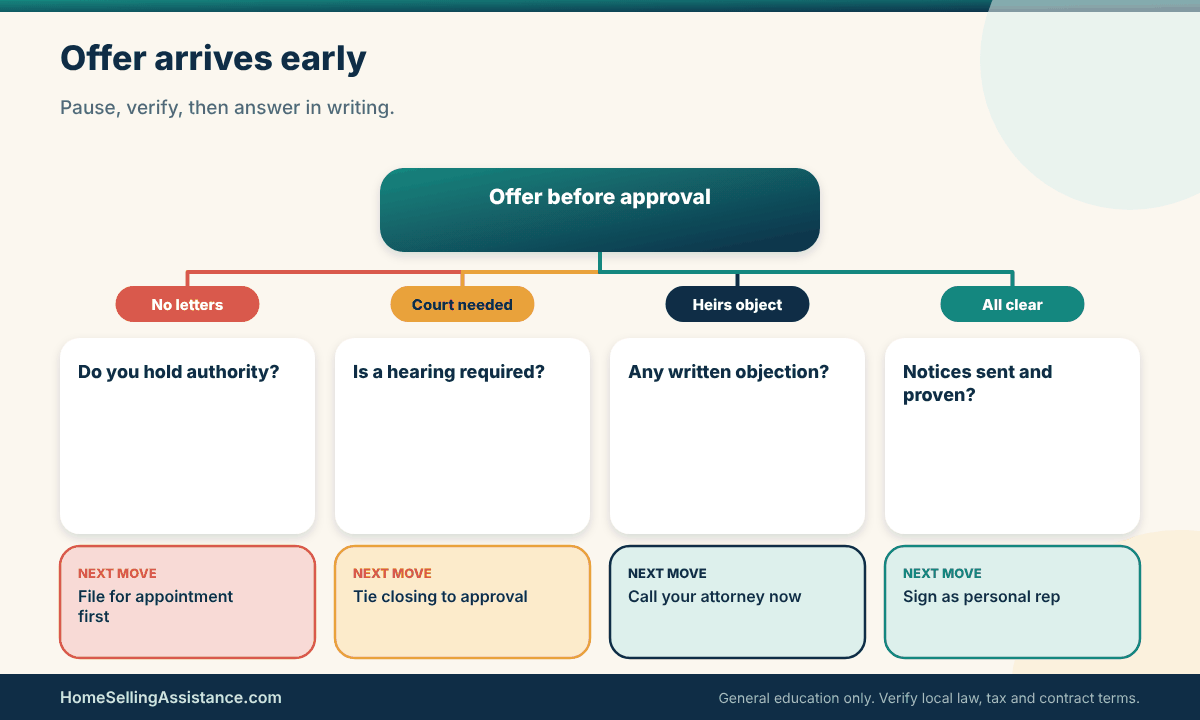
The graphic below lays out the main routes an estate home can take, from waiting for court authority to selling under an independent power, so you can see where each kind of paperwork enters the picture.
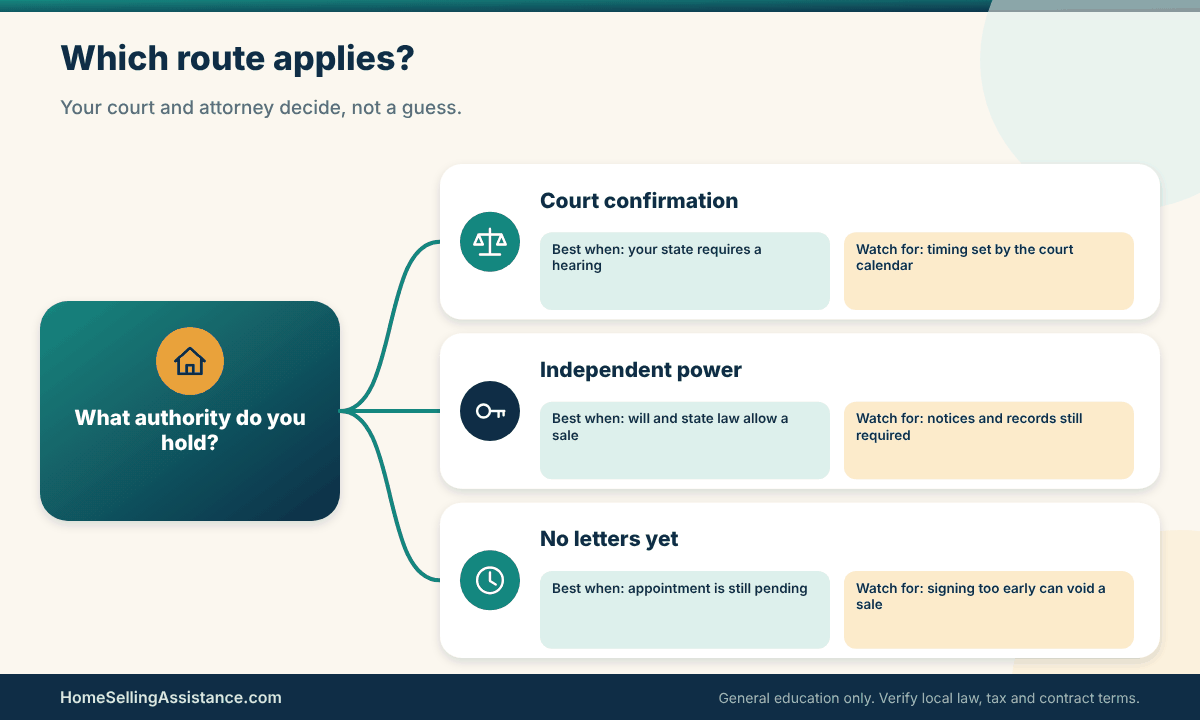
Start with disclosures in your executor selling house checklist, since they involve the most personal liability. Our general explainer on seller disclosure requirements shows how widely the forms vary. Executors and administrators often get some relief in certain states, such as the ability to state they have never occupied the home, but relief is not universal, and you remain responsible for sharing what you actually know.
Evidence to gather: what the executor actually knows about the home
Write down what you personally know and where you learned it. Did you see water stains during a clean-out? Did a neighbor mention a past flood? Did the decedent leave repair receipts, permits, warranties or inspection reports? A simple log with dates protects you, because it shows you reported what you knew at the time you knew it.
Look for the paper history of the house you are handling as executor selling house: permits for additions or finished basements, warranty cards, termite or radon reports, insurance claims and prior sale paperwork. If the home was built before 1978, check for any lead-based paint records. Collect homeowners association documents too, since resale certificates and transfer fees can take time to produce and may be your buyer’s first request.
Consider ordering a pre-listing inspection. It does not replace your disclosure, but it can reveal issues you could not know about as someone who never lived there. The report is also useful for pricing and for explaining condition to heirs who live out of town. Be aware that findings you obtain generally become known to you, which may need to be disclosed. Ask your attorney or listing agent how your state treats inspection findings.
If the death occurred in the home, some states have specific rules about whether and how that must be disclosed. Our article on death in a house and seller disclosure explains why this varies and who to ask. Do not decide this by instinct. Give the question to your attorney or listing agent early, and answer it in the same way for every buyer.
A scenario, an exception and your next step: notices to heirs, creditors and the court
Imagine you are executor of an estate with three adult children as heirs, a modest mortgage and a few unpaid medical bills. You have a buyer ready to sign. Your attorney says the court wants notice to heirs before sale, and the creditor claim period is still running. Can you still close?
Often yes, but your order of operations changes. A creditor claim period usually does not freeze an executor selling house sale; it affects how and when proceeds can be distributed. A sensible executor holds sale proceeds in the estate account until the claim deadline passes and the attorney confirms what is owed. Distributing money early, because heirs are impatient, can leave you personally exposed if a valid claim surfaces later.
The exception is a home that is mortgaged beyond its value or subject to a lien that exceeds the likely price. Then a short sale or a negotiated payoff may be on the table, and lender approval becomes the controlling step. A cash offer does not change that; the lien still has to be satisfied at closing or accepted as a loss by the lender.
Your next step in this scenario is a written notice schedule. List each heir, their address, the date the notice went out, and how it was delivered. Add the creditor deadline date from the court file. Share it with your attorney, and keep a copy in the estate binder. When a relative later says nobody told them about the sale, you can answer with dates instead of memory.
The table below compares the usual building blocks of an estate sale: the issue, which document or authority controls it, what you must do or choose, the typical timing driver, and what you should confirm locally. Use it as a conversation starter with your attorney rather than a finished answer, since each state fills these boxes differently.
| Issue | Controlling document or authority | Your obligation or choice | Deadline driver | Verify locally |
|---|---|---|---|---|
| Authority to sign a deed | Court letters, will, state probate code | Obtain letters before contracting | Court appointment date | Clerk or probate attorney |
| Power of sale | Will language or statute | Confirm you may sell without approval | Before listing | Attorney reads the will |
| Court confirmation | Local probate rules | File petition and give notice if required | Hearing calendar | Court website or clerk |
| Notice to heirs and creditors | State statute, court order | Send and document each notice | Statutory claim period | Attorney confirms dates |
| Buyer disclosures | State form, federal lead rule | Share what you know, no more, no less | Before or at contract | State real estate commission |
| Mortgage or lien payoff | Lender statement, recorded liens | Request written payoff from servicer | Before closing | Title commitment |
| Distribution of proceeds | Will or intestacy law, court order | Hold funds until cleared to pay | After claim period | Attorney and tax preparer |
To use the matrix, copy it into a note and fill in your own column for each row: who confirmed it, on what date, and what document you were shown. A row you cannot fill in yet is a row to ask about this week. Rows that depend on one another, such as authority and court confirmation, should be answered in order, because an answer further down may change once the one above it is confirmed.
Handing the file to the buyer, the title company, the court and your attorney
An executor selling house deal involves more hands than a regular sale. Your attorney confirms authority and court steps, the title company decides whether the deed will be insurable, the buyer’s lender wants proof the seller can deliver, and the court may want to see what you did. A tidy handoff to each of them prevents most of the delays that make an executor selling house timeline feel unpredictable.
Evidence to gather: the title commitment and what it will ask for
For an executor selling house file, order a title search early, even before you list, if your attorney agrees. The commitment lists who the record owner is, which liens and judgments are attached, which easements exist, and what the insurer requires before it will issue a policy to the buyer. For estates, those requirements usually include certified letters, sometimes the will, sometimes a death certificate, and occasionally a court order authorizing the sale. Our overview of a title search before a home sale explains the general process.
Read the requirements section of the executor selling house commitment line by line and sort each item into three piles: things you can supply yourself, things your attorney must supply, and things only a third party can fix. A mortgage that was paid off years ago but never released of record belongs in the third pile. So does an old judgment against someone with a similar name. Raising these early gives you weeks to resolve them rather than days.
Ask the title officer what proof of authority they want and in what form. Some want letters issued within a certain number of days. Some ask for the full will, others for a short certificate or affidavit. Some want every co-executor to sign. A five-minute call with the closing agent now can save an urgent scramble at the end, and the agent will usually tell you exactly what the underwriter requires for estate sales.
Finally, ask about the closing mechanics. Will the estate receive proceeds by wire, check or deposit into an estate account? Does the title company require a tax identification number for the estate? Is a bank account in the estate’s name already open? Mixing estate money with your personal funds is a mistake courts take seriously, so set up a separate account before the first dollar arrives, and read our guide on real estate wire fraud before you send or confirm any wiring details.
A scenario, an exception and your next step: a fast-closing buyer meets a slow court calendar
A buyer’s agent calls with a strong offer and a request for a closing in three weeks. You like the price. Your attorney points out that the court’s next confirmation hearing is five weeks out and that your state requires notice to heirs before the hearing can be scheduled. What do you do?
You have a few honest options as an executor selling house. You can counter with a closing date tied to the court’s approval, written clearly in the contract as a condition. You can ask whether your estate qualifies for a different procedure that does not need a hearing. Or you can decline the offer if the buyer will not bend. What you should not do is promise a date that the court controls, because missing it can mean breaching the contract and risking the buyer’s deposit dispute.
An exception worth knowing: if the will grants full power of sale and your state allows independent administration, you may not need a hearing at all, and the three-week closing could be realistic. The same offer can be easy in one county and impossible in another, which is exactly why you ask before you answer.
Your next step is to write a short reply to the buyer’s agent that states what is known and what is not. Say you are the personal representative, say that the contract will need to include any required court approval, and ask whether the buyer is open to that structure. Keep the tone friendly and factual. Serious buyers of estate homes have usually seen this before.
Offers in an executor selling house sale deserve their own habits. A price you cannot support invites questions from heirs, so many executors gather a broker’s opinion of value or a formal appraisal as of the date of death, which also helps with the tax basis. When you compare offers, look beyond the headline number.
A slightly lower contract from a buyer with solid financing and a flexible closing date can serve the estate better than a higher one loaded with contingencies, and our article on multiple heirs selling an inherited house shows why the whole group should see how you decided.
Every executor selling house contract should also say plainly that the sale depends on court approval, if approval is required, and that the seller signs as personal representative of the estate, not as an individual. Ask your attorney to review the wording before you sign. Estate sales are commonly sold as-is because the executor has little first-hand history with the home, yet an as-is clause narrows only certain repair claims, not your duty to share what you know.
Broker compensation is negotiable and has to be written down. If you hire a listing agent, read the listing agreement for its length, its cancellation terms and what happens if the court delays closing. Agents who work estates regularly are comfortable with these conditions, and a vacant home often needs extra care, which our guide to selling a vacant house covers. Interview more than one, and ask each how they handle a delayed court date.
Build an executor selling house verification checklist you can trust
By now the pattern in every executor selling house situation should be clear: nearly every risk in an estate sale comes from relying on someone’s say-so instead of a document. A verification checklist turns that lesson into a routine you can repeat for each step, with a source and a date next to every answer.
Use the next table as a scenario map. For each situation, it shows the options open to you as the seller, the main risk, the paper to read, and the point at which you should stop and call a professional.
| Situation | Seller options | Main risk | Document to review | Escalate when |
|---|---|---|---|---|
| Named executor, no letters yet | File for appointment, then sell | Signing without authority | Will, petition, court order | Buyer wants to sign now |
| Offer arrives before inventory is filed | Negotiate timing, keep listing | Missed court deadlines | Court calendar and inventory | Deadline is within weeks |
| Heirs disagree about selling | Seek written consent or court direction | Claims of breach of duty | Will, heir correspondence | Any heir objects in writing |
| Mortgage balance near value | Negotiate payoff or short sale | Deficiency or lender delay | Payoff letter, loan documents | Offer is below the payoff |
| Home is vacant and deteriorating | Secure, insure, repair or sell as-is | Insurance gaps, vandalism | Insurance policy, vacancy clause | Policy cancels or lapses |
| Executor is also an heir and buyer | Disclose, get approval, appraise | Conflict of interest claim | Will, appraisal, court order | Before any negotiation |
When you use this executor selling house scenario map, read across a row before you act. For example, the last row looks tempting because it seems simple, yet an executor buying the estate’s home is the textbook conflict of interest. Many states allow it only with full disclosure, independent valuation, and consent from heirs or the court. Treat any row marked with an early escalation trigger as a stop sign, and bring the facts to your attorney before you make a promise.
Official sources and recorded documents beat secondhand answers
Every claim about your executor selling house plan should trace back to a document you or your attorney has seen. Recorded deeds, court docket entries, certified letters, payoff letters and the title commitment are primary sources. Emails from a cousin, a relative’s memory of what Dad said, and a stranger’s answer in an online forum are not, however confident they sound.
Evidence to gather: court records, county records and written confirmations
Start with the probate docket. Many courts offer online case search, and the file will show filings, hearing dates, orders and sometimes the letters themselves. Pull the case number from your appointment paperwork and check it regularly. If your court has no online system, the clerk’s office can tell you what is on file, and for a small fee they provide certified copies.
Next, use the county recorder or clerk’s land records to confirm the deed, any mortgages, liens or judgments, and any recorded easements. The county tax assessor or treasurer shows the property tax status and any delinquency. If the home sits in a homeowners association, request a statement of dues and any violations in writing. For taxes, the IRS lays out the general rules for selling a home in Publication 523, and its guidance for executors appears in Publication 559 on survivors, executors and administrators.
When you ask anyone for a rule, ask for the source. If your attorney says the court requires a hearing, ask which local rule or statute that comes from, and write the answer down. If a title officer says they need something, ask for it in writing. You are not being difficult. You are building a record that shows you acted prudently, which is the standard most courts apply to fiduciaries.
Keep every written confirmation from your executor selling house work in one place. A shared folder with subfolders for court, title, lender, tax, heirs and property keeps things organized, and it makes the eventual accounting far less painful. Date every note. A short line such as “called title officer, told X, follow-up email sent” is plenty.
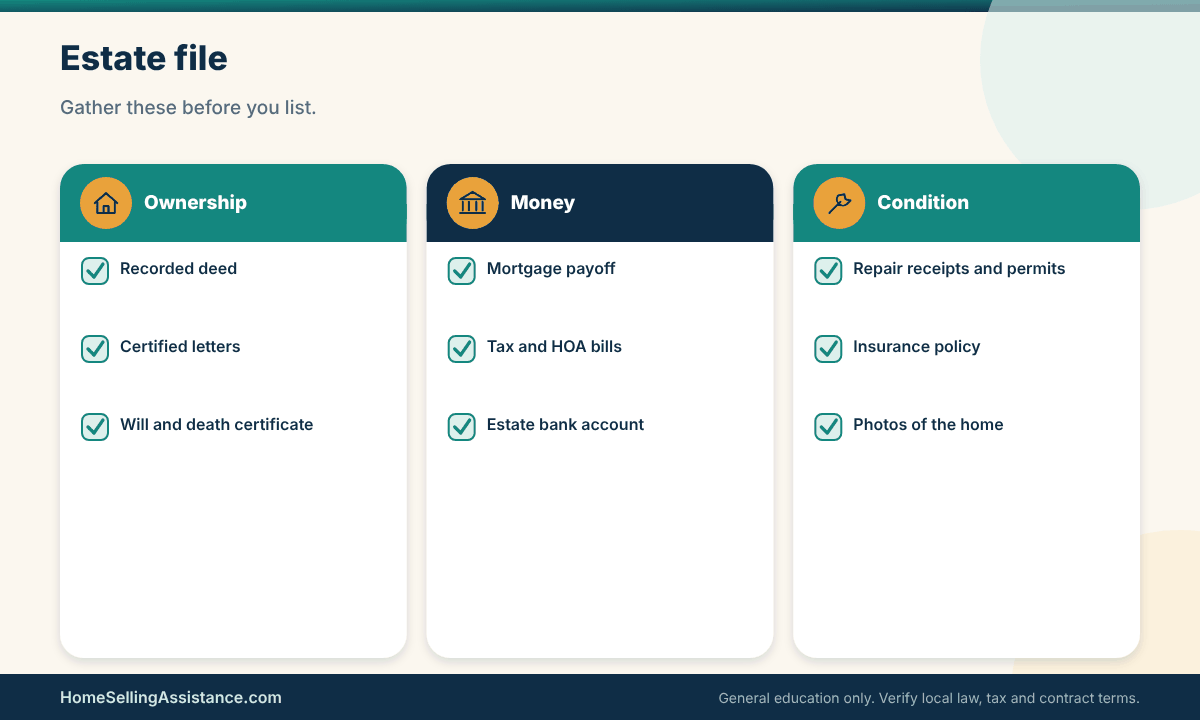
The checklist graphic below groups the documents an estate home sale usually needs into ownership, money and condition, which is a handy way to see what is still missing.
A scenario, an exception and your next step: when the answer you were given does not match the record
Suppose a relative insists the house was left to him alone because “Mom always said so.” The will you filed says the home is divided equally among three children. Meanwhile, the deed on record shows Mom and her late husband as tenants by the entirety, which may mean the house passed outside the will at his earlier death. Three sources, three stories.
In an executor selling house dispute like this, a recorded document beats memory and a will does not automatically override a deed. Depending on how title was held, the estate may own all of the home, only part of it, or none of it. Your attorney will read the deed, the earlier death records and the will together and tell you what the estate truly holds. Until then, nobody should sign a listing agreement or promise a share to anyone.
The exception is a legitimate dispute over whether the will is valid or whether a later document exists. Those are contested matters, and the court decides them. Your role as the executor selling house is to preserve the property, keep records, treat heirs evenhandedly and follow the court’s directions, not to settle family arguments yourself.
Your next step is to request the recorded deed and the earlier death records, send them to your attorney, and let the heirs know that you are confirming ownership before any listing. A short, calm email that says exactly that tends to lower the temperature, and it leaves a written trail that shows you moved carefully.
What must be current on signing day for an executor selling house closing
Documents go stale in every executor selling house closing. A court letter that was fine in March may not satisfy a closing agent in September, a payoff figure changes every day interest accrues, and an insurance policy on a vacant home can lapse without anyone noticing. The last stretch before closing is about confirming that each fact you rely on is still true on the day you sign.
Evidence to gather: fresh letters, payoff figures, insurance and the final accounting of costs
Begin with authority, the foundation of any executor selling house closing. Ask the closing agent whether the letters on file meet their date requirement, and if not, order new certified copies from the court well ahead of closing, since court offices can take days to respond. Confirm that no one has filed an objection, a petition to remove you, or a motion that could change your authority. A quick look at the docket the week of closing is a habit worth keeping.
Then the money in the executor selling house closing. Request an updated written payoff from every lienholder, with a per-day interest figure, and check that the title company has the same numbers. Gather the final property tax and HOA figures so prorations can be calculated correctly. Our walkthrough of the seller closing statement shows how each of those lines will look, and the estate’s side of the closing is covered more fully in estate home sale closing.
Check insurance and utilities, a quiet risk in any executor selling house timeline. Many standard homeowners policies restrict or exclude coverage when a home has been vacant beyond a certain period, and the period differs by insurer. If the house has been empty since the death, ask the agent in writing whether coverage is still in force and whether a vacancy endorsement is needed. Keep utilities on through closing, since inspectors, appraisers and walk-throughs need them.
Review the personal property question. Who owns the furniture, the vehicles in the garage and the items heirs want? Clearing the house is a task, and so is deciding what stays with the sale, and our guide to cleaning out an inherited house before sale offers a practical sequence. Take dated photos before and after, so that nobody can later claim something went missing.
Finally, build a one-page closing summary for the estate file. List the contract price, expected payoffs, closing costs, expected net, the account where proceeds will land and the rule that governs distribution. Share a draft with your attorney. Numbers on the page are illustrative until the final statement arrives, but a summary prepared in advance lets you spot a surprise while there is still time to ask about it.

A scenario, an exception and your next step: the documents say yes, but something changed overnight
Imagine your executor selling house closing is Friday. On Wednesday you confirm the letters, the payoff and the title commitment. On Thursday evening your attorney spots a new filing on the docket: an heir has asked the court to review the sale price. The closing agent says they cannot proceed until the court clarifies. Everything looked ready, and now nothing is.
A late filing during an executor selling house closing is not rare, and it is not a sign you did anything wrong. A last-minute objection is a reason to pause, not to push through. Closing over a pending objection can expose you personally and may give the objecting heir grounds to challenge the deed. Your attorney will explain whether the sale can proceed with a court order, a short continuance or a negotiated resolution.
An exception: if your authority is independent and the filing is only a request for information, the sale might continue. Whether that is true depends on the exact wording and local rules, so do not decide it on your own. The next step is to notify the buyer and agent promptly, in writing, that closing is delayed for a legal reason, and to ask whether the contract’s extension terms apply. Prompt, honest communication usually preserves goodwill better than silence.
Keep a log of every change that affects the schedule, with dates. If the delay ends up costing the estate something, a record that shows you acted quickly and sought advice is your best defense, and it also helps your attorney explain events to the court.
Before the signing appointment, keep a handful of questions that you can answer with a document. Do I hold current, certified court authority? Does the will or statute allow me to sell, and does the court need to approve this sale? Have the required notices gone out, and can I show proof? Does the title commitment have any open requirements? Do I know what the estate owes and in what order it must be paid?
Add three more. Has every disclosure I am obliged to make been made, in writing, to every buyer? Is the estate account open, separate from my personal funds, and ready to receive proceeds? Have I told my attorney about anything I am unsure of? If any answer is no, the signing can wait a day while you fix it. Few buyers walk away over a short, well-explained pause, and a deed signed too early is far harder to undo.
If you only take one habit from this executor selling house guide, make it this: whenever you feel pressure to sign quickly, ask who benefits from the speed. Sometimes it is a buyer with a legitimate schedule. Sometimes it is a relative eager for money. Sometimes it is a vendor with something to sell. A calm executor treats urgency as information, not as an instruction.
Quick scenario
An illustrative case: an executor receives an offer of $300,000 on a house with a $120,000 loan balance. After an estimated $20,000 in closing and carrying costs, about $160,000 would remain, which is not hers to spend. It stays in the estate account until the claim period ends and her attorney confirms who is owed what. The numbers are round examples only, and your estate will differ.
Frequently asked questions about executor selling house decisions
Can an executor sell the house without court approval?
It depends on the state, the will and the type of administration. Some estates are administered independently, so an executor with a power of sale can sell after appointment without a hearing. Others require notice, a hearing or confirmation. Your probate attorney or the court clerk can tell you which path applies, and you should get the answer before you list the home.
Do I need letters from the court before I list the property?
Many executors begin preparing the home before appointment, such as cleaning, photographing and gathering documents. Signing a listing agreement or a purchase contract is different, because you need authority to bind the estate. Some listing agents will wait for letters, others will sign a limited agreement. Ask your attorney what is safe in your state.
What if the will says to sell but the heirs want to keep the house?
A will’s instructions usually control, but heirs may have rights to object or to buy the home. A disagreement is a legal question, not a negotiation you can win by persistence. Talk to your attorney, document each heir’s position in writing, and consider whether a buyout among heirs is practical before listing.
Is an executor selling house property personally liable for mistakes?
Executors owe fiduciary duties to the estate and its beneficiaries, and a careless or self-interested act can create personal exposure. Acting in good faith, following the will and the court’s directions, keeping records and seeking advice are the usual protections. The standard varies by state, so your attorney should explain how it applies to you.
Must I disclose problems with the home if I never lived there?
Many states require sellers to disclose known material defects, and some give executors or estates partial relief from completing the full form. Relief rarely covers concealing something you actually know. Federal lead-paint rules apply to older homes regardless. Check your state real estate commission’s guidance and ask your listing agent or attorney.
Can the executor or a family member buy the house?
Some states allow it, but only with strong safeguards because the buyer sits on both sides of the deal. Common protections include a fair independent appraisal, written consent from heirs and sometimes a court order. Doing it informally invites a later claim of unfair dealing. Do not negotiate with yourself until your attorney has approved the structure.
How long does an estate home sale usually take?
No honest universal number exists. Timing depends on how quickly the court appoints you, whether a hearing is needed, the creditor claim period, the condition of the home and the buyer’s financing. Ask your attorney for a realistic range in your county and then add some cushion for surprises such as a title issue.
What should I do with the sale proceeds?
Deposit them in an estate account opened under the estate’s name and tax identification number, not into your personal account. Distribution usually waits until debts, taxes, expenses and claim periods are settled and your attorney confirms. Distributing early can leave you responsible if a valid claim appears later, so patience protects you.
Are there tax consequences for the estate or the heirs?
Possibly. Inherited property generally gets a basis tied to its value around the date of death, which affects any gain or loss on sale, and the estate or heirs may have filing duties. Our article on inherited home sale taxes explains the basics. A tax professional should review your actual facts before you decide how and when to sell.
How do I spot a scam while handling an estate home?
Be wary of unsolicited offers that push you to sign fast, buyers who avoid putting terms in writing, requests to wire money or change payment instructions, and anyone who asks for fees up front. The FTC publishes consumer guidance at consumer.ftc.gov, and wire fraud can be reported at ic3.gov. Always verify instructions by calling a known number.
Slow down, verify, then sign
Handling an executor selling house transaction is mostly a matter of order: authority first, rules second, marketing third, closing last. You do not have to know everything, only to know what to ask and to write down the answers. This article is general education, not legal, tax or financial advice, so take your questions to a probate attorney and a tax professional in your state, and browse more in our inherited homes and probate library.