Deciding whether to relist expired home listing paperwork as it stands, change it, or walk away from the market for a while is one of the more emotional choices a seller makes, because the sign has come down and the house did not sell.
If you are reading this, your listing probably ended without a closing. Maybe the agreement ran out on its date. Maybe you or your agent pulled the home off the market while a repair, a trip or a family matter got sorted. Maybe the listing was cancelled after a disagreement. Each of those endings leaves a slightly different paper trail, and the trail decides what you are free to do next.
We will separate the terms first, because sellers and agents use them loosely. An expired listing is one whose term simply ended. A withdrawn listing is one taken off the market while the agreement may still be in force. A cancelled listing is one ended early by mutual consent or by a contract right. Your MLS, your state and your signed agreement define these words, so the labels matter less than what the documents say.
Then comes the harder question: should you relist expired home listing details at all, or change the plan around them? Is the problem that the house needs a fresh start, or that it needs a different plan? Sometimes the honest answer is a new price and new photographs. Sometimes it is a repair, a different agent, a different season or a different kind of buyer altogether. This guide walks through that decision in order, with scripts, checklists and a simple net-result rule.
For the wider picture of timing, our cornerstone guide on the best time to sell a house is a good companion.
One caution up front. Rules about listing status changes, days on market counters, protection periods and commission terms differ by MLS, by state and by contract. Wherever you see numbers below, they are round illustrative figures meant to show the arithmetic, not predictions for your property.
Key takeaways
- Read the paper trail first. Expired, withdrawn and cancelled mean different things, and your listing agreement and MLS rules, not the label, decide what you can do and when.
- Diagnose before you relist expired home listing. Showing counts, feedback and price history usually point to one dominant problem: price, presentation, condition, exposure or terms.
- A fresh listing is not a fresh market. Buyers and agents can often see the earlier history, so the plan has to change, not just the status.
- Protect yourself from overlap. Before you relist expired home listing details, check for protection periods, notice clauses and who holds the right to market the home before you sign anything new.
- Judge every path by net result. Compare price, carrying costs, time and risk side by side, using your own quotes and local data.
- Set triggers in advance. Decide now what activity level would make you adjust the price, pause or switch routes.
Decide whether to relist expired home listing or change course
Before anyone suggests a new price, it helps to treat the first listing as an experiment that produced data. You paid for that data with weeks or months of carrying costs and showings, so use it. The goal here is to describe your real choice in plain terms, which is rarely “list again or not.”
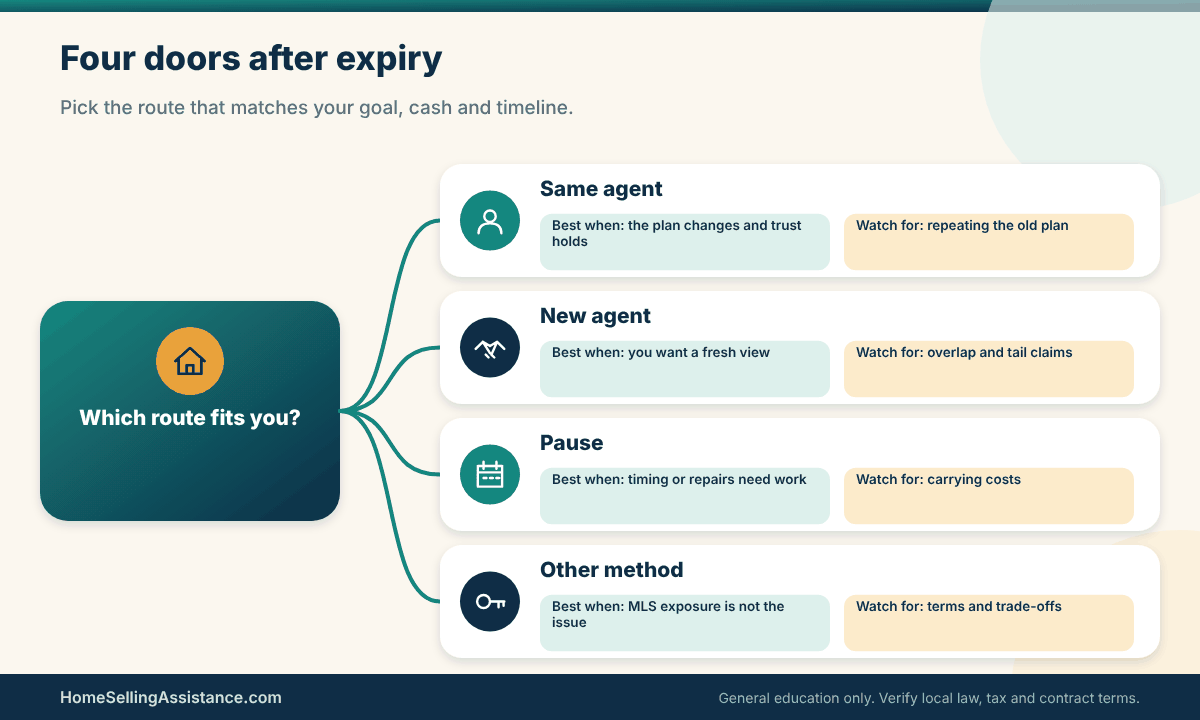
The real choice is usually between several different plans that all happen to start with a listing. One plan changes only the price. Another changes the home itself. A third changes the agent or the marketing. A fourth pauses the sale until the season or your circumstances change. A fifth moves away from the MLS entirely. Seeing the whole menu keeps the urge to relist expired home listing from becoming a reflex.
What goal, timeline, cash and condition tell you before you relist expired home listing
Four personal facts shape every sensible plan: what you need the sale to accomplish, when you need it done, how much cash you can spend while waiting, and what condition the home is in. Write each one down in a sentence. Sellers who skip this step often relist expired home listing paperwork because it feels like progress, then discover three months later that their real constraint was something the listing could never fix.
Goal means what the sale must do. Pay off a loan and fund a down payment on the next place. Release an estate to heirs. Finish a divorce settlement. Each goal carries a different tolerance for waiting and for a lower price. Timeline means the date after which waiting becomes expensive or impossible, such as a job start, a lease end, a school year or a deadline in a court order.
Cash means how many more months you can pay the mortgage, taxes, insurance, utilities and upkeep on a house nobody lives in or that you live in while it sits. Condition means the honest state of the property, including anything a buyer’s inspector would flag. Risk tolerance sits across all four. Some sellers sleep fine with an open-ended listing. Others need a firm date and a firm number.
Evidence to gather: the old listing’s activity record
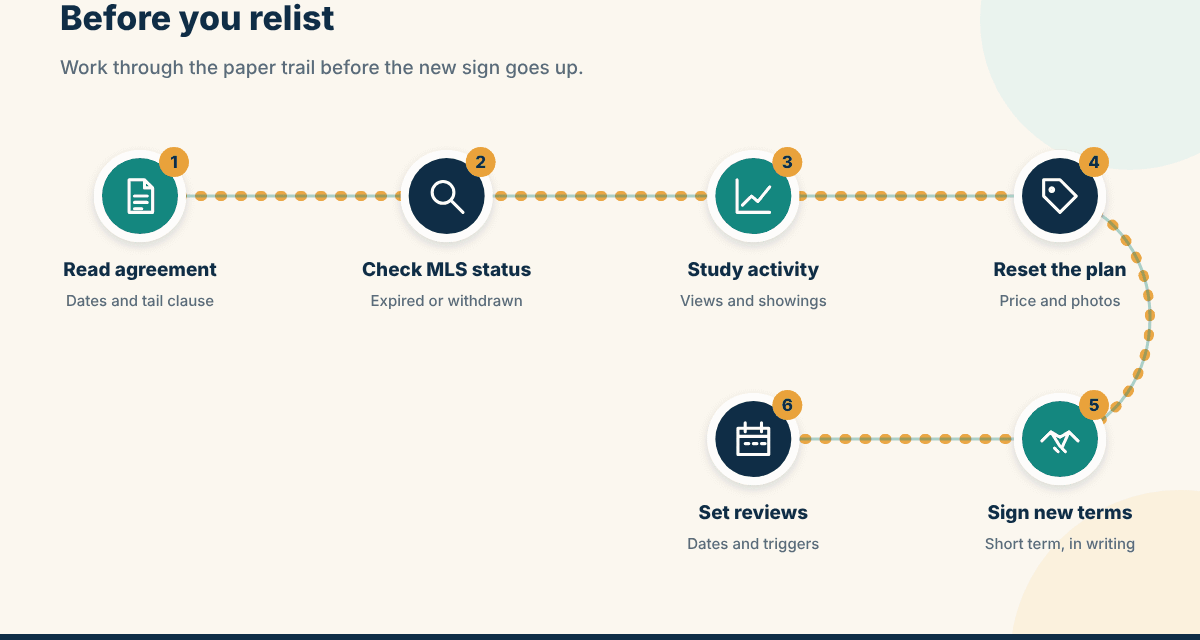
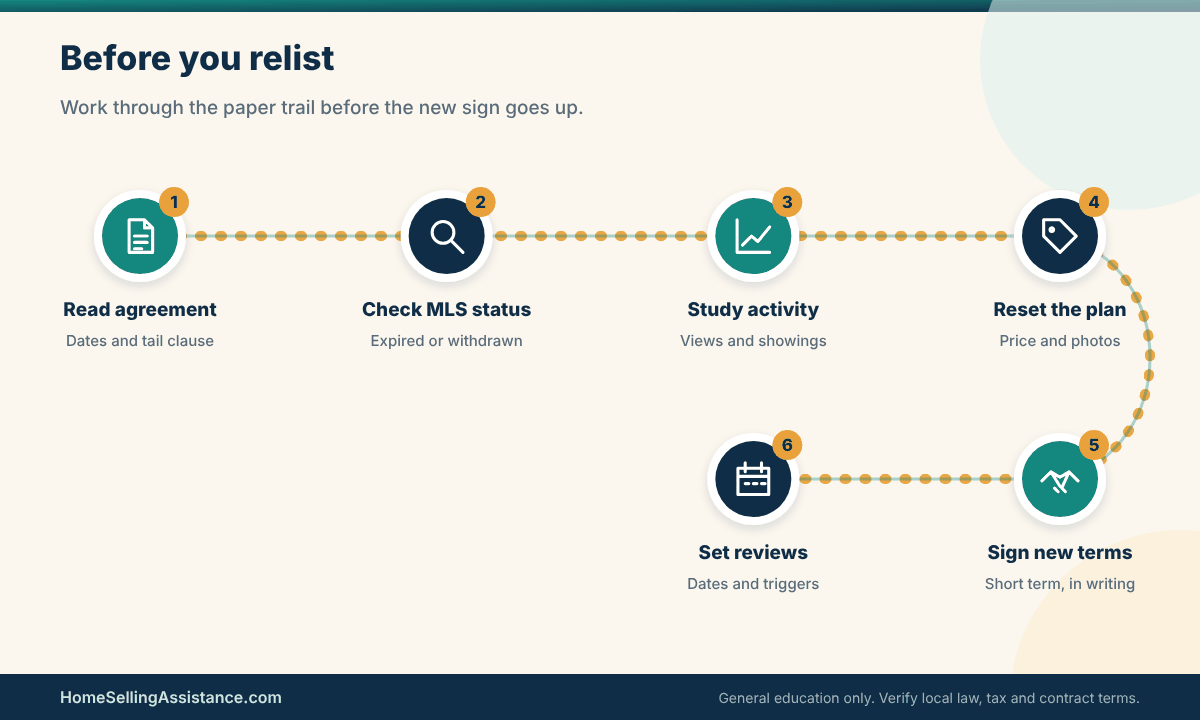
Before you relist expired home listing details, ask your previous agent, in writing, for a complete activity summary of the expired term. A reasonable package includes the date the listing went live, every price change with its date, the number of online views and saves if the portal provides them, the number of showings, any feedback from buyers’ agents, and any offers, including ones you rejected or countered.
Also request the actual listing sheet as it appeared, the photographs used, and the description text. Sellers are sometimes surprised when they look at the public page with fresh eyes. A blurry front photo, a missing room, a description that buries the best feature or a price that sits just above a common search cutoff can quietly cost a house many views.
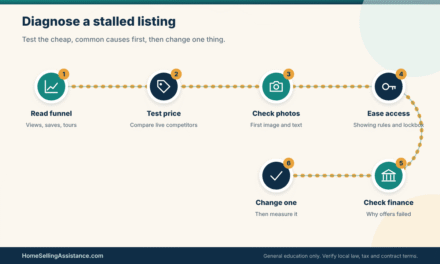
Then read the pattern rather than any single number, because it tells you what to fix before you relist expired home listing materials. Few views with a handful of showings suggests an exposure or first-impression problem. Many views, few showings suggests that the price, photos or location of the listing is getting a quick no. Many showings, no offers suggests condition or price problems that appear only in person. Showings with offers that you declined suggests a gap between your expectations and what buyers will pay.
If the agent cannot or will not provide these records, check whether your MLS gives sellers access through a client portal or whether the public history on large portals tells part of the story. Treat any missing data as a gap to fill, not as a verdict. Your local agents can often pull the same history for a comparable market analysis, and a short consultation with one of them costs nothing in many markets.
A scenario, an exception, and your next step for the goal question
Take an illustrative case. A seller needs to move for a job in roughly four months and let the first agreement run its full term. The record shows steady online views, many showings and no offers, with several buyers’ agents commenting that the kitchen felt dated and the price felt a bit high for the finish level. The goal is a move date, the timeline is firm, and cash is limited.
For this seller, choosing to relist expired home listing at the same number would likely repeat the first term. A sensible next step is to test a lower price band against nearby recent sales, handle the most commonly mentioned cosmetic issues that are cheap to fix, and agree in writing on a date to revisit the price if activity stays flat. The concept matters more than the specifics: each step answers something the data showed.
Now an exception. A different seller has no hard deadline, strong savings and a home with a quirky layout that suits a narrow group of buyers. Few showings may be normal for that kind of house. Waiting for the right buyer may be reasonable, and a longer listing period, a specialist agent or marketing aimed at the right audience may do more than a price cut. The same facts can call for opposite plans, which is why your goal comes first.
Your next step is small, and it comes before any decision to relist expired home listing paperwork. Before you speak to a single agent about new terms, write your goal, timeline, monthly carrying cost and condition notes on one page, and add the activity record from the expired term. That page becomes your reference when someone offers you a pitch.
Facts about the expired listing that could change the decision
Some facts matter as much as price and photos when you relist expired home listing records, and they can change both the legal position and the market’s perception of your home. These include the exact status in the MLS, any protection or tail clause in the old agreement, the way your MLS handles days on market when a home returns, and whether any buyer who saw the home during the first term might still be a live prospect.
There are also practical facts: whether a pending repair or permit issue emerged during the first term, whether an offer fell through for a reason that now must be disclosed, and whether the home has been vacant. Each of these may alter what you say to the next buyer, what you fix, and who you pick to help you.
Evidence to gather: agreement terms, MLS status and protection clauses
Pull out your signed listing agreement and read three things: the stated start and end dates, any clause about what happens to buyers the agent introduced during the term, and any clause that covers early termination or withdrawal. Many agreements contain a protection period, sometimes called a tail, that can entitle the old brokerage to compensation if you sell to someone it introduced to the home, even after the term ends. Whether it applies, and for how long, depends entirely on your contract and state rules.
Many agreements also require the brokerage to give you a list of protected buyers within a set time after expiration. If you never received one, ask for it in writing. If you sign with a new agent while a protection clause still applies, the two agreements can overlap, and a buyer on the protected list could trigger a claim from the old broker even after a sale through the new one. Our guides on the listing agreement and on exclusive right to sell agreements explain how these clauses typically work.
Next, confirm the MLS status, since any plan to relist expired home listing data depends on it. Ask the old agent or the MLS support line, through an agent, what the status says: expired, withdrawn, cancelled or terminated. Each status can follow different rules about reactivating the same record, creating a new listing, resetting the days-on-market counter and re-using photos. Some MLSs have rules aimed at stopping the practice of changing status just to make a listing look new, and you should not try to work around them.
Finally, check your compensation terms. Broker compensation is negotiable and should be written down. If you were offering a certain arrangement to buyers’ agents in the first term, read exactly what it said and decide whether you want to repeat it, change it, or leave it for each offer to address. Our article on seller real estate commission covers the options in plain terms.
A scenario with a withdrawn listing and an exception to check
Consider a seller who withdrew the listing after four weeks because a water stain appeared on a ceiling and a buyer’s agent raised it. The seller repaired the leak, kept the receipts and wants to come back to market quickly with the same agent. Because the home was withdrawn rather than expired, the original agreement may still be running. That can be good, since there is no gap and no need to start over, but the seller should still ask what the MLS will show when the listing returns.
Here, to relist expired home listing records safely, the next step is a short written agreement, an addendum or a fresh listing form, that records the new price, the new marketing plan, the repair documents available to buyers and the way the days-on-market counter will be handled under local rules. The seller should also decide how the earlier leak will be disclosed. Disclosure duties vary by state, but a repaired problem that a buyer already heard about is usually better explained openly, with records, than left for a buyer to discover.
The exception: if the withdrawal happened because of a disagreement with the agent, the seller may want to end the agreement rather than extend it. Cancellation terms differ, and some agreements allow it only with the brokerage’s consent. Read our guide on how to cancel a listing agreement before sending an angry email, because how you leave can affect how the next stretch goes.
Compare the two realistic ways to relist expired home listing
Once you know your goal and your paperwork position, the practical choices for how to relist expired home listing details narrow to two broad families. In the first, you return to the market with the same agent or brokerage, but under a different plan. In the second, you change something bigger: the agent, the timing or the sales method. Both can work, and both can fail if the underlying problem is not addressed.
The table below puts the two families of ways to relist expired home listing materials side by side so you can see where they differ in money, time, contract exposure, workload and risk. We label the cells in general terms because local practice varies, so use it as a conversation guide when you speak with agents and, where the contract is unclear, an attorney.
| Factor | Option A: relist with same agent | Option B: new agent, pause or new method | What to check |
|---|---|---|---|
| Price and net proceeds | Often a revised price; commission terms may carry over | New price view from a fresh opinion; terms renegotiated | Written net sheet under each plan |
| Time | Fast restart, little gap | Slower start, but possibly a cleaner reset | Dates in old and new agreements |
| Contingencies and contract | Existing agreement may simply be amended | Possible protection clause or cancellation terms | Tail period, notice, consent |
| Workload | Lower; the agent knows the home | Higher; new photos, new paperwork, new meetings | Who handles what, in writing |
| Execution risk | Repeats earlier results if the plan is unchanged | New agent may overpromise to win the listing | Evidence behind every promise |
| Flexibility | Moderate; you are tied to one brokerage | High before signing, less after | Term length and exit rights |
Read the table by row, not by column. Pick the row that matters most to you, such as time or contract exposure, and weigh the two options against that one factor first. Then repeat with the next most important row. If both options score the same on your top two rows, the tiebreaker is usually the evidence behind the plan, which is the subject of the next sections.
Path one: relist with the same agent, a new plan and a new price
Returning with the same agent has real advantages when you relist expired home listing details after a short or interrupted term. The agent already knows the home, the neighborhood, the buyer feedback and your priorities. There is no learning curve, no new photographer to schedule from scratch and no gap in representation. If the first term simply ran too short for the market to respond, or a temporary issue interrupted it, this route can be efficient and sensible.
The danger is inertia. A decision to relist expired home listing details only makes sense if something is different: the price, the condition, the presentation, the marketing or the strategy. A new date on an old plan will tend to produce an old result. A good test is to ask your agent to put in writing three specific changes and the reason for each, tied to the activity record from the expired term.
As the second image shows, there are really four doors from here: relist with the same agent, relist with a new one, pause, or sell another way. Think of this section as door one, the simplest way to relist expired home listing materials. The decision fork below sets out when each door tends to fit.
Evidence to gather: what the agent can show you in writing
If you are leaning toward the same agent to relist expired home listing details, ask for a short written plan before you extend or sign anything. A useful plan names the new list price and the comparable sales or active competition that support it, the specific changes to photographs and description, the schedule for reviewing activity, and the date or conditions that trigger a price review. It should also say how the listing will be shown in the MLS after the change.
Ask what the agent thinks went wrong the first time, and listen for specifics. An answer like “the market was slow” is rarely enough. A better answer cites a price that sat above recent sales, a feature that photographed poorly, a showing restriction that blocked weekend traffic, or feedback that repeated a pattern. If the agent’s explanation does not match the data, trust the data.
Ask also about the cost side. Is the compensation arrangement unchanged? Are there any marketing costs that you pay out of pocket, and were they used the first time? Sellers sometimes pay again for services that produced little. The goal is not to be suspicious, only to keep the plan tied to evidence. Our guide on how to choose a listing agent includes questions that work just as well for an existing agent you are thinking of keeping.
Finally, ask about communication. A short weekly note with views, showings and feedback keeps both of you honest, and it gives you the facts you need if you later decide to adjust the price or change course. Put the schedule in the plan so it does not depend on anyone’s memory.
Scenario and next step for staying with your current agent
Imagine a seller whose listing expired after a quiet winter term with few showings. The agent shows that the price was in line with recent sales, the photos were taken on a grey day, and the listing went live shortly before the holidays. Feedback was thin. In that case the first term may simply have been poorly timed, and a modest price adjustment, new photographs and a restart ahead of the busier months could be reasonable. You can read more on timing in our piece on home selling seasonality.
Now suppose the same seller sees steady showings and repeated comments about a worn carpet and a dark basement. Here the better move may be to deal with the carpet, brighten the basement, then relist expired home listing materials. Spending a little before the second launch can be better than spending months explaining the issue.
The next step in either case, once you decide to relist expired home listing details, is a short written addendum or new agreement, signed only after you have read the plan. Keep the term modest, perhaps shorter than the first, so that both sides have a reason to act on the data. A shorter term is not a punishment. It is a way of keeping a review date on the calendar.
Path two: switch agents, wait, or sell another way
The second family of choices is bigger and often misunderstood, and it changes what it means to relist expired home listing records. It includes hiring a different agent or brokerage, waiting for a better season or for repairs to finish, or leaving the traditional listing route for something else, such as a negotiated private sale, a flat-fee MLS listing, a cash offer or, in some situations, renting the home for a time. Each has its own trade-offs, and none is automatically better.
Changing agents can bring a new perspective on price and presentation, a different network of buyers’ agents and different marketing strengths. It can also bring a new set of promises. Be wary of any agent who wins your listing mainly by naming the highest price, since a price that looks generous in a meeting can turn into a long wait later. Look for the person who shows the clearest evidence and the most honest plan.
Evidence to gather: protection periods, interviews and alternatives
If you are leaving your agent, your first piece of evidence is the contract. Check the end date, the protection clause and any notice requirement. If the listing is still active, find out whether the agreement lets you terminate with notice, with a fee, or only by mutual consent. Do not sign with a new agent until you know whether the old agreement is truly finished, because overlapping agreements are a common source of disputes over who is owed compensation.
Next, interview at least two or three agents about how they would relist expired home listing materials, and compare their answers on the same questions. Ask each to bring a comparable market analysis, a marketing plan, and an explanation of what they would change about your first listing. Ask how they handle price reviews and how often they report. Ask about their experience with homes that have been on the market before, and whether the MLS in your area has rules that affect relisting. Pay attention to who listens before talking.
For alternative methods, gather real quotes. A flat-fee MLS service, a cash buyer, an auction house or a rental manager will each give you numbers and terms, and you can compare them against a conventional relisting using a net-proceeds sheet. Be skeptical of vague promises of speed or certainty, and read every contract term before you agree. Our article on what to do when a house is not selling goes deeper on the alternatives.
If the issue is a condition problem, an inspection can supply hard evidence. A pre-listing inspection or contractor estimates tell you what a buyer will probably find. Our guides on the pre-listing home inspection and on repairs before selling a house describe how to decide what is worth fixing.
Scenario with a pause, a new agent and a reason to wait
A seller in a cold-weather market lists in late autumn, receives little interest and sees the listing expire. The seller is not in a hurry, and a pause until the spring buying season may cost less than a long winter of carrying costs and price cuts. In that case, using the pause to complete repairs, update photographs and gather documents can give the next launch a stronger start.
A different seller needs to sell before a job relocation, has little time to wait, and has a home that is priced above recent sales. A pause would not help, because the issue is price, not season. The better route is a new price view from a second agent, a candid conversation about the carrying cost of waiting, and a clear plan for the next few weeks.
The exception to watch for is the agent who suggests relisting immediately under a new listing number to reset the days-on-market counter. Whether and when that is allowed depends on MLS rules, and buyers and agents can often see the history anyway. A quick restart rarely replaces a real change in price or presentation. Ask directly what the local rule is, and ask for the answer in writing.
Your next step on how to relist expired home listing records: choose the two routes that fit your goal best, list the documents or quotes needed to compare them, and set a date a week or two out to decide. An open-ended search for the perfect plan costs money every month, so give yourself a deadline.
Use a net-result rule to decide when to relist expired home listing
After the stories and the contracts, you still need a way to decide whether to relist expired home listing details. A simple net-result rule keeps the decision grounded: for each plan, estimate the price you can reasonably expect, subtract the costs of getting there, add the cost of the time it will take, and weigh the risk that the plan does not work. The plan with the best net result for your goal, not the highest list price, wins.
Using this rule to relist expired home listing materials does not require perfect forecasts. It requires honest ranges and written quotes. A seller who writes “maybe this much, maybe that much” next to each plan will see differences that are invisible when everything sits in the head. Treat it as a discipline, not a calculation that gives certainty. Sale prices, timing and buyer behavior can never be guaranteed.
A price, time, cost and risk framework you can run on one page
To compare plans before you relist expired home listing records, draw four columns on a sheet of paper or a spreadsheet: price, time, cost and risk. Give each plan its own row. Under price, write a low and a high figure supported by comparable sales and current competition. Under time, estimate the weeks until a likely closing. Under cost, add the monthly carrying costs multiplied by the weeks, plus commission terms, repairs, marketing and any fees. Under risk, write the one thing most likely to go wrong.
The waterfall picture shows the idea in miniature. It starts with a list price and subtracts the pieces that sit between that number and what you keep. In the version for a plan to relist expired home listing details, there are a few extra lines that a first-time sale does not have, such as the months already spent, carrying costs during a second term and any price reduction needed to bring buyers in.
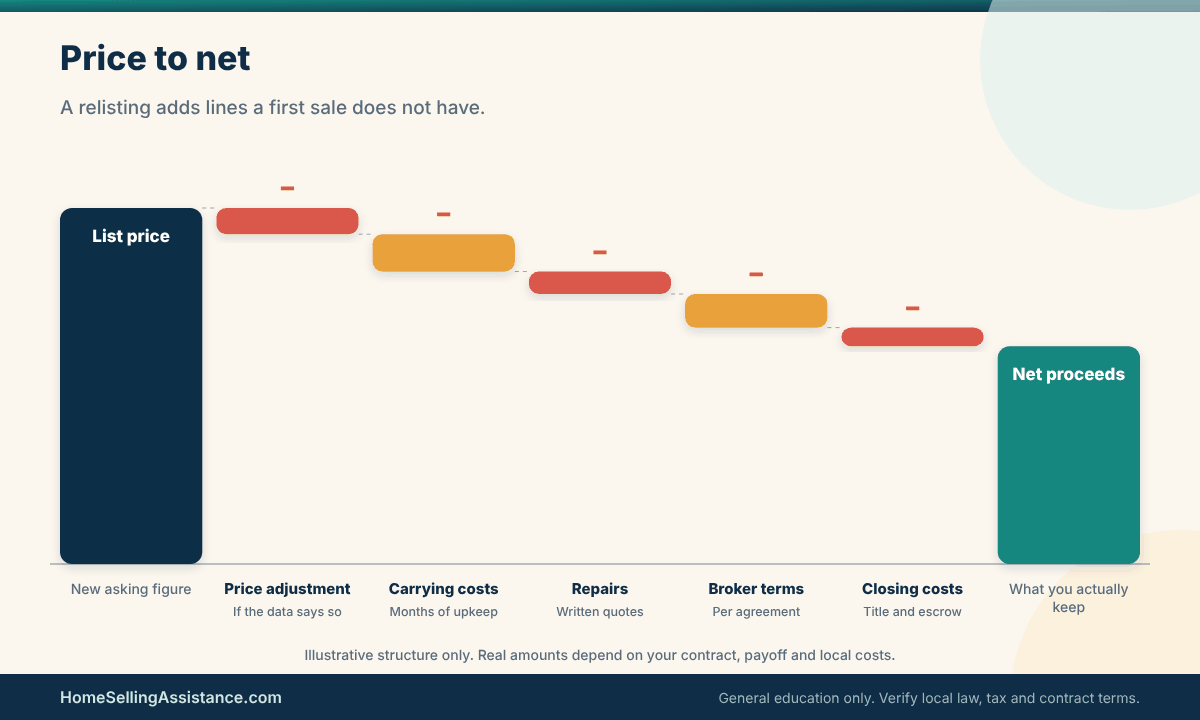
Evidence to gather: comparable sales, carrying costs and written quotes
For price, use closed sales of similar homes in your area from a recent period, not asking prices. Active listings show the competition, and pending sales show what buyers are accepting now, but closed sales show what buyers actually paid. Ask agents for a comparable market analysis and read the adjustments, since the reasoning matters more than the final figure. Our guide on how to price a house to sell shows how that reasoning works.
For carrying costs, collect your actual monthly figures: mortgage payment, property taxes, insurance, utilities, lawn or snow care, HOA dues and any other regular spending. Add the cost of keeping the home show-ready, including cleaning and small upkeep. Keep these as monthly numbers so they can be multiplied by the weeks of delay in each plan. A plan to relist expired home listing records that takes three more months to close costs three more months of these, whatever the final price.
For commissions and fees, ask for the terms in writing. Compensation to the listing brokerage and to buyers’ agents is negotiable, and it must be stated in the agreement. Ask for a net sheet showing proceeds at two or three sale prices under each plan. Your title company or a closing attorney can often help check the closing-cost lines. Our piece on home sale net proceeds walks through a typical sheet.
For the repair question, gather estimates rather than guesses. A contractor’s written estimate for a roof patch or a flooring replacement turns a vague worry into a number you can compare against what buyers might ask for. Keep every receipt and permit, because those documents help later in negotiation and disclosure.
Now an illustrative example, using round numbers only. Suppose a home could plausibly sell for a range around three hundred thousand dollars after a price adjustment, and carrying costs run about two thousand dollars a month. If Plan A is likely to take two months to a closing and Plan B four months, the extra two months cost around four thousand dollars before any difference in price. Plan B must therefore deliver a better price, or a lower risk, by more than that to be worth it. The figures here are invented to show the method, so use your own.
Scenario, exception and next step for the one-page rule
A seller compares three routes. Route one is to relist expired home listing records with the same agent at a lower price after cosmetic work. Route two is a new agent at a slightly higher price with no work. Route three is a pause for the spring season with repairs done in the meantime. When the one-page sheet is complete, the second route has the highest price but the weakest evidence, and the third has the lowest carrying cost risk only if the seller can truly afford the wait.
The sheet does not pick a winner automatically. It shows that the second route depends on a price the data does not support, so the seller discounts it. The seller then sees that the first route is faster and cheaper, but the third could net more if cash allows. That clarity moves the conversation from opinions to trade-offs, which is the point.
An exception: the rule can mislead when a non-money factor dominates. A seller who is caring for a parent, or who needs to be out by a court date, may rightly choose the fastest option even if the net is lower. The sheet is a tool, not a verdict. Add a “must-have” line at the top of the page and rule out any plan that fails it before you compare the rest.
To make the comparison concrete, the checklist graphic collects the preparation items that tend to separate a stronger relaunch from a repeated one. Run through it before you sign anything to relist expired home listing details. If three or more items are unchecked, delay the launch until they are done, since a second launch that looks like the first gives buyers little reason to look again.
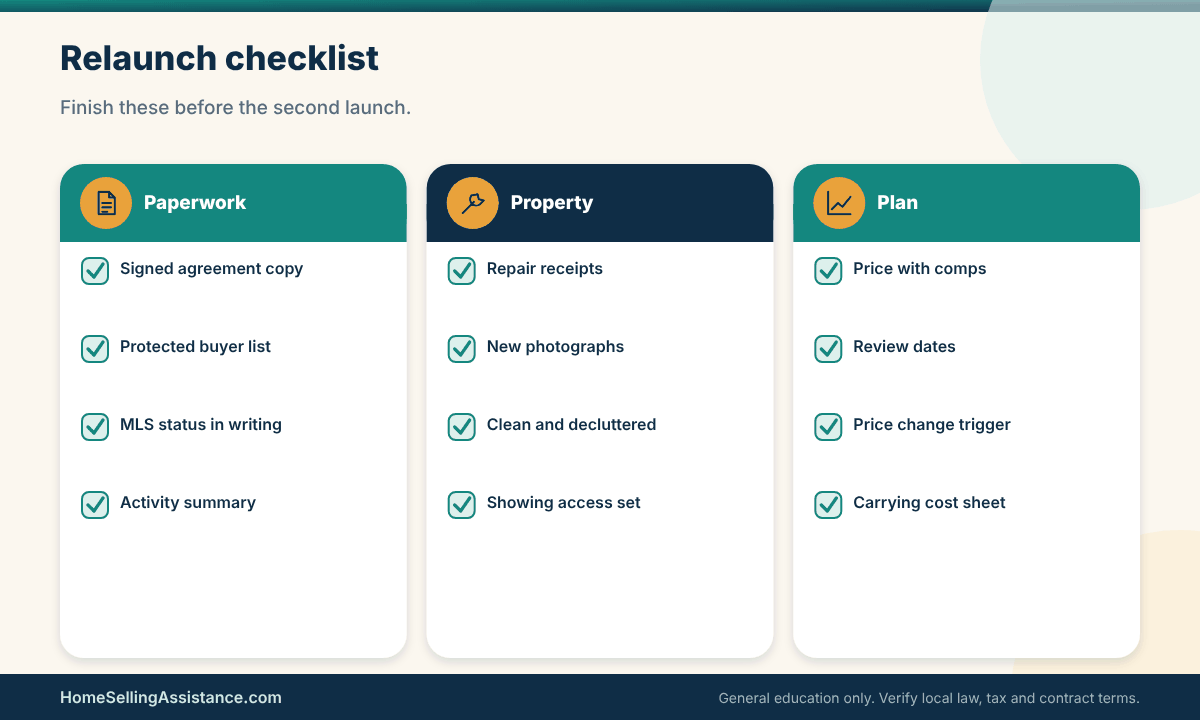
Your next step is to complete the sheet for at least two plans, share it with an agent you trust and ask them to challenge your assumptions. A good agent will find the weak number quickly. If the agent only agrees with everything, that is useful information as well.
The second table puts common seller situations next to the route that tends to fit, why, what it costs you and the single fact that would change the answer. Use it to test your own situation against a familiar pattern, then adjust for your facts. Remember that no table replaces local data, and rows describe tendencies, not rules.
| Situation | Route often favored | Reason | Trade-off | Fact that changes it |
|---|---|---|---|---|
| Priced above recent sales, lots of showings | Relist with a revised price | Interest exists; price is the gap | Lower proceeds per sale | Fresh comps showing a rising market |
| Few online views, weak photos | Relist after new photography | First impression limited exposure | Short delay and small cost | Agent’s marketing was already strong |
| Inspection issue scared buyers | Repair, document, then relist | Removes a known objection | Upfront spending | Estimate far above likely price effect |
| Hard deadline within weeks | Fastest credible route | Time outweighs price | Likely discount | Carrying costs you can absorb |
| Off-season expiry, flexible timing | Pause, prepare, relaunch | Better season may help | More months of carrying cost | Cash to wait |
| Disagreement with agent | Switch after checking protection terms | Trust matters for a long process | Possible overlap claim | Cancellation or tail clause wording |
When two rows seem to apply to you, favor the one that involves a fact you can document. A home with weak photos and a price above recent sales needs both fixes, but the price change will probably matter more. If you are unsure, ask two agents which fix they would do first and why, then compare their reasoning, not their confidence.
When new evidence should change the plan after you relist expired home listing
A plan to relist expired home listing details is a hypothesis. The first weeks of a second listing give you new evidence quickly, and the discipline of the rule is to let that evidence move you. Sellers who hold to a plan out of pride, or who change it out of panic every few days, both lose money. The healthy middle is a written review schedule with triggers set in advance.
Set the first review for a short, fixed point such as ten to fourteen days after launch, and then a regular rhythm after that. Compare views, showings and feedback with what you and your agent predicted. If the numbers match, stay the course. If they fall short, decide which of the usual suspects is responsible: price, photos, condition, access or terms.
Evidence to gather: showings, feedback and the signals buyers send
Early activity after you relist expired home listing materials tells you a lot. Strong online views with few showings suggests a price or photo issue that turns interest away. Plenty of showings with silence afterward points to what buyers see in person, such as condition, smell, clutter or layout. Offers that arrive well below your price may signal that the market sees the home as worth less than you do, or that the home is being tested for a bargain.
Feedback from buyers’ agents is useful when it repeats. One comment about a paint color is noise, while five comments about the same issue is a signal. Keep a simple tally, and share it with your agent. Also watch the competition: if three similar homes appear nearby at lower prices, your effort to relist expired home listing details is competing with a changed market, which our guide on housing inventory and sellers covers.
The days-on-market figure deserves care. Many buyers read a long figure as a sign of a problem, and in some MLSs the counter may reset or carry over depending on the rules. Either way, you cannot hide the history, since agents and portals often keep records of earlier listings. Plan on the assumption that informed buyers can see it, and meet the question directly. Our article on days on market for sellers explains what the figure does and does not tell you.
Finally, watch your own limits as you relist expired home listing details. If your cash cushion shrinks faster than expected, or your timeline tightens, that is also new evidence. A plan that made sense at the start may no longer fit your goal, and adjusting it is not failure.
Scenario, exception and next step for changing course
Picture a seller who decides to relist expired home listing materials at an adjusted price and, after two weeks, sees many online views but only a couple of showings, both followed by comments about the price.
The seller and agent had agreed on a review at this point. They look at the closest recent sales and at the new competition, and decide on a further adjustment, announced with a refreshed description. Because the review was already scheduled, the change feels like part of the plan, not a defeat. Our guides on when to reduce a house price and on how much to reduce a house price go through the logic of a reduction.
A different seller sees a few offers well below the list price within the first week. Reacting by dropping the price at once would send a message that the home is negotiable below that level. Instead, the seller and agent review the offers, counter the most serious one and watch whether other buyers respond. Early low offers do not always mean the price is wrong.
The exception to remember: if the activity is strong and a buyer’s financing or inspection falls through, that is not a signal against the plan. It is a normal part of selling. Our guide on backup offers can help you stay ready.
Your next step is to put the review dates on your calendar the day you relist expired home listing details, write down the numbers that would trigger a price change, a pause or a change of agent, and share them with your agent. Decisions made calmly in advance tend to be better than decisions made after a bad weekend.
Triggers are easier to follow when you can see them. The last picture maps the usual patterns in the first few weeks, from almost no activity to showings without offers to low offers to a deal that falls apart, and it pairs each with a sensible first question. Use it as a prompt for a conversation with your agent, never as an order, because the right answer depends on your contract and your market.
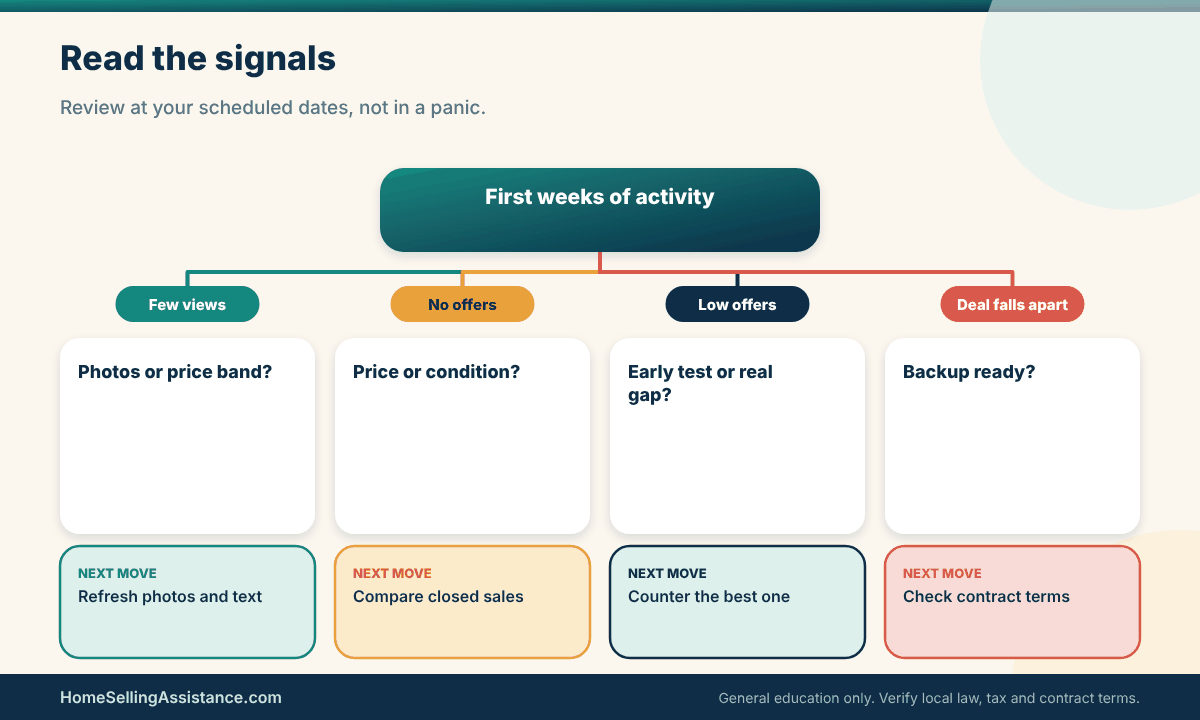
Quick scenario
A seller lets a first term end, asks three questions (what did buyers say, what does the agreement say, what does carrying the house cost per month) and then chooses to relist expired home listing materials with a new price, new photographs and a signed review date three weeks out. Nothing about it is dramatic. It simply replaces a hope with a plan. All figures in any example like this are illustrative and your own numbers will differ.
A short note on tone with buyers. A seller who relists expired home listing details and then explains the history openly, such as “we repaired the leak, here are the receipts,” usually reads as straightforward. A seller who pretends the earlier term never happened invites suspicion. Fair housing rules also apply to how you describe and show the home, and you should never steer or screen buyers by protected class. HUD explains those rules on its fair housing and equal opportunity pages.
If you want to read more about how timing, competition and pricing interact in a slower stretch, our library on market conditions and timing collects the related guides. For questions about agent terms, protection periods and compensation, the section on listing agents and commissions is the place to start. Both pair well with the cornerstone article on choosing the best time to sell a house.
Frequently asked questions about relist expired home listing
How soon can I relist expired home listing details after the term ends?
The answer depends on your MLS rules and your agreement. Some systems allow a new listing almost immediately, while others treat a quick return as a continuation and carry the earlier days on market forward. Ask your agent to cite the specific MLS rule in writing rather than relying on a general statement.
Does a new listing number hide the earlier history?
Usually not for long. Agents can often see prior listings of the same address, and public portals frequently keep their own records. Many MLSs have rules against changing status only to make a home look new. Plan as if informed buyers know the history and make sure the plan itself has changed.
Is it better to relist expired home listing with the same agent or a new one?
Neither is automatically better. The same agent knows the home and can move quickly, while a new agent offers a fresh view and different contacts. Judge each by the written plan and the evidence behind it, and check for protection clauses before you sign with anyone new.
What is a protection period and why does it matter?
It is a clause that can entitle the earlier brokerage to compensation if you sell to a buyer it introduced during the term, even after the agreement ends. Length and wording vary by contract and state. Ask for any protected-buyer list in writing and keep a copy before you sign a new agreement.
Should I lower the price before I relist expired home listing paperwork?
Not automatically. Compare your old price with recent closed sales and with current competition, and look at the activity record. If views and showings were strong but no offers came, price is a likely factor. If views were weak, photos and exposure may matter more. Your agent can show you the comparisons.
Do I need to disclose problems that came up in the first term?
Disclosure rules vary by state, and you should ask a local attorney or your state real estate commission what applies. In general, a known material issue, even one that was repaired, is better explained with records than left for a buyer to discover. Do not rely on a buyer not hearing about it.
Can I sell without relisting on the MLS at all?
Yes, in many cases. Options include a flat-fee MLS listing, a private sale, a cash offer or waiting for a better season. Each has trade-offs in price, speed, paperwork and risk, so compare written quotes. The National Association of Realtors publishes consumer material at nar.realtor, which can help you understand current practices.
What if the old agent keeps calling me after it expires?
Calls after an expiration are common from many agents, including the one you worked with. You are free to listen and compare plans, but you do not have to sign anything. Treat each pitch the same way, by asking what would change, what evidence supports it and what you would have to commit to in writing.
How long should a second listing term be?
There is no universal answer. Many sellers prefer a shorter term with a scheduled review so that the plan can be adjusted, while others need longer for a specialized property. Read any automatic renewal language, and ask whether you can end the agreement early if activity stays flat. Put the review dates in writing.
Your plan before you relist
To relist expired home listing paperwork well, start with your goal, read your agreement and MLS status, study the activity record, and compare a few plans on price, time, cost and risk. Change something real before you relaunch, and set review dates in advance. This article is general education, not legal, tax or financial advice, and your contract, state and local market control the details, so check them with a licensed professional before you sign.