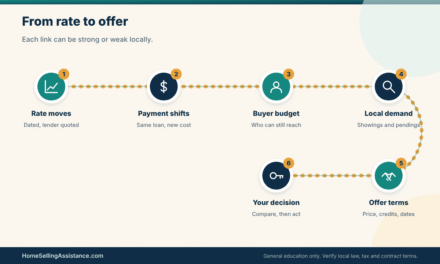
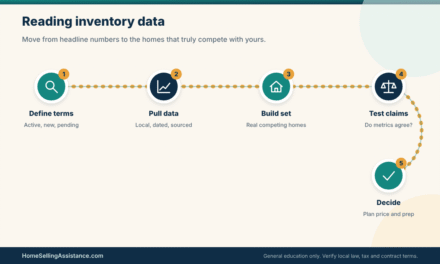
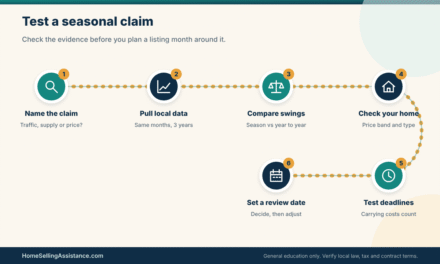
Working out how much to reduce house price is a matter of evidence, not a guessing game, and the sellers who handle it well are usually the ones who stop asking for a magic percentage and start asking what buyers in their own market have actually done with similar homes this month.
If your home has been listed for a while and the phone has gone quiet, the pull toward a round number is strong. Someone at a barbecue says “drop it five percent.” A website says the average reduction is something or other. Your agent suggests a figure and you nod because you are tired. Each of those answers to how much to reduce house price may turn out to be close to right, but none of them is a method, and a method is what protects you from cutting too little to matter or too much to recover.
This guide builds that method in plain steps. First we define the comparison you are really making and the inputs it needs. Then we put your options, such as holding, reducing a little, reducing a lot or changing the listing strategy, on the same footing so they can be compared fairly. Finally we talk about false precision, because a reduction figure that looks exact is often more dangerous than one that admits its own margin of error.
It sits inside our wider set of guides on the best time to sell a house and the market conditions that shape every listing. If your real question is whether to cut at all, start with our companion piece on when to reduce your house price, then come back here for the size of the move. Every example number in this discussion of how much to reduce house price is an illustration with round figures, chosen to show the arithmetic and not to predict your sale.
Key takeaways
- There is no universal percentage. The right size of a cut depends on your comparable sales, current competing listings, buyer activity and how far above the evidence you started, and all of those are local.
- Feedback tells you which problem you have. Few showings points at price or presentation, showings without offers points at price or condition, and low offers point at where buyers think value sits.
- Date every number. A comparable sale from a different season or rate environment may not describe today’s buyers, so write down where each figure came from and when.
- Compare options like for like. Reduction, patience and a change of strategy should be judged by expected price, time and risk together, not by the list price alone.
- Use ranges, not single points. A sensitivity range shows how fragile your conclusion is and keeps you from treating an estimate as a fact.
- Some answers need a live source. A current comparative market analysis, an appraisal, your listing agreement and your lender’s figures settle what an article cannot.
A method for deciding how much to reduce house price
Before any arithmetic, it helps to say out loud what you are deciding when you settle how much to reduce house price. It is not a punishment you apply to a stubborn house, and it is not an admission that you made a mistake. It is a new offer to the market, made with better information than you had on day one. The only question that matters is whether the new number lines up with what a ready, financed buyer is likely to pay for this home, in this condition, against the other homes they can visit this weekend.
That framing changes the job. Instead of asking for a percentage, you are trying to locate your home among its competitors and decide how far it sits from where buyers are actually spending money. The distance between those two points is your first answer to how much to reduce house price. Everything in this section is about measuring that distance honestly.
The inputs behind how much to reduce house price
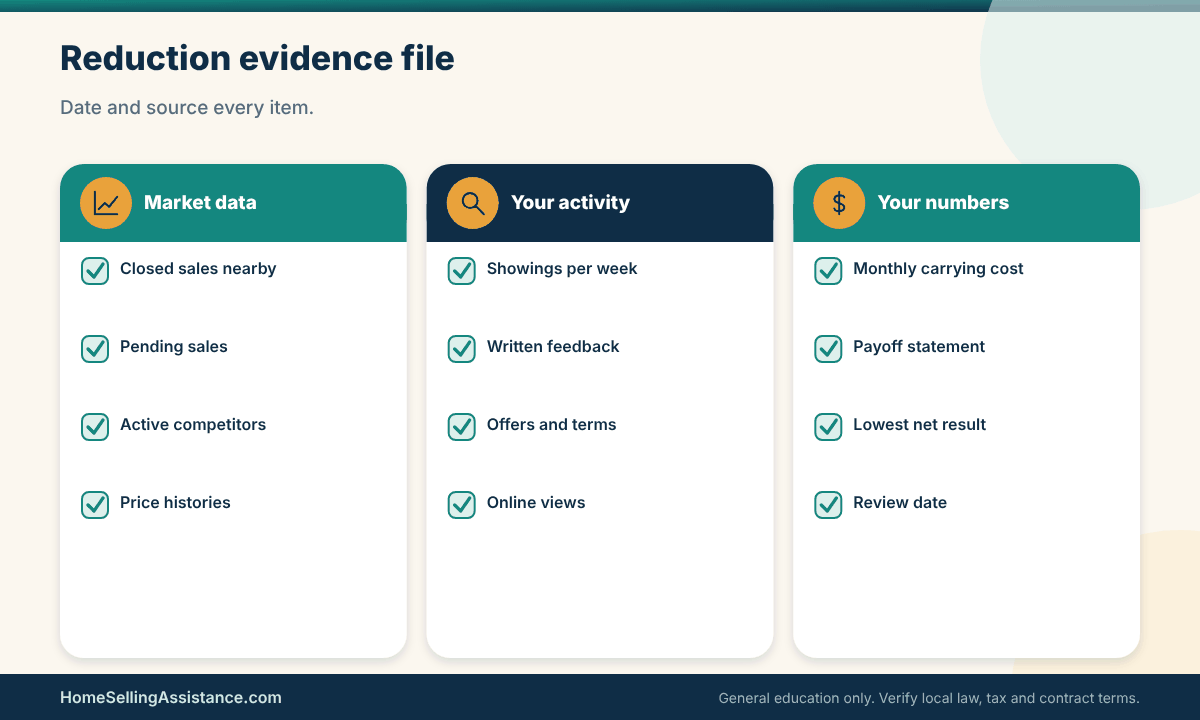
A sound calculation needs only a handful of inputs, and you can collect most of them in an afternoon. You need your current list price and the date you listed. You need the number of showings and any written feedback. You need the recent closed sales that resemble your home, the active and pending listings that compete with it, and a clear statement of your own floor, meaning the lowest net result you could accept without wrecking your next step.
Each input to how much to reduce house price has a trap attached. List price is not value. Showings are not interest. Closed sales are history, and active listings are only hopes. Holding all of that in mind is most of the skill.
Evidence to gather: comps, activity and your own numbers
Start with closed sales, because they are the only prices a buyer and seller both signed. Ask your agent for, or pull from a public portal, the sales of homes close to yours in size, age, condition and location over a recent window. Ideally they are in the same neighborhood and the same price band, and the window is short enough to reflect today’s financing and mood. The guide to adjusting comps explains how to correct for differences such as a finished basement or a larger lot.
Next, list the pending sales, which show what buyers accepted but have not yet closed. These are often the freshest signal you have. Then list the active competitors, the homes a buyer would compare with yours today. Note their list prices, how long they have been on the market, and whether any of them have already been reduced, because a price that has already fallen once tells you where sellers are conceding.
Finally, gather your own activity record. Write down showing counts by week, the exact wording of feedback, any offers you received and how far they were from your price, and the traffic numbers on your online listing if your agent or portal can share them. This record is the difference between a hunch and an argument. If your agent is advising a figure, our list of questions to ask a listing agent about price shows how to request the reasoning behind it.
Be strict about what counts as evidence when you decide how much to reduce house price. A neighbor’s asking price is not a sale. A friend’s story about a house that “sold in a weekend” does not tell you what that house cost relative to its competitors. A national headline about prices falling or rising describes a country, not your street. Keep the file to documents you could show a skeptical stranger.
A scenario with round numbers and your next step
Here is an illustration, using round figures that belong to no real home. Suppose a house listed at $400,000 and has had steady showings for five weeks but no offers. Three recent closed sales of similar homes landed between $370,000 and $385,000. Two competing active listings are at $389,000 and $395,000, and one of those has already had a reduction. Feedback repeatedly mentions that the price feels high for the kitchen.
Read that evidence in order, because the order is how you work out how much to reduce house price.
The showings suggest the photos and description work, so buyers are willing to walk in. The absence of offers suggests the number, the kitchen or both are blocking a decision. The closed sales sit below the list price, which supports a cut. The active listings are close to the list price, which suggests the market has not fully reset.
A seller might reasonably conclude that the evidence supports moving into or just under the closed-sale range, and the arithmetic is simple: a move from $400,000 to $385,000 is a $15,000 change, or a little under four percent of the list price, but that percentage is a result of the evidence and not the goal.
Your next step in a case like this is to write your answer on how much to reduce house price down with the three facts that justify it, then ask your agent or a second professional to challenge it. If you cannot name the facts, you are guessing. If you can, you have a position you can defend to yourself and to a buyer.
Dating your data so it does not mislead you
Market information spoils quickly, and that matters for how much to reduce house price more than for most choices. A report that was accurate in spring can mislead you in autumn, and a sale that closed before a notable move in mortgage rates may describe a different buyer pool than the one shopping now. The simplest defense is a habit: attach a source and a date to every figure in your file, and treat anything you cannot date as a rumor.
Dating also forces you to notice gaps. If your newest comparable is four months old, you are measuring an old market. That does not make the number useless, but it does mean you should widen your range and lean harder on pending sales and fresh listings.
Where the numbers come from and how old they are
The best local source for how much to reduce house price is the multiple listing service, which your agent or a flat-fee broker can search for you. County records can confirm recorded sale prices, although they often lag and may not show concessions or the condition of the house. Public listing portals are useful for active competitors and can show price history, but they can be incomplete or slow to update, so confirm anything that matters with a professional who has MLS access.
For national context, the National Association of Realtors publishes existing-home market data that you can use to understand the general direction of sales and inventory. Treat it as a weather report for the whole country. It can tell you whether conditions are broadly tightening or loosening, but it cannot tell you whether a four-bedroom colonial two blocks from the school is overpriced.
When you record a source, include three things: what it is, the date range it covers, and the date you pulled it. A line such as “closed sales within a mile, last 90 days, pulled this Tuesday” is enough. It sounds fussy, yet it is what lets you rerun the comparison two weeks later and see what changed.
When fresh data contradicts the plan
Sometimes the file you built on Monday looks wrong by Friday. A new competing listing appears at a lower price. A pending sale falls through and reopens a comparable. An unusually strong closed sale posts. Do not treat that as a nuisance. It is exactly why the plan needs a date on it, and it is why sensible sellers review their price on a schedule and not only when they are frustrated.
A practical rule is to set a review point when you set the price. For example, you might decide to reassess after a fixed number of days or after a fixed number of showings, whichever comes first, and to bring updated comps to that review. Our article on days on market for sellers explains why the clock matters and why it can be misread.
If new data contradicts the plan, revisit how much to reduce house price before you touch the listing. Ask what the new information says about buyers, rerun the distance between your home and the evidence, and only then adjust the target. A reduction made in reaction to a mood is hard to explain later. A reduction made in response to a dated change in the market is easy to explain and easy to reverse in your own thinking if conditions shift again.
With the method and the inputs in hand, the next question is how to read what you collected. Sellers tend to make one of two mistakes here. Some treat every signal as proof that the price is wrong. Others explain away every signal because they are attached to a number. The claim and evidence matrix below is a way to slow down and test each belief about how much to reduce house price against the specific thing that supports it, and against the thing that limits it.
Use it as a worksheet for how much to reduce house price. Pick the claim you are tempted to believe, find the metric that would support it, and write down honestly what that metric cannot tell you. The last column translates each line into a practical move.
| Claim | Metric or source | What it supports | Limitation | Seller implication |
|---|---|---|---|---|
| Price is above buyer value | Closed sales below list price | A cut toward the sold range | Condition and location gaps | Adjust comps before choosing a number |
| Market has softened | Pending sales and new listings | A faster, larger move | Short windows are noisy | Recheck weekly, not once |
| Marketing is the issue | Online views versus showings | Fix photos before price | Portal data may be partial | Test presentation first, briefly |
| Condition is blocking offers | Written showing feedback | Repair, credit or smaller cut | Feedback can be polite or vague | Price the visible flaw |
| Low offers mean low value | Offer amounts and terms | Where one buyer sees value | One offer is one opinion | Counter, and watch for a pattern |
| Competitors have already cut | Listing price histories | Sellers are conceding locally | Their prices may be stale | Position against pending sales |
When you weigh how much to reduce house price, notice how often the limitation column points toward more verification and not more confidence. That is deliberate. A matrix like this is most useful when it makes you a little less sure, because a seller who knows what is uncertain can decide how much room to leave. If three or four rows point the same way, you can act with reasonable confidence. If the rows disagree, you have learned that more data, a second opinion or a smaller test cut is cheaper than a large move you cannot take back.
Putting every seller option on the same footing
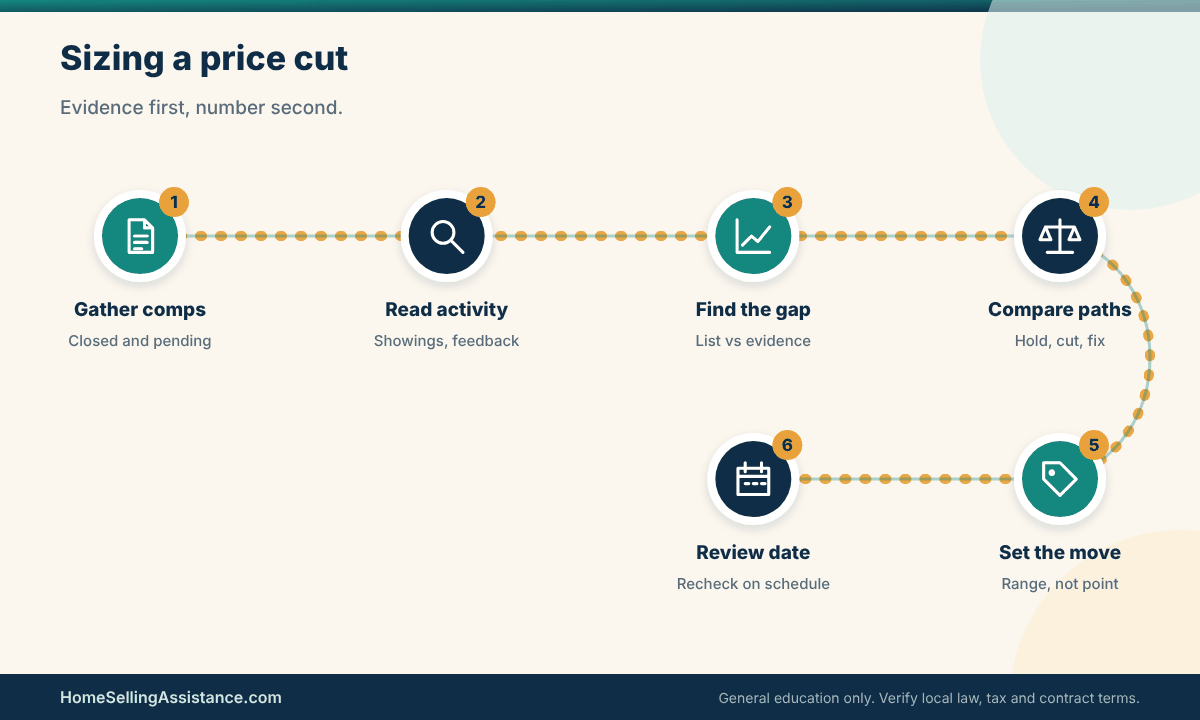
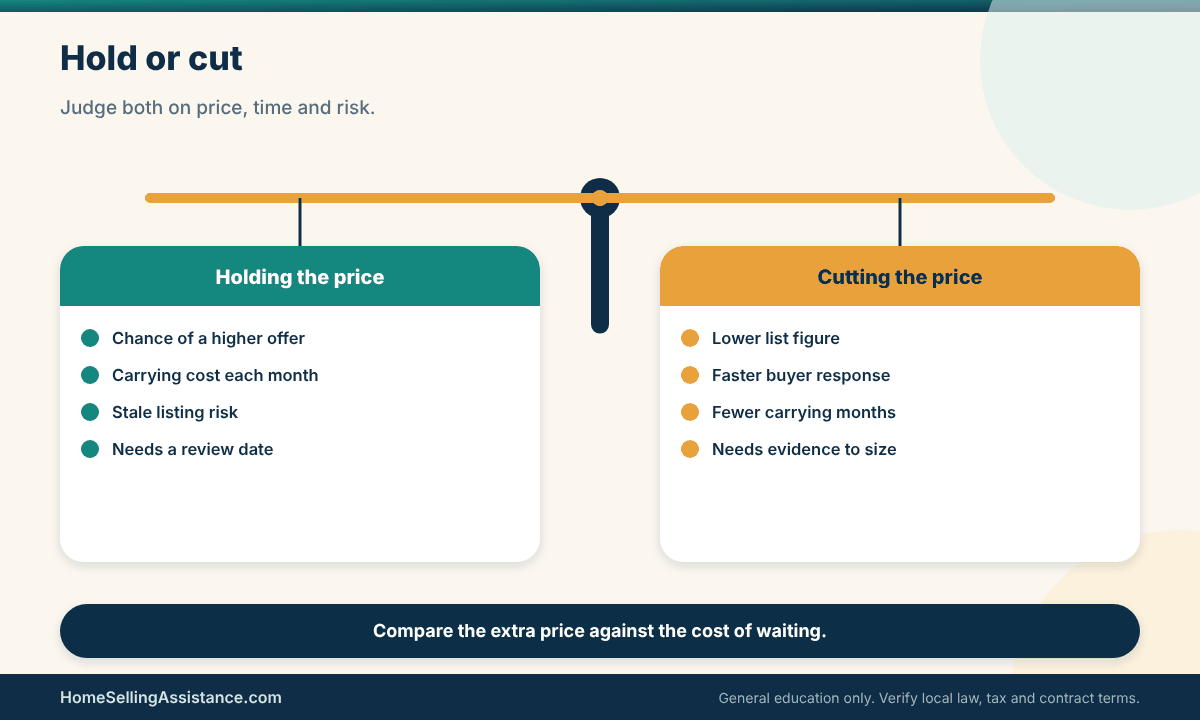
Once you have a candidate range, deciding how much to reduce house price becomes a comparison. You are not choosing between “reduce” and “do nothing” in the abstract. You are choosing among actual paths, such as holding the price for another set period, making a modest cut, making a larger cut, pairing a cut with a repair or a credit, or changing how the home is marketed. Each path produces a different mix of expected price, expected time and risk, and they cannot be compared fairly until you convert them into the same units.
The picture above walks through the order of those decisions about how much to reduce house price. The sections below explain the two ideas that make the comparison honest: putting price, cost and time on a common basis, and adjusting for things you cannot verify.
Like-for-like inputs for price, cost and time
A lower price that sells in three weeks and a higher price that sells in three months are not directly comparable, because time has a cost. Carrying a house means mortgage interest, property tax, insurance, utilities, upkeep, and often the cost of living in two places. Time also carries a risk cost, since a long listing can accumulate a visible price history that colors how buyers see the home.
To compare fairly when weighing how much to reduce house price, translate each path into an expected net amount over a fixed horizon, then subtract the monthly cost of waiting for each month the path is likely to take. You will not know any of these numbers exactly, which is why the next section on sensitivity matters, but you can estimate them well enough to see which path looks stronger.
Turning offers and reductions into comparable figures
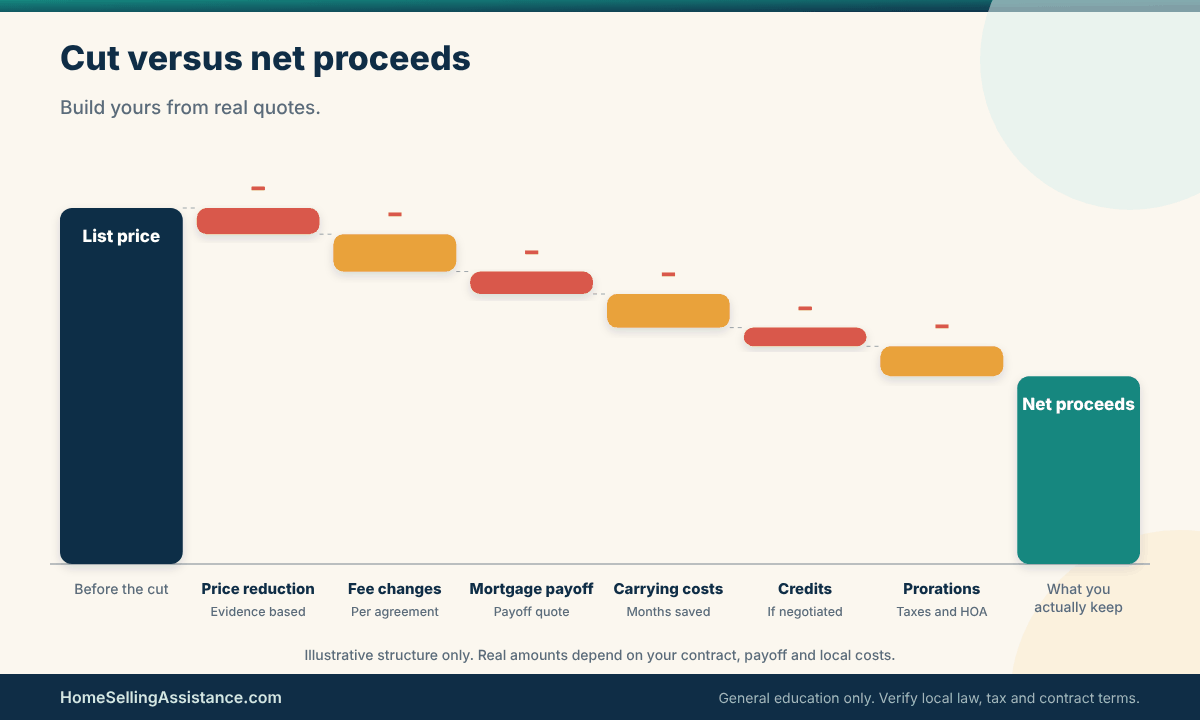
Start with what you would actually keep. Our guide to home sale net proceeds explains how payoff, fees, credits and prorations come out of a price, and the same logic applies here: a price reduction lowers your proceeds dollar for dollar only if every other deduction stays the same, and some costs, such as a percentage-based fee under your listing agreement, shrink slightly as the price falls. Read your own agreement to see which of your costs move with the price and which do not.
Then convert time into money. Add up your monthly carrying cost from the mortgage statement, tax bill, insurance declaration, utility bills and a reasonable allowance for upkeep. If the home is vacant, include the extra cost of keeping it presentable. If you are paying rent or a second mortgage because of the sale, include that too. This monthly figure is the price of waiting, and it is the most common number sellers leave out.
Finally, put offers on the same footing as list prices. An offer of a given amount with a long closing, a financing contingency and a request for repairs is not the same as an offer of a slightly lower amount with a short closing and few conditions. Our article on how to evaluate a home offer as a seller lays out how to weigh terms, and it is a useful companion when a reduction starts to bring in real offers.
A two-path scenario and a decision rule
Take the earlier illustration again, with round numbers only. Path A holds at $400,000 for another six weeks and hopes the market comes to the home. Path B reduces to $385,000 immediately. Suppose your monthly carrying cost is $3,000. Under Path A, six more weeks of waiting costs roughly $4,500 even before you know whether a buyer appears. If Path A eventually ends in a reduction to $385,000 anyway, you will have paid the carrying cost and reached the same price later.
That does not make Path B automatically the right answer to how much to reduce house price. If the local evidence suggested a buyer might pay close to the list price after the spring market picked up, waiting could be worth the carrying cost. The decision rule is to compare the extra expected sale price from waiting against the extra cost of waiting and the added risk that conditions worsen. When the expected gain from waiting is smaller than the cost, a reduction usually deserves more attention.
Whenever you apply a rule like this, write the assumptions beside the answer. A conclusion that depends on “a buyer might appear in spring” is a bet, and you should know you are making it.
Adjusting for risk and uncertainty
Two numbers that look the same on paper can carry very different risk. A buyer who has already been approved by a lender and has funds verified is less uncertain than a buyer who plans to sell their own home first. A price based on three closely matched sales is steadier than one based on a single outlier. Good comparisons give less weight to the shaky number, and they do that on purpose and in the open.
You do not need a formula for this part of how much to reduce house price. You need a habit of asking, for each figure, how sure you are and what would change your mind. Where you are not sure, give yourself a margin.
Evidence for discounting a number you cannot verify
Some inputs to how much to reduce house price deserve a haircut. An unverified buyer’s promise, a comparable sale that closed under unusual terms, a “pending” listing that may not close, and a forecast about next season all carry more uncertainty than a signed, closed sale with a known price. Treat each uncertain input as a range, and when you must pick a single value for a calculation, pick a cautious one.
Look for evidence that tells you how much to trust a figure. A buyer who provides a lender letter and proof of funds is easier to trust than one who does not, and the same is true for an investor or cash buyer. Our guide to proof of funds from a cash buyer explains what to ask for. A comparable that sold quickly but needed major repairs says less about a move-in-ready home like yours than one that sold at a similar condition.
Also separate what the market is telling you from what one person is telling you. A single low offer can come from a bargain hunter, an investor with a strict return target, or a buyer who simply likes your home less than you do. Three low offers across three weeks from unrelated buyers are more informative. The same logic applies to feedback: one comment about paint is taste, while five comments about the same awkward layout is data.
An exception, and what to do next
There is a common exception to how much to reduce house price worth keeping in mind. Sometimes the evidence says the price is fine and the home is simply waiting for the right buyer, for instance a one-of-a-kind property in a market with few comparables, or a home with a specialized appeal. In those cases a large cut can destroy value and a modest cut can be pointless. The better move may be to improve exposure, adjust the marketing, or give the listing more time within a window you set in advance.
Another exception appears when a financing or insurance problem is the real obstacle, such as a property type that lenders treat cautiously or a condition issue that affects insurability. A price cut might help, but a repair, a disclosure fix or a different buyer pool might help more. If you suspect something like this, ask your agent or a lender what the buyers’ lenders are saying, and ask for it in writing or in a call you can summarize.
Your next step in either case is to define, before acting, what result would prove your reading right and what result would prove it wrong, and by when. A price cut then becomes a test with a deadline, not a hope.
Keeping how much to reduce house price from false precision
Spreadsheets and portals make estimates look exact. A tool says your home is worth a figure down to the dollar, a chart shows a clean line of days on market, and an agent writes a recommended price that ends in a tidy number. None of that changes the fact that every one of these figures is built from a small number of messy sales, a few assumptions and a good deal of judgment. Treating the answer to how much to reduce house price as if it were a measurement is how sellers end up surprised.
The remedy is not to give up on numbers. It is to attach honest margins to them, to say which assumptions carry the most weight, and to know which questions no article, calculator or dashboard can answer for your specific home.
Building a sensitivity range instead of a single number
A sensitivity range asks a simple question: if my assumptions are a little off in either direction, how much does my answer change? If a modest change in one input flips your decision, that input deserves more checking. If the decision survives a wide swing, you can act without agonizing.
The sensitivity table below lists the kinds of assumptions that typically drive how much to reduce house price, what each tends to do to the right answer, what can confuse the picture, and what to verify locally before you rely on it. Use it as a prompt for your own list, because your market will have its own quirks.
| Market or property assumption | Expected effect | Confounder | What to verify locally |
|---|---|---|---|
| Comparable sales are recent and close | Narrows the cut to a tighter band | Condition and upgrades differ | Adjusted comps from a current analysis |
| Few competing listings nearby | Supports a smaller cut | Inventory can jump quickly | New listings in your price band |
| Buyer financing costs rise or fall | Shifts what buyers can afford | Buyer mix may change slowly | Lender feedback on current buyers |
| Season is slow or busy | Changes speed more than value | Weather, holidays, local events | Your own area’s activity last year |
| Condition issues are visible | Widens the gap to move-in comps | Estimates of repair cost vary | Written contractor bids |
| Home is unusual for the area | Makes comps less reliable | Few true matches exist | Appraiser or agent with similar sales |
| Seller has a firm deadline | Raises the value of speed | Pressure can push over-cutting | Your floor, carrying cost and date |
Read each row as a conversation starter. Take the line about visible condition issues, for example. If your showing feedback keeps mentioning an aging roof, the expected effect is a gap to comparable homes with newer roofs. The confounder is that repair estimates can differ widely between contractors, which is why the local check is a set of written bids and not a guess. That one habit can move your cut by a meaningful amount, and it turns an argument into a fact.
How to build the range from your own comps
To size how much to reduce house price, take your adjusted comparable sales and find the lowest sensible value, the highest sensible value and a middle value. Do the same for pending sales and for competing active listings, remembering that active prices are asking prices and usually sit above what buyers eventually pay. You now have a low, middle and high estimate of where buyers are placing similar homes, and the spread between low and high is your honest margin.
Next, do the same for time. Estimate a short, a typical and a long period for a sale at each candidate price, using the days on market of similar homes that actually sold. Our overview of seller markets and buyer markets explains how the general mood of the market stretches or shortens those periods, and why a number for one neighborhood may not carry over to the next.
Combine the two, and keep the result beside your draft view of how much to reduce house price. For each candidate price, you can say, in words, “if the market is kind, I expect this; if it is typical, I expect that; if it is harsh, I expect something else.” You are not trying to forecast the future. You are making visible how wide your uncertainty is, so that you can ask whether the cheapest, safest-looking cut still works at the harsh end of the range.
If you share the range with your agent, you also invite a better conversation. Instead of arguing about one number, you can ask which end of the range the agent believes is most likely and why, and you can compare that reasoning to the advice in our home price reduction strategy guide.
A scenario where the range changed the decision
Here is another illustration of how much to reduce house price, with round figures only. A seller is leaning toward a single large cut because a neighbor’s home sold quickly after one. The seller builds a range and finds that closed sales of matched homes span a wide band, with the lowest sale well under the proposed new price and the highest well above it. The pending sales cluster near the middle of the band, and two of the three homes that sold fast were in noticeably better condition.
The range shows that the large cut would put the home at the low end of the band even though its condition is average. The seller decides on a moderate cut to the middle of the band instead, sets a review date, and agrees with the agent in advance what activity would justify a second move. The decision did not become certain. It became informed, and it came with a plan for being wrong.
Your next step is to write down, for your own home, the lowest price at which you would still be comfortable, the price you think is most likely to attract a buyer, and the price at which you would hold. Those three numbers frame every later conversation.
What requires a live quote, CMA, appraisal, policy or contract
Some questions cannot be answered from general information, no matter how carefully you read. How much to reduce house price in your case depends on facts that live in documents and in live data: the comparative market analysis your agent prepares, the appraisal a lender orders, the terms of your listing agreement, the payoff on your mortgage and the specific language of any contract you sign. Anything an article tells you about those is general. Anything a document tells you is specific.
It helps to sort your open questions about how much to reduce house price into two piles. In one pile are the things you can reason through yourself with the method above. In the other are the things you must confirm with a person or a document before you act.
Items no article can settle for you
Start with the comparative market analysis, the document most likely to shape how much to reduce house price. It is a professional’s estimate of where your home sits among current competitors, and it can reflect local knowledge about streets, school boundaries, construction quality and buyer behavior that national data cannot. If you want to understand what it is and how it differs from a lender’s valuation, read our explanation of a CMA versus an appraisal.
Next, your listing agreement. It sets how a price change is made, whether it requires your signature, what fee structure applies, and how long the agreement lasts. Compensation arrangements for listing and buyer-side services are negotiable and should be written down, and you should confirm the current terms in your own contract and not assume. Our guide to the listing agreement covers the clauses worth a second look.
Then your loan. A payoff statement tells you what you owe today, and the difference between that number and a proposed sale price tells you how much room a reduction really leaves you. If you have a mortgage, a lender or your servicer can provide the payoff, and the Consumer Financial Protection Bureau offers plain-language material on mortgage questions. For tax consequences of selling, the IRS guide to selling your home explains the federal rules, and a tax professional can apply them to you.
Finally, an appraisal. If a buyer uses a loan, the lender orders one, and it can come in below the contract price. A price you cut to a level you believe is fair can still run into an appraisal that disagrees, which is covered in our guidance on what to do when the number comes in low. No article can predict that outcome for your house.
A short script and your next step
When you need a live source for how much to reduce house price, a short, specific request works best. To your agent, you might say: “Please send me a current analysis with closed, pending and active comparables, adjusted for differences, and tell me which three you trust most and why.” To a lender: “Can you give me a payoff figure good through a specific date, and tell me whether any prepayment terms apply?” To a contractor: “Please give me a written estimate for this specific item so that I can compare it with the buyer feedback.”
Each of these requests produces a document or a number with a date on it, which is exactly what the method needs. Keep what you receive in the same file as your comps and your activity record.
If you are unsure whom to ask, consider a second opinion from a different professional. That is reasonable and common, and a good agent will not be offended by it. What you are paying for is a better-informed decision, and there is nothing disloyal about checking one expert against another when the stakes include tens of thousands of dollars.
Before moving on, it is worth seeing how all of this fits together when a listing stalls and you must decide how much to reduce house price. The tree in the next picture sorts the common situations by what buyers are doing, because the right size of a cut, and sometimes the right decision to skip a cut, depends on which situation you are actually in.
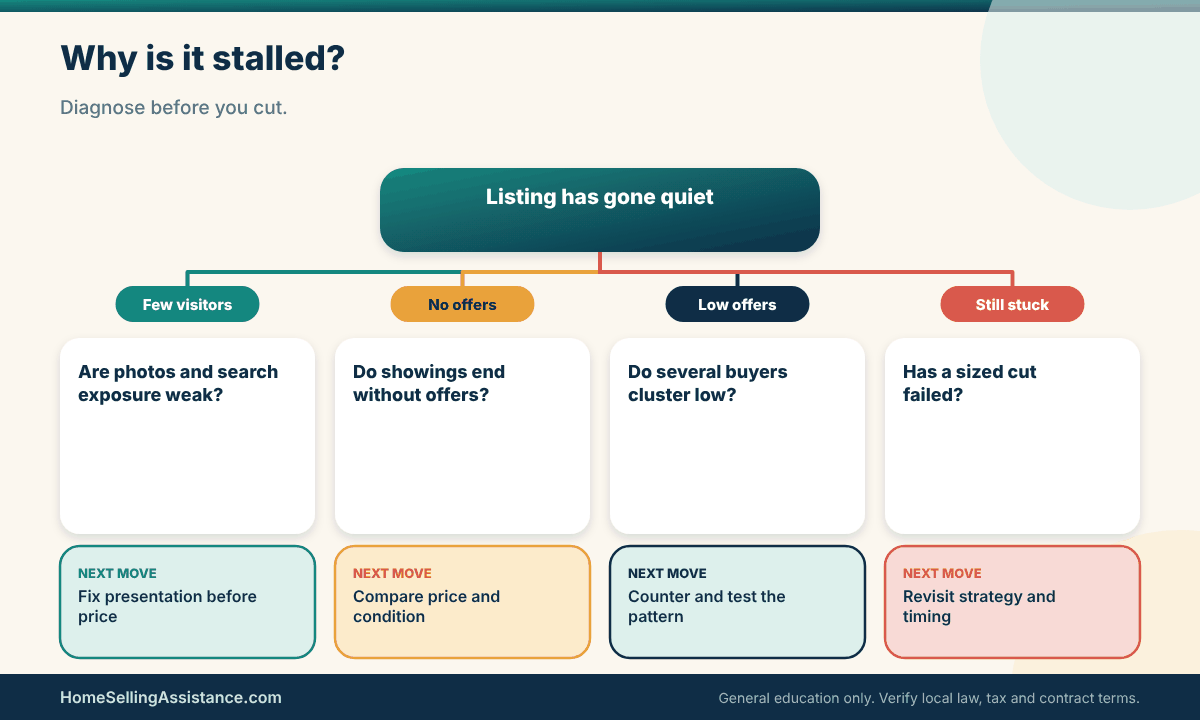
If almost nobody is visiting, the first suspect is exposure, meaning the photos, the description and the way the home appears in searches, and a price move may come second. Our article on what to do when a house is not selling walks through that diagnosis. If buyers visit but do not offer, price or condition is usually in play. If offers arrive but are low, the market is telling you where one buyer sees value, and you can counter and watch for a pattern.
Quick scenario
A seller reduced the price twice in three weeks, each time by a small round amount, hoping one of them would land. Activity barely moved. The agent later suggested a single, evidence-based move to the middle of the closed-sale band, and showings picked up within days. The lesson is not that bigger cuts work better. It is that small, repeated cuts can signal uncertainty without ever crossing the line where buyers decide, so it is worth sizing the move to the evidence before you make it.
Two other forces deserve a mention in any plan for how much to reduce house price, because they change what buyers can pay without changing your house at all. Financing costs affect monthly payments, which our piece on mortgage rates and home sellers explains in more detail. The number of competing homes affects how much choice buyers have, and the guide to housing inventory and sellers covers that side. Both can make a previously reasonable price look high, or the reverse, without any change in your own listing.
Finally, a note on what happens if your answer to how much to reduce house price still does not work. Some sellers decide to take the home off the market, refresh it and return, and that has its own tradeoffs, which we cover in our guide to relisting an expired home listing. Others revisit the original price logic from scratch, and our article on overpricing a house explains how an early pricing misstep tends to echo through the rest of the listing.
If you want a refresher on setting a price in the first place, start with how to price a house to sell.
You can find more articles in this area in our market conditions and timing library and in the pricing and home value category.
Frequently asked questions about how much to reduce house price
Is there a standard percentage for how much to reduce house price?
No, and be wary of anyone who offers one as a rule. The right size depends on how far your list price sits above the evidence in your local market, what comparable homes sold for, what competing listings are doing and how buyers have responded to your home so far. A figure that suits a hot neighborhood may be wrong for a slow one. Use percentages only as a way to describe a cut after you have chosen it from evidence.
How do I know whether the problem is price or something else?
Look at the pattern of activity. Very few views or showings usually point to exposure, such as photos, description or timing. Many showings with no offers usually point to price or condition. Offers that arrive well below your price point to where buyers see value. Written feedback helps you separate these, and a second professional opinion can confirm your reading before you change anything.
Should I make one big cut or several small ones?
It depends on the evidence, but sellers often find that tiny, repeated cuts attract little notice and keep the home looking stale. A single move sized to the market, which is the real point of deciding how much to reduce house price, made once you have a clear reason, tends to be easier for buyers to respond to. That said, nothing is guaranteed, and a smaller test cut with a review date can be sensible when your data is thin or mixed.
What numbers should I gather before deciding how much to reduce house price?
Gather your list price and listing date, showing counts and written feedback, recent closed sales that match your home, current pending sales and the active competitors in your price band. Add your monthly carrying cost and your lowest acceptable net result. Date every figure and note its source. That file is more useful than any rule of thumb because it describes your house in your market.
Can national housing data tell me how much to reduce house price?
Not directly. National reports, such as those published by the National Association of Realtors, describe broad conditions across the country and can help you understand whether the market is generally tightening or loosening. They cannot tell you how a particular street is performing. Use them for context, and rely on local closed, pending and active listings for the actual decision.
Does a price reduction hurt my chances of selling?
A decision on how much to reduce house price does not by itself doom a listing. Buyers often respond to a price that now matches the market. The risks come from cutting too little to change buyer behavior, from cutting repeatedly in small steps, or from cutting without fixing a separate problem such as condition or marketing. A clear reason and a well-sized move generally read better than a series of hesitant ones.
How do carrying costs affect how much to reduce house price?
Every month the home stays unsold costs you mortgage interest, taxes, insurance, utilities and upkeep, and possibly rent elsewhere. Those costs are part of the real price of waiting. If the extra sale price you might gain by holding is smaller than the costs and risks of waiting, a cut deserves more weight. Estimate the cost from your own statements, since it varies widely.
What if my agent and I disagree about how much to reduce house price?
Ask the agent to show the comparable sales and activity behind the recommendation, and share your own range in return. A disagreement often shrinks once both sides look at the same dated evidence. If it does not, you may ask a second agent for an opinion, review your listing agreement for how price changes are made, and remember that the decision remains yours to make.
Will an appraisal affect a reduced price?
It can. If a buyer is using a loan, the lender orders an appraisal, and it may come in lower than the contract price even after a reduction. That is why a cut should rest on adjusted comparable sales, which appraisers also use. If the appraisal is low, your contract and your agent or attorney will guide your options, and these vary by state and by contract.
When should I stop reducing and consider other options?
If you have cut to a level supported by solid comparable sales and activity still has not improved, the cause may be something other than price. Condition, marketing, financing for the property type or a mismatch with local demand can all be factors. At that point it is reasonable to revisit your approach, consider a repair or credit, change the marketing or talk about a different timing or sales route.
A calm way forward
Deciding how much to reduce house price will never feel perfectly certain, and it does not need to. If you gather dated evidence, compare your options on the same footing and keep a sensible range, you will make a choice you can explain and adjust. This article is general education, not legal, tax or financial advice, and your own listing agreement, lender figures and local professionals should guide the final decision.