An underpricing house strategy means listing a home deliberately below what you think it could eventually sell for, hoping that a low entry point pulls in more buyers, creates competition and lets the final price climb past where a more conventional list price would have landed. It is a real tactic, it is sometimes used well, and it is also one of the easiest ways for a seller to leave money on the table when the crowd never shows up.
The idea behind an underpricing house strategy borrows from auctions. Open the bidding low, let people feel they might win something at a bargain, and a few of them will push each other upward. Anyone who has watched a room full of people bid on a folding table at a charity event has seen the effect. A house is a far bigger purchase than a folding table, though, and the buyers are not standing in one room at one time.
They arrive through listing sites, agent networks and weekend open houses, each with a lender, a deadline and a spouse to consult.
So the honest question is not whether an underpricing house strategy works. It is whether it works for your house, in your market, this month, given what you need from the sale. That depends on how many qualified buyers are truly looking at homes like yours, how your offer-review process is set up, what an appraiser is likely to say, and how much downside you can stomach if the competition is thinner than hoped.
This guide does not try to talk you into the tactic or out of it. We walk through the decision the way an experienced friend would at your kitchen table: define what you are really after, compare the realistic paths, then put the numbers into a simple net-result rule so the choice rests on evidence rather than on a story about bidding wars. It stays general on purpose. Local rules, contracts and market conditions differ, and you should confirm the details with your own agent, attorney or title company before acting.
Key takeaways
- Low pricing buys attention, not a guaranteed bidding war. The tactic only pays when enough qualified buyers actually compete before your review deadline.
- The appraisal is the usual weak point. A bid-up contract price can run ahead of what an appraiser supports, and someone then has to cover the gap or renegotiate.
- Judge every path by net proceeds, time, contingencies and risk. Compare the strategy with market-rate pricing on the same four measures, not on the headline price alone.
- Your local competition decides the odds. Count comparable homes for sale, recent days on market and offer activity before choosing a starting price.
- Set your fallback before you list. Decide in advance what you will do if offers are thin, so you are not improvising under pressure.
An underpricing house strategy starts with what you actually need
Before comparing tactics, it helps to be blunt about what the sale has to accomplish. Pricing is a tool. The goal might be the highest possible price, a firm closing date, a clean sale with few conditions, or simply a result you can live with while you handle everything else going on in your life. An underpricing house strategy can serve some of those goals and quietly work against others.
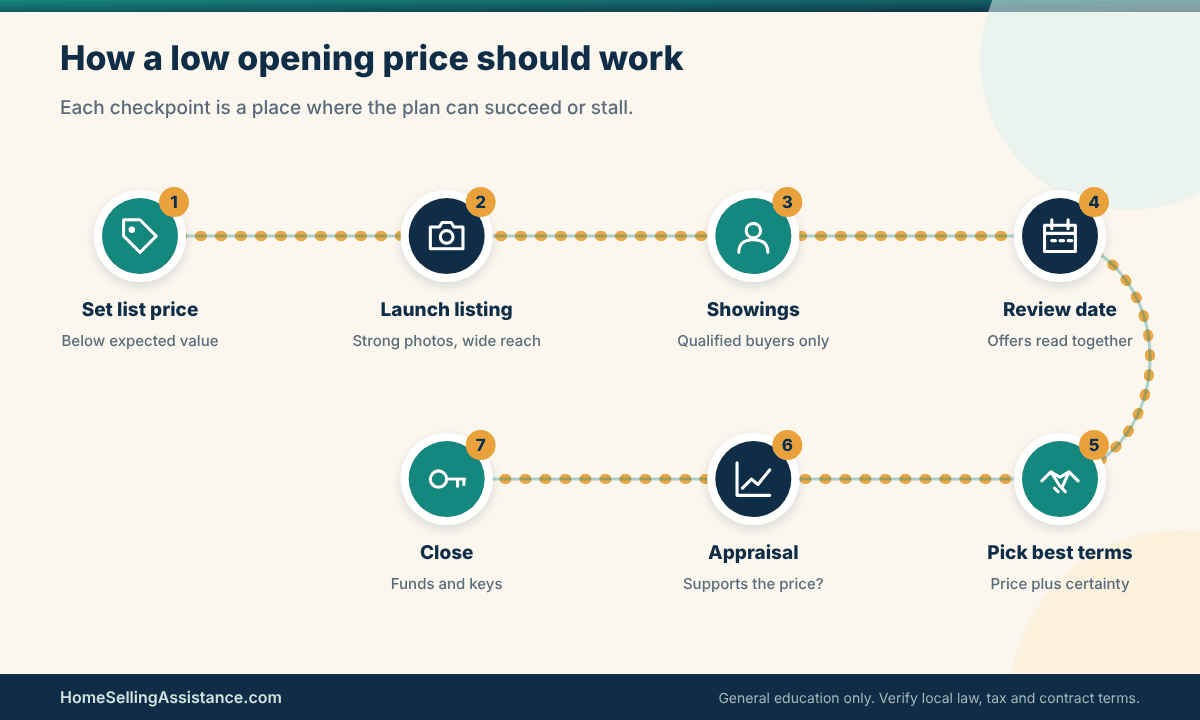
The picture below shows the basic mechanism sellers have in mind, along with the checkpoints where it tends to succeed or stall. Keep it in view as you read the next sections.
Goal, timeline, cash needs, condition and risk tolerance
Five personal facts shape whether a low starting price is sensible. They are your goal, your timeline, your cash position, your home’s condition and your tolerance for an outcome that disappoints. None of them is a market statistic, which is exactly why generic advice about bidding wars so often misses the mark. Two sellers with identical houses can reasonably choose opposite pricing approaches.
Evidence to gather: your numbers before any list price
Start with the loan. Ask your lender for a written payoff statement, because the figure on your monthly statement is not the amount you must repay at closing. Then list what you need to net in order to do whatever comes next, whether that is a down payment, a lease deposit or a moving budget. That minimum net figure is the first piece of evidence, and it matters more than any hope about the top end.
Next, gather what the market says. Pull recent sales of similar homes in your neighborhood, and separate pending and active listings from closed sales. Closed sales show what buyers actually paid. Active listings show your competition. Our guides on how much your house is worth and on comparing a CMA with an appraisal explain how those numbers get built and why they differ.
Finally, write down your condition facts: age of the roof and mechanical systems, known defects, deferred maintenance, recent upgrades. Condition affects how far a low price can pull buyers in. A sharp list price in an underpricing house strategy on a well-kept home reads as an opportunity. The same price on a home with visible problems can read as a warning.
One more number deserves a place on your sheet: the cost of waiting. Every month a home sits unsold, you may keep paying the mortgage, taxes, insurance, utilities and upkeep. Add those carrying costs up for a typical month and compare them with the extra money an underpricing house strategy might earn. If a quiet week or two would cost you more than the likely upside, the tactic is a worse fit than it first sounds.
It also helps to write down who must agree before you sign anything. If the title is shared with a spouse, relative or trust, every owner has to be on board with the pricing plan, including the possibility of a lower result. An underpricing house strategy that one owner loves and another dreads tends to create trouble the first time a thin offer arrives.
A scenario, an exception, and your next step for goal-setting
Picture a seller with a firm job start date in six weeks and a modest mortgage balance. The date is fixed, the equity is comfortable, and she can accept a slightly lower final price in return for a fast, clean sale. For her, an underpricing house strategy, meaning a sharp opening price that invites quick offers can match the goal well, provided the review window is short and the offers are screened for solid financing.
Now take the exception. Another seller owes nearly as much as the house is worth and needs every dollar to pay off the loan and cover costs. If the bidding does not materialize, even a modest shortfall could leave him unable to close without bringing cash. For him, the downside of an underpricing house strategy is far larger than the upside, and a more conventional list price is the safer choice.
Your next step is simple. Write one sentence that completes this thought: “A good result for me is a sale that nets at least this much, closes by this date, and carries no more than this much risk.” If you cannot finish the sentence, you are not ready to pick a pricing tactic yet.
A third scenario sits in between. A seller with moderate equity and a flexible date may not want to risk a weak ending, yet still wants some competition. She might choose a price only slightly under her comparable range and a short review window. That softer version of an underpricing house strategy narrows the gap between strong and weak endings, at the cost of a smaller possible upside.
Notice what all three cases share. None of them starts with the question “Will this get me the most money?” They start with what the seller can afford to lose and what she cannot. That ordering keeps a clever tactic from turning into a coin flip, and it gives your agent a clear brief to work from when you discuss options together.
Facts that could change an underpricing house strategy
Even with a clear goal, several outside facts can flip the answer. They tend to be local, current and easy to overlook when a confident voice is telling you that low prices always create bidding wars. Treat each one below as a question to research, not an assumption to accept.
Evidence to gather: competition, activity and local contract habits
The strongest evidence is how homes like yours have behaved lately. Look at how many days similar homes took to go under contract, whether they sold above, at or below their list prices, and how many were still sitting after several weeks. Your agent can pull these from the local listing service. Be wary of one or two dramatic examples. A single house that drew twelve offers does not describe the street.
Also ask about local habits. In some areas, sellers routinely set an offer deadline a week after listing. In others, offers trickle in whenever buyers see the house, and a deadline would feel strange. Customs on earnest money, escalation clauses and appraisal terms vary too. A multiple-offer situation is only manageable if you know how offers are normally written where you live.
Interest rates and lending conditions matter as well. When financing is tight, fewer buyers qualify at any given price, and a bargain price attracts looks but not always offers. National figures from sources like the National Association of Realtors give context, but they describe the country, not your block. Use them as background and rely on local data for the decision.
Ask, too, how seasonal swings affect your area. Some neighborhoods see a surge of buyers when families want to move before a school year, and a lull in the holiday weeks. A low opening price during a lull may draw fewer buyers than the same price in a busy week. Timing and price work together, so an underpricing house strategy should be judged against the calendar as well as the comps.
Finally, check whether any special circumstances in the neighborhood could pull attention one way or the other, such as a new employer, a large construction project or a change in local taxes. Facts like these can quietly raise or lower buyer interest. Your agent, a local lender or the county planning office can usually tell you what is changing nearby, and none of it requires guessing.
A scenario, an exception, and your next step for shifting facts
Imagine a neighborhood where three comparable homes listed in the past month and each went under contract within days. Buyers seem hungry and inventory is thin. In that setting, a modest discount to attract early offers might plausibly create competition. Now imagine that two weeks later five new listings appear and the pace slows. The same discounted price now risks selling quickly at a discount with no one bidding it up.
That is why timing of the decision matters. Facts can change between the day you plan and the day you list. Build a habit of refreshing your comparable sales and your competitor list the week before launch, and again if the first few days draw less traffic than expected.
Your next step: ask your agent or a trusted local professional for a short list of active competitors and recent closed sales, with list price, sale price and days on market for each. A one-page summary is enough. If you are selling without an agent, the county records and public listing sites can show a rough version, though the details are thinner.
One more exception comes from the buyer side. In some periods, lenders tighten standards and fewer buyers can qualify even at lower prices. A bargain list price then draws curious visitors rather than committed offers. If local lenders or your agent report that mortgage approvals are slowing, give the underpricing house strategy less weight and lean toward a price that comps can defend.
Keep in mind that national headlines rarely line up with what is happening in your zip code. A story about cooling prices elsewhere may not describe your street, and a story about bidding wars elsewhere may not either. Use the headlines for general background, and let the recent closed sales near your home carry the argument.
Comparing an underpricing house strategy with the alternatives
There are two broad ways to look at the choice. One is to list below your expected value on purpose and let competition do the work. The other is to price near what comparable sales support and let the house find its buyer, or to use a different sales route altogether. Neither is automatically smarter. Each moves price, time, workload and risk in different directions, and the right answer depends on the facts you gathered above.
The table below lines up the two main options on the measures that affect your wallet and your stress level. Read across a row to see the trade-off, and then adjust the notes to match your own market and contract.
| Measure | Option A: low opening price | Option B: market-rate price | What to check |
|---|---|---|---|
| Price and net proceeds | Wide range; may beat or trail market | Narrower, more predictable range | Your minimum net figure |
| Time on market | Often short if buyers respond | Moderate; depends on pace | Recent days on market |
| Contingencies | May attract fewer conditions | Usual mix of conditions | Local offer customs |
| Workload | Heavy in a short window | Spread out over weeks | Showing and review capacity |
| Appraisal risk | Higher if price is bid up | Lower; price tracks comps | Comps supporting the price |
| Execution risk | Thin offers leave a low anchor | Possible price cuts later | Competing listings now |
| Flexibility | Hard to raise price afterward | Easier to adjust either way | Your fallback plan |
Use the table as a prompt for questions, not as a verdict. If your minimum net figure is tight, the appraisal row and the flexibility row deserve the most attention. If your schedule is tight but your equity is comfortable, the time and workload rows will probably count for more.
Option one: an underpricing house strategy that invites competing offers
The first path, the underpricing house strategy itself, is the one this article is named for. You set a list price below the figure you privately think the home would fetch, you announce an offer review date a few days out, and you hold off on accepting anything until that date. The theory is that more buyers will walk through the door, some will fall in love, and a handful will bid against each other.
Evidence to gather: how the mechanics usually work
Three mechanics have to line up for this to pay. First, the price must be low enough to widen the pool of interested buyers, including some who would have skipped a house at the higher figure. Second, enough of those buyers must be qualified, with lender letters or proof of funds, because curiosity without financing creates noise rather than bids. Third, the review window must be short enough to keep urgency alive and long enough for out-of-town and working buyers to see the home.
Ask your agent how recent similar listings handled their review periods and how many written offers each one drew. If the answer is “usually two or three,” you have a rough picture of what to expect. If the answer is “it varied a lot,” you have your real risk. A fair comparison of offers is covered in our guide to the highest offer versus the best offer, which is worth reading before you set any deadline.
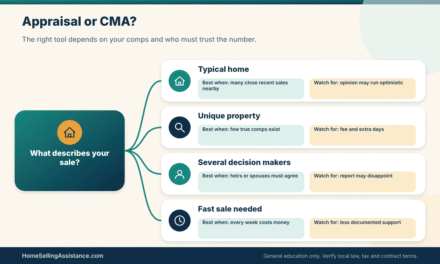
A short preparation checklist keeps the whole effort honest. The one below groups the items sellers most often skip before announcing a low opening price.

Also request the details of how bids would be communicated. Some areas allow a “highest and best” round after initial offers. Others rely on a single deadline. Neither is magic, and neither guarantees a number. What matters is that every buyer understands the process in advance so no one feels tricked, and that the process treats every buyer the same way under federal fair housing rules.
Preparation matters as much as the price. A low list price will attract attention, but it will not rescue poor photos, a cluttered living room or a confusing description. Buyers who are drawn in by price and then disappointed in person will not bid. If you plan to use an underpricing house strategy, spend the first effort on presentation so that the extra traffic turns into serious interest.
Think about workload as well. A busy review window can mean many showings in a few days, quick answers to questions, and a stack of offers to read carefully. If your schedule is packed or you will be traveling, line up help in advance. A sloppy process can cost more than a few thousand dollars of price, and it can leave buyers feeling uneasy about the sale.
A scenario, an exception, and your next step for the low-price route
With an underpricing house strategy in mind, suppose a tidy three-bedroom house is listed a little under what recent comparable sales suggest, with a review date four days out. Over the weekend it draws a steady flow of showings and several written offers. Two buyers, each worried about losing out, raise their terms. The seller picks the strongest package, which is not necessarily the highest price, and goes under contract. Everything lined up.
The exception is the same underpricing house strategy in a slow week. Showings are light, only one offer arrives and it sits right at the discounted list price. The seller can negotiate, but the low number is now public and it frames every conversation. Buyers and their agents see where the home was listed, and a counter far above that figure can look unreasonable even if it is fair.
Your next step if you are leaning toward an underpricing house strategy: write your walk-away number before you list, and decide what you will do if the review date passes with a single offer at the list price. Having that plan on paper protects you from accepting a result you would have rejected in a calmer moment. If you want to compare it with other offer scenarios, our overview of how to evaluate a home offer as a seller covers the terms to weigh.
Consider how the contract terms might look when competition is real. Buyers may shorten inspection periods, offer larger deposits or agree to cover part of an appraisal gap. Each of these is a negotiated term that changes risk for you. A strong underpricing house strategy is not just about the price number, it is about which terms buyers volunteer when they feel pressure to stand out.
Remember too that a low opening price does not cancel your duty to be truthful. Describe the house accurately, disclose what your state requires, and avoid statements that could mislead a buyer about the price you will take. The listing price is a marketing choice, but the contract and disclosures are legal documents, and your agent or attorney should review them against local rules.
Fairness deserves a word here. Whatever price you pick, every buyer who asks about the home should receive the same information and the same chance to submit an offer. An underpricing house strategy that quietly favors one buyer over another can raise legal and ethical problems, and fair housing rules apply to every step. Ask your agent to put the process in writing so everyone follows it.
Think also about reputation inside your own neighborhood and agent community. A tidy, transparent review process leaves buyers with a good impression even when they lose. A confusing one can leave people frustrated, and word travels. An underpricing house strategy depends on trust that the process is straightforward, so clarity is part of the tactic, not an afterthought.
Option two: market-rate pricing or a different route to sale
The alternative is to price near the middle of what the comparable sales support, accept that the buyer pool will be what it will be, and plan to adjust if the market responds slowly. Some sellers also look at other routes altogether, such as a negotiated private sale, a cash buyer or a formal auction, each with its own trade-offs.
Evidence to gather: comps, adjustments and a defensible range
For market-rate pricing, the evidence is a defensible range, not a single number. Collect three to six truly comparable closed sales, adjust for size, condition, lot, age and features, and look at where your home sits in that spread. The mechanics of those adjustments are laid out in our article on adjusting comps to estimate home value.
Then consider how the list price compares with active competitors. A price in the middle of the range is not a promise of a quick sale, but it keeps the appraisal story simple, because the contract price and the supporting sales tell the same tale. That simplicity is a real benefit when a buyer’s lender is waiting on the appraisal report.
If you are considering a formal auction or a private sale instead, ask for the rules in writing. Auction terms, reserve prices, buyer fees and deadlines differ, and you should read them as closely as you would a listing agreement. Our comparison of a home auction versus a traditional listing explains the differences without taking sides.
A small amount of pricing humility goes a long way. Comparable sales are a guide, not a law of nature, and two appraisers or agents can look at the same set and land in slightly different places. Treat your range as a zone. If you list near the middle of it and see strong interest, you can adjust your thinking, whereas an underpricing house strategy locks in a lower number up front.
Some sellers also ask whether they can run the numbers themselves. You can, in a rough way, by building your own comparable sales sheet and checking it against public records. The risk is that you miss adjustments an agent would catch. If you work without an agent, consider paying for an independent opinion before choosing an underpricing house strategy or any other price, since a small error here costs far more than the fee.
A scenario, an exception, and your next step for the middle route
Take a seller with a well-kept home in a market where houses take a few weeks to sell. She prices in the middle of her comparable range and watches the first two weekends. Traffic is decent, showings produce a couple of offers slightly under list, and she negotiates to a price she is happy with. It was not dramatic, but it was predictable, and her net proceeds were close to her plan.
The exception arises when the home is priced a bit too high within that range and sits. Weeks pass, the listing goes stale, and a price cut follows. We cover how to handle that in a home price reduction strategy, and in the companion piece on overpricing a house to sell. Market-rate pricing reduces appraisal risk, but it does not remove the risk of misjudging the range.
Your next step: ask your agent or advisor to show you two versions of the plan side by side, the low-opening version and the market-rate version, with an estimated net proceeds figure, a realistic timeline and a list of what could go wrong in each. Seeing both in writing makes the underpricing house strategy decision far easier, and it makes it harder for a single persuasive anecdote to steer you.
Some sellers split the difference with a staged plan. They list at a sensible figure, review traffic after the first week, and reduce only if the evidence supports it. The method is less dramatic than a sharp opening, yet it keeps options open. Compare that plan side by side with an underpricing house strategy, and ask which one fits the way you like to make decisions under pressure.
A net-result rule for judging any underpricing house strategy
Headline prices are seductive. “It sold for thirty thousand over asking” makes a great story, and no one tells the story of the house that sold at its discounted list price after one quiet weekend. The cure is to stop comparing prices and start comparing what lands in your account, how long it takes and how likely each outcome is. This section gives you a simple rule you can run on a single sheet of paper.
The price, time, cost and risk framework
The framework has four columns and three rows. The columns are price, time, cost and risk. The rows are the strong outcome, the middling outcome and the weak outcome of each pricing path. For every cell you write down a number or a short note, then you look at the whole grid before you decide, instead of falling for the best-case cell.
Evidence to gather: the arithmetic of a worked example
Here is an illustrative example using round, made-up numbers. Suppose comparable sales support a market-rate price of $400,000. Your payoff is $250,000, and for simplicity we assume combined selling costs of $24,000 in every case. These are placeholders for the sake of arithmetic. Your real payoff and costs will differ, so use quotes from your lender, title company and agreement.
Before you judge any underpricing house strategy, price the baseline. Market-rate path: $400,000 minus $250,000 minus $24,000 leaves $126,000. Now the low-opening path, which lists at $380,000 and has three possible endings. In the strong ending, bidding lifts the contract to $420,000 and the appraisal supports it, which leaves $146,000. In the middling ending, bidding lifts the contract to $420,000 but the appraisal comes in near $408,000 and the sale closes there, which leaves $134,000. In the weak ending, only one buyer shows up and the sale closes at $378,000, which leaves $104,000.

Look at what the grid says. Under an underpricing house strategy the low-opening path spans a $42,000 range, from $104,000 to $146,000, while the market-rate path sits at about $126,000. If you believe the strong ending is likely, the underpricing house strategy wins. If you cannot honestly say the weak ending is unlikely, the market-rate path starts to look wiser. The picture above shows how those deductions stack up in the middling case.
You can stress-test the grid by changing one assumption at a time. What if selling costs run higher than you thought? What if the appraisal lands lower still? What if the closing date slips by a few weeks? Each change shifts the numbers, and the point is to see which path stays acceptable. An underpricing house strategy that survives these small shocks is far sturdier than one that only works in a perfect run.
A quick reality check on probabilities helps. You do not need exact odds, only an honest ranking. Ask yourself whether the strong ending is likely, possible or unlikely, and do the same for the weak ending. If you rate the weak ending as possible and the strong ending as only possible, the underpricing house strategy is not clearly ahead, and you may want more evidence first.
Another practical check is to ask three people for their view of the likely ending: your agent, a different agent for a second opinion, and a recent buyer or seller in your area if you know one. Their answers will rarely match, and that spread is itself useful information. A wide spread says the underpricing house strategy rests on a shaky guess, while a narrow one suggests the market is more predictable.
A scenario, an exception, and your next step for the decision rule
A seller with substantial equity, a flexible timeline and a tidy home might look at that grid and accept the weak ending as survivable. The potential upside outweighs a downside that does not threaten her plans. That is a perfectly reasonable conclusion, and the underpricing house strategy fits her.
The exception is a seller whose plan depends on a minimum net of $120,000. In the weak ending he comes up $16,000 short. For him, the question is not which path has the highest average. It is which path avoids falling below the line, and the market-rate route, which nearly clears it, comes closer to protecting him. Neither seller is right in general. Each is right for the facts.
Your next step is to build the grid for your own home with your agent, using your payoff quote and real cost estimates. Our guide to home sale net proceeds explains how to assemble the costs. Ask for the strong, middling and weak outcomes, then circle the cell you could not tolerate.
Another way to read the grid is to ask how much you would pay for certainty. If the low path has the higher average but a much worse weak outcome, the gap between the market-rate result and that weak outcome is, in effect, the price of insurance. Some sellers happily pay it. Others decide that a steady result is worth more than an underpricing house strategy with an uncertain finish.
The table below turns that thinking into a quick reference for common situations. Each row names a seller situation, the route it tends to favor, the reason, the trade-off and the one fact that could flip the choice.
| Situation | Route favored | Reason | Trade-off | Fact that changes the choice |
|---|---|---|---|---|
| Thin inventory, many active buyers | Low opening price | Competition is likely | Appraisal gap risk | Recent offer counts |
| Equity is slim, loan is large | Market-rate price | Protects minimum net | Fewer upside outcomes | Payoff quote |
| Fixed move date, flexible price | Low opening price | Speed matters most | May leave money behind | Review window length |
| Home needs visible work | Market-rate or as-is | Low price may signal trouble | Slower sale possible | Inspection findings |
| Slow local market | Market-rate price | Few bidders to compete | Possible price cuts | Days on market trend |
| Unusual or hard-to-compare home | Market-rate, tested | Comps give weak guidance | Pricing is a judgment call | Pre-listing appraisal |
To use the table, find the row closest to your situation, read the reason and trade-off, then check the last column against your own research. If the fact in that column does not hold for you, the favored route may not either. The table is a starting point for a conversation with your agent or advisor, not a substitute for local data.
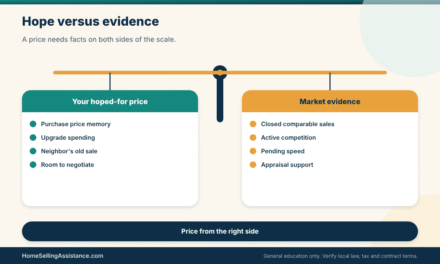
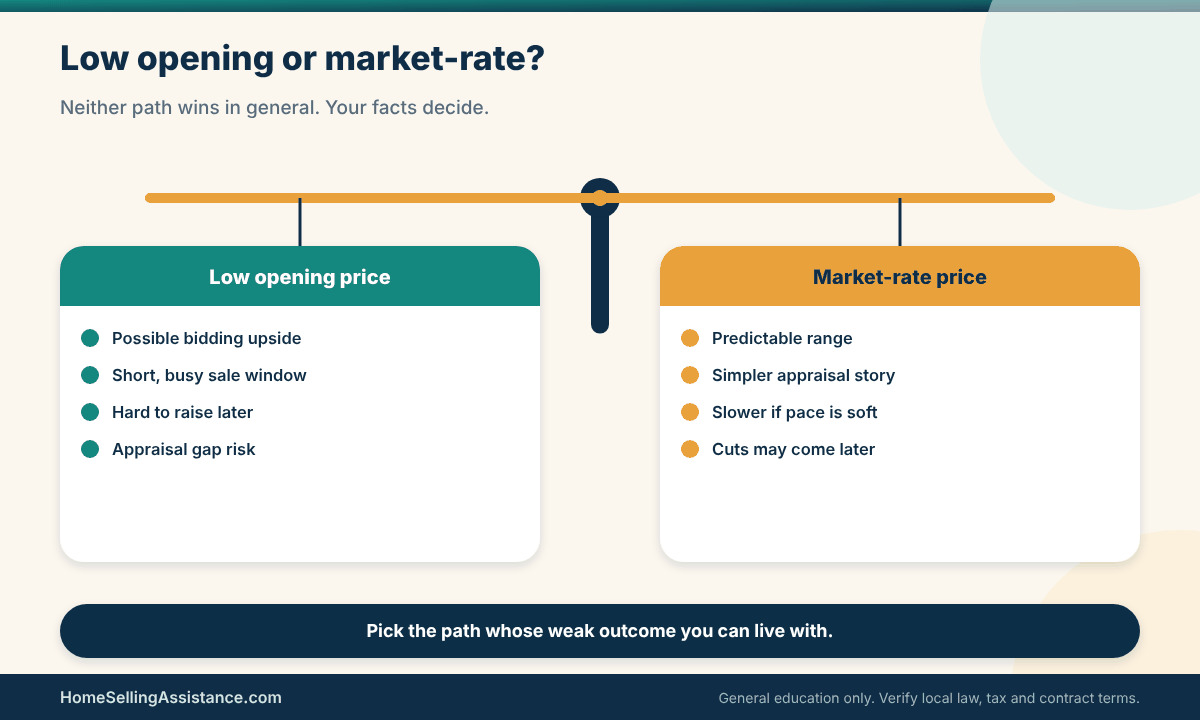
The scale below sets the two paths against each other in plain terms, so you can see what you gain and what you accept with each.
When new evidence should change the plan
Pricing decisions are not carved in stone. The best sellers decide in advance which signals will make them change course, and they hold themselves to those signals even when the original plan felt exciting. Without that discipline it is far too easy to cling to a story that the market has already stopped telling.
Evidence to gather: early signals, appraisal clues and offer quality
Three kinds of evidence deserve attention. First, early traffic: showings, online views and inquiries in the first few days. Strong traffic with no offers suggests a price or condition problem, while weak traffic suggests a visibility or pricing issue. Your agent can explain which is more likely using your listing platform’s activity reports.
Second, appraisal clues. If offers are rising above the supporting comps, ask the buyers’ agents how they plan to handle a low appraisal. Some buyers agree in writing to cover a gap up to a stated amount, which is a negotiated term rather than a standard feature. Our guides on appraisal gaps from the seller’s side and low appraisal options walk through the choices, and the Consumer Financial Protection Bureau publishes general mortgage education that helps you understand the buyer’s side.
Third, offer quality, which decides whether your underpricing house strategy produced real bids. A high price with many conditions, a thin deposit or unclear financing can be worth less than a slightly lower offer that is clean and well funded. Compare offers on the whole package. An offer you cannot trust to close has a net value that is hard to estimate.
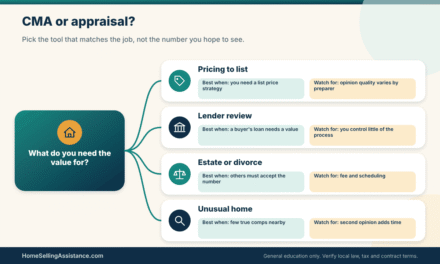
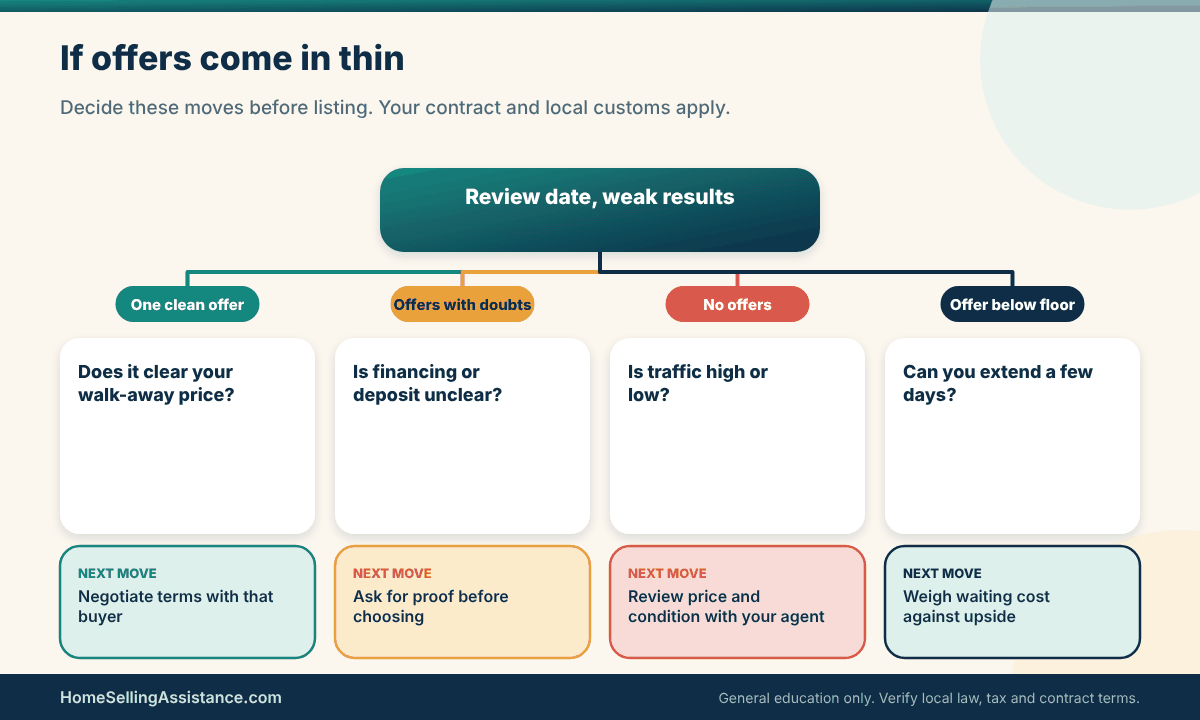
The decision tree below shows one way to respond when the review date brings thinner results than you hoped.
Keep a simple log during the listing period. Note the date, the number of showings, any feedback and every inquiry. After a few days the pattern usually becomes clear. A log makes it far easier to talk to your agent about whether the underpricing house strategy is working, because the conversation rests on facts rather than on how the week felt.
Finally, share the plan with your family or co-owners before listing, not after the first offer arrives. Decisions made in the heat of a review deadline tend to be emotional. If everyone has already agreed on the underpricing house strategy, the walk-away number and the tripwires, you can make choices calmly, and no one is surprised by what happens next.
A scenario, an exception, and your next step for changing course
Say you list sharply and the review date arrives with two offers, both only slightly above list and both with financing questions. You can accept one, ask for improvements, or extend the window a few days. You decided in advance that two weak offers meant the competition story had failed, so you negotiate with the cleaner buyer and lock in a reasonable result rather than gambling on a second round.
The exception is when you hold firm too long. A seller who rejects a fair offer hoping for a better one can end up with a stale listing and a lower eventual price. Waiting is a decision with a cost, and that cost should be written down alongside the possible gain.
Your next step: before listing, write three tripwires on a sheet of paper, such as “fewer than this many offers by the deadline,” “appraisal support below this figure,” or “no clean offer within this many days.” For each tripwire, note the action you will take, whether that is accepting, countering, extending or repricing. When a tripwire trips, follow the plan. That one habit separates a calculated tactic from a hopeful one.
When you do change course, tell your agent clearly and put the new instructions in writing. Whether you reprice, extend the review window or accept an offer, the change should be a decision, not a drift. Good records also protect you if a buyer later disputes what was agreed, and they make it easier to learn from the sale whenever you list again.
It is worth saying plainly that no pricing method removes uncertainty. The best an underpricing house strategy, or any other approach, can do is shift the odds and shape the range of outcomes. Your job is to choose the shape you are comfortable with, and to leave yourself enough room to adjust when the market tells you something new.
Quick scenario
A couple needs to close before a school year starts. They have comfortable equity and a well-kept home. They choose a modest discount, a five-day review window and a written rule that offers need a lender letter. Four offers arrive, two with clean terms, and they accept one. The same couple would have chosen differently if their equity were thin. The underpricing house strategy did not change. Their facts did.
Frequently asked questions about underpricing house strategy
What is an underpricing house strategy in plain terms?
It means setting the list price below what you expect the house could eventually sell for, then letting buyer interest and competing offers lift the final price. Sellers use it to widen the pool of interested buyers and create urgency. It is a bet on competition, so it only pays when enough qualified buyers actually show up. Without them, you may simply sell for less.
Does an underpricing house strategy guarantee multiple offers?
No, and nobody can honestly promise that. Offer counts depend on local inventory, interest rates, the home’s condition, the season and the quality of the marketing. Look at how similar homes in your area performed recently rather than trusting a general claim about bidding wars. If recent listings drew only one or two offers, plan for that outcome.
How low is low enough to attract buyers without giving away value?
There is no universal figure, and anyone quoting a fixed percentage is guessing. The right gap depends on your local comparable sales, the number of competing listings and your minimum acceptable net. Many sellers work with an agent to test a few price points against recent results. Whatever you choose, set a walk-away number before you list.
Why do appraisals matter so much with this approach?
If bidding pushes the contract price above what comparable sales support, a buyer’s lender may receive an appraisal below the price. The buyer, the seller or both then need to negotiate: the buyer may bring more cash, the seller may lower the price, or the deal may end. Some buyers agree in writing to cover a gap, but that is a negotiated term. Plan for it before offers arrive.
Is it risky to set an offer review date?
It carries trade-offs. A review date can build urgency and give every buyer a fair chance, but some buyers will refuse to wait and may buy elsewhere. Rules and customs around review dates and pre-emptive offers vary by area, so ask your agent or a local attorney what is normal and permitted. Whatever you decide, apply the process the same way to every buyer.
What if I list low and only get one offer?
You still have choices. You can negotiate, counter, extend the window or decline and relist at a different price, though a declined low-priced listing can leave a mark. This is why it helps to decide your fallback plan beforehand, including how long you are willing to wait. Our guide to price reduction strategy covers moving the price in either direction.
Can I raise the price later if I started too low?
Raising a published list price is awkward and rarely done, because buyers have already seen the lower figure. Some sellers withdraw and relist, but that can raise questions and may carry contract or timing consequences under your listing agreement. It is far easier to start at a defensible figure and adjust downward if needed. Think of the first number as a decision with limited undo options.
Should I choose the offer with the highest price?
Not automatically. A slightly lower offer with solid financing, a fair deposit and fewer conditions can be worth more than a higher one with doubts. Compare net proceeds, timing, contingencies and the buyer’s apparent ability to close. Choose on terms and evidence only, and never on a buyer’s protected characteristics, which fair housing law prohibits.
Where can I check the rules that apply to my sale?
Start with your state real estate commission, your listing agreement and your purchase contract, since many rules are state-specific. A local real estate attorney or title company can explain customs on deadlines, deposits and appraisal terms. For the wider pricing picture, our main guide on how to price a house to sell is a good next read. You can also browse the home pricing category for related articles.
A calm way to decide
An underpricing house strategy can work well for a seller with equity, a clear timeline and a market that has plenty of buyers. It can also backfire when the buyers are not there. The safest route is to compare both paths on net proceeds, time and risk, write down your tripwires, and let evidence steer the choice. If you want to see how offers get compared once they arrive, the offers and negotiation category is a useful next stop. This article is general education, not legal, tax or financial advice, so confirm your plan with qualified local professionals.