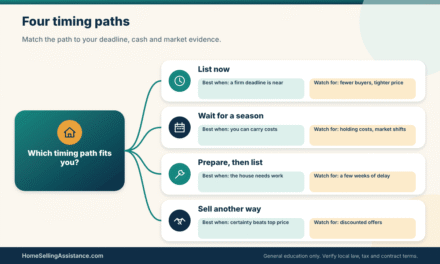
Knowing when to reduce house price is mostly a question of reading evidence on schedule, not a question of how nervous you feel on a given Sunday night. This guide walks through the signals that actually matter, which are showings, buyer feedback, competing listings, offers and the passage of time, and shows you how to weigh them against what a price cut would cost you in real dollars.
Every seller eventually feels the pull. The listing has been live for a couple of weeks, the weekend traffic was thinner than you hoped, and somebody at work mentions that a house down the road “sat forever until they dropped it.” That kind of story is almost useless, because it leaves out the original price, the condition, the photos and the neighborhood. Your decision about when to reduce house price deserves better inputs than a secondhand anecdote.
The honest answer to when to reduce house price is that it depends on a short list of facts you can collect: how many people looked, how many of them toured, what the tours led to, what else was for sale at the same time, and what you can afford to accept. Some listings need a change within the first few weeks, and others never need one. Others deserve patience, or a fix that has nothing to do with the number on the sign. Telling those cases apart is the skill.
We will build that skill in three steps. First, you will pin down your own situation, because a seller with a mortgage deadline and a seller with no rush should not follow the same calendar. Second, you will compare the two realistic paths, holding the price or cutting it, with their trade-offs spelled out. Third, you will use a net-result rule so the final call rests on proceeds, time and risk instead of mood. Everything here is general education, and local conditions always outrank national headlines when you are weighing when to reduce house price.

Key takeaways
- Decide your trigger points before you list. Picking dates and evidence in advance keeps the choice of when to reduce house price from turning into a reaction to one bad weekend.
- Read the funnel, not just the calendar. Online views, requested showings, completed tours and offers each point to a different problem, and only some of them point to price.
- Compare against live competition. Active and pending listings nearby tell you more than last season’s sold prices alone.
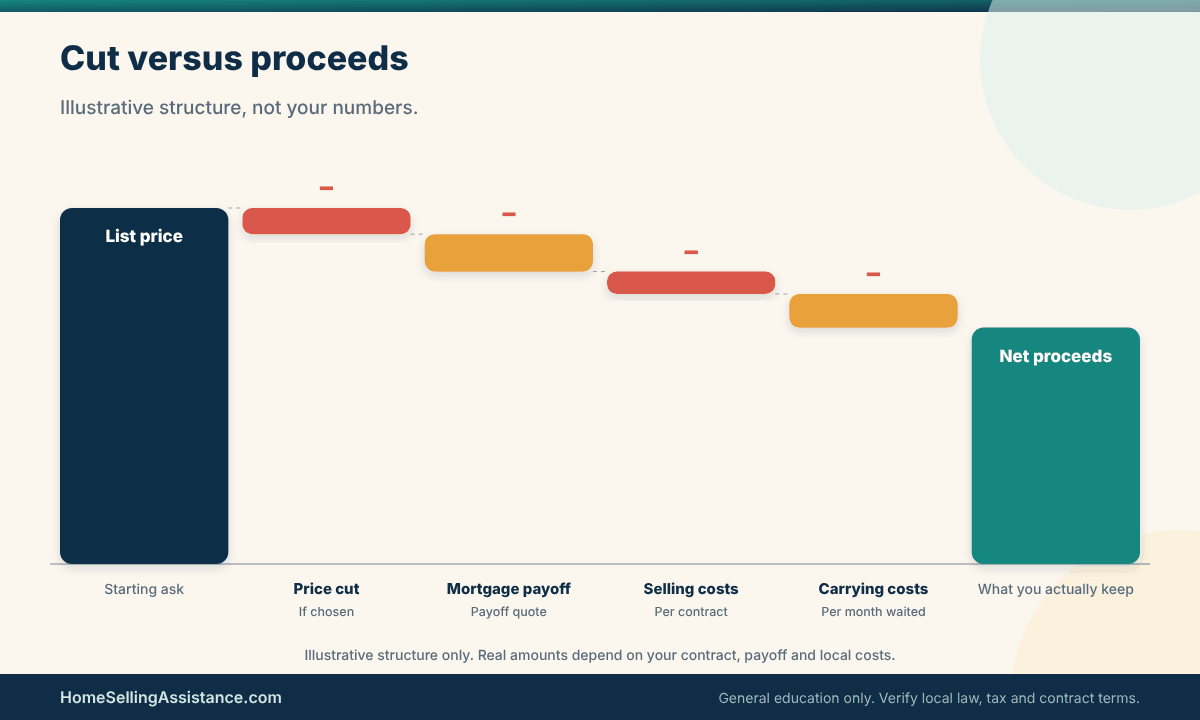
- Judge a cut by net proceeds. A smaller price changes your payoff math, your costs and your timeline, so run the numbers on what you would actually keep.
- Change one thing and watch. Photos, access, terms and price all influence buyers, so alter them in a way that lets you see what worked.
Define your real choice before deciding when to reduce house price
Before you look at a single comparable sale, spend a few minutes on the person doing the selling. The right answer on when to reduce house price is not the same for everyone, and a calendar copied from a stranger’s listing can steer you wrong. Your goal, your deadline, your cash position, the house itself and your tolerance for risk all shape the answer.
What you need from the sale: goal, timeline, cash, condition and risk tolerance
Start with the goal. Some sellers want the highest possible number and can wait for it. Others need to be out by a specific date because of a job start, a lease on the next place or a divorce settlement. Most fall somewhere between, and the honest conversation with yourself is about which side you will give up first, price or time, when the market does not cooperate.
Then look at cash and costs. If you carry a mortgage, taxes, insurance, utilities and upkeep on a house nobody lives in, every extra month has a price tag. If the house is paid off and you live in it comfortably, waiting costs far less. Neither situation is better. They simply lead to different answers about when to reduce house price, and writing yours down keeps you from borrowing someone else’s.
Evidence to gather: your monthly carrying cost, payoff and walk-away number
Pull the actual figures instead of estimating from memory. Request a written payoff statement from your lender, which shows what you owe including interest through a target closing date. Add up monthly mortgage payment, property tax, homeowners insurance, utilities, lawn or snow service, and any HOA dues. That total is what each additional month on the market costs you before a single concession is made.
Next, sketch a rough net sheet using clearly labelled illustrative numbers. Suppose, purely as an example, you list at $400,000, owe $220,000, and expect selling costs and credits that you can estimate from a quote. The gap between those numbers is your cushion. Your walk-away number is the lowest price at which the sale still meets your goal, and you should know it before the first offer arrives. Our guide to home sale net proceeds shows how to build that sheet line by line.
Finally, note any hard dates. A purchase contract on your next home, a lease ending, a school year, a relocation start date. Dates turn a vague worry into a schedule. A seller with a firm date can reasonably set an earlier review checkpoint than a seller who could keep the house for another season without strain.
A scenario, an exception, and your next step: two sellers, one house style
Picture two neighbors with nearly identical homes. Dana has already bought her next house and is paying two mortgages. Marcus is staying put until spring and has no second payment. Both listed on the same day at the same price, and both saw a quiet first three weeks. Dana’s carrying cost makes patience expensive, so an earlier, evidence-based adjustment is reasonable for her. Marcus can afford to keep testing other fixes first.
The exception is the seller who is emotionally attached to a number. If your walk-away price is based on what you paid for renovations or what you hoped for, rather than on what buyers are doing, the evidence will keep disagreeing with you. Your next step, before you decide when to reduce house price, is to write your goal, deadline and floor on one page, then share it with whoever is advising you so the plan is shared, not private.
Facts that could change the decision: what you do not yet know
Even with a clear personal picture, some facts are missing at the start of a listing. You do not know how buyers will react to the photos, whether a competing house will hit the market next week, or whether interest rates will shift enough to change what shoppers can afford. A good plan admits those unknowns and names which of them would change your timing.
Some of these facts show up quickly. Others take weeks. That is exactly why a fixed calendar is only a starting frame. The question of when to reduce house price becomes sharper as real data arrives, and the sellers who do best are usually the ones who collect that data on purpose instead of waiting for it to land in their lap.
Evidence to gather: what showing data, feedback and nearby listings can tell you
Ask your agent, or check your listing portal if you are selling without one, for four counts: online views, saves or favorites if available, showing requests, and completed tours. These form a funnel. Plenty of views with few showing requests often suggests that the price, photos or first impression are not working at the click stage. Plenty of requests but no offers after tours suggests that buyers who see the house in person are comparing it with something better or cheaper.
Collect feedback in writing when you can, and read it as patterns, not as single remarks. One comment about paint color is taste. The same remark about the price relative to condition from several visitors is information. Be careful with feedback that touches on who lives in the neighborhood or who a buyer is. Fair housing rules protect buyers, and a good agent will screen those comments out; the HUD fair housing pages explain the protected classes in plain language.
Also list nearby competition: what is active today, what went pending recently and what sold, with dates. Active homes are the ones your buyers can choose instead of yours right now, which makes them more relevant to timing than a sale from several months ago.
A scenario, an exception, and your next step: the great photos and the empty weekend
A seller lists on a Thursday with polished photos and gets nine showing requests by Sunday, then nothing the following week. It is tempting to read the quiet week as proof that the price is wrong. But early listings often draw a burst from buyers who had been waiting for something new, and the burst fades whether or not the price is right. The first weekend tells you about interest, and it should not by itself settle when to reduce house price. The weeks after tell you about conversion.
The exception is a listing that never gets the burst at all. If few people even click, the problem is probably upstream of the showing, in price relative to the search filters buyers use, in photos or in the headline. Your next step is to compare your funnel with a similar nearby listing, ideally through your agent’s access to the local listing service, and write down where yours drops off.
For a broader view of how timing across the year shapes these early weeks, our cornerstone on the best time to sell a house explains why a slow week in one season is a normal week in another.
Compare the two realistic paths: hold steady or cut now
Once your own situation is on paper, the question of when to reduce house price usually narrows to two practical paths. You can hold the price and change something else, such as presentation, access or terms, or you can lower the price now and accept the cost in exchange for speed. A third path, pulling the house off the market, exists too, and we touch on it later, but most sellers live in the first two.
The table below puts the two paths side by side on the factors that matter most in a sale. Use it as a thinking aid, not a verdict. Your own contract, your local market and your finances change how each row plays out, and a row that looks minor for one seller can dominate for another.
| Factor | Option A: hold and adjust other things | Option B: reduce the price now | What to check |
|---|---|---|---|
| Price and net proceeds | Keeps the full ask in play if buyers respond | Lowers the ceiling by the full cut, with costs shifting too | Updated net sheet at both prices |
| Time | May lengthen the listing if buyers do not respond | May bring faster interest, with no guarantee | Your carrying cost per month and any hard date |
| Contingencies | Offers may still come with ordinary conditions | Lower price can attract financed buyers who need an appraisal to match | Appraisal, inspection and financing terms in each offer |
| Workload | Needs re-shoots, repairs or schedule changes | Mostly a paperwork and marketing refresh | Who handles photos, access and re-listing text |
| Execution risk | Risk of drifting while waiting for proof | Risk of cutting too little, then needing a second cut | Written checkpoint dates and a floor price |
| Buyer perception | Looks steady and confident if activity is healthy | Can signal motivation, which buyers may use in negotiation | How competing sellers handled their own changes |
Read across a row rather than down a column. The question in each row is whether Option A or Option B costs you more of the thing you care about most. If your top priority is net proceeds and you have time, Option A rows tend to look better. If a deadline presses on you, the time and execution rows tend to favor acting sooner. Neither reading is wrong. Your approach to when to reduce house price simply has to match what you wrote in the first section.
Option one: hold the price and fix what else could be wrong
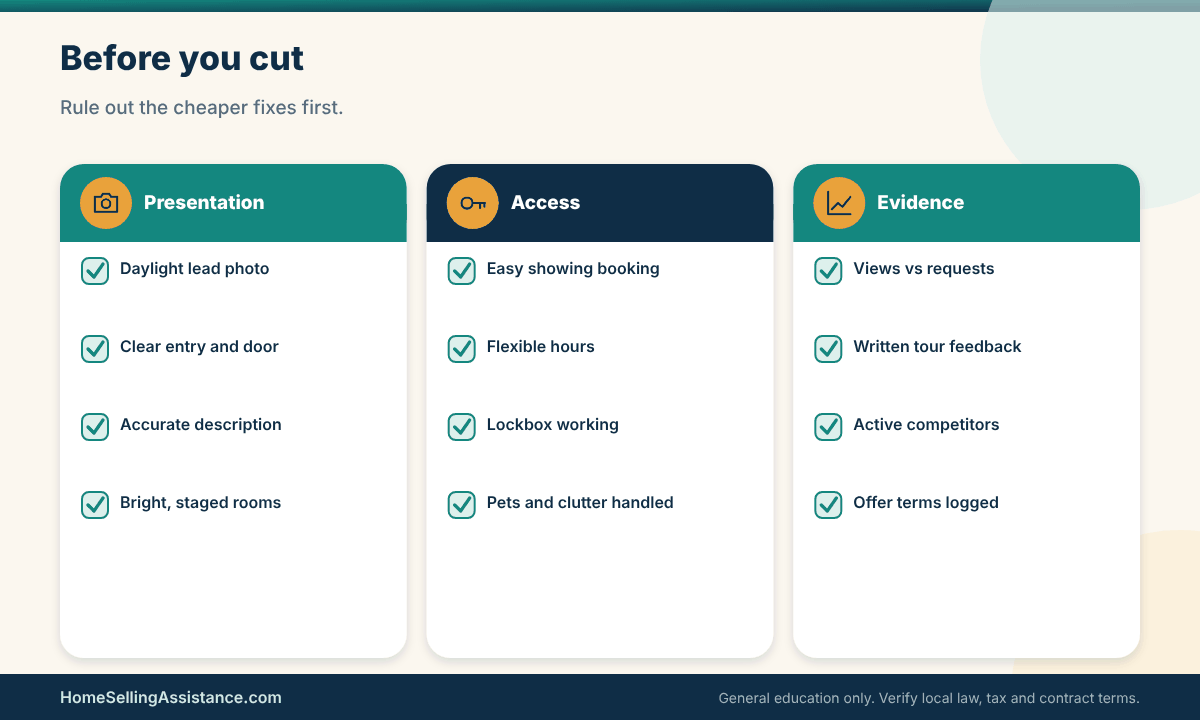
Holding the price is not the same as doing nothing. It means choosing to test the other levers first. Photos, the listing description, showing availability, the condition of the entry and the first rooms buyers see, and the terms you will accept all affect how many people tour and how seriously they compare you with other homes. Fixing one of these can be cheaper than a cut, and it does not lower your ceiling.
The risk is time, and time is the heart of when to reduce house price. A hold only works if you set a short, specific window and an honest test. Otherwise it becomes a quiet hope that buyers will eventually appear. A hold with a deadline, say two weeks to try new photos and extended showing hours, is a plan. A hold without one is a wish, and it can be an expensive wish when carrying costs run every month.
Evidence to gather: the signals that justify a short hold
A hold is best supported when your funnel shows early strength somewhere. Healthy online views with few showing requests point toward presentation or first impression. Several showings with specific, repeated comments about something fixable, such as a smell, clutter, a dark room or a deferred repair, point toward a task you can complete. These are cases where changing the price would only mask a problem that a different buyer would also notice.
Check the competition as well. If the homes most like yours are still sitting at their own original prices, you may not be an outlier. If two or three of them have recently reduced, you may be priced against an adjusted market without knowing it. Cross-check with your agent or with the listing portal, and compare list price per square foot only as a rough yardstick, since condition and lot differences distort it. Our guide on how to prepare a house for showing covers the low-cost fixes worth trying first.
Also read what the photographs themselves communicate. A listing with dim, crooked or sparse images can lose buyers before price is ever seen. If that is plausible, ask about re-shooting in good light, and see our overview of real estate photography for sellers for what a professional set should include.
A scenario, an exception, and your next step: the listing that needed a front door, not a discount
A couple listed a tidy ranch and had steady online views but few tours. Their agent suggested a cut, but the couple asked to look at what showing visitors actually saw. The entry was cluttered with shoes and a stroller, the front door paint was peeling, and the first photo was a dim living room shot at dusk. They spent a weekend clearing the entry, repainted the door and had the lead photo retaken in daylight.
Tours picked up within days. That outcome is never certain, and a different house might have shown no change at all, which is the exception to remember. If the fixes land and activity still stays flat after a set period, the evidence has told you something and the price lever is next. Your next step is to write the hold window and the checklist of fixes on the calendar, with a date when you will review honestly.
Option two: reduce the price now and reset the listing
A reduction is the strongest single lever you have, and it works best when it is large enough to move your listing into a new group of searches and comparisons. Buyers often search within price brackets, so a change that crosses a bracket can put the house in front of people who never saw it. A very small change that stays within the same bracket may do little beyond a symbolic gesture.
The trade-off is that every dollar comes straight out of your proceeds, and a cut that is too timid can force a second one later, which tends to signal weakness. Reducing is also hard to reverse. You can lower a price in a day, but raising it back is unusual and may cost credibility. That asymmetry is why timing and size deserve more thought than the act itself, and why when to reduce house price is worth settling in advance.
Evidence to gather: the comparison that supports a reduction
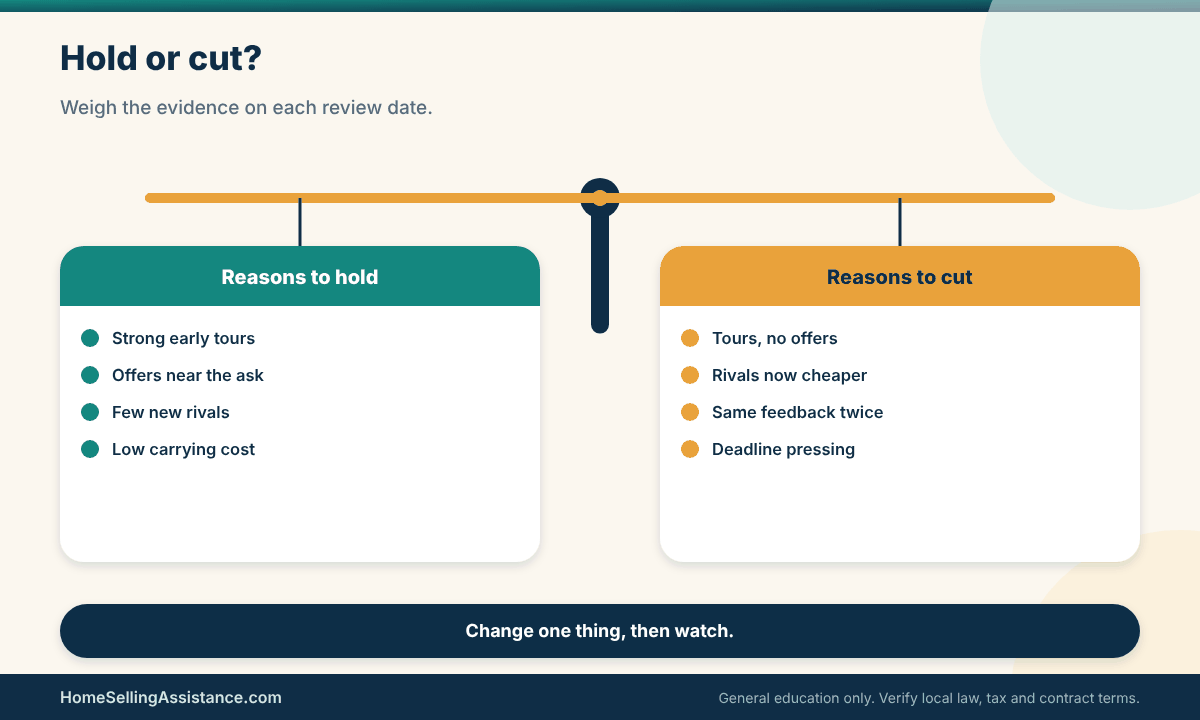
Evidence for a reduction tends to look like this. Several weeks of normal exposure, a completed set of presentation fixes, tours that happen but lead to no offers, and competing homes that are priced lower, in better condition or both. When you can point to those facts in writing, the reduction is a response to the market and not a flinch. You will also be able to explain it clearly to a co-owner, a lender or a spouse who needs to agree.
Ask your agent for a short written comparison: the three most direct competitors, their list dates, price changes and status. If you are selling without an agent, you can pull the same details from public listing sites, with the caveat that sold data may lag. Our article on building a home price reduction strategy goes deeper on checkpoints for when to reduce house price, and overpricing a house to sell explains how an inflated start shapes everything that follows.
Then rerun your net sheet at the lower price. A reduction also changes what buyers can finance and how an appraiser may view the contract price, so keep in mind that the lower number is a new starting point for negotiation, not a floor. Offers often arrive below any list price, and your walk-away number from the first section is what keeps you steady.
A scenario, an exception, and your next step: the reduction that crossed a search bracket
Consider an example with round, illustrative numbers. A home is listed at $425,000 and draws views but few tours. The seller reduces to $409,000, which crosses below a common search threshold of $410,000 used on many listing sites. Showing requests rise noticeably. The seller cannot know whether the bracket or the signal of motivation caused it, and does not need to, as long as the result was acceptable.
The exception is the seller who reduces by a small amount, waits a week and sees nothing. A tiny cut inside the same bracket rarely changes who finds the listing. Before you act, ask your agent which search ranges buyers in your area tend to use, and decide whether your cut should cross one. Your next step is to confirm the new price, the effective date and any advertising update in writing, so every channel shows the same number.
Use a net-result rule to settle when to reduce house price
Paths and signals only get you so far. At some point you need a rule that turns evidence into a decision, and the fairest rule we know is to compare the outcomes in terms of what you would actually keep and when. This is the same lens you would use for any other large financial choice: results after costs, time and risk, not the headline number alone.
The second table below, built around when to reduce house price, maps common seller situations to the route that tends to be favored, with the reason, the trade-off and the one fact that would flip the choice. Treat it as a pattern guide. Your particular house, your market and your contract can overturn any row, which is why the last column matters most.
| Situation | Route favored | Reason | Trade-off | Fact that changes the choice |
|---|---|---|---|---|
| Hard move date and double housing costs | Earlier, evidence-based reduction | Each month on the market has a real cost | Lower proceeds in exchange for time | A bridge arrangement that removes the deadline |
| No deadline and low carrying cost | Hold and test other fixes first | Patience costs little | Longer exposure and fading novelty | A new competitor or rate shift that thins the buyer pool |
| Many online views, few showing requests | Review photos, headline and price together | Buyers are rejecting at the click stage | A re-shoot may not fix a price problem | Whether nearby lower-priced homes get the clicks |
| Steady tours, no offers | Reduction after comparing competitors | Buyers see the house and choose another | A cut that is too small may not change the comparison | Repeated feedback about condition rather than price |
| Strong first weekend, then one low offer | Counter in writing, hold the list price | Interest exists, so negotiate | The buyer may walk away | Your walk-away number and the offer terms |
| Competing homes recently reduced | Re-run comps, then consider matching the market | Your relative position has changed | Reacting to a competitor may be premature | Whether those homes are truly comparable |
To use the table, find the row closest to yours and read the last column first. If that fact is true for you, the favored route on when to reduce house price may reverse. Then read the trade-off and ask whether you can live with it. If you cannot decide, that usually means an input is missing, and your next move is to gather that one fact rather than choose by instinct.
The price, time, cost and risk framework for when to reduce house price
The framework is four columns on one page. Price is what you would receive at the new list price and at a likely accepted price. Time is how long each path may take and what you pay while you wait. Cost is the cash outlay for repairs, photos or concessions, plus the lost proceeds from a cut. Risk is what could go wrong, including a second cut, a buyer who cannot finance or a listing that goes stale.
No single column wins on its own. A path with the highest possible price but a long and uncertain timeline may be worse for a seller with a deadline. A path that closes fast with lower proceeds may be right for someone whose carrying costs would eat the difference. Putting all four in front of you at once is the point of any sound rule on when to reduce house price.
Evidence to gather: a worked net-result example with illustrative numbers
Here is a simple example using round numbers that are illustrative only. A house is listed at $400,000. The seller owes $220,000 and pays $2,500 a month in mortgage, tax, insurance and utilities while waiting. A reduction of $12,000 would lower the list price to $388,000. Dividing the cut by the monthly cost gives a rough break-even of a little under five months. If waiting would cost more than that, the cut may pay for itself in avoided carrying costs.
That arithmetic ignores several things. The reduction might not bring an offer. A longer wait might produce a better one. And selling costs, credits and any taxes change what the seller finally keeps. The point of the exercise is not precision. It is to see whether your gut feeling about a cut is large or small relative to what waiting costs, and to show a co-owner the logic in plain numbers.
Ask your title company or agent for an estimated closing statement at the lower price, and confirm that no tax or lien item changes the picture. If you want to understand the federal tax rules around gain on a home sale, IRS Publication 523 is the primary source, though your own situation may call for a tax professional.
A scenario, an exception, and your next step: the seller who counted the wrong cost
A seller reasoned that a cut was too expensive because she was still living in the home and had no extra costs. Then she took a job in another state, started renting, and her old house went from a comfortable asset to a second housing payment. Her original rule, which was to hold, was sound for the circumstances she had at the time. It stopped being sound when the circumstances changed.
The exception is the reverse case: a seller who panics about carrying costs that are actually small. The next step in both cases is to refresh the numbers on a fixed schedule, such as every two weeks, instead of trusting an old estimate. Our guide to how much to reduce house price picks up where this section leaves off, once you have settled when to reduce house price and decided a change is warranted.
When new evidence should change the plan
Plans exist to be updated, and a plan for when to reduce house price is no exception. If you set a checkpoint for two weeks after listing, and on that date a new competing home appears at a lower price with better photos, your assumptions changed. Likewise if an offer arrives that is lower than hoped but serious, the whole question of when to reduce house price can move from a cut to a counter. The skill is knowing which new facts matter.
Some evidence deserves a quick response, while other evidence deserves patience. Strong evidence is specific, repeated and verifiable. Weak evidence is a single comment, a rumor about a neighbor’s sale or a national headline about the housing market. National data from sources such as the National Association of Realtors provides context, but it is not a forecast for your street.
Evidence to gather: the changes that deserve a response and the ones that do not
Changes that usually change the answer on when to reduce house price include a new listing that directly competes with yours, a recent sale of a similar home at a price that differs from your assumptions, repeated written feedback on the same issue, a shift in mortgage rates large enough that your agent sees local buyers reacting, and a written offer with terms you can compare. Each of these is checkable. Ask for the address, the date or the document.
Changes that usually deserve patience include one slow weekend, a holiday week, a single negative comment, a neighbor’s story and a news article about national trends. These can matter in aggregate, but a single instance rarely justifies a price move. A simple habit helps: before changing anything, write down what new fact you learned and where it came from. If you cannot fill in the second blank, wait.
Your agent, if you have one, is a good partner here, and you should feel free to ask for the underlying data. The questions to ask a listing agent about price include several that bring these facts to the surface without turning the conversation into a standoff.
A scenario, an exception, and your next step: the offer that arrived on day nineteen
A seller planned a review on day twenty-one and intended to cut if nothing had changed. On day nineteen, a financed offer arrived about four percent below list, a figure used here purely as an illustration. The seller’s plan had assumed no offers, so the old rule no longer applied. Instead of reducing the list price, the seller countered in writing, kept the original ask visible and negotiated terms that mattered, such as closing date and inspection timing.
The exception is an offer that is far below your floor and comes with heavy contingencies. That is not necessarily a reason to cut. It may simply be a buyer testing the market. Your next step with any offer is to compare it against your walk-away number and your net sheet, then respond within the deadline stated in the offer. Our guide to counteroffer strategy for sellers walks through that response.
It helps to turn all of this into a rough calendar, so the question of when to reduce house price has an answer on paper before emotions get involved. The schedule below is an example, not a rule, and your agent or your own experience of the local pace should adjust it. In a fast area the dates compress. In a slow one, or in a quiet season, they stretch.
In the first week, you are mostly collecting data: views, requests, tours and any early feedback. Do not change the price in this window unless something plainly went wrong, such as a typo in the listing that shows the wrong figure. Around the second or third week, hold a first review of when to reduce house price. Look at the funnel, scan the competition and decide whether a presentation fix is warranted. This is the moment when many sellers ask when to reduce house price for the first time, and it is usually too early to cut on silence alone.
Around the fourth to sixth week, hold a second review with fresher comparisons. If you have fixed what could be fixed and the funnel still shows tours with no offers, the evidence for a reduction becomes much stronger. If you are still within your carrying-cost tolerance, you can take another week or two. If you are not, this is where your written plan says to act. A calendar like this does not remove judgment. It only makes sure judgment arrives on a date, with facts in hand.

Consider also how your listing agreement shapes the timing. If you signed with an agent, the contract probably sets a listing period, and it may say how price changes are requested, who approves them and whether they are in writing. Reading that document early, before the first review date, prevents surprises. Our overview of the listing agreement for sellers explains the terms worth checking, and the rules about commission and cancellation vary by state and by contract.
There is also a third path that sits outside the hold-or-cut choice: taking the house off the market for a while. Sellers sometimes do this when a season turns, when major repairs are needed or when a fresh start would help. The cost is that the listing history may stay visible, and a relisting is not a magic reset. If you are weighing it, our guide to relisting an expired home listing covers what changes and what does not, and what to do when a house is not selling lays out a wider troubleshooting path.
Quick scenario
A seller lists a three-bedroom home in a quiet part of winter. Four weeks pass with a handful of tours and no offers. Nearby active listings are mostly unchanged, and agent notes say buyers like the layout but find the kitchen dated. The seller has no hard deadline. Rather than cut at once, the seller sets a two-week window to price the kitchen question honestly, gets a contractor estimate and a flooring quote, and decides to hold until the review date.
Whether that is the right call on when to reduce house price depends on the evidence that comes back, which is exactly the point.
Mistakes in this decision tend to repeat, so it is worth naming them before you settle when to reduce house price. The first is reacting to a single data point: one slow weekend, one harsh comment or one headline. The second is cutting by a token amount that changes nothing, then waiting and cutting again, which can train buyers to expect further drops. The third is ignoring terms. Sometimes a seller who is flexible about closing date, repairs or a rent-back period can close a gap that no price cut would have touched.
The fourth mistake is skipping the net sheet. A decision about when to reduce house price without a net estimate is a decision about a number you do not understand. The fifth is letting a co-owner, a relative or a neighbor drive the call with opinions rather than evidence. If you share ownership, agree on the floor price and the review dates together, ideally in writing, long before the first offer arrives. Disagreements are far easier to settle in a calm week than in a tense one.
Finally, remember that the numbers on any one listing are small samples. A single house on the market for three weeks does not generate enough data to be statistically certain about anything. That is why a thoughtful seller leans on several signals together and on local professional judgment, instead of treating any one measure, whether days on market, tours or comparable sales, as the answer. Our explainer on days on market for sellers shows how to read that number without over-reading it.
One last trap is advice that claims to know your exact answer. Be careful with anyone who promises that a particular cut will bring an offer by a particular date, who quotes one universal rule for when to reduce house price, or who pressures you to decide before you have seen your own numbers. Reliable advisers show their data, explain their reasoning and tell you what could prove them wrong.
If you are unsure about a legal or financial point, a licensed real estate attorney, a title company or a tax professional in your state is the right source, and the market conditions and timing section of our library collects more guides on reading the local picture.
You can also strengthen your footing by studying how price interacts with the broader market. Our piece on seller market vs buyer market explains why the same price decision can look different depending on how many buyers are competing for how many homes, and our guide to how to price a house to sell shows what a defensible starting number looks like in the first place.
Frequently asked questions about when to reduce house price
How long should I wait before deciding when to reduce house price?
There is no universal number of days, because local pace, season and price range all change what is normal. A practical approach is to set review dates before you list, such as a first look after a couple of weeks and a firmer one a few weeks later, and to adjust them with your agent’s knowledge of your area.
Act earlier if your carrying costs are heavy or a deadline presses on you, because that is when when to reduce house price becomes a cash question as much as a market one.
Is a lack of showings always a sign that the price is too high?
Not always. Few showings can come from weak photos, a poor headline, limited access, a hard-to-schedule lockbox or a price just above a common search cutoff. Compare your online views to showing requests to see where buyers drop off. If views are healthy and requests are scarce, review presentation and price together before deciding.
What does buyer feedback tell me about when to reduce house price?
Feedback is most useful as a pattern. A single comment about paint is taste, while several comments that mention the price compared with another house are a signal. Ask for feedback in writing where possible, and be wary of any remark that touches on protected characteristics of buyers, which an agent should screen out under fair housing rules.
Should I match a competing home that just dropped its price?
Not automatically, because when to reduce house price is a question about your house and not your neighbor’s. First confirm the other home is truly comparable in size, condition, lot and location. Then check whether it was overpriced to begin with, since a cut might only bring it back into line. React to a pattern of several adjustments, not to one neighbor, and recalculate your own net proceeds before changing anything.
How much should a reduction be when I decide to cut?
The amount depends on your market, price bracket and the evidence you collected, so no percentage fits every house. A cut that is too small may change nothing, while a larger one may cross a search range and reach new buyers. Our separate guide on how much to reduce house price covers sizing in detail, and your agent can show comparable examples.
Can I raise the price again if a cut does not work?
Technically you can, but it is unusual and may look odd to buyers who have watched the listing. Treat a reduction as a one-way move and decide it with care. If activity does not improve after a sensible period, look first at terms, condition and presentation instead of cycling the price up and down.
Does the time of year change when to reduce house price?
Yes, often, and seasonality is a big input to when to reduce house price. A slow week in a quiet season may be completely normal, while the same silence in a busy season could be a warning. Holidays, school calendars and weather affect traffic in many places. Ask your agent how seasonal patterns look locally and compare your listing with similar homes from the same time of year.
What should I do if I get a low offer right after listing?
Compare the offer against your walk-away number and your net sheet, then respond within the stated deadline. A low early offer usually calls for a counter, not for a list price cut, because interest clearly exists. Terms such as closing date, contingencies and financing type matter as much as the figure, so weigh the whole package.
Will a price reduction affect the appraisal?
It can influence the contract price an appraiser reviews, though the appraisal itself is based on comparable sales and the home’s condition, not on your list history. If a financed buyer’s appraisal comes in lower than the contract price, you may face a renegotiation or a buyer who walks away, so ask your agent how to plan for that possibility.
Who decides when to reduce house price if I have an agent?
You do, including the final call on when to reduce house price. The agent advises and may recommend a change, but the owner approves the price, usually in writing under the listing agreement. If you disagree with a recommendation, ask to see the data behind it. A good adviser welcomes that question and explains it, and you can request a short written comparison to review.
A calm way to decide
Deciding when to reduce house price is easier when you have your goal, your floor and your review dates written down before the pressure builds. Gather the evidence, compare the paths on net proceeds, time and risk, and change one thing at a time so you can see what works. This article is general education, not legal, tax or financial advice, and rules and market conditions vary by state and by neighborhood, so confirm the details that affect your sale with a licensed professional in your area.