Overpricing a house to sell is one of the most common and most expensive mistakes a seller can make, and it usually starts with a perfectly understandable feeling: you want to leave room to negotiate, or you simply believe your home is worth more than the neighbors’ homes. This guide explains what actually happens to showings, days on market and negotiation when a list price runs ahead of the market, and how to tell whether yours has.
Nobody sets out to price a home badly. You remember what you paid, you remember the kitchen you redid, and you can see what the house next door was listed for last spring. Add a friend who swears the market is hot, and a number that feels bold starts to feel reasonable. The trouble is that buyers do not see your history. They see a price, a set of photos and a handful of other homes they can tour the same afternoon. That is the basic reason overpricing a house to sell backfires more often than sellers expect.
We will go through this in four steps. First, what the claim “my house is worth this much” really rests on. Second, how to read the early signals from a listing without over-reading them. Third, how to turn that evidence into a decision to hold, trim or reset. Fourth, which questions only local data and a professional can answer. If you want the full pricing framework first, our guide on how to price a house to sell covers the whole method.
Key takeaways
- Buyers compare, they do not negotiate with your hopes. A price is judged against other homes they can tour, so a number above the market gets skipped before anyone talks about it.
- Early activity is the cheapest data you will ever get. Showings, online saves and feedback in the first couple of weeks tell you more than any opinion.
- Overpricing a house to sell rarely leaves “room to negotiate.” It more often leaves a stale listing and a weaker position later.
- No single percentage applies everywhere. Price cuts, days on market and sale-to-list ratios vary by neighborhood, price band and season, so use local data.
- A price change needs a reason. Change the number when evidence points to it, not because a calendar page turned or a neighbor said so.
- This is general education. Your contract, your local market and a licensed professional decide the specifics.
What overpricing a house to sell really means
Before you can decide whether a price is too high, you need a clear definition of “too high.” It is not a feeling and it is not a fixed percentage above anything. A price is too high when the buyers who are actually shopping in your area, with the financing they actually have, will not choose your home over the alternatives at that number. That is a statement about the market, not about the house. Keep that in mind, because overpricing a house to sell usually shows up first in the numbers you can count.
This section pins down the claim you are making when you pick a list price and the data that would back it up. Overpricing a house to sell tends to survive only as long as nobody tests the claim, so we start with the test.
The gap between your list price and what buyers will pay
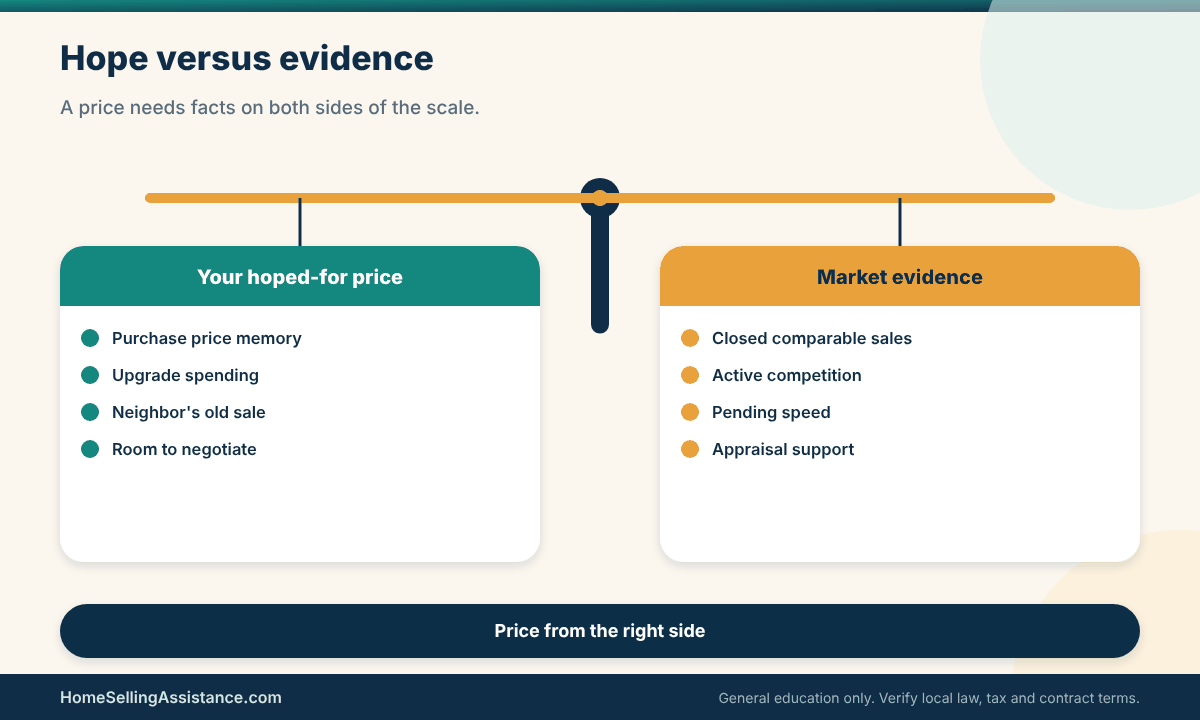
Every list price carries an unspoken sentence: “Buyers in this market will pay this much for this house.” Sellers often hold that sentence loosely, as hope, and later treat it as fact. The gap is the distance between that sentence and reality, and it is measurable once you know where to look.
Evidence to gather: how to measure the gap yourself
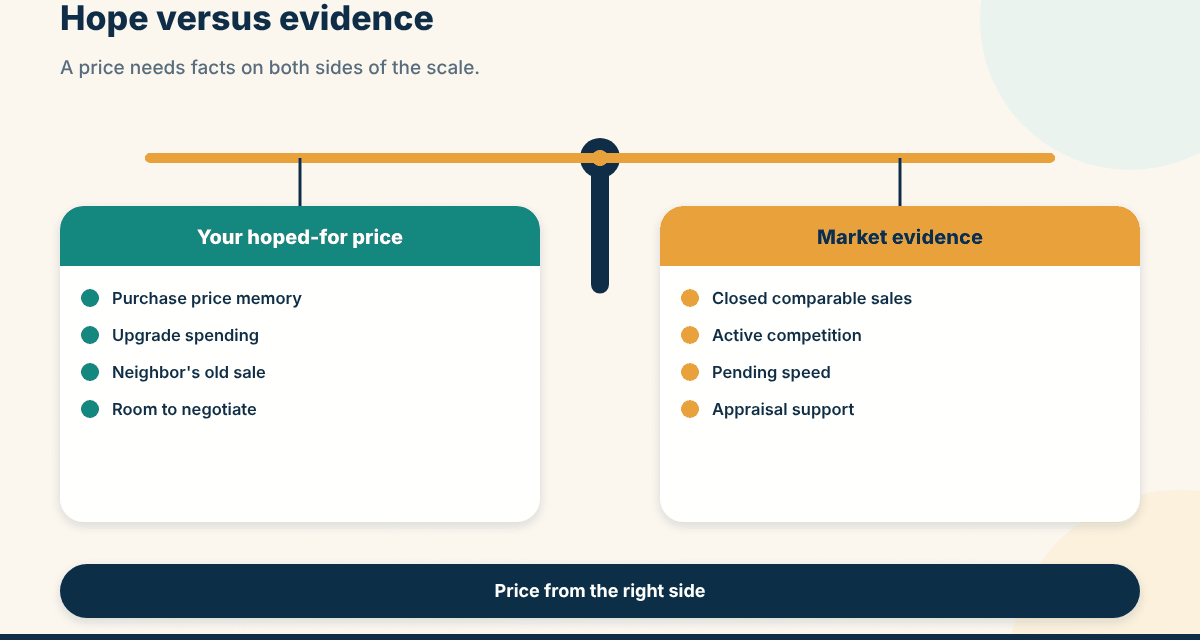
Start with homes that have actually sold, not homes that are listed. A listed price is another seller’s hope. A closed sale is a buyer’s decision, backed by a contract, a lender or cash, and usually an appraisal or inspection. Pull closed sales from roughly the last few months in your immediate area, favoring homes that resemble yours in size, age, condition and lot. Your local MLS holds the best version of this, and a licensed agent can share it.
Next, line your price up against them. Not the average price, which hides everything useful, but the specific homes that are closest to yours. If the best comparable sold for a figure noticeably below your intended list price, ask what justifies the difference: an extra bedroom, a finished basement, a newer roof. Write the reason down. If you cannot name one in a sentence, the gap is probably real.
Then look at what is competing with you right now. Active and pending homes in your price range are the ones buyers are touring this week. If three similar homes are listed below you with better photos, your price is not competing with sold homes at all, it is competing with them. Our overview of how much your house is worth shows how these sources fit together. Honest answers here are your best defense against overpricing a house to sell.
A last piece of evidence people skip is the pending list. Pending means a buyer and seller agreed, which tells you what level of price and condition is actually clearing. If homes like yours go pending within days at a price below your plan, that is the market speaking loudly. Keep notes on addresses, list dates and any price changes, because patterns show up quickly when written down.
A scenario, an exception, and your next step on the gap
Here is an illustrative scenario with round numbers. A seller plans to list at 500,000 because a house two streets away sold for that last year. Looking closer, that house had a renovated kitchen and a larger lot, and the market has shifted since. The three most similar recent sales closed between 455,000 and 470,000. The seller’s number is not wildly out of reach, but it asks buyers to pay for features the home does not have. None of this is an argument against ambition, only against overpricing a house to sell without proof.
An exception is worth stating plainly. Sometimes your house really is different: unusual views, a rare lot, an addition that comparables lack. In thin markets, a higher price can be defended if the evidence is specific and documented. The key is that the justification is something a buyer can see and an appraiser can adjust for, not something only you value.
Your next step is small. Write one paragraph that starts “I believe this house is worth more than the closest sales because…” and finish it with facts. If the paragraph comes easily and the facts are checkable, you may have a defensible price. If it turns into feelings about the neighborhood or what you spent on upgrades, that is a sign the gap exists. A sketch of the reasoning is shown below.
It also helps to say the quiet part out loud. Overpricing a house to sell often comes from anchoring on a past number, such as the purchase price or a peak-season sale you remember. Those figures describe a different moment. The market you are selling into is the one that exists this month, and it does not owe you the price from last year.
The market data that shows whether a price is too high
Once you accept that the claim needs testing, the next question is what data to test it with. More data is not always better. Four or five well-chosen numbers beat a spreadsheet of thirty, and the quality of the source matters more than the quantity. Overpricing a house to sell is easiest to spot when you compare your plan against measurements the market has already produced. Seen this way, overpricing a house to sell is a testable habit, not a mystery.
Data worth pulling before you set a number
The core set is short. Closed sales for similar homes, active competition in your price band, pending homes and how fast they went under contract, and any recent price reductions on nearby listings. Each answers a different question. Sold homes show value, active homes show competition, pending homes show speed, and price reductions show where sellers misjudged.
Pay attention to the relationship between final sale price and original list price in your area, sometimes called the sale-to-list ratio. A local agent can pull it for your neighborhood and price band. Do not borrow a national figure for this, because it varies enormously between towns and even between price tiers in the same town. National data from sources such as the National Association of Realtors is useful for general context, not for your pricing decision. Sellers who check this step rarely end up overpricing a house to sell by accident.
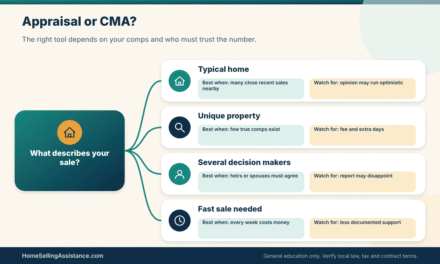
Days on market deserves the same caution. A home that sat for sixty days in a slow month and a home that sat for sixty days because it was overpriced look identical in a spreadsheet. That is why the number has to be read alongside price changes and listing history. We unpack the difference in the next section, and our guide on comparing a CMA with an appraisal explains why different pricing tools answer different questions.
Finally, gather what is specific to your property: age of major systems, recent improvements with receipts, lot features and anything that sets the house apart. These are the details a comparable-sales analysis adjusts for. If you want to understand the adjustment process, see how agents adjust comps for home value.
One more caution about data: be careful with averages. An average sale price for a whole zip code blends starter homes, luxury homes and everything between, so it says little about yours. When you hear that the market is up or down, ask which segment, which area and which period. A claim that cannot answer those three questions is not much use when you are deciding on overpricing a house to sell or avoiding it.
A scenario: when the data is thin
Consider a rural property with only two comparable sales in the past year, both older and both different in acreage. In that case, the usual toolkit runs out. The honest answer is that any price will carry wide uncertainty, and a seller who pretends otherwise is guessing with extra steps.
When data is thin, widen the net carefully rather than forcing precision. Look at a longer time period, a larger radius or sales from comparable towns, and be explicit that each step weakens the comparison. Professional input matters more here than anywhere, because an experienced local professional knows which of the few sales truly resemble your property and which are misleading. It is a modest effort that keeps overpricing a house to sell off the table.
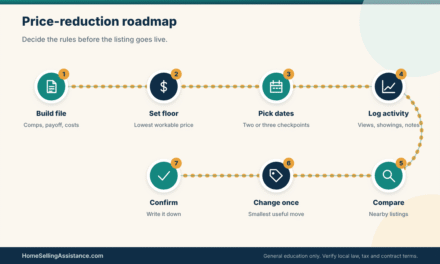
Thin data also changes the strategy. If you cannot be confident in a number, plan a price you can adjust quickly with a clear review date, rather than a high price you defend for months. Decide in advance what early activity would make you hold, and what would make you trim. Writing those triggers down before the listing goes live protects you from emotional decisions on day twelve.
Keep a simple log as you gather this. A page with the addresses, sale dates, sale prices, listing dates and a one-line note on how each home differs from yours is enough. Seeing the evidence on one page makes it harder to fall back on a hopeful number, and it gives you something concrete to hand to a professional. Sellers who skip the log tend to remember only the comparable that flatters them, which is a quiet route to overpricing a house to sell.
A final practical point: ask for the reasoning behind any number you are given, whether from an agent, a website estimate or a friend. A number without comparable sales behind it is an opinion. A number with three closely matched sales, adjustments explained and a stated range is a pricing recommendation you can evaluate. For a broader view of the process, our home pricing and value resources collect the related guides. Small checks like this make overpricing a house to sell much easier to catch early.
Separating signal from noise when a listing sits
Once a home is live, the market starts handing you information. Some of it is useful and some is noise, and the skill is telling them apart. A single slow weekend proves very little. Three weeks of quiet, with similar homes getting offers, proves quite a lot. This section is about reading that early feedback without jumping to conclusions in either direction, because overpricing a house to sell and bad luck can look similar for the first few days.
What showings, days on market and feedback can tell you
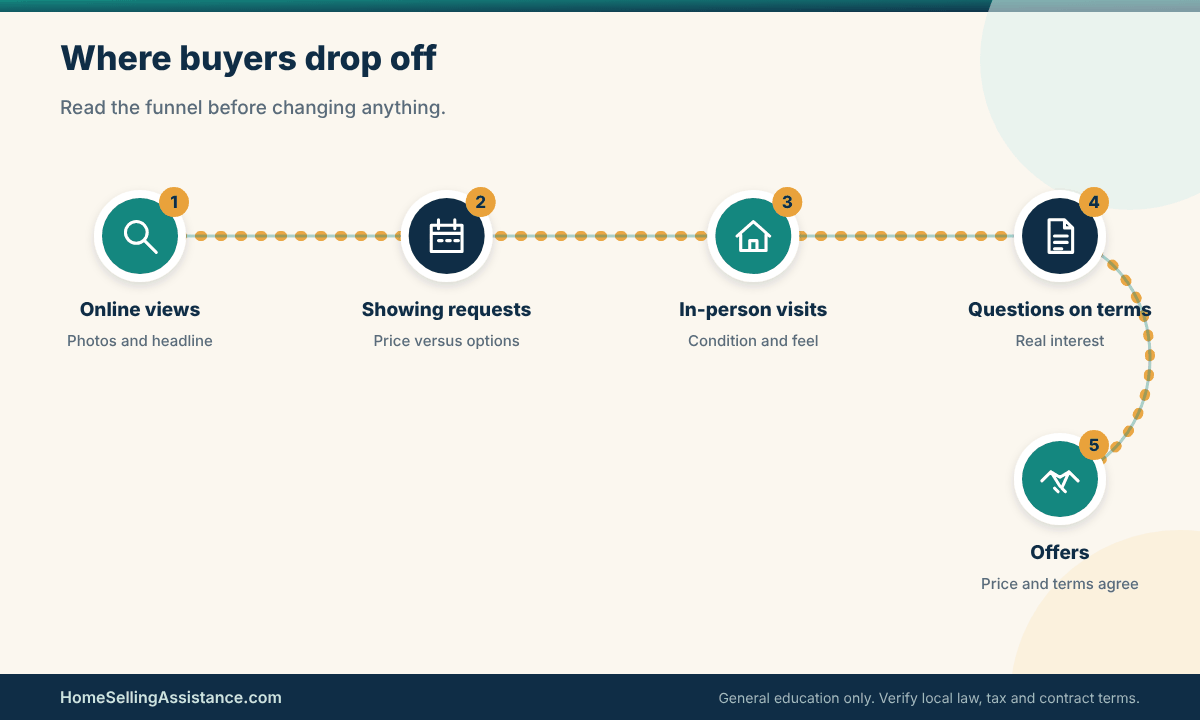
Think of three layers of buyer behavior. First, online attention: views, saves and shares. Second, in-person attention: showing requests and open house traffic. Third, commitment: second visits, questions about terms and offers. Each layer filters out some people, and where the funnel narrows tells you what the problem is.
Reading the numbers: what each metric shows
Lots of online views but few showing requests usually points to price. Buyers are curious, click through, compare the number to what they have seen and move on. Few online views at all points more toward presentation, photos, a weak headline or poor placement in search filters. Reading the funnel this way keeps you from repainting the kitchen when the real issue is the number.
Showings with no offers deserve a closer look at feedback. Comments about price cluster in a recognizable way: buyers say it felt like more than comparable homes, or ask whether the seller is flexible. Comments about condition sound different, mentioning smells, worn floors or dated finishes. If your agent or you collect feedback, sort it into price, condition and location, and count how often each appears rather than reacting to one loud comment.
Days on market is the slowest signal, and it is easy to misuse. It is a count, not a diagnosis. A useful habit is to compare your listing to the typical days on market for similar homes in your area, using local data, then ask whether you are well behind that pace. Be wary of rules such as “if it has not sold in thirty days, cut the price.” Those rules ignore how fast your specific segment moves. This is where overpricing a house to sell tends to start, so give it a little time.
One more signal is easy to overlook: the first weekend. New listings often get their strongest attention right after they appear, when buyers with saved searches are notified. A listing that gets a weak response then has less room to recover, because it will not look new again. That is why checking your pricing evidence before launch matters so much. Our guide to price reduction strategy goes into what to do when the early data disappoints.
Scenario: three weeks, few showings, no offers
Take an illustrative case. A home listed three weeks ago has had a modest stream of online views, five showings and no offers. Two nearby homes in a similar range went pending within about ten days. The seller feels uneasy but wants to wait for the spring crowd.
Lay out what is known. The listing is getting attention, so photos and exposure are probably fine. Showings are happening but not converting. Similar homes did attract offers quickly. Taken together, that pattern leans toward price or condition rather than visibility. It does not prove price, and the seller should check feedback before deciding. Treat it as a habit, because overpricing a house to sell grows from small unchecked assumptions.
An exception: if the five showings came mostly from buyers outside the target price range, the problem might be how the listing is being found rather than what it costs. Ask your agent which filters and price brackets the viewers used. If the right buyers have not yet seen it, patience might be reasonable. If the right buyers have seen it and passed, patience is expensive.
Your next step is to set a review date before you need it, such as the end of the second week, and decide what you will look at: showings per week, feedback themes, and how competing homes are doing. A scheduled review turns a vague worry into a plan, and it keeps you from changing the price on a Tuesday night because of one discouraging text message.
Seasons of feedback matter too. If your agent only reports “people liked it,” ask for specifics. Which homes did they see before or after yours? Did they mention the price unprompted? Did they ask about the seller’s flexibility? Detailed answers are what turn feedback into evidence, and they are the quickest way to confirm or rule out overpricing a house to sell without waiting another month for an offer that may never come.
Below is a summary of how to match each claim to the evidence behind it, and where that evidence stops being reliable. Use it as a checklist when someone offers you a pricing opinion. Overpricing a house to sell is easier to avoid when each claim has a source, a limit and an action attached to it.
| Claim | Metric or source | What it supports | Limitation | Seller implication |
|---|---|---|---|---|
| “The price is too high.” | Closed comparable sales in the last few months | Value range for similar homes | Few true comps; adjustments are judgment | Compare your number to the closest two or three sales |
| “Buyers are not interested.” | Online views, saves, showing requests | Whether exposure is working | Platform counts are rough and vary | Check photos and headline before changing price |
| “It is just slow right now.” | Local days on market for similar homes | Typical pace in your segment | Seasonal swings can mask the cause | Compare against the segment, not the whole city |
| “Feedback says it is expensive.” | Showing feedback sorted by theme | Buyer perception of value | Small sample; polite comments | Count themes; act on repeated ones |
| “Nearby homes got offers quickly.” | Pending list and listing history | What price and condition are clearing | Those homes may differ in ways photos hide | Study why they moved before you copy them |
| “We can always come down later.” | Your own listing history and local reductions | That cuts are possible | A stale listing may carry a stigma | Plan a review date and a price floor |
To use the table, pick the sentence you or someone else keeps repeating and read across. If the metric in column two is not something you have actually looked at, that claim is still an opinion. If the limitation in column four applies to your situation, ask for a second source before you act. The last column is a nudge toward a concrete next action, not a rule. The goal is not a low number, only a number that is not the result of overpricing a house to sell.
Local and property quirks that distort the picture
No dataset is clean. Local oddities and the quirks of one specific house can make a perfectly priced home look overpriced, or an overpriced one look fine. The point of this section is not to give you excuses. It is to help you test whether a quirk is really behind slow activity, or whether it is a convenient story.
Confounders to check: season, rates, condition and photos
Season matters in most places, though not in the same way everywhere. Some markets slow around holidays or severe weather, and some move with school calendars. Check how similar listings in your area performed in the same weeks last year. A seasonal dip hits every listing, so if your neighbors are getting offers during the same slow stretch, season is not your explanation.
Interest rates and lending conditions change what buyers can afford, and that can shift demand in a particular price band faster than other bands. A home priced at the top of what typical local buyers can finance narrows its audience. This does not have a universal percentage, and we will not invent one. A local lender or agent can tell you how financing conditions are affecting your price tier right now. For general consumer information on mortgages, the Consumer Financial Protection Bureau publishes plain-language guides. That is why overpricing a house to sell is better prevented than repaired.
Condition and presentation are the next suspects. Poor photos, clutter, deferred maintenance or a smell can make a fair price look like too much. Be honest about this, because it changes the fix: a price cut helps, but so might repairs, decluttering or better images. Our guide on staging a home for sale covers presentation changes that cost far less than a price drop.
Finally, check the basics of how the listing appears. Is the home categorized correctly, with accurate bedrooms, bathrooms and square footage? Does the description match the photos? Errors here can hide your home from the right searches. Fix those first, since they cost nothing and can change the traffic you see.
Photos deserve a second look before anyone blames the number. Listing photos are the first showing, and buyers decide within moments whether to click. Dim rooms, crooked angles, a cluttered counter or a missing exterior shot can suppress activity even at a fair price. A quick test is to scroll through nearby listings on your phone and ask honestly whether yours would make you stop. If not, fix that before concluding that overpricing a house to sell is the only explanation.
Scenario: a unique house in a thin market
Imagine a house with an unusual layout, say a converted barn with a large workshop, in an area where such properties rarely sell. Comparable sales barely exist, and the few that do are from years ago. A standard analysis will produce a wide range and low confidence.
In this case, slow early activity is less informative, because the pool of buyers who want this kind of home is small. Weeks may pass between serious viewers. That does not mean the price is wrong. It means the sample is small, and the seller needs a longer evaluation window and a clearer view of what buyers in the niche actually pay.
The risk runs both ways. A seller may use “it is unique” as a reason to hold an unrealistic price for months, and an agent may use “it is unique” as a reason to avoid a hard conversation. The test is whether you can name specific buyers, the kind of person who wants this property, and whether the price makes sense to them, not just to you.
A reasonable next step is to ask a professional with experience in that property type for a range and the reasoning behind it, and to schedule a review at a longer interval than you would for a typical house. Specialized properties often need specialized pricing help, and it is worth asking about it directly. Overpricing a house to sell is hard to diagnose in a thin market, so be generous with time but strict about evidence, and go back to our guide on list price, market value and appraised value if the three terms blur together.
Translate evidence into a decision about overpricing a house to sell
Evidence is only useful if it changes what you do. After you have measured the gap and read the early signals, you face a practical choice: hold, trim, relist or change strategy. This section turns the earlier work into a decision process you can follow calmly, and it marks where general guidance ends and local professional analysis has to take over. Notice how often overpricing a house to sell begins with a single untested belief.
What overpricing a house to sell does to offers and negotiation
The effects of a high price are not dramatic on any single day. They accumulate: fewer showings, a longer listing history, a weaker negotiating position and monthly costs that keep running. Understanding the mechanics makes the trade-offs clearer.
Mechanics: anchoring, stale listings and appraisal gaps
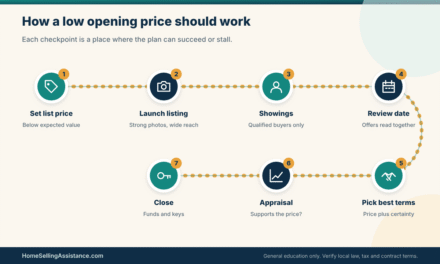
Start with anchoring. A list price sets the reference point for every conversation, and buyers measure offers against it. A price above the market does not anchor buyers upward. More often it filters them out, because many shoppers set a ceiling in their search tools and never see homes above it. The people who do see it compare it with the homes they have toured and decide it is the one to skip.
Then there is listing history. Online platforms show how long a home has been listed and how its price has changed. Buyers and their agents read that history, and some treat a long stay as a sign that something is wrong, whether or not it is. A reduced price on an older listing may be a bargain, but it often invites lower offers because buyers sense the seller has run out of patience. Writing it down is a plain way to avoid overpricing a house to sell.
Appraisal is the third mechanic. When a buyer uses a mortgage, the lender usually requires an appraisal, and an appraiser looks at comparable sales rather than your list price. If a buyer agrees to a price above what comparable sales support, the appraisal can come in lower, which forces a renegotiation, a bigger cash contribution from the buyer, or a collapse of the deal. How that plays out depends on the contract and the financing terms. Our guide to pre-listing appraisals explains one way sellers test value early.
It helps to be honest about the opposite risk as well. Pricing low to attract attention can leave money behind, and we cover that trade-off in our piece on underpricing a house. Neither direction is safe by default. What protects you is a number tied to evidence, with a plan for adjusting it.
There is also a psychological side. Sellers who start high often feel each reduction as a loss, so they cut in small, reluctant steps. Buyers notice the pattern, and a series of tiny cuts can signal that more are coming, which encourages them to wait. A single decisive adjustment, based on evidence, usually reads differently from a slow drip. This is one reason overpricing a house to sell tends to be costlier than it first looks.
Scenario: the lowball after two months
An illustrative case: a seller listed at a price above the closest comparable sales, held it for two months, then reduced it twice in small steps. Now an offer arrives well below the original list price. The seller feels insulted and considers refusing to respond.
It helps to separate feeling from facts. Compare the offer with recent sales and with what the seller would have accepted on day one. The buyer may be reacting to the listing history, not to the home. A counteroffer can still be sensible, because both sides usually have an interest in a deal. Our guide to evaluating a home offer shows how to compare terms, not just price.
An exception: sometimes a low offer is simply a low offer, from a buyer who makes the same bid on every listing. Responding with a clear counter costs little. Ignoring it can cost an opportunity, since offers are often rare on a stale listing.
Your next step is to write down your real minimum, meaning the net result you need after the mortgage payoff and costs, before you reply. That number comes from your closing statement estimate, not from your pride. Our guide to seller closing costs shows what to subtract so you know where your floor actually sits. You will rarely regret asking, and it helps with overpricing a house to sell in particular.
Whatever you decide, document the reasoning. A short note listing the sales you relied on, the date you set for review and the net amount you need protects you from rewriting history later. When the sale is over, it also gives you a record of what worked, which is valuable if you sell again. Sellers who keep notes make fewer repeat mistakes with overpricing a house to sell.
Next, a sensitivity view. It shows how different market and property assumptions change the likely effect of a high price, what could confuse the reading, and what to check locally. The effects are directional, not predictions, and each row ends with something you can verify yourself.
| Market or property assumption | Expected effect | Confounder | What to verify locally |
|---|---|---|---|
| Many similar homes for sale | High price loses visits to cheaper options | Some rivals may be in poorer condition | Count active homes in your price band |
| Few homes for sale | Buyers may tolerate a firmer price | Scarcity can fade quickly | Check months of supply with an agent |
| Mortgage-dependent buyers | Appraisal gap risk rises with price | Appraisers vary in adjustments | Ask how local appraisals compare with contracts |
| Cash-heavy local buyers | Appraisal matters less | Cash buyers often expect a discount | Ask how many recent sales were cash |
| Unusual or highly updated home | Comparables understate or overstate value | Few true matches | Seek an agent experienced with that type |
| Slow season | Everything takes longer | Season hides price problems | Compare with the same weeks last year |
| Carrying costs are high | Waiting gets expensive fast | Costs differ by owner | List your monthly costs in dollars |
Read the table by locating your own situation in the first column, then reading across to find the part most likely to mislead you. The final column is your homework. If you cannot answer the verification question, that is the question to bring to a local agent, lender or appraiser. A good professional will welcome it.
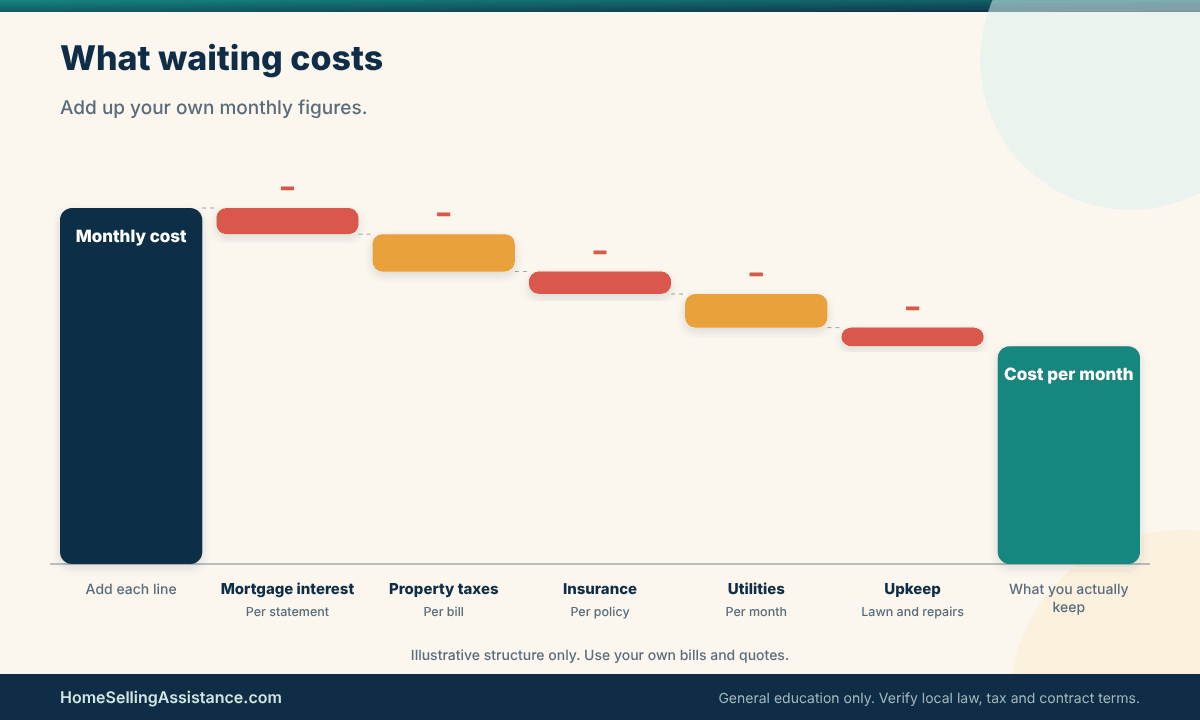
The cost of waiting deserves its own look. Waiting is not free, and the costs are easy to overlook because they arrive in small monthly pieces. Mortgage interest, property taxes, insurance, utilities, lawn care, HOA dues and maintenance continue while the house sits. If you have already bought another home, you may be paying for two. Add them up for a typical month, then multiply by the weeks you are willing to wait.
Here is an illustrative round-number example, not a prediction. If keeping the home costs a combined 3,000 per month and a stubborn price adds two months to the sale, that is 6,000 spent on waiting. Compare that with the difference between your hoped-for price and the likely price. Sometimes the extra patience pays off, and sometimes it only feels like it does. Doing the arithmetic keeps the decision honest. Weigh it calmly, since overpricing a house to sell costs time as well as money.
There are less visible costs too. A sale that drags can complicate a job move, a school start or a purchase contingent on your sale. Sellers who must close by a certain date have less flexibility than sellers who can wait indefinitely, and the right price strategy differs between them. Our guide on pricing a house to sell shows how to match the strategy to your timeline.
Finally, consider the opportunity cost of attention. A listing that is not working consumes your energy, your schedule and the patience of people who help you. That is a real cost even if it never appears on a statement. Name it, weigh it, and decide on purpose.
What still requires local pricing or professional analysis
General guidance has limits. It can explain how markets behave and what questions to ask, but it cannot tell you the right number for your address this month. This final section is about knowing which questions to hand off, and how to hold professionals accountable for answering them.
Local rules and customs affect how all of this plays out, including how price changes are recorded on the listing service and what your listing agreement says about them. These details vary by state and brokerage. Read the agreement closely, ask your state real estate commission or a real estate attorney about anything unclear, and do not assume that practices in another town apply to yours. Overpricing a house to sell is a local problem with local solutions.
Questions to bring to a professional about pricing
The most useful request you can make is for reasoning, not just a number. Ask which sales the recommendation relies on, what adjustments were made and why, and what range of outcomes is realistic. A professional who can explain that clearly is giving you analysis. One who simply says “the market will bear it” is giving you a sales pitch, and overpricing a house to sell is often the result of such a pitch.
Ask how the professional is paid and how that might affect advice. Compensation in residential sales is negotiable and should be written down in the agreement. A professional who earns more from a faster sale and one who earns a share of a higher price have different incentives, and neither is inherently dishonest. The point is to understand them. Our guide on choosing a listing agent covers questions that bring these things into the open. A second opinion is a cheap hedge against overpricing a house to sell.
Ask what the plan is if early activity is weak. A solid professional will have a plan: a review date, a list of signals and a rough price floor. If the plan is vague, ask for a clearer one before you sign anything. Also ask how often you will receive feedback and in what form, because without feedback you cannot read the signals described earlier.
You can also consider an independent opinion. A fee-based appraisal or a second agent’s analysis costs time or money, but it can reveal how much agreement there is. If three sources land close together, you can be more confident. If they are far apart, find out why, because the disagreement is itself information.
A scenario, an exception, and your next step on professional help
Picture a seller who interviews three agents. Two suggest prices within a small range of each other. The third suggests a number noticeably higher and promises strong interest. The seller is drawn to the high number because it matches their hopes.
The better move is to ask the third agent for the sales behind the number. If the evidence is solid, the higher price may be defensible. If it rests on a single outlier sale or on the phrase “I have buyers waiting,” it deserves skepticism. Buying a listing with an inflated promise is a known pattern, and the cost shows up weeks later as a price reduction. Remember that overpricing a house to sell is a market problem, not a character flaw.
An exception: sometimes the agent with the highest number is right, particularly when they know something specific about a buyer pool or an upcoming local development. A professional with real local insight can add value that data alone cannot. Judge the reasoning, not the number.
Your next step is simple. Request written pricing recommendations that show comparable sales and a range, then compare them side by side. Check any figures you plan to rely on against your own notes. If you face tax questions about your gain, the IRS guide to selling your home is the primary source, and a tax professional can apply it to you. For personal pricing, see how the whole process fits in our pricing and home value category.

Finally, put the pieces together into a short working plan. Price from sold evidence, set a review date, define what you will watch, agree on triggers for a change, and know your floor in net-proceeds terms. Our guide on price per square foot shows one quick check you can add, though it should never be your only one.
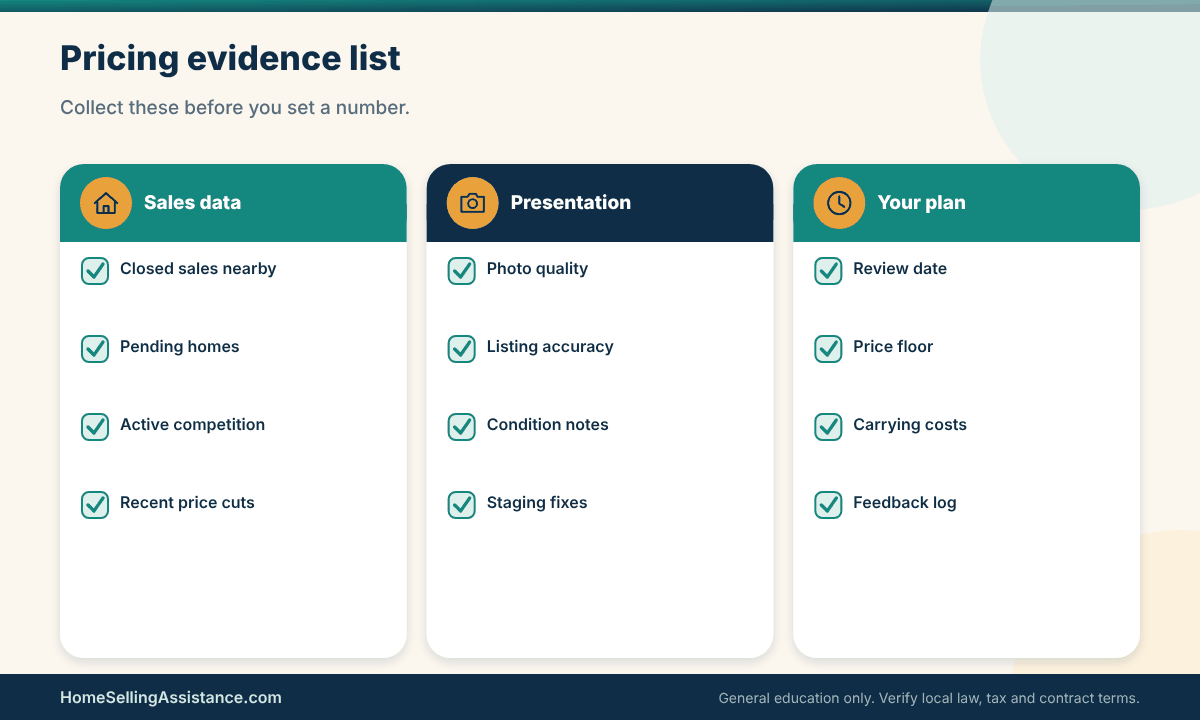
Once you have a plan, stick to it unless the evidence changes. The temptation is to keep adjusting based on mood. A written plan is a way of being fair to yourself on a bad week. The goal is a sale that works for your life, at a price the market supports, reached without needless months of waiting.
If you take one habit from this guide, make it the review date. Put it in your calendar before the listing goes live, along with the three numbers you will check: showings, feedback themes and the status of competing homes. A date turns a worry into a task. It is the cheapest protection available against overpricing a house to sell and then drifting for months without a decision.
Quick scenario
A couple lists at a number slightly above the best comparable sale, with a review date set for day fourteen. By then they have had a steady stream of views, six showings and consistent feedback about price. They trim to a figure that sits just inside the comparable range, relaunch the marketing, and receive an offer within the following weeks. The round numbers are illustrative, and your own result will depend on your market.
Frequently asked questions about overpricing a house to sell
Is overpricing a house to sell ever a good strategy?
Occasionally, when a home is truly unusual and the seller can wait without pressure, a higher starting price can be tested. Even then it works best with a firm review date and evidence a buyer can see. For a typical house in a market with many similar homes, it tends to cost more in time and leverage than it gains. The strategy only makes sense if you have already priced the cost of waiting.
How long should I wait before lowering the price?
There is no universal number of days, because markets and price bands move at different speeds. To avoid overpricing a house to sell for too long, a better method is to compare your listing with how fast similar local homes get offers, then set a review date in advance. At that date, look at showings, feedback themes and competing listings. If the evidence points to price, act then instead of waiting for another slow week.
Will a price drop make buyers think something is wrong with the house?
Sometimes, particularly after several small reductions on an older listing. A single, well-reasoned reduction that brings the price in line with comparable sales is usually read as a seller who has adjusted to the market. Pair it with fresh photos or a relaunch if the listing has been quiet. Your local agent can tell you how buyers in your area tend to react.
Does a high list price leave more room to negotiate?
It can feel that way, but buyers often never reach the negotiation if the price puts the home outside their search or comparison set. Offers on a stale listing may also come in lower because buyers sense patience running out. Negotiating room comes from competition and demand, not from a padded number. A fair price that draws several buyers often does more for you.
What if my appraisal comes in below the contract price?
When a buyer uses a mortgage, the lender typically orders an appraisal, and a low result can force a renegotiation, additional cash from the buyer, or a termination depending on the contract. Your contract’s financing and appraisal terms govern what happens. Review them with your agent or a real estate attorney. Pricing near the comparable sales makes this situation less likely.
Can I rely on an online estimate to pick my price?
Online estimates are a rough starting point, and leaning on one alone is a common route to overpricing a house to sell. They usually lack knowledge of your condition, upgrades and the latest local sales, and their accuracy varies by area. Treat one as a conversation starter, then test it against closed comparable sales and a professional opinion. Never treat it as the final word.
How much do carrying costs matter in the decision?
In any plan around overpricing a house to sell, they matter more than most sellers expect, because they add up quietly. Total your mortgage interest, taxes, insurance, utilities and upkeep for a month, then multiply by the weeks you might wait. Compare that figure to the price difference you hope to gain. Your own numbers decide whether patience is worth it.
Should I get an appraisal before listing?
It can help in cases where comparables are thin or you want an independent view, though it costs money and does not guarantee a sale price. A pre-listing appraisal is one data point against overpricing a house to sell, beside a comparative market analysis. Ask a local professional whether it adds value in your situation. Our guide on pre-listing appraisals covers the trade-offs.
What if my agent keeps suggesting a lower price than I want?
Ask for the comparable sales and adjustments behind the suggestion, since your agent may be steering you away from overpricing a house to sell, and for the same evidence for your number. Disagreements are healthier when they are about data. If you still disagree, a second opinion from another professional can help. Remember that your listing agreement and its terms matter, so read them before agreeing to a long term.
Where can I find reliable help if I am unsure?
Start with a licensed local agent, an appraiser or your state real estate commission for rules that vary by state. For general consumer information, the Consumer Financial Protection Bureau and, for housing counseling, HUD-approved counselors are good starting points. Be cautious about anyone who promises a set price or a set speed, and about advice that treats overpricing a house to sell as harmless.
A price you can defend is a price you can adjust
Overpricing a house to sell is rarely a single bad decision. It is a chain of small ones, each made without testing the claim behind the number. If you ground your price in closed sales, read early signals with patience, and set review dates and a floor before you list, you give yourself options. This article is general education, not legal, tax or financial advice, so confirm specifics with licensed local professionals.