If you want to negotiate FSBO offer terms well, start by accepting that the price on the first page of the offer is only one of about a dozen things you are actually bargaining over.
When there is no listing agent in the middle, the first offer often arrives as a text message, an email with a half-filled form attached, or a buyer’s agent calling you directly and asking what you “need.” It feels informal. It is not. Whatever you say next can shape a binding contract, and the seller who has not decided in advance what matters most tends to give ground on the wrong items.
This article is about the conversation that happens between “we received an offer” and “we have a signed contract with dates that make sense.” We will look at price, financing, contingencies, credits, and deadlines as one connected package, because a seller who negotiates them one at a time usually discovers that a win on one line was quietly paid for on another.
It is general education, not legal advice. Contract forms, disclosure rules, attorney involvement, and escrow customs differ a great deal from state to state, and sometimes from county to county. Where that matters we will say so and point you to the people who can answer for your location. For the wider picture of selling without an agent, our cornerstone guide on for sale by owner covers the basics so we do not have to repeat them here.
Key takeaways
- Decide before the offer arrives. Write down your must-haves, your trade-offs, and your walk-away line so you can negotiate FSBO offer terms from a plan, not from adrenaline.
- Price is one term among many. Financing type, contingencies, credits, possession date, and deposit size can move your real outcome as much as the headline number.
- Everything is a counter in writing. Verbal agreements and text threads do not replace a signed counteroffer with dates, and each side should initial every change.
- Verify before you trust. Ask for a lender letter that is current, proof of funds from the actual institution, and confirmation of who represents the buyer and who pays that representative.
- Deadlines are leverage and risk. Short response windows pressure both sides; long ones let a better buyer slip away. Choose them deliberately.
- Get local help at the signature points. A real estate attorney, title company, or escrow officer can check the contract language that general articles cannot.
Before we get into mechanics, one framing idea helps anyone who wants to negotiate FSBO offer terms well. A FSBO seller carries two jobs that an agent would normally split: the commercial job (what deal do I want?) and the process job (is the paperwork complete, correct, and on time?). When you negotiate FSBO offer terms, keep the jobs separate in your head. Decide the commercial position first, then check the process, and never let a buyer’s urgency collapse the two.
Build your negotiation file before the first offer lands
The best way to negotiate FSBO offer terms is to do most of the work before anyone makes an offer. Once a buyer is waiting for an answer, you are reading contract language under pressure, guessing at numbers, and wondering whether your cousin’s story about “how it works” applies in your state. A prepared file removes most of that stress and lets you respond calmly, usually within a day.
Think of the file you build to negotiate FSBO offer terms as a shared reference with three parts: the facts about your property and payoff, the market evidence behind your price, and your own written priorities. None of it is complicated. All of it is easy to skip, which is why sellers who skip it tend to be the ones asking for help halfway through a contract.
Documents, numbers, contacts, and deadlines you need to negotiate FSBO offer terms confidently
Start with documents that prove you can deliver what you are promising. That means your deed or a copy of the title information, your most recent mortgage statement with a current payoff estimate, the latest property tax bill, any homeowners association contact and fee schedule, and whatever disclosure forms your state requires. If a buyer asks about permits, warranties, or past repairs, you want the paperwork in one folder, not scattered across email.
Next come numbers, because you cannot negotiate FSBO offer price without them. You need a payoff figure that is recent, a rough view of what you will owe at closing, and the lowest net amount you can accept and still complete your next move. Our guide to home sale net proceeds walks through building that worksheet. Without it, “can you do a little better on price?” is an unanswerable question, because you do not know what “a little” costs you.
Then list contacts you will need whenever you negotiate FSBO offer details: a real estate attorney or the title company you plan to use, your lender’s payoff department, your HOA manager if there is one, and the escrow or closing officer once you know who it is. Put phone numbers and office hours beside each. Finally, record the deadlines you already face, such as a lease ending, a purchase closing on your next home, or a school year, because those dates quietly define how much time you can afford to give a buyer.
Evidence to gather: pricing support, payoff, and net-proceeds floor
Your price position when you negotiate FSBO offer terms should rest on dated, local evidence, not on a national headline. Collect recent closed sales of similar homes nearby, active and pending listings that compete with yours, and the number of days those homes took to sell. If you priced the home yourself, our article on how to price a FSBO home explains how to gather comparables without access to an agent’s tools. Whatever you use, write the date next to it. Market evidence goes stale faster than most sellers expect.
Then calculate your floor. Start from a hypothetical price, subtract the mortgage payoff, any liens, expected title and escrow charges, property tax and HOA prorations, and any compensation you have agreed to pay a buyer’s agent. Add or subtract credits you might grant. What remains is your net proceeds at that price. Run it at three prices, then compare. Your walk-away number is the price below which the net no longer covers your next step, and it should be written down before you read the first offer.
A small illustrative example makes the point. Suppose, using round numbers for teaching only, a seller owes a payoff balance of 200,000 dollars and needs at least 60,000 dollars in the bank to make a down payment elsewhere. Every credit, concession, or price cut below the level that leaves 60,000 dollars of net cash is a decision with a consequence, not a casual courtesy. Your own numbers will differ, and real quotes from your title company should replace anything in this paragraph.
A scenario, an exception, and your next step on documents and deadlines
Picture a seller who receives a good-looking offer on a Friday evening with a response deadline of Sunday at noon. She has no payoff letter, her HOA manager is unreachable until Monday, and she has not decided whether she will pay anything toward the buyer’s agent. The deadline was probably not meant to be hostile, but it is forcing her to decide with missing facts.
The exception worth knowing is that a deadline in an offer is a request, and the seller can respond with a counter that moves it. She can reply in writing, acknowledge the offer, and say she will respond with a full answer by a specific time after she confirms payoff and HOA details. A calm, polite extension request rarely sinks a serious buyer, and it protects you from agreeing to terms you cannot check.
Your next step, before listing or immediately after, is to assemble the folder, confirm the payoff, pick your walk-away net, and write one page of priorities. If you have not yet reviewed the sale paperwork, our overview of FSBO paperwork lists what a seller typically needs to have ready.
Information still missing when you sit down to negotiate FSBO offer terms
Even a thorough seller usually discovers gaps once an offer arrives. The common ones are the buyer’s financing details, whether an agent represents the buyer and how that agent expects to be paid, the status of any survey or title issue, and the exact meaning of contract terms in your area, such as what a due diligence period or attorney review window is called locally.
When you negotiate FSBO offer terms, the useful habit is to treat every unknown as a question you write down and assign to someone. “I do not know whether the buyer’s lender requires a specific repair” becomes a question for the buyer’s lender through the buyer. “I do not know if my state requires an attorney to prepare the contract” becomes a call to your state real estate commission or an attorney’s office. Unknowns that live only in your head will surface later as surprises.
What to verify: buyer financing, representation, and local contract rules
On financing, ask for a recent pre-approval letter from a named lender and, if the buyer is paying cash, a proof-of-funds statement from the actual bank or brokerage, current within a short window you choose. A pre-qualification based on a quick conversation is weaker than a pre-approval that involved documents. Neither is a promise that the loan will close, so treat them as evidence, not guarantees. The Consumer Financial Protection Bureau publishes plain-language material for buyers, which helps you understand what a lender’s letter does and does not mean; you can start at the CFPB site.
On representation, ask directly whether the buyer has a signed agreement with an agent, and whether that agent expects you to pay compensation. Broker compensation is negotiable, and any arrangement should be written down in the contract or a separate addendum rather than assumed. Our detailed piece on what to do when a FSBO buyer has an agent covers how to handle that conversation so it does not stall the deal.
On local rules, which matter whenever you negotiate FSBO offer terms, check which contract form is customary, whether attorney review is built into the process, and what your state requires you to disclose. Your state real estate commission, a local attorney, or the title company can answer in a short call. Do not rely on a buyer, a buyer’s agent, or this article for the rule that governs your sale, because their interests and our reach are limited.
A scenario and next step when information is missing
Imagine a buyer who says he is “pre-approved” but sends only a screenshot with no lender name, no date, and no loan type. The seller’s temptation is either to accept it as is, to avoid seeming suspicious, or to reject the offer as unserious. Neither is necessary.
A better move is to reply that you are happy to proceed once you receive a lender letter with the lender’s name and contact information, and to offer a reasonable window for sending it. You can also ask for the lender’s phone number so you or your attorney can confirm the letter. Serious buyers understand this request; buyers who cannot answer it have told you something useful at no cost.
The same logic applies to every missing fact as you negotiate FSBO offer terms. Name it, assign a person, set a date, and keep the offer moving. If the missing piece is complicated, such as a title defect or a survey question, pause and ask a professional before you respond rather than guessing and committing to a position you will have to retract.
Work the offer in order: from first read to signed counter
Once an offer is in your hands, order matters. Sellers who answer the emotional part first, usually the price, tend to reveal their position before they have read the rest. Sellers who read everything, rank the terms, and respond once tend to keep control. This section follows the sequence we would suggest if you wanted to negotiate FSBO offer terms without an agent sitting beside you, and it assumes you want to negotiate FSBO offer terms calmly, in writing, and with a clear head.
The sequence has three beats: understand the offer, decide your counter, and move the paperwork to the right people. We will take the first two under early decisions, and then the contingencies and handoffs that follow in the second half of the section.
Early action and decision points when you negotiate FSBO offer terms
The first twenty-four hours set the tone for how you negotiate FSBO offer terms. Acknowledge receipt in writing, thank the buyer or the buyer’s agent, and say when you will respond. That one message prevents the anxious follow-up texts that make sellers feel rushed. Then read the whole offer, including the fine print about deposit, inspection period, financing deadline, possession, and what personal property is included. A short offer form can still contain a clause that changes everything.
Next, separate the terms into three groups. Group one holds the items you must have, such as a minimum net, a closing window that fits your move, and a deposit that shows commitment. Group two holds the items you can trade, such as the possession date, a small credit, or an included appliance. Group three holds the items you do not care about. Knowing which group each term falls into is the whole skill of negotiation.
Scripts help, because most sellers freeze when a buyer says something blunt. If a buyer opens low, you can say, “Thanks for the offer. Before I respond on price, I would like to understand the financing and the timeline.” That sentence commits you to nothing, signals you are serious, and gets you information. If a buyer pushes for an answer in an hour, try, “I want to give this the attention it deserves and will reply by this evening.” Calm, short, and polite works better than long explanations.
It also helps to know the quiet mistakes that cost FSBO sellers money. One is countering on price alone and leaving the contingencies untouched. Another is responding verbally, then discovering that the buyer remembers a different deal. A third is treating a buyer’s agent as an opponent instead of a person with a client and a deadline of their own. When you negotiate FSBO offer terms politely and in writing, you give a buyer’s agent very little reason to be difficult.
Fair housing rules apply to every part of this conversation. You may not choose or reject a buyer, adjust terms, or steer showings based on race, color, religion, sex, familial status, national origin, disability, or other protected characteristics. Judge offers on price, terms, financing strength, and timing only. HUD explains your obligations on its fair housing page, and our article on fair housing for home sellers offers a plain-language walk-through.
The workflow in the table below puts that sequence in one place. It is a planning tool, not a legal checklist, so adapt the stages and deadlines to your contract and local customs.
| Stage or symptom | Information to gather | Action | Decision deadline | Next handoff |
|---|---|---|---|---|
| Offer arrives, details unclear | Full written terms, buyer name, agent status | Acknowledge in writing, ask clarifying questions | Same day acknowledgment | Buyer or buyer’s agent |
| Price feels low or high | Dated comps, your net floor | Run net at the offered price | Before replying with any number | Your own worksheet |
| Financing is vague | Lender letter, loan type, appraisal plan | Request documents, confirm with lender | Set a short, stated window | Buyer’s lender |
| Contingencies pile up | Inspection, appraisal, sale-of-home clauses | Rank by risk, propose shorter periods | Before countering | Attorney or title company |
| Credits requested | Inspection report, repair quotes | Compare repair versus credit | Within the inspection response period | Contractor or buyer |
| Counter drafted | Every changed term, dates, initials | Send one written counter | Reasonable stated expiry | Buyer, then escrow |
| Signed contract | Fully executed copy, deposit receipt | Deliver to title or escrow | Per contract, often within days | Title, escrow, attorney |
Use the table by finding the row that matches where you are, gathering what the second column lists, and not moving to the next row until the action is done. If you find yourself skipping rows as you negotiate FSBO offer terms, that is usually where a later dispute starts.

Evidence to gather: comparing price, terms, and net before you answer
When two offers, or one offer and your expectations, are in play and you negotiate FSBO offer terms, compare them on net proceeds and risk, not on price alone. A higher price with a long financing contingency, a large repair credit, and a distant closing date may leave you worse off than a slightly lower price with a short timeline and a firm deposit. Build a simple comparison with the headline price, the expected credits, the deposit, the closing date, and each contingency, and then estimate your net at each.
The visual below shows how a sale price turns into net proceeds, which is the number that actually matters when you weigh terms. The steps are illustrative; your own payoff, charges, and credits will differ, so replace them with real quotes. Seeing the sequence as a chain of deductions makes it easier to understand why a 2,000 dollar credit costs you exactly 2,000 dollars at the closing table, no matter how it is described.

Also look at what you know about the buyer’s side, since the buyer’s loan shapes how you negotiate FSBO offer timing. Is the financing conventional, government-backed, or cash? Government-backed loans can come with property condition standards and appraisal steps that differ from a cash purchase, which affects what repairs a buyer might request. You do not need to be a loan expert. You need to ask the buyer’s lender or agent what the loan type requires and let that inform your timeline. The related article on cash versus financed offers explains the trade-offs from the seller’s side.
A scenario, an exception, and your next step on price and terms
Take two offers described with round, made-up numbers. Offer A is 10,000 dollars higher, but it depends on the buyer selling their own home, includes a request for a repair credit, and proposes a closing date two months out. Offer B is lower, is financed with a firm lender letter, has a short inspection period, and closes in a month. If your next purchase has a hard date, Offer B may be worth more to you even though it is smaller on paper.
The exception is that a seller with no time pressure and a strong market position may reasonably prefer Offer A, or may ask the first buyer to remove the sale-of-home clause or shorten it. Nothing in the comparison is universal. What is universal is writing both offers side by side and answering with your priorities rather than an instinct.
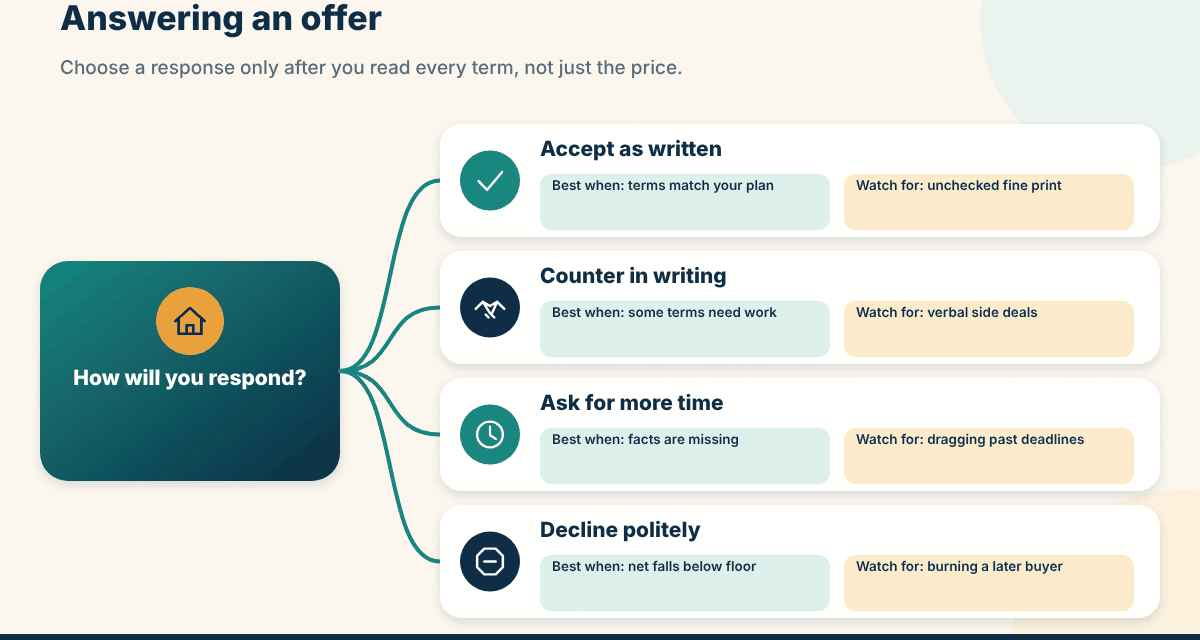
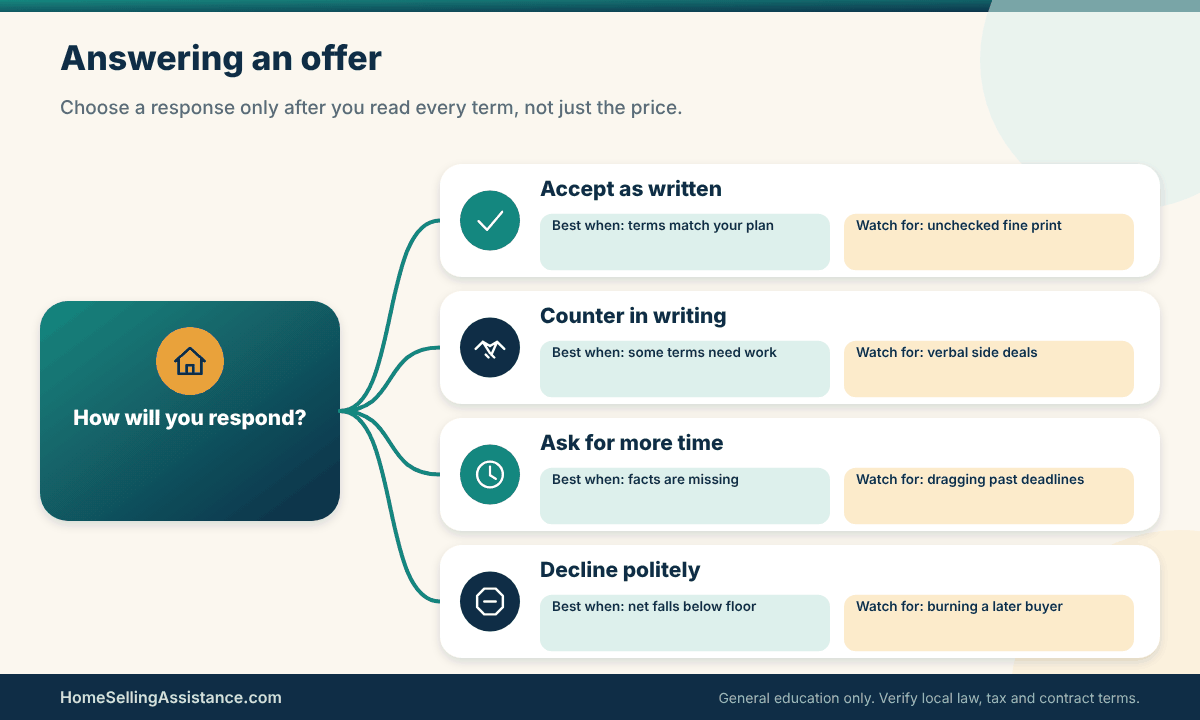
Your next step as you negotiate FSBO offer terms is to send a short acknowledgment, complete the comparison within a day, and then choose one of three responses: accept as written, decline, or counter. Our deeper look at counteroffer strategy for sellers helps you decide which of the three suits the situation and how to word the counter.
Handoffs, negotiations, and contingencies that shape the contract
A contingency is a condition that lets one side leave the contract, usually with the deposit returned, if something does not happen by a date. The common ones are inspection, appraisal, financing, and the buyer’s need to sell another home. Each one gives the buyer an exit and gives you a risk, so each one deserves a decision: accept it, shorten it, narrow it, or ask for something in exchange.
Handoffs are the moments the transaction passes from one party to another: from you to the buyer, from the buyer to a lender, from the signed contract to a title company or attorney, and from the inspection report to a repair negotiation. Most FSBO problems occur at handoffs, because no one agent is watching all of them. If you want an overview of each contingency, our guide to home sale contingencies explains how they work for sellers.
Evidence to gather: contingency language, deadlines, and deposit terms
To negotiate FSBO offer contingencies sensibly, read each one for three things: what triggers it, how long it lasts, and what the buyer must do to use it. A well-written inspection contingency names the period, requires written notice, and says what happens if no notice is given. A vague one invites dispute. If the offer form is silent on any of the three, ask your attorney or title company whether your state’s customary form fills the gap or whether you need to add language.
For financing, learn the deadline by which the buyer must either remove the contingency or give notice, and ask when the lender expects to order the appraisal. For the deposit, learn the amount, who holds it, and under what circumstances it is returned or released. Our explainer on earnest money from the seller’s side covers how deposits typically work, with the caveat that your contract controls.
It also helps to know what the appraisal contingency does when a lender’s valuation comes in below the contract price. The buyer may ask you to reduce the price, split the gap, or terminate. Having a plan before that happens is easier than improvising. The piece on low appraisal options for sellers lays out the paths and how to think about each.
A scenario, an exception, and your next step on contingencies and handoffs
A buyer offers a fair price but wants a thirty-day inspection period and a financing contingency of equal length. In many markets that is long. You might counter with a shorter inspection window, a clear statement that the buyer must deliver written notice of any objection with the inspection report, and a financing deadline tied to the lender’s stated timeline. These are not hostile requests. They simply convert open-ended uncertainty into dates.
The exception is a buyer with a specialty loan or an older home that really does need more time, such as a property needing a specialist inspection. In that case, a longer period may be reasonable if the deposit is firm and the other terms are strong. The skill is to match each period to a real purpose rather than accept or refuse by habit.
Your next step to negotiate FSBO offer contingencies is to write them on one page, mark which you will accept, shorten, or trade, and share only the final counter. Handing over a clean, dated, initialed response is one of the best ways to keep the process moving and to prevent misunderstandings from hardening into positions.
One more piece of planning will save you stress: a fallback tree. Deals do wobble. A lender asks for another document, an inspection turns up something unexpected, or a buyer goes quiet near a deadline. If you decide in advance what you will do in each case, the wobble becomes a step in a plan instead of a crisis. The visual below maps the most common branches and the first question to ask at each one.
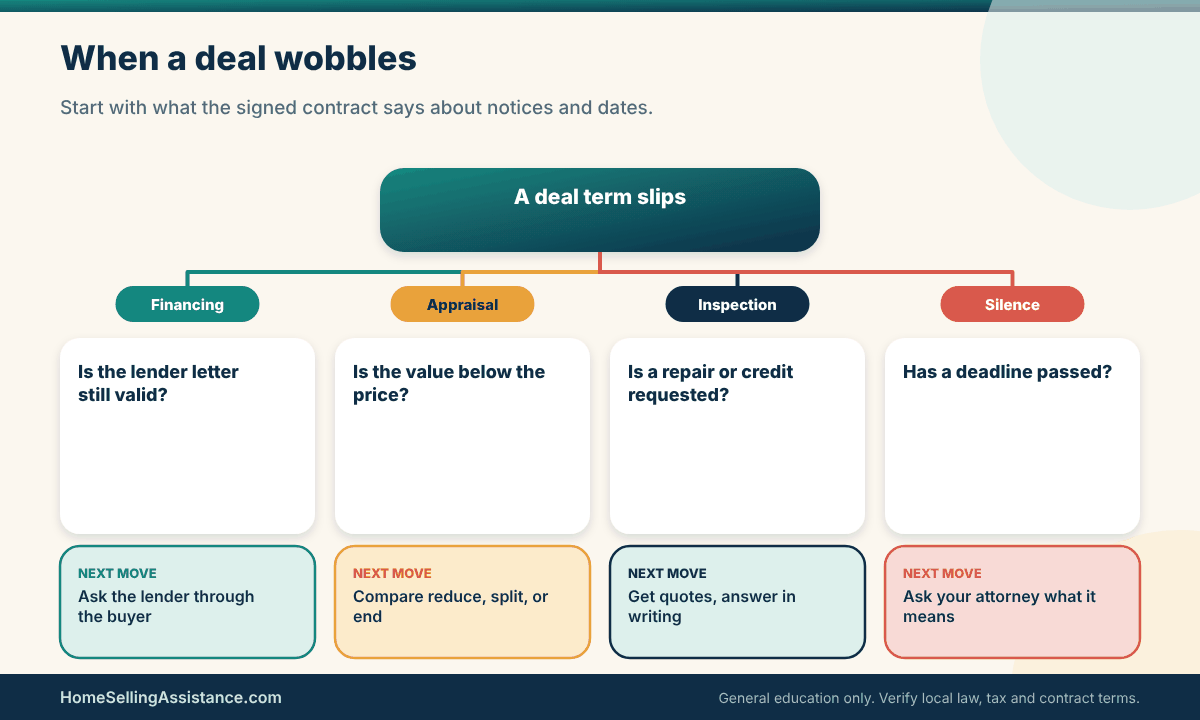
When you negotiate FSBO offer terms, notice that every branch begins with the contract, not with emotion. The first question is nearly always what the signed document says about deadlines, notices, and the deposit. Your attorney or title company can tell you what a missed deadline means in your state. Without that answer, it is easy to either let a deadline pass that gave you rights, or to act as if rights exist that do not.
When a deal does end, treat it as information that improves how you negotiate FSBO offer terms next time. Ask what failed, whether a term or a person was the cause, and whether the next buyer needs a different approach. Perhaps your price was fine and the financing was the weak link, so you ask for stronger lender documentation up front next time. Perhaps the inspection findings were predictable, so a pre-listing check might help. Our piece on when to hire an agent after FSBO covers the point where changing course may make sense, without any pressure either way.
Quick scenario
A seller receives an offer with a decent price, a financing contingency, a repair-credit request, and a closing date she dislikes. Instead of rejecting it, she writes one counter: keep the price, shorten the financing period, trade the credit for a smaller amount, and move the closing date by one week. Everything is in a single signed document with an expiry time. The buyer replies with one change, she initials it, and the contract moves to title. The numbers here are invented, but the pattern is the point.
Close the loop: get every negotiated term onto paper
A negotiation is not finished when two people say “deal.” It is finished when the agreed terms appear in a document both sides have signed, and when the people who will carry out those terms have received it. Many FSBO disputes are not really disagreements about price. They are disagreements about what was agreed, which a clear paper trail would have prevented.
This final section of our guide to negotiate FSBO offer terms covers what to confirm in writing as the contract moves to closing, and what to keep and do after the keys change hands. If you want to negotiate FSBO offer terms and then forget about them, this is the part that quietly protects you.
What to confirm in writing before you rely on a handshake
To negotiate FSBO offer terms safely, start with the principle that anything affecting money, time, or property must appear in the signed contract or in an addendum that both parties sign. That includes the price, the deposit, financing terms, each contingency and its dates, credits, who pays which fees, included and excluded items, possession date, and any agreement about buyer’s agent compensation. If a term is not in writing, assume it does not exist.
Why does this matter so much when you negotiate FSBO offer terms yourself? Because there is no agent whose job is to notice that the counter you sent on Tuesday never got a signature, or that the buyer’s version of the deposit deadline differs from yours. In an agent-assisted sale, a second pair of eyes usually catches those slips. In a FSBO sale, you become that second pair of eyes, and a short written review at every step is the substitute.
A practical routine is to read each new document out loud once, slowly, with your notes beside you. It sounds silly and it works, because reading aloud forces you to see each date and amount instead of skimming. Read the deposit amount, the deposit deadline, each contingency date, the closing date, and the possession date, and write them on one calendar. When two dates collide or leave a gap, you will see it immediately.
The second principle is consistency. Dates should match between the contract, any addenda, and the instructions you give to title or escrow. Names should match your deed. Amounts should match across documents. A surprising share of closing delays come from small mismatches, such as a middle initial, a wrong date, or a credit written one way in the contract and another in the closing instructions.
The table below is a transaction check you can use before and after signing. Treat it as a prompt for questions to ask your attorney or title company, not as a replacement for them.
| Issue | Seller evidence | Buyer, agent, or title input | Risk | Fallback |
|---|---|---|---|---|
| Buyer financing | Lender letter, loan type noted | Lender confirmation through buyer | Loan denied late | Backup offer, extension, or termination per contract |
| Low appraisal | Comparable sales, recent upgrades list | Lender valuation, buyer response | Price gap at closing | Reduce, share gap, or end per terms |
| Inspection repairs | Repair quotes, past records | Inspection report, buyer request | Dispute over scope | Credit, repair, or decline in writing |
| Buyer’s agent pay | Written compensation terms | Buyer’s agent agreement details | Surprise demand at closing | Addendum signed before acceptance |
| Possession date | Your move schedule | Buyer’s plans, lender rules | Overlap or gap | Rent-back addendum, flexible date |
| Title issues | Deed, payoff, lien records | Title search results | Hidden lien or claim | Cure plan, attorney review, delay |
To use the table, read across each row before signing and ask who will provide the right-hand evidence. If a cell is empty for a row that matters, such as the written compensation terms or a title search, that is a gap to fill before the next deadline, not after.

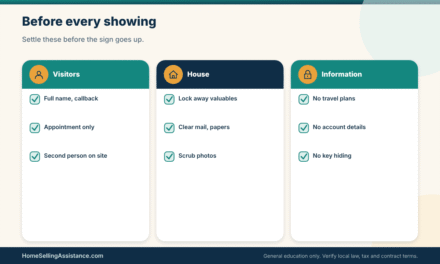
The checklist graphic above, built for anyone who must negotiate FSBO offer terms alone, pulls the same idea into a short list of seller documents and verifications. Keep it with your folder and tick items as they arrive, so you can see at a glance what is still outstanding when a closing date approaches.
Evidence to gather: signed contract, addenda, and written confirmations
After you negotiate FSBO offer terms, collect a fully executed copy of the contract and every addendum, with all pages, initials, and signatures. Confirm that the version you hold is the same version the buyer holds, because an old draft floating around is a common cause of confusion. If a change was made after signing, make sure both parties sign an amendment rather than relying on an email thread.
Once you negotiate FSBO offer terms and sign, gather the deposit receipt, the escrow or title company’s confirmation that they have the contract, and the names of the closing officer or attorney. If any credit or concession was negotiated, ask the closing office to confirm in writing how it will appear on the closing statement. Our piece on seller concessions explains how credits show up and why wording matters.
It also helps to keep a simple log of communications: the date, who said what, and which document it relates to. You are not building a lawsuit. You are building a memory aid for yourself, because a month after a call, no one remembers whether the buyer asked for a credit of one amount or another. A short note taken that day settles it.
A scenario, an exception, and your next step on written confirmation
Imagine a seller who tries to negotiate FSBO offer terms by phone and agrees to leave the washer and dryer and to close two days later than first planned. Neither point appears in the signed contract. At the final walkthrough, the buyer expects the appliances, and the seller expects to take them. Both believe they are right, and the closing is now tense.
The fix is dull and effective: put every included item in the contract by name, and sign a short amendment for any date change. If the conversation has already happened, send a message that restates the agreement and ask for a signed amendment before the closing date. If the other side disagrees with your summary, you learned that early enough to fix it.
The exception is a very small, genuinely harmless item that both sides are comfortable settling informally. Even then, a written note costs a minute. Your next step is to review the executed contract line by line against your notes and mark any item that is only verbal.
Records and follow-up after the closing is done
After closing, a seller who chose to negotiate FSBO offer terms alone still has jobs. You need to keep the final closing statement, the deed information, receipts for improvements and selling expenses, disclosure copies, and the full contract package. Those records matter for tax reporting, for answering later questions from the buyer, and for any dispute that appears months later. Do not discard them when the moving boxes come out.
You will also have practical follow-up: confirming that your mortgage was paid off and the lien was released, closing or transferring utilities, handing over keys, garage openers, manuals, and warranties, and forwarding mail. A short checklist for those items keeps the end of the process from becoming a scramble.
Evidence to gather: closing statement, payoff confirmation, and tax records
If you managed to negotiate FSBO offer credits, compare the final closing statement with the numbers you expected. Check the sale price, deposit credit, payoff, prorations, credits, and any compensation paid to a buyer’s agent. If something differs from the contract, ask the closing office to explain before you leave the table, because corrections are easier on the day than weeks later. The article on the FSBO closing process describes what typically happens on that day.
Confirm in writing that your lender received the payoff and will release the mortgage, and later check that the release is recorded in your county. For taxes, keep records that show the price, selling costs, and the cost and improvements of the home. The IRS explains how to figure a gain and what counts in Publication 523. Our own guide to home sale tax records lists what to keep and for how long, though a tax professional can tell you what applies to you.
A scenario, an exception, and your next step after closing
Consider a seller who closes, moves to another state, and tosses the paperwork. A year later, the buyer sends a letter about a disclosed item, and a tax preparer asks for the costs of a kitchen update. Without records, the seller spends weeks reconstructing receipts and trying to find which disclosure form she signed.
The simple habit after you negotiate FSBO offer terms and close is to scan every document into one folder, back it up, and label it by property and year. Keep paper copies of anything that carries original signatures. How long you should hold them depends on your situation and the rules that apply, so ask a tax professional or attorney.
The exception is the seller whose situation involves something unusual, such as a sale of a former rental, an inheritance, or a divorce. Those carry their own record needs and tax questions, and it is worth getting professional help early. Your next step is a one-hour cleanup within a week of closing, while memories and paperwork are still fresh.
Frequently asked questions about negotiate FSBO offer terms
How quickly should I respond when I receive an offer?
Acknowledge it right away, then give a realistic time for a full reply, often within a day. A quick acknowledgment keeps the buyer calm without forcing a decision. If the offer includes a short deadline, you can ask for more time in writing. A serious buyer will usually agree when you negotiate FSBO offer timing politely, and a polite request is better than accepting terms you have not checked.
Is it risky to negotiate FSBO offer terms without an agent?
It carries different risks, not necessarily more of them. You take on the paperwork and the pacing yourself, so mistakes come from missed dates and unclear wording rather than from a middleman. Many sellers reduce that risk by hiring a real estate attorney or using a title company to review the contract. Whether that is required depends on your state.
Should I counter on price only?
Rarely. Price is one term among several, and the buyer may care more about timing, credits, or contingencies than you assume. Countering on one item leaves the others as the buyer wrote them, which may not suit you. Review the whole offer, rank the terms, and negotiate FSBO offer items as a package, and send one written counter that addresses everything you want changed.
What should I ask a buyer to prove about financing?
A recent pre-approval letter from a named lender is a common request, and cash buyers can provide proof of funds from the institution that holds the money. Neither is a guarantee. You can ask for the lender’s contact information so the letter can be confirmed. Requests like this are routine, and a buyer who resists them is giving you useful information.
Do I have to pay the buyer’s agent?
Not automatically. Broker compensation is negotiable and must be written down, and practices have shifted in recent years. Ask early whether the buyer has a signed agreement with an agent and what that agent expects. Then decide whether to offer compensation, how much, and whether it comes out of your price. Put the decision into the contract or an addendum.
How do I handle a repair request after inspection?
You can agree to repair, offer a credit, offer a mix, or decline, depending on your contract. Get quotes before you respond, so you know what the request actually costs. A credit is simple but changes your net, and a repair carries a quality risk. Respond in writing within the period the contract gives you.
What if the appraisal comes in low?
The buyer’s lender may not lend the full amount against the contract price, and the buyer may ask you to reduce the price, share the gap, or leave the contract. Your options depend on the appraisal contingency in your contract. Prepare comparables in advance and decide your position before it happens. A professional can help you check whether a valuation should be challenged.
When should I involve an attorney?
Many sellers who negotiate FSBO offer terms ask for review before they sign a counter, since a short consultation costs far less than a dispute. Involve one sooner if the buyer proposes unusual terms, if there is a title problem, or if you are unsure what the contract form means. Some states expect attorney involvement and others do not, so check locally.
Is it a problem if the buyer wants to close very quickly or very slowly?
Neither is wrong on its own. A fast closing may suit you if your next move is ready, but it leaves little room for surprises. A slow one may give the buyer time to find trouble. Match the date to your needs and the lender’s realistic timeline, and put both in writing with an extension process.
What records should I keep after the sale?
Keep the signed contract, addenda, closing statement, deed information, disclosures, and receipts for improvements and selling costs. These support tax reporting and answer later questions. Ask a tax professional how long you should hold them in your situation, and store copies in more than one place.
Before you answer that offer
To negotiate FSBO offer terms well, you need a plan, a paper trail, and a willingness to pause before replying. Decide your priorities, check the numbers, put every change in writing, and ask a professional to review the pieces that depend on local rules. For the wider picture, return to our guide on selling without a listing agent, or browse the offers and negotiation and FSBO and flat-fee MLS categories. This article is general education, not legal, tax or financial advice, and your state, contract, and situation will shape what is right for you.