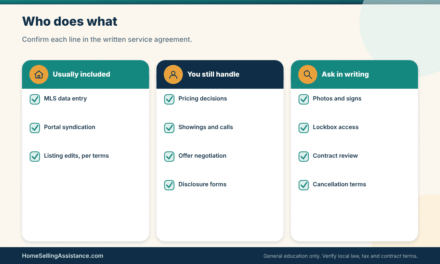
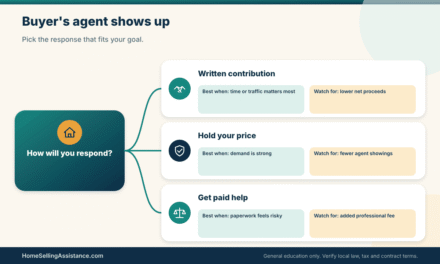
Good FSBO showing safety starts with a simple idea: when you sell without a listing agent, you become the person who opens the front door, so you also become the person who decides who gets in, when, and with what information in hand.
A traditional listing usually puts a buffer between your home and the public. Visitors schedule through an agent, an agent usually meets them, and the paper trail is built into the process. When you list the house yourself, that buffer disappears unless you build a replacement. This guide helps you build one that fits your house, your neighborhood and your comfort level, without turning the sale into a fortress that scares off real buyers.
Most showings are uneventful, and a calm approach to FSBO showing safety keeps them that way. People look at kitchens, open closets, ask about the roof and leave. The trouble tends to come from a short list of repeatable patterns: a visitor who will not give a name, a “buyer” who is really scouting what is worth taking, an email that looks like a lender or closing agent but is not, and a seller who overshares because the conversation felt friendly. Good FSBO showing safety is mostly about spotting those patterns early and having a calm script for each one.
We cover four parts of FSBO showing safety here: how to see your home through a stranger’s eyes, how to verify visitors and schedule on your terms, how to keep personal and financial details out of the wrong hands, and what to do the moment something feels off. Every state, county and lender works a little differently, so treat the ideas below as general education and confirm local rules with your state real estate commission, a real estate attorney or your title company.
Key takeaways
- Control the door. Appointments, a sign-in routine and a second person on site are the three habits that do most of the work in FSBO showing safety.
- Verify before you reveal. Confirm who a visitor is, and who their agent or lender is, through a contact channel you found yourself, not one they handed you.
- Treat the house like a stage set. Medications, mail, documents, keys, jewelry and anything with your account numbers should be gone before the first guest arrives.
- Qualify on money and timing, never on who someone is. Ask every visitor the same neutral questions so your screening stays safe and fair-housing compliant.
- Slow down any request that rushes you. Urgent changes to payment instructions or wire details deserve a phone call to a number you already trust.
- Write things down. Names, times, messages and screenshots are what banks, settlement agents and police actually use if a problem develops.
Spotting the real risks behind FSBO showing safety
Before you buy a lockbox or write a sign-in sheet, it helps to be specific about what you are protecting against. Vague worry leads to either panic or shrugging. Specific risks lead to specific habits. Think of three FSBO showing safety buckets: your physical safety while showing the house, your belongings and personal information inside it, and your money and identity once serious negotiations begin.
If you have not yet decided whether to sell on your own, our overview of selling a home for sale by owner lays out the whole route. This article zooms in on the one stage where strangers physically meet you and your home.
What a bad showing looks like in practice
A bad showing, in FSBO showing safety terms, rarely looks dramatic. More often it looks slightly off, and the off feeling is the useful signal. The visitor arrives earlier or later than agreed, or brings more people than the message mentioned. They ask where you sleep, when the house is empty, or whether you live alone. They drift away from your tour route and open doors you did not point to. They are far more curious about the garage and the bedrooms than about the price.
The most common outcomes are minor: an awkward conversation, a missing small item, a visitor who never returns. The outcomes worth planning for are rarer but more serious, such as a theft of something portable, a visitor who returns when the house is empty, a confrontation, or personal information used later for fraud.
Evidence to gather: patterns worth recognizing
You do not need crime statistics to run a sensible plan, and we would be wary of any article that quotes a single percentage as if it applied everywhere. Instead, gather evidence from sources that are specific to you. Ask your local police non-emergency line whether they have seen showing-related reports in your area and whether they offer home security walk-throughs. Ask neighbors, politely, whether they have noticed unfamiliar cars.
Read the safety guidance published by organizations such as the National Association of Realtors, which publishes safety material for its members that sellers can adapt even when they are not using an agent.
Then add your own evidence. Walk the route a visitor would take and note the spots where you cannot be seen from the door, where a phone signal drops, or where a stranger could be between you and the exit. A cramped basement stairwell, a converted attic or a back bedroom with one door deserves extra thought. These notes become the backbone of your FSBO showing safety rules in the next section.
A scenario, an exception, and your next step for a pushy visitor
Picture a weekday message: “I’m in town today only, can I see the house in an hour? I’ll pay cash, no agent.” Nothing in that message is automatically dishonest. Some buyers genuinely have tight travel schedules. But it stacks urgency, secrecy about identity and a money claim into a single sentence, and each piece is easy to say and hard to check.
Your next step is not to refuse. It is to answer with a calm, standard reply: you show by appointment, you need a full name and a phone number that you will call back, and the earliest slot is the one you offer. A genuine buyer usually accepts. Someone who wanted a quick look at an unattended house usually goes quiet. If you want to understand the legitimate version of a cash claim, our guide on how to verify a cash home buyer explains what real proof looks like.

What information and property a visitor can see, photograph or take
Strangers in your house see far more than the kitchen. They see the mail pile on the counter, the prescription bottles by the sink, the family calendar on the fridge, the school name on a backpack, the safe-looking cabinet, the garage door opener on the visor of a parked car. A listing photo can also reveal more than you intended: house numbers, a street sign, a reflection in a mirror, a gun cabinet, a piece of art you would hate to lose.
Exposure runs in two directions, and FSBO showing safety means watching both. Property can leave with a visitor, and information can leave with a visitor, usually through a phone camera. Both are easy to reduce with a short list of habits that you can repeat before every showing.
Evidence to gather: a stranger’s-eye walk-through
Try this exercise on a quiet afternoon. Pretend you are a visitor and you have ten minutes to look around your own house without being watched. Where would you look first? Most people check bathrooms for medicine, bedrooms for jewelry, desks for paperwork, and entry tables for keys. Make a short list of everything you would notice and either remove it or lock it away.
Do the same for your listing photos. Zoom in on each one and read it like an investigator. Is your house number visible? Is there a package with a name label? Is there a mirror reflecting a room you did not intend to show? Our guide on protecting your privacy as a home seller goes deeper on what to scrub from photos, descriptions and signs.
If you plan to stay in the house during showings, the guide to being home during a showing covers the etiquette and the trade-offs of staying or leaving.
A scenario and your next step when a photo goes online
For a concrete FSBO showing safety case, imagine you notice that a visitor photographed the inside of a closet and a desk drawer that you did not open on the tour. It could be innocent. Some buyers take photos of every room to remember details, and many agents encourage it. Still, you set the policy, not the visitor. Many sellers post a simple, friendly note: “Please ask before photographing. Photos of the interior are for personal use only.”
Your next step, if something bothers you, is to ask politely and quietly. You might say, “I’d rather not have the office photographed, would you mind deleting that one?” Most people comply without fuss. If you ever find your own interior photos posted in a place you did not choose, save the link and a screenshot with the date, then ask the site’s operator to remove them.
For deeper background on staging and showing preparation that also protects your belongings, browse our staging, photos and showings category.
Reducing risk before the first FSBO showing
The best moment to think about FSBO showing safety is before the sign goes in the yard. Once a listing is live, messages arrive at odd hours, curiosity runs high and you are tempted to say yes to anything. A short written routine, decided calmly in advance, makes each later decision easier and keeps you consistent, which also protects you if anyone ever questions how you treated different visitors.
The FSBO showing safety routine has two layers. The first is about people: who comes, how they are checked and how visits are scheduled. The second is about information: what you say, post and hand over. Neither FSBO showing safety layer requires special equipment. Both reward a little boring discipline.
Identity checks and scheduling controls that work
In FSBO showing safety, scheduling is your strongest tool because it turns an open invitation into a series of small, known events. Every visit gets a day, a start time, a name and a phone number you have called back. That takes five minutes per visitor and removes most of the “drop-in at a random moment” risk.
Identity checks do not have to feel like airport security. Think of them as the same polite questions a hairdresser or contractor might ask. Most real buyers, and almost all buyers working with an agent, expect to introduce themselves properly before they walk through a stranger’s home.
Evidence to gather: what a reasonable identity check involves
A proportionate check has four parts. First, a full name and a mobile number you can call back at the time of booking, not just a messaging handle. Second, a quick confirmation call or text exchange so you hear a human voice or at least a consistent thread. Third, for a visitor who says they have an agent, the agent’s name and brokerage, which you verify through your state’s real estate license lookup or the brokerage’s public website, found by your own search rather than from a link in the message.
The fourth part is a sign-in at the door. A clipboard or a printed sheet with name, phone and arrival time is enough, and some sellers photograph a visitor’s driver’s license for their own records only when the visitor volunteers and the situation calls for it. Whatever you collect, treat it carefully. A sign-in sheet holds personal details about other people, so store it in a drawer, not on the kitchen counter, and shred it when you no longer need it.
If you are also deciding how to treat visitors who are touring with agents, our article on handling a buyer who brings an agent to an FSBO explains how those visits usually work and why they tend to be easier to verify.
Here is a sample FSBO showing safety routine used by many sellers who show alone. Adapt it freely.
- Reply to every inquiry with the same message: your showing hours, a request for full name, phone number and number of visitors.
- Call or text back to confirm. If the number does not work, no appointment.
- Share the street address only after the call, never in the first message or the public ad.
- Tell a trusted person the time, the visitor’s name and when you expect to check in.
- At the door, ask for the sign-in and keep the tour on a route you planned.

The picture above shows the same routine as a start-to-finish timeline for a single visit, which can be handy to print and keep by the phone.
Scenario: the buyer who will not be scheduled
Suppose a visitor messages three times in one evening, declines to give a last name, asks you to leave the key somewhere so they can “look quietly”, and offers a large deposit by app transfer to prove they are serious. Each request is a different flavor of the same thing: skipping the checks that protect both sides.
The exception to keep in mind is that some honest buyers are nervous about privacy, too. They may be uncomfortable giving details to a stranger. A reasonable compromise is a public-facing first contact, a phone call, and a showing at a time when a friend or family member is present.
If they still refuse any identification, you can decline without drama: “My process is the same for every visitor, so I will need to pass this time.” Never hide a key for anyone, and never accept a payment or transfer as a substitute for a signed offer and a written contract.
What to keep to yourself and what never to assume
Sellers are usually surprised by how much they volunteer. In a long friendly conversation about why you are moving, it is easy to mention that the house will be empty next week, that you work nights, that your spouse is traveling, or that you already bought another place and need to move fast. Each of those facts helps someone else, whether a negotiator or a thief.
The same goes for information in writing. Listing descriptions, social media posts and emails travel further and last longer than a conversation. Treat them as public even when you think only one person will see them.
Evidence to gather: the facts you should never post or say
Create a short FSBO showing safety “do not share” list and keep it where you answer messages. It usually includes the days and hours the house is empty, your travel plans, where spare keys or codes are kept, your alarm provider, the location of valuables, your bank or mortgage servicer by name, your full loan balance, your Social Security number, and any account number. None of those are needed to schedule a tour or to receive an offer.
You will, at the right stage, share some personal data with the closing professionals. A title company or settlement agent will ask for identification and tax details. That exchange should happen through their secure portal or in person, with an office you verified, not through the first email that asks. Our guide to real estate email phishing shows how convincing fake closing emails can look.
For a broader look at how fraud works in a sale, the cornerstone article on home sale fraud and seller safety ties the pieces together, and the fraud and seller safety category collects the related guides.
Scenario: the friendly question you should not answer
A visitor says, warmly, “This is such a lovely street. Do you live here alone? When’s a quiet time to come back and measure?” The tone is friendly and the question seems harmless, but it asks for exactly the two facts you were told to guard: who else is in the house and when it is empty.
The easy script is to redirect without accusation. “I do showings by appointment, so just send me a time that works and I’ll confirm.” You can say it with a smile. If the same visitor keeps pressing, take it as information, and keep future contact in writing. Honest buyers do not need to know your schedule; they need to know yours is a booking system.
Qualifying visitors without breaking fair housing rules. A little more on screening, because it connects directly to what you share.
Qualifying a buyer is a legitimate part of an FSBO sale, and it also supports safety. The point is to ask about money and timing, not about who people are. Treat everyone the same way. Questions about whether they have talked to a lender, whether they have an agent, what move date they need and whether they have a home to sell all relate to the transaction. Questions or comments tied to race, religion, national origin, sex, disability, familial status or other protected characteristics do not, and sellers are covered by fair housing law just as agents are.
The federal fair housing office, part of HUD’s Office of Fair Housing and Equal Opportunity, explains the basics, and your state or city may add more protected classes. Our article on fair housing rules for home sellers adds examples for sellers who handle showings themselves.
A neutral qualification script.
A neutral script protects you in two ways and supports FSBO showing safety. It screens out time-wasters, and it creates a record of consistent treatment. Keep it short and use the same words every time. For example: “Thanks for your interest. To schedule, I need your full name, phone number, and whether you are working with an agent or a lender. Do you have a target move date?”
You can add a request for a pre-approval letter or proof of funds after a visitor says they are interested in making an offer, not before the first tour. Our guide on proof of funds from a cash buyer explains what documents mean and what they do not prove. A letter alone does not guarantee that the money exists or that a loan will close, so treat it as one input, not a promise.
When safety instinct and fairness seem to conflict.
Sometimes a seller says, “Something about this person makes me uncomfortable,” and cannot say why. Fair treatment does not require you to ignore your instincts. It requires that your decisions rest on behavior and not on who someone is. A visitor who refuses to identify themselves, ignores your tour route, or makes comments that scare you has given you a reason based on conduct.
A good habit is to write a one-line note after any showing that bothered you: what happened, what was said, what you did. If you ever decline further contact, that note shows the decision followed conduct. If you are unsure, a real estate attorney or your local fair housing agency can explain what is and is not a safe line for your area.
Quick scenario
Maria lists her townhouse herself and receives eleven inquiries in two days. She sends all of them the same message and booking window. Eight reply with names and numbers, two never answer, and one wants a private tour at midnight. She schedules the eight over a weekend, with her brother in the house, and declines the midnight request by repeating her showing hours. Nothing dramatic happens, and that is exactly the point of a routine.
The table below turns the principles above into a quick reference. Think of it as a risk and verification matrix: each row names a common threat or claim, the evidence worth checking, a safe action, what you should never share and when to escalate. It is general education, so adjust it to your area and contract.
| Threat or claim | Evidence to check | Safe action | Never share | Escalate when |
|---|---|---|---|---|
| Visitor refuses a name | Callback number works; consistent story | Decline, offer appointment slot | Address, schedule | Visitor returns uninvited |
| “I have an agent” | License lookup; brokerage site you searched | Confirm agent by phone | Lockbox or alarm codes | Agent cannot be found |
| “Cash, no inspection” | Proof of funds from the institution | Verify through known bank number | Your payoff balance | Money requested up front |
| Photos of private rooms | Which rooms; any later posts | Ask politely to delete | Valuables location | Images reappear online |
| Urgent same-day tour | Name, number, reason for rush | Offer your own time slot | When the home is empty | Repeated pressure |
| Request for the key | None needed | Say no every time | Spare key location | Items go missing |
To use this FSBO showing safety matrix, print it and keep it next to the phone. When a message arrives, find the closest row, do the safe action first and check the evidence column before you decide anything. If a request does not match any row, treat it as unverified and slow it down. The final column is a reminder that you are never required to handle a serious problem alone.

One more choice shapes your FSBO showing safety exposure more than any other: whether you hold an open house at all. The comparison above lays out the trade-offs between open houses and private appointments. Our article on open houses versus private showings weighs them in more depth, and the guide to open house safety for sellers covers the practical steps if you choose to host one.
Whichever format you pick, the day itself deserves a short checklist of its own. Good FSBO showing safety on the day looks unremarkable from the outside. You arrive early, walk through every room, turn on the lights, open the back door only if you plan to show the yard, and check that the route you planned is clear of clutter. You also decide, before anyone arrives, where you will stand and which exit you will keep in view.
Phones matter here. Keep yours charged and in your pocket, not on the counter. Share your location with the person who knows your plan, if you are comfortable doing so. Agree on a simple check-in message, such as a text at the start and another when the visitor leaves. That one small habit does more for FSBO showing safety than most sellers expect, because it means someone notices quickly if you go quiet.
Next, think about the visitor’s route. Show the main living areas first and let the visitor lead into bedrooms rather than walking ahead into them. Avoid being the person at the far end of a hallway or in a basement stairwell. If a visitor wants a second look at a room alone, you can say, “Of course, I’ll be in the kitchen if you have questions.” Staying within earshot, in a space with a clear path to the door, is a sensible compromise between privacy and caution.
Keep a few ordinary items within reach but out of sight: a flashlight, a charged phone and the contact sheet. Park your own car where you can leave easily, and consider leaving the front door unlocked from the inside during a tour so you are never fumbling. Pets are a separate point. Many buyers are allergic or nervous, and animals can bolt through a open door, so a friend, a kennel or a neighbor can take them out for the hour.
After the visitor leaves, close the loop the same day. Lock up, walk through the main rooms for anything out of place, and write one or two lines in your log: time in, time out, who came, what they asked about, and whether anything felt off. These notes are also how you remember who asked about the roof and who asked about the closing date when you follow up with genuinely interested buyers. Over a few weeks, the log becomes a practical record of your FSBO showing safety habits and your marketing results at the same time.
A final habit is to review your FSBO showing safety routine after the first few visits. Which questions came up that you did not expect? Where did you feel rushed? Did the sign-in sheet work, or did people ignore it? Small adjustments, like moving the sheet to the entry table or adding a line to the listing about appointments, improve FSBO showing safety without adding work. If you have a chance to compare notes with another seller or a local landlord who shows property regularly, you may pick up ideas that suit your street.
Responding without escalating the damage
Even a seller who takes FSBO showing safety seriously can have a bad moment: a message that looks wrong, a visitor who behaves oddly, an item that goes missing, or an email that changes payment instructions. What you do in the first hour matters more than almost anything else, and the instinct to react fast is usually the wrong one. Good FSBO showing safety includes a plan for the day something goes wrong, because the plan keeps small problems small.
Two principles guide the response to any FSBO showing safety problem. First, verify through channels you already know, not channels the other person gave you. Second, escalate to the right professional in the right order, with records in hand. Everything else in this section is detail on those two ideas.
Verifying through contact channels you already know
Scammers and opportunists depend on one trick above all: they want you to use their phone number, their link or their reply address. The moment you do, they control the conversation. Verification works by flipping that around. You find the contact yourself, from a source that existed before the message arrived, and you ask the question there.
A “known” channel is one you can trace independently: the title company number on the contract you signed, the bank’s number printed on your statement or card, the agent’s brokerage phone from a public license lookup, the lender’s number from the loan paperwork. A number inside a suspicious email, even one that looks right, is not known.
Evidence to gather: your short list of trusted numbers
Build a one-page contact sheet before your first showing. List your mortgage servicer, your bank, your homeowner’s insurer, your local police non-emergency number, the title or escrow company once you have chosen one, and any attorney you may call. Write the number you got from an official source, and note where you got it, such as a statement, a contract or a state website.
Add one line to the sheet: “Any change to payment or wire instructions gets a call-back to this number before I act.” That sentence prevents more expensive mistakes than any clever software. The federal consumer protection agencies, including the Federal Trade Commission’s consumer site and the Consumer Financial Protection Bureau, publish plain-language warnings about closing-related scams and are worth a read before you list.
For the money side of an FSBO deal, see our guide on real estate wire fraud for sellers, which explains how altered instructions typically arrive and how to confirm them.
Scenario: the email that changes the instructions
Say you have accepted an offer and a message arrives that appears to come from your buyer’s agent: “Please send the earnest money details again, we updated our account, the old one is closed.” The message uses the right names, the right address and even a line from your contract. The pressure is soft but clear: do this today.
Your FSBO showing safety next step is not to reply to the email. You call the settlement agent or title company using the number from your signed contract, describe the message and ask whether anything changed. If the answer is no, the message was a fake, and you have just stopped a loss. If the answer is yes, ask them to confirm in writing through their own secure system. An exception worth noting: legitimate changes do happen, but they happen through the same verified office, not through a surprise email from a third party.
The related guide on seller identity fraud at closing looks at the reverse problem, where someone tries to impersonate you.
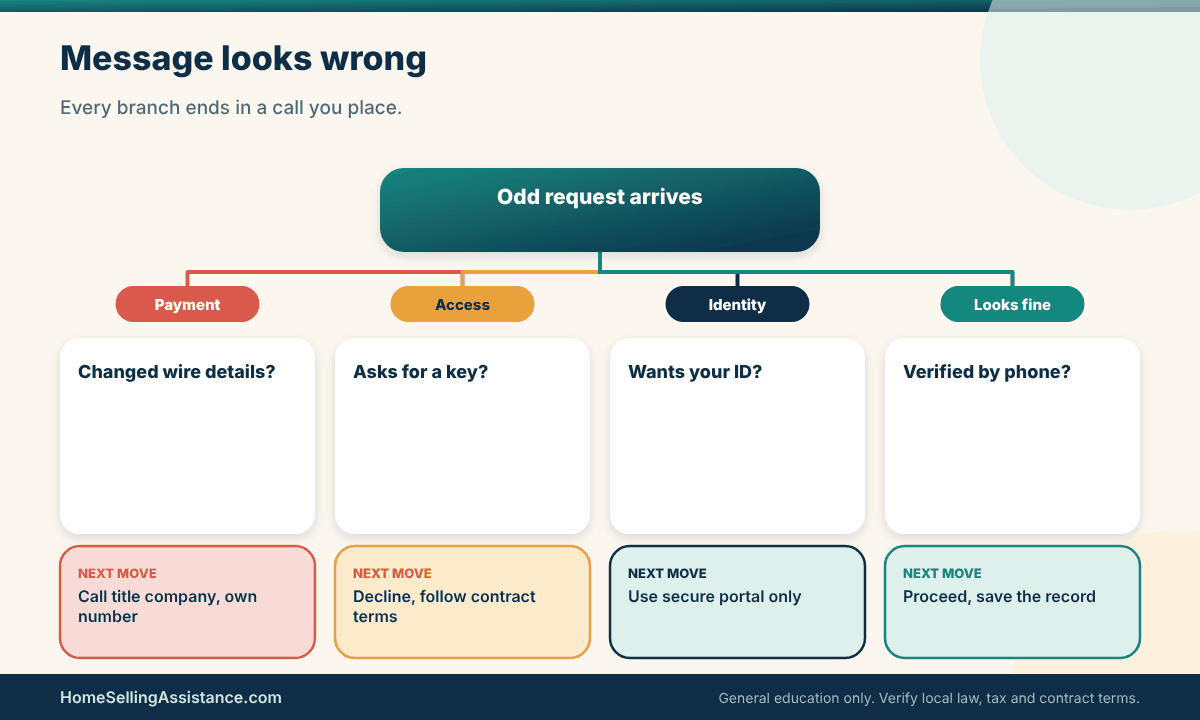
The decision tree above shows how a simple “does this message look wrong?” check branches into verify, pause or escalate. The point is that every path ends in a call you place yourself.
Escalating to the bank, settlement agent, police, insurer or attorney
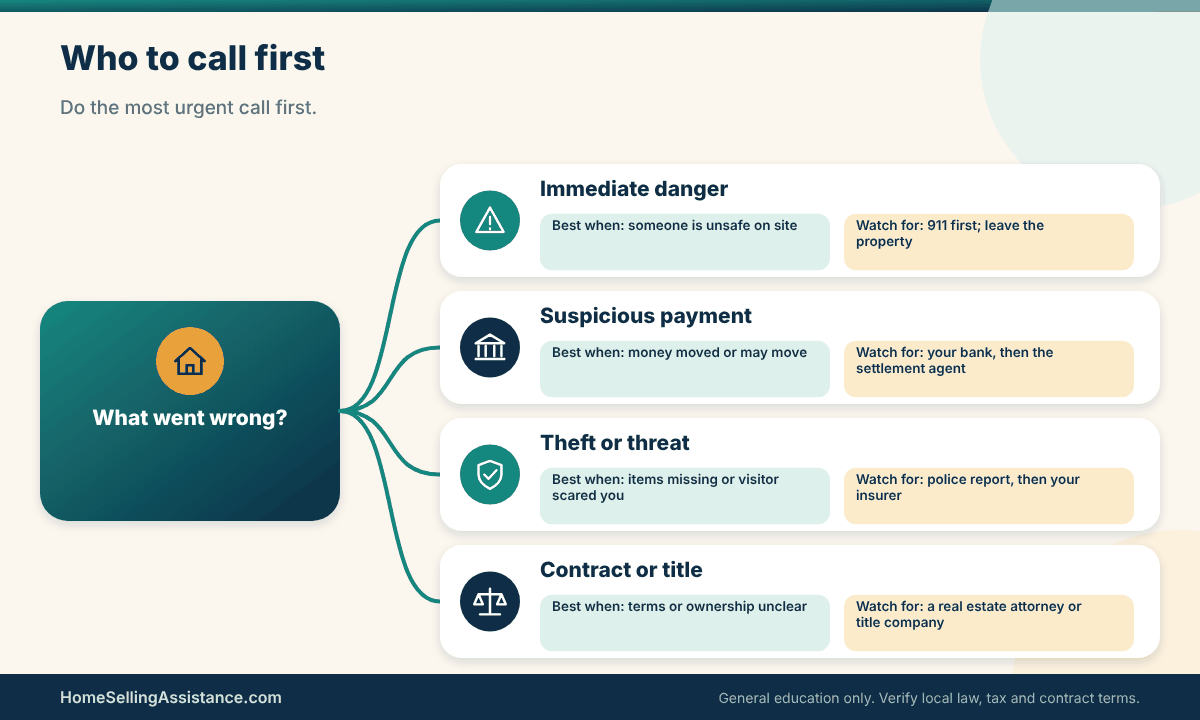
Knowing who to call, and in what order, saves hours and is a core part of FSBO showing safety. The right contact depends on what happened. A physical threat belongs with emergency services. A missing item belongs with police and your insurer. A suspicious payment belongs with your bank first, then the settlement agent. A contract or title problem belongs with an attorney or the title company. Overlap is normal, so do the most urgent call first and keep a log of the rest.
Speed matters most with money, which is why FSBO showing safety reaches beyond the front door. Banks can sometimes recall or freeze a transfer if they hear quickly, though success is never guaranteed, and the earlier the call the better the chance. Do not wait to be sure it is fraud before you call.
Evidence to gather: the record that every responder will ask for
Whoever you call will ask for roughly the same file. Collect the original messages with full headers if you can, screenshots with dates, phone numbers and names used, copies of any documents the other person sent, bank confirmation details, and a written timeline in your own words. Write the timeline soon, while the details are fresh, and keep it factual: what happened, when, what you did next.
For online fraud in the United States, the FBI’s Internet Crime Complaint Center accepts reports, and your local police can take a report for theft or threats. A report number is useful for insurance claims and for banks. If an identity was misused, the FTC’s consumer site describes recovery steps you can follow. Keep everything in one folder, paper or digital, labeled with the date.
Insurers and attorneys differ on what they cover and what they advise, so read your own homeowner’s policy for theft and liability language, and ask a licensed attorney in your state about legal questions. We cannot tell you what your policy pays or what a court would decide.
Scenario: when to call whom, step by step
Suppose you discover that a jewelry box is missing the day after an open house. Your first move is to look again, calmly, in the places you may have moved it. If it is truly gone, call the police non-emergency line to file a report, then your insurer to ask how claims work and what documents they need, such as photos and receipts. Share your sign-in sheet with the officer; it is the most useful record you have.
The exception is when you feel in danger or someone is still on the property: call emergency services right away and leave. Do not confront anyone. Afterward, review your routine. Maybe the jewelry should have been in a locked box or a bank, and maybe the open house needed a second person. Treat the lesson as an upgrade to your plan, not a failure. Our guide on securing a vacant home during a sale offers extra steps if the house sits empty between showings.
The next table extends FSBO showing safety into the transaction itself. It brings together the transaction side of safety. It shows situations that tend to arise once a buyer is serious, the warning sign in each, the channel you can use to verify, how to respond and which record to keep. Use it as a transaction scenario table when negotiations begin and money, paperwork and personal data start to move.
| Situation | Warning sign | Verification channel | Seller response | Record to preserve |
|---|---|---|---|---|
| New wire instructions arrive | Urgent email, new bank | Title company number from contract | Pause, call back, confirm in writing | Email with headers; call notes |
| Cash offer with no documents | Refuses proof of funds | Buyer’s bank, via a public number | Ask for documents before signing | Offer, messages, request date |
| Buyer wants house keys early | Pressure for access | Your contract’s possession terms | Decline; follow written terms only | Contract pages; refusal message |
| “Agent” you cannot find | No license or brokerage trace | State license lookup | Deal only with verified parties | Screenshots of lookup result |
| Request for your ID numbers | Asked by email or text | Settlement agent portal or office | Share only through secure channel | Request copy; who asked, when |
| Deposit sent by odd method | Gift card, app, overpayment | Escrow holder in contract | Refuse; direct to escrow | Transfer details and messages |
Read across a row before you act. If you cannot name the verification channel for a situation, you are probably not ready to proceed, and that gap is itself the answer. The “record to preserve” column is the one most sellers skip, and it is the one banks and investigators ask for first.
If a problem grows beyond what you can solve with a few phone calls, the article on when to hire an agent after trying FSBO explains how some sellers add professional help partway through, and the FSBO closing process shows where title and settlement professionals take over the money and paperwork.
The detail that surprises many first-time sellers is how much of FSBO showing safety is simply preparation. People who do well have done the same dull things in the same order: a routine, a contact sheet, a tidy house, and a habit of picking up the phone.
For the paperwork that sits behind a safe sale, our guide to FSBO paperwork lists the documents a seller commonly needs, and the wider FSBO and flat-fee MLS category collects every article in this series.
Finally, keep perspective about cost and effort. Some sellers find that the time spent screening, scheduling and supervising visitors is more than they expected, and that is a useful discovery rather than a mistake. Strong FSBO showing safety takes real hours, and those hours belong in your decision about whether to keep selling yourself, hire a flat-fee service for the listing, or bring in a full-service agent.
Our guide on flat-fee MLS listings for sellers explains how some owners keep control of showings while still getting broader exposure, and our comparison of FSBO versus using a Realtor sets the trade-offs side by side.
If you do continue on your own, build a routine that you could hand to a friend. A written plan for FSBO showing safety, one page long, with the booking message, the sign-in rules, the do-not-share list and the contact sheet, makes it easier to ask a family member to cover a showing when you cannot. It also keeps your own choices steady on a tiring day, when the temptation to skip a step is highest.
Pricing and offer strategy matter here too, because a house that is priced realistically draws serious buyers who are easier to verify. If you are still setting your number, our article on how to price an FSBO home walks through the method, and the guide to negotiating an FSBO offer picks up where showings end. Seen this way, FSBO showing safety is one link in a chain that runs from the first inquiry to the final signature.
Last, remember that no checklist replaces judgment. If your gut says a visit should not happen, you can cancel it, reschedule it with a friend present, or move it to a public meeting place for the first conversation. A sale that closes a week later is far better than a showing you regret. That mindset is the real heart of FSBO showing safety: calm rules, applied consistently, with permission to say no.
Frequently asked questions about FSBO showing safety
What is the single most useful habit for FSBO showing safety?
For FSBO showing safety, showing only by appointment, with a name and a phone number you have called back, does more than any gadget. It turns strangers into scheduled, known visitors and gives you a record. Add a second person in the house, and most of the common risks shrink. None of this guarantees that nothing will go wrong, but it removes the easiest openings.
Should I hold an open house if I am selling on my own?
From an FSBO showing safety view, it depends on your comfort, your neighborhood and whether someone can stay with you. An open house brings many unknown people through at once, which makes it harder to watch your belongings and to check who is who. Private appointments are slower but easier to control. Many sellers try appointments first and add one supervised open house only if interest is thin.
Is it reasonable to ask visitors for photo ID?
Asking for a name, a callback number and a sign-in is normal in FSBO showing safety. Some sellers also ask to see identification, or to photograph it for their own records, when a visitor offers. Nobody is required to hand over ID, and you are free to decline a showing if you are not comfortable. Whatever you collect is personal information about someone else, so store it carefully and dispose of it when it is no longer needed.
How do I qualify buyers without risking a fair housing problem?
Ask every visitor the same neutral questions about money and timing: whether they are pre-approved or paying cash, whether they have an agent, and when they want to move. Do not ask or comment about race, religion, family status, disability or other protected traits. Write your questions down so you ask them the same way each time. Your state or city may protect additional groups, so check with your state agency or an attorney.
What should I remove from the house before a showing?
For FSBO showing safety, think portable and personal: medications, jewelry, cash, keys, garage remotes, mail, financial papers, laptops and small electronics. Lock away or remove firearms according to local law. Take down anything with your full name and address together, such as bills or school notices. A locked closet, a trunk at a friend’s home or a bank box are all reasonable places.
Can I trust a proof-of-funds letter or pre-approval letter?
Treat it as a useful clue, not proof. A letter can be outdated, edited or issued for a different amount. Verify by calling the bank or lender using a number you looked up yourself, not the one printed on the letter. Even then, the document describes a moment in time and does not promise that a loan will close.
What if someone asks me to change the wire or payment instructions?
Stop and call the title company or settlement agent on the number in your signed contract. Do not reply to the email or call a number in it. Legitimate offices rarely change instructions by surprise email, and they will be glad you checked. If money has already moved, call your bank at once and then report it through the channels described above.
Who do I call first if something seems wrong?
Call emergency services if you feel unsafe. For a suspicious payment, call your bank first, then the settlement agent. For theft or threats, file a police report and tell your insurer. For a contract or title question, talk to a real estate attorney in your state. If you are unsure which applies, do the most urgent call first and keep a written log.
Does my homeowner’s insurance cover something taken during a showing?
It varies by policy, by what is taken and by the circumstances. Some policies have limits on jewelry, cash or items taken by someone you let in. Read your own policy or ask your insurer or agent before you list, and ask how a claim works when strangers visit by invitation. Photos and receipts for valuables make any claim easier.
When does it make sense to hand showings to an agent?
Some sellers decide that the time spent on FSBO showing safety, the interruptions or the risk are not worth it, and they switch to a listing agent or a flat-fee service that handles showings. That is a legitimate choice, not a failure. Compare the costs and the contract terms carefully, and read any listing agreement before you sign it. A real estate attorney or your state real estate commission can answer questions about local rules.
Make the routine, then stop worrying
FSBO showing safety is not about fear. It is about a small set of habits you decide on once: appointments, a sign-in, a second person, a tidy and locked-down house, a contact sheet and a rule that every change in money instructions gets a phone call. Do those, and you can focus on showing the home well. This article is general education, not legal, tax or financial advice. For decisions about your own sale, talk with a licensed real estate professional, an attorney or your title company, and check rules with your state real estate commission.