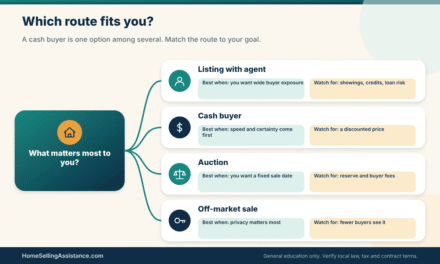
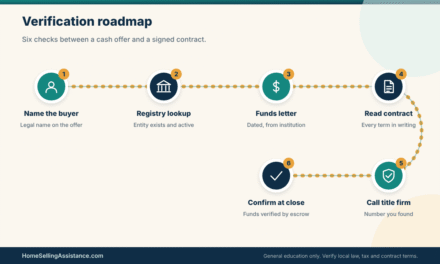
If you plan to sell house to family member, the hardest part is rarely the paperwork itself; it is deciding, out loud and in writing, whether this is a real sale, a partial gift, or something in between, because that one decision changes your taxes, your buyer’s loan and your relationship with everyone else in the family.
When you sell house to family member, most of the usual guardrails of an agent-led deal disappear. Family sales feel different from stranger sales. You trust each other, you probably have a rough number in mind from a conversation over dinner, and nobody wants to insult a daughter, a brother or a favorite cousin by insisting on formalities. That warmth is the reason these deals go wrong more often than people expect. Without a written structure, small misunderstandings about price, repairs, move-in dates or who owes what at closing harden into long grudges.
This article walks through the whole process in the order you will actually meet it: who owns and signs, which rules are federal and which belong to your state, what the lender and appraiser will want, how a gift of equity works in general terms, how the title company and an attorney fit in, and what has to be current before you sign. It sits inside our wider library on cash offers and alternative sale routes, and if you are still comparing routes, our cornerstone guide to the cash offer for house seller decision is a good companion.
One honest note before we start. This is general education, not legal, tax or financial advice. State law, lender rules and tax treatment vary, and a family sale sits right where those three areas overlap. Any dollar figure below is a round, illustrative example meant to show how the arithmetic works, never a prediction about your property.
Key takeaways
- Decide what kind of deal it is. A sale at fair market value, a sale below market value, and an outright gift are treated differently by lenders, tax rules and sometimes benefit programs, so name the structure before you name a price.
- Put the price on paper with support. An independent appraisal or a written comparable-sales analysis protects both sides and answers questions from other relatives, lenders and tax professionals later.
- Expect extra lender scrutiny. Loans between related parties often come with special rules, gift letters and documentation, so involve the lender before you shake hands on terms.
- Do not skip disclosures or inspections. Many disclosure duties still apply to a family sale, and an as-is house remains an as-is house for the person you love.
- Use professionals for the handoffs. A title company, a real estate attorney in your state and a tax professional each cover a piece you cannot safely guess at.
- Verify before signing. Confirm payoff, ownership, tax figures and local transfer rules from official or recorded sources, not from memory or a relative’s advice.

Before you sell house to family member, pin down ownership and the legal question
A family sale starts with two plain questions that people often skip because the answers feel obvious: who actually owns this house in the eyes of the county, and what exactly are you trying to do with it? The answers decide who must sign, which documents control the transaction, and which professionals you need to bring in.
Plans to sell house to family member deserve the same legal checks as any other sale. Sellers sometimes assume that because the buyer is a trusted relative, the legal questions are lighter. They are not lighter, only quieter. The same deed, mortgage, tax and title rules apply. What changes is that nobody forces you to confront them, so you have to do that yourself.
Who owns the home, who signs, and which papers control
Ownership is a matter of public record and private contracts, and the two do not always match what the family believes. A house that “belongs to Mom” may be titled in Mom and Dad jointly, in a trust, in an estate that has not been fully settled, or in the name of a sibling who helped with the down payment decades ago. The person who signs the contract has to be the person, or the group of people, with legal authority to transfer title.
Think of this as step one of any plan to sell house to family member. Before you talk price, work out which of these situations describes your property, because each one points to a different controlling document and a different signature page.
Evidence to gather: deed, loan, trust and marital status
Start with the recorded deed, which you can usually request from the county recorder or clerk’s office, often online. It shows how title is held and may reveal that a former spouse, a co-owner or a trust is still on it. If the home sits in a living trust, you will need the trust document or a certification of trust so the title company can confirm who the trustee is and whether they may sell.
Next, pull your most recent mortgage statement and request a written payoff quote from your servicer. Even a free-and-clear owner should look for liens: unpaid property taxes, a home equity line, an old contractor claim or a judgment can all attach to the property and surface at closing. A preliminary title report from a title company is an inexpensive way to see all of this in one place.
Marital status matters in many states. Depending on where you live, a spouse may need to sign even if their name is not on the deed, particularly in community property states or where homestead rights apply. Ask the title company or a local attorney how your state treats this, and do it before the contract exists rather than after.
A scenario, an exception, and your next step for co-owners
Here is an illustrative case. Two brothers, Dan and Marcus, inherited a house from their father a few years ago and still hold title together. Dan wants to sell his half to Marcus’s daughter, who is buying her first home. Dan assumes that because it is his half, he can simply sign. In reality, selling a fractional interest creates a very different transaction from selling the whole house, and a lender will rarely finance a purchase of half a property with another owner remaining on title.
The cleaner path is usually for all owners to agree to sell the whole property, then let the niece buy it, with Dan and Marcus splitting proceeds under a written agreement. If the brothers disagree about price or timing, a family sale may not be the right tool at all, and a conversation with an attorney about options for co-owned property is worth having first. Our article on the multiple heirs selling an inherited house covers how shared ownership complicates the signature question.
The exception to watch for is a recorded life estate or a transfer-on-death arrangement. A parent who deeded the house to a child years ago while keeping the right to live there may not own what they think they own. Your next step in any co-ownership or unusual title situation is the same: get a preliminary title report and have an attorney read it before you agree to anything. The same caution applies whether you sell house to family member now or after a long delay.
Federal rules, state rules and family-transfer exceptions
Nobody who decides to sell house to family member gets a separate rulebook. People often ask whether there is a special legal category called a “family sale.” There is not one single rule. Instead, several federal and state systems each have their own way of treating a transfer between related people, and a few of them offer exceptions or add extra scrutiny. Knowing which system is speaking helps you ask the right professional the right question.
At the federal level, the biggest touchpoints are tax rules, the lender’s loan program guidelines, and a handful of disclosure and fair housing rules. At the state and local level, you meet transfer taxes, reassessment rules, disclosure forms, deed requirements and recording procedures.
Where federal rules touch a family sale
On the tax side, a home sale is a home sale. The federal home sale exclusion lets many homeowners exclude up to $250,000 of gain, or $500,000 for qualifying joint filers, if they meet the ownership and use tests of two out of the last five years. The IRS explains the rules in Publication 523, Selling Your Home. Selling to a relative does not cancel the exclusion, but pricing far below market value can raise gift tax questions, which we cover later. Our guide to the home sale capital gains exclusion explains the basic tests.
On the lending side, federal housing programs and secondary-market investors publish guidelines for what they call identity-of-interest or family sales. These are not laws against selling to relatives. They are conditions on the loan, such as limits on how a gift of equity is counted or requirements for an appraisal. Your buyer’s lender, not you, controls these, so ask early.
For homes built before 1978, the federal lead-based paint disclosure rule applies to the sale regardless of who is buying. The EPA summarizes the requirement on its real estate disclosure page. Fair housing law also still applies to how a home is offered and advertised if you ever list it publicly, and HUD describes those protections on its fair housing and equal opportunity pages.
Where state and county rules take over
Your decision to sell house to family member will be shaped by local rules more than you expect. State and local law decides much of what actually happens at the closing table. Some states charge transfer or documentary taxes on deeds and then exempt or reduce them for transfers between certain relatives, while others offer no such break.
Some counties reassess property for tax purposes after a sale, and a few places have limited exclusions for sales or transfers between parents and children. Whether any of this applies to you depends on your state, your county and often on the exact family relationship, so these are questions for the county assessor and a local attorney.
Disclosure duties also differ. Many states require sellers to complete a property condition disclosure, and some exempt transfers between family members, while others do not. Do not assume the exemption exists. Ask your state real estate commission, an attorney or a title company, and if there is any doubt, provide the disclosure anyway, because it protects you from a later claim that you hid a problem.
Finally, deeds themselves vary. States use different deed types, formalities for notarization and witnesses, and recording requirements. A deed that looks fine to a family member may be rejected by the county recorder. This is one of the quiet reasons many families, even those who trust each other completely, route a sale through a title company or attorney. The matrix below pulls these issues together so you can see where each one is controlled and how to check it.
| Issue | Controlling document or authority | Seller obligation or choice | Typical deadline | Local verification |
|---|---|---|---|---|
| Who may sign | Recorded deed, trust certificate, estate papers | Confirm every owner and spouse signs as required | Before contract | County recorder, title company |
| Price support | Appraisal or written comparable analysis | Choose fair market value or a stated discount | Before contract or loan approval | Lender, appraiser, tax professional |
| Gift of equity | Gift letter and closing statement | Decide whether to give part of the value | Loan underwriting stage | Buyer’s lender, tax professional |
| Property disclosure | State form and federal lead rule if built before 1978 | Complete the form or confirm a valid exemption | Before contract or per state law | State real estate commission, attorney |
| Transfer taxes and reassessment | State statute, county assessor rules | Learn which taxes apply and who pays | Closing and recording | County assessor, title company |
| Existing loan | Mortgage note and payoff letter | Pay off at closing or confirm lender consent | Payoff quote good for stated days | Mortgage servicer |
| Deed and recording | State deed rules, recorder requirements | Use the correct deed type and notarization | Closing, then recording | County recorder, attorney |
A matrix like this keeps your plan to sell house to family member honest. Use the matrix as a conversation starter, not a verdict. Print it, write the name of the actual person or office next to each row, and fill in the real deadline once a contract exists. If a row has no name next to it by the time you sign, that is the row most likely to produce a surprise.
People who sell house to family member often lean on relatives for legal answers. Notice that none of these rows says “ask the family.” Family members are often the best source of context and the worst source of legal answers, because they usually remember how a similar transfer worked many years ago, in another state, under rules that have since changed. Treat their stories as prompts for questions, then confirm each answer with an official source.
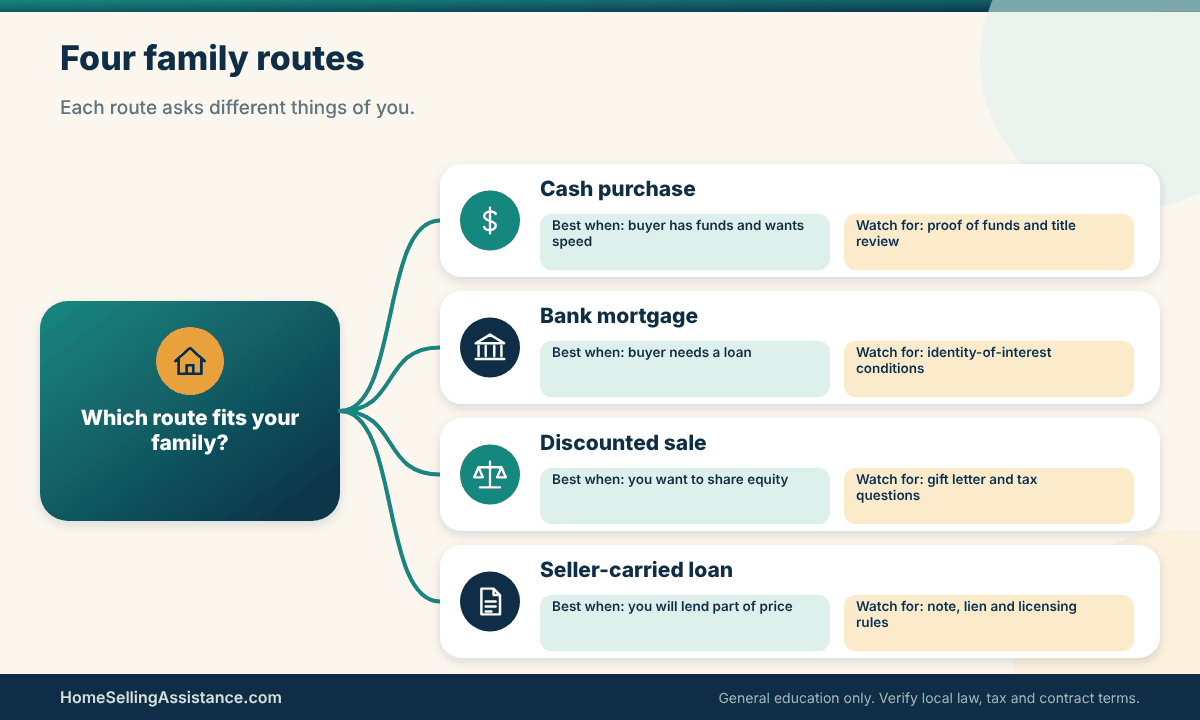
The decision picture above sorts the usual family sale routes by how much each one asks of the lender, the tax return and the paperwork. It is worth a look before you commit to a structure, because the route you choose also decides how many people need to be involved. Make that choice before you sell house to family member, not after the contract is drafted.
How to sell house to family member as a real seller workflow
A plan to sell house to family member becomes a workflow like any other. Once you know who owns the house and which systems apply, the sale becomes a workflow like any other: price it, document it, disclose what you know, sign a contract, then hand the file to the lender, the title company and sometimes an attorney. The only difference is that you have to impose the discipline yourself, because there is no agent pushing the calendar forward.
It helps to think of the workflow as two halves. The first half is what you produce: the price support, the disclosures and the written agreement. The second half is what other people verify: the lender, the appraiser, the title examiner and the recording office. A smooth family sale is one where the first half is complete before the second half begins. Anyone who tries to sell house to family member without an agent has to run both halves personally.
Disclosures, price support and approvals before the contract
Before a contract exists, three things should be on the table: how the price was set, what you know about the condition of the house, and who has to approve the deal. Skipping any of these is how a friendly handshake turns into an argument two years later. None of them takes long when you do them first and in writing. That is true whenever you sell house to family member, however close you are.
Paperwork evidence: price support, gift letter and disclosures
When you sell house to family member, price support is the first thing to settle. For price support, the cleanest tool is an independent appraisal ordered through a lender, or a separate appraisal you commission yourself. An appraiser is a licensed professional who estimates market value from comparable sales; that is a different exercise from an agent’s comparative market analysis, which is an opinion of likely listing price. Our explainer on CMA versus appraisal lays out the difference. In a family sale, an appraisal is valuable mostly because it is neutral: neither of you set the number.
If the sale price will be below appraised value, the difference is often described as a gift of equity. Lenders usually require a signed gift letter that states the amount, confirms that no repayment is expected, and names both parties. The letter needs to match the numbers on the closing statement exactly, so write it after the price is final, not before.
On disclosures, gather what you already know: past repairs, leaks, pest history, permits, insurance claims, neighborhood issues and any known defects. Use your state’s official form if one exists. If your state exempts family transfers, you can still give the form voluntarily. A completed form costs nothing and is far cheaper than a dispute about what you “should have said.” Sellers who sell house to family member and hand over the form tend to avoid the hardest conversations later.
Let us make the gift of equity concrete with round, illustrative numbers. Suppose an appraiser values the house at $400,000 and you still owe $150,000 on your mortgage. You agree to sell it to your daughter for $350,000. The $50,000 difference between value and price is the gift of equity. At closing, the $150,000 payoff comes out of the price, closing costs are settled, and the rest comes to you. Your daughter’s lender may treat the $50,000 as her down payment, which is exactly why it wants the gift letter and a clean appraisal.
Here is the honest caveat for anyone who wants to sell house to family member at a discount. Notice what that example does and does not show. It shows how the arithmetic works. It does not tell you what your taxes, the lender’s limits or your state’s transfer costs will be, and it does not suggest that a discount of that size is wise. Some families give no discount at all; others give a large one. The right amount is a family and financial planning decision, and a tax professional should look at it before you sign.
The most common tax question is whether a gift of equity triggers a gift tax. In general terms, the federal gift tax system lets people give up to an annual amount per recipient without filing, and larger gifts may require the giver to file a gift tax return even when no tax is actually owed because of the lifetime exemption. The annual figure changes over time, so we are not quoting it here. The IRS publishes current numbers and instructions, and a tax preparer can tell you whether you would need to report your particular discount.
Reporting is mostly a paperwork matter, but missing a required form is the kind of mistake that is easy to avoid.
A related point is the seller’s own gain. Generally, your taxable gain on a sale is measured against what you actually receive, not the appraised value you chose not to charge. If you sell at a discount and your gain falls within the home sale exclusion, your tax picture may be unchanged. If you sell at a loss to a relative, the tax rules generally do not let you claim that loss, and a personal residence loss is typically not deductible in any case.
Our guide to adjusted basis in a home sale explains how to compute the starting number, and IRS Publication 551 on basis covers how cost is figured, including how gifted and purchased portions are handled for the person receiving the home.
That last phrase matters for your buyer. When a home is partly bought and partly gifted, the buyer’s cost basis, the number later used to calculate gain when they sell, follows its own rules and may differ from the price on the contract. It is one of the best reasons to have the buyer talk to a tax professional too, ideally before closing, because it affects their future taxes more than yours.
Finally, think about what else a below-market transfer could affect. Some government benefit programs, including long-term care benefit programs, look back at transfers for less than fair value when they decide eligibility. Whether your sale could matter depends on your age, health, state and program, and the rules are technical. If anyone in the family may need that kind of care within the next several years, speak to an elder law attorney before you set a discounted price. Whether you sell house to family member for full value or at a discount, check this point first.
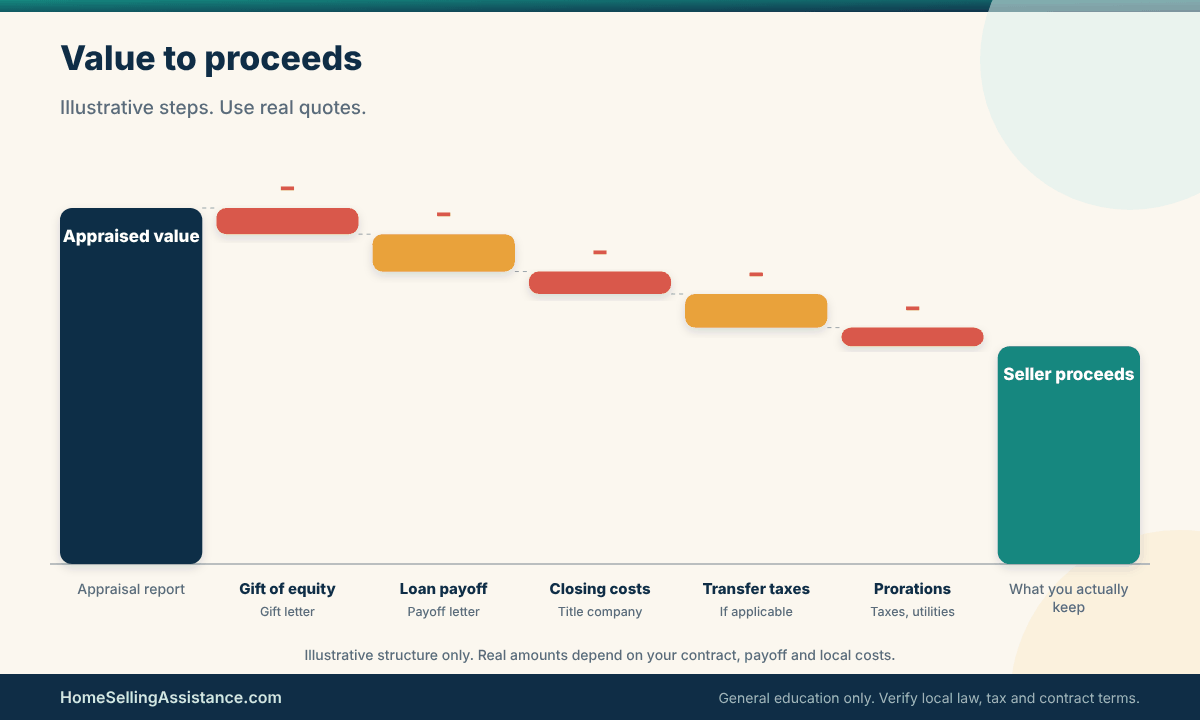
The waterfall graphic above shows an illustrative path from appraised value to what a family seller actually keeps, with the gift of equity shown as its own step. Replace the placeholder labels with real quotes from your own payoff letter, title company and tax professional.
When family says skip it: a scenario and the safer next step
Picture a mother selling to her son. He says, “Mom, I grew up in this house, I don’t need an inspection or a form.” She is touched and tempted. Six months after closing, he discovers a failing sewer line. He is not angry yet, but he is stressed and out of money, and she is now the person he is quietly calculating whether to blame.
The safer path is to treat the sale as if a stranger were buying. She completes the disclosure form honestly, including the fact that the sewer line was scoped years ago and had slow drains. He orders a professional inspection and decides whether to proceed, ask for a credit or walk away. Every step is written down. If a problem appears later, there is a record showing what both of them knew and agreed to. That is the habit that makes it safer to sell house to family member.
A common exception: a buyer who insists on waiving an inspection. That is their right in most places, but put the waiver in writing, in the contract, with a sentence stating that they were offered the chance and declined. Your next step in all of these cases is to ask your attorney or title company whether your state has a required form or exemption, then document what you provided. Our broader article on seller disclosure requirements shows how widely these duties differ.
Lender, title company, attorney and family handoffs
After the contract is signed, other people take over pieces of the process. In a stranger sale, agents coordinate most of this. In a family sale without agents, you may become the coordinator yourself, which is fine as long as you know who the players are and what each one needs from you. Plan these handoffs early if you intend to sell house to family member without agents.
The handoffs fall into three groups: the money side, run by the lender and appraiser; the title side, run by the title company or attorney; and the family side, which no professional manages but which deserves a plan of its own. A sale where you sell house to family member usually needs all three groups covered.
What the lender and appraiser will ask of both of you
If the buyer is using a mortgage, the lender will treat the transaction as an identity-of-interest sale, meaning the buyer and seller are related or otherwise connected. Many loan programs allow these sales but add conditions. You may be asked to confirm your relationship in writing, provide a copy of the sales contract, supply a gift letter, and allow a full appraisal rather than relying on any waiver.
Some programs limit how much of the seller’s equity can be counted as a down payment, and some set rules about occupancy or the loan type. Expect this whenever you sell house to family member and the buyer needs financing.
Because those rules differ between programs and change over time, we will not quote them here. What we can say is that the buyer should talk to a lender before the price is final, show them the draft terms, and ask specifically about identity-of-interest and gift-of-equity rules. A lender can often say “this structure works, this one does not” in a single conversation, which beats finding out three weeks into underwriting. Ask about it before you sell house to family member on a handshake price.
The appraiser will ask for access, a copy of the contract in some cases, and recent improvement history. A low appraisal is the most common surprise in a family sale because the family price was often set by feel. Our article on low appraisal seller options explains how sellers typically respond, and the same logic applies when the buyer is a relative.
A related option that comes up often is seller financing, where you lend part of the price to the relative instead of the bank. Families sometimes prefer it because it is flexible and keeps money in the family. It also adds a promissory note, a mortgage or deed of trust, a servicing plan and tax reporting for interest.
Federal and state rules can apply to seller-financed mortgage loans, including licensing questions and ability-to-repay standards, and the IRS has minimum interest rules for loans between family members. These details vary, so involve an attorney and a tax professional before offering a family loan. The Consumer Financial Protection Bureau publishes plain-language information on mortgage rules that is worth reading. Think hard before you sell house to family member with your own financing.
A second question is whether the existing mortgage can stay in place. Most loans contain a due-on-sale clause, which lets the lender demand repayment when the property transfers. Some federal rules limit how lenders use that clause for certain transfers within families, but they are narrow and depend on the facts, so never assume you qualify. Ask your servicer in writing, and have an attorney read the answer. For most family sales the straightforward route is paying off the old loan at closing, which our guide to mortgage payoff when selling a house explains step by step.
Title, deed and attorney handoffs, plus the siblings problem
The title company or closing attorney searches the public record, identifies liens, prepares or reviews the deed, collects funds, pays off your loan, records the transfer and issues title insurance to the buyer’s lender and optionally to the buyer. This is the stage where hidden problems surface, and where an unrecorded handshake agreement becomes a legal document. Reading our overview of the title search for sellers will make the preliminary report easier to follow.
Many families wonder whether they can skip these professionals to save money. Some do, using a simple deed and a handwritten contract. The risk is that errors in the deed, a missed lien or an unrecorded transfer may not appear for years, and they are expensive to repair after a parent has died or a buyer wants to refinance. A modest professional fee is usually cheaper than a quiet defect. The cost of professional help is small next to the cost of a defect found years after you sell house to family member.
Then there is the siblings problem. If you have other children or relatives who expected to inherit or buy the house, a below-market sale to one of them can be read as favoritism. There is no law requiring you to be equal, but there are practical ways to reduce conflict: explain the decision openly, document the price basis, and consider putting your reasons in a short letter kept with your estate papers.
An estate attorney can advise how a below-market sale interacts with your overall plan. Siblings are the most common source of pushback when people sell house to family member.
A verification checklist to sell house to family member safely
By this point you have a structure, a price story and a list of professionals. The last stage is verification, which means checking each claim in the deal against an official source or a recorded document instead of trusting recollection. Family sales are where this matters most, because the people involved are the least likely to double-check each other. This is the stage that protects you after you sell house to family member.
Verification is not about distrust. It is about making sure that the person you love ends up with a house they can insure, refinance, sell and pass on without a hidden problem, and that you end up with proceeds and records that hold up if anyone asks questions later. Done well, verification makes it far easier to sell house to family member and keep the peace.
Official sources and recorded documents to confirm
Think of every statement in your plan as having an owner. “The house is in my name” belongs to the county recorder. “The payoff is about this much” belongs to your loan servicer. “No gift tax is owed” belongs to the tax rules, as read by a qualified professional. “The deed is valid” belongs to the recording office and the closing professional. Verification means going to that owner and getting the answer in writing. Use that rule whenever you sell house to family member.
Sources to check: IRS, county recorder, servicer and state commission
For tax questions, start with the IRS publications for home sales and basis, and for gift tax with the IRS instructions for the gift tax return, then confirm with a preparer. For ownership and liens, order a copy of the recorded deed and any recorded mortgages, and ask a title company for a preliminary report. For payoff, request a written payoff statement from the servicer with a per-day interest figure and an expiration date.
If the buyer is paying cash, our guide to proof of funds for a cash buyer explains what documents to ask for, because even a relative should be able to show funds.
For disclosure rules and licensing questions, use your state real estate commission’s website, which usually explains what forms sellers must provide and whether there are exemptions for family transfers. For transfer taxes and reassessment, check with the county assessor or recorder; many offices publish exemption lists, and a phone call often settles it in minutes. For lender conditions, the buyer should ask the loan officer for a written list of what the lender will require on an identity-of-interest sale.
Finally, for fraud awareness, remember that family sales are not immune. Email accounts get hacked, and wire instructions can be changed by criminals who read a message thread. Confirm any wiring details by phone with a number you already know, and see our article on real estate wire fraud for sellers before closing day. The FBI’s Internet Crime Complaint Center is where victims report these scams.
A scenario and next step when the records disagree
Here is an illustrative case. Elena wants to sell her condo to her nephew. She believes she owns it solo, but the preliminary title report shows her late husband’s name still on the deed, and the recorded documents mention a home equity loan she thought was closed. Her nephew’s lender will not move forward until both items are cleared.
When records disagree with memory, the records win until someone proves otherwise. Elena’s next step is to ask the title company what documents would fix the deed, which might involve a death certificate or estate paperwork, and to ask the lender that held the equity line for a recorded release. None of that is quick, and it is better to find it before a closing date is set than during the final week.
The general lesson: when a recorded document, a statement or a verbal claim does not match, write down the difference, identify the office that can resolve it, and give the buyer an honest update. A relative can handle a delay; surprises after a signed contract are harder. The scenario table below shows several common situations and where to escalate each one. Keep that habit through every stage as you sell house to family member.
| Situation | Seller options | Main risk | Document to review | Escalation point |
|---|---|---|---|---|
| Price below appraised value | Document a gift of equity or raise the price | Lender conditions, gift reporting | Appraisal, gift letter | Lender and tax professional |
| Appraisal comes in low | Renegotiate, add cash, or end the deal | Financing falls through | Appraisal report, contract | Lender and attorney |
| Buyer wants no inspection | Written waiver or still offer the chance | Later repair dispute | Contract, waiver language | Attorney |
| Seller carries a family loan | Use a note and recorded security instrument | Default, tax and licensing issues | Promissory note, deed of trust | Attorney and tax professional |
| Siblings object to the deal | Explain, document, or pause | Family conflict, later claims | Estate plan, price support | Estate attorney |
| Title shows a hidden lien | Pay it off or cure it before closing | Delay or failed closing | Title commitment | Title company |
To use the table, find the row closest to your situation and read across from left to right. The second and third columns tell you what choices exist and what might go wrong; the last two tell you which document to pull out and who to call. If your situation is not on the list, that is a good sign you need a professional rather than a template. Sellers who sell house to family member often find that two or three rows apply at once.

The decision tree above follows the most common stumbling block, a low appraisal, and shows the four directions a family sale can take. As with any picture, your contract and your lender’s rules decide which branches are actually open to you. Keep a plan B in mind whenever you sell house to family member with a loan.
What has to be current before anyone signs
A last-week review matters most when you sell house to family member without agents. Documents go stale. A payoff quote expires, an appraisal ages, interest rates move, a lender changes a condition, a property tax bill arrives. A family sale that took weeks to arrange can easily have a few outdated facts buried in it by signing day. A short freshness review in the last week protects everyone.
The goal is simple: on the day you sign, every number in the contract and every statement in your disclosure should be one you could defend with a dated document. If you cannot point to the paper, treat the number as unconfirmed. That standard applies when you sell house to family member as much as any sale.
The pre-signing freshness list
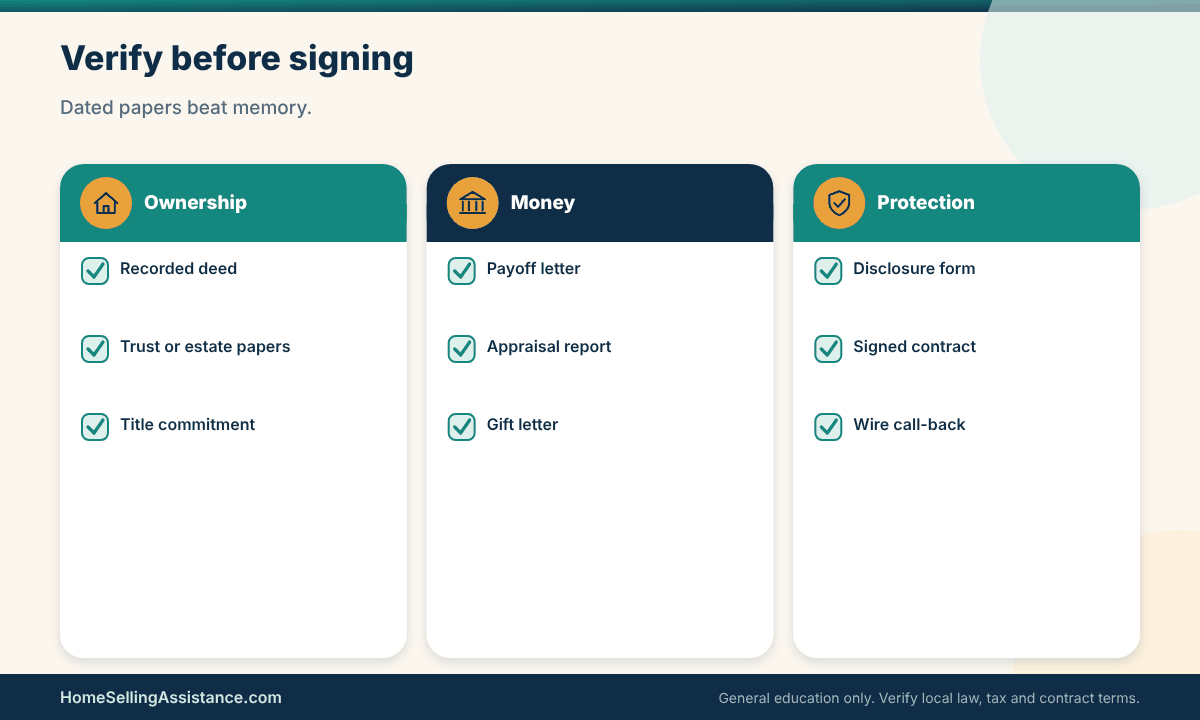
As you sell house to family member, work through the list in order. Work through the list in order. First, confirm the payoff amount with a fresh written quote that includes a per-day interest figure and an expiration date. Second, ask the title company for an updated title commitment so that any lien, judgment or tax issue filed in recent weeks appears. Third, check the property tax situation: whether current bills are paid and how they will be prorated between you and the buyer at closing.
Fourth, ask the buyer’s lender whether any condition has changed, especially around the gift letter, the appraisal, occupancy and identity-of-interest terms. Fifth, reread your disclosure form and update it for anything that happened since you filled it in, such as a new leak, an insurance claim or a repair. Sixth, compare the draft closing statement to the contract line by line, including who pays transfer taxes, recording fees and title insurance. Our guide on reading a seller closing statement shows what each line normally means.
Seventh, make sure the names on the deed, the contract, the gift letter and the closing statement are spelled identically and match government ID. Small inconsistencies, such as a middle initial or a maiden name, can stop a recording. Eighth, confirm wiring or check instructions by phone using a number you already trust, and never from an emailed update alone. A final review of each point takes an hour or two and often catches the one item that would otherwise delay closing.
This step is easy to forget when you sell house to family member and everyone already knows each other’s names.
A last-week scenario, and what to do when something is stale
Imagine Tom and his daughter Priya, three days from closing. Tom’s payoff letter was issued five weeks ago and expires tomorrow. The appraisal is fine, but Priya’s lender now wants an updated gift letter because the final price changed by a small amount after a repair credit. Tom assumed the letter did not matter once the price was agreed. The title company has also found a small unpaid water bill that attached to the property.
None of this is dramatic, but all of it can move the closing date if it is found late. Tom requests a new payoff quote the same day. The title company confirms the water bill can be paid from his proceeds at closing. Priya’s lender issues a revised condition, Tom signs a corrected gift letter that matches the final closing statement, and everyone agrees in writing on the new closing date. Fixing items like these quickly is part of how you sell house to family member without drama.
The principle is to treat stale as a normal event rather than a failure. When something expires or changes, tell the other party, fix it with a dated document, and update the calendar. Avoid improvising by phone or text, because a family sale is exactly the situation where someone says “we can sort it out later” and later never comes. If a figure cannot be refreshed in time, a short, written extension of the closing date is far better than closing on a number nobody has confirmed.
After closing, keep your records. Hold on to the signed contract, closing statement, deed copy, gift letter, appraisal, disclosure form and any tax professional notes for as long as your tax advisor suggests, since you may need them to explain the sale later. Our guide on home sale net proceeds helps you compare your closing statement to what you expected to receive. Keep them whether you sell house to family member now or years from now.
Quick scenario
A retired couple sells their paid-off home to their grandson for a price below the appraisal. They hire an attorney to prepare the contract and deed, collect an appraisal, sign a gift letter, ask a tax professional about reporting, and complete their state’s disclosure form. It takes a few extra weeks and some fees. Years later, when a cousin asks why the deal was done that way, the file answers every question.
Frequently asked questions about sell house to family member
Can I sell my house to a family member for less than it is worth?
Yes, in most places you can. A price below market value is often called a bargain sale, and the discount may be treated as a gift. That can affect gift reporting, the buyer’s lender and sometimes benefit eligibility. Before you decide to sell house to family member at a discount, ask a tax professional and, if relevant, an elder law attorney what applies to you.
Do I need a real estate agent to sell to a relative?
No law requires one in a typical private sale, and many families skip agents. You still need a contract, a deed, a title search and a way to collect and distribute funds, which is why many people use a title company or attorney. An agent can help with pricing and paperwork if you want one. Compare costs and roles before deciding, and see our look at off-market home sales. Many people who sell house to family member choose professionals only for the closing.
What is a gift of equity?
It is the difference between a home’s appraised value and the lower price a seller accepts from a relative, treated as a gift of part of the seller’s equity. Lenders often count it toward the buyer’s down payment, usually with a signed gift letter. Programs differ on how much they allow, so the buyer should ask the lender before the price is set.
Will a family sale be taxed differently than any other sale?
Generally the same federal home sale rules apply, including the exclusion for qualifying owner-occupants described in IRS Publication 523. The discount, if any, may add gift tax reporting questions, and losses on sales to related parties are generally not deductible. State and local transfer taxes also vary. Treat this answer as a starting point and confirm with a tax professional.
Does the buyer need an appraisal and inspection?
If a mortgage is involved, the lender will almost always require an appraisal, and it is often a good idea even for a cash purchase because it documents value. An inspection is the buyer’s choice in most places, but a waiver should be in writing. Skipping both removes your best evidence if a disagreement appears later.
Do I still have to give disclosures?
Often yes, though some states exempt certain family transfers. For homes built before 1978, the federal lead-based paint disclosure applies to sales generally. Because exemptions differ, check with your state real estate commission or an attorney and consider giving the form anyway. Our overview of lead paint disclosure for sellers explains the federal piece.
Can the buyer use a mortgage to buy from family?
Yes, many buyers do, though lenders treat these as identity-of-interest transactions and may add conditions or documentation. Details differ by loan program and over time. The buyer should speak with a lender before agreeing to terms, and the seller should be ready to supply a contract, a gift letter if used, and cooperation with the appraiser.
Can I finance the sale myself?
You can, in many places, by taking a promissory note secured by the property. It adds legal, tax and sometimes licensing questions, plus the job of collecting payments. Use an attorney to draft and record the documents, and a tax professional for interest reporting. A family loan should be written as carefully as a bank loan. Whether you sell house to family member with a loan or not, put every term in writing.
What if other relatives object?
You generally have the right to decide who buys your own home, but objections can still hurt relationships and, if estate planning is involved, create disputes later. Explain your reasons, document the price basis and consider talking to an estate attorney. If title is shared, other owners must agree before a sale can proceed. Families that sell house to family member sometimes pause just to hold a family meeting.
How long does a family sale take?
It varies with the lender, the appraisal, title issues and how organized the paperwork is. A cash deal with a clean title can move quickly, while a financed deal with a gift of equity follows the lender’s timeline. Ask your title company and the buyer’s lender for realistic dates once you have a contract. The time to sell house to family member depends on those same variables.
Make the generous choice a documented one
A family sale works best when love and paperwork travel together. Settle the structure, support the price, disclose what you know, bring in the lender, title company and professionals who can read your state’s rules, and verify every number before you sign. If you decide to sell house to family member, you give the buyer a home and give yourself a clean record.
This article is general education, not legal, tax or financial advice, so confirm the details for your situation with qualified professionals in your state. If you are comparing other routes, our guide to verifying a cash home buyer covers the stranger-sale side.