Choosing between a home auction vs listing is really a choice between two different ways of finding a price: one lets buyers compete on a fixed date under rules set before anyone bids, the other lets the market respond over days or weeks while you negotiate one offer at a time. Neither is automatically better. This guide explains how each route works, what it costs, where the risk sits, and which seller situations tend to point in one direction.
Most sellers meet the home auction vs listing question in a hurry. A property has sat, a deadline is close, a probate court wants the house sold, or a neighbor mentions that a house down the street “went to auction and was gone in a month.” Those stories leave out the reserve price, the fees, and the buyers who never showed up. A fair home auction vs listing comparison has to include the quiet failures as well as the dramatic wins.
We will keep this practical. You will see how the money flows on each side, how contingencies and deposits change your risk, what a calendar looks like, and what to ask an auctioneer or listing agent before you sign anything. Along the way we link to deeper guides on related questions, including the broader cash offer for house seller overview, because an auction is only one of several alternative routes.
One boundary before we begin. This is general education. Auction rules, licensing, disclosure duties, and contract language vary by state and by company, so treat every example here as a prompt for questions, not as an answer for your property. A local real estate attorney, your state real estate commission, and the actual documents you are handed are the final authorities.
Key takeaways
- Different problems, different tools. In a home auction vs listing choice, a traditional listing tries to reach the widest set of buyers over time, while an auction tries to compress the decision into a set event with firm terms.
- The reserve is the seller’s safety net. Whether the sale is absolute, reserve, or minimum-bid changes your downside more than almost any other term.
- Fees are structured differently. Auction costs may include seller fees, marketing charges, and a buyer premium that sits on top of the winning bid, so compare net proceeds, not headline prices.
- Contingencies are usually the real trade. Auction buyers often accept fewer contingencies and a firm closing date, which can reduce uncertainty but also narrows the buyer pool.
- Both routes can fail. A listing can sit unsold and an auction can end without a sale, so decide your fallback before you start.
- Your facts decide. Condition, title, timing, occupancy, and local demand matter more than any general rule about which route wins.
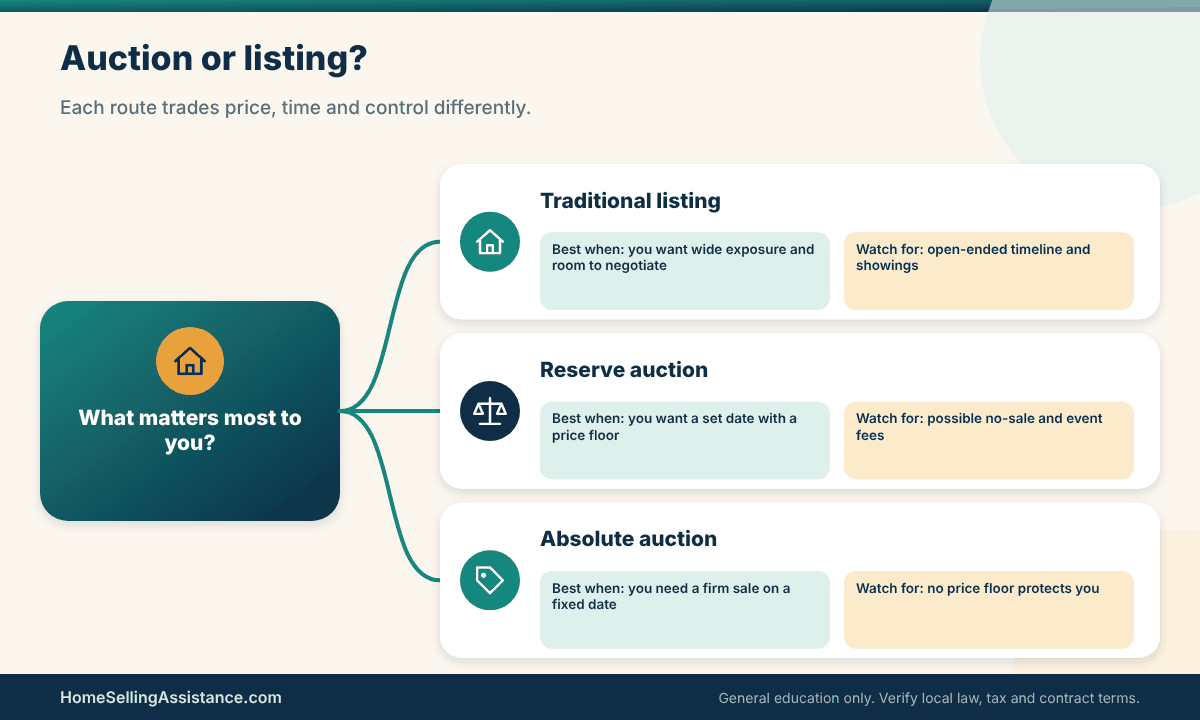
What a Traditional Listing and an Auction Each Try to Do
Every route to market is an answer to a question. The question for a conventional sale is “how do I expose this property to as many qualified buyers as possible and then pick the best offer?” The question for an auction is “how do I get several motivated buyers into the same room, physical or online, at the same time and let competition set the price?” Keeping those two questions in mind makes the rest of this home auction vs listing discussion much easier to follow.
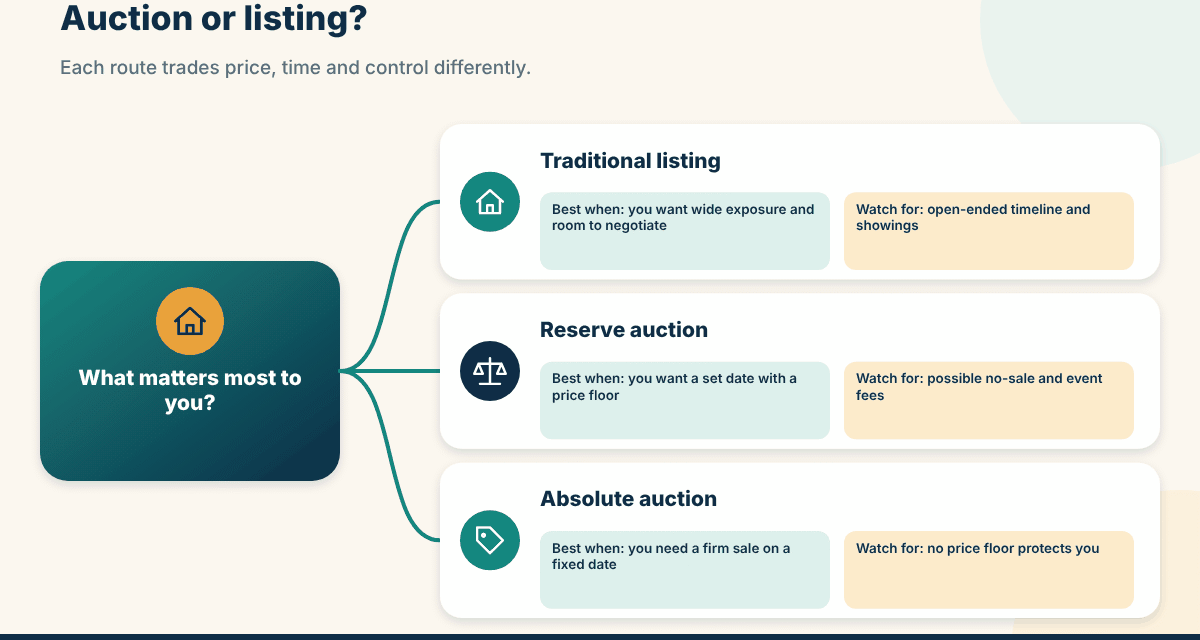
Figure 1 above gives you the overall shape of the home auction vs listing choice. The sections below take each option in turn, then compare them on money, time, control, and risk. You will notice that the same word, such as “contingency” or “deposit,” can mean something quite different depending on which route you are in.
It helps to name what you are optimizing before you read a single proposal. Some sellers want the highest possible price and can wait. Others want the least stress, the shortest calendar, or the fewest surprises after signing. A home auction vs listing decision looks very different depending on which of those goals is yours, so write your priority down in one sentence and keep it where you can see it.
It also helps to separate the sale route from the buyer type. A listing can attract cash buyers, mortgage buyers, and investors. An auction can attract the same people, though the format tends to favor buyers who can act quickly. The route shapes who shows up, but it does not change the basic rule that every offer is only as good as the buyer’s ability to close.
Finally, keep in mind that sellers can combine routes in sequence. A house may be listed first and moved to an auction later, or the reverse. Those pivots have costs and contract consequences, which is why the early questions in any home auction vs listing review should include what happens if plan A does not work.
How a traditional listing works from agreement to closing
In a standard listing, you sign a listing agreement with a licensed broker or agent, the property goes into the local multiple listing service, and buyers and their agents schedule showings. Offers arrive over time. You can accept one, counter it, or wait for another. Once you accept, the contract usually lays out inspection, appraisal, financing, and title steps leading to a closing date. Our guide to the listing agreement covers the paperwork in detail.
The strength of this route in a home auction vs listing comparison is flexibility. You choose the list price, you can change it, and you can adjust marketing if the first weeks go quietly. The cost of that flexibility is uncertainty about timing. A well-priced home in a busy market may attract offers in days, while the same home in a slow market or with an optimistic price can sit for a long time. Our look at days on market explains how that pattern develops.
Evidence to gather: comparable sales, agent plans, and written compensation terms
Before you pick a listing route, gather proof of what similar homes near you have actually sold for, not only what they were listed at. Ask any agent you interview for a written pricing recommendation with the sold comparables behind it, a marketing plan, and the exact compensation terms they propose. Since the broker compensation changes that followed the national industry settlement, compensation is negotiable and must be stated in writing, so read that section line by line.
It also helps to request a draft net proceeds sheet using at least two price scenarios, one cautious and one hopeful. Our walkthrough of home sale net proceeds shows how the pieces fit. If an agent cannot explain each line, keep interviewing. A listing plan you cannot read is a plan you cannot compare against an auction proposal later.
Pay attention to the listing term and the cancellation language too. Some agreements run for months and can be hard to exit, which matters if you are weighing an auction as a second option. Ask what happens if you decide to switch routes midway, and whether any commission applies when a buyer found during the listing term later buys through another channel. Those clauses are easy to skim and expensive to misread.
A scenario, an exception, and your next step for the listing route
For a home auction vs listing example, imagine a seller with a clean, move-in-ready house in a neighborhood where similar homes have recently sold. Time is not tight, the title is simple, and the owner is comfortable with showings. A traditional listing fits that profile well, because broad exposure usually helps a house that photographs well and has plenty of nearby comparables. The auction alternative offers little that the market is not already providing.
The exception to the home auction vs listing default is a property that does not behave like its neighbors. Maybe it needs major work, has an unusual layout, or carries a deadline set by a court or lender. Here a standard listing can stall because buyers hesitate over the unknowns. If that sounds like your house, your next step is to ask for both a listing proposal and an auction proposal, in writing, so you can compare them against the same price and time assumptions.
How a home auction vs listing differs once the auction contract is signed
A home auction begins with an agreement between you and an auction company, often with a licensed auctioneer and, depending on your state, a licensed real estate broker involved. The company markets the property for a defined period, then holds the sale on a set date, either in person, online, or both. Bidders typically register in advance and may need to show financial ability or place a deposit. The highest qualifying bid wins, subject to your reserve if one exists.
After the bidding ends, the winning bidder signs a purchase contract on the auction’s terms, usually the same day or soon after. That contract often has a short closing window and few or no contingencies. The structure is built to move quickly and avoid the back-and-forth of a negotiated sale. Our companion article on absolute vs reserve home auction goes deeper on how the type of auction changes your risk.
Evidence to gather: auction terms, reserve language, and fee schedules
Ask the auction company for its standard seller agreement before you commit to anything, and read it with a pen, since the fine print drives any home auction vs listing comparison. You want the auction type spelled out: absolute, reserve, or minimum bid. You want the reserve amount, if any, and who can change it. You want a full list of seller charges, marketing costs, and what happens to those costs if the property does not sell. Also ask whether a buyer premium applies and who receives it.
A buyer premium is a fee added to the winning bid and paid by the buyer, so the contract price may be the bid plus the premium, depending on how the auction is structured. Sellers sometimes assume it is extra money for them. It usually is not, but it can influence how high bidders will go, because the bidder is thinking about the total cost. Ask for a sample settlement statement from a past sale, with names removed, to see how the numbers really land.
Licensing deserves a direct question as well. Rules differ on who may conduct a real estate auction, and some states require a broker or an auctioneer license, or both. Check your state real estate commission’s website or ask the company for its license numbers and look them up yourself. If the answers are vague, treat that as information about how the sale may be run.
The format of the auction matters as much as the paperwork. In a live event, bidders compete in real time with an auctioneer calling the pace. In an online auction, bids arrive over a window of hours or days, often with an extension if a bid lands near the end. Some sales combine both. Ask which format your company uses, how bidders are identified, and whether you can watch the bidding as it happens.
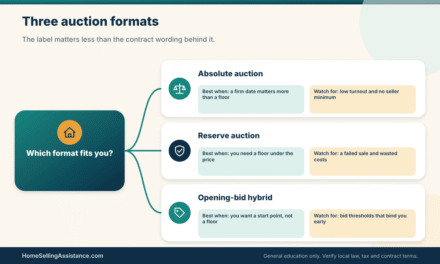
Then ask about the three common structures. In an absolute auction, the property sells to the highest bidder with no minimum. In a reserve auction, you set a confidential floor and are not obliged to sell below it. In a minimum-bid auction, bidding opens at a published figure. Each structure changes your exposure, and a careful home auction vs listing comparison treats them as three separate options rather than one.
Marketing is the other piece. A good auction campaign usually relies on the company’s database of bidders, online advertising, signage, and sometimes open house events before the sale. Ask to see examples of past campaigns for similar homes, and ask who pays if the campaign goes beyond the original budget. Without clear answers, you are guessing about the most important driver of bidder turnout.
A scenario, an exception, and your next step for the auction route
Picture an owner of a property that has been vacant for a while, with deferred repairs and a title that needs attention. Buyers using traditional mortgages may struggle with that condition, and the seller wants a defined end date. An auction can suit this situation because it attracts buyers who are comfortable with cash, with risk, and with a firm timeline, and because the sale date forces everyone to decide.
The exception in the home auction vs listing debate is an auction that draws too few bidders, which can happen when marketing is thin, the location is hard to reach, or the opening bid is set too high. With a reserve in place, you keep the house but you have paid some costs. Your next step is to ask the company how many registered bidders its recent comparable sales drew, and to treat any refusal to share that history as a caution flag.
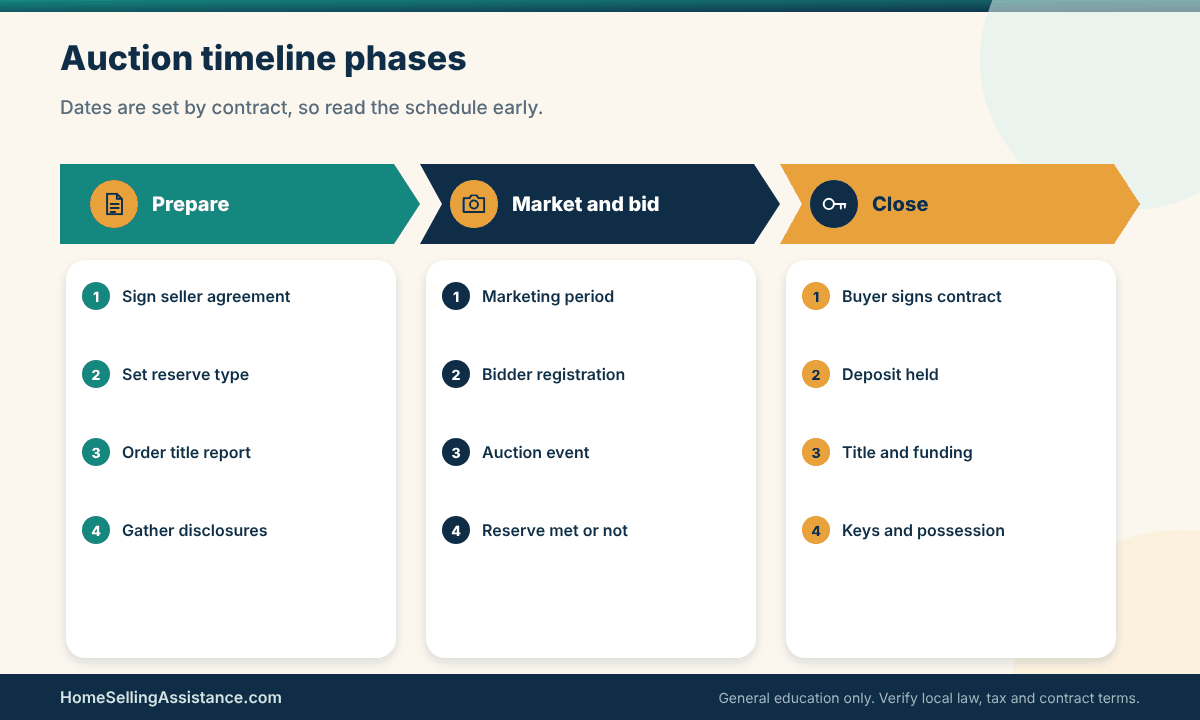
Comparing Money, Time, Control, and Risk in a Home Auction vs Listing
Once you know how each route works, the useful question in any home auction vs listing review becomes what you give up and what you gain in each. Sellers often compare only the expected sale price, which is the least reliable number on the page. A better home auction vs listing comparison lines up net proceeds, calendar, contingencies, your own workload, and the ways each route can break.
The matrix below is a starting framework, not a verdict. Read across a row to see how the two routes differ on one factor, and read down a column to see the general character of each option. Your own contract terms can change any cell, so treat the table as a list of questions to ask.
| Factor | Traditional listing | Home auction | Where it varies |
|---|---|---|---|
| Price and net proceeds | Set by negotiation over time; list price is a starting point | Set by bidding on one date; reserve may set a floor | Fees, buyer premium, concessions, local demand |
| Time to a sale | Open-ended until an acceptable offer arrives | Fixed marketing period and event date | Auction calendar, closing window in the contract |
| Contingencies | Often inspection, appraisal, and financing steps | Often fewer or none, with a deposit at risk | Contract terms, state rules, buyer type |
| Seller workload | Showings, repairs, negotiation, counters | Document prep, event access, fewer showings | Who handles marketing and open houses |
| Control over price | High, can reprice or reject offers | Lower once bidding starts, unless reserve applies | Absolute vs reserve vs minimum bid |
| Execution risk | Deals can fall through after acceptance | Event may not draw bidders or may miss the reserve | Marketing quality, bidder verification, deposit rules |
Use the table by marking which rows matter most to you in this home auction vs listing decision. If a firm date and fewer moving parts rank highest, the auction column deserves attention. If top-of-market price and negotiating room rank highest, the listing column probably does. Many sellers find that two or three rows dominate their decision, and the rest are secondary.
Weighing price, time, control, and workload in a home auction vs listing choice
Price is the headline everyone argues about in a home auction vs listing debate, but net proceeds is what lands in your account. On a listing, you pay agreed compensation to the brokers involved, plus the usual seller closing costs. At an auction, you may pay an auction company fee, marketing expenses, and the same closing costs, while the buyer premium, if any, is generally the buyer’s cost. Those structures are not the same, so a flat comparison of percentages can mislead.
Time and control pull in opposite directions. A listing gives you control over price and timing but leaves the end date open. An auction gives you a date but gives up control once bidding begins, unless you set a reserve. A reserve restores some control, though it can also lead to a no-sale result. Neither tradeoff is wrong. It simply has to match what you most need from the sale.
Workload is the quiet factor in the home auction vs listing decision. A listing means keeping the house show-ready, being available for showings, reviewing offers, handling inspection requests, and managing a negotiation. An auction concentrates much of that effort into the weeks before the event, and the buyer usually takes the property closer to as-is. That can be a relief if you are tired or far away. It can be a loss if you have time to improve the property and capture the added value.
Evidence to gather: a side-by-side net sheet for each route
Build two net sheets, one for each route, using the same starting assumption about the sale price and clearly marked as illustrative. For example, imagine a property that might sell for a round figure of $300,000 on the open market. List the payoff of any mortgage, agreed broker compensation, title and escrow charges, prorated taxes, and any repair credits you expect. Then repeat the exercise for an auction, adding auction company fees and marketing costs.
The number you want is not the highest price but the difference between what you owe and what you receive on each path. Our guide to the closing cost calculator method shows how to structure the lines, and the figure below shows the usual order of deductions. Ask the auction company and the agent to fill in real figures on your sheets, then compare.
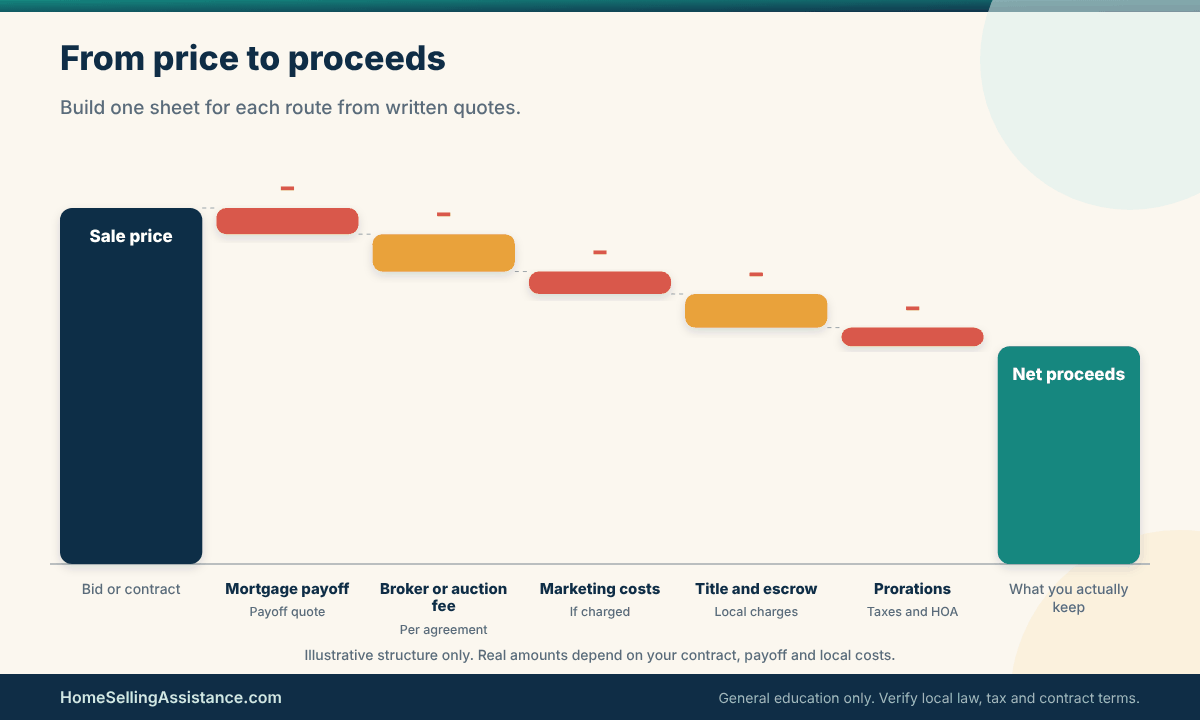
Here is a deliberately simple illustration, using round numbers that are examples only. Suppose a house could sell for $300,000 either way. On the listing side, imagine agreed broker compensation, closing charges, and a few months of carrying costs. On the auction side, imagine an auction company fee, marketing costs, closing charges, and a shorter calendar. The two totals may be close or far apart, and only real quotes can say which.
The lesson from that exercise is that a home auction vs listing comparison cannot be settled with a single percentage. Carrying costs, repair credits, and the possibility of a lower or higher sale price all move the answer. If a salesperson tells you one route “always” nets more, ask to see the arithmetic behind the claim, and treat the absence of arithmetic as your answer.
Keep the illustrative numbers honest. An example sheet is only a method, and the real line items depend on your mortgage, your state, your contract, and the fee schedules you receive. If a company gives you a net projection that cannot be traced to specific lines, ask for the lines. A projection without lines is advertising, not analysis.
A scenario, an exception, and your next step on price and proceeds
Suppose a seller is comparing a listing at a hopeful price against an auction with a modest reserve. On paper the listing could produce more, but it also carries months of carrying costs: mortgage payments, taxes, insurance, utilities, and upkeep. Those monthly costs are real money. A seller who counts them may find that a faster sale at a lower price leaves a similar net position, though only the actual figures can show whether that is true.
The exception to the home auction vs listing tilt is a house in a strong local market, where careful pricing and decent condition can attract several offers within days. There, a listing may capture competition without the cost of auction fees. Your next step is to ask a local agent for the typical time to sell for comparable homes, and then ask the auction company what similar properties have actually achieved relative to their reserves.
Understanding legal, financing, execution, market-exposure, and fallback risk
Risk is not one thing. It is a bundle: the buyer might not close, the financing might fall through, the property might not appear to enough people, a title problem might surface late, or the contract language might hide an obligation you did not expect. A listing and an auction spread these risks differently, and a clear-eyed home auction vs listing review looks at each strand separately.
Financing risk is the clearest example in a home auction vs listing comparison. A conventional buyer often needs a loan, so the sale can depend on an appraisal and underwriting, a theme explored in our guides on the financing contingency and on low appraisal options for sellers. Auction buyers are commonly expected to arrive ready to close, often with cash or fast funding, which reduces that particular risk but does not remove the question of whether the buyer can actually perform.
Market exposure runs the other way. A listing is visible to the whole market over a long period, which can help you find the best buyer. An auction depends on getting the right bidders to the right event on the right day. If marketing misses them, you will not know what price the market might have paid. Neither route has an advantage here until you see the marketing plan and how it will reach buyers.
Title and occupancy deserve their own attention because they can derail either route. A lien, an unreleased old mortgage, or a boundary dispute can delay closing whether the buyer arrived through a listing or a bidding event. Tenants or occupants who will not leave can do the same. Ask your title company for a preliminary report early, and check local rules on notice and possession with an attorney.
Auction sellers sometimes assume that the as-is label removes all legal exposure. It does not. Depending on your state, you may still owe disclosures, and misrepresenting a known defect can create liability under any sale format. Treat the as-is language as a statement about repairs, not as a shield, and let your attorney explain how your state treats it.
A good habit in any home auction vs listing review is to ask who bears the risk at each stage. Before the bidding, you bear the marketing risk. During the contract period, the buyer bears the performance risk, but you bear the delay risk. After closing, both sides face whatever claims state law allows. Mapping those stages on paper makes gaps easier to spot.
Evidence to gather: contract clauses, deposit rules, and proof of buyer funds
Read the purchase contract that the winning bidder will sign before the auction, not after, because the contract is where a home auction vs listing difference becomes real. Look at the deposit amount, whether it is refundable, what happens if the buyer defaults, the closing deadline, and any extension rules. Ask whether the buyer has any inspection rights, and whether the property is sold strictly as-is. If the contract says your obligations in the event of a title defect, understand them now.
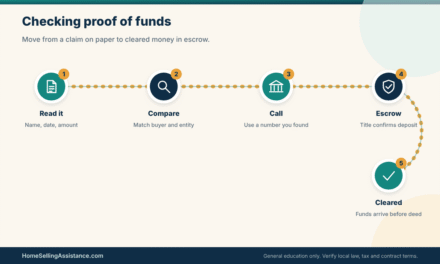
For buyer funds, ask how bidders are verified. A deposit held in escrow is stronger than a promise. Our guides on how to verify a cash home buyer and on proof of funds describe what real documentation looks like and what fake documentation tends to look like. The same cautions apply whether the buyer arrived through a listing or a bidding event.
Finally, ask for a copy of any disclosure forms your state expects. Disclosure duties apply to many sellers whichever route they choose, and being sold as-is does not erase them. Our overview of seller disclosure requirements explains the general picture, and your state commission or attorney can confirm the specifics. For homes built before 1978, federal lead-based paint disclosure rules apply, and the EPA real estate disclosure page explains them.
A scenario, an exception, and your next step for fallback planning
Think of fallback in a home auction vs listing choice as the answer to “what if this does not work?” On a listing, the fallback might be a price change, a relist with a different agent, or a switch to a different route. At an auction, the fallback might be a post-auction negotiation if the reserve was missed, a later auction, or a move to a conventional listing. Each carries costs and delays, so it is wise to price them in advance.
The exception for a home auction vs listing seller is someone who has no room for a fallback, such as someone facing a hard court or lender date. For that person, an auction with a reserve that is too high is a risky choice, and a listing without a timeline is risky too. If you are in that position, a calm conversation with an attorney and a HUD-approved counselor, found through HUD’s counselor search, can help you see the options before the clock runs out.

Matching a Home Auction vs Listing to Your Situation
In the home auction vs listing question there is no universal winner, and any source that names one without asking about your property is selling something. What exists instead is a set of seller situations in which one route tends to fit better. The table below pairs common situations with the route they often favor, the reason, the trade-off, and the single fact that could flip the answer.
Scenario thinking works because the same question, asked about different facts, produces different answers. A home auction vs listing choice for a vacant fixer-upper is not the same decision as one for a polished family home. By describing your situation in plain language first, you protect yourself from advice that sounds confident but was written for someone else.
| Situation | Route often favored | Reason | Trade-off | Fact that changes it |
|---|---|---|---|---|
| Move-in-ready home, flexible timing | Traditional listing | Broad exposure and room to negotiate | Open-ended timeline and showings | A strong or weak local market |
| Vacant home needing major work | Auction, with a reserve | Draws buyers who accept condition | Fees and a possible no-sale | Whether a realistic reserve is set |
| Hard deadline from a court or lender | Depends on the date | Auction gives a fixed event date | Missing the reserve leaves no time | How many days remain |
| Unusual or specialty property | Often auction, sometimes listing | Competition may help unusual assets | Smaller buyer pool by location | Past results for similar assets |
| Estate or shared owners who disagree | Either, with legal sign-off | Structure can end a stalemate | Authority and consent take time | Court or co-owner approval |
| Seller needs top price and can wait | Traditional listing | Time to find the best match | Carrying costs while waiting | Monthly holding costs |
To use the table, find the row closest to your own circumstances, then test the last column against your real facts. If your answer to that final question is uncertain, that is where to focus your research. Our category page on cash offers and alternative sales collects related guides for sellers weighing unconventional routes.
Before you meet any professionals, prepare a short list of questions and use the same list with each one. Ask what the written fee structure is. Ask what recent comparable results look like, including the ones that did not go well. Ask what could cause delay, who handles problems at closing, and what happens if you change your mind. Comparing identical questions across firms is the fairest way to compare the answers.
Take notes during each meeting, and ask for the key points in writing afterward. A confident verbal promise has no force once the contract is signed, while a clear written term does. If a firm will not put a promise in writing, you have learned how much weight to give it. This habit protects you in a home auction vs listing comparison and in nearly every other real estate decision.
Also look at who is advising you and how they are paid. A listing agent is compensated if the house sells through the listing, and an auction company is compensated if the auction produces a sale or under the fee schedule you sign. Neither incentive is improper, but both are worth knowing. Ask directly, and if you want a neutral view, consider paying a real estate attorney for an hour of review.
Seller scenario one: a time-pressured sale of a difficult property
For the home auction vs listing question, consider an heir who has inherited a house that is dated, partly cleared, and a long drive away. The estate has bills, the family wants closure, and a court timetable adds pressure. Repairing and staging seems unrealistic, and a traditional buyer with a mortgage might ask for repairs that the estate cannot easily complete. In this situation a home auction vs listing discussion may lead toward an auction, though authority to sell must be settled first.
For more on how estate sales work generally, see our guide to selling an inherited house. The key point for now is that probate rules vary widely, and who may sign, when, and with what court approval depends on your state and the facts. A probate attorney should confirm authority before any auction contract is signed, because a contract signed without it can create serious problems later.
Evidence to gather: authority to sell, title status, and the true deadline
Start with paperwork that proves who can sell. That might be letters testamentary or letters of administration, a trust certificate, or a power of attorney, depending on the situation. Then order a title report so that liens, unpaid taxes, or ownership gaps appear before bidders find them. Finally, pin down the real deadline in writing, since sellers often discover that a date they feared was flexible, or that a date they assumed was flexible was not.
If tax questions arise, general reading on the topic is available in IRS Publication 559, which covers survivors and executors. It does not replace advice from a tax professional who can look at the estate’s real numbers. Keep records of the date of death value, repair costs, and selling expenses, because those can matter when the tax side is worked out later.
A scenario, an exception, and your next step when the clock is running
Suppose the heir sets a reserve based on a quick broker opinion, and the auction draws only a few bidders. The reserve is not met, so there is no sale. The family now has less time, bills still accumulating, and a decision to make: lower the reserve, run another auction, or list the house conventionally with the lessons learned. A calm plan made beforehand keeps this from becoming a scramble.
The exception to that home auction vs listing lean is when the property is simply in good shape and the market is active. Then a listing may bring a stronger result without the auction’s costs, even if the heir is stressed. Your next step is to ask two professionals for written plans with timelines, and to compare those against the deadline. If neither plan fits, a conversation with an attorney about extending the date may be worth having.
Seller scenario two: a market-ready home with a flexible calendar
Now picture a homeowner whose house is clean, updated, and in a neighborhood where similar homes sell steadily. The owner is not in a rush, wants the strongest price available, and is willing to handle showings. This seller has little reason to give up the control that a listing provides. A home auction vs listing choice here usually leans toward listing unless some unusual factor appears.
That said, some owners in this position are curious about auctions because they like the idea of competing bidders. It is a fair curiosity. The question to ask is whether bidders will really compete for a house that already attracts strong interest through normal channels. If the answer is yes, a listing can capture much of the same competition, as our guide on how to evaluate a home offer explains.
Evidence to gather: local sold data, buyer demand signals, and holding costs
For your own home auction vs listing analysis, gather recent sold prices for comparable homes, the typical time they took to sell, and how close final prices came to the original list prices. A local agent can pull these from the multiple listing service, and you can cross-check against county records. Also tally your monthly carrying costs so that you know what each extra week of waiting really costs. Our article on how to price a house to sell shows how to build that evidence.
Then compare that evidence against an auction proposal. Ask the auction company for recent results on similar homes, including sales that missed the reserve. If their examples are mostly distressed properties, that tells you something about the buyers they attract. The point is not to criticize either route but to ask whether the buyers each one draws are the buyers your house is most likely to please.

Think about how you will judge success afterward. Some sellers measure a sale by price alone, while others care about how the process felt. A seller who values calm and certainty may be pleased with an auction that sold near a reserve, while a seller who values the last few thousand dollars may be happier waiting on a listing. A home auction vs listing choice is partly a question about your own temperament, and there is no shame in saying so.
It can help to set decision checkpoints in advance. For a listing, that might be a review of price and feedback after a few weeks of showings. For an auction, it might be a review of bidder registrations before the event, with a clear rule for adjusting the reserve. Checkpoints keep a slow patch or a disappointing early result from turning into a rushed decision.
A scenario, an exception, and your next step for a flexible seller
Take that same owner and add a twist: a job offer arrives in another state, with a start date that is two months away. Suddenly the calendar is no longer flexible, and the owner must weigh a patient listing against the certainty of a set date. A home auction vs listing choice that seemed obvious becomes a real question again. Facts change the answer, which is why reviewing the decision at each milestone is wise.
The exception to the exception is that many relocation sellers still do well with a listing, particularly with a well-chosen price and a clear plan for the move. Your next step, if circumstances shift, is to ask your agent to update the timeline and net sheet, then request the auction company’s matching figures. For a related topic, our guide on sell house fast claims explains how to evaluate speed promises from any buyer.
Before you decide, it also helps to read the neighboring guides on investor offers versus listing a house and iBuyer versus realtor sales, since the same comparison logic applies. For the general overview of alternative routes, return to the cash offer for house seller guide. And if you are considering a sale outside the open market, our piece on off-market home sales explains the trade-offs.
If the property needs work and you are unsure whether to repair or sell as-is, review selling a house as-is before you set a reserve or a list price. And for a clearer picture of what each route costs in broker compensation, our guide to seller real estate commission explains how fees are structured and why they are negotiable.
Quick scenario
A seller with a dated house, a looming date, and no appetite for repairs asks two firms for written proposals. The listing proposal shows a higher possible price but an open calendar. The auction proposal shows a fixed event, a reserve, and itemized fees. Neither is clearly better on paper, so the seller builds a net sheet for each, checks the reserve against recent sold prices, and chooses based on the date. The method matters more than the outcome.
Frequently asked questions about home auction vs listing
Is a home auction faster than a traditional listing in a home auction vs listing comparison?
Often the sale date is more predictable at an auction, because the marketing period and event day are set in advance. The closing date then follows the purchase contract. Speed is not guaranteed, though. If the reserve is not met, you may have no sale and have to start again. A listing has no fixed date, but a well-priced home can still sell quickly in an active market.
Will a home auction vs listing choice change what I net?
It can, because the fees differ in structure. A listing typically involves agreed broker compensation, while an auction may involve an auction company fee, marketing costs, and sometimes a buyer premium paid by the buyer. The best way to compare is to build a net sheet for each route using the same illustrative sale price, then ask each firm to fill in real figures from its written agreement.
What is a reserve price?
A reserve is the minimum price you are willing to accept. If bidding does not reach it, you are not required to sell. Some auctions are absolute, meaning the property sells to the highest bidder regardless of price, and others are minimum-bid events with a published starting point. Read the contract carefully, because the label on the auction does not matter as much as the written terms.
What is a buyer premium and who gets it?
A buyer premium is an extra charge added to the winning bid and paid by the buyer. In many auctions it goes to the auction company, though the arrangement depends on the contract. As a seller you should know whether one applies, because bidders consider the total cost, which can influence how high they are willing to bid.
Do auction buyers get an inspection or financing contingency?
Frequently they do not, or they have far fewer than in a conventional sale, and they may have a deposit at risk if they fail to close. That is part of how auctions try to reduce uncertainty. Terms differ by company and state, so ask for the buyer contract in advance and have an attorney review it if you are unsure of any clause.
Can I list my house and then switch to an auction?
Sometimes, but your listing agreement may restrict it. Some agreements run for a set term and include language about sales made through other channels. Ask about cancellation and about any compensation that could apply, and consider reading our guide to the exclusive right to sell listing agreement before you sign.
What happens if the auction fails to meet the reserve?
You keep the property, and you may still owe some costs under your agreement. Often the seller can negotiate with the highest bidder after the event, run another auction, or move to a listing. Decide these options in advance with your attorney or advisor, so that a missed reserve is a planned branch and not a surprise.
Is an auction a good choice for an inherited or estate property?
It can be, particularly when the property needs work and the estate wants a defined timetable, but authority to sell and court rules come first. Probate processes vary by state. Confirm with a probate attorney who may sign and whether approval is needed before you hire anyone to sell.
How do I avoid scams when comparing sale routes?
Verify licenses with your state, insist on written terms, never wire money on an unverified request, and be wary of anyone pressing for fast signatures. The FTC consumer site publishes general guidance on scams. If you suspect fraud, the FBI’s IC3 accepts reports of internet crime.
Who should I talk to before settling a home auction vs listing question?
Start with a local real estate attorney for contract and title questions, a licensed agent for comparable sales, and the auction company for its written seller terms. A tax professional can address tax questions. The home auction vs listing decision is yours, and the right amount of outside advice depends on the size of the risk.
Make the choice with your own numbers
The home auction vs listing question gets easier once you replace opinions with documents: two net sheets, two timelines, two sets of contract terms, and a fallback plan for each. Take your time reading before you sign, ask every question twice if needed, and let your own facts decide. This article is general education, not legal, tax or financial advice, so confirm specifics with a licensed attorney, agent or tax professional in your state.