Sell house fast claims are everywhere once you let it be known that you might sell: the postcard promising a check in a week, the website with a countdown timer, the text message from a number you do not recognize, the online form that asks for your address and instantly “approves” you. Some of these come from established companies that really do buy houses quickly. Some come from middlemen who plan to hand your contract to someone else. A few come from people who are not what they say they are.
This guide is not here to scare you away from speed. Speed is a legitimate thing to want. A job that starts in six weeks, an estate that needs to be settled, a house that has sat empty and costs money every month: all of those are good reasons to prefer a short timeline. The trouble is that a promise of speed costs nothing to make, while an actual fast closing depends on a chain of ordinary, checkable facts. Money has to exist. A title company has to be ready. A contract has to say what the marketing said.
So the working question about sell house fast claims is simple. How do you compare a “close in days” headline with the contract and title paperwork that would have to back it up? We will go through what each kind of promise really means, what evidence a genuine offer produces, how to verify things through channels you choose yourself, what screenshots and polished sales language can never prove, and how to react to warning signs without accusing anyone of anything. Everything here is general education. Your state, your county, your lender and your actual contract decide what applies to you.
If you are still deciding which kind of buyer to talk to at all, our cornerstone guide to a cash offer for your house lays out the trade-offs between cash buyers, iBuyers, investors and traditional listings. This article sits one step later: you already have a promise in front of you, and you want to know how much weight it can bear.
Key takeaways
- Break every promise into parts. Sell house fast claims bundle several promises together. “Fast” can mean funds, a short contingency period, a quick title search, or simply a fast first reply. Each part has its own evidence.
- Paper beats adjectives. A real offer becomes a written purchase contract with a named buyer, a price, a closing date, deposit terms and an escape clause list you can read.
- Verify through channels you pick. Look up the company, the title or escrow office and the bank yourself. Do not rely on phone numbers, links or logos supplied by the party making the claim.
- Screenshots prove very little. An image of an account balance, a badge, or a testimonial can be edited, borrowed or out of date. Treat it as an introduction, not as proof.
- Red flags are patterns, not verdicts. Pressure, secrecy, and requests to move money or sign blank pages deserve a pause and a second opinion, not an accusation.
- Keep your records. Save messages, contracts and call notes. If something goes wrong, a tidy file is the most useful thing you can hand to a professional.
What sell house fast claims are really promising
Before you test a claim, you have to know what it is. Most marketing behind sell house fast claims is deliberately loose. It uses words like “quick,” “as soon as,” “typically,” and “in as little as,” which sound like commitments but are not. Your first job is to translate the sentence into something that could be proven wrong.
That translation is not cynical. It is the same thing you would do with any large purchase. If a contractor said “we finish fast,” you would ask for a start date and a completion date in writing. A house sale deserves at least that much care, because it is usually the largest transaction of your life and because you cannot easily undo a closing once it has happened.
Five promises hiding inside one fast-sale pitch
Read a typical pitch behind sell house fast claims slowly and you will usually find five separate claims bundled together. The first is a claim about money: the buyer says they have cash, or that funds are “ready,” or that financing is “pre-approved.” The second is about identity: who exactly is buying, and are they the company on the website or someone using its name. The third is about service: what will actually be done for you, such as handling paperwork, paying closing costs, or taking the house as it stands.
The fourth is about timeline, which is where sell house fast claims tend to be most slippery. “Close in seven days” might describe the shortest possible path under ideal conditions, or it might be a number nobody has ever hit with a property like yours. The fifth is about fees and authority: what is deducted from your proceeds, and whether the person talking to you has the right to bind the buyer, set the price or sign anything at all.
Separating these matters because sell house fast claims can be honest on four points and shaky on the fifth. A company may truly have the money and still quote a closing date it cannot control, because the title search is not in its hands. A buyer may be exactly who they say they are and still be an assignment-style middleman, meaning they plan to pass the contract to a different buyer, which changes who must have the funds. Neither is automatically bad. Both change what you should ask for.
Evidence to gather: turning an adjective into a date and a number
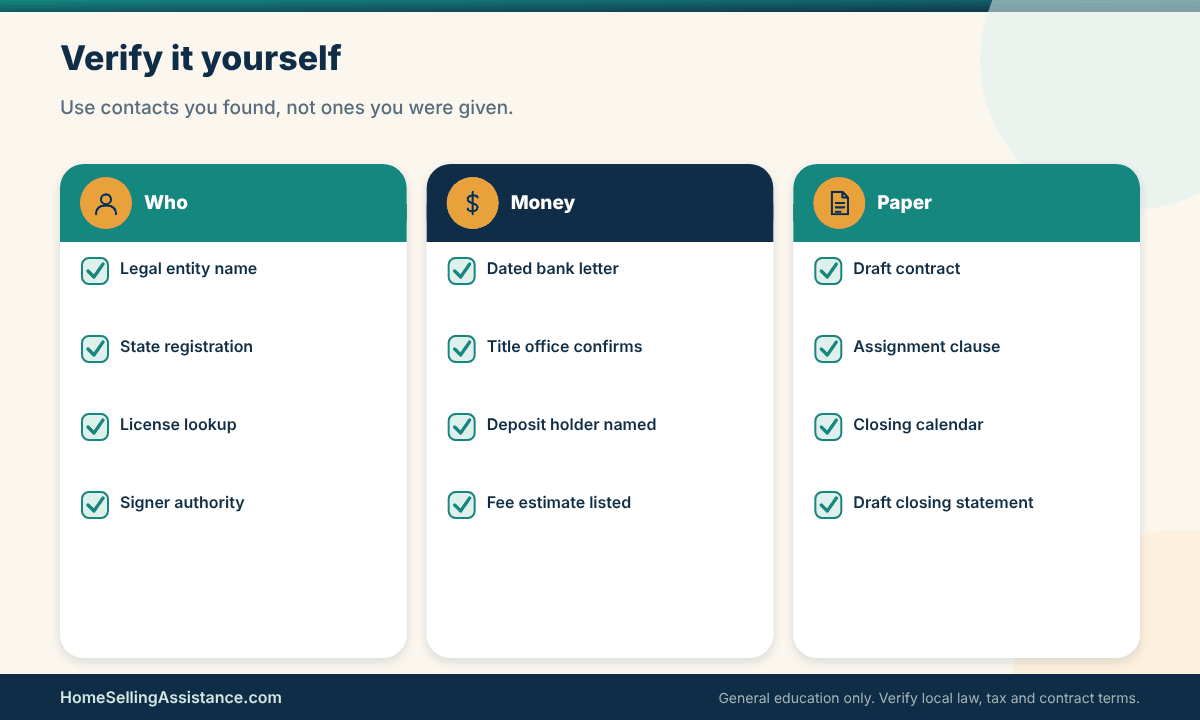
For each of the five promises, write down the evidence that would make it checkable. For money, that is a statement of where the funds are held, shown in a way the title company can confirm. For identity, it is a legal entity name, a state registration you can look up, and a signer whose authority is documented. For service, it is a written list of what the buyer pays for and what they do not.
For timeline, ask for a proposed calendar: contract date, deposit date, title commitment date, any inspection or review window, and target closing date, each with a name beside it saying who is responsible. For fees, ask for a line-by-line estimate of everything that will come out of your proceeds, including any fee the buyer or a related business charges. If a question gets a vague answer, that tells you something too.
A useful habit with sell house fast claims is to restate the promise back in an email: “To confirm, you are offering a closing date of this day, with funds not subject to any loan, and you will pay these costs.” Their reply, or their silence, becomes part of your record. Legitimate buyers are usually comfortable with this because they have been asked before. If you are weighing an offer from a company that markets heavily, our guide on how to verify a cash home buyer goes deeper on this step.
A scenario, an exception, and your next step on “close in days”
Here is an illustrative example with made-up details. A seller receives a mailer offering to close “in days.” She calls and gets a friendly representative who says an offer will arrive by the next afternoon. It arrives as a one-page letter with a price and the phrase “close in as little as 7 days.” There is no closing date, no buyer entity name, and no mention of a deposit.
The exception to keep in mind: sometimes a short letter really is the front end of a serious offer, and the contract follows once the seller says she is interested. So the letter alone is not a reason to walk away. Her next step is to reply in writing, asking for a draft purchase agreement with the buyer’s legal name, a target closing date, deposit terms and a list of contingencies. Then she waits to see what actually shows up.
If the draft agreement arrives and it matches the pitch, she has something real to compare. If it arrives with a much longer timeline, a large list of conditions, or a lower price than the letter, she has learned that the headline and the contract are different documents, and that the contract is the one that counts. Either way she has used the claim as a starting point rather than a conclusion, which is exactly the role it deserves.
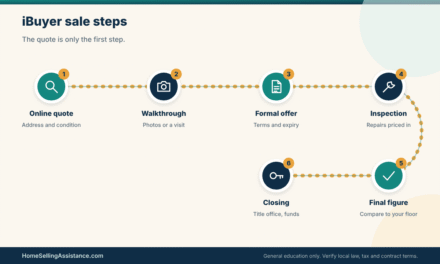
You can see how this plays out in other routes too, for instance in the way an iBuyer compares with a realtor once the paperwork is on the table.
The paper trail that should exist behind sell house fast claims
Fast sales are not magic, and neither are sell house fast claims. They are ordinary sales with fewer steps where delay usually happens, and each of those steps leaves paper behind. If none of that paper shows up, sell house fast claims remain a story rather than a plan. It helps to know in advance what the normal documents are, so that you can notice when one is missing or arrives late.
Think of it from the buyer’s side for a moment. Someone who is truly about to buy your house for cash has already done a few things: found where the money will come from, chosen a title or escrow company, and read enough about your property to feel comfortable with a price. Those facts exist whether or not you are watching, and a buyer who is serious can usually describe them in a sentence or two without discomfort.
Documents a real offer produces before you commit
The core document is the written purchase agreement. It should name the buyer as a person or a legal entity, identify the property by address and legal description, state the price, state the closing date or the number of days after acceptance, describe any deposit and who holds it, and list every condition that lets the buyer leave. Many contracts also say whether the buyer may assign the agreement to someone else, and that clause deserves your attention in a fast-sale setting.
Beyond the contract, expect a proof-of-funds document, a notice of which title or escrow company will handle the closing, and eventually a title commitment, which is the title company’s written statement of what it will insure and what must be cleared first. Our article on proof of funds from a cash buyer explains how to read what is usually offered, and why a bank letter and a screenshot are very different things.
Not all of this arrives on day one. A reasonable offer can come first with a few holes still to fill, and a buyer may need your acceptance before paying for a title search. What you are looking for is direction of travel. Each exchange should produce more specifics, not fewer. When an offer keeps promising paperwork “soon” while the pressure to sign grows, that mismatch is worth noting in your records.
When the paper is thin: a scenario and a calm next step
Imagine a seller who has accepted a verbal “yes” from a buyer and has been told that a contract will be sent “once we have the title ordered.” Two days pass. The buyer texts that the sale is “on track” and asks the seller to stop showing the house. No contract has arrived, no deposit has been described, and the buyer has not said which title company is involved.
Stopping showings on the strength of a text is the kind of move that costs real time if the deal does not materialize. A calmer next step is to say, politely, that you are glad to pause marketing once there is a signed agreement and a deposit confirmation from the title or escrow office, and to ask for the draft by a stated date. That is a normal request, and it keeps your options open.
If the buyer objects to that, you can ask them to explain what they need first, and write the answer down. Sometimes the explanation is reasonable, such as waiting on an internal approval. Sometimes it reveals that no one has actually committed to anything. Either way, you are working from information rather than hope. If the situation starts to resemble the patterns described in our guide to fake cash home buyer signs, pause and read it before sharing anything further.
Verifying sell house fast claims on your own terms
Checking sell house fast claims has one rule that does most of the work: use channels you found yourself. If the buyer gives you a phone number, a website link, a title company contact and a “bank reference,” and you check only those, you have verified that the buyer controls those things. You have not verified that they are true. The whole point is to build a second path to the same facts that the other party does not control.
That does not require special skills. It requires an hour, a search engine, a phone and a willingness to say “I will call you back.” Most legitimate professionals respect that, because they get the same treatment from careful customers all the time. In practice, sell house fast claims hold up well under this kind of check when they are honest, and they fall apart quickly when they are not.
The matrix below pairs common sell house fast claims with what to check, how to respond safely, what you should not hand over along the way, and when to escalate to someone with the authority to help. Use it as a prompt for your own notes rather than as a script. Your state’s rules and your actual documents may change several of these steps.
| Claim you hear | Evidence to check | Safe action | Never share | Escalate to |
|---|---|---|---|---|
| “We have cash ready” | Funds statement the title office can confirm | Ask the title or escrow office, via a number you looked up, what they have received | Bank login, full account numbers, SSN | Your attorney or state licensing office |
| “We are a well-known company” | State business registration, license, local office address | Search the registry yourself and call a listed number | Copies of ID before a signed contract | State attorney general or consumer office |
| “Close in 7 days” | Draft contract with a dated calendar | Compare each date with title and lender realities | A signed blank or partly filled form | Real estate attorney or experienced agent |
| “No fees, no commissions” | Written estimate of every deduction from proceeds | Ask for the closing statement draft early | Deposit or “processing” payment to the buyer | Title company, then consumer agency |
| “We can sign for the owner” | Recorded authority, power of attorney, entity papers | Request the document and confirm with the county recorder | Original deed or title papers | Attorney before any signature |
| “Wire the fee to hold your spot” | Nothing legitimate supports a seller paying up front | Stop and call the title office from a known number | Any wire or gift card details | Bank, FTC, FBI IC3 if money moved |
Read the table from left to right as a sequence. You hear one of the sell house fast claims, you identify what would prove it, you take a small and safe action, you keep certain things to yourself, and you know who to call if the answer is wrong. With sell house fast claims, the last column matters most when something has gone off track, because the first few hours after a mistake are when a bank or a title company can sometimes still help.
Records and contact channels you find yourself
Official records are boring in the best possible way, and they are the best test of sell house fast claims. They do not care how good the buyer’s website looks, and they usually cannot be edited by the person making the pitch. The three families worth knowing are public business and licensing records, county property records, and the financial or title paperwork of the transaction itself.
Business records tell you whether a named company exists, where it is registered, and who the registered agent is. Licensing records matter if the party says they are a licensed broker, agent, attorney or title professional, and most states let you search those names online. County records let you see who currently owns your property, whether anything is recorded against it, and later whether the new deed was recorded properly.
Where to look: registries, county offices, title companies and your own bank
Start with your state’s business entity search, usually run by the secretary of state, and check the exact legal name the buyer used on the offer. Small spelling differences matter; a company with a similar name registered last month is not the same as one that has operated for years. Then check whether the person you are dealing with holds a real estate license if they claim one, using the state commission’s lookup.
For the closing side, find the title or escrow company’s own website and phone number independently, and call to ask whether they have an open file for your address. Many will confirm the basic fact that an order exists without sharing details. Your own mortgage servicer is another channel: a payoff request goes through them, and you can request it yourself rather than relying on a number the buyer sends. Our overview of the title search on a home sale shows what that office checks and why it takes the time it does.
Finally, keep a simple log. Write the date, the name you spoke with, the number you called and what they said. It takes a minute per call and it turns a pile of impressions into a record. If a dispute ever arises, a dated log and saved messages are far more useful than your memory of what was promised.
A scenario where the contact details came from the offer itself
A seller receives a purchase agreement from an investor, with the title company named on page one and a “closing coordinator” who emails from a free webmail address. The coordinator asks the seller to send a copy of her driver’s license and her mortgage statement “so the title company can start.” The seller does not know the title company.
The exception worth noting is that small, genuine investors sometimes use inexpensive email accounts and informal staff. An odd address alone proves nothing. What changes the picture is the combination: unknown title company, an urgent request for identity documents, and no independent confirmation. A careful next step is to look up the named title company’s website herself, call its main number, and ask whether an order exists for her address and who the assigned closer is.
If the title office confirms, she can send documents through whatever secure method that office provides, rather than through email chains. If it cannot find any such file, she has avoided handing over identity documents to a stranger, and she can tell the buyer that she will proceed once her own contact with the title office is established. A real buyer can almost always accommodate that. Our guide to wire fraud aimed at sellers explains why identity documents and closing instructions are such attractive targets.
What screenshots, badges and sales language cannot prove
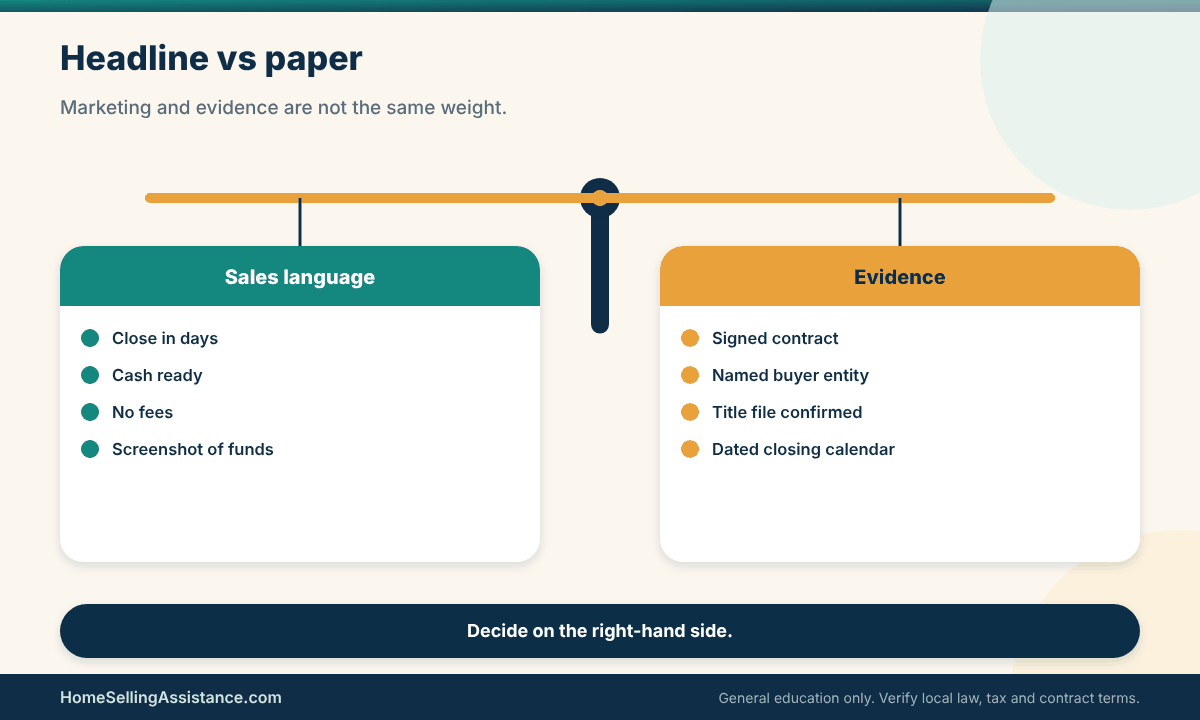
A great deal of the marketing around sell house fast claims leans on things that look like evidence but are really decoration. A glowing review carousel, a row of logos, a “verified buyer” badge, a screenshot of a bank balance, a video of a smiling team holding a key: these are persuasive because they feel concrete. They are mostly cheap to produce, easy to copy, and impossible for you to check without more work.
None of this means the company behind them is dishonest. Many reputable firms use all of these things. The point is narrower: these items cannot do the job of a contract, a title commitment or a confirmation from a bank. When you notice that a decision is leaning on one of them, it is a signal to reach for a real document instead.
Why a proof-of-funds image proves less than it seems
An image of a balance is a picture of numbers on a screen. It does not show whose account it is, whether the money is borrowed, whether it is already committed to other deals, or whether it will still be there on your closing date. It also does not say whether the same image has been sent to other sellers, which is common with investors who make many offers at once.
When you test sell house fast claims about money, a stronger form of evidence is a letter from the bank or a statement that shows the account holder’s name matching the buyer’s legal entity, with a date close to the offer and with sensitive details redacted by the buyer, not by you. Even then, the strongest confirmation usually comes from the title or escrow office confirming that the money has arrived or has been arranged through them.
For a buyer who is purchasing through a loan despite a “cash-like” pitch, our explainer on the financing contingency shows why a loan-based sale has a different set of exits.
Nothing here prevents a buyer from using a screenshot as a first step. It is simply the opening move, and you can accept it as such while asking politely for the next level. Doing so does not signal distrust. It signals that you understand how closings work.
A scenario with a polished testimonial page
A seller reads a company’s site full of five-star quotes, dated photos of closings, and a counter claiming thousands of homes bought. Impressed, she skips the usual questions and agrees to sign a short agreement on the phone. The agreement, it turns out, includes a clause letting the company assign the contract and a right to list the property for sale on its own terms for a period if the deal does not close.
The exception is that such clauses are not inherently improper, and many investors use assignment openly and fairly. But the testimonials told her nothing about the clause, and she never asked. Her better next step, once she notices the language, is to pause and ask a real estate attorney or a trusted agent to read the agreement, and to ask the company in writing how the assignment would work and what happens to her deposit terms if it is used.
She can also check whether the company actually operates in her state and whether the reviews appear on independent sites rather than only on its own. Neither check is definitive, but together they replace a feeling with some facts. For a broader view of how investors present offers relative to a normal listing, see our comparison of an investor offer and listing your house.
Reading red flags without making unsupported accusations
Once you start checking sell house fast claims, you will notice things that bother you. This is the point where many sellers swing too far in one direction. Some ignore the discomfort because they want the problem solved. Others decide that anyone who markets quickly must be a scammer and shut down conversations that might have been perfectly fine. Neither response serves you well.
A better frame is to treat red flags as reasons to slow down and verify, not as evidence of wrongdoing. You almost never know someone’s intent from the outside. What you do know is whether the behavior in front of you makes it harder for you to protect yourself. Sell house fast claims that come with transparency usually survive scrutiny. Claims that come with pressure to skip scrutiny are the ones to handle carefully, whatever the reason behind the pressure.
That distinction also keeps you out of trouble when you discuss sell house fast claims with others. Telling a friend “I am not comfortable moving ahead until the title office confirms the file” is a statement about your own process. Telling someone “you are a fraud” is a statement about them, and you may not be able to support it. Stay with the first kind of sentence, and let the facts speak if they need to.
Warning patterns worth a pause
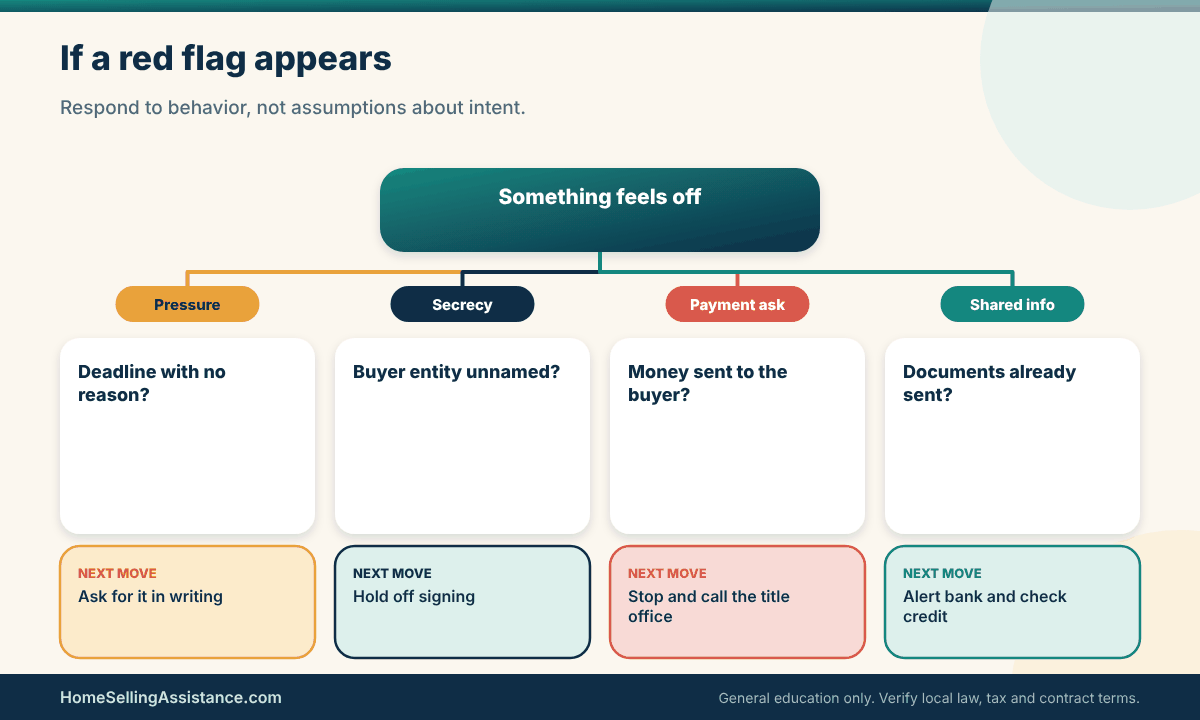
Most concerning situations involving sell house fast claims look alike in a few ways. They involve urgency that has no apparent source, secrecy about who is behind the offer, requests for money or sensitive information early, and reluctance to put things in writing. Any one of these can have an innocent explanation. Several together deserve a closer look and probably a conversation with a professional.
It also helps to separate behavior you can observe from conclusions you might draw. “The buyer asked me to sign before the title company was named” is observable. “The buyer is a scammer” is a conclusion. Write down the first kind and let a lawyer, title officer or agency decide what, if anything, follows from it.
Pressure, secrecy and money moving the wrong way
Pressure around sell house fast claims takes many forms: “this price expires tonight,” “I have three other houses to look at,” “my funding window closes tomorrow.” Real buyers sometimes do face deadlines, so the existence of a deadline is not the signal. The signal is a deadline that cannot be explained, or that shifts every time you ask a question. Ask what exactly happens at the deadline, and whether the buyer can put the deadline in writing.
Secrecy shows up as a refusal to say who the buyer is, who will close the deal, or what happens after the contract is signed. Some privacy is normal, since many investors buy through entities. But you are entitled to know the legal name of the party on the contract and the name of the company that will hold the money. If they will not tell you, the contract has nothing to bind.
The sharpest pattern is money moving the wrong way. In an ordinary sale, the buyer’s money flows toward the title or escrow office, and your proceeds flow from that office to you at closing. Any request that you send money to the buyer, to a “processing” company, or to a different account than the title office provided is outside the normal flow. Our cornerstone article on home sale fraud and seller safety covers these money-flow patterns in more depth, and it is worth reading before you accept any instruction to move funds.
Scenario: the legitimate buyer who also looks rushed
Here is the harder case, because it does not have a clear villain. A seller is dealing with a regional investor who has bought dozens of houses locally. He moves quickly, sends a contract within a day, and pushes for a short inspection window. He also asks the seller not to talk to other buyers while the contract is pending, which is a common request. Nothing looks fraudulent. Everything feels fast.
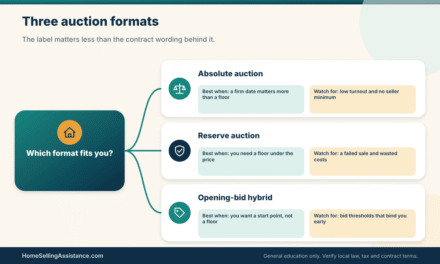
In this setting, sell house fast claims are being backed up by a document, a track record and a named title company, so the right response is probably not to withdraw. It is to read the contract carefully and see where the speed is coming from. Is the inspection window short because he knows the market, or because he wants little time to renegotiate? Does the contract let him walk away freely while you cannot? A speedy buyer can be a good fit for you, and still deserve a close reading.
The next step is to have someone qualified review the agreement, particularly the exclusivity language, the assignment clause and the deposit terms. If the reviewer says it is standard, you move on with more confidence. If they point out terms that concern them, you can negotiate or decline. The fact that you checked is the protection, not the result of the check. For a view of how a rushed but sincere process can still go well, our guide to an off-market home sale shows what to ask before agreeing to one.
Scenarios are where decisions about sell house fast claims actually get made, so the second table below walks through several common ones. It is written as a way to rehearse your response before you are under pressure. Treat each row as a pattern you may recognize, not as a prediction about any specific buyer, and remember that your own contract and state rules come first.
| Situation | Warning sign | Verification channel | Seller response | Record to preserve |
|---|---|---|---|---|
| Unsolicited text offers a “assured” quick closing | No company name, no address, link to a form | Search the company name yourself; check state registry | Do not click links; ask for a written offer by mail or known email | Screenshot of the text, number and date |
| Offer arrives with no named buyer entity | Signer cannot name who will close | Ask the title office who the buyer is on its file | Hold off signing until the entity is named | Draft contract and your email request |
| Proof of funds is an image sent by chat | Account holder name hidden or different | Title or escrow office confirmation of funds | Request a dated bank letter or title confirmation | The image, the reply and the date received |
| Buyer asks you to pay a fee to reserve the deal | Seller paying money up front is outside the normal flow | Title office and your attorney | Decline and pause communication | Payment request and sender details |
| Closing date keeps moving later | Reasons change; no new paper appears | Title commitment status from the title office | Ask for the revised calendar in writing | Each date change and the reason given |
| Wiring or payment instructions change by email | New account number close to closing | Call the title office from a number you found yourself | Do not act on emailed changes | The email with headers, plus your call notes |
The most useful column may be the last one. In nearly every scenario, the single most useful thing you can do after the first moment of doubt is keep the evidence: the message, the document, the date, the name. You may never need it. If you do, it is the difference between a conversation that starts with “I think something was off” and one that starts with a folder of dated facts.
A safer next step when sell house fast claims leave you unsure
Uncertainty about sell house fast claims is a normal state in the middle of a sale. What matters is having a routine that turns it into action rather than leaving you stuck or pushing you to a rushed yes. The routine can be short. It should be written down, simple enough to use while tired, and reasonable enough that a legitimate buyer would not mind it.
Here is a way to think about it. When sell house fast claims reach you, you have three options: accept, decline, or verify. Verify is almost always the right first move, because it costs little and keeps both other options available. The only real cost of verifying is time, and if the claim is honest, a day or two of checking rarely changes the outcome. If the claim is not honest, that day or two may be the whole value of the exercise.
The people who tend to get hurt by sell house fast claims are not foolish. They are rushed, stressed, or told that a decision must be made now. Having a plan in advance protects against the stress. It also gives you something to say, which is often the hardest part. “I have a standard process I follow before signing anything” is a complete and respectable sentence.
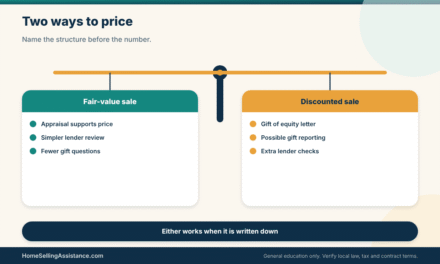
Even a fully honest, fully verified fast offer comes with a price, and sell house fast claims often skip that part. A quick closing may mean a lower price than a longer marketing period would produce, or a buyer who takes the property as it stands and prices accordingly. That trade can be fair. It becomes a problem only when it is hidden.
Speed has a value to you, and sell house fast claims cannot set that value for you. Avoiding two months of mortgage payments, carrying costs, or an empty house might be worth a lot. Or it might not. The honest approach is to estimate what a normal sale would likely net you, in a range, and compare that with the fast offer after all deductions. Our guide to home sale net proceeds walks through building that comparison. The figures below are illustrative only and do not describe any real market or buyer.
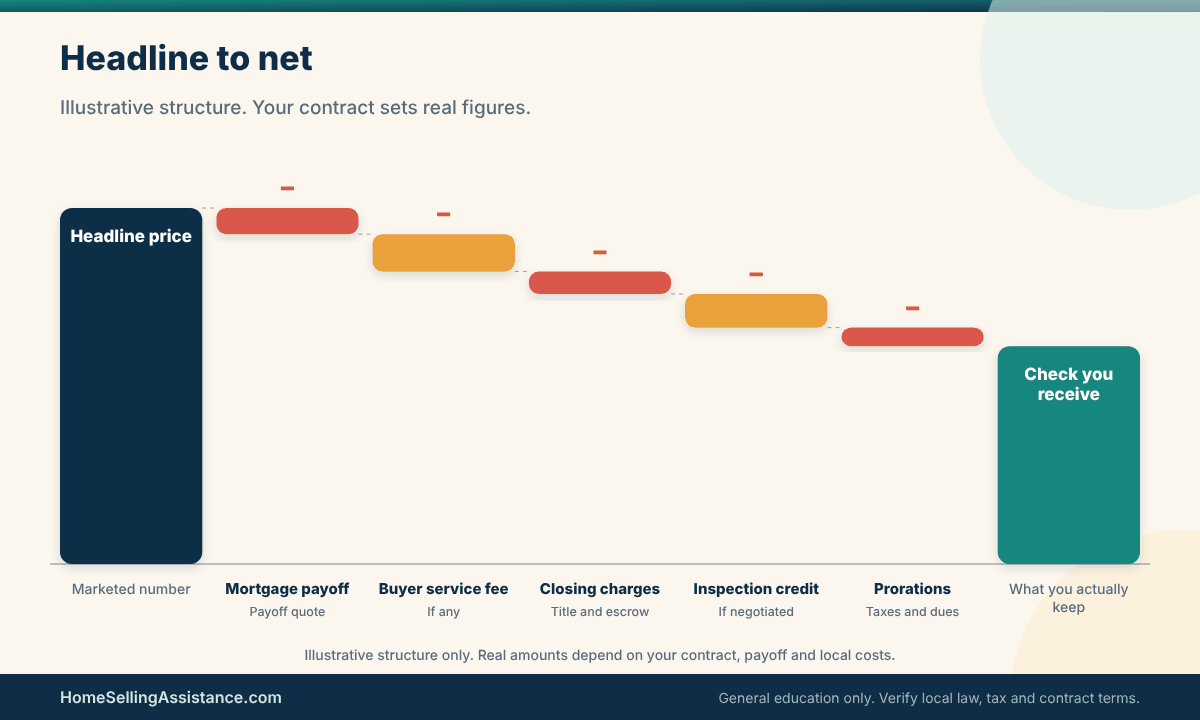
Start with the headline price, then subtract what the contract says will come out: the mortgage payoff, any liens, fees charged by the buyer or related businesses, closing costs the buyer does not cover, and any repair credits or price reductions that arrive after inspection. Then add back anything the buyer pays that you would otherwise pay, such as certain closing costs. The number at the bottom is the one that matters.
For example, imagine a headline offer of a round number. After a payoff, a service fee, local closing charges and an inspection-related reduction, the check could be noticeably smaller than the headline suggests. That does not make the offer wrong. It makes the headline an incomplete number, and the incomplete number is the one sell house fast claims usually put in the foreground.
Ask for a draft closing statement as early as the buyer can reasonably provide one, and ask what could change between that draft and the final version. A buyer who cannot or will not describe the possible changes is giving you information about how much of the number is firm.
Plenty of sellers choose speed with open eyes and are glad they did. A house with significant deferred repairs, a seller who needs to relocate quickly, an estate with several heirs who want a clean exit, a property that would be hard to show: these are situations where a fast, as-is sale may be a sensible trade. The key is that the seller understands what is being traded.
If you are in one of those situations, a useful test is to ask yourself what you would regret more: leaving some money on the table, or carrying the house for several more months. The answer is personal, and neither is wrong. What you want to avoid is making the choice on the basis of a claim you have not checked. For people balancing speed against other routes, the cornerstone guide on a cash offer for your house sets out the alternatives side by side.
Whichever way you lean on sell house fast claims, keep your options open until the contract is signed and the deposit is confirmed. Once you have that, you can plan around the closing date in a more relaxed way, since the claims have become commitments.
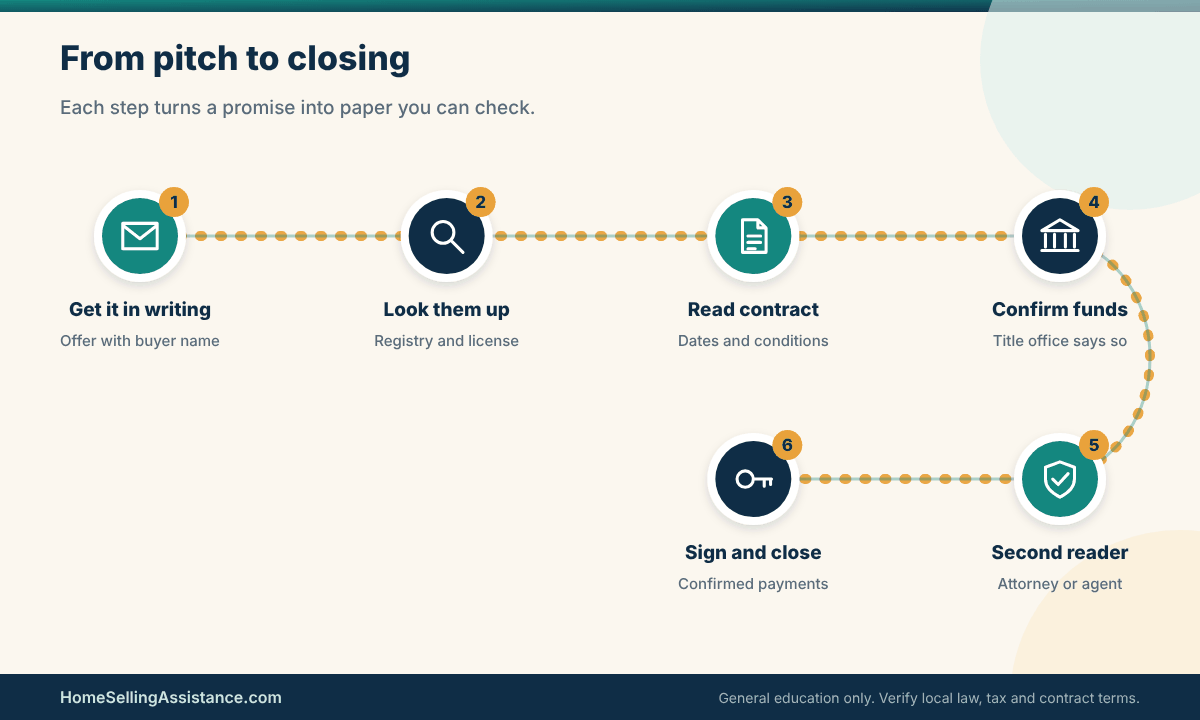
Building a short, written verification routine
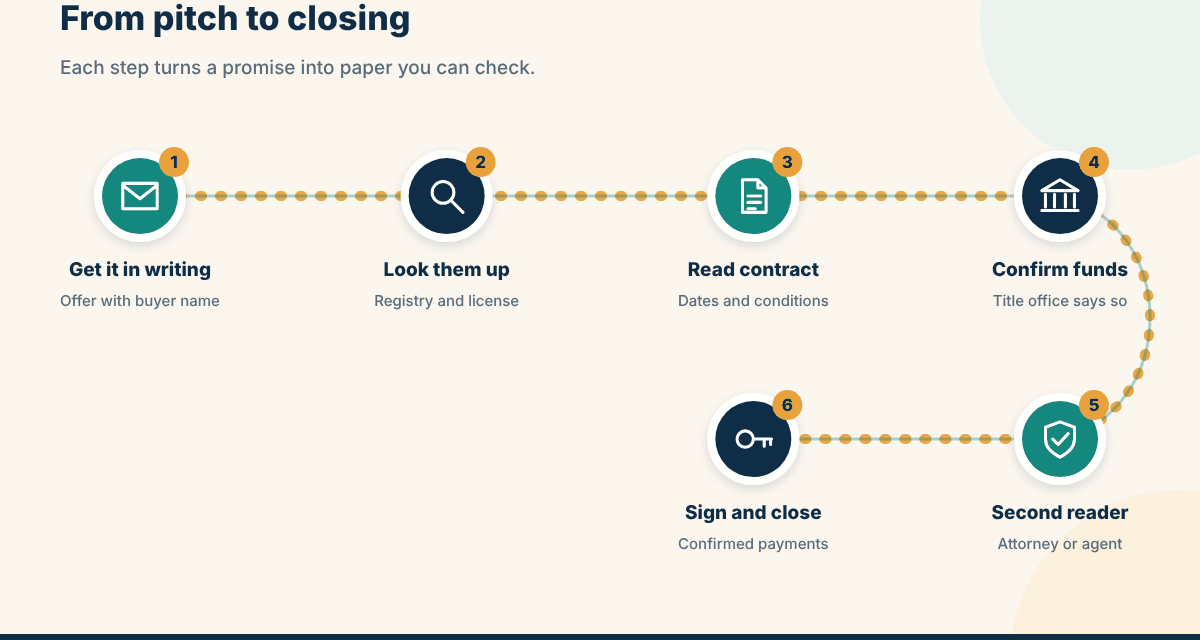
A workable routine has about six steps, and you can adjust them. First, ask for the offer in writing, including the buyer’s legal name, the price, the closing timeline and the deposit. Second, look up the buyer entity and any claimed licenses through official registries. Third, identify the title or escrow company, find its contact details independently, and ask whether an order exists.
Fourth, have a qualified person read the contract before you sign. Depending on your state, that may be a real estate attorney, a licensed agent, or both, and the right choice varies. Fifth, request a draft closing statement early so you can compare the deductions with what was marketed. Sixth, confirm all payment instructions by phone through a number you found independently, and never act on a change sent only by email. Our walkthrough of the seller closing statement shows what those deductions normally look like.
You do not have to complete every step before talking to a buyer. You do need to finish them before you sign, and certainly before you send money or sensitive documents. Put the sequence in a note on your phone or a page on the fridge, and you will be far less likely to skip steps when the conversation speeds up.
It can also help to name a “second reader,” a friend, relative or advisor who sees every document before you sign it. A second reader catches things you have stopped noticing, and being able to say “I need to run this by someone” is a graceful way to slow a conversation without confrontation.
Scenario: what to do if you already shared something
With sell house fast claims, sometimes the problem is not what to do next but what to do after. Suppose a seller sent a photo of her driver’s license and her mortgage statement to a buyer who then became hard to reach, and she now worries that she was too quick. She has not lost money, but she is uncomfortable and unsure whether anything needs to be done.
The exception to panic is that sharing a document with someone who is simply slow to reply is not proof of wrongdoing. Still, a calm precaution is reasonable. She can ask her mortgage servicer and bank whether they recommend any account alerts, review her credit reports through the official free channels, and consider whether a fraud alert or credit freeze makes sense for her. The FTC consumer site explains identity-theft steps in plain language.
If money did move, speed matters more. She should contact her bank immediately, ask whether a recall or fraud report is possible, and file a report with the FBI’s Internet Crime Complaint Center. She should also call the title company on a known number and warn them. None of this guarantees recovery, and outcomes vary, but quick reports are widely recommended. Keep every message and receipt, and consider talking with a real estate attorney about your options.
If the sale itself is tied to a larger hardship, such as a looming foreclosure or an inherited property, the pressure to act quickly is greater and the scams are often more targeted. Our article on foreclosure rescue scams covers that situation, and the HUD housing counselor directory can connect you to a free or low-cost counselor.
Quick scenario
A seller gets an offer promising a seven-day closing. She asks for the contract, finds the title company on her own, and calls. The title office has no file yet but says it can open one once a contract is signed. She asks the buyer for a dated calendar. The buyer sends one with a fourteen-day target and a note about the title search. The headline said seven days; the paper says fourteen. She decides whether fourteen works for her, which is a much better position than deciding on a number nobody would put in writing.
Frequently asked questions about sell house fast claims
Are sell house fast claims usually dishonest?
No. Many companies and investors really do close quickly, and some do it well. The problem is that the marketing language is loose and the proof is not in the marketing. Treat the claim as a starting point, then look for a contract, a named buyer and title office confirmation. Honest buyers generally welcome that process because it separates them from the ones who cannot meet it.
What does “close in days” actually mean in a contract?
It means whatever the contract says it means. Look for a specific date or a stated number of days after acceptance, and then read the conditions that allow the buyer to delay or leave. A short headline with a long list of conditions is a different promise than a short headline with few conditions. Your state’s rules and the title company’s schedule also affect how fast a closing can really happen. Reading the contract is the fastest way to test sell house fast claims about timing.
How can I tell whether a buyer really has cash?
Ask for a document that names the buyer’s legal entity and shows funds available, then ask the title or escrow office, using a number you found yourself, what it has received or arranged. A screenshot alone is weak evidence. Even a bank letter shows a moment in time. The title office’s confirmation is usually the most reliable signal, though no single document guarantees the money will be there at closing. The same standard applies to every one of the sell house fast claims about funds.
Is it a problem if the buyer plans to assign the contract?
Not automatically. Assignment is a legal and common practice in some investor deals, and contracts often address it openly. What matters is that you know it is allowed, understand who ends up buying, and are comfortable that the final buyer has the money. Read the assignment clause, ask how it works, and have a qualified professional review it if the language is unclear. Our guide on investor offers versus listing discusses this further, and it shows how assignment interacts with sell house fast claims about who the buyer is.
Should I ever pay a fee to a buyer or a “closing coordinator”?
In an ordinary sale, the seller does not send money to the buyer to hold a deal. Seller costs normally show up as deductions on the closing statement handled by the title or escrow office. A request for up-front payment, gift cards or a wire to an unfamiliar account is a reason to stop and verify through a trusted channel.
If you have already sent money, contact your bank right away and report it to the proper agencies. Sell house fast claims that include an up-front seller payment deserve extra scrutiny.
What if the buyer says the offer expires tonight?
Ask what specifically happens at the deadline and whether they will put it in writing. Real deadlines exist, but they usually have a reason you can understand. If you cannot get a clear answer, you can say you follow a standard review process before signing. A buyer who is serious will often extend a day or two.
If the offer is truly gone after a short delay, you have lost less than you might have if the deal was not sound. Handle urgency inside sell house fast claims the way you would handle any other pressure.
Can I verify a title or escrow company without relying on the buyer?
Yes. Look up the company’s website and phone number yourself, confirm it is licensed or registered where your state requires, and call to ask whether an order exists for your address. Many offices will confirm the basics. Your own attorney, or the lender if you have a mortgage, may also know reputable local offices. Avoid using email addresses or phone numbers that appear only in the buyer’s documents. Doing this early makes sell house fast claims about the closing office easy to confirm.
Do I need an attorney or an agent to review a fast-sale contract?
Requirements and customs differ by state, and some states have attorneys closely involved in every closing. Whatever your location, a qualified professional reading the agreement before you sign is a sensible precaution, particularly if the terms are unusual or the buyer is unfamiliar. Our article on the real estate sales contract from the seller’s side explains what a reviewer typically looks at, including how the contract compares with the sell house fast claims made in marketing.
Where can I report a suspected scam related to a quick home sale?
If money or personal information has moved, contact your bank first, then consider reports to the FTC at its consumer site, the FBI’s Internet Crime Complaint Center, and your state attorney general or consumer protection office. Local law enforcement may also take a report. The Consumer Financial Protection Bureau publishes plain-language material on mortgage and closing issues. Keep copies of everything, since agencies and professionals will want to see the record. Reports about sell house fast claims that proved false help agencies see patterns.
What if I do not feel sure about any of this?
That is a reasonable place to be. You can slow down, ask for everything in writing, and talk to a housing counselor, an attorney or an experienced agent before deciding. Our fraud and seller safety section collects related guides, and the cash offers and alternative sales category covers the other routes you might compare.
Your next move on sell house fast claims
You do not have to be suspicious to be careful. Take each promise apart, ask for the contract, find the title office yourself, and keep a dated record of every exchange. Sell house fast claims that survive that process are worth considering on their merits, and the ones that do not have told you something useful. This article is general education, not legal, tax or financial advice. For decisions about your own sale, speak with a licensed real estate attorney, your title company, and, where relevant, a tax professional in your state.