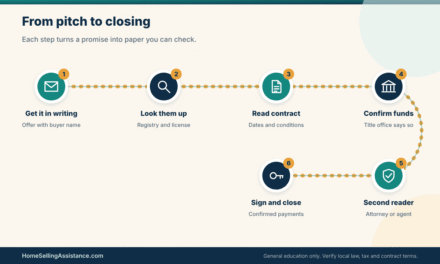
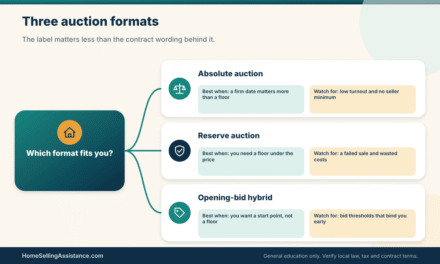
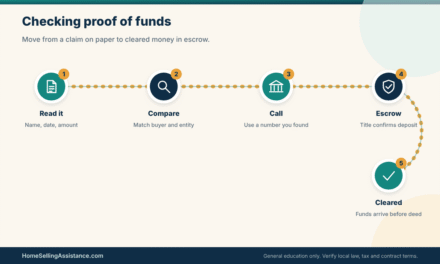
Weighing an investor offer vs listing house is one of the most common crossroads for sellers who own a property that is tired, inherited, tenant-worn or simply inconvenient, and it deserves a slower look than the phone calls and postcards usually allow. One path offers a quick, as-is sale to a buyer who pays with their own money or private funding. The other puts the house in front of the whole market and asks you to wait for the best combination of price and terms.
Neither side of an investor offer vs listing house choice is a trick, and neither is automatically the smart one. An investor can be a perfectly honest buyer who prices in repairs, holding costs and the effort of resale, and who truly saves you months of hassle. A listing can be the right call even when it asks for patience, cleaning and a few uncomfortable negotiations. The usual mistake in an investor offer vs listing house decision is choosing on a headline number or a mood, before you know what each route would actually leave in your bank account.
This guide works through the investor offer vs listing house question the way an experienced friend would at your kitchen table. We start by defining what each option is built to solve, then compare them on net proceeds, timing, control, contingencies and workload, then look at legal, financing and fallback risk. After that we run through seller scenarios, because the honest answer to an investor offer vs listing house question changes with your repairs, your deadline, your title, and who is living in the property.
Everything here is general education. Contract terms, licensing rules, disclosure duties and tax results vary by state and by your own facts, so treat the figures below as round, illustrative numbers and confirm anything that affects your money with a licensed professional in your area.
Key takeaways
- Compare net proceeds, not offer prices. A lower investor figure can sometimes net close to a higher listing price once repairs, fees, carrying costs and credits are counted, and sometimes it cannot.
- In an investor offer vs listing house choice, certainty and price pull in opposite directions. A listing exposes the house to more buyers, while an investor purchase usually trades some of that exposure for speed and fewer conditions.
- Read the contract, not the pitch. Inspection periods, assignment rights, deposit terms and extension options decide how firm an investor offer really is.
- Verify the buyer before you sign. Ask for proof of funds, a track record and a named title company, and read the cash buyer verification checklist before trusting a promise.
- The answer depends on your scenario. Condition, deadline, occupancy, title problems and your tolerance for showings change which route fits.
- Keep a fallback. Whichever route you pick, know what you will do if the deal stalls and what each delay costs you.
Investor offer vs listing house: what each route is built to solve
Before comparing numbers, it helps to be clear about the problem each route was designed for. Selling a home is rarely just about price. You may be juggling a repair list you cannot afford, a relocation date, a probate timeline, a tenant lease or a mortgage payment that has become a burden.
The two sides of an investor offer vs listing house decision answer those pressures in very different ways, and understanding the design of each one keeps you from judging a screwdriver by how well it hammers. The first figure below sketches the three routes most owners of a tired property end up weighing.

We use the word investor loosely in this guide. It can mean a local rehabber who buys, fixes and resells, a landlord who adds houses to a rental portfolio, or a company that markets itself with phrases like “we buy houses.” It can also mean a wholesaler, who signs a purchase contract with you and then looks for another buyer to take over that contract.
Those are different businesses with different risks, and part of your job is to find out which one is sitting across from you. Our broader piece on the cash offer for house seller decision covers the wider family of cash buyers.
How an investor purchase works for a seller
A typical investor sale begins with a short conversation, a walkthrough or a set of photos, and then an offer that arrives within days. The buyer usually proposes to purchase the property as it stands, with no staging, no showings and no repair negotiation afterward. The price they propose is not a verdict on what the house is worth to the market. It is a calculation of what they can resell or rent it for, minus their repair budget, their financing and holding costs, their profit target and a cushion for surprises.
That structure explains both the appeal and the discount. You are paying, in effect, for someone else to absorb uncertainty. The investor takes on the unknown repairs, the carrying costs, the risk that the neighborhood market softens before they resell, and the work of finding the next buyer. Sellers who value that transfer of risk may be glad to pay for it. Sellers who do not need it may be paying for protection they would never have used.
In an investor offer vs listing house comparison, investor contracts often look shorter and friendlier than a standard listing sale, but short is not the same as simple. Some include a due diligence or inspection window during which the buyer can walk away or ask for a lower price. Some give the buyer the right to assign the contract to a different buyer. Some use a small deposit that is easy to forfeit and easy to get back. Each of these features changes how firm the offer actually is, so they deserve a careful read before you sign anything.
Evidence to gather: who the buyer really is and what they have bought before
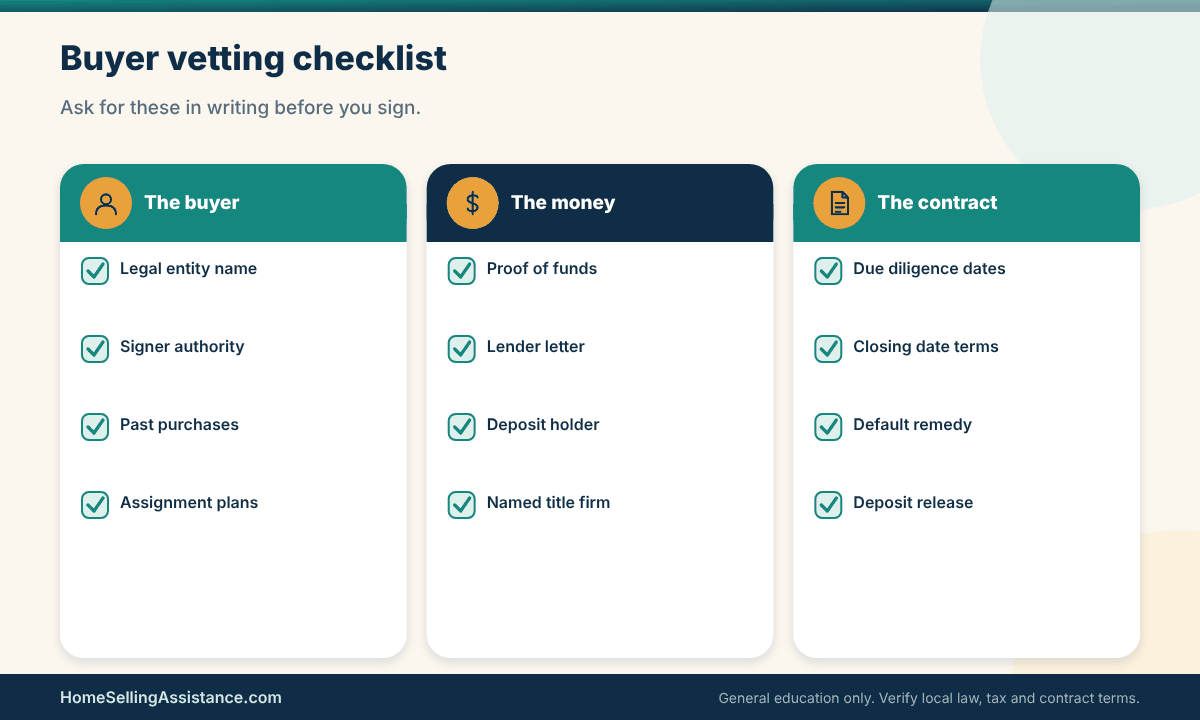
Start with the buyer’s identity and capacity. Ask for the legal name of the entity that will sign the contract, the name of the person with authority to sign, and the title or escrow company that will handle the closing. Ask whether the buyer intends to purchase the property themselves or to assign the contract, and ask them to put that answer in writing. A direct buyer will usually answer in a sentence. A wholesaler may answer in a paragraph that never quite says yes or no.
Next, look for a track record you can check without relying on the buyer’s own brochure. County recorder or assessor records often show which entities have recently purchased property in your area, and a quick search of your state’s business registry can tell you whether the company exists, who is listed as responsible for it and how long it has been active. Ask for two or three recent addresses where they bought and closed, then see whether the public record agrees.
Finally, ask for proof that the money exists. A bank or brokerage statement showing available funds, or a letter from a lender confirming financing for this purchase, is a reasonable request from a seller. The details of what counts as acceptable proof, and which documents should make you cautious, are covered in our article on proof of funds from a cash buyer. A buyer who is serious usually expects the question and answers it calmly.
A scenario, an exception, and your next step with an investor
Picture a seller we will call Dana, who has inherited a three-bedroom house with an old roof, dated kitchen and a basement that smells damp. Dana lives two states away and cannot manage contractors from a distance. An investor offers a round, illustrative figure that is well below what a renovated house on the same street might fetch, but offers to close in a few weeks, buy as-is and handle the cleanout.
For Dana, the investor offer vs listing house question is really about who carries the risk, and the discount is partly a fee for work she cannot do and risks she does not want. The exception is if the damp basement is a symptom of something the investor discovers during inspection, in which case a contract with a generous due diligence clause could lead to a mid-contract price cut.
Dana’s next step is to read the inspection and cancellation terms line by line, and to ask a local attorney or title company how the closing would work if the buyer asked to renegotiate.
How a traditional MLS listing works for a seller
A listing is built around exposure. You sign an agreement with a listing broker, or use a flat-fee service or sell on your own, and the house is entered into the local multiple listing service so that buyers and their agents can see it. Photos, a description, showings and sometimes an open house follow. Offers arrive over days or weeks, and you negotiate price, repairs, credits, closing date and contingencies with buyers who are usually financing the purchase.
On the listing side of an investor offer vs listing house choice, what you gain is competition and a broad test of the market. If several buyers want the house, the final price can rise above what any single buyer would have offered privately. What you give up is time, privacy and control over the schedule. You will prepare the house, keep it show-ready, accept that buyers can ask for repairs after an inspection, and live with the chance that a financed buyer’s loan or appraisal runs into trouble.
Broker compensation is a separate piece that sellers should understand in general terms. Since the industry’s settlement-era rule changes, compensation is negotiable, and arrangements generally need to be written down rather than assumed. That means the cost side of a listing can be shaped by your own conversations. Our guides on the listing agreement for sellers and on how a seller real estate commission is set explain what to ask before you sign, and our cash offers and alternative sales section gathers related guides.
A listing also has a built-in advantage in any investor offer vs listing house comparison that is easy to overlook: it tells you the market’s opinion of your price in real time. Showing activity, feedback and offers are all information. An investor offer arrives without that information, which is why many owners collect at least a rough broker opinion of value before they decide whether a discounted cash offer is a fair trade.
Evidence to gather: comparable sales, net sheet and listing terms
The evidence for the listing half of an investor offer vs listing house comparison starts with comparable sales. Ask any agent you interview to show you recent closed sales of similar houses nearby, adjusted for condition, and to explain which ones they trust and why. Request two versions of the pricing story: one for the house as it stands today and one for the house after specific repairs. The gap between those two values is the number that matters when you later set an investor’s discount beside it.
Then ask for a written estimated net sheet. A net sheet lists the expected sale price, your mortgage payoff, broker compensation, title and escrow charges, transfer taxes where they apply, prorations and any repair credits or concessions you might reasonably expect. Treat it as a draft, and ask what assumptions sit behind each line. The method behind these estimates is explained in our guide to home sale net proceeds.
Finally, read the proposed listing terms. Look at the length of the agreement, whether it can be cancelled, how long the broker is paid after expiry for buyers they introduced, and what marketing is included. A long, hard-to-exit agreement is a bigger commitment than a short one, and it affects how freely you can entertain an investor offer later. If you want to understand your exit options, see how to cancel a listing agreement.
A scenario, an exception, and your next step with a listing
Now picture Marcus, who owns a well-kept ranch house in a neighborhood where similar homes have been selling steadily. He has a few thousand dollars of cosmetic work to do and no pressing deadline. An investor has texted him an offer that is noticeably below what his agent suggests the house could bring on the market, and Marcus is tempted by the idea of skipping showings.
For Marcus, the investor offer vs listing house question leans toward listing, because a listing probably captures value that an investor would otherwise keep as profit. The exception is if his circumstances shift, for example a job offer that moves his target date forward, or if showings prove disruptive.
His next step is to ask an agent for a net sheet and a timeline, ask the investor for a written offer and proof of funds, and set the two side by side before replying to either one. Our overview of iBuyer vs realtor selling uses the same side-by-side habit for a different kind of cash buyer.
Comparing an investor offer vs listing house on money, time, and control
Once each route is clear, the comparison itself can begin. The fairest way to weigh an investor offer vs listing house is to turn both into the same set of measurable outcomes: what lands in your account, when it lands, how much of the process you control, how many conditions can still unravel the deal and how much work you personally carry. The next figure shows the idea in picture form, and the section that follows turns it into steps you can actually take.
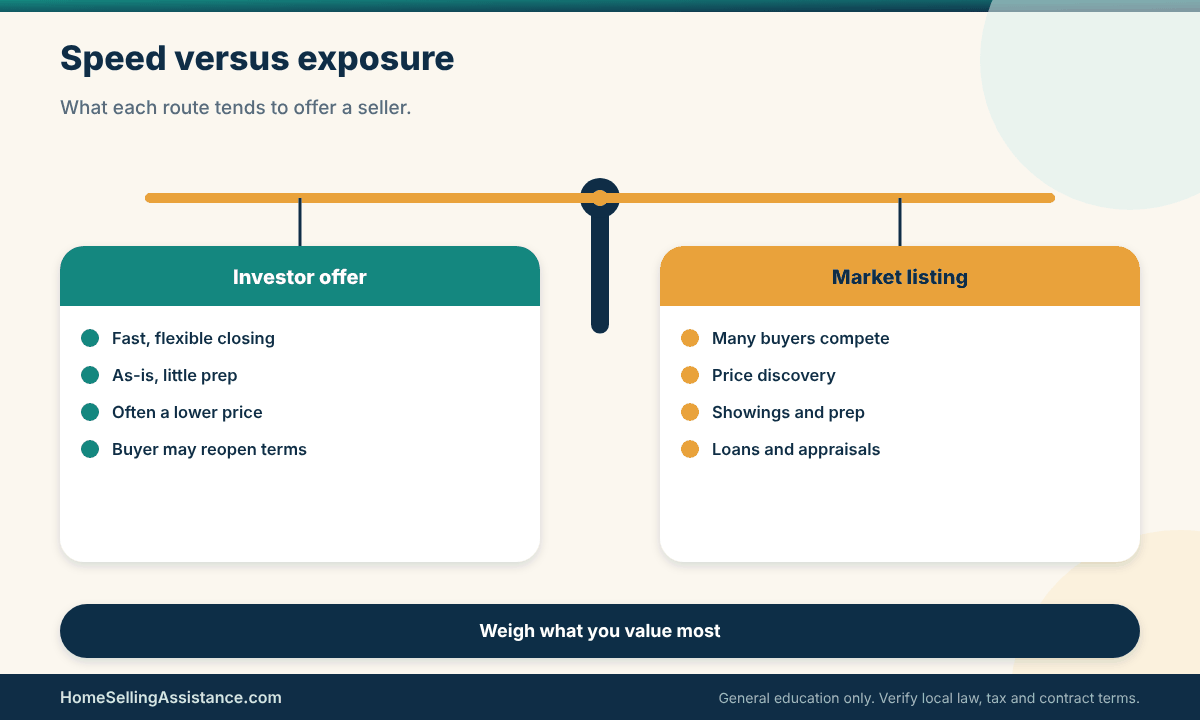
The balance in that image is deliberately uneven on both sides. Investor offers lean toward speed, simplicity and fewer showings, while listings lean toward price discovery and a wider pool of buyers. What tips the scale is your situation, not a rule of thumb. If you remember one idea from this article, let it be that an investor offer vs listing house decision is a question about trade-offs you value, rather than a contest with a permanent winner.
Price, net proceeds, time, control, contingencies, and workload
These six measures interact, so it helps to see them together before looking at each one. The decision matrix below sets an investor offer vs listing house side by side across the factors that most often decide the outcome. It is written in general terms, because every contract and every local market is different, and the last column tells you what to check in your own paperwork before trusting the row.
| Factor | Investor offer | Listing on the market | What to verify |
|---|---|---|---|
| Price and net proceeds | Often discounted to cover repairs and profit; fewer fees | Broader exposure may lift price; more fees and credits | Two written net sheets built from real quotes |
| Time to close | Can be short if funds and title are clean | Prep, showings and loan timelines add weeks | Closing date and extension terms in the contract |
| Contingencies | May be few, but a due diligence window can reopen price | Inspection, appraisal and financing are common | Every deadline and walk-away right in writing |
| Control of process | Buyer sets pace; you set a minimum price | You control showings, timing and which offer to take | Who decides on delays and repairs |
| Workload | Little prep; cleanout may be on you or included | Cleaning, staging, photos and repeated showings | Condition in which the house must be left |
| Execution risk | Buyer funding, assignment or renegotiation | Loan denial, low appraisal or repair disputes | Proof of funds, deposit and default remedy |
Use this investor offer vs listing house matrix as a worksheet rather than a scoreboard. Mark the two or three rows that matter most to you, such as deadline and workload for one seller or price and control for another, and give those rows the most weight. Then use the last column as a to-do list. A row you cannot verify is a row you should not rely on, and that is true for both columns.
Price deserves its own paragraph in any investor offer vs listing house comparison because it is where emotions run highest. An investor offer is almost always lower than the best realistic listing result for the same house in the same condition, because the investor needs room for repairs, costs and profit. That gap is not automatically unfair. The right question is whether the gap is larger than the combined cost of repairs, carrying costs, fees and the value of your time and certainty.
Time comes next. A cash purchase can move quickly when the buyer has funds, the title is clean and the property needs no lender appraisal. A listing has a longer runway, since it includes preparation, marketing, negotiation and the buyer’s loan process. Neither timeline is fixed. A slow investor with a long due diligence clause can take as long as a listing, and a well-priced listing with a motivated buyer can close faster than you might expect.
Evidence to gather: build two net sheets from real quotes
The single most useful exercise in an investor offer vs listing house decision is to build two net sheets that use the same rules. For the investor route, start with the written offer price, then subtract anything the contract makes you pay: your mortgage payoff, any liens, your share of title and escrow charges, transfer taxes where the law assigns them to sellers, unpaid property taxes, utility and HOA balances and the cost of cleaning out the property if it is not included. If the buyer pays your closing costs, confirm that the contract says so.
For the listing route, begin with a realistic sale price range from comparable sales, not the highest number you have heard. Subtract broker compensation as written in your proposed agreement, any compensation you agree to offer a buyer’s agent, title and escrow, transfer taxes, prorations and a repair or credit allowance. Then subtract the cost of the preparation you would actually do. Because mortgage payoff, taxes and fees differ by state, ask a title or escrow company for a preliminary seller estimate. Our seller closing costs guide lists the usual line items.
Finally, add the cost of time. If a listing would take longer, price the monthly carrying costs: mortgage payment, property taxes, insurance, utilities, lawn or snow care, HOA dues and any rent you are paying elsewhere. These are real dollars that rarely show up in an offer comparison. Here is a simple, entirely illustrative example. If an investor offers a round 200,000 and a listing might reasonably bring 235,000 after prep, the 35,000 gap must cover repairs, broker costs, carrying months and your own effort before the listing comes out ahead.
In an investor offer vs listing house comparison, that arithmetic can swing in either direction. If fees, repair credits and four extra months of carrying costs consume most of the gap, the investor offer may be closer than it looks. If the house needs little work and sells quickly, the gap may remain mostly intact. This is why a quick, written, line-by-line comparison beats any rule of thumb you read online, including ours.
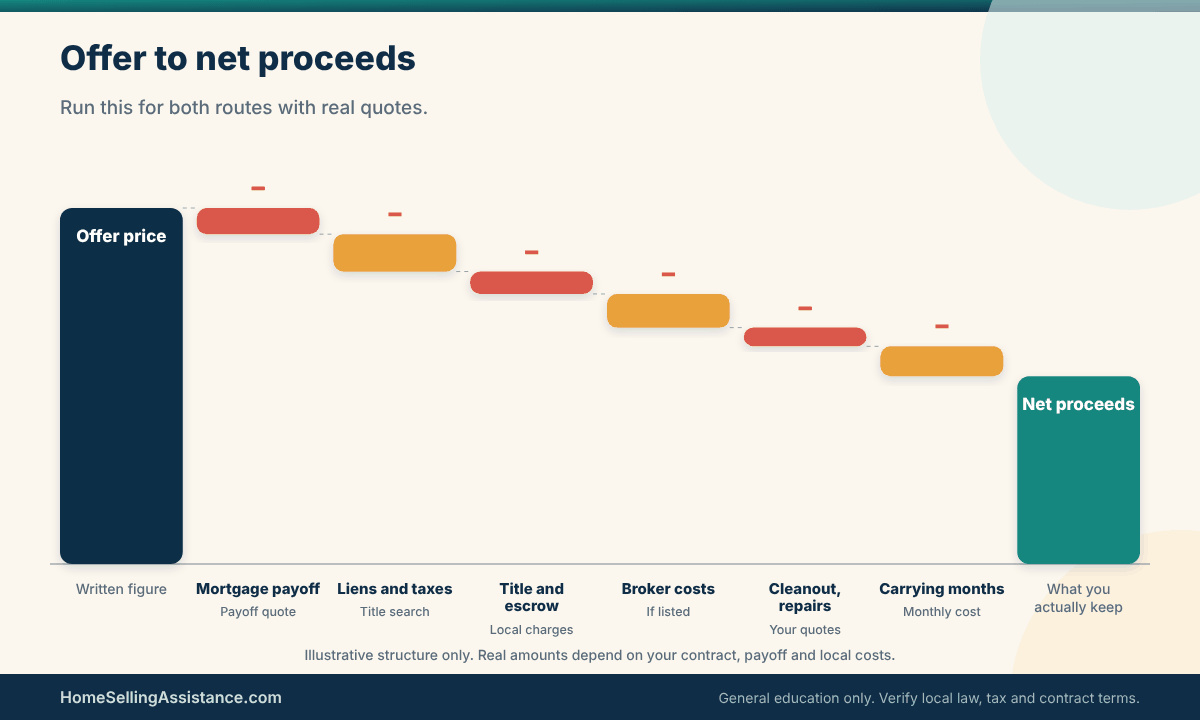
The waterfall above shows the general shape of an investor offer vs listing house net-proceeds exercise: begin with a price, then walk down through the deductions that apply to your sale until you reach the figure you would actually receive. Fill in each step with a quote or a contract clause, and leave a step out only if you have a document showing it does not apply to you.
Where the numbers mislead: three common traps
The first trap in an investor offer vs listing house analysis is comparing an investor’s price to a hoped-for listing price rather than a likely one. It is natural to anchor on the highest sale you saw on your street, but that sale may have had a new kitchen, a better lot or a bidding war. When you compare, use the middle of a realistic range, and test what happens at the low end. If the investor offer still looks reasonable against the low end, you have learned something useful.
The second trap is treating the investor’s quick closing as a guarantee. A short timeline on the first page of an offer does not mean the buyer cannot extend it, renegotiate during inspection or assign the contract. Ask what happens if the closing date slips, who pays for the delay and whether your deposit protection changes. Terms that look equal on paper can behave very differently on the day something goes wrong.
The third trap is forgetting the cost of what the investor will do after buying. If the offer is low partly because of a known problem, such as unpermitted work or a persistent leak, you may still need to disclose what you know. Disclosure duties vary by state and by sale type, and an as-is clause does not erase them everywhere. Our guide on selling a house with unpermitted work explains how to think about it before you sign.
A fourth, quieter trap deserves a mention here. Sellers sometimes weigh an investor offer vs listing house as though the listing had no variance. In reality, a listing outcome is a range, with some sales landing above expectations and others requiring price reductions. A fair comparison puts a range on both sides, so you are weighing a fairly firm number against a likely band, and you can decide how much certainty you want to buy.
If your property is in unusually rough shape, an investor may be the only buyer willing to take it without extensive repairs. In that case a listing may still be possible, but the market may price it as a project and some lenders may decline to finance it. Our overview of how to sell a house as is shows how a listing can handle condition without an investor.
Legal, financing, execution, market-exposure, and fallback risk
Money and time are only half the picture. The other half is risk: the chance that something in the deal fails, changes or costs more than you expected, and how well protected you are if it does. Both routes carry risk. They simply carry different kinds, and a thoughtful comparison of an investor offer vs listing house looks at who bears each risk and what the paperwork says about it.
On the investor side of an investor offer vs listing house decision, the main risks are buyer capacity, contract terms and conduct. Capacity means whether the buyer actually has the funds or financing to close. Contract terms include inspection periods, assignment rights and deposits. Conduct covers a smaller group of cases in which a buyer misrepresents who they are, what they will pay or how the closing will work. The Federal Trade Commission publishes consumer protection guidance that is worth reading if an offer feels pressured or vague.
On the listing side, the main risks are financing, appraisal, inspection and market exposure. A buyer’s loan can be delayed or denied, an appraisal can come in below the contract price, and an inspection can produce a repair request. Market exposure means that a house sitting on the market too long can start to look stale, which is why pricing and presentation matter. Many of these risks can be managed with good contract terms and honest pricing, and our guide to home sale contingencies explains how.
Legal risk sits across both sides of an investor offer vs listing house decision. Disclosure duties, agency relationships, licensing rules for people who market or assign contracts, and the handling of deposits all differ by state. Some states regulate wholesaling activity, and some require specific disclosures if a buyer intends to assign a contract for a fee. Rather than guess, check with your state real estate commission, a licensed real estate attorney or a reputable title company, and ask them to explain how your state treats the structure you are being offered.
Documents to read: contract, assignment language, and title commitment
Begin with the purchase contract. Read the sections on price, deposit, closing date, inspection or due diligence, financing, default and assignment before you read anything else. Ask yourself three questions about each. Can the buyer change this without my consent? What happens to my deposit or my property if they do? Who pays if the closing date slips? If the contract is hard to follow, a short consultation with a real estate attorney is often a modest cost compared with the value of the house.
Next, look closely for assignment language. Phrases such as “and/or assigns” after the buyer’s name often mean the buyer can transfer the contract to another party. That is not automatically a problem, since many legitimate investors work with partners and funding sources. It does mean you should ask who will actually close, ask for their details before closing, and confirm that the price you agreed to is the price you will receive. Our article on how to verify a cash home buyer walks through those questions.
Then request a title commitment, which the title company prepares to show who owns the property and what claims are recorded against it. Liens, unpaid taxes, judgments and ownership gaps can delay either route, and an investor may react to a title problem by lowering the price. If you know of a lien or unresolved claim, read our piece on how to sell a house with a lien, and fix or at least understand the issue before you accept an offer.
The checklist below pulls the documents for an investor offer vs listing house decision together in one picture. Print it, bring it to your first call with any buyer or broker, and tick items off as you receive them. If a buyer resists providing something reasonable, that resistance is itself useful information.
Fallback plans: what happens if the deal stalls
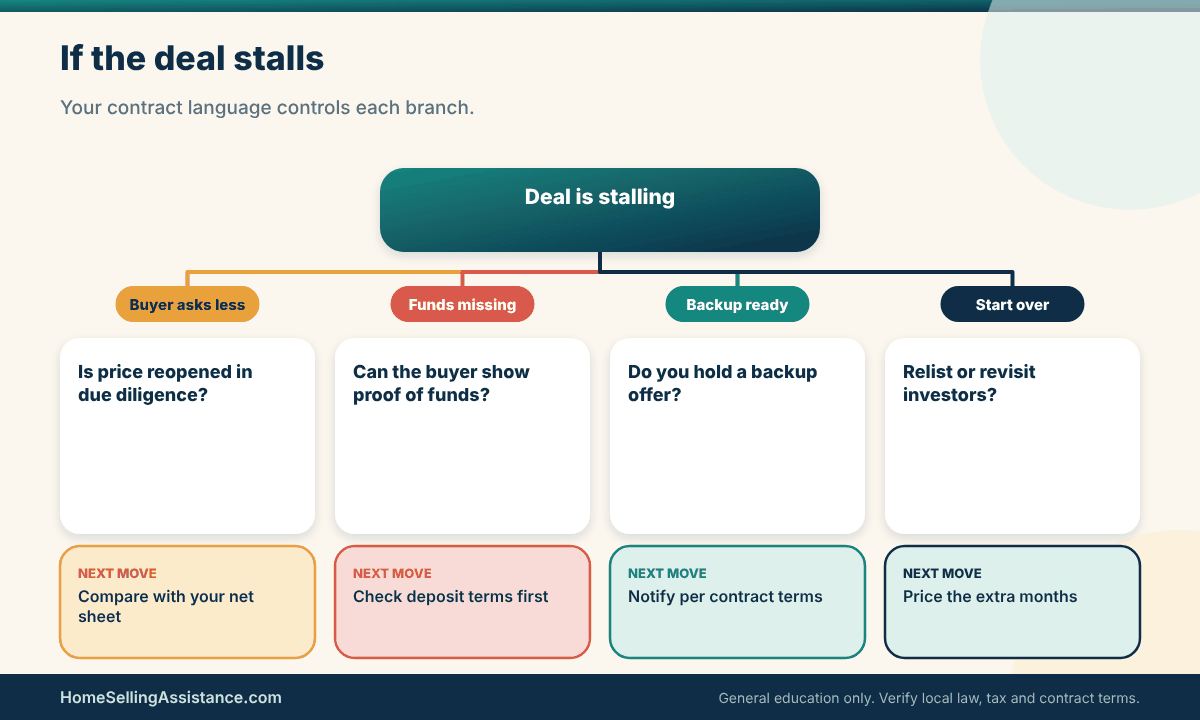
A fallback plan for an investor offer vs listing house decision is the answer to the question “what if this does not close?” and the time to write it is before you sign. For an investor sale, think about the case where the buyer asks for a lower price after inspection, misses the closing date or cannot show funds. For a listing, think about a loan denial, a low appraisal or a buyer who withdraws. In each case, ask what your contract allows, how long you have and what the delay costs you.
For an investor deal, practical safeguards include a clear deadline for the buyer to complete due diligence, a deposit that is held by a neutral title or escrow company rather than by the buyer, and a written statement of when the deposit becomes non-refundable under the contract. Whether and when that happens is a matter of the contract and your state’s law, so ask the title company or an attorney to explain it. Never assume that a deposit is yours just because it is called earnest money.
For a listing, a backup offer is the classic safeguard. If your first buyer falters, a prepared backup can step in without sending the house back to the beginning. Our article on backup offers for sellers explains how they work and what to watch for. You can also keep a relationship with an investor open as a late fallback, though their offer may not remain the same after weeks of market exposure.
The tree below gives you a simple way to think through a stalled deal under either side of an investor offer vs listing house choice. Start at the top, ask the first question about your contract, and follow the branch that matches your facts. The details in each branch should come from your own agreement and from the advice of the professionals you have chosen, not from a general guide.
One more risk deserves a plain mention: pressure. Be wary of any buyer or marketer who insists you must decide today, who discourages you from speaking with an attorney or a family member, or who will not put terms in writing. Time-limited offers are normal, and a reasonable deadline of a few days is not a red flag by itself. But an offer that cannot survive a day of questions is not an offer worth rushing.
If you suspect fraud, such as a buyer using a fake name, a forged document or a request to wire money unexpectedly, stop and report it. The FBI’s Internet Crime Complaint Center accepts reports of online and wire-related fraud, and our article on the signs of a fake cash home buyer lists warning signs worth knowing. Your title company can also help confirm that a closing is legitimate.
Choosing between an investor offer vs listing house by seller scenario
By now the pattern should be visible: no side of the investor offer vs listing house question wins everywhere. The better question is which route fits a seller in your position, with your repairs, your deadline, your occupancy and your title. The scenario table below summarizes several common situations and the route that often fits, along with the reason, the trade-off and the fact that could flip the answer. Treat it as a starting point for your own thinking about an investor offer vs listing house choice, not a verdict.
| Situation | Route often favored | Reason | Trade-off | Fact that changes the choice |
|---|---|---|---|---|
| Heavy repairs, no cash for work | Investor offer | Buyer absorbs repair cost and risk | Lower price than a renovated sale | Repair quotes smaller than the discount |
| Move-in ready, no deadline | Listing | Broad exposure can lift price | Showings and waiting | Weak local demand or a long listing history |
| Tight relocation date | Investor offer, or a firm-date listing | Fewer conditions and a chosen closing date | Possible price discount | Proof of funds and a title company you trust |
| Inherited, estate not yet settled | Depends on authority to sell | Either route needs the right signers | Delays if court approval is required | Local probate rules and the personal representative’s powers |
| Tenant in place on a lease | Investor or listing, case by case | Landlord-buyers value occupied rentals | Showings are limited by lease and law | Lease terms and local landlord-tenant rules |
| Known title or lien problem | Fix first, then compare | Clean title helps both routes | Cost and time to clear | Payoff amounts and the title commitment |
To use this investor offer vs listing house table, find the row closest to your situation, then read across to the last column. That final cell is the question most likely to change your decision, so answer it with a document, a quote or a professional’s opinion rather than a guess. If no row fits, build your own with the same five columns. The act of writing down a reason, a trade-off and a deciding fact tends to clarify a choice that felt foggy.
When the property needs work or the clock is short
Some sellers weighing an investor offer vs listing house face a house that needs more than they can give and a calendar that does not bend. A foundation concern, a roof near the end of its life, years of deferred maintenance or an estate cleanout can make a conventional listing feel like a second job. In these cases an investor is not a last resort so much as a service: the buyer is purchasing your problems along with the property, and it is reasonable to expect a discount in exchange.
The key is to make sure the discount is proportionate. Get at least two repair estimates from licensed local contractors, or a pre-listing inspection if you want a clearer picture of the house’s condition. Our guide to a pre-listing home inspection explains how that report can serve both routes, since it gives you a price anchor with an investor and a disclosure document for a listing.
A deadline adds its own arithmetic to the investor offer vs listing house decision. A relocation, a divorce settlement, a job start date or a mortgage that is becoming unaffordable can raise the value of certainty. If you are in that position, ask each buyer what closing date they will commit to in writing and what they will do if the date slips. You can also ask a listing agent whether a firm-date, well-priced listing could meet your timeline. Our article on claims about selling a house fast helps you test the promises you hear.
Evidence to gather: repair quotes, carrying costs, and a firm closing date
Begin with two or three written repair estimates. Ask for the scope in plain language, the cost range and the timeline, and ask each contractor which items affect safety, habitability or financing. This lets you separate cosmetic work an investor would do anyway from problems that could block a buyer’s loan. If a lender would refuse to finance the property in its current state, the listing route narrows to cash buyers and renovation-loan buyers, which changes the comparison.
Then total your monthly carrying costs. Add the mortgage payment, property taxes, insurance, utilities, maintenance and any HOA dues. Multiply by the number of extra months a listing might need compared with an investor closing. Be honest about uncertainty here, because nobody can promise a number of days on market. Use a short and a long case, and see whether your answer holds in both.
Finally, ask the investor for a written closing date and what it depends on. Does the date depend on the buyer’s inspection, financing, partner approval or assignment? If the answer includes several of these, the date is softer than it sounds. A buyer who can name a clear condition and a clear fallback is easier to rely on than one who simply says “we close fast.”
A scenario, an exception, and your next step when time and condition collide
Consider Priya, who must relocate for work within about two months and owns a house with an aging roof and a half-finished bathroom. She has little cash for repairs. Two investors offer different illustrative prices, and an agent suggests a listing at a higher figure but warns of a longer timeline and likely repair requests after inspection.
For Priya, the investor offer vs listing house numbers are closer than they first appear, because the higher listing figure may be eaten by repair credits, carrying months and the stress of managing a sale from far away. The exception is if the house shows well in photos and local buyers are active, in which case the agent’s plan could work. Her next step is to build both net sheets, ask the better investor for a written timeline with a deposit held by a title company, and decide how much certainty is worth to her.
When the house is move-in ready or you have time to wait
At the other end sits the seller with a clean, well-maintained house, a flexible schedule and no urgent pressure. For this seller, the investor offer vs listing house decision often starts with the listing. The property is the kind of home that financed buyers can purchase, an appraisal is less likely to be a hurdle, and exposure to many buyers gives the market a chance to reward condition and location. An investor offer here is more likely to include a large discount for a house that needs little work.
That does not mean you should ignore investors entirely. Ask for an offer anyway, since it costs nothing and gives you a floor. A written investor offer tells you what a well-capitalized buyer thinks the property is worth in its current state, which can sharpen your own pricing conversation. If your listing meets resistance later, that offer may or may not still be available, but you will have learned what the market’s low end looks like.
Also consider the middle path of preparing the house modestly and listing it with a clear plan. Decluttering, deep cleaning, minor repairs and good photographs are often within reach, and our guides on repairs before selling a house and on timing, such as days on market, help you set expectations.
Evidence to gather: comparable sales, showing plan, and an investor floor price
Start with comparable sales from the last several months within a short distance, adjusted for size, age, condition and lot. Ask your agent to explain the three comparables they weigh most heavily and the two they ignore. Then gather a sense of local pace: how many similar homes are listed, how long they sit and how often prices are reduced. These facts speak to how patient you can afford to be.
Next, plan the showing experience. Decide what hours you can accommodate, how you will handle pets and valuables and whether you prefer private showings to open houses. Our comparison of an open house vs private showing covers the privacy and safety side. A seller who dislikes strangers in the house, or who cannot leave during the day, should price that discomfort into the decision honestly.
Then collect an investor floor price. Ask one or two investors for written offers with proof of funds and a named title company. Do not negotiate against yourself by revealing your target. The point is simply to learn the low end of the range. If the floor is far below the listing plan, that is expected, and you have a reference point if the listing does not go as hoped.
A scenario, an exception, and your next step for a ready house
Think about Marcus again, with his well-kept ranch and no deadline. His agent suggests a listing at a price supported by recent sales, and an investor offers a figure well below that. With a modest preparation budget and a flexible calendar, the listing side of the investor offer vs listing house choice is the natural first move, with the investor offer kept as a floor.
The exception is a change in circumstances: if three months pass with little activity, a price reduction or a switch in plan may be needed, and an investor may then become the better fit. Marcus’s next step is to set a review date, such as a few weeks after launch, decide ahead of time what feedback would trigger a price change and keep a short note of the investor’s written offer and its expiry. Our guide on a house that is not selling explains the options.
Quick scenario
A seller comparing an investor offer vs listing house receives an investor offer of 180,000 (an illustrative round figure) and an agent’s estimate that the house could list near 215,000. After a rough net sheet, the listing route shows about 190,000 after fees, repairs and four months of carrying costs, while the investor route shows about 176,000 after the seller’s cleanout. The gap is smaller than the headline suggested, and the seller can now decide how much the extra 14,000 is worth against the wait and the risk.
Frequently asked questions about investor offer vs listing house
Is an investor offer vs listing house decision mostly about price?
Price matters, but net proceeds, timing and risk matter just as much. A lower offer can sometimes leave you close to the same amount once repairs, fees and carrying costs are counted, and sometimes it cannot. Build two net sheets with the same rules before you decide. Then add a note about how much certainty and convenience are worth to you personally.
Why are investor offers usually lower than listing prices?
An investor has to cover repairs, financing and holding costs, resale or rental effort, and a profit target. They also take on the risk that the market or the house surprises them. The discount is therefore partly a price for speed and for removing hassle. Whether the gap in an investor offer vs listing house comparison is fair depends on how large it is compared with the real cost of those items in your situation.
Can I list the house and still talk to investors?
Often yes, and many sellers run an investor offer vs listing house comparison in parallel, but read your listing agreement carefully. Some agreements pay the broker if the property sells during the listing period to any buyer, including an investor you found yourself. Others have exceptions for named parties. Ask your broker to explain the terms in plain language before you sign, and ask for any exceptions to be written in.
How do I know an investor really has the money?
Ask for recent proof of funds, such as a bank or brokerage statement, or a lender’s letter tied to this purchase. Ask for the legal name of the buying entity and the title company that will close. Then check public records and the state business registry for a track record. A serious buyer expects these questions, and a buyer who dodges them is giving you information.
What is wholesaling, and should it worry me?
A wholesaler signs a contract with you and then looks for another buyer to take over that contract, usually for a fee. It is not automatically improper, but rules vary by state and the structure adds risk, because the party who signs may not be the one who closes. Ask directly whether the buyer plans to assign the contract. If the answer is unclear, speak with a real estate attorney.
Do I still have to disclose problems if I sell as-is to an investor?
Often yes, to some degree. Selling as-is usually changes who pays for repairs, but it does not necessarily remove the duty to disclose known material defects, and the rules depend on your state and the type of sale. Check with your state real estate commission or an attorney. Our guide to material defects and seller disclosure is a good starting point.
What happens to my deposit if the buyer backs out?
That depends entirely on the contract and your state’s law. Look at who holds the deposit, when it becomes non-refundable and what the buyer must do to cancel during due diligence. A deposit held by a neutral title or escrow company is generally safer than one held by the buyer. Ask the title company to explain the release rules before you sign.
Is a cash investor sale always faster than a listing?
Not always. A cash buyer can close quickly when funds and title are clean, but due diligence windows, assignment steps and title problems can slow things down. A well-priced listing with a strong buyer can also move faster than expected. Ask each buyer for a written closing date and the conditions behind it, then compare how firm each one sounds.
Should I get a pre-listing inspection before talking to investors?
It can help, especially if you suspect problems. A report gives you a factual picture of the house’s condition, which supports a fair price conversation with an investor and doubles as a disclosure aid for a listing. It also costs money and may reveal items you must disclose, so weigh both sides. A local agent or attorney can tell you how it fits your state’s rules.
Where can I report a suspicious buyer?
Start with your title company and your state’s attorney general or real estate regulator, and consider filing a report with the Consumer Financial Protection Bureau or the FTC if the conduct involves financial products or deceptive practices. For wire or online fraud, the FBI’s Internet Crime Complaint Center accepts complaints. Keep copies of every message and document you received.
A calmer way to decide
The right answer to an investor offer vs listing house question is the one you can explain in a sentence, backed by two net sheets, a reviewed contract and a fallback plan. Take your time with the paperwork, ask for what you need in writing and speak with a licensed professional in your state before you sign. This article is general education, not legal, tax or financial advice, and your own facts and local rules will shape the outcome.