The choice between an absolute vs reserve home auction comes down to one question that sounds simple and turns out to be surprisingly deep: are you willing to let the room decide your price, or do you need a floor under it? In any absolute vs reserve home auction, the formats put your house in front of competing bidders on a set date. They differ in whether you keep the right to say no when the bidding stops.
That single difference in an absolute vs reserve home auction ripples through almost everything else. It changes how many bidders are likely to show up, how much risk you carry on the day, what your net proceeds could look like, and whether the auction can fail without a sale. In an absolute vs reserve home auction, sellers often hear the two formats described in a sentence or two by an auction company that has a preference, so the trade-offs get flattened.
This guide to the absolute vs reserve home auction question slows that down. We will define each format in plain terms, walk through what you should ask for in writing, compare the two on money, time, control and risk, and then test them against realistic seller situations. We are neutral here. An auction can be a sensible route for some homes and a poor one for others, and the answer depends on your facts, your local rules and the contract you sign.
If you are still deciding whether an auction belongs on your shortlist at all, our broader comparison of a home auction vs a traditional listing covers that earlier fork. This article assumes you have already narrowed it down and now need to choose the format.
Key takeaways
- Absolute means the property sells to the high bidder once bidding opens. Reserve means you set a minimum and can decline a bid that falls short, though the exact terms live in the auction contract, not in the label.
- Control and price risk move in opposite directions. The more control you keep, the less certain the sale; the more certainty you accept, the more you depend on bidders showing up.
- Judge each format by net proceeds, not the winning bid. Buyer premiums, auction fees, marketing costs, payoff and prorations decide what you actually keep.
- Liens, co-owners and lenders can limit your choices. If a payoff must be covered or several people must sign, an absolute sale may not be available to you at all.
- Rules vary by state and by contract. Auctioneer licensing, disclosure duties, bidding conduct and deposit terms differ, so verify with your state real estate commission, an attorney or your title company.
What an absolute vs reserve home auction is really deciding
Before comparing numbers, it helps to see what each format is trying to solve. A conventional listing tries to find the best buyer over weeks or months and then negotiates the terms. An auction compresses that process into a defined window and lets competing bidders set the price in public or online.
Once you commit to an auction, the next decision in the absolute vs reserve home auction choice is how much protection you want against a disappointing result. That is the whole job of the reserve. The right answer for you depends on how you rank price, certainty, speed and risk, a ranking we walk through in our cornerstone guide on a cash offer for your house and the alternative routes around it.
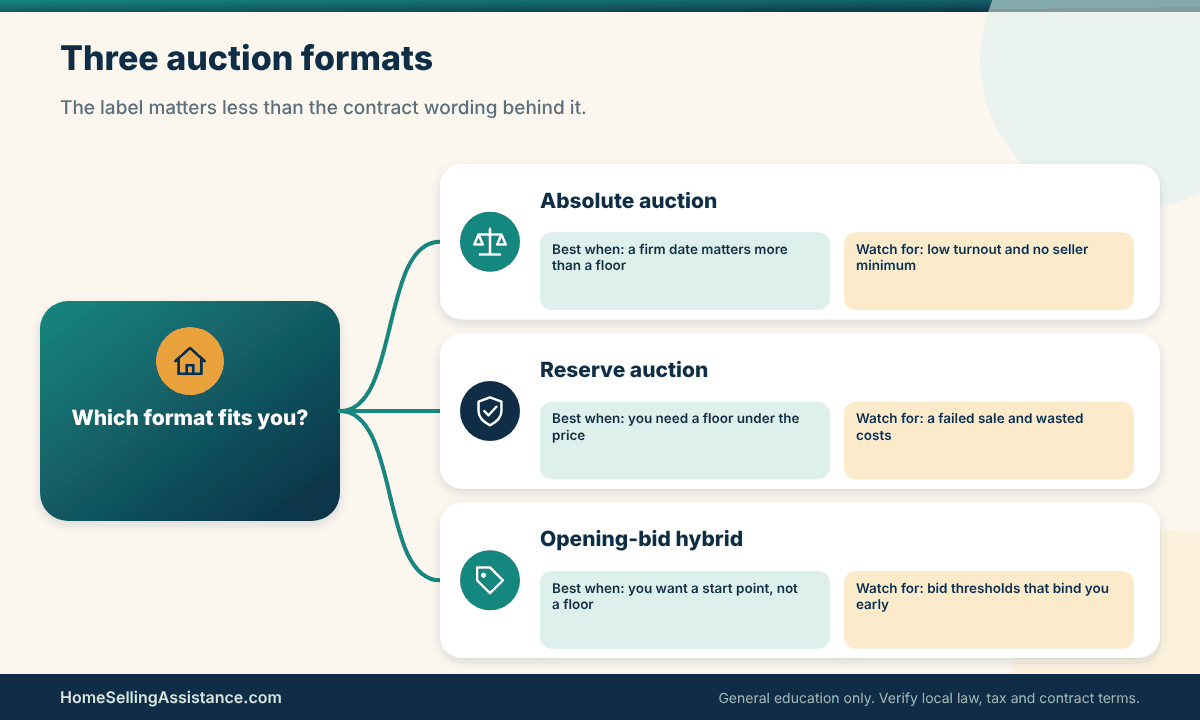
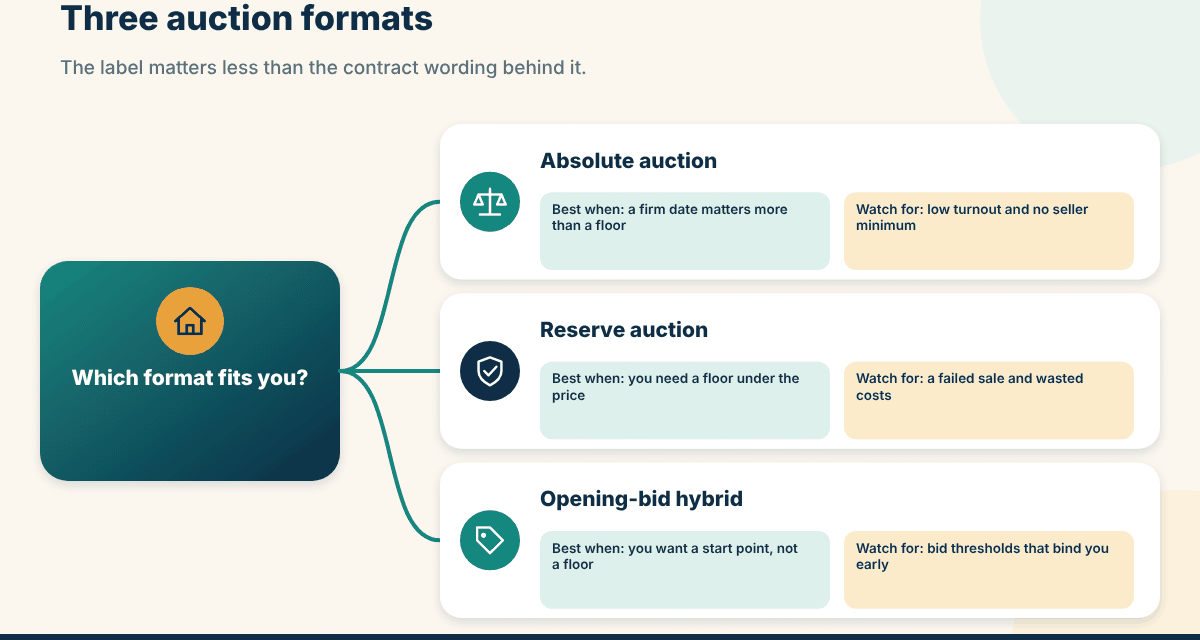
The first diagram of the absolute vs reserve home auction options lays out the three formats sellers usually meet: a fully absolute sale, a true reserve sale, and the hybrid versions in between, such as a published minimum opening bid. Keep that fork in mind as you read, because many auction companies blend the labels, and the contract wording matters more than the marketing.
How an absolute auction works for a seller
In the absolute half of an absolute vs reserve home auction, sometimes called an auction without reserve, the property is offered to the highest bidder with no minimum price that the seller can enforce after bidding begins. If one bidder shows up and offers a low number, the contract may still require you to sell. That is the defining feature, and it is also the part that makes sellers nervous.
The appeal of absolute vs reserve home auction formats runs the other way for bidders. Bidders know the sale will happen, which can encourage serious buyers to prepare financing, inspect the home beforehand and commit time to attending. Some auctioneers argue that this certainty draws stronger bidding. Others dispute it. Treat it as a claim to test with the auction company’s recent results, not as a rule.
Evidence to gather: the auction terms that define “absolute”
In an absolute vs reserve home auction, the word absolute is not a legal term of art that means the same thing everywhere. Before you sign, ask for the exact clause that says when the sale becomes binding. Some contracts bind you at the moment the auctioneer opens bidding. Others bind you when the first bid is accepted, or only after the auction company publishes an announcement of the format at the start of the event.
Ask what happens before that moment. Can you withdraw the property if you receive a private offer ahead of the auction date? Is there a withdrawal fee or a reimbursement of marketing costs? Can the auction company extend the date without your consent? These questions have written answers, and a good company will give them to you before you commit rather than at the signing table.
Request a sample purchase agreement too. The bidder’s contract controls closing date, deposit, remedies for default and condition of the property. If the sample is not available until after you sign the listing agreement with the auction firm, treat that as a yellow flag. You are agreeing to a format whose consequences you cannot yet read.
Finally, ask for the auction firm’s written description of how it handles a very low bid. A seller who has pictured a strong crowd and not a thin one should hear the answer to that scenario out loud, and see it in writing, while there is still time to choose another format or another route. Our guide to the seller side of the real estate sales contract explains how to read the clauses that decide who bears risk.
A scenario, an exception, and your next step for absolute sales
Picture an owner weighing an absolute vs reserve home auction for a dated farmhouse on acreage in a thin market, with few recent comparable sales and no mortgage. A conventional listing could sit while buyers struggle to value it. An absolute auction gives bidders a date, a deadline and a reason to commit. For this owner, who can tolerate a range of outcomes, the format may fit.
Now change one fact. Suppose the same owner still owes a loan balance that would take most of a mid-range result. An absolute sale could produce a price that does not cover the payoff, and the lender is not obligated to accept less. The exception is not rare: any lien or loan that must be satisfied at closing changes the math from a preference into a constraint.
Your next step is a payoff request from the lender and a title search, so you know the number any format has to clear before you decide how much risk you can carry. Our walkthrough on selling a house with a lien shows what those documents look like and who can order them.
How a reserve auction works for a seller
The reserve half of an absolute vs reserve home auction sets a minimum price, the reserve, that bidding must reach before you are obligated to sell. If the highest bid falls short, you can decline, and the property stays yours. The reserve may be published, kept confidential, or replaced by a softer feature such as seller confirmation within a set period after the auction ends.
That flexibility is the reason many sellers choose it. You are protected against a result far below what the property is worth to you. The cost is that some bidders discount a reserve sale, since they might invest time and money in a property that does not sell, and a failed auction can leave you with marketing costs and no buyer.
Evidence to gather: reserve type, amount, and who sees it
Start with the type. A confidential reserve is known only to you and the auction company, and the auctioneer may stop the sale if bidding does not reach it. A published reserve tells bidders the target openly. A minimum opening bid is different again: it sets where bidding starts, not necessarily where you are willing to sell, and sellers sometimes confuse the two.
Next, ask how the reserve is set. A responsible auction firm will point to comparable sales, the property’s condition and your own payoff and carrying costs, then explain why the number is realistic. If the firm gives you a reserve target without evidence, or suggests a number far above what nearby homes sold for, press for the reasoning. Our primer on how to price a house to sell shows how to test a figure against local evidence.
Then read the clause that covers a bid just under the reserve. Some contracts let the auctioneer negotiate on the spot, some give you a short window to accept the highest bid, and some leave it entirely to your discretion. That clause is where a reserve auction either rescues a near miss or lets it evaporate.
Last, in any absolute vs reserve home auction, ask about bidding by or on behalf of the seller. Rules on whether a seller may bid, and how it must be disclosed, vary by state and by auction type. A clear written policy protects both you and the bidders. If no one can explain it plainly, that is worth noticing.
A scenario, an exception, and your next step for reserve sales
Imagine a suburban seller facing an absolute vs reserve home auction choice, whose house would likely attract several interested buyers on the open market, but who needs the closing to happen on a firm schedule because of a job start. They choose a reserve auction, setting the minimum near the lower edge of a realistic range. If bidding clears it, they have a binding sale on a known date. If it does not, they can pivot to a listing.
The exception is the reserve that is set too high. A seller who anchors on a hoped-for number may watch the bidding stall below it, decline the best offer, and then face a market that has seen the property go unsold. That outcome is not fatal, but it costs time, and sometimes price pressure that was not there before.
Your next step is to write down two numbers before the auction company talks you into one: the least you can accept without hardship, and the number you would be happy with. Share the first with the firm, hold the second as your target. The gap between them is your real negotiating room.
Comparing seller trade-offs in an absolute vs reserve home auction
With the definitions settled, the useful work in an absolute vs reserve home auction is comparison. We will look at the money and the calendar first, then at the legal and execution risks that tend to surprise sellers. Throughout, remember that an absolute vs reserve home auction is a question about how risk is shared between you and the bidders, so every row of the comparison is really asking who carries what.
Net proceeds, time, control, contingencies, and workload side by side
Most sellers compare formats by imagining the winning bid. A better habit is to compare what lands in your account after everything is paid. Two auctions with the same hammer price can produce different net results because of who pays the auction firm, whether a buyer premium is added on top, and how much you spent on marketing before the date.
The table below summarizes the usual absolute vs reserve home auction differences. Read it as a conversation starter, not a verdict: your contract may shift a row in either direction, and local custom varies. Use it by taking each row to the auction company and asking for the written answer that applies to your property.
| Factor | Absolute auction | Reserve auction | What to confirm in writing |
|---|---|---|---|
| Price and net proceeds | Set by the bidding; no seller floor once binding | Protected by the reserve; may stall below it | Fees, premium, who pays what |
| Time to a sale | Sale occurs on the date if bidding opens | Sale occurs only if the reserve is met or accepted | Auction date, extension rights |
| Contingencies | Usually none offered to bidders | Usually none, though confirmation periods may exist | Sample bidder contract |
| Seller control | High before the date, minimal after | Retained through the reserve decision | Withdrawal and confirmation terms |
| Workload | Marketing, access for inspections, document package | Same, plus reserve research and decisions | Who handles showings and disclosure |
| Execution risk | Low bids, thin attendance, bidder default | Failed sale, wasted costs, stigma | Default remedies, deposit terms |
Notice how the rows echo each other. Whatever you gain in control from a reserve, you pay for in certainty. Whatever certainty an absolute sale gives bidders, you pay for with price risk. Neither format removes the risk; each one parks it somewhere different.
Evidence to gather: a net-proceeds worksheet for each format
Build one worksheet for your absolute vs reserve home auction decision and run both formats through it. Start with a range of plausible winning bids, perhaps a low case, a middle case and a high case, using numbers grounded in local comparable sales rather than hope. Then subtract every cost you expect to bear: the loan payoff, any lien payoff, auction firm compensation if you pay it, advertising you advance, title and closing charges, and prorations for taxes and association dues.
Here is an illustrative example with round numbers, not a prediction. Suppose the middle case is 300,000 dollars and a buyer premium of a few percent is added on top by the auction firm. Depending on the contract, that premium may raise the contract price, or it may be carved out and paid by the bidder separately. Those two structures can produce different seller results from the same winning bid, so ask which one applies.
Now stress the low case. If the bidding lands 15 percent below your middle case in this example, run the same subtractions and see whether the payoff still clears and whether you would still be willing to close. In an absolute auction, that number is your real downside. In a reserve auction, the reserve is your attempt to cut it off, at the cost of the sale possibly failing.
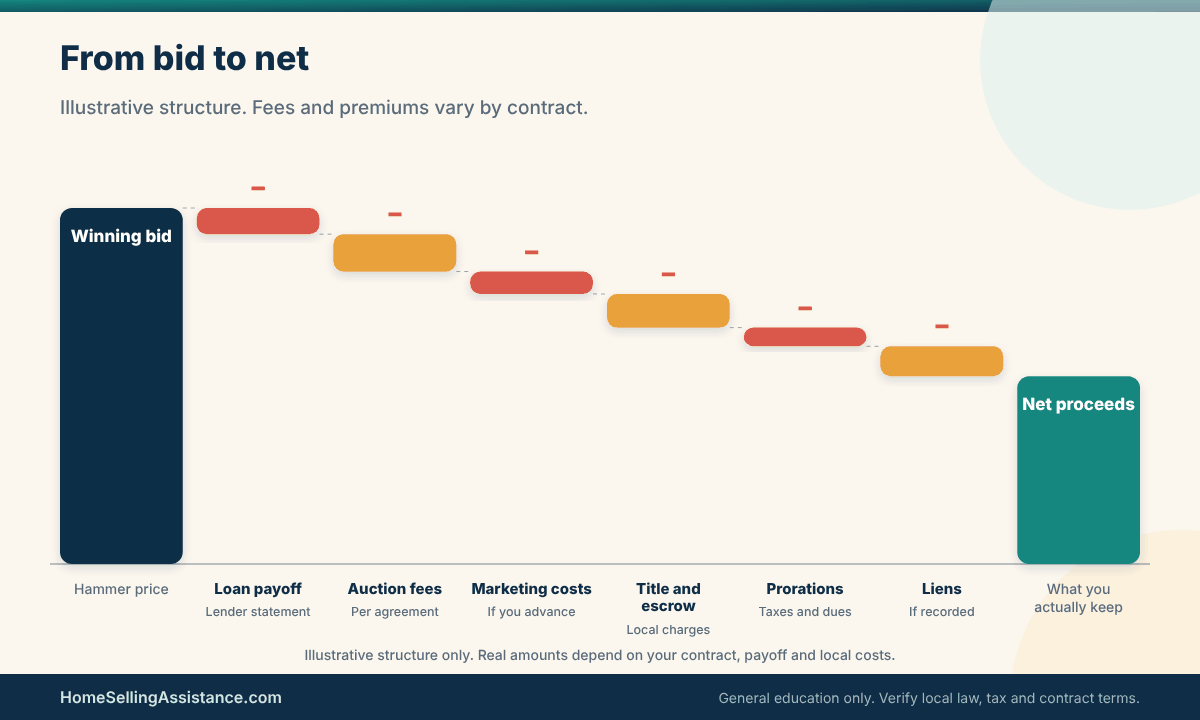
The waterfall graphic shows how each deduction sits between the bid and your net proceeds. Our full guide on home sale net proceeds goes line by line, and the explanation of seller closing costs helps you check that nothing is missing before you rely on a number.
A scenario, an exception, and your next step for price and timing
Take a seller considering an absolute vs reserve home auction who is in no hurry, owns the home free and clear, and cares most about price. For this person the reserve usually earns its keep, because a floor costs little when delay is acceptable. If the first auction fails, the seller can regroup, relist, or try again.
The exception is the seller with a hard deadline. A failed reserve auction does not give the date back. If you must close by a particular day, a reserve that sits above what the room will pay can turn the auction into a lost month. In that case an absolute format, or a reserve set deliberately low, may serve the schedule better.
Your next step is to decide which constraint is firmer, price or date, and say it plainly to the firm. A good auctioneer can adapt the format to that answer, perhaps recommending a reserve near the bottom of the range or an absolute date with a strong marketing push. A company that gives the same advice regardless of your answer is selling a format, not advising you.
Legal, financing, execution, and fallback risk
The second layer of an absolute vs reserve home auction comparison is risk that lives outside the price. Auction sales are usually offered to bidders without financing, inspection or sale-of-home contingencies, which can be an advantage for you. But that structure moves pressure onto bidders, and it moves some onto you through disclosure duties, default remedies and what happens if the winning bidder cannot close.
Both sides of an absolute vs reserve home auction share these risks, but they feel different. In an absolute sale you cannot walk away from a poor bid, so the question is whether you can live with the low end. In a reserve sale you can walk away, but you carry the consequences of a failed event. Our overview of home sale contingencies from the seller side explains why removing them is a trade, not a gift.
Evidence to gather: licensing, disclosure, deposit, and default terms
Start your absolute vs reserve home auction review with who is allowed to run the auction. Many states regulate auctioneers and real estate auctions through licensing rules, and some require a real estate license for the person marketing the property. Check your state real estate commission and, if it applies, the state auctioneer board. A quick look at a license number takes minutes and can save you from a firm that is not authorized to do what it promises.
Next, read the disclosure package. An as-is sale does not automatically erase your duty to disclose known material problems in many states, and federal lead-based paint rules generally apply to sales of housing built before 1978. The EPA explains the requirement on its real estate lead disclosure page. Ask whether the auction package includes the forms your state and federal rules require, and who delivers them to bidders.
Then look at deposits and default. Winning bidders usually put down a deposit at the event, and the contract says what happens if they do not close. Some contracts let you keep the deposit, some also let you pursue further remedies, some require you to offer the property to the next bidder. Ask for those terms in the sample contract, and compare them with the earnest money practices described in our guide to earnest money from the seller’s side.
Finally, confirm the closing mechanics. Who is the closing agent, how soon must closing occur, and what happens if the title search turns up a problem? A shorter closing window can be a benefit when everything is clean and a burden when it is not. Gather your payoff statement, title questions and entity documents first so the clock does not catch you unprepared.
A scenario, an exception, and your next step for legal and fallback risk
Consider a seller whose absolute vs reserve home auction ends with a strong bid in an absolute auction, only for the winning bidder to default at closing. The contract may let the seller keep the deposit, but the property is back on the market with a recent public history. A seller with a lined-up backup bidder or a plan to relist is in a better position than one who treated the auction date as the finish line.
The exception is the seller whose property has a title problem, an unresolved lien or an owner who has not signed. In those cases the risk is not the bidder; it is the seller’s own ability to deliver clear title on schedule. No format fixes that.
Your next step in an absolute vs reserve home auction is a short fallback plan on paper: what you will do if the bidding fails the reserve, if the winner defaults, or if the title search flags something. Our decision map below follows the reserve-miss version of that plan, and the cluster guide on auction versus listing helps you think through the relisting path in more detail.
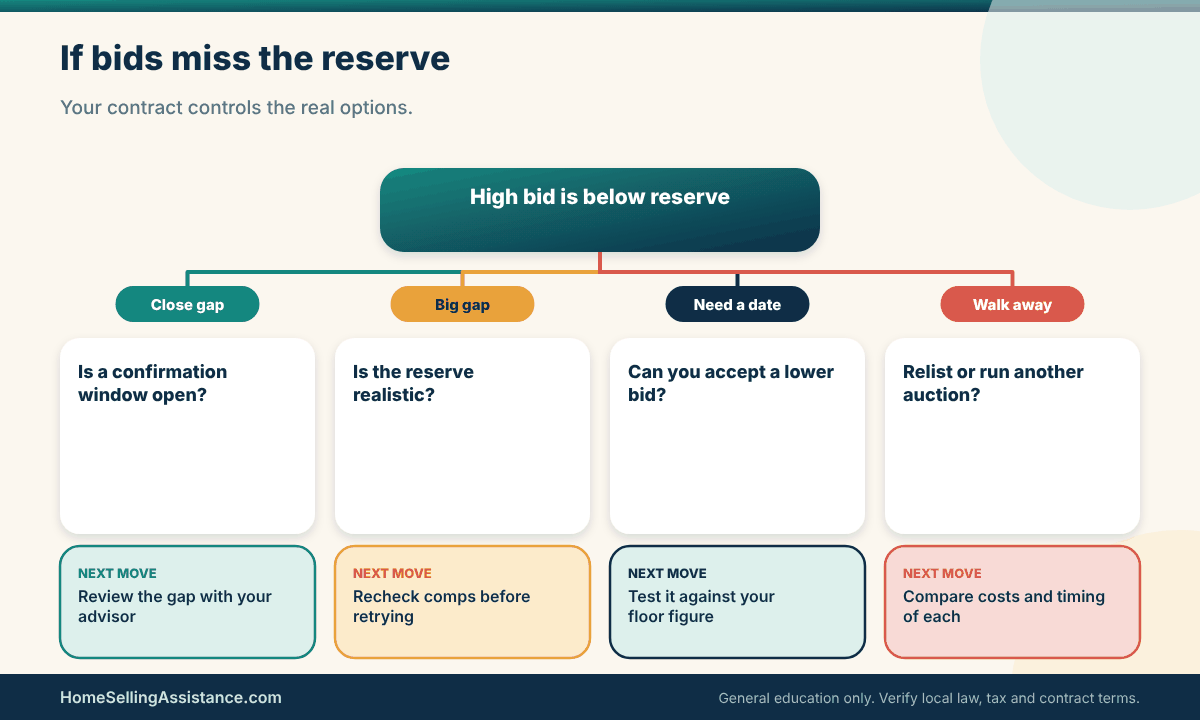
In the tree, each branch asks a plain question about where you stand after bidding closes and points to a sensible next move. It is a planning tool, not a script. Your actual options depend on the confirmation window in your contract, local rules and the specific high bid you receive.
Choosing between an absolute vs reserve home auction by scenario
Because the right absolute vs reserve home auction format depends on the seller, it is more useful to test your own situation against a few patterns than to look for a universal winner. The checklist below collects the questions to settle before you sign any auction agreement, whichever format you lean toward.
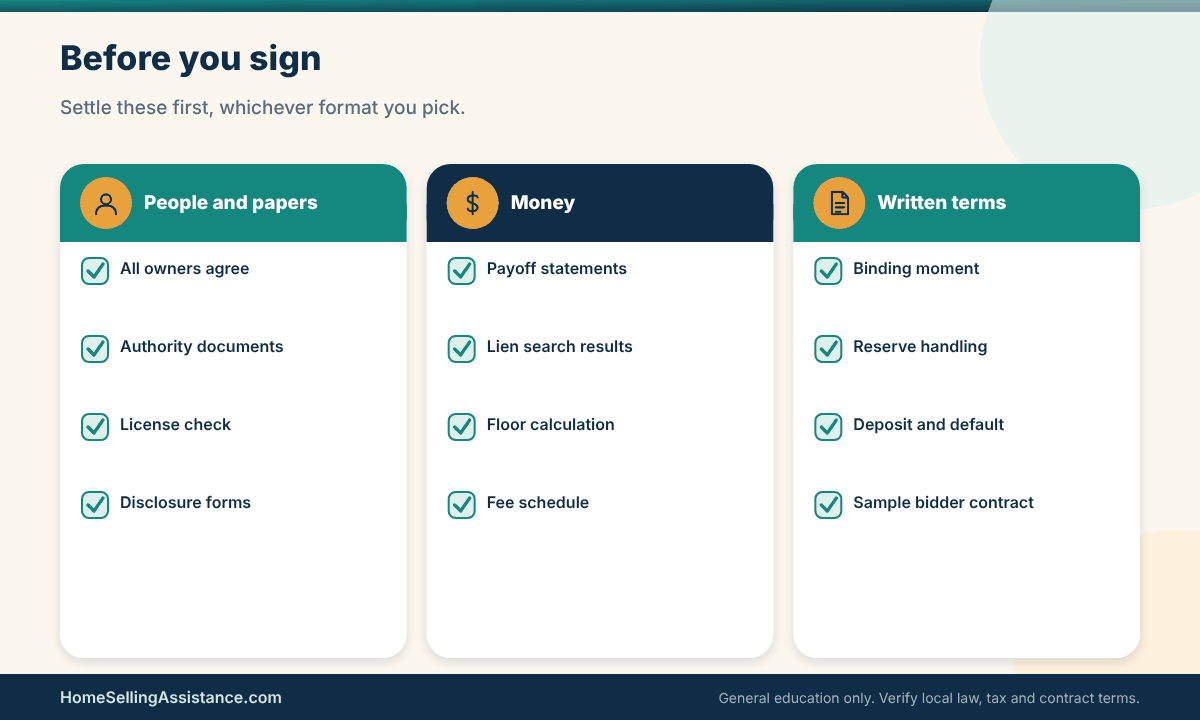
Work through those groups in order: the people and papers that must be in place, the money that must be covered, and the terms that must be in writing. If you cannot tick a group, you are not yet ready to choose a format, and the right move is to fix that gap first. That is also a good time to read about verifying a cash home buyer, since auction bidders may arrive with cash and the same checks apply.
Scenario one: an equity-rich owner who wants a firm date
In our first absolute vs reserve home auction example, the seller owns a house outright, maybe an older property that is hard to compare, and wants the sale finished by a specific day. They have time to market the event and can tolerate a range of outcomes, though they would obviously like a strong one. They are weighing an absolute vs reserve home auction and want to know which one respects the date.
Nothing in this absolute vs reserve home auction case forces a particular format, which is exactly why the choice deserves care. Without a payoff to cover, the seller can consider the lower-reserve or absolute route, accepting price variability in exchange for a sale that happens on the day. A reserve is still on the table if they want a floor, but they should price it with the calendar in mind.
Evidence to gather: comparable sales, past results, and bidder demand
For this absolute vs reserve home auction seller, evidence means answering one practical question: how many serious bidders will this property attract? Ask the auction firm for the results of recent sales of similar properties in your area, including both the ones that sold and the ones that did not. A firm proud of its record will share it, along with how many registered bidders attended each event.
Pair that with your own comparable-sales research. Look at what similar homes sold for through conventional sales and through auctions nearby, and note any condition differences. An older property that needs work often sells for less than a renovated neighbor regardless of format, so the question is the gap, not the headline number.
Then ask about marketing. How long will the property be advertised, to which audiences, and who pays? A shorter campaign can be fine for a standard house in a busy market and thin for an unusual property. If the firm will not describe its plan in concrete steps, you may be paying for a date on a calendar and little else.
If you want to compare against a quieter route, our explainer on an off-market home sale shows what that alternative can offer, and where it falls short on price discovery.
A scenario, an exception, and your next step for the firm-date seller
Suppose this seller picks the absolute side of the absolute vs reserve home auction and the event draws four registered bidders, with a result roughly in line with local comparable sales. That is a successful outcome in the sense that matters: a sale on schedule at a price the market supports. The seller never had to guess a reserve.
The exception is the event that attracts one bidder. In an absolute auction, one bid can be enough to bind the sale. If the seller had asked for evidence of past turnout and learned that similar properties often drew a thin crowd, a reserve set at a modest level could have protected against that outcome without surrendering the date.
Your next step, if you are this seller, is to ask the firm for the number of registered bidders at each of its last several comparable events and to treat a low average as a signal to consider a reserve. The marketing claim and the track record should point the same way.
Scenario two: a seller with a payoff to cover
Our second absolute vs reserve home auction seller still has a mortgage, and possibly other liens, that will need to be paid from the proceeds. They live in a market with a solid buyer pool and are not in a rush. A strong result would leave them with cash after the payoff; a weak one could leave them short.
For this person the reserve usually matters more than the date. A reserve set at or above the payoff plus costs means the seller can decline a bid that would require bringing money to closing. An absolute sale could produce a result that does not cover the loan, and a lender is not obliged to accept less than the balance owed. The underwater mortgage guide covers what happens when the sale price cannot cover the loan.
Evidence to gather: payoff letter, lien search, and a floor calculation
Begin an absolute vs reserve home auction plan with an official payoff statement from every lender with a claim on the property, not an estimate from your monthly statement. Payoffs include interest through the closing date and sometimes fees, and the number changes by the day. Request updated figures as the auction date approaches, and note how long each statement stays valid.
Then order or request a title search to see every recorded claim: second mortgages, tax liens, contractor liens, judgment liens and association assessments. Our walk-through of how liens affect a home sale explains how each type is paid at closing and who needs to be contacted before the auction.
Finally, do the floor calculation. Add the payoffs, the auction-related fees you expect to bear, title and closing costs, and prorations. The sum is the least the property must bring for you to close without writing a check. Round it up slightly for surprises, and use that figure as the starting point for any reserve conversation, not the number the firm happens to suggest.
If your plan involves selling for less than the payoff, that is a different transaction entirely, called a short sale, and it needs the lender’s written approval before any auction. Do not assume an auction can substitute for that approval.
A scenario, an exception, and your next step for the payoff seller
Imagine the floor calculation in this example comes to 240,000 dollars, an illustrative figure, and the seller sets the reserve slightly above it. At the event, the top bid is 235,000. The seller declines or, if the contract allows, counters within a confirmation window. A modest gap may be closed by negotiation; a large one is a sign to rethink the strategy.
The exception is the seller whose reserve sits well above the floor because of sentiment or an unrealistic hope. The more distance between the floor and the reserve, the greater the chance of a failed auction, and the more any cost they advanced is lost.
Your next step is a written plan with two lines: the reserve you will set and the lowest figure at which you would still accept a post-auction offer. Share the second only with your own advisors. You will make better decisions on the day if you decided calmly beforehand.
The scale below sets the absolute vs reserve home auction formats against each other the way a seller experiences them, with certainty on one side and control on the other.
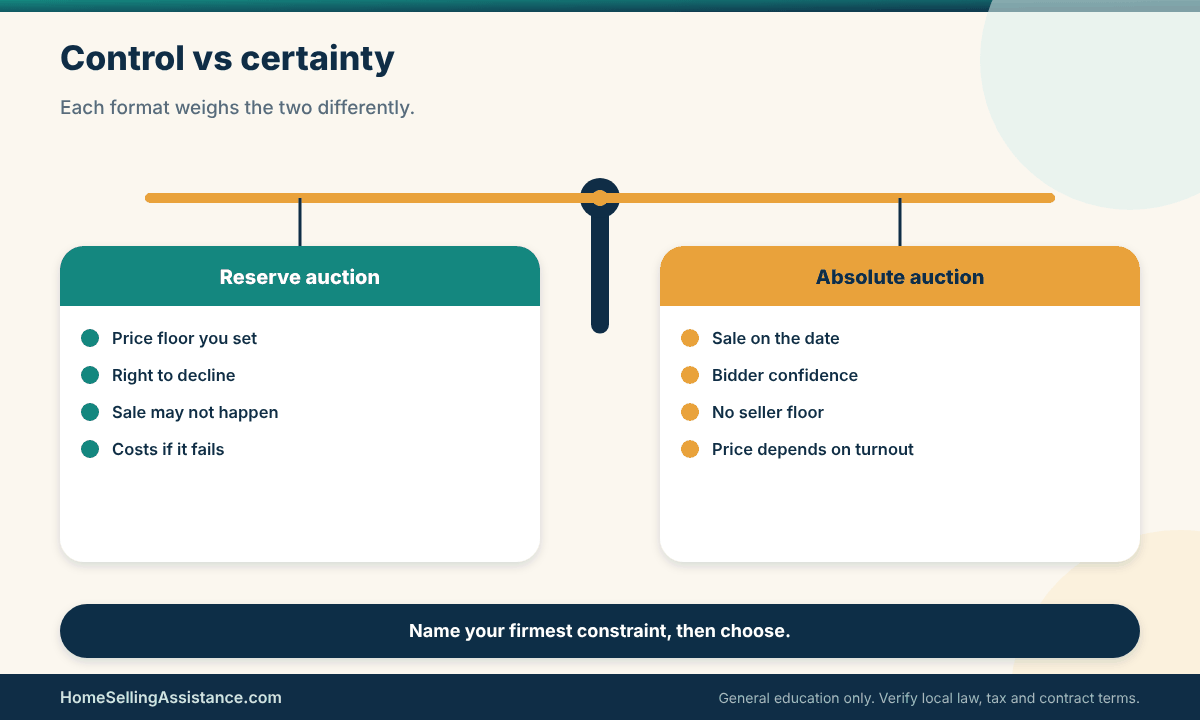
Read the picture as a reminder rather than a ruling. If a feature on either pan matters more than all the others in your case, such as a hard date or a payoff that must be cleared, that single feature may decide the matter.
The next absolute vs reserve home auction table gathers several seller situations into one view. Use it to see where your circumstances sit, then check the last column, because one fact can flip the answer.
| Situation | Route favored | Reason | Trade-off | Fact that changes the choice |
|---|---|---|---|---|
| Owned free and clear, firm closing date | Absolute, or low reserve | Date matters more than a floor | Price depends on turnout | Thin bidder history for similar homes |
| Loan and liens to pay off | Reserve | Floor covers payoff and costs | Sale may fail | Lender consent for any lower result |
| Unique property, few comparables | Either, with evidence | Bidders set a price the market lacks | Hard to set a fair reserve | Results of comparable auctions |
| Several owners or an estate | Reserve, with approvals | Everyone must agree to terms | More time to coordinate | Court or co-owner approval rules |
| No hurry, wants top price | Reserve, or a listing | Time allows a retry | Failed event may signal weakness | Strength of the conventional market |
| Needs speed but a floor | Reserve set near range bottom | Balances date and protection | Fewer bidders may attend | How the reserve is disclosed |
To use the table, find the row closest to your situation and read across, then test the last column against your facts. If the changing fact applies to you, move to a different row. A seller with several owners and a lien, for instance, should read both rows and take the stricter answer.
Whichever side of the absolute vs reserve home auction you pick, protect yourself from the scams that tend to follow publicity around a sale. Our guide to home sale fraud and seller safety and the FTC’s consumer protection resources help you spot fake bidders, advance-fee schemes and fraudulent deposit instructions.
Before the FAQ, a few practical layers deserve their own space, because they are where an absolute vs reserve home auction most often goes wrong in real life: the questions sellers forget to ask, the hybrid formats that blur the labels, and the mistakes that cost money after the signing.
Start with the questions. When you interview an auction firm, write the answers down and ask for them by email afterward. Try these in your own words: “Under this contract, at what exact moment am I bound to sell?” “If bidding stops below my number, what are my choices and how long do I have?” “Which fees come out of my proceeds, which come from the bidder, and which are advanced before the date?” A firm that answers cleanly is easier to trust than one that says it depends.
Add two more. “Can you show me the results of your last several events for similar homes, including the ones that did not sell?” and “Who will be present when I sign, and who is on the hook if the winning bidder does not close?” The goal is not to catch anyone out. It is to turn a sales conversation into a documented set of terms before you commit the property.
Quick scenario
A seller with a two-bedroom house hears two pitches. One firm recommends an absolute sale because “it brings the crowds.” The other recommends a reserve because “it protects your price.” Rather than pick a side, the seller asks each firm to put its reasoning, recent results and fee structure in writing. Two weeks later, the written answers make the choice for the seller: one firm gave specifics, the other gave slogans.
Next, hybrid formats. Many auctions are neither fully absolute nor fully reserve. A seller might set a published opening bid and then go absolute once bidding passes a stated threshold. Or the property might sell absolutely above a number and subject to confirmation below it. Some online auctions run on a timer, with a soft close that extends the clock if late bids arrive. Each variation moves risk around, so the label alone tells you very little.
When you see a hybrid, rewrite it in your own sentence and read it back to the firm: “So if bidding ends at X, I can decide within Y days, and above Z I am bound. Is that right?” If the firm corrects your summary, good, now you both agree on the terms. If the firm cannot confirm it, you do not yet have a deal. The sentence is worth more than any brochure phrase, because it tests whether the contract and the sales pitch describe the same thing.
Online and in-person formats also differ in practical ways. An in-person event gives bidders a shared room and a visible pace; an online event can reach more people but may attract casual bidders who lose interest or fail to follow through. Ask the firm how bidders are registered and qualified, whether proof of funds is required before bidding, and what happens when a bidder cannot close. Our guide to proof of funds from a cash buyer shows what reliable evidence looks like.
Now the absolute vs reserve home auction mistakes. The first absolute vs reserve home auction mistake is choosing a format for the story instead of the facts. A seller who has heard that absolute auctions “always bring more” or that reserve auctions “always protect you” is choosing from a slogan. Neither statement holds everywhere, and a firm that repeats either one without local evidence deserves a polite request for numbers.
The second mistake is setting the reserve emotionally. Many sellers anchor on what they paid, what a neighbor claims, or what they need to buy the next home. None of those are evidence of what bidders will pay. The reserve should come from comparable sales, condition, and your floor calculation. If the gap between your hope and the evidence is large, you may need a conversation with an appraiser or agent before you pick any format; our piece on reading a listing agreement helps with the contract side of that conversation.
The third is ignoring the full bill. An absolute vs reserve home auction can look cheaper or costlier depending on who pays the firm and how a buyer premium is treated. Sellers who compare formats by commission-style percentages alone, instead of by dollars after all costs, tend to be surprised at closing. Ask for the fee schedule in writing and run it through your worksheet.
The fourth is skipping the legal read. Auction contracts bind sellers quickly and can be hard to unwind. Many sellers hire a real estate attorney for a single consultation on the listing agreement and sample bidder contract; whether that suits you depends on your state, your property and your comfort with the paperwork. The state real estate commission and your title company can also tell you what is customary locally.
The fifth is forgetting fair housing. Whoever markets your property and whoever attends your event, the same rules apply: no preferences or steering based on protected classes, in marketing or in who you accept. HUD explains the basics on its fair housing and equal opportunity page, and our overview of fair housing for home sellers translates it into practical habits.
A sixth, quieter mistake is treating the auction date as a finish line. The winning bid starts a closing process with title work, payoff letters, disclosures and prorations. Keep your documents ready and your phone on. A stalled closing after a successful auction is far more stressful than one you saw coming. If the pace of the event itself is what draws you, read about claims about selling a house fast to keep expectations grounded.
Finally, consider the weeks around an absolute vs reserve home auction event. Illustratively, a typical plan might include a preparation period for documents and access, a marketing window while bidders inspect, the event itself, and then a closing period. Each part has someone responsible. Ask the firm to give you that sequence in writing, with names and dates, so there is no gap where nobody owns a task. The investor-side picture in our guide to an investor offer vs listing shows how these handoffs differ on other routes.
Frequently asked questions about absolute vs reserve home auction
What is the main difference in an absolute vs reserve home auction?
In an absolute auction, the property sells to the highest bidder once bidding opens, with no seller minimum. In a reserve auction, you set a minimum and can decline bids below it. The exact moment you become bound, and what happens near the reserve, depends on the written contract, so read it before you sign.
Can I back out of an absolute auction?
Usually not after the binding point described in your contract, which is often the moment bidding opens. Before that point, your rights depend on the agreement with the auction firm, and there may be fees or cost reimbursements for withdrawing. Ask for those terms in writing, and consider having an attorney review them.
What happens if bidding does not reach the reserve?
You are generally not required to sell, and the property stays with you. Some contracts give a short confirmation window to accept the high bid or negotiate with the bidder. You may still owe marketing costs or fees, so check which ones apply to a no-sale result.
Is an absolute auction riskier than a reserve auction?
The price risk is higher because you have no floor once the sale is binding. The execution risk can be higher in a reserve auction, since the event can end without a sale. Which risk matters more depends on your payoff, your deadline and your tolerance for a retry.
Who pays the auction fees and buyer premium?
It varies by firm and contract. Some charge the seller, some add a premium to the bidder’s price, some do both. Ask for a fee schedule and an example showing seller proceeds at a few sample winning bids, so you can compare formats in dollars.
Do I still have to disclose problems with the house?
Often yes. Disclosure duties vary by state, and an as-is label does not necessarily remove them. Federal lead-based paint rules generally apply to housing built before 1978. Ask the auction firm which forms they provide, and verify the requirements with your state real estate commission or an attorney.
Can I use an absolute vs reserve home auction if I have a mortgage?
Yes, but the payoff must be covered from proceeds at closing. An absolute sale could produce a price below the payoff, which would require the lender’s agreement or money from you. A reserve set above your floor reduces that risk, though it does not eliminate it. Ask your lender for a payoff statement first.
Can the seller or the auction firm bid on the property?
Rules vary by state and by contract, and bidding meant to drive up the price can be unlawful. Ask the firm for its written policy on seller bids and how any such bid is disclosed. A clear answer protects you and the other bidders.
Do bidders get inspections and financing contingencies?
Auctions often sell without those contingencies, so bidders inspect before the event and arrange funds in advance. That can speed the sale and reduce renegotiation. It also means a defaulting bidder can leave you re-marketing, so confirm deposit and default terms.
Should I hire an attorney or agent for an auction?
Many sellers do, at least for contract review, but the right choice depends on your state, your property and your comfort level. A one-time review of the listing agreement and sample bidder contract can be far cheaper than a misunderstanding. Your state bar or real estate commission can point you to qualified professionals.
Pick the format that matches your constraint
If a date matters most, lean toward the format that protects the date; if a floor matters most, lean toward the one that protects the floor. Weigh the absolute vs reserve home auction decision against your payoff, your co-owners and your tolerance for a retry, and put every term in writing first. For more on alternatives, see our guide to the cash offers and alternative sale routes and the closing costs and net proceeds library.
This article is general education, not legal, tax or financial advice. Check the IRS guidance in Publication 523 and consult a licensed professional about your own situation.