The sell first vs buy first downsizing question comes down to one uncomfortable fact: you are trading a large, paid-down house for a smaller one, and whichever closing you line up first decides who carries the risk of the other.
If you sell first, the risk of a gap lands on your living arrangements. You may need a place to stay for a few weeks or months, and you may be bidding on the smaller home with cash from a sale that has already closed. If you buy first, the risk lands on your wallet. For a while you own two homes, with two sets of taxes, insurance, utilities and possibly two loans, and the old house has to sell on a schedule you do not fully control.
Downsizers face a version of the sell first vs buy first downsizing choice that younger movers rarely do. You often have a lot of equity, which makes the money side look easy. You may also have decades of belongings, a neighborhood you know well, and a smaller target market, because the right condo, townhome or single-level house may be scarce and sought after by other buyers. Many downsizers are also retired or close to it, so income may be fixed, and lenders may look at your finances differently than they did when you bought the big house.
This article compares both orders of sell first vs buy first downsizing in plain terms. We will look at what each option is designed to solve, how they compare on net proceeds, time, control, contingencies and workload, how the legal, financing and fallback risks differ, and which seller situations tend to tilt the answer one way or the other. You will not find a universal winner here, because there is not one.
If you want the wider picture first, our guide to downsizing and selling your home sets the scene, and the cornerstone on how to sell a house for relocation covers the moving side in more depth.
A caution before we start. Contract customs, lender rules, tax treatment and closing practices vary by state, by lender and by transaction. Every dollar figure in this article is a round, illustrative number meant to make the arithmetic easy to follow. None of it is a quote, a prediction for your house, or individualized advice. A licensed agent, a real estate attorney, a mortgage professional and a tax adviser can check the details that apply to you.
Key takeaways
- There is no universal winner. The sell first vs buy first downsizing decision depends on your cash, your timeline, your market and how much uncertainty you can live with.
- Selling first buys certainty about money. You know your net proceeds before you commit to the smaller home, but you may face a housing gap and a fast search.
- Buying first buys certainty about housing. You can pick the smaller home calmly, but you carry two homes until the old one sells, and the exit is not fully in your hands.
- Contingencies and dates are the real levers. A flexible closing, a rent-back or a sale contingency can soften either path, but each one has a price in leverage or competitiveness.
- Test the plan against the slow case. A good sell first vs buy first downsizing plan survives a slower sale than you hope for. Whichever route you choose, ask what happens if the sale takes longer, the appraisal comes in low or the smaller home is hard to find.
- Check local rules. Contract terms, disclosures and tax questions differ by state, so confirm the specifics with licensed professionals before you sign.
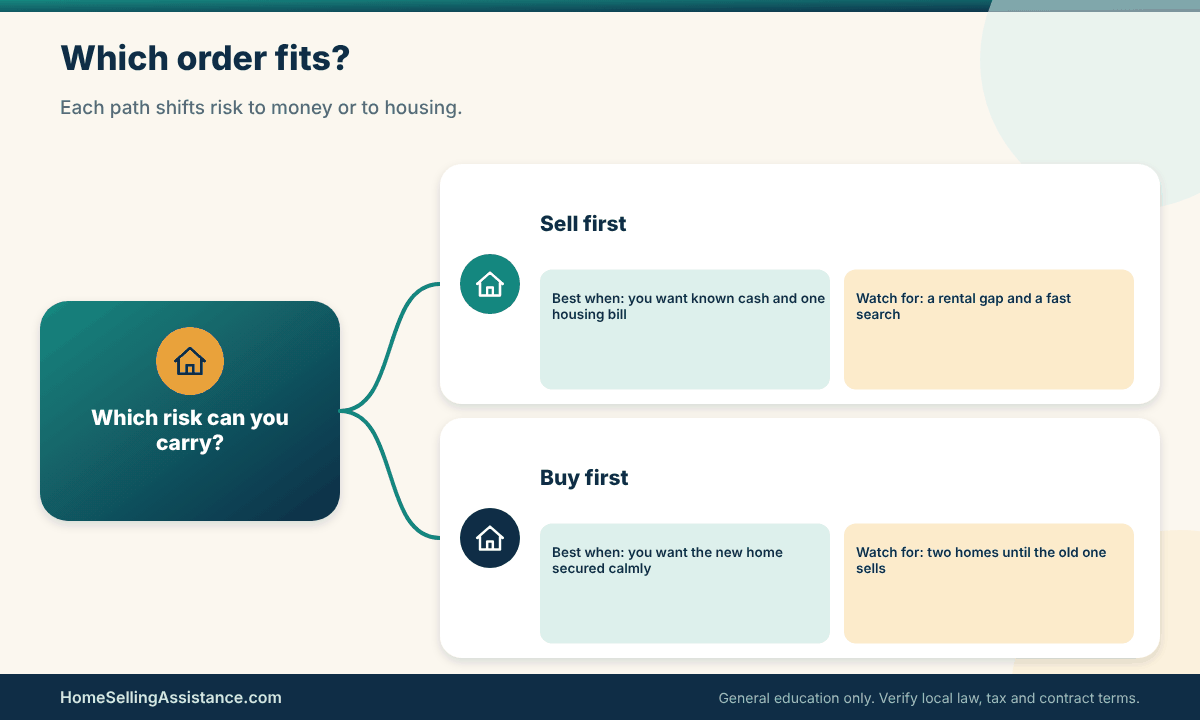
What each route is really meant to solve for a downsizer
Before comparing anything, it helps to be honest about what you are trying to fix. Some downsizers want to unlock equity to fund retirement. Others want less maintenance, fewer stairs, or a lower monthly cost. Some simply want to be closer to family. Each goal pushes toward a different order of events, and the sell first vs buy first downsizing choice looks very different depending on which goal comes first for you.
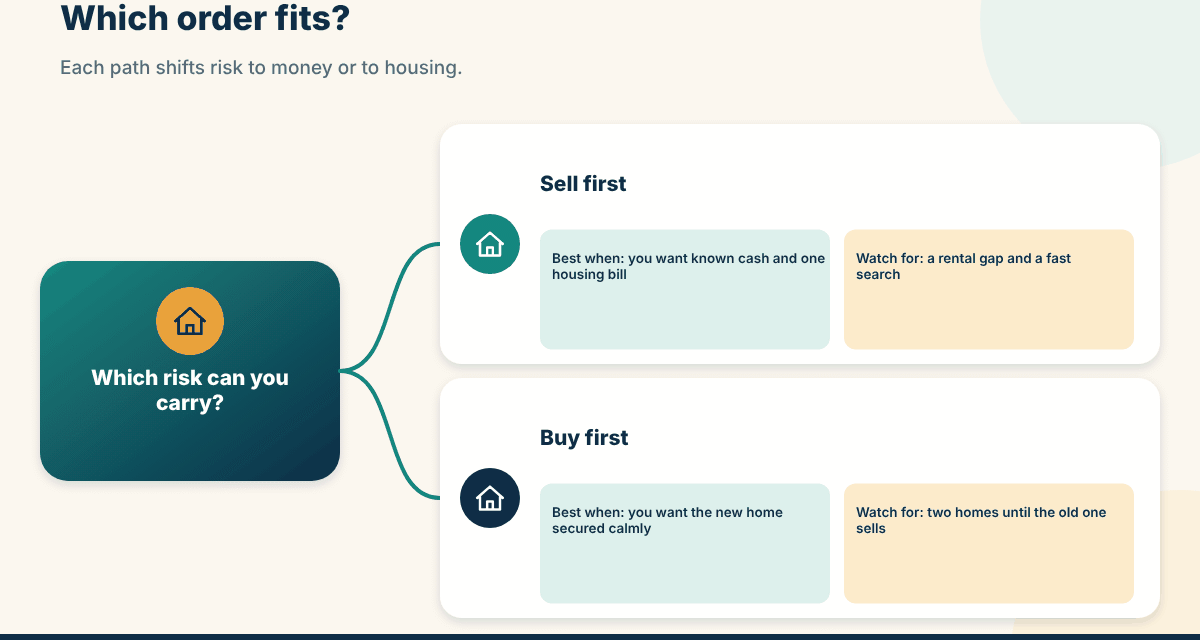
The picture above lays out the two sell first vs buy first downsizing sequences side by side. In one, your big house closes and your smaller home follows. In the other, the smaller home closes first and the old house follows. The next two sections take them one at a time, with the evidence you can gather and a short scenario for each.
Selling first in a sell first vs buy first downsizing plan: what it protects and exposes
Selling first means listing the larger house, accepting an offer, and either closing before you buy or buying in a tight window around the same time. The appeal is straightforward. Once the sale closes, your equity is cash in the bank, you know what you can spend, and you are not paying to own two properties. For someone on a fixed income, that clarity can be worth a great deal.
The exposure is on the housing side. If your house sells quickly and the smaller home you want has not appeared, you may need temporary housing, storage and a second move. If you make an offer on a smaller home with no sale contingency because your cash is already in hand, you may be competitive. That is a genuine advantage in a market where good small homes attract several offers. Our guide on how to sell your house before buying another walks through the mechanics in more detail.
Evidence to gather before choosing the sell-first order
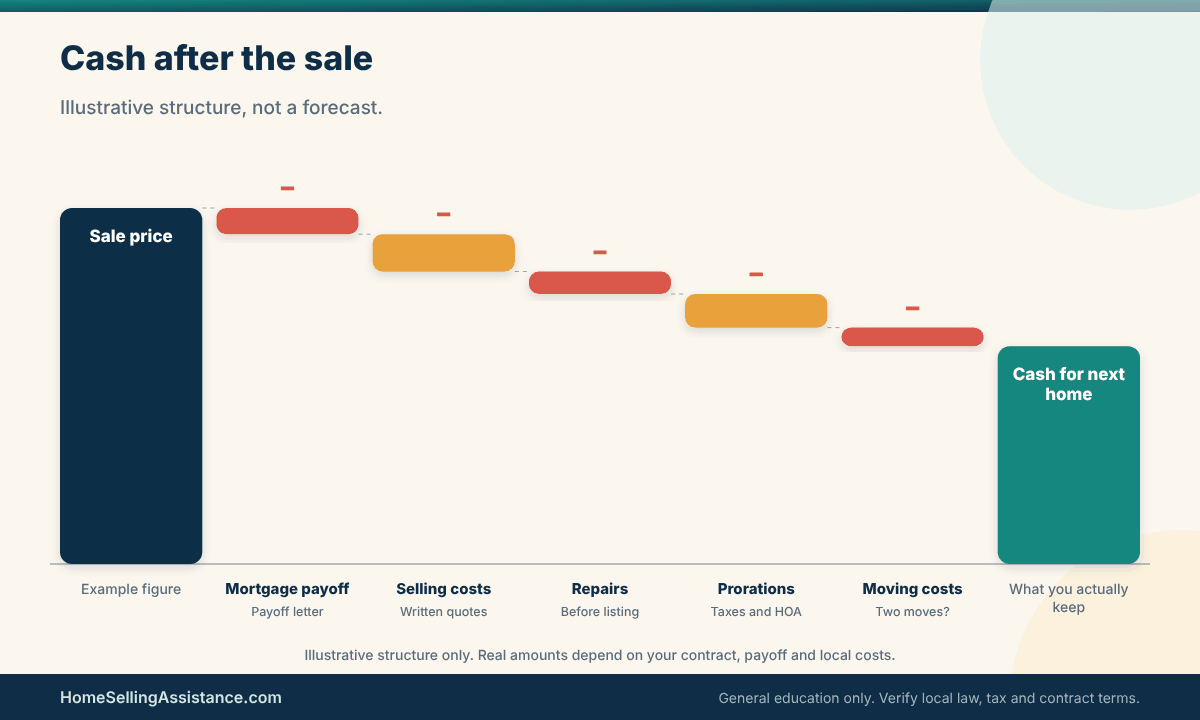
For sell first vs buy first downsizing, start with a realistic estimate of your net proceeds, not your hoped-for sale price. Ask a licensed agent for a written comparative market analysis, then ask your lender for a payoff statement, and ask a title company or attorney for an estimated seller closing statement. Our overview of home sale net proceeds shows how the deductions stack up. Subtract the payoff, selling costs, repairs you expect to make, prorated taxes and any HOA charges, and then round the result down.
Next, study the market for the kind of smaller home you want. Look at how many condos, townhomes or single-level houses in your preferred areas came on the market over the last few months, and how long they stayed listed. That is evidence about how hard the second half of your plan may be. If suitable homes are scarce, a quick sale of your house could leave you waiting. If they are plentiful, the sell-first order is less stressful.
Finally, ask yourself where you would live for ninety days if you needed to. That question sounds blunt, but the answer is often the cleanest test of whether selling first is realistic for you.
A scenario, an exception, and your next step for selling first
Picture a couple in their late sixties, deciding on sell first vs buy first downsizing, with a paid-off family house and a hoped-for condo near their daughter. Their illustrative plan is to list in spring, accept an offer, and negotiate a closing date about forty-five days out. They then plan to rent a furnished unit near the condo community while they shop. Because their cash is secured, they can bid without a contingency when the right unit comes up.
The exception is a market where small, well-located homes are so scarce that the rental period drags on. If that happens, they may feel pressured to accept a unit that is not quite right. Their next step is to ask their agent how long comparable condos typically stay on the market locally, and to price a three-month rental and a short-term storage unit before they list. Once those numbers are in front of them, they can decide whether the sell-first route still feels comfortable.
Buying first in a sell first vs buy first downsizing plan: what it protects and exposes
Buying first means you purchase the smaller home while you still own the larger one. You might pay with savings, a home equity line, a bridge loan, or a loan that counts both properties. The strongest argument for this order is control of the move. You can choose the new home carefully, make repairs or changes, move belongings gradually, and list the old house when it is empty and clean. Our guide to buying a house before selling your current home covers the money side in detail.
The weak point is the sale of the old house. Until it closes, you are paying carrying costs on two properties, and the old house has to find a buyer at a price that makes the plan work. If your market softens, your buyer’s financing falls through, or the appraisal lands short, your cushion shrinks. A buy-first plan is only as strong as the way it behaves when the sale goes slowly.
Evidence to gather before choosing the buy-first order
In a sell first vs buy first downsizing comparison, begin with cash you can reach without selling. List savings, retirement accounts you would not want to touch, available credit and any family help, and be honest about which of these you would actually use. Equity in the old house is not spendable until the sale closes, unless you borrow against it, and borrowing has its own approval, cost and risk.
Then ask a lender how they would count both payments. Some lenders include the old mortgage in your debt-to-income picture even if the house is listed, while others treat a signed sale contract differently. That single answer can decide what you qualify for, so get it in writing. A housing counselor approved by HUD can also help you review a budget at no or low cost.
Finally, price your carrying costs. Add taxes, insurance, utilities, lawn or snow care, and any HOA dues for the old house, and multiply by three, six and nine months to see how you feel.
A scenario, an exception, and your next step for buying first
Imagine a single homeowner in her early seventies, weighing sell first vs buy first downsizing, who has found a small, single-level house close to a medical center. Her illustrative plan is to buy it with a mix of savings and a short-term loan, move over a few weeks, and then list the big house cleaned and staged. She is comfortable carrying both homes for four months, and she has a written pre-approval that treats the old mortgage in a way she understands.
The exception is a plan that assumes the old house will sell by a certain date. If the listing sits, the cushion thins and stress rises. Her next step is to set a firm price-reduction schedule with her agent before she lists, so the decision to lower the price is made calmly in advance rather than in a panic at month three. She can also ask whether a rent-back agreement or a flexible closing date might help the old sale line up with her move.
Before moving on, it helps to see why the sell first vs buy first downsizing choice is harder than the same decision for a family trading up. When you trade up, both homes usually sit in a similar market, so a hot market helps on both sides. When you downsize, the two ends of the transaction can behave very differently. Your larger house may appeal to a narrow set of buyers who can afford it, while the smaller home you want may be chased by many people at once.
That mismatch is the reason a plain rule such as “always sell first” or “always buy first” tends to fail. A sound approach to sell first vs buy first downsizing starts by checking how each of your two markets is behaving, then asks which sequence leaves you the most room to adjust. Our companion piece on selling a house when moving out of state covers a related timing puzzle for movers who cannot easily visit the old home.
Putting the sell first vs buy first downsizing trade-offs side by side
Once you understand each side of sell first vs buy first downsizing on its own, the useful move is to lay them next to each other on the same yardsticks. We will use two groups. The first covers money, time, control, contingencies and workload. The second covers legal, financing, execution, market exposure and fallback risk. Neither group produces a single score, and we will not pretend that it does. Instead, the goal is to show where each path gives you something and where it asks for something in return.
Net proceeds, time, control, contingencies and workload compared
The decision matrix below summarizes the main differences for a typical downsizer. Read this sell first vs buy first downsizing matrix as a starting point for questions, not as a verdict. The wording is deliberately general because contract customs, lender rules and market conditions change from one place to the next, and your own numbers will not match anyone else’s.
| Factor | Sell first | Buy first | Contingencies | Execution risk |
|---|---|---|---|---|
| Net proceeds | Known before you buy | Estimated until sale closes | Fewer on your purchase | Low on money, higher on housing |
| Time | Housing gap possible | Overlap of two homes | Dates must line up | Depends on closing dates |
| Control | You set the sale pace | You choose the new home calmly | Sale contingency may weaken offers | Old sale outside your control |
| Workload | Two moves possible | One staged move | Extra paperwork if bridging | Coordination heavy |
| Cash needed | Mostly from sale | From savings or loans | Lender may add conditions | Cash cushion matters |
| Competitiveness | Strong offer with cash | Strong if no contingency | Contingent offers may lose | Depends on local demand |
Here is how to use that table. Pick the two rows that worry you most, perhaps net proceeds and execution risk, and ask what number or document would calm that worry. For net proceeds, it might be a written estimate from a title company. For execution risk, it might be a clear picture of how the closing dates could fit together.
Evidence to gather: price, proceeds, time and workload
To compare sell first vs buy first downsizing, gather three sets of figures. First, the likely price range of your current house, based on recent nearby sales and a written market analysis. Second, the likely price range of the smaller home you want, using the same method. Third, your full cost of moving, including packing, hauling, storage, cleaning, repairs, and temporary housing if needed. The difference between the first two figures is not your cash left over, because transaction costs sit between them. Our guide to seller closing costs explains what they usually include.
Here is a simple illustration. Suppose your house sells for an example price of 600,000, the payoff is 100,000, selling costs and prorations come to 40,000, and repairs cost 10,000. Your cash after the sale is about 450,000. If the smaller home costs 350,000 and you spend 15,000 on buying costs and moving, you keep about 85,000 after both transactions. Every figure here is illustrative only. If you buy first, you also add the carrying costs of the old house for each month it remains unsold.
Workload matters too. Selling first often means one long push of decluttering followed by a rental period. Buying first often means two moves, or one move that happens in stages.
A scenario, an exception, and your next step on proceeds and time
Consider a retired teacher, weighing sell first vs buy first downsizing, with a house worth far more than the condo she wants. On paper, she could buy first with room to spare. Her agent, however, points out that her market has been slow for homes at her price, and that two similar houses on her street have each taken several months. The exception to the “plenty of equity” comfort is a slow local market. If the old house sits, even a large equity cushion can feel thin.
Her next step is to ask for a written estimate of carrying costs for six months and a list of how long nearby comparable homes took to sell. If the carrying costs for six months are manageable and she is comfortable with them, buying first remains reasonable. If not, she can consider selling first or negotiating a flexible closing on the old house. The key is that the choice is based on her actual costs and local timing, not on a rule of thumb.
Legal, financing, execution, market exposure and fallback risk compared
The second group of sell first vs buy first downsizing differences is quieter, and downsizers tend to underestimate it. Money and dates are visible. Contract language, lender conditions and fallback plans only show up when something changes. A smart approach is to read the paperwork for both options before you choose, and to ask what each side of the plan would look like if one piece failed.
On the legal side, the main questions are what your purchase contract says if your sale does not close, how your listing agreement treats a buyer you find yourself, and what your deposit terms are. On the financing side, they are how a lender counts both loans, what a bridge or line of credit costs, and what happens if an appraisal comes in short. Our guide to bridge loans for a home sale explains one of the common tools.
Evidence to gather: contracts, loans, deposits and fallback paths
Ask for a sample purchase contract and read the sections on contingencies, deposits and default before you shop. If you plan to make an offer contingent on selling your house, read how the clause is written and how a seller can respond to it. Our article on buying with a home sale contingency explains that structure from the other side of the table. Terms vary by state and by form, so do not rely on a generic description.
For lending, request a written explanation of how your lender counts the old mortgage, the new mortgage, and any line of credit. The Consumer Financial Protection Bureau at consumerfinance.gov publishes plain-language material on mortgage shopping and closing disclosures. Compare the cost of each tool, including fees, interest and the time to set it up, against the cost of simply waiting.
For fallback, write down what you would do if the sale of the old house stalls for ninety days, and what you would do if the purchase of the smaller home falls apart after your house has already closed.
A scenario, an exception, and your next step on legal and financing risk
Think of a widower, working through sell first vs buy first downsizing, who signs a contract to buy a small townhome with a contingency that depends on the sale of his house. His agent explains that the seller of the townhome can keep marketing and may ask him to remove the contingency if a better offer arrives. He realizes the clock could start quickly, with only a short window to decide.
The exception is a case where the townhome seller will not accept any contingency at all in a competitive market. In that case, his next step is to ask whether a short bridge, a line of credit, or selling first would let him present a cleaner offer. He should also ask a real estate attorney or licensed agent in his state how a deposit is handled if he has to withdraw. Contract terms are local, and a short consultation before signing is usually less costly than a dispute after.
Quick scenario
A couple sells their house in six weeks and rents a small apartment for three months while they search. They find the right condo in month two, close in month three, and spend a modest amount on temporary housing and storage. Another couple buys the condo first, then watch their old house sit for five months through a slow stretch. Both plans were reasonable on paper. What separated them was how well each plan handled the unexpected, which is why the fallback question deserves as much attention as the price.
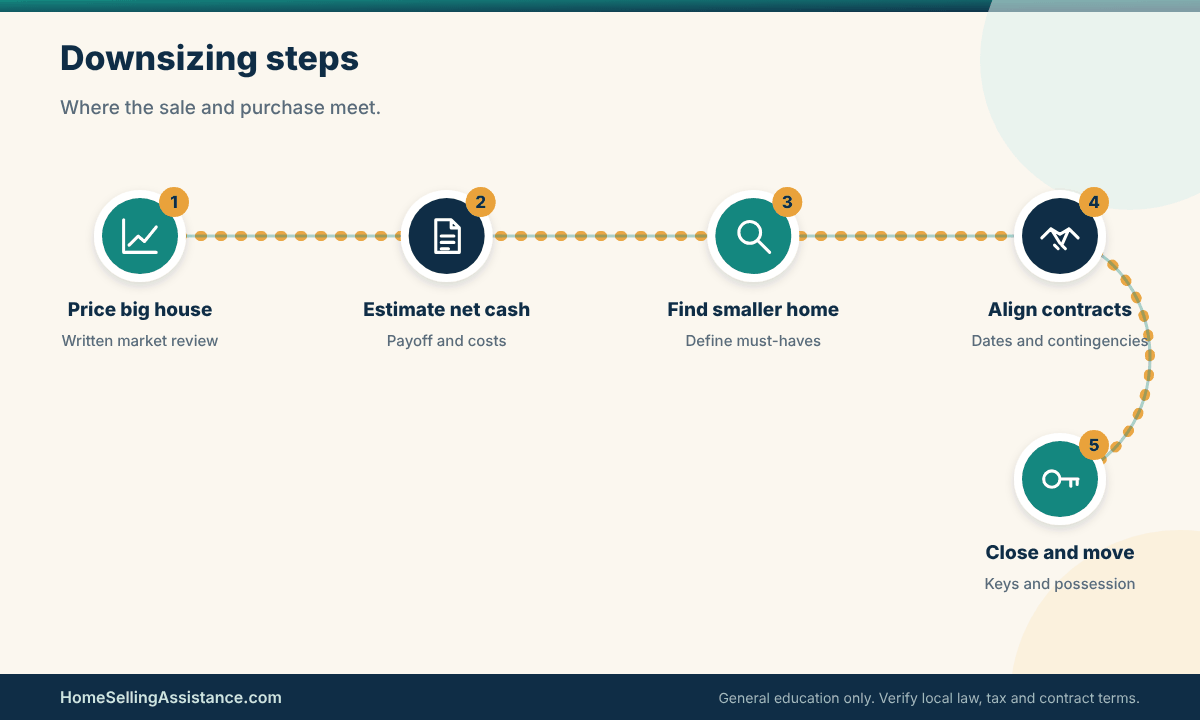
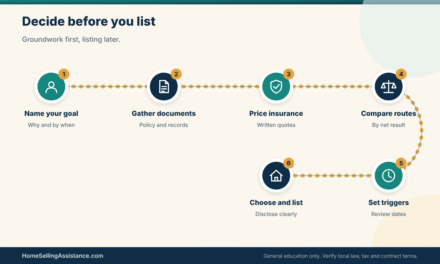
The roadmap above shows how the major steps of sell first vs buy first downsizing stack up in time. Notice where the long stretches fall and where the handoffs between sale and purchase happen. Those handoffs are where most surprises appear, and they are the places where a flexible closing date or a short rent-back can help.
We should also mention the role of your agent, attorney and lender here. A licensed agent can tell you how long comparable homes take to sell locally, but cannot promise a result. An attorney can explain how contract language works in your state, but cannot predict a buyer’s behavior. A lender can tell you what loans you may qualify for, but only after reviewing your documents. Treat each as a source of facts for their own field, and be wary of anyone who offers certainty about all three at once.
Two more practical points deserve space here, because they are easy to overlook until a deadline is close.
The first is the tax picture. Many homeowners can exclude a portion of the gain on the sale of a main home if they meet the federal ownership and use tests, which generally require that you owned and lived in the home for at least two of the five years before the sale.
The federal exclusion is up to 250,000 for a single filer and up to 500,000 for a married couple filing jointly, with conditions. Whether it covers your gain depends on your basis and the details, so the order you pick for the sell first vs buy first downsizing decision should not be driven by taxes alone. Ask a qualified tax professional how your own sale would be treated, and see our article on the home sale capital gains exclusion for the general rules.
The second point is the cost of a hurried second choice. People who sell first sometimes buy a smaller home too quickly because the rental period is wearing on them. People who buy first sometimes accept a low offer on the old house because carrying costs feel heavy. Both are understandable, and both are costly. The best protection is a written plan with a decision date, a budget for the gap or the overlap, and a trusted person who will tell you when you are drifting from it.
Finally, remember that both paths can be softened. A seller who sells first can ask for a post-closing stay, so the buyer of the big house allows a short rent-back. A seller who buys first can ask the lender about a loan structure that does not count the old mortgage once the house is under contract. Neither request is promised, and both depend on the other party and your lender, but asking early costs little. Our guide to move-out dates versus closing dates explains how possession and closing can be separated in the contract.
Why seller scenarios beat a single answer on sell first vs buy first downsizing
Advice that names one winner is usually selling something, or is repeating a rule that worked in one market at one moment. The honest answer to the sell first vs buy first downsizing question is that it depends on a short list of facts about you. The scenario table below pairs common situations with the route they tend to favor, the reason, the trade-off, and the single fact that would change the answer.
Use the sell first vs buy first downsizing table the way you would use a map legend. Find the row that looks most like your situation, read the trade-off column first, and then check whether the last column describes something true for you. If it does, the favored route may flip.
| Situation | Route favored | Reason | Trade-off | Fact that changes it |
|---|---|---|---|---|
| Fixed income, little savings | Sell first | Avoids two sets of bills | Rental gap and fast search | Family housing available |
| Large savings, slow local market | Buy first | Calm choice of new home | Old sale timing uncertain | Carrying costs rise sharply |
| Scarce small homes, many bidders | Sell first | Cash offer is stronger | Pressure to accept a poor fit | Seller accepts contingency |
| Hot market for your big house | Either, often sell first | Sale likely quick | Gap risk if you find nothing | Flexible closing available |
| Health or care needs soon | Buy first | Move on a known date | Two homes for a while | Short rental can bridge |
| Older home needing repairs | Buy first | Time to prepare calmly | Repair cost while carrying | Buyers accept as-is |
| Moving in a short window | Sell first with rent-back | Dates align | Less price leverage | Buyer will not agree |
To use the table well, avoid reading the third column as a promise. “Reason” describes why a route often fits, not what will happen in your case. The last column is the most valuable. It tells you what to ask your agent, lender or attorney, because a single fact, such as whether a seller will accept your sale contingency, can turn a good plan into a risky one.
Two scenarios deserve a closer look, because they sit at opposite ends of the spectrum and show how the same facts can point in different directions. The first is a household that values certainty about money. The second is a household that values certainty about where it will live.
Scenario one: certainty about money matters most
Some downsizers are living on retirement income, a pension, or the proceeds from their house, and have little tolerance for unexpected bills. For them, the best-sounding plan is the one that keeps outflows predictable. In most of these cases, selling first looks attractive because it turns an uncertain asset into a known sum before any new commitment is made.
That does not make selling first free of risk. It moves the risk into the calendar and into the market for the smaller home. The central questions become how long you can comfortably rent or stay with family, what that costs, and how you will bid when the right home appears. Our guide to selling a house in retirement covers more of the income and planning angle.
Evidence to gather if certainty about money is your priority
For sell first vs buy first downsizing, start with a budget that shows every monthly bill you would carry in each scenario. Include housing, insurance, healthcare costs, food, transport and anything else that does not stop when you move. Then run the same budget with two housing costs for six months, and again with one housing cost plus a rental for six months. You are not trying to predict the future. You are trying to see which version leaves you with a margin you can live with.
Next, ask a title company or attorney for an estimate of what you would receive at closing, and ask your lender for a payoff statement. If you are unsure how a lump sum would affect your taxes, benefits or investments, a qualified tax professional is the right person to ask. The IRS explains the basics of selling a main home in Publication 523, including the federal exclusion for many homeowners who meet the ownership and use tests. Rules and thresholds change, so confirm the current ones with a professional.
A scenario, an exception, and your next step for money-first sellers
Take a retired couple, weighing sell first vs buy first downsizing, with a modest pension and a house they have owned for decades. They decide to sell first, rent a one-bedroom apartment near their intended neighborhood, and look for a condo over the next several months. Their illustrative budget shows that rent plus storage costs far less per month than carrying two homes would, and they feel comfortable with a six-month window.
The exception is a market where the condo they want is rarely available. If month six arrives without a good option, they may feel tempted to overpay or accept a home that does not fit. Their next step is to define a realistic range of acceptable homes in advance, including a few neighborhoods they would be happy with, and to write down a date when they will widen the search. A plan with a pre-decided adjustment point tends to feel less stressful than one that has to be invented under pressure.
Scenario two: certainty about housing matters most
Other downsizers care less about the spreadsheet and more about the move itself. Perhaps a spouse has mobility issues, a caregiver relationship requires a particular location, or the household simply cannot face a stretch in temporary housing. For these sellers, buying first often feels more humane, because the destination is secure before the old home is released.
The cost is carried by the cash cushion and by patience. A buy-first plan should be built around the question of how long you can carry both homes without strain. If your answer is a specific number of months, you have a plan. If your answer is “until it sells,” you have a hope. Our overview of temporary housing between selling and buying is also worth a read, since a short rental sometimes makes the buy-first plan unnecessary.
Evidence to gather if certainty about housing is your priority
For sell first vs buy first downsizing with housing as the priority, gather proof of the cash you can reach and the loans you can use. That means recent statements, a written pre-approval, and a conversation with your lender about how the old mortgage and any new loan would be treated together. If you plan to use a line of credit or bridge loan, get written terms, including fees, interest, repayment date and what happens if the old house has not sold by then.
Also gather information about the old house’s likely sale. Ask your agent for a list of recent nearby sales, the typical days on market, and the condition buyers seem to expect. If your home needs work, ask for a repair estimate and a view on whether to fix, credit or sell as-is. That information turns a vague hope into a schedule you can test.
A scenario, an exception, and your next step for housing-first sellers
Consider a family, facing sell first vs buy first downsizing, whose father has recently needed more help with daily tasks. They find a small, accessible house near his daughter and decide to buy it first, using savings and a short-term loan. They plan to move him in over a month, then list the larger house, which needs some paint and minor repairs. Their illustrative cushion covers about five months of both homes.
The exception is an unexpectedly slow sale or an appraisal that comes in short. Their next step is to agree on a price-reduction schedule with their agent before listing, to ask the lender what happens at the end of the short-term loan, and to keep a list of backup choices such as a smaller price, a rent-back, or a sale to a buyer who can close quickly. Preparing these fallbacks calmly, before they are needed, is the whole point of the buy-first discipline.
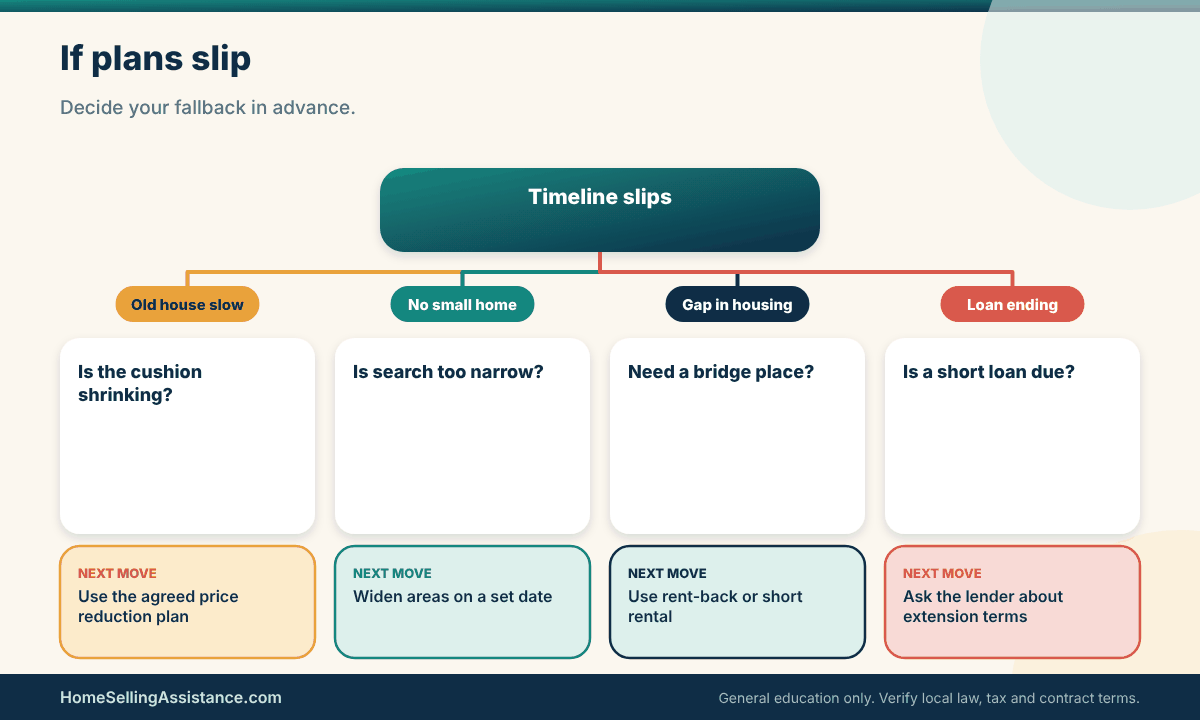
Both sell first vs buy first downsizing scenarios share one habit: they write the plan down, put numbers on it, and name the fact that would change their minds. That habit is more useful than any rule of thumb about which order wins.
If your situation does not match either scenario, that is normal. Plenty of downsizers sit in the middle, with moderate savings, a reasonably active market and some flexibility. For those households, a hybrid approach such as a flexible closing date on the old house, a short rent-back, or a sale contingency on the new one may be worth exploring. Our guide to the flexible closing date explains how that tool works, and our cornerstone guide on whether to sell first or buy first covers the broader decision.
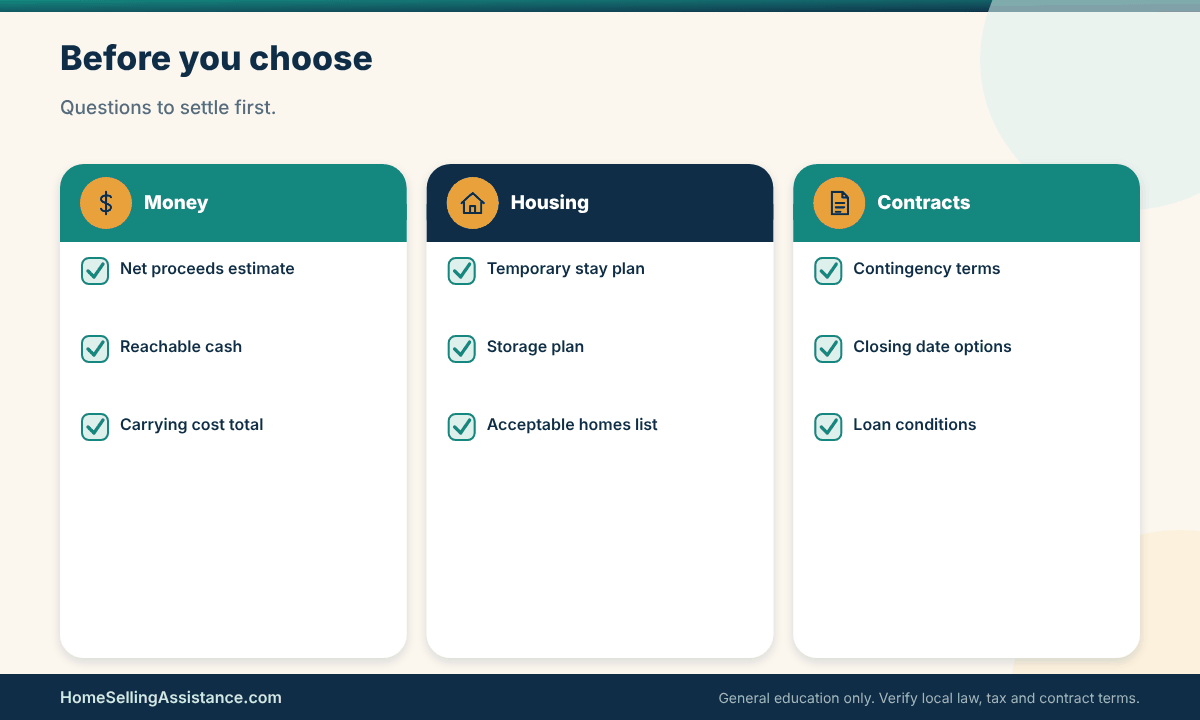
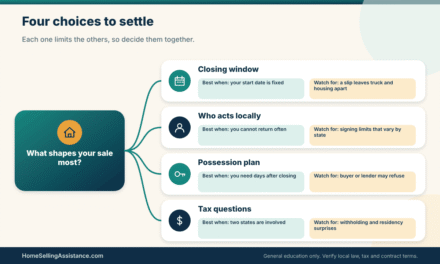
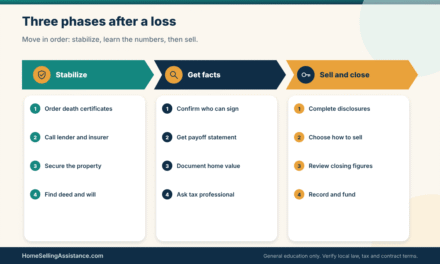
The checklist above pulls the main steps together. Use it as a prompt for a conversation with your agent, lender and attorney rather than as a substitute for one. If a step has an answer you cannot supply, treat that as the next thing to find out. You can also browse our sell first or buy first category for related articles, and our relocation and downsizing category for more life-event guides.
If you want a practical way to run the comparison yourself, here is a simple routine. Set aside an afternoon, a pad of paper or a spreadsheet, and the documents mentioned above. The goal is not a perfect forecast. It is a side-by-side picture that shows which version of the sell first vs buy first downsizing plan you could live with if things went a bit worse than hoped.
Start with two columns, one for each route. In the first row, write the housing situation in each month for the next twelve months, such as “own big house, rent nothing” or “own both, pay both.” In the second row, write the monthly cost for each of those months. In the third, write what could go wrong that month, such as a low appraisal or a delayed closing. Seeing twelve months on one page makes the sell first vs buy first downsizing trade-offs concrete in a way that a general discussion cannot.
Then repeat the exercise with a slower case. Add two months to the sale of the old house, add a month to the search for the smaller home, and add a moderate repair bill. If one route still works and the other strains your budget, that tells you something. If both still work, you have room to choose based on preference. If neither works, the sell first vs buy first downsizing question may be the wrong one to ask, and a different plan, such as renting for a year or choosing a less expensive home, may deserve a look.
Next, prepare a short list of questions for each professional. For your agent, ask how long comparable houses in your price range have taken to sell recently, what condition buyers expect, and how local sellers respond to contingent offers. For your lender, ask how both mortgages would be counted, whether a bridge or line of credit is available, and what documents are needed. For an attorney or title company, ask how contingencies, deposits and possession dates are handled in your state. For a tax professional, ask how your sale would be treated.
You can also borrow a habit from experienced sellers: ask for answers in writing, and ask the same question of two people. If your agent and your lender give different answers about how a sale contingency affects your loan, that difference is worth resolving before you sign. People who skip this step often find that the sell first vs buy first downsizing plan they built on a verbal assurance does not match the paperwork.
A few common mistakes appear again and again. One is treating equity as cash. Another is assuming that the smaller home will be easy to find. A third is signing a contract with a short, inflexible deadline and no fallback. A fourth is letting emotion about the old home drive the pricing, which can lengthen the sale and strain the buy-first cushion. A fifth is ignoring the cost of two moves. None of these is a character flaw. They are the ordinary result of making a big decision with partial information, and a written plan helps catch them.
It is also worth remembering that your choice is not permanent. Some households start on one path and switch. A homeowner who planned to buy first may see the market cool and decide to list sooner. A household that planned to sell first may find the perfect condo early and use a short sale contingency to secure it. Reviewing the sell first vs buy first downsizing plan every few weeks, with fresh facts, is a sign of good management, not indecision.
For readers who feel stuck, a housing counselor approved by HUD can review your budget, and a trusted friend or family member can act as a sounding board. Fair housing law also protects you and any buyer in the process. If you want to understand your obligations and rights, the HUD Fair Housing page is a good starting point. Whatever you decide, give yourself permission to take the time that a sell first vs buy first downsizing decision deserves.
Frequently asked questions about sell first vs buy first downsizing
Is there one right answer to sell first vs buy first downsizing?
No. The sell first vs buy first downsizing choice depends on your cash, your income, your local market and how much uncertainty you can tolerate. Selling first gives clarity about money, while buying first gives clarity about housing. Many households choose a hybrid with flexible dates, so compare both on paper before deciding.
Which path is safer for someone on a fixed income?
Many people on fixed incomes prefer to sell first, because it avoids carrying two homes and turns equity into known cash. That said, safety depends on how long a rental or temporary stay would last and what it would cost. Run both budgets and ask a trusted professional to review them.
Can I make an offer on a smaller home before my house sells?
Yes, and many people do. The offer may include a sale contingency, which says the purchase depends on your sale, or it may rely on savings or a loan to proceed without one. Sellers often view contingent offers as weaker in competitive markets, so ask your agent how local sellers respond.
What is a bridge loan and is it worth it?
A bridge loan is short-term borrowing that helps you buy before your sale closes. It usually carries fees and interest, and it must be repaid on a schedule. Whether it is worth the cost depends on terms, your timeline and the risk of a slow sale, so read the full terms and compare alternatives.
How much cash should I keep in reserve if I buy first?
There is no universal figure. A sensible approach is to total the monthly carrying costs of the old home, multiply by the number of months you would be willing to carry it, and then add a margin for repairs and price reductions. A lender or housing counselor can help check the math.
Does downsizing trigger a tax bill?
It might, but it depends on your gain, how long you owned and lived in the home, and current federal and state rules. Many homeowners can exclude part of the gain if they meet the ownership and use tests described in IRS Publication 523. Check your own situation with a qualified tax professional.
What if I sell first and cannot find a smaller home?
That is the main risk of selling first. You may need to rent, stay with family or use storage while you keep looking. To prepare, define acceptable homes and neighborhoods before you list, price a few months of temporary housing, and set a date to widen your search if nothing fits.
What if I buy first and my old house does not sell?
You continue paying carrying costs, and your cash cushion shrinks. To protect yourself, agree on a price-reduction schedule with your agent before you list, understand the terms of any short-term loan, and consider alternatives such as a rent-back, a different buyer type or a flexible closing date. Avoid waiting passively for the market to change.
Can a rent-back help either route?
Often, yes. A rent-back lets you stay in the old house for a short period after closing, which can bridge the gap to a new home. It must be written into the contract with clear dates, payments and responsibilities. Not every buyer or lender will agree, and terms vary, so ask your agent and attorney.
Who should I talk to before deciding?
Start with a licensed agent for local market facts, a lender for financing, a real estate attorney or title company for contract and closing questions, and a tax professional for tax effects. A HUD-approved housing counselor can also help with budgeting. Ask each of them to put key answers in writing.
A calmer way to decide
Sell first vs buy first downsizing is not a contest with a single winner. It is a question about which kind of uncertainty you can carry more comfortably, and what plan you would follow if the unexpected happened. Write down your numbers, test the slow case, and talk with the right professionals before you sign anything. This article is general education, not legal, tax or financial advice, and the rules that apply to you may differ by state, lender and contract.