

The decision to sell house before buying another sounds like a simple question of order, yet it quietly decides how much cash you will hold at closing, where you will sleep for a few weeks or months, and how much leverage you carry into the next negotiation.
Most homeowners who ask whether to sell house before buying another are not really asking about real estate theory. They are asking a practical question: will I be stuck with two mortgages, or stuck with nowhere to live? Both fears are reasonable, and neither one has a universal answer. The right sequence depends on your equity, your lender, your local market, your household, and how much uncertainty you can tolerate between a closing date and a moving truck.
This article treats the choice to sell house before buying another as one path among several, not as the correct one. We will walk through what it really costs in temporary housing, storage and double moves, how financing changes once your old home is sold, and why a clean sale can strengthen your negotiating position on the next purchase. If you want the full picture of the sequencing debate first, our cornerstone guide on sell first or buy first frames the whole choice, and you can return here for the details of the sell-first route.
A note on numbers. Every dollar figure below is a round, illustrative example meant to show how the arithmetic works. It is not a prediction for your house, and it is not a quote. Lender rules, contract forms, disclosure duties and closing customs vary by state, by county and by transaction, so treat this as general education and confirm specifics with the professionals involved in your sale.
Key takeaways
- Choosing to sell house before buying another buys certainty, and you pay for it in logistics. You know your proceeds and avoid carrying two homes, but you take on temporary housing, storage and possibly two moves.
- Your cash cushion matters more than your confidence. If a delayed purchase would force you into a rushed offer, the plan needs more slack, not more optimism.
- Financing changes the moment your old home sells. Lenders look at your debts, income and cash differently without a second mortgage in the picture, which can help or hurt depending on your file.
- A finished sale is a negotiating asset. Sellers of the next home often value an offer with no home-sale contingency, though the effect depends on the local market and the specific seller.
- Compare paths on net result, not on stress alone. Price, time, cost and risk can be put in one rough worksheet, and the answer is allowed to be different for your neighbor.
- Build a plan B before you list. A rent-back, a flexible closing, short-term housing and a storage plan are cheaper to line up early than to improvise under a deadline.
Define the choice you are really making when you sell house before buying another
Before comparing mortgages or moving quotes, it helps to name the actual trade. When you sell house before buying another, you are exchanging flexibility on timing for certainty on money. You will know what the sale produced, you will usually have proceeds in hand when you shop, and you will not be paying a mortgage on a home you no longer live in. What you give up is the comfort of walking from one front door to the next.
The sections below put that trade into concrete questions. Each one asks you to gather a number or a document, because a plan built from real figures holds up much better than one built from a general feeling that “the market is hot” or “rates might move.”

Goal, timeline, cash and risk tolerance: four inputs that shape the answer
Four inputs do most of the work. Your goal is the reason you are moving: a job start date, a growing household, a smaller home, a different school zone, or a simple wish for a change. Your timeline is the hardest date attached to that goal. Your cash is what you can spend or lose without panic. Your risk tolerance is how you actually behave when plans wobble, which is often different from how you think you will behave.
Write each input down in a sentence. “I need to be in the new city by a specific start date” is a very different starting point from “I would like to move sometime this year.” A hard date pushes you toward whatever route protects the date, while a soft date lets you wait for a better price or a better house.
Be honest about risk tolerance, because it breaks ties. Some people sleep fine with a short overlap of two mortgage payments if it means a calm move. Others lose sleep over a single open question. Neither temperament is wrong, but the plan has to fit the person who will live through it.
Ask a few plain questions of each input. Why do you want to sell house before buying another, and would you still want that if it cost an extra month of rent? What is the latest date by which you must be in the next home? How much money could disappear into storage, deposits and moving without hurting your plans? And if the sale closes early and the purchase slips, how would you feel about that Tuesday night? The answers set the terms for everything else.
Numbers to pull together: payoff, equity, carrying costs and a cash cushion
Start with your mortgage payoff, which is the exact amount a lender needs to release the lien on the closing date. It differs from the balance on your monthly statement because of accrued interest and any fees. Request a payoff statement or ask your lender for an estimate, and remember that the figure changes daily. Equity is roughly the likely sale price minus that payoff minus selling costs, so it is always an estimate until a contract exists.
Next, list the monthly cost of owning the home you are leaving: mortgage payment, property tax, insurance, utilities, HOA dues, lawn or snow service, and a small repair reserve. Then list what a temporary setup would cost for a month: rent or short-term lodging, a storage unit, a second set of utilities, and transport. Multiply the gap by a realistic number of months, not the hopeful one.
Finally, set a cash cushion. A useful rule of thumb is to keep enough liquid money that a delay of several weeks would be inconvenient, not frightening. The exact size depends on your household, so choose a figure you can defend rather than copying a number from a forum post.
For a broader view of what you will actually keep from the sale, our guide to home sale net proceeds shows how payoff, fees, credits and prorations fit together, and it pairs well with the estimates above.
A scenario: the seller who wanted certainty more than speed
Picture a couple, illustrative only, whose home has a comfortable amount of equity and whose next purchase is not tied to any hard date. They worry most about being forced to bid on a house they do not love because a deadline is closing in. Their goal is a calm decision, their timeline is flexible, their cash cushion is healthy, and their risk tolerance for an overlap is low.
For them, the plan to sell house before buying another fits well. They list, accept an offer with a closing date that leaves a few weeks of room, and arrange a short furnished rental. Their trade-off is a second move and a month or two of rent, which they accept in exchange for shopping without a clock. Another couple with the same numbers but a hard relocation date could reasonably choose differently.
Your next step from this scenario is simple: write your four inputs, attach one real number to each, and see which of them is actually driving your preference. Often the surprise is that the loudest worry is not the largest cost.
One more habit helps at this stage: separate the decisions that are reversible from the ones that are not. Hiring an agent, getting a payoff statement and touring a storage facility are all easy to undo. Signing a listing agreement, accepting an offer or committing to a purchase contract is much harder to undo, and each one narrows your options. If you are still unsure whether to sell house before buying another, stay in the reversible zone a little longer and keep gathering facts.
It also helps to decide who shares the decision. Spouses, partners, adult children helping a parent, and co-owners often hold different fears. One person worries about money, another about disruption, a third about a school year. Talk through the four inputs together and write down where you disagree, because an unspoken disagreement tends to surface at the worst moment, usually right after an offer arrives and the clock starts.
A good test is to say the plan out loud in one sentence: “We will sell house before buying another, close on a date we choose, live in a short rental, and buy with proceeds in hand.” If that sentence makes someone in the household flinch, find out which clause caused it. The flinch usually points to the real issue, whether it is the rental, the second move, the lender or the fear of missing the right house.
People who sell house before buying another also tend to underestimate the emotional side. Handing over keys to a home you have lived in for years can feel abrupt even when the numbers are comfortable. Plan a small ritual, such as a last dinner or a photo walk-through, and plan the first week in the temporary home as carefully as the move itself, so the gap feels like a transition and not an exile.
Facts that could change your decision to sell house before buying another
Some facts act like switches. They do not appear in a generic checklist, but one of them can reverse the whole plan. Think of them as the questions you want answered early, while you still have several routes open and nothing is under contract.
The most common switches are how quickly homes like yours sell nearby, how much inventory exists in the kind of home you want next, what your loan type and lender allow, whether you can leave your current home on a flexible schedule, and whether anything about the property will complicate a sale, such as condition issues, an HOA transfer process or unusual title questions.
Treat each of these as a question to research, not a feeling to trust. A quick conversation with a local agent, a lender and a title or escrow officer will answer most of them within a week or two, and the answers will make every later comparison more honest.
Local professionals can help you test your assumptions. A lender can explain how it would view your file if you sell house before buying another, an agent can show how long comparable homes took, and a title or escrow officer can flag recording or payoff steps that take time. Ask each to put key points in writing, and compare their answers. Where they disagree, ask why, because the disagreement often reveals a local custom you had not heard about.
Evidence to check: local pace, lender rules, title and property condition
For market pace, ask an agent for recent closed sales of homes similar to yours and note how long each took from listing to accepted offer and from accepted offer to closing. Active listings show hopes, while closed sales show results. Our article on seller market vs buyer market explains how to read those signals without overreacting to a headline.
For lender rules, ask your current lender whether any prepayment terms apply, and ask a prospective lender how they treat your existing mortgage while you shop. Some lenders will count your current payment against your debt-to-income ratio until the old home is sold or under contract, and others will use the sale documents once available. Ask directly rather than assuming, and get answers in writing where possible.
For title and condition, review what you already know. Open permits, an unreleased old lien, a co-owner who is hard to reach, or a deferred roof can all slow a sale. A little early research with a title company, and a candid look at the home as a buyer’s inspector would see it, can spare you a delayed closing that disrupts the second half of your plan.
Fair housing law also applies to the sale of your home, and it protects every buyer who tours it. Your own preferences about where you move next are your business, but how you market and negotiate your current home should never depend on a buyer’s protected characteristics. The HUD fair housing resources explain the basics, and a licensed professional can help you stay on the right side of them.
An exception and your next step: when the house is hard to sell or the next one is scarce
Two situations deserve special care. The first is a home that is likely to sit, whether because of price expectations, unusual features, condition, or a thin buyer pool. If your sale could take several months, a plan that depends on a quick closing is fragile, and you may want a longer housing bridge or a different sequence.
The second is a very tight market for the kind of home you want next. If few suitable homes appear and the good ones draw several offers, a plan to sell house before buying another can leave you shopping from a rental while competing against buyers who already hold keys. In that case a clean offer helps, but it may not be enough on its own, and a rent-back or a flexible closing might protect you better.
Your next step is to sketch two schedules on paper, one where the sale is quick and one where it takes twice as long. If the second schedule breaks your plan, add slack, such as a larger cushion, a month-to-month lease or a longer closing window, before you list.
Compare the realistic paths before you sell house before buying another
Once your inputs are on paper, you can compare routes. There are really only a handful. You can sell first and then buy, buy first and then sell, overlap the two with a contingency or a rent-back, or use short-term financing to bridge the gap. Each one moves risk to a different place, and none of them removes it.
The aim of this section is not to crown a winner. It is to show where the money, the stress and the leverage actually sit under each route, so that your choice is a deliberate trade rather than a default. You will find more comparisons in our sell first or buy first category, which collects the detailed articles on each route.
The case to sell house before buying another: what you gain and what you pay
The case for choosing to sell house before buying another is easiest to see in the paperwork. Once your sale closes, you are no longer carrying a mortgage on a house you are leaving, and your proceeds are a real number in a real account. You can shop for the next home knowing exactly what you can spend, and you can make offers that do not depend on anyone else’s closing.
The price of that clarity is the gap. Between your closing and your next move-in, you need somewhere to live and somewhere for your belongings. Depending on how long the gap lasts, you may also move twice, which is physically tiring and costs money. Pets, children in school, and work schedules can make the gap harder than the spreadsheet suggests.
There is also a quieter risk: you may feel pressure to buy faster than you would like because every week in temporary housing has a visible cost. Naming that pressure in advance helps you resist it, for example by deciding ahead of time what you will not compromise on.
Before we price the gap, a word on why sellers still choose to sell house before buying another despite the costs. Some do it because their lender strongly prefers it, some because their equity is tied up in the house, and many because they want a single clear budget. Whatever your reason, the gap costs are real, so list them honestly and compare them with what you gain in certainty.
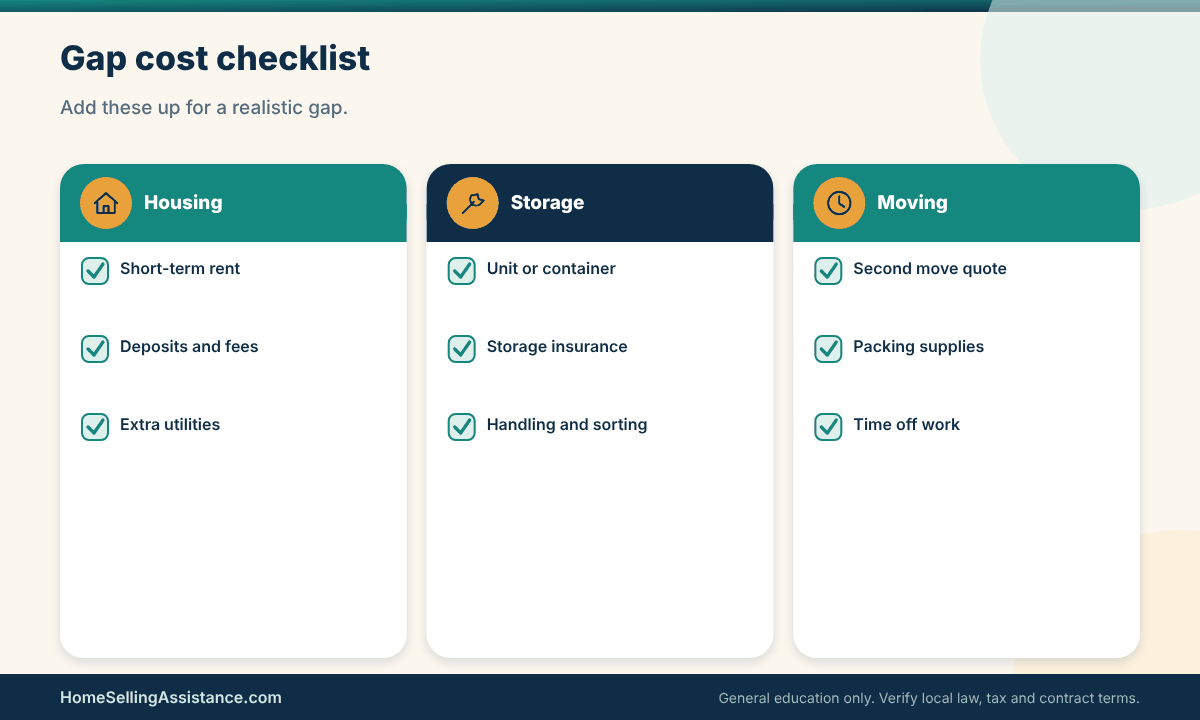
Costs to price out: temporary housing, storage, double moves and utilities
Temporary housing comes in several forms. A furnished short-term rental is convenient but usually priced at a premium. A month-to-month apartment lease is cheaper but may require a deposit and sometimes a fee for flexibility. Staying with family costs little in cash and can cost a lot in patience. Our guide to temporary housing between selling and buying compares these options in more detail.
Storage has its own arithmetic. Price a unit, any insurance, the cost of moving items in and out, and the time spent sorting. Some sellers use the gap as a reason to declutter seriously, which lowers storage costs and sometimes helps staging before the sale. A portable storage container delivered to the driveway can also avoid one handling step, though local rules and HOA covenants may limit where containers can sit.
Add the double move. Even if you do most of the packing yourself, a second truck, boxes, tape, and a day or two off work add up. Finally, remember small duplications such as a utility connection fee at the new address, mail forwarding, and the cost of eating out more than usual while your kitchen is in a box.
The checklist below pulls those items together so nothing slips through when you build your own estimate.
Take a moment to compare how different sellers experience the gap. A household without children, working remotely, may treat a short rental as a minor adventure. A household with school-age children, pets and a home office may find that every week matters. Those who sell house before buying another and plan the school calendar, pet policies and work setup in advance usually have a calmer gap than those who plan only the closing.
A scenario: three months in a rental, and the clean offer that followed
Consider a hypothetical seller, illustrative only, who sold first and rented a month-to-month apartment. Their house sale closed on a schedule they chose, so they had cash and a pre-approval refreshed against their new, simpler finances. They toured homes on weekends without the pressure of a closing date hanging over them.
After a few offers on other homes did not work out, they found a house whose sellers cared about a quick, certain closing. Their offer carried no home-sale contingency and a short financing timeline, which the sellers valued. The seller still accepted a modest price compromise elsewhere, so the offer was not a magic key, but it did reduce one major worry the sellers had.
The trade-off was real: roughly three months of rent plus storage and a second move. Whether that is acceptable depends on how those costs compare with the alternatives for your household. The point of the scenario is the shape of the trade, not the exact numbers.
A final point on this route concerns your belongings and your routine. Sellers who sell house before buying another often discover that the gap is easier when they plan it as a real chapter rather than an inconvenience. That means choosing which items travel with you, which go to storage and which are sold or donated before the move. It also means keeping essentials, such as medications, work equipment, school items and important documents, in one clearly labelled place you can reach without opening a storage unit.
Mail, subscriptions, voter registration, insurance, and professional licenses can all be affected by a temporary address. A short list of who needs your address, and which address they should have on which date, prevents missed bills and returned packages. Closing documents in particular should reach you wherever you actually are, so give your title or escrow officer a reliable contact method and a backup.
Many sellers ask how a lender will treat them in the gap. In general terms, a lender wants to see stable income, manageable debts, acceptable credit and enough verified cash for the down payment, closing costs and reserves. When you sell house before buying another, your sale proceeds can supply the cash, and your old mortgage no longer counts against you after it is paid off. Your lender, not an article, decides what qualifies, so ask which documents they will want after closing and how long the approval stays valid.
Pre-approval letters expire, and a long gap can mean refreshing your paperwork. Avoid large new debts, big unexplained deposits and job changes during the process unless your lender has said they are acceptable, because the final review before a purchase closes often looks again at the whole file. For consumer-friendly background on mortgages, the sell first or buy first resource library links to related guides.
In short, the strongest argument to sell house before buying another is predictability, and the strongest argument against it is disruption. Neither argument wins by default. Weigh them against your own cushion, your own market and your own household, and give extra weight to whatever you cannot easily fix once the sale closes.
Alternatives: buying first, rent-backs, contingencies and bridge financing
If the plan to sell house before buying another feels too disruptive, there are several other routes, and each answers a different fear. Buying first lets you move once, but it exposes you to carrying two homes. A rent-back lets you stay in your sold home for a short, agreed period. A home-sale contingency makes your purchase depend on your sale. Short-term bridge financing can cover the overlap.
These paths are not interchangeable. Some are widely available, and some depend on your lender, your equity, your market and the seller across the table. Learn how each one works before you assume it will be on offer, because a route that sounds ideal can be unavailable or expensive in your situation.

How the alternatives work mechanically, and what each one needs
Buying first usually means you qualify for the new mortgage while your current mortgage still exists, or you use cash or a home equity line to make the purchase. You are betting that your sale will happen in time and at an acceptable price. Our article on buying a house before selling your current home goes through the financing side step by step.
A rent-back is a written agreement letting you remain in your sold home after closing, typically for a short fixed period, in exchange for rent or a daily charge, with terms covering deposits, insurance, utilities and condition. See our explainer on rent-back agreements for sellers for what to put in writing. A flexible closing date is a related tool, covered in our piece on a flexible closing date for sellers.
A home-sale contingency says your purchase is conditional on selling your current home within a set period. Sellers of the next home may view it as risk and respond with a higher price expectation, a shorter window, or a refusal, as our guide to buying with a home sale contingency explains. Bridge loans, covered in our guide to a bridge loan for a home sale, are short-term loans secured by your current home, typically with higher costs and tight terms.
A scenario: a hybrid plan that bought time without a second mortgage
Imagine a seller, again hypothetical, who wanted to avoid both a rental and a second mortgage. They listed their home and, once they had a strong offer, asked for a closing date that fit their house hunt and a short rent-back after closing, written clearly with a per-day rate, a deposit, an insurance requirement and a firm end date.
That choice kept their proceeds certain while giving them a few extra weeks to find the next home. The buyer of their house agreed because the terms were specific and the dates did not clash with the buyer’s own plans. If the buyer had needed immediate possession, the plan would have needed another layer, such as a short rental.
Your next step is to ask your agent or attorney how rent-backs are typically written locally, and whether your lender and insurer need to approve one. Some loans restrict occupancy after closing, so treat this as a question, not an assumption.
Negotiating position deserves a closer look, because it is a major reason sellers choose to sell house before buying another. Sellers of the next home usually weigh price, certainty, timing and risk. An offer that does not depend on a prior closing removes one source of doubt, and an offer with a confirmed lender and a refreshed pre-approval removes another. That can matter when several buyers compete, but it does not replace a fair price, a sensible inspection plan and reasonable timing requests.
Be careful not to oversell your own certainty. A seller who says “we have already sold” has to be ready to close on schedule and to explain where they will live meanwhile if the sale closes first. Sellers of the next home may ask for proof of funds, a lender letter and a realistic timeline, and they may prefer a buyer who is flexible on possession. Your clean position is useful only if the rest of the offer is credible too.
The table below puts the main routes side by side. Read down a column to see how one route behaves across money, time and risk, and read across a row to see which route handles a particular worry best. The entries are general patterns, so replace them with facts from your own quotes and contract wherever you can.
| Factor | Sell first | Buy first | Overlap (rent-back, flexible close) | Watch for |
|---|---|---|---|---|
| Price and net proceeds | Known after closing | Uncertain until sale | Known once under contract | Costs of any extra housing |
| Time pressure | Gap before next move-in | Pressure to sell on schedule | Short, scheduled overlap | Buyer needs possession |
| Contingencies | None needed on purchase | Often relies on your sale | Tied to the sale contract | Seller of next home refuses |
| Workload | Two moves, storage | One move, two homes | One move, careful drafting | Paperwork and insurance |
| Execution risk | Rushed buying | Two payments if sale stalls | Dates slipping | Lender or insurer limits |
| Negotiating position | Strong, no sale dependency | Strong if cash-backed | Mixed, depends on terms | Local competition |
A practical way to use the matrix is to circle the cell that worries you most in each row, then see which column collects the fewest circles. If two columns tie, the tie-breaker is usually workload or your cash cushion. Share your marked-up version with your agent, lender and, if you use one, a real estate attorney, since each will know details that change a cell.
Use a net-result decision rule instead of a gut feeling
After you have compared routes, you need a way to decide without relitigating everything every night. A net-result rule does that. You estimate, in plain numbers, what each route is likely to leave you with after price, time, cost and risk, and you pick the route whose total picture you can live with.
The rule does not need to be precise to be useful. It needs to be honest. A rough worksheet that includes the awkward items, such as storage, a second move and a possible price concession, will usually beat a clean spreadsheet that quietly leaves them out.
A price, time, cost and risk framework for choosing whether to sell house before buying another
Think of four buckets. Price is what each route is likely to do to your sale and purchase prices: for example, a seller who must close by a fixed date may accept a lower offer, while a buyer without a contingency may pay a premium or save money in negotiation. Time is how many weeks you spend in limbo. Cost is every dollar outside the two prices. Risk is the chance that something goes wrong, multiplied by how bad it would be.
Assign each bucket a rough comparison for your two or three best routes. You do not need exact probabilities. A simple scale of low, medium and high is enough, as long as you record why you chose it. Writing a reason for each rating makes weak assumptions obvious, and it makes later conversations with a lender or agent far more productive.
One caution on price: do not assume that any route guarantees a better sale or purchase price. Market conditions, buyer motivation and your own preparation decide that, and no sequencing rule overrides them.
The framework works best when you apply it to your own two or three finalists. Write each route in a single line: how it affects price, how many weeks it adds, which costs it creates and what could go wrong. Seeing the choice to sell house before buying another next to buying first, on one page, makes tradeoffs visible that stay vague in your head.
A worked illustration with round numbers, labelled illustrative only
Suppose, purely as an example, that a plan to sell house before buying another would cost about three months of temporary housing at a round figure of 2,000 per month, 300 per month for storage, and 1,500 for a second move. That totals 8,400. Buying first might cost two overlapping months of carrying costs at 3,000 per month if the sale drags, plus a modest bridge or line-of-credit fee, say 1,000, for a total of 7,000 in the case where the sale takes two months longer.
On a pure cost basis, buying first looks slightly cheaper here. But add risk. If the sale takes five months instead of two, the overlap becomes 15,000, and a price reduction to attract a buyer could add more. Choosing to sell house before buying another caps the downside at the gap length, which is under your control to a degree, while buying first leaves the downside open-ended.
The waterfall below shows the general shape of how a sale price becomes net proceeds, which is the starting figure for any worksheet like this. Your figures will come from a payoff statement, a listing agreement and a settlement estimate, not from this article.
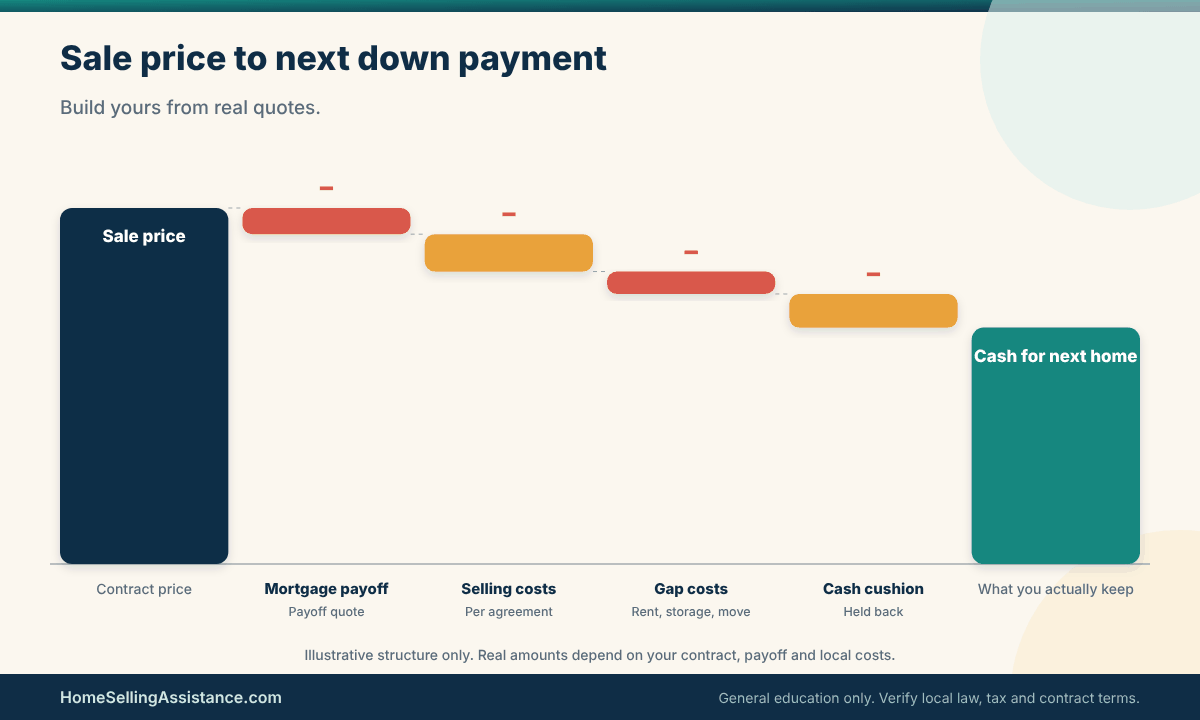
For help building the proceeds side accurately, our overview of seller closing costs lists the typical categories you will see on a settlement statement, and our category page on closing costs and net proceeds collects the related guides.
Numbers alone will not settle the question, and they should not. The aim of this exercise is to make sure that if you sell house before buying another, you do it with open eyes, and that if you decide against it, you do so for reasons you can name. A decision with named reasons is far easier to adjust when facts change than one built on habit or advice from someone else’s situation.
A scenario where the framework says sell first and your gut says no
Imagine a seller who loves their home and hates the idea of living in a rental. Their worksheet shows that a plan to sell house before buying another has a modest, capped cost, while buying first leaves them exposed if the sale slows. Their gut says to buy first, because it feels more comfortable, and a friend did it successfully last year.
The useful question is whether the gut feeling is information or just comfort. If it is information, for example a specific worry about their local market or a lender restriction, it belongs in the worksheet. If it is comfort, then the framework should win, because the discomfort of a rental is visible and temporary while a prolonged double mortgage can be harder to unwind.
The honest exception runs the other way too. If your worksheet shows a strong cash position, a hot local market for your kind of house, and a flexible lender, buying first or overlapping may be perfectly reasonable. The rule is meant to surface the trade, not to pick for you.
The scenario table below shows how common situations lean. Use it as a starting point for discussion and adjust it against your own facts. The last column matters most, because it names the single fact that would reverse the verdict.
| Situation | Route favored | Reason | Trade-off | Fact that changes the choice |
|---|---|---|---|---|
| Limited cash cushion | Sell first | Caps carrying costs | Temporary housing | Strong equity line available |
| Fixed relocation date | Sell first, flexible close | Protects the date | Less time to shop | Employer housing support |
| Hot market for your home | Overlap or buy first | Sale likely to be quick | Some price pressure | Listing sits unexpectedly |
| Scarce inventory for next home | Sell first with rent-back | Clean offer plus time | Terms need drafting | Buyer needs possession |
| Home needs repairs or has title questions | Sell first | Resolve issues before buying | Longer pre-listing work | Issues are minor and fixed |
| Downsizing with large equity | Either, based on comfort | Cash covers both homes | Carrying cost if delayed | Tax or estate questions |
Treat the table as a conversation starter rather than a ruling. The seller with a limited cushion and a strong equity line, for example, might still buy first, but only after confirming the terms and the cost of that line in writing. If tax questions affect your decision, a qualified tax professional is the right person to ask, and general background is available in IRS Publication 523 on selling your home.
Three habits keep a worksheet like this honest. First, use ranges rather than single numbers: a rental might run a month longer or shorter, and a moving quote might change when the date moves. Second, rerun the sheet whenever a big input changes, such as a new offer or a lender update. Third, share it with someone who will challenge it, because a plan that has survived a skeptical reader is stronger than one that only its author has seen.
Finally, remember that the rule decides the route, not the outcome. Even the best-matched plan can hit a slow buyer or a hard-to-find house. What the rule gives you is a way to take a hit without losing your footing, since you picked the path whose bad days you had already counted.
Consider how the rule works for different households. A retired couple choosing to sell house before buying another may have plenty of equity and a long time horizon, so the rule mostly asks them to price comfort. A growing family with a school start date may find that time dominates every other bucket. A single owner with a tight budget may find that cost and risk dominate, and a safety margin matters more than a perfect house. The same rule produces different answers because the inputs differ.
If you are unsure how to weight the buckets, try a simple exercise. Ask what you would regret more: paying extra for a calm, certain move, or saving money and then facing a stressful scramble. Your answer is not a scientific measure, yet it often clarifies which bucket should carry the most weight in your worksheet, and it helps you explain your choice to a spouse, a lender or an agent.
To sum up the rule: if you sell house before buying another, you are choosing a known cost and a capped risk over an open-ended one. If you buy first, you are choosing convenience and accepting variance. Either choice can be right, and the worksheet exists to show which one fits you.
When new evidence should change the plan
Plans made before listing are guesses, and the market will test them. Good decision-makers set triggers in advance: specific events that cause a pause or a pivot. Without triggers, people tend to push forward on a plan that stopped making sense weeks ago, because changing course feels like admitting a mistake.
Triggers should be concrete and checkable. They also should come from a calm moment, not from the stressful evening after a disappointing showing. Write them down now, share them with your household and your agent, and agree on who decides when one fires.
Write your triggers in a short list before you start. For example: if the first set of showings produces no offers, revisit the price; if the lender asks for new documents, update the timeline; if the rental ends sooner than the closing, extend it. A plan to sell house before buying another is only as strong as the triggers that keep it honest, so make them specific and share them with your agent.
Evidence to watch: showings, offers, appraisal, lender conditions and local competition
Showing traffic and feedback are early signals. If a reasonable number of buyers visit and none make offers, the price or presentation may need adjustment, and our guide to how much your house is worth helps you review the pricing logic. Offers tell you more: their prices, contingencies and requested closing dates reveal what buyers can actually do.
After a contract, the appraisal and the buyer’s financing become the next risk points. An appraisal below the contract price, a lender asking for new documents, or a buyer’s loan conditions that are slow to clear can all push the closing date. Our article on the financing contingency from the seller’s side explains how those clauses work and what options sellers typically have.
On your purchase side, watch your lender’s conditions and the local competition. If rates, lending standards or inventory change meaningfully between planning and shopping, rerun the worksheet with the new information. A plan is a tool, and a tool that no longer fits the job should be adjusted.
Another trigger is a change in your own life. A job offer that moves your start date, a family health matter or a school decision can alter the whole schedule. If that happens, revisit your decision to sell house before buying another and ask whether a different route, such as a longer rent-back or a flexible closing, now fits better. Changing your plan for a good reason is a sign of good planning.
A scenario and next step: the plan B checklist
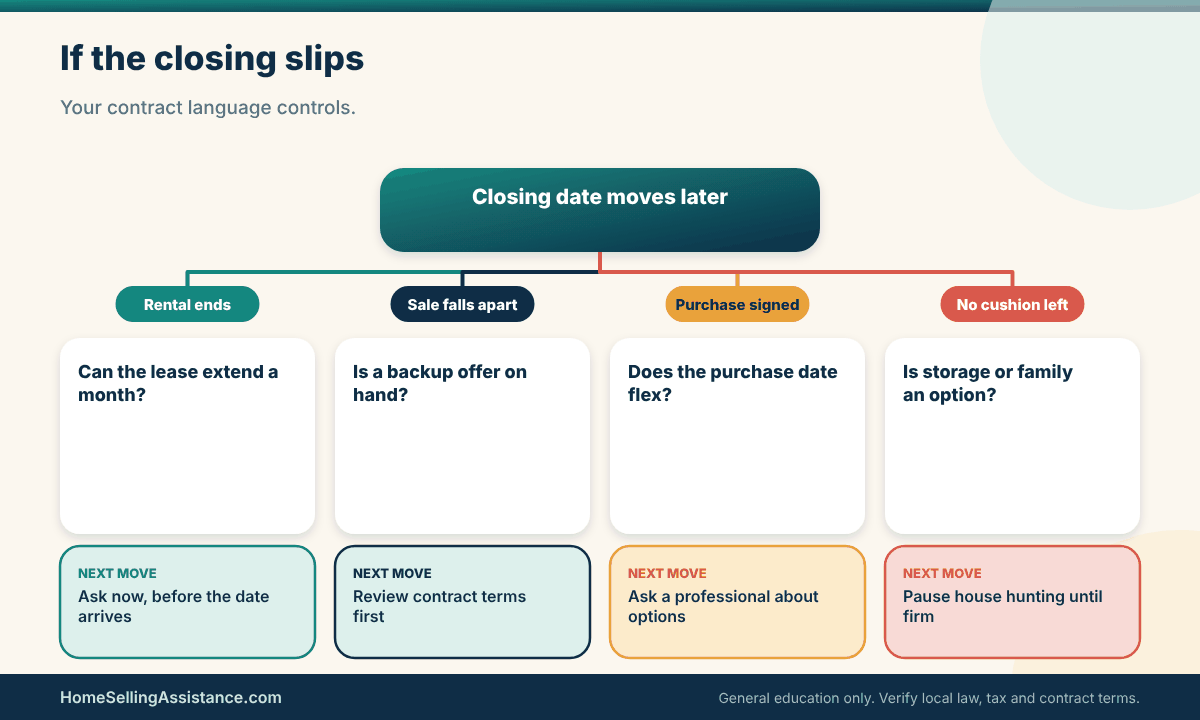
Suppose your accepted offer falls through at the lender stage while you have already lined up a short rental start date. A plan B, written beforehand, might say: relist or accept a backup offer if one exists, extend the rental by a month, and pause serious house hunting until the new closing date is firm. Having that sequence ready avoids a panic decision.
A good plan B names three things: who you will call first, what you will not spend until a new contract is signed, and the date by which you will reconsider the whole route. Different households will fill those in differently, and that is fine.
The tree below shows one way to think about a fallback when the plan wobbles. Your own tree should reflect your contract, your finances and your tolerance for delay, and it is worth reviewing with your agent or attorney before you list rather than after something goes wrong.
Once your triggers and your plan B exist, return to the broader home selling timeline and map each trigger to a date, so you can see at a glance which decisions have to be made first.
Quick scenario
A seller with a modest cash cushion lists in spring, accepts an offer with a closing date six weeks out, and signs a month-to-month lease starting a week before closing. The purchase search runs from the rental with a fresh pre-approval and no sale dependency. The cost is rent, storage and a second move; the gain is a clear budget and offers that stand on their own. Illustrative only.
If you take one practical step this week, make it a call to a lender and a call to a local agent or attorney. Ask the lender how they would treat your file if you sell house before buying another, and ask the local professional how long homes like yours take to sell and what rent-back or closing-date terms are customary. Those two conversations answer most of the early questions and keep the decision grounded in facts.
If you are still deciding, remember that you can keep your options open for a while. Getting a payoff statement, a pre-approval, quotes for storage and moving, and a pricing opinion costs little and commits you to nothing. Once you have those numbers, the question of whether to sell house before buying another becomes a comparison of real figures, which is a much easier conversation than one built on worry.
Finally, keep a record as you go. Save payoff statements, lease quotes, storage estimates and lender emails in one folder, so if you sell house before buying another and a question arises later about dates or costs, you can answer it quickly and show where each figure came from.
Frequently asked questions about sell house before buying another
Is it better to sell house before buying another?
There is no universal answer, because the better route depends on your cash, your lender, your local market and how firm your move date is. Selling first usually offers certainty and lower financial exposure, while buying first usually offers a smoother move. Build a rough worksheet of price, time, cost and risk for each route, then choose the one whose worst case you can live with.
Will I be able to get a mortgage if I sell house before buying another?
Many people do, but approval depends on your income, credit, debts and the cash you hold at the time. Selling first can simplify your file because there is no second mortgage to count, though a gap in occupancy or a change in income can matter. Talk to a lender before you list, and ask what documents they will want after closing.
Where do I live if I sell house before buying another?
Common options include a month-to-month lease, a furnished short-term rental, staying with family or friends, or a negotiated rent-back in your sold home. Each has different costs and flexibility. Price a few of them before you list, and decide which one you would use if the gap runs longer than planned.
How much does storage and a double move cost if I sell house before buying another?
That varies widely with distance, volume, season and local pricing, so any figure here would be a guess. Get written quotes from a mover or storage provider and add a margin for surprises. If you can reduce belongings before listing, you lower both storage and moving costs and often help your sale preparation too.
Does a plan to sell house before buying another help me win the next house?
It can, because an offer without a home-sale contingency may look more reliable to a seller. But the effect depends on the local market, the seller’s priorities and your other terms, so it is never a guarantee. Price, timing, financing strength and flexibility on closing or possession often matter as much as the absence of a contingency.
What is a rent-back and is it safe?
A rent-back is a written agreement that lets you stay in the home for a short period after closing, usually for a set rent or daily charge. It can work well when the terms are clear on dates, deposit, insurance, utilities and condition. Your lender, insurer and the buyer all need to be comfortable, so have it drafted by a professional familiar with local practice.
What if I sell house before buying another and the sale closes faster than expected?
Ask for flexibility before you accept an offer: a longer closing window, a rent-back, or a clause that allows you time to move. You can also line up temporary housing in advance so a fast sale does not become an emergency. Having the fallback ready lets you accept a good offer without panic.
What if I plan to sell house before buying another and the sale runs late?
That is the main reason to avoid plans that depend on one closing date. Review your price and presentation with an agent, consider whether terms such as closing flexibility could widen your buyer pool, and extend your housing arrangement if needed. If you have already signed a purchase contract, ask a professional about your options.
Is a bridge loan a good alternative to selling a house before buying another?
It can be, for some borrowers, but it is a short-term loan with its own costs, qualification rules and deadlines. It makes the most sense when you have strong equity, a realistic sale plan and a clear picture of the total fees. Compare the full cost with the cost of a rental gap before choosing, and read every term carefully.
Who should I talk to before I sell house before buying another?
A lender, a local agent or a real estate attorney (depending on your state’s customs), and a tax professional if capital gains could apply. Each sees a different part of the picture. For general financial education, the Consumer Financial Protection Bureau offers free resources on mortgages and closing.
Choosing your sequence with open eyes
Deciding to sell house before buying another is a trade of flexibility for certainty, and the right call is the one that holds up if your timeline stretches. Gather your payoff, price your temporary housing and storage, talk to a lender early, and write your triggers before you list. This article is general education, not legal, tax or financial advice, and rules vary by state and contract, so confirm the details with qualified local professionals.


