
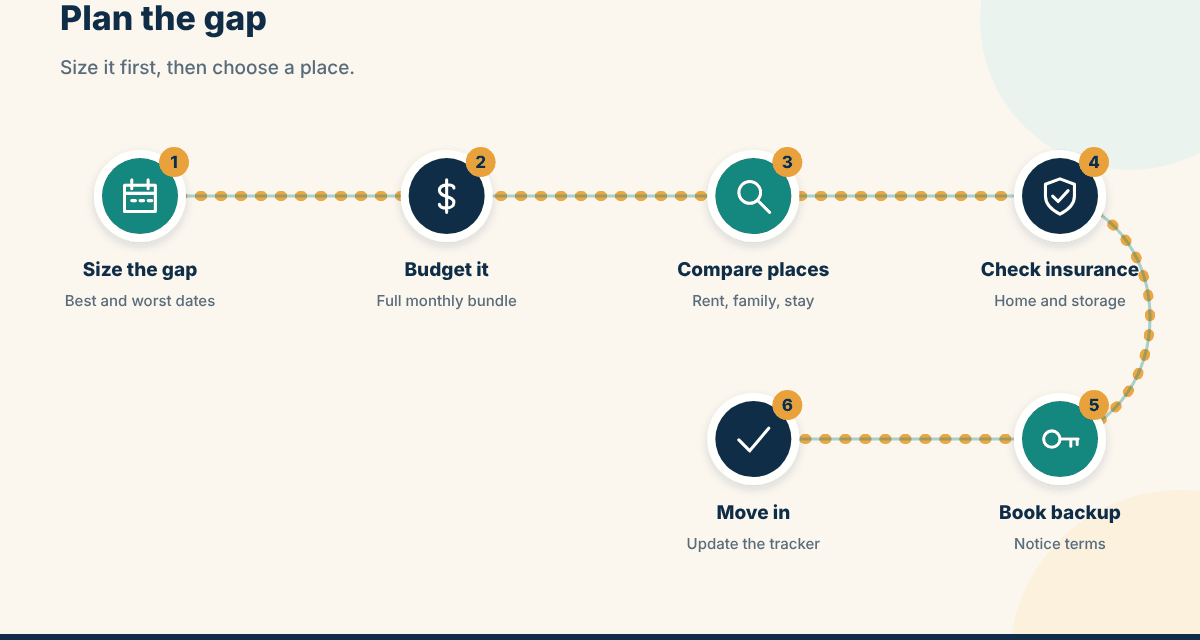
Planning temporary housing between selling buying is the part of a move that almost nobody budgets properly, because it only exists when the timing of two transactions refuses to line up. If your sale closes before your purchase does, you need somewhere to sleep, somewhere to put the furniture, and a plan for the dog, the kids and the commute. If your purchase closes first, you may be carrying two homes for a while and living in the wrong one.
The gap is rarely dramatic. With temporary housing between selling buying, the gap is usually a few weeks, sometimes a few months, occasionally a single awkward weekend. Yet those short stretches can quietly cost more than sellers expect, and they can also decide how brave you can afford to be at the negotiating table. A seller who knows a clean landing spot is waiting can say yes to a buyer’s preferred closing date. A seller who has no plan B tends to cling to contingencies and delay.
This guide to temporary housing between selling buying is built for people who already understand the basic sell-first or buy-first question and now need the practical layer underneath it. We look at short-term rentals, extended stays, staying with family, storage, and what to do with pets, and we price each one the way a closing statement would: line by line, with the hidden items included. Every dollar figure in the article is a round illustration, not a quote or a typical local number.
We also keep the legal edges honest. Lease terms, landlord rules, storage laws, insurance and contract language vary by state and by company, so you will see where to check rather than a promise about what your situation allows. Think of this as the plain-spoken friend who has watched many closings slip by a week and knows which small preparations made the difference.
Key takeaways
- Size the gap before you pick a place. Temporary housing between selling buying looks different when a two-week stopgap and a four-month stopgap call for different solutions, so start with the dates in your contracts.
- Price every option as a full monthly bundle. Rent, deposits, utilities, storage, extra moves, parking, pet fees and double commuting all belong in one number.
- Flexibility has a price tag. Month-to-month terms usually cost more per night or per month than a long lease, but they protect you if a closing moves.
- Family can be the cheapest option and the most fragile one. Agree on dates, rules and an exit in advance, and keep a paid backup ready.
- Storage and pets are where plans quietly break. Check insurance, access hours, climate control and pet policies before the move-out date, not after.
- Rules vary by state and contract. This is general education, so confirm leases, insurance and closing terms with the actual documents and licensed professionals.

Define the real choice behind temporary housing between selling buying
Before you browse a single rental listing, decide what question you are actually answering. Many sellers think temporary housing between selling buying means choosing a place to stay. In truth they are choosing how much flexibility to buy, how much disruption to accept, and how much money to spend to protect the sale and the purchase from each other.
That framing matters in temporary housing between selling buying because the cheapest place to stay is not always the cheapest outcome. A free guest room that forces you to accept a weaker offer can cost more than a pricey furnished apartment. The sections below help you pin down your goal, your cash picture and the facts that could change everything.
Goal, timeline, cash and tolerance for a short-term base
Start by naming your goal in one sentence. Examples include “close on the sale by the end of the month and land in the new house with one move,” or “keep the kids in the same school until June,” or “spend as little as possible and accept some hassle.” Your sentence sets your priorities. Without it, every option looks equally reasonable and the decision turns into whichever listing you saw last.
Next, sketch a timeline with three anchors: the likely closing date of your sale, the likely closing date of your purchase, and the date you must be out of the old home. Those three dates produce the gap. Sometimes the gap is negative, meaning you close on the purchase first, and the problem becomes overlap rather than homelessness. Both versions need a plan, but they use different tools.
Then take an honest look at cash. Temporary housing between selling buying pulls money in several directions at once: earnest money on the purchase, moving costs, deposits, possibly a down payment that depends on the sale proceeds. If your down payment is tied up in the house you are selling, your temporary housing budget competes with it. That competition is why it helps to read your home sale net proceeds estimate before you commit to a lease.
Finally, measure tolerance. Some people can live out of two suitcases for a month and think of it as an adventure. Others, especially with school-age children, a remote job, a medical routine or an elderly parent, need stability. Neither is better. The point is to be candid about what you can live with, because a plan you resent tends to fall apart at the first delay.
Numbers to pull before you price any stopgap
Gather a small set of figures for temporary housing between selling buying and write them on one page. First, your expected gap in weeks, with a best case and a worst case. Second, the monthly cost of your current home, because you may still be paying it until closing. Third, the amount of cash you can spend without touching the money earmarked for the next down payment or closing costs. Fourth, the number of people, pets and vehicles that need a place.
Add the fixed one-time items that every plan shares: moving the household once or twice, packing supplies, cleaning, utility transfers and any storage setup. Those costs show up in almost every scenario, so listing them separately keeps you from double counting. They also help you compare a plan that needs two moves with a plan that needs three.
For the documents side, pull the purchase contract, the sale contract, and any addendum that mentions possession, occupancy or a rent-back. Possession terms are where a lot of surprises hide. Our article on move-out date versus closing date explains why the day you sign and the day you hand over keys are not always the same day, and that difference is exactly the slack you are trying to price.
A useful trick is to build three versions of the same budget: tight, expected and stretched. The tight version assumes everything closes on schedule. The expected version adds two weeks. The stretched version adds six weeks. If the stretched version breaks your finances, you need a different approach or a bigger cushion before you list, not after you accept an offer.
A scenario: the three-week gap and the three-month gap
Picture two sellers planning temporary housing between selling buying for the same house with different gaps. The first expects the sale to close on the first of the month and the purchase on the twenty-second. Three weeks is short enough that a furnished rental, an extended-stay room or a spare room can all work. The decision turns on convenience, and most of the money goes to the second move and to storage for a few weeks.
The second seller expects a gap of about three months because the new home is under construction and the builder’s date keeps slipping. Three months changes the math. A month-to-month rental, a short lease with a sublet clause or a furnished rental with a clear monthly rate starts to look better than a nightly stay. It also makes storage a real line item instead of an afterthought.
Here is a small illustration with round numbers, purely for teaching. Suppose a furnished rental costs 2,400 dollars a month, a storage unit costs 200, and an extra move costs 900. A three-week gap might total a little under 2,000 for rent plus 200 for storage and 900 for the move, roughly 3,100. A three-month gap would be about 7,200 for rent, 600 for storage and the same 900, closer to 8,700. Your own local numbers will differ, but the shape of the comparison holds.
Your next step in either case is the same. Write down the best and worst gap, and then decide what you would do if the worst case arrived. If you do not have an answer, the sale contract is probably the first thing to revisit. A flexible closing window, covered in our guide to the flexible closing date, can shrink a nasty gap before it starts.
Facts that can change the plan overnight
In temporary housing between selling buying, some facts are stable and some are fragile. Your mortgage payoff is fairly stable. A buyer’s loan approval, an appraisal, a builder’s completion date or a seller’s willingness to move out can shift without much warning. A good plan separates the stable facts from the fragile ones and gives each fragile fact a trigger date, a date by which you will know more and can act.
The fragile facts also tend to cluster around the two contracts. If your sale depends on the buyer’s financing and your purchase depends on the sale closing, then a single delay ripples through both. That is why a home sale contingency, discussed in our article on buying with a home sale contingency, deserves a careful read before you rely on it.
Other fragile facts sit outside the contracts. Seasonal demand for short-term rentals, local events that fill extended-stay rooms, a landlord’s willingness to accept a short lease, and a relative’s changing circumstances can all affect availability. Booking a base early, with a cancellation policy you understand, is often cheaper than trying to find one in the last week.
Contract dates and documents that set your real gap
Read your contracts for four things that shape temporary housing between selling buying: the closing date, the possession date, any extension rights and any penalty for delay. Closing is the date title transfers. Possession is the date the buyer can occupy. In many transactions they coincide, but a written agreement can separate them, and that separation is what allows a rent-back or a delayed move-out. Never assume. Look for the clause itself.
Look at the financing and inspection deadlines too. A financing contingency date tells you when the buyer’s loan should be firm, and an inspection period tells you when repair negotiations should end. After those dates pass without a problem, the risk of a late collapse usually drops, though it does not vanish. That is the moment many sellers choose to sign the longer lease or book the longer stay.
Check any rent-back terms. A rent-back lets you stay in the home you sold for a short period after closing, usually under a written agreement with a daily or weekly charge, a deposit and insurance rules. It can be the simplest stopgap there is. Our guide to the rent-back agreement walks through the paperwork, and the terms vary by contract and by state.
Finally, confirm what the purchase contract says about the builder’s or seller’s delivery date if you are buying something that is not finished or not yet vacant. A new-construction contract often includes language about estimated completion, and the estimate is not a promise. Ask the builder or the listing agent, in writing, how and when delays will be communicated, and plan your stopgap around the later date.
When the gap grows: a scenario and a next step
Imagine a family handling temporary housing between selling buying that has booked a four-week furnished rental to cover the gap. In week three, the buyers of their home ask for a short extension because their lender needs another few days. The family can say yes, but their rental ends in a week and the host has another guest arriving. That is the moment a plan either flexes or snaps.
A resilient plan has a second option already mapped out. It might be a longer booking with a free-cancellation window, a month-to-month lease with a notice period of thirty days or less, or a relative with a spare room for a short overflow. The family does not need to use the backup. They only need to know where it is and what it would cost to switch.
The next step is to rank your options by two measures: how quickly each can be lengthened, and how quickly each can be ended. An option that is easy to extend and easy to cancel is worth paying a premium for when your dates are uncertain. An option that is cheap but rigid is better when your dates are firm. We look at that trade-off in detail in the next part of the article.
If the delay comes from the purchase side instead, consider whether it is worth asking the seller of your new home for an earlier possession date, a short rent-back or a closing-date swap. Sometimes a small concession on timing opens a door that money cannot. Always put any such agreement in writing and have it reviewed by your agent or attorney before you rely on it.
Compare the realistic places to land during temporary housing between selling buying
Once the gap has a size, you can compare actual options. Most sellers handling temporary housing between selling buying end up choosing among four families of solutions: a short-term or furnished rental, a stay with relatives or friends, a rent-back in the home they just sold, or a blend of storage plus a smaller base. Each one trades cost, privacy, flexibility and effort differently, and none of them is the best answer for everybody.
The decision matrix below puts the main options side by side on the factors that matter to a seller: what the money looks like, how flexible the dates are, how much work it takes, and what usually goes wrong. Read it as a conversation starter, not a verdict. Your local market, your household and your contracts will move the entries around.
| Option | Cost shape | Date flexibility | Workload | Main execution risk |
|---|---|---|---|---|
| Furnished short-term rental | Higher monthly rate, few extras | High, if the host allows extensions | Low once booked | Host cancels or next booking blocks an extension |
| Unfurnished lease, 6 to 12 months | Lower rent, plus deposit and furniture or storage | Low, early exit may cost fees | Medium to high | Paying for months you no longer need |
| Month-to-month rental | Premium over a long lease | High with a notice period | Medium | Landlord raises rent or ends the term |
| Relatives or friends | Low cash, high goodwill cost | Medium, depends on the host | Medium | Strain grows as the stay stretches |
| Rent-back after closing | Daily or weekly charge, deposit | Fixed by written agreement | Low | Buyer’s lender or insurer objects |
| Extended-stay hotel | Nightly rate, taxes and fees may apply | High, short notice | Low | Small space for a family or pets |
To use the matrix, circle the one or two rows that fit your household size and gap length, and then check the last column. If the main risk for a row is something you cannot tolerate, such as a host who might cancel, move that row down your list. The goal is not to find a perfect option. It is to find the one whose worst case you can survive.
Short-term rentals, extended stays and month-to-month leases
Rentals are the most common answer to this problem, and for good reason. They give you a door that locks, a kitchen, and a predictable monthly cost. The differences between them, though, are wide enough to matter. A furnished apartment on a corporate-housing platform, a vacation-style short-term rental, an extended-stay hotel suite and a traditional month-to-month lease can look similar online while carrying quite different terms.
In temporary housing between selling buying, furnished options save you from moving everything twice, which is often the biggest hidden expense. Unfurnished leases save money on rent but force a second truck, a second set of helpers and possibly a storage unit. If your gap is short, the furnished route often wins on total cost even though the monthly price looks higher. If the gap is long, the arithmetic may reverse.
Check the cancellation and extension terms before you fall in love with a photo. Many short-term hosts reserve the right to cancel, and some hosts block calendars after your dates. Ask in writing whether you can extend, how much notice you must give, and whether the rate stays the same. A flexible month-to-month arrangement with a clear notice period may be worth more to you than a prettier unit with a rigid end date.
Local rules for temporary housing between selling buying differ, and they can affect your rights as a guest or tenant. Some places treat stays beyond a certain number of days as a tenancy with its own protections, while others treat them as lodging. Do not guess. Your state or city housing office, a local tenants’ resource or an attorney can tell you which rules apply to your stay, and the lease or booking terms control the practical details.
What to read in a rental agreement and the true monthly cost
Start with the number most people skip when pricing temporary housing between selling buying: the true monthly cost. Add the rent to the utilities if they are not included, internet, parking, a security or cleaning fee, pet charges, renter’s insurance if required, and any taxes on short stays. Then add the deposit, remembering that it ties up cash even if it comes back later. A listing that says 2,200 dollars can easily behave like 2,700 once the extras arrive.
Read the termination clause twice. Look for the notice period, early-exit fees, the process for returning keys and the date your deposit is due back. If the lease says you owe the rest of the term when you leave early, price that risk. A six-month lease with a heavy early-exit clause is a bet that your gap will be at least six months, and that is a bet you may lose.
Check what is included. Is the unit really furnished, with linens, kitchenware, a working desk and reliable internet if you work from home? Are there laundry facilities? Are there limits on guests, parking for more than one vehicle or storage space for your overflow? Ask for photos and a list instead of trusting a headline. Surprises here do not bankrupt anyone, but they sour a stay quickly.
Finally, protect yourself from rental fraud. Scammers copy real listings, ask for deposits by unusual payment methods and push for urgency. The Federal Trade Commission publishes consumer protection guidance on rental listing scams. Tour the unit or video-call the host, verify ownership where you can, use traceable payment, and never wire money to someone you have not verified.
Scenario: furnished rental for a family with school-age children
In a temporary housing between selling buying example, a family of four expects to close on the sale in early spring and on the purchase about six weeks later. The kids need to stay in their school, and the parents both commute. They look for a furnished two-bedroom within a short drive of the current neighborhood, accepting a higher monthly rate in exchange for flexibility and for one move instead of two.
They book for two months with a clear extension option and a written notice period. They put most belongings into a climate-controlled storage unit, keep a few boxes of essentials, and keep a small buffer in their budget for a possible third month. When the purchase closes a week late, the extension option saves them from a scramble.
The trade-off is cost. A furnished rental with a flexible term may run well above a standard lease, and a family may feel cramped. What they buy is the ability to absorb a delay without panic. Families with different priorities, such as maximum savings, might choose differently, and that is fine as long as the choice is deliberate.
The fact that could change their choice is the stability of the dates. If the new home were move-in ready with a firm possession date, a shorter booking would have done the job. If the new home were still being built, they might have chosen a month-to-month lease instead. Dates drive the plan, which is why the earlier work on contract deadlines pays off.

Family, friends, storage and pets: the low-cash alternatives
Staying with relatives or friends is the oldest answer to temporary housing between selling buying, and it can be a kindness on both sides. It can also be the most fragile arrangement on this page, because it runs on goodwill rather than a contract. The same generosity that makes the first week lovely can wear thin by the fifth, especially when children, pets, work schedules and different habits collide.
If you take this route, treat it with the same care you would give a lease. Agree on the start date, the expected end date and what happens if the dates move. Talk about food, utilities, quiet hours, parking and guests. Offering to contribute, even modestly, signals respect and keeps the arrangement from feeling like a favor with no end. Conversations like these feel awkward for five minutes and save weeks of resentment.
Storage belongs in almost every temporary housing between selling buying plan, whether you stay with family or rent a furnished unit. The simplest approach is to move once into storage and once out, rather than shuffling boxes between rooms. A good storage plan chooses the right size, the right access hours and the right protection for the contents, and it recognizes that some things should never go into a unit.
Pets deserve their own paragraph because they cause more last-minute scrambles than any other detail. Many rentals and extended-stay hotels limit pets, charge pet deposits or monthly pet fees, restrict breeds or sizes, or exclude animals entirely. Policies for assistance animals follow different rules than ordinary pet policies, and the HUD fair housing resources explain the general framework. Ask early, and ask in writing.
Storage, insurance and the pets question
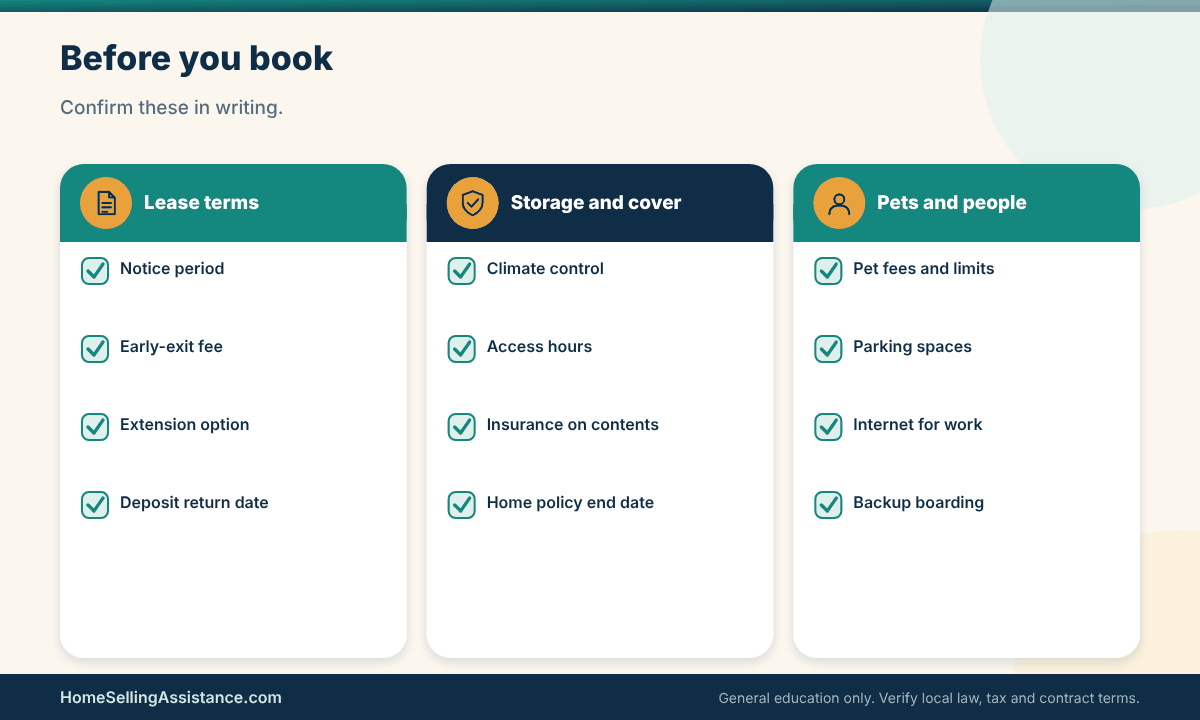
For storage during temporary housing between selling buying, compare facilities on four points: climate control, security, access hours and the contract terms. Ask about minimum rental periods, rate increases after the first months, late fees and what happens if you miss a payment. Ask what the facility insures and what it does not. Many facilities do not insure your belongings, and you may need your own coverage.
Check your homeowner’s or renter’s insurance policy and ask the agent whether belongings in storage or in a temporary rental are covered, and whether coverage changes once you no longer live in the old home. Coverage rules differ by insurer and state, and a quick call can prevent a painful surprise. Also confirm when your current homeowner’s policy should end and your new one begin, so you are never uninsured in the gap.
Keep valuables, documents, medication, chargers and anything irreplaceable with you rather than in storage. Label the boxes you will need first. Photograph the contents of the unit and keep a simple inventory. If you are moving a household with antiques, electronics, musical instruments or anything sensitive to heat, ask about climate-controlled space instead of the cheapest option.
For pets, make a short checklist. Confirm the pet policy and fees in writing before you book. Check the rules about size, number and breed. Ask about nearby walking space, vet access and noise. Prepare a backup, such as a friend’s yard or a boarding facility, for the days around the move itself, when doors are open and routines are upended.
Scenario: staying with relatives, and the exit plan
A single seller planning temporary housing between selling buying expects a gap of about five weeks. A sibling offers a spare room, with a dog of their own and two teenagers in the house. The seller says yes gladly, but first they sit down with the sibling and agree on a start date, an expected end date and a rough plan for groceries and utilities.
They also agree on what happens if the gap runs longer. The sibling says they are comfortable with up to eight weeks, after which they would prefer a different arrangement. The seller quietly identifies a month-to-month rental as the fallback and notes its likely cost, so there is no panic if the closing shifts. The family stay stays cheerful because the boundaries were clear from the start.
The trade-off is privacy and independence, plus the cost of any friction. The fact that could change the choice is a longer delay than expected. When the gap stretches, the seller’s best option may shift from family to a paid rental, and having the numbers ready makes that switch calm rather than dramatic.
If you have a dog, a cat or a more unusual companion, add the pet to that conversation early. A host who loves you may still be nervous about a new animal in their home, and a polite question now beats an awkward standoff later. Bring crates, bedding and your own supplies, and keep vaccination records handy in case a boarding facility or vet becomes necessary.

Use a net-result rule for temporary housing between selling buying decisions
Comparing temporary housing between selling buying options by feel works until the first surprise. A net-result rule works better, and it is simple: choose the option whose total cost and total risk you can live with across the best and worst version of the gap, not the one with the lowest advertised price. Total cost includes money, time, effort and the effect on your two transactions.
This matters because temporary housing between selling buying is not an isolated expense. It interacts with the offers you accept, the closing dates you agree to and the cash you will have on the day of the purchase. A plan that saves a few hundred dollars but makes you reject a strong offer is a bad trade. A plan that costs a little more but lets you accept the right offer may be a good one.
A price, time, cost and risk framework
The framework for temporary housing between selling buying has four questions. What is the total price of this option across a tight, an expected and a stretched gap? How long can I keep it, and how long can I shorten it? What does it cost in work, disruption and second moves? And what is the worst thing that could happen, and could I recover from it? Write short answers for each option and compare them side by side.
Price should include everything in the bundle. Time should include both the extension and the exit, because a stopgap that cannot stretch or shrink is a bet on your dates. Cost in effort should include the second move, the commute and the disruption to children, pets and work. Risk should include contract risk, such as a delayed closing, and personal risk, such as a host who changes their mind.
Many sellers also consider the effect on negotiating position. A seller who has a ready landing spot can offer a buyer a flexible closing or even a short rent-back, and those terms often make an offer more attractive. Our guide on the flexible closing date explains how timing terms and price can trade against each other, and the specifics always depend on the market and the buyer.
Building the gap budget line by line
A temporary housing between selling buying budget is a short list with a subtotal for each item. Begin with housing: rent or nightly charges, deposits, utilities, internet, parking and pet fees. Add storage: the unit, any insurance and the extra trips. Add moving: the move into the stopgap, the move out, and the possibility of a third move if you must change places mid-gap. Add the carrying costs of the home you still own, which continue until closing.
Then add the quieter items. Meals can cost more when you lack a full kitchen. Mileage can rise when the temporary base sits farther from work or school. Laundry, cleaning and replacement of forgotten items add up. A cushion of ten to fifteen percent of the total is a sensible way to avoid false precision, and you can choose a different cushion to suit your own risk tolerance.
Here is an illustrative example. Say a six-week furnished rental costs 3,600 for rent, 400 for fees, 250 for utilities and parking, 200 for storage, 900 for the extra move and 400 for added meals and mileage. That totals 5,750. With a cushion of about one tenth, you plan for roughly 6,300. The numbers are made up for teaching, and your own will differ, but the structure gives you a defensible figure.
Once the budget exists, compare it with the cash you can spare. The proceeds from your sale arrive after closing, not before, so use cash you actually hold today. If the number feels too large, look at which line items you can trim and which only look trimmable. Our net proceeds guide and the overview of seller closing costs show how to estimate what you will really keep.
Quick scenario
Two sellers face temporary housing between selling buying for about eight weeks. One chooses a free spare room and cuts the budget to almost nothing, but the arrangement sours after five weeks and a rushed rental costs extra. The other pays a higher monthly rate for a flexible furnished unit and stays calm through a two-week delay. Neither choice is wrong in general. The first ignored the exit plan, and the second priced the flexibility.
The scenario table below turns the temporary housing between selling buying framework into a quick reference. Each row describes a seller situation, the route that usually fits, the reason, the trade-off and the fact that could change the choice. Use it to sanity-check your own plan, and remember that real life blends rows. Most people end up with a mix of storage, a short rental and a family backup.
| Situation | Route favored | Reason | Trade-off | Fact that changes the choice |
|---|---|---|---|---|
| Gap of about two to three weeks | Extended-stay room or spare room plus storage | Short stay, low setup effort | Tight space, little privacy | Pets or children need more room |
| Gap of two to four months, family with children | Furnished rental with extension option | One move, school stability | Higher monthly rate | School calendar or a firm possession date |
| Unknown gap, new construction pending | Month-to-month rental plus storage | Dates may slip | Premium over a long lease | Builder commits to a written date |
| Strong family support, short gap | Stay with relatives, paid backup mapped | Low cash cost | Privacy and goodwill | Gap runs beyond the host’s comfort |
| Buyer wants a quick closing | Rent-back or flexible closing combined with a short rental | Stronger offer terms | Insurance and agreement details | Lender or insurer objects to occupancy |
| Relocating for work from another state | Employer-assisted furnished housing or corporate stay | Fewer moving parts | May cap length or location | Employer policy and tax treatment |
To use the table, find the row closest to your situation and read across. If the fact that changes the choice already applies to you, shift to the next closest row. For relocation, our overview of selling a house while moving out of state covers the long-distance problems that make a furnished base more attractive.
Scenario: two options with the same sticker price
For temporary housing between selling buying, consider two rentals that both advertise 2,500 dollars a month. The first is a six-month lease with a deposit equal to a month’s rent, no furniture and an early-termination fee. The second is a month-to-month furnished unit with a small cleaning fee and a thirty-day notice period. On paper they match. In practice their costs diverge sharply once your gap turns out to be two months instead of six.
With the lease, you may owe several more months or pay a fee, and you need a truck, helpers and storage for any extra furniture. With the furnished unit, you pay for two months and leave. If your gap is certain to last half a year, the lease could win. If the gap is uncertain, flexibility is worth real money, and the net-result rule shows why.
The takeaway is not that flexible options always win. It is that sticker prices hide differences in exit cost, extra moves and furniture. When two options look equal, ask each one the same questions: what happens if I leave early, what happens if I need to stay longer, and what extra work do I take on? The answers usually break the tie.
If you are unsure, build the budget both ways, a short gap and a long gap, and compare the totals. The option that stays reasonable in both versions is usually the safer pick. If one option is great in the short version and awful in the long version, treat it as a gamble and decide whether you are willing to place it.
When new evidence should change your temporary housing between selling buying plan
A plan is a living document. The day you build it is the day you know the least, and every contract milestone adds information. Treating your temporary housing between selling buying plan as fixed is a mistake, and so is changing it on every rumor. The sweet spot is a short list of triggers that tell you when to extend, shorten, switch or hold.
Triggers for temporary housing between selling buying usually come from three sources: the sale contract, the purchase contract and the housing market itself. A buyer’s lender asking for more time, an appraisal that comes in below the contract price, a builder revising a completion date, or a seller of the home you are buying asking for a delay each deserve a plan review. So does a change in your own life, such as a job start date or a family need.
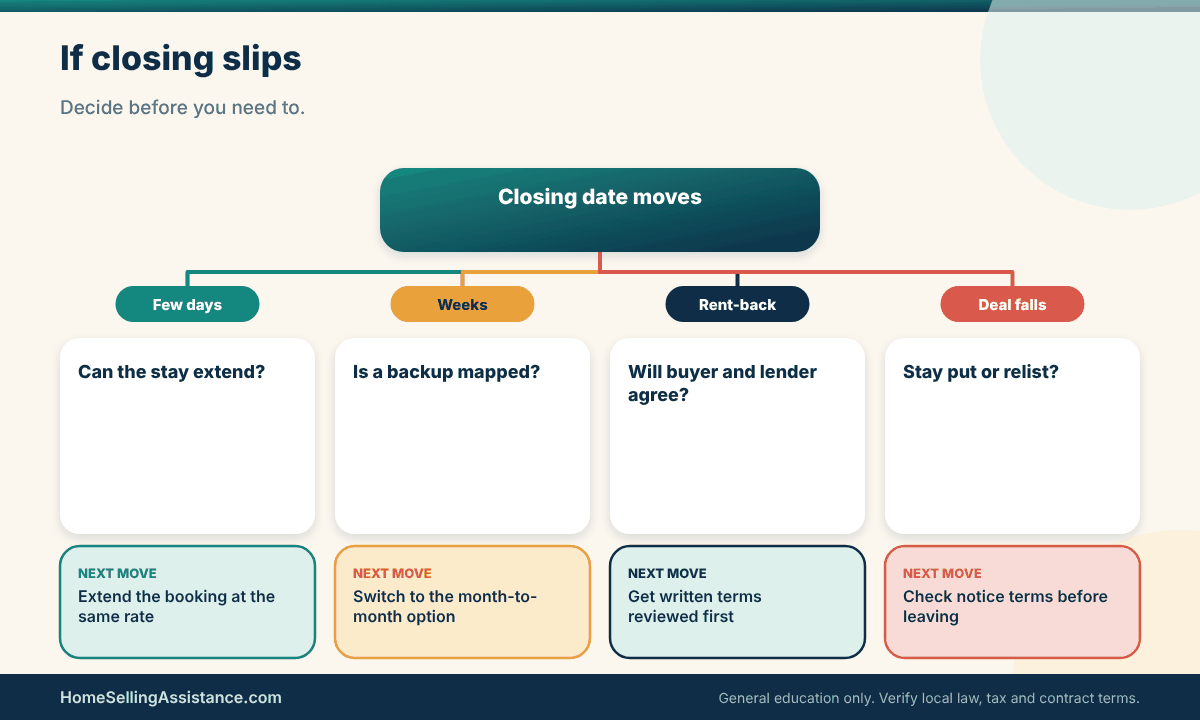
Each trigger should come with a decision. If the closing slips by a few days, you may simply extend the booking. If it slips by weeks, you may need to compare options again. If the deal falls apart, you may need to stay put, relist, or look for a different home entirely. Thinking about these branches early keeps you from deciding under stress.
Triggers to watch and who to call
Keep a one-page tracker with the key dates and the person to call for each. For financing questions, that is the loan officer or the buyer’s agent. For title and closing logistics, it is the title or escrow officer. For possession and rent-back questions, it is your agent or attorney. For the temporary housing itself, it is the host, landlord or property manager, with their notice terms written beside their number.
Look at the dates your contracts set for key checkpoints: inspection response, appraisal, loan commitment, final walkthrough and closing. Place a reminder a few days before each one to ask, “has anything changed that affects where I will be living?” The answer will usually be no. When it is yes, you will have days instead of hours to adjust, and that gap often saves a few hundred dollars and a lot of nerves.
Also pay attention to financial triggers. If your bridge or down payment depends on the sale proceeds, a delay in closing can ripple into your purchase. The article on bridge loans for buying before selling explains one tool some buyers use, with real costs and qualification hurdles, while the guide to buying before selling your current home covers the overlap version of the problem.
If you feel overwhelmed by the numbers, a HUD-approved housing counselor can help you think through a budget and your options. You can find one through the HUD housing counselor directory. Counselors offer education and guidance, not legal or investment advice, and many services are free or low cost, though availability and scope vary.
Scenario: the closing slips, and what to do next
A couple managing temporary housing between selling buying booked a furnished rental for five weeks and scheduled their move for the day after closing. Four days before closing, the buyers’ lender asks for additional time. The new date is a week later, and the rental has no extension available. The couple’s calm response depends on what they prepared earlier.
Because they listed a backup in advance, they call a month-to-month landlord they had already contacted and confirm a short stay, and they also ask the sale buyers about a brief rent-back. They check with their agent about the written terms and compare the total cost of each option. They do not panic. They choose the lower total, and they update their tracker.
The next step for any reader is to write a “what if” line next to each contract date. What if it moves a week earlier, a week later, or falls through? Even a rough answer will make you faster and calmer. If the delays start piling up, it may be time to revisit the bigger question, whether to sell first or buy first, in the overview of the sell-first or buy-first decision.
If the sale falls through altogether, you may stay in the home, relist or accept a different offer, and you may need to release or extend your stopgap. Contract language on deposits, termination and notice decides what you owe, so keep copies of everything and ask a licensed professional before you act. A stopgap with a short notice period is cheap insurance against this outcome.
Frequently asked questions about temporary housing between selling buying
How long does temporary housing between selling buying usually last?
There is no universal answer, because it depends on how the two closing dates line up. For some sellers it is a few days, for others a few months. Build your plan around a best case and a worst case instead of a single date, and revisit it whenever a contract deadline moves.
What is the cheapest way to handle temporary housing between selling buying?
Staying with relatives or friends usually costs the least in cash, but it can carry a cost in privacy and goodwill. A short rent-back in the home you sold can also be inexpensive. Cheapest is not always best, so compare total cost and risk using the net-result rule above.
Should I rent furnished or unfurnished while I wait?
Furnished places tend to suit short or uncertain gaps because you avoid a second moving cycle. Unfurnished leases tend to suit longer, firmer gaps where lower rent outweighs the extra moving work. Compare the full bundle, including deposits, storage and early-exit terms, before you decide.
Can I stay in my house after the sale closes instead of using temporary housing between selling buying elsewhere?
Sometimes. A rent-back agreement lets a seller remain for a defined period under written terms, but the buyer, the lender and the insurer must agree, and rules differ by state and contract. Read our guide to the rent-back agreement and ask your agent or attorney to review the paperwork.
Is it better to sell first or buy first if I want to avoid a gap?
Neither route removes risk. Selling first can create a gap in housing, while buying first can create overlap in payments. Our overview of sell first or buy first and the article on selling before buying another home compare the trade-offs in more detail.
How do I protect belongings in storage during temporary housing between selling buying?
Ask the facility what it covers, and then ask your insurance agent whether your policy extends to stored items. Choose climate control for sensitive items, take photos and keep an inventory. Keep documents, medication and valuables with you instead of in the unit.
What if my pet is not allowed at the rental?
Ask about pet policies before you book, because fees, size limits and breed restrictions are common. Rules for assistance animals follow different standards than ordinary pet rules. If a rental cannot take your animal, consider another unit, a friend’s home or boarding for the short transition.
Do I need to tell my lender or insurer about a temporary move?
If you still own the old home, your insurer may have rules about vacancy or occupancy, and your lender may have occupancy requirements for the new loan. Ask both before you move, and get answers in writing where you can. Requirements vary by company and loan type, so general assumptions are risky.
When do I actually receive my sale proceeds?
Proceeds usually arrive after closing and funding, and the timing depends on your state, title company and method of disbursement. Our article on when the seller gets money after closing explains the typical sequence. Do not count on funds you do not hold yet when you commit to a lease or deposit.
Could I keep the old house as a rental instead of moving twice?
Some owners consider renting out the home they own rather than selling immediately, but that is a different decision with tax, landlord and financing consequences. Our guide to selling versus renting out your house and the IRS publication on rental property are good places to begin. A licensed tax professional can discuss your facts.
The best time to plan your temporary housing between selling buying stopgap is before you list, because that is when you have the most room to choose. Start with the seller checklist before listing, then add your gap budget and your backup option. Our home selling timeline and the article on moving out before selling a house help you place these steps in order.
For more articles on temporary housing between selling buying, browse the sell first or buy first category, and for moves that cross state lines or involve a smaller home, see the relocation and downsizing category. If your plan includes a smaller place, the guide to downsizing and selling your home is a useful companion.
Plan the gap, then stop worrying about it
A good plan for temporary housing between selling buying is not about perfection. It is about knowing your dates, pricing the real monthly bundle, keeping a backup and reviewing the plan when a deadline moves. You can then accept the right offer instead of the most comfortable one. This article is general education, not legal, tax or financial advice. Lease, insurance and closing rules vary by state and contract, so confirm your specifics with your documents and licensed professionals.


