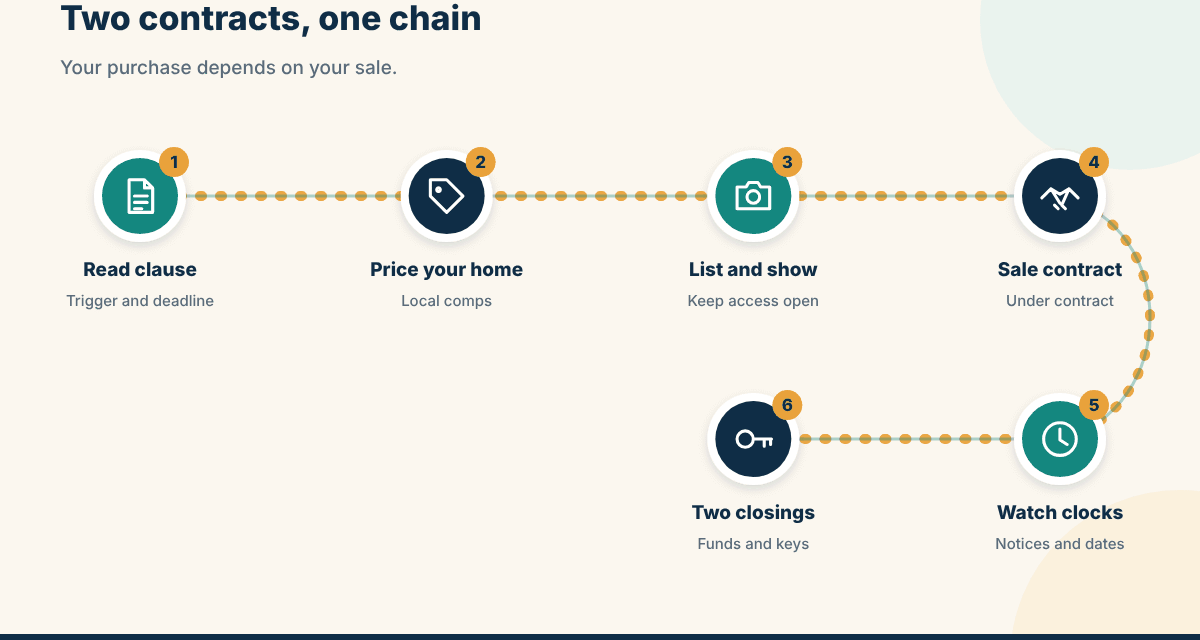
Buying with home sale contingency seller terms means you ask the owner of the house you want to accept an offer that depends on you first selling the house you already own, and that single sentence hides two contracts, two sets of deadlines and a surprising number of ways for the plan to wobble.
If you are in this spot, you probably love a home and cannot comfortably carry two mortgages. Buying with home sale contingency seller language feels like a safety net. You say, in effect, “I will buy yours if I can sell mine.” For you, buying with home sale contingency seller protection can be a sensible way to avoid owning two houses at once. For the person selling the house you want, it is a request to wait while a stranger’s sale plays out, and that wait has a price.
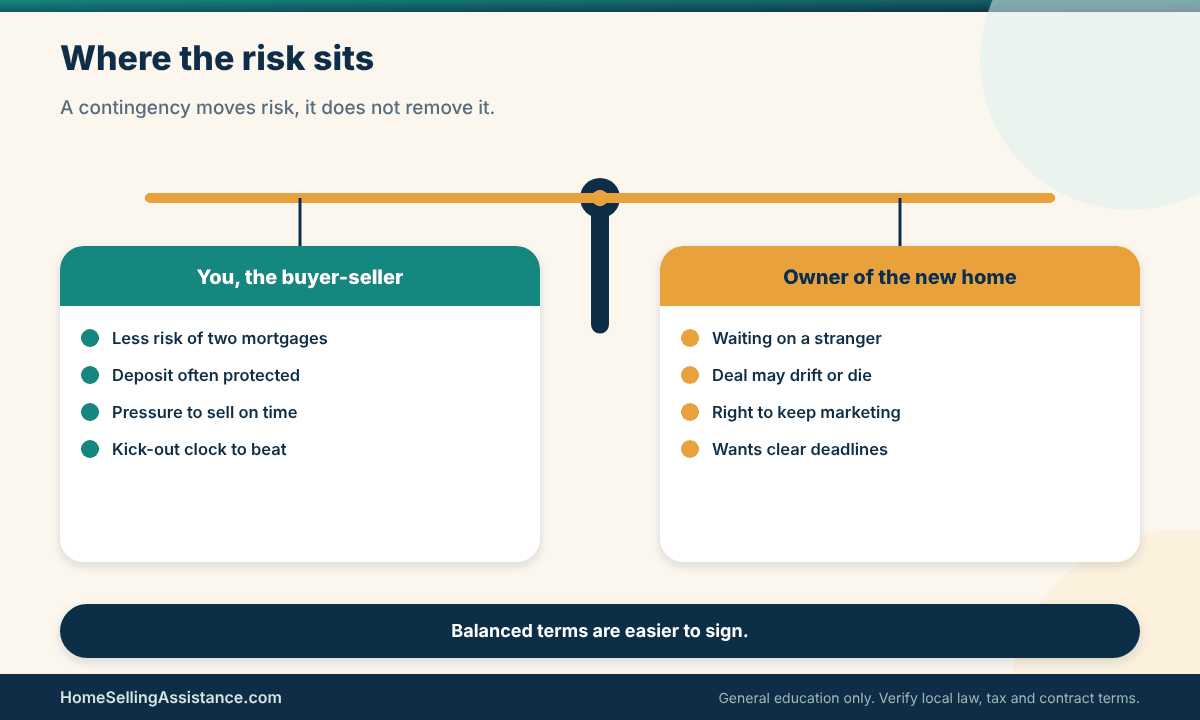
We want to be straight about something at the start. A home sale contingency does not remove risk; it moves it around. You carry less risk of owning two homes, and the other owner carries more risk of a deal that drifts or dies. Everything in buying with home sale contingency seller negotiations is really about who holds that risk, for how long, and what happens when the clock runs out.
This guide is written for the person who must sell first and buy second, with a side view of how the owner of the new home reads your offer. It sits inside our broader sell first or buy first guide, so if you have not yet decided whether this path suits you, start there and return here for the contract mechanics.
Disclosure rules, deposit handling, attorney roles and standard form language all vary by state and even by county, so we point you to how to verify things locally rather than pretending one rule fits everyone. Any dollar figures below are round illustrations, not predictions.
Key takeaways
- Two contracts, one dependency. Buying with home sale contingency seller language ties your purchase to your own sale, so a delay in one contract becomes a problem in the other.
- The clause itself decides everything. Whether the other owner can keep marketing, how many hours you get after a competing offer, and what happens to your deposit are all written terms, not customs you can assume.
- Your own listing is the evidence. A realistic price, a live listing and clean showing access make the contingency believable. A house that sits unlisted makes it look like wishful thinking.
- Waiving the contingency is a real decision. It can win a deal and it can also leave you owning two homes, so treat it as a financial choice with a plan B, not a tactic.
- Get the right people to read it. A local agent, a real estate attorney where one is customary, and your lender should all see the clause before you sign.
Read the clause behind buying with home sale contingency seller deals
Before comparing strategies, you need to know what the paper actually says. People use “home sale contingency” as one phrase, yet contracts treat it as several separate moving parts: the condition itself, the deadline, the right of the other owner to keep showing the house, and the remedy if you run out of time. Each part can be written generously or strictly, and the difference matters far more than the label on the form.
Start by reading the clause out loud. Whatever your state’s standard form calls it, it will almost always answer four questions. What event must happen, such as your house going under contract, or your house actually closing? By what date must it happen? Who may cancel if it does not? And what happens to the deposit afterward? If any of those four answers is vague on your copy, ask your agent or attorney to tighten it before you sign, not after.
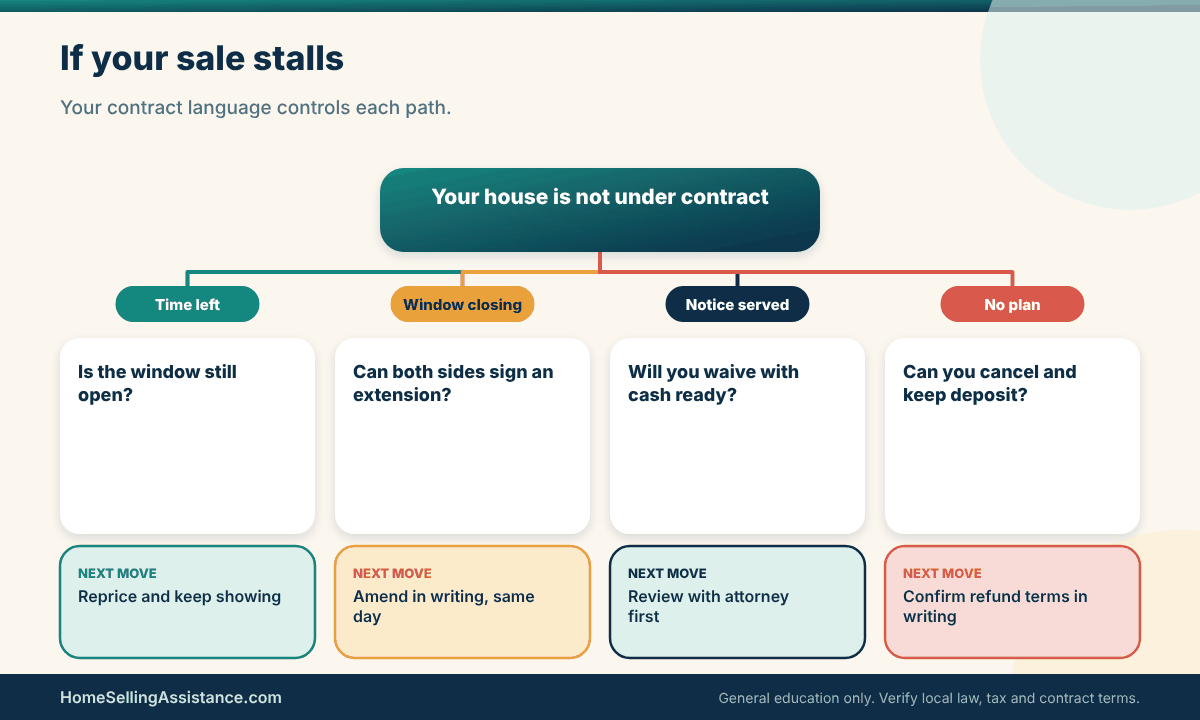
The first sections on buying with home sale contingency seller rights take the questions in order: who holds the rights, then how the clocks and remedies work. Later sections model the outcomes and then show you how to control risk in writing. The picture below sketches the overall sequence so you can see where each decision sits.
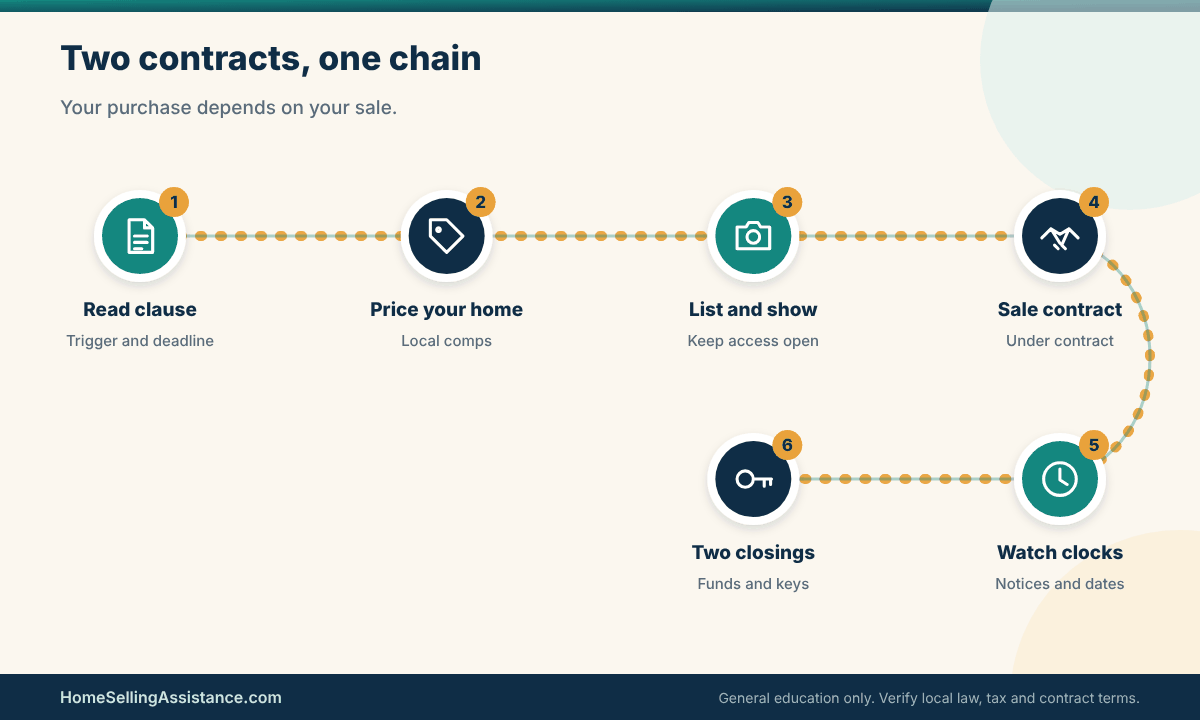
Who holds the right to cancel when buying with home sale contingency seller terms apply
The cleanest way to understand buying with home sale contingency seller rights is to ask who gets to walk away without penalty. In a typical home sale contingency, you, the buyer, may cancel and recover your deposit if you cannot sell your current home within the agreed window. The owner of the new home usually receives something in return for granting you that freedom, most often the right to keep the house on the market and to accept a better offer if one shows up.
Notice how those two rights fit together. Your freedom to cancel is balanced by their freedom to keep looking. When one side has strong rights and the other has none, the contract is lopsided, and the owner of the new house will either refuse it or price the risk into the deal in some other way. A seller who gives you total certainty with no escape of their own is rare, and a sensible agent will tell you so.
There is also a quieter holder of rights: your lender. A mortgage approval for the new home is usually built on assumptions about your current house, such as whether its payoff will clear or whether you will still carry that payment. If the lender’s approval depends on your sale, a missed closing on your side can quietly damage the financing for the new purchase. So the question “who may cancel” is really three questions: you, the other owner, and what your lender will tolerate.
Evidence to gather: the clause, the addenda and the listing status
Pull together the paper trail before you sign anything, because each document answers a different part of the question. First, the actual contingency addendum, not a summary. Second, any separate “right to continue marketing” or “kick-out” addendum, which often lives on its own page. Third, the listing status of your current home, including the listing agreement, the list date and the current price. Fourth, your lender’s written statement of what it needs from the sale of your house.
Read them together rather than one at a time. It is common to find a main contract with a thirty-day window and an addendum that shortens the effective window to a few days once a competing offer arrives, and the two pages can appear to disagree. When they do, ask which controls. Many forms say that an addendum overrides the main body, but forms differ, so get the answer in writing from your agent or attorney, and ask them to point to the sentence that says so.
Finally, check what is attached to “sale of the buyer’s property.” Some forms define the trigger as a signed contract on your house. Others require an actual closing and funding. A signed contract with a long closing date can meet the first definition and still leave you months from cash. If you want a broader view of how those two events differ in time, our guide to the flexible closing date seller approach explains why the gap between “under contract” and “closed” can swallow a schedule.
A scenario, an exception and your next step for the cancel right
Here is an illustration with made-up numbers. You make an offer on a house with a clause that lets you cancel if your own home is not under contract within a set window. You list your house, get a contract in the first couple of weeks, and everything looks fine. Then your buyer’s inspection reveals a repair dispute, and your buyer cancels. Depending on wording, the window may already be satisfied, because your house was under contract at the moment that counted, or it may reset.
That is the exception worth asking about: what happens to the contingency if your own buyer drops out? Some forms treat the condition as met once and forever. Others say the contingency revives, with a fresh clock. Others stay silent, which is the worst outcome because silence invites a dispute. Your next step is simple. Ask your agent or attorney, in writing, whether the clause survives the collapse of your own sale, and request that the answer be added to the contract if it is missing.
The clocks, kick-out notices and remedies inside the clause
Time is the real currency in buying with home sale contingency seller negotiations. A well-drafted clause has several separate clocks, and they interact. There is the overall window in which your house must go under contract or close. There may be a shorter window that starts when the other owner receives a competing offer and sends you a notice. And there may be a separate deadline for you to remove the contingency, sometimes called waiving it, by proving you have the cash or the financing without the sale.
Most disputes in buying with home sale contingency seller deals happen at the edges of these clocks. Does a notice count when it is sent or when it is received? Do the days count calendar days or business days? Does a deadline that falls on a weekend roll to Monday? These details are not trivia. A notice delivered to the wrong email address, or counted in the wrong kind of days, can turn a deal you thought was alive into one that is legally over.
The remedy matters just as much as the clock. If you miss the window, the usual outcomes are that the contract terminates and your deposit is returned, or that you must remove the contingency and proceed, or that the other owner may choose between the two. Which one applies determines whether your downside is a lost opportunity or a lost deposit, and those are very different things to lose.
Numbers to pin down: days, deposits and notice periods
For buying with home sale contingency seller planning, write the numbers from your clause on one sheet of paper. You want the total contingency window in days, the notice period after a competing offer, the method and address for delivering notices, the date the contingency expires if never triggered, and the amount and holder of your deposit. Then add one line for each: calendar or business days. A sheet like this takes ten minutes and prevents a surprising number of arguments.
For illustration, imagine a window of sixty days, a notice period of three days after a competing offer, and a deposit of a round figure such as ten thousand dollars held by a title company. Those numbers are invented, and your contract may be shorter, longer or structured differently. The point is that a short notice period combined with a long window creates a sudden squeeze: you may have weeks of calm, followed by seventy-two hours to decide whether to waive.
Do the arithmetic about your own side of the squeeze too. If your house usually needs more than a few days to line up funds from a buyer, a short notice period means you cannot realistically meet it unless you have a plan, such as a bridge product, savings or a flexible lender. If a plan like that is on your mind, read our overview of a bridge loan for a home sale before agreeing to any short fuse. Never accept a clock you cannot actually beat.
A scenario with a short fuse and what to do about it
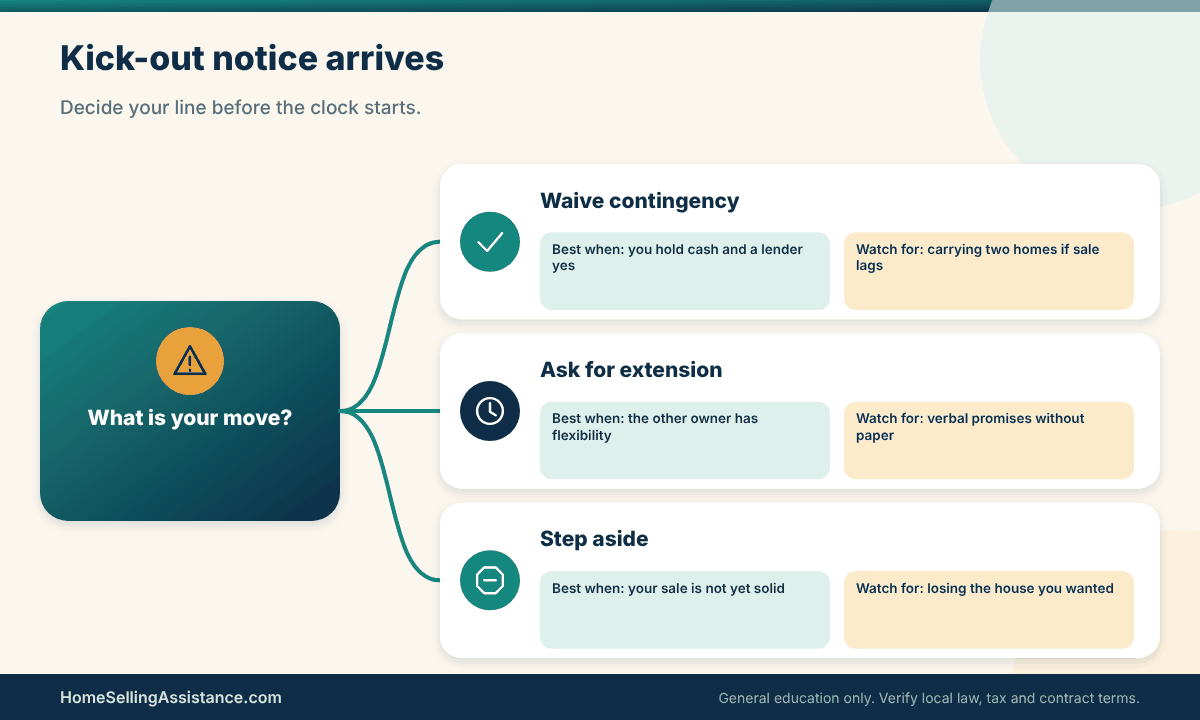
Picture a hot week of buying with home sale contingency seller negotiations. You and another household both want a house, and the owner accepts your contingent offer but keeps the right to continue showing. Four days later, a cash offer arrives. The owner’s agent sends you a written notice, and the clock says you have a short number of hours to remove your contingency or step aside. Your house is listed but not yet under contract.
You have three honest choices, and the paper decides which are available. You can remove the contingency, which means committing to buy while your house is unsold. You can let the contract end and keep your deposit, if the clause protects it. Or you can ask whether the owner would extend the clock in exchange for something, such as a higher deposit or a firm closing date.
A calm conversation with your agent and lender before the notice arrives will serve you better than a panicked one afterward, so decide your walk-away point in advance, in writing, and keep it near your calendar.
To keep all of this in one place, the matrix below lines up the main issues that come up in buying with home sale contingency seller contracts. For each issue it shows which document usually controls, what you can choose, which deadline applies and where to confirm the local rule. Treat it as a map for your questions to an agent or attorney, not as legal text, because the wording of your actual forms governs.
| Issue | Controlling document | Your obligation or choice | Deadline to watch | Verify locally with |
|---|---|---|---|---|
| Sale trigger | Contingency addendum | Choose “under contract” or “closed” wording | Contingency expiry date | State form, agent or attorney |
| Right to keep marketing | Kick-out addendum | Accept or negotiate the other owner’s right | Hours or days after notice | Agent, listing broker |
| Deposit protection | Purchase contract | Confirm refund terms if the condition fails | Cancellation notice date | Title or escrow company |
| Financing link | Loan estimate and approval | Disclose your current mortgage and plan | Loan commitment date | Your lender |
| Your listing duties | Listing agreement | Keep the home actively marketed | Listing end date | Listing agent, state commission |
| Waiving the contingency | Written waiver or amendment | Decide with proof of funds in hand | Waiver response deadline | Attorney or agent |
Use the table by working across one row at a time. Pick the issue that worries you most, find the document in the second column, and read it again with the other columns beside you. If you cannot name the deadline or the person who can verify the rule, that row is your homework before signing. You will probably notice that most rows end with a local professional, which is exactly the point: forms differ, and a quick local check beats a confident guess.
Model what happens to your two contracts
Once the clause is clear, the useful exercise in buying with home sale contingency seller planning is to run the film forward. Contracts are easy to read in a calm moment and hard to apply when a notice arrives on a Friday evening. If you rehearse the main outcomes now, you will recognize them when they show up. We will walk through the happy path first, then the path where something is disputed, missed or waived, and we will keep asking what each one does to your wallet and your calendar.
A good model has three columns for every outcome: what you owe, what you may recover and what you must do by when. You do not need software for this. A page of paper, with one line for each contract, is enough to show the points where the two contracts rub against each other. Where they do, buying with home sale contingency seller planning means deciding in advance which contract you protect first, and why.
Keep your own sale’s timetable in view the whole way. The sale of your house is not a background task. It is the engine that drives the purchase, so if your showings are thin or your price is off, the contingency is under strain before anyone sends a notice. Our article on selling a house before buying another compares what changes when the sale comes first and the purchase follows.
When your own sale closes on schedule
The good outcome of buying with home sale contingency seller plans deserves attention because it is not automatic. For the contingency to be satisfied cleanly, your house has to reach a contract, clear its own inspection and appraisal hurdles, and close, ideally a little before or on the same day as the purchase. Even in a smooth run, the two closings must be coordinated, because the money from your sale often funds part of the purchase. That is a coordination task for your agent, your lender and the title or escrow companies on both sides.
The word “clean” can mislead. A clean outcome still contains choices: do you close both on the same day, with proceeds moving straight across, or do you close your sale first and take a short stretch of temporary housing? Each has costs. Same-day closings are tidy on paper and fragile in practice, because a delay at either end pushes both. A gap of a few days gives you slack, but you will need somewhere to sleep and store belongings.
Do not forget what you owe after your sale closes. Possession terms, prorated taxes and utilities, and final walk-through promises all remain live. If your plan includes staying in your old house briefly after closing, that arrangement should be written, and our guide on a rent-back agreement for sellers shows how those short stays are usually papered.
Documents that prove the chain is moving
In buying with home sale contingency seller files, think of your documents as a chain of receipts that show every link is holding. At the start, you have your listing agreement and the purchase contract with its contingency addendum. As the weeks pass, you collect the signed contract on your house, the buyer’s financing approval letter if you are given one, the inspection and repair response, the appraisal outcome and the title commitment. Each of these answers a quiet question from the other owner: is this sale real?
Many owners in buying with home sale contingency seller deals ask for regular updates, and it helps if you offer them first. A short written status note once a week, shared through the agents, keeps trust high and rarely costs you anything. Include the milestone reached, the next milestone and its date. Stay factual. If the appraisal has not yet been scheduled, say so. Candid updates are more convincing than cheerful silence, and they protect you if the timeline ever has to be extended.
Keep your own copies as well. File the dated notices, any amendments and the confirmation that each notice was delivered. If a disagreement ever arises about whether you met a deadline, a tidy folder with timestamps is worth far more than a memory of a phone call. Most title companies and escrow officers are happy to confirm in writing what they received and when, so ask them.
A clean-run scenario and the follow-ups that still matter
Here is an everyday buying with home sale contingency seller illustration. You make a contingent offer, list your house at a price your agent supports with local sales, and receive a contract in the third week. Your buyer’s financing and appraisal go through. Your closing is set for a Tuesday, and the purchase closes the same afternoon. This is the version people picture when they first consider buying with home sale contingency seller terms, and it does happen.
Even then, three follow-ups remain. First, confirm that the wire or funds from your sale will actually be available when the purchase needs them, since cut-off times for wires and recording practices differ by company. Second, compare the final settlement statements on both transactions line by line, because credits and prorations land in different places. Third, hold back some cash for the unexpected, because a clean run can still produce a small surprise at the table.
The exception to watch is a delayed recording or funding on your sale. If the county or lender slips by a day, the purchase may not be able to close until the next business day. Ask your closing officers beforehand how they handle that case, and whether a short extension or a sign-over arrangement is standard in your area. The answer varies, so ask locally.
When the chain is disputed, missed or waived
Not every buying with home sale contingency seller deal runs on rails. Your buyer can renegotiate after an inspection, the appraisal can come in light, or the buyer’s lender can pause. Any of those can threaten your ability to close, and with it the contingency on your new purchase. Disputes also arise purely between you and the other owner: over whether notice was properly given, whether a window was met or whether an extension was agreed. Plan for these, because they are the situations where people find out what the paper really means.
There are three families of outcome. In a dispute, both sides claim the contract says something different, and the deposit is often frozen until a title company, an escrow agent or a court resolves it. In a miss, a deadline passes without the event, and the contract’s remedy clause decides what follows. In a waiver, you deliberately give up the contingency, sometimes to win a house or to avoid losing it, and from that moment your purchase no longer depends on your sale.
Waiving is the choice that deserves the most caution. It can be wise when you have equity, savings, a flexible lender and a strong sense of your house’s likely sale. It can be reckless when you are counting on the proceeds to cover the down payment. The honest framing is that a waiver converts a contingent purchase into a firm one, and everything left to chance on your side becomes your own financial risk. Our buy a house before selling your current home article looks at the carrying costs that follow.
Evidence to collect before a dispute hardens
If a buying with home sale contingency seller disagreement seems likely, begin gathering evidence at once rather than waiting for it to escalate. Save every email and text, and ask agents to confirm key points in writing instead of by phone. Note the date and time of any notice you sent or received, together with the method used. Gather the signed pages that show the exact contingency and notice language. Request from your title or escrow company a written statement of what funds they hold and what instructions they have received.
Be precise, and be calm. A common mistake in buying with home sale contingency seller disputes is to argue about intentions, as in “we always meant to extend.” What counts is what was signed. If an extension was agreed verbally, write it up and have both sides sign an amendment before the old deadline passes. After a deadline passes, the leverage often shifts, and the same request can meet a very different answer.
Also think about who is on your team. In many states, a real estate agent can explain the form but cannot give legal advice, while an attorney can. If the deposit is large, or the other side is threatening to keep it, speak with a local real estate attorney. Your state’s real estate commission, county bar association referral service or a title company can help you find one. We say more about when to escalate near the end of this guide.
Scenarios: the kick-out, the waiver and the extension
Run three short buying with home sale contingency seller scenarios to see how the model works. In the first, the other owner serves a kick-out notice because a competing offer arrived. If you cannot or will not waive, the contract ends and, if the clause is written in your favor, your deposit comes back. You lose that house but keep your money. Your next step is to refocus on selling and be ready for the next opportunity with a stronger plan.
It also helps to understand how the other owner weighs bids, which our guide to handling multiple offers as a seller explains.
In the second, you decide to waive because you have the savings to carry both homes for a while and a lender who confirmed your approval without the sale. You sign the waiver, and the contract becomes firm. Your risk now sits in your own listing: if it lingers, you will carry two sets of costs. Before signing, estimate those monthly costs honestly, then add a cushion, because showing a house often takes longer than people expect.
In the third, you ask for an extension because your buyer’s appraisal is delayed. The other owner may agree if you offer something real, such as a larger deposit that becomes non-refundable on a date, or an earlier kick-out right. Any extension should be written, signed and dated. An informal “sure, take a few more days” is worth very little if the relationship sours, so move the handshake onto paper the same day.

The scenario table below turns those outcomes into a quick reference. Each row describes a situation that comes up in buying with home sale contingency seller transactions, lists the choices open to you, names the main risk, points to the document worth rereading and says when to call in a professional. The situations are general, so match them to your own paperwork rather than assuming your clause behaves the same way.
| Situation | Your options | Main risk | Document to review | Escalate when |
|---|---|---|---|---|
| Competing offer arrives | Waive, step aside or negotiate time | Owning two homes | Kick-out addendum | Notice clock is under a few days |
| Your buyer cancels | Relist, seek backup, ask for extension | Missing the window | Contingency addendum | Clause is silent on revival |
| Your appraisal is low | Renegotiate, add cash, wait | Delay in both closings | Appraisal and finance terms | Deposit is at stake |
| Dates drift apart | Extend, rent back, short stay | Gap in housing | Possession terms | Insurance or loan terms change |
| Deposit is disputed | Mediate, wait for joint release | Funds frozen | Deposit and default clauses | Other side refuses release |
| Lender balks | Change loan, wait, drop contingency | Approval withdrawn | Loan commitment letter | Approval conditions change |
You might use the table as a rehearsal for buying with home sale contingency seller surprises. Cover the last two columns, name your move and your fallback, then check yourself against what the documents say. If you cannot say which page governs a situation, that is a signal to ask a local professional before you sign. The goal is not to predict the future, only to avoid meeting a familiar problem for the first time at the worst moment.
Control risk in writing before you sign
The best moment to manage risk in buying with home sale contingency seller deals is before you sign, because that is when every term is still negotiable. After signing, you can only perform, amend or argue. So the work of this section is to turn worries into questions, questions into drafted terms and drafted terms into something both sides sign.
Two principles help in buying with home sale contingency seller contracts. First, if it matters, write it down. Verbal assurances from an agent, a lender or the other owner are friendly, but they are not terms. Second, make each promise measurable. “We will keep the house in good shape” is hard to enforce, while “access for showings on twenty-four hours’ notice” can be checked. Contracts that read like checklists produce fewer arguments than contracts that read like speeches.
Keep fairness in mind as well. A contingency that squeezes the other owner will probably cost you in price, deposit or goodwill. A contingency that leaves you with no protection will cost you if your sale stumbles. The healthiest deals usually give each side a clear, balanced route out, and they are easier to finish because nobody feels trapped. Our overview of sell first or buy first decisions collects related reading if you want to compare routes.
Questions to ask before buying with home sale contingency seller paperwork is signed
Good questions about buying with home sale contingency seller terms are specific. Ask your agent: “Does this clause end when my house is under contract, or when it closes?” Ask your lender: “Will my approval hold if my current mortgage is still open at closing?” Ask the title or escrow officer: “Who holds the deposit, and what do you need to release it?” And ask yourself the hardest question: “If I had to carry two homes for several months, could I?” Honest answers will tell you whether the contingency is a convenience or a necessity.
There are also questions for the other side, usually passed through agents. How long has the house been on the market? Is the owner already under contract elsewhere? Does the owner have a move date that can flex? Are there other offers waiting? None of this is nosy. It tells you how much pressure the contingency will face, and whether a competing offer is likely to turn up while you wait.
Finally, ask what the contract says about condition and inspections. A home sale contingency is separate from an inspection contingency, an appraisal condition and a financing condition, and each has its own clock and remedy. Mixing them up is a classic error. For a closer look at how those other conditions work from the owner’s side, read our guide on the inspection contingency for sellers and compare the dates with your own.
Sources for answers: lender, agent, title and the listing side
Each source can answer a different slice of buying with home sale contingency seller questions. Your lender can speak to approval conditions, timing of verifications and what they will do if your sale slips. Your agent can explain local form language, usual practice for notices and how similar contingent deals have gone in your area, without promising any outcome. The title or escrow company can explain deposits, wire timing and recording. And an attorney, where used, can explain what a clause legally does.
Where your state sets rules, the primary source is the state real estate commission or the statute itself, and the county recorder or clerk can explain filings. For general consumer information about mortgages and closing, the Consumer Financial Protection Bureau publishes plain-language material, and if you want free help understanding your budget, HUD-approved housing counselors can be found through HUD. Use them as references for questions, not as a substitute for reading your own contract.
Keep a simple list: question, who you asked, what they said, and the date. When two sources disagree, resolve it in writing before you sign. A frequent example is an agent who says the other owner “has to give you notice” while the form says notice is optional. If you find that gap, ask your attorney or the form’s issuing association which statement is right, and update the contract to remove any doubt.
A scenario of a seller who asked early
Imagine a seller named Dana, a made-up example. Before making an offer, she asked her lender how a pending sale would be treated, learned the lender wanted a signed contract on her house before issuing a final approval, and told her agent. The agent drafted the contingency so that her house needed to be under contract by a fixed date, with a firm closing plan after that, and a short, clearly delivered kick-out notice.
Dana also priced her own listing with local sales rather than hopes, and she agreed to a weekly update. When a competing offer arrived, the notice went out as the form required, and she had already decided, in writing, that she would not waive without a signed buyer on her side. She stepped aside, kept her deposit and later bought a different home after her sale closed. The result was not glamorous, but it was calm, which is often the best a contingent plan can offer.
The lesson from buying with home sale contingency seller cases is that early questions, specific wording and a decided walk-away point turn a stressful situation into a manageable one. You will not control the market, and you will not control the other owner. You can control your paperwork, your price, your notice habits and the line you refuse to cross.
When to bring in an attorney, agent or title officer
In buying with home sale contingency seller deals, some questions are fine for an agent. Others call for an attorney, and some belong with the title or escrow officer. In general, form language, local custom and market strategy sit with your agent. Interpretation of a clause, a deposit dispute, or a request to alter standard terms often sit with an attorney. Mechanics of funds, deposits, payoffs and recording sit with title or escrow. Nobody in this list should be guessing, and a good professional will tell you when a question is outside their lane.
Some states place attorneys in the middle of nearly every closing, while others rely mainly on title or escrow companies and agents. Do not assume your state works the way a friend’s did. A quick call to your state real estate commission, a local title company or a local bar association will tell you what is customary. If you are using the contingencies, inspections and appraisals library for background, treat it the same way: as preparation for the conversation, not a replacement for it.
There is a cost to professional review of buying with home sale contingency seller documents, and it is usually small next to a deposit or a second mortgage payment. If your plan depends on the contingency working, pay for the review. If a professional recommends changing a clause, ask them to explain the downside to the other owner as well, since a clause that is easy for the other side to accept is more likely to be signed.
What a professional review should cover
A solid review of buying with home sale contingency seller paperwork covers at least six points. Does the clause define the trigger clearly, as under contract or closed? Are the clocks written in calendar or business days, with a stated method of notice? Is the remedy for missing a deadline clear and fair? Does the deposit follow a defined path? Does the contract mention what happens if your own buyer cancels? And does the document match the lender’s expectations for how the current home is treated?
Ask the reviewer for a short written summary, even an email, rather than a verbal run-through. A written summary can be shared with your spouse, co-owner or lender, and it records what was understood. If you co-own the home with a former partner, relative or estate, mention that too, because co-owners must usually sign both contracts, and a missing signature can delay either sale.
Also ask how the reviewer would handle a worst case. What would they do if you had to cancel late, or if a notice went to the wrong address? Their answer reveals whether the contract is built for stress. A professional who responds with concrete steps is usually reviewing with the right mindset, and that is the kind of person you want in your corner for buying with home sale contingency seller deals.
A scenario, an exception and the next step
Consider a buying with home sale contingency seller exception that surprises people. You sign a contingent contract, and midway through, your employer announces a transfer that moves your start date earlier. Suddenly you need to close sooner than the contract allows. Can you shorten the contingency? Only by agreement. The other owner has no duty to speed up, though some will if the timing helps them too. If they say no, you remain bound by the original dates.
The next step is to speak to your agent and attorney immediately, before talking to the other side, so that you know your options. They might suggest offering a shorter window in return for a smaller price concession, or arranging temporary housing so your move date can float. Our guide to temporary housing between selling and buying covers the practical side of that fallback.
Write down what you decide, along with the date. If a deal changes, have the amendment signed by everyone who signed the original. A rushed handshake does not outrank a signed page. Once the paper is in order, update your lender and title company so that none of them is working from outdated dates.
Frequently asked questions about buying with home sale contingency seller terms
What does buying with home sale contingency seller language actually mean?
It means your offer on a new home is conditioned on the sale of your current one. If your house does not sell, or does not close, within the agreed time, the contract usually lets you cancel and recover your deposit. The exact trigger, deadline and remedy come from the written clause, so read yours closely rather than relying on a general description.
Will buying with home sale contingency seller language make my offer weaker?
Often it does, because the other owner takes on uncertainty that a non-contingent buyer would not bring. How much weaker depends on local competition, the condition of your listing and how the clause is drafted. A clean clause with a believable plan, a realistically priced listing and a reasonable window can soften the effect, though no one can promise it will win a house.
Can the owner of the new home keep showing the house?
Frequently yes, if the contract includes a right to continue marketing, sometimes called a kick-out clause. When another offer arrives, the owner gives you written notice and you must remove the contingency or step aside within the stated time. Some contracts have no such right, so check the actual pages and ask your agent which version applies in your area.
What happens to my deposit if my own sale falls through?
Where the contingency is properly written and you cancel on time, the deposit is typically returned to you. If you miss a deadline or send notice incorrectly, the other owner may argue you are in default. Deposit rules and release procedures vary by state, contract and escrow practice, so confirm them with your agent, attorney or the title company holding the funds.
Should I waive the contingency to win the house?
That is a financial decision, not a trick, and only you can weigh it with your advisers. Waiving turns a conditional purchase into a firm one, so you may end up owning two homes if your sale lags. Consider your savings, your lender’s position, your carrying costs and a fallback plan before agreeing, and put the waiver in a signed amendment.
Does my lender care about buying with home sale contingency seller terms?
Very likely. Lenders look at how your current mortgage is treated and whether your new approval depends on the sale proceeds. Talk to the loan officer before you write the offer so the contingency language matches what the lender needs. A mismatch between the contract and the loan conditions is a common cause of late surprises.
How long should a home sale contingency last?
There is no universal length. The right window depends on how quickly homes in your area tend to sell, your listing’s readiness and how patient the other owner is willing to be. Ask a local agent how long similar listings took, then build in time for inspection, appraisal and closing on your own sale, not just the offer stage.
What if my own buyer cancels after I removed the contingency?
Then you are bound to the purchase without the safety net, and the risk is yours. You might need to find temporary financing, delay your move, or relist and carry both homes for a time. This is why many advisers urge people to compare a bridge arrangement, covered in our article on a bridge loan for a home sale, before they waive.
Do I need an attorney for a contingent purchase?
Custom differs by state. In some places attorneys handle most closings, while in others agents and title companies do most of the work. Even where attorneys are optional, a review of the contingency and kick-out language can be worthwhile when your finances depend on it. Your state real estate commission or a local title company can tell you what is usual.
Is there a cleaner alternative to buying with home sale contingency seller terms?
There are several, each with trade-offs. You can sell first and rent or stay briefly, ask for a flexible closing, use a rent-back, line up bridge financing or buy first without a contingency if you can afford it. Our main guide on sell first or buy first compares these routes, and none is right for everyone.
Before you sign
Buying with home sale contingency seller terms is a way to share risk, not erase it, and the people who handle it best are the ones who read the clause, set a walk-away line and keep their paperwork tidy. Take your questions to a local agent, a lender and, where customary, an attorney. This article is general education, not legal, tax or financial advice, and your contract and your state’s rules always come first.