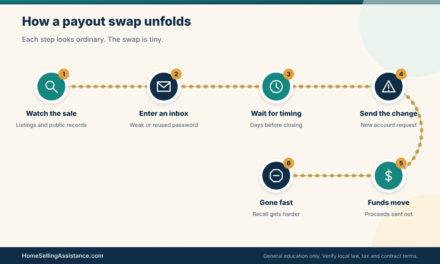
Choosing between a wire and a check for your sale money sounds like a small administrative detail, but the seller proceeds wire vs check decision shapes how fast you can use your money, how exposed you are to fraud on the last day of the sale, and how much stress you carry through closing week.
Most sellers never think about the seller proceeds wire vs check question until the settlement office asks, a few days before closing, “How would you like to receive your funds?” That question arrives at a bad moment. You are packing boxes, scheduling movers, turning off utilities and trying to remember where you put the garage remote. It is exactly the kind of moment when a rushed answer, or a convincing fake email, can cost real money.
This guide compares the seller proceeds wire vs check options in plain terms. We will look at what each one actually does, how bank holds work in general, where criminals insert themselves, and how to confirm instructions through channels you already trust. We will not tell you that one method is always better. For some sellers a wire is the clean answer. For others, walking out of the office with a check, or picking one up in person, is the calmer path.
Because this is a safety topic, you will also find a calm response plan for the day something looks wrong. Closing fraud is rare compared with the number of ordinary closings, but when it happens the amounts are large and the clock runs fast. If you want the wider picture first, our home sale fraud and seller safety guide covers the full landscape, and this article zooms in on the payout step.
Key takeaways
- Neither method is automatically safer. A wire moves quickly and is hard to reverse; a check is slower, can be altered or counterfeited, and may sit under a bank hold. The seller proceeds wire vs check choice is really about which risks you can control.
- Verify by phone, using a number you already trust. Never rely on a phone number or link inside the same email that gives or changes payout instructions.
- Your account details go only to your settlement agent. Not to the buyer, not to a stranger who “works with the title company,” and not through a casual email thread.
- Change requests close to funding are the classic warning sign. Treat any late switch of account, payee or delivery method as unconfirmed until you speak to a person you know.
- Funds “available” is not the same as funds “final.” A deposited check can still be returned after the bank shows a balance, so ask how your bank treats deposits.
- Act within minutes if something looks wrong. Call your bank and your settlement agent first, then report to the proper authorities.
Where the seller proceeds wire vs check choice goes wrong
Before comparing methods, it helps to see the failures. Most payout problems fall into a few patterns, and almost all of them come from the same root cause: a decision made quickly, from an unverified message, close to the funding date. Understanding the patterns makes the later safeguards feel like common sense instead of a chore. Seeing these failures first makes the seller proceeds wire vs check safeguards later in the article feel earned rather than fussy.
What the bad outcome looks like for a seller
The most damaging outcome is a diverted wire. Your sale closes normally, the buyer’s money arrives at the settlement office, and then your proceeds are sent to an account that belongs to a criminal because someone, somewhere, accepted altered instructions. The sale itself is valid. The deed has recorded. But the money you expected is gone, and the recovery path is slow and uncertain.
Check-related bad outcomes are quieter but real. A check can be mailed to an old address, intercepted from a mailbox, altered, or deposited and later returned. A seller can also be handed a counterfeit cashier’s check in a side deal, such as a buyer who “overpays” for something and asks for a refund. Delays also count as a bad outcome: a seller who needed cash for a down payment on the next house may close the sale and still not be able to use the money for days.
Evidence to gather: how funds really move at closing
Start with the basics of the flow, because fraud lives in the gaps you do not understand. In a typical sale, the buyer and the lender send funds to the settlement agent, who may be a title company, escrow company or closing attorney depending on your state. The agent confirms the funds, records the documents, pays off your mortgage and other obligations, subtracts your costs, and then releases what is left to you. Your seller closing statement shows each of those lines.
Ask your settlement agent three plain questions in writing, then confirm the answers by phone. Which payout methods do they offer? What do they charge for each, if anything? And when, on the closing day, do funds normally leave their account? Fees, cut-off times and local customs vary by company and by state, so there is no universal answer to give you here. The point is to know their process before anyone sends you a surprise.
A scenario, an exception, and your next step
Picture a seller we will call Marta. Two days before closing she gets an email that appears to come from her closing office, asking her to “re-send wire details because the system flagged an error.” The sender name looks right. The signature block looks right. Only the domain has one letter swapped, and she does not notice. She replies with her account number, and nothing visibly happens until closing day, when no money arrives. Her story is a textbook seller proceeds wire vs check failure, and it is avoidable.
The exception is worth remembering: sometimes a settlement office genuinely does need to correct your payout details. That is normal. What matters is how the correction happens. The safe next step is to stop, call the office at the number printed on your contract or on its official website, and give corrections only through a method they confirm over that call, such as a secure portal or an in-person visit.
What information and property is exposed by each payout method
Every option in the seller proceeds wire vs check decision asks you to expose something. A wire exposes your bank name, routing number and account number to the people and systems that handle the instructions. A check exposes your name, your mailing address and, once it is deposited, your account details through the endorsement and the image of the check itself. Neither exposure is unusual, but you control who receives it and how.
The property at risk is not only the money. Your closing file contains your full name, home address, loan numbers, signatures, and sometimes copies of identification. A criminal who obtains those pieces can attempt identity theft long after the sale is done. That is why our guides on seller identity fraud at closing and the home seller privacy checklist pair naturally with this one.
Evidence to gather: what your closing file already reveals
Take a few minutes and list what you have already sent to anyone involved in the sale. Photo of your driver’s license to the title company? Void check for payout? Mortgage statements to a potential buyer? Each item may have been sent for a good reason, and each one is also a piece of the profile a scammer would love to hold. You are not trying to panic yourself, only to know what exists and where it traveled. That short inventory is the quiet first step of any seller proceeds wire vs check plan.
Then note how each item was sent. Email attachments, text messages, a secure upload portal and a face-to-face handoff carry different risks. Email is the weakest of these because messages can be forwarded, copied or read by someone who has taken over an inbox. If you sent sensitive documents by ordinary email, mention that to your settlement agent so they can watch for odd activity and consider tighter confirmation steps.
A scenario, an exception, and your next step
Consider a seller named Dev who wants a paper check because he does not trust wires. He asks the title office to hold the check for pickup. That is a sensible approach, and it limits online exposure. Two things can still go wrong: someone could impersonate Dev by phone to redirect the check to a courier address, or Dev could deposit the check at a branch where the funds are held for several days while his next purchase waits.
The exception is that a pickup plan only works if the office verifies who is collecting. Ask what identification they require and whether they confirm with you by phone before releasing anything. Your next step is simple: tell the office who is allowed to collect the check, and ask your own bank in advance how it handles a large deposit, so the seller proceeds wire vs check plan does not collide with a hold you did not expect.

Setting up your seller proceeds wire vs check plan before closing week
The best time to protect your money is weeks before anyone asks for payout details. Once closing week begins, deadlines pile up and people are tired, which is when verification gets skipped. A few calm controls put in place early turn the final days into routine paperwork instead of a scramble. Think of this section as your seller proceeds wire vs check preparation checklist in prose.
Build a verification routine for the seller proceeds wire vs check decision
A verification routine for seller proceeds wire vs check is just a short, repeatable habit. You decide, ahead of time, which phone number you will use, who you will speak to, and what counts as confirmed. Then every payout message, however urgent it sounds, goes through the same routine. Scammers rely on urgency because urgency breaks routines. If your routine is already written down, it is much harder to break.
Here is a version many sellers find workable. Save the settlement office’s phone number from your signed contract or from a business listing you looked up yourself, and label it clearly. Tell the office, at your first meeting, that you will confirm any payout instruction by phone. Ask them to note that preference in your file. From then on, a message that does not fit the routine is simply not acted on until you call.
Evidence to gather: the numbers and names you can trust
Trusted contact details come from documents that existed before the fraud attempt. Your purchase contract, the settlement office’s printed letterhead, your listing agent’s agreement and your lender’s statements all carry contact information you did not get from a cold message. Write down two or three phone numbers and the names of the people you have actually met. Keep that page somewhere you can find it quickly, on paper if you like.
Be careful with the shortcut of searching online while stressed. Fraudsters buy search ads and publish look-alike listings so that a quick search leads to their number. Use the number in your own paperwork. If something in your paperwork looks different from the website, call the main line of the company and ask to be connected, rather than trusting either source alone.
A scenario, an exception, and your next step
A seller named Priya has a closing scheduled for Friday. On Wednesday an email arrives with a “corrected payout form” that lists a different bank than the one she gave earlier. The message says the first bank “rejected incoming wires from title companies.” It sounds technical, and slightly alarming. She remembers her routine, calls the office from her saved number, and is told no change was requested. The email goes to the office’s fraud contact.
The exception: occasionally a bank truly cannot receive a wire, such as when an account is restricted. If that is real, your settlement agent will already know and will say so when you call. Your next step in any version of this story is the same: let the phone call decide, not the message. Keep a record of the date, time and name of the person you spoke with.
Information you should never share and assumptions you should never make
Some details have one legitimate destination, and everything else is a leak. Your full bank account number and routing number belong with your settlement agent through a secure method, and with your own bank. They do not belong with the buyer, with a buyer’s agent, with a moving company, or with a “verification specialist” who calls you out of the blue. Online banking passwords and one-time codes belong to nobody but you. Keep this rule in mind through every seller proceeds wire vs check conversation you have.
The matching list of assumptions is just as important. Do not assume an email is genuine because it quotes your address and closing date; criminals can read leaked or intercepted transaction details. Do not assume a familiar name means a familiar sender. Do not assume that someone else on the deal has already verified a change. Each of those assumptions has been the first step in a real loss.
Evidence to gather: who legitimately needs your account details
Ask your settlement agent exactly what they need from you and why. In many offices the answer is a signed payout authorization and either a wire instruction form or a request for a check, plus identification. Ask whether you can deliver account details in person, through an encrypted portal or by phone with a callback. Knowing the legitimate path lets you spot an illegitimate one instantly, because it will ask for something different.
For sellers who owe a mortgage, remember that your lender is paid directly out of closing funds. You never wire money to your lender yourself during the sale. Payoff quotes come from the lender to the settlement agent. If someone tells you to send money to a “lender account” to complete the sale, treat it as a warning and read our guide to mortgage payoff when selling a house to see how the real process works.
A scenario, an exception, and your next step
Imagine a buyer’s agent who politely asks you to “send your banking information so we can verify proceeds and speed up the funding.” It is friendly and sounds helpful. But the buyer’s side has no reason to hold your account number, and your proceeds are calculated by the settlement office, not by the buyer. The right reply is a courteous refusal and a pointer: “Our settlement office handles payout; I’ll confirm with them directly.”
The exception is a buyer who is also paying you a separate amount outside closing, such as a rent-back deposit or personal-property purchase. Even then, payment details should be exchanged through documents the parties signed, and ideally through the settlement office. Your next step is to write a one-line rule on your trusted-contacts page: account details go only to the settlement agent, through a method confirmed by phone.
The matrix below turns these ideas into a quick reference. Read it from left to right: find the claim or threat you are looking at, check the evidence in the second column, take the safe action in the third, remember what must stay private, and use the last column to see where to escalate. It is a general guide, so adapt it to your own contract and your settlement office’s stated process.
| Threat or claim | Evidence to check | Safe action | Never share | Escalate to |
|---|---|---|---|---|
| Email says wire details changed | Sender domain, tone, unusual urgency | Call known office number | Account number by email | Settlement agent, then bank |
| Caller offers to “speed up” funding | Caller cannot cite your file accurately | Hang up, call back yourself | Codes, passwords | Bank fraud line |
| Check mailed to new address | Address not in signed payout form | Confirm address by phone | Full ID images | Settlement agent |
| Buyer sends extra funds, asks refund | Amount exceeds agreed price | Refuse any refund | Account details | Bank, local police |
| Link says “verify your proceeds” | Odd web address, login request | Do not click, go to official site | Login credentials | Agent, FTC report |
| Deposit shows available, then reversed | Bank notice, returned item | Ask bank about finality | Spending plans | Bank, settlement agent |
Use the matrix as a checklist during closing week rather than a one-time read. When a message lands in your inbox, find the nearest row and ask whether you completed the safe action before responding. If the situation does not fit any row, that is itself a signal to slow down and call a person you know. Rows two and four also pair well with our guide to fake cash home buyer signs.
Now compare the seller proceeds wire vs check methods themselves. A wire usually moves the same business day once the office releases it, arrives as final funds in most cases, and requires you to hand over account details. A check requires no account details in advance, though it is slower, depends on mail or pickup, and may sit under a hold depending on the check type and your bank. Sellers who close on one house and buy another often prefer a wire for timing, while sellers worried about data exposure may prefer a pickup check.
What decides the matter is usually the next move for your money. If your next purchase closes within days, ask whether a wire is truly necessary, and plan the timing carefully. If your money will sit in savings for months, a check and a brief hold may cost you nothing. Think about where the funds are going before you decide how to receive them, and read our overview of when the seller gets money after closing for the timing side.

The picture above lays out the decision as a fork: a wire path on one side, a check or pickup path on the other, with the questions that tend to settle the choice. Look at it as a way to talk with your settlement agent, not as a verdict. If you can answer the questions at each branch, the seller proceeds wire vs check choice usually makes itself.
One more control deserves a mention: how you speak to your own bank. Before closing, call the branch or the fraud department and ask three things. Will they receive an incoming wire in the amount you expect without a delay? How do they treat a large check deposit, including any hold and when the money is considered final? And can they place a note on your account that large incoming transfers are expected?
Banks differ, and federal rules set a floor but not every detail of practice. These calls take ten minutes and make your seller proceeds wire vs check choice far better informed.
Some sellers also set up extra account protection: alerts on every transaction, a second person who can see activity, and strong, unique passwords with multi-factor authentication enabled. These steps cost little and make an after-the-fact discovery faster. They do not replace verification, but they shorten the time between a problem and your response. Our guide to real estate email phishing for sellers adds tips for protecting the inbox where most of the trouble begins. Layered protection like this supports any seller proceeds wire vs check decision, whichever way it lands.
Timing deserves its own planning. Funding and disbursement rules differ across states, and some require that deposited funds be collected before the office may release your money. That means a closing that “happens” in the morning may not pay you until later that day or the next business day. When you map out your seller proceeds wire vs check plan, work backward from the moment you need the money and allow a cushion, rather than assuming funds appear the instant documents are signed.
Weekends and holidays matter too. Wires move only on banking days, and a check deposited late on a Friday may not start its clock until the next business day. If your closing falls near a holiday, ask the office what their cut-off time is and whether a wire requested after that time goes out the following morning. Sellers who understand this calendar detail rarely feel pressured into a hasty change of method, which is one of the quiet protections in any seller proceeds wire vs check plan.

The checklist graphic above gathers these setup steps in one place so you can work through them in the last week before closing. Treat it as a short list to tick off, then file it with your closing documents. Checking each item early means the seller proceeds wire vs check conversation with your settlement agent is a quick confirmation rather than a first-time decision.
Responding to a seller proceeds wire vs check problem without escalating the damage
Even careful sellers sometimes face a seller proceeds wire vs check message that looks wrong, or a payout that does not arrive. What you do in the first hour matters more than almost anything else. The goal is not to find out who did it or to win an argument; it is to stop money from moving further, to alert the people who can act, and to keep a clean record. Panic tends to produce replies, forwards and deleted emails, and all three make the job harder.
Confirm through a known contact channel before you act
A known contact channel is any route you established before the suspicious message arrived: the phone number in your signed contract, the office address on your closing documents, the in-person visit you already made. Verification through that channel, in any seller proceeds wire vs check situation, is the single most useful move at nearly every stage of a sale, and it works for wires and checks alike. It is slow by comparison with replying to an email, and that slowness is exactly the point. Make that channel the anchor of your seller proceeds wire vs check routine.
Resist the urge to reply to the suspicious message “just to ask.” A reply tells the sender the address is active and monitored, and it may give them more material to refine the next attempt. Forward the original to your settlement agent only if they have given you an address for reporting, and otherwise bring it up on the phone call. Keep the message intact rather than deleting it, because the headers and links are evidence.
Evidence to gather: what to capture before you call
Before you pick up the phone, spend two minutes capturing facts. Take screenshots of the message with the sender address visible. Write down the time you received it, any phone number that called you, and what exactly you were asked to do. If you already replied or sent anything, note what and when. These details help your bank and settlement agent act faster, and they help investigators later. Store the screenshots in a folder you can share quickly. Good notes make a seller proceeds wire vs check report far easier to act on.
Also write down the state of the transaction at that moment: whether closing has happened, whether funds have left the settlement office, and whether you have sent or deposited anything. A clear timeline changes the advice you receive. A concern raised before funding can often be solved by correcting the instructions. A concern raised after funds have been sent is a recovery effort, which has a different set of steps and a shorter window of opportunity.
A scenario, an exception, and your next step
Take a seller named Tom. His closing is tomorrow morning. At noon a text arrives, supposedly from the title office, saying a “banking verification failed” and asking him to confirm his account number through a link. He feels the pull to fix it quickly, since delays could push his closing back. Instead, he calls the office on the number from his contract. They tell him nothing is wrong and that they never send verification links by text.
The exception: a real office might text you to say a message is waiting in its portal, though a trustworthy office will not ask you to type full account details into a page that opened from a text. Tom’s next step is to report the text to his carrier or the FTC through its consumer site and to mention it to the office so they can watch for similar attempts on other files. A quick, calm call kept his seller proceeds wire vs check plan intact.
The scenarios in the table below show how verification works across typical situations. Each row describes a situation, the warning sign that should catch your attention, the channel you should use to verify, how you might respond, and the record to preserve. The wording of your response can be short and polite; you do not owe an explanation to anyone who is pressuring you for banking details.
| Situation | Warning sign | Verification channel | Seller response | Record to preserve |
|---|---|---|---|---|
| Wire details emailed again | New bank or account, “urgent” | Office number from contract | Pause, call, confirm in person | Email with full headers |
| Check promised but not received | Tracking absent, address unclear | Settlement office phone | Ask date, method, recipient | Call notes, tracking number |
| Bank holds deposited check | Balance shows pending | Bank branch or fraud line | Ask hold length and finality | Deposit receipt, notice |
| Caller claims to be the title company | Unexpected call, pressure | Callback to known number | Hang up, call back yourself | Caller number, time |
| Wire sent to wrong account | Funds not received on closing day | Bank and settlement agent now | Report same hour | Wire confirmation, timeline |
| Buyer asks to redirect your funds | Request comes from buyer side | Settlement agent only | Decline, refer to office | Messages, names |
To use the table, find the row that most resembles what is happening to you and follow the channel in the middle column before taking any action. The right-hand column is easy to forget in the middle of a stressful day, so make a habit of saving the record the moment something looks off. If you ever end up speaking with a bank, an investigator or an attorney, an organized folder saves hours and avoids contradictory memories.

The decision tree above is a rough map of what to do in the first hour, depending on whether funds have already left. Follow the branch that matches your situation. If you cannot tell which branch you are on, treat it as the more urgent one and call your bank and settlement agent first. In a seller proceeds wire vs check emergency, time is worth more than certainty about what happened.
Escalate to your bank, settlement agent, law enforcement, insurer or attorney
Escalation in a seller proceeds wire vs check problem is a sequence, not a single call. The order below reflects what most guidance from consumer agencies and banks emphasizes: stop the money first, then widen the circle. Your bank can sometimes act on a wire very quickly, and your settlement agent knows the transaction and can contact the receiving bank and the other parties. Law enforcement, insurers and attorneys come next, and each answers a different question about reporting, coverage or legal options.
For wires, speed is critical. Ask your bank to contact the receiving bank to request a recall or hold, and ask specifically whether the sending institution can file a fraud notice. Success is never certain, and results depend on how quickly the report is made and where the money has moved. Do not let anyone promise you a recovery. Do take the steps that give you the best chance, and write down every reference number you are given.
Evidence to gather: the report package
Prepare a short package you can hand to each party. Include your name and contact details, the settlement office and agent names, the transaction address, the amount, the date and time of any wire, the receiving bank details as listed on the confirmation, and a plain description of how the fraud attempt arrived. Add copies of the emails, texts and call logs. Your settlement agent will often hold most of this already, and having it all in one place speeds every report. Having this package ready is part of a mature seller proceeds wire vs check plan.
Know where to report. In the United States, the FBI’s Internet Crime Complaint Center accepts complaints about internet-enabled financial crime, and the FTC accepts reports of fraud and scams at its consumer protection site. Local police can create a report that your bank or insurer may ask for. The Consumer Financial Protection Bureau also publishes guidance on closing scams. Reporting rules and processes may change, so check each site for current instructions.
A scenario, an exception, and your next step
Consider a seller, Elena, who realizes on closing afternoon that her proceeds went to an account she does not recognize. She calls her bank, which opens a fraud case, then calls her settlement agent, who contacts the sending bank and confirms the instructions came from an email that looked like hers. She files with the IC3 and her local police, and she calls an attorney to understand her options against any party that may bear responsibility. Each call took minutes and each produced a case number.
The exception is that responsibility is genuinely complicated. Depending on the facts, state law, contracts and insurance policies, the loss may be the seller’s, a firm’s, or shared, and outcomes vary widely. We cannot tell you how your case would turn out. A licensed real estate attorney in your state can explain how liability and recovery work, and your insurer can tell you whether any policy covers the loss. Your next step is to ask early, not to assume.
Insurance deserves a short note. Title companies, settlement agents and some lawyers carry their own coverage, such as errors and omissions or crime policies, and homeowners and personal policies seldom cover wire losses. Policies differ and exclusions are common, so rather than guessing, ask the settlement agent which coverage their firm holds, and ask your own insurer in writing what your policy covers. Keep every written response, since coverage questions can drag out. Ask these questions before closing, not after a seller proceeds wire vs check loss.
It also helps to plan for the aftermath. If any personal data may have been exposed, consider placing a fraud alert or freeze with the credit bureaus, changing passwords for email and banking, and turning on multi-factor authentication. Watch statements closely for months. Our title and deed fraud guide explains related risks to a property you still own, and the fraud and seller safety category collects the rest of our practical safety material.

The final graphic summarizes the escalation order so you can find it quickly when your hands are shaking. Print it, or note the sequence on your trusted-contacts page. Once you have walked through the steps a single time on paper, the seller proceeds wire vs check emergency plan feels familiar instead of frightening.
A last word on money you do receive safely. After the funds land, confirm the amount against your final statement, keep the statement with your tax records, and review how the payout fits your plans. If you are choosing where to place the money, our walkthroughs on home sale net proceeds and the closing costs and net proceeds category explain how final figures are built.
Quick scenario
A seller named Grace plans to buy her next home a week after selling. She asks her settlement office about a wire, then calls her bank to confirm it will accept an incoming wire that day. She saves the office number from her contract, gives account details only in person at signing, and sets transaction alerts. On closing day she calls the office to confirm the wire left, and she checks her balance that afternoon. Nothing dramatic happens, which is exactly how a well-handled seller proceeds wire vs check choice should feel.
If you want a second look at the fraud itself, our article on real estate wire fraud for sellers covers how these schemes are built, and the cornerstone seller safety guide places it among the other closing risks. For the cost side of the closing statement, see our overview of seller closing costs.
Here are a few practical habits that tie the whole topic together. Decide on your payout method early and tell the settlement office in writing. Keep one trusted-contacts page. Put account details only into channels the office confirms by phone. Treat any change as unconfirmed until you speak to someone you know. And when you finish closing, check the money, keep your records, and tidy up the digital trail by changing passwords if you shared sensitive documents.
Each habit is small, and together they make a seller proceeds wire vs check plan hard to attack. Those habits are the heart of safe seller proceeds wire vs check planning.
A few common misunderstandings are worth clearing up. First, some sellers believe a check is always safe because it is paper. In practice, paper can be stolen from a mailbox, washed, copied or counterfeited, and a “good” looking check can still be returned. Second, some believe a wire is always risky. A wire sent through a verified process, to an account you confirmed yourself, is how a great many sellers receive their money every day.
The risk lives in the instructions, not in the wire itself. Clearing them up helps you judge any seller proceeds wire vs check advice you hear.
Third, there is a belief that fraud only happens to careless people. Criminals who target closings often study public listings, hack or spoof email accounts, and time their message to the busiest hour of the deal. A careful seller can still receive a convincing fake, which is why a habit of phone verification matters more than intelligence or caution. The seller proceeds wire vs check decision is protected by process, not by being clever in the moment.
Finally, sellers sometimes assume that the closing office will catch every problem. Settlement agents work hard on security, but they handle many files, and criminals only need one slip. Share responsibility. Ask about the office’s own verification steps, add your own, and keep the conversation friendly. A good office welcomes a seller who asks how the seller proceeds wire vs check process works and who wants a phone confirmation on file. A seller proceeds wire vs check conversation is a perfectly normal thing to start early.
If you want to go deeper, pair this article with the guides on phishing, identity fraud and privacy linked above. Each covers one slice of the same problem, and reading them together gives a fuller picture than any single page can. When you are ready to talk with your settlement agent, bring your questions about the seller proceeds wire vs check options, your trusted-contacts page and a note of your bank’s policies.
Frequently asked questions about seller proceeds wire vs check
Is a wire or a check better for seller proceeds?
Neither is better in every case. The seller proceeds wire vs check question depends on how soon you need the money, how comfortable you are sharing account details, and how your bank treats deposits. A wire is usually faster and more final, while a check avoids sharing account details in advance but can be slower and subject to holds. Ask your settlement agent what they offer, and ask your bank how it handles each.
How can I tell whether wire instructions are real?
Call the settlement office at a phone number from your signed contract or another document that existed before the instructions arrived. Do not use a number in the same message as the instructions. Ask the person to confirm the bank name and the last digits of the account, then compare them to what you received. If anything differs, stop and ask a supervisor to explain the difference in writing.
Will my bank hold a large check from the settlement office?
It may. Federal rules set general timelines for making deposited funds available, but banks have discretion in many situations, and large deposits or new accounts are often treated more carefully. Call before closing and ask how a deposit of your expected size would be handled, when funds are available, and when the deposit is considered final. Written answers or a branch manager’s note are useful.
Can a check bounce after the bank shows the money in my account?
Yes, it can happen. A bank may make funds available before the check has finally cleared, and if the check is later returned, the bank can reverse the deposit and may hold you responsible. Cashier’s checks and settlement office checks are usually reliable, but counterfeits exist. Ask your bank about the difference between available and final, and avoid spending against a fresh deposit until you are sure.
Can a wire be reversed if it goes to the wrong account?
Sometimes, but not reliably. Wires are designed to be fast and final, so recovery usually depends on how quickly the sending bank is told, whether the receiving bank can still hold the money, and where it has moved. Call your bank and your settlement agent immediately, and then report to the proper authorities. Nobody can honestly promise you the money will come back.
Should I give my bank account number to the buyer’s agent?
No. The buyer’s side has no reason to receive your account number, and sharing it widens the number of people who hold sensitive data. Your proceeds are calculated and paid by the settlement office. If a buyer or agent asks for details “to confirm funds,” politely decline and refer them to the settlement agent, then let your agent know the request was made.
What if the settlement office asks me to email my account details?
Ask for a safer method before you send anything. Many offices offer encrypted portals, in-person delivery or a call-back process. If email is truly the only option, confirm by phone that the request is real, ask what exact details they need, and send only that. Then tell your bank to watch the account. Policies vary, and you are entitled to ask how the office protects your information.
Do I need to pay a fee for a wire or a check?
Possibly. Offices and banks charge differently, and fees may appear on your closing statement or on your bank account. Ask the settlement agent what they charge for each payout method, and ask your bank about incoming wire charges. Because practices vary by company and state, compare the actual numbers on your estimated statement rather than relying on a general rule.
Who do I call first if I think my proceeds were stolen?
Call your bank’s fraud line and your settlement agent right away, ideally within minutes. Then file reports with the FBI’s IC3, the FTC and your local police, and gather your records. Next, contact a real estate attorney in your state and ask your insurer what, if anything, your policies cover. Avoid anyone who contacts you offering to recover the money for an upfront fee.
Does the seller proceeds wire vs check choice affect my taxes?
The payout method itself generally does not change how the sale is reported, but the sale may matter for taxes. Federal rules like the home sale exclusion have specific ownership and use tests, so read IRS Publication 523 or speak with a tax professional about your own facts. Keep your final closing statement and any bank record of the deposit.
Before you choose how to get paid
The right answer to the seller proceeds wire vs check question is the one you can verify, afford in time and fees, and explain to a person you trust. Pick early, confirm by phone, share account details only with your settlement agent, and keep records you can find. This article is general education, not legal, tax or financial advice, and rules differ by state and by contract, so check with your settlement agent, bank and a licensed professional about your own sale.