If you need to sell house with mold or with a history of water damage, the first thing to know is that the sale is usually still possible, and the second is that the order of your next moves matters more than almost anything else. Water comes first, cleanup second, paperwork third, and only then a price conversation. Sellers who reverse that order tend to lose time, trust and money.
Mold has a way of making people panic. A dark patch behind the toilet, a musty smell in the basement or a buyer’s inspection note that says “elevated moisture” can feel like the end of the listing. It usually is not. Mold is a very common finding in houses of every age and price range, and buyers, agents and inspectors see it all the time. What unsettles a buyer is not the patch itself.
It is the suspicion that nobody knows where the water came from or whether anyone is telling the truth. The practical job when you sell house with mold is to swap that suspicion for facts.
So this guide is built around three questions. Where did the moisture come from, and is it actually stopped? What was done about the growth and the damaged materials, and who can prove it? And what do you say to buyers, in writing, so that the contract rests on facts instead of guesses? We cover each one in plain language, with checklists you can adapt and scripts you can borrow.
One honest limit before we start. This is general education. Disclosure duties, contractor licensing, remediation standards and insurance terms differ from state to state and from policy to policy. We point you to the right place to check, but your own attorney, licensed professionals and local real estate authorities have the last word. Nothing here predicts a sale price or a buyer’s reaction.
Key takeaways
- The water matters more than the mold. Buyers worry most when the moisture source is unknown or unrepaired, so identify and stop it before anything else.
- Cosmetic fixes backfire. Paint, scented sprays and a quick wipe can hide a problem for a showing, but they tend to surface in an inspection and can look like concealment.
- Disclose what you know, in writing. The exact form and wording vary by state, so check your state’s seller disclosure rules and talk to a local attorney or agent.
- Paper is part of the repair. A scope of work, photos, receipts and a post-work test or clearance report carry real weight with buyers, lenders and insurers.
- You have several honest paths. Remediate first, offer a credit, or sell as-is with full disclosure, and each one trades price, time and risk differently.
Start by finding the moisture source when you sell house with mold or water damage
Mold needs a few things to grow, and moisture is the one you can actually control. Spores are in ordinary indoor air all the time. They only become a problem where materials stay damp for long enough, which public health guidance commonly describes as a day or two of wetting for some surfaces. That is why a sensible plan to sell house with mold always begins with the question of water, not with a scrub brush.
Think of the house as a detective story. The visible growth is the clue, not the culprit. The culprit might be a slow plumbing leak, a failed roof flashing, a clogged gutter, a poorly vented bathroom, a crawl space that stays wet, or condensation on a cold wall. Each one calls for a different fix, and a buyer’s inspector will ask which one applies to your house. Sellers who sell house with mold and can name the cause tend to have calmer negotiations.
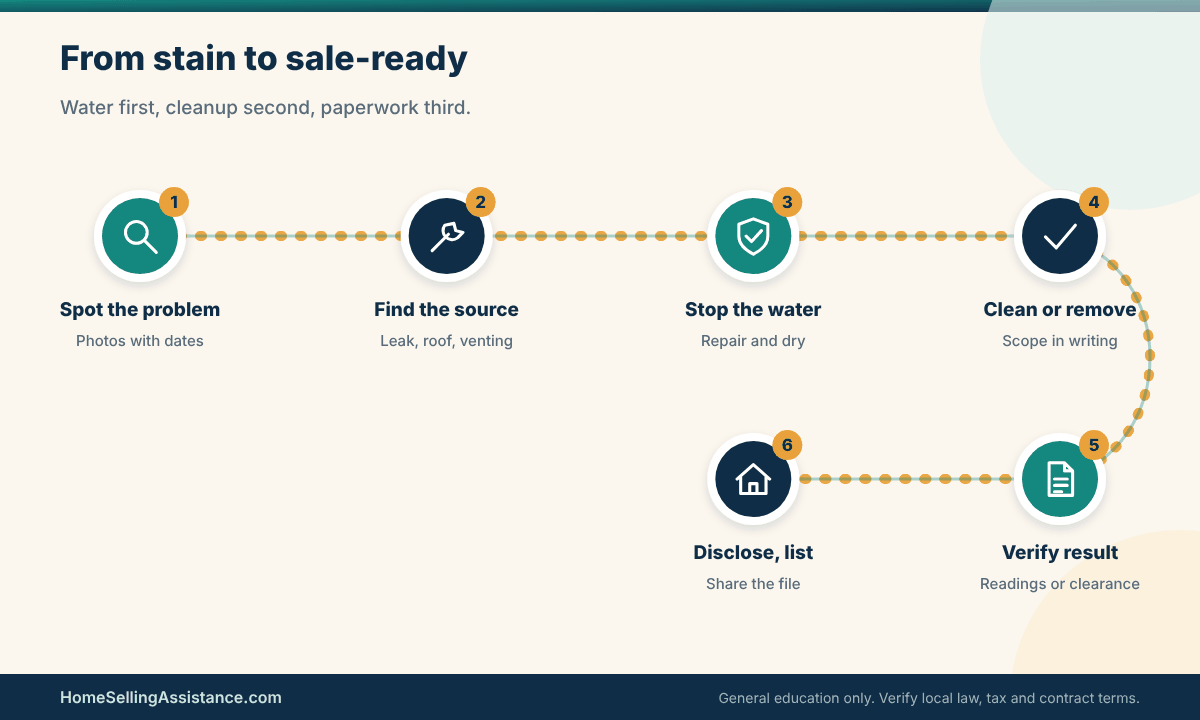
The first figure below shows the usual order of work, from spotting a problem to handing a buyer a clean file. Keep it nearby, because the later sections follow the same sequence.
What buyers and inspectors find when you sell house with mold
Most mold discoveries during a sale are not dramatic. They tend to be small and ordinary, and they cluster in the same places: under sinks, around tubs and showers, on basement walls, in attic corners near roof penetrations, around windows and in closets on exterior walls. Knowing where inspectors look helps you look first, and looking first is nearly always cheaper than being surprised. That habit helps whether you sell house with mold on a surface or a leak behind it.
A typical home inspection is visual and non-invasive. The inspector may use a moisture meter or an infrared camera, but the report mostly describes what is visible and what the instruments suggest. Mold testing by a specialist is a separate service that buyers sometimes request. Understanding that difference helps you read a report calmly instead of treating every sentence as a verdict. If you sell house with mold on the report, expect questions about which category each finding falls into.
Evidence to gather: stains, smells, readings and moisture maps
Before you call anyone, walk the house with a notebook and a phone. Photograph every stain, bubble in paint, soft drywall edge, warped baseboard, rusty fastener and musty room, with a date and a short note on location. Smell tells you something too. A damp, earthy odor that returns after cleaning often means moisture is still being supplied from somewhere behind a surface.
Next, ask a qualified professional for readings rather than opinions. A licensed home inspector or a water damage or mold professional can use a moisture meter to map which walls, floors and ceilings are wet, damp or dry. That map is gold. It shows the extent of the problem, it gives a repair contractor a starting scope, and it later proves what was dry on a given date.
Be careful with do-it-yourself test kits. Spores are everywhere, so a kit that finds some mold has told you very little about whether you have a hidden problem. Reputable guidance generally emphasizes finding and fixing moisture over chasing spore counts. If a buyer or a lender does ask for lab sampling, hire an independent tester who does not also sell the remediation, so the findings are not tied to a sales pitch. A decision to sell house with mold should rest on documented moisture findings, not on a kit.
A scenario, an exception and your next step: the small bathroom patch
Picture a seller who spots dark spotting on the ceiling of a second-floor bathroom three weeks before listing. The easy move is a coat of stain-blocking paint. The better move is to ask why the ceiling is damp. In this example, the inspector finds that the exhaust fan vents into the attic instead of outdoors, so warm shower steam condenses on cold roof sheathing and drips back down.
The fix is a properly vented fan, a cleanup of the affected ceiling and attic surfaces, and a written note of what was done. That is a modest job compared with a rotted roof deck. The exception is when the staining is old and the wood above it is soft, which points to a longer leak. If the inspector probes soft framing, stop and get a contractor’s opinion before you list anything.
Your next step in either case is the same: write down what the cause was, who confirmed it and what changed. We return to that file in the documentation section, and you will see why it can matter more than the repair itself. The same thinking applies to other defects, which we compare in our guide to selling a house with foundation problems.
What a mold or water problem can put at risk: health, structure and the sale
Three things are exposed when moisture goes unaddressed. The first is people. Damp buildings are associated with respiratory irritation and allergy symptoms for some occupants, and sensitivity varies a great deal from person to person. You are not the one to judge a buyer’s health, and you should never make claims about it either way. Your job is to describe conditions honestly. Each exposure shapes how you sell house with mold, so keep all three in mind.
The second is the house itself. Persistent moisture can swell and rot wood, corrode metal fasteners, stain finishes, degrade insulation and damage subflooring. The third is the transaction. Hidden moisture that surfaces after closing is a classic source of disputes, and a dispute costs far more than a careful cleanup beforehand. Everything in the next sections is aimed at keeping those three exposures small.
Evidence to gather: hidden moisture, wood rot and insulation
Visible mold is often the smaller part of the story. Moisture can travel inside wall cavities, under flooring and above ceilings, so a clean-looking surface does not prove a dry one. This is why professionals open a small inspection hole or use thermal imaging to check behind finishes, and why a sudden reappearance of stains after a rainstorm is worth documenting with a date. Remember that when you sell house with mold, the hidden part is what buyers ask about.
Ask any contractor who inspects the house to describe, in writing, which materials are affected and which are only surface-stained. Porous materials such as drywall, ceiling tile and some insulation are often removed when they have been wet and moldy. Hard, non-porous surfaces such as glass or metal are typically cleaned. Wood framing is judged case by case, and the contractor should say why it can stay or must go.
Also check the paper trail for the house itself. Old claim records, plumbing repair invoices, a past roof replacement, window flashing work and any earlier inspection reports all help you reconstruct what happened and when. Gaps in that history are not a crime, but you will want to be honest about them. A seller who says “we noticed it in March, here are the photos and the plumber’s invoice” sounds credible in a way a vague answer never does.
If the house was built before 1978, add one more question to your list. Tearing out damaged walls or ceilings can disturb old paint, and federal rules treat older homes as possible lead-paint properties. The EPA keeps a page on lead-based paint real estate disclosure, and a good contractor will tell you what lead-safe practices apply to the demolition work.
A scenario, an exception and your next step: a seller who finds mold after the inspection
Now imagine you are already under contract. The buyer’s inspector notes a musty crawl space and moisture readings along one foundation wall. The temptation is to argue that the buyer is exaggerating. Resist it. A calmer response is to ask for the inspector’s photos and readings, then bring in your own qualified professional to confirm the cause and propose a scope. Expect questions to arrive all at once, which is common when you sell house with mold.
That sequence protects you in several ways. It shows good faith, it replaces an emotional reaction with data, and it gives both sides one shared set of facts. The exception is when the contract’s inspection period is short. In that case, ask your agent or attorney whether an extension, a credit or a termination right is in play, because the clock may matter as much as the mold.
Your next step is to compare what the inspection found with what you already knew. If you knew about a leak and had not mentioned it, talk to your attorney right away about disclosure. Waiting rarely makes the conversation easier, and our guide to pre-listing home inspections explains how looking first can prevent this exact scramble.
Reduce the risk before the contract: stop the water, then deal with the mold
Once you know where the moisture comes from, the work falls into a clear order. Stop the source. Dry the structure. Remove or clean what is affected. Verify the result. Rebuild or refinish. Skip a step and the problem tends to return, usually right after the buyer’s inspection. This is also where most of the money in a plan to sell house with mold is decided, so it pays to slow down and get it in the right sequence. Skipping the order is the costliest way to sell house with mold.
Stop the water first, then choose the right level of remediation
Repairing the source can be as simple as clearing a gutter or replacing a worn supply line, or as involved as regrading a yard, repairing a roof, or waterproofing a basement. Get that repair done, or at least scheduled and written down, before the cleanup contractor starts. Cleaning an area that is still being rewetted is a bit like mopping beside a running tap. Whether you list now or later, to sell house with mold safely you want the source fixed first.
Then match the response to the size of the problem. A small surface patch on a hard material is a different job from a wet wall cavity or a flooded basement. Public guidance generally treats larger or hidden problems, and any situation involving sewage or floodwater, as work for trained professionals. When you are unsure which side of the line you are on, ask a professional to say so in writing. Sellers who sell house with mold of any size benefit from a written opinion.
If the damage came from a roof problem, the repair choices overlap with a bigger decision about whether to replace or patch. We cover that trade-off in our piece on replacing a roof before selling, and the broader repair-or-not logic sits in the complete guide to repairs before selling a house.
Documents to ask for when you sell house with mold: scope, protocol, clearance
A trustworthy remediation job produces paper. Ask every contractor for a written scope that names the rooms, the materials to be removed or cleaned, the containment and air filtration approach, the drying method, and how success will be judged. Ask whether they hold a license or certification that your state requires or recognizes, since requirements differ widely and some states have no specific mold licensing at all. Buyers who see that paper are more at ease when you sell house with mold history.
Ask who will verify the work. Many professionals separate the person who writes the protocol and checks the result from the crew that does the cleanup. That separation reduces the temptation to declare victory early. A post-work moisture reading, visual check or independent clearance report, whichever your professional recommends, becomes the key page in your file.
Collect the invoice, the proof of insurance, warranty terms and any photographs the contractor takes before and after. Read the warranty carefully. Some are transferable to a new owner and some are not, and that detail can be a selling point when you hand the file to a buyer’s agent. Get two or three quotes if time allows, and compare scopes, not just totals, since a low quote with a thin scope is not a bargain.
Be wary of anyone who diagnoses a whole-house emergency over the phone, demands a large deposit up front, pressures you to sign immediately, or refuses to put the scope in writing. The Federal Trade Commission publishes consumer guidance on hiring contractors and spotting repair scams, and it is worth a look before you sign anything.
Scenario: do-it-yourself cleanup versus a licensed contractor
Take two examples with illustrative round numbers. In the first, a seller finds a small spot of surface mold on a bathroom tile grout line after fixing a dripping faucet. The area is small, the material is hard, and the cause is repaired. Cleaning it carefully, drying the area and photographing the result may be reasonable, and the seller notes the event in the disclosure. Both examples show how a seller might sell house with mold at very different scales.
In the second, a seller discovers a soft, discolored section of basement drywall where a foundation seep has been running for months. Say a contractor’s scope for removal, drying, new insulation and drywall comes to a few thousand dollars. A do-it-yourself approach here risks missing wet material behind the wall and spreading spores while demolishing it.
The deciding factors are size, hidden extent, material type, your health and any occupants’ sensitivities, and what your state or insurer requires. If you hesitate, hire the professional, because a documented job transfers confidence to the buyer in a way a weekend project rarely can. For the larger decision of what to fix and what to leave, our overview of important repairs before selling a house helps you rank the work. If you plan to sell house with mold, the documented route is usually the easier story to tell.
What never to do or assume when you sell house with mold
Some mistakes turn a manageable repair into a legal and financial headache. They share a theme: they replace information with appearance. A seller who paints over a stain, runs a dehumidifier only on showing days or tells a buyer “it has never leaked” without checking has created a problem that is bigger than the original one. Each of them makes it harder to sell house with mold honestly.
The matrix below lays out common claims and pressures you may run into, what to verify, a safe action, what not to say or share, and where to escalate. Use it as a conversation aid with your agent or attorney, not as a script that fits every state. The first sentence of each row is the situation, and the last column says who to call if the facts get complicated.
| Claim or pressure | Evidence to check | Safe action | Never say or assume | Escalate to |
|---|---|---|---|---|
| “It is only surface mold, paint it.” | Moisture map, cause of dampness | Ask a professional to confirm scope in writing | That a clean surface means a dry wall | Licensed remediator, inspector |
| Buyer wants lab air testing | Who orders it, who pays, what it measures | Agree on an independent tester in writing | That a test result proves safety either way | Your attorney, agent |
| Contractor quote far below others | Scope, license, insurance, warranty | Compare scopes line by line | That cheapest means equal | State licensing board, FTC |
| Stain returns after rain | Dated photos, roof or grading cause | Fix the source, then re-dry and re-check | That one cleanup solved a recurring leak | Roofer, plumber, inspector |
| Past insurance claim exists | Claim file, repair invoices | Gather records and answer questions truthfully | That an old claim need not be mentioned | Insurer, attorney |
| Buyer asks “any water problems?” | Your own history, disclosure form | Answer from facts and match the written form | That a verbal answer replaces the form | Attorney, state commission |
To use the table, find the row closest to your situation, then follow it left to right. Gather the evidence in the second column before choosing the action in the third. The fourth column is the one people skip, so read it twice. If two rows apply at once, such as a recurring stain and a past claim, treat the more serious one as the lead and talk to a professional about the other. Used this way, the table makes it easier to sell house with mold without improvising.
Evidence: why bleach, paint and fans are not a fix
It is natural to reach for household products. A bleach wipe may lighten a stain on a hard surface, but it does not repair a leak and does not reliably treat porous materials, where growth can sit below the surface. Guidance from health and environmental agencies generally steers away from relying on bleach, and it never replaces fixing the moisture problem. Mixing cleaning chemicals can also create dangerous fumes, so follow product labels strictly. Quick fixes rarely help a seller who must sell house with mold and answer buyer questions.
Stain-blocking paint and sealant are cosmetic tools. They can be a legitimate finishing step after the material is dry and cleaned, but used alone they conceal. A fresh patch on one wall of an otherwise old ceiling is exactly what an experienced inspector notices first. Fans and dehumidifiers help drying when used as part of a plan, and they hide nothing when a smell is still present.
If you are tempted by an air freshener or an ozone generator before showings, remember that a lingering smell is information. Buyers with sensitivities may react strongly to fragrance, and heavy scents can read as a cover-up. A better investment is an honest explanation plus proof that the source was found and fixed. That is also the line between presenting a house well and hiding a defect.
Scenario: the quiet cover-up that surfaces at closing
Here is a cautionary example. A seller notices staining below a window, patches it, repaints and says nothing. The buyer’s inspector misses it, and the sale closes. Months later, after a heavy storm, the paint bubbles and the buyer cuts open the wall to find rotted framing and growth. The buyer’s attorney asks what the seller knew and when. It is the opposite of a careful plan to sell house with mold.
Whether any legal claim succeeds depends on the state, the contract language, the disclosure form and the facts, and we cannot say how it would turn out. What we can say is that the seller’s position is far weaker than it would have been with a dated note and a plumber’s invoice. Even a seller who sells strictly as-is generally remains responsible for honest answers in many states.
The better next step is simple. If you have patched something, say so and keep the evidence of what was behind it. If you are unsure what your state requires, ask a local real estate attorney before you complete the form. Our explanation of material defects and seller disclosure shows how that duty is usually framed.
Disclose, document and respond when you sell house with mold history
Repair work solves the physical problem. Disclosure and documentation solve the trust problem, and in a sale the second is often the harder one. Buyers cannot see inside walls. They rely on what you tell them, what an inspector finds and what your records prove. When those three agree, deals tend to survive the discovery of a problem. When they conflict, even small issues can sink a contract. Both halves matter when you sell house with mold.
There are two broad decisions here. One is what you must disclose, which is a legal question that varies by place. The other is what you choose to provide beyond the minimum, which is a strategy question. In our experience the sellers who share a tidy file voluntarily are usually the ones who sleep better and face fewer surprises. The picture below sketches the fork many sellers face once they know about the problem. A seller who must sell house with mold usually faces both.

Disclosure basics: what you know, what you say and where it goes
Most states require sellers of residential property to complete a disclosure form or otherwise reveal known material defects, but the details differ widely. Some states use a detailed checklist that asks directly about water intrusion, mold, past repairs and insurance claims. Others rely on narrower duties, and a few historically placed more weight on buyer inspection. Never assume your state resembles your cousin’s state across the border. The same is true if you sell house with mold from an earlier leak.
To check your own rules, start with your state real estate commission or its equivalent, which usually publishes the form or explains the duty. A local real estate attorney can tell you how courts in your area treat prior mold, prior leaks and prior repairs. Your listing agent, if you use one, can supply the standard form, though the answers must come from you. Our wider explainer on seller disclosure requirements covers the common structure. Ask them how to sell house with mold history on the form.
A practical habit helps here. Treat the disclosure form as a statement about what you know, not a guess about what a buyer will tolerate. If you are unsure whether something counts, write the fact down in neutral words and ask your attorney or agent how to present it. That is an honest, protective approach, and it is far safer than silently leaving a line blank. It is a calm way to sell house with mold without second-guessing each line.
Source to check: your state form, your contract and your own history
Pull three documents side by side. The first is the state or local disclosure form, with its questions about water, moisture, mold, past repairs and insurance claims. The second is the draft purchase contract, which may contain its own clauses about condition, inspection periods and as-is wording. The third is your own timeline of what happened, with dates, photos and receipts. This is the quickest way to sell house with mold history without contradicting yourself.
Read the form’s questions one by one and answer each from your timeline. If the form asks whether you are aware of any past water intrusion, and you replaced a ceiling after a roof leak three years ago, that is part of the honest answer, together with what fixed it. A short, factual sentence such as “roof flashing replaced, ceiling repaired and repainted, receipt available” tends to land better than silence.
Watch the interaction between disclosure and an as-is clause. Selling as-is generally means you are not offering to repair, which is different from having no disclosure duties. In many states you still must answer disclosure questions truthfully, and the as-is language does not erase that. If you plan an as-is sale, our guide to how to sell a house as-is explains the structure, and your attorney can confirm what applies locally.
A scenario, an exception and your next step: the buyer who asks one direct question
Suppose a buyer at a showing asks, “Has this basement ever had water in it?” You had a sump pump fail two springs ago. The cleanup was handled by a professional and the wall was dried and refinished, and there has been nothing since. The honest answer is yes, once, here is what happened and here is the paperwork. That is a typical moment when you sell house with mold history and need a plain answer.
Answering that way does something subtle. It makes the buyer’s agent trust the file. If a buyer’s inspector later reports moisture readings, your history already explains them. Compare that with a seller who answers “never” and is contradicted by a neighbor, an old claim or a repair invoice. In that second case, a manageable event becomes a credibility problem.
There is one exception worth noting. If you did not own the home at the time, say so, and say what you were told. Disclosure generally covers what you actually know, and a clear note about the limits of your knowledge is legitimate. Your next step is to write the answer in your own words, then run it past your attorney or agent before it goes on any form.
Build a records file buyers, lenders and insurers can trust
Think of the records file as the second product you are selling. The house is the first. A buyer who gets a clear, indexed packet feels managed well, and a buyer’s agent can answer questions without guessing. Even if the buyer never opens it, the existence of the file changes the tone of negotiations, because most disputes begin where memory ends. That is true whenever you sell house with mold, even an old, resolved case.
The file also helps with insurance. Some insurers ask about prior water or mold claims when pricing a policy for the new owner, and some lenders and appraisers ask whether a known issue was resolved. Your documents are what let a buyer answer those questions cleanly. Keeping a copy yourself also protects you if someone raises a question long after the closing. It is one more reason to organize things before you sell house with mold.
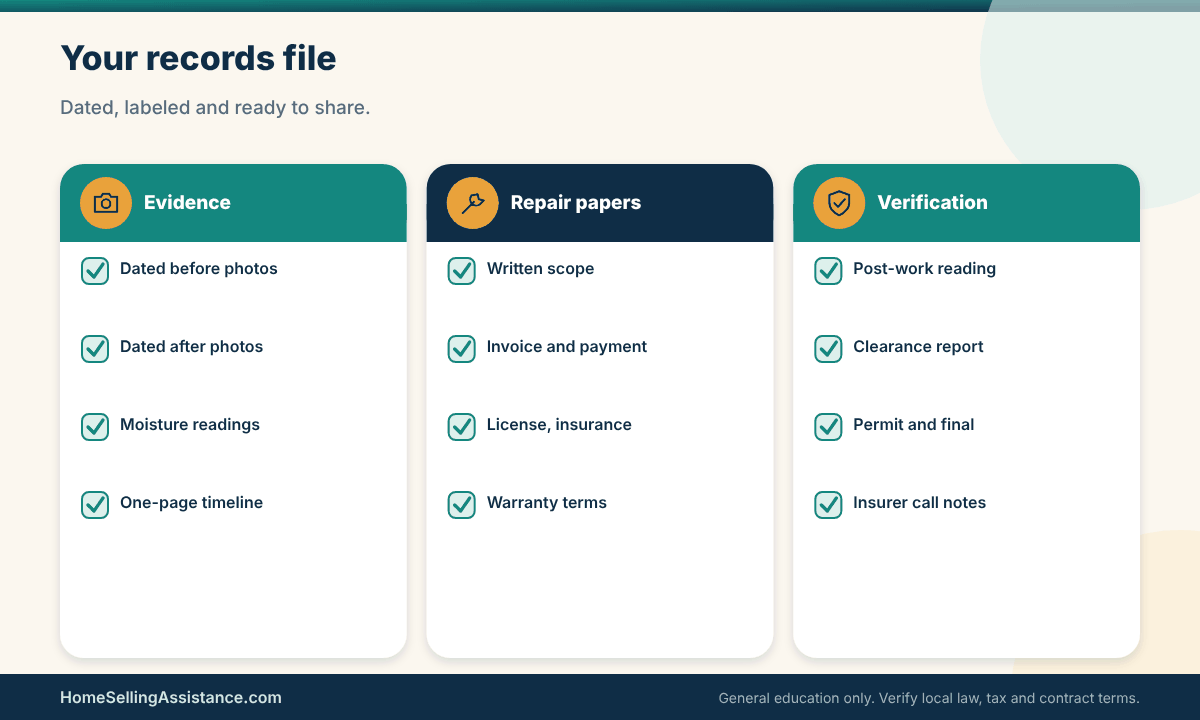
The checklist figure below shows what many sellers include. It is a starting point, and your own situation may need more or less.
What to include: photos, readings, receipts and clearance results
Start with a one-page timeline: when you noticed the problem, when you found the cause, when the source was repaired, when cleanup was done and when it was verified. Attach dated photographs of the problem and of the finished work from the same angles. Include the moisture map or readings before and after, the written scope of work, the contractor’s invoice and proof of payment. A file like this is standard practice for many who sell house with mold.
Add any warranty, the contractor’s license or certification details, and the clearance report or post-work verification your professional used. If an insurance claim was filed, keep the claim number, the adjuster’s summary and the payment record, and confirm with your attorney how to describe it. Include permit paperwork when the repair required one, since open permits are a separate problem that can delay closing.
Label each document with a plain file name and date so a stranger can follow the story. A packet of twenty unlabeled photos helps nobody. If a repair involved structural or electrical work, make sure the permit and final inspection are in there too, and look at our guide to selling a house with unpermitted work if any past repairs were done without one.
Sharing the file, then answering buyers when they push back
Sharing a file raises a fair question about privacy. You do not need to hand over bank statements, full insurance policies, your identification or your personal contact trail. Share the condition records, redact account numbers and personal information, and send them through your agent, the title company or a secure link rather than posting them publicly. Keep the original, give out copies. That balance matters when you sell house with mold and still want your privacy.
Timing matters as well. Many sellers offer the file when the house is listed, so that buyers can write offers with eyes open and fewer inspection surprises. Others hold it until a buyer is under contract. Either approach can be legitimate, though earlier tends to build trust. Whichever you choose, tell your agent or attorney what exists, so nobody denies a record you actually have.
Your next step is to build the file now, even if you are not yet listing. Memories fade quickly, receipts fade faster, and contractors change phone numbers. Our guide to home sale tax records explains why a tidy habit with seller paperwork pays off in more than one way, since repair costs can matter to the numbers later.
Paperwork is only half the job. Even a well-prepared seller will hear about moisture at some point, usually through a buyer’s inspection report. How you respond in the first few days often decides whether the sale holds together. The goal is not to win every point. It is to keep the conversation factual, keep it in writing and keep your options open until you understand the contract. A realistic plan to sell house with mold includes a response plan for buyer requests.
The scenario table below covers situations that come up when you sell house with mold in its history or on its inspection report. Each row names the situation, the warning sign to watch, the channel through which to verify, a sensible seller response and the record to save. It will not replace advice from your agent or attorney, but it should help you ask better questions.
| Situation | Warning sign | Verification channel | Seller response | Record to keep |
|---|---|---|---|---|
| Inspection report flags moisture | No cause or readings given | Ask for photos and meter data through the agents | Get your own professional to confirm cause and scope | Report, photos, your professional’s note |
| Buyer demands a large credit | One quote, no scope attached | Request written quotes from licensed trades | Counter with a documented scope or your own bids | All quotes, counter-offer, signed addendum |
| Buyer asks for remediation before closing | Vague standard for “done” | Agree on a verifier in writing | Define the work and the post-work check in an addendum | Addendum, invoice, clearance or reading |
| Cash buyer offers as-is with no inspection | Pressure, unusual deadline, vague funds | Verify identity and funds through the title company | Keep full disclosure; do not trade honesty for speed | Disclosure form, proof of funds, contract |
| Buyer cancels after the inspection | Dispute over who owed what | Contract terms, escrow or attorney | Review deadlines and deposit terms before replying | Emails, notices, dated timeline |
| Insurer asks about the damage | Request by phone only | Use the number on your policy or the agent’s office | Answer factually; check wording with your attorney if unsure | Claim notes, call dates, correspondence |
Use the table by finding your situation, then looking at the warning sign and verification columns before you answer anyone. The point of the verification channel is to rely on documents and trusted contacts, not on whoever is pressing hardest. If a scenario mixes two rows, begin with the contract terms, because deadlines are the thing you cannot get back.
An inspection report is a negotiation document, whether anyone says so or not. It often contains a mix of significant items, routine maintenance notes and cautious wording by an inspector who is protecting themselves. A thoughtful response sorts these into groups and addresses the significant ones with evidence. Our guide to inspection repair request options for sellers goes through the general menu of responses. This is where a seller trying to sell house with mold history needs patience.
You usually have a few broad choices: repair the problem and document it, offer a credit or price reduction, agree to a split, or decline and accept the risk that the buyer walks if the contract allows it. Which is wise depends on your contract, the timeline, the severity and your alternatives. Reading the contract’s inspection clause before you reply is worth more than any negotiating trick. Each can work for a seller who must sell house with mold, depending on the contract.
Before agreeing to anything, gather the buyer’s specific request, the inspector’s photos and your own contractor’s scope. Then read your contract’s inspection or due diligence section, noting the deadlines, whether the buyer may terminate, what a repair request must include and how responses are delivered. Many disputes come from missing a notice deadline rather than from the mold itself. That discipline matters most if you sell house with mold and face a deadline.
Ask for bids from licensed contractors, and compare the scope inside each one. If a buyer’s quote says “mold remediation, large credit” and yours lists specific rooms, materials, drying and verification, you have a more concrete discussion. When the numbers differ widely, the gap usually sits in assumptions about how much material must be removed. Ask both contractors to walk the area together if both sides agree.
Consider whether a repair credit or a seller-completed repair serves you better. A credit hands the buyer control of the work, and some lenders restrict how credits are used. A seller repair gives you control and a paper trail but takes time before closing. Our comparison of repair credit versus seller repair walks through those trade-offs in more detail. Both are common ways to sell house with mold when problems surface late.
Here is an illustrative case with round numbers only. A buyer asks for a credit of a few thousand dollars after a report notes damp insulation in a crawl space. You get a contractor’s scope that suggests the work may cost less than the buyer’s figure, and the underlying cause is a downspout that discharged next to the foundation. You fix the downspout, document it and offer a smaller credit with the scope attached. It shows how you can sell house with mold repairs on a modest scale.
The buyer may accept, counter or ask for a re-inspection. All three are reasonable. The exception is when the contractor finds more than expected after opening the area, such as rot in a sill plate. In that case, revisit the numbers honestly and tell the buyer promptly. Hiding new findings turns a negotiation into a trust problem, and trust is the thing holding the sale together. Any of these is normal when you sell house with mold on an inspection report.
Your next step is to answer inside the contract’s deadline and in writing. Keep the tone businesslike and avoid blaming the buyer or inspector. If the deal still falls apart, our guide on what to do when a deal falls through after inspection explains how to reset without repeating the same mistakes. The figure below compares the two main routes side by side.

Some situations are bigger than a negotiation with a buyer. Water damage can involve your homeowner’s insurance, your mortgage servicer, your local building department and sometimes a public health office. Deciding when to involve each one is a judgment call, so we offer a simple rule: when a decision could have legal, financial or health consequences for someone else, get advice from the right professional first. They can complicate a plan to sell house with mold in a hurry.
The decision tree below shows one way to think about the first branching points after you discover a problem. It does not replace professional judgment, and your contract and policy may add steps. The branches are meant to keep you from skipping the cheap, early phone calls that prevent expensive late ones.
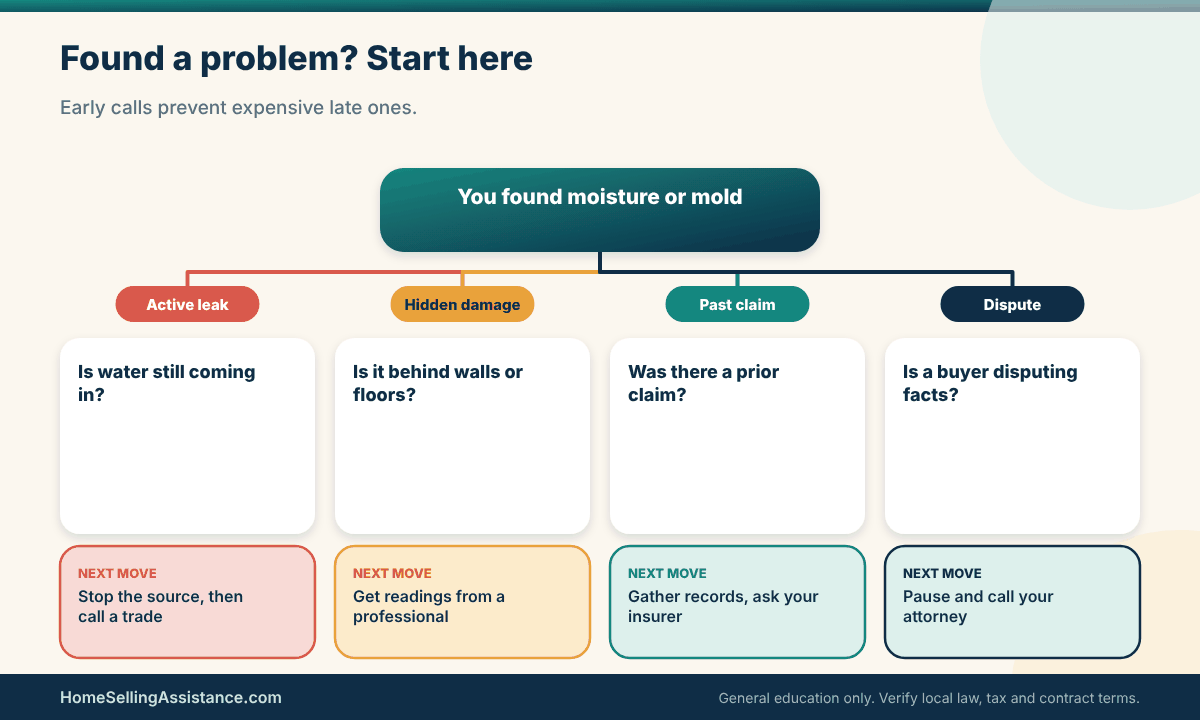
Insurance first. Many homeowners policies treat sudden and accidental water damage differently from long-term seepage or maintenance problems, and mold coverage is often limited or excluded, but the specifics depend on your policy. Read the water and mold sections, then call the number on your policy or through your agent’s office to ask how a claim would work. Ask, too, whether starting a claim affects your premiums or your ability to renew. Insurers also matter if you sell house with mold or a past leak that led to a claim.
Be careful about timing. Policies often require prompt notice, and deadlines to file may be short. Keep notes of every call, including the date, person and what was said. If a claim is paid, remember that insurance money is meant for repairs, and your lender may have an interest in how it is spent. If you are considering leaving the house vacant while repairs happen, see our note on selling a vacant house for the risks that creates.
Attorney next, especially when you disagree with a buyer about disclosure, have a prior claim to describe or face a threatened lawsuit. A local real estate attorney understands how your state treats mold, as-is clauses and misrepresentation. Ask what you must disclose, how to word it, how your contract handles termination and what records to preserve. A single consultation can cost far less than a dispute. Good advice can make it far easier to sell house with mold history cleanly.
Finally, licensed trades. Plumbers, roofers, electricians and structural professionals can each confirm that a source is fixed. If the house is old and demolition may disturb paint, ask about lead-safe practices. Keep every written opinion and make sure each one names the date and the address.
Imagine a seller whose buyer says, after closing, that mold appeared in a bedroom closet that the disclosure never mentioned. The seller remembers an old wet spot and a repair, but the paperwork is thin. A frantic reply to the buyer is exactly the wrong first move. Anything said casually in a text or email can become evidence. This is the worst case for a seller who had to sell house with mold history.
The calmer path is to stop, preserve every message, locate the receipts and talk to an attorney before replying in substance. Notify your insurer if your policy or the facts suggest it, since some policies include liability coverage for certain claims, though the details vary. Do not promise repairs or payments until you understand your position. Calm habits protect any seller who needs to sell house with mold.
The exception is an urgent safety condition, such as active flooding or a hazard, where immediate practical steps may be needed regardless of who is at fault. Your next step in every case is to document, pause and ask. If you are weighing whether this much hassle is worth it at all, our comparison of cash offers for a house and the tips on fast-sale claims will help you judge any shortcut with open eyes.
Quick scenario
A seller listed a home with a dated file: leak found in spring, gutter and flashing repaired, wet drywall removed by a licensed contractor, readings taken after drying, photos from the same angles and a short disclosure. The buyer’s inspector still noted moisture in a different corner. Because the seller already had a timeline, the two sides compared notes in an afternoon and agreed on one more repair. The file did not stop the finding. It stopped the panic.
Frequently asked questions about sell house with mold
Can I legally sell house with mold in it?
In general, yes, there is no blanket federal rule that forbids selling a home with mold. What matters is how you handle disclosure, contract terms and any local requirements, which vary by state and sometimes by city. Many sellers choose to remediate first, and others sell as-is with honest disclosure. Ask a local real estate attorney which duties apply where you live.
Do I have to fix the mold before I list?
Not necessarily. Some sellers fix the source and the damage first because it removes a big source of buyer worry. Others disclose and let the buyer decide, often at a lower expected price or with a credit. Neither path is automatically right, so compare cost, time and the buyers you want to attract.
Is it better to remediate or to offer a credit?
It depends on your timeline and your comfort with risk. Remediating gives you control of quality and a paper trail, but it takes time and money before the sale. A credit can be quicker, though it hands the work to the buyer and may be limited by the buyer’s lender. Reading the contract and getting real quotes settles most of the debate.
What must I disclose about past water damage?
The rules differ by state, so check your state’s disclosure form or ask your attorney. Many forms ask about water intrusion, mold, repairs and insurance claims. A good rule is to answer from what you actually know, state facts plainly and avoid guessing. If you are unsure whether something counts, ask before leaving it off.
Does an as-is sale mean I do not have to disclose?
Usually not. Selling as-is generally means you will not make repairs, but many states still require truthful answers about known defects. The as-is wording does not typically erase the duty to disclose what you know. Confirm the details with an attorney, particularly if you know about a past leak or mold.
Should I test for mold before selling?
Testing is optional and depends on the situation. Because spores exist almost everywhere, a test does not by itself prove a house is safe or unsafe, and results need interpretation. Many professionals care more about locating moisture and confirming that wet materials were dried or removed. If you do test, use an independent professional and keep the report.
Will my homeowners insurance pay for mold or water damage?
Coverage varies a lot. Policies often respond differently to sudden, accidental water events than to slow leaks or lack of maintenance, and mold limits or exclusions are common. Flood coverage is generally separate. Read your policy and ask your insurer or agent directly before relying on any payment.
How do I find a trustworthy remediation contractor?
Ask for licenses or certifications your state requires, proof of insurance, references, a detailed written scope and a warranty. Be cautious of high-pressure sales, large upfront deposits and quotes with no scope. Comparing two or three written bids helps you see what is normal. The FTC consumer site offers general tips on avoiding repair scams.
What if the buyer’s inspector finds mold after I accept an offer?
Read the inspection clause in your contract and note deadlines. Ask for the report, photos and readings, then bring in your own qualified professional to confirm cause and scope. Respond in writing, within the contract’s timeframe, with a repair, credit or other proposal. If things get contentious, call your attorney before replying.
Will a cash buyer take the house without caring about mold?
Some buyers do purchase houses in rough condition, but you should still expect questions, and honest disclosure still applies. A cash offer may reflect the buyer’s estimate of repair costs and risk. Verify the buyer and the funds through the title company, and compare the offer with the net you could expect elsewhere. Quick promises deserve extra care.
A calm way to approach this sale
When you sell house with mold or water damage in the picture, the winning habits are modest ones: find the water, fix it, keep paper, tell the truth and read your contract before you answer anyone. None of that guarantees a particular price or timeline, and every state and policy differs. This article is general education, not legal, tax or financial advice, so confirm the details with your attorney, insurer and licensed professionals before you act.
Once the file is built, the rest of your repair plan gets easier, and the repairs and selling as-is hub and the disclosures and seller paperwork hub will help you plan what comes next.