Sorting out the important repairs before selling house day arrives is mostly a triage job: you look at everything that is wrong, decide what could hurt someone, what could stop a loan, what could scare a buyer and what is merely annoying, and then spend money only where it earns its keep. Most sellers do the opposite. They repaint the hallway, replace a faucet they never liked and leave the leaking water heater for “the inspector to find.”
Here is the uncomfortable truth we see again and again. Buyers rarely walk away because a house has scuffed baseboards. They walk away, or ask for a large concession, because something looks unsafe, something does not work, something might block their mortgage, or something suggests the owners were careless and other problems are hiding. Those four worries, safety, function, financing and confidence, are the lens for this whole article. Think of this as the first filter for important repairs before selling house planning.
You will not find a universal price list here, and you should be suspicious of anyone who offers one. Repair costs and buyer reactions vary by region, climate, home age, price band and the mood of the local market. What we can give you is a method: how to define your real choice, how to compare the realistic paths, and how to apply a net-result rule so you can look at a quote and decide whether it belongs on your list.
This guide is one of several in our repairs series. If you want the full overview first, start with our complete guide to repairs before selling a house, then come back here to rank the individual items. Everything below is general education, not advice about your particular property.
You can also browse every guide in the repairs and selling as is category if you prefer to jump between topics. Keeping the list of important repairs before selling house work short and evidence-based is the habit we hope you take away, because a short, well-documented list is easier to finish, easier to explain to buyers and easier to defend if a negotiation gets tense. That is why a clear view of important repairs before selling house work starts with your own facts.
Key takeaways
- Safety comes first. Hazards such as exposed wiring, gas smells, active leaks or missing stair railings are the repairs most likely to matter to every buyer and every inspector.
- Function beats finish. A roof, furnace or plumbing line that does not work usually raises more concern than dated paint or carpet.
- Financing can decide the sale. Some loan programs and appraisers flag condition problems, so ask your agent or attorney which items could trouble a buyer’s lender in your area.
- Confidence is a repair too. Receipts, permits, past reports and honest disclosure often calm buyers more than a fresh coat of paint.
- Rank by net result. Compare the cost of a fix with the credit, price cut or delay you might face if you leave it, using real quotes and not rules of thumb.
- Revisit the plan. An inspection report, an appraisal or a buyer’s lender can change which important repairs before selling house matter, so stay flexible.
Define which important repairs before selling house really apply to you
Before you call a single contractor, it helps to pin down what you are trying to achieve. A seller who needs to close in five weeks because of a job transfer faces a very different repair list from a seller who can wait for spring. The house might be identical, yet the sensible answer changes completely, and that is why generic repair lists so often send people in the wrong direction.
This first section covers two things. The first is your own situation, meaning your goal, your calendar, your cash and how much uncertainty you can stomach. The second is a handful of facts about the property and the market that can quietly move an item from “skip” to “must do.” Get these right and the rest of the process becomes much easier to manage. Sellers who skip this step often misjudge important repairs before selling house costs by a wide margin.
Your goal, your cash and your tolerance for surprises
Start with four plain questions. What outcome matters most: the highest price, the fastest closing, the least effort or the lowest chance of a deal collapsing? How much time do you have before you must move or before carrying costs become painful? How much cash can you actually put into the house without borrowing against your proceeds? And how would you feel if a buyer’s inspector found something you had not expected?
Write your answers down. It sounds almost too simple, but a short written statement keeps you honest when a contractor starts suggesting upgrades. If your goal is a quick, low-effort sale, a long renovation list contradicts it. If your goal is a top price in a slow market, ignoring condition may contradict that instead. Your goal is the yardstick against which every item gets measured. Keep that in mind as you build your list of important repairs before selling house tasks.
It also helps to separate “wants” from “needs.” A want is something that would make the house nicer to you. A need is something a buyer, inspector or lender is likely to treat as a problem. Your list of important repairs before selling house needs belongs in the second category, and wants can wait until you see how the market responds. Sellers who mix the two often overspend on the first and underspend on the second.
Evidence to gather: a room-by-room walk-through and two quotes
The first piece of evidence is a careful walk-through. Go room by room with a notepad or phone and list everything that is broken, stained, leaking, loose, drafty, noisy, missing or simply tired. Check inside cabinets under sinks, look at ceilings for stains, open the electrical panel cover only if you know how to do so safely, and test every faucet, switch, door and window. Do not rank anything yet. Just collect.
Next, add evidence about cost. For anything beyond a minor handyman job, get at least two written quotes from licensed or properly insured local contractors, and ask each to describe the scope in plain words. Keep any receipts, warranties and permit records for past work. If you already own a prior inspection report, an insurance claim file or a utility audit, pull those together too, because they tell you what is known and what has already been fixed.
A word of caution about online “cost versus value” charts. They average projects across large regions and are not a promise about your sale. Use them, if at all, to understand which kinds of projects tend to be controversial. Then rely on your own quotes and on feedback from a local agent who has watched recent buyers react to homes like yours. Our guide on the pre-listing home inspection explains how an inspector’s report can complement your own list.
A scenario, an exception, and your next step: the tight-cash seller
Imagine, with purely illustrative numbers, a seller named Dana who expects roughly the same equity she needs for a down payment on her next home. Her walk-through finds a dripping hall bathroom faucet, a cracked window pane, a soft spot in a deck board and a water stain on a bedroom ceiling. She has a few thousand dollars set aside and not much more.
The stain deserves first attention, because water that has reached a ceiling may point to an active roof or plumbing problem, and that is both a function and a confidence issue. The deck board is a safety matter if people will stand on it. The faucet and the pane are cheap and quick. The exception would be a ceiling stain that a roofer confirms is old and dry. Her next step is to have a roofer or plumber look, take photos, and keep the written finding for buyers.
Notice what Dana did not do. She did not repaint the whole house or replace the kitchen counters. With limited cash, the first dollars go where risk is highest, and the rest waits for evidence from the market or from an inspection. That logic carries through every section that follows. This habit makes decisions about important repairs before selling house far less stressful.
Facts that change which repairs count
Some facts sit outside your own preferences yet change the whole calculation. The age of the home, the climate, the price band, the typical buyer’s loan type, the way local contracts handle inspections, and the amount of competition from similar homes all shape what buyers will accept. Two houses with the same cracked driveway can need different answers because one sits in a busy market and the other does not.
The sensible approach is to treat these facts as questions to ask professionals rather than as things you can guess. A local listing agent, a real estate attorney, a title company and a home inspector each see a different slice of the transaction, and between them they can usually tell you what buyers and lenders in your area tend to push back on. It is a small step that improves every later choice about important repairs before selling house work.
Evidence to check: loan types, local custom and what past reports say
Start with the likely buyer’s financing. Many buyers use conventional mortgages, but others use government-backed programs, and some of those programs set minimum condition standards that an appraiser must consider. Peeling paint on an older home, a missing handrail, a roof near the end of its life or an inoperable heating system can draw attention in an appraisal. Ask your agent or attorney how this tends to work locally, and do not assume a universal rule.
Local custom matters as well. In some areas sellers routinely fix inspection items before closing, while in others buyers accept a credit and arrange their own work. Some places require specific disclosures, certificates or municipal inspections at sale. Your state real estate commission, a local attorney or a title company can tell you what is required where you live, so check those sources rather than relying on a neighbor’s story.
Finally, reread any older reports you own. A previous inspection that flagged a worn water heater five years ago is a clue, even if you have forgotten it. Compare that report with today’s walk-through and note which items have already been addressed, which have worsened and which were never fixed. Disclosure rules also depend on what you know, so our overview of seller disclosure requirements is worth reading alongside your notes. Good records are half the battle when important repairs before selling house questions come up later.
Think about the order in which buyers meet a house. First they see photographs, then they walk through, then an inspector tests systems, then an appraiser measures value for a lender. A repair that matters at one stage may not matter at another, so the useful question about important repairs before selling house work is always where in that chain a problem would cause damage. A visible stain hurts at the photo stage. A failing furnace hurts at inspection. A missing railing can hurt at appraisal.
A scenario, an exception, and your next step: the house with a known leak
Picture a seller, Marcus, who has known for two winters that a basement corner gets damp after heavy rain. He assumed it was cosmetic. In a slow, cautious market, a buyer’s inspector is very likely to notice efflorescence, staining or a musty smell, and a buyer’s lender may care if the cause looks structural. That single known condition changes what he has to disclose and how he should price.
An exception exists when the dampness has a simple, documented cause, for example a gutter downspout that dumped water against the wall and was later redirected, with the damp spot staying dry through several storms afterward. In that case, a short written note and a few photos may do more good than a large project. His next step is to hire a qualified drainage or foundation professional to identify the cause before deciding how to proceed.
The lesson is that a known problem is a decision point, not a secret to manage. Whether you repair it, document it or price around it is your choice, but you generally cannot pretend you never saw it, and disclosure duties vary by state, so confirm yours with an attorney or your state commission. The same logic applies to almost every one of the important repairs before selling house you might consider.
When you look back at these two stories, notice that neither seller needed a huge budget to make a better decision. Both needed information: what is the problem, what does it cost, who needs to know, and what do buyers here usually do. Answering those four questions is the core of choosing important repairs before selling house day, and it costs far less than guessing wrong on a large project.

Compare realistic paths for important repairs before selling house
Once you know your goal and the facts, you can compare the paths on offer. In practice, almost every seller picks one of two broad routes for each defect, or a blend. Either you repair it before the house goes on the market, or you leave it, tell buyers about it honestly and let price or a credit absorb the problem. Neither route is wrong in general. Each is wrong for some sellers in some situations.
The picture below shows the three common ways to treat a single defect. We will walk through the first two in detail, and the third, selling the whole property as is, has its own guide at selling a house as is. As you read, keep in mind that the answer can differ item by item. You might fix the stair railing, credit the old water heater and leave the dated bathroom alone, all in one sale.

The next table lines up the two main paths across the factors sellers usually care about. It is a framework for conversation with your agent or attorney, not a verdict, and the words in it are deliberately general because real figures depend on your market and your contract.
| Factor | Repair before listing | Disclose and adjust | What to ask |
|---|---|---|---|
| Price and net proceeds | Spend now, may support a stronger asking price | Keep cash, accept a lower price or credit | What do local comps with similar condition show? |
| Time | Adds weeks before listing | Can list sooner | How soon must I close? |
| Contingencies | May shrink inspection friction | Buyer may negotiate harder after inspection | Will buyers waive or use inspections here? |
| Workload | Contractors, permits, scheduling | Mostly paperwork and disclosure | Can I manage a project while selling? |
| Execution risk | Poor work or overruns can hurt | Buyer estimates may exceed yours | Do I have two written quotes? |
| Financing risk | Can remove lender condition issues | Lender or appraiser may still object | What does the buyer’s loan program require? |
To use the matrix, pick one defect at a time and walk across its row. If the repair is cheap, quick and clearly tied to safety or financing, the left column usually looks attractive. If the repair is large, uncertain or likely to reflect the buyer’s own taste, the right column may be a better fit. Where the two columns feel balanced, the deciding factor tends to be your timeline and risk tolerance. In practice, this is where many important repairs before selling house debates are settled.
Path one: repair the priority items before listing
Fixing first has an obvious appeal. You control the work, the contractor and the paperwork, and a buyer’s inspector finds fewer surprises. Receipts and warranties become part of your marketing story. A seller who can say “the furnace was serviced in October and here is the invoice” removes a question before it is asked, which is a quiet form of buyer confidence that photographs alone cannot provide.
Fixing first also has costs. It uses cash and time, it exposes you to contractor risk, and it can tempt you to do more than the sale needs. Some repairs also create new disclosure or permit duties. This path works best for items that are small relative to their impact, clearly safety related, or likely to be demanded by nearly every buyer. Treat it as a reality check on your important repairs before selling house plan.
Evidence to gather: scope, permits, warranties and the buyer’s likely view
When you decide to fix something, write down the scope before work starts. A one-page description naming the problem, the intended fix, the materials, the start and finish dates and the price protects you from vague invoices. Ask whether the work needs a permit in your municipality, because unpermitted work can cause trouble later at inspection, appraisal or closing. Our article on selling a house with unpermitted work explains why this matters.
Collect the documents that prove the work was done properly. That means the invoice, any permit and final inspection sign-off, the contractor’s license or insurance details where relevant, and any manufacturer or workmanship warranty. Photograph the problem before the repair and the result after it. A tidy folder of these items can go straight to your agent for the listing or to a buyer’s agent when questions come up. None of this requires special expertise, only patience with your important repairs before selling house list.
Also try to see the repair through a buyer’s eyes. Ask your agent which repairs local buyers expect and which they consider the buyer’s job. A new roof might be a major selling point in one neighborhood and a nonissue in another where buyers plan to renovate. Our deep dives on whether to replace the roof before selling and whether to replace HVAC before selling show how those big-ticket calls tend to work.
A scenario, an exception, and your next step: the hazard you can fix in a weekend
Suppose a seller, Priya, notices that a basement stair has no handrail and a bathroom outlet near the sink is not protected against ground faults. Both are inexpensive and can usually be corrected quickly by a qualified person. Both are also the kind of item an inspector will mention first, and the kind a nervous buyer reads as a sign of casual upkeep.
The exception is when the issue hints at something larger. If the outlet problem comes from old, deteriorated wiring throughout the house, a small fix may not be enough, and she would want a licensed electrician to describe the full picture. Her next step is to hire a qualified professional for the work, keep the invoice and add the repair to her disclosure notes where required. Used honestly, this approach keeps important repairs before selling house spending proportionate.
Cases like Priya’s are where fixing first tends to pay off most clearly. The cost is modest, the benefit is broad and the story it tells buyers is simple. Larger projects deserve a harder look, which brings us to the second path.
A last word on timing for this first path. Repairs done long before listing give you room to fix mistakes and to collect paperwork, while repairs rushed in the final days tend to look rushed. If you can see a month or two ahead, schedule the important repairs before selling house work first and the photography and staging afterward, so the camera captures the finished house and not a half-finished project. A buyer reading your paperwork will judge your important repairs before selling house decisions by the same standard.
Path two: disclose, price it in, or offer a credit
The alternative is to leave a defect alone and handle it through information and price. You tell buyers what you know, set the asking price with the defect in mind, and, if a buyer’s inspection raises it, negotiate a credit or a price change instead of performing the work yourself. Many sellers like this because it keeps cash in hand, avoids contractor management and respects the fact that some buyers want to choose their own finishes and vendors.
This route is not free of risk. Credits and price reductions are negotiated, buyer estimates can be higher than your own, and some lenders limit how credits may be used. A defect left in plain view can also make a showing feel grim, which may thin out offers. Our detailed comparison, repair credit versus seller repair, covers the mechanics.
A practical way to think about this path is that you are trading control for convenience. With disclosure and adjustment, the buyer decides how and when to fix things, and you stop worrying about contractors. For many sellers with other priorities, such as a move, a new job or a family event, that trade is attractive. It simply needs to be priced honestly, so the important repairs before selling house you skip do not come back as a surprise at negotiation.
Evidence to gather: disclosure rules, estimates and lender limits
Begin with what you must tell buyers. Disclosure requirements differ widely by state, and many states provide a standard form that asks about specific systems and known defects. Some require disclosure of known material problems even where no form exists. Your state real estate commission, a local real estate attorney or your listing agent can tell you what applies. Our article on material defects and seller disclosure gives a general framework. That single question can shrink your important repairs before selling house list considerably.
Then gather a written estimate for the defect, ideally two. Estimates serve several purposes: they help you set price or a credit with confidence, they give buyers a reference point that is not their own worst case, and they show good faith. Label them clearly as estimates by named professionals on a given date, and avoid presenting them as guarantees.
Finally, ask about lender limits. Rules about seller credits and repair requirements depend on the loan program and the lender, and they change over time. A loan officer or your agent can tell you whether a credit is likely to work for a particular buyer’s financing, and our guide on inspection repair requests and your options as a seller shows how these conversations often unfold. This is also why important repairs before selling house advice from friends rarely transfers cleanly.
A scenario, an exception, and your next step: the aging water heater
Take a seller, Tomas, whose water heater is old but still works. Replacing it is a moderate expense, and a buyer’s inspector may note its age without calling it a defect. Because it works, it is a function item at the lower end of urgency. Tomas can leave it, mention its approximate age in any disclosure, and be ready to offer a modest credit if a buyer asks.
The exception arrives if the tank shows rust, leaks or scorch marks. A leaking tank is a damage risk and possibly a safety concern, and replacing it quickly is usually cheaper than arguing about it later. His next step is to have a plumber inspect it, then decide between replacement and a documented credit.
This example shows why the two paths are not rivals. The same house can use both, and the choice for each defect rests on risk, cost and how the market is likely to react. Keep notes on this, since important repairs before selling house choices often get revisited.
Before you commit to either path for a given defect, ask yourself one more question: could I explain this decision to a buyer in two sentences? “We replaced the heater and here are the papers” is clear. “We priced the house with the old heater in mind and disclosed its age” is also clear. A muddled answer usually means the decision is not yet made, and the important repairs before selling house still on your list need another look.
Use a net-result rule to rank important repairs before selling house
Now we reach the practical center of the article. Every repair has a cost and an expected effect on what you keep, how long the sale takes and how likely it is to close. A net-result rule simply asks you to compare those things honestly for each item. It will not give you a precise answer, because nobody can predict a buyer’s reaction with certainty, but it prevents the two most common mistakes: spending on things buyers do not care about and ignoring things they will.
Before the rule itself, it helps to sort your list using four lenses. Safety asks whether the item could hurt someone. Function asks whether a system or component works. Financing asks whether a lender or appraiser could object. Confidence asks whether the item makes a buyer doubt the care the house has received. The checklist image shows examples of each, and many items belong in more than one group.
Safety deserves a special mention because it is the one lens where waiting rarely helps. A gas leak, exposed wiring or a rotten stair does not become less serious as time passes, and it creates risk for your own household, for contractors, for photographers and for every visitor at a showing. If your list of important repairs before selling house tasks includes a genuine hazard, treat it as urgent regardless of the market. It is the kind of detail that separates a sensible important repairs before selling house plan from a hopeful one.

A price, time, cost and risk scoring method you can use
For each item on your list, ask four questions in plain language. What will it cost to fix, using a real quote? How much time will the fix add before listing or before closing? What is the likely price effect if I leave it, in the form of a lower offer, a credit or a failed deal? And what is the risk that the fix itself goes wrong, runs over budget or creates new problems?
Then compare the cost of fixing against the cost of leaving, always treating the second as a range, not a point. If the fix is clearly cheaper than the plausible concession, or if leaving the item risks the whole sale, the repair earns a place on the list. If the plausible concession is smaller than the fix, or the fix is mostly cosmetic, the item usually belongs in the disclose-and-adjust column. The method is simple on purpose, and you can run it on a single sheet of paper.
Evidence to gather: a worked example with illustrative round numbers
Here is a worked example using round numbers that are purely illustrative and not drawn from any market. Suppose a handrail repair quote is a few hundred dollars, a ceiling stain repair after a confirmed fix is a few hundred more, and a furnace replacement is several thousand. The first two are cheap compared with the likely friction they cause. The third is large, so it deserves a closer look at age, condition and local buyer expectations.
Say the furnace is working but old. If buyers in your area commonly accept a working older furnace and an inspector would call it serviceable, you might leave it and disclose its age. If it is failing or unsafe, leaving it could cost you not only a credit but the loan approval, because a buyer’s lender or appraiser might require it to be functional. The numbers did not change, yet the evidence did, and so did the answer.
Run the same arithmetic on your own items with your own quotes, and remember that every dollar spent on repairs comes out of the same pot as your mortgage payoff, fees and taxes. Our guide to home sale net proceeds shows how to build that pot item by item, and the waterfall below illustrates the structure. Remember that important repairs before selling house decisions are reversible until work begins.
One more reminder about numbers. A scoring method only works if you refuse to flatter yourself. People tend to underestimate repair costs and overestimate how much buyers will pay for new work. Add a cushion to every quote, because older homes hide surprises behind walls, and treat the final total of important repairs before selling house work as a range, not a promise.

The second table shows how the same method plays out for different sellers. Read it as a set of examples of reasoning, not as a prediction of what any particular market will do, and add your own situation as a new row when you work with your advisors.
| Situation | Route favored | Reason | Trade-off | Fact that changes the choice |
|---|---|---|---|---|
| Cash is tight, house is sound | Fix hazards only, disclose the rest | Protects the budget | Buyers may negotiate on small items | An inspection finding a larger problem |
| Hard deadline, heavy list | Credit or sell as is | Avoids project delays | Fewer buyers, sharper offers | Quick contractor availability |
| Flexible timeline, active leak | Repair before listing | Removes a major worry | Costs time and cash | The cause turning out to be minor |
| Older home, likely government-backed buyer | Fix condition items lenders may flag | Reduces financing risk | Some work may not be needed | Buyer using a different loan type |
| Heir selling an estate property | Disclose and price, limited repairs | Limited cash and knowledge | Lower offers likely | Estate rules on spending |
| Hot local market, many offers | Light fixes, strong presentation | Buyers may waive inspections | Skipped repairs may resurface later | Market cooling or buyers requesting inspections |
When you use this table, find the row closest to your life and read across, but pay most attention to the last column. That column names the single fact that would flip the recommendation, which tells you what to verify first. If you cannot say what would change your mind, you probably have not yet collected enough evidence to decide. Many sellers find this the clearest way to explain their important repairs before selling house choices to family.
A scenario, an exception, and your next step: pricing the leftover list
Consider a seller, Lena, who fixes the hazards and the leak, leaves a dated kitchen and a worn deck alone, and lists at a price that reflects both. She tells her agent about the deck, discloses what she knows and prepares two contractor estimates. When a buyer asks for a credit, she can respond with facts rather than feelings.
The exception is a market where comparable homes are all freshly updated and buyers are comparing finishes closely. There, leaving the kitchen may cost more in showing activity than a modest refresh would. Her next step is to ask her agent to pull recent comparables of similar condition, and to read our guide on how to price a house to sell before settling on a number. Use the same test whenever a new item joins your important repairs before selling house list.
Pricing and repairs are two halves of one decision. A house priced honestly for its condition and described honestly in disclosures often attracts serious buyers who accept the condition, while a house priced as if perfect invites tough negotiation after inspection.
When new evidence should change the plan
Your first plan is a hypothesis. It rests on what you know today, and the process of selling reliably produces new information: a contractor’s surprise inside a wall, a buyer’s inspection report, an appraiser’s note, a lender’s condition letter, or feedback from early showings. The wise seller treats each as a prompt to reconsider and not as an insult to the original plan. Apply it consistently and your important repairs before selling house budget stays under control.
Write down, in advance, which events would make you change course. A short list of triggers helps you stay calm when pressure is high, and it prevents the sunk-cost trap of finishing a repair simply because you have already started it.
Evidence to watch: inspection findings, appraisal notes and showing feedback
Inspection findings are the most obvious trigger. A report that raises safety concerns should push you to get a licensed contractor’s opinion before you respond, because a vague fear is more expensive than a specific scope. A report full of minor cosmetic notes should push you toward polite firmness. Our guide on responding to inspection repair requests covers how sellers often structure their replies. This is a good moment to revisit the important repairs before selling house you ranked earlier.
Appraisal notes matter too, though the appraiser serves the lender, not you. If the appraisal mentions condition items or a value shortfall, ask your agent or the buyer’s lender what the report actually requires, and check whether a repair or a renegotiation makes more sense. Do not assume that fixing something will change a valuation, because the appraiser’s methods are their own.
Finally, listen to showing feedback with a cool head. If several buyers raise the same objection, such as a smell, a sticky door or a stained ceiling, it is evidence, and it may be cheaper to fix than to keep explaining. If feedback is scattered, with each visitor saying something different, treat it as taste and not as a repair list.
It also pays to set a review date. Pick a point, perhaps two or three weeks after listing, and look at the evidence again: number of showings, quality of feedback, any offers and any inspection results. If activity is strong, the important repairs before selling house you chose were probably enough. If activity is weak and feedback repeats, update your list, and consider whether price, presentation or condition is the real issue. Whatever the answer, write it next to the matching entry on your important repairs before selling house sheet.
A scenario, an exception, and your next step: the report that changes the list
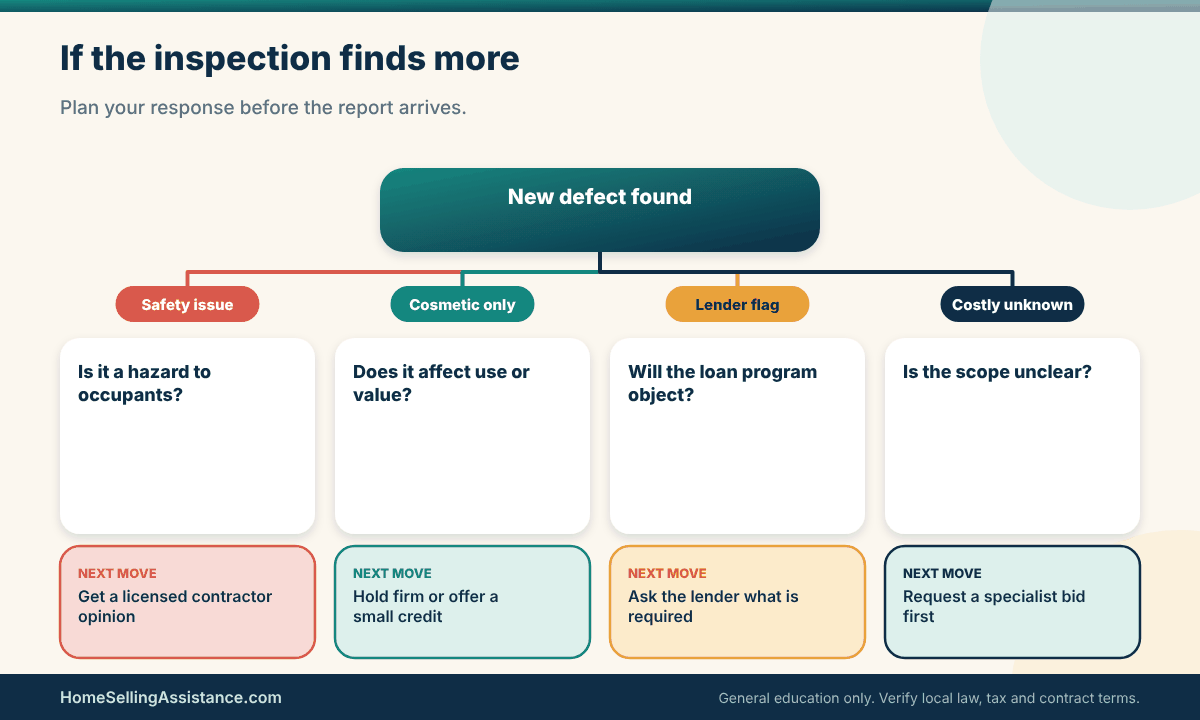
Imagine a seller, Omar, who made a plan to fix a few small items and leave the rest. The buyer’s inspector then flags a crack in a basement wall and suggests a structural engineer. Suddenly the plan is unusable. Omar should pause, ask the buyer for a reasonable window, and hire a qualified engineer or specialist himself or accept the buyer’s choice of one, since a clear professional opinion is worth more than a week of worry.
The exception is a crack that the specialist calls ordinary settling with no action required. In that case a short written statement may settle the matter at little cost. His next step is to read the specialist’s findings carefully, share them with his agent or attorney, and decide among a repair, a credit, a price change or holding firm.
The flowchart below sketches how this kind of surprise can be sorted, and our companion articles on selling a house with foundation problems and selling a house with mold go further into two of the most stressful discoveries. Few sellers regret taking this extra hour when sorting important repairs before selling house work.
One more point about lead paint. If your home was built before 1978, federal rules require you to give buyers certain lead-based paint information before the contract binds you, and peeling paint on older homes may attract lender or inspector attention. The EPA explains the requirement on its lead-based paint real estate disclosure page, and our article on lead paint disclosure for sellers covers the practical steps.
Repairs can also matter at tax time, though that is a separate topic and a matter for a tax professional. Records of capital improvements may affect your cost basis, while routine repairs generally are treated differently. The IRS explains the basics in Publication 523, and our article on home improvements and cost basis is a friendly starting point. Keep every receipt either way. Share these notes with your agent or attorney when you review important repairs before selling house choices together.
A closing thought on contractors and trust. Many pre-sale problems come not from the defects themselves but from rushed hiring. Check licenses and insurance where required in your state, ask for references, never pay the full price up front, and get changes in writing. Good vendors will not mind. Protecting yourself while handling important repairs before selling house tasks is part of protecting your net proceeds, and it keeps you from replacing one problem with another.
Quick scenario
A seller has three items: a loose stair railing, a stained ceiling and a dated bathroom. The railing is cheap and a safety matter, so it gets fixed. The ceiling gets a professional look and a documented finding. The bathroom stays as it is and is priced in. Three items, three different decisions, all by the same simple rules.
Frequently asked questions about important repairs before selling house
Which important repairs before selling house prep should come first?
Start with anything that could hurt someone, such as electrical hazards, gas or carbon monoxide concerns, missing railings and active water intrusion. Next come items that stop a system from working, then items a lender could flag, and finally things that shape buyer confidence. Cosmetic work generally comes last. Your agent and a licensed contractor can refine the order for your property.
Do I have to fix everything an inspector finds?
Generally no. Sellers are usually not required to fix inspection findings unless the contract says so or they agree to in negotiation. Rules and customs vary by state and by contract, so read your agreement and ask your agent or attorney. You may still choose to fix, credit or hold firm depending on the item and your goals.
Will a repair raise my sale price by more than it costs?
Nobody can promise that. Some repairs mostly remove objections instead of adding value, so the benefit appears as a smoother sale and not a higher price. Use local comparables, your agent’s experience and your own quotes to judge each item, and be wary of any universal rule.
Should I repair or give a credit?
It depends on cash, time and what buyers in your market prefer. Repairs give you control and documentation, while credits keep cash in your pocket and let buyers choose their own vendors. Lender rules can limit how credits work, so ask early. Our comparison of repair credits and seller repairs explains the trade-offs.
What about repairs a buyer’s lender might require?
Some loan programs set condition standards, and an appraiser may note items such as peeling paint, missing handrails or nonworking systems. Requirements differ by program and change over time. Ask your agent or the buyer’s loan officer what applies, and avoid assuming either that everything will pass or that everything will be flagged.
Do I need permits for pre-sale repairs?
Many repairs, especially electrical, plumbing, structural and roofing work, may need permits depending on your municipality. Unpermitted work can complicate inspections, appraisals and closing. Check with your local building department or a licensed contractor before work begins, and keep permit records with your receipts.
Is it worth getting a pre-listing inspection?
It can be, because it shows you what a buyer’s inspector is likely to see and lets you plan before negotiations start. The trade-off is that you may then have to disclose what the report reveals, depending on local law. Talk with your agent or attorney about how that works where you live.
What if I cannot afford any repairs?
You still have choices. You can disclose honestly, price the house for its condition, offer a credit, or consider selling as is to a buyer who wants to renovate. Fixing only the cheapest safety items can also help. Compare each option’s net result before deciding.
Should I repair cosmetic flaws like paint and flooring?
Sometimes, especially when they are inexpensive and affect first impressions in photos. But cosmetic work is the category most likely to reflect your taste and not a buyer’s, so keep it modest. Our guide on renovating before selling versus selling as is looks at larger projects.
How do I know if a repair estimate is fair?
Get at least two written quotes with clear scope from properly licensed or insured professionals, and compare what each includes. Be careful with unusually low bids and with urgency tactics. Your agent, a trusted neighbor or a local trade association may suggest reputable vendors, and a second opinion on large items is cheap insurance.
A calm way to finish your repair list
The best approach to important repairs before selling house decisions is neither fixing everything nor ignoring everything. It is a short, honest triage: hazards first, working systems next, lender worries after that, and confidence-building paperwork throughout. Check your local rules, get real quotes and talk with the professionals you trust. This article is general education, not legal, tax or financial advice, and your own situation may call for different choices.