Deciding whether to replace HVAC before selling is one of the most common pre-listing worries, because the heating and cooling system is expensive, hard to see, and almost guaranteed to be looked at closely by a buyer’s inspector.
Most sellers land on this question the same way. A friend says buyers will walk if the air conditioner is old. An agent says a new system sells itself. A contractor, naturally, says it is time. Meanwhile your own experience of the house is simple: it keeps you warm and cool enough, so why spend a large sum on something that works?
This article is meant to slow that argument down and turn it into arithmetic and evidence. We will look at what a system’s age and condition really tell a buyer, how inspections and lender rules can turn a quiet problem into a loud one, and what the alternatives to a full replacement look like in practice.
Nothing here is a verdict on whether you should replace HVAC before selling in your house. Prices, local buyer habits, climate, contract rules and disclosure duties vary a great deal. The goal is to leave you with a clear method, a few scripts for talking to contractors and agents, and a sense of which facts should change your mind.
Key takeaways
- Age is a clue, not a verdict. A well-kept older system that runs reliably can be a smaller problem than a younger one with a documented history of breakdowns.
- Buyers price uncertainty. What costs you in negotiation is often the unknown, so paperwork from a licensed technician can be worth as much as new equipment.
- You have more than two options. Beyond choosing to replace HVAC before selling or ignoring the system, you can repair, service and document it, offer a credit, or provide a warranty.
- Run a net-result comparison. Put the full replacement cost next to the realistic cost of the alternatives, including time, stress and the chance of a renegotiation.
- Disclosure still applies. If you replace HVAC before selling, that does not erase what you know about earlier problems, and rules on what you must say vary by state.
- Plan for new evidence. A pre-listing inspection, a first offer or a hot week of weather can all justify changing your plan.
What you are really deciding when you replace HVAC before selling
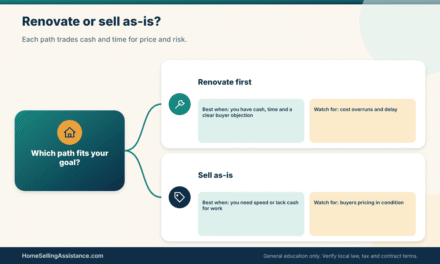
The phrase sounds like a yes-or-no question, but it hides several smaller ones. How much cash can you spare before closing? How long can you wait to list? What would you do if a buyer’s inspector writes the system up as near the end of its life? Your answers shape the right path far more than any rule of thumb about equipment age.
It also helps to separate two goals that people blur together. One goal is a higher price. The other is a smoother, lower-risk transaction. Choosing to replace HVAC before selling can help with the second even when it does little for the first, and many sellers only realise that after they have already written the check.
Three myths cause most of the confusion around whether to replace HVAC before selling. The first is that buyers always pay back a new system dollar for dollar. The second is that an older system always kills a deal. The third is that doing nothing is always the cheap option. Each contains a grain of truth and each fails often enough to be dangerous as a rule.
A calmer way to think about it is that the choice to replace HVAC before selling is a risk-management decision with a price tag attached. You are buying fewer unknowns, not a guaranteed higher price. Seen that way, the question becomes how much uncertainty you are willing to carry into negotiation, and how much you would pay to put it down.
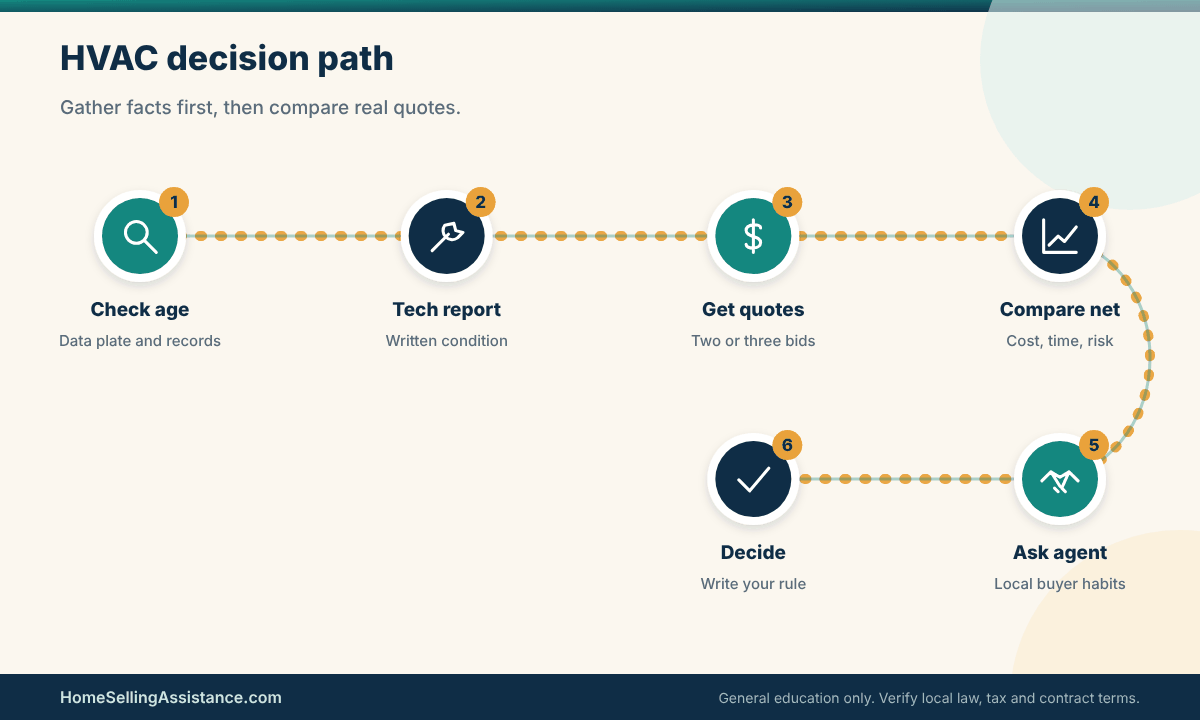
Your goal, timeline, cash and tolerance for surprises
Start with what you are optimising. If your priority is the highest possible sale price and you have time, you will weigh the system differently from someone who needs to close by a firm date to buy somewhere else. If you are cash-tight, a five-figure replacement may be impossible, and the real question becomes which cheaper option protects you best.
Tolerance for surprises matters just as much when you weigh whether to replace HVAC before selling. Some sellers are happy to negotiate a repair request in the middle of a deal. Others would pay extra to never have that conversation. Neither is wrong, but you should know which one you are before you spend money or turn down an offer.
Evidence to gather: age, data plate and service records
Before forming an opinion, gather facts. Most furnaces, air handlers and outdoor condensing units carry a data plate with a model number, serial number and often a manufacture date encoded in the serial. A technician can decode it in a minute, and manufacturers publish decoding guides. Your closing paperwork from when you bought the house, or permit records at the local building department, may also show when the equipment was installed.
Next, collect every service invoice you can find. Annual tune-ups, filter changes, refrigerant top-ups, capacitor swaps and thermostat replacements each tell a story. A system with regular maintenance and a short invoice history looks very different on paper from one with three emergency calls in the last two summers.
Finally, note anything that affects comfort in daily life: rooms that never reach temperature, loud starts, short cycling, uneven airflow, high utility bills for the season, or a smell when the heat first comes on. You do not need to diagnose these. You only need to write them down, because a technician can use the list to give you a sharper, more honest assessment.
One more source is worth a call: the utility. Many utilities can show your usage history, which helps a technician judge efficiency. If you are weighing whether to replace HVAC before selling, a year of bills beside the equipment age tells a clearer story than either fact alone. Do not publish the bills to buyers unless you choose to, but keep them for your own comparison.
A useful habit is to keep everything in one folder, paper or digital. When a buyer’s agent asks about the system, you can answer with dates and documents rather than guesses. That kind of preparedness is one of the cheapest ways to reduce friction. For a broader checklist of what to gather, the sibling guide on a pre-listing home inspection covers how reports and records fit together.
A scenario and your next step: the seller with a ten-week runway
Picture a seller we will call Dana, with a house she plans to list in about ten weeks. Her air conditioner is older and has needed two repairs in recent years, but it cools the house. Dana has some savings but would rather keep them for the move. She is nervous but not desperate.
Ten weeks is a real advantage. Dana can ask two or three licensed contractors for written assessments and quotes, one of which can be a straight replacement bid and another a repair-and-tune-up plan. She can also have a pre-listing inspection to see whether the system draws any attention at all.
Dana should also ask her agent a blunt question: if she chose not to replace HVAC before selling, what would the agent expect to hear from buyers? A thoughtful agent will answer with examples from recent showings and not with slogans. Dana can then compare that answer with the cost of the quotes, and the decision stops being an argument and becomes a comparison.
Her next step is simple. She books the assessments in the next two weeks, compares the replacement quote with the cost of keeping the existing unit healthy, and decides after seeing real numbers rather than fears. If she had only two weeks, her options would narrow quickly, which is why timeline sits at the top of the list.
Facts that could flip the decision on replace HVAC before selling
Some facts are specific to your situation and can reverse a sensible plan. Climate is the obvious one: in a place with long, hard winters, heat is a daily need and buyers worry about it. In a mild region, a mediocre air conditioner may barely register. The type of home matters too, since a small condo with a simple split system differs from a large house with several zones.
Other facts are about the market. In a busy market with multiple offers, buyers often accept more imperfection and inspect with less leverage. In a slow market, a concern about the system can become the lever for a price reduction. You can learn which market you are in from your listing agent’s recent local sales, not from a national headline.
Your own plans matter here too. If you are buying another home and need every dollar for the down payment, the bar to replace HVAC before selling is higher. If you are leaving the area and have equity to spare, the bar is lower. Neither is right in general; the point is that your finances are part of the facts, and they belong in the calculation.
Evidence to gather: climate, home type and local buyer habits
Local buyer habits are best learned by asking. A listing agent who works your neighbourhood can tell you whether recent buyers asked for HVAC credits, whether sellers in the area typically offered warranties, and how often a new system was mentioned in the listing remarks. Treat the answer as one input, and ask for examples rather than generalisations.
You can also read recent listings yourself. Look at comparable homes that sold and see whether the descriptions highlight a recent system, and whether homes with older equipment lingered or sold quickly. This is not a scientific method, but it gives you a feel for what your own buyers care about.
Another practical check is to walk through a few open houses or online listings as a buyer would. Notice whether sellers mention equipment, and whether buyers in photos or comments seem to care. This will not tell you whether to replace HVAC before selling, but it shows how visible the issue is compared with kitchens, floors and paint, which tend to dominate first impressions.
Check how your type of home is typically heated and cooled. Heat pumps, gas furnaces, electric resistance, boilers with radiators and ductless mini-splits each have different failure patterns and replacement costs. A buyer who is used to one kind of system may have strong opinions about another. When in doubt, ask a contractor to describe what a replacement would involve, including any duct work, electrical upgrades, permits or condensate changes.
If your home is in a condominium or a community with an association, read the governing documents. Some communities restrict where outdoor units can sit, require approval for exterior changes, or share certain equipment. You do not want to discover a rule after you have signed a contract with an installer.
An exception and a next step: when the system is already failing
Everything above assumes a system that works. If yours has already stopped, cools badly, or fails a safety check, the decision changes. A heating system that cannot run safely, or one that has a cracked heat exchanger or a carbon monoxide concern, is not a negotiation item. It is a repair or replacement that should happen for the safety of the people living there, whether or not you sell.
In that case, get a licensed technician to document the problem in writing, fix it properly, and keep the invoice. Disclosure rules in most states ask sellers to share known material defects, and an unreported failing system can create trouble later. Our guide to material defects and seller disclosure explains the general pattern.
If the system works but is simply old, you are in the territory this article covers. The next section lays out the realistic paths, with their numbers and trade-offs side by side.
Comparing the realistic paths: new system, repair, credit or warranty
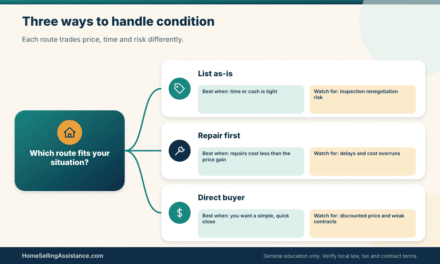
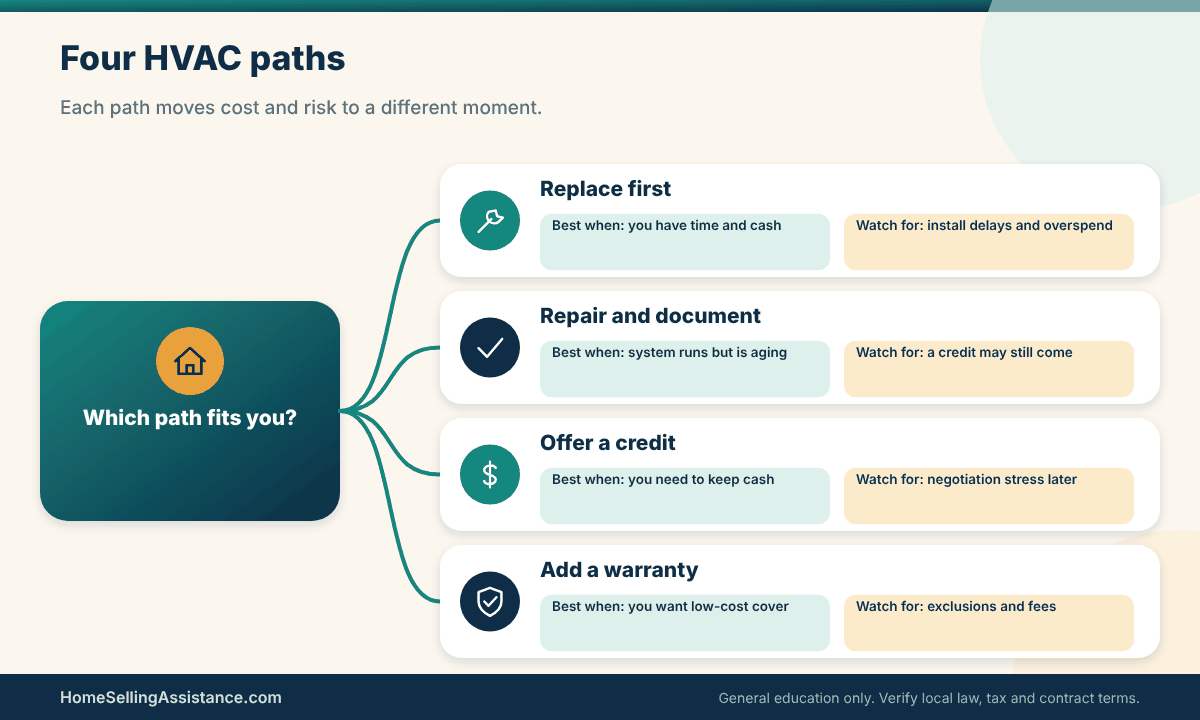
Once you know your goal and your facts, the paths come into focus. There are really four, and only one of them is to replace HVAC before selling: install new equipment, repair and document what you have, offer a credit or price adjustment, or attach a home warranty. Sellers sometimes combine two of them. Each one moves cost, time and risk to a different place on the timeline.
The decision matrix below puts those paths side by side. The entries are qualitative on purpose, because the real numbers depend on your quotes and contract. Use it as a prompt for the conversations you will have with contractors and your agent, and fill in the blanks with figures from your own bids.
| Factor | Replace before listing | Repair and document | Offer a credit later | Warranty only |
|---|---|---|---|---|
| Price and net proceeds | Highest upfront cost; payback uncertain | Small cost; keeps cash | Cost set in negotiation | Modest fee; limited cover |
| Time | Days to weeks for quotes, permits, install | Usually quick | None before listing | Quick to arrange |
| Contingencies | Fewer HVAC-related requests | Fewer surprises if records are strong | Inspection issue handled in the deal | Buyer may still ask for repairs |
| Workload | Quotes, permits, scheduling, warranty paperwork | One or two technician visits | Negotiation and quotes later | Choosing a plan and reading terms |
| Execution risk | Overspend; install delays | Repair may uncover a bigger issue | Deal tension; possible re-trade | Exclusions can frustrate buyers |
Read the table by column, not by row. Pick the path that seems closest to your situation, then check each row for something you cannot live with. A seller who cannot tolerate a late renegotiation will find the credit column uncomfortable. A seller who cannot spare cash will find the first column impractical.
Notice that no column wins every row. That is the point. The right answer depends on what you value, and the next two sections look at the first column and the other three in turn.
Option one: replace HVAC before selling and list with a new system
The first path is to replace HVAC before selling and market the house with a new system and a manufacturer warranty. It is the cleanest message you can send to buyers: this part of the house is done. It also removes the biggest single item an inspector might flag as a limited-life component.
The downsides of choosing to replace HVAC before selling are cost and uncertainty. A full replacement is a large, certain expense, while the benefit in price terms is not certain. Some buyers will notice and value it. Others will assume it should be there anyway. A fair way to think about it is that new equipment reduces risk and friction, and only sometimes returns its cost in sale price.
It helps to keep the scale in mind. For most buyers, the heating and cooling system is one of several large components, along with the roof, the water heater and the windows. If you replace HVAC before selling but leave a worn roof, buyers will simply move their worry to the next item. Look at the whole list before you commit your budget to one line of it.
The numbers to run: cost, quotes and likely buyer response
Get at least two or three written quotes from licensed, insured contractors. Ask each to itemise equipment, labour, permits, duct work, electrical work, refrigerant or line sets, thermostat, disposal of old equipment and the length of the labour and equipment warranties. Quotes that differ widely often differ in scope, so compare scopes before comparing totals.
Ask what size and type of system each contractor proposes and why. A good contractor will explain how they sized the equipment, often through a load calculation, instead of simply matching the old unit. Over-sized or poorly matched equipment can create comfort and humidity problems that a buyer’s inspector or the next owner will eventually notice.
Then ask your listing agent a different question: in recent sales near you, did a new system lead to a visibly better result? Ask for specific examples, and be sceptical of general promises. You are looking for a pattern in your own market, not a national rule. If your agent cannot point to any, treat the payback as unproven.
It also helps to ask what the system will mean to the buyer after closing. A buyer who plans to stay for years cares about efficiency, noise and reliability. A buyer who plans to renovate, or an investor, may care very little about equipment they intend to replace anyway. Knowing who is likely to buy your house tells you how much a decision to replace HVAC before selling will matter to them.
Timing deserves its own line in your notes. Contractors are busiest in the first hot or cold stretch of the year, and quotes, equipment availability and install dates can slip. If you decide to replace HVAC before selling, book early, get dates in writing, and avoid scheduling the install in the same week as photos or the first showing.
Finally, check the paperwork side. Incentives, rebates and tax credits for efficient equipment have existed in various forms, but they change and have eligibility rules. Ask the contractor what applies, and confirm with your utility, the IRS or a tax professional before assuming anything. Do not count a rebate in your numbers unless you have confirmed it in writing.
A scenario and its trade-offs: the new-system listing
Consider Marcus, who replaced a failing-looking furnace and air conditioner before listing. He used an illustrative budget in the mid five figures and delayed the listing by a few weeks for installation and inspection. His listing highlighted the new equipment and included the paperwork in the disclosure packet.
The result was a quieter inspection, with the system noted as new and functioning. That is a real benefit. What Marcus could not know is how much of his cost came back in price. His sale price reflected many things: condition, location, timing, competing listings. Isolating the HVAC share is not possible.
There is also a quieter benefit worth naming. Because Marcus chose to replace HVAC before selling, his agent could describe the equipment with confidence, and the marketing photos and remarks did not need hedging. Confidence in the listing story is hard to measure, but agents often say it shortens awkward conversations. It does not replace pricing the house correctly, which still does most of the work.
The trade-off here is clear. Marcus bought certainty and a cleaner process, and paid for it in cash and time. If your priorities are similar, this path can make sense. If you need your cash, or your market is moving fast, one of the others may fit better. For how this fits the wider picture of pre-sale repairs, see our cornerstone on which repairs to make before selling.
Option two: leave the system, repair it, or offer a credit or warranty
The second family of paths, the alternatives to replace HVAC before selling, keeps your existing equipment. You can have a technician tune it up and repair anything small, you can offer a credit later if an inspector objects, or you can give the buyer a home warranty that includes the system. Each has different strengths, and some sellers use two together.
The common thread is that you are spending less now and accepting some risk that the topic comes up in negotiation. For many sellers with a working system, that is a reasonable trade. The key is to manage the risk with documentation and honest disclosure, rather than hoping nobody asks.
What to document: repair invoices, tune-ups and warranty terms
A technician’s written report is the most useful single document. It should state the equipment make, model and approximate age, the tests performed, the system’s condition and any recommended work. Ask the technician to be factual and to avoid guessing about remaining life, which no one can predict precisely. A balanced report reads as credible; an overly rosy one invites suspicion.
If you do repairs, keep itemised invoices and note what was fixed and when. A new capacitor, a cleaned coil or a replaced blower motor each show a system that has been looked after. Pair these with a recent tune-up record and your disclosure form, and you have a file that answers most questions before they are asked.
If you choose a home warranty, read the contract, not the brochure. Look at what the plan covers, what it excludes, whether pre-existing conditions are covered, any per-visit service fee, caps on claims, and whether the buyer must use the company’s contractors. Plans differ widely. Present it to buyers as what it is, which is a service contract, and not as a guarantee that nothing will fail.
Some sellers also ask the technician to label key components, photograph the data plate and note the filter size and thermostat model. It takes a few minutes and spares a buyer from hunting through a utility closet. A tidy mechanical area suggests a tidy house. It costs almost nothing, and it works whether or not you replace HVAC before selling.
When a buyer’s request does arrive, how you respond matters. Our article on repair credit versus seller repair explains the logic behind each choice, and the guide to inspection repair requests walks through the typical response options.
A scenario and a next step: the older working system
Now think about Priya. Her heat pump is older, runs fine, and has a tidy record of yearly service. She does not want to spend a large sum, and she is not in a hurry. She books a tune-up, asks the technician for a written condition report, and gathers the invoices.
She lists the house with the report in the document folder and a clear note in her disclosure about the system’s age. When the buyer’s inspector flags the unit as older, the buyer already has a report from a licensed technician saying it is operating normally. The conversation is short and the request, if any, is modest.
Priya’s next step, had the buyer asked for a credit, would be to get a replacement quote and compare it to the buyer’s request. The principle is that evidence calms negotiations, and it often makes it unnecessary to replace HVAC before selling. If you are leaning toward leaving the system alone, the sibling article on selling a house as is covers the broader approach and what it asks of you.
One more option deserves a mention: pricing the house with the system’s age in mind. You can discuss with your agent whether an adjustment to the list price makes more sense than a pre-listing expense. That is a legitimate strategy, and it simply moves the cost into the price rather than the checkbook. Whichever path you pick, make the choice before you list, so your agent can describe it consistently in the marketing.
Keep a simple decision log as you go. Write down each quote, each technician comment and the date you received it, along with the reason you chose one path over another. If you decide not to replace HVAC before selling, that log shows you acted reasonably on the information available. If a buyer later disputes something, a dated record is far better than memory.
Finally, do not let a contractor decide your timeline for you. A good technician will tell you honestly whether a repair is enough. If one pushes you to replace HVAC before selling and refuses to put the reasoning in writing, get a second opinion. The right quote is one you can explain to your agent and a buyer in two sentences.
A net-result rule for deciding to replace HVAC before selling
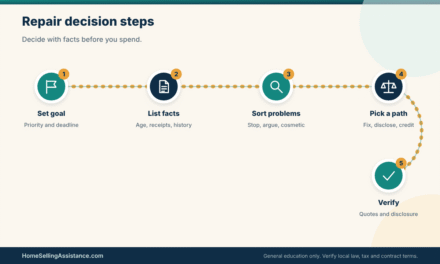
Opinions about HVAC tend to be loud and numbers tend to be missing. A net-result rule fixes that by asking one question of every path: after all costs, delays and risks, what do I expect to keep? The rule does not need precision. It needs honest ranges, filled in from real quotes rather than from anecdotes.
In practice, you compare the cost of choosing to replace HVAC before selling against the combined expected cost of the alternatives. That combined figure includes the repair or tune-up, any credit you might end up giving, the value of your time and the chance of a delay or a lost deal. The path with the better net, adjusted for your tolerance for stress, is usually the one to take.
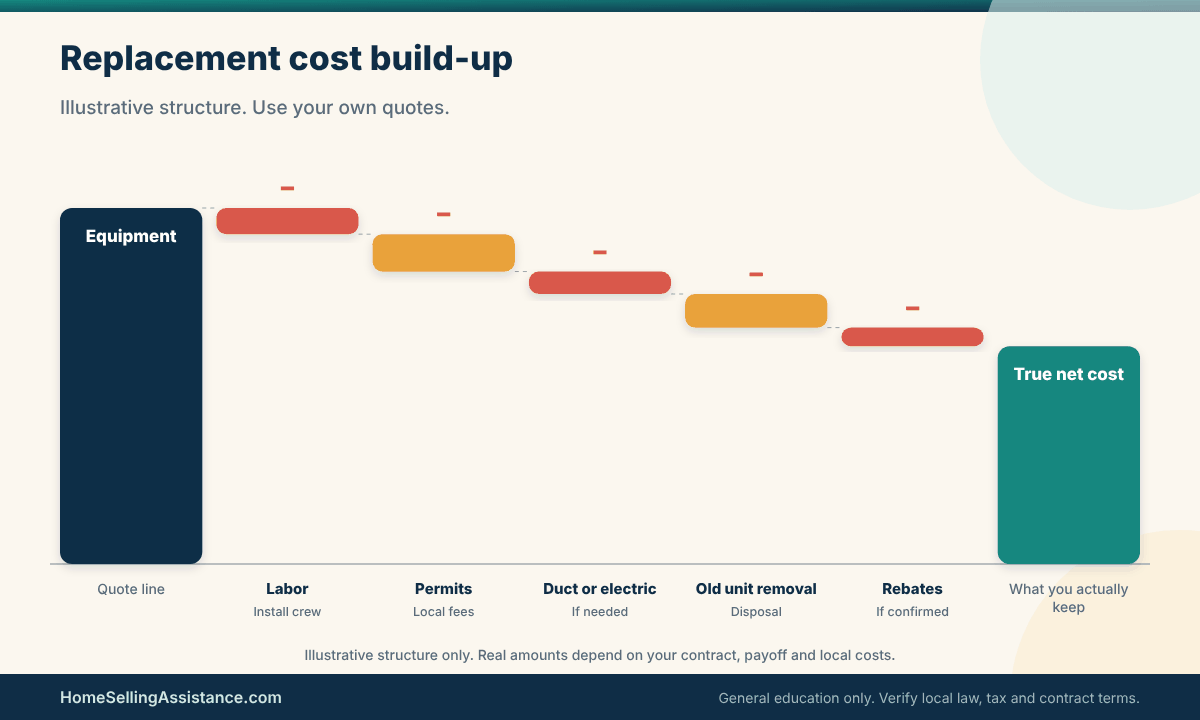
Price, time, cost and risk in one framework
Four lenses keep the framework simple. Price asks whether a decision to replace HVAC before selling would change what buyers offer, or whether the equipment is likely to influence what buyers offer. Time asks how long each path takes and whether the delay costs you in carrying expenses or missed market timing. Cost asks for the real out-of-pocket figure. Risk asks what might go wrong and how bad it would be.
Fair housing rules also apply to how you talk about the house, so keep descriptions of equipment and neighbourhood factual and limited to the property. Describe what the system is, when it was installed and what documents exist. Whether you replace HVAC before selling or keep what you have, a plain factual description serves every buyer equally.
Give each path a short answer for every lens. You will often find that one lens dominates. A seller with a firm closing deadline cares mostly about time and risk. A seller with plenty of runway but little cash cares mostly about cost. Naming the dominant lens makes the decision feel much less muddy.
Another useful habit is to run the framework twice, once with optimistic assumptions and once with cautious ones. If the answer to replace HVAC before selling stays the same under both, you can act with confidence. If it flips, the decision is sensitive to a fact you should try to pin down, such as a contractor quote or a local sales pattern, before you spend anything.
Worked example with illustrative numbers
Here is a simple illustration with round figures that are not predictions. Suppose a full replacement quote is 14,000 dollars. A repair and tune-up with a written report is 600 dollars. A buyer asks, in the middle of a deal, for a credit that you negotiate down to 4,000 dollars. A home warranty offered to the buyer costs 600 dollars.
Under the path where you replace HVAC before selling, you spend 14,000 up front and might see a smoother deal. Under the repair path, you spend 600 and carry the risk of a credit request. Under the credit path you might pay 4,000 later. Under the warranty path you spend 600 and may still receive a request for repairs, because a warranty does not stop a buyer from asking.
Now add probabilities, which only you and your agent can estimate. If you think there is a modest chance of a 4,000 dollar credit under the repair path, the expected cost is well below the replacement figure. If you believe a credit request is very likely and that it could escalate to a larger demand, the gap narrows. These are the kinds of judgments the rule forces you to make explicitly.
Notice that the example never claims a replacement pays for itself. It simply shows how the pieces fit. If your own numbers say a decision to replace HVAC before selling costs far more than the likely credit, you can save the money. If they say the opposite, the same framework supports spending it, and you will know why.
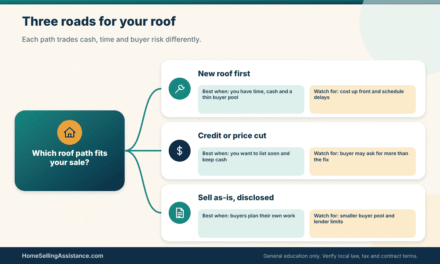
Finally, adjust for what the numbers leave out: the stress of a late negotiation, the cost of delaying the listing, and any value you place on handing buyers a new, warrantied system. Those are real. A seller who values peace of mind may rationally choose the more expensive path. The framework does not tell you what to value. It makes sure you know what you are paying for. To see how the same logic applies to other big items, compare it with our guide on whether to replace a roof before selling, which follows a similar pattern with different numbers.
The table below turns the same logic into scenarios. Each row describes a seller situation and shows which route tends to fit, why, what it costs you, and which fact would change the choice. Treat the rows as starting points for a conversation, not as predictions.
| Situation | Route favored | Reason | Trade-off | Fact that changes the choice |
|---|---|---|---|---|
| System runs well, modest age, good records | Tune-up and documentation | Evidence reduces buyer worry cheaply | A credit request is still possible | Inspector flags a safety issue |
| System is failing or unsafe | Repair or replace now | Safety and disclosure duties | Cash and time up front | Quote shows repair is cheap |
| Tight closing deadline | Documentation plus warranty or credit | Installation could delay listing | Possible price pressure | Installer can start within days |
| Slow market, many competing listings | Consider replacing | Buyers have leverage and options | Payback is uncertain | Comparable sales ignore equipment |
| Hot market, strong demand | Leave as is with records | Buyers accept more imperfection | Some offers may be discounted | Market cools before listing |
| Cash-tight seller | Credit or price adjustment | Preserves cash for the move | Negotiation stress | Financing or grants become available |
To use the table, find the row nearest your situation, then read across to the last column. That final cell is the real prize, because it names the fact worth verifying before you commit. If you can check that fact this week, do. If you cannot, plan for both outcomes.
Scenario: when the rule says wait
Sometimes the best output of the framework is a decision not to replace HVAC before selling yet. Imagine Tom, who is ready to list in three weeks and has an older but functioning system. His quotes for replacement would push the listing back by a month. His market is busy, and his agent says buyers in recent weeks have not asked for HVAC concessions.
Under the rule, the plan to replace HVAC before selling costs a large sum and a month of delay for a payoff that is not visible in the local pattern. A tune-up and report cost a small sum and fit the schedule. Tom chooses to list on time with documentation and a clear disclosure, and he keeps a replacement quote in his pocket in case a buyer asks for a credit.
That last step is quietly valuable. A quote in hand lets you answer a request quickly and with facts, rather than reacting to a number the buyer gives you. If you are weighing a similar choice for other systems, our guide to the important repairs before selling a house helps rank them.
The rule says wait only when the evidence supports waiting. If Tom’s market were slow, his agent’s feedback were different, or his inspection flagged a problem, the same framework could point the other way. That responsiveness is what makes it more useful than a slogan.
When you reach a decision, write it as a one-line rule for yourself, for example: replace HVAC before selling only if the inspection shows a safety issue or a quote beats the likely credit by a clear margin. A rule you wrote while calm will hold up better when an offer is on the table and everyone is in a hurry.

When new evidence should change your plan
A plan to replace HVAC before selling is a draft, like any other. The most common reason to revise it is new information, and the most common sources are an inspection, a first round of showings, and a change in conditions such as a heat wave or cold snap. Write your triggers down ahead of time so you are deciding calmly rather than in the heat of a negotiation.
It also helps to decide who you will call. Line up a contractor who can respond quickly, and tell your agent what you are willing to do. When a request arrives on a tight contract deadline, you will be glad you already know your options, your numbers and your limits.
Triggers to watch: inspection findings, offers, weather
Inspection findings are the clearest trigger to revisit your plan to replace HVAC before selling. If a pre-listing inspection or a buyer’s inspection finds a safety problem, a cracked heat exchanger, a refrigerant leak or an electrical hazard, the plan changes immediately. Findings of age alone are less urgent, but a recommendation from a licensed technician to evaluate further is worth acting on quickly.
Offers are a second trigger. If several buyers mention the system in their feedback, or an offer arrives with a heavy discount tied to it, you have learned something about your market. Ask your agent to separate comments about the equipment from comments about the price in general, because the two get confused.
Weather is a quieter trigger. A long stretch of extreme heat or cold exposes weaknesses in older equipment, and showings during those days will test the system. If the house is uncomfortable during showings, buyers notice. A repair or a portable solution before the next showing can help more than people expect.
If you are in doubt, it is cheaper to ask a technician to look before a hot or cold spell than to react afterward. A short visit costs far less than an emergency call, and it gives you a fresh data point on whether to replace HVAC before selling or to keep going with the plan you have. Dated reports also protect you if buyers ask about the system later.
Lender and appraiser rules can also matter. Some financing programs and appraisal processes require that heating work and be in safe condition, and a buyer’s lender can ask for a correction before closing. Requirements differ by loan type and lender, so ask your agent or the buyer’s lender what applies in your deal, and do not assume. Our article on home sale contingencies explains how those clauses shape deadlines.
A scenario and a next step: the buyer’s inspector flags the system
Suppose an offer arrives, and the buyer’s inspector writes that the air conditioner is old and recommends further evaluation. The buyer asks for either a replacement or a substantial credit. Many sellers feel their stomach drop at this point, and it is tempting to answer immediately.
The better response is to slow down for a day and gather facts. Ask the buyer’s agent for the inspector’s exact wording. Have your own technician evaluate the system and write a report. Compare the replacement quote with the buyer’s request, and consider offering something between, such as a modest credit, a warranty, or a repair of whatever specific item was flagged.
The next step depends on your contract, so read the inspection clause and its deadlines, and confirm them with your agent or a real estate attorney if the stakes are high. Our guide to responding to an inspection repair request lays out the usual options, and the article on home sale net proceeds helps you see how a credit changes what you keep.
In every case, keep the conversation factual. You are not trying to win an argument about the equipment. You are trying to close a sale that works for both sides, and a calm, well-documented answer usually does more for that than a clever counter.
Remember that disclosure and negotiation are separate tracks. You can disclose a known issue and still keep the price where it is, and you can negotiate a credit without hiding anything. Whether you replace HVAC before selling or not, the honest answers you give about its history protect you after closing. Rules on what to disclose vary, so our guide to seller disclosure requirements is a good place to orient yourself.

Quick scenario
A seller gets two quotes: one for a full system, one for repairs and a written condition report. The report costs a fraction of the replacement. She lists with the report and a clear disclosure, keeps the replacement quote handy, and decides to replace HVAC before selling only if an inspection or an offer gives her a concrete reason.
Frequently asked questions about replace HVAC before selling
Should I replace HVAC before selling if it still works?
Often there is no need to replace HVAC before selling when the system runs, but it depends on your goals, your market and your cash. A working system with good records is a smaller problem than many sellers fear. A technician’s report, recent service invoices and honest disclosure can answer most buyer questions. Replacing makes more sense when the system is unreliable, unsafe, or when your market tends to punish older equipment.
How old is too old for a buyer?
There is no universal number. Lifespans vary with equipment type, installation quality, climate and maintenance, so a general age cutoff can mislead you. Ask a licensed technician to read the data plate and describe the condition. Buyers and inspectors tend to react to age combined with signs of wear, not age alone.
Will a new system raise my sale price?
Choosing to replace HVAC before selling may help the price, but you cannot count on it. New equipment can reduce friction and inspection concerns, yet sale prices reflect many factors at once. Ask your listing agent for local examples before assuming a return. If the examples are missing, treat any price benefit as a bonus rather than the reason to spend.
Is a home warranty a good substitute?
It can be a useful, low-cost reassurance, but it is not the same as new equipment. A warranty is a service contract with exclusions, fees and limits, and many cover only items in working order at the start. Read the contract carefully and describe it honestly to buyers. Some buyers will still ask for repairs or credits despite the warranty.
Do I have to disclose HVAC problems?
Disclosure duties vary by state, and many ask sellers to share known material defects. If you know about a problem, such as past failures or a safety issue, plan to disclose it according to your state’s rules and form. Ask your agent, your state real estate commission or a real estate attorney how it works where you live. Replacing the system does not remove the need to answer questions truthfully.
What if the inspector says the system is near the end of its life?
Treat it as information, then gather facts before you decide whether to replace HVAC before selling after all. Get your own technician’s report, ask for replacement quotes, and read your inspection clause and deadlines. You can respond with a credit, a repair, a warranty or a firm no, depending on your position. Our guide to inspection repair request options can help you compare choices.
Can a lender or appraiser force me to replace HVAC?
Sometimes a lender or an appraisal process raises a condition if heating does not work or looks unsafe, and requirements differ by loan program and lender. Ask your agent or the buyer’s lender what applies in your specific deal. Do not assume it will or will not come up. If it does, a repair or a documented fix is often enough, but the details are case specific.
How do I choose a contractor for a pre-sale replacement?
If you do replace HVAC before selling, look for licensed, insured contractors, and ask for written, itemised quotes with equipment details, permits and warranty terms. Check reviews and your state’s licensing lookup. Be wary of high-pressure sales, unusually low bids or requests for large upfront payments. For general scam awareness, the Federal Trade Commission’s consumer site is a sensible place to start.
Should I wait for a buyer to ask, or act before listing?
Both can be reasonable when you decide whether to replace HVAC before selling. Acting before listing gives you control and a cleaner story, but costs money and time. Waiting preserves cash and flexibility, though it brings the risk of a mid-deal negotiation. Many sellers compromise by getting a report and a quote before listing, then deciding with real numbers once feedback arrives.
Where can I see how HVAC fits the bigger repair picture?
Start with the cornerstone guide on repairs before selling a house, and browse the repairs and selling as-is section. Those pages show how to rank repairs, when to leave things alone and how to document what you decide. Market data and local practice are also summarised at the National Association of Realtors.
A calm way to decide
The decision to replace HVAC before selling is rarely an emergency, and it rarely needs to be made on instinct. Collect the age and service facts, get written quotes, ask your agent for local evidence, and compare the real net of each path. This article is general education, not legal, tax or financial advice, so confirm local rules and contract details with a licensed professional before you commit.