
If you need to sell house with foundation problems, the first thing to know is that the word “foundation” covers everything from a harmless hairline crack that has not changed in twenty years to active movement that is pulling a wall away from the floor, and buyers, lenders and insurers will not treat those two situations the same way.
Most sellers who later sell house with foundation problems learn about the issue in one of three ways. A buyer’s inspector writes it up during escrow. A pre-listing inspection turns it up before photos are taken. Or you have lived with sticking doors and a sloping kitchen floor for years and finally decided the time has come to move on. Each route leaves you in a different position, and the sooner you can describe the problem in plain, documented terms, the more choices you keep.
This guide walks through how to sell house with foundation problems in the order a careful seller would face the decisions: what you want from the sale, what the evidence actually says about the foundation, whether to repair first or sell as-is, and how to compare the two on net result rather than on gut feeling. It sits inside our wider guide to repairs before selling a house, and it assumes you want a straight explanation rather than a pitch for any particular route.
A few honest limits. Disclosure duties, contract forms, inspection customs and repair permitting differ by state and often by county, so we explain how to check those rules instead of quoting them. Every dollar figure below is a round, illustrative number used to show arithmetic, not a price quote, not a prediction for your house and not a promise about what any buyer will pay. This is general education, and your own situation may call for an engineer, an attorney or a tax professional.
Key takeaways
- Get an independent diagnosis early. A licensed structural engineer who does not sell repairs can tell you whether you have cosmetic cracking, settlement that has stopped, or movement that is still going.
- Two realistic paths exist. You can repair first and list with paperwork, or sell as-is with full disclosure and a price that reflects the unknowns. Both can work when you sell house with foundation problems, and neither is automatically cheaper.
- Disclose what you know. Calling a sale “as-is” does not erase known-defect disclosure duties in many places, and hiding a foundation issue is one of the fastest ways to turn a sale into a dispute.
- Judge by net result. Compare what you keep after repair cost, carrying cost, price effect and risk, not the headline price on either route.
- Financing is part of the story. Many buyers use loans, and appraisers and lenders may ask for an engineer’s letter or completed repairs before they will fund.
- Keep the plan flexible. Anyone who plans to sell house with foundation problems should expect new bids, a second opinion or lender feedback to change the best route, so set decision points in advance.

Decide what you actually want when you sell house with foundation problems
Before you call a single contractor, it helps to settle what a good outcome looks like for you if you sell house with foundation problems. Foundation work tends to be expensive, disruptive and uncertain in scope, so it pulls sellers toward quick reactions: panic and repair everything, or shrug and list at a steep discount. Neither reaction is wrong in every case, but both are better when they follow a clear idea of your own limits.
The picture above shows how a decision to sell house with foundation problems usually unfolds, from the first sign of trouble to a closing table. Notice that the diagnosis comes first and the choice of route comes second. Sellers who reverse that order often pay for a repair they did not need, or price a house as if the damage were worse than an engineer would have said.
Your goal, your clock, your cash, and the real condition of the house
Four personal facts drive almost everything else. Your goal is the outcome you care about most, whether that is the highest sale price, the shortest path to closing, the least hassle, or the least risk of a problem after the sale. Your clock is the date you genuinely cannot miss, such as a job start, a lease end, a second mortgage payment or a divorce decree. Your cash is what you can spend now without hurting your next move. And condition is the physical truth about the foundation.
Be honest about which of these is tight, because it decides how you sell house with foundation problems in practice. A seller with six months of flexibility and savings in the bank can often afford to repair, wait for the work to finish and list a cleaner house. A seller who must close in six weeks and has little cash may be better served by a straightforward as-is sale, even if the price is lower, because a repair that runs long can cost more in carrying costs than the discount would have.
Risk tolerance matters too when you sell house with foundation problems, and it is personal. Some sellers sleep fine knowing an as-is buyer might negotiate hard after an inspection. Others would rather spend money up front and hand a buyer a stack of engineer letters and warranty papers. Neither temperament is better. The mistake is picking a route that clashes with how you handle uncertainty, then regretting it halfway through escrow.
Evidence to gather: the inspection report, an engineer’s letter, and repair quotes
Start with what already exists, because it shapes how you sell house with foundation problems from day one. If a buyer’s inspector or a pre-listing inspector flagged the foundation, ask for the full written report with photographs, not a summary. Home inspectors are generalists. Many will describe what they see and recommend further evaluation by a structural engineer, which is a hint to take seriously, not a diagnosis. Our guide to a pre-listing home inspection explains what that kind of report can and cannot tell you.
Next, consider a licensed structural engineer. Licensing rules and titles differ by state, so check your state’s licensing board to confirm the person is credentialed where the house sits. The reason to hire an engineer rather than a foundation repair company is independence. A repair company earns money by performing repairs, so a free estimate may lean toward a larger scope. An engineer is paid for the opinion itself and can say plainly that the movement is old, stable and needs only drainage correction, or that it needs real structural work.
Ask the engineer for a written report that describes what was observed, what likely caused it, whether movement appears active or historic, and what repair approach would be reasonable, without pricing it. Then collect two or three written bids from separate repair contractors against that same scope. Bids that are far apart usually mean the contractors read the problem differently, which is useful information about uncertainty in itself.
Keep every receipt, photo and email in one folder. If past owners did earlier work, ask them or look for permits at the local building department. A prior repair with a transferable warranty is an asset, and a prior repair with no paperwork is a question mark that a careful buyer will ask about.
A scenario, an exception, and your next step for a seller on a deadline
Imagine a seller who must sell house with foundation problems because a job starts in ten weeks. A buyer’s inspection mentions a horizontal crack in one basement wall and recommends an engineer. The seller has not yet spoken to one. The wise first move is not to guess at a repair price but to book an engineer promptly, because the answer will take days rather than weeks and will shape everything after it.
Now suppose the engineer says the wall has bowed slightly from soil pressure and recommends reinforcement plus drainage correction. A bid comes back at an illustrative round figure of fifteen thousand dollars with a four-week schedule. That fits inside ten weeks, but only if the work starts at once and the buyer is willing to wait. The seller can offer a repair credit instead, or hand the buyer the bid and let the buyer’s own contractor do the work after closing.
The exception to watch for is a buyer whose lender will not fund until repairs are done and verified. In that case a credit alone may not solve the problem, because the loan itself depends on the work. Your next step in any version of this story is the same: get the engineer’s findings in writing, then talk with your agent or attorney about how the contract should handle the repair, the credit or the price.
Facts that can flip the plan before you list
Some facts matter more than the crack you can see when you sell house with foundation problems. They tend to be about cause and trend rather than size, and a small crack with an unresolved cause can be a bigger problem than a large crack with a known, fixed one. Before you commit to a route, try to learn the answers to a short list of questions.
Is the movement still happening? Settlement that occurred in the first years after construction and then stopped is very different from ongoing movement. What is driving it? Poor drainage, a leaking pipe, expansive clay soil, tree roots, an unevenly compacted fill or a past flood each point toward different fixes. Has anyone repaired it before, and did the repair hold? And what does the house look like inside, in doors, windows, floors and ceilings, compared with the foundation outside?
These answers shape what a buyer and a lender will accept when you sell house with foundation problems. A stable, explained and documented condition can sometimes be sold with relatively little drama. An unexplained or active one tends to push buyers toward large price reductions or toward walking away, since few people want to inherit an open-ended structural question. Understanding that difference is how you decide how hard to push toward repair.
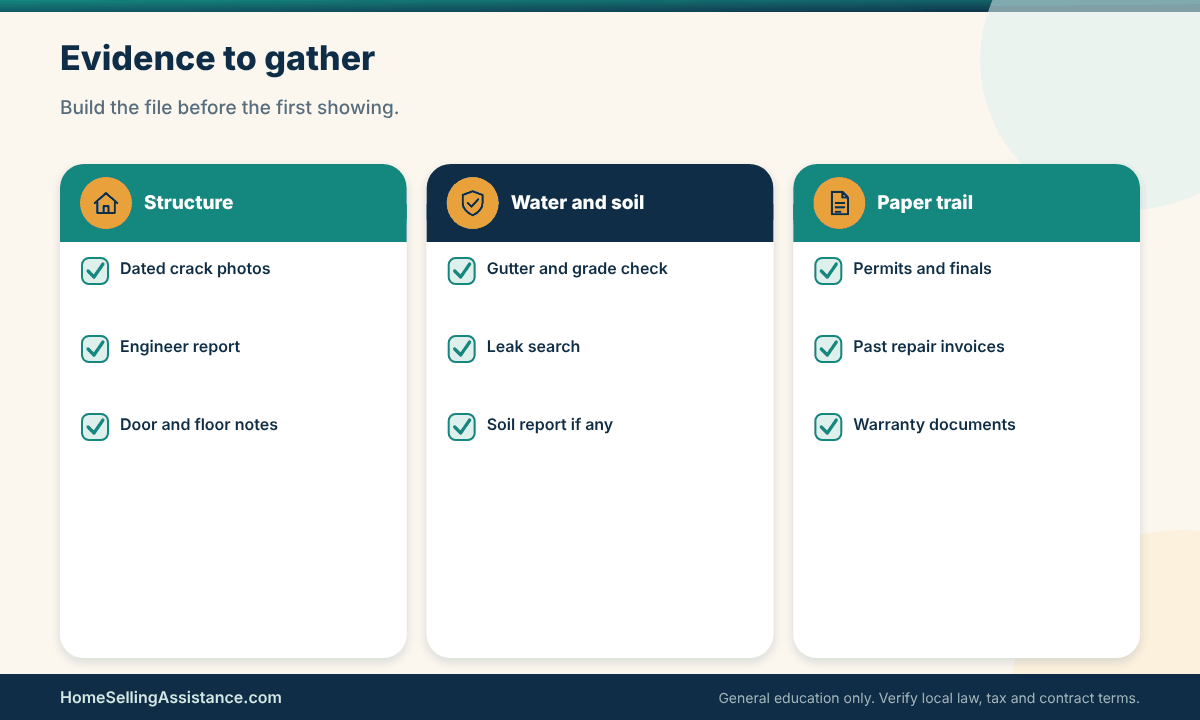
Evidence to gather: crack patterns, drainage, soil and permit history
The checklist graphic above groups the evidence that helps you sell house with foundation problems into three buckets: what the structure looks like, what the water and soil are doing, and what the paper trail says. Start with the structure. Photograph every crack with a ruler or coin beside it, note the date, and mark the ends of cracks with a pencil and date. A few months later a fresh measurement tells you whether anything has moved, which is more useful than any opinion.
Pattern matters. Stair-step cracks in brick or block walls, horizontal cracks in basement walls, doors that rub their frames, gaps at the top of window trim and floors that slope noticeably toward one side all deserve a professional look. Thin vertical cracks in poured concrete are often related to normal curing and shrinkage, though only an expert on site can say so with confidence. Do not treat any internet photo comparison as a diagnosis.
Then look at water. Walk the outside of the house during or just after a rain. Are the gutters overflowing at the same spot, does the ground slope toward the walls, does a downspout dump beside the foundation, is there a plumbing leak, or is the crawl space damp? Much foundation trouble starts with water, and in some cases a drainage fix costs far less than structural work, though an engineer should decide that, not a salesperson.
Finally, check the paper trail. Ask the local building department what permits exist for the address, since structural repair, underpinning and major slab work commonly need them in many places. Review any soil or geotechnical report from original construction if one exists. Gather past inspection reports, insurance claim records and repair invoices. A claim history that mentions foundation or water damage will turn up in buyer-side reports anyway, so you are better off knowing what it says.
A scenario, an exception, and a next step when the facts surprise you
Consider a seller ready to sell house with foundation problems who assumed the sloping living room floor meant a costly foundation job. The engineer finds that the foundation is sound and the real culprit is a rotted wooden support post in the crawl space, a much smaller repair. The seller fixes it, keeps the engineer’s letter and lists with a clear explanation. Here the facts flipped the plan from “sell at a discount” to “repair and document,” and the upside came from learning the cause.
The reverse can also happen to anyone who sets out to sell house with foundation problems. A seller expecting a minor drainage fix learns the movement is active and tied to expansive soil, and that a lasting repair may involve a larger scope and carry a warranty with conditions. That seller may decide an as-is sale to a buyer who can absorb the risk is more realistic, particularly if the clock is short or the budget is limited.
The exception is when two professionals disagree. If an engineer and a repair contractor describe the problem very differently, a second independent engineer’s opinion is often worth its fee compared with the size of the decision. Your next step in every version is to write down what you know, what you do not know yet, and which single piece of new evidence would change your route. That sentence will keep you from deciding in a panic.
Compare the two realistic ways to sell house with foundation problems
Once you have a diagnosis, the practical choice for how to sell house with foundation problems narrows to two main routes. You can repair the foundation and then list the house with documentation, or you can sell as-is, disclose what you know, and price and negotiate around the open question. There are hybrids, such as offering a credit, getting bids ready for buyers or selling to an investor, but they are variations of those two themes.
The fork graphic below lays out who each route tends to suit and what to watch for. Treat it as a starting orientation for how you sell house with foundation problems, not a verdict. The same house can favor different routes for different owners, which is why the net-result rule in the final section matters more than any rule of thumb.

The table that follows puts the two routes side by side on the factors sellers most often care about. Read across a row to see how each path behaves on that factor, then read the last column for what you should verify with your own contract, contractor and local market before trusting the row.
| Factor | Option A: repair, then list | Option B: sell as-is, disclosed | Check before you rely on it |
|---|---|---|---|
| Price and net proceeds | Higher asking price possible, minus repair cost | Lower price likely, no repair outlay | Local comps and written bids |
| Time | Weeks to months before listing | List as soon as paperwork is ready | Contractor schedule and permit wait |
| Contingencies | Fewer structural surprises in escrow | Buyer may still add inspection terms | Contract inspection and financing dates |
| Workload | Heavy: bids, permits, supervision | Lighter: documents and disclosure | Your time and access to the house |
| Execution risk | Cost overruns, hidden scope, delays | Buyer retrades or lender balks | Contractor insurance and lender rules |
| Disclosure effect | Disclose past problem and repair record | Disclose condition and known facts | State form and attorney or agent advice |
| Buyer pool | Wider, including financed buyers | Often narrower, more cash or investors | Your market and the listing strategy |
A few lessons about how to sell house with foundation problems sit inside that table. First, neither column is simply better. The repair route spends your money and time to widen the buyer pool and calm buyer fears, while the as-is route saves both and asks the buyer to carry the uncertainty. Second, the repair route does not eliminate disclosure. You still describe what was wrong and what was done. Third, the as-is route rarely means “no negotiation.” Buyers still inspect, still ask questions and may still ask for price changes.
Path one: repair first, then list the house with proof
Repairing first appeals to sellers who sell house with foundation problems and want control. You decide the scope with an engineer, pick the contractor, and hand buyers a finished solution rather than a problem. If the work is done well and documented, the foundation becomes a described, resolved item and not an unknown, and some buyers who would have walked away from the unrepaired house will stay in the conversation.
The trade-offs are real. You spend money before you know what the market will pay for a repaired house. Work can uncover more than the first bid assumed, such as a second failing area or hidden water damage. And a repaired foundation does not always bring a house back to the price of an identical home that never had the problem, since some buyers still discount any structural history. How big that discount is varies by market and buyer, so avoid anyone who quotes a universal figure.
Repairing also takes calendar time, and that matters when you sell house with foundation problems on a schedule. Engineers must evaluate, contractors must bid and schedule, permits may need to be pulled and inspected, and landscaping or interior finishes may need patching afterward. If you are also carrying a mortgage, taxes, insurance and utilities during those weeks, those costs belong in your comparison, which we cover in the net-result section.
Before you commit, our broader guide to important repairs before selling a house helps you separate repairs that buyers and lenders usually insist on from those that only please a picky eye.
Evidence to weigh: bids, warranties, permits and the engineer’s sign-off
Compare bids on scope first, price second, since scope drives every plan to sell house with foundation problems. Two quotes can differ by a wide margin because one covers the whole wall and the other only the visible section, or because one includes drainage correction and the other leaves it out. Ask each contractor to describe in writing what method they would use, how many support points or anchors, what is excluded, how long it takes, and what happens if they find something unexpected.
Warranties deserve a careful read. Some repair companies offer a warranty that transfers to a later owner, some limit what is covered, and some require an annual inspection or are voided by a change in drainage. A warranty is only as good as its terms and the company standing behind it, so ask for the actual document and read the transfer rules, the exclusions and any fees. Do not pass along a brochure summary as if it were the contract.
Ask who will pull permits and whether the local building department will inspect and sign off. A permitted and approved repair is easier to explain to a buyer, an appraiser and an insurer than a repair with no paper trail. Where permits are required, work done without them can cause trouble at sale time, and our article on selling a house with unpermitted work explains why that matters.
Finally, consider asking the engineer to review the finished work and issue a short letter confirming it matches the recommended scope. Not every engineer offers this and it may carry a fee, but a closing letter is often the single most persuasive item in the buyer’s packet, because it comes from someone with no repair to sell. Keep invoices, permits, photographs and the warranty together in a PDF you can send with the listing.
A scenario, an exception, and a next step for the repair-first seller
Picture a seller preparing to sell house with foundation problems, with no hard deadline, a modest savings cushion and a house with clearly documented movement near one corner. The engineer recommends underpinning the corner and fixing a downspout. The seller collects three bids, selects the one that matches the engineer’s scope, pulls a permit, completes the work in a few weeks, and lists with the full file. Buyers can read the engineer’s letter, view the warranty and see the permit sign-off.
The exception is the seller whose repair bid is large compared with the likely price lift. If the expected gain from repair is smaller than the cost plus carrying time, spending the money first can leave the seller worse off than an as-is sale would have. An illustrative round example: if repair costs twenty thousand dollars and the repaired house would likely sell for only ten thousand dollars more than the as-is price would be, the repair loses ground unless it also rescues a sale that would otherwise fail.
The next step is to price both ways to sell house with foundation problems with the same inputs before you sign a repair contract. Ask your listing agent, if you have one, to show you comparable sales with and without documented foundation work. If no such comps exist nearby, say so out loud and treat the lack of data as a risk to plan around.
Path two: sell as-is with full disclosure and a realistic price
To sell house with foundation problems as-is means you are not promising to repair anything, and you price the house to reflect that. It is the cleaner route for sellers who are short on time, short on cash or simply unwilling to manage a structural project. Our general explainer on how to sell a house as-is covers the wider mechanics. Here we focus on what changes when the as-is item is the foundation.
The first thing to understand is that “as-is” describes the repair promise, not the disclosure duty. In many states a seller who knows about a material defect must disclose it whatever the contract says about condition, and the rules on what counts as material, what form to use and what remedies a buyer has all vary. Our piece on material defects and seller disclosure gives a general frame, and your state real estate commission, a local attorney or your agent can tell you what applies where you live.
The second thing is who the buyer is likely to be when you sell house with foundation problems. An unrepaired foundation concern often narrows the field to cash buyers, investors, renovation-minded owners and financed buyers whose lenders accept the condition. That does not mean those buyers are predatory or that they are the only ones who will look. It means the easiest path to a closing tends to run through buyers who can absorb the uncertainty, and you should weigh offers carefully, as we discuss in cash offer versus financed offer.
Third, price and terms work together. A seller who discloses everything, provides the engineer’s report and sets a price that already reflects the repair scope often finds negotiations easier, because the buyer is not discovering a surprise. A seller who hides, minimizes or guesses invites a retrade, a lawsuit or a collapsed contract after weeks of waiting.
Evidence to weigh: disclosure forms, reports, lender rules and insurance
To sell house with foundation problems responsibly, start with your state’s disclosure form or the contract addendum your agent uses. Answer every foundation-related question truthfully and with specifics: what you know, when you learned it, what was done about it and what documents exist. If you are not sure what the question asks, ask your agent or attorney instead of guessing, and keep a copy of what you signed.
Consider sharing the engineer’s report with prospective buyers. Some sellers worry that this will scare buyers, but a report that explains the cause and a sensible fix often reassures more than it frightens, because it replaces open-ended imagination with a defined scope. Whether and when to share is a strategy conversation to have with your agent or attorney, and the law in your state may shape the answer.
Next, think about lenders. Appraisers on certain loan programs are expected to note and sometimes require repair of conditions that affect structural soundness or safety, and conventional lenders may react to appraisal comments too. The rules vary by program and lender, so do not assume a financed buyer will be able to close on an unrepaired house. When you receive an offer, ask the buyer’s agent what the lender requires, and read the financing contingency dates in the contract with care.
Insurance is another gatekeeper. Many homeowners policies treat gradual settlement and earth movement differently from sudden damage, and a buyer may need to confirm insurability before closing. Coverage terms differ widely, and your seller records or past claims may be visible to insurers. Encourage serious buyers to speak to their own insurer early, and do not tell them what a policy will cover, because you do not know their policy.
Lastly, pay attention to taxes and records. Repair costs on a home you lived in are generally treated differently from improvements that add value, and the details depend on your facts. The IRS explains how selling a home is taxed in Publication 523 and how basis works in Publication 551. A tax professional can tell you how those rules apply to you.
A scenario, an exception, and a next step for the as-is seller
Take a seller who has to sell house with foundation problems after inheriting a house with visible cracking and has no interest in managing repairs from another city. The seller obtains an engineer’s report, discloses everything, prices the house with the report’s scope in mind and markets it as a fixer to buyers who plan to renovate. Several offers arrive, and the seller chooses the one with the cleanest terms and the most reliable proof of funds, not simply the highest number.
An exception arises when a financed buyer falls in love with the house, and the lender then asks for repairs the seller did not plan. The seller can decline, offer a credit, or negotiate a price change, but each choice has consequences, so it helps to decide ahead of time what you would accept. Our guide to repair credits versus seller repairs explains how those trade-offs generally work.
The next step is to build a one-page seller summary before the first showing: what you know about the foundation, which documents exist, what you will and will not do, and a bottom-line price or net figure below which you would rather not sell. Pre-deciding keeps negotiations from becoming emotional.
The scenario table below pulls the pieces together by situation. Use it to see which route tends to fit which kind of seller, then read the last column to find the single fact that could reverse the answer. A row that resembles your own is a starting point for a conversation with your agent or attorney, not a recommendation for your house.
| Situation | Route favored | Reason | Trade-off | Fact that changes the choice |
|---|---|---|---|---|
| Hard move date within weeks | Sell as-is, disclosed | Repairs may outlast the clock | Lower price, narrower buyers | A fast contractor with permit approval |
| Flexible timing, cash available | Repair first | Wider buyer pool, calmer escrow | Money spent before price known | Bids that exceed likely price lift |
| Minor, stable, explained cracking | List with engineer letter | Little or no repair may be needed | Some buyers still worry | Evidence of new movement |
| Active movement, unclear cause | Diagnose first, then decide | Scope and price are unknown | Delay while studying the problem | Second engineer disagrees |
| Inherited or estate sale | Often as-is with reports | Heirs rarely want project risk | Discount for uncertainty | Court or co-owner approval rules |
| Buyer needs a loan on the house | Repair or credit, per lender | Lender may require fixes | Credit alone may not satisfy | Loan program and appraiser notes |
Two patterns stand out for anyone who has to sell house with foundation problems. Where time or money is short, the as-is route usually wins by default, and the work lies in pricing and documenting it well. Where time and money are plentiful, repairing is more attractive, but only if the bids and comps back it up. The middle cases, where the cause is unclear or the lender’s rules are unknown, are really diagnosis problems, and the table keeps pointing back to evidence for that reason.
Between the two main routes sit a few variations that sellers sometimes overlook. One is to obtain an engineer’s report and two bids, then list as-is at a price that already subtracts the likely repair, giving buyers a clear, documented scope. Another is to complete only the part of the work that is cheap and clearly necessary, such as drainage correction, and leave the structural question to an informed buyer.
A third is to offer a repair credit at closing, which gives the buyer money rather than a finished job. Credits sound simple but are not always usable, because some lenders limit how much of a credit they permit and others want the work done before closing. A fourth is selling to a buyer who purchases specifically for renovation. These buyers may pay less, but the process can be smoother and quicker, and you should compare it carefully against the net you would keep on the open market.
None of these ways to sell house with foundation problems is clearly better than the others. The question to ask of each is the same: what do I keep after costs, and what could go wrong? That is the framework we build next.
A net-result rule for sell house with foundation problems decisions
Headline prices mislead, and that is especially true if you sell house with foundation problems. A buyer’s number tells you what a contract says, not what lands in your account after repairs, credits, carrying costs and fees. The only fair way to compare routes is to ask what you expect to keep on each, how sure you are about that figure, and how long it will take to get it. We call that the net-result rule, and it works for almost every repair-or-not decision, not only foundations.
The rule has four inputs for any plan to sell house with foundation problems: price, time, cost and risk. Price is what the house will probably fetch on each route. Time is the number of weeks until money arrives. Cost is everything you pay along the way. Risk is the chance that the number you wrote down turns out wrong. Our guide to home sale net proceeds covers how the other deductions, such as payoff, fees and prorations, fit into the same picture.
The price, time, cost and risk framework in plain numbers
To sell house with foundation problems on solid numbers, start by writing two columns on a page, one for each route. For the repair-first route, list the expected repaired sale price, the repair cost from the best written bid, a cushion for surprises, and the extra weeks of mortgage, taxes, insurance and utilities while the work and permits finish. For the as-is route, list the expected as-is price, any credit or concession you anticipate, and the fewer weeks of carrying cost. Subtract in each column and compare.
The waterfall graphic below shows the structure of that subtraction with no real numbers in it, since yours will differ. The key point is that repair spending and carrying cost sit on the repair side of the ledger while a lower price sits on the as-is side. Whichever route leaves more after those items, adjusted for risk, is the stronger candidate. The other deductions at closing apply to both routes and mostly cancel out.

Risk is the hard column when you sell house with foundation problems, because it is not a number. One practical technique is to run each route in a good case, a typical case and a bad case. In the bad case for repair, the work costs a quarter more than bid and takes twice as long. In the bad case for as-is, the first buyer retrades and the house sits for extra weeks before a second contract.
If you could live with the bad case on a route, that route is safer for you, even if its typical case is a little worse.
Evidence to use: an illustrative worked comparison
Here is a deliberately simple, illustrative example of how to sell house with foundation problems on paper, using round numbers only. Suppose comparable houses without foundation history sell near four hundred thousand dollars. After an engineer’s report, you estimate that the house would sell near three hundred eighty thousand dollars once repaired and documented, and near three hundred forty thousand dollars as-is with disclosure. A repair bid is eighteen thousand dollars and you add a cushion of three thousand. Repairs and permits add six weeks, and your carrying cost is two thousand dollars a month.
On the repair route, you start with three hundred eighty thousand, subtract twenty-one thousand for repair and cushion, and subtract about three thousand for six weeks of carrying cost, leaving roughly three hundred fifty-six thousand before the costs common to both routes. On the as-is route, you have three hundred forty thousand with little extra carrying cost. The repair route leads by about sixteen thousand in the typical case. These numbers are invented to show the method, not to say repair always wins.
Now stress the example. If the repair cost climbs to thirty thousand and the repaired price lift shrinks to twenty thousand dollars over as-is, the lead disappears and the as-is route looks better. If the as-is buyer pool is thin and the house sits for three extra months, carrying costs reverse the result again. The method does not tell you the answer. It tells you which assumptions the answer depends on, and those are the ones to verify first.
For the repair-or-credit question in particular, renovating before selling versus selling as-is offers a broader way to think about when spending money before listing pays for itself and when it does not.
A scenario, an exception, and a next step when the numbers are close
When the two ways to sell house with foundation problems land within a small gap, other factors should decide. A seller who values certainty may prefer the as-is route even at a slightly lower figure, because fewer unknowns remain. A seller who enjoys project management and has flexible timing may prefer repair, since it keeps control. Closeness is not a failure of the method. It means either choice is defensible, and you can pick on temperament.
The exception is when one route carries a risk the other does not, such as a possible permit problem, a lender requirement you cannot meet, or a co-owner who will not sign. A path with a hidden veto is not equal to one without, however close the arithmetic looks. Ask what must go right on each path for the number to hold, and be suspicious of any route that depends on one person’s cooperation.
Your next step is to share the two columns with your agent, attorney or a trusted adviser and ask them to challenge your assumptions, particularly the repaired price and the schedule. Where they disagree, note why. A disagreement about an assumption is useful because you can test it with another bid, another comp or a call to the building department.
When new evidence should change the plan
No plan to sell house with foundation problems survives contact with a real escrow unchanged. Bids come in, engineers refine opinions, lenders react and buyers behave in ways you did not predict. The skill is not holding a plan firmly. It is knowing in advance which developments would justify changing course and which are noise. Decide those triggers before you list, while you are calm.
Good triggers are concrete. A second engineer disagrees with the first. A repair bid changes by more than you budgeted. A building department tells you a permit is required and the wait is long. A lender tells a buyer the house will not qualify as is. The house sits on the market without serious offers past the time you set. Each of these should prompt a defined review, not a reflex.
The decision tree below turns four common developments into next moves. It is not exhaustive, and your contract and professionals control the details. What it shows is the habit worth building: when something new arrives, ask which route it favors, what it costs to switch and whether a short pause would clear the confusion.

Evidence to watch: buyer feedback, lender notes, bids and days on market
Buyer feedback is a quiet source of evidence when you sell house with foundation problems. If several showings end with the same comment about the foundation, price or fear of cost, believe the pattern. Ask your agent for specifics, such as whether buyers would have accepted the condition at a lower price or whether they wanted a documented repair. Silence is also a message, and a house with no showings for a long stretch may be telling you the price is wrong, not the foundation.
Lender and appraiser notes matter more once a contract exists. If an appraisal comes in with structural comments, the buyer may need repairs, a lower price or a different loan. Read any appraisal communication that is shared with you, and ask what conditions the lender attached. Keep in mind that you may not see everything, because the lender’s file belongs to the buyer.
Bids and engineer updates matter before and during escrow. If a new bid reveals a scope you did not know about, update both columns and recheck the result. If an engineer sees movement during a follow-up visit, that fact should reach your disclosure and your pricing, not stay in a drawer. Keeping the paper trail current also protects you if anyone questions later what you knew and when.
Finally, watch days on market against the clock you set earlier. If you decided in advance that you would reprice or switch routes after a given number of weeks, honor that decision, since waiting past it rarely improves things. Sellers often hold out because a price once felt right, though the market has already answered.
A scenario, an exception, and a next step when you must switch routes
Imagine a seller trying to sell house with foundation problems who listed as-is and received only low offers, then learned from buyer feedback that most visitors wanted a documented repair. The seller pauses, obtains bids, repairs the part the engineer calls essential and relists with an engineer letter. The switch costs weeks but opens the house to financed buyers who could not close before.
The opposite switch also happens. A seller who began repairing hits a bid far above the first estimate, as hidden water damage appears behind a wall. After checking the numbers again, the seller stops, discloses what was found and sells to a renovation buyer instead. Stopping early can feel like losing, yet it can limit losses when the arithmetic has changed.
An exception worth noting: if you sell house with foundation problems and are under contract, switching is not a solo decision. The contract controls deadlines and remedies, and changes usually need written agreement. Talk to your agent or attorney before you promise a buyer a repair, a credit or an extension. For the wider category of related questions, our repairs and selling as-is library collects the other guides in this cluster, including how selling a house with mold raises similar disclosure and testing questions, and our cornerstone on repairs before selling a house ties the pieces together.
Frequently asked questions about sell house with foundation problems
Can I legally sell house with foundation problems?
In general, yes, owners can sell a house with known structural issues. What the law cares about is honesty and process, such as completing the required disclosure forms and not hiding what you know. The details vary by state, so check with your state real estate commission, a local attorney or your agent. Selling is allowed in general, and the choice to sell house with foundation problems is yours. Concealing is where sellers get into trouble.
Do I have to disclose foundation problems if I sell as-is?
In many places, a seller who knows about a material defect must disclose it even in an as-is sale. The as-is label usually limits repair obligations, not honesty obligations. Rules differ on what counts as material and what the form asks, so confirm locally. When in doubt, disclose clearly and keep a copy of what you provided as you sell house with foundation problems.
Should I hire a structural engineer or a foundation repair company first?
Many sellers start with an independent structural engineer because the engineer is paid for an opinion, not for performing repairs. A repair company can still be valuable for bids once the scope is defined. Check that the engineer is licensed where the house is located. Using both, in that order, tends to give you a clearer picture when you sell house with foundation problems than relying on either alone.
Is a small crack in the foundation a deal-breaker for buyers?
Not necessarily. Many hairline cracks relate to normal curing or old, stable settlement, and some buyers accept them without concern. What worries buyers and lenders is movement that is active, unexplained or paired with sticking doors and sloping floors. A professional’s written opinion on a crack is more persuasive than any reassurance from the seller.
Will a buyer with a mortgage be able to close on a house with foundation issues?
It depends on the loan program, the appraiser’s notes and the lender’s rules. Some lenders ask for repairs or an engineer’s letter before funding, while others accept the condition if the appraisal does not flag it. Ask the buyer’s agent what the lender requires as soon as an offer arrives. Do not assume a financed buyer is unaffected just because the offer looks strong.
Is it better to repair first or offer a credit?
There is no universal answer. Repairing first gives buyers a finished solution but spends your money and time before you know the price. A credit gives the buyer money and control but may not satisfy a lender that wants the work done. Compare both on net result using written bids, and read our guide on credits versus seller repairs for the trade-offs.
How much does foundation repair cost?
No honest article can give a single figure, because cost depends on the method, the size of the problem, access, soil, drainage work, permits and your region. That is why written bids against an engineer’s scope matter. Use the numbers in examples like ours only as arithmetic practice. Your own bids are the only numbers that belong in your decision to sell house with foundation problems.
Will foundation repair raise my sale price enough to pay for itself?
Sometimes, but nobody can promise it. A repaired and documented foundation can widen your buyer pool and reduce negotiation, yet some buyers still discount any structural history. Ask your agent for comparable sales and test the result against the cost plus carrying time. If the evidence is thin, treat the repair as a risk, not a sure return.
What if the engineer and the contractor disagree?
Treat the disagreement as information. Ask each to explain their reasoning in writing, including what evidence they used and what they would monitor. A second independent engineer’s opinion is often worth the fee given the size of the decision. Avoid choosing the answer that happens to cost less or the one that happens to sell more work.
Are there tax effects when I sell a house that needed foundation work?
They can exist, and they depend on your facts, such as how long you lived there, your basis and whether work counts as repair or improvement. The IRS publications on selling your home and on basis explain the general rules. A qualified tax professional can apply them to your situation. Do not assume repair costs reduce your taxable gain without checking.
Before you decide
To sell house with foundation problems well, get the diagnosis in writing, price both routes on net result, disclose what you know and keep your plan flexible when new evidence arrives. A calm, documented approach tends to serve anyone who has to sell house with foundation problems better than panic or silence. This article is general education, not legal, tax or financial advice, and rules vary by state and contract, so confirm the details that apply to you with your agent, an attorney, a licensed engineer or a tax professional.