Weighing an iBuyer vs realtor seller decision comes down to a trade you rarely get to see on one page: a fast, low-effort offer from a company that buys your house itself, set against a slower, more public sale that tries to find the buyer willing to pay the most.
Both sides of an iBuyer vs realtor seller choice are legitimate, and both can leave you happy or frustrated. What separates the two outcomes is usually not luck but whether you compared the actual terms, in dollars and in days, before you signed anything. This guide gives you a way to run the iBuyer vs realtor seller comparison honestly, without a sales pitch for either side.
We should say plainly what “iBuyer” means here. It is shorthand for a company that uses software and market data to produce a quick purchase offer on a home and then buys that home with its own money, usually to resell it. The “realtor” side means hiring a licensed real estate agent or broker to list the property, market it to the open market, and help you negotiate with buyers who typically rely on mortgages. Each model has its own fees, its own contract, and its own ways of going wrong.
Programs in this space change often. Some national iBuyer operations have narrowed, paused, or left certain markets over the years, and local investor companies sometimes use similar language in their ads. So treat this article as a framework, then check who is actually buying in your area today. If you want the wider picture of every cash-style route, our cornerstone guide on the cash offer for house seller decision covers iBuyers, investors, and auctions in one place.
A last note before we start on the iBuyer vs realtor seller details. Rules about agency, disclosure, deposits, and closing vary by state and even by county, and every contract is different. The example numbers below are round, illustrative figures meant to show how the arithmetic works. They are not predictions, quotes, or typical results for your home.
Key takeaways
- Compare net proceeds, not headline offers. An iBuyer vs realtor seller comparison only works when both sides are reduced to what you would actually receive after payoff, fees, credits, and repairs.
- An instant quote is a starting point. Many iBuyer offers are adjusted after an inspection, so the number you see online may not be the number you close on.
- Convenience has a price, and sometimes it is worth paying. A short, predictable timeline can matter more than the last few thousand dollars, depending on your goals.
- Market exposure is the agent route’s main advantage. More buyers seeing the home can raise the odds of a stronger offer, but it also brings showings, negotiation, and contingencies.
- Read the contract before the sales page. Fees, cancellation rights, repair terms, and deposit handling live in the signed documents, and they vary by company, state, and agent.
- There is no universal winner. Your deadline, the home’s condition, your equity, and your market decide which route fits.
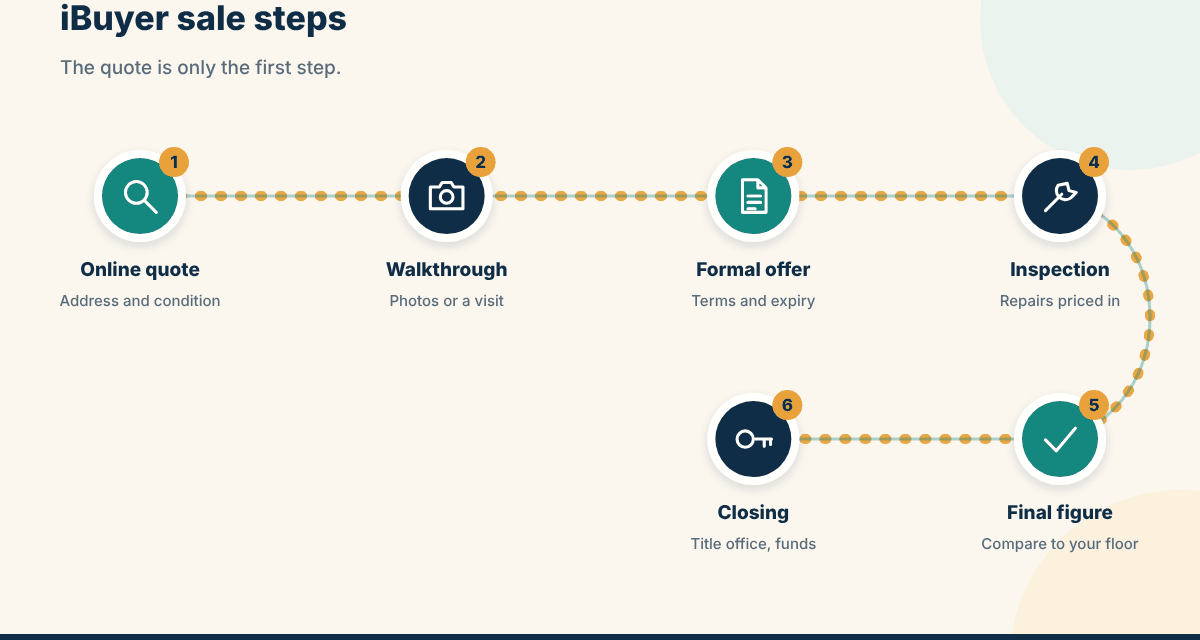
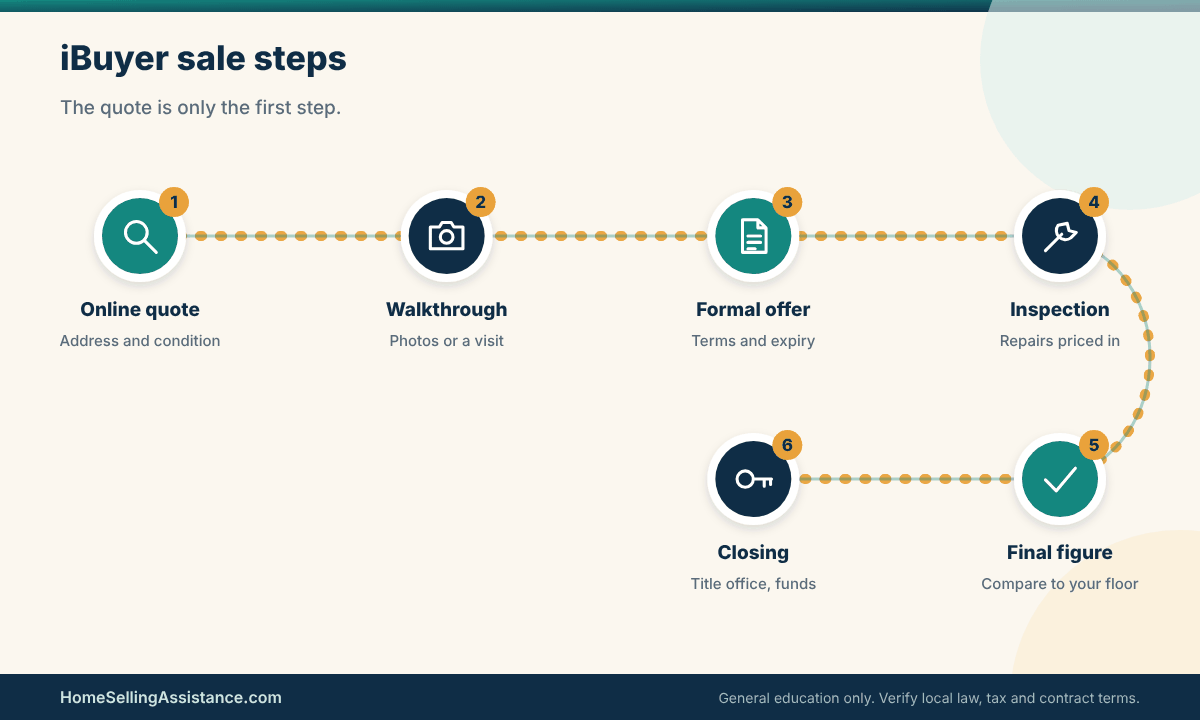
Before the details, here is the shape of an iBuyer sale from first quote to closing. Keep this sequence in mind as you read, because most of the surprises in this route happen between the quote and the final offer, not at the beginning.
What the iBuyer vs realtor seller choice is really solving
Every seller facing an iBuyer vs realtor seller decision is trying to solve some mix of four problems: getting a good price, finishing by a date, avoiding disruption, and not getting burned by a deal that falls apart. The iBuyer route and the agent route weight those four problems differently, and that is most of the story. The rest of this article is about turning that general idea into numbers you can check.
An iBuyer offer tries to remove uncertainty and effort. In exchange, you usually accept a price that reflects the company’s need to cover its own costs, risk, and profit on resale. A realtor-led sale tries to maximize price by reaching the widest pool of buyers. In exchange, you accept uncertainty about timing, the possibility of price changes, and more work preparing and showing the home.
Neither side of the iBuyer vs realtor seller question is automatically cheaper. An agent route carries commission terms and often preparation costs. An iBuyer route carries a service fee or a discounted purchase price, plus possible repair adjustments. The sections below take each model apart so the comparison later rests on facts rather than impressions.
How an iBuyer offer works from instant quote to closing
An iBuyer process usually begins on a website. You enter an address, answer questions about bedrooms, bathrooms, updates, and condition, and receive a preliminary figure, sometimes within minutes. That figure comes from an automated valuation model, which compares your home with recent nearby sales and adjusts for the features you reported.
The preliminary number is not a binding offer. Most companies follow up with a virtual walkthrough, photos, or an in-person visit. After that, you receive a more formal offer, often valid for a limited window. If you accept, the company typically schedules an inspection of its own, then presents a final figure that accounts for repairs it expects to make before reselling.
Closing then happens at a title company or escrow office, often on a date you choose within a range. Because the buyer is a company paying with its own capital, there is usually no mortgage approval standing between you and the closing table. That is the core appeal: fewer moving parts on the buyer side.
The cost side of an iBuyer sale deserves equal attention. Many iBuyer programs charge a service fee, which may be shown as a line item or built into a lower purchase price, plus closing costs that follow local custom. Fee structures differ by company and sometimes by market, so we will not quote a typical figure here. Ask for the fee in dollars, in writing, for your specific home.
Evidence to gather: the offer terms behind the quote
Before you treat an iBuyer figure as real, collect the paperwork that turns it into a number you can compare. Ask the company to send, in writing, the purchase price, the service fee, the estimated closing costs it expects you to pay, and the process for adjusting the price after its inspection. Ask whether the offer is binding once you accept, and whether you can walk away if the final figure drops.
Also ask who the buyer is on the contract. Sometimes the entity named in the purchase agreement is a subsidiary or affiliate, and some programs act as a lead-passing service that connects you with local investors or agents rather than buying directly. Knowing which one you are dealing with changes how much weight to put on the quote in your iBuyer vs realtor seller math.
Finally, ask for a sample contract before you commit. A company that is comfortable with its terms will usually share the standard agreement. Read the sections on repairs, inspection rights, deposit, possession date, and termination. If a clause is unclear, a real estate attorney in your state can explain it for a modest fee compared with the money involved.
A scenario, an exception, and your next step for iBuyer sales
Picture an iBuyer vs realtor seller case with a seller we will call Dana, who must leave town for a job in six weeks. Her house is a typical suburban three-bedroom with aging carpet and an older water heater. She requests an iBuyer quote, receives a preliminary figure, and schedules a walkthrough. The formal offer arrives a few days later and is close to the preliminary number.
The exception shows up after the company’s inspection. The inspector flags the water heater and a small roof patch, and the final figure drops by an amount Dana had not expected. Because she asked about this possibility in advance, she knew she could decline and move to a listing instead, although that would cost time she did not have.
Her next step, and ours if we were in her place, is to treat the inspection adjustment as a normal part of the model, price it in before accepting the first offer, and keep a second route alive until the final number is on paper. A backup plan costs little. A rushed acceptance can cost a lot.
How a real estate agent route works from listing to closing
The agent half of an iBuyer vs realtor seller decision begins with a conversation, not a quote. A licensed agent or broker reviews your home, pulls recent comparable sales, and proposes a list price and marketing approach. If you hire that agent, you sign a listing agreement that sets the length of the relationship, the compensation terms, and what the agent will do in return.
After preparation, which may include cleaning, minor repairs, staging, and professional photography, the home goes on the multiple listing service and other channels. Buyers tour the property, and offers arrive over days or weeks depending on the market. You compare offers by price, financing type, contingencies, and closing date, then negotiate and accept one.
Once under contract, the buyer’s lender orders an appraisal, the buyer may inspect the home, and the title company works through ownership records. Each of those steps can lead to a request, a delay, or a renegotiation. If all goes well, the sale closes on the contract date and your proceeds arrive after payoffs and costs are settled.
Compensation deserves a careful, current read. Since the broker-compensation changes that followed major industry litigation, commission terms are negotiable and need to be put in writing, including what, if anything, you will offer to a buyer’s agent. Our guide to seller real estate commission explains the pieces without quoting any universal rate.
Evidence to gather: comps, listing agreement and fee terms
To compare the agent side of an iBuyer vs realtor seller choice fairly, ask each agent you interview for a written market analysis built on recent sales close to your home, with adjustments explained. Ask how many comparable sales are truly similar, how old they are, and which ones they would discount as different. If an agent cannot explain the range, that tells you something about both pricing and preparation.
Then read the listing agreement line by line. Look for the listing period, the compensation structure, any fee that survives after the agreement ends, cancellation terms, and who pays for marketing items such as photography. A good agreement is specific. A vague one leaves room for disputes later. Our walkthrough of the listing agreement seller terms shows what to check before signing.
Finally, build a rough net sheet with the agent. It should list your mortgage payoff, the estimated commission or fee, title and escrow charges, prorated taxes, any seller-paid concessions, and expected prep costs. The sheet is an estimate, not a promise, yet it gives you numbers to set beside an iBuyer’s.
A scenario, an exception, and your next step for agent sales
Now picture the other side of the iBuyer vs realtor seller choice with Marcus, who owns a well-kept home in a neighborhood where houses have been selling steadily. He has no firm deadline, only a hope to close within a few months. He interviews two agents, compares their analyses, and lists at a price the data supports.
The exception, and a reminder that the realtor side has its own surprises, comes in week three, when the first accepted offer depends on the buyer selling another home. Marcus had not planned on that contingency. His agent explains the risk, and he decides to accept it with a deadline for the buyer to remove it, while keeping the home active for backup offers. That is a real cost of the open-market route: more choices, but also more conditions to weigh.
Marcus’s next step is simple and worth copying. Before listing, decide which contingencies you can live with and which you cannot, so the first strong offer does not force a decision you have not thought through.
Comparing the iBuyer vs realtor seller trade-offs side by side
With both routes defined, we can put the iBuyer vs realtor seller options next to each other. The comparison below follows the five things sellers feel most: what you keep, how long it takes, how much control you have, which conditions attach to the deal, and how much work lands on your plate. After that we look at the risks that rarely appear in a sales pitch.
One caution applies to everything in this section. A trade-off is a tendency, not a rule. A well-run iBuyer sale can beat a poorly run listing, and a strong listing in a hot market can beat any quick offer. Use the iBuyer vs realtor seller comparison to ask better questions, not to settle the answer in advance.
Net proceeds, time, control, contingencies and workload
The matrix below sets the two routes against the factors that tend to matter most. We wrote each cell as a general tendency, so always check it against the actual offer and the actual listing agreement you are considering.
| Factor | iBuyer route | Agent-listed route | Workload | Execution risk |
|---|---|---|---|---|
| Price and net proceeds | Often discounted, plus a service fee | Market-driven, less commission and prep | Low versus high | Final price may shift after inspection |
| Time to close | Often short and flexible within a range | Prep, market time, then contract period | Quick to start | Slower, with more dates to track |
| Control over terms | Mostly the company’s contract | You choose among offers and counter | Few decisions | Many decisions |
| Contingencies | Fewer buyer-side conditions, company inspection | Financing, appraisal, inspection, sale of buyer’s home | Fewer to manage | More points where a deal can stall |
| Showings and privacy | Usually one or two visits | Photos, tours, open houses possible | Light | Heavy |
| Repairs and condition | Priced in or deducted after inspection | Negotiated through credits or repairs | Company handles later | Seller handles or negotiates |
Use this iBuyer vs realtor seller matrix as a prompt, not a scorecard. Read across a row and ask which side of it matters to you this year. A seller on a tight deadline will weigh the time row heavily, while a seller with strong equity and no rush may care most about the price row. Then replace each general phrase with a real figure from a real quote.
We also suggest you write one factor, outside the iBuyer vs realtor seller table, that is not in the table because it is personal. For some people it is privacy, for others it is the emotional effort of strangers walking through a home they lived in for twenty years. That factor is allowed to decide the question, as long as you know what it costs.
If you are also looking at investor offers, which behave somewhat like iBuyers but often with more room to negotiate, our comparison of an investor offer vs listing house goes through that version of the trade.
Build the net sheet for both routes
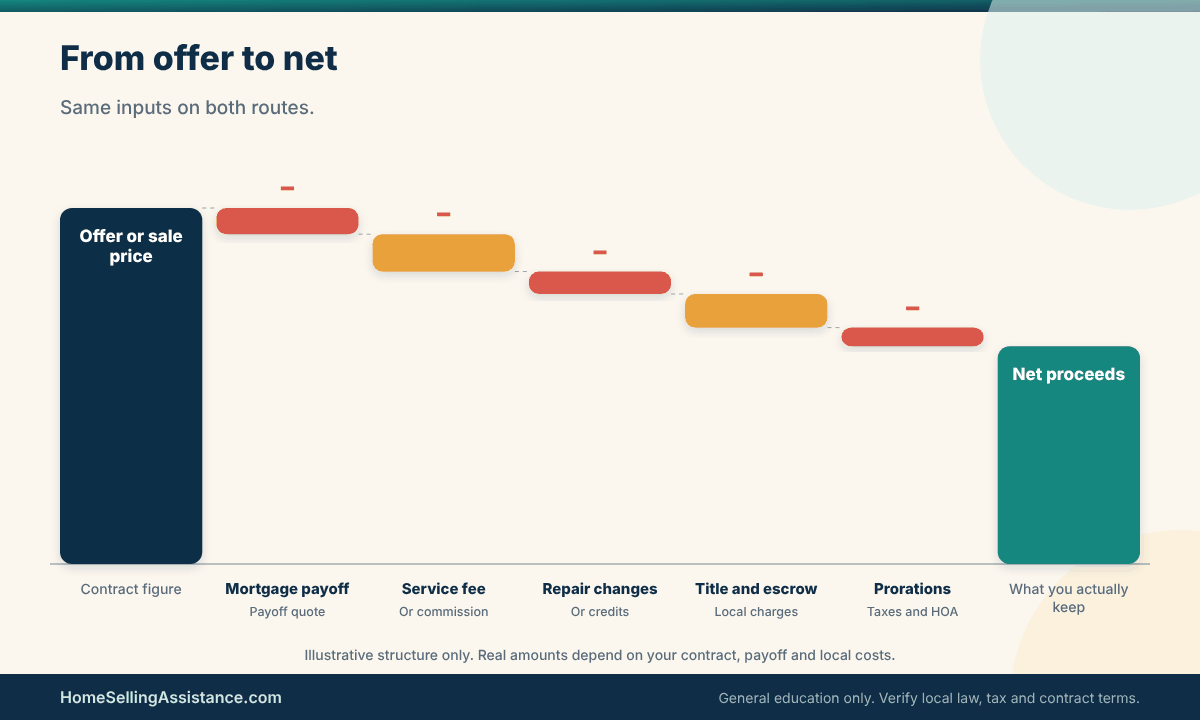
The single most useful tool in an iBuyer vs realtor seller comparison is a net sheet for each path, built with the same inputs. Start with the same mortgage payoff, the same estimated property tax proration, and the same title and escrow charges. Then add what differs: the iBuyer service fee and expected repair adjustment on one side, and the agent compensation, prep costs, and concessions on the other.
Here is an illustration using round numbers that are not typical of any market. Suppose an iBuyer offers $380,000 with a service fee of $19,000 and an expected repair adjustment of $6,000. Suppose the same house, listed with an agent, might sell for $405,000 with $20,000 in total agent compensation, $4,000 in prep and cleaning, and $3,000 in concessions. The iBuyer path leaves $355,000 before shared closing costs, and the listing path leaves $378,000.
The gap in that example is $23,000, and the question becomes whether the speed, certainty, and avoided effort are worth it to you. Change a single input, such as the repair adjustment or the sale price, and the answer moves. That sensitivity is the lesson, which is why we show the structure in the picture below instead of a promise about outcomes.
For more on building each line, see our guide to home sale net proceeds, and for the cost side specifically, seller closing costs.
When the faster check costs more than the slower one
Speed has a real value in an iBuyer vs realtor seller comparison, and it is easy to underprice it when you are comfortable. Carrying costs are one way to measure it. Every extra month of mortgage payments, taxes, insurance, utilities, and upkeep on a house you no longer live in is money that the listing route must beat before it wins.
Suppose, as another illustration, that carrying a vacant home costs about $2,800 a month in total. A listing that takes two additional months to close costs $5,600 more in holding costs. That amount does not erase a $23,000 gap, but it narrows it, and a carrying cost twice that size narrows it further. Use your own numbers, not ours.
There is also a quieter cost on the other side. A seller who accepts a discounted offer because the process felt easy may never learn what the open market would have paid. If you suspect your home is in strong condition and in demand, a free or low-cost conversation with an agent about likely pricing is cheap insurance before you decide.
Notice what we are not saying. We are not saying the listing route nets more, and we are not saying the iBuyer route nets less. Both statements are sometimes true and sometimes false. What the net sheet does is turn a feeling into a figure you can check.
Legal, financing, execution, market-exposure and fallback risk
Price is the visible part of any iBuyer vs realtor seller decision. Risk is the invisible part, and it is where sellers get hurt. Each route has a different failure pattern, and it helps to name them before they happen.
On the iBuyer side, the main risks are price adjustment after inspection, contract terms that favor the company, fees that are not obvious until the closing statement, and the possibility that the program does not buy your type of home at all. Some companies decline older homes, unusual properties, or homes outside a set price band, and the quote you see may disappear when they review the details.
On the agent side, the main risks are a buyer whose financing falls through, an appraisal below the contract price, an inspection that reopens negotiation, and a listing that sits long enough to lose momentum. Market exposure cuts both ways: a long public record of price cuts or time on market can weaken your position, which is why pricing and preparation matter so much before launch.
Legal risk sits underneath both sides of the iBuyer vs realtor seller choice. Disclosure duties, agency relationships, and how deposits are held depend on your state, and none of that changes just because a company runs an app. Verify the rules with your state real estate commission, a local real estate attorney, or your title company, depending on the question.
Documents and clauses that carry the risk
Most of the risk can be found on paper if you know where to look. In an iBuyer purchase agreement, read the clause on inspection and price adjustment, the clause on what happens if the company decides not to proceed, the deposit terms, and the section on possession and condition at closing. Check also whether the contract limits your right to sue or sends disputes to arbitration, which some do.
In a listing agreement and sales contract, read the compensation clause, the cancellation terms, the contingency deadlines, and the remedies if either side defaults. A short contingency window protects you, while a long one gives the buyer more time to leave. Our guide on inspection contingency seller choices shows how to weigh that window.
Whichever route you take, confirm who holds the earnest money or deposit and under what conditions it is released. A deposit in a licensed escrow or title account is different from a deposit with the buyer or a broker’s informal account. If the terms are vague, ask for them in writing before signing anything.
What happens if the offer or the buyer falls apart
Fallback planning is the iBuyer vs realtor seller habit that separates calm sellers from stressed ones. With an iBuyer, the fallback is usually a listing, and the cost is time plus any momentum you lost. With an agent route, the fallback is a backup offer, a relist, or a negotiated extension, and the cost depends on how the contract treats the failed deal.
The most common iBuyer fork appears after the company inspects the home. If the revised number is lower than you can accept, the picture below shows four ways sellers commonly respond. None of these is right for everyone, and your contract controls what you can do and when.
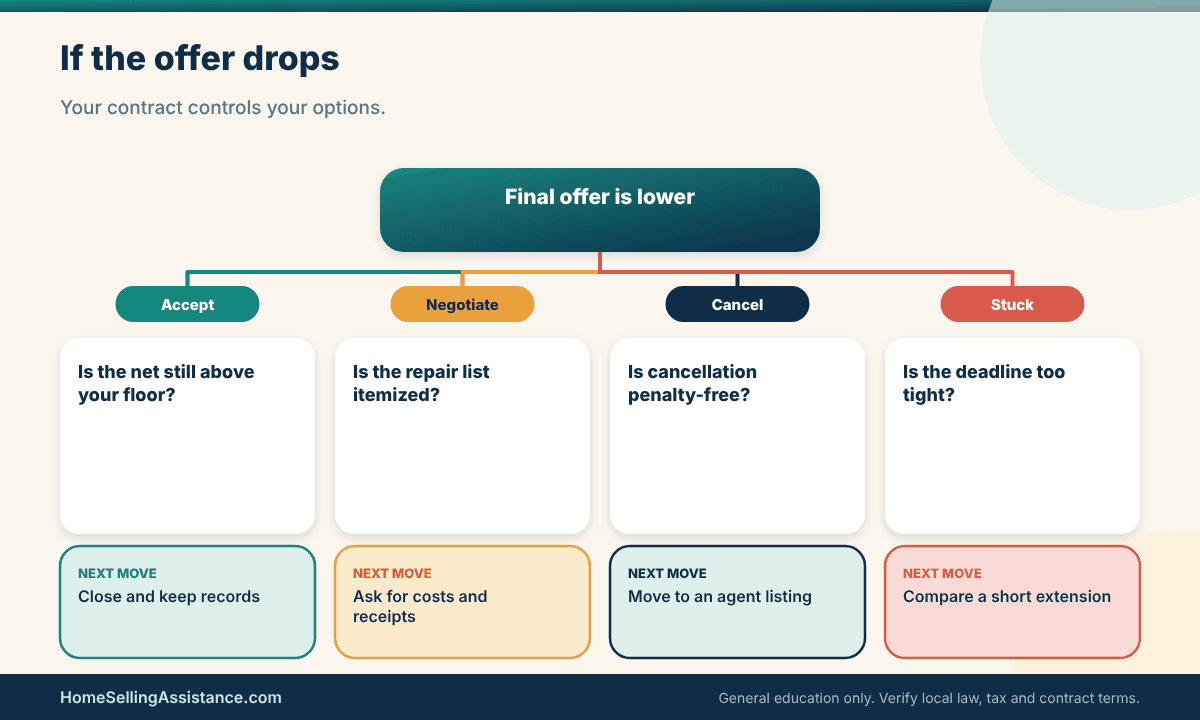
Notice that the best branch depends on what you set up before the problem appeared. A seller who already has an agent’s price opinion in hand can decide quickly. A seller who has nothing ready tends to take the revised number because the clock is ticking. That is not a failure of willpower. It is a predictable result of having no plan.
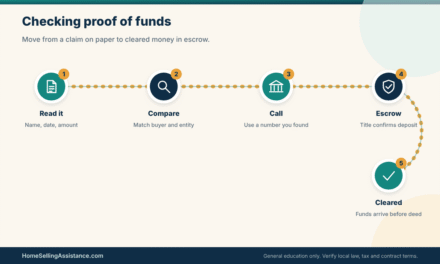
On the financing side, a conventionally financed buyer can fail to close for reasons outside your control, and the same is true of any buyer using a mortgage. If a buyer in either route is paying with cash, ask for proof of funds, a topic we cover in proof of funds cash buyer seller, and learn how to verify a cash home buyer before you rely on their promise.
A few habits keep any iBuyer vs realtor seller comparison from going sideways. First, ask every company and every agent the same questions in the same order, so you are comparing answers and not personalities. Second, keep a simple log of each quote, with the date, the figure, the fees, and the conditions attached. Quotes expire, and memory is a poor record when three people have given you three different numbers.
Third, notice when anyone pushes you to decide quickly. Urgency is sometimes real, such as a quote that expires or a hot market that rewards fast action. It is also a common sales technique. A trustworthy iBuyer or agent will explain the deadline and let you read the contract in full. If the pressure grows as your questions get sharper, treat that as information about the person, not just the offer.
Finally, remember that an iBuyer vs realtor seller choice is not permanent until you sign. Requesting a quote does not obligate you, and interviewing an agent does not lock you into a listing. Gathering information is nearly free, and it is the best protection a seller has. The costly mistakes tend to happen after a signature, which is why the reading, the asking, and the net sheet all belong before it.
Choosing an iBuyer vs realtor seller route by scenario, not by universal winner
People who search for an iBuyer vs realtor seller answer usually want a verdict. We understand the wish, but a single verdict would be dishonest, because the right route flips when a few facts change. A better habit is to describe your situation first, then see which route it favors and which fact could change the call.
The scenario table below lists several common situations. Read this iBuyer vs realtor seller table as a map of tendencies. If you recognize yourself in a row, treat the “fact that changes the choice” column as your homework: it names the one piece of information worth confirming before you decide.
| Situation | Route favored | Reason | Trade-off | Fact that changes the choice |
|---|---|---|---|---|
| Fixed move date within weeks | iBuyer or quick cash buyer | Short, flexible closing | Lower net, possible price adjustment | Whether the final figure holds after inspection |
| Sound home, no deadline | Agent-listed sale | Open-market exposure | Prep, showings, longer timeline | Local demand and days on market |
| Dated home needing repairs | Depends on repair scope | iBuyer may price repairs in; listing may need credits | Discount versus negotiation | Contractor estimates for the real repairs |
| Buying next home, needs certainty | Either, with timing plan | Fewer buyer conditions can help | Speed against price | Whether you can bridge a gap between closings |
| Little equity, tight payoff | Whichever clears the payoff | Net must cover loan and costs | Fees can eat thin equity | Payoff statement and total line items |
| Unusual or older property | Agent or specialty investor | iBuyer may decline or discount | Narrow buyer pool | Whether the iBuyer program accepts the property |
To use the table, find the row closest to your life, then test it with real quotes. If the favored route does not come out ahead on your net sheet, trust the net sheet over the table. The table tells you where to look first. It does not know your house.
Also notice how often the deciding fact is a document, not an opinion: a payoff statement, a contractor estimate, a signed offer, a days-on-market report. That is a good sign. It means the decision can be made with evidence, and you do not have to rely on whoever is most persuasive.
If you are also thinking about a speedy sale through other channels, be careful about marketing claims that promise guaranteed outcomes. Our overview of sell house fast claims explains what to question before you trust a headline.
Scenario one: the seller with a hard deadline and a tired house
Our first seller in this iBuyer vs realtor seller example has a firm date. Maybe a job starts in a distant city, or a lease on a new place begins, or a family situation leaves no room for a long process. The house itself is livable but dated, with worn flooring, an old roof, and appliances near the end of their lives.
For this seller, an iBuyer vs realtor seller comparison leans toward certainty and speed. The iBuyer route can offer a schedule the seller controls within a range, no showings, and no buyer mortgage to wait on. The cost is usually a lower net and a possible adjustment after inspection.
Still, in this iBuyer vs realtor seller case the agent route is not out of the question. A listing with an aggressive timeline, a price set to attract offers quickly, and a seller willing to accept a short-term concession can sometimes close within a similar window. Whether it works depends on local demand, which is why a conversation with an agent costs little even if you lean toward the quick sale.
The honest iBuyer vs realtor seller summary is this: when time is the scarcest resource, pay attention to how much the speed is costing you, and make sure the price of speed is a number you chose rather than a number you were given.
Evidence to gather: repair estimates, payoff, and the real calendar
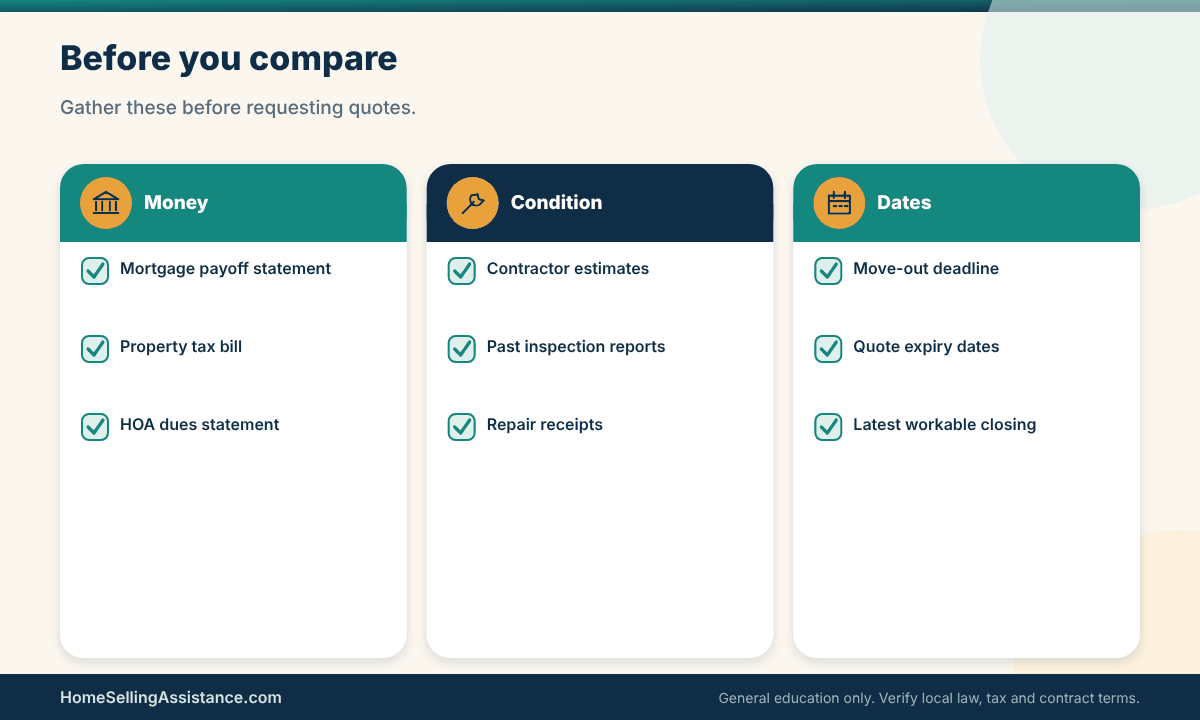
Three documents matter most for this seller. The first is a payoff statement from the mortgage servicer, which tells you the exact amount needed to clear the loan on a specific date. The second is a realistic repair estimate from a licensed local contractor for the items you know are worn, such as the roof or the water heater. The third is a simple calendar showing your actual deadline and the latest closing date that still works.
With those three in hand, compare the iBuyer’s repair adjustment with a real contractor’s number. If the company deducts much more than the work would cost, ask them to itemize it, and consider whether doing a small repair yourself would shift the offer. If the deduction is close to the real cost, the convenience may be fairly priced.
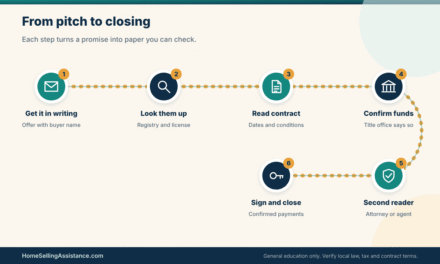
The picture below pulls together the papers that make any comparison faster, whichever route you end up choosing. Having them ready before you request quotes shortens the process and keeps you from agreeing to terms you did not have time to read.
A scenario, an exception, and your next step for the deadline seller
Take Priya, who has seven weeks before she must be in another state. She gathers her payoff statement, gets a roofer’s written estimate, and requests two iBuyer quotes and one agent’s price opinion. Both quotes come in below the agent’s range, as often happens, but one is close enough that the gap looks like a fair price for certainty.
The exception is that the better quote depends on a company inspection, and Priya has no way to know in advance what it will find. She asks about the price-adjustment process, reads the clause on her right to cancel, and decides to accept only if cancellation carries no penalty.
Her next step is to set a personal rule before the inspection: if the final figure drops below a number she writes down now, she moves to an agent listing the same week. Writing the rule in advance keeps a tired decision from being made under pressure.
Scenario two: the seller with a healthy house and time to market
Our second seller in the iBuyer vs realtor seller comparison has no hard deadline. The home is in good condition, the neighborhood has steady activity, and the owner has equity and patience. Perhaps they are moving to be closer to family, but the date has some give.
For this seller, the iBuyer vs realtor seller question tends to favor the agent route, simply because the main advantage of an iBuyer, speed and certainty, is worth less when time is available. The market exposure that a listing offers has more chance to pay off on a home that shows well and is priced to the data.
Choosing the agent side of the iBuyer vs realtor seller question does not make the iBuyer quote useless. A quote from the company can serve as a floor, a number you could accept if the listing went poorly. Knowing the floor can make it easier to price boldly and negotiate calmly, since you are not afraid of getting nothing.
If you decide to list, spend time on pricing before launch, because the first two weeks of exposure often shape how buyers see the home for the rest of the listing. Our guide on how to price a house to sell walks through comparable sales and adjustments in plain language.
Evidence to gather: comparable sales, demand signals and your floor
For this seller, the evidence is mostly about the market. Collect recent sales of similar homes nearby, noting size, condition, lot, and how long each took to sell. Look at active listings that compete with yours, and at how many have reduced their prices. Together they show whether buyers are in a hurry or taking their time.
Request at least one iBuyer quote even if you plan to list. It costs nothing, takes little time, and gives you a concrete floor. Ask that agent, too, what they would do differently if you wanted to close faster, because the answer shows how flexible their plan really is.
Finally, decide in advance how long you are willing to let the home sit before changing the plan. Some sellers set a number of weeks, others a number of showings, and others a price at which they would switch routes. The specific rule matters less than having one.
A scenario, an exception, and your next step for the patient seller
Consider Elena, who owns a tidy home and expects to move in the spring, with no hard date. She gets an iBuyer quote as a floor, interviews two agents, and lists at a data-backed price. Two weekends later she has several showings and a strong offer.
The exception arrives when a seasonal slowdown cools demand and the first offer collapses after the buyer’s appraisal comes in low. Elena still has her floor in her notes. She weighs a modest price adjustment against accepting the quote and decides to keep the listing active for a few more weeks before switching.
Her next step, which we would suggest to anyone in her place, is to treat a low appraisal as information, not a verdict. Our guide to low appraisal seller options explains the choices, from renegotiating to waiting for the buyer to cover a gap.
Quick scenario
A seller receives an iBuyer quote of $380,000 and an agent’s price opinion of $400,000 to $415,000. The seller’s mortgage payoff is $210,000, and no deadline is pressing. Before settling the iBuyer vs realtor seller question, the seller asks for the iBuyer’s fee in dollars, a contractor’s estimate for the known repairs, and the agent’s net sheet. These are illustrative numbers only. With all three on paper, the choice becomes arithmetic plus a personal view of what speed is worth.
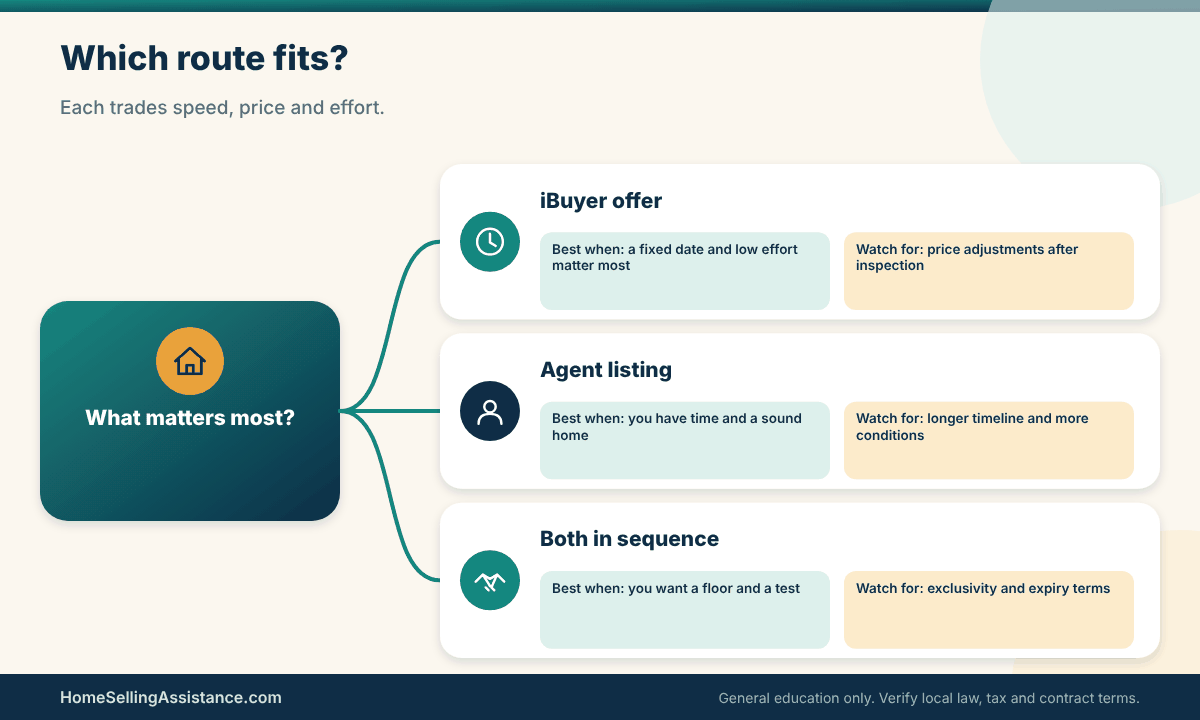
Before moving to the questions readers ask most, a word about the mix of routes. Some sellers find the cleanest answer is not one route but a sequence: start with an agent listing for a defined period, and keep the iBuyer quote available as a fallback. Others reverse it, taking a quick quote first to learn their floor, then deciding whether to test the market.
In an iBuyer vs realtor seller decision, sequencing lets you use the strengths of each path while limiting the risk of both, and it is the plan we most often see work for sellers who feel torn.
If you are weighing a flexible schedule, our article on flexible closing date seller terms shows how to negotiate a date that fits your move, and our cash offers and alternative sale routes library collects the rest of the options in one place.
Two more points can tilt an iBuyer vs realtor seller decision without announcing themselves. The first is your own financial plan for the next home. If you are buying, the date and certainty of your sale proceeds may decide how strong an offer you can make, and our guide on whether to sell first or buy first explains how sellers sequence the two moves. A quick, firm closing can help, but only if the price still leaves enough for your next purchase.
The second is the type of home. A condo or a house in an association adds paperwork, resale documents, and sometimes approval steps that lengthen either route, and our article on selling a house with an HOA covers those extras. A buyer who needs less paperwork may be more attractive to you, but the association rules do not disappear. Ask both the iBuyer and the agent how they handle them.
Condition can matter as much as type. If your house needs significant work, the iBuyer vs realtor seller comparison often turns on how each side treats repairs. Some sellers fix a few items and list, some sell as-is to a company, and some negotiate credits after an inspection. Our guides on selling a house as is and on a repair credit vs seller repair show how those choices change the math.
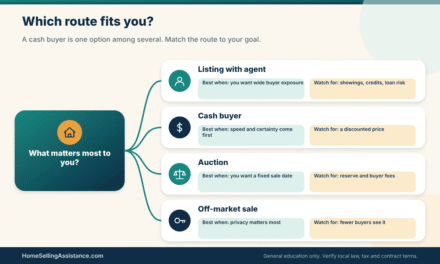
The picture below condenses the choice into a fork you can return to when the details start to blur. It names the situations in which each route tends to fit and the thing to watch for on either side, which is a handy way to check yourself before you sign.
Frequently asked questions about iBuyer vs realtor seller
Is an iBuyer offer usually lower than what an agent could get?
Often the headline number is lower, because the company builds in its own costs and resale risk, but that is a tendency and not a guarantee. The fair way to settle an iBuyer vs realtor seller question is to compare net proceeds after fees, repairs, and carrying costs. In some markets or for some homes, the gap is small, and in others it is large. Ask for the figures in writing and decide with a net sheet.
Does an iBuyer buy any house?
No. Programs set limits on price range, age, condition, property type, and location, and many decline homes outside those limits. A quote can also change when the company reviews photos or inspects the house. Before you spend time, ask whether your specific property type is eligible in your market, since the answer can end the comparison early.
What fees should I expect from an iBuyer?
Fee structures differ by company and sometimes by market, so we do not quote a typical figure. You may see a service fee, a discounted purchase price, and closing costs that follow local custom. Ask for each item in dollars for your own home, and compare the total with what an agent route would cost you.
Can the iBuyer lower the price after I accept?
In many programs, yes, after the company’s own inspection, because the offer is conditional on condition. Whether you can cancel without penalty depends on the contract. Read the inspection and termination clauses before accepting, and keep a fallback route available until the final figure is on paper.
Is the realtor route always slower?
In an iBuyer vs realtor seller comparison, the listing usually takes longer to reach closing, since preparation, marketing, negotiation, and a buyer’s financing steps all take time. In an active market with a well-priced home, the gap can be modest. Our selling process timeline guides explain how each stage adds days, and an agent can estimate local timing for your price range.
Do I still need an agent or attorney if I sell to an iBuyer?
The law does not force you to hire one in most places, but some sellers choose to have a real estate attorney review the purchase agreement, and requirements differ by state. A short review can be worth the cost when the contract includes arbitration, fees, or unusual repair clauses. Check your state real estate commission or a local attorney for the rules that apply to you.
How do I protect myself from a fake or unreliable buyer?
Confirm who the buyer is, ask for proof of funds when the buyer says they pay cash, and never pay fees upfront to someone promising a fast sale. In any iBuyer vs realtor seller process, our guide to fake cash home buyer signs lists warning signs, and the Federal Trade Commission’s consumer site publishes current scam alerts. Walk away from pressure to sign immediately.
What if I have little equity in my home?
Thin equity makes fees matter more, since every dollar of cost comes out of a small cushion and the sale must still cover your payoff. Get a current payoff statement and compare total net figures on each route. If the net does not clear the loan, speak with your lender and a HUD-approved housing counselor before choosing a route.
Will I owe taxes on the sale?
It depends on your gain, how long you owned and lived in the home, and your situation. Federal rules allow many homeowners to exclude a portion of gain when they meet the ownership and use tests, as explained in IRS Publication 523. Our guide to the home sale capital gains exclusion gives the general picture, and a tax professional can address your facts.
Can I use both routes?
Many sellers weighing an iBuyer vs realtor seller choice use both, in sequence. They gather an iBuyer quote as a floor, list with an agent for a set period, and keep the quote as a fallback if the listing stalls. Check any listing agreement and any iBuyer offer for terms that limit this, such as exclusivity or expiration dates, so one does not block the other.
Make the comparison, then decide
An honest iBuyer vs realtor seller decision rests on numbers you gathered yourself: two or three quotes, one price opinion, a payoff statement, and a calendar. Weigh what speed, privacy, and certainty are worth against what the open market might pay, and keep a fallback ready until the money is secure. This article is general education, not legal, tax or financial advice, so check your contract with a licensed professional in your state, and visit our cash offers and alternative sales section whenever you want to compare another route.