Anyone selling manufactured home property quickly learns that the sale is only partly about the house itself. The rest is about paper: a certificate of title or a deed, a lot lease or a land parcel, a lender who may or may not hold a lien, and sometimes a park manager whose approval stands between your buyer and the keys. Get those pieces lined up early and selling manufactured home property feels ordinary. Leave them for later and they become the reason a closing slips.
The confusing part is that two manufactured homes that look identical from the street can be legally different things. One may be treated as real estate, recorded at the county like any other house. Another may be titled much like a vehicle, held by a state agency, and sold with a bill of sale. A third may sit on a rented lot in a land-lease community, where the buyer is also signing up with the park. The rules for selling manufactured home property depend on which of these you actually own.
This guide walks through selling manufactured home listings in the order the problems tend to appear. We start with who owns what and who has to sign. Then we separate federal rules from state titling law and park rules. After that comes the seller workflow, meaning disclosures, park approval, inspection, financing and the handoffs between the buyer, the lender and the title or escrow agent. We finish with a verification checklist you can use before signing anything.
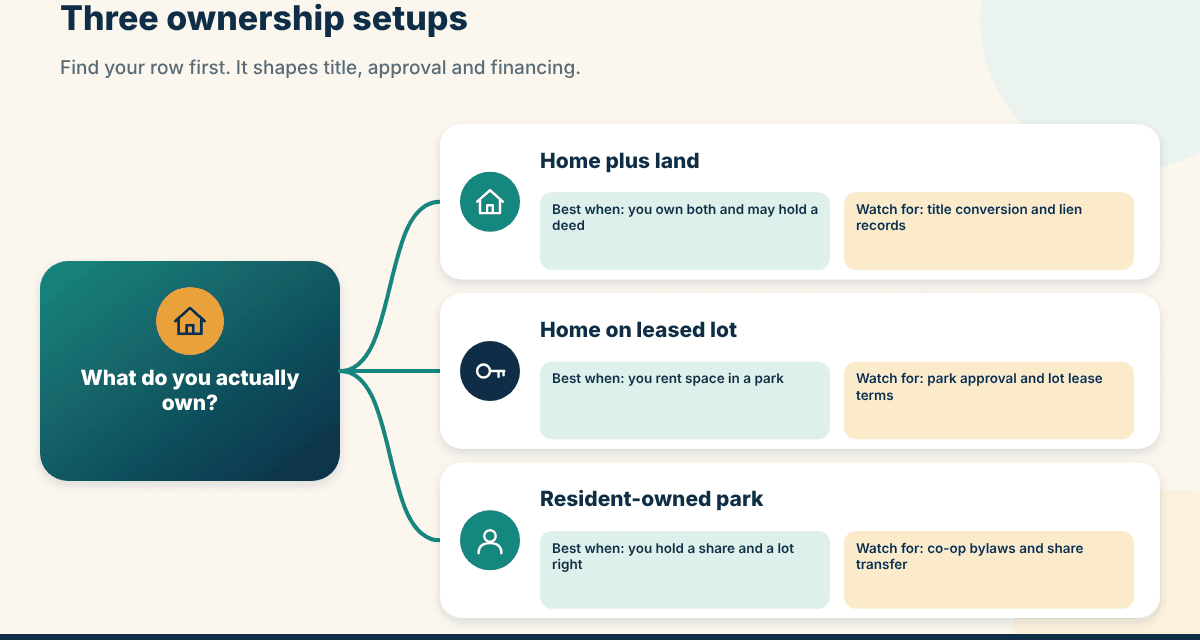
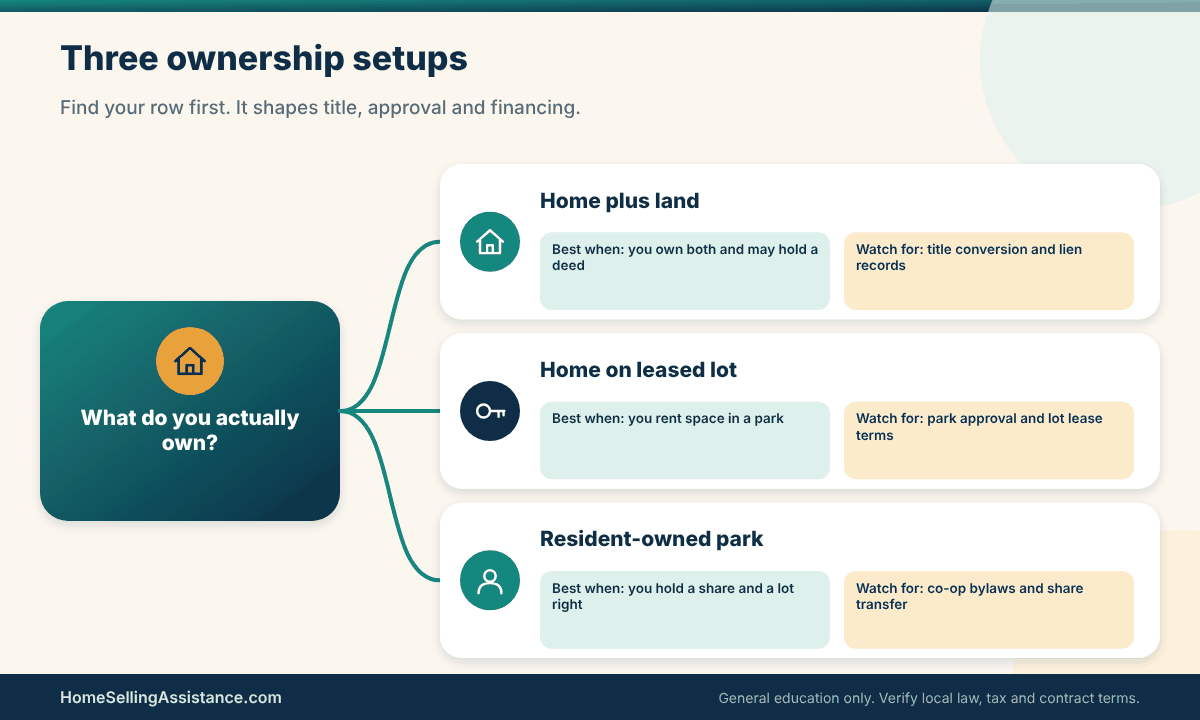
We stay neutral about how you sell. A listing agent, a flat-fee service, a dealer, an attorney-assisted private sale or a cash buyer can each be a sensible route, and each meets the same documents at the finish line. If your home sits in a community with an association, our guides on selling a house with an HOA and the broader cornerstone on selling a condo cover overlapping ground, such as resale packages and transfer fees. The picture below shows the three ownership setups that shape everything else.
Key takeaways
- Find out what you actually own. The home, the land and the lot lease can each belong to a different person or entity, and the sale has to match that reality.
- Title is the gatekeeper. Whether your home is titled as personal property or recorded as real property decides who handles the transfer, which liens to search and what the buyer’s lender will accept.
- Park approval can be a second sale. In a leased-lot community the buyer often has to be approved by the park, and the park may have rules about the age and condition of the home.
- Financing is narrower than for a typical house. Some buyers use a mortgage, others a loan secured by the home alone, and the type can change what the buyer needs from you.
- Verify, then sign. Pull the lien records, tax status, park paperwork and payoff letters yourself, and confirm anything state-specific with a title or escrow company, the state housing or motor vehicle agency, or an attorney.
Before the detail, here is a quick look at the common ownership setups. Which one describes you decides what selling manufactured home property will involve, so it is worth finding your row before reading on.
Selling manufactured home property starts with ownership, land and the title
The first job in selling manufactured home property is dull but decisive: describe, in one sentence, what you are selling. “I am selling the house and the land it sits on” is one sentence. “I am selling a home I own on a lot I rent from a park” is a different one. “I am selling a share in a resident-owned community along with the right to live on a particular lot” is a third. Each leads to different paperwork, different buyers and different professionals.
Agents and escrow officers who help with selling manufactured homes regularly see sellers who assumed the second sentence was the first. Someone has lived in the home for twenty years, paid the property tax bill that arrived each year, and believes the land is theirs. Then a title search shows the lot belongs to the park, or the home is still titled in a former spouse’s name. Better to learn that now than from a buyer’s lender.
Who owns the home, who owns the land, and who must sign
Start by listing every person or entity with a legal interest in the sale. That list usually includes each owner named on the title or deed, any lienholder, the landowner if you rent your lot, and, in some situations, a spouse or co-owner who is not on the title. The people who must sign are not always the people who live in the home, and the person who pays the bills is not always the person on the record.
If your home is titled and registered with a state agency, the certificate of title shows the owners and any recorded lien. If the home is real property, the deed and the county records show it instead. Some homes carry both: a certificate that was surrendered or cancelled when the home was attached to land, plus a deed that now covers home and land together. States handle this differently, so the details are worth confirming locally.
Evidence to gather: title certificate, deed, lot lease and lien records
Pull together the originals or certified copies of what you have. That means the certificate of title if one exists, the deed if the home sits on land you own, the bill of sale from when you bought, your lot lease or rental agreement if you rent space, and any loan documents. If you cannot find a title certificate, many states let you request a duplicate from the agency that issued it, which may take weeks, so start immediately.
Then look at what the records say about names. A common snag is a name that does not match across documents: a maiden name on the title, a middle initial missing on the deed, or an owner who has since died. Each mismatch is fixable, but the fix may need an affidavit, a court order or a probate step, and none of those are quick. Write down every discrepancy you find so your title or escrow contact can tell you the cure.
Finally, check who is shown as a lienholder. A loan you paid off years ago may still appear if the release was never filed. A lender sometimes holds a lien on the home alone, separate from any lien on the land, and the payoff process differs for each. Ask your servicer for a written payoff statement and ask your title contact to confirm that the record shows the same lender and the same loan.
A scenario, an exception, and your next step on mixed ownership
Picture a seller we will call Dana, an illustrative example rather than a real client. Dana owns a manufactured home on a leased lot. Her late husband’s name is still on the title next to hers, and she assumed that “just signing for both of us” would be fine. It will not be. The buyer’s lender and the title agent will want proof that the second owner has died and that Dana holds the authority to sell, which often means an estate or survivorship document.
The exception worth knowing is joint ownership with survivorship wording, where a death certificate and a short filing may be enough in some states. In others, a probate step is needed first. Which applies to Dana depends on how the title was held and on state law, so her next move is a call to the title or escrow company, and probably an hour with a probate or real estate attorney, before she accepts any offer.
If you are in a similar spot, resist the urge to list first and sort it out later. A buyer who signs a contract on a home you cannot yet legally transfer is not protected, and neither are you. Our guide on documents needed to sell a house lists the general paperwork, and the manufactured-home items in this article add to that list rather than replacing it.
Federal rules, state titling law and local park rules
Three layers of rules touch the work of selling manufactured home property, and they rarely overlap neatly. The federal layer covers how the home was built and a few nationwide disclosure and fair housing duties. The state layer covers titling, real versus personal property, transfer taxes or fees, and often the rights of residents in leased-lot communities. The local layer covers county records, property tax, zoning, and what the individual park or community allows.
For a seller the practical lesson is this: no single website, agent or neighbor can tell you the whole answer. Federal rules are the same in every state, but they are narrow. The state and park layers carry most of the weight, and they are exactly where generic advice fails. Treat any claim about “how it works” as a lead to verify, not a fact to rely on.
What the HUD label and data plate prove, and what they do not
Homes built after June 15, 1976 under the federal construction and safety standards carry a permanent certification label on the exterior of each transportable section, often called the HUD tag, and a data plate inside the home, commonly found in a kitchen cabinet or a closet near the electrical panel. Homes built before that date are generally called mobile homes and were not built to the same federal standard.
These marks matter because buyers, lenders, appraisers and many parks look for them. A missing label does not necessarily mean the home cannot be sold, but it can complicate financing and insurance, and some states have a process for getting a replacement or a substitute document. What the label does not prove is who owns the home, whether liens exist, or whether the home was installed correctly. It speaks to construction, not to title or condition.
Take clear photographs of each label and of the data plate now, since selling manufactured homes goes faster with proof in hand. They help listing descriptions, they help the appraiser, and they save a scramble if a buyer’s lender asks. If you cannot find a label, do not guess or try to recreate one. Ask the state housing or manufactured housing agency, or your title contact, how a replacement is handled where you live.
Two sellers, two states: why the same home sells differently
Imagine two sellers with the same model of home, the same age and the same asking price, in two different states. Seller A lives where manufactured homes on owned land are routinely converted to real property, with the title certificate surrendered and a deed recorded. The sale looks much like any other house sale, with an earnest money deposit, a title search and a deed at closing.
Seller B lives where the home remains titled with a state agency, and the sale closes with a signed title, a bill of sale and a lien release, sometimes through a dealer or an escrow company that specializes in this work. Neither route to selling manufactured home property is better or worse. The difference is simply procedural, and it determines what you ask your escrow contact on the first call.
Both sellers face the same federal fair housing rules, and both should check state and local rules directly. The HUD fair housing and equal opportunity pages explain the federal side, which applies to how you advertise, screen and treat prospective buyers regardless of the type of home.
To pull the ownership and rules layers together, the matrix below lists the issues that most often decide whether a sale proceeds smoothly. Use it as a question list for your first call with a title or escrow contact. The deadline column is deliberately general, because actual time limits come from your contract, your lender and your state, not from this article.
| Issue | Controlling document or authority | Seller obligation or choice | Typical deadline | Where to verify locally |
|---|---|---|---|---|
| Who may sign | Title certificate or recorded deed | Obtain signatures of every owner of record | Before listing or before accepting an offer | Title or escrow company, attorney |
| Lien payoff | Lender payoff letter, lien record | Request payoff and a written release at closing | Payoff letters often expire; ask for the good-through date | Lender, state title agency or county recorder |
| Real or personal property status | State law, title or deed records | Confirm how the home is classified before pricing and marketing | Before the contract is drafted | State housing or motor vehicle agency, attorney |
| Park approval of buyer | Lot lease, park rules, state law | Tell the buyer about the application and any fees | Set by the park and your contract | Park office, state resident-protection office |
| Lead paint notice | Federal rule for pre-1978 housing | Provide the required notice if the home was built before 1978 | Before the buyer is bound by the contract | EPA guidance, your agent or attorney |
| Property tax or fees owed | Tax bills, county or state records | Pay or prorate what is due at closing | At closing, per the contract | County tax office, title or escrow company |
Read the matrix from left to right for each row you recognize. If you cannot name the controlling document in your own case, that is the first thing to track down. Rows where the deadline depends on someone else, such as the park or a lender, are the ones to start earliest, since you cannot hurry another party’s office.
How selling manufactured home deals turn into a seller workflow
Once you know what you own, selling manufactured home property becomes a sequence. There is the disclosure and approval layer, where you tell the buyer what you know and, if needed, help them clear the park. Then there is the handoff layer, where the buyer’s lender, the title or escrow agent and sometimes a county or state agency each take a piece of the paperwork. A calm, early plan for selling manufactured home property prevents most of the late-stage drama.
We like to think of it as three questions you can answer in a single afternoon. Do I know everything about the home’s condition that a buyer would want to know? Do I know what the park or association will need from a buyer? And do I know which lender and which title or escrow company will be handling the transfer? If the answer to any is no, that is your next task.
Disclosures, park approval and the paperwork buyers expect
Disclosure duties when selling manufactured homes vary by state. Some states use the same seller property disclosure form as for site-built houses, some have a version that addresses manufactured housing specifically, and some have fewer formal requirements. Whatever your state requires, the safest habit is the same: say plainly what you know about the roof, plumbing, electrical system, past water damage, any additions, and how the home is anchored and set.
Federal law adds one fixed point. If the home was built before 1978, the EPA’s lead-based paint disclosure rule for target housing applies, and sellers must give buyers the required information and pamphlet and disclose known hazards. Most manufactured homes built under the 1976 federal standard will be newer than that, but a home built in 1976 or 1977 is inside the window, and the EPA real estate disclosure page explains the requirement. Our guide on lead paint disclosure for sellers covers the mechanics.
If the home sits in a community, the second half of this layer is park approval. Many parks require a prospective buyer to submit an application, and they may run credit or background checks, ask about income, and tell the buyer whether the home itself meets the park’s standards for age, size, skirting, porches and exterior condition. Some states regulate how parks may screen buyers and how quickly they must respond. Those rules are state specific, so ask the park manager for the written process and confirm anything that sounds unusual with your state’s housing or consumer agency.

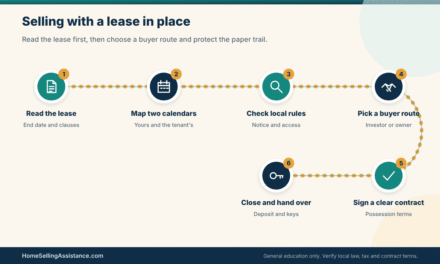
The roadmap above shows the order of operations that tends to work best when selling manufactured home property on a leased lot: confirm title, request the park rules, disclose, market, approve the buyer, then close. Skipping ahead is tempting, especially the marketing step, but a buyer who finds out late that the park will not accept the home’s age is a buyer who walks away.
Evidence to gather: inspection findings, tie-downs, skirting and utilities
Buyers when you are selling manufactured home property, and often their lenders, care about parts of the home that sellers of site-built houses never think about. How the home is supported and anchored matters. So do the condition of the skirting, the underside or belly wrap, the roof and its seams, the connection between sections, and the way water, sewer and electrical are hooked up to the lot. A seller who has looked at these items in advance can answer questions calmly.
Consider paying for a pre-listing inspection from someone who has experience with manufactured housing, not just a general home inspector, if you want a clear picture. This is a choice, not a requirement, and you may reasonably decide to wait for the buyer’s inspection instead. The trade-off is simple. An early report gives you time to repair or price around problems, while waiting can leave you negotiating under contract deadlines. Neither approach is wrong.
Gather paperwork for any additions, decks, porches, carports or sheds. Work done without permits can cause trouble with a lender, an insurer or the park. Our article on selling a house with unpermitted work explains how to think through that situation, and the same principles apply here. Add receipts for new roofing, water heaters and appliances, plus any manufacturer or home warranty documents you still have.
A scenario: the park says no to your buyer
Here is another illustrative case. Marcus has an accepted offer on his home in a land-lease community. Two weeks later, the park informs the buyer that her application is denied because of a credit issue. Marcus did not cause this, but the contract is now at risk, and the buyer’s deposit may be affected depending on how the agreement was written.
What can Marcus do? First, read the contract for a park-approval contingency, which is a clause that lets either party exit or extend if approval is not obtained by a certain date. Second, ask the park, in writing, for the reason for the denial and whether the buyer can appeal, reapply or add a co-signer, since processes vary. Third, keep marketing quietly in case a backup buyer is needed, if the contract allows backup offers.
If the denial looks arbitrary or tied to a protected characteristic, that is a fair housing concern, and the buyer can contact HUD or a state or local fair housing agency. Marcus should not accuse the park of anything himself. His job is to document dates, keep copies of every message and speak with his agent or attorney about the contract options. Park rules and resident protections differ widely, so the conversation should be local.
Handoffs to the buyer’s lender, the title agent and the park
Selling manufactured home property involves more handoffs than most sellers expect. The buyer’s lender needs documents about the home and the foundation. The title or escrow agent needs proof of ownership, lien releases and tax status. The park, if there is one, needs its paperwork. And a state or county agency may need a filing to record the new owner. You are the common point connecting all of them, so a one-page contact sheet helps.
Write down each party’s name, phone number, email and what they need from you, then send documents once, in an organized set, instead of piecemeal. Ask each party how long their step usually takes. A park office that needs ten business days for a buyer application and a lender that needs a foundation certification will shape the earliest realistic closing date, so tell your buyer about those timelines before you agree on a closing day.
Evidence to gather: financing type, appraisal and foundation papers
Financing for selling manufactured homes comes in several forms. Some buyers use a traditional mortgage when the home is real property on land the buyer will own. Some programs are tied to federal agencies and have their own requirements about foundations, permanence and the home’s construction date. Others use a personal property loan, sometimes called a chattel loan, secured by the home alone. Terms, availability and down payment expectations vary by lender and by buyer, and we will not quote figures here.
What matters for you is what each type needs from the seller. A mortgage lender will usually order an appraisal and may require documentation that the home is on a permanent foundation, that the HUD label is present and that the title has been converted to real property. A personal property loan may focus more on the title, the lien search and the condition of the home. Ask the buyer’s loan officer, early, for a list of items they will need from you.
Appraisals of manufactured homes can be harder to complete because comparable sales are sometimes scarce. We cannot predict how any appraisal will come in, and you should be wary of anyone who promises a number. If the appraisal falls short of the contract price, the usual options are renegotiating, the buyer adding cash, challenging the appraisal through the lender’s process or ending the contract if an appraisal contingency allows. Our guide on selling a house with a mortgage explains how your own payoff interacts with the closing.
A scenario: the lender declines a chattel loan
Consider Priya, an illustrative seller whose buyer is using a personal property loan. Ten days before closing, the lender says it cannot proceed because the home’s age falls outside its guidelines. The contract has a financing contingency, but it expires in two days. What now?
Priya’s choices are all ordinary ones. She can agree to extend the financing deadline in writing, giving the buyer time to try another lender. She can offer a short extension while she keeps marketing, if the contract permits. She can negotiate a lower price if the buyer finds a lender with less favorable terms, or she can release the buyer and relist. Each path has trade-offs for price, time and risk.
What she should not do is let the contingency lapse in silence, or accept a verbal promise that the deal will work out. Any extension, price change or release belongs in a signed amendment. If the buyer suggests seller financing as a workaround, Priya should pause and talk to an attorney first, since the legal and tax effects of carrying the loan can be significant and vary by state. The Consumer Financial Protection Bureau publishes plain-language information on how mortgages and closing disclosures work.
One more structural decision in selling manufactured home property sits above the paperwork: how the home will change hands. Selling manufactured home property in place, meaning the buyer takes over the home on the existing lot, is the most common route in a community. Selling to be moved means the buyer plans to relocate the home, which brings permits, a mover, utility disconnects and a very different set of costs. Selling manufactured home and land together moves the transaction closer to an ordinary house sale.
Beyond that, you can sell to a private buyer, through a dealer or consignment arrangement, to an investor, or to a cash buyer. Each choice affects price, speed and effort. Our overview of a cash offer for a house explains the trade-offs of that route, and a few of its cautions about proof of funds apply to manufactured homes as well. The figure below compares the two most common structures side by side.

The scale is not a recommendation. Selling in place can be simpler when the park welcomes the buyer and the home meets its rules. Relocation can be the only practical path when a park is closing or will not accept an older home, but it can cost real money and may reduce the pool of buyers. Whichever you choose for selling manufactured home property, put the structure in the contract so that responsibility for moving, disconnecting and cleanup is clear.
The next table collects the situations sellers run into most often when selling manufactured homes. We wrote it to help you decide whom to call and what to review, not to predict how any one case will turn out. Outcomes depend on the contract, state law and the people involved, so use it to organize questions for a professional.
| Situation | Seller options | Main risk | Document to review | Escalate to |
|---|---|---|---|---|
| Title lists a deceased co-owner | Gather death record, find out if survivorship applies | Buyer cannot receive clear title | Title certificate, deed, estate papers | Probate attorney, title company |
| Park denies buyer | Appeal, extend, find a backup buyer | Contract expires or deposit dispute | Park rules, purchase contract | Agent, attorney, fair housing agency if bias is suspected |
| Lender rejects older home | Extend contingency, renegotiate, relist | Lost time and price pressure | Loan estimate, contingency clause | Buyer’s loan officer, attorney |
| Old lien still recorded | Obtain release from the lender or file the correction process | Closing cannot fund | Lien search, payoff and release letter | Title agent, lender, state title agency |
| Buyer wants to move the home | Allocate permits, mover and cleanup costs in writing | Damage, disputes, abandoned lot | Lot lease, contract addendum | Park office, attorney |
| Buyer proposes seller financing | Decline, or take legal and tax advice first | Default, loan-servicing and tax complications | Proposed note and security documents | Real estate attorney, tax professional |
To use the table, find the row closest to your situation, read across to the document column and locate that paper before you call anyone. Professionals can help faster when you arrive with the actual title, lease or contract in hand. The escalation column names the kind of person to start with, though a good title or escrow officer will often point you to the right specialist.
Build a selling manufactured home verification checklist before you sign
By now the pattern should be clear: most problems in selling manufactured home property are problems of verification. Who is on the title, what the lender thinks is owed, whether the park has changed its rules, whether taxes are current. None of these steps in selling manufactured home property require special expertise to check. They require a willingness to ask for documents and to read them. This last section turns the earlier ideas into a checklist you can work through in a weekend.
The goal of selling manufactured home property carefully is that nothing important is a surprise on closing day. Sellers who do this work rarely regret it, and the effort is small compared with a delayed closing, an unexpected lien payoff or a collapsed contract. If you are working with an agent or attorney, share the checklist with them so you are not duplicating effort.
Official sources and recorded documents to pull yourself
Rely on records, not recollection, when selling manufactured home property. The official sources that matter most are the state agency that issues titles or registers manufactured homes, the county recorder or land records office, the county tax office, the lender’s servicing portal and the park’s written rules. A title or escrow company will often run many of these searches for you once you open an order, but you can look at much of it yourself first.
For federal rules, the primary sources are the agency pages themselves. The IRS Publication 523 covers selling your home, including that a main home can be a mobile or manufactured home, and the EPA lead disclosure page covers pre-1978 housing. For state rules, look for the state real estate commission, the housing or manufactured housing division and the attorney general’s consumer office.
Evidence to gather: lien searches, tax records and park estoppel
A lien search for selling manufactured homes tells you what encumbrances are recorded against the home or the land. For titled homes, this often means a search with the title agency. For real property, it means the county records. Ask the title or escrow company which searches they run and whether they include judgments, tax liens and liens recorded under commercial filing systems, since some lenders file in more than one place.
Request your property tax and fee status. Depending on the state, a manufactured home may be taxed as personal property, as real property or through a different annual fee or license. Unpaid amounts can block a transfer or be collected at closing. Get the latest bills and confirm whether anything is delinquent, since a delinquency can add penalties and may attach to the home.
If you rent a lot, ask the park for a written statement of your account status, sometimes called an estoppel or account ledger letter. It should show rent paid, fees owed, any notice of violation and the lease term remaining. Park rent and rule changes may affect what a buyer will pay, so read the lease for rent adjustment and renewal terms and share what is required with the buyer.

The checklist above groups the paperwork into ownership, money and condition. Print it and tick items off as the documents arrive, and write the date next to each one. Dates matter because many items expire: payoff statements, park letters, inspection reports and even the buyer’s pre-approval.
A scenario: a forgotten lien surfaces in week three
Take Elena, who sold her home and, three weeks into escrow, learned that a lien recorded by a former lender was never released. She had paid that loan off a decade earlier and had no paperwork to prove it. Closing was scheduled in five days, and the buyer’s lender would not fund over an open lien.
Her next steps are practical. She contacts the original lender, or the company that acquired its loans, and asks for a release or a satisfaction letter. If the lender no longer exists, the title agency may know of a process for clearing the record, which could involve an affidavit, a court action or an agency procedure depending on the state. She tells her buyer promptly and asks whether a short closing extension is acceptable.
The lesson is the same one running through this article: search early. A lien search in week one costs a small fee and might give you months to fix a problem. The same discovery in week three can threaten the closing date, the buyer’s rate lock and your next move. Our guide on selling land versus a house also covers how the land side of the transaction can bring its own record issues.
What must be current before signing
Some documents used in selling manufactured home deals have a shelf life. Before you sign a purchase contract, and again before closing, make sure that the facts underneath your paperwork have not changed. A title that was clean in March can have a new judgment in June. A park that accepted older homes last year can adopt a new rule. A lender payoff that was accurate on one date grows with daily interest. Build a short list of items that need refreshing.
The best moment to check them is just before each major step: before you sign the contract, before the inspection response, and in the final week before closing. Put reminders in your calendar. If your agent or escrow officer offers to track these dates, ask them to send you the list so you can see what is outstanding and what has changed since the last review.
Evidence to gather: payoff letters, tax receipts and rent status
Four items tend to go stale fastest. The first is the lender payoff statement. A payoff figure includes interest that accrues every day, so the statement carries a good-through date, and a closing that slips past it needs an updated figure. Ask for a per diem amount so you and the closing agent can adjust without starting over, and confirm in writing where and how the lender wants to be paid.
The second is proof that taxes and fees are current. Keep the receipt or the online record, and bring a fresh copy to closing in case a bill was issued in the meantime. The third is your lot rent and fee status, because a late payment, a new charge or a new rule notice can change what the park will sign off on. The fourth is the buyer’s side: pre-approval letters, proof of funds and park application results all age out.
Keep a simple log for selling manufactured home paperwork with the date each document was issued, who issued it and when it will need replacing. People who sell homes this way, and especially people selling manufactured home property for the first time, often find that the log turns a stressful final week into a short list of phone calls. Share it with your escrow contact so everyone is working from the same dates.
A scenario: closing slips and a document expires
Our last illustrative seller, Tom, who is selling manufactured home property, has a signed contract and a closing date set for the end of the month. The buyer’s lender needs three more days than expected, and the closing moves by a week. Tom’s payoff letter expires two days before the new date, the park’s approval letter lists the original closing date, and the buyer’s pre-approval is about to lapse.
None of this is a crisis if Tom catches it. He asks his lender for an updated payoff with a per diem, asks the park to reissue its letter with the new date, and tells the buyer’s loan officer that the pre-approval needs a refresh. He also asks the escrow company to confirm that the lien search is still clean on the new date. A weekly phone call during escrow costs little, and the habit pays for itself.
The exception is when delay triggers a contract deadline, such as a financing or appraisal contingency, or a date after which either side can cancel. If your contract has one, do not rely on a verbal extension. Put any new date in a signed amendment, and talk to your agent or attorney before you agree to anything that could weaken your position.
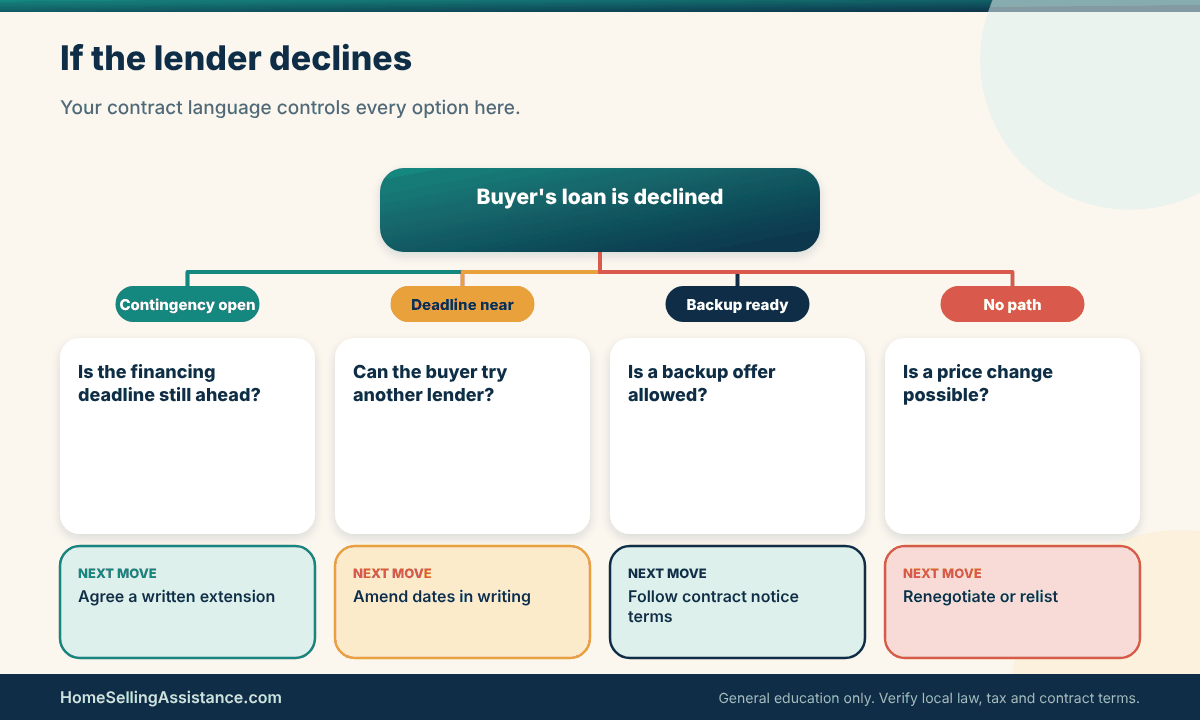
The decision tree above shows how to think about a closing that runs into trouble. Ask whether a contingency is still open, whether a deadline has passed, whether you have a backup and whether an extension makes sense. The right answer depends on your contract language, so use the tree to frame the question for your agent or attorney rather than to settle it yourself.
Before the checklist wraps up, three side topics deserve a few paragraphs, because they come up in nearly every conversation about selling manufactured home property. The first is tax. The second is fraud, which tends to target sellers who are in a hurry or who live in communities where homes sell quickly. The third is a short list of repeat mistakes, collected from the kind of situations described above.
On tax, the federal home sale exclusion can apply to a manufactured home that was your main home. The general rule is that you may be able to exclude up to $250,000 of gain, or $500,000 for many joint filers, if you owned and used the home as your main home for at least two of the five years before the sale. IRS Publication 523 explains the rule and the exceptions, and it notes that a main home can be a mobile home. Whether it applies to you depends on your facts, so talk to a tax professional.
Basis, the figure used to measure gain, can be harder to reconstruct for a home sold years after purchase. Land and home may have been bought together or separately, and improvements such as a new deck or a room addition may add to basis. IRS Publication 551 covers basis, and our articles on adjusted basis in a home sale and the home sale capital gains exclusion walk through the logic in plain language. Keep your purchase and improvement records.
Fraud deserves its own attention when selling manufactured homes. Sellers who advertise a home online can attract fake buyers who send overpayment checks, ask for a refund of the difference and vanish when the check bounces. Others pose as park managers or title agents and send altered wire instructions. Never wire money based on an emailed change, always call a number you looked up yourself, and treat unusual urgency as a warning sign. The FTC consumer site publishes current scam alerts, and our cornerstone on home sale fraud and seller safety goes deeper.
The mistakes in selling manufactured home deals are simple to list. Sellers selling manufactured home property assume the home is real property without checking. They list before locating the title. They forget the park application timeline. They take a buyer’s financing claim at face value, promise a closing date they cannot control or let a payoff letter expire. Another frequent one is trusting a general-purpose price estimate that ignores park rent, home age and foundation type. Each of these is avoidable with a bit of early checking.
If your situation also involves tenants, an empty home or a rural parcel, our guides on selling a tenant-occupied house, selling a vacant house and selling a rural home cover related issues, and the specialty property sales category collects them in one place.
Quick scenario
A seller selling manufactured home property lists a 1990s home in a leased-lot community, assuming it is real property. The title company’s first search shows a certificate of title with a lender’s lien still recorded and a park that requires buyer approval. Because the seller learned this before accepting an offer, the contract included a park-approval contingency and a lien release at closing, and the buyer’s lender knew what to expect.
Frequently asked questions about selling manufactured home property
Is a manufactured home real estate or personal property?
It depends on your state and on how the home is attached and titled. Some homes remain personal property with a certificate of title, while others become real property once the title is surrendered and a deed covers both home and land. Check with your title or escrow company and the state agency that handles manufactured housing, because this answer drives nearly every other step in selling manufactured home listings.
Can I sell my home if I rent the lot?
Usually yes, though the lot lease and park rules control how. Many communities require buyer approval, may restrict the age or condition of homes and may charge application or transfer fees. Some states regulate those practices. Read your lease, ask the park office for its written sale procedure and confirm any legal protections with your state housing or consumer office.
What is the difference between a manufactured and a mobile home?
Homes built after June 15, 1976 under the federal construction standards are manufactured homes, and they carry a HUD certification label. Earlier homes are generally called mobile homes. Lenders, parks and insurers often treat the two differently, and that can affect your buyer pool when selling manufactured home inventory of different ages.
What if I lost the title?
Many states allow you to request a duplicate from the agency that issued it, usually with an application, identification and a fee. If a lien is recorded, the lender may need to be involved. Processing can take time, so start the request before you list rather than after you have a buyer waiting.
Do I have to disclose problems with the home?
Disclosure rules differ by state, and some require a written form. Even where the form is short, hiding a known defect is risky. Federal law also requires lead-based paint disclosure for housing built before 1978. Our guide on seller disclosure requirements explains the general framework, and an attorney can answer state-specific questions.
What financing can buyers use?
Buyers may use a mortgage, a government-backed program or a personal property loan, depending on the home, the land and the lender. Each has its own rules about age, foundation and title status. Ask the buyer’s loan officer early what they need from you, and do not assume a loan that works for one home will work for another.
Can the park refuse my buyer?
Parks can generally set screening standards within the limits of state and federal law, but they cannot discriminate based on protected characteristics under the Fair Housing Act. If you suspect unlawful treatment, document what happened and contact HUD, a state agency or a local fair housing group. For ordinary denials, ask for the reason in writing and whether reapplication is possible.
Will I owe tax on the sale?
For selling manufactured home profit, it depends on your gain, your ownership and use of the home and your filing status. The federal exclusion for a main home can apply to manufactured homes, but eligibility has conditions. Read IRS Publication 523 and speak to a tax professional before assuming anything about your own return.
Should I sell in place or move the home?
Selling in place is often simpler when the park welcomes the buyer, while relocation may be necessary if the park is closing or will not accept the home. Moving involves permits, a mover, utility work and risk of damage, and the costs vary widely. Whichever you choose when selling manufactured home property, write responsibility for each task into the contract.
How long does a sale take?
There is no standard timeline for selling manufactured home deals. Park approval, lender requirements, title work and any lien or title cleanup can each add days or weeks. Ask each party how long their step takes and build your closing date from those answers instead of from a generic estimate.
Your next step
The calmest way through selling manufactured home property is to identify what you own, find the title, read the park rules and order a lien search before you list. Then keep a dated list of documents that expire. This article is general education, not legal, tax or financial advice, and rules differ by state, county and community, so confirm the details with a title or escrow company, your state housing agency and, where the stakes are high, a licensed attorney or tax professional.