
Selling multifamily property is a different job from selling a single-family house, because the building is both a home and a small business, and the people who might buy it will measure it with a calculator before they ever admire the porch. Your rents, your leases, your expenses and your tenants are the product. The paint color matters much less than the paperwork.
That shift catches many owners off guard when they start selling multifamily property for the first time. A duplex, triplex or fourplex can feel like “just a house with extra kitchens,” and in some ways it is. It can be financed with a residential mortgage in many cases, it can be bought by someone who wants to live in one unit, and it still has a roof, a furnace and a deed.
But the moment a buyer asks for your rent roll, you are in a second world, one where income is verified, tenants have rights, and every number gets questioned.
This guide walks through selling multifamily property from the first decision to the closing table. We cover how buyers underwrite a building, what to gather before you list, how tenants and leases change the process, and how to compare a conventional listing with a quieter direct sale. You can browse more guides like this in our condos, HOAs and specialty property category. We stay neutral on agents, brokers, attorneys and buyer types, because the right choice depends on your building and your goals, not on what any one industry would like you to pick.
One note on scope. Landlord-tenant law, disclosure duties, transfer taxes, licensing and rent regulation vary a great deal by state and often by city. Where we describe a rule, we describe the general idea and tell you how to check the local version. If you have also read our broader piece on selling a condo, you will recognize the theme: the building type changes who the buyer is, and the buyer decides what the paperwork has to prove.
Key takeaways
- Know your building class first. Small buildings of two to four units are often treated like residential property by lenders, while larger buildings are usually valued on income. That one fact changes who your buyers are.
- Your documents are the listing. When selling multifamily property, a current rent roll, signed leases and twelve months of real expenses do more for your price than a fresh coat of paint.
- Tenants have rights that survive the sale. In most places the buyer inherits the leases. Notice rules, security deposits and entry rules vary, so verify them locally.
- Compare paths by net result. A higher offer with a long contingency period can be worth less than a lower, cleaner one once time, cost and risk are counted.
- Taxes can dwarf fees. Depreciation, possible recapture and exchange options deserve a conversation with a tax professional before you sign anything.
- Treat every tenant fairly. Fair housing rules apply to how you show, disclose and communicate during the sale.
Before we get into the details, here is the overall flow of a typical sale. Most owners find it useful to see the whole road once, even if their own trip skips a few stops. The picture below shows the stages in the order they tend to happen, from deciding to sell through to the post-closing handoff of leases and deposits.

What you are really deciding when selling multifamily property
Every seller we have ever talked with started with a price in mind. That is natural, and it is also the wrong first question. The better first question is what you need the sale to accomplish, because a building can sell well for one goal and poorly for another. An owner who needs cash for a retirement move has a different best path from an owner who wants to swap into another rental and defer tax.
Your goals, your timeline and how much tenant risk you can carry
Start by writing down what “a good sale” means for you in plain words. Maybe it is the highest net number you can reasonably get. Maybe it is a closing before a specific date because a loan balloon is coming due. Maybe it is a smooth landing for tenants you have known for ten years. These goals pull in different directions, and you will have to rank them, because selling multifamily property rarely lets you win on all of them at once.
Timeline deserves its own honest look when you are selling multifamily property. A small building with stable tenants and clean books can move from preparation to closing in a few months in many markets, while a building with messy records, deferred repairs or unusual zoning can take much longer. We cannot give you a universal number, and anyone who does is guessing. What you can do is estimate your own preparation time by counting the documents you do not yet have.
Then consider cash and risk together, since selling multifamily property can tie up both. If you carry a mortgage with a prepayment penalty, or if the building has a lien, a code violation or an unpaid tax bill, those items shape how much room you have to negotiate. If you can afford to wait for the right buyer, you can usually afford to be pickier about terms. If you cannot, a cleaner but slightly lower offer may serve you better than a higher one with strings attached.
Evidence to gather: rent roll, leases and twelve months of expenses
The core of your evidence file for selling multifamily property is three things. The first is a rent roll, which is a unit-by-unit list showing each tenant, the lease start and end dates, the monthly rent, the security deposit held and any unusual terms. The second is the full set of signed leases and any addenda, such as pet agreements or parking rights. The third is a trailing twelve-month statement of income and expenses, often called a T-12.
Build that statement from actual bank records and receipts, not from memory. Buyers and their lenders will compare your numbers with your tax returns and bank deposits, and a gap you cannot explain will cost you credibility. Include property taxes, insurance, utilities you pay, repairs, maintenance contracts, landscaping, snow removal, trash, management fees if any, and a line for turnover costs such as painting and cleaning between tenants.
One more document many owners forget is the record of security deposits. In many states, deposits must be held in a particular way, sometimes in a separate account, and the rules for transferring them at sale vary. Know exactly how much you hold for each unit and where that money sits. If you want to see how landlords and buyers handle a similar situation with a single rented house, our guide on selling a tenant-occupied house covers the same deposit and notice questions at a smaller scale.
Finally, collect the boring items that selling multifamily property always asks for: the deed, any survey, certificates of occupancy, permits for past work, rental registration or inspection certificates where your city requires them, and utility bills for the last year. If any of these do not exist, write that down too. A known gap you can explain is much less alarming to a buyer than a gap they discover on their own.
A scenario, an exception and your next step for the owner-occupant
Picture a fourplex where the owner lives in one unit and rents the other three. This is a very common setup, and it opens two doors at once. An investor may want the building as it stands, and a different buyer may want to live in one unit and rent the rest, which can allow certain residential loans that require the buyer to occupy the property. Those buyers may value the building differently and may be willing to wait for different things.
Here is an illustrative example with round numbers only. Suppose each unit rents for about 1,500 dollars a month, giving 72,000 dollars of scheduled rent over a year if all four were rented, though yours includes the unit you occupy. A buyer who plans to live there will treat that unit as a housing cost instead of income. An investor will assume it can be rented. Both views are legitimate, and neither is the “right” price.
The exception is tax. If you have lived in your unit as your main home for enough of the last five years, part of your gain may qualify for the federal home sale exclusion, but the rest, tied to the rented portion and to depreciation, generally does not. Our tax cornerstone on taxes when selling a home explains the two-of-five-year rule, and IRS Publication 523 on selling your home covers partial business use of a property.
Your next step in selling multifamily property is simple. List the units you occupy, the units you rent, how long each has been in that status, and any time a unit sat vacant. That one page will save you an hour with every professional you hire.
Facts about the building and its tenants that can change the plan
Some facts about selling multifamily property are not about your preferences at all. They are conditions of the property that decide which paths are even open to you. Unit count is the clearest one. In many lending practices a building with up to four units is treated as residential, which lets an individual buyer use a home loan, while a building with five or more units is commonly treated as commercial and valued mainly on net operating income. Your lender-facing market therefore changes at that line.
Zoning and legal status come next, and they shape selling multifamily property more than most owners expect. A building marketed as a triplex that the city only recognizes as a duplex is a problem, and it is a problem you want to discover before a buyer does. Ask your local planning or zoning office whether the number of units is legal, whether the use is conforming or “grandfathered,” and what happens to that status if the building is damaged or leaves the rental market for a long period.
Tenant facts matter just as much when selling multifamily property. A building full of month-to-month tenants can look flexible to one buyer and unstable to another. A building with long leases at below-market rents can look safe to one buyer and underpriced to another. Neither view is wrong. What matters for you is that the facts are accurate and documented, because an honest picture lets the right buyer find you.
Evidence to gather: unit count, zoning, permits and tenant status
Pull together the legal description of the unit count from three places and see whether they agree. Those places are your deed or title policy, the county or city property record, and the certificate of occupancy or rental registration. If one says three units and another says four, resolve it now, since lenders and appraisers pay close attention to the count and a mismatch can slow or sink a loan.
Check permits for any work you did, especially kitchens, bathrooms, added units, finished basements and converted garages. Unpermitted work does not always stop a sale, but it can affect financing, insurance and negotiation, and in some places it triggers disclosure duties. The state real estate commission or a local real estate attorney can tell you what your area requires you to say.
For tenant status, make a simple list that records whether each tenancy is under a fixed lease or month-to-month, whether any tenant is behind on rent, whether any notice has been given or received, and whether any subsidy program is involved. Subsidized tenancies often carry their own paperwork and inspection steps, and a buyer will want to know before they commit. Keep the list factual and avoid commentary about the tenants themselves.
If the building was built before 1978, the federal lead-based paint rules apply to the sale. Sellers must give buyers certain information and an opportunity to test, and the EPA explains the details on its page about real estate disclosure for lead. Make sure any past lead reports are in your file.
A scenario with below-market rents and your next step
Imagine a triplex where one longtime tenant pays noticeably less than neighbors, because you never raised the rent over the years. Buyers will see that gap on the rent roll right away. An investor might read it as upside, since rents might rise when the lease allows, while an owner-occupant might read it as a long-term constraint if local rules limit increases or require specific notice.
Resist the urge, when selling multifamily property, to hide or “fix” the gap before listing. Raising rent sharply right before a sale can create friction, may be limited by your lease or local law, and can look like window dressing to a careful buyer. A better move is to document the history, state what the lease allows, and let buyers decide how to value it.
The exception arises when a local rent regulation applies. Some cities cap increases, require just-cause reasons for ending a tenancy, or require registration, and the rules can differ even between neighboring towns. Check with your city housing office or a local landlord-tenant attorney before you describe future rent potential in any marketing.
Your next step is to take the rent roll and add one column called “what the lease or local rule actually allows.” Fill it in for each unit. That column often becomes the most useful page in the whole file.
Comparing the realistic ways of selling multifamily property
Once you know your goals and your facts, the paths for selling multifamily property become easier to sort. Broadly, most owners choose between a conventional listing that exposes the building to many buyers and a more direct route that trades exposure for speed, privacy or simplicity. There are variations on each, and some owners try one and then switch. The next picture lays out the choice as a fork so you can see which route lines up with which priority.
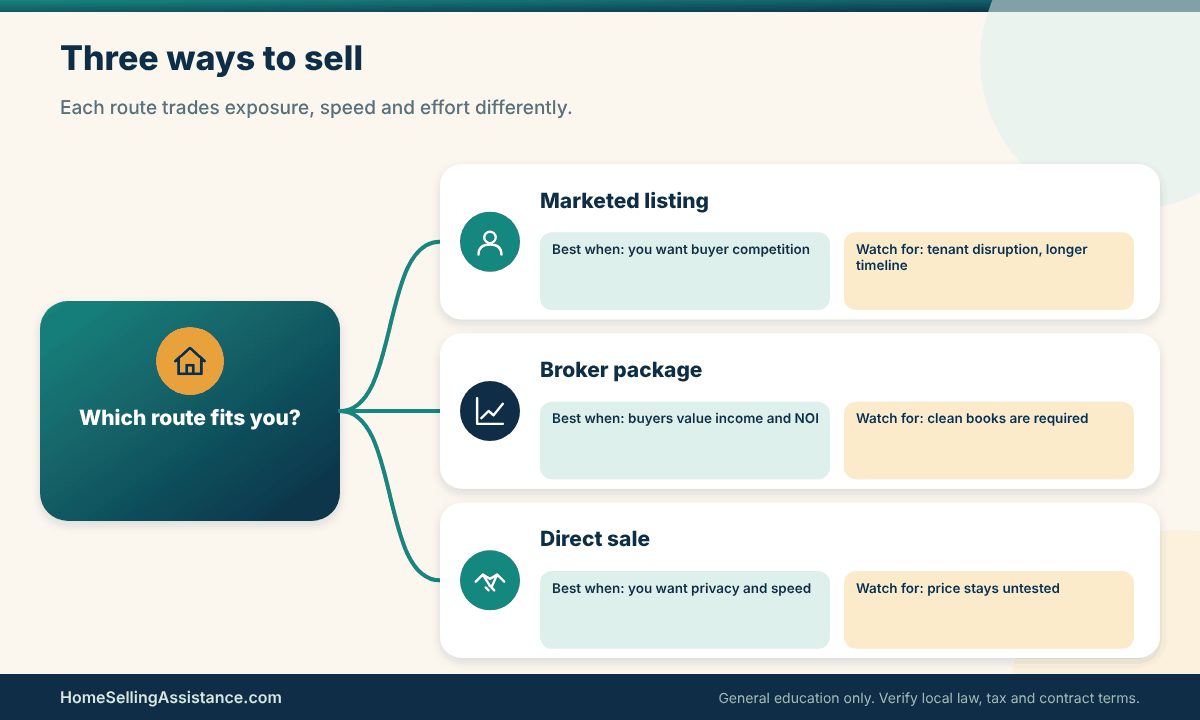
The table below puts the same two paths side by side across the things sellers usually care about: money, time, contingencies, workload and execution risk. Treat it as a prompt for your own research. The cells describe tendencies, not promises, and your market and your contract will change them.
| Factor | Option A: marketed listing | Option B: direct or off-market sale | What to verify |
|---|---|---|---|
| Price and net proceeds | More buyers may compete, which can lift the price | Fewer bidders, price may be lower or simply untested | Recent comparable sales and offer terms |
| Time | Prep, marketing, showings, then contract | Can be shorter if one buyer is ready | Buyer proof of funds and lender status |
| Contingencies | Inspection, financing and appraisal are common | May be fewer, but must be negotiated | Deadlines, deposit terms, release rules |
| Workload | High: showings, tenant coordination, document requests | Lower on showings, still heavy on documents | Who handles tenant notices and access |
| Tenant disruption | More showings mean more entries and notice | Fewer entries, though inspections still occur | Lease entry clauses and local notice rules |
| Execution risk | Deals can fall apart at financing or appraisal | Risk shifts to buyer reliability and contract quality | Contract wording, attorney review, title status |
Use the matrix for selling multifamily property by filling in your own version. Replace each cell with a number or a fact you can check: the offers you actually receive, the deadlines they propose, the days of notice your tenants must be given. After you have done that, the column that looks best on paper is usually not the one you assumed at the start.
Path one: a traditional listing to investors and owner-occupants
A traditional listing means you hire a licensed professional or manage a flat-fee listing, put the building on the local listing service, and invite buyers to tour and make offers. For smaller buildings this exposes the property to both investors and owner-occupant buyers, which can widen the pool considerably. For larger buildings, specialized brokers often circulate an offering package to a network of investors instead of relying on a general home listing.
The big advantage of listing when selling multifamily property is competition. If more than one qualified buyer wants the building, you have leverage on price and terms. The big costs are time, tenant disruption and the chance that a deal dies in the middle. Broker compensation is negotiable and has to be written down in your listing agreement, so ask for the terms in writing and compare more than one proposal. Our guide to how to choose a listing agent explains what to compare beyond the headline fee.
Not every agent knows income property, and selling multifamily property is a specialty. A professional who sells mostly single-family homes may price a fourplex by square footage, which can miss the point entirely. Ask any candidate how many multifamily sales they have handled, how they prepare an offering package, and how they handle tenant access. Their answers will tell you quickly whether they understand the product.
Evidence to gather: how buyers underwrite the building
Underwriting, in the context of selling multifamily property, is just a formal word for “checking whether the numbers hold up.” Here is the basic logic buyers use, with illustrative round numbers only. Start with the rent the building could collect if every unit were rented all year. Subtract an allowance for vacancy and unpaid rent. Add other income such as laundry or parking. That gives effective income.
Next, subtract the operating expenses: taxes, insurance, utilities, repairs, management, reserves for big items and so on. Mortgage payments are not included at this stage. What remains is net operating income, usually shortened to NOI. If a building had 60,000 dollars of effective income and 24,000 dollars of expenses in an example, its NOI would be 36,000 dollars.
Buyers then convert NOI into a price using a capitalization rate, or cap rate, which reflects what return they expect for a building like yours in your market. In a purely illustrative case, an NOI of 36,000 dollars and a cap rate of 6 percent suggests a value of 600,000 dollars, and the same NOI at 7 percent suggests a lower value. The point is how sensitive the price is to the rate and to every expense line, not that any specific rate applies to you.
That sensitivity explains why anyone selling multifamily property should correct small errors before listing. A missing 3,000 dollars of annual expense, in the example above, moves the implied value by tens of thousands. On the flip side, an expense that is truly one-time, such as a roof replacement paid last year, should be labeled as such so buyers do not treat it as a permanent cost. Another quick method some buyers use is the gross rent multiplier, which compares price with annual gross rent. It is rougher than cap rate, so expect serious buyers to move past it.
For smaller buildings sold to owner-occupants, an appraiser will often rely on comparable sales plus an income check, so the building still needs to make sense on both measures. Ask your listing professional which method local appraisers and lenders tend to emphasize in your area.
A scenario: the four-unit with one vacant unit
Take a fourplex where one unit has been empty for two months, a common wrinkle when selling multifamily property. Should you lease it before you list, leave it empty or show it staged? There is no universal answer, but we can describe the trade-off. A filled unit shows actual income and removes a question from underwriting. On the other hand, a new lease signed in a hurry at a low rent or with generous concessions can drag down the numbers, and a new tenant may complicate a buyer who wants to occupy that unit.
A vacant unit has its own advantage, and our piece on selling a vacant house covers the showing side of that, because an owner-occupant buyer can sometimes move in sooner and an investor can renovate without a tenant to relocate. It also lets you show the interior freely. The cost is a month-by-month hit to your own income and a buyer who may ask for a price reduction based on the vacancy.
If you do decide to lease it, use your normal screening criteria, apply them the same way to every applicant, and follow fair housing rules. HUD explains those rules on its fair housing and equal opportunity pages. Your next step is to ask two or three local professionals how vacant units have been treated in recent offers on similar buildings, and compare what they say.
Path two: an off-market, direct or delivered-vacant sale
The second family of paths skips the public listing. You might sell to a neighbor who owns nearby rentals, to a tenant, to a local investor who has asked about the building, to a relative, or to a buyer you meet through a professional network. You might also sell to an investor who buys quickly with cash, a path we describe more broadly in our overview of a cash offer for a house.
The advantages of selling multifamily property directly are privacy, a shorter timeline and fewer showings. Tenants are often calmer when strangers are not touring their homes every weekend. The drawbacks are the lack of competition, the difficulty of knowing whether an offer is fair, and a higher chance of skipping steps that protect you, such as a clear written contract, title work and proof of funds. A direct sale still needs all the same legal documents as a listed sale.
A related variation in selling multifamily property is delivering the building vacant, which means ending tenancies before the sale. This is sometimes done to sell to an owner-occupant or to a developer. It is also heavily regulated in many places, with notice periods, relocation payments, just-cause rules and penalties for improper termination. Never start that process on the strength of a buyer’s request alone. Talk to a local landlord-tenant attorney first, because mistakes here can create liability that outlasts the sale.
Evidence to gather: what an offer without marketing should include
When you are selling multifamily property without competing offers to compare, the written offer itself has to do more work. Look for the price, the earnest money amount and who holds it, the due-diligence period, the financing terms, the closing date, and what the buyer expects you to deliver, such as estoppel certificates, assigned leases and security deposit transfers. Vague offers are often a warning sign.
Ask for proof of funds or a lender letter, and verify them directly with the institution, using contact details you find yourself instead of ones the buyer supplies. Scammers and unprepared buyers both exist, and proof of funds on a letterhead means little until you confirm it. Our guide to home sale fraud and seller safety covers the common patterns, and the FTC keeps general consumer guidance at consumer.ftc.gov.
Consider a broker’s opinion of value, or an independent appraisal that you commission, so you have a reference point. A professional opinion does not guarantee what a buyer will pay, but it reduces the odds that you accept an offer far below the market without realizing it. You can also test the market quietly by sharing the building with a small number of qualified buyers instead of the public.
If your building has a lease that runs well past closing, our guide on how to sell a rental property with a lease in place explains how that affects buyers. Finally, insist on title work and a real contract, even for a friendly buyer. Have a title company or attorney review the deed, any liens, and the closing statement. A handshake sale feels easy, but a clean paper trail protects both sides.
A scenario: the long-term owner with tenants who are friends
Consider an owner of a triplex who has rented to the same three households for many years and wants them treated decently. A direct sale to a buyer who will keep the tenants may fit that goal better than a public listing. It might also leave money on the table if more competition would have raised the price. That is a real trade-off and only the owner can weigh it.
The exception is when the buyer’s plans differ from the promise. If a buyer says they will keep everyone but the contract says nothing, you have no protection. If keeping tenants matters to you, discuss with an attorney whether any commitments can be written into the purchase agreement, and understand that the tenants’ own rights come from their leases and local law, not from your intentions.
Your next step is to write down which outcome for tenants is a must-have, which is a preference and which is just a hope. Then ask each prospective buyer questions that map to those three lists. Honest answers will often settle the choice for you.
A net-result rule for selling multifamily property
After you have compared paths, you still need a way to choose. The cleanest tool we know is a net-result rule: judge each offer by what you expect to keep, how long it will take to get there, what could go wrong, and how much of your own effort it demands. A rule like this keeps selling multifamily property from turning into a contest of headline prices, which are the easiest numbers to compare and often the least useful.
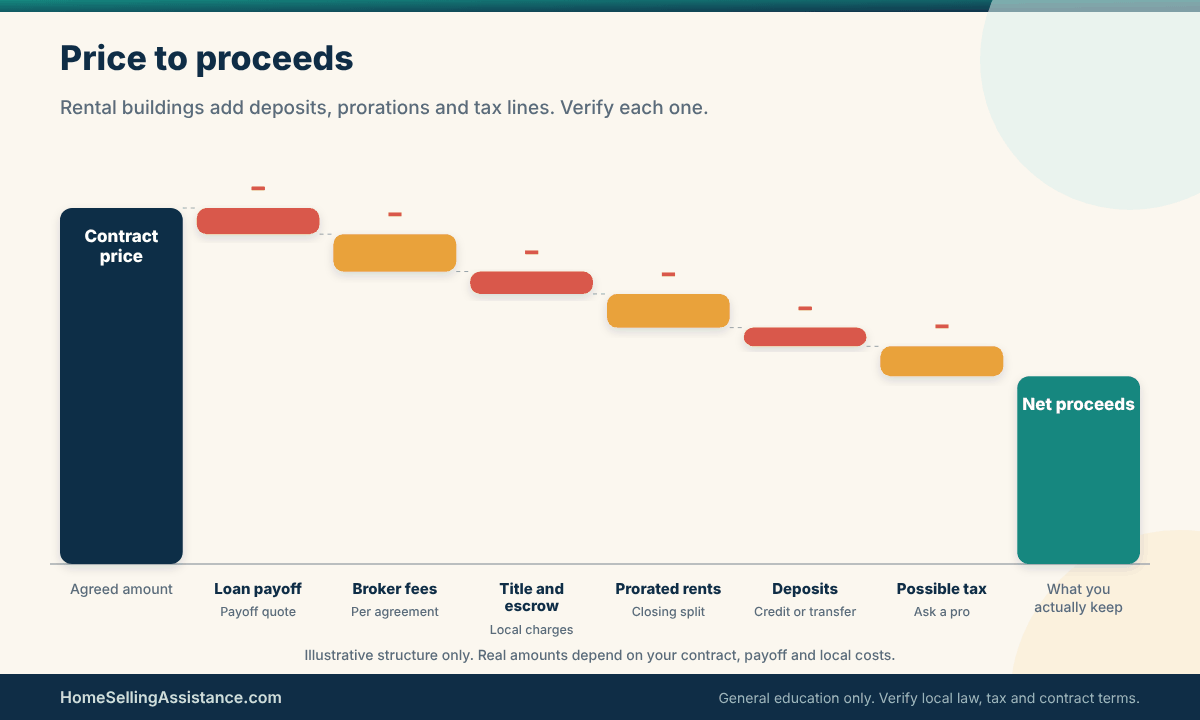
The waterfall below shows how a sale price shrinks into proceeds. The exact steps and amounts depend on your contract, your loan payoff, your state and the building itself, so read it as a structure, not a forecast. Your job is to replace each box with a quote or a statement you can verify.
Weighing price, time, cost and risk in one framework
Here is a simple way to run the comparison. For each offer, write a line for the contract price, then subtract the costs that actually apply to you: loan payoff, broker compensation if any, title and escrow charges, transfer or recording taxes where they apply, prorated rents and expenses, repair credits you expect to grant, and any tax you reasonably expect to owe. Then add a note on timing and a note on risk. That is the whole framework, and it works for selling multifamily property of any size.
Time has a price, even though it does not appear on any closing statement, and selling multifamily property can stretch the clock. A building that sits for months continues to cost you taxes, insurance, utilities, upkeep and the mental weight of showings. A faster offer that nets slightly less may leave you ahead once those carrying costs are counted. Conversely, rushing a sale can leave real value behind if the building could have attracted competition. Estimate your monthly carrying cost honestly and use it as your clock.
Risk is the part sellers underrate when selling multifamily property. A contract that depends on a buyer’s loan, a clean appraisal, a long due-diligence period and tenant estoppels has more places to break than a shorter, cleaner contract. Our cornerstone on home sale contingencies for sellers explains how each type of contingency works, and the same logic applies to income property with a few extras.
Finally, count your own effort in selling multifamily property. A sale that demands daily tenant coordination, repeated document requests and repair negotiations has a real cost in time and stress, even if no one invoices you for it. Some owners hire a property manager or an attorney specifically to absorb that load, and for many that is a sensible trade. Others prefer to handle it directly. Both choices are fine as long as you make them deliberately.
Evidence to gather: the net proceeds build-up for rental buildings
Selling multifamily property adds several lines that single-family sellers rarely see. The first is prorations. At closing, rents collected for the month and expenses already paid or owed are usually split between you and the buyer based on the closing date. Customs differ, so ask your title company or attorney how it is done locally and ask for a draft proration worksheet early.
The second is security deposits and prepaid rent. In many places you must either transfer the deposits to the buyer or give a credit, and some jurisdictions require written notice to tenants about the change. Because a deposit belongs to the tenant, a mistake here can create liability for the seller. Have your professional confirm the right method for your state and keep a record of what was transferred.
The third is tax. Rental owners often claim depreciation over the years, which lowers taxable income while they own the building. When the building is sold, part of the gain tied to that depreciation may be taxed differently from the rest, an idea sometimes called recapture. IRS Publication 527 on residential rental property explains depreciation basics, and a qualified tax professional can model your situation.
Some owners consider a like-kind exchange under federal tax law, which can defer tax if strict rules and deadlines are met and if a qualified intermediary is used before closing. It is a technical area, the deadlines are short, and mistakes are costly, so talk to a tax professional before you sign a purchase agreement, not after. We cannot say whether it fits your case, and nothing in this guide is tax advice.
The last piece is the cost of getting the building ready. Not every repair needs to be done, but known safety or code problems should be handled or disclosed. Collect two quotes for anything significant so you can compare the cost of fixing it with the credit a buyer might ask for. Our overview of seller closing costs shows how the standard fees stack up, and you can add the rental-specific lines on top.
A scenario: two offers, one cleaner than the other
Imagine two offers on a fourplex while selling multifamily property, using round illustrative figures. Offer one is higher on paper, but it depends on the buyer selling another property, includes a long inspection window, and asks for a repair credit once the inspection is done. Offer two is lower, from a buyer with a pre-approved loan who has already walked through all units and asks for a shorter, simpler timeline.
Suppose the carrying cost is 3,000 dollars a month in this example, and offer one is expected to take two months longer with a meaningful chance of falling through. Even before any credit, six thousand dollars of extra carrying cost and a real chance of restarting changes the math. The right answer may still be offer one, if you can afford to wait, but you should see the trade clearly.
The exception is when you have a backup. If a second qualified buyer is waiting, the risk in offer one shrinks and the comparison shifts. Ask your professional how backup offers are handled under your contract and state, because the rules differ. Your next step is to build this two-offer comparison on one page, with price, costs, time, risk and effort in five rows.
Now the second table. It sets out several seller situations, the path that tends to be favored, the reasoning, the trade-off and the one fact that could flip the decision. Use it to test your own situation against common patterns.
| Situation | Route often favored | Reason | Trade-off | Fact that changes the choice |
|---|---|---|---|---|
| Small building, strong demand, no hurry | Marketed listing | Competition can lift price and terms | More showings and tenant disruption | Tenant notice rules or lease limits on entry |
| Larger building, income-driven buyers | Broker-led offering package | Investors expect NOI-based materials | Needs clean books and time to prepare | Gaps between rent roll and bank records |
| Owner needs a quiet, quick exit | Direct or off-market sale | Fewer showings, shorter timeline | Price is less tested | Whether the buyer can prove funds |
| Owner wants to defer tax on a swap | Sale structured with a tax advisor | Exchange timing starts before closing | Strict deadlines limit flexibility | Whether a replacement property is available |
| Building has code or permit problems | Fix first, or sell as-is with disclosure | Known issues surface in inspection anyway | Repair cost versus a lower price | Whether the issue blocks financing |
| Tenants are behind or leaving | Resolve through lawful process, then decide | Disputes reduce buyer confidence | Delay and legal cost | Local eviction and notice rules |
To use this table well when selling multifamily property, find the row closest to your situation and read the last column first. That column names the fact most likely to overturn the usual answer, and verifying it is often the best first hour of work. If none of the rows fits, build your own row and be honest about the trade-off. A good decision names its cost.
When new evidence should change your plan
No plan survives contact with every buyer. Selling multifamily property takes weeks or months, during which rents change, tenants give notice, inspections reveal surprises and interest rates and lending standards shift. The question is not whether the plan will change, but which changes are signals worth acting on and which are noise. A short list of tripwires, written in advance, keeps you from deciding in a panic.
Good tripwires for selling multifamily property are specific. For example, “if no qualified offers arrive within a set number of weeks, we revisit price and terms” is better than “if it does not sell, we will adjust.” Another might be “if an inspection finds a safety defect over a certain repair cost, we get quotes before responding.” Setting thresholds early takes emotion out of the later decision.
Also be ready to change the path itself. A listed sale that stalls can become a direct sale, and a direct offer that looks thin can become a reason to market publicly. Switching is not failure. It is the plan working as designed, provided your listing agreement or contract allows it. That is one reason to read exclusivity and termination language before you sign anything, which our piece on selling a house with an HOA also stresses for another type of property.
Stay honest about what you do not know while selling multifamily property, because selling multifamily property rewards accurate answers. If a tenant says something that contradicts your records, or a buyer’s lender asks for a document you do not have, treat it as new evidence and update your plan. Sellers get into trouble when they defend an old assumption against new facts, especially in a business as document-driven as selling multifamily property.
Evidence to gather: tripwires worth watching
Several kinds of evidence deserve a regular check. Market feedback is first: how many showings, how many requests for the offering package, and what objections recur. If buyers repeatedly question the same item, such as a high expense line or a single failing system, that is market feedback you can act on, whether by fixing the item, explaining it better or adjusting the price.
Tenant news is second when selling multifamily property. A notice to vacate, a late payment or a complaint to a city agency can change the underwriting overnight, and it may also create disclosure duties. Keep a dated log of tenant communications and share material developments with your professional promptly. Do not retaliate against a tenant for a complaint or a request, because retaliation rules exist in many places and carry penalties.
Lender and appraiser feedback is third. If the buyer’s appraisal comes in below the contract price, or the lender asks about unit count, rent verification or code compliance, you will want to know the cause before you respond. Ask for the appraisal’s reasoning and comparable sales instead of simply cutting the price. The answer might be a correctable error, a different valuation method or an honest market signal.
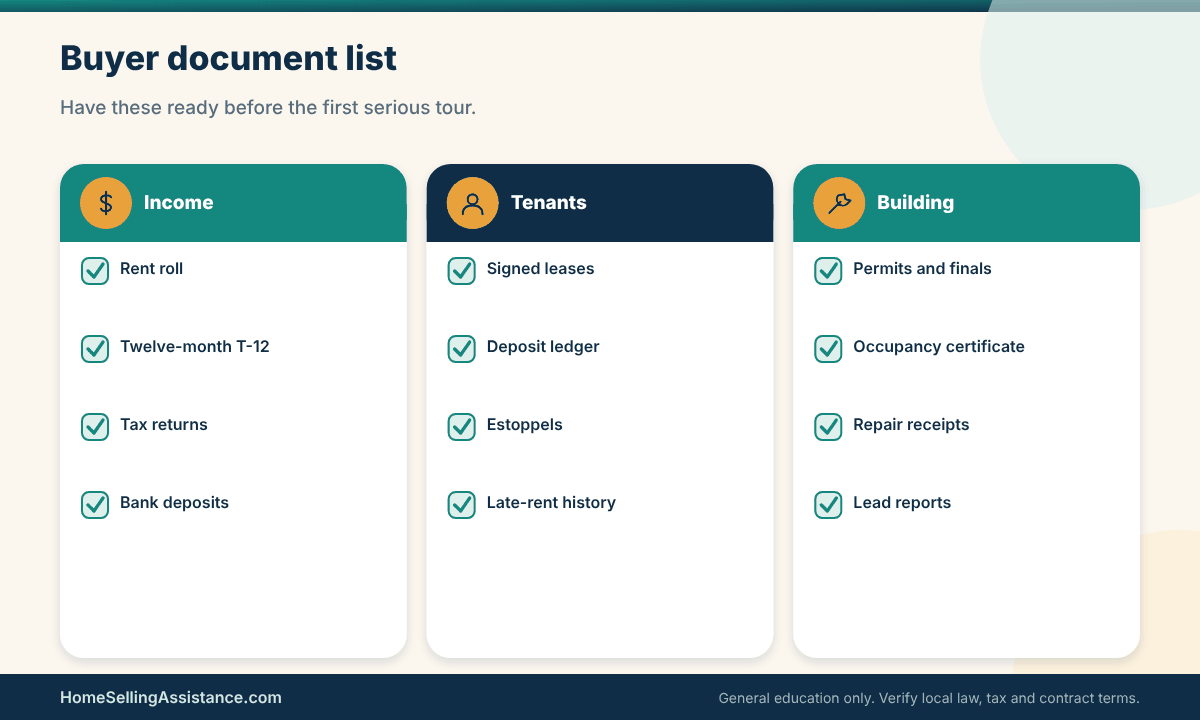
Finally, watch the paper. Title searches can reveal liens, easements or ownership questions, and a survey can reveal encroachments. Check everything against what you told the buyer. The checklist below groups the documents buyers usually request, so you can see at a glance what is still missing. When a document and a statement disagree, correct the statement quickly. Honest corrections protect your credibility and your legal position.
A scenario: the estoppel that does not match the rent roll
An estoppel certificate is a short signed statement from a tenant confirming the lease terms, the rent, the deposit and whether the tenant has any claims against the landlord. Buyers of larger buildings often request them, and lenders sometimes do too. Whether a tenant is obligated to sign one depends on the lease and local law, so check your documents and ask your attorney before you press anyone.
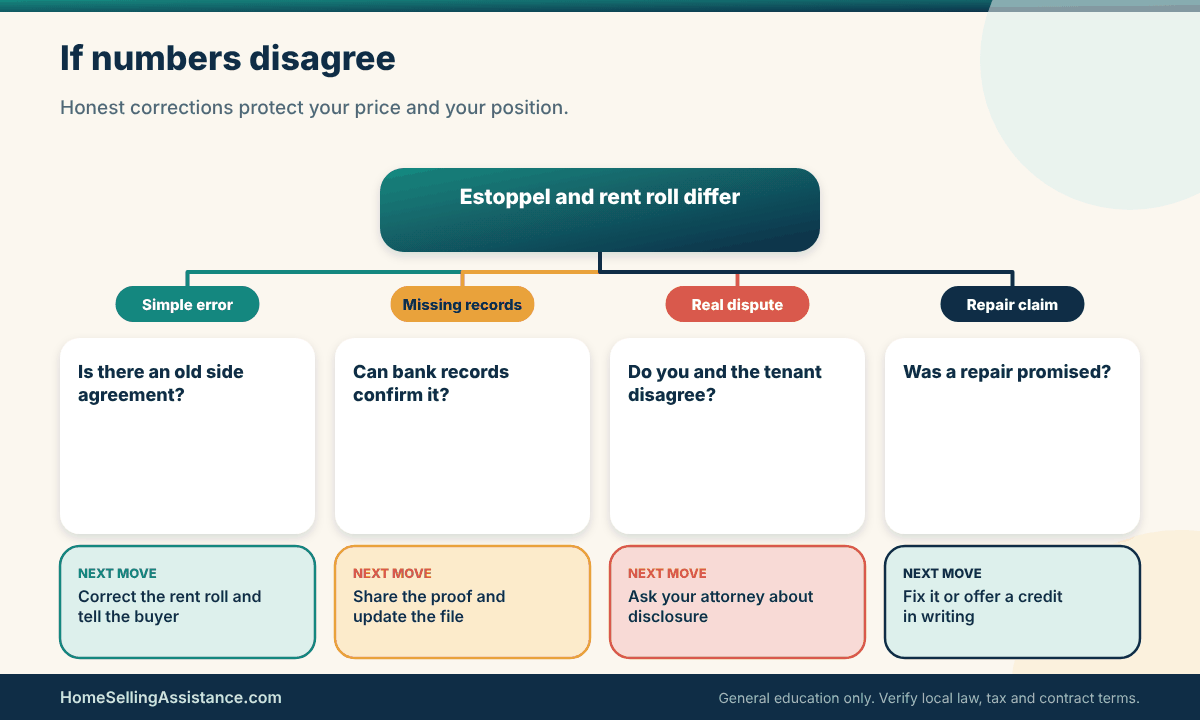
Now suppose a tenant’s estoppel says the rent is lower than the rent roll shows, or that a deposit larger than your records was paid, or that a promised repair was never made. This is exactly why buyers ask for them. A mismatch can be innocent, such as an old side agreement you forgot, but it needs an honest explanation before closing, not a quiet fix.
The exception is a mismatch that cannot be reconciled. If you and the tenant truly disagree, you may need to disclose the dispute, adjust the price or credit, or resolve the matter through a lawful process before closing. Do not pressure the tenant to change the document, and do not alter your own records to match. Both approaches create risk that outlasts the sale.
Your next step is to ask your professional how estoppels work in your area, send tenants a polite explanation of why the request is being made, and compare each returned certificate with your rent roll line by line. The picture below shows how to think through a mismatch step by step.
The most useful habit in selling multifamily property is to keep a single running log of what you have told buyers, what you have received and what you still owe. Every sale of an income building generates dozens of small promises. Writing them down keeps you accurate, and accuracy is what gets a buyer from interested to closed.
Quick scenario
A retired owner of a duplex wants to sell in the spring, live in one unit herself, and rent the other to a longtime tenant on a lease that runs through summer. She learns that a buyer will inherit that lease, so she gathers the lease, the rent history and a year of expenses before calling anyone. That single afternoon of preparation lets her compare an owner-occupant buyer with an investor on equal footing, instead of reacting to whichever offer arrives first.
Frequently asked questions about selling multifamily property
How is selling multifamily property different from selling a regular house?
Buyers evaluate the building on income and expenses as well as condition, so your rent roll, leases and operating statements carry real weight. Tenants are part of the deal, which brings notice rules, entry rules and deposit handling that a vacant house never raises. Financing can also differ depending on the number of units. The core steps of contract, inspection, title and closing still apply.
Do the tenants have to leave when I sell?
In many places a valid lease continues after the sale and the buyer takes over the landlord’s role. Whether and how a tenancy can be ended, especially for a buyer who wants to occupy the unit, depends on your state and sometimes your city. Do not give notices based on assumptions. A local landlord-tenant attorney or housing agency can tell you what applies.
What is a rent roll and why do buyers insist on it?
A rent roll is a unit-by-unit schedule of tenants, rents, lease dates and deposits. It is the quickest way for a buyer to see income and spot risk, such as leases ending together or unusually low rents. Buyers compare it with leases, bank statements and estoppel certificates, so every figure should be accurate and supported.
How do buyers decide what a multifamily building is worth?
Many use net operating income divided by a capitalization rate that reflects local investor expectations, along with comparable sales and replacement costs. Smaller buildings sold to owner-occupants may lean more on appraisals of comparable sales. The exact method varies by buyer, lender and market. Ask your listing professional which approach local appraisers favor.
Should I fix everything before listing?
Not necessarily. Safety, code and major system problems are worth addressing or disclosing, because inspections will surface them anyway. Cosmetic updates may not pay back, particularly when tenants occupy the units. Collect quotes for the big items and compare the repair cost with the credit or price reduction a buyer might request.
Are there tax issues I should know about before selling multifamily property?
Often yes. Rental owners may have claimed depreciation, and part of the gain may be taxed differently as a result. Owners who live in one unit may qualify for a partial home sale exclusion, subject to federal tests. Some owners explore a like-kind exchange, which has strict timing rules. Speak with a qualified tax professional before signing a contract.
What happens to security deposits at closing?
Deposits belong to the tenants, so they must be accounted for. Depending on local law, you may transfer the money to the buyer, give a credit, or return deposits and notify tenants in a particular way. Get the method confirmed by your title company or attorney and keep a written record of the amounts for each unit.
Do fair housing rules apply while I am selling?
Yes. Fair housing laws cover how you communicate with tenants, how you treat prospective tenants for any vacant unit, and how you market and show the building. Apply the same standards to everyone and avoid comments about who should or should not live in the building. HUD publishes plain-language guidance on its fair housing pages.
Do I need a broker, an attorney or both?
The law does not make one choice right for every seller, and rules differ by state. A broker or agent helps with pricing, marketing and negotiation. An attorney can review contracts, tenant notices and tax-sensitive structures. Some owners use both, especially for larger buildings. Compare written proposals and ask each professional about their experience with income property.
Before you decide
Selling multifamily property rewards the owner who prepares, and selling multifamily property well is mostly a matter of documents, honesty and patience. Gather your rent roll, leases and real expenses, learn what your tenants and your city require, and judge every offer by what you will keep, how long it will take and what could go wrong. This article is general education, not legal, tax or financial advice, so confirm local rules and talk with a licensed attorney, tax professional or real estate professional before you act.