Sellers who ask when does seller get money after closing are really asking about a chain of small events, and the answer depends on which link in that chain your state, your title company and your bank treat as the moment the cash becomes yours to spend.
Most people picture closing as a single scene. You sign a stack of papers, someone hands over keys, and a check appears. Reality is more like a relay. You sign, the buyer’s lender releases the loan money, the title or escrow company confirms that nothing is wrong with the file, the deed goes to the county for recording, your old mortgage gets paid off, and only then is whatever remains sent to you. Each handoff has its own clock, and the clocks do not always tick together.
That is why when does seller get money after closing gets such different answers: the same sale can feel instant to one seller and maddeningly slow to another. In some places, money moves the afternoon you sign. In others, the settlement agent waits for the deed to be recorded first. Add a late-day wire, a bank holiday, a missing payoff figure or an out-of-state signing, and a payout that looked like Tuesday becomes Thursday. None of this means something has gone wrong. It means the process has a shape, and you can learn it.
This guide explains that shape in plain language. We will look at what you should have ready before you sit down to sign, how funding and recording fit together, why wires and checks behave differently, what holdbacks can delay a share of your proceeds, and what to confirm in writing so the answer to when does seller get money after closing is a specific day instead of a guess.
For the bigger picture of what comes out of the sale price before you are paid, see our cornerstone guide on seller closing costs or browse the closing costs and net proceeds library.
A caution that applies throughout. Closing customs differ by state, by county and by company, and your own contract and closing instructions control. Any numbers here are round examples to show how the arithmetic works. They are not predictions, and nothing here replaces advice from your closing agent, a real estate attorney or a tax professional who has read your documents.
Key takeaways
- Signing is not paying. Your signature starts the process, but money usually moves only after the buyer’s funds arrive and the closing agent is satisfied that conditions have been met.
- State practice matters. Some areas disburse only after recording, others fund first and record later, and some run on attorney escrow accounts, so ask your closing agent which pattern applies to you.
- Wire, check and bank rules shape the last mile. A wire can land the same day if released early enough, while a check may face a bank hold even after it is in your hand.
- Holdbacks are separate from delays. A repair escrow, tax holdback or unresolved payoff item can keep part of your proceeds in place after everyone else has been paid.
- Verify payout instructions by phone. Wire fraud targets sellers at exactly this moment, so use a phone number you found yourself, never one from an email.
- Get the payout day in writing. A short confirmation from the closing agent turns a vague hope into a plan you can build your move and your next purchase around.
Get your payout paperwork ready before closing day
The fastest way to avoid a surprise about when does seller get money after closing is to settle the boring details before the signing appointment. Nothing here is complicated. It is a short list of facts that the closing agent will need to send your money to the right place at the right time, and each one is easier to collect now than at a signing table with a notary waiting.
Documents, contacts and deadlines that decide when does seller get money after closing
To understand when does seller get money after closing, think of your payout as depending on four things: a clear title, a known payoff, a funded buyer and correct delivery instructions. You control the last one entirely and influence the other three through how quickly you respond. Gather your government photo identification, the names exactly as they appear on the deed, the contact for your mortgage servicer, and the details of the bank account where you want proceeds sent.
Ask your agent or closing officer for a direct phone number and an email address, and save both in your phone. You will want them later when you verify wire instructions. If you are selling with a spouse, a co-owner or through a trust, find out now who needs to sign and whether anyone will sign by mail or through a power of attorney, because those cases add days that nobody can speed up for you.
Evidence to gather: the numbers the closing agent will ask you for
Start with the payoff, the biggest moving piece in when does seller get money after closing. Your regular monthly statement is not a payoff figure, because it does not include interest accrued through the day of payment or any fees. Request a written payoff statement from your servicer, which will show a good-through date and usually a daily interest amount if closing slips. Our guide to the mortgage payoff when selling a house explains how those figures are built.
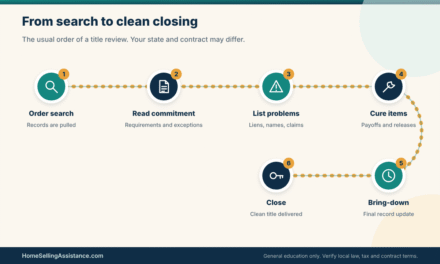
Next, collect your property tax bill, the latest HOA statement if you have one, and any second mortgage, line of credit or lien information you know about. A small lien nobody mentioned can stall disbursement completely. If you are unsure, the title company’s search will find recorded items, and you can read about that step in our article on the title search for a seller.
Finally, write down the destination. For a wire, you need the bank’s name, the routing number and your account number, and the account should be in the name of the people on the deed. For a check, you need to know where you will be and who can pick it up. These facts feel trivial until a typo sends funds back through a bank queue.
A scenario, an exception, and your next step on payout details
Picture a seller named Dana, curious about when does seller get money after closing, who moves out two weeks before closing and forwards her mail. The closing office emails a payoff confirmation request to her old address and a reminder to her old phone number. Nothing is wrong with the sale, yet the request sits unseen for three days. Dana loses no money, but her proceeds wire is delayed because the closing officer has not received her signed wiring authorization.
The exception is the seller who is paying off the loan from a different bank account or who needs funds for a purchase the same day. In that case, tell the closing office early. They can often plan the order of wires, though they cannot promise a bank will post a transfer by a particular hour. Your next step is simple: confirm, in writing, the phone number and email the office will use to reach you during the final week.
Information still missing when you think you are ready
Even a well-prepared seller usually has a few blanks. The goal is not to eliminate every unknown, but to identify which ones can change the payout day and ask about them early. Typical blanks include the exact payoff, final tax and HOA prorations, whether a buyer credit is still being negotiated, and whether the buyer’s lender has cleared every condition.
You can write these unknowns on a single sheet of paper and give each one an owner. The payoff belongs to your servicer, the prorations to the closing agent, the credits to your agent and the buyer’s side, and the lender conditions to the lender. When you know whom to ask, a missing piece becomes a phone call instead of a worry, and the question of when does seller get money after closing starts to have real inputs.
Evidence to gather: where the open questions can be answered
Your purchase contract is the first source for when does seller get money after closing. Read the sections on closing date, possession, prorations, repairs and credits, and any language about funds being held after closing. Your listing agreement or attorney engagement letter may also describe who handles final figures. Where a clause is unclear, ask for a plain-English explanation before the signing appointment instead of at it.
The second source is the closing agent’s own instructions, which speak directly to when does seller get money after closing. Escrow companies and title offices commonly send a short list of what they need and when. Read it the day it arrives. If a state-specific practice is involved, such as an attorney reviewing documents or a separate recording step, they can tell you how it works locally. You can also check your state real estate commission or your county recorder’s website for general local procedures, though the closing agent knows the day-to-day reality best.
The third source is your lender’s payoff department, which can say how long it takes after payment to release the lien and, separately, how long it takes to refund any escrow account balance. Those are two different timelines, and sellers often confuse them. We cover how the final numbers are assembled in our guide to the seller closing statement.
A scenario, an exception, and your next step on missing information
Suppose a seller named Marcus, who keeps wondering when does seller get money after closing, is told on Monday that closing is Friday, but the buyer’s lender still needs one document from the buyer’s employer. Marcus cannot fix that, and he should not try to pressure the buyer. What he can do is ask his agent for a plain status update each morning, keep his own paperwork complete, and avoid scheduling movers or a purchase of his own that depends on Friday funds being in his account by noon.
The exception is a deal where the delay lies on your side, for example a missing signature from a co-owner or an unresolved lien. Then your next step is to treat it as urgent and call the closing agent the same day. Delays you cause tend to be fixable quickly, and delays outside your control are better handled by building slack into your own plans.
Follow the timing for when does seller get money after closing, from signing to funding
Once the paperwork is in order, the useful skill for judging when does seller get money after closing is reading the sequence. Four words come up constantly in closing offices, and they mean different things: signing, funding, recording and disbursement. Sellers who know the difference stop treating every quiet hour as a problem, and they know which question to ask when something does stall.
Signing, funding, recording and disbursement in plain order
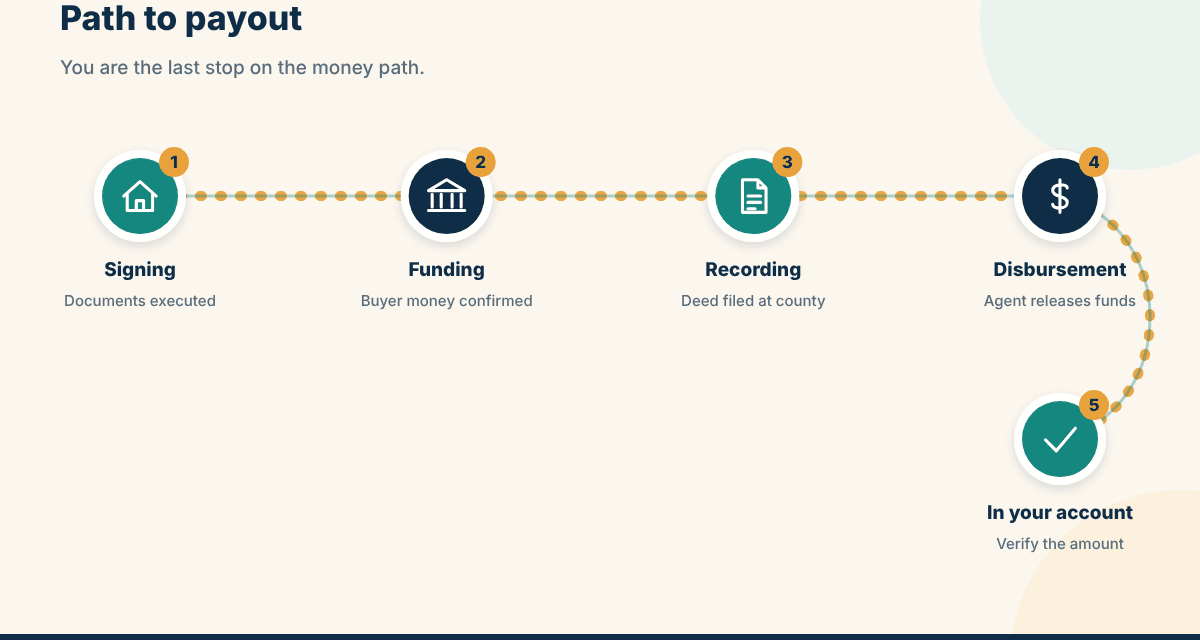
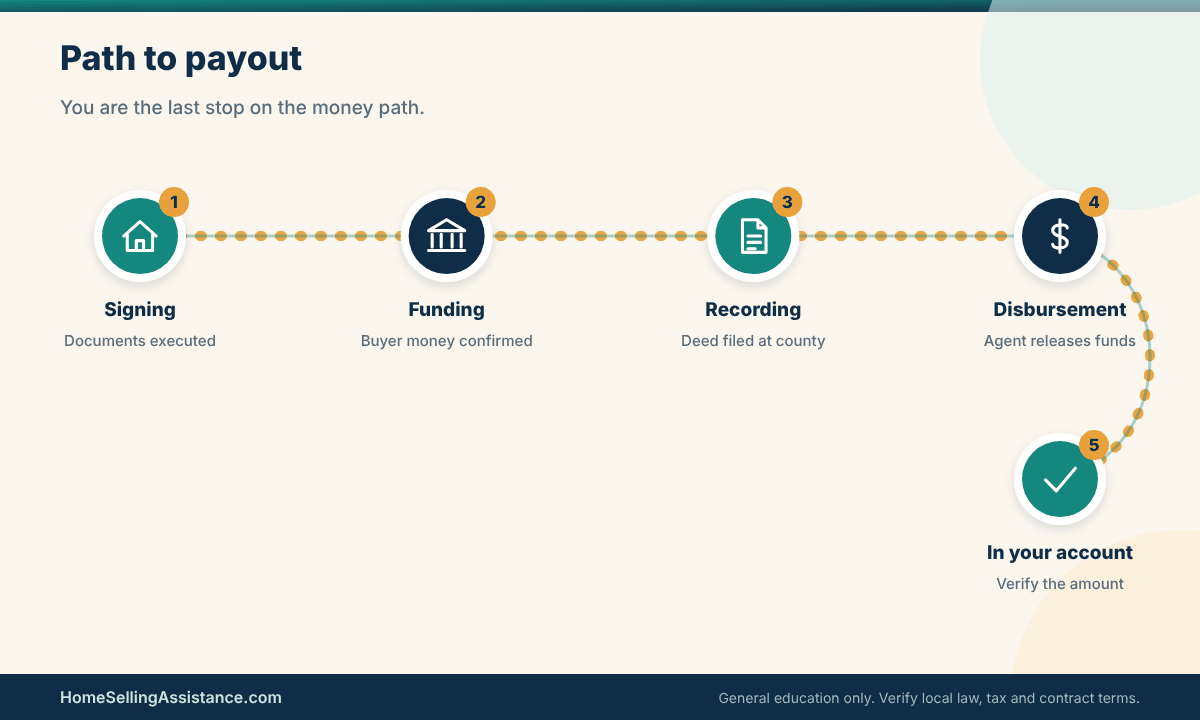
Signing is when you and the buyer execute the documents. It can happen days apart, at different locations, even with different notaries. Funding is when the buyer’s money, whether loan proceeds and cash to close or an all-cash wire, is actually in the hands of the closing agent. Recording is when the deed is submitted to the county and entered in the public record. Disbursement is when the agent releases money to everyone owed, including you.
The order of those events is where state practice enters. In some regions the closing agent will not release your proceeds until the deed has been recorded, which can be the same afternoon or the next business day. In others, the agent disburses once funds are confirmed and signed documents are in hand, and recording follows. Neither approach is wrong. Both are tied to local law, county recorder procedures and the title insurer’s rules, which is why national averages tell you little.
The more useful thing to know is which pattern your closing office follows, and the answer to when does seller get money after closing usually begins there.
Many lenders also have their own rules that affect when does seller get money after closing, including when loan money can be released after a borrower signs. For some transactions the buyer has a short review period before the loan funds, which can push disbursement a business day or so after signing. Your closing agent will know whether that applies, so ask early. The rules vary by loan type and by state, and nobody outside the file can tell you the exact timing in advance.
For a plain look at the steps between acceptance and the closing table, our article on what happens after accepting an offer on a house lays out the sequence from the other end.
Evidence to gather: what shapes when does seller get money after closing in your state
Ask your closing agent four direct questions about when does seller get money after closing. Does your office disburse before or after recording? What time of day do you need the buyer’s funds to confirm same-day disbursement? What is your usual cutoff for outgoing wires? And in your experience, how long do sellers wait for a mailed check versus a wire? You are not asking for a promise. You are asking for the office’s normal pattern, which is more valuable than any guess you could make.
Also ask whether your state uses a settlement agent, an escrow company or a closing attorney, because that changes who is holding the money and who you call. Your state real estate commission, state bar or county recorder can usually explain the general local custom, and your agent or attorney will know how it plays out in practice. If you are selling across state lines, make sure you are asking the office in the state where the property sits, not where you now live.
One more piece of evidence is the closing instructions themselves, which settle when does seller get money after closing on paper. They often state when funds will be disbursed and under what conditions, in dry legal language that is easy to skim. Read that paragraph slowly. If it says disbursement will occur after recording and confirmation of funds, then the afternoon you sign is not the afternoon you are paid, and you can plan accordingly.
A scenario, an exception, and your next step on funding order
Imagine two sellers with identical contracts and the same question, when does seller get money after closing. One signs at ten in the morning in a state where the closing office disburses after the buyer’s lender wires funds, and the money arrives in her account that afternoon. The other signs at the same hour in a place where the deed must be recorded first, the county accepts filings until a set time, and disbursement lands the next morning. Same paperwork, different days, no mistakes.
The exception is a closing late in the week or just before a holiday. A wire that cannot be released before the bank’s cutoff may simply wait for the next business day, which can mean a Monday or later. Your next step is to ask, at least a week ahead, what day the office expects to send your money if everything goes smoothly, and what the fallback is if the funding arrives late in the day.
The table below turns that sequence into a working checklist for when does seller get money after closing. Read it as a seller workflow: each row is a stage or symptom you might notice, the information to collect, the action to take, the deadline that matters and the person who receives the baton next. Adapt it to your contract, and note that the dates in your own agreement override any general pattern.
| Stage or symptom | Information to gather | Action | Decision deadline | Next handoff |
|---|---|---|---|---|
| Signing appointment booked | ID, deed names, bank details | Send payout instructions through the closing office’s secure method | Several days before signing | Closing officer |
| Payoff not yet confirmed | Written payoff with good-through date | Request an updated statement from your servicer | Before the closing date | Servicer to closing agent |
| Buyer funds not yet confirmed | Lender status, wire timing | Ask your agent for morning updates; avoid pressuring the buyer | Morning of closing | Buyer’s lender to closing agent |
| Signed but not disbursed | Office pattern: record first or fund first | Ask for the expected disbursement time in writing | Same day as signing | Closing agent to recorder |
| Wire sent, not showing | Wire reference number, bank cutoff time | Ask the closing office for the reference, then call your bank | Next business morning | Closing agent to your bank |
| Part of proceeds held back | Holdback clause, release conditions | Confirm amount, trigger and who approves release | Before signing | Escrow holder to you |
Use the table for when does seller get money after closing by reading across a row, then asking whether you actually know every cell. If the deadline cell is blank in your head, that is the question to raise at your next check-in. Print it, write names and numbers in the margins, and tick rows off as they resolve. It is a notebook, not a script, and it works because it keeps small questions from piling up on closing day.

The picture above shows the money path behind when does seller get money after closing as a sequence of handoffs. Notice that you are the last stop. Every earlier box has to be completed by someone else, which is why your own best contribution is a complete file and quick answers, not repeated calls asking whether the money is there yet.
Wire, cashier’s check or mailed check: the last mile to your account
After disbursement is approved, the money still has to travel, and that last mile affects when does seller get money after closing. A wire is generally the quickest, because it moves bank to bank electronically and can arrive within hours if it is released before the sending bank’s cutoff. A cashier’s check or office check can be handed to you at the table in some settings, but it must then be deposited, and your bank may place a hold on a large item according to its own policy.
A mailed check adds postal time and a deposit step. It can make sense for a seller who has no bank account at the closing location or who prefers paper, but it is rarely the fastest option. An overnight courier narrows the gap, though it adds fees that appear on your closing statement. Whichever method you pick, choose it before closing, because changing course on the day can mean new forms and new verification steps.
If you want a closer look at the safety side of this choice, our article on seller proceeds by wire versus check compares the two on speed, cost and fraud exposure. Neither is automatically better. A wire is faster but irreversible if sent to the wrong place, while a check is slower but gives you a paper trail and a physical item to inspect.
Evidence to gather: bank timing, cutoffs and holds for proceeds
Call your own bank, not the closing office, because the bank controls the last part of when does seller get money after closing. Ask it three questions. Will you receive incoming wires on that date, and until what hour? Is there any fee for incoming domestic wires? And what is your policy for holds on a large cashier’s or title company check deposited in person? Banks publish different answers, and some treat a check from a title company differently from an ordinary personal check.
Also check whether your account has any daily transfer or deposit limits that could affect how fast you can move the funds afterward. If you intend to wire part of your proceeds onward to another closing, such as a purchase on the same day, tell both banks in advance. A banker who has been warned can often make a smoother path than one who finds a large wire at four in the afternoon.
Finally, confirm the name on the account. The closing office will want proceeds sent to an account that matches the seller names on the deed. A joint account with a different spelling, a business account or an account belonging to a family member can trigger extra review, and no seller wants to learn that on the afternoon of closing.
A scenario, an exception, and your next step on how funds arrive
Take a seller wondering when does seller get money after closing who signs on a Thursday and chooses a wire. The closing office releases it at midday and it appears that afternoon. A second seller picks a cashier’s check, deposits it Thursday evening, and finds that part of the amount is on hold until the following week under her bank’s policy. She did nothing wrong, but she assumed that holding a check meant holding cash.
An exception is the seller who needs the money for a purchase that closes the same day. For that person, a wire is almost always the only workable method, and the sequence should be planned with both closing offices well in advance. Your next step is to decide on a method now, tell the closing office, and ask what happens if the method fails, for example if a wire is rejected for an account typo.
The figure above compares the main delivery choices for when does seller get money after closing side by side so you can match the method to your own situation. If you are unsure, ask your closing agent which they would pick for a seller who needs the funds quickly and which for a seller who does not.
Delivery method is only half of the last mile. The other half is whether every dollar you expect is actually released at disbursement. Sellers are sometimes surprised to learn that when does seller get money after closing can have two answers within the same sale: one for most of the proceeds and a later one for a portion that someone is holding on purpose.
Holdbacks come in several flavors. A repair holdback appears when work agreed in the contract is not finished by closing, and the buyer’s side wants assurance it will be done. A tax holdback can arise when a bill is not yet final and the parties want to settle up later. Another kind covers occupancy: if you remain in the home for a few days after closing, the contract may keep a deposit until you hand over the keys and leave the property in the agreed condition.
None of these is unusual, and none should surprise you at the table. The risk lies in vague wording. A good holdback clause states the amount, who holds it, what event releases it, who approves release and what happens if the event does not occur by a certain date. If any of those pieces is missing, ask your agent or attorney to tighten the language before you sign, since fixing it afterward depends on goodwill from the other side.
Late closings change when does seller get money after closing in a different way. When the buyer’s lender needs extra days, the original closing date can pass without a default. Your contract may allow an automatic extension for a set number of days, or it may require a signed amendment. During that gap, your mortgage keeps accruing interest, and the payoff letter you collected has an expiration date. Ask for an updated payoff the moment a date moves, so the numbers at the table are not stale.
Sometimes the delay is the sign of a deeper problem, such as a buyer whose financing is not holding together. Our article on what to do when buyer financing falls through describes the options a seller usually has and the questions to put to your agent or attorney. Keep in mind that your contract decides what you may do and when, and that nobody can promise a buyer will perform.
Possession adds another layer to when does seller get money after closing. If the contract lets you stay briefly after closing, or if you need the keys handed over at a different hour than the funding, the closing office needs to know. A rent-back arrangement is usually a separate written agreement with its own deposit and daily charge, and the money for it flows differently from your sale proceeds. If your move-out and closing dates are not the same day, our guide to move-out date versus closing date can help you line up the logistics.
A practical habit helps through all of these. Keep one running note on your phone with each date, who said it and how you heard it. When the closing office says funds are expected by noon, write that down with the time of the call. If plans change, you can compare notes with the written confirmation and ask a clear question, instead of trying to recall a conversation from last Tuesday.
Finally, avoid making irreversible plans that depend on the exact answer to when does seller get money after closing. Do not sign a purchase contract on another property that requires proceeds at noon on closing day unless the closing offices have agreed on the order of wires, and keep a cushion in your checking account for the movers, the deposit on the next home and a few days of ordinary bills. A small buffer turns a delay from a crisis into an annoyance.
Most sellers who feel stress about the wait are really feeling uncertainty, not delay. Once they know the office’s pattern and the bank’s cutoffs, and see the holdbacks on paper, the question of when does seller get money after closing shrinks to a date on the calendar with a comfortable margin around it.
Close the loop: confirm the payout in writing
By the time you reach the final days of when does seller get money after closing, most of what remains is verification. You are not hunting for new information. You are checking that what you believe about the money matches what the closing office has on paper, and that the paper matches your contract. Sellers who skip this step are the ones who discover, after the keys are gone, that a holdback existed or that a wire went to a number nobody checked.
What to confirm in writing before you sign
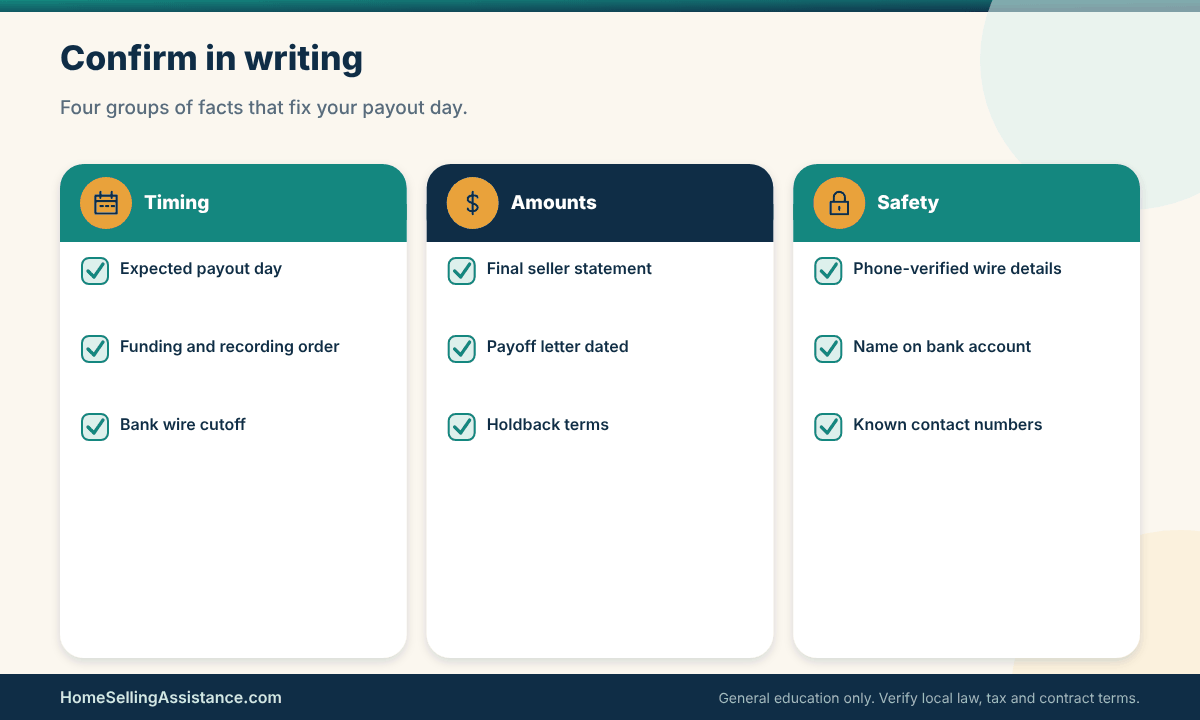
Ask for four items by email or in a printed note. First, the expected disbursement day and the method. Second, the final estimated seller statement, showing every deduction. Third, any amount that will be held back after closing, with the reason and the release conditions. Fourth, the payoff confirmation showing your lender will be paid in full at closing. If you can see all four, then when does seller get money after closing becomes a calendar question you can answer, not a mystery.
Keep the tone friendly. Closing officers handle many files at once, and a polite request with a specific deadline gets a quicker reply than a general worry. Something like “Could you confirm in writing the day you expect to wire my proceeds and the amount of any holdback?” is easy to answer and leaves a record. Do not accept a verbal promise as the only record if money depends on it, because verbal promises are not much help when memories differ.
On fraud, treat payout instructions as the most sensitive information in the whole sale. Criminals watch for transactions in progress and send convincing messages that seem to come from your agent or the title office, asking you to send new bank details or to confirm a number by reply. The FBI’s Internet Crime Complaint Center and the Federal Trade Commission’s consumer site both publish guidance on this kind of scam. Our article on real estate wire fraud for sellers shows what the messages usually look like.
Evidence to gather: the confirmations that make the payout day real
Gather these records, which together answer when does seller get money after closing, and keep them together. The closing instructions or escrow instructions, which say when funds will be released. The estimated seller statement, which lists every credit and charge. The payoff letter and its good-through date. A wire authorization form signed by you, if the office uses one. And a written record of the phone call in which you verified instructions, with the date, the number you dialed and the name of the person who answered.
That last item sounds fussy, but it is one of the best habits a seller can build. When you verify by calling a number you found independently, such as the one on the closing office’s own website or on a printed document from your first meeting, you cut off the most common fraud path. Never use a number or link supplied in the message you are trying to check. If anything seems off, stop and call the agent you know, not the sender.
For a sense of how the other figures are assembled, the guide to home sale net proceeds walks through each line of a typical estimate, and it is worth reading before you review your own statement.
The table below is a transaction check table for when does seller get money after closing. Use it when something about the payout looks uncertain, to match the issue to the evidence you should hold, the input you should ask other parties for, the risk of ignoring it and a sensible fallback. Treat it as general education and let the real contract decide in your case.
| Issue | Seller evidence | Buyer, agent or title input | Risk | Fallback |
|---|---|---|---|---|
| Buyer funds arrive late | Contract closing date, deadline clause | Lender status from agent | Payout slips a day or more | Ask for a written extension and daily payoff interest figure |
| Payoff amount changes | Updated payoff letter | Closing agent’s revised statement | Proceeds smaller than expected | Request a new letter and compare line by line |
| Holdback in contract | Signed addendum, release terms | Escrow holder’s written terms | Cash tied up after closing | Negotiate a cap and a release date before signing |
| Wire instructions look different | Original instructions you verified | Phone confirmation from known number | Funds sent to a criminal | Stop, call known contacts, report the message |
| Recording delayed at county | Closing instructions on disbursement order | Title officer’s recording update | Disbursement waits for recording | Ask the date recording is expected and set your plans after it |
| Co-owner signs late or by mail | Copy of signed pages, courier tracking | Closing agent’s receipt confirmation | Entire closing waits for one signature | Arrange notary and courier early; confirm receipt in writing |
Read the table from left to right if when does seller get money after closing starts to feel uncertain. If you can name the evidence and the input, you are probably safe. If you cannot, that gap is the thing to work on today. The fallback column is a starting point for a conversation with your agent or attorney, not a script, because the right response depends on your contract and your state’s rules.
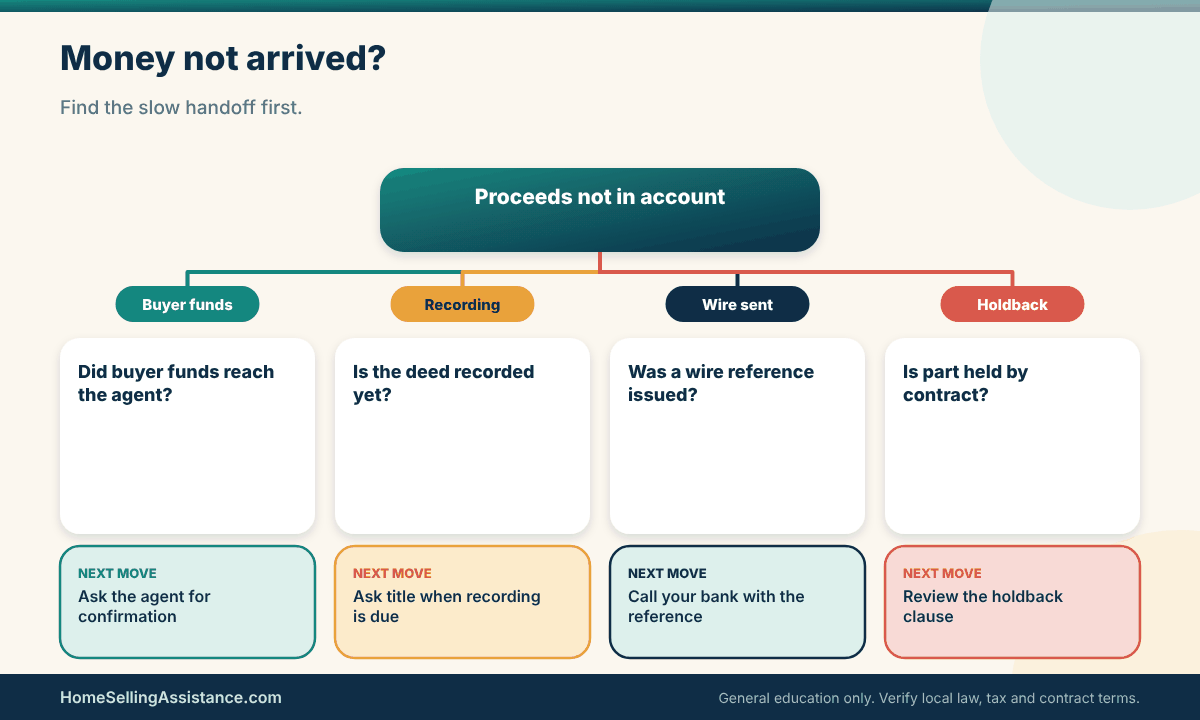
The decision tree above shows how a seller might reason about when does seller get money after closing when funds are not where they were expected. The first question is always whether the delay sits with the buyer’s money, the title work, the recording or your own bank. Each branch has a different person to call and a different timeline to expect.
A scenario, an exception, and your next step on written confirmations
Consider a seller named Priya who, while waiting to learn when does seller get money after closing, receives an email that looks like it comes from her title officer. It says wire details have changed and asks her to reply with her new bank information. The email address is almost identical to the real one, with one letter swapped. Because Priya had saved the title officer’s real number earlier, she calls, learns that nothing has changed, and forwards the message to the office so it can warn others.
The exception is a seller who has never been given a phone number except through email. In that case, look up the company’s main line on its official website, call it, and ask to be transferred to the officer on your file. It takes five extra minutes. Your next step is to write down, today, the two or three contacts you will trust on closing day, and refuse any request to change them unless you hear it by phone.
Records and follow-up after the money lands
Funds in your account settle when does seller get money after closing, but they are not the finish line for the whole sale. A handful of follow-up items remain, and they are far easier to handle in the first week than six months later. They include checking the amount received against the final statement, making sure your old loan has been released, collecting refunds, and filing your documents where you can find them.
Start by comparing the deposit with the final seller statement, the last real answer to when does seller get money after closing. If the amount is lower than expected, ask the closing office the same day, with the statement in hand. Small differences can come from wire fees, a final proration, or a holdback you forgot. If the amount is higher, which does happen when a bill was paid separately, tell the office as well, because a correction after the fact is awkward for everyone.
Then watch for the loose ends. Your lender should confirm the loan is paid in full and record a release of the lien in the county records, and your state may set a deadline for that. Any balance in your lender’s escrow account for taxes and insurance will usually be refunded to you separately, on its own timeline, so do not mistake that for a missing part of your proceeds. Also cancel homeowner’s insurance only after you are sure closing is complete, and ask about any unearned premium refund.
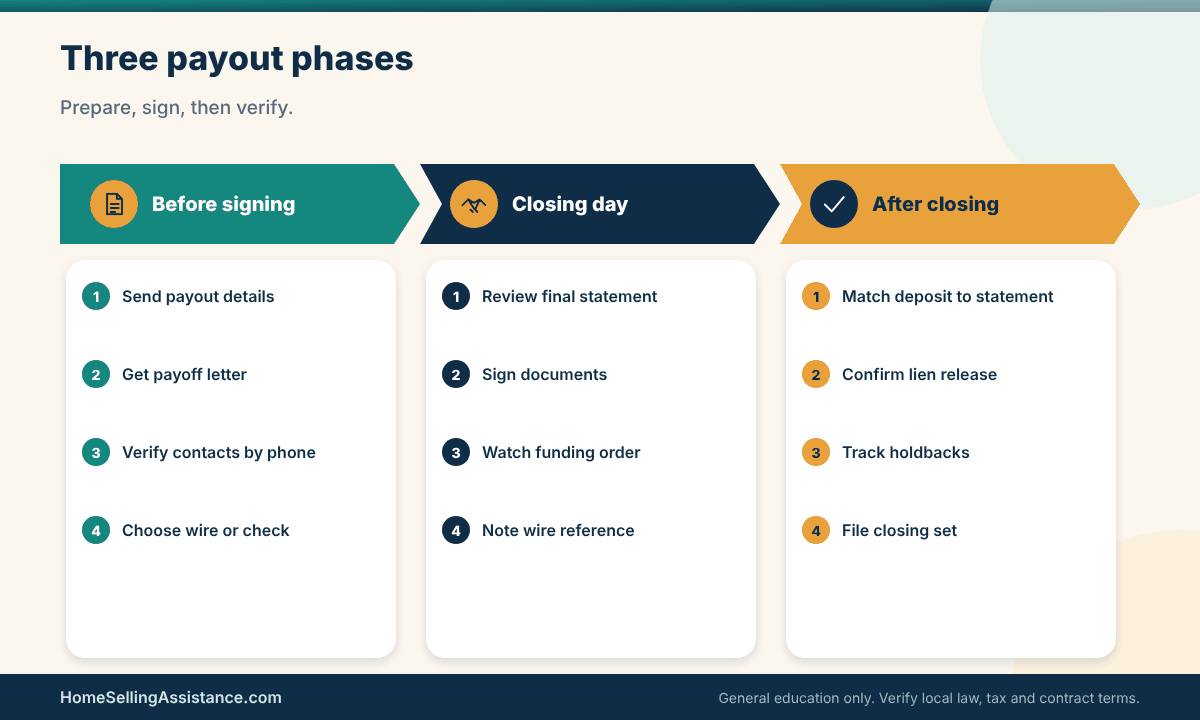
The checklist below groups the items that fix when does seller get money after closing so that the payout day is not a surprise, and it doubles as a tidy list to hand to a family member who helps with your move.
Evidence to gather: the closing set and the payoff proof
Keep a complete copy of the signed closing package, since it documents when does seller get money after closing and how much. That means the final seller statement, the deed, the settlement or closing instructions, any addenda about holdbacks or repairs, the wire confirmation and the lender’s payoff and release letters. Store it digitally and on paper, and write the closing date and the name of the closing office on the folder. A single scan is not enough if your phone is lost.
For taxes, the settlement agent may report the sale to the IRS on a form called 1099-S in some cases, and you may be asked to sign a certification about the home being your main home. Whether you owe anything depends on your facts, including how long you owned and lived in the house and what your basis is. The IRS explains the general rules in Publication 523, Selling Your Home. Keep improvement receipts as well, and see our guide on home sale tax records for what to hold on to.
If your documents mention a recording number or a pending release, put a reminder on your calendar to check the county’s online records after a few weeks. Many counties let you search by name or address, and a quick look will tell you whether the old mortgage shows as released. If it does not, call the servicer, not the closing office, because they are the ones who issue the release.
A scenario, an exception, and your next step after closing
Imagine Tomas, who sells, moves across the country and learns exactly when does seller get money after closing. His proceeds arrive on time, and he assumes everything is finished. Six weeks later he notices that no refund of his old escrow balance has come, and that the county records still show his loan. A call to the servicer turns up an old mailing address, and the paperwork is reissued. Nothing was lost, but he spent a month with an open loose end that a quick check would have caught.
The exception is a seller who left a holdback in place, such as money kept for a repair or a final utility bill. For that seller, the follow-up task is to keep the release conditions in view and ask the escrow holder for a written release once the condition is met. Your next step is to set two reminders: one to check the lien release a few weeks after closing, and one for any holdback release date in your documents.
Quick scenario
A seller signs on Friday morning and expects to pay a moving company Monday. The office disburses after recording, the county closes at midday, and Friday’s wire misses the bank cutoff. Money arrives Tuesday. Because she had asked a week earlier when does seller get money after closing in the worst case, she had paid the movers from savings and was never stuck.
Frequently asked questions about when does seller get money after closing
So, when does seller get money after closing in the simplest terms?
Usually after the buyer’s funds are confirmed, the closing agent has your signed documents and the payoff is handled. In some places that is the same day you sign. In others the agent waits for the deed to be recorded, which can add a business day or more. Your closing instructions and the office’s usual practice give the real answer for your sale.
Does signing the papers mean I am paid that day?
Not necessarily. Signing is one step, and funding, recording and disbursement follow in an order set by your state, your closing agent and the buyer’s lender. Some sellers receive a wire the afternoon they sign, and others wait until the next business day. Ask for the expected day in writing a week ahead, and do not make plans that depend on a specific hour.
Is a wire faster than a check?
Generally yes, because a wire moves electronically and can arrive within hours if it is released before the bank’s cutoff. A check must be picked up or delivered, then deposited, and your bank may hold part of a large deposit under its own policy. A wire is harder to reverse if sent in error, so verify the details by phone first.
Why would the closing office hold back part of my proceeds?
Holdbacks usually come from the contract, such as unfinished repairs, a pending tax figure or a post-closing occupancy deposit. They should be written down with the amount, the release trigger and the person who approves release. If you do not see a holdback clause in your documents, ask the closing agent to confirm none applies before you sign.
What if the buyer’s funds arrive late in the day?
The closing agent may be unable to release your money until the next business day, because bank wire cutoffs and office procedures limit late transfers. This does not mean the sale has failed. Ask about the plan for late funding in advance, and keep a small cash cushion for the gap. Your contract will say whether a late closing date triggers any consequences.
Will my old lender be paid before I am?
Yes, the payoff comes out of the sale price first, then taxes, fees, credits and other items, and what is left goes to you. Your lender’s release of the lien is a separate step that follows payment and can take days or weeks, depending on the servicer and your state. Check the county record afterward to confirm.
How do I know a wire instruction email is real?
Treat any change in instructions as suspect until you confirm by phone with a number you found independently, such as the one printed on your original paperwork or on the company’s official website. Do not use a number or link in the message itself. Federal sources such as the Consumer Financial Protection Bureau publish general guidance on closing scams.
Can I get paid faster if I need the money for my next home?
Sometimes the order of wires can be arranged between the two closing offices, and some buyers and sellers close on the same day. No office can promise the hour a bank will post a transfer, so discuss it early, keep a buffer and consider whether a flexible closing or short rent-back would reduce pressure. Your agent or attorney can explain the options in your market.
Will my escrow refund from the lender come with my proceeds?
Usually not. The balance in your lender’s escrow account for taxes and insurance is returned separately by the servicer after the loan is paid off, on its own timeline. If it has not arrived within the period your servicer gave you, call and ask. Keep your forwarding address current so the check or transfer reaches you.
Where can I check the rules that apply in my state?
Start with your closing agent, who knows local practice, then your state real estate commission, county recorder and a local real estate attorney. Federal sources like the IRS explain tax reporting basics. When your own money and rights are involved, have someone licensed read your actual contract, because customs vary and general articles cannot replace that review.
Turn the wait into a date you can plan around
The question of when does seller get money after closing has a different answer in every state and every closing office, but it always has an answer you can find. Gather your payout details early, ask about the funding and recording order, choose a delivery method, confirm holdbacks in writing and verify every wire instruction by phone. This article is general education, not legal, tax or financial advice. For your own sale, rely on your closing agent, an attorney or a tax professional who can read your documents.