A dependable seller closing cost calculator method is not a website where you type a price and receive a number; it is a repeatable way of building an estimate from your own contract, your own payoff and your own local charges, and then admitting how wide the honest range really is. Online calculators can be a fine place to start, but every one of them is quietly making assumptions on your behalf, and you cannot judge the result until you know what those assumptions were.
Most sellers meet the problem at the worst moment. An offer arrives, the number looks wonderful, and someone asks what you will actually walk away with. You open a calculator, it applies a flat percentage for “closing costs,” and you get a tidy figure with no explanation. Weeks later the closing statement shows something different, and you wonder whether you were misled. Usually nobody lied. The tool simply guessed where a real quote was needed.
This guide sits beside our broader pillar on seller closing costs and goes one level deeper on the seller closing cost calculator method. You will learn how to list your inputs, label where each one came from and when, put competing offers on an equal footing, adjust for risk, and show a sensitivity range instead of a single falsely exact number. All dollar figures below are round, illustrative examples. None of them is a price, fee or percentage you should expect.
A note on scope. Closing costs, transfer taxes, title practices and who pays for what vary by state, county and sometimes by neighborhood. Nothing here replaces a written estimate from a title or escrow company, a payoff statement from your lender, or advice from a licensed professional who knows your situation. The goal is to make you a sharper reader of those documents and a harder person to mislead.
Key takeaways
- A method beats a number. The seller closing cost calculator method is a written list of inputs, sources and dates that anyone could check, not a single output.
- Label every input by source and date. A payoff quote, a fee schedule and a guess are three different kinds of evidence, and they age at different speeds.
- Normalize before you compare. Two offers only compare fairly when price, credits, costs and timing are expressed the same way for both.
- Price in uncertainty. Financing risk, repair requests and delays have a cost even when no invoice shows it yet.
- Show a range. A low, expected and high case protects you from false precision and from nasty surprises at the table.
- Know what needs a live quote. Payoff, title charges, prorations and appraisal-driven changes should come from the people who issue them.
Laying out your seller closing cost calculator method before you touch any numbers
Before any arithmetic, decide what question the estimate has to answer. Sellers usually want one of three things: the cash they will receive at closing, the cash they will have after paying everything attached to the sale, or a comparison between two or three offers. Those are related but not identical questions, and a seller closing cost calculator method works best when you name the question first. A comparison of offers, for example, can ignore costs that are identical on both sides.
Think of your seller closing cost calculator method as a short written recipe with four stages. First you list the inputs. Second you tag each input with a source and a date. Third you build a low, expected and high version of the total. Fourth you mark which lines are still guesses and who can replace them with real figures. If you can hand that page to a spouse, an attorney or an agent and they can follow your reasoning in five minutes, the seller closing cost calculator method is doing its job.
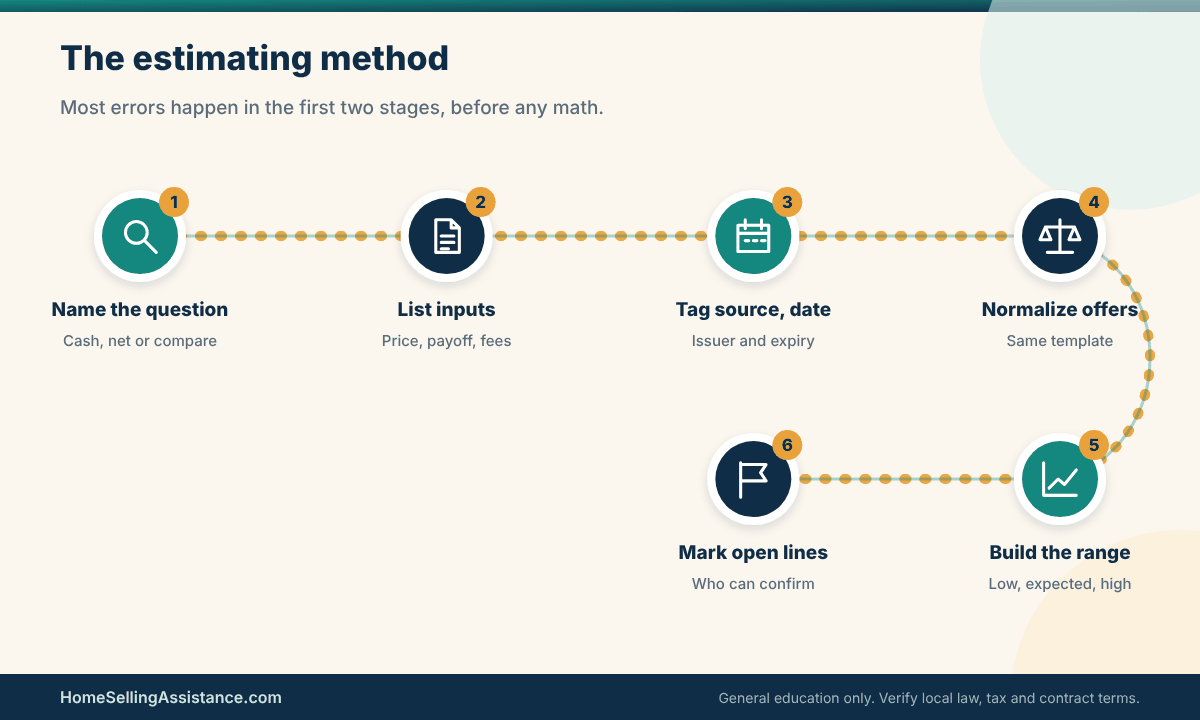
The picture above shows that sequence as a path. Notice that the arithmetic comes late. Most estimating mistakes happen in the first two stages, where a stale number or an unlabeled assumption slips in unnoticed and then gets treated as fact. Slowing down at the start of any seller closing cost calculator method is cheap. Rebuilding trust in a spreadsheet after a surprise at closing is not.
The inputs and assumptions behind the math
Every seller closing cost calculator method rests on a small set of inputs. The sale price comes first, and with it the question of whether you are using a list price, an offer or a final contract price. Next comes the loan payoff, which is not the balance printed on your last statement. Then come the charges that surround the transaction: title and escrow or closing-attorney fees, recording and transfer charges, any broker compensation you agreed to in writing, credits to the buyer, and prorated items such as property tax and association dues.
Assumptions are different from inputs. An input is a figure you can point to on a document. An assumption is something you are choosing to believe, such as “the buyer will close on the date in the contract” or “the repair request will stay under a certain amount.” A good seller closing cost calculator method keeps the two lists separate so you can see how much of your estimate stands on paper and how much stands on hope.
Evidence to gather: contract price, payoff, fee quotes and local rules
Start with the document that fixes the price, which is the signed purchase contract or, before one exists, the written offer. Then request a payoff statement from your lender. A payoff figure includes the principal, interest accrued up to a specific date, and sometimes fees, and it usually carries a per-day amount so it can be adjusted if closing moves. Our guide to mortgage payoff when selling explains why the balance on your monthly statement can differ from the payoff.
Next, ask the title company, escrow office or closing attorney who will handle your sale for a seller estimate. Many will produce one from the draft contract. Ask what each line covers, which charges are customary for sellers in your area, and which ones the contract assigns to the buyer. A few minutes on the phone with the company that will actually close your sale beats an hour with a national average, because local custom decides who pays for a surprising number of items.
Then collect the quiet items that sellers forget. Pull the latest property tax bill and note whether taxes are paid in advance or in arrears in your county. Find your association statements and any transfer or resale fees. Locate any lien, judgment or unpaid utility that could show up in a title search. Our article on a title search for sellers covers how these show up and what to do about them.
Finally, write down the local rules you do not yet know. Transfer taxes, recording fees and who customarily pays them differ widely. Your state real estate commission, county recorder and title company are the right places to confirm them. Put “unknown, ask title company” on the page instead of a number. An honest blank is more useful than a confident guess.
A scenario, an exception and your next step when the price moves
Picture a seller with an accepted offer at a round illustrative price of $400,000 who has built a tidy estimate. Two weeks later the buyer’s inspection leads to a negotiated credit, and the contract price effectively falls. Because the seller recorded the price as an input with its own line, only that line and anything linked to it needs updating. The spreadsheet does not need to be rebuilt, and the seller can see right away which other lines move too.
Here is the exception. Some charges depend on the price and some do not. A flat title fee may not change when the price changes by a few thousand dollars, but a percentage-based charge or a price-tiered fee schedule might. If you assume every line scales with price, you will mis-state the result in both directions. Mark each line as “fixed,” “price-linked” or “time-linked” so you know what to recompute.
Your next step in this seller closing cost calculator method is small. Add a column to your page called “changes if,” and fill it in for each line with the event that would alter it, such as a new closing date or a revised contract price. That single column turns a static list into something you can update in minutes when negotiations shift, and it makes the later sensitivity work almost automatic.
Where each number came from, and how old it is
An estimate is only as current as its oldest input. Sellers often combine a payoff quote from last month, a fee schedule from an online article and a tax figure from last year’s bill, and then present the total as if it were one fresh measurement. A seller closing cost calculator method fixes this by attaching two small tags to every number: where it came from and the date it was true. It sounds fussy. It takes seconds, and it saves arguments.
Source quality in a seller closing cost calculator method falls into a rough order. Figures printed on a document issued by the party who will charge you, such as a payoff letter or a title company estimate, are strongest. Figures from a public record, such as a county tax bill, are next. Figures from a professional’s verbal explanation are useful but should be confirmed in writing. Figures from articles, forums and calculators belong at the bottom and should be treated as placeholders until replaced.
Evidence to gather: dates, versions and who issued each figure
For each input, record four things: the number, the issuer, the issue date and the date through which it is valid. A payoff letter, for instance, is typically good through a stated date and states a per-day amount after that. A title estimate is usually labeled preliminary and tied to a draft contract. A tax bill covers a particular period. When you write these down, you can see at a glance which numbers are about to expire.
Pay particular attention to versions. Contracts get amended, and an estimate built from the first draft may not reflect a later addendum that shifted a cost from one side to the other. If your agent, attorney or title company sends an updated estimate, replace the earlier one rather than keeping both, and note the version in your log. Two conflicting numbers in the same file invite you to quietly pick the one you like better.
It also helps to keep the original files, not only the figures. Save the payoff letter as a PDF, save the title estimate, and screenshot any online tool with its assumptions visible. If a number later turns out to be wrong, you can trace which document it came from and ask the issuer to explain. Without a paper trail, a discrepancy becomes a memory contest.
To see how claims, sources and limits line up, the next table pairs six statements sellers commonly make with the evidence that backs each one and the weakness to watch for. The figures are placeholders for your own documents, so treat it as a template you can copy.
| Claim you might make | Metric or source | What it supports | Limitation | Seller implication |
|---|---|---|---|---|
| “My payoff is about this amount” | Lender payoff letter with per-day interest | The largest deduction in most sales | Expires on a stated date | Refresh it if closing slips |
| “Title charges will be about this” | Written estimate from the closing office | Fees, endorsements and recording lines | Preliminary until the contract is final | Re-request after each amendment |
| “Taxes will prorate like this” | County bill and the contract’s proration terms | The seller’s share of the tax year | Rates and billing cycles vary locally | Confirm paid-in-advance or arrears status |
| “The buyer will pay these items” | Purchase contract cost-allocation section | Which lines belong on your side | Local custom fills any gaps | Read the allocation clause, not a summary |
| “This credit is already agreed” | Signed addendum or amendment | A firm reduction in proceeds | Verbal deals carry no weight | Count only credits that are in writing |
| “The market supports this price” | Comparative market analysis with dates | The plausible price band | Opinion, not an appraisal | Treat it as a range, not a promise |
The matrix above is a good way to keep your seller closing cost calculator method honest. Read down the first column and ask whether you would be comfortable defending each claim to a skeptical friend. Then read across to the limitation column, which is where most mistakes hide. If a claim has a weak source and a serious limitation, it belongs in the “assumptions” list, and your estimate should carry a wider margin around it.
A scenario, an exception and your next step when a quote expires
Suppose a seller collected a payoff letter that was valid for ten days, and then closing moved back three weeks because the buyer’s lender needed extra documents. The seller’s spreadsheet still shows the old payoff. Interest keeps accruing every day on most loans, so the old figure now understates what the lender will demand. A careful seller notices the expiry date on the log, asks for an updated letter, and avoids a shortfall surprise.
The exception worth knowing is that some payoff letters include a per-day amount you can use for small shifts. If closing moves by a few days, you can multiply that daily amount by the extra days as a rough check. For larger changes, or if your loan has unusual features, request a new statement instead. Do not assume the arithmetic is exact, because lenders have cutoff times and posting rules that a rough multiplication will not capture.
Your next step is a calendar reminder. Put each expiry date from your log into your calendar with a note to refresh that figure a few days earlier. If your closing date shifts, you will already know which quotes need renewing. For the timing of the money itself after signing, our piece on when a home seller gets paid describes the sequence of recording and funding.
Putting every offer on equal footing with a seller closing cost calculator method
The most common use of a seller closing cost calculator method is comparing offers, and it is also where sellers lose the most money to confusion. One offer has a higher price but asks for a repair credit. Another has a lower price with a quick closing and no contingencies. A third is a cash offer with its own terms. Comparing headline prices tells you almost nothing. You need to turn each offer into the same set of lines so the differences show up as numbers rather than impressions.
Normalizing inside a seller closing cost calculator method means three things. Put price, costs and time on a common basis. Convert credits, concessions and contingencies into their likely effect on your proceeds. And then add a risk adjustment for how likely each offer is to close as written. None of this requires advanced math. It requires patience and a willingness to write down things that feel awkward to write, such as the chance an offer falls apart. For help weighing the legal side of terms, see our discussion of offers and negotiation.
Be careful about who is doing the comparing. If anyone helping you has a financial stake in which offer you choose, ask them to show their work and then check it against your own page. This is not an accusation. It is just good practice for any decision where the incentives of the people advising you may not match yours exactly.
Like-for-like price, cost and time inputs
Start your seller closing cost calculator method by writing each offer in the same template. The template needs a contract price, any credit to the buyer, any items the seller must pay that a competing offer would not require, the proposed closing date, the buyer’s financing type, the deposit, and the contingencies. Then build one net figure for each offer using identical cost assumptions wherever the offers do not truly differ. If a title fee is the same for both, leave it out of the comparison or enter it the same way.
Time deserves its own line. A closing three weeks earlier can save you three weeks of mortgage interest, property tax, insurance and utilities on a house you no longer want to carry, and it may also shorten the period when a deal can fail. Put a rough illustrative dollar value on each week of holding costs so a faster offer and a slower offer can be compared in the same currency. Be honest that this value is an estimate, not a fact.
| Line | Offer A | Offer B | Note |
|---|---|---|---|
| Contract price | $410,000 | $400,000 | Example figures only |
| Buyer credit requested | $6,000 | $0 | Must be in writing |
| Carrying cost to closing | $3,000 | $1,500 | Offer A closes later |
| Risk allowance | $4,000 | $1,000 | Your own judgment |
| Adjusted price | $397,000 | $397,500 | Nearly a tie |
Read the table from top to bottom, as you would any seller closing cost calculator method worksheet. The offer with the larger headline number ends up almost level with the other once the credit, extra carrying time and risk allowance are included. You may disagree with the allowances, and you should feel free to, since they are placeholders. The point is that the comparison now rests on lines you can argue about, instead of an impression that bigger means better.
Evidence to gather: offer terms, credits, timelines and holding costs
Pull every term out of the paper rather than relying on a summary email. Look for seller-paid items hidden in the contract, such as a requested home warranty, a repair allowance, payment of the buyer’s closing costs, a post-closing occupancy arrangement or a rent-back. Each has a dollar effect, and some have a legal one. If you are unsure what a clause means, ask the professional who will represent you at closing, and ask for the answer in writing.
Next, assemble the holding costs for your house, which you can calculate from your own records. Add monthly mortgage interest, property tax, homeowner insurance, utilities, lawn or snow care and any association dues, then divide by the number of days in a month to get a daily figure. Multiply by the difference in closing dates between offers. You are not forecasting the future. You are giving a slower closing a fair price tag.
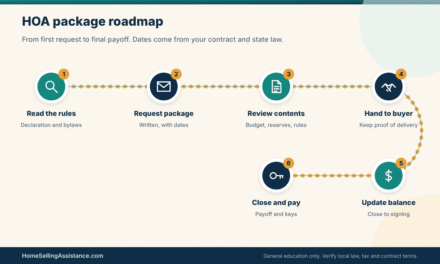
Check the proration items as well, because they move with the closing date. Property tax and association dues are usually split between buyer and seller as of the closing date, so a later closing shifts more of that period onto the seller’s side of the ledger. Our guide to property tax proration at closing explains how that split works and why local billing cycles change it, and HOA resale fees and documents covers the association side.
Finally, verify the buyer’s side of the equation just enough to know what you are comparing. You are not entitled to a buyer’s full financial file, but you can ask for a pre-approval letter or proof of funds, and you can ask how the deposit is held. Those details feed the risk adjustments we cover in the next section.
A scenario, an exception and your next step when offers look different
Consider a seller who applies the seller closing cost calculator method to two offers received within a day. One is a financed offer with a higher price, an inspection contingency and a request for a credit. The other is a cash offer at a lower price with a short closing and few contingencies. The seller builds the template above and discovers that after adjustments the difference is small enough that other factors, such as moving logistics and preference for certainty, may decide it. That is a good outcome, because the decision is now an informed one.
An exception arises when offers differ in kind rather than degree. If one buyer wants to rent back the home for a month or needs a long closing, the cost of that flexibility may not fit neatly into a holding-cost line. In that case, describe the arrangement in plain words next to the numbers and ask your attorney or agent how it affects your risk, insurance and obligations. Some terms cannot be turned into dollars without professional input.
Your next step is to run the seller closing cost calculator method template on every serious offer, even the ones you expect to reject. Doing so takes little time and it builds a record you can use if the favored offer collapses and you need to return to the others. Our discussion of home sale contingencies helps you understand which terms deserve the most weight when you rank them.
Adjusting for risk and uncertainty
Two offers with the same adjusted price are not equally good if one has a much higher chance of failing. A deal that falls through costs you time, a second round of showings, possibly a lower follow-up price and the stress of restarting. A seller closing cost calculator method therefore includes a risk adjustment, which is a modest dollar allowance for how likely each offer is to deliver the number on its face.
Resist the urge to turn the seller closing cost calculator method into false science. You will not find a percentage that tells you how likely a given buyer is to close, and anyone who offers one is guessing. What you can do is rank offers by the number of independent things that must go right: financing approval, appraisal support, inspection outcomes, a buyer’s own home sale and the buyer’s ability to deliver funds on time. Fewer open items generally mean fewer ways to fail.
Be aware that risk is not one-directional. A cash buyer may offer certainty on financing but still fail to verify funds, or may use an inspection period to renegotiate hard. A buyer with a mortgage may be perfectly reliable. Judge the details of the actual offer instead of the label on its type. Our overview of how to choose a listing agent includes questions about how an agent screens buyers, which can inform this step.
Evidence to gather: proof of funds, approvals, appraisal exposure and contingencies
Request documents that reduce uncertainty in your seller closing cost calculator method. For a financed buyer, that is a recent pre-approval from a named lender, and ideally a conversation between your agent and the lender about how far along the file is. For a cash buyer, it is a recent statement or a letter from a bank confirming available funds. Be careful to verify that a document is genuine, since fake proof of funds is a known fraud pattern. The Consumer Financial Protection Bureau publishes plain-language material on closing and mortgage scams worth reading.
Look at how the contract handles the appraisal. A financed buyer’s lender will order one, and if it comes in below the contract price, the deal may need to be renegotiated, funded differently or cancelled depending on the terms. A clause that waives or limits the appraisal contingency shifts risk, but it does not remove it. Read what happens to the deposit if the buyer defaults, because that clause tells you how much the buyer has at stake.
Review every contingency for its deadline and its exit. An inspection contingency with a short window is less open-ended than one with a long window. A sale-of-buyer’s-home contingency adds an entirely separate transaction to your timeline. Count the number of contingencies, note their dates, and write the number next to each offer. It is a crude measure, but it surfaces differences that a price comparison hides.
Also note any term that moves risk onto you quietly, such as an extended possession date, a buyer’s right to extend closing, or a requirement that you complete repairs by a date. Each is a place where your estimate could change after you sign. List them under “assumptions,” with a note about what you will do if they go badly.
A scenario, an exception and your next step when risk changes
Imagine a seller using a seller closing cost calculator method who chooses a slightly higher offer, then learns that the buyer’s appraisal came in under the price. The contract gives the buyer the right to renegotiate. Because the seller had already included a risk allowance and had a ranked list of other offers, the decision to reduce the price a little or return to the market is made calmly, using numbers prepared in advance, instead of in a panic.
An exception to keep in mind is that your risk allowance is not a reserve you can spend. It is a way of comparing offers, not money set aside. If the offer you choose closes without trouble, the allowance simply vanishes from the final result. Do not budget your next purchase around a risk allowance that exists only in a comparison column. Use your expected case for planning and your low case for safety.
Your next step is to write a one-line fallback for each leading offer, such as “if the appraisal is low, we will review price options with our agent or attorney,” or “if financing fails, we will check the deposit terms before releasing anything.” Those lines cost nothing and keep you from deciding under pressure. For more on how closing statements reflect these changes, see how to read a seller closing statement.
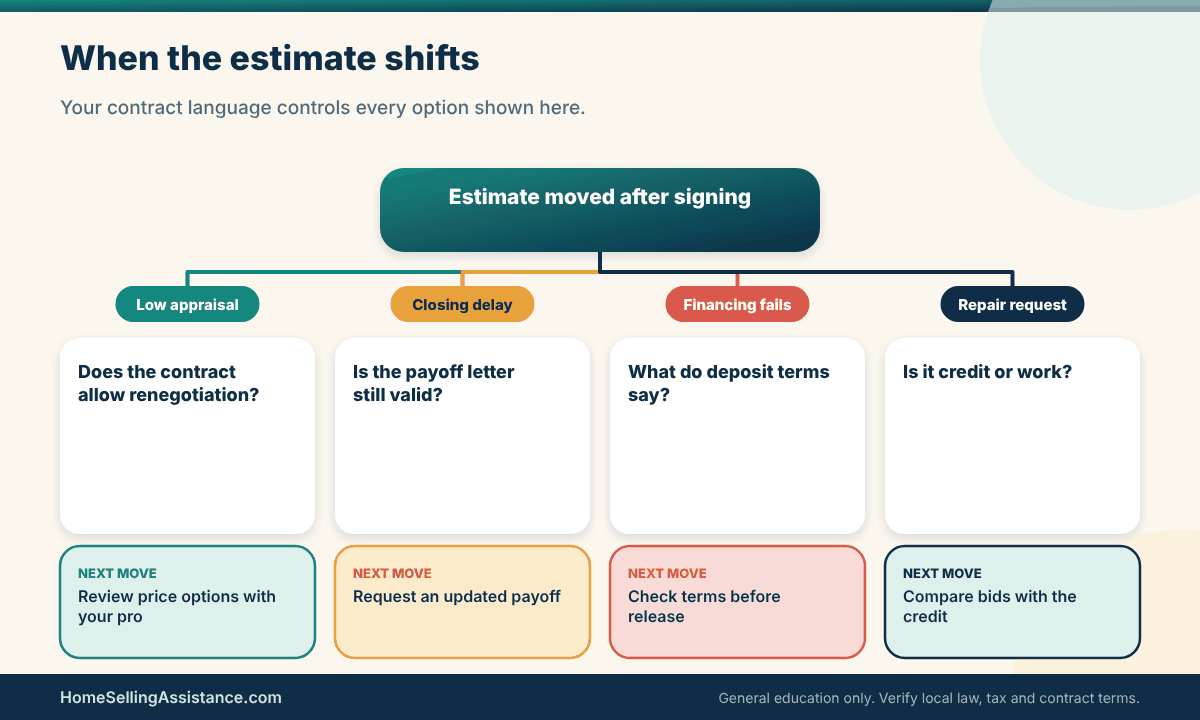
The decision tree above shows how a fallback plan can branch depending on what goes wrong. Keep your own version short and specific to your contract, since the terms and deadlines in your documents control what you may do and when.
Keeping your seller closing cost calculator method honest about false precision
False precision is the habit of reporting a number with more certainty than the evidence allows. “Your net will be $312,847” sounds authoritative. It is also almost certainly wrong, because several of the lines beneath it are estimates, and rounding them to the dollar does not make them more accurate. A trustworthy seller closing cost calculator method resists that habit. It reports a range, flags the soft spots and tells you which figures will firm up and when.
Think of every seller closing cost calculator method result as a forecast rather than a receipt. A weather forecast that says “rain is possible this afternoon” is more honest than one that claims it will start at 2:14. In the same way, “likely between a lower and an upper figure, narrowing as quotes arrive” is a more useful answer for a seller than a single total. It tells you how much cushion to keep and when to stop worrying.

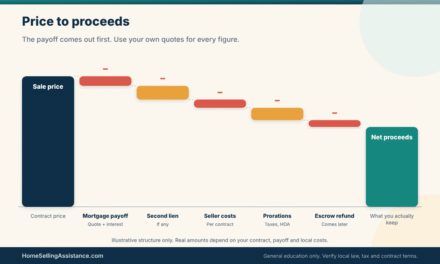
The illustration above shows how a sale price turns into net proceeds as each deduction and credit is applied. In a real file, each bar would carry a note about its source and whether it is a quote, a contract term or a guess. The bars that carry guesses are the ones to widen when you build your range.
Building a sensitivity range you can defend
In a seller closing cost calculator method, a sensitivity range answers the question “what if I am wrong about this input?” Take your expected case, then change one input at a time to a plausible lower and higher value and see how the total moves. The inputs that move the total most deserve the most attention, and the ones that barely matter can be left alone. This is the same approach analysts use for any uncertain forecast, and it works fine on a single sheet of paper.
Choose the swings in your seller closing cost calculator method carefully. A swing should be plausible, not catastrophic. If you vary the sale price by an enormous amount you learn nothing about the closing costs, and if you vary it by a few dollars you learn nothing at all. A sensible approach is to test the price against the spread between your offers, test the closing date against the earliest and latest realistic dates, and test each fee against quotes from two providers where the choice is yours.
When you combine inputs, build a low case, an expected case and a high case. The low case uses the least favorable plausible value for each uncertain line, and the high case uses the most favorable. You will rarely see either extreme in practice, because uncertainties tend to partly offset. Even so, the low case tells you whether the sale still works for your plans, such as a down payment on your next home, even when things go modestly wrong.
| Market or property assumption | Expected effect | Confounder | What to verify locally |
|---|---|---|---|
| Closing date moves later | More interest, tax and upkeep on your side | Proration rules differ by contract | Payoff per-day amount and proration clause |
| Appraisal lands below price | Price cut, buyer cash gap or cancellation | Contract wording on appraisal gaps | Appraisal contingency terms and deadlines |
| Repair requests after inspection | Credits or work reduce proceeds | Age, condition and disclosed defects | Inspection clause and any local disclosure rules |
| Transfer or recording charges differ | A line item rises or falls sharply | State, county or city may each add charges | County recorder and title company estimate |
| Association fees or dues are unpaid | Extra payoff or document charges | Management company timelines and fee rules | Resale certificate request and association ledger |
| Buyer asks for closing help | A credit reduces proceeds | Lender limits on credits | Written addendum and lender confirmation |
Use the table as a prompt for your seller closing cost calculator method, not a forecast. For each row, decide whether it applies to your sale, then replace the generic columns with notes from your own documents. A row that does not apply can be deleted. A row that applies but that you cannot yet verify should become a task on your list, with a name next to it and a date, so that the uncertainty shrinks over the coming weeks rather than lingering until the closing table.
Evidence to gather: ranges from quotes, past statements and local custom
The best evidence for a range in a seller closing cost calculator method is two or three actual quotes. If you can choose your title or escrow provider, ask for estimates from more than one and compare the lines rather than the totals. The differences tell you what is negotiable and what is fixed by law or custom. If you have no choice, ask whether the estimate is a firm quote or a good-faith estimate, and ask what typically changes between the estimate and the final statement.
Your own history can help too. If you bought your home a few years ago, your old closing statement shows the structure of costs in your area, even though the amounts have changed. Dig it out and look at the lines that applied to the seller. You are not copying numbers, since fees change, but you are learning the vocabulary and the categories so that nothing on the new estimate comes as a total surprise.
Ask professionals for ranges in words, not guarantees. A question like “what is the usual spread between your estimate and the final figures on sales like mine?” invites an honest answer. An experienced closing officer or attorney will often tell you which lines tend to move. Write down what you hear, with the person’s name and the date, and file it with your other sources so you can show where your range came from.
Finally, remember that the national or “average” numbers you see online mix very different markets. Treat them as a prompt for questions to local professionals, not as inputs. A seller closing cost calculator method that quietly leans on a national average has swapped a local fact for a general guess and hidden the swap in the arithmetic.
A scenario, an exception and your next step when the range is wide
Say a seller applying the seller closing cost calculator method builds a range and finds that the gap between the low and expected cases is small, but the gap between expected and high is large because of an uncertain repair request. The useful insight is that repair outcomes drive the uncertainty. The seller can reduce it by ordering a pre-listing inspection, collecting contractor bids early or asking the buyer’s agent how likely negotiations are to focus on certain items.
The exception is when a wide range in a seller closing cost calculator method does not matter for your decision. If you will sell at any plausible net because you must relocate, the extra precision may not change your choice, and spending days narrowing the range would be wasted effort. Match the effort to the stakes. If the low case still clears your mortgage and leaves enough for your plans, you may be fine with a rougher estimate.
Your next step is to circle the two inputs that move your total the most and put a name and a date next to each. Those are the numbers worth chasing. If you are also thinking about the income tax side of the sale, remember that net proceeds and taxable gain are different questions, and our guide on taxes when selling a home explains why.
Knowing what needs a live quote, CMA, appraisal, policy or contract
Some numbers in a seller closing cost calculator method cannot be estimated responsibly from a distance. They have to come from a live quote, a comparative market analysis, an appraisal, an insurance or title policy, or the contract itself. A seller closing cost calculator method should have a visible boundary between “things I can compute” and “things someone else must tell me.” Marking that boundary early prevents the common mistake of treating a placeholder as a fact.
The payoff amount is the clearest example. Only your lender can state it, and only for a particular date. Title, escrow and settlement fees come from the company handling your closing. Prorations come from the contract and the tax and association records. The likely sale price comes from market evidence and, if a buyer is financing, from an appraisal. Each of these has a rightful owner, and your job is to get the number from that owner in writing.
Evidence to gather: who issues each figure and in what form
For your seller closing cost calculator method, make a short list titled “who owns this number.” Next to the payoff, write your lender’s name and the department that issues payoff letters. Next to title and settlement fees, write the title or escrow company and the officer assigned to your file. Next to taxes, write your county’s treasurer or assessor, and next to association charges, write the management company. When you know who owns each figure, requesting the right document becomes a five-minute errand.
Ask for each figure in the form that matters. A payoff should be a formal letter with a good-through date. A title estimate should be a written, itemized document. A pricing opinion should come as a comparative market analysis with the comparable sales listed, so you can read the reasoning rather than just the conclusion. An appraisal is ordered by the buyer’s lender, and as a seller you will usually learn the outcome through the contract process, not through a report addressed to you.
Be aware of what a CMA is not. It is an informed opinion about likely market value, usually prepared by an agent, and it is not the same thing as an appraisal, which follows a lender-driven process and its own standards. Both can differ from an actual offer. Our closing costs and net proceeds category gathers deeper articles on each document type if you want more detail.
If a policy is involved, such as an owner’s title policy or a home warranty, read the schedule of what it covers and who pays. A seller in some areas customarily pays for the buyer’s title policy, while in others the buyer does. Do not assume. Ask the closing office to say which policies are priced into your side of the statement and which are not, and have them point to the contract section that assigns the cost.
A scenario, an exception and your next step when something is still unknown
Consider a seller using a seller closing cost calculator method who has every figure except the association’s transfer and document fees, because the management company has been slow to respond. Rather than guess, the seller enters a placeholder, marks it “unknown, requested on this date,” and sets the high case to include a generous allowance. When the real figure arrives, the placeholder is replaced and the range narrows. At no point did the seller present a guess as a fact.
An exception arises when a figure cannot be known until closing, such as a final interest amount that depends on the exact funding date. In that case, state the method for computing it and the assumptions you used, instead of a bare number. For example, “payoff plus the daily amount times days to the expected funding date.” Anyone reading the page can then see how the number was built and recompute it if the date moves.
Your next step is to send three short requests this week, one to your lender for a payoff letter, one to the closing office for an itemized seller estimate and one to your association for its fee schedule and resale documents. Then log the date each arrives. By the time you are choosing between offers, your seller closing cost calculator method will be resting on documents rather than guesses, and you will be able to say so with a straight face.

The checklist above groups the documents you may want to have in hand, sorted by who issues them. Treat it as a starting point and add anything your own contract or local custom requires.
Before the questions and answers, it helps to see the whole seller closing cost calculator method working on a single worked example. The numbers below are round and illustrative, chosen only to make the arithmetic easy to follow. They are not typical costs, and your real lines will differ in size, number and name depending on your state, county, contract and loan.
To apply the seller closing cost calculator method, imagine a contract price of $400,000. The lender’s payoff letter says $215,000 through a stated date, with a small per-day amount after that. The seller’s written listing agreement and contract set broker compensation at an agreed figure. The title company’s draft estimate lists settlement, recording and transfer lines. The contract gives the buyer a $3,000 credit. Property tax and association dues prorate by closing date. Those are the lines of the expected case.
To build the low and high cases, the seller does not change everything at once. The closing date moves two weeks later, adding interest and holding costs. A repair request increases the credit. A fee line comes in higher than the draft estimate. Then the seller does the opposite for the high case. Reading the three totals side by side shows a spread of several thousand dollars, and the seller can see that the closing date and the repair credit account for most of it.
Quick scenario
A seller needs at least a certain amount at closing to fund a down payment elsewhere. The expected case clears it comfortably, and the low case clears it narrowly. Knowing that, the seller agrees to a slightly longer closing in exchange for a stronger buyer, keeps a small cash cushion and asks the title company to confirm the payoff and fee lines one week before closing. The seller closing cost calculator method did not produce certainty. It produced a plan.
Notice what the seller did not do. They did not average the three cases and call the result the answer. They did not assume the closing statement would match the expected case to the dollar. And they did not treat a repair credit, a holding cost or a delay as an unforeseeable event, because they had already priced each one as a plausible deviation. That mindset is more important than any individual figure on the page.

The balance above sums up the trade-off most sellers face between a higher headline price and a more certain, cleaner path to closing. Your own scale will tilt according to your plans, your timeline and your tolerance for risk, and nobody else can set that weight for you.
A few habits keep your seller closing cost calculator method healthy over time. Update the page whenever a new document arrives, and note the date. Share the current version with the people helping you so everyone works from the same numbers. Keep earlier versions so you can see how the estimate evolved. And when the final closing statement arrives, compare it line by line with your last estimate and write down where it differed and why. That review makes your next estimate better, and it may reveal an error worth raising before you sign.
If something on the closing statement looks wrong, say so early and in writing. Ask the closing office to explain the line, request the document that supports it and give them time to correct it. Errors do happen, and the days before closing are the easiest time to fix them. Wire instructions deserve special care: confirm any change in instructions by calling a phone number you already trust, and report suspected fraud through resources such as the FBI’s Internet Crime Complaint Center.
One more caution concerns tax. The cash you receive at closing is not the same as your taxable gain, which depends on your basis, improvements, selling expenses and eligibility for any exclusion. The IRS guide to selling your home explains the federal rules. A seller closing cost calculator method answers a cash question, not a tax question, so keep the two analyses apart and talk to a qualified tax professional about the second.
Finally, think about who else needs to see the seller closing cost calculator method. A co-owner, an executor or a spouse may need to sign off, and showing them a clear page with sources and a range builds trust faster than a verbal summary.
If the sale involves a lien or an unusual payoff, our article on selling a house with a lien explains how those items are typically resolved at closing. For a wider view of every charge a seller can face, return to our pillar on building the seller closing cost estimate from real line items, and to home sale net proceeds for the step that follows. If you want to see how the disclosure side can add cost, read seller disclosure requirements.
Frequently asked questions about seller closing cost calculator method
What is a seller closing cost calculator method in plain terms?
It is a written, repeatable way to estimate what you will pay and keep at closing. You list every input, tag each with its source and date, build a low, expected and high case, and mark which lines still need real quotes. It is more about discipline than about software.
Can I just use an online calculator?
You can use one as a starting point, as long as you know it is applying assumptions on your behalf. Check which costs it includes, whether it uses a flat percentage and how it treats payoff, prorations and credits. Replace its guesses with quotes as they arrive, and never treat its output as a final number.
Why not simply apply a percentage of the sale price?
A single percentage hides the fact that some costs are fixed, some depend on price and some depend on time. It also varies by state, contract and local custom, so no universal percentage is reliable. A line-by-line list is slower to build, but it is much easier to correct.
How early should I request a payoff statement?
Request one as soon as you have a serious offer, then refresh it if your closing date moves. A payoff letter is valid only through a stated date and interest keeps accruing, so an old figure can understate what your lender will require. Ask your lender how to get an updated one quickly.
How do I compare two offers fairly?
Put both into the same template with contract price, credits, seller-paid items, holding costs, closing date and risk allowance. Use identical assumptions for costs that do not differ. The comparison shows whether the higher headline number really helps you or whether it narrows once everything is counted.
What should my sensitivity range include?
Include the inputs that move your total most, such as the closing date, repair credits, appraisal outcomes and any uncertain fee lines. Change one at a time to a plausible lower and higher value, then combine them into low, expected and high cases. Keep the swings realistic so the range stays useful.
Which numbers need a live quote?
The mortgage payoff, title and settlement fees, transfer and recording charges, association fees and prorations all come from someone else. Ask for each in writing from the party who issues it. An estimate built only from averages should be treated as a placeholder, not as planning material.
Is a comparative market analysis the same as an appraisal?
No. A comparative market analysis is an opinion of likely value, usually prepared by an agent from recent comparable sales. An appraisal follows a lender-driven process and its own standards. Either can differ from an actual offer, so treat both as ranges rather than promises.
Does the seller closing cost calculator method tell me what I will owe in taxes?
No. It estimates cash flows at closing, while tax depends on basis, improvements, selling expenses and eligibility for exclusions. The two questions use different inputs. Review the federal guidance and speak with a qualified tax professional about your situation before relying on any tax assumption.
What if my final statement differs from my estimate?
Compare it line by line, note each difference and ask the closing office to explain anything unclear. Some differences come from timing, like interest or prorations, and some from errors that can be corrected. Raise questions early and in writing, and keep the notes to improve your next estimate.
Make the estimate earn your trust
A good seller closing cost calculator method does not promise a perfect number. It gives you a page you can explain, update and defend, with every figure tied to a source and a date and a range that tells the truth about uncertainty. Build it early, refresh it as quotes arrive and compare it with the final statement when you get there. This article is general education, not legal, tax or financial advice, so confirm local rules and your own numbers with your lender, title or closing professional and a licensed advisor.