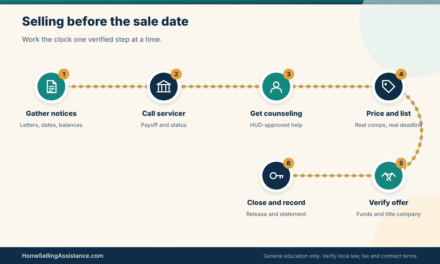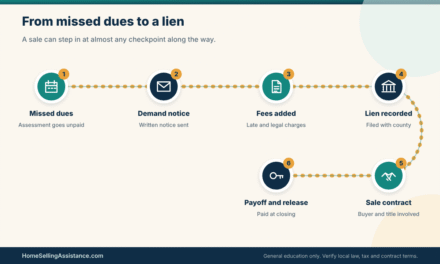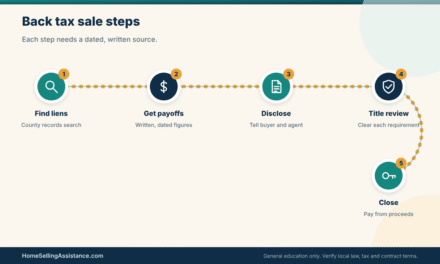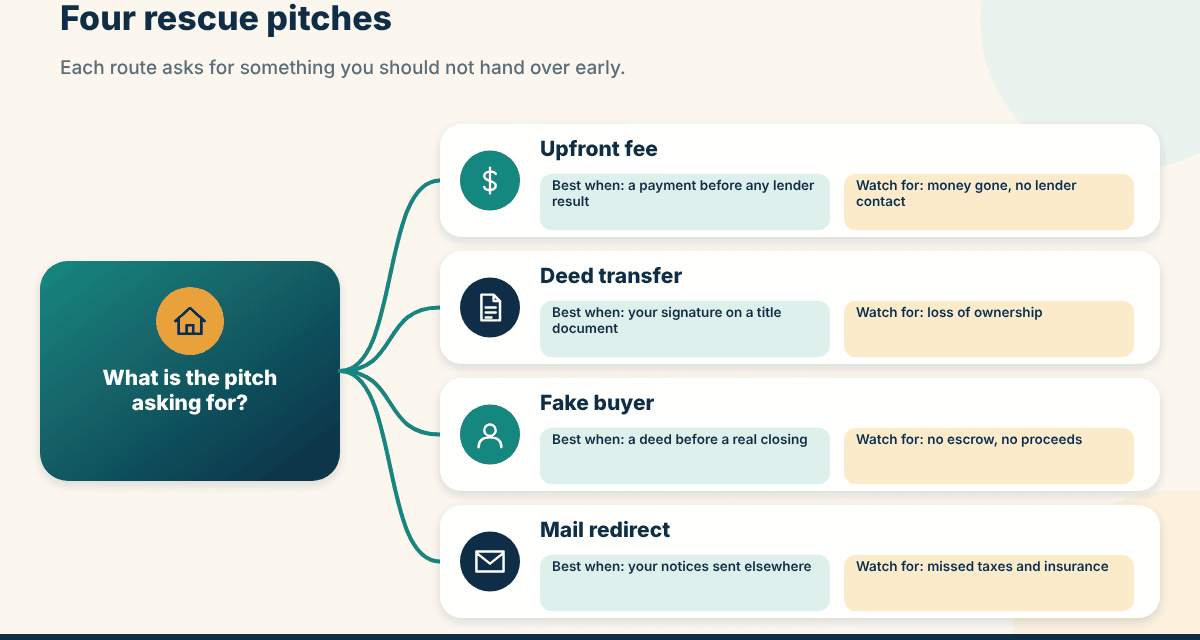
Foreclosure rescue scams work because they arrive at the exact moment a homeowner is tired, frightened and willing to try almost anything, and they usually sound like the first friendly voice in months.
If you have missed payments, received a default letter or seen a notice taped to the door, you have probably also noticed that your mail, phone and inbox have filled with people who “can help.” Some of them are real professionals. Others are running a script they have used on hundreds of families. The trouble is that the two groups often use the same words: save your home, stop the sale, act now, we are on your side.
This article is about telling them apart before you pay, sign or hand over anything you cannot take back. We will look at the usual shapes foreclosure rescue scams take, including upfront fees for loan help, a deed that quietly changes hands, a buyer who is not quite a buyer, and a “consultant” who collects your documents and disappears. Then we will walk through the checks that cost nothing, the information you should guard, and the calls to make if something already went wrong.
It sits inside our wider library on selling under pressure. If you are still weighing your options, our cornerstone guide on how to sell a house before foreclosure lays out the full picture, and this page zooms in on the fraud side. Rules about foreclosure, deeds and fees differ by state and change over time, so treat what follows as general education rather than advice for your particular file.
Key takeaways
- Be suspicious of anyone who wants money first. A company that asks for a fee before it has delivered anything in writing from your lender deserves a long pause, and federal rules restrict advance fees for many mortgage relief services.
- Never sign over the deed to “save” the house. A transfer of title is the centerpiece of many foreclosure rescue scams, and a rent-back promise or a buy-back promise is not a substitute for owning the property.
- Verify through a channel you already trust. Call the number on your own mortgage statement, not the number on a flyer, a text or an email that happens to know your name.
- Use free, HUD-approved counseling first. Approved housing counselors can explain your options without selling you a product, and your servicer must also be part of any real solution.
- Keep every record. Notes, screenshots, receipts and signed pages make it far easier for a bank, attorney, regulator or police agency to help you later.
How foreclosure rescue scams find and trap homeowners
Those behind foreclosure rescue scams do not guess. Default notices, lis pendens filings and auction listings are public in many places, and some operators buy or scrape those lists and mail letters within days. That is why a stranger can seem to know that you are behind, and why the timing feels so uncanny. The knowledge is not proof of legitimacy; it is simply public information used as a lure.
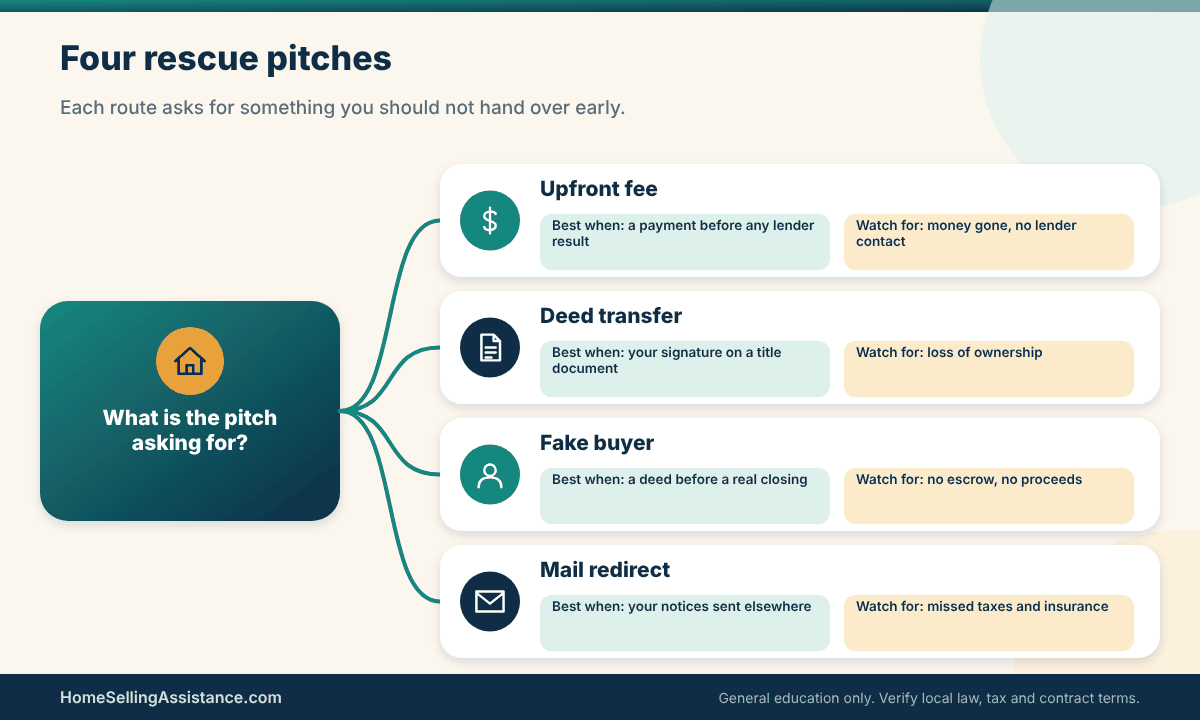
What follows describes the damage foreclosure rescue scams cause and the information they want, because understanding the goal makes the pitch easier to recognize. A practical map of the whole landscape is easier to hold in mind with a picture, so the first figure below shows the common routes foreclosure rescue scams take from first contact to loss.
What the damage from foreclosure rescue scams looks like
The harm from foreclosure rescue scams is rarely a single dramatic event. More often it is a slow stack of small losses that all feel reasonable when they happen. You pay a few hundred dollars “to start the file.” You send your last two pay stubs. You stop answering calls from your servicer because the new company said it would handle everything. Weeks pass, the foreclosure clock keeps running, and the one thing you had in short supply, time, is gone.
At the severe end, the loss is the house itself. In an equity-stripping version, you sign a document believing it is a repayment agreement, and it is actually a deed. The scammer becomes the owner of record, borrows against the property or sells it, and you are left as a tenant with no rights you understood. Foreclosure rescue scams of this kind can also leave your name on a loan you no longer control, which is why credit and tax problems sometimes follow.
Evidence to gather: the paperwork that reveals foreclosure rescue scams
Start with every page you were given or asked to sign, including the ones you only skimmed. Look for words such as “grant deed,” “quitclaim deed,” “warranty deed,” “bargain and sale,” “power of attorney,” “limited power of attorney,” “assignment,” “lease,” “option to repurchase” or “joint venture.” A document titled something soft like “Homeowner Assistance Agreement” can still contain a transfer inside. If a page says you are conveying, granting, transferring or releasing your interest, treat it as a title document no matter what the cover sheet is called.
Next, check public records. Most county recorder or register of deeds offices let you search by name or address, and many offer online indexes. Look for any recording that you do not recognize. A deed recorded without your knowledge, a new mortgage or a lien you never agreed to is a red flag. Compare the date against the day you signed something. A recording within days of a meeting is a common pattern in foreclosure rescue scams.
Finally, gather your payment trail. Cancelled checks, wire confirmations, card statements and app receipts show who received money, in what name and on what date. Those details matter later, and they are easier to collect now than after an account is closed.
A scenario, an exception, and your next step after a fee-only scheme
Picture a homeowner, call her Dana, who receives a glossy letter offering to “negotiate with your lender and stop the auction.” She pays an illustrative $1,500 upfront by card and signs a two-page contract. For a month the company says negotiations are underway. Then the phone number stops working. Nothing has been filed with the servicer, and her sale date is closer than before.
The exception is worth knowing. Some licensed attorneys do take retainers for foreclosure defense, and the rules on how they hold and bill that money are set by state bar regulators, not by this article. A retainer paid to a verified attorney is a different thing from a fee paid to an unlicensed “processor” who calls himself a specialist.
The next step for Dana is to contact her real servicer on the number printed on her statement, ask what is actually pending, and request a written status. She should then report the company to the places listed later in this guide and call her card issuer about a dispute while the window is still open.
What a rescue scammer wants from you besides money
Money is the obvious prize in foreclosure rescue scams, but it is not the only one. Many foreclosure rescue scams are also collecting identity details, signatures and access. A signature on a blank or half-filled form can be used later for things you never discussed. Your Social Security number and bank details can open accounts or redirect payments. Even your house keys, alarm codes and tenant information have value to the wrong person.
Think of your information and your property as two buckets. The first bucket holds identity, financial and account data. The second holds title, possession and the legal ability to decide what happens to the house. A trustworthy helper asks for only what is needed, in the order it is needed. A scammer asks for everything on the first call and calls it “intake.”
Evidence to check: where your personal data and deed travel
Trace each piece of information back to where it went. Which pages did you give them? Did you sign an authorization that lets the company talk to your servicer, and does that form limit what they can do? A genuine authorization usually names one purpose and one lender. A broad power of attorney that lets someone sign for you, collect payments or manage the property is far more than a conversation permission, and it can be misused if the person is dishonest.
Also check where your mail goes. Some schemes tell homeowners to redirect mortgage statements, tax notices or insurance renewals to a new address “so we can monitor everything.” That detail is a serious warning sign, because it cuts you off from the very notices that tell you whether the loan, the taxes and the insurance are actually being paid.
Look at your credit reports from the free federal sources for accounts or inquiries that you did not start. You are looking for new loans, address changes or hard inquiries tied to the weeks when you were in contact with the company. An unfamiliar entry does not prove fraud on its own, but it tells you what questions to ask next.
A scenario with a fake buyer and a next step
Now consider Marcus, who is behind on payments and gets a call from a “private investor” eager to buy fast. The investor says a quick sale will “save your credit,” offers a price that sounds fair, and asks Marcus to sign a deed now so the buyer can “stop the foreclosure immediately” while the closing paperwork is prepared. No title company is involved, and the buyer wants Marcus to keep paying his mortgage until the “real” closing.
Each piece is a warning. Signing a deed before funds are in the hands of a neutral closing agent is dangerous. Continuing to pay a mortgage on a house you have already deeded away gives you cost without control. A real purchase has a written contract, an escrow or title company, a payoff figure from your servicer and a closing statement that shows where every dollar goes. Our guide on how to verify a cash home buyer walks through those checks in detail.
Marcus’s next step is simple to say and hard to do: stop, sign nothing more, and call a HUD-approved counselor or a real estate attorney before replying to the investor again.
Reducing the risk before you sign or pay anyone
The cheapest protection you will ever buy is a delay. Nearly every one of the foreclosure rescue scams includes a clock: the offer expires tonight, the auction is Monday, the investor has another house to look at. Legitimate professionals know that real foreclosure timelines are set by your servicer, your loan documents and your state, and that a day or two spent verifying someone does not usually change them. A pitch that cannot survive a day of checking was not built to help you.
Before we go into the details, here is a table that pulls the common threats together. It pairs each claim you might hear with the evidence worth checking, the safe response, what to keep private and where to go if the claim turns out to be false.
| Threat or claim | Evidence to check | Safe action | Never share | Escalate to |
|---|---|---|---|---|
| “Pay a fee and we stop the sale” | Written lender response, license, contract terms | Ask what is delivered before payment; call servicer | Card, bank login, pay stubs | State attorney general, FTC, CFPB |
| “Sign this deed to save the house” | Document title, recorder index, title company role | Refuse to sign; get an attorney review | Signature on deed or blank forms | Real estate attorney, county recorder |
| “A buyer will pay cash tomorrow” | Proof of funds, escrow agent, written contract | Insist on a neutral closing agent | Account numbers before a contract | Title company, state licensing office |
| “Redirect your mail and payments to us” | Servicer statement, tax and insurance status | Keep every notice coming to you | Servicer login, online portal password | Servicer, local police, postal inspector |
| “Government program, limited slots” | Official agency website, counselor directory | Find the program yourself, never via the caller | Social Security number on the first call | HUD counselor, CFPB, FTC |
| “Lease and buy back later” | Deed type, rent terms, repurchase price in writing | Stop and consult an attorney before any transfer | Keys, alarm codes, tenant details | Attorney, state housing agency |
Use the table on foreclosure rescue scams as a quick screen, not a verdict. If a pitch matches a row, the safe action column is your first move, and the last column tells you who should hear about it. If several rows apply at once, assume you are looking at a coordinated scheme and slow everything down further. More general background on this topic lives in our guide to home sale fraud and seller safety.
Verification steps that expose foreclosure rescue scams
Spotting foreclosure rescue scams does not need special skills. It needs a few minutes and a willingness to be slightly rude. You are allowed to say, “Please email me your license number, physical address and written terms, and I will call you back.” Real firms expect that request. Operators running foreclosure rescue scams tend to answer with pressure, vague promises or an offer to “just come by with the paperwork.”
A good habit is to separate the person from the process. Even if the caller is pleasant, ask what exactly would be delivered, by whom, in what time frame, and what happens if it does not work. Then check each answer against an independent source. Our article on fake cash home buyer signs adds a longer list of cues that apply when the helper claims to be a purchaser.

Evidence to gather: licenses, complaints and written terms
Begin with who they say they are. If someone claims to be a lawyer, look up the name in the state bar’s attorney directory. If they claim to be a real estate licensee, check the state real estate commission’s license lookup. If they claim to be a housing counselor, search the HUD counselor finder at hud.gov/findacounselor and call the agency yourself on a number you found there. Names that cannot be matched to a real record are not proof of fraud, but they are a reason not to continue.
Then read the contract for what is missing. A real service agreement usually states the services, the total cost, when fees are due, how to cancel and who to complain to. Be careful with language that says no guarantee is made but also says results are “virtually certain.” Pay attention to cancellation windows, arbitration clauses and any clause that has you waive rights. If anything is unclear, ask for a copy to take home and show to a professional.
For complaint history, search the company and its owners by name with words like “complaint,” “lawsuit” or “scam,” and look at your state attorney general’s consumer pages and the FTC’s consumer site. Absence of complaints means little for a company created last month, so give extra weight to how long the business has existed and whether a physical office exists.
A scenario, an exception, and a next step on a legitimate-looking firm
Imagine a firm with a polished website, a toll-free number and a testimonials page. It tells you it is “affiliated with lenders nationwide” and says it will contact your servicer if you sign a service agreement and pay an illustrative $1,000 start-up fee. The agreement does not mention a license, and the person you spoke to will not name the attorney who supposedly oversees the work.
Appearances are cheap. A website can be built in a day, and testimonials can be written by anyone. The exception to keep in mind is that some legitimate nonprofits and attorneys have professional websites too, so polish alone proves nothing in either direction. What matters is whether the structure holds up: verifiable licenses, written scope, no advance payment for promises, and a willingness to let you check.
The next step is to say no to the fee and ask for everything in writing. Then call your servicer and ask whether any third party is authorized on your account. If the answer is no, you have learned the company never contacted your lender, which is useful information for any report you file about foreclosure rescue scams later.
What never to share and what never to assume
Some details should stay in your hands until a transaction is real and a neutral party is involved. Some assumptions should be dropped no matter how convincing the speaker sounds. Both lists are short, and both protect against the most common ways people lose a house or a savings account.
The principle behind them is that trust should follow proof. At the start of a conversation you have no proof, so you share only what the other side cannot misuse. As documents, licenses and escrow arrangements appear, you can share more, and only with the party that actually needs each item.
Evidence behind the rule: why signatures and account details matter
A signature is not just a name on paper. On a deed it moves ownership. On a power of attorney it hands someone the pen. On a blank form it gives another person the right to fill in the rest. Before you sign anything, read every line and make sure there are no empty fields. Ask for a copy of the final document at the time of signing, not “later by email.”
Account details work the same way. Online banking logins, card numbers with security codes, and servicer portal passwords let someone act as you. A legitimate helper may need a statement showing your balance and payment history, but almost never needs your password. If a person asks for your login “to see the status,” offer a screenshot or a printed statement instead, and notice how they react.
Assumptions are the other half. Do not assume a company is approved because it uses words like “federal,” “national” or “housing” in its name. Do not assume a government logo means a government office. Do not assume a notary stamp means the content of a document is fair. A notary confirms who signed, not whether the deal is good. These are the quiet assumptions that foreclosure rescue scams rely on.
A scenario and next step when someone says time is almost up
Suppose a caller tells you the sale is scheduled for Thursday and that only a signature today can freeze it. He sends a document by text and offers to meet at a coffee shop with a mobile notary. He says the servicer “will not take calls from homeowners at this stage,” which is why he must handle everything.
Several claims here can be checked within an hour. Servicers do take calls from borrowers, including at late stages, even if the person you reach is a different department than the one that handled your payments earlier. Foreclosure dates can sometimes be postponed or may already have been moved, and the official notice or the attorney handling the foreclosure can tell you. A caller who says otherwise is gambling that you will not check.
The next step is to decline the meeting, then call the servicer and ask for the loss mitigation department. Ask whether a sale date is set, whether any application is under review, and what documents they actually need from you. Then contact a HUD-approved counselor, who can often help you organize that call.
Responding to foreclosure rescue scams without escalating the damage
If you realize foreclosure rescue scams have already reached you and you paid, signed or shared something, take a breath. Shame is a scammer’s best friend, because embarrassed people stay quiet and quiet people do not file reports. Foreclosure rescue scams are designed by professionals to persuade careful, intelligent adults, and many victims are exactly that. The goal now is to stop further loss and to make the record as strong as possible.
The order matters. First verify what is true through channels you control. Then reach the people who can freeze, record or investigate. Avoid confronting the company in a way that tips it off before you have secured your accounts and evidence. The second table below turns this into scenarios you can compare against your own situation.
| Situation | Warning sign | Verification channel | Seller response | Record to preserve |
|---|---|---|---|---|
| Loan help company asks for a retainer | Payment due before any lender contact | Servicer number on your statement | Decline, request written scope | Contract, receipts, call notes |
| Investor wants a deed before closing | No escrow agent or contract | Title company you choose yourself | Refuse to sign; see an attorney | Draft documents, texts, emails |
| Rent-back offer after “sale” | Repurchase price vague or unwritten | County recorder and attorney | Stop; get a written review | Lease, deed copy, payment log |
| Caller says to stop talking to servicer | Pressure to cut off your lender | Servicer loss mitigation desk | Keep contact open and documented | Date and name of each servicer call |
| Wire instructions change by email | New account, urgent tone | Phone number from your own file | Pause funds; call to confirm | Original and changed emails |
| Fake agency or program letter | Logo but no verifiable office | Official agency site you type in yourself | Ignore the reply link and phone | Letter, envelope, caller ID |
Read across a row of this foreclosure rescue scams table for the pattern, then read down a column for the action that repeats. Notice how often the verification channel is something you already own, such as a statement, a title company you picked or a directory you searched yourself. That is deliberate. The more one of the foreclosure rescue scams depends on a channel the other side controls, the more likely it is that the channel is the trap.
Checking every claim through a contact channel you already know
Known-channel verification means that you never use the phone number, link, email address or office the other party hands you. You use one that existed before they appeared. It sounds almost too simple to matter, yet it defeats a surprising number of foreclosure rescue scams, because the whole scheme depends on you trusting a channel the scammer set up.
This habit also keeps you steady. When an urgent voice is on the phone, it is hard to think clearly. Telling yourself the rule in advance, “I hang up and call back on my own number,” removes the need to decide in the moment. Our guide on real estate wire fraud for sellers uses the same rule for money movements at closing.

Evidence to use: numbers from your own statements
Gather the documents that carry trustworthy contact details. Your latest mortgage statement lists the servicer’s name, mailing address and customer service line. Your original closing papers show the lender and sometimes the settlement agent. Your tax bill lists the taxing authority, and your homeowners insurance declarations page lists the insurer and agent. Those four sources give you a ring of verified contacts that a scammer cannot easily replace.
Use them to ask direct questions. Ask your servicer what your current balance and past-due amount are, whether a foreclosure has been filed, whether a sale date exists, and whether any outside company is listed as authorized on your account. Ask the tax office whether your property taxes are current. Ask your insurer whether the policy is active and who the loss payee is. The answers either match what the rescuer told you or they do not.
Write down who you spoke with, the date, the time and what they said. If the servicer offers a reference number for the call, record it. A clear log gives you a credible account of events if you later file a complaint, and it helps any attorney or counselor catch up quickly. It also helps with foreclosure rescue scams that involve several people who each tell you something slightly different.
A scenario, an exception, and a next step with a servicer call
Rosa receives a letter claiming that her lender “has approved a special hardship program” and that she must call a number to claim it before a deadline. The letter has a government-looking seal and uses her full loan number. She calls her servicer using the number on her statement instead. The representative has no record of any such program and notes that a letter with her loan number could have come from public records or a data leak.
The exception is that real lenders and servicers do sometimes send letters about workout options, and those letters can be urgent. The test is not whether the letter exists but whether the options are confirmed when you call the number you already trust. A real program will show up in your account notes, and a counselor can help you interpret it. If the servicer cannot find it, treat the letter as unverified.
Rosa’s next step is to ask the servicer for a written list of her actual options, then book a free session with a HUD-approved counselor to review them. She can also report the letter to the FTC, since similar mailings often reach many households. This is how a single suspicious letter becomes useful evidence against foreclosure rescue scams in her area.
Escalating to the bank, settlement agent, police, insurer or attorney
After verification, decide who needs to hear what, and in what order. A single event, such as a wire sent to the wrong account or a deed that was recorded, may involve several parties at once. A short, factual report to each one, supported by the same set of documents, is better than a long emotional account to just one of them.
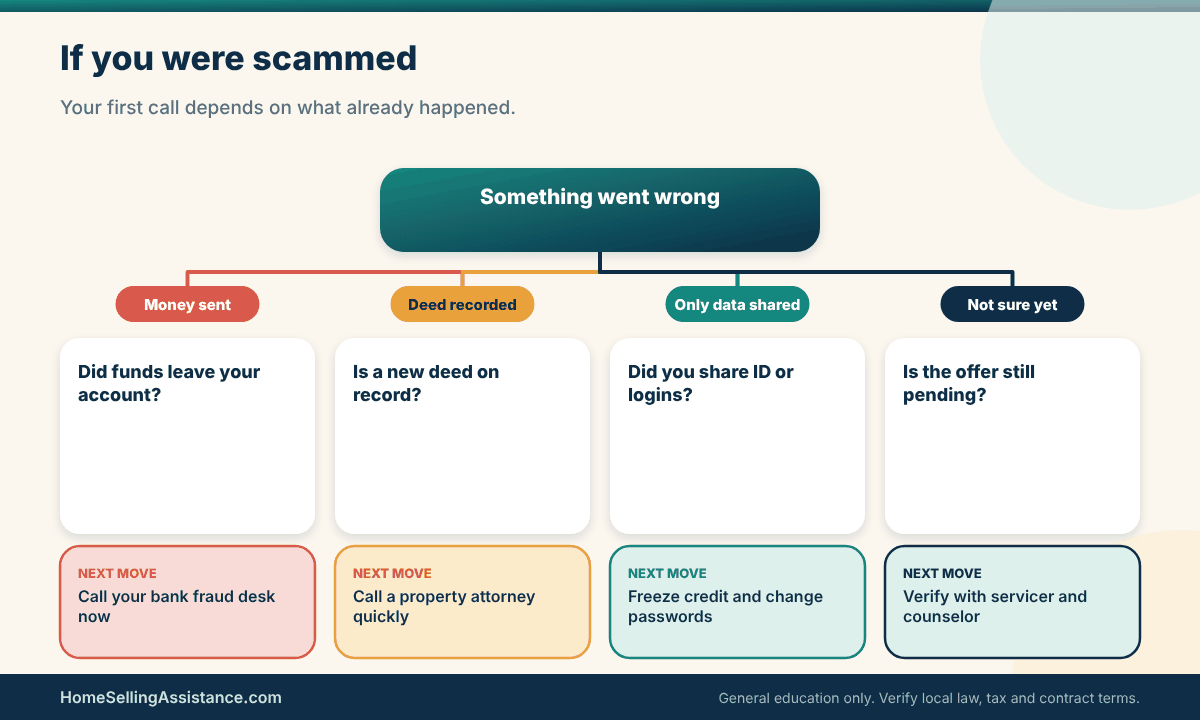
Time can matter, especially with money transfers. If funds left your account recently, call your bank immediately and ask for its fraud department. If a deed has been recorded, you will probably need a lawyer who handles real property and title disputes. If a closing is pending, tell the settlement agent that you suspect fraud. For related guidance, see our piece on title and deed fraud for homeowners.
Evidence to hand over: a clean record
Put everything in one folder, paper or digital. Include the contracts, flyers, letters, text messages, emails, voicemails, screenshots of websites, business cards and any receipts or confirmations. Add a one-page timeline that lists the date of first contact, what was promised, what you paid or signed and when, and each follow-up. Short, dated, factual entries are the most useful.
Make copies before you hand originals to anyone. For digital evidence, save messages in their original form rather than retyping them, and note the phone numbers and email addresses used. Do not delete the conversation in anger, even if it is painful to look at, because those details often help investigators connect cases.
When you file reports, give the same facts each time. Federal options include the Consumer Financial Protection Bureau for mortgage-related complaints, the FTC for fraud reports, and the FBI’s Internet Crime Complaint Center when electronic transfers or online contact were involved. Your state attorney general and the state real estate or banking regulator may also accept complaints. Local police can take a report, and a case number helps with banks and insurers.
A scenario, an exception, and a next step if the deed already moved
Consider Tom, who learns from a county records search that a deed in favor of an unfamiliar company was recorded two weeks ago. He remembers signing a stack of papers at his kitchen table but believed they were part of a repayment plan. The company has since stopped answering, and a listing for his house has appeared online.
This is urgent but not hopeless. Courts in many states have tools to set aside deeds obtained through fraud, misrepresentation or unfair terms, and some states have specific statutes aimed at foreclosure rescue schemes. Whether any of these apply to Tom depends on his facts, the wording of the documents and local law, which is why a qualified attorney is essential here. Nothing in this article can promise a particular result.
The exception is a deed that was signed knowingly as part of a real sale, where the dispute is about price or terms rather than fraud. That situation is handled differently from outright deception. Tom’s next steps are to contact a real property attorney or a legal aid office immediately, notify his title insurer if he has a policy, tell his servicer what happened, and report it to law enforcement and the agencies above.
If an attorney advises it, he may also record a notice or take other protective steps, but that is a legal decision for the lawyer to make with him.
Recovery usually has two tracks that run at the same time: fixing the immediate damage and returning to a real plan for the house. Many people stall on the second because the first feels so heavy. Try to keep both moving, even if each step is small.
On the first track, watch your credit, change passwords, consider a fraud alert or credit freeze through the credit bureaus, and keep a record of every new contact from the foreclosure rescue scams you met. On the second track, go back to the real options, which may include a loan workout, a sale, a short sale, a deed in lieu or, where appropriate, bankruptcy advice from a qualified attorney. Our guides on selling a home in pre-foreclosure and on short sale versus foreclosure explain how those alternatives compare.
It is also worth planning for the emotional side of this, because it affects decisions. People who have been caught by foreclosure rescue scams often report a mix of anger, embarrassment and exhaustion, and each of those can push you toward a bad second choice. Anger makes you want to confront the company directly, which can alert it to destroy records. Embarrassment keeps you from telling family or a counselor. Exhaustion makes the next confident voice sound like relief.
A small support team helps. Choose one person you trust, a relative, friend or advisor, and agree that you will run any new offer past them before signing. This is not about doubting your own judgment. It is about adding a second set of eyes at a moment when stress narrows everybody’s thinking. Two people reading the same page often catch the sentence that quietly transfers ownership.
Keep your servicer in the loop even when the news is unpleasant. Explain that you were contacted by a third party, say whether you paid or signed anything, and ask what is on file for your account. Servicers see foreclosure rescue scams regularly and may have a process for fraud flags, for noting that a third party is not authorized, and for reviewing your loss mitigation options without the intermediary. They cannot promise a result, but they can usually tell you what is possible and by when.
If you rent your home to tenants or share ownership with a spouse, relative or co-borrower, bring them in early. A deed or lease affects every owner and occupant. Co-owners may have their own rights and their own exposure, and tenants may have notice rights that vary by state. Our category page on foreclosure and hardship sales collects the guides that cover those mixed situations, and our fraud and seller safety section covers the broader set of closing-day scams.
Finally, think about prevention for the next time. Set up fraud alerts where they are available, keep your mailing address current with your servicer, and store key records, such as your deed, your closing papers and your insurance declarations, in a safe place. Ask your county recorder whether it offers a free property fraud alert service, since some offices will notify you when a document is recorded under your name. None of this guarantees protection, but each step makes the next attempt harder to pull off.
Last, remember what a good outcome looks like. It is not necessarily a dramatic rescue. It may be an ordinary one: a modification you can afford, a sale that closes through a title company with a clear statement, or an orderly move that gives you room to start again. Foreclosure rescue scams promise something more exciting and deliver something worse. The plain path, checked at every step, is usually the safer one.
One more point about recovering from foreclosure rescue scams deserves its own space, because it is where many people feel stuck: how to find legitimate help once you have been burned by the wrong kind. After a bad experience, every offer looks suspicious, and that is partly healthy. But refusing all help is also a risk, since the real options for a struggling homeowner often have deadlines of their own.
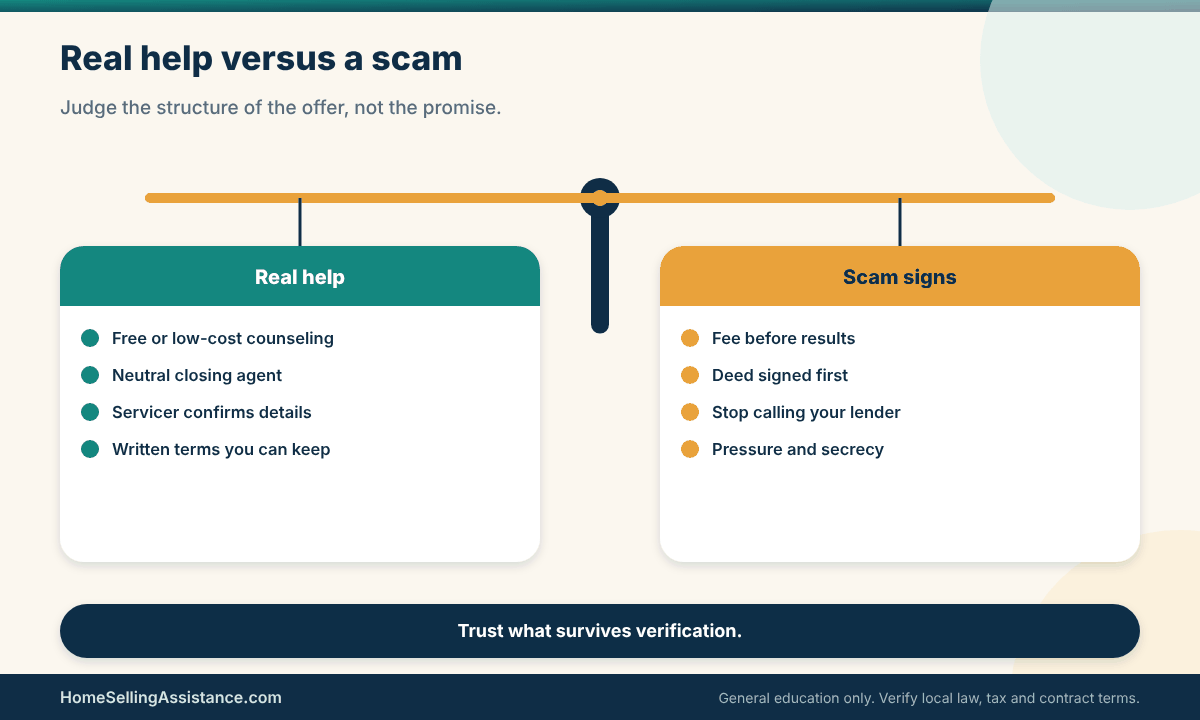
Against foreclosure rescue scams, the most reliable starting point is a HUD-approved housing counseling agency. These agencies are listed through HUD, they work with homeowners on default and foreclosure questions, and their services are free or low-cost in many cases. A counselor can look at your income, your loan and your timeline, explain the options a servicer may offer, and help you prepare an application. A counselor does not take your deed, does not ask for your account password and does not promise a particular outcome. Those absences are part of how you recognize the real thing.
Counselors, servicers and attorneys each cover a different piece. The counselor helps you understand and organize. The servicer decides whether to approve any workout or sale arrangement. An attorney advises on your legal rights, deadlines and risks. A well-run plan usually includes all three, and none of them should require you to hand over ownership of the house in exchange for a promise. When someone claims they can replace all three at once, that is a signal to slow down, not speed up.
It also helps to know why legitimate sales and short sales look different from foreclosure rescue scams, even when both involve selling quickly. A real sale transfers title at closing, at the same time money moves through a neutral escrow or title company, with a closing statement you can read before you sign. A scam transfers title first and promises money later. If you are considering a sale, our guide on a short sale as a house seller explains the lender approvals and paperwork that give the process its shape.
Quick scenario
A homeowner is contacted by two helpers on the same day. The first offers a free call, asks for a copy of her mortgage statement, and suggests she also talk to a HUD-approved counselor. The second wants a deed signed that evening and says the first helper “just wants to sell you something.” Both claims cannot be right, and only one helper is comfortable being checked. That difference, more than any promise, tells her whom to trust.
If you are not sure which side of that line a pitch falls on, you can always turn to the questions that have no good scam answer. Who holds my money, and where? Who becomes the owner of record, and when? What does the lender say about this arrangement, in writing? What happens if the plan fails? Who can I call at the office, and where is it? Honest professionals answer calmly. People running foreclosure rescue scams change the subject.
Frequently asked questions about foreclosure rescue scams
What are foreclosure rescue scams, in plain terms?
They are schemes that target homeowners who are behind on a mortgage and promise to save the house in exchange for money, a signature or ownership. Common forms include advance fees for loan help, deeds disguised as repayment papers, fake investor purchases and rent-back deals that never let you buy the home back. The details change, but the pattern of pressure, secrecy and payment before results stays the same.
Is it legal for a company to charge upfront fees for mortgage relief?
Federal rules restrict many companies that offer mortgage assistance relief from collecting fees before they have delivered a written offer from your lender that you accept. State laws differ, and rules for attorneys can differ again. Because these details vary, verify the specific rule through the CFPB, your state attorney general or a qualified lawyer before you pay anyone.
Can I be asked to sign my deed over to stop a foreclosure?
You can be asked, but you should treat the request as a major warning sign unless a real estate attorney you trust has reviewed it. Transferring title usually ends your ownership, and promises to rent the house back or sell it back later are often unenforceable in practice or hidden behind unfavorable terms. A real sale closes through a neutral escrow or title company, not at your kitchen table.
How do I check whether a housing counselor is real?
Use the HUD counselor finder and contact the agency using the phone number listed there, not one a caller gave you. Counseling from approved agencies is free or low-cost in many cases, so a demand for a large upfront fee is itself suspicious. You can also ask your servicer whether it recognizes the agency.
What if I already paid a company and now it will not answer?
Contact your card issuer or bank right away to ask about disputing or recalling the payment, and keep every record of what you paid and what was promised. Then report the company to the FTC, the CFPB and your state attorney general, and consider a local police report. None of these steps can guarantee a refund, but they create the record that makes recovery possible.
What if a deed has already been recorded in someone else’s name?
Speak with a real property attorney or legal aid office as soon as you can, and tell your title insurer if you have a policy. Some states give homeowners tools to challenge deeds obtained through fraud or misrepresentation, but outcomes depend on facts and local law. Do not rely on the scammer’s assurances, and do not sign anything further without legal review.
Should I stop talking to my servicer if a rescue company tells me to?
No. Cutting off contact with your servicer removes the one party that can actually approve a workout or postpone a sale. Keep your own communication open, keep notes of every call, and share only what the servicer requests. If a third party truly represents you, the servicer can confirm that authorization.
Are cash buyers who contact me about my pre-foreclosure house all scammers?
No, and it would be unfair to say so. Many investors buy distressed homes legitimately. The difference is process: a written contract, proof of funds, a neutral escrow or title company, a payoff figure from your servicer and a closing statement. A buyer who refuses these steps or asks for the deed first should not get your trust.
Where can I report foreclosure rescue scams?
Useful places include the FTC, the CFPB, the FBI’s Internet Crime Complaint Center for online or electronic fraud, your state attorney general, your state real estate or banking regulator and local police. File the same facts everywhere and keep your case numbers. A report helps you and may also help investigators connect foreclosure rescue scams to other victims.
Before you sign anything
The simplest defense against foreclosure rescue scams is to slow the conversation down until you can verify it on your own terms: call your servicer on the number you already have, ask a HUD-approved counselor to review the offer, and keep your deed in your name until a neutral closing agent is holding real funds. This article is general education, not legal, tax or financial advice, and rules vary by state, so talk with a qualified attorney or counselor about your own situation.