Every off market home sale seller is making a trade, whether they say so out loud or not: you give up some public attention in exchange for privacy, speed or control, and the real question is whether that trade leaves you with more money, less stress or both. This guide explains how a quiet sale works, what you can and cannot learn about price without a public listing, and how to decide between staying private and going to the open market.
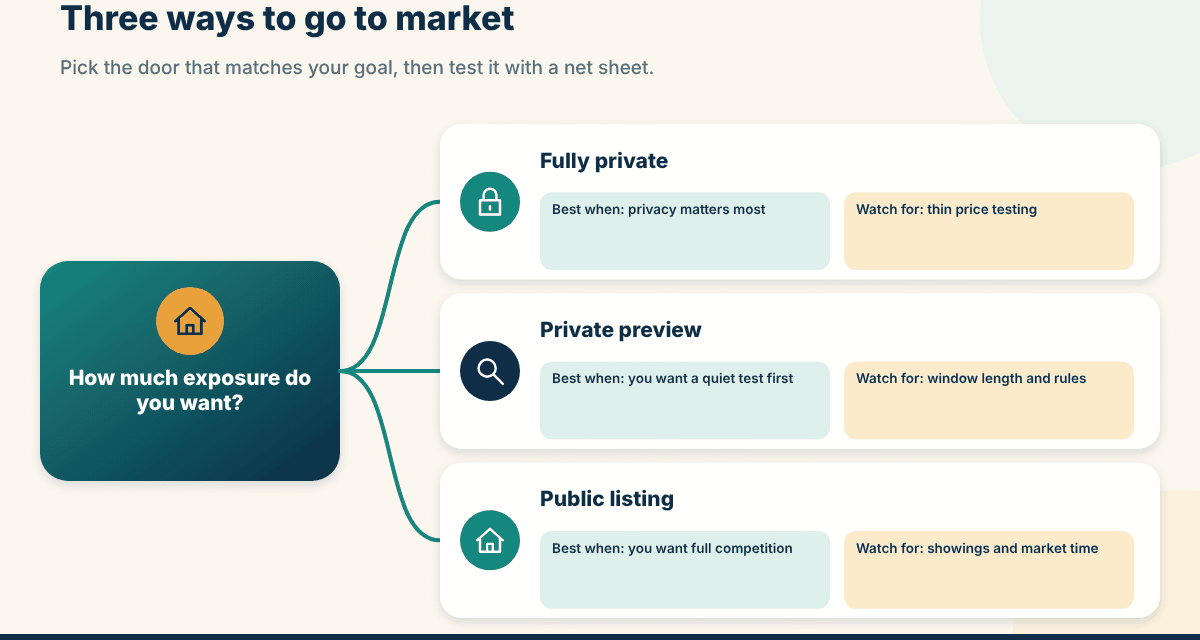
The phrase “off market” gets used loosely. Sometimes it means a house that is never advertised and is sold to a neighbor, a relative, an investor or a buyer someone’s agent already knows. Sometimes it means a property marketed privately for a short window before it appears on the multiple listing service. Sometimes it is just a sales pitch. Because the label covers so many situations, an off market home sale seller needs to ask what is actually happening behind the label before agreeing to anything.
We should say plainly where this article sits. It is part of our library on cash offers and alternative sale routes, and it works best alongside the broader guide to getting a cash offer for your house. Nothing here tells you to list publicly or to avoid doing so. Private sales suit some households very well, and they quietly cost others real money. The goal is to help you tell which group you are in.
One caution before the details. Rules about private marketing, agent duties, disclosure and contract forms differ by state, by local multiple listing service and by brokerage. The dollar figures below are round numbers invented to show the arithmetic, not predictions about your property or your market. Treat them as a way to practice the thinking, then replace them with real quotes.
Key takeaways
- Privacy has a price you can measure. An off market home sale seller should compare a private offer with a realistic public outcome using the same net-proceeds math, not feelings about hassle.
- Fewer buyers means less price discovery. A single private offer tells you what one buyer will pay, not what the market would pay, so test it against comparable sales and, if possible, a second opinion.
- “Off market” can mean several different things. Ask whether the sale is fully private, privately previewed first, or simply unadvertised, and who represents whom.
- Someone still has to do the transaction work. Disclosures, contract drafting, title, escrow and closing do not disappear when marketing does.
- Fair housing rules still apply. Keeping a sale quiet must never become a way of steering a home toward or away from people because of who they are.
- New facts should change the plan. A lapsed deadline, a weak appraisal or a buyer who cannot prove funds are reasons to widen exposure.
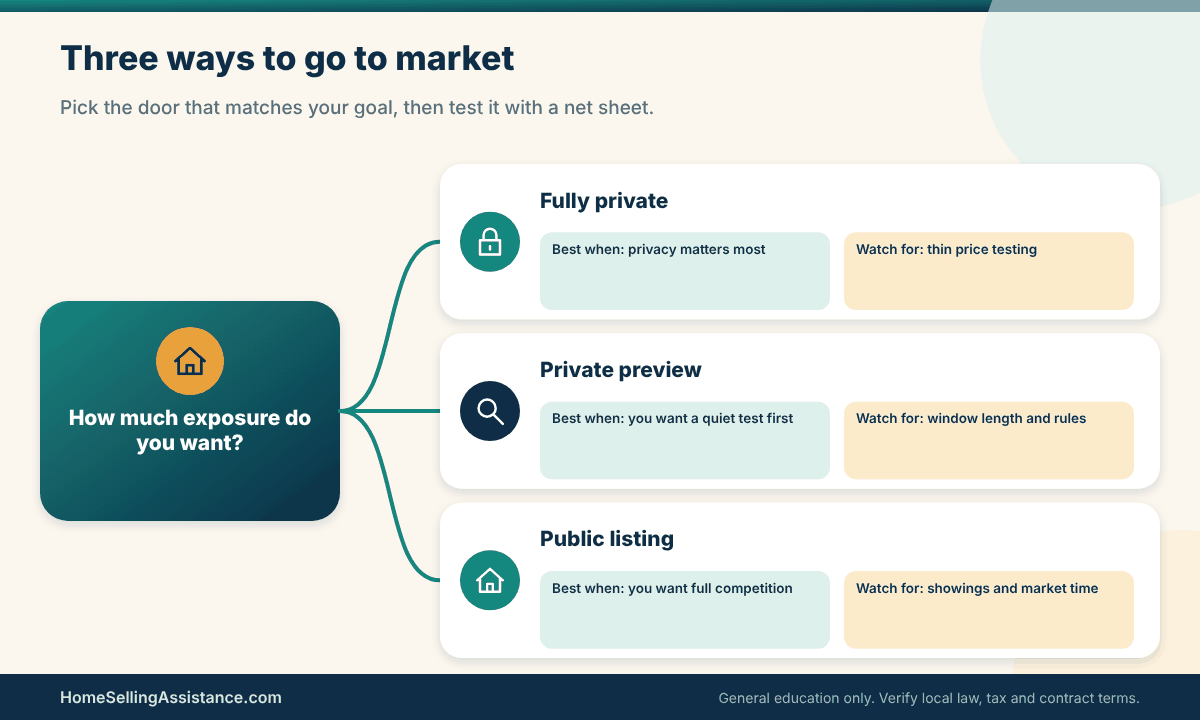
What the off market home sale seller is really deciding
Before comparing routes, it helps to be honest about what you want from the sale. A private route is a tool, and tools only make sense once the job is clear. Two sellers can both say “I want a quiet sale” and mean completely different things, one worried about neighbors and strangers walking through, the other worried about a deadline that will not move.
This first section helps you define your own choice. We start with your goals and constraints, then move to the facts that could quietly change the answer, such as a listing agreement you already signed or a tenant who has rights you did not expect.
Goal, timeline, cash needs, condition, and risk tolerance
Most sellers carry five variables into this decision, even when they have never written them down. Your goal might be the highest price, the shortest timeline, the least disruption or the most certainty. Your timeline is the date by which you truly need to close. Your cash needs describe what you must receive and when. Condition means what the house needs. Risk tolerance is how much uncertainty you can live with.
An off market home sale seller usually ranks privacy and convenience high. That is fine, as long as the ranking is a choice and not an accident. Write the five variables on one page and put a number or a plain sentence next to each. Where two of them conflict, such as a firm deadline and a hope for top price, decide which one wins before any buyer calls.
Evidence to gather: your payoff, your dates, your repair list
Start with the numbers that sit behind your goals. Request a current payoff statement from each lender or lienholder, because the balance on your last mortgage statement is rarely the figure a closing agent will use. Add property tax bills, any homeowners association balances, and a short list of known repairs with rough quotes from contractors rather than guesses.
Then write down your dates. Note when a lease ends, when a job starts in another city, when a new home closes, or when a loan modification or forbearance period runs out. These dates are the real clock on your home selling timeline, and a private buyer who knows your deadline may price accordingly. That is not a reason to hide the deadline from yourself.
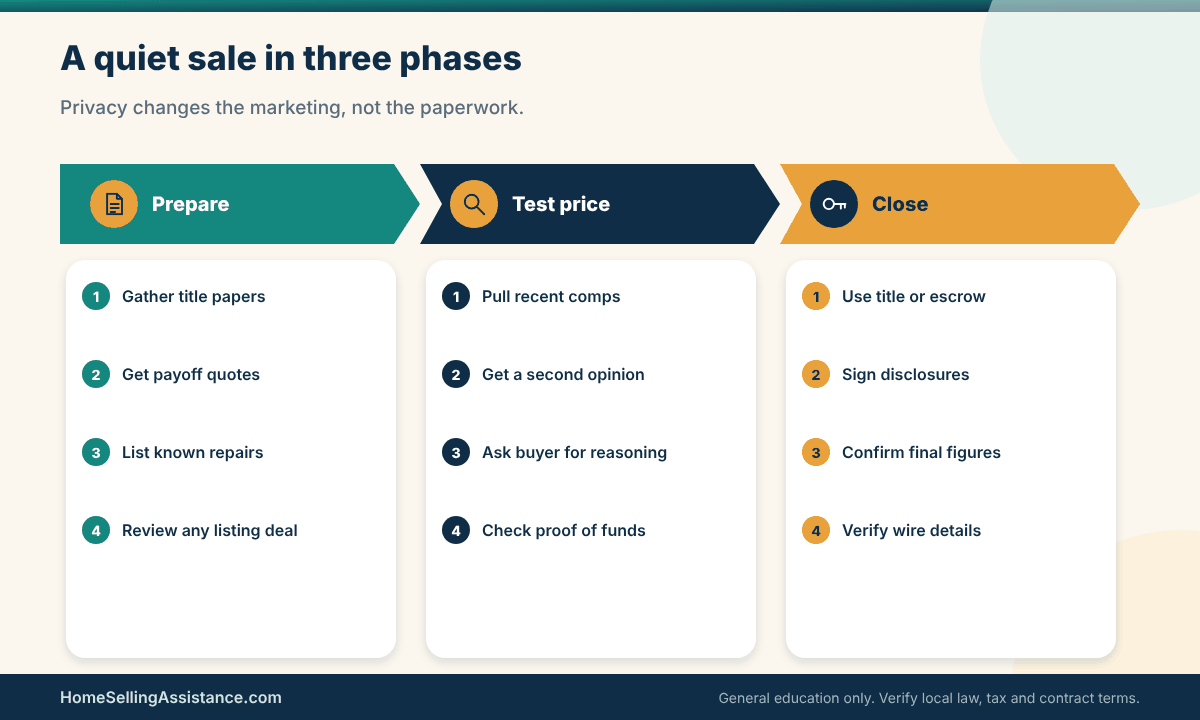
Finally, gather proof of what you own. The deed, any trust or estate documents, and a copy of any existing listing or broker agreement matter more than people expect, because they decide who can sign and who might be owed a fee. The checklist in documents needed to sell a house covers the usual set. A seller who has these papers in a folder can respond to a serious private buyer in a day instead of a week.
It also helps to put a price on your own time. A quiet sale can feel free because no one is photographing the kitchen, yet an off market home sale seller still spends hours on calls, document requests and follow-up. Estimate those hours honestly. Then estimate the hours a public sale would take, including cleaning before showings and rearranging your week around them. Neither number is a bargain, but knowing both makes the comparison fairer.
Cash needs deserve the same treatment. If you must buy your next home with the proceeds, a delay of a few weeks could cost you a purchase. If you do not, the same delay may cost you nothing. An off market home sale seller with spare cash and no deadline can afford patience, which is a bargaining strength that many private buyers will quietly test. Know which category you are in before the first offer arrives.
A scenario, an exception, and your next step for privacy-minded sellers
Picture a retired couple who raised their children in a house on a quiet street. They want few strangers in the home and no sign in the yard. Their timeline is flexible, their house is in good shape, and a neighbor’s adult child has mentioned interest. Here the route chosen by this off market home sale seller has real appeal: low disruption, a motivated buyer and no need to rush.
Now change one fact. Suppose the couple needs the sale proceeds to close on a retirement community by a fixed date, and the neighbor’s family is still arranging financing. The same private route now carries timing risk that the couple did not have before. The exception is not that privacy is wrong, but that privacy plus a hard deadline plus an unproven buyer is a combination to examine carefully.
Your next step in either case is the same. Write down your walk-away number in net proceeds, not sale price, and note the latest date you could accept a delay. Those two lines will make every later conversation clearer, including the one in which you decide whether to widen the audience for your home.
A short self-test can sharpen this section. Ask yourself whether you could explain, in two sentences, why an off market home sale seller like you would prefer this route over a public listing. If your reasons are privacy, a deadline or a property that suits a particular buyer, they are strong and specific. If your reason is “I heard it is easier,” pause. Ease is real, but it should show up in a net sheet, not just in a feeling.
It also helps to separate what you want from what you fear. An off market home sale seller who dreads open houses has a different problem from one who fears a low price, and the solutions differ. The first might choose limited showings by appointment under a public listing. The second might gather stronger price evidence before going private. Naming the fear points to the right fix.
Facts that could change the decision before you stay private
Some facts are invisible until someone asks the right question. A listing agreement can claim a fee even on a sale you arrange yourself. A tenant may have the right to stay under a lease. A co-owner may need to sign. Checking these facts costs little when done first and a great deal when discovered at the closing table.
Evidence to check: MLS rules, listing agreement, and local custom
If you are working with a listing agent, or have in the past, read the agreement itself. Look for the term, any clause that protects the agent’s fee when you sell to someone you found, and any language about marketing the home privately before public exposure. Many agreements address this directly, and the wording differs from one brokerage to another. If you cannot tell what a clause means, ask the brokerage for a written explanation.
Local multiple listing services also have rules about when and how a home must be shared with the wider agent community, and those rules have been revisited in recent years. We will not describe them in detail because they differ by MLS and change over time. Ask your agent, the local MLS or your state real estate commission how private marketing is treated where you live, and get the answer in writing if it affects your plan.
Local custom matters too. In some areas attorneys draft every contract; in others, title or escrow companies guide the process and standard forms dominate. If an investor or buyer offers their own contract, compare it to the usual local form. A document that is quite different from what neighbors typically sign deserves a careful read by a licensed professional before you put a pen to it.
A scenario with a tenant, an HOA, or a co-owner
Consider a landlord who wants to sell a rented house quietly to an investor. The lease may remain in force after sale, may be subject to notice requirements, or may carry a purchase option or other terms that affect value. State and local landlord-tenant law varies a great deal, and a buyer will ask to see the lease, the rent history and the deposit records. A private sale does not shield you from any of that.
Condos and planned communities add another layer. A homeowners association may have a right of first refusal, resale certificate requirements or fees tied to a transfer. A co-owner or a spouse may also have to sign, depending on how title is held and where you live. If any of these apply, an off market home sale seller should confirm them early.
The practical next step is a short list of questions for a title company or real estate attorney: who must sign, what must be disclosed, and what recorded interests exist. Asking them before you accept a private offer keeps a promising conversation from stalling for reasons nobody could see. Our guide to the title search for a home sale explains what that review usually turns up.
Comparing a private route with open-market exposure for the off market home sale seller
With your goals and constraints written down, you can compare two realistic paths on equal terms. The first is the quiet sale, where the house is offered to a limited audience or to one known buyer. The second is the public listing, where the home is marketed broadly and offers compete. A third, hybrid path sits between them, and we will cover it in its own subsection.
The table below lines up the two main options across the things that usually decide the outcome: net proceeds, time, contingencies, workload and execution risk. Read it as a set of prompts, not a verdict. Every cell describes a tendency that your market, your buyer and your contract can overturn.
| Factor | Private off-market sale | Public listing | Who carries the work | What could flip it |
|---|---|---|---|---|
| Price and net proceeds | One or few offers; price tested less | Competing offers can reveal value | Seller checks comps either way | A strong appraisal or multiple bids |
| Time to close | Can be fast if buyer is ready | Prep, showings and market time | Seller and any agent | Buyer financing or title delays |
| Contingencies | Negotiable; may be few or many | Often inspection, appraisal, financing | Seller reviews every term | Cash buyer with proof of funds |
| Workload | Less staging; more paperwork ownership | Staging, photos, showings | Depends on who is hired | Whether an agent supports a private deal |
| Privacy | High; fewer strangers and no public record of listing | Low during marketing | Seller sets access rules | Safety or neighbor concerns |
| Execution risk | Unproven buyer, thin paperwork | Deals can still fall apart | Title company and lender | Verified funds and clean title |
To use the matrix, copy it onto a page and circle the row that matters most to you. If it is price, the first row is where you should spend your effort. If it is certainty, look at the contingency and execution rows. Then fill in the blanks with real figures from your own quotes so the page stops being general and starts describing your house.
Option one: the quiet, off-market route and its trade-offs
A quiet sale can be very simple for the off market home sale seller who is prepared. A buyer is identified, an offer arrives, terms are negotiated, and the transaction moves through title and closing without public marketing. For an off market home sale seller with a clean property and a willing, verified buyer, that simplicity is the main attraction. The trade-off is that simplicity can hide gaps in price testing and protection.
How an off market home sale seller can test price without a public listing
The central weakness of a private sale is price discovery. In an open listing, the market tells you what buyers will pay by how they respond. In a private sale, you rarely get that signal, so you need substitutes. Gather recent sales of similar homes nearby, ideally from the last few months, and note their condition, size and features. An agent can prepare a comparative market analysis, and licensed appraisers can provide a formal valuation for a fee.
A second substitute is a limited second opinion. You might ask one or two agents for a written opinion of value with no obligation to list, or request a short evaluation from a different buyer. If a private buyer’s number sits comfortably inside the range of reasonable estimates, you can proceed with more confidence. If it sits far below, ask why before accepting.
A third approach is simply to ask the buyer for their reasoning. Serious buyers, investors included, usually have a method. They might subtract repair costs from a resale value, or account for carrying costs and their own profit target. Our guide to an investor offer versus listing your house walks through that logic so you can recognize it. A buyer who cannot explain a number is not necessarily dishonest, but you cannot judge the number either.
A scenario where quiet works, and one where it does not
Imagine a seller whose home needs a new roof and some interior updates. A local buyer with a renovation crew offers a fair-looking price, no inspection contingency and a short closing. Compared with the cost, mess and delay of fixing the home and listing publicly, the private sale may leave the seller as well off or better. Here the buyer’s willingness to take the house as it stands carries real value.
Now picture a seller whose home is in excellent condition in a neighborhood where well-kept houses attract many offers. A private buyer offers a price near the low end of recent sales and presses for a quick yes. The speed and quiet may feel appealing, yet the seller may be giving up the very competition that would have lifted the price. The offer is not automatically bad, but it needs testing against realistic public results.
The deciding fact in both stories is not privacy. It is how much value the market would add compared with what the buyer’s terms take off. Work that out in dollars before you answer. If the gap is small, a quiet sale can be sensible. If it is large, widening exposure is worth considering, and the guide on how to evaluate a home offer as a seller can help you weigh the terms.
A short script can keep early conversations on track. When a private buyer calls, you might say: “Thanks for your interest. Before we talk price, can you send proof of funds or a lender letter, and tell me which title company you would use?” That is polite, clear and fair. A genuine buyer will usually answer within a day or two. An off market home sale seller who asks these questions early filters out time-wasters without being rude.
A second script covers price. You might say: “I am comparing a few ways to sell, so I would like to understand how you reached your number.” Then listen. Good answers mention recent sales, repair costs and carrying costs. Vague answers that rely on urgency or secrecy are harder to evaluate. You are not obliged to share your own deadline, your walk-away figure or your other conversations, and keeping those details to yourself is ordinary negotiation, not dishonesty.
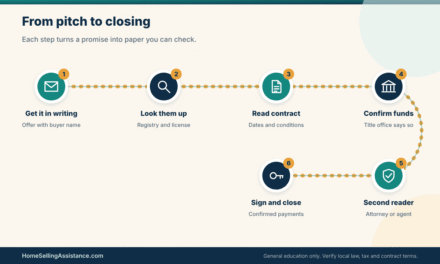
Finally, keep every important step in writing. Offers, extensions and changes to terms should arrive by email or in a signed document so that nothing depends on memory. If a buyer prefers only phone calls and refuses to put anything in writing, treat it as a signal. The clearest benefit of a written record for an off market home sale seller is that it makes later disputes much less likely.
Option two: the public listing path
A public listing puts your home in front of the widest practical audience, usually through the local multiple listing service and the sites that draw from it. It brings photographs, showings and scheduled offer deadlines. It also brings disruption and visible market time. For some sellers that is a fair price to pay; for others it is the reason they are reading this article.
What public exposure buys: buyer pool and price discovery
The main thing public exposure buys an off market home sale seller is a larger buyer pool. More buyers means more chances that someone values your home’s particular features more than the average person does. It also means more data. If many showings produce no offers, that is information. If several offers arrive, that is information too, and it can improve terms as well as price.
Public listing also often comes with professional support. A listing agent can handle marketing, screening, negotiation and the timeline, and the cost is a negotiated fee that must be written down in the listing agreement. Compensation is negotiable, and it is worth understanding exactly who is paid what before you sign. For a comparison of seller-led and agent-led routes, see FSBO versus a realtor.
Against those benefits, an off market home sale seller should count the costs honestly. Preparing and staging a home takes time and sometimes money. Showings affect daily life. A long time on the market can make buyers wonder what is wrong. None of these costs is automatic or fixed, but an off market home sale seller who dismisses them is not weighing the options fairly.
A middle route: limited-time private marketing, then public
Some sellers and agents use a short private window before a public launch. The home is shown to a selected audience, such as an agent’s own network, for a limited time. If a strong offer arrives, the seller can accept it; if not, the home goes public with a clear start date. Because multiple listing service rules and brokerage policies differ, this approach is allowed in some places and restricted in others.
The appeal is that you test demand without committing to a full public campaign. The risk is that a long private window can reduce your exposure at the moment when the home is freshest, and some buyers feel shut out. Ask any agent proposing this path to put the length of the window, the rules that apply and any fees in writing.
Fair housing principles apply to every step. Limiting who sees your home must never be based on race, color, religion, sex, disability, familial status or national origin, and agents are bound by the same rules. The federal overview at HUD’s Fair Housing and Equal Opportunity pages explains the basics, and our guide on fair housing for home sellers turns them into everyday practice. If a private plan depends on who the buyers are rather than on their offers, stop and ask for advice.
Before moving on, one practical habit is worth building. Whatever route you lean toward, write a single paragraph that states why, in plain words, and keep it with your notes. An off market home sale seller who can read that paragraph back a week later, after a few phone calls and a tempting offer, will notice quickly if the reasons have shifted. Changing your mind for good reasons is wise; drifting without noticing is how sellers end up with outcomes they did not choose.
A net-result decision rule for any off market home sale seller
The cleanest way to settle the choice is to stop comparing sale prices and start comparing what lands in your account. A higher price with heavy costs and a long timeline can net less than a lower price that closes quickly with few deductions. This section gives you a simple rule you can apply to any offer, private or public.
The rule is short. Estimate your net proceeds under each realistic path, adjust for time and risk in plain dollars, and choose the path whose adjusted result you would be comfortable defending to a friend. The details below show how to build it. If you want a deeper look at the arithmetic, our guides on home sale net proceeds and seller closing costs go line by line.
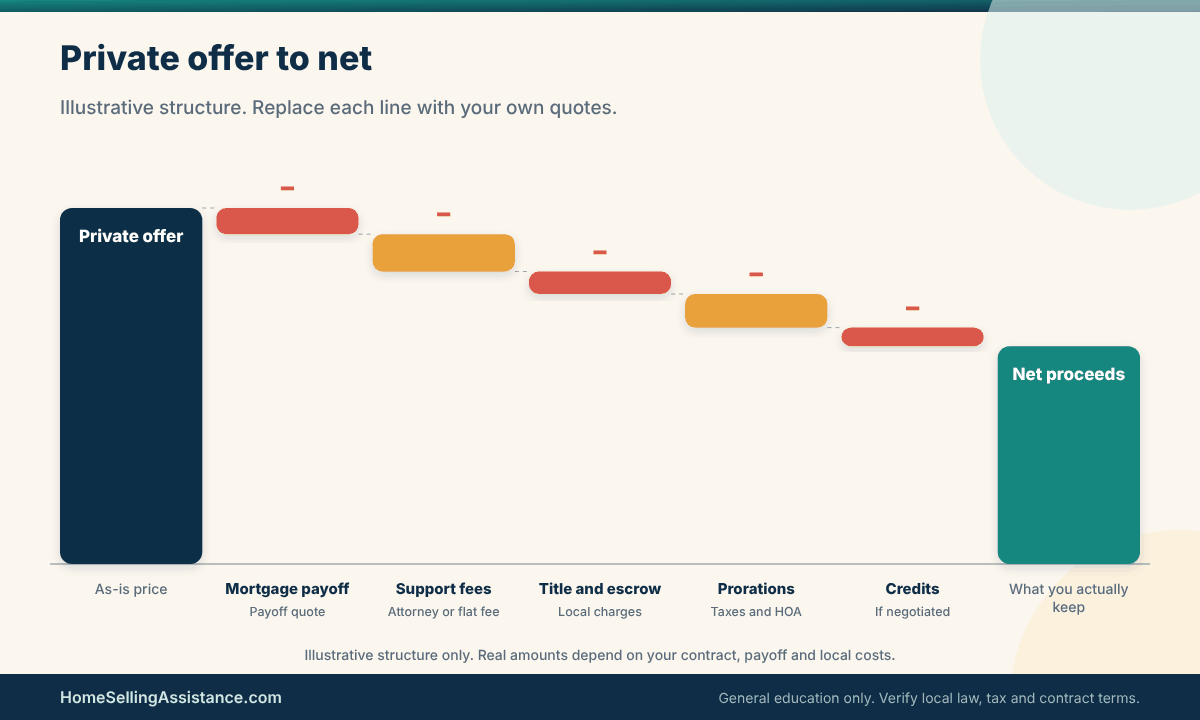
A price, time, cost, and risk framework
Four questions sit under every offer. What is the price on paper? How long until the money arrives? What will it cost to get there? What is the chance it does not close, and what happens then? Writing an answer to each, for each option, turns a vague hunch into something you can compare.
Calculation: building two net sheets side by side
Take two columns on a page, one for the private offer and one for a realistic public outcome. In each, start with the price and subtract the mortgage payoff, any other liens, broker or agent fees you have agreed to, title and escrow charges, transfer taxes where they apply, prorated property taxes and association dues, and any repair credits you expect to give. Real quotes should replace every guess as soon as you can get them.
Now add the costs that rarely appear on a closing statement. A longer public timeline means more months of mortgage interest, taxes, insurance and utilities. Staging, cleaning, photography and minor repairs have costs too. A private sale may avoid some of these, but it may also leave you paying for items a buyer would otherwise have negotiated, so keep both columns honest.
Here is an illustration with round numbers, labelled as an example only. Suppose a private buyer offers $380,000 as is, with a quick close. A public listing might attract an offer of $400,000, but after agent fees, repairs and two extra months of carrying costs, the net sheet shows a gain of perhaps $6,000 over the private route. That small gap may not justify the extra effort and uncertainty. If the gap were $30,000, the answer might change. The principle matters more than the numbers.
Use the same discipline when someone explains a fee. Ask for the amount in writing and ask what it covers. Our guide to the seller closing statement shows where each charge normally appears, which helps you spot items that do not belong. An off market home sale seller who builds two net sheets before negotiating is far harder to rush.
Scenario: a lower private offer that still nets more, and one that does not
Consider two sellers who each receive a private offer noticeably below what a friend says the house might fetch publicly. The first seller owns a home needing significant updates, owes little on the mortgage and faces a long carrying cost every month it sits. After building the net sheets, the private offer comes out close to the public estimate, and the private buyer closes without repairs. For this off market home sale seller, the discount mostly disappears.
The second seller owns a turnkey home in a busy market and has no deadline. The net sheets show that the public route would most likely leave several thousand dollars more in pocket even after fees. The private offer, though convenient, gives up that margin in exchange for comfort. This off market home sale seller may still choose privacy, but would be doing so knowingly and at a stated price.
These stories share one lesson. The percentage gap between offers means little until costs, time and risk are included. Compare adjusted nets, not headline prices. If the adjusted gap is small, take the option you trust more; if it is large, ask what exactly you are buying with the discount, and whether you would pay that amount for it if it were itemized.
Time and risk can be priced in plain dollars, which makes them easier to compare. For time, add up the carrying costs of the months you expect to wait under each route. For risk, ask what you would lose if the buyer failed to close, and how long it would take to recover. A private deal that collapses after you have stopped showing the home can cost weeks of lost momentum, so give that scenario a dollar value of its own.
Many sellers also find it useful to rank outcomes instead of chasing a single best number. Write down your best realistic case, your expected case and your worst case for each path. An off market home sale seller who sees a decent worst case under the private route may be comfortable with it. One who sees an unacceptable worst case, such as missing a closing on the next home, may prefer a path with wider exposure and more backup buyers.
The next table collects common seller situations and the route each tends to favor. These are tendencies, not rules, and the last column shows the fact that would change the answer. Use it to see which row looks most like your own circumstances, then test your facts against it before you decide.
| Situation | Route favored | Reason | Trade-off | Fact that changes the choice |
|---|---|---|---|---|
| Needs heavy repairs and wants no showings | Private sale to a verified buyer | Buyer accepts condition | Lower price likely | Repair quotes smaller than the discount |
| Turnkey home, flexible timeline | Public listing | Competition can lift price | Showings and market time | Strong private offer near market value |
| Public figure or safety concern | Limited private marketing | Controls who sees the home | Smaller buyer pool | Security measures that make public viable |
| Fixed move date within weeks | Verified private cash offer | Certainty of timing | Possible price discount | Proof of funds not confirmed |
| Rented home with tenants | Private sale to investor, or public | Tenant terms may suit investors | Lease and notice limits | Lease rights under local law |
| Sale to a neighbor or relative | Private, with full paperwork | Known buyer, simple terms | Price may drift from market | Lender or tax rules on the sale |
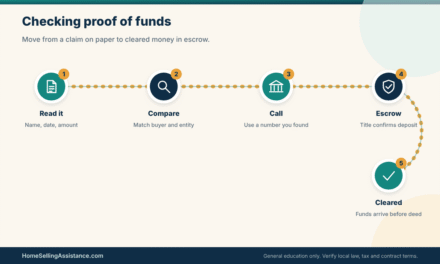
When you use this table, notice how often the final column is something you can verify rather than guess. Proof of funds, lease terms, repair quotes and lender requirements are all documents. If you can gather them quickly, your decision becomes much firmer. The guide on proof of funds from a cash buyer shows what acceptable evidence looks like.
Think of the rule as a loop rather than a one-time calculation. Each time a fact changes, such as a new offer, a repair quote or a lender comment, you refresh the two net sheets and ask the same four questions again. The off market home sale seller who keeps that loop running is rarely surprised, because the numbers are always current. The one who calculates once and then relies on memory tends to be surprised at the worst moment.
When new evidence should change the plan
A good plan is not one you never change. It is one you decide in advance how to change. Private sales are especially sensitive to new evidence because there is little market feedback to cushion surprises. Setting your tripwires ahead of time keeps you from sliding into a bad deal because you have already invested emotion in it.
Evidence that should widen exposure: red flags to watch
Several signals suggest an off market home sale seller should broaden the audience. A buyer who cannot or will not show proof of funds is one. A buyer who keeps changing terms after you agree is another. Pressure to sign quickly, to skip a title company, or to wire money or sign unfamiliar documents before verification should stop the process entirely. The guide to how to verify a cash home buyer lists practical checks.
Appraisal or valuation surprises matter as well. If an independent opinion comes in well above a private offer, you now have evidence about the price gap. If the buyer’s lender appraisal falls short, you may have to renegotiate, wait for a new buyer or reconsider the route altogether. Neither result is a failure, simply information that deserves a response.
Fraud deserves a separate mention. Private, unadvertised sales attract impostors, and every off market home sale seller is a potential target who claim to be buyers, agents or title representatives. Be careful with any request for wire transfers or last-minute changes to payment instructions, and confirm instructions by calling a known number. The Federal Trade Commission’s consumer site publishes scam alerts, and our guide to real estate wire fraud explains how these schemes tend to unfold.
Next steps when a private plan stalls or a better option appears
If a private deal stalls for an off market home sale seller, decide in advance how long you will wait. Perhaps you give a buyer seven days to supply documents, as an example, and then you move on. Put that date in writing in your notes, and if you have an agent, in your communications too. A clear deadline keeps a hopeful conversation from running past the point where waiting costs you.
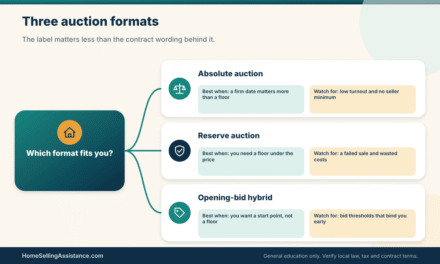
When a better option appears for an off market home sale seller, take a breath and compare it on the same net sheet. A higher number from a new buyer may carry weaker terms. A lower number from a verified buyer may be worth more in practice. Check whether your agreement with any agent or buyer limits what you can do. If a deadline is looming, a home auction versus a listing comparison may also be worth a look.
If your private plan falls through entirely, you are not back at zero. You now know more about your home’s value, your buyer pool and your own priorities. A public launch after a quiet attempt is common and rarely a disaster, particularly when you have your documents ready. The cash offers and alternative sales library covers related routes if you want to compare further.
A final point about confidence. No framework removes uncertainty, and an off market home sale seller should be wary of anyone, including us, who claims to know the exact price a quiet sale will bring. What the framework does is replace guesses with documents, deadlines and written terms. When those are in place, either route can be a sound choice, and the better one is simply the one that matches your goals and leaves you with a result you understand.
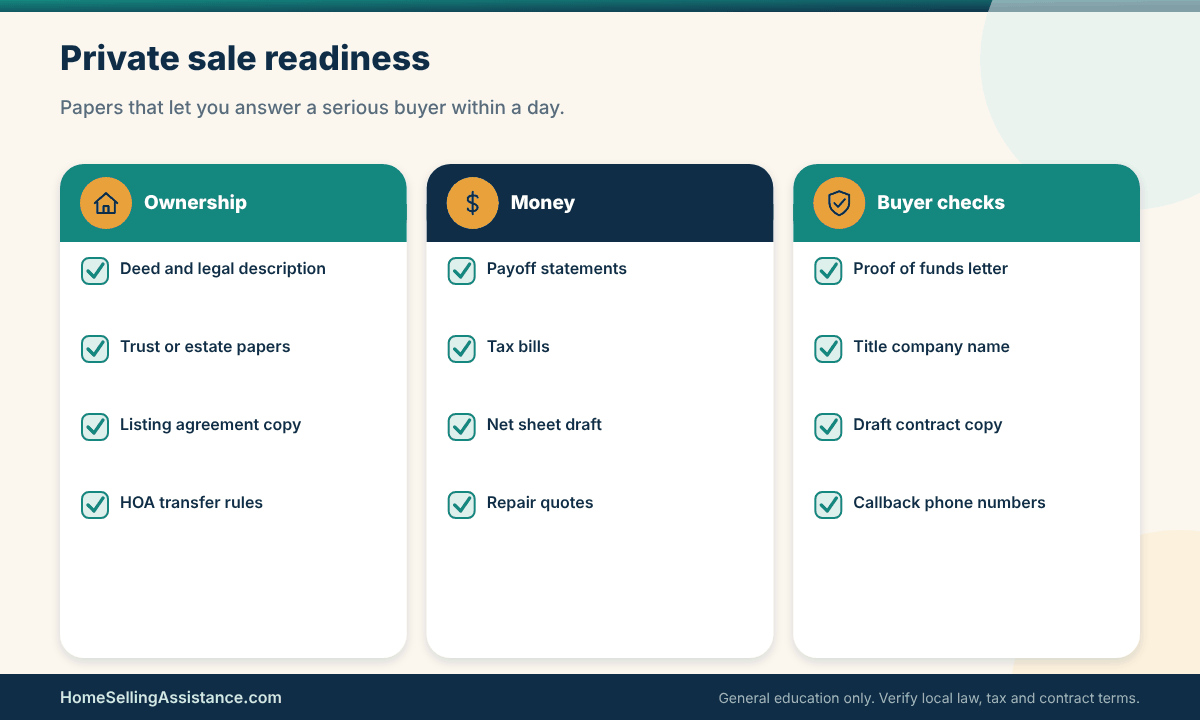
Here is a simple way to stay organized when a stalled deal tempts you to improvise. Keep a one-page log with three columns: what was promised, the date it was due and what actually happened. When two dates pass without delivery, the log tells you it is time to act on your tripwire, instead of waiting another week out of politeness. For an off market home sale seller, that log is cheap insurance, and it also helps any agent or attorney you bring in later.
If you do widen exposure, do it deliberately. Choose a start date, decide on the price you will list at, and prepare photos and documents before launch. A planned launch after a quiet attempt looks very different to buyers than a panicked relisting. Agents can explain how the local market treats homes that were privately shopped first, and what disclosures, if any, your multiple listing service expects about earlier private marketing.
One more layer sits under all of this, and it is the one private sellers most often underestimate: transaction support. When marketing disappears, the rest of the work does not. Someone still has to prepare the disclosures your state requires, draft or review the purchase contract, order title work, coordinate the escrow or closing agent, track deadlines and confirm the final figures. In a public sale, an agent often carries many of these tasks. In a private sale, you either hire help or carry them yourself.
That does not mean an off market home sale seller must use a full-service agent. Some pay a real estate attorney for a flat fee to draft and review the contract. Some use a flat-fee listing service for paperwork support, which our guide to a flat-fee MLS seller explains. Others use a title or escrow company in states where they run the closing. What matters is that every task has a named owner before you accept an offer, and that the cost of that support appears on your net sheet.
Disclosure is the task that most often falls through the cracks for an off market home sale seller. Selling privately does not remove your duty to disclose known material defects where your state requires it, and for homes built before 1978 federal rules require lead-based paint disclosures; the EPA’s real estate disclosure page describes the basics. Our guide on seller disclosure requirements explains how state forms differ. A sale that skips disclosure to stay quiet can create legal exposure later.
Quick scenario
A seller receives a private offer on a Friday with an “expires Sunday” deadline. Instead of answering, they ask for proof of funds, a copy of the proposed contract and the name of the title company. By Monday morning the buyer has supplied the contract but not the funds letter. The seller extends the deadline by two business days in writing, and keeps a short list of agents to call if the proof does not arrive. The pressure drops, and the decision becomes a matter of paperwork rather than nerves.

Frequently asked questions about off market home sale seller decisions
What does it mean to sell a house off market?
It means the home is not publicly advertised on the usual listing channels, at least at first. The buyer might be a neighbor, a relative, an investor or someone found through an agent’s private network. Some sellers use a short private window before listing publicly. The details differ by local rules and by who is helping you, so ask what exactly is being proposed.
Will an off market home sale seller get a lower price?
Not necessarily, but the risk is real. Fewer buyers see the home, so you lose the competitive pressure that sometimes lifts a price. A private buyer may also factor in repairs, speed and certainty. The honest way to answer is to compare adjusted net proceeds against a realistic public outcome, using comparable sales and written quotes rather than hopes.
Does an off market home sale seller still need an agent or attorney?
The law on this varies by state, and some states routinely involve attorneys at closing. Even where you are free to go without either, the paperwork still has to be done correctly. Many sellers hire a real estate attorney or a flat-fee service for contract review. Decide who owns each task, and price that help into your net sheet before agreeing to terms.
Can I be charged an agent fee on a private sale?
Possibly, if you signed a listing agreement that protects the agent’s fee even when you find the buyer yourself. Read the term, the cancellation language and any protection period before you talk to private buyers. If the wording is unclear, ask the brokerage for a written explanation. Broker compensation is negotiable and must be written down, so nothing should be left to assumption.
How can an off market home sale seller tell whether a private offer is fair?
Gather recent comparable sales, ask one or two agents for a written opinion of value, and consider a professional appraisal if the stakes are high. Then ask the buyer to explain how they reached their number. A fair offer usually fits within the range of reasonable estimates once repairs and costs are accounted for. If it does not, ask why before replying.
Is it safe for an off market home sale seller to share an address and photos with private buyers?
It is sensible to be careful. Verify who you are talking to, share only what is needed and keep valuables out of sight during any visit. Use a trusted agent or a closing professional as an intermediary if you are uneasy. Our guides on seller safety explain how to screen visitors and protect your information during a quiet sale.
What if a private buyer asks an off market home sale seller to skip the title company?
Treat that as a red flag. Title work, escrow and a properly recorded deed protect both sides. A buyer who resists independent, neutral closing steps may be trying to avoid verification. You can suggest a title company you chose yourself, and if the buyer refuses without a good reason, you can usually walk away at no cost before signing.
Does selling privately change my taxes?
The route you choose does not by itself change how a sale is taxed, but the price, your basis and your ownership and use history do. The federal rules on the home sale exclusion are explained in IRS Publication 523. Your situation may differ, so speak with a qualified tax professional about your own facts.
Can an off market home sale seller list publicly later if the private route fails?
Usually yes, unless a signed agreement says otherwise. Many sellers try a quiet approach first and then list publicly. The main cost is time, so set a clear deadline for the private effort. Gather your documents in advance, and be ready to explain to a listing agent what happened during the private period.
A calm way to decide
An off market home sale seller does not have to choose between privacy and a good result, but should know the price of each. Build two net sheets, verify the buyer, write down who owns every task, and keep a date by which you will widen exposure if the quiet route stalls. This article is general education, not legal, tax or financial advice. Local rules vary, so confirm the details with your state real estate commission, a title company, and a licensed attorney or tax professional.