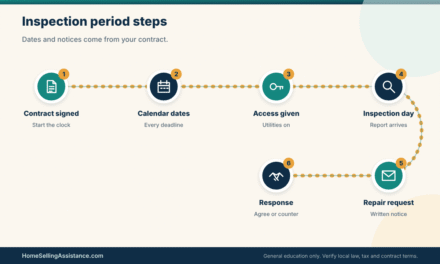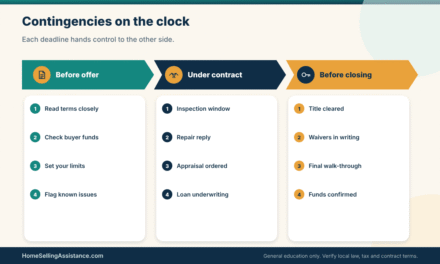
A deal fell through after inspection seller situation feels personal even when it is purely mechanical: you accepted an offer, you stopped answering the phone every time a stranger wanted a showing, you may have started packing, and then a report arrived and the buyer walked away. The first twenty-four hours matter less than the next two weeks. What you disclose, what you repair, how you relist and how you reprice will shape whether the second attempt goes better than the first.
This guide is written for the owner who is sitting with a terminated contract and a lot of questions. In a deal fell through after inspection seller case, did the buyer have the right to leave? Do you have to tell the next buyer what the inspector found? Should you fix the roof flashing, offer a credit, or sell as-is? Is it time to drop the price, or was the problem never the price at all? We will work through those questions in order, using documents and deadlines rather than guesswork.
One honest caveat up front. Contracts, disclosure forms, earnest money rules and inspection customs differ from state to state and sometimes from county to county. Nothing here replaces your own purchase agreement or a conversation with a licensed agent or real estate attorney in your state. What we can do is show you what a careful seller checks, what to ask, and where the decision points sit, so the deal fell through after inspection seller experience becomes a short detour instead of a spiral.
A last note on tone. Buyers back out after inspections for many reasons, and most of them are not an accusation against you or your house. Some are about a single serious defect. Some are about a financing plan that could not absorb a repair bill. Some are plain nerves. Sorting out which one you are dealing with is the real work of any deal fell through after inspection seller recovery, and it is covered in the pages ahead.
Key takeaways
- Read the termination before you react. The paperwork shows which contingency the buyer used, whether notice was timely, and who has a claim to the earnest money.
- Treat the inspection report as information you now hold. In many states, known material defects must be disclosed to the next buyer, and your forms and local rules decide how.
- Separate safety and structure from cosmetic items. Fixing a few high-impact problems with receipts often serves you better than a scattershot repair list.
- Do not reprice on emotion. Compare showing feedback, days on market and fresh comparable sales before changing the number.
- Relist with a clean story. Decide in advance how you will describe the history, the repairs and the documents available to buyers.
- Get every release and refund in writing. A signed termination, a deposit release and your own records protect you long after the deal is over.
Build your file first: what to gather before you touch the listing
When a contract ends, the temptation is to change the listing photos by lunchtime. Resist it for a day. In any deal fell through after inspection seller case, a calm hour with the paperwork will tell you more than a week of guessing, and it keeps you from making promises to the next buyer that the first deal already complicated.
Gather the documents, numbers, contacts and deadlines
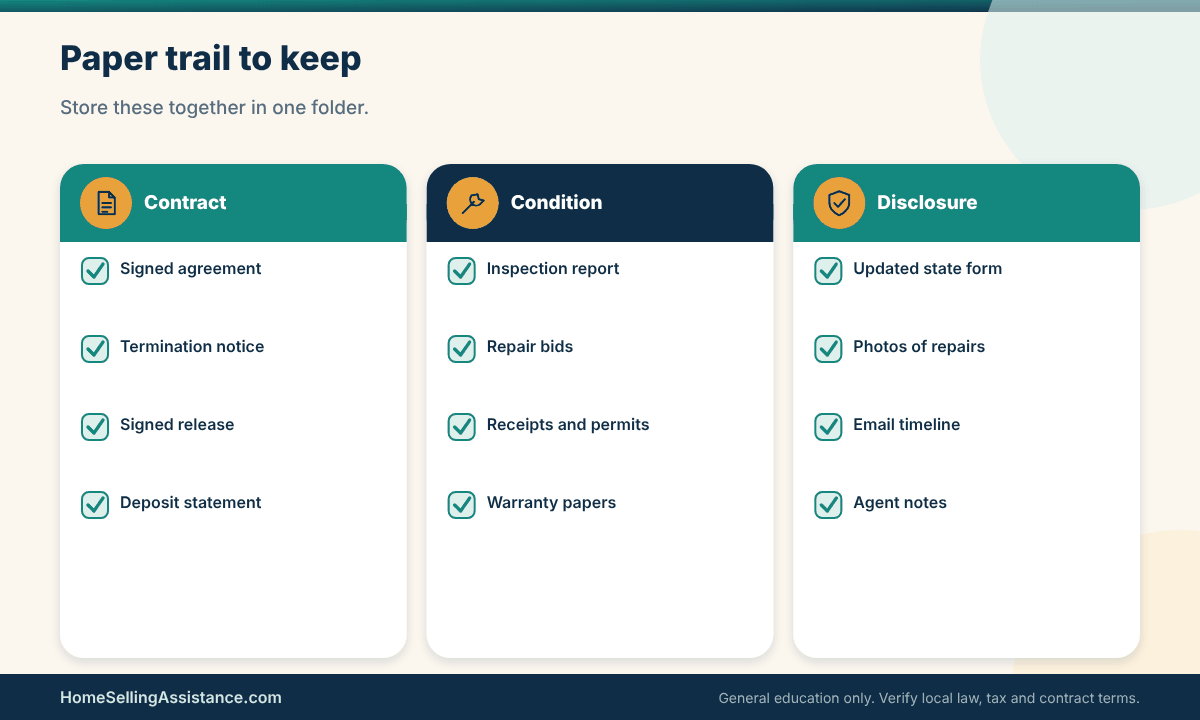
Start with a simple folder, paper or digital, that holds everything the first transaction produced. It does not need to be fancy. It needs to be complete, because every later decision in a deal fell through after inspection seller checklist leans on something inside it.
Evidence to gather: the contract, the report and the termination
Pull the signed purchase agreement with every addendum, counteroffer and amendment. Find the inspection contingency clause and read the three things that control everything else: how many days the buyer had, what the buyer was allowed to do inside that window, and what notice the buyer had to deliver to end the contract. Many contracts require written notice delivered a specific way. A text message from a buyer’s agent may not meet that standard.
Next, collect the inspection report itself, plus any specialist follow-ups such as a sewer scope, a roof opinion, a radon test or a structural engineer letter. If the buyer’s side did not share the full report, ask for it in writing. Some contracts require the buyer to provide copies on request, and some leave it to goodwill, so ask politely and keep the reply.
Then find the termination paperwork. This might be a notice of termination, a repair request with no agreement reached, or a mutual release. Note the date and time it arrived and by what method. If your agent, attorney or title company received it first, ask them for a copy and for a short written timeline of who said what and when. A one-page timeline written today is worth far more than memory next month.
Finally, gather the numbers. Write down your mortgage payoff estimate, the earnest money amount and where it is held, any prepaid listing costs, and what the first buyer’s requested repairs were estimated to cost. You are not building a case against anyone. You are building a clear picture so that the next offer can be judged against real figures.
A scenario, an exception and your next step
Consider an illustrative deal fell through after inspection seller case. A seller accepts an offer on a Friday, the inspection happens the following Wednesday, and the buyer’s agent emails a termination on day five with a photo of a cracked foundation corner. The seller assumes the buyer simply panicked. When she reads the contract, she finds the inspection window was ten days and the buyer had also asked for a repair negotiation first.
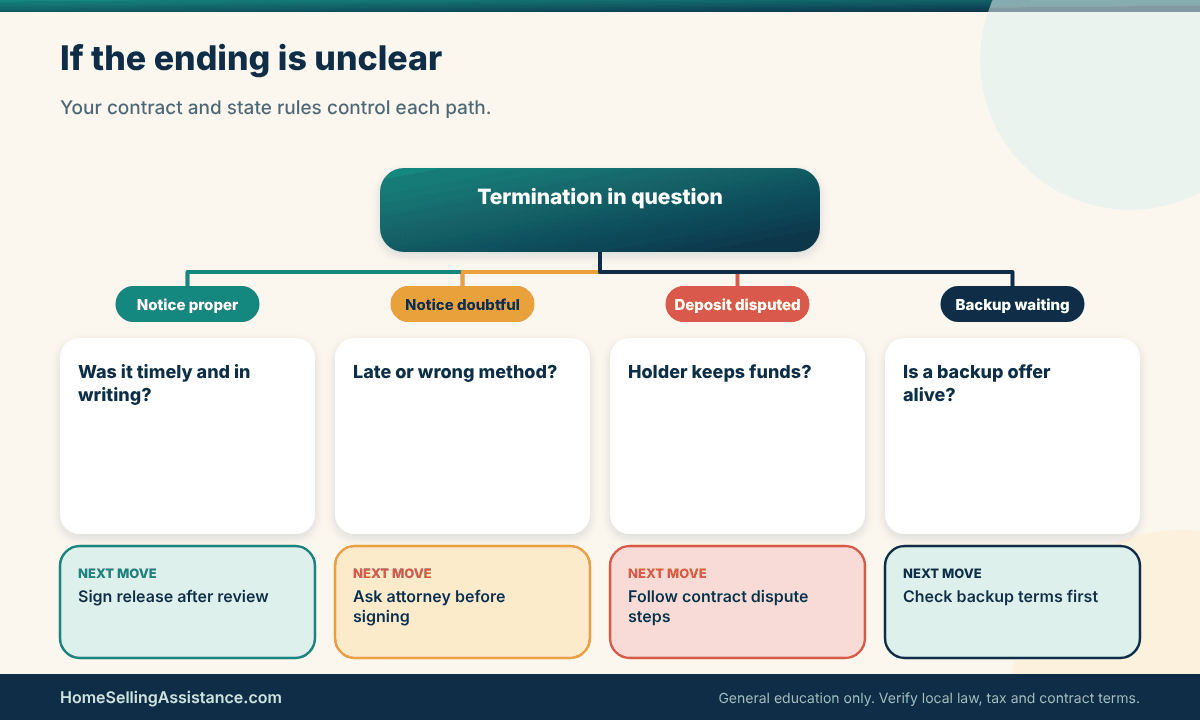
That detail changes the next step in this deal fell through after inspection seller example. If the buyer ended the contract properly inside the window, the earnest money question is usually straightforward under many contracts. If the termination came late or skipped a required notice, the situation is murkier, and a conversation with your agent or an attorney is worth having before anyone releases a deposit.
The exception to watch for is a buyer who leaves quietly and then comes back with a lower offer. That can be perfectly legitimate, since new information sometimes changes what a buyer will pay. Just keep it separate from your relisting plan. Decide your own walk-away number before the conversation, using the guidance later in this article and in our deeper piece on how sellers respond to inspection repair requests.
Spot the information you still do not have
Even a careful seller usually has gaps in the deal fell through after inspection seller file after a contract falls apart. The buyer’s real reason may be unstated. The cost of the repair may be unknown. The next buyer’s lender may react differently from the first one. Naming the gaps early keeps you from treating guesses as facts.
Evidence to gather: what only the other side can tell you
In a deal fell through after inspection seller file, some of the missing information sits with the buyer’s agent, the inspector or the lender, and you cannot compel any of it. You can still ask. A short, friendly message to the buyer’s agent asking whether the buyer would share the report and the main concern often gets a useful answer, especially when the relationship ended on decent terms. Frame it as wanting to fix the problem for the next buyer rather than as a challenge.
Ask your own agent what showing feedback said before the offer. If three earlier visitors commented on the same dated electrical panel or musty crawl space, the inspection did not create the issue, it confirmed one. That history is valuable because it tells you whether the defect is a one-off or part of a pattern buyers were already pricing in.
If you are handling a deal fell through after inspection seller problem without an agent, your sources are narrower, so lean on professionals directly. A local licensed inspector can look at the disputed item and give you a plain description. A contractor can quote the repair. A title company can confirm the earnest money status. Each source costs little compared with guessing, and each produces something you can show a future buyer.
You can also review the federal fair housing guidance from HUD before drafting any new buyer-facing language, so descriptions stay about the property and never about who might live in it.
A scenario, an exception and your next step
Imagine a seller in a deal fell through after inspection seller situation who learns, two weeks later, that the first buyer was actually worried about an old oil tank buried in the yard, a detail mentioned only in a verbal comment from the inspector. The seller never saw it in the written report. Now she knows something the next buyer could also discover, and she has to decide how to handle it.
The sensible next step is to get the issue checked and documented, then ask your agent or attorney how your state treats known conditions on a disclosure form. The exception is a condition that is truly unknown to you. You are not generally required to hunt for hidden problems, but once you hold specific information, silence becomes a different matter. We cover that line in more depth in our guide to material defects and seller disclosure.
Work the sequence: disclosure, repair, relisting, pricing
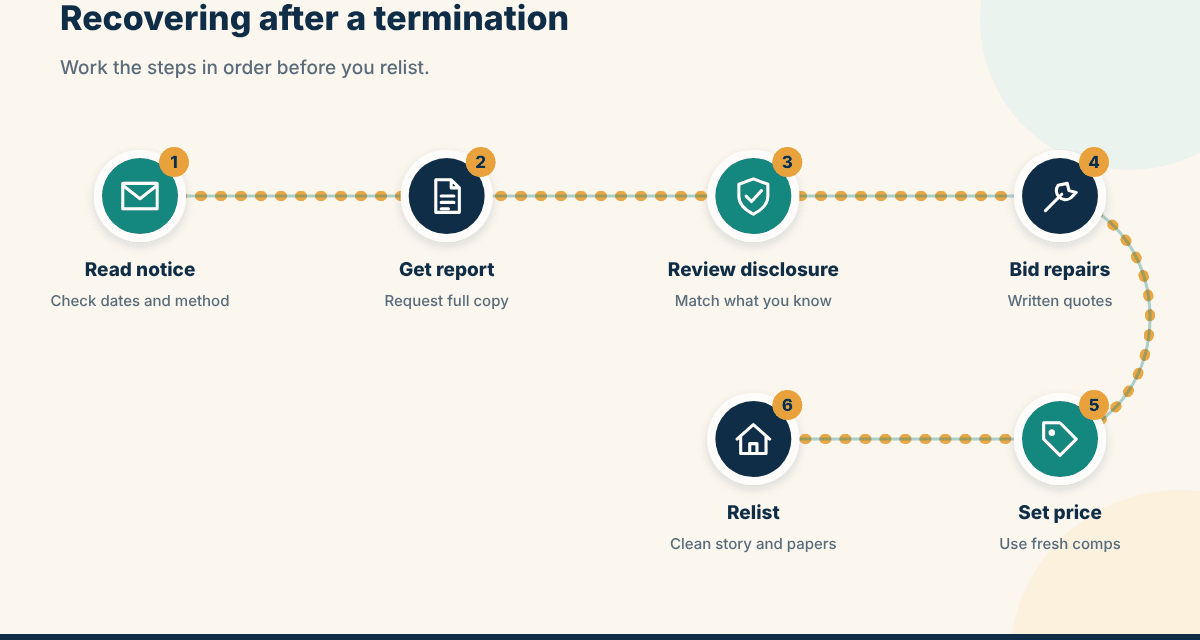
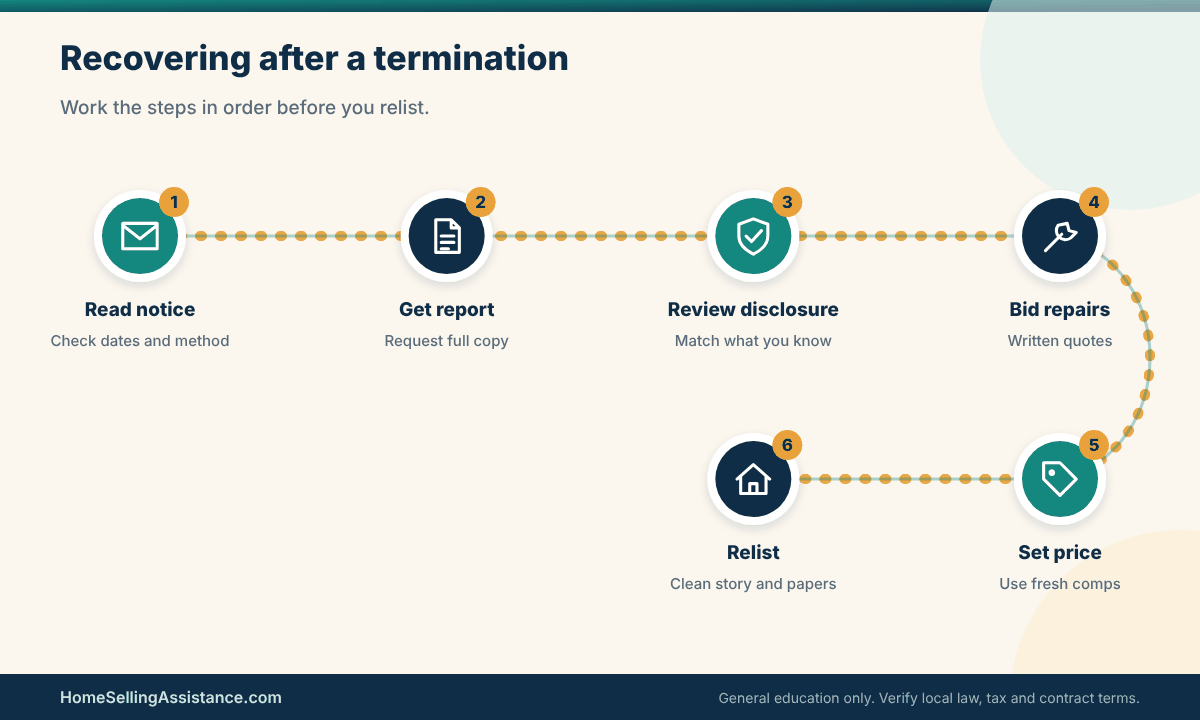
The order matters more than most sellers expect in a deal fell through after inspection seller recovery. Disclosure comes before repair, because what you know shapes what you fix. Repair comes before relisting, because photos and descriptions should reflect the house as it will be shown. Pricing comes last, because it should rest on what you learned from the first four steps rather than on irritation.
The first week of a deal fell through after inspection seller timeline
The first week is mostly about slowing down and protecting your position. Nothing in it is dramatic. It is a handful of calls, a few emails and some honest reading. The table below is a working version of that week, and it is meant to be adapted to your contract and your state rather than followed like a recipe.
| Stage or symptom | Information to gather | Action | Decision deadline | Next handoff |
|---|---|---|---|---|
| Termination notice arrives | Signed notice, date, delivery method | Compare to contract notice terms | Within the contract response window | Agent or attorney |
| Deposit question | Earnest money amount and holder | Ask holder for written status | Before any release is signed | Title or escrow company |
| Report in hand | Full report and specialist notes | Sort items by safety, structure, cosmetic | A few days, before relisting | Inspector or contractor |
| Disclosure review | State form, known conditions, prior repairs | Update disclosures to match what you know | Before the next buyer sees the form | Agent or attorney |
| Repair choice | Written bids, permits needed, timing | Fix, credit, or sell as-is | Before relisting photos are set | Licensed contractor |
| Relist and price | Fresh comparable sales, feedback, days listed | Reset price or hold with evidence | Before the relist date | Listing agent or your own plan |
Use this deal fell through after inspection seller table as a prompt for questions rather than a schedule. The deadline column is intentionally soft because your contract and local customs set the real dates. If a row does not apply, skip it. If something comes up that is not listed, such as a lender letter or a homeowners association notice, add a row of your own.
Source check: how disclosure interacts with the inspection report
Many states require sellers to complete a written disclosure form about known conditions, and many of those forms ask about defects, repairs, water intrusion, pests and structural concerns. An inspection report prepared for a buyer is usually not your report, yet the findings inside it can still become something you know. If you read a defect in that report, you are no longer in the position of not knowing.
What follows from that varies, and your deal fell through after inspection seller disclosure duties depend on it. Some states expect you to update a form when new material facts arise. Some require disclosure before a contract is signed and treat later changes differently. A few make disclosure a negotiation point. The cleanest way to find out where you stand is to read your state’s required form, check the state real estate commission website, and ask your agent or a real estate attorney how updates are handled in your area.
The federal rule most people recognize is the lead-based paint requirement for homes built before 1978, which involves a specific disclosure and pamphlet. The EPA real estate disclosure page explains it. Beyond that, treat anything specific as state-dependent. Our broader overview of seller disclosure requirements and the comparison in seller disclosure versus the inspection report will help you separate the two documents. You can also browse the wider inspections, appraisals and contingencies library for related topics.
A scenario, an exception and your next step
Picture a deal fell through after inspection seller example where the first buyer ended the contract after a report flagged active moisture in a basement corner. The seller had never seen water there and had answered no to the disclosure question honestly. Now there is a written finding with a photo and a moisture meter reading. A second buyer will almost certainly have an inspector who looks at the same corner.
The practical next step is to find the cause. A drainage contractor or a waterproofing specialist can say whether it is a downspout that dumps beside the foundation or something deeper. The exception is when the source is uncertain even after investigation. In that case your agent or attorney can help you word an accurate disclosure that states what you know and what you do not, instead of guessing in either direction.
Repair, credit or sell as-is after the report
Once the disclosure picture is clear, your deal fell through after inspection seller plan can include a repair strategy. There are three broad routes, and each has trade-offs. Repairing can remove a buyer objection and give you paperwork to show. Offering a credit can keep you out of the contractor business and let the buyer pick their own vendor. Selling as-is can save time, though it usually narrows the buyer pool.
Evidence to gather: written bids, permits and who does the work
If you decide to repair after a deal fell through after inspection seller outcome, get written bids before you decide. One quote is a number, three quotes are a range, and the range tells you whether a price is reasonable. Ask each contractor to describe the scope in plain terms, name materials, state whether permits are required, and note the licensing status your state expects for that trade. Keep these papers. They become the documents you can hand to the next buyer’s agent.
Permits deserve special attention. Some repairs, such as electrical panel work, structural fixes or water heater replacement, commonly need a permit and a final inspection in many jurisdictions. Unpermitted work can create a fresh problem for the next sale, so ask your local building department how it handles permits for the specific repair. Our article on selling a house with unpermitted work explains why that matters.
Choose contractors who will give you receipts, warranties where available and clear before and after photos. A cheap fix with no paper trail often satisfies nobody. A modest fix with documentation and a licensed signature usually answers the question a buyer is quietly asking, which is whether someone competent has looked at this.
A scenario, an exception and your next step
Take an illustrative deal fell through after inspection seller case with three findings: a failing water heater, a loose handrail on the front steps and a cracked bedroom window. She gets quotes, repairs the handrail and water heater with licensed help, and keeps the window as a small disclosed item with a replacement bid attached. The first two are safety matters that many buyers and lenders care about. The window is a negotiable cosmetic detail.
The exception is a major system or structural concern, such as a roof near the end of its life or a foundation crack with movement. Those can cost more than a seller can reasonably front, and a credit or a price adjustment may fit better. Your next step is to compare the bid with how much you would give up in price if you left it alone, then decide which path keeps you closer to the result you want.

Relisting, repricing and the next negotiation after a deal fell through after inspection seller experience
Relisting is where emotion tends to hijack arithmetic in a deal fell through after inspection seller case. Some sellers rush to cut the price because the deal collapsed, as if the market had issued a verdict. Others hold firm out of principle. Both reactions skip the question that matters: what does the evidence say about why buyers hesitated, and does that evidence point to the price, the condition or something else entirely?
Evidence to gather: feedback, comparables and the days-on-market clock
Begin your deal fell through after inspection seller review with showing feedback from before the contract. If visitors liked the house but kept mentioning the same objection, that objection is your best clue. If feedback was quiet and the offer came late and low, price might be part of it. If the offer was strong and the buyer left over a single defect, condition is the more likely culprit. Ask your agent for written notes, or recall which comments repeated.
Then pull fresh comparable sales. A contract that lasted several weeks means the market may have moved while your house was off the active list. Look at homes that closed recently, homes now under contract, and homes sitting unsold. Adjust for condition honestly, since a house with a known repair item usually does not compare with a turnkey neighbor. Our guides to price reduction strategy and overpricing a house explain how to read those signals.
Last, consider the clock. Listings that return to the market after a terminated contract are sometimes read by buyers as a sign that something went wrong. How much that matters depends on your market. In a busy neighborhood, a fresh listing date and honest photos can reset attention. In a slow one, a calm explanation up front, such as a buyer’s financing change or an inspection item you have since resolved, often works better than silence.
Whichever route you choose, write down your reasoning before you decide. A short note with three lines, what we learned, what we changed, what price we chose and why, keeps you from rewriting history later. It also gives your agent or advisor something concrete to react to, which tends to produce better advice than a general conversation about how you feel.
A scenario, an exception and your next step
Consider a deal fell through after inspection seller case in which the owner sees that a nearby similar home recently sold at a slightly lower price after having a new roof, while his own roof has about five years of life left according to the inspector. He had assumed the buyer walked away because the number was too high. The evidence suggests the roof was the sticking point, not price, so cutting the list price might not solve it.
His options are to quote and replace the roof, offer a roof credit in the relist, or price in the condition and market it as a house with an older roof. Each is defensible. The exception is when comparable evidence really does show you are above the market, in which case a price adjustment is not an overreaction but a correction. Your next step is to write down which of the two you believe and what evidence supports it.
If the evidence is mixed, you can test it. Hold the price for a defined period, perhaps two weeks, and track showings, feedback and online views. If activity is healthy but offers are low, condition or terms are the likelier issue. If activity is thin, price or presentation is the likelier one. Setting a date for the next review turns a worry into a plan.
Handoffs between your agent, the buyer’s side, the title company and the lender
A deal fell through after inspection seller contract passes through many hands. Your agent, the buyer’s agent, the escrow or title company, the lender and sometimes an attorney all hold a piece of it. Mistakes tend to happen at the handoffs, when each party assumes someone else has sent the release, updated the listing status or confirmed the deposit. The table below helps you check the main handoffs.
| Issue | Seller evidence | Buyer, agent or title input | Risk | Fallback |
|---|---|---|---|---|
| Termination validity | Contract clause, dated notice | Buyer agent confirms timing and method | Dispute over late or improper notice | Seek advice before any release |
| Earnest money | Receipt, holder contact | Title company written status | Funds held in limbo | Follow contract dispute steps |
| Disclosure update | State form, report findings | Agent or attorney review | Incomplete disclosure to next buyer | Correct and re-deliver the form |
| Repair scope | Written bids, permits | Contractor and inspector notes | Undocumented fix doubted later | Credit or as-is with paperwork |
| Listing status | Agreement, MLS change record | Listing agent confirms status | Stale or confusing listing details | Correct remarks and dates |
| Backup interest | Prior showings, contact list | Agent outreach to earlier visitors | Missed buyers who already like it | Reopen contact with new terms |
To use this table, go row by row and write who is responsible for the next step. If you cannot name a person, that is your gap. Keep your own emails or texts confirming each handoff, and ask for written confirmation when anyone says they have taken care of something. A confirmation takes seconds to request and can save weeks of confusion.
Source check: contingency terms, earnest money and release language
The contract controls the deposit, and contracts differ. Some provide for the deposit to be returned to the buyer when a contingency is properly used. Some allow deductions for certain costs. Some require both parties to sign a release before the holder can act. If the buyer and seller disagree, the holder may keep the money until the dispute is resolved under the contract or by agreement. None of that is something you should guess at.
Read your contract’s dispute and release language, then ask the holder, typically a title company, escrow officer or broker, for the current status in writing. If you are uncertain whether the buyer properly used a contingency, talk to your agent or a real estate attorney before signing a release. Releases tend to be final, and signing one quickly to be done with it can hand away rights you did not mean to waive. See our overview of earnest money for sellers for more.
The inspection contingency itself is worth rereading with fresh eyes. It may have allowed the buyer to terminate for any reason during the window, or only for items above a certain threshold, or only after a repair negotiation failed. Our detailed explanation of the inspection contingency from the seller’s side walks through those variations in plain language.
A scenario, an exception and your next step
Take a deal fell through after inspection seller case where the first buyer quietly ended the contract and the agent promised to relist right away. Three days later, the listing still showed pending, and a second interested buyer could not schedule a visit. Nobody was at fault in a dramatic way. The agent had been waiting for a signed release, and the release was waiting on the title company, which was waiting on the buyer.
The fix was a short email thread naming each task and its owner. The exception is a termination under dispute, where the listing status and the release may depend on legal advice or a negotiated agreement. In that case, ask your agent how your market handles status while a deposit is unresolved, and do not advertise the house as available if your contract says otherwise.
If a buyer’s side never produces a release, ask your agent or attorney about the dispute steps your contract names. Some contracts point to mediation, some to a waiting period and some to a court process, and the sensible choice depends on the amount at stake and your appetite for delay. A modest deposit and a long fight rarely make sense together, so weigh what you would gain against the time and cost involved.

Close the loop: paperwork, proof and the second attempt
A second listing does not begin from zero. It begins from a pile of documents, a history and a set of promises you either keep or break. The last section of any deal fell through after inspection seller plan is about turning that pile into something orderly, so the next contract starts on firmer footing and the old one is truly finished.
Confirm every release, refund and update in writing
People trust handshakes and friendly emails right up until a dispute appears. Written confirmation is dull, and it is also the single cheapest protection you have in a deal fell through after inspection seller situation. Every deal fell through after inspection seller checklist should end with a short set of confirmations, so nobody can later claim a different understanding of how the first contract ended.
Evidence to gather: signed release, deposit confirmation and listing status
First, the signed release. Many purchase contracts have a standard mutual release form, and many title companies require it before they disburse any deposit. Read it before signing. It should name the property, identify the contract by date, state that both parties release each other from further obligations under it, and say where the deposit goes. If any language surprises you, ask your agent or attorney to explain it before you sign.
Second, a confirmation from the deposit holder showing the final disposition of the earnest money. Keep the email or letter. If the holder is a brokerage, ask for a written statement showing the amount, the date and the recipient. This avoids a surprising letter months later asking about money you assumed was settled.
Third, a screenshot or printout of the listing showing active status, plus the date it returned to the market. Listing details sometimes carry old remarks such as under contract or inspection pending. Cleaning those up is not cosmetic. A deal fell through after inspection seller listing that still hints at the previous contract can confuse agents and discourage visits.
Fourth, an updated disclosure packet. If you completed a state form before the first contract, check whether it needs a revision in light of the report. If you made repairs, add the receipts, permits and warranties. A tidy disclosure packet is one of the better trust signals you can give a cautious buyer. Our guide to documents needed to sell a house lists what such a packet usually holds.
A scenario, an exception and your next step
Imagine a deal fell through after inspection seller case where the first buyer left after the inspection and the agent gave her a one-line text saying the deposit was handled. Months later, when she sold to a second buyer, the title company asked about an unresolved claim on the first contract. Nobody had written anything down, and sorting it out cost her time at the worst moment, right before closing.
The next step in a deal fell through after inspection seller situation like this is to ask for the missing papers now rather than later. The exception is a deposit dispute still in progress. If the money is contested, you may need the advice of an attorney and may not be able to close the first chapter yet. In that case, record the dispute status in your file, tell your agent, and ask how it affects relisting.
Keep records after a deal fell through after inspection seller sale closes
Records are not exciting in a deal fell through after inspection seller case, but they are what you reach for when something unexpected arrives: a question from the next buyer’s lender, a tax form, a claim about a repair. Good records after a deal fell through after inspection seller episode also help you learn from the experience instead of simply surviving it.
Evidence to gather: repair receipts, final statements and tax records
For a deal fell through after inspection seller relist, keep every receipt for repairs and improvements you make during the second listing. Some of those costs might affect your cost basis or your selling expenses when you eventually report the sale, and the rules are specific enough that you should check the current IRS guidance instead of relying on a guess. The IRS Publication 523 explains how sellers treat these items, and Publication 551 covers basis.
The general federal exclusion for selling a main home, up to 250,000 dollars for a single filer and 500,000 dollars for joint filers, requires meeting ownership and use tests, usually two out of the last five years. Whether it applies to you depends on your facts, so treat that as a pointer, not an answer. A tax professional can look at your situation in a way no article can. Our overview on home sale tax records offers a practical filing approach.
Also save your closing statement from the final sale, copies of any release from the first contract, the inspection report you received if any, and the disclosure packet you delivered. Store them somewhere you can find in a few years. A deal fell through after inspection seller story can resurface when a buyer later asserts that a defect was known. Your records show what you knew, when you knew it and what you did about it.
A scenario, an exception and your next step
Imagine a seller in a deal fell through after inspection seller situation who replaced a water heater and repaired a gutter during the second listing, kept the invoices in an email folder, and then sold. Two years later, when preparing taxes, she needed the dates and amounts. Because the invoices were in one place, her tax preparer could tell in minutes which items might matter and which were ordinary maintenance.
The exception is the seller who made repairs only to satisfy a buyer and has no idea whether they count for tax purposes. That is common, and it is fine. Your next step is to bring everything to a qualified tax professional and let them sort it. Do not assume that any expense qualifies or that none do. If you sold at a loss or with unusual circumstances, the rules may differ, which makes professional input even more useful.
Quick scenario
Dana accepted an offer in a week, then received a termination on day six after the inspector found an aging electrical panel. She waited two days, read her contract, got an electrician’s written bid, and decided to replace the panel with a permit. She updated her disclosure, kept the invoice and permit final, relisted with those papers attached, and held her price for two weeks while tracking feedback. The second buyer asked for a few minor items but not the panel.
Dana’s outcome is illustrative, not a promise, yet the pattern shows how a deal fell through after inspection seller story can turn into a documented, calmer second attempt.
Cases that need extra care: financing worries, backup offers and special properties
Not every termination is a clean inspection problem. Some are tied to financing, some to an appraisal, some to a property type that adds its own complications. Knowing which category you are in lets you pull in the right guide and the right professional.
Evidence to gather: why financing, appraisal and inspection issues overlap
In a deal fell through after inspection seller file, inspection problems and financing problems often travel together. A buyer who is stretched thin may not be able to absorb a repair bill, and a lender may require certain repairs before funding. If the first buyer’s loan depended on a repair, say so in your notes. Our articles on buyer financing that fell through and the options after a low appraisal cover those paths in depth.
If you had a backup offer, now is the time to revisit it, but read the backup’s terms carefully. Backup contracts can expire or be revoked in ways that depend on their wording, and a backup buyer may have moved on. Our guide to backup offers for sellers explains how to approach them. The broader picture of home sale contingencies is also worth a read if you did not fully understand which contingency ended your contract.
For condos, co-ops, homes with shared walls or properties with association rules, add one more layer: association documents, resale certificates and any rule that controls repairs. Those can lengthen the timeline, so allow room in your plan. For estate or divorce sales with several decision-makers, make sure everyone with authority agrees on the repair and pricing approach before you relist.
A scenario, an exception and your next step
Picture a deal fell through after inspection seller case where the buyer left after an inspection found a failing septic system. The lender required a certified repair before funding, and the buyer lacked cash to cover it. In that case, the inspection issue and the financing issue were the same issue. The seller wisely got a local septic professional’s evaluation and a written repair bid before deciding whether to fix or reprice.
The exception is a defect that is large enough to change what the house is, not just what it costs, such as significant structural failure or contamination. For those, speak with an attorney and a qualified specialist, and consider whether selling as-is to an investor or a cash buyer fits your goals better than a full retail relist. Your next step is to compare realistic net outcomes, not just sticker prices, and ask for advice when the numbers are too large to guess.
Frequently asked questions about deal fell through after inspection seller
Can a buyer really walk away after an inspection?
Often yes, if the contract includes an inspection contingency and the buyer ends the agreement properly inside the allowed window. The details depend on your contract, including the number of days, the required notice and any repair negotiation steps. A deal fell through after inspection seller question usually starts with reading those clauses. If the buyer missed a deadline or skipped a required step, your agent or attorney can tell you what that means in your state.
Do I have to tell the next buyer what the inspector found?
It depends on your state, your disclosure form and what you personally know. Many states expect sellers to disclose known material defects, and a written finding in a report can become something you know. Do not guess. Ask your agent or a real estate attorney how updates to a disclosure are handled where you live, and keep a copy of whatever you deliver.
Who gets the earnest money when a deal fell through after inspection seller issues arise?
The purchase contract answers this, and contracts differ. When a buyer properly uses a contingency, many contracts return the deposit to the buyer. When there is a dispute, the holder may keep the funds until both sides sign a release or a process named in the contract finishes. Ask the holder for a written status and read any release carefully before you sign.
Should I repair everything on the report?
Rarely. A better approach is to sort the findings into safety, structure, systems and cosmetic items, then decide which ones a typical buyer in your market would object to. Written bids help you compare the cost of fixing with the cost of a credit or price adjustment. For a deal fell through after inspection seller plan, a short list of well-documented repairs usually reads better than a long list of rushed ones.
Is it better to offer a credit or fix the problem myself?
Neither is always better. Repairs can remove an objection and produce receipts, but they cost money up front and might delay relisting. Credits keep you out of the contractor business and let the buyer choose a vendor, but some lenders limit how credits work and some buyers prefer a repaired house. Your agent can tell you what is common locally, and your contract and the buyer’s loan program will set the limits.
Do I need to lower the price after a failed inspection?
Not automatically. If showing feedback and comparable sales point to the condition issue rather than the number, a price cut may not fix anything. If the evidence says you are above the market, a measured adjustment can be sensible. Look at the numbers, set a review date and decide with evidence in the deal fell through after inspection seller conversation, not with frustration.
Do I have to tell buyers the house was under contract before?
Practices vary. A prior contract itself is not usually a required disclosure, though the reason it ended may become relevant if it involved a material defect you know about. Many agents mention only what is accurate and necessary, and some offer a short, factual note. If you are unsure what a buyer is entitled to ask or hear, speak with your agent or an attorney before answering questions in your listing remarks.
Can I sell as-is after an inspection problem?
You can usually offer a house as-is, though the phrase does not erase disclosure duties and it does not stop a buyer from inspecting. It signals that you will not make repairs, which may attract different buyers and different offers. A deal fell through after inspection seller as-is listing works best with a realistic price, clear documents and an honest description of known items.
Could I be liable if I stay silent about something I learned?
Liability rules vary and depend on facts, so no article can answer this for your case. In general, knowingly hiding a material defect can create legal risk in many states, while honestly disclosing what you know and documenting repairs usually reduces it. Ask a licensed real estate attorney in your state, especially when a defect is significant or the report contained something you did not expect.
When should I bring in a professional?
Consider it when the deposit is contested, when a defect is structural, environmental or expensive, or when you are unsure what your state requires you to disclose. An agent can guide pricing and marketing, an attorney can explain rights and duties, and a licensed inspector or contractor can describe the physical problem. Using the right person at the right moment often costs far less than fixing a misstep afterward.
Your next move
A deal fell through after inspection seller experience is disappointing, yet it also hands you something useful: a detailed look at how a real buyer saw your home. Read the contract, record the facts, decide what you will disclose and repair, and set your price from evidence rather than from the sting of the moment. Take it one step at a time and keep everything in writing. This article is general education, not legal, tax or financial advice, and rules differ by state, so check with a licensed agent, attorney or tax professional about your own situation.