The FSBO closing process is the stretch between a signed purchase contract and the moment the buyer’s funds reach the right account, and when you are selling without a listing agent, nobody else is automatically responsible for keeping that stretch organized. That job lands on you, along with a title company or attorney who handles the paperwork and money, and a buyer who may or may not have an agent of their own.
The FSBO closing process is where many first-time sellers relax too early. The hard parts, pricing, showings and negotiating, feel finished once the contract is signed. In reality the contract is only the starting gun for a series of deadlines, documents and handoffs. Each one has a person responsible for it, a date attached to it, and a way of going quietly wrong if nobody checks.
This guide walks through the FSBO closing process in the order things actually happen: building your seller file, choosing who runs the closing, tracking the contract calendar, handling payoff and title, reviewing the final numbers, signing, funding, and keeping records afterward. It sits inside our wider for sale by owner guide, and it assumes you already have an accepted offer or expect one soon.
One honest caution before we start. Closing practices differ a great deal from state to state, and sometimes from county to county. In some places an attorney leads, in others a title company or escrow officer does. This article explains the common mechanics so you know what to ask, but your contract, your state’s rules and your closing professional decide what applies to your sale.
Key takeaways
- Someone neutral runs the closing. Depending on where you live, that is an attorney, a title company or an escrow officer. Choose and contact them early, not after the buyer asks.
- Your seller file saves weeks. A deed, loan details, tax bills, association contacts and ID ready before the contract is signed prevent most last-minute scrambles.
- The contract calendar is the real project plan. Every inspection, financing and title deadline needs a date on your wall and a name beside it.
- Payoff figures expire. A mortgage payoff quote is a snapshot with a per-day interest amount, so request it close to closing and confirm the wiring or mailing instructions by phone.
- Verify every wire instruction by phone. Closing-day fraud targets sellers and buyers alike, and a call to a number you already trust is the cheapest protection you have.
- Keep your closing records for years. The settlement statement, deed copy and improvement receipts matter later for taxes and for questions that surface after the sale.
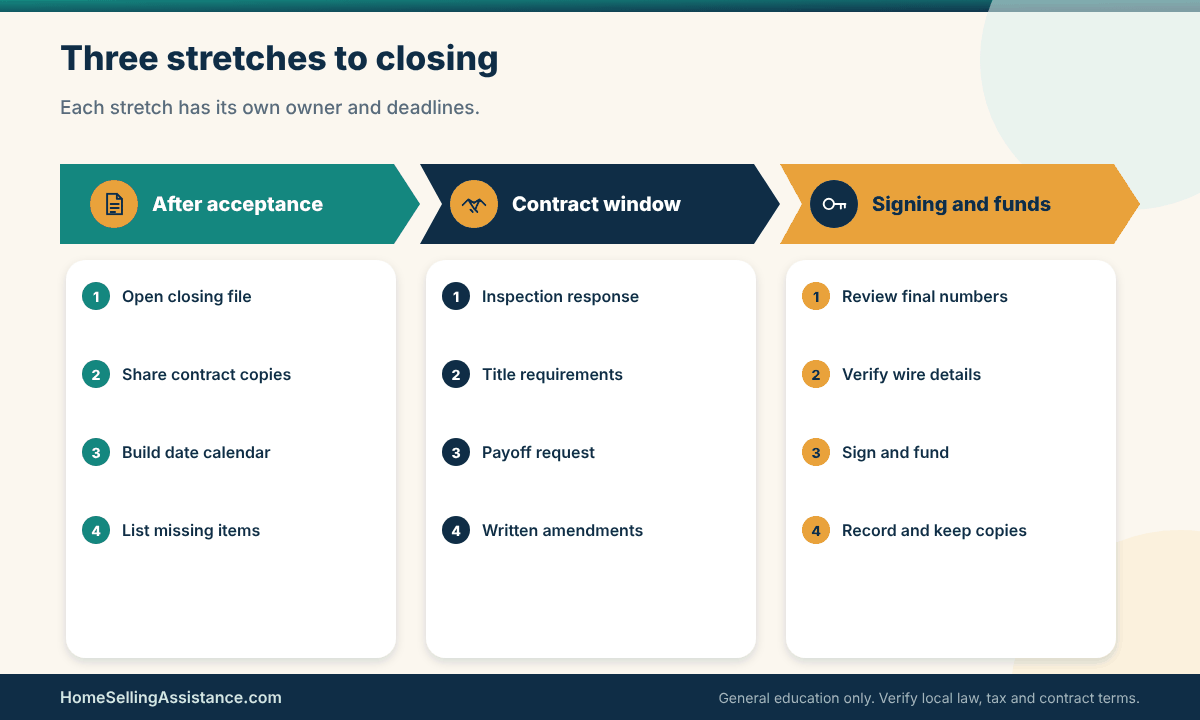
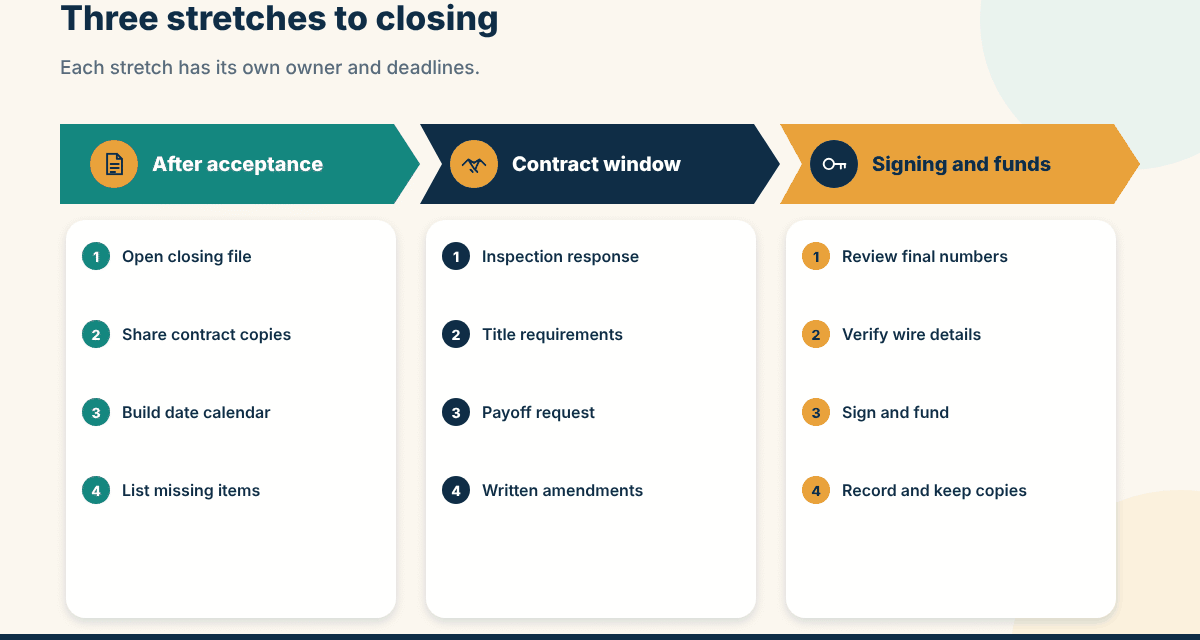
The picture above shows the basic shape of the sale: three stretches: the days right after an accepted offer, a contract window where most things can still change, and the final review that leads into signing and funding. Keep it in mind as you read, because almost every section below attaches to one of those three stretches.
Build your seller file before the contract clock starts
For the FSBO closing process, a seller file is nothing fancier than a folder, paper or digital, that holds every document and contact someone will ask you for between acceptance and closing. Sellers who work with a full-service agent often never see this file because the agent’s office assembles it. When you sell on your own, a thin file is the most common reason the FSBO closing process drifts past its target date.
Start the folder the day you decide to sell, not the day you receive an offer. Once the buyer’s side is waiting, every missing paper becomes a delay you are visibly responsible for, and delays can cost a buyer a rate lock or a move-in date. That pressure makes people agree to things they would otherwise question.
Documents, numbers, contacts and deadlines your FSBO closing needs
Think of the file in four layers: ownership, money, property and people. Ownership means the deed you received when you bought, plus the legal description if it is not on the deed. Money means your latest mortgage statement, any second loan or home equity line, and the most recent property tax bill. Property means permits, warranties, appliance manuals and any association documents. People means phone numbers and email addresses you can reach quickly.
Numbers matter as much as paper. Write down your loan servicer’s payoff department number, the approximate balance, whether there is a prepayment term in your note, and your annual property tax amount. Those four items let you sanity-check the FSBO closing process estimate the early estimate your closing professional produces. If an estimate looks off, you will notice, and that is the entire point of keeping your own figures.
Deadlines belong in the file too. Your FSBO paperwork checklist covers the forms that go in before and during the listing; here the focus is what the closing team needs after acceptance. Keep a one-page calendar listing the contract dates once you have them, with a column for who owes what by when.
Evidence to gather: ownership, payoff and tax records
Pull three things first. The deed shows how title is held, and every name on it must match the people who will sign. The loan statement shows the servicer, the account number and the approximate principal. The property tax bill shows the parcel number, the amount, and whether taxes are paid through an escrow account your lender manages or directly by you.
Next add the quieter items sellers forget. If you hold a homeowners association membership, find the management company’s contact and the name of whoever handles resale certificates. If there is a second lien, a home equity line, a solar lease or a utility assessment tied to the property, find those agreements now. Any of them can need a payoff or consent letter, and some take days to produce.
Finally, collect identity documents that the closing office will want to see. Rules about what counts as acceptable ID, notarization and witnesses vary by state and by closing company, so ask early rather than assuming your driver’s license is enough. A one-line email to the closing office asking what each signer must bring takes two minutes and prevents a rescheduled signing.
A scenario, an exception and your next step for the paper file
Picture a seller, Dana, who accepts an offer on a Friday. On Monday the closing office asks for a payoff letter, the HOA contact and a copy of the deed. Dana has the deed but cannot find the loan servicer’s payoff line, and the HOA changed management companies last year. It takes four days to sort out, and the buyer’s lender notices the slow response. Nothing disastrous happens, but the buyer’s confidence dips.
Now the exception. Suppose the property sits in a trust or an estate. The person signing may not be the person named on the deed, and the closing office will ask for trust certifications or court letters instead of a simple ID check. That kind of ownership question can add weeks, which is why it belongs in your file work long before an offer arrives.
Your next step is small and concrete. Make the folder today, list the four layers on the cover sheet, and tick off what you already have. Anything not ticked becomes a phone call this week, and every call shortens your FSBO closing process. If you are unsure whether your situation is unusual, mention it to your closing professional at the first contact and let them tell you what extra papers they will want.
Information that is still missing when you accept an offer
Even a well-prepared seller reaches acceptance with a few blanks in the FSBO closing process. The buyer’s lender may not have been named yet. The buyer’s agent, if there is one, may not have sent contact details. The exact closing date may be tied to a loan program timeline rather than a calendar you control. You may not yet know who the buyer prefers for the closing office. None of this is unusual, but each blank needs an owner.
The useful habit is to write the blanks down the same day you sign. A short list titled “still missing” with one name per line does the job. Sellers who do this tend to spot problems earlier, because a blank that stays on the list for five days stands out in a way a vague worry never does.
Evidence to gather: the missing pieces and who can supply them
For each blank, decide who can fill it. The buyer or the buyer’s agent can name the lender and the loan type. The title company or attorney can say what the final closing date depends on and confirm what documents they still need from you. Your mortgage servicer can supply a payoff statement. Your HOA’s management company can supply governing documents and a resale certificate, if your community uses them.
Be careful with sources. A friend’s closing in another state is not evidence of how yours will work. A website that quotes a single “typical” closing timeline is not evidence either, because timelines depend on loan type, title condition, the buyer’s lender and local practice. The reliable sources are your contract, the closing office and the specific institution holding the paper you need.
If you are weighing whether to bring in help at this point, our piece on when to hire an agent after FSBO explains the trade-offs of adding a professional mid-transaction, including what that does to the agreement you already signed with the buyer.
A scenario, an exception and your next step for open questions
Say your buyer’s lender has not yet ordered the appraisal and the contract has a financing deadline in three weeks. Nothing is wrong yet, but the calendar is tighter than it looks. A polite note asking the buyer’s side when the appraisal is expected costs you nothing and gives you a date to track. If the date slides, you will see it slide.
The exception is when the missing information is yours. If you realize you never found the original deed, or a past owner’s lien might still be recorded, say so to the closing office immediately. They can order a title search and tell you whether a copy of the deed from the county recorder is enough. Hiding a gap does not make it disappear; it just moves the surprise to the week of closing.
Your next step is the “still missing” list itself. Date it, assign one person to each line, and read it again every two or three days until it is empty. When the list is empty you are ready for the part of the FSBO closing process that actually moves money, and a tidy list keeps the whole FSBO closing process on schedule.
Move through the FSBO closing process in order
Once the contract is signed, the work stops being creative and becomes sequential. Certain things have to happen before others, and a few of them cannot start until a third party finishes their part. Seeing that order clearly is the best protection against the feeling that the sale is happening to you instead of being run by you.
The FSBO closing process follows a fairly stable sequence even when the details change. A closing office opens a file. Earnest money, if the contract calls for it, is delivered to a neutral holder. Title work begins. The buyer’s lender reviews the property. Inspection and repair questions get settled. Payoff figures are requested. Final numbers are drafted, reviewed and corrected. Then everyone signs and funds move. Below we take that in two halves, early decisions first and handoffs second.
Early actions and decision points after the contract is signed
The first week of the FSBO closing process sets the tone. Two decisions deserve your attention immediately: who will run the closing, and how you will keep dates straight. If the contract already names a title company, attorney or escrow office, your job is to contact them. If it does not, you and the buyer usually agree on one, and it is worth asking a few questions before settling.
Ask what the closing office charges for their services and who pays which fees under your contract. Ask how they handle wire instructions. Ask whether they offer in-person, mobile or remote signing. Ask who your day-to-day contact will be and what the usual turnaround is for a payoff request. Those answers tell you more about how smooth your FSBO closing process will be than any brochure.
Your contract may say who chooses the closing office and who pays for the title policy, and customs differ by region. Do not assume. Read that clause, and if it is unclear, ask the closing office or an attorney to explain it in plain words before you agree to a choice. For a deeper look at the paperwork side of the sale, see our guide to FSBO paperwork.
The table below turns the early weeks into a working tool. It lists the stage, what you should gather, what to do about it, when a decision is typically due, and who gets the baton next. Treat the deadline column of this FSBO closing process table as a prompt to check your own contract, because the actual dates come from there.
| Stage or symptom | Information to gather | Seller action | Decision deadline | Next handoff |
|---|---|---|---|---|
| Contract just signed | Full contract, addenda, contact list | Deliver copies to closing office | Within a day or two | Closing office opens file |
| Earnest money not confirmed | Receipt from the holder | Ask for written confirmation | Contract delivery date | Buyer or holder |
| Title questions appear | Deed, old liens, survey | Respond to title requests quickly | Before title objection window ends | Title examiner |
| Buyer requests repairs | Inspection report, quotes | Accept, counter or decline in writing | Inspection response date | Buyer and buyer’s agent |
| Payoff needed | Servicer contact, loan number | Request written payoff statement | Shortly before closing | Closing office |
| Final numbers drafted | Draft closing statement | Compare to your own estimate | Before signing day | Closing office corrects |
| Signing scheduled | ID, signer names, deed form | Confirm who signs and where | Days before signing | Notary or closing officer |
To use the table, copy the stages into your calendar and replace the vague deadline entries with the real dates from your contract. Highlight any stage where the next handoff goes to someone you have not yet spoken to, because those are the places where messages get lost. A short email to each person introducing yourself and confirming the date is enough.
Evidence to gather: the contract calendar and the choice of closing office
Read your contract slowly, because the FSBO closing process runs on its dates, and extract every date and every named responsibility into a one-page calendar. Typical entries include the delivery of earnest money, the inspection period, the date by which the buyer must secure financing or waive that condition, title commitment review, the appraisal if one applies, the final walkthrough and the closing date itself. Contracts vary enough that you should not copy a calendar from an article, including this one.
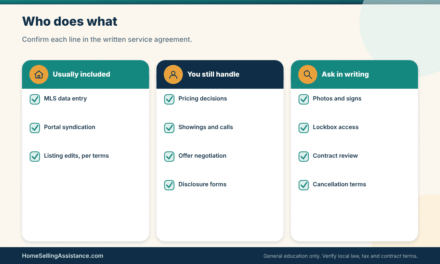
Alongside the calendar, record your choice of closing office and why. If an attorney is customary where you live, ask what the attorney handles beyond the signing, such as reviewing the contract, preparing the deed, or advising on title issues. If a title or escrow company leads, ask who prepares the deed and who answers legal questions. Knowing what each person will and will not do keeps you from assuming coverage that does not exist.
For the money side, ask the office how they will receive and disburse funds, and write down whether they use a dedicated trust or escrow account. You do not need to understand the banking. You need to know that the office handling your funds is licensed or regulated in your state, which your state’s real estate commission, department of insurance or bar association can help you confirm.
A scenario, an exception and your next step at the start of closing
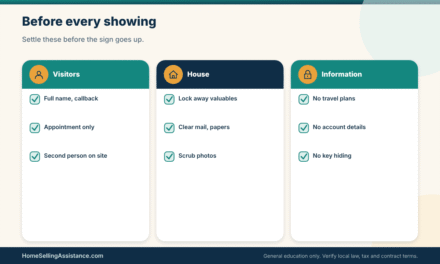
Imagine a buyer who does not have an agent and asks you to recommend a title company. You are allowed to suggest one, but think about it carefully. A neutral office should treat both sides evenly, yet buyers sometimes feel pressured by the seller’s pick, and some states have rules about who may select title services. Offering two or three options and letting the buyer choose avoids the discomfort, and our guide on what to do when an FSBO buyer has an agent covers how those conversations differ when a buyer’s agent is involved.
The exception is a contract that already names the closing office, perhaps because the buyer’s lender requires its own preferred provider or because local custom assigns it. Then your decision is simply to cooperate and confirm contact details. If anything about the named provider concerns you, ask the buyer or an attorney how to raise it before the first deadline rather than after.
Your next step in the FSBO closing process is the calendar. Build it within two days of acceptance, send it to the closing office with a note asking them to correct any date you misread, and keep the corrected version as the working copy. A calendar the closing office has seen is worth far more than one that only exists in your head.
Handoffs, negotiations and contingencies during the contract window
The contract window is when most of the negotiation actually occurs, even though the price was settled earlier. Inspection results, appraisal outcomes, title surprises and loan conditions can all reopen conversations. How you handle each handoff decides whether the FSBO closing process stays calm or turns adversarial.
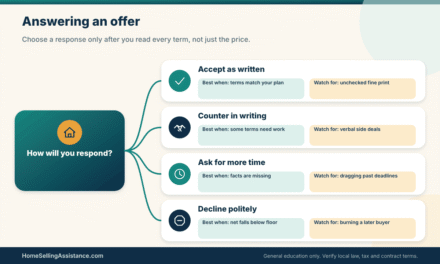
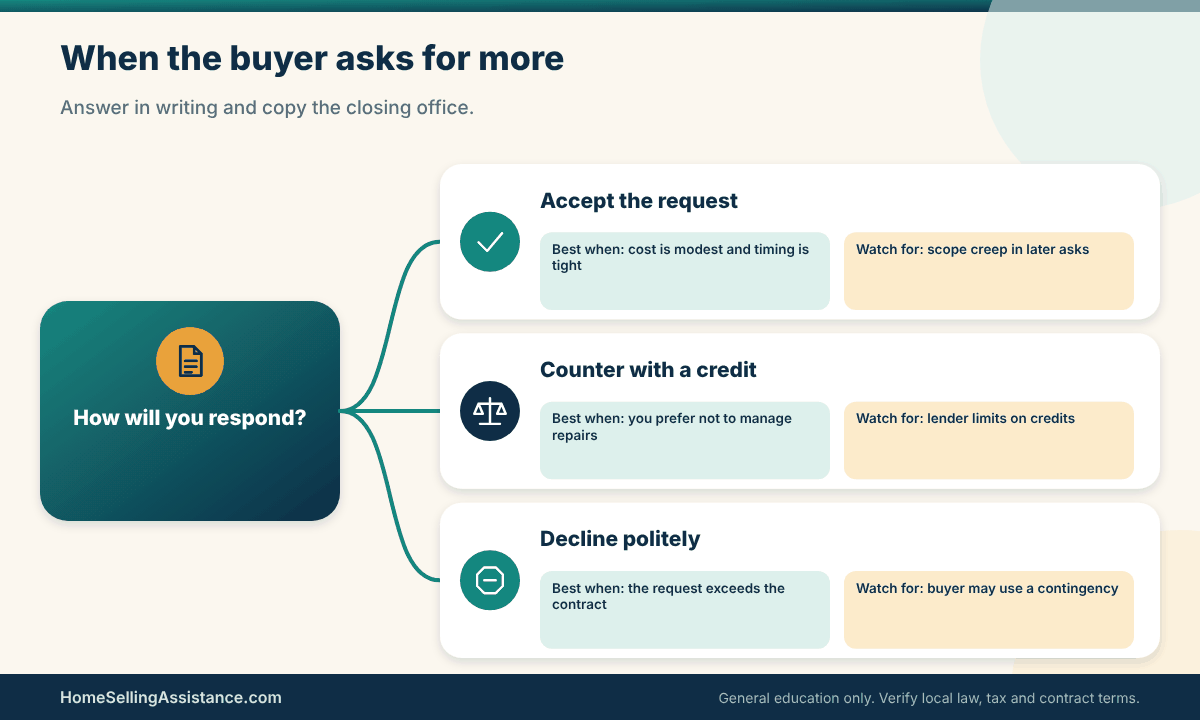
The graphic below shows a decision fork that applies whenever the buyer raises an issue: you can accept the request, counter it, or decline it, and each choice has a different effect on the deadline clock. Whatever you choose in the FSBO closing process, put it in writing and make sure the closing office receives a copy, since verbal agreements do not travel well between people and paper.
If you want to revisit how the earlier negotiation shaped these terms, our article on how to negotiate an FSBO offer explains what the contract probably already says about repairs, credits and timing. Reading that alongside your actual contract will make this stage easier to follow.
Evidence to gather: written requests, responses and amendments
Every change to the deal should leave a paper trail: the buyer’s written request, your written response, and if you both agree, a signed amendment that the closing office can attach to the file. Without that last piece, the closing statement may not reflect the agreement, and the buyer’s lender may be working from an older version of the contract than you are.
Keep copies of the inspection report and any repair quotes or receipts. If you agree to a credit instead of repairs, confirm how the credit will appear on the closing statement and whether the buyer’s lender allows it in that form. Lenders have rules about credits and seller contributions, and the buyer’s loan officer is the right person to ask, not the seller.
For title, evidence means the title commitment and any list of exceptions or requirements the title examiner sends you. Read the requirements as a to-do list. They usually include things like paying off existing loans, resolving old liens or obtaining a signature from a former owner. Each one has a person responsible, and if the person is you, the clock is already running.
A scenario, an exception and your next step for handoffs
Consider a buyer who finds a worn water heater during inspection and asks for a replacement. You have three options. You can replace it yourself and give proof. You can offer a credit and leave the repair to the buyer. Or you can decline and risk the buyer using the contingency to cancel, if the contract allows it. None of those is automatically right; the best choice depends on cost, timing, the strength of your position and what else is pending.
The exception is when the buyer’s request touches something that must be disclosed or permitted, such as unpermitted work or a known safety issue. Then the conversation should include your disclosure obligations, which vary by state, and often a conversation with an attorney. Do not use a fix-it-quietly approach with problems that the law may require you to reveal.
Your next step is a standard FSBO closing process routine for every request: read it, check the contract deadline, decide, write the response, send it to the buyer’s side and the closing office on the same day, and note the response in your calendar. After two or three rounds it stops feeling like a negotiation and starts feeling like administration, which is exactly what it should be.
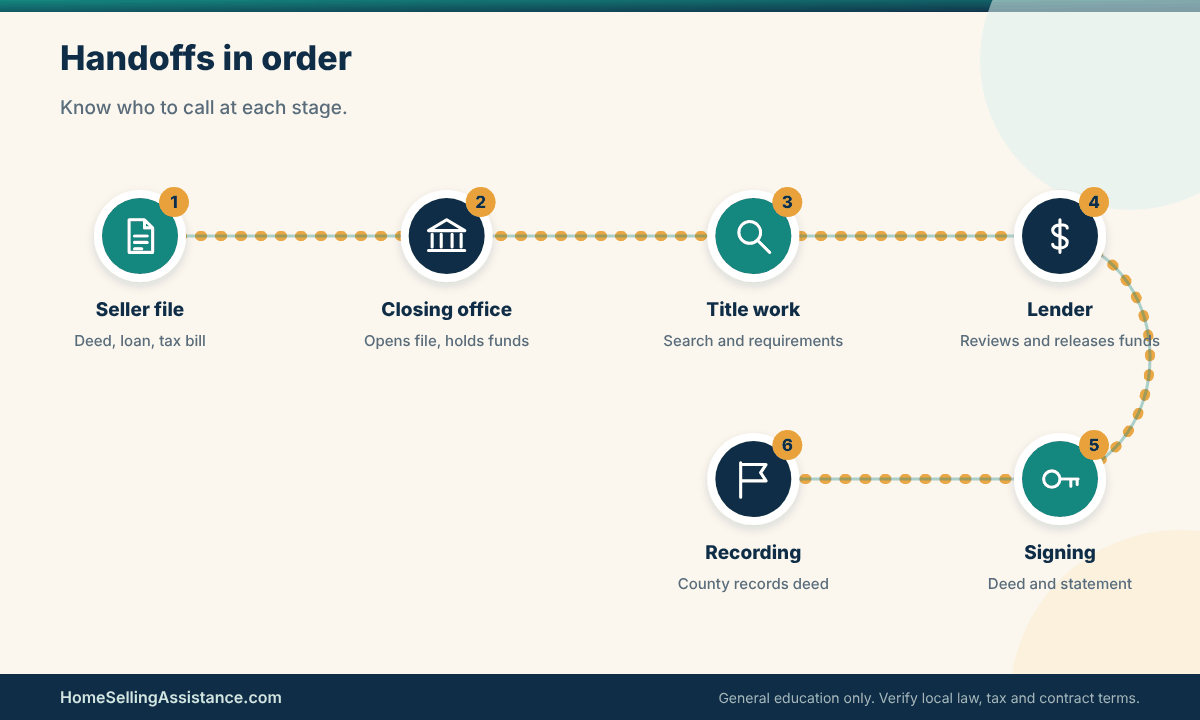
The visual above shows the order in which ownership, money and paperwork pass between the people involved. Use it as a map of the FSBO closing process when you are unsure who to call: if the issue is about title, it goes to the title examiner; if it is about money, it goes to the person holding funds; if it is about the loan, it goes to the buyer’s lender.
Close the loop on the FSBO closing process with payoff, final numbers and funds
The last stretch is where money, signatures and recording all converge. It is also where small inconsistencies turn into real problems: a payoff figure that is a few days stale, a name spelled two ways, a wire instruction that arrived from an unfamiliar email address. None of these is hard to prevent. All of them are easy to miss when you are tired and the finish line is close.
Treat the final week of the FSBO closing process as a verification exercise. Your job is not to redo the closing office’s work but to confirm that what they produced matches what you expect, using the figures you collected in your seller file and the dates in your contract calendar. Anything that does not match gets a question, asked in writing, before you sign.
What to confirm in writing before your FSBO closing process ends
Four things in the FSBO closing process deserve a written confirmation, and each should come from the person who actually controls it. The payoff amount comes from your lender or servicer. The closing figures come from the closing office. The date, time and place of signing come from the closing office as well. The delivery of funds and the instructions for receiving your proceeds come from the closing office and your own bank. Verbal reassurance from anyone else does not count.
Written does not have to mean formal. An email that says “please confirm the payoff good through the 28th is the figure you will use” is a perfectly good confirmation, provided the reply comes from an address you already trust. Save those replies in the folder you built earlier so that you can show them later if a question arises.
Closing costs and net proceeds are the heart of this stage of the FSBO closing process, and the full breakdown lives in our guides to seller closing costs and the seller closing statement. Here we focus on checking, not calculating from scratch.
The next table pairs each common issue with the evidence you should hold, what the buyer, buyer’s agent or title office should be providing, the risk if the issue is ignored, and a sensible fallback. It is an FSBO closing process transaction check, so use it more than once, perhaps at the end of the inspection period, again a week before closing, and a third time the day before signing.
| Issue | Seller evidence | Buyer, agent or title input | Risk if missed | Fallback |
|---|---|---|---|---|
| Payoff figure outdated | Written payoff letter with per-day interest | Title office confirms the figure used | Shortfall or delayed lien release | Request an updated letter before signing |
| Name mismatch on deed | Deed, marriage or name-change record | Title office flags the discrepancy | Recording rejected or signing delayed | Sign with a corrective affidavit if advised |
| Unreleased older lien | Old loan payoff or satisfaction letter | Title commitment lists it as a requirement | Buyer cannot receive clear title | Obtain release from the lienholder |
| Wire instruction change | Original written instructions on file | Closing office confirms by known phone | Funds sent to a fraudulent account | Stop and call a number you already trust |
| Proration errors | Tax and HOA bills | Draft statement shows dates used | You overpay or underpay at closing | Ask the office to show the calculation |
| Walkthrough dispute | Photos of condition before closing | Buyer’s written walkthrough notes | Delay or last-minute credit demand | Agree a written holdback or credit |
How to use it: for each row, ask whether you already hold the evidence, whether the other side has given you their piece, and whether the fallback is something you could actually carry out in the time left. Rows where you answer no to any of the three belong at the top of your to-do list.
Evidence to gather: payoff letters, draft statements, title requirements and wire details
A payoff letter, sometimes called a payoff statement or demand, is the servicer’s written figure for the amount needed to clear your loan on a stated date. It usually includes interest per day after that date, because interest keeps accruing. Our explanation of how a mortgage payoff works when selling a house goes through the pieces. What matters here is that the letter must match the closing date, or be updated if closing shifts.
The draft closing statement is the other document to compare. Some offices send it a couple of days before signing, others only hours before, so ask early when you can expect it. Put your own estimate beside it and check the big lines first: sale price, payoff, commission or fees if any, taxes and association items, title charges and your estimated proceeds. A difference you can explain is fine. A difference you cannot explain deserves a question.
Finally, reread the title commitment’s requirements list. Each item should be marked satisfied, in progress or assigned to someone. If one item has no owner, the closing is at risk and the title office needs to hear about it today, not next week.
Wire fraud is the FSBO closing process crime that gets the most attention, with good reason. Criminals impersonate title offices, agents and even sellers, often by sending an email that looks like a normal update with new instructions. The FBI’s Internet Crime Complaint Center, at ic3.gov, takes reports, and the Federal Trade Commission’s consumer protection site has plain-language guidance on scams.
The practical rule is simple. When you receive instructions for sending or receiving money, call the closing office at a number you already had, such as one from their website or from your first contact, and read the instructions back. Do this even when the email looks right. Also confirm by phone before changing the bank account where you want proceeds delivered, and only change it with a written request that the office has verified.
Our dedicated pieces on real estate wire fraud and on choosing a wire or a check for seller proceeds explain the fraud patterns and the trade-offs. For your file, record who you spoke to, when, and the number you called.
Identity checks in the FSBO closing process go the other way. A legitimate closing office will confirm who you are before it releases deed or funds, and some will ask for a call-back or an in-person look at your ID. That is not suspicion, it is protection, because identity fraud on vacant or unencumbered homes is a known risk. If you are asked for more verification than you expected, treat it as a good sign about the office, not an annoyance.
A scenario, an exception and your next step before signing
Take an illustrative example with round numbers. Suppose the sale price is $400,000 and your payoff letter, good through the 15th, shows $240,000 plus a few hundred dollars of interest per day after that. If closing slips from the 15th to the 22nd, the letter no longer covers your balance, and the shortfall comes out of your proceeds. The numbers here are made up to show the mechanism, not to predict what you will owe.
The exception is a home with no mortgage. You may still have a lien from a contractor, an unpaid assessment or a judgment, and a title search can reveal them. Even a free-and-clear owner should expect the title office to run a search and share requirements. Never assume that having no loan means the paperwork is simple.
Your next step in the FSBO closing process is a short email to the closing office, two or three days before signing: confirm the signing time, ask for the draft statement, ask which payoff date they used, and ask how your proceeds will be delivered. The replies become your confirmation file, and if anything looks off you have time to fix it.
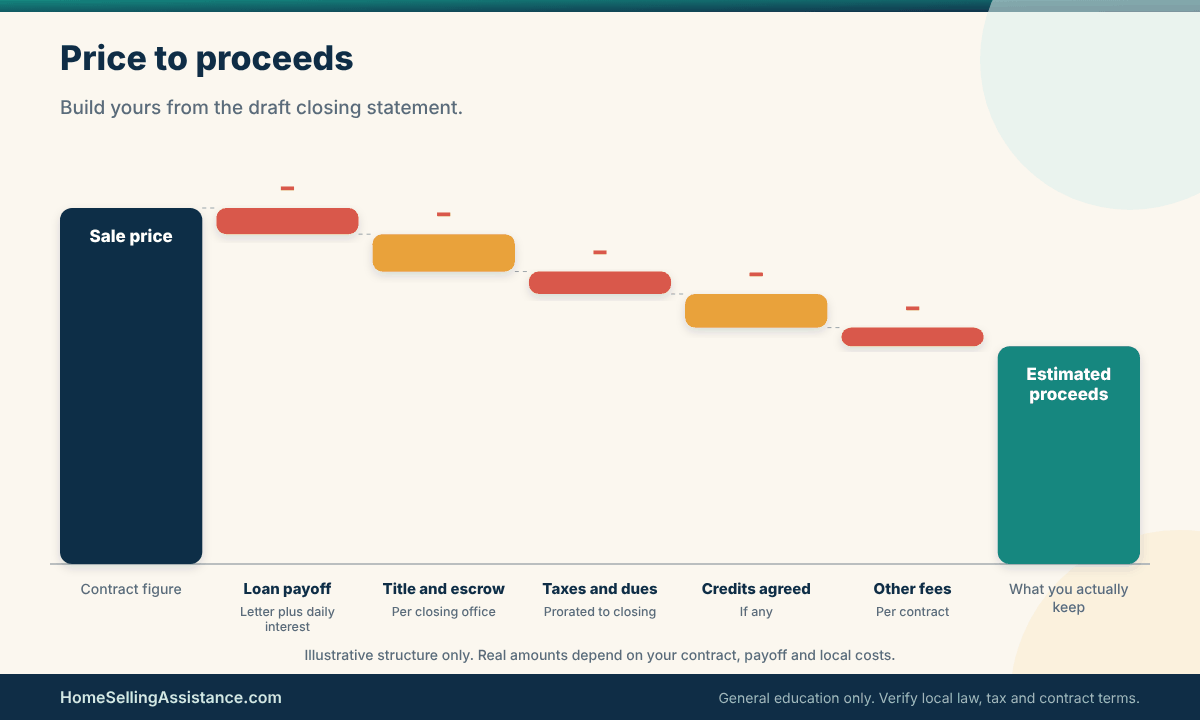
The walk-down shown above follows an example sale from contract price through the usual deductions and credits to your estimated proceeds. The amounts are illustrative only. Your own statement will include lines that are specific to your contract, your lender, your county and your closing office, so use the picture for structure and your draft statement for numbers.
Signing, funding, recording and the records you keep after the FSBO closing process
Signing day is usually the shortest part of the FSBO closing process. You arrive, show identification, read and sign a stack of documents, and in many places walk out without receiving money, because funding and recording follow after the buyer’s lender releases funds. Understanding that sequence keeps you from worrying when the keys change hands before the wire shows up in your account.
Roughly, the FSBO closing process order is: you sign the deed and the seller’s documents, the buyer signs the loan and purchase documents, the lender reviews and releases funds to the closing office, the office pays off your loan and other items, the deed is recorded with the county, and then your proceeds are released. Some offices complete several of those steps within hours; others take a day or more. Local custom and the lender’s schedule decide.
The timing of your money is a common source of anxiety, and our article on when the seller gets money after closing explains what delays are normal. For now, ask your closing office a direct question: when, and by what method, will my proceeds be released?
Evidence to gather: signed documents, lien proof and long-term records
Before you leave the closing table, ask for copies of everything you signed, or confirm that the office will email a complete set the same day. At minimum you want the final settlement statement, the deed or a copy of it, any bill of sale for items included in the deal, and any agreement about possession after closing. If something is not ready, ask when you will receive it and note the answer.
Proof that your loan is paid is its own item in the FSBO closing process. The servicer typically sends a payoff confirmation and, after a period that varies, a release or satisfaction of the mortgage is recorded with the county. Keep an eye out for that paperwork over the next weeks. If you hear nothing, ask the closing office to confirm that the payoff was sent and received, then contact your former servicer to ask when the release will be processed.
If your loan had an escrow account for taxes and insurance, there may be a refund of the leftover balance. The timing and method come from your servicer’s rules and state law, so check your final servicer letter. Also cancel or transfer automatic payments, homeowners insurance and utilities on the dates your contract specifies, and not before, since you remain responsible until possession changes.
Imagine a seller who closes on a Thursday and discovers the next week that the county tax bill, which arrives later, was not fully covered by the proration at closing. Usually the closing statement handles that with a best estimate, and a correction between buyer and seller may follow if the final bill differs. Our piece on property tax proration for sellers shows how the estimate works. The step is to read your contract’s re-proration clause now, before the bill appears.
The exception is a post-closing occupancy arrangement, sometimes called a rent-back, where you stay for a few days or weeks. That arrangement should be written, with a stated end date, a daily charge or a flat fee, a deposit if agreed, and clear language on who pays utilities and who is responsible for damage. Without that, a friendly handshake can become an unpleasant dispute.
Your next step after the FSBO closing process is a calendar entry thirty days out: confirm the lien release is recorded, confirm your proceeds arrived as expected, and confirm any final utility bills are closed. That small check catches FSBO closing process loose ends while everyone still remembers the sale.
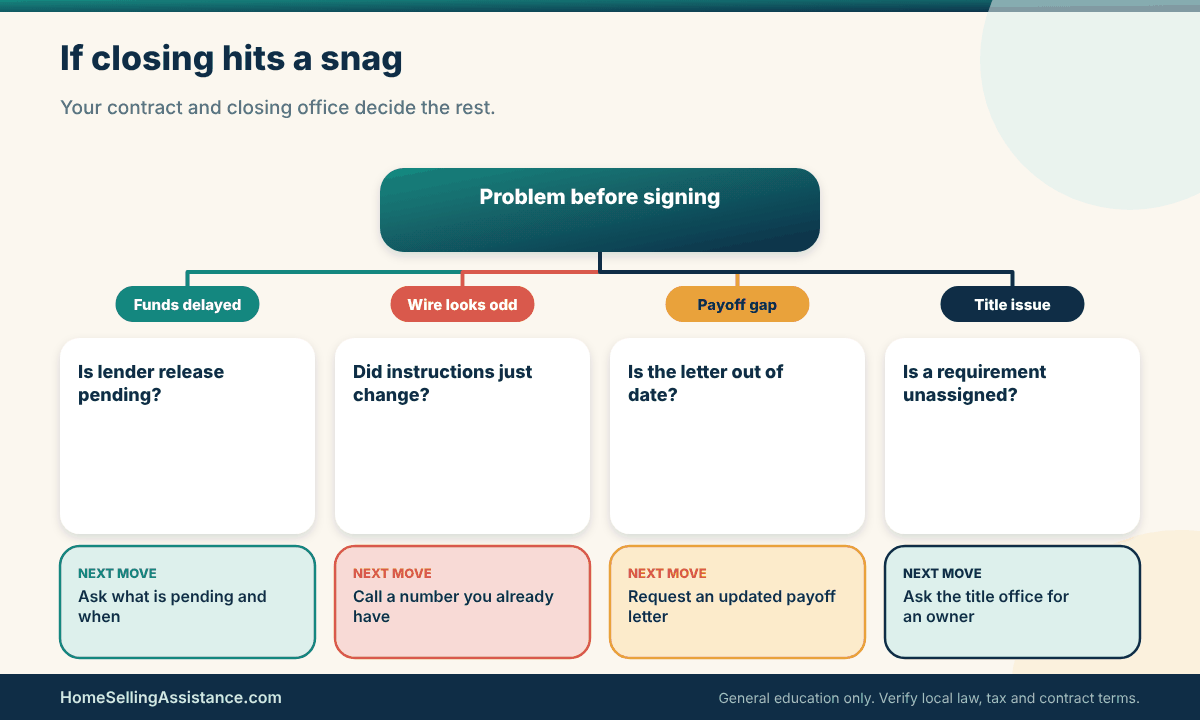
The tree above is a fallback map for the situations sellers worry about most as signing approaches, such as a buyer whose funds are not ready or a wire instruction that looks wrong. In each branch the first move is the same: pause, call a trusted number, and put the plan in writing before you sign anything new.
Create a permanent folder for your FSBO closing process records and keep it as long as the tax rules and your own comfort suggest. The final settlement statement, the deed, your original purchase closing documents and receipts for major improvements all belong there. These papers help establish your basis, which is the starting point for working out any gain, and the Internal Revenue Service explains how basis and the home-sale exclusion work in Publication 523.
We are not giving tax advice, and the rules depend on your situation. In general terms, the federal exclusion for a main home can shield up to $250,000 of gain for a single filer and $500,000 for joint filers when the ownership and use tests are met, which generally means two of the last five years. Whether you qualify, and what you must report, is something to confirm with the IRS materials or a tax professional.
For a practical approach to what to save and for how long, read our guide to home sale tax records. Save digital copies in two places, because a single laptop or drawer is not a records system.
A scenario, an exception and your next step for the weeks and years after closing
Think about a seller who sold three years ago and now receives a letter from a title company asking about an old easement, or a question from the buyer’s insurer about a repair. If the seller kept the disclosure forms, repair receipts and closing statement, answering takes ten minutes. If they threw the folder away, the same question can take weeks of searching, and the sale is already history.
The exception is a sale that involved a dispute, a credit, a repair agreement with a long tail or a seller-financed note. Those arrangements create ongoing obligations, and the records should be kept longer and shared with whoever advises you on them. If you hold a note, for instance, you will need payment records for years.
Your next step after the FSBO closing process is to write the retention note on the folder itself: the date of the sale, the date the folder was last reviewed and the date you will next check it. It is the simplest records policy in the world, and it works because it lives where you will see it.
Quick scenario
A seller accepts an offer on a Monday, builds the calendar by Wednesday, confirms the payoff the week of closing, compares the draft statement to her own estimate two days before signing, calls the closing office on a number she already had to verify wire details, and files her records the same weekend. Nothing about her FSBO closing process was dramatic, and that is exactly the goal: a boring, organized finish.
Frequently asked questions about FSBO closing process
Who runs the FSBO closing process when there is no listing agent?
A neutral third party does, and who that is depends on where you live. In some regions an attorney leads the closing, in others a title company or escrow officer does. You remain responsible for supplying documents, meeting deadlines and reviewing the numbers, so ask your closing office early which tasks are theirs and which are yours.
Do I need an attorney to close an FSBO sale?
Requirements vary by state and by local custom. Some states expect an attorney to be involved, others do not. Even where it is optional, many FSBO sellers pay for a one-time contract or closing review because they have no agent to catch drafting problems. Your state bar association or real estate commission can tell you what applies where you live.
How long does the FSBO closing process usually take?
There is no universal number. The FSBO closing process timeline comes from your contract, the buyer’s loan type, the appraisal, title condition and the closing office’s schedule. A cash buyer with a clean title can close faster than a financed buyer with a lien to clear. Use the dates in your own contract instead of an average from the internet.
What documents will I need to bring to closing?
For the FSBO closing process, expect to bring valid photo identification, any keys, garage openers and manuals, and whatever the closing office has asked for in advance. Some offices want a copy of the deed, trust documents or power of attorney papers if those apply. Ask for a written list a few days ahead, because requirements differ between offices and states.
How does my mortgage get paid off at closing?
In the FSBO closing process, the closing office requests a payoff statement from your servicer and sends that amount from the sale funds on closing day. The letter shows a figure good through a specific date plus daily interest after it. You should not wire money to your lender yourself unless the closing office tells you to, and any change in payoff instructions should be verified by phone.
Can the buyer back out during the closing process?
That depends on the contingencies written into your contract and on its default terms. During the FSBO closing process, a buyer who still has an open inspection, financing or appraisal condition may have a legitimate way out. A buyer who has waived those conditions may risk the earnest money by walking away. Your contract and an attorney can explain what applies in your situation.
What if the buyer’s funds are delayed on closing day?
Ask the closing office what exactly is pending, who is responsible and when it is expected. Check whether your contract allows an extension and whether doing so requires a signed amendment. Do not hand over keys or possession before funds are confirmed as released under your contract and the closing office’s instructions.
How do I protect myself from closing wire fraud?
Always confirm wire or payment instructions by calling a phone number you already had, not one printed in an email. Be suspicious of last-minute changes, urgency and requests to keep a payment secret. If something seems wrong, stop, call the closing office, and report it through the FBI’s ic3.gov or the FTC.
What should I keep after the FSBO closing process is done?
Keep the settlement statement, copy of the deed, disclosure forms, repair and improvement receipts, the original purchase closing papers and any signed amendments. These can matter for tax reporting and for questions that surface long after the sale. Store them in at least two places, and ask a tax professional how long to retain them.
Should I hire an agent just for the closing stage?
Some sellers do, and some fee-based services offer help with contracts and closing coordination for a flat charge. Whether that is worthwhile depends on how confident you are with deadlines and paperwork, and on what you already agreed with the buyer. Compare the cost against the specific tasks you want covered before signing anything.
A calm finish is built early
A smooth FSBO closing process rarely depends on luck. It depends on a tidy seller file, a closing office you chose with care, a contract calendar everyone has seen, and a habit of confirming every important figure in writing. If you want to compare routes or revisit earlier decisions, our for sale by owner guide, the FSBO and flat-fee MLS category and the closing costs and net proceeds category go deeper on each step. This article is general education, not legal, tax or financial advice, so confirm the details with your closing professional, an attorney or a tax advisor.