To sell house as is means you offer the property in its current condition and tell buyers up front that you will not be making repairs or paying for them, but it does not mean you are invisible to the law, the lender or the buyer’s inspector. Plenty of sellers hear the phrase and picture a clean exit: no contractors, no negotiation over a leaky water heater, no stress. The real picture is more interesting, and a little more demanding.
Deciding to sell house as is gives you a pricing and negotiating position, not a magic shield. You are saying, in writing, “this is what you get, and the price reflects it.” Buyers hear something slightly different: “there may be surprises, so I should pay less, inspect harder, or walk away.” Both readings are fair, and your job is to make the gap between them as small as honest preparation allows.
This guide explains what the phrase usually covers, what it almost never waives, and what buyers tend to expect when they see it on a listing. We stay neutral on the route you choose. Some owners are right to sell house as is because of cash, time, health or the size of the work. Others lose money by skipping a small fix that would have changed how every buyer saw the house. We will help you tell which group you are in.
If you are still deciding how much to fix at all, our wider guide on repairs before selling a house sets out the full landscape, and this article zooms in on the decision to leave things as they are. Everything below is general education. Contracts, disclosure forms and licensing rules differ by state, so treat each section as a map of questions to ask, not a ruling on your situation.
Key takeaways
- As-is is a term in your contract, not a legal force field. It usually limits what you owe the buyer in repairs or credits, but disclosure duties and honesty obligations generally stay with you.
- Buyers still inspect. Most as-is buyers keep the right to look at the house and, depending on the contract, to cancel or renegotiate during the inspection period.
- The price carries the weight. You are trading repair effort for a lower or more flexible price, so compare net proceeds, not list prices.
- Know what you know. Known material defects, pre-1978 lead paint, and title problems do not disappear because a listing says as-is.
- Your financing mix matters. Some loan programs and appraisers care about safety and condition, which can limit who can buy the house.
- Revisit the plan when evidence changes. A new quote, a failed inspection or a long stretch on market can justify a different route.
Start with the real question behind the decision to sell house as is
Before you worry about wording on a flyer, ask what you are trying to accomplish. Nobody chooses to sell house as is for its own sake. They choose it because of something else: a closing date they cannot miss, a house that needs more money than they have, an estate with several decision makers, or a simple wish to stop managing a project they never wanted.
That motive shapes everything. A seller who needs speed will accept a smaller net result than a seller who can wait for the right buyer, and the right plan for each looks different even when the house is identical.
Your goal, timeline, cash on hand, condition and risk tolerance
Think of five dials: what you want from the sale, how quickly it must happen, how much cash you can spend before closing, what shape the house is truly in, and how much uncertainty you can tolerate. Turning one dial changes the others. A tight timeline and thin cash almost force you to sell house as is. A flexible timeline and decent cash open up other doors, and a plan to sell house as is becomes a choice rather than a necessity.
Be honest about the fifth dial. Some people sleep fine with a sale that might fall through after inspection and relist. Others would rather accept a lower, steadier offer. Neither temperament is wrong, but ignoring yours leads to decisions you regret around week three of showings.
Evidence to gather: your numbers and your house
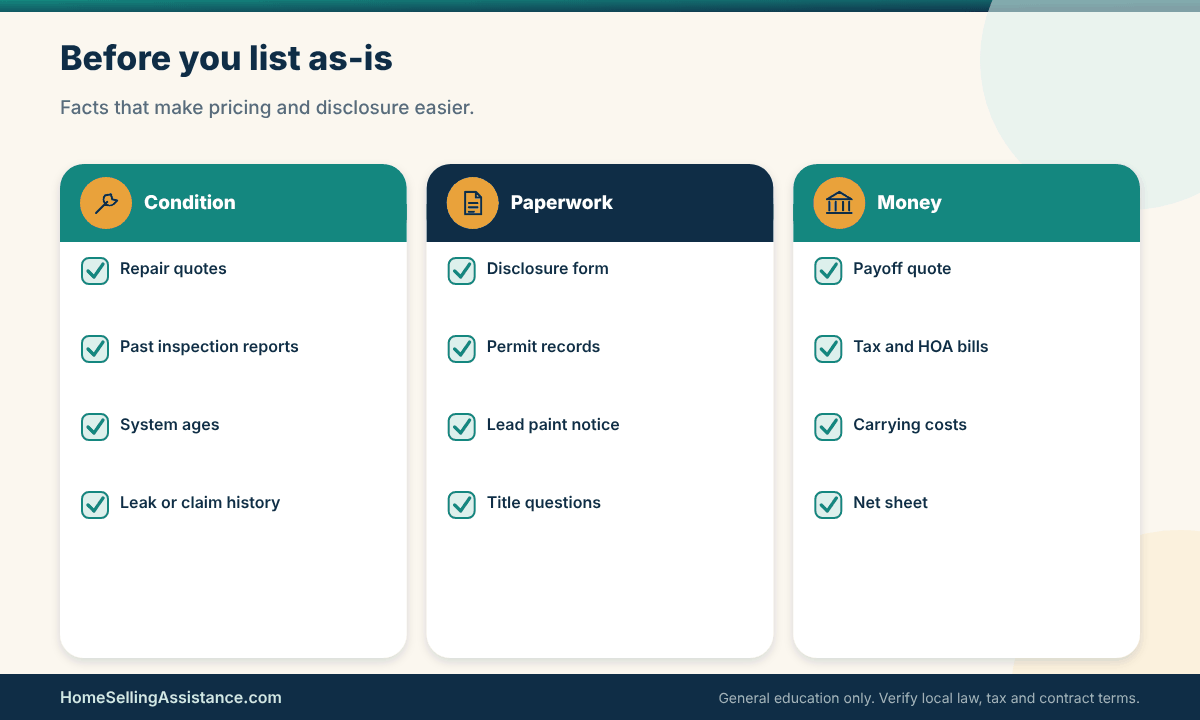
Start with your payoff. Ask your servicer for a payoff quote, because the balance on your last statement leaves out accrued interest and fees. Add any second mortgage, line of credit or recorded lien you know about. Then look at the house with fresh eyes, ideally with notes: the age of the roof, heating and cooling equipment, water heater and electrical panel, plus any history of leaks, pests or settling.
Next, collect two or three written contractor estimates for the biggest items you already suspect. They do not have to be hired; they just turn vague dread into figures. Also gather recent comparable sales from your agent, or from public records if you are selling on your own. Without comparables for homes in similar condition, you cannot tell what discount the market really applies to a house that needs work.
Finally, pull your disclosure paperwork. Many states require a seller property disclosure form, and the way you fill it in matters as much as the as-is wording. Our overview of seller disclosure requirements explains how those forms work in general terms.
A scenario, an exception, and your next step
Picture an illustrative case. A retired couple owns a house they have lived in for decades. The roof is near the end of its life, the kitchen is original, and a bathroom has a slow leak under the floor. They are moving to be near family and have to close within a few months. Repair estimates, in this made-up example, total a large sum they would have to front before seeing any proceeds.
For them, selling in current condition may be the sensible route, provided the price reflects the work and they disclose the leak honestly. The exception would be a cheap, visible fix, such as a broken stair rail or missing smoke detectors, which can be handled in a weekend and removes an obvious red flag. The next step is not to pick a label. It is to price the house against comparable homes in similar condition and decide which small items are worth handling anyway.
Facts that could change the decision to sell house as is
Some discoveries should make you pause even if your goal and timeline point toward leaving everything alone. They are the facts that either limit who can buy, expose you to claims, or change the price so much that a modest repair suddenly pays for itself.
The most common ones are unpermitted work, active leaks or mold, a failing foundation or roof, safety hazards that a lender’s appraiser might flag, and any recorded problem with title. If one of these is present, the question changes from “should I fix things?” to “how do I price, disclose and structure this sale so nobody is surprised?”
Evidence to gather: permits, reports, records and loan rules
Check your county or city building department for permits on past renovations, such as finished basements, additions, new electrical or plumbing, and decks. Missing paperwork does not automatically sink a sale, but buyers and lenders ask about it. If you suspect work was done without permits, our guide to selling a house with unpermitted work covers how those conversations typically go.
Look for any prior inspection report, pest report or insurance claim history. If you ever filed a claim for water, fire or storm damage, keep the documentation, because buyers’ insurers can see claim histories. Ask a loan officer or your agent in general terms which loan types tend to require certain minimum conditions. Government-backed loans and some conventional loans can require that basic safety and habitability items are working before closing, and that can shrink your buyer pool.
If the house was built before 1978, federal rules require you to give buyers the EPA lead-based-paint disclosure and pamphlet, and you can read the requirement on the EPA real estate disclosure page. As-is language does not remove that duty.
A scenario, an exception, and a sensible response
Imagine a seller who discovers, while gathering papers, that a finished basement has no permit on file. The plan was to sell house as is at a discount to cover cosmetic work. The new fact changes the picture: some buyers will want a quote for legalizing the space, others will ask for a lower price, and a few lenders may care.
The sensible response is to call the building department, learn what retroactive permitting would involve, and compare that cost with a price adjustment. Sometimes the answer is still to sell house as is, with plain disclosure. Sometimes the answer is to handle the permit and reopen the negotiation from a stronger place. Which one wins depends on local rules and the numbers, which is exactly why gathering facts comes first.
Compare the paths you can realistically take
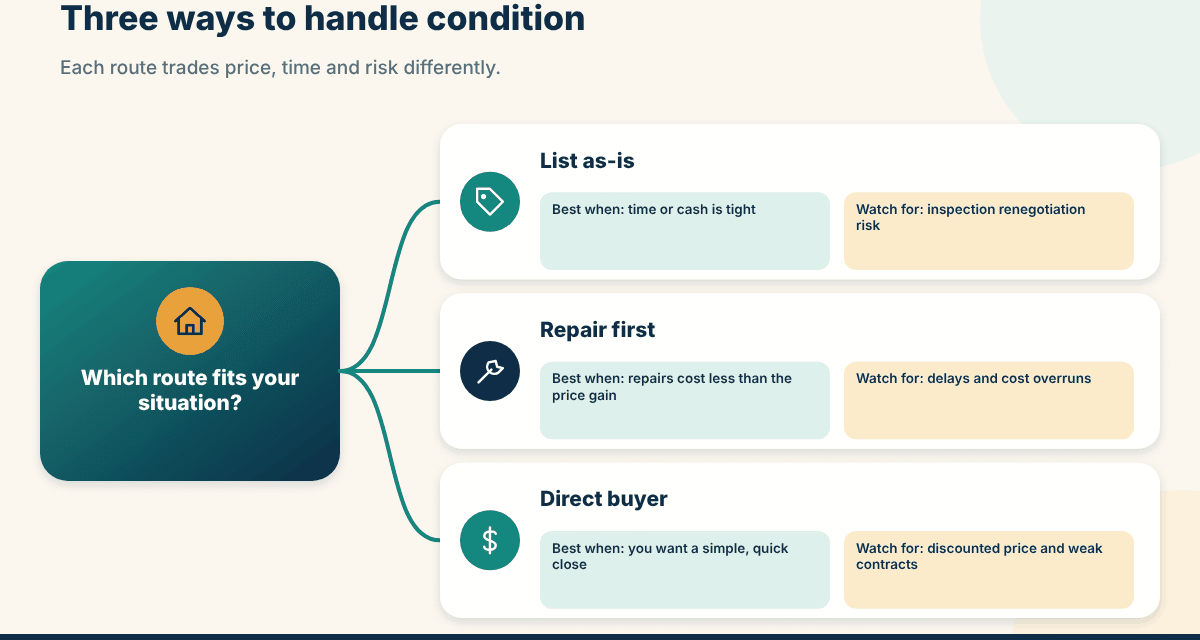
Once your goal and facts are on the table, you are choosing among a handful of routes. Three cover most sellers: list on the open market in current condition, make repairs or offer a credit first, or sell directly to a buyer who expects to do the work, such as an investor or a cash-offer company. Each one moves price, time and risk in a different direction, and none is the best for everyone.
The table below puts the first two side by side so you can see where the trade-offs sit. It is a decision matrix, not a verdict. Read each row as a prompt for your own numbers.
| Factor | Option A: list as-is | Option B: repair first, then list | How to compare |
|---|---|---|---|
| Price and net proceeds | Often priced lower; no repair spend | Higher price possible; repair cost comes out first | Subtract repair cost and carrying cost from the higher price |
| Time to list | Can list sooner | Adds weeks or months of work | Count mortgage, taxes and utilities per month |
| Contingencies | Buyer may still inspect and negotiate | Fewer surprises if reports are shared | Read the inspection clause, not just the label |
| Workload | Light; cleaning and disclosure | Heavy; contractors, permits, scheduling | Ask who will manage the work |
| Buyer pool | Narrower if loans require condition standards | Wider if safety items are fixed | Ask a lender how condition affects approval |
| Execution risk | Deal may fall apart after inspection | Repairs may cost more or run late | Get written quotes and a buffer |
Use the table as a worksheet. Fill the cells with your own figures from quotes and comparable sales, then look at the row that worries you most. If it is time, the left column tends to win. If it is price, the right column deserves a serious look. If it is workload, you may prefer the left column even at some cost to price.
Option one: list on the open market and sell house as is
This is the path most people picture. You photograph the house as it stands, write a candid description, set a price that reflects condition, and invite offers. Buyers can be owner-occupants who want a project, investors who plan to renovate, or families who simply cannot afford a finished house nearby. When you sell house as is on the open market, you keep exposure to all of them, which can bring competition if the price is attractive.
The trade-off is that you are asking buyers to take on uncertainty. They will want to inspect, and many will ask for a lower price after the inspection reveals something your photos did not. Your pricing and your disclosures decide how smoothly that conversation goes.
Evidence to gather: comparable sales, inspection terms and net figures
Ask for comparable sales that match your house in condition, not just size and location. A renovated house two streets over tells you little about what a dated house with deferred maintenance will bring. Look for sales described as needing work, estate sales, or homes that sold with visible issues, and note how long each took to go under contract.
Then read the inspection language your agent or attorney would put in the contract. A common structure says the buyer can inspect, and either cancel or request repairs within a set number of days. An as-is variation says the buyer can inspect and cancel, but the seller will not negotiate repairs. Another version limits the buyer to inspect for information only. These are very different promises, and state forms word them differently. If you want a full explanation of how that period works, our inspection contingency guide for sellers covers the mechanics.
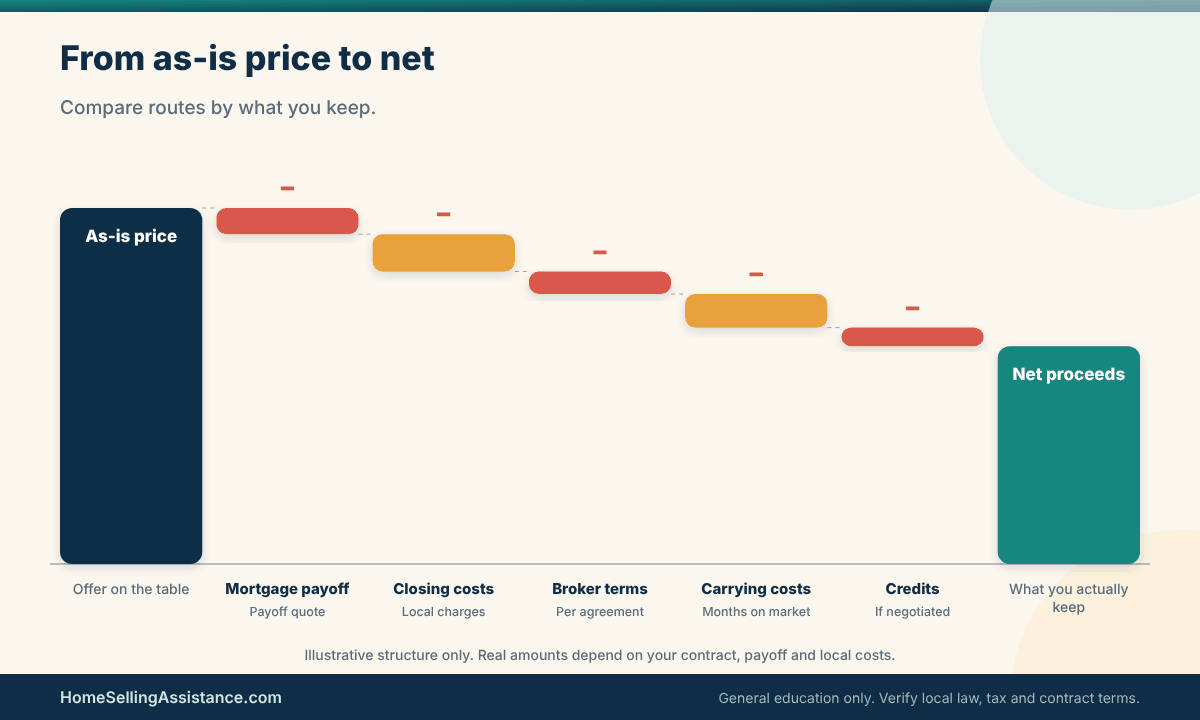
Finally, build a rough net sheet from your expected price, subtracting payoff, closing costs and any broker compensation you have agreed to in writing. Our walkthrough of home sale net proceeds shows how to structure it.

A scenario, an exception, and your next step
Take an illustrative example with round numbers. A seller believes the house would bring about 300,000 dollars in good condition and gets estimates of roughly 40,000 dollars for the roof and mechanical items. Choosing to sell house as is at around 255,000 dollars draws two offers. One is fully financed with an inspection period, the other is cash with a shorter timeline. The figures are invented, but the pattern is common: the cash offer may be slightly lower yet more certain.
The exception is a house where the problem is the kind that makes lenders hesitate, such as no working heat in winter or serious structural movement. There the decision to sell house as is may mean mostly cash buyers, and the price reflects that smaller pool. Your next step is to ask your agent or a lender how many recent as-is sales in your area used financing versus cash, and price with that answer in mind.
Option two: fix or credit first, or sell to a buyer who expects the work
The alternatives share a theme: you shift some of the condition problem away from a standard retail buyer. You can fix the items yourself, offer the buyer a repair credit at the negotiating table, or sell directly to someone who is in the business of buying homes that need work. Each has its own price tag and timeline.
A repair-first plan often costs money up front and time before listing, but it can turn an uncertain inspection into a short list of known items. A credit keeps you flexible, though it may leave you negotiating under deadline pressure. A direct sale to a buyer who plans to renovate can be quick and simple, usually at a price that accounts for their risk and profit.
Evidence to gather: quotes, credit terms and buyer credentials
For repairs, collect at least two written quotes per major item, confirm contractors are licensed where your state requires it, and ask about permits. For a credit, learn how a lender treats seller credits for repairs, since some loan programs limit how credits can be applied. Our comparison of a repair credit versus doing the repair yourself lays out the usual differences.
For a buyer who pays cash or plans to renovate, verify that they are real before you sign anything. Ask for proof of funds from a bank or broker, confirm the company’s registration through your state’s business records, and have a title company or attorney review the contract. The comparison in our investor offer versus listing guide goes further into how those offers are built, and our cash offer for house seller cornerstone covers verification in more detail.
A scenario, an exception, and a sensible fallback
Consider a seller who accepts a direct investor offer without reading the assignment language, then learns the contract lets the buyer transfer it to someone else and extend closing. The seller is not necessarily harmed, but the speed they were promised depends on a stranger. The lesson is to read for who actually closes, how deposits are held, and what happens if the buyer backs out.
If the direct route turns uncertain, the fallback is to relist and sell house as is with the same honest disclosures. A short period off the market costs some momentum, so decide in advance how long you will give a direct offer before moving on. If your situation involves an estate, our article on inherited houses and the sell-as-is-versus-repair choice adds the extra layer of multiple decision makers.
Use a net-result decision rule when you sell house as is
Every route above can be reduced to one question: after price, time, cost and risk are all counted, which path leaves you with the better result? The word “net” matters. A higher offer that comes with repair demands, a long closing and a real chance of collapse may be worth less than a lower offer that closes cleanly. The rule is simple to say and surprisingly hard to follow when emotions run high.
Before the framework, it helps to be clear about what the as-is label does and does not do, because the risk column of your comparison depends on it. In general, the phrase limits the buyer’s ability to demand repairs or sue over ordinary condition issues they could have discovered. It does not usually excuse you from disclosing known material defects where your state requires disclosure, from honest answers to direct questions, from federal lead-based-paint rules for older homes, or from clearing title to the property.
Our guide to material defects and seller disclosure explains the general idea of what counts as material.
A price, time, cost and risk framework to sell house as is
Build the comparison in four lines. Price is what you realistically expect from each route, based on comparable sales in similar condition. Time is how many months until money reaches you, including prep, marketing, contract period and closing. Cost is everything you pay or give up: repairs, credits, carrying costs, broker compensation you agreed to, and closing charges. Risk is the chance each number turns out worse than expected, and what you do if it does.
Run the same four lines for each route, then compare the net figure and the spread of outcomes. If one route has a clearly higher net with a similar risk profile, the decision is easy. If the nets are close, let time and risk break the tie. That is usually where real life, rather than arithmetic, makes the call.
Evidence to gather: a simple worked example with round numbers
Here is an illustrative comparison, with every figure invented for the example. Route A: sell house as is with a list price of 270,000 dollars, expect closing costs and broker compensation totaling 20,000 dollars, no repairs, three months to close, carrying costs of 2,000 dollars a month. Net before payoff: 270,000 minus 20,000 minus 6,000 equals 244,000 dollars.
Route B: spend 25,000 dollars on repairs over two months, list at 295,000 dollars, same closing costs structure at a slightly higher level, say 22,000 dollars, and five months total with carrying costs. Net before payoff: 295,000 minus 22,000 minus 25,000 minus 10,000 equals 238,000 dollars. In this invented case the choice to sell house as is nets more, because the repair spend and extra months ate the gain.
Change one assumption and the answer flips. If the repairs only cost 10,000 dollars and take one month, route B wins. That sensitivity is the point: your own quotes and timeline decide, not a rule of thumb. If you want a method for building this kind of sheet, see our guide on the net proceeds calculation and the broader overview of renovating before selling versus selling as-is.
A scenario, an exception, and your next step
Imagine a seller who runs the numbers and finds the two routes nearly tied. In that situation, the tie-breakers are personal: a looming move, a second mortgage payment, a health matter, or the sheer drain of managing contractors. A seller who values speed and calm will often sell house as is, the simpler path, even at a slightly lower figure. A seller with time and energy may take the repair path.
The exception is when the repair removes a risk that no discount can fully offset, for example an active roof leak that damages more of the house every week. Fixing that small, urgent item can protect the entire sale. Your next step is to mark which repairs are urgent (damage grows or safety is at stake) and which are optional, and treat them differently.
The second table collects common seller situations and the route each one tends to favor. Use it as a conversation starter with your agent, attorney or advisor, not a prescription.
| Situation | Route often favored | Reason | Trade-off | Fact that changes the choice |
|---|---|---|---|---|
| Fixed move date, limited cash | List as-is with candid pricing | Saves time and up-front spend | Lower price, inspection risk | A cheap, urgent fix that prevents damage |
| Estate with several heirs | As-is, or direct sale to an investor | Avoids managing repairs by committee | Heirs must agree on price | Probate authority and who may sign |
| Cosmetic wear only | Light touch-ups, then list | Small cost, broad appeal | Some effort and delay | Comparable sales that show no premium |
| Major system near failure | As-is with credit or discount | Buyers can price the work themselves | Narrower buyer pool | Lender condition rules for buyers |
| Safety or code issue | Fix or disclose and discount | Protects sale and reduces liability | Cost and permits | Local code and disclosure rules |
| Strong, fast local market | As-is may attract several bids | Competition can offset condition | Market may cool | Days on market for similar homes |
Read the table from left to right. Find the row closest to your situation, notice the reason and the trade-off, and then pay special attention to the final column. That column names the fact most likely to overturn the default, and it is often something you can check in a day or two.
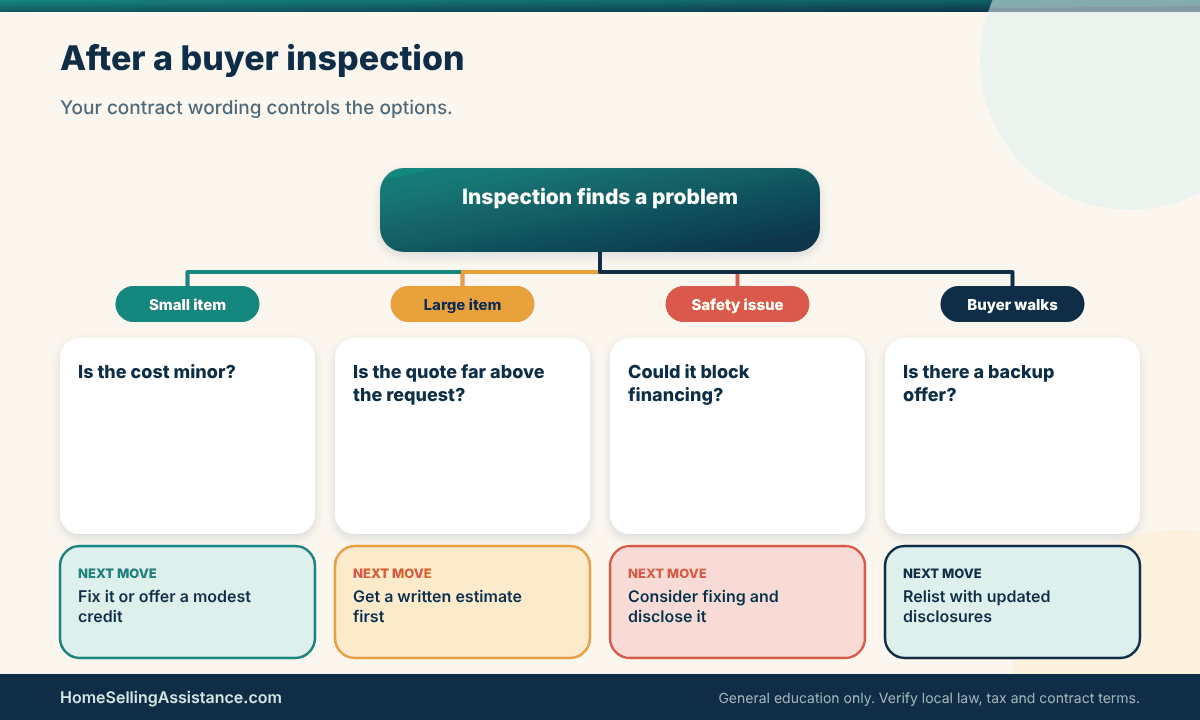
When new evidence should change the plan
A plan to sell house as is is not a vow. It is a working assumption that deserves a review whenever a meaningful fact arrives. The most common triggers are a repair estimate that comes in far above or below your guess, an inspection that finds something surprising, showings that produce the same objection again and again, and a change in your own timeline or finances.
Set a few checkpoints in advance. For instance, decide that if you receive no offers after a defined stretch, you will review price, photos and the disclosure package. Decide also that if an inspection reveals a safety issue, you will get a professional opinion before replying. Pre-commitments, especially if you sell house as is, protect you from making important choices in the middle of a stressful negotiation.
Evidence to gather: feedback, reports and changed numbers
Keep a simple log. Write down every showing, every comment you hear secondhand, and every question buyers’ agents ask. If the same concern appears several times, such as a smell, a dated bathroom or worries about the foundation, treat it as data. Ask your agent or a contractor what the concern would cost to resolve and whether it is cheaper to address than to discount.
If an inspection report arrives, read the summary and the full text. Inspectors list many minor items in every report, so focus on safety, water, structure, and major systems. When a buyer asks for money or repairs on an as-is contract, check what your inspection clause actually says before responding. Our guide on pre-listing home inspections explains why some sellers commission a report early, so surprises arrive on your schedule rather than the buyer’s.
Mold, water and structure deserve special care if you sell house as is, because they influence insurance and lending. If those issues are in play, our articles on selling a house with mold and selling a house with foundation problems go into the particulars.
A scenario, an exception, and a sensible way to adjust
Suppose a seller decides to sell house as is, gets steady showings, and receives an offer. The buyer’s inspection then reveals a failing sewer line, and the buyer asks for a price reduction. The seller’s contract says as-is, but the inspection clause still lets the buyer cancel. Pushing back hard risks losing the deal and relisting with a new disclosure about the sewer.
The sensible adjustment is to get a plumber’s estimate, compare it with the request, and consider a counter that splits the difference or offers a modest credit. Keeping the sale alive may be worth more than winning the argument. The exception is when the request is out of proportion to the estimate; in that case, a polite, documented refusal is reasonable. Your next step in any version is to put the response in writing and ask for the buyer’s response by a stated date.
Quick scenario
An owner chooses to sell house as is with a dated interior, discloses a past basement leak that was repaired, and attaches the plumber’s receipt. A buyer’s inspector finds old water staining but no active moisture. Because the history was disclosed and documented, the conversation stays about price rather than trust. The same staining discovered without disclosure would invite a very different reaction, and in some states a legal one. General education only; check your state’s rules.
It is worth spending a few more minutes on what buyers expect, because their expectations set the tone of every negotiation when you sell house as is. A buyer who sees the phrase in a listing usually assumes three things: the price will be lower than for a finished house, the seller will not be generous after the inspection, and there may be more wrong than the photos show. Good buyers respond by budgeting a cushion and inspecting thoroughly. Nervous buyers respond by walking away or asking for large discounts.
You can ease those assumptions without promising anything you cannot deliver. Share what you know in a plain written summary: the age of major systems, past repairs with receipts, known problems you have not fixed, and the reports you have already gathered. A seller who hands over a tidy folder looks credible, and credibility is worth real money when you sell house as is. It shortens negotiations because the buyer is comparing the house to what you disclosed, not to their fears.
Another expectation is access. Buyers who accept current condition almost always want an inspection, and many will ask for specialists, such as a sewer camera, a roof inspector, a structural engineer or a radon test. Saying no to reasonable access tends to backfire, because it signals that you are hiding something. Saying yes, while holding the line on repairs, is what most as-is contracts are designed for. If a buyer wants an unusually long inspection window, you can weigh that against the cost of keeping the house off the market.
Lenders add their own layer when you sell house as is. An appraiser has to report on condition, and some loan programs expect that the house be safe, structurally sound and secure from the elements. A home with a missing handrail, exposed wiring, a broken window or an active roof leak can stall financing even if both sides are happy with the contract. That does not mean you must fix everything.
It means you should ask, early and in general terms, how condition might affect the buyers your price is meant to attract, and consider fixing the specific items that block financing when they are cheap.
Fair housing rules apply no matter how you sell, including when you sell house as is. Whether the house is listed as-is or fully renovated, you cannot steer buyers or favor offers based on protected characteristics. If you want a plain overview, the HUD fair housing page explains the federal rules. Evaluate offers on price, terms, financing strength and timing, and keep your notes about each offer focused on those points.
Now consider the other side of the ledger, the parts of a sale that an as-is clause generally leaves untouched. Disclosure is first. Many states require sellers to complete a property condition form, and some give sellers the option to decline in exchange for a lower price or a credit. The details vary widely, so ask your state real estate commission, a local attorney or a title company how it works where you live. Our disclosures and seller paperwork category collects the related articles.
Fraud and misrepresentation are second, and they matter if you sell house as is. Courts in many places treat an intentional lie or active concealment very differently from an honest limit on repairs. Painting over a water stain you know is from a recent leak, or telling a buyer a roof was replaced when it was patched, is not a gray area just because the contract uses the words as-is. If you are unsure whether something has to be disclosed, ask a professional rather than guessing, and lean toward telling the buyer.
Title and ownership are third. A buyer expects to receive a property that you have the legal right to sell, free of liens that are not paid at closing. Unpaid contractor bills, tax liens, judgments or an unclear estate can derail a sale in ways condition never will. Run a title check early, and treat problems on that front as separate from the decision to sell house as is.
Last is money you may owe at closing regardless of condition: your mortgage payoff, prorated property taxes, association charges, and whatever compensation arrangements you have with brokers. These are covered in the net proceeds guide above. They are worth remembering because a seller who accepts a lower price to sell house as is and then discovers a large payoff has little room left to absorb a surprise.
If you are feeling overwhelmed, a useful habit is to write down three lists. The first is what the buyer will find on their own, such as dated finishes, worn flooring and old fixtures. The second is what you know that the buyer might not see, such as a slow leak you fixed or a past insurance claim. The third is what neither of you knows yet. Share the first two honestly, price for the third, and leave room in the schedule for the unexpected.
Many sellers also ask whether a cosmetic refresh counts as a repair. In practice, buyers see paint, cleaning, trimming shrubs and removing clutter as presentation rather than condition, and the cost is usually small compared with the impression. You can still sell house as is in the contractual sense while presenting a clean, bright home. The label describes your promise about repairs after you accept an offer, not a requirement to show the house at its worst. Our overview of important repairs before selling a house helps separate must-fix items from optional ones.
Finally, remember that your agent, attorney or title company is part of your decision team, not a substitute for your own judgment. Ask each one to explain, in their own words, how the as-is wording in your state contract works, which disclosures still apply, and how they would handle an inspection request. If three professionals give you three different answers, that is a signal to read the contract itself line by line. Neutral questions get the most useful answers, and you are allowed to compare more than one before you commit.
A short checklist in prose may help you put all of this to work. First, decide whether you truly need to sell house as is, or whether the label is simply the path of least resistance. Many owners discover that two or three small fixes change the conversation, and that the rest of the work can safely stay on the buyer’s side of the table. Others discover that nothing on their list is worth the money, and the decision to sell house as is becomes easy and calm.
Second, write down the price you would accept if you sell house as is, and the price you would expect for a repaired house, then subtract the repair bill and the cost of waiting. If the gap is thin, the simpler route usually deserves the benefit of the doubt. If the gap is wide, ask whether the work is something a contractor can finish on a clear schedule, with a written scope, a start date and a price you have compared with a second quote.
Third, remember that you can sell house as is and still be generous with information. Offering an inspection report, a list of recent maintenance, utility bills and a clear explanation of past repairs reduces the chance that a buyer invents a worst case. The more a buyer knows, the less they price in fear, and fear is usually more expensive than the truth.
Fourth, think about how you will talk to buyers who ask for changes after inspection. An as-is position holds up better when you have decided your limits in advance. Some sellers set a ceiling for credits they would consider, others decline all requests but welcome price conversations, and others agree to fix only safety items. Any of those can be reasonable, as long as you know which one you are using before the first message arrives. That clarity keeps you from reacting to each request emotionally.
Fifth, protect yourself with good records. Keep copies of what you disclosed, when, and in what form. Keep the signed contract, the inspection report your buyer shared, and any written responses. If a dispute ever appears after closing, those documents are what a lawyer would ask for first. A seller who can show an honest disclosure and a clear contract is in a much stronger position than one who relies on memory.
Sixth, match your marketing to the choice you made. If you sell house as is, say so in plain language, describe the condition honestly, and set expectations in the photos and description. A listing that hides the issues and only reveals them at the inspection tends to waste everyone’s time. A listing that says what the house needs attracts the buyers who are looking for it, and those buyers tend to negotiate more efficiently.
Seventh, if you sell house as is, think about the buyer’s financing early. If your price is aimed at owner-occupants who need a mortgage, ask how condition might affect their approval. If your price is aimed at investors who pay cash, ask how they verify funds and how soon they can close. Either way, the people most likely to buy a house offered as-is are the ones whose financing fits its condition, so it pays to know the odds in advance.
Eighth, give yourself a way out. If you cannot find a buyer at your chosen price within a period you set, treat that as information rather than failure. It may be time to adjust the price, make a targeted repair, or change the route altogether. Selling house as is does not lock you into a single strategy, and the sellers who do best are usually the ones who stay flexible while keeping their disclosures consistent.
Ninth, keep your tone steady in negotiations. Buyers of as-is homes often make low first offers to test your resolve. Responding with a counter, with reasons grounded in comparable sales, is usually more productive than taking the offer personally. If you need a refresher on how counters work, our article on counteroffer strategy for sellers walks through the basics.
Frequently asked questions about sell house as is
What does it actually mean to sell house as is?
It means you offer the property in its present condition and refuse to make repairs or pay for them after an offer is accepted. The price is expected to reflect that choice. It is a term in the contract and the listing, so the exact wording matters more than the phrase itself, and state forms differ in how they describe it.
Can a buyer still inspect an as-is house?
Usually yes. Most as-is contracts still give the buyer an inspection period, and many allow the buyer to cancel during it. What changes is your promise: you generally decline to negotiate repairs, though you may still choose to offer a credit or price change if you want to keep the sale alive. Read the inspection clause in your own contract.
Do I still have to disclose problems if I sell house as is?
In many states, yes. As-is language typically limits repair demands, but it does not usually cancel a state’s disclosure rules or excuse you from lying about or hiding a known defect. Some states handle disclosure differently, so check with your state real estate commission, a local attorney or a title company. When in doubt, disclose in writing.
Does as-is waive lead-paint disclosure?
No. If the home was built before 1978, federal rules require you to give buyers the lead-based-paint disclosure and the EPA pamphlet, and to allow an opportunity to test, no matter how the home is listed. The EPA real estate disclosure page describes the requirement. Our guide on lead paint disclosure for sellers adds detail.
Will I get a much lower price if I sell house as is?
Often the price is lower than a renovated comparable, but there is no universal discount, and it varies by market, condition and buyer type. Competition can narrow the gap in a busy market. Compare net proceeds after repairs, carrying costs and time, using comparable sales of homes in similar condition rather than a rule of thumb.
Can I sell house as is if I still have a mortgage?
Yes, as long as the sale price and your other funds cover the payoff at closing, or your lender agrees to some other arrangement. Request a payoff quote early, because the balance on your last statement leaves out interest and fees. If the sale price might fall short, talk to your lender and a housing counselor before listing; HUD lists counselors at its find a counselor page.
Do cash buyers always want to buy when you sell house as is?
Many do, because they plan to renovate, but not all. Cash buyers vary: some are owner-occupants, some are investors, and some are companies with set purchase formulas. Verify proof of funds and read the contract for assignment, deposit and closing terms before agreeing to anything. Our cash offer for house seller guide explains the verification steps.
Should I fix the roof before I list?
It depends on its condition, your price range and what buyers in your area expect. A leaking roof damages the house and can block financing, so it is often treated as urgent. An older roof that still works may be better handled with pricing or a credit. We discuss the question in detail in our guide on whether to replace the roof before selling a house.
What if the inspection finds something big after I accept an offer?
Read your contract first. If the buyer has a right to cancel or negotiate, you can respond with a counteroffer, a credit, a repair or a refusal. A professional quote often turns a scary finding into a manageable number. If you refuse, expect the buyer to consider leaving, and plan for relisting with the new information disclosed.
Where can I read more about repair decisions before I sell house as is?
Start with our cornerstone guide on repairs before selling a house and browse the repairs and selling as-is category. Those articles cover individual repairs, inspection strategy and the credit-versus-repair question from several angles.
A calm way to decide
The decision to sell house as is is rarely about courage or laziness. It is about arithmetic, honesty and fit. Write down your goal, price the house against comparable homes in similar condition, compare net results for each route, disclose what you know, and revisit the plan when new facts arrive. This article is general education, not legal, tax or financial advice. Contracts, disclosure rules and licensing requirements vary by state, so check with a local attorney, a title company or your state real estate commission before you sign anything.