A pre foreclosure home sale is a sale of your house that closes after you have fallen behind on the mortgage but before the lender’s foreclosure process reaches its final step, and the single most useful thing to know is that the clock is real but rarely as short as the letters in your mailbox make it feel.
If you are reading this because a late notice, a call from the servicer or a formal letter has arrived, take a breath first. Missing payments is stressful, and it is also extremely common. Lenders, servicers, housing counselors and courts all deal with it every week, which means there are established paths, and a sale is only one of them. This guide is written for the stretch of time when a pre foreclosure home sale is still one of your choices.
We will cover what to gather for a pre foreclosure home sale, what to ask, how the order of events usually works, who has to sign off on what, and how to avoid the mistakes that cost sellers the most. We will not tell you that selling is the right answer. For some households a loan modification, a repayment plan, a short sale or even a managed exit by other means fits better, and we say so plainly where it matters.
One caution up front. Foreclosure law is state law, and the details differ a great deal: some states run foreclosure through a court, others mostly through a notice process outside court, and the notice periods, reinstatement rights and post-sale rights all vary. Nothing here is legal, tax or financial advice for your situation. Treat it as a map, then check the real terrain with your servicer, a HUD-approved housing counselor and a licensed attorney in your state. Our broader roadmap, how to sell a house before foreclosure, sets the larger context for everything below.
Key takeaways
- Time is your most valuable asset. A pre foreclosure home sale works best when it starts early, because marketing, a buyer’s financing and a title search all take weeks that a late-stage deadline may not leave you.
- Get the real numbers before choosing a path. A payoff quote, a realistic value opinion and a lien search tell you whether a sale clears the debt, leaves cash, or needs lender approval for less than is owed.
- Talk to the servicer in writing and keep copies. Dates, names and promises you cannot prove tend to vanish when it matters.
- Use neutral help. HUD-approved housing counselors and a local attorney have no stake in taking your house, unlike many of the offers that arrive in the mail.
- Never sign over title or pay an upfront fee to a stranger who promises to stop foreclosure. Those are classic warning signs of a rescue scam.
- Confirm every payoff and release in writing before closing. A sale is not finished for you until the debt, any deficiency question and the recorded releases are settled on paper.
Build your pre foreclosure home sale file before the next deadline
Sellers in trouble often want to start with the listing: a price, a photographer, a sign in the yard. That instinct is understandable, and it puts the cart before the horse. A pre foreclosure home sale only works if the people who control the loan, the title and the calendar can all say yes, so the first job is to find out what they know and what they will need from you.
Think of the pre foreclosure home sale file as a single folder, paper or digital, that you can hand to an agent, an attorney, a counselor or a title company without having to retell your story each time. It will also keep you calm. When a servicer representative asks for a document on a phone call, you will have it in front of you instead of searching drawers.
Documents, numbers, contacts, and the dates that are already running
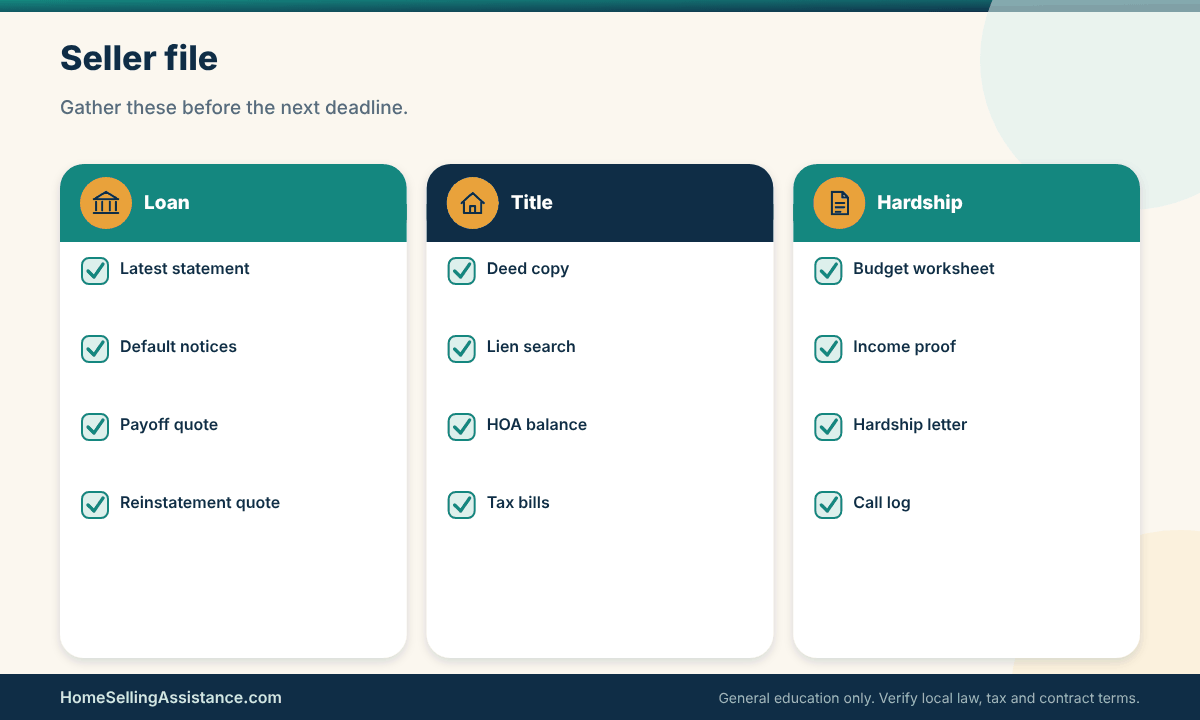
Begin with the loan itself. You want the most recent mortgage statement, the original note and mortgage or deed of trust if you still have copies, any modification or forbearance agreement, and every letter the servicer has sent since the first missed payment. Put the letters in date order. The first formal notice, often called a notice of default or a notice of intent to foreclose, starts a sequence in most states, and the date on it matters.
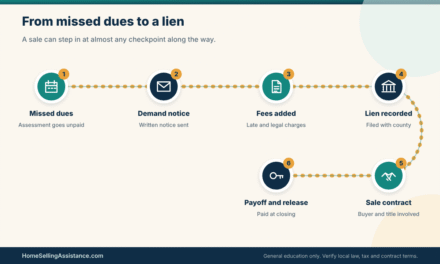
Next, list the numbers. How many payments are behind, and what is the total needed to bring the loan current, including late fees and any amounts the servicer has advanced for taxes or insurance? What is the unpaid principal balance? Is there a second mortgage, a home equity line, a judgment, a tax lien or an unpaid HOA assessment? Each of those can claim a share of any sale proceeds, and some can threaten the sale on their own.
Then write the contacts. A servicer often has separate departments for collections, loss mitigation and foreclosure, and they do not always talk to each other. Note the name, direct number and date of every conversation. Add the foreclosure attorney named in any notice, the county where the property sits, your HOA manager if you have one, and anyone who co-signed or co-owns. Our guide on selling a house with a mortgage covers the ordinary version of this payoff process.
Last, mark the dates that are already running. You are looking for a reinstatement deadline, a response deadline in a loss mitigation letter, a hearing or sale date if one has been set, and any date after which your rights change. If you cannot find one, that is itself useful information to bring to the servicer or an attorney. Never assume a date is soft because a letter sounds polite.
Evidence to gather: the loan, the notices, and the title
Good evidence is specific and comes from the source. For the loan, that means a current payoff statement and a reinstatement quote, both requested from the servicer in writing. These are different numbers. The payoff is what it costs to retire the loan entirely, while reinstatement is what it costs to bring a delinquent loan current. Having both lets you compare keeping the house with selling it using real figures.
For the notices, keep the envelopes as well as the letters. Postmarks and the dates you received them can matter later. If anything was served on you in person, such as a summons or a court notice, put it at the front of the folder and show it to an attorney quickly, because those documents often carry short response windows that cannot be extended by phone.
For the title, your deed shows who owns the property, and a title search or preliminary report shows what is recorded against it. Many sellers do not know what is on their record until a title company looks. For a pre foreclosure home sale, ordering an early search, or asking a title company what they would charge to run one, helps you spot a hidden lien before a buyer’s lender does. More on that in our guide to the seller’s title search.
A scenario, an exception, and your next step with the paperwork
Picture a homeowner who lost overtime hours and fell three payments behind. She has a letter from the servicer dated a few weeks ago and another that she has not opened yet. She opens it, and it offers a call with a loss mitigation specialist and gives a date by which she must respond. Because she opened the file work early, she can respond inside that window with the documents the servicer wants, instead of discovering the deadline after it passed.
Now an exception. If the loan is a home equity line or a second mortgage, the first lender may not even know the second one is delinquent, and the second lender may have separate foreclosure rights. If the property is owned in a trust, by an LLC or by a person who has died, the paperwork changes again, because the person who can sign a sale contract may not be the person named on the loan.
Your next step is small. Pick one weekday evening, put every letter and statement into a single folder, and write three lines at the top: the date of your first missed payment, the earliest deadline you can find, and the name and number of the person at the servicer you will call first. That page keeps you oriented when the days start moving quickly.
The information you cannot get yet, and who can supply it
Some answers about a pre foreclosure home sale do not exist until someone else produces them. You cannot know what the house will sell for until a professional looks at it and at recent sales nearby. You cannot know what a buyer’s lender will require until a buyer applies. You cannot know whether your servicer will approve a sale for less than the balance until you ask and they respond. Naming these gaps is useful, because it tells you which phone calls come first.
The biggest missing pieces are usually the market value, the exact payoff including fees, the full list of liens, the servicer’s willingness to accept a sale at a particular price, and the timeline the servicer or court will actually follow. Each one has a natural source: a local agent or appraiser for value, the servicer for payoff, a title company for liens, and the servicer’s loss mitigation team plus an attorney for timing.
It is worth understanding why you should gather these early rather than guess. If you guess high on value, you may spend weeks on a price that never draws an offer, and the foreclosure calendar keeps running while you wait. If you guess low, you may sell for less than you needed to. A clear picture, even a rough one, gives you the chance to correct your expectations while correcting still costs nothing.
Helpful companions here include our explainer on estimating home sale net proceeds and the wider foreclosure and financial hardship library, which collects the related questions sellers ask most often.
Evidence to gather: payoff quotes, value opinions, and lien searches
Start with the payoff request. Send it in writing, ask for the figure good through a specific date, and ask the servicer to list every component: principal, interest, late charges, escrow advances, legal fees and any property preservation charges. Legal and inspection fees can grow while a loan is in default, so ask for the quote to be updated if the closing date moves.
For value, ask two or three local agents for a comparative market analysis, and be clear about your timeline and the loan situation so they can speak to it. A comparative market analysis is an agent’s opinion based on recent nearby sales. It is not an appraisal, which is what a lender orders. Notice how each agent explains the comparables, how long similar homes took to sell, and what the condition of your house does to the likely price. Our piece on the difference between a CMA and an appraisal goes further.
For liens, ask a title company or attorney to run a search. Look for second mortgages, judgments, tax liens, HOA liens and any recorded notices tied to the foreclosure itself. The result tells you whether the proceeds, if any, will be spread across several creditors, and whether a buyer’s title insurer will insist on specific payoffs or releases before it will insure the sale.
A scenario, an exception, and your next step on missing facts
Take a couple weighing a pre foreclosure home sale who believe their house is worth enough to clear the loan. Two agents give them figures with a meaningful gap between them. Rather than pick the higher number, they ask each agent to walk through three recent sales, then compare the homes to their own. One agent counted a renovated kitchen the couple does not have. That conversation reveals the realistic range, and the couple now plans around the lower end.
The exception to watch for is a lien that surfaces late. A judgment from an old debt, a contractor’s claim or an unpaid special assessment can appear in a title search after you have already accepted an offer. That does not always sink the deal, but it can add cost and time. Finding it before listing gives you options, such as negotiating a payoff, rather than surprises under deadline.
Your next step for the pre foreclosure home sale: write down the five unknowns that most affect your decision, assign each to a person who can answer it, and set a date by which you expect an answer. If a date passes without a reply, follow up in writing. Silence from a servicer does not stop a foreclosure calendar from running.
Move through a pre foreclosure home sale in the right order
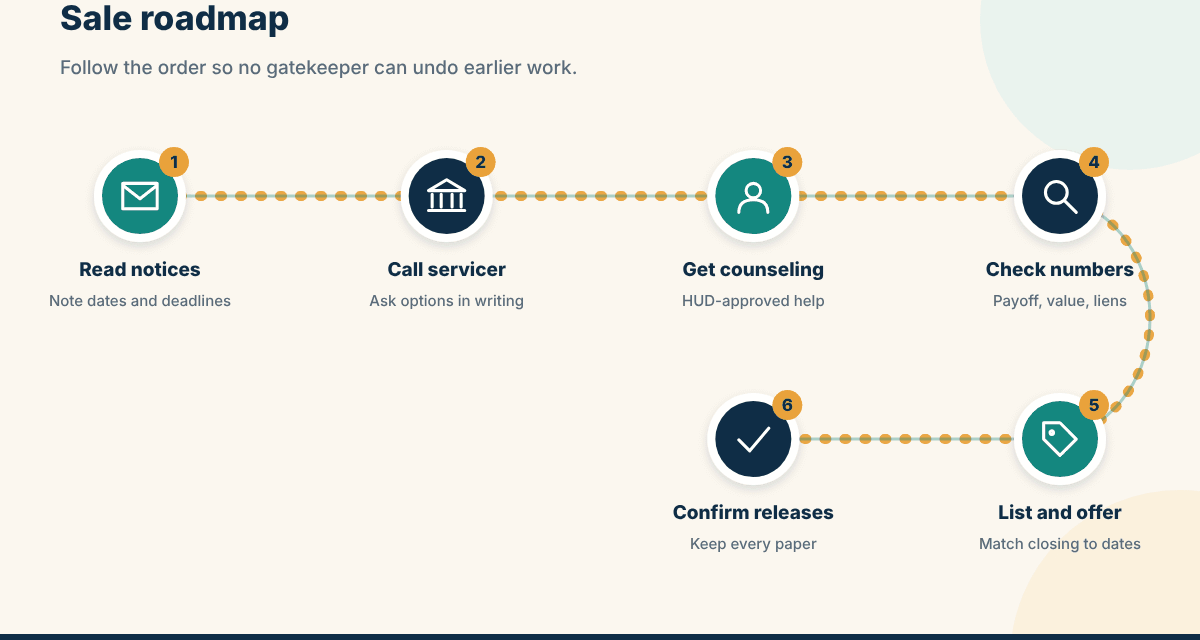
Once your file is in decent shape, the question becomes the sequence of a pre foreclosure home sale. A pre foreclosure home sale has more moving parts than an ordinary listing, because a lender, sometimes a court, sometimes a second lienholder and a buyer all have to line up. Doing the steps in a sensible order keeps you from paying for work that a later gatekeeper can undo.
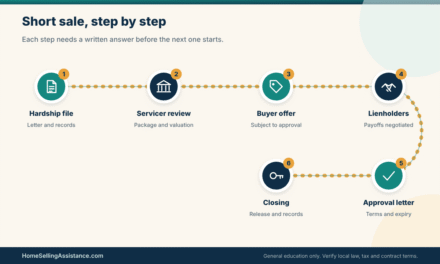
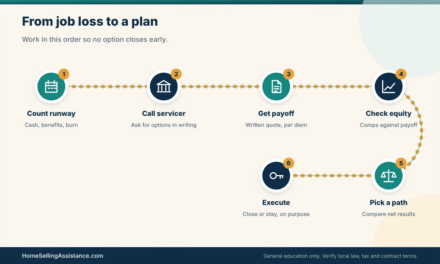
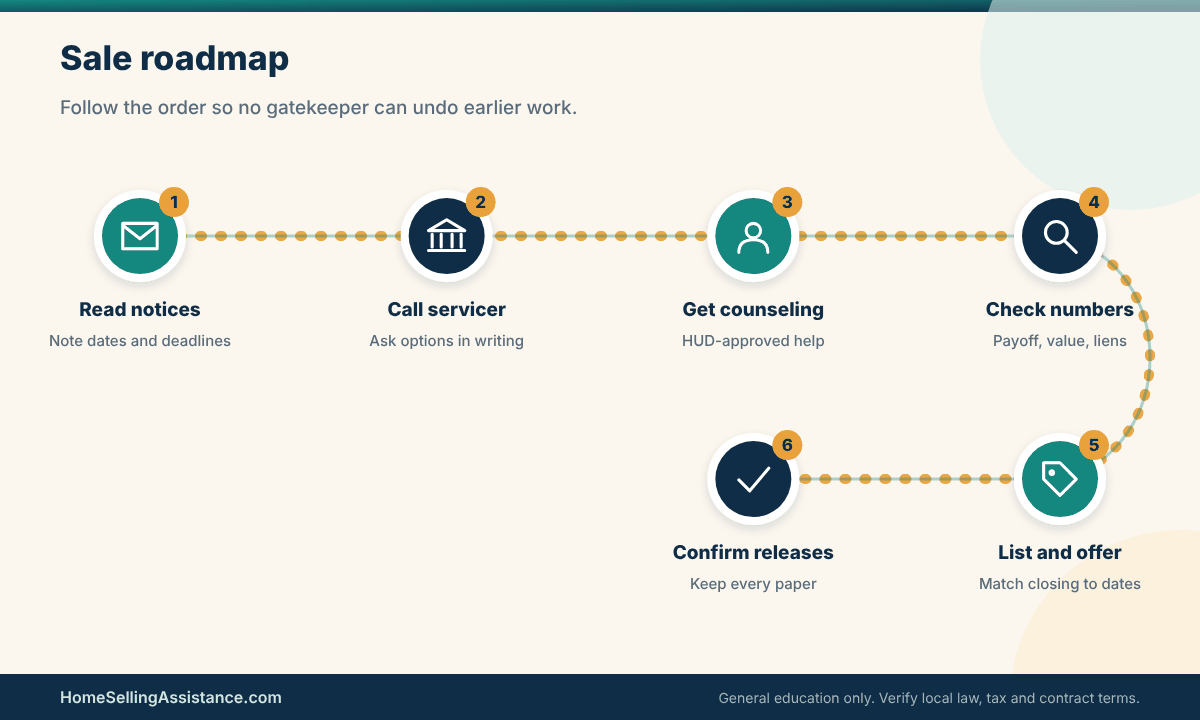
The rough order of a pre foreclosure home sale is simple to describe. You gather facts, talk with the servicer and a counselor, decide whether a sale is your route, choose how to market the home, review offers with the lender’s requirements in mind, and then manage the contract through title work and closing. The next table shows how the stages, the information you need, the action, the deadline you are watching and the handoff fit together.
Use this pre foreclosure home sale table as a working checklist rather than a rulebook. Your servicer’s letters, your state’s process and your contract will change the timing. Read each row left to right: where you are, what to gather, what to do, the date that limits you, and whom you pass the baton to next.
| Stage or symptom | Information to gather | Action | Decision deadline | Next handoff |
|---|---|---|---|---|
| First missed payments, no formal notice yet | Statements, hardship cause, budget | Call servicer, ask about options in writing | Before the account reaches formal default | Servicer loss mitigation team |
| Formal default or intent letter received | Notice date, reinstatement quote, payoff | Book a HUD-approved counselor, consult an attorney | Response date printed in the notice | Counselor and attorney |
| Deciding whether to sell | Value opinions, lien search, net estimate | Compare keep, modify, sell, short sale | Well before any set sale date | Listing agent or attorney |
| Home listed or marketed | Disclosures, access, condition notes | Price to the evidence, tell servicer the plan | Dates in forbearance or postponement letter | Agent, servicer, buyer |
| Offer in hand | Buyer financing proof, offer terms, lender rules | Review closing date against foreclosure calendar | Offer expiration, any lender approval window | Title company and lender |
| Under contract | Title commitment, payoff update, inspection results | Track contingencies, request updated payoffs | Contract dates plus foreclosure dates | Closing agent |
| Closing and after | Final statement, release letters, recording | Confirm payoffs and releases in writing | Closing day and recording date | Records folder, tax adviser |
Notice that two columns carry most of the risk: the decision deadline and the handoff. Most failed sales do not fail because of price. They fail because a date slipped between two parties who each assumed the other was watching it.
Early action and the decision points that close doors
The earlier you act, the more of your options stay open. A homeowner who is two or three payments behind and calls the servicer right away may hear about repayment plans, forbearance, loan modification or help that has a request window. A homeowner who waits until a sale date is set may be left with an emergency sale, a bankruptcy conversation or a foreclosure. This is the central reason to treat an early pre foreclosure home sale as a choice rather than a reaction.
For anyone planning a pre foreclosure home sale, federal mortgage servicing rules generally limit when a servicer can begin the formal foreclosure process, often described as after the loan has been delinquent for more than 120 days, and they also set expectations around how a servicer handles a complete loss mitigation application. The details and exceptions are technical, so confirm them with the CFPB resources or an attorney rather than rely on this summary. The point is that a window usually exists, and it is worth using.
The decisions behind a pre foreclosure home sale fall into a handful of families. Do you want to keep the home if you can afford to? Can you afford it with a modification or a repayment plan? Would selling solve the problem or merely change it, for example if the equity is thin? If you sell, does the price cover the debt, or will you need the lender’s permission to sell for less? Each question has a different set of professionals attached, and you should not skip a question simply because the answer is uncomfortable.
Counseling is the step many people postpone because of pride or cost fears. HUD-approved housing counselors can walk through your budget, explain servicer options and help you prepare a hardship package. You can find one through HUD’s counselor search. Ask each agency about its fees up front, since policies vary, and avoid any outfit that demands a large payment before it does anything.
Evidence to gather: servicer options, budget proof, and a net estimate
Ask the servicer, in writing, which options your loan type allows and what documents they require for each. Typical requests include a hardship letter, proof of income, recent bank statements, a list of expenses and sometimes a tax return. Keep a copy of everything you send and note when you sent it. If a submission is described as incomplete, ask what is missing and when the review clock restarts.
Build a simple budget, using actual bills rather than guesses. Include housing costs, utilities, insurance, taxes, debt payments and food, then compare them to income you can reasonably count on. This is what a counselor will ask for, and it also tells you whether a modification is realistic. A plan that only works if everything goes right next month is not a plan.
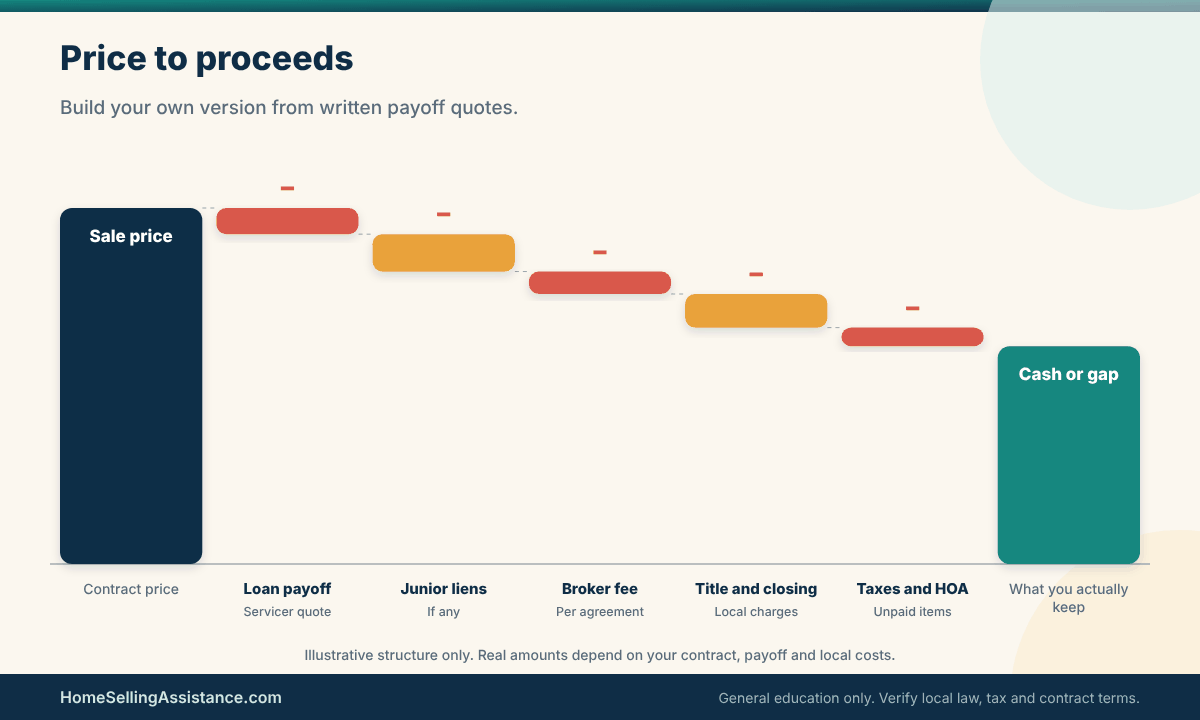
Then draft a net estimate on a single page. List an illustrative sale price, subtract the loan payoff, any second liens, the broker fee you negotiate, title and closing charges, and unpaid property taxes or HOA dues. The result may be positive, near zero or negative. A negative result does not end the discussion, but it moves you toward lender approval for a short sale. Our detail on how a short sale works for sellers explains that road.
A scenario, an exception, and your next step before the door closes
Imagine a seller considering a pre foreclosure home sale who has a loan balance of 300,000 dollars and an agent’s value range of 310,000 to 330,000 dollars. These are illustrative round numbers only. After a broker fee, closing costs and about two months of arrears, the sale might leave little or nothing. Knowing that early lets him plan a modest move-out budget instead of expecting a windfall, and lets him ask the servicer about relocation assistance if it exists for his loan.
The exception is the seller whose equity is large, where a pre foreclosure home sale can pay the lender in full. If the home is worth much more than the debt, a sale can pay the lender in full, resolve the arrears, and leave real money. That seller still needs speed, but usually has more room to market the home widely and wait for the right offer, because the debt is covered at a wide range of prices.
Your next step toward a pre foreclosure home sale: before the end of the week, request the reinstatement quote, request the payoff quote, book a counseling appointment, and ask an attorney about the foreclosure timeline in your state. That is four calls or emails that turn a vague fear into a dated plan.
Handoffs, negotiations, and contingencies with the servicer in the middle
In an ordinary sale, the seller negotiates with the buyer and the lender is mostly a payoff line. In a pre foreclosure home sale, the servicer is a stakeholder, and its rules shape what you can promise a buyer. If the sale covers the loan in full, the servicer is mainly interested in being paid on time and in the right amount. If it does not, the servicer may have to approve the price, and that approval has its own steps and its own delay.
Handoffs deserve attention in a pre foreclosure home sale. The listing agent talks with the servicer’s representative, the buyer’s agent talks with the title company, the title company talks with every lienholder, and you talk with all of them. Pick one primary contact for each channel and ask that person to confirm important changes in an email you can save. When something goes wrong, a written trail shortens the repair time.
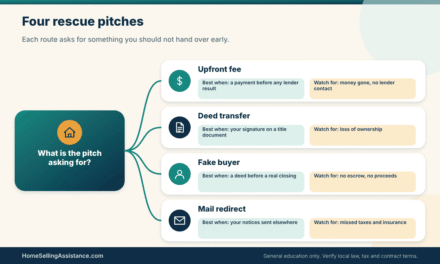
Negotiation in a pre foreclosure home sale looks different as well. Buyers who understand the situation may expect a discount, while others will pay market price for a clean, simple deal. Be wary of buyers who ask you to skip inspections, sign unusual side agreements, move out early or deed the home to them before closing. A legitimate buyer’s offer should fit into a normal purchase contract with a title company or attorney handling the closing. Our guide on weighing a cash offer for your house sets out the questions to ask.
Contingencies matter more in a pre foreclosure home sale, where time is short. A financing contingency, an inspection period, an appraisal clause or a home-sale contingency adds uncertainty, and every added week can collide with a foreclosure date. That does not mean you must reject them, only that you should ask a buyer for realistic dates and compare each offer’s total risk, not just its headline price.
Evidence to gather: lender approvals, buyer proof, and written timelines
Ask the servicer what documents it expects if your pre foreclosure home sale might be for less than the debt. Many ask for a signed listing agreement, a purchase contract, a hardship letter, a broker’s price opinion or appraisal, and a draft closing statement. They may also have rules about who can pay what at closing. Getting that list at the start avoids repeated rounds in which the file is incomplete.
Ask any buyer for proof of funds or a lender pre-approval, and ask the buyer’s lender how long underwriting typically takes. For cash buyers, confirm funds with the title company rather than only accepting a screenshot. Our guide on verifying a cash buyer covers what to request. A buyer who cannot document funds is not an offer, just a conversation.
Finally, request any postponement or forbearance terms in writing. If a servicer agrees to pause a sale date while you are under contract, the letter should state the new date, any conditions and who to call if closing slips. A verbal promise on a phone call is not something you can show a court clerk or a title officer, so do not rely on it.
A scenario, an exception, and your next step with buyers and lenders
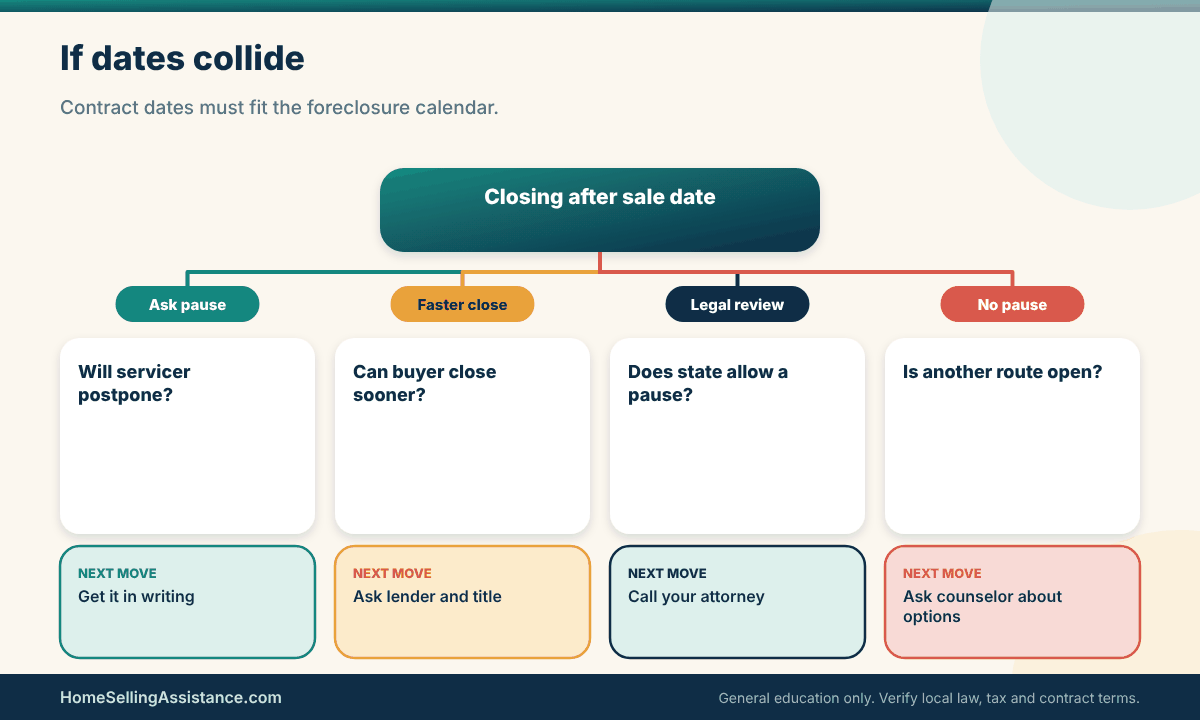
Consider a pre foreclosure home sale in which the seller accepts an offer from a buyer using an FHA or conventional loan, with a closing date set 45 days out. The servicer’s published sale date falls 40 days out. Because the seller kept the servicer informed and asked for a written postponement, the servicer agrees to pause. Without that letter, the sale could have gone forward on the original date, with the buyer’s closing a few days too late.
An important exception: some servicers will not grant a postponement without an executed contract in hand, while others want to see proof that the buyer’s lender has issued a commitment. These expectations differ across lenders, loan types and states. Ask for the requirements rather than assume them, and ask your attorney what your state permits after a sale date is set.
Your next step in a pre foreclosure home sale is to create a single timeline page with two columns: the foreclosure dates and the contract dates. Update it every time either changes, share it with your agent and attorney, and look for any contract date that falls after a foreclosure date. A mismatch that you spot now is a negotiation. A mismatch spotted later can be a lost house.
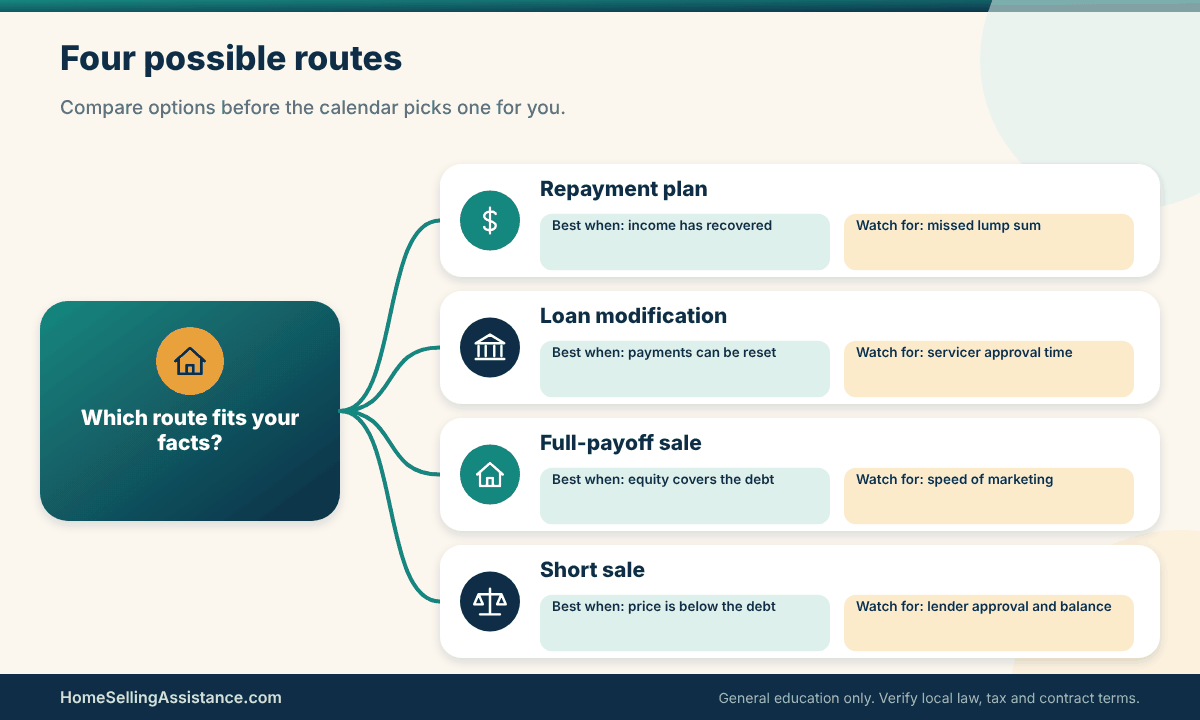
A short sale, a full-payoff sale and a sale with a negotiated lien release can look alike from the outside and play out very differently inside the servicer’s office. Our comparison of a short sale versus foreclosure goes into the consequences of each outcome, including credit effects and how deficiencies are treated, which are areas where state law and the loan documents decide a great deal.
Quick scenario
A homeowner receives three unsolicited letters in a week, each promising to buy the house for cash “before the bank takes it.” One asks her to sign a quitclaim deed and rent the house back. She sends all three to a housing counselor and an attorney first. Two of the letters turn out to come from buyers who would pay a discounted price through a normal contract. The third is a transfer scheme. Pausing for a day saved her from the third.
You can see why a controlled pre foreclosure home sale process helps. When a sale is moving, every party wants a signature, and the pressure to sign quickly is highest exactly when your judgment is most strained. Reading each document, asking what it does to your ownership, and having a neutral professional look at it is not slow. It is the cheapest insurance in the whole transaction.
One more habit is worth building early: decide in advance what you will not do. You will not sign a deed before closing. You will not pay an upfront fee to anyone who promises to stop a foreclosure. You will not move out of the house before you know what your contract and the servicer require. Writing those boundaries down makes them easier to hold when someone is pushing.
Close the loop on your pre foreclosure home sale in writing
The closing table is where weeks of effort either turn into a clean ending or into a loose end that follows you for years. Because a pre foreclosure home sale involves a distressed loan, it deserves extra care in the last stretch. The goal is simple: by the time you hand over the keys, every debt that was supposed to be paid has been paid, every release has been requested, and every promise someone made to you exists on paper.
This section of the pre foreclosure home sale guide covers what to confirm before you sign, what to keep after you sign, and what can still go wrong after the sale. It is a little tedious. It is also the part sellers most often regret skipping, so a patient read now can spare you a hard phone call later.
The table below is a transaction check list built for a pre foreclosure home sale. Each row names an issue, the evidence you should have from your side, the input to request from the buyer, agent or title company, the risk if it goes wrong, and a fallback.
| Issue | Seller evidence | Buyer, agent or title input | Risk | Fallback |
|---|---|---|---|---|
| Payoff amount changes before closing | Written quote with good-through date | Title company requests update | Closing delayed or short at the table | Request a fresh quote, adjust closing date |
| Sale date set before closing date | Servicer letter listing dates | Agent shares contract timeline | Foreclosure sale proceeds first | Written postponement, attorney review |
| Hidden lien appears in title search | Deed, tax and HOA records | Title commitment lists exceptions | Buyer’s insurer refuses to insure | Negotiate payoff or release with lienholder |
| Price below total debt | Net estimate, hardship papers | Agent supplies value support | Servicer declines the price | Ask about short sale approval, counselor help |
| Buyer financing slips | Pre-approval letter, lender contact | Buyer’s lender gives status updates | Contract fails near the deadline | Backup offer, extension request |
| Deficiency or tax question left open | Signed approval letter terms | Attorney or tax adviser review | Later bill or surprise tax form | Get written terms and professional advice before signing |
Take the table to your agent or attorney and ask which row worries them most for your file. That conversation tends to identify the real weak point quickly. Then copy the table into your own notes and add the dates that apply to you.
What to confirm in writing before and at the closing table
Writing is the thread that holds a pre foreclosure home sale together. You want written confirmation of the payoff amount, the closing date, the account where funds go, the treatment of any junior liens and, if the sale is for less than the debt, the lender’s formal approval and exactly what it says about the remaining balance. Ask your agent or attorney to read the approval letter with you, line by line, before you sign anything that depends on it.
Review the draft closing statement as early as the title company will provide it. Look for every line that sends money to a lender, a tax office, an HOA or a lienholder, and match each to a payoff letter or invoice. Our article on how to read a seller closing statement walks through the usual lines. Anything you do not understand deserves a question before closing day.
Wire fraud is a particular hazard at this stage, because buyers, sellers and title companies exchange payoff and wiring details by email. If you receive a message changing where money should go, confirm it by calling a number you already know, never one listed in that message. The FBI’s Internet Crime Complaint Center collects reports if you suspect a scam.
Evidence to gather: approval letters, payoff letters, and the final statement
Before the closing appointment of your pre foreclosure home sale, your folder should hold the servicer’s payoff letter, any second lienholder’s payoff or release letter, the lender’s written approval if the price is short of the debt, the title commitment, the draft closing statement and the purchase contract with all addenda. Check that the names, the property address and the loan numbers match from one document to the next. Small mismatches cause delays that are easy to avoid.
Ask the title company who will send the payoff, by what method, and how you will learn that it arrived. Ask when the lender will record or issue a satisfaction of mortgage, and when you can expect a copy. If a lender will not release in writing that the loan is paid, ask your attorney what protection you have and what a title insurer expects in that situation.
If the sale is short, ask the servicer for a written statement of whether it treats the debt as fully satisfied, and whether it reports the sale and any remaining balance in a particular way. Rules for deficiency balances differ by state and by loan, so this is not a place for guesses. Also ask a tax professional whether any forgiven amount could be reported to the IRS, using the IRS website as a starting reference, since outcomes depend on your facts.
A scenario, an exception, and your next step before you sign
A seller is a day from closing and receives an email from the title company’s “assistant” with new wiring instructions for the payoff. The sender’s address is nearly right but not quite. Because she has promised herself to confirm any change by phone, she calls the title company at its published number. They never sent the message. The call took four minutes, and it protected the whole payoff.
The exception arises when the final statement shows a charge you did not expect, such as a lender’s attorney fee or a property preservation fee. These are sometimes legitimate and sometimes disputed. Ask for an itemized invoice and for the contract section that allows the charge. If an answer is not available before closing, ask the title company whether the amount can be held in escrow while you resolve it.
Your next step in a pre foreclosure home sale: send your closing folder checklist to the title company a week before closing and ask them to confirm which items they already hold. Missing pieces surface early, and the closing table becomes a signing appointment rather than a negotiation.
Records and follow-up after the closing is done
When the keys change hands, you may feel that the work is over. Almost, but not quite. A short list of follow-up tasks protects you from the long tail of a distressed sale: confirming that the loan is shown as paid or settled, confirming the recorded release, watching your credit report for accurate reporting, and keeping the paperwork that supports any later tax or legal question.
Give your pre foreclosure home sale a few weeks of attention after closing. Ask the title company for the final settlement statement and any recorded documents. Check county records, which are often searchable online, to see whether the release or satisfaction of mortgage has been recorded. If it has not, follow up with the title company first, then with the lender. Our overview of which home sale tax records to keep tells you what to put in the box.
Finally, handle the human side. Moving out of a home during financial strain is hard. A trusted friend, a counselor or a community resource can help with the practical and emotional load. If you are renting back temporarily, put the terms in writing with dates and costs. If you need a new place to live quickly, a housing counselor may know of local help and deposit assistance that you could not easily find alone.
Evidence to gather: recorded releases, credit reports, and tax papers
Your pre foreclosure home sale records folder should include the signed contract, the final closing statement, the payoff letters, the lender’s approval letter if there was one, proof that funds were paid, the recorded release or satisfaction when it arrives, and any correspondence about the balance or how the account is reported. Store a digital copy somewhere other than your phone, since phones get replaced, lost or reset.
About a month after closing, pull your credit reports and check that the mortgage shows the status the servicer agreed to report. Federal law gives consumers access to free reports on a regular schedule, and the Consumer Financial Protection Bureau explains how to dispute an error. A dispute is easier when you can point to a letter that says what was agreed.
For taxes, keep the closing statement and any Form 1099 or similar document you receive. Whether a sale produces a taxable gain, a loss, or an amount treated as forgiven debt depends on your facts, and the home-sale rules in IRS Publication 523 cover the basic gain rules. A tax professional can tell you whether anything specific applies to you.
A scenario, an exception, and your next step after the sale
Take a seller whose pre foreclosure home sale ends as a short sale and, months later, receives a collection letter on a balance she thought was forgiven. Because she kept the approval letter, which states that the lender accepted the sale proceeds in full satisfaction, she sends a copy with a dispute letter, and the matter is corrected. Without that letter she would have had only her memory and a stack of unrelated statements.
An exception worth knowing about: some loans, some states and some investors treat deficiencies differently, and some approvals leave the remaining balance open. If your letter does not say the debt is satisfied, treat it as possibly unsettled and talk with an attorney before you celebrate. Wording is everything here, and it is much easier to negotiate before closing than after.
Your next step after a pre foreclosure home sale is a calendar entry for 30 days and again for 90 days after closing. On each date, check the recorded release, the credit reports and the mail for stray bills. Those two short check-ins close most of the loose ends that a pre foreclosure home sale leaves behind, and most of the loose ends that a distressed sale leaves behind.
Frequently asked questions about pre foreclosure home sale
What exactly counts as a pre foreclosure home sale?
It is a sale that closes after you are in default on the mortgage but before the foreclosure is completed. The details of when foreclosure is complete depend on your state’s process. In some places that means a court judgment and a sale date, in others a notice period followed by a trustee sale. Your attorney or servicer can tell you where the finish line sits for your loan.
How long do I really have to sell?
There is no single number. Timelines vary by state, by loan type, by whether a court is involved and by how the servicer handles your case. Some homeowners have many months, while others have only weeks after a notice. Ask the servicer for the dates in writing and ask an attorney what your state’s process allows, then plan around the earliest date you can find.
Can I sell if I owe more than the house is worth?
Sometimes, but not on your own say-so. If the sale price will not cover the loan, the servicer generally has to approve a short sale, and any other lienholders may need to agree as well. Approval is not guaranteed, and the terms about any remaining balance differ. A housing counselor and an attorney can help you request approval and read the response.
Will selling hurt my credit less than foreclosure?
It can, but the effect depends on how each account is reported and on your credit history before the default. Outcomes differ by servicer and by the exact terms of the sale. Ask for the way the loan will be reported in writing, and check your reports after closing so you can correct mistakes.
Do I need a real estate agent for a pre foreclosure home sale?
Not by law in most places, but the process has enough moving parts that many sellers want experienced help. Look for someone who has handled lender approvals and tight timelines, and ask how they are paid, in writing. Compensation is negotiable and must be documented. Some sellers also choose an attorney-led process, depending on local custom.
Should I accept a quick cash offer that arrives in the mail?
Treat it like any other offer in a pre foreclosure home sale: verify who the buyer is, ask for proof of funds, insist on a normal purchase contract and have a title company or attorney handle the closing. Some such buyers are legitimate. Others are not, so compare the offer with a market listing and with the net you would receive. If anyone wants you to sign over title before closing, stop and get advice.
How do I recognize a foreclosure rescue scam?
Common signs include upfront fees for loan help, pressure to sign quickly, requests to deed the home or stop paying the servicer, guarantees that foreclosure will be stopped and instructions not to talk to your lender or a counselor. The FTC’s consumer site describes these patterns. Our article on foreclosure rescue scams goes deeper.
What happens to the money left over after the sale?
If the sale price exceeds the payoff and costs, the remainder generally goes to you after liens are satisfied. The order in which creditors are paid depends on the recorded liens and state law. The closing statement shows where every dollar goes, so ask to review it in advance and compare it with the payoff letters.
Could selling create a tax bill?
Possibly, depending on your gain or loss and on whether any debt is forgiven. The home-sale exclusion has ownership and use tests you must meet, and forgiven debt can have its own rules. This is general information only, so consult a qualified tax professional about your facts. IRS Publication 523 is the starting reference for home sales.
Where can I get neutral help right now?
Start with your servicer’s loss mitigation department, a HUD-approved housing counselor and a licensed attorney in your state. Many areas also have legal aid organizations for people who qualify. Avoid anyone who charges large upfront fees or wants a deed. If money is the barrier, ask each provider about fee schedules before you begin.
Before you decide
A pre foreclosure home sale is neither a failure nor a magic fix. It is one of several routes, and it works best when it begins early, rests on real numbers and stays in writing from the first call to the recorded release. You can compare it with modification, repayment, a short sale or other options using the steps above, and our overview of selling after a job loss may help if income is the root problem.
This article is general education, not legal, tax or financial advice, so check the specifics with your servicer, a HUD-approved counselor and a licensed attorney.