If you need to sell house with back taxes hanging over the title, the good news is that an unpaid tax bill is usually a payoff line on a closing statement, not a wall; the harder part is learning exactly who is owed, how much, and in what order the money has to move.
Back taxes come in more than one flavor. Some sellers owe the county or city for property taxes that went unpaid for a year or two. Others owe income tax to the IRS or to a state revenue department, and a lien has been recorded against everything they own, including the house. A few owe both. The paperwork, the people and the deadlines are different for each, and mixing them up is how sellers end up paying the wrong office or signing a contract they cannot perform.
This guide walks through the whole path in plain language. We start with figuring out whose name is on the title and which bill is actually attached to it. Then we turn the problem into a seller workflow: disclosures, payoff letters, the title company and the buyer. Last, we build a verification checklist so every number on the closing statement has a source you can point to. If foreclosure is already on the horizon, our cornerstone guide on how to sell a house before foreclosure covers the wider picture, and this article zooms in on the tax piece.
One firm note before we go further. Tax liens, redemption periods, tax sales and payoff procedures are set by statute and by local practice, and they differ a great deal from one state and county to the next. Dollar figures here are round, illustrative examples that show how the arithmetic works. They are not predictions for your home, and nothing here is legal, tax or financial advice for your situation. Keep that in mind each time you sell house with back taxes, because small details decide the closing date.
A useful rule of thumb if you sell house with back taxes: never trust a figure you cannot attach to a name, a date and a document.
Key takeaways
- Identify the lien before you price the house. Property tax, federal tax and state tax claims are different animals with different payoff offices, so get the recorded documents and the official account balance first.
- Equity decides the easy path. When the sale price comfortably covers the mortgage, the tax debt and closing costs, the title company can usually pay everything from your proceeds at the closing table.
- Payoff figures move. Interest and penalties keep accruing, so every payoff letter has a good-through date, and you should ask for a fresh one close to closing.
- Tell your agent and the buyer early. A lien that surfaces in the title search after the contract is signed causes more delay and more renegotiation than one disclosed up front.
- Get qualified help when the numbers are tight. A real estate attorney, a tax professional and a HUD-approved housing counselor can each answer questions that a general article cannot.
Start by pinning down who owes what before you sell house with back taxes
Before you talk about price, listing dates or buyers, you need a clear answer to three questions. Who legally owns the home? Which tax debts are actually attached to it? And which office is entitled to be paid first? Sellers often assume the answers from the letters that arrive in the mail, but a letter is not a recorded lien, and a lien is not always what it appears to be. Spend a week on this stage and everything afterward gets simpler.
Before you sell house with back taxes, write down every office that could be owed money, even the ones you think are already settled.
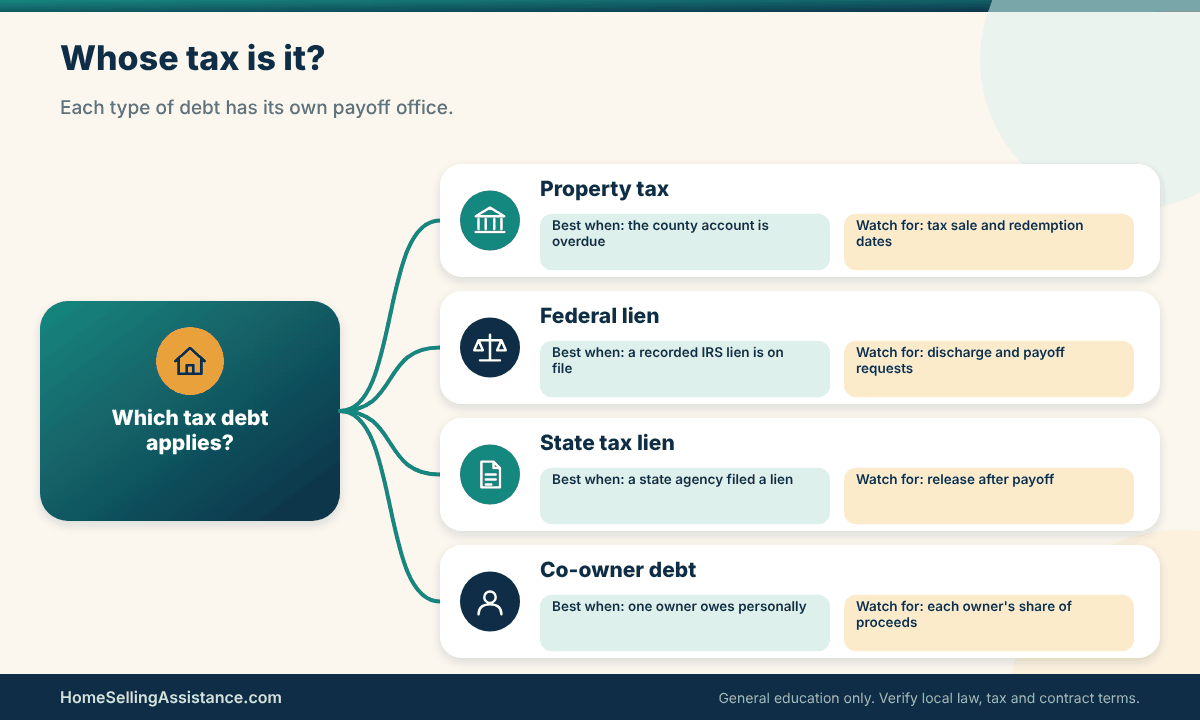
It also helps to separate two ideas that people blur together: a debt and a lien. A debt is what you owe. A lien is the legal claim that lets the creditor collect from a particular asset, here your house, when it is sold or refinanced. Property tax debt almost always becomes a lien on the property itself. Income tax debt becomes a lien only after the taxing agency takes certain steps, and the lien may be recorded in the county records where the home sits.
Who owns the home, who signs, and which tax bill is overdue
Start with the deed. The vesting language on the recorded deed tells you whether the home is held by one person, by spouses, by co-owners, by a trust or by an estate. Everyone listed as an owner generally has to sign the sale contract and the deed, so a name you forgot about can stall the closing. If an owner has died, the property may need probate or a similar process before anyone can sign, and that adds time.
Next, match each tax bill to the right owner. Property taxes follow the parcel, so they attach to the house no matter whose name is on the account. Income tax debts follow the person. That means a federal or state income tax lien against one co-owner can attach to that person’s interest in the house, while a co-owner who owes nothing is not personally responsible for it. How that plays out at closing depends on state property law, so it is a question for a title company or attorney rather than a guess.
Many sellers who sell house with back taxes find that one calm phone call to the county clears up three weeks of worry.
Evidence to gather: deed, tax account and recorded notices
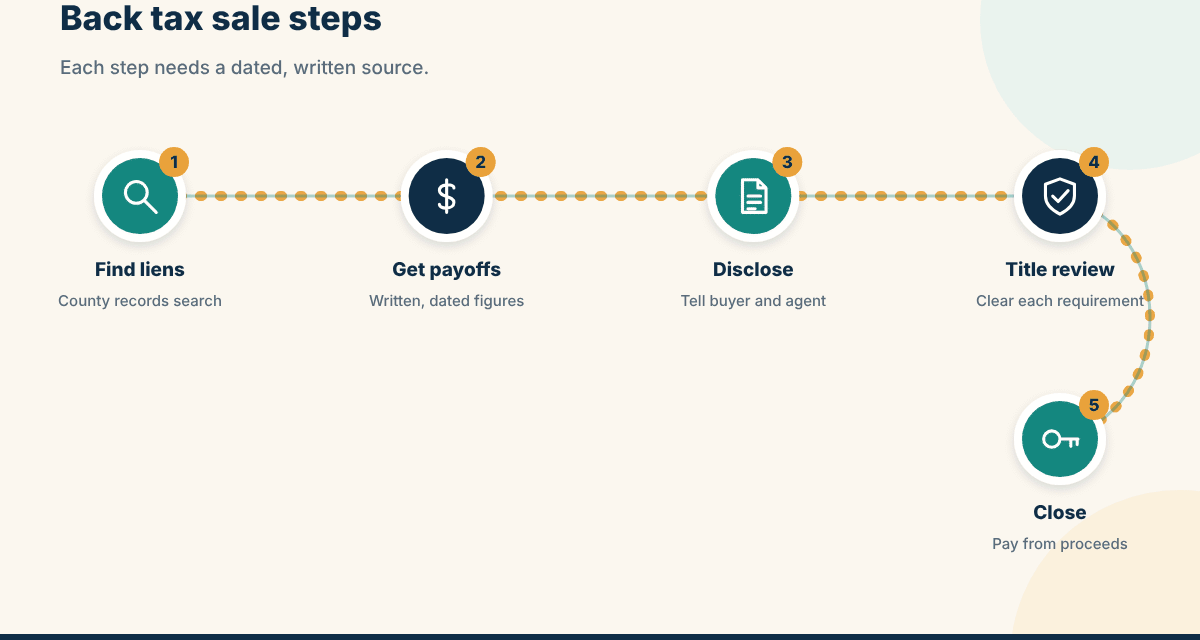
Pull four documents before you do anything else. First, a copy of your recorded deed, which you can request from the county recorder or clerk, often online. Second, the current property tax account statement from the county treasurer or tax collector, showing each tax year, any penalties and interest, and whether the account has been sent to a tax sale or a collection agency. Third, any letters from the IRS or your state revenue department, which usually carry a notice number and a date. Fourth, a search of the county land records for recorded liens.
Most counties let you search recorded documents by owner name or parcel number, and some charge a small copy fee. If the online system is confusing, call the recorder’s office and ask which index covers liens. Print or save every result. A notice of federal tax lien, for example, is typically recorded in the county where the property is located, and what you find there is the real starting point for your payoff conversation, whatever an old letter says.
When you sell house with back taxes, ask each creditor to put the payoff in an email or letter, not just on the phone.
A fifth item is optional but useful: the latest mortgage statement. It tells you whether the lender collects taxes through escrow. If it does, the lender pays property taxes on your behalf, and a delinquent tax bill may mean the lender advanced money that was added to your loan balance. That changes who you owe, so check before you call the county. It is a pattern worth remembering if you plan to sell house with back taxes.
A scenario with two owners and one unpaid bill
Picture a couple, Dana and Marcus, who bought together years ago. After a separation, Marcus moved out and stopped contributing, and the county property tax bill went unpaid for two years. Separately, Marcus owes state income tax, and a lien was recorded in his name. Dana wants to sell. Both of them have to sign the sale documents because both are on the deed.
If you sell house with back taxes and own with someone else, make sure both owners hear the same numbers at the same time.
At closing, the delinquent property tax is paid off the top because it follows the house. Marcus’s state lien is a separate question, because it attaches to his interest, and the title company will want it released or paid from his share of the proceeds. If the sale price is large enough, everyone is paid and both receive their net. If not, they need an attorney, because the order of payment and each person’s share are no longer simple. Our guide on selling a co-owned home during a divorce or separation goes deeper on that dynamic.
Federal, state and county rules each pull a different lever
Three layers of government can have a claim on a home, and each runs by its own rulebook. Counties and cities collect property taxes under state law. State revenue departments collect state income and sometimes other taxes. The IRS collects federal taxes. A seller who tries to sell house with back taxes from more than one of these sources is really managing several separate payoffs, each with its own contact person, its own paperwork and its own idea of what counts as “paid in full.”
To sell house with back taxes smoothly, give the title company your documents early and answer its questions the same day.
Property tax liens are the ones sellers should respect most, because in many places they rank ahead of a mortgage and most other claims. That priority is the reason an unpaid property tax bill can end in a tax sale or a tax deed, with the homeowner losing the property even if the mortgage is current. The details, including how long you have to catch up before anything is sold, are set by your state, so treat any general timeline you read online with caution.
Income tax liens work differently. A federal tax lien arises when a tax assessment goes unpaid after notice and demand, and the IRS may then file a public notice so that other creditors, buyers and title companies know about it. Many states have a similar process for state tax debts. These liens usually do not stop you from selling, but a buyer’s title company will almost always insist that they be paid or formally released from the sale proceeds before the deed is recorded.
Anyone who needs to sell house with back taxes should keep a running log of calls, with names, dates and the figures quoted.
Where each rule comes from and how to read it
For property taxes, the primary source is your state’s tax code plus the county treasurer’s published procedures. Look for four things: the due dates, the penalty and interest rate, the date a delinquent account can be sold or foreclosed, and the redemption period, which is the window after a tax sale when an owner can still pay and reclaim the property. Some states sell a tax lien certificate to an investor, while others sell the deed itself, and the consequences for you are very different.
For federal tax liens, the IRS publishes plain-English explanations of how liens work, how to request a payoff, and how a lien can be discharged from a specific property so a sale can close. You can start at the IRS website and search for the federal tax lien topic. For the separate question of how a home sale is taxed, see IRS Publication 523 on selling your home. The lien payoff and the tax on any gain are two different matters, and both can apply to the same sale.
It is perfectly reasonable to sell house with back taxes through a traditional listing, a cash buyer or another route, so long as the liens are paid or released at closing.
For state income tax debts, go to your state revenue or taxation department’s website and look for lien, payoff and release procedures. Names vary, and so do the forms. If a website is hard to follow, call the number on your notice and ask what the department needs to issue a payoff statement for a real estate closing. Write down the name of the person you speak with and the date, because those details help if a figure is later disputed.
An exception, a surprise and your next step
Here is a common surprise. A seller assumes that the delinquent income tax lien is the only problem, but the title search also turns up an unpaid property tax year the seller never received a bill for, perhaps because the mailing address was out of date. The seller now has two payoffs to coordinate, and the closing date needs a little breathing room. Few sellers expect this part when they first decide to sell house with back taxes.
If you sell house with back taxes, expect your closing date to depend on how quickly the slowest creditor sends a letter.
The exception to watch for is a payment plan. Many counties and taxing agencies allow installment arrangements, and some states offer deferrals or relief programs for certain owners, such as seniors or disabled owners. These programs vary and usually have eligibility rules. If you already have a plan in place, a sale generally ends it and the remaining balance becomes due at closing, so ask the agency for a payoff figure rather than assuming the monthly payment is all that is left.
Your next step is simple. Call each taxing office and ask three questions: what is the exact payoff today, what is the daily or monthly amount it grows, and what written document will you send to a title company. Then keep a one-page log with the office name, the figure, the good-through date and the contact person. The matrix below pulls the main questions into a single view you can use as a worksheet while you gather answers.
Do not assume a lien disappears just because you made a payment; to sell house with back taxes safely, confirm the release is recorded.
The next table lays out the requirement matrix for a sale with back taxes. For each issue it names the controlling document or authority, what you owe or get to choose, the deadline that usually matters, and where to verify the local rule. Read across a row to see how one issue connects to the paperwork and the clock. Rows that mention state or county practice are reminders to check locally, not statements of what your jurisdiction does. If you sell house with back taxes, treat this as a standing item on your task list.
| Issue | Controlling document or authority | Seller obligation or choice | Deadline to watch | Where to verify locally |
|---|---|---|---|---|
| Delinquent property tax | County tax account and state tax code | Pay from proceeds or before closing | Tax sale or redemption dates | County treasurer or tax collector |
| Federal tax lien | Recorded notice of federal tax lien | Pay, or seek discharge for the sale | Contract closing date | IRS lien contact and county recorder |
| State income tax lien | State lien filing and release rules | Pay from proceeds, request release | Payoff good-through date | State revenue department |
| Mortgage with escrow advance | Mortgage note and servicer statement | Confirm payoff includes advances | Payoff letter expiry | Mortgage servicer |
| Disclosure to buyer | Sale contract and state disclosure form | Disclose known liens and liabilities | Before or at contract signing | State real estate commission or attorney |
| Title clearance | Title commitment requirements list | Satisfy each listed requirement | Before the closing date | Title company or closing attorney |
Use the matrix by filling in the last column first. Writing down a real phone number and a real person for each row turns a vague worry into a task list. If a cell says “contract closing date” and you have not yet signed a contract, leave it blank and come back once a buyer is under agreement. The point is not to complete every box on day one; it is to know which boxes exist, so nothing at the closing table is a surprise.
Remember that a buyer is not responsible for your debts, so to sell house with back taxes the title company will insist they be handled at the table.
Many sellers also find it useful to read our broader piece on seller disclosure requirements while they work through the matrix, since the disclosure row is where tax liens meet your legal duty to be honest with the buyer. The short version is that a lien you know about is generally something you should disclose, and a rule that excuses silence is rare. Your agent, attorney or state real estate commission can tell you what your state requires in writing.
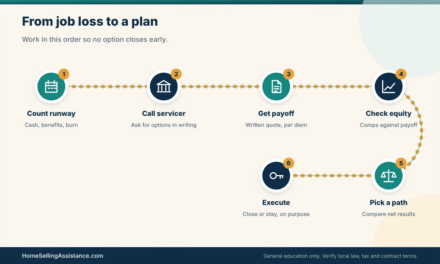
Translate the tax problem into a seller workflow that ends at a closing table
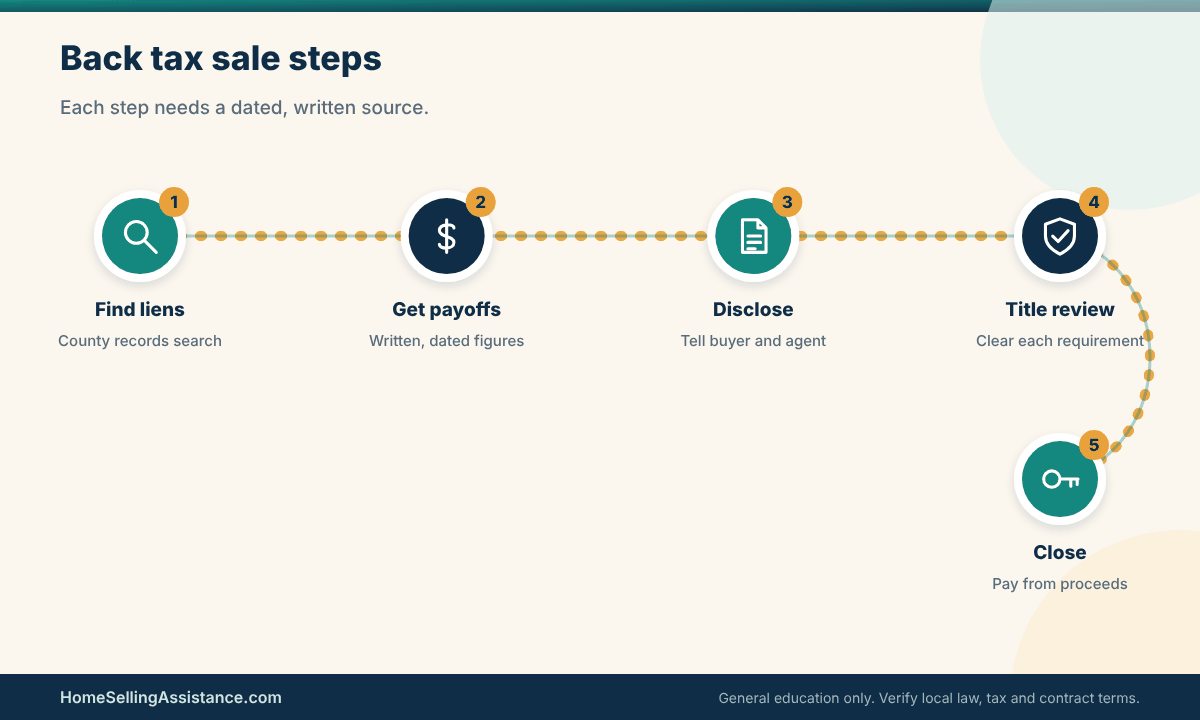
Once you know what is owed and to whom, the next job is to sequence the work. A sale involving back taxes has the same skeleton as any other sale, with a few extra checkpoints. Think of them as gates the transaction has to pass through: the payoff gate, the disclosure gate, the title gate and the funding gate. Passing each one in order, with documents in hand, is what keeps a closing date from sliding.
Before you list to sell house with back taxes, ask a local title company which of your records they will want to see first.
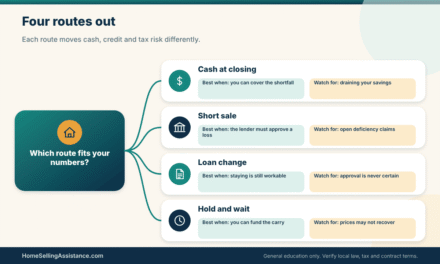
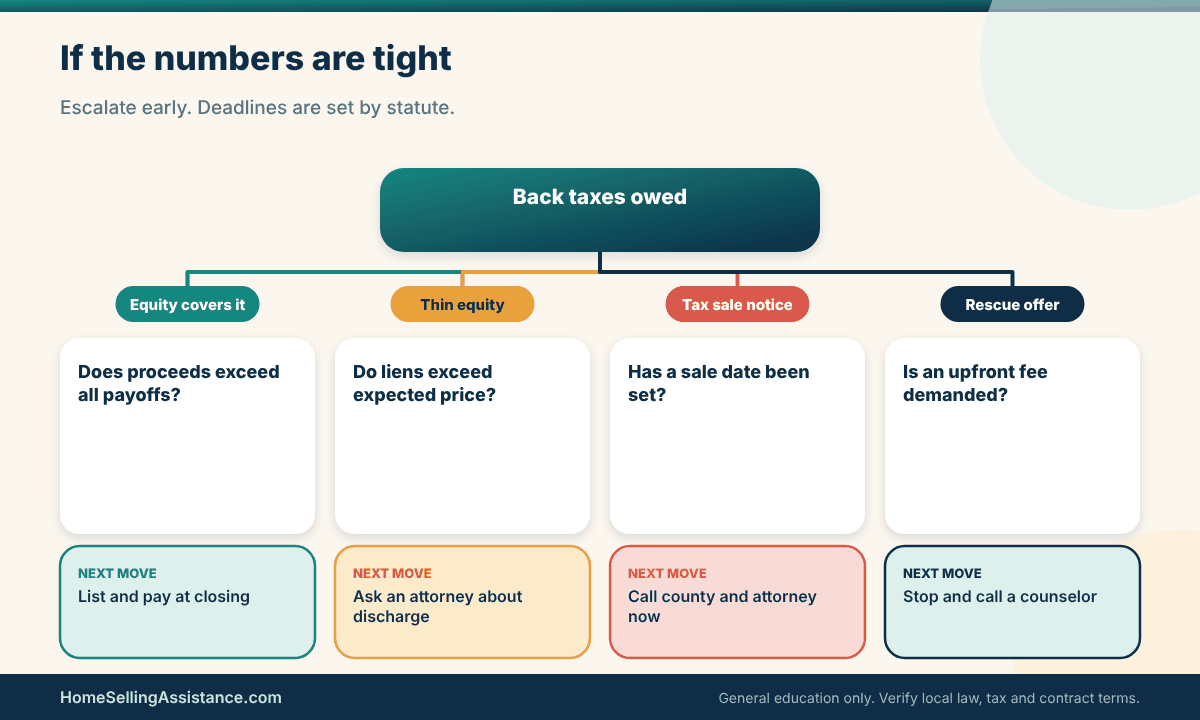
It helps to decide early whether you are selling in a position of comfortable equity or a tight one. With comfortable equity, the workflow is mostly administrative: order payoffs, list the house, and let the title company pay each creditor from proceeds. With thin equity, the workflow becomes a negotiation, and you may need the taxing agency, the mortgage servicer or a court to agree to something before a buyer can close. That second case deserves professional help from the first day.
Disclosures and payoff letters when you sell house with back taxes
Disclosure comes first, because it shapes how buyers and their agents read your listing. Most states require sellers to disclose known material facts about the property, and a recorded lien or delinquent tax account is the kind of fact buyers care about. Some state forms ask directly about liens, special assessments or unpaid taxes. Others leave it to the contract. Either way, the safest habit is to be straightforward, put the plan to resolve it in writing, and let your agent or attorney decide how it appears in the paperwork.
A seller who has to sell house with back taxes on a short clock should tell the agent about the deadline on day one.
Honesty also protects the sale. A buyer’s lender will order a title search, and the search will find recorded liens whether or not you mentioned them. If a buyer learns about a lien from the title company rather than from you, trust drops and renegotiation becomes likelier. A short, calm statement such as “there is a recorded tax lien that will be paid from proceeds at closing, and here is the payoff letter” usually lands far better than a surprise in week three. Our overview of seller disclosure requirements explains how those duties differ across states.
Payoff letters are the second half of this gate. A payoff letter or statement is a written figure from a creditor that says how much is needed to satisfy the debt on a given date. The title or escrow company uses it to wire the right amount. Without one, nobody can safely close, because an underpayment leaves the lien alive and an overpayment means chasing a refund. Request payoff letters for every tax debt and for the mortgage, and ask each office for its preferred method, since some accept requests by fax, portal or phone only.
Numbers to request: payoff, penalties and interest
A good payoff request names the property, the parcel or account number, the expected closing date and the title company’s contact. Ask for the total payoff on that date, a per-day or per-month amount for after that date, and a note on whether the figure includes recording or release fees. For property taxes, also ask whether the current year’s tax has been billed yet and, if so, whether it is included. Prorations for the current year are normally handled separately on the closing statement.
If you sell house with back taxes and the equity is thin, ask early whether a creditor will accept a reduced payoff in writing.
To see why each of those details matters, take a purely illustrative example. Suppose a home is under contract at $300,000, the mortgage payoff is $170,000, delinquent property taxes with penalties come to $9,000, a state income tax lien payoff is $14,000, and seller-side closing costs are estimated at $20,000. Those are round example numbers, not your costs. Adding the deductions gives $213,000, so the seller would net roughly $87,000 before any tax on gain or other adjustments. None of this changes the basic idea: to sell house with back taxes, you need facts before decisions.
Now suppose closing slips by thirty days and the lien payoffs grow by a total of $500 because of interest. The net proceeds drop to roughly $86,500. The change is small here, but in a thin-equity sale the same slippage can be the difference between everyone being paid and a shortfall. This is why you request good-through dates, and why you ask for updated figures a few days before closing. A broader walkthrough of how these deductions stack up is in our guide to seller closing costs, and the closing costs and net proceeds library collects related articles.
Keep copies of every notice, because to sell house with back taxes you may need to prove when a letter arrived or a payment cleared.
Keep in mind that tax debt is not the only deduction. The mortgage payoff, any other liens, agent compensation if you hired one, transfer taxes where they apply, title and escrow fees, and prorated utilities or association dues all come out of the same pot. A seller who counts only the tax debt and forgets the rest can be disappointed at the closing table. Build the full list before you decide whether a sale makes financial sense.
A scenario where the payoff moves
Consider a seller named Priya who receives a property tax payoff on the first of the month. The county letter says the account must be paid by the end of the month to avoid another penalty step. Her contract closes on the tenth of the following month. If nobody notices, the figure on the title company’s statement will be stale, and the title company will have to ask for an updated payoff at the last minute. That is why it pays to slow down briefly before you sell house with back taxes.
Take care with online advice: how to sell house with back taxes depends on your state, and an article cannot replace a local attorney.
The fix is dull and effective. Priya asks the title company which date they expect to close and requests the county payoff for that date. She also asks whether the county will accept a wire from the title company directly and how long the lien release takes to record. Then she puts a reminder on her calendar to reconfirm every figure three business days before closing. Dull wins here, because the sale never has to wait on a missing number.
There is one more wrinkle worth knowing. If a payoff is calculated to a date and the closing funds arrive late, some agencies require the difference. Ask your title company how they handle a closing that funds a day after the stated payoff date. Many have a standard approach, and if they do, you will simply be told what to expect and when to budget a small cushion.
If a lien is filed against someone with a similar name, ask the agency for a correction before you try to sell house with back taxes.
Handing off to the buyer, title company, taxing office and attorney
A sale with back taxes involves more handoffs than most. You give the contract to the title or escrow company. The title company runs a search and sends you a commitment listing what must be cleared. You send payoff requests to each creditor. The creditors send letters back. The title company reconciles everything on a closing statement. Meanwhile your agent, if you have one, coordinates with the buyer’s agent and lender. Every one of those steps can be smooth or sticky depending on how well each person knows what the next person needs.
The title company is usually the central player. Its job is to make sure the buyer receives clear, insurable title, which means every lien on its list has to be paid, released or specifically excepted before it funds. That is why you want the title company engaged early. Some sellers wait until a contract is signed to talk to one, but an early conversation about a known tax lien lets you learn which documents the company will want before the clock starts.
Pay attention to prorations too, because when you sell house with back taxes the current year’s bill is split separately from the overdue years.
The buyer’s role is smaller but real. Buyers and their lenders want assurance that the lien disappears at closing. They do not need to know your personal finances, only that the title commitment requirements are satisfied. If a buyer asks for proof, the commitment and the payoff letters are the right documents to share. Most contracts also include a clause about title defects and cure periods, which lets a seller fix a problem within a set time or lets a buyer walk away; read that clause closely.
Evidence the title company will want
Every title company has its own checklist, but the usual items are easy to predict. Expect to provide a government photo ID, proof of your authority to sign if you are an executor or trustee, a copy of any recorded lien notices, the most recent tax statements, and a signed payoff authorization so the company can request figures on your behalf. For a federal tax lien, the title company may also ask whether a certificate of discharge has been issued or applied for.
Sellers who sell house with back taxes sometimes forget that interest keeps running, so ask for per-day amounts.
A certificate of discharge is an IRS document that releases a specific property from the federal tax lien so the sale can close, even when the lien is not paid in full beforehand. Often the lien is simply paid out of proceeds and then released, which makes a separate discharge unnecessary. When the sale price does not cover the lien, a discharge application becomes more important, and the IRS asks for documents such as the purchase contract and a title report. The IRS website explains how to apply, and a tax attorney can tell you whether it fits your case.
For state liens, ask the department what it issues after payment. Some provide a release automatically, and others require a request. Either way, ask the title company whether it needs the release at closing or whether recording it afterward is acceptable. Get the answer in writing, because the buyer’s lender may insist on the stricter version. When in doubt, plan on needing the release in hand, and treat anything faster as a bonus. Written confirmation is your friend when you sell house with back taxes.
If you sell house with back taxes and the buyer uses a lender, the lender’s underwriter will read the title commitment line by line.
Finally, keep a copy of every receipt, wire confirmation and release notice after closing. Liens that were paid but never properly released have a way of resurfacing years later, when you try to refinance or the buyer sells. A folder with the final closing statement and the release documents is cheap insurance, and it takes ten minutes to assemble while the details are fresh.

A scenario where the closing table gets tense
Imagine a seller, Tom, who is two days from closing when the title company discovers that the county’s payoff includes a penalty the seller did not expect. The buyer is ready, and the buyer’s lender has a lock that expires in a week. Tom is tempted to push the title company to close anyway and sort it out later. That is the wrong instinct, and a good title officer will refuse, because closing with an unresolved lien exposes the buyer, the lender and the title insurer.
What helps instead is a calm sequence. Tom asks the county for an itemized breakdown, checks that the penalty matches the published schedule, and asks his agent or attorney whether any part of it can be contested. If the figure is right, he pays it from proceeds. If he believes it is wrong, he asks the title company whether an escrow holdback is possible while the dispute is resolved. Holdbacks are not always allowed, and lenders must agree, so this is a request, not a right.
An honest conversation with your agent is the best start when you sell house with back taxes, since pricing and timing both depend on the payoff total.
The takeaway from Tom’s story is to treat the days before closing as a verification window, not a formality. Ask every creditor for an itemized payoff, compare it to the title commitment, and ask the title company to tell you the exact amount it expects to wire to each office. If any figure surprises you, you still have time to get answers. If you find it on closing morning, you probably do not. Everyone involved, from the buyer to the title officer, will read this part closely if you sell house with back taxes.
The next table covers scenarios rather than documents. Each row describes a legal or contract situation a seller might face, the options generally available, the main risk, the document worth reviewing and the point at which you should escalate to a professional. It is a decision aid, not a prediction, and your own contract and state law decide what is possible. Use it to spot your situation, then read the matching row as a prompt for questions to bring to an attorney or counselor.
Consider asking a housing counselor for a second opinion before you sell house with back taxes under pressure.
| Situation | Seller options | Main risk | Document to review | Escalate to |
|---|---|---|---|---|
| Plenty of equity, one tax lien | List, pay lien from proceeds at closing | Stale payoff figure | Payoff letter with good-through date | Title company |
| Thin equity, several liens | Negotiate payoffs, seek discharge or reduction | Sale price cannot cover all claims | Title commitment and lien notices | Real estate or tax attorney |
| Property taxes near tax sale | Pay arrears, ask about plan, or sell quickly | Losing the home at a tax sale | County delinquency notice | County treasurer and attorney |
| Tax sale already held | Check redemption rights and deadline | Redemption window closes | Tax sale certificate or notice | Attorney, urgently |
| Lien in one co-owner’s name | Pay from that owner’s share, or negotiate | Dispute between owners | Recorded deed and lien filing | Attorney for each owner |
| Owner passed away with back taxes | Estate pays from sale proceeds | Delay waiting for authority to sign | Letters of authority or court order | Probate attorney |
To use this table well, find the row that sounds most like your situation, then look at the last two columns first. They tell you which paper to put in front of a professional and when waiting becomes risky. The “tax sale already held” row is the one with the shortest fuse, because redemption deadlines are set by statute and missing one can end your ownership. If that row sounds familiar, move that call to the top of today’s list.
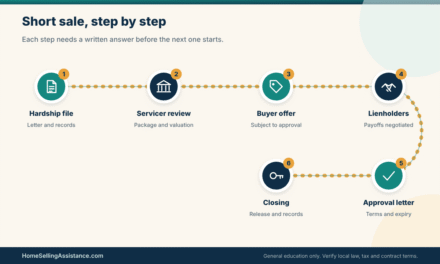
If your house is worth less than what you owe in total, your options widen but also get more delicate. A negotiated sale for less than the amount owed on the mortgage is generally called a short sale, and it needs lender approval. Our guides on short sales for sellers and on selling when you owe more than the home is worth explain how that process works. Tax liens complicate a short sale because the taxing agency may also need to agree to accept less.
If you sell house with back taxes and a tax sale date is near, tell the title company and the county so everyone works toward the same deadline.
Quick scenario
A seller owes $12,000 in delinquent property tax and has a mortgage of $140,000 on a house a local agent suggests could sell near $260,000. These are made-up round figures. After the mortgage, the tax debt and estimated closing costs, a sizeable amount is likely left over, so the seller lists normally, discloses the tax account, and lets the title company pay the county at closing. The same house with a mortgage of $245,000 would be a very different problem.
Bankruptcy deserves a brief, careful mention. Some people with heavy tax debts consider it, and it can interact with liens in ways that vary by chapter, by type of tax and by timing. This article cannot tell you whether it fits your case, and you should not rely on an article or an internet forum for that decision. If you are considering it, talk to a bankruptcy attorney before you sign a sale contract, because a sale in the middle of a case may need court approval.
Finally, a note on who to trust. Anyone who calls you after a tax lien was recorded and offers to “save” your house for an upfront fee should be treated with caution. Legitimate help comes from a licensed attorney, a HUD-approved housing counselor, your servicer, or the taxing office itself. You can find a counselor through HUD’s housing counselor search, and our article on foreclosure rescue scams lists the warning signs. Never sign over title, or pay a large fee in advance, without independent legal advice.
It helps to sell house with back taxes with a backup plan, such as a short extension clause in the contract.
Build a checklist to verify every figure before you sell house with back taxes
By now you have a lot of paper: a deed, tax statements, lien notices, payoff letters, a contract and a title commitment. The last stage is making sure the paper agrees with itself. Mistakes in a tax-lien sale are rarely dramatic. They are small gaps, such as a payoff that omits one year, a lien release that names the wrong parcel, or an owner’s middle name spelled two ways. Each can delay funding by days, and a checklist is the cheapest way to catch them.
Think of verification as two questions asked over and over. Where did this number come from, and is it still true on closing day? The first question pushes you toward official sources and recorded documents. The second pushes you toward dates and expiry. Together they turn a stack of papers into a short, reliable list of facts you can defend if anyone asks. Most delays when people sell house with back taxes trace back to a missing or outdated document.
Never wire money or sign over title to a stranger who promises to fix things for a fee; it is safer to sell house with back taxes through ordinary, documented channels.
Our broader reading on this theme sits in the foreclosure and financial hardship library, which collects articles on related situations such as selling during pre-foreclosure. If a tax problem is only one piece of a bigger financial squeeze, those pages help you see how the parts connect.
Official sources and recorded documents worth trusting
Not every document carries the same weight. A recorded lien notice or release, filed with the county, is part of the public record and is what a title company relies on. A letter from a taxing agency on its letterhead, with an account number and a date, is strong evidence of what the agency says is owed. A conversation with a clerk is useful for orientation but should be followed up in writing. A forum post or a social media comment, however confident, is not evidence at all.
Aim to collect at least one official source for each claim on the closing statement. The property tax amount should trace to a county statement. A federal tax lien should trace to a recorded notice and an IRS payoff or release. A state lien should trace to the state’s filing and payoff statement. The mortgage payoff should trace to a servicer letter. When every line has a source, the closing statement stops feeling like a puzzle. Write the answer down, since you will need it again as you sell house with back taxes.
Ask the title officer to walk you through the draft statement once, line by line, before you sell house with back taxes at closing.
Evidence to pull: county, agency and servicer records
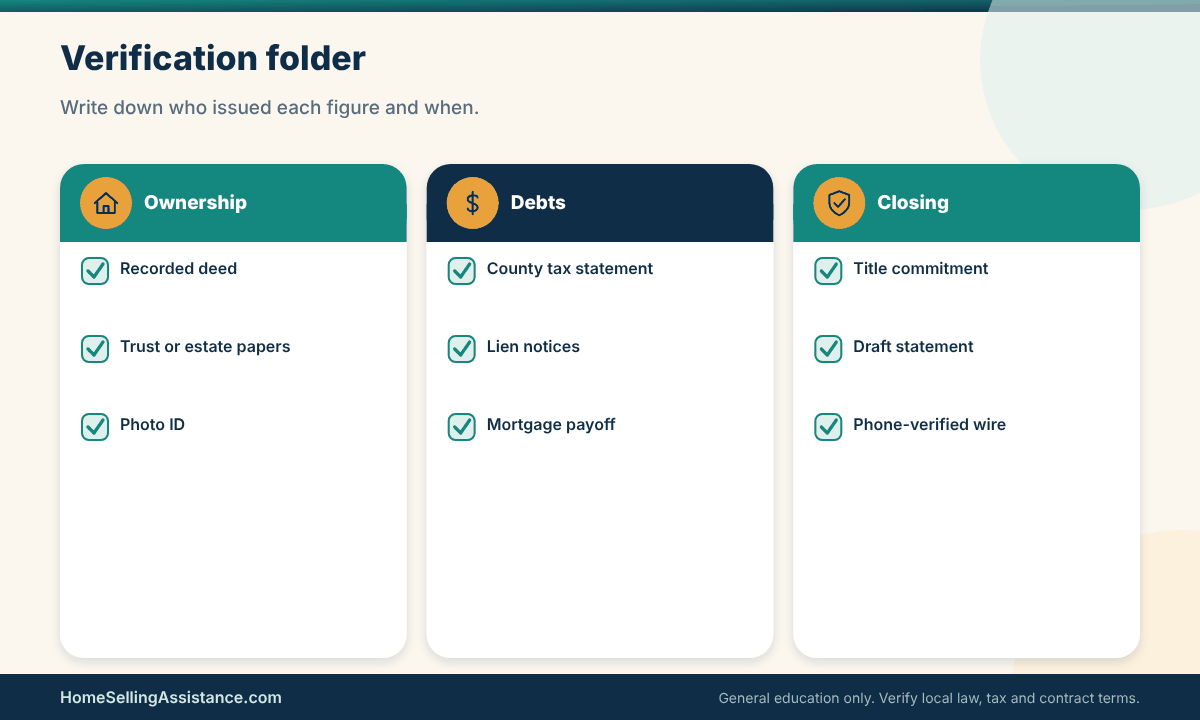
Build a simple folder, digital or paper, with six sections. First, ownership: deed, trust papers, estate documents. Second, property tax: each year’s statement and the current delinquency notice. Third, federal and state liens: recorded notices, agency letters, and any payment plan paperwork. Fourth, mortgage: the latest statement, the payoff letter and any notice of default. Fifth, contract and title: the signed contract, the title commitment and any amendments. Sixth, closing: draft statements and final wire instructions.
For each section, add a cover note with three lines: who issued the document, the date, and what it proves. This sounds fussy, but it pays off the first time a title officer asks, “where did this figure come from?” You hand over the page rather than searching your email. If an agent or attorney is helping, share the folder with them so everyone works from the same facts, and so you are not answering the same question twice.
To sell house with back taxes without a gap in your records, save the final statement, the lien releases and the wire confirmations.
Be careful with wire instructions. Closing-related email fraud is common, and criminals sometimes impersonate title companies or agents to redirect funds. Confirm any wire instruction by calling a phone number you already know to be correct, and never rely on a number in an email. The FTC consumer site and our guide on home sale fraud and seller safety explain what to watch for. Experienced closers say the sellers who sell house with back taxes smoothly are the ones who ask early.
A scenario, an exception and your next step
Take a seller, Elena, who finds a county tax statement showing $7,500 owed, while the title commitment lists $8,200 for the same tax. The difference is $700. Rather than assume one is wrong, she calls the county treasurer, who explains that the commitment included the current year’s bill that had just been issued. The statement she held was a few weeks old. Both numbers were right on their respective dates.
If an owner has died, an estate representative will usually need authority before anyone can sell house with back taxes on the estate’s behalf.
The exception is when the numbers genuinely disagree. A payoff could include a penalty applied in error, a payment that was never credited, or a lien filed against the wrong person with a similar name. In those cases, ask the agency for a written correction and a revised payoff. If the agency does not respond, tell the title company and your attorney early. Disputes can sometimes be resolved with an escrow holdback, but that depends on the agency, the lender and the buyer.
Elena’s next step was to update her folder with the new statement and note the date on every figure. That small habit means that if anyone asks later, she can show what was true when. Do the same, and your verification becomes a record rather than a memory. It is a small detail, but it can decide whether you sell house with back taxes on time.
After you sell house with back taxes, check the county records a month or two later to confirm each release was recorded.
What has to be current before you sign anything
Signing happens twice in most sales: once when you sign the purchase contract, and again at closing when you sign the deed and settlement documents. Different things need to be current at each moment. At contract signing, you want your best understanding of the liens and a plan for each. At closing, you want every payoff figure, every release and every wire instruction confirmed within the last few days.
The simplest rule is this: no figure is current unless you can name its date. A payoff letter dated six weeks ago is probably out of date. A lien search run before you listed may miss something filed afterward. A mortgage balance from last month’s statement is not a payoff. Ask for fresh versions before you sign, and put the dates in your folder so you can see at a glance what needs refreshing. A trusted professional can confirm the local version when you sell house with back taxes.
When you sell house with back taxes, a small cushion in your budget for interest, recording fees and delays is a sensible precaution.
Items to refresh: payoffs, releases and title updates
Before contract signing, refresh four things. Confirm the property tax status with the county. Run a new search of the county land records for liens recorded since your last search. Ask your tax professional whether any new notices have arrived from the IRS or the state. And request a current mortgage payoff estimate. None of this takes long, and each item can change the story your contract tells.
Before closing, refresh a different set. Ask the title company for an updated commitment or a bring-down search, which checks for new liens recorded after the original search. Ask each creditor to confirm that the payoff is good through the closing date plus a few days. Review the draft settlement statement against your folder, line by line. And confirm wire details by phone. If any of these steps reveals a change, tell your agent and the title company that same day.
People who sell house with back taxes often feel embarrassed, but title companies see this situation regularly and handle it routinely.
If you are also thinking about taxes on the sale itself, a separate set of rules applies. Selling a home can create a taxable gain, though many sellers qualify to exclude some or all of it under federal rules that depend on ownership and use, and the lien payoffs do not change that calculation by themselves. Our guide on taxes when selling a home explains the basics, and IRS Publication 523 has the official detail. A tax professional can apply it to your facts.
A scenario for the week before closing
Picture the week before closing. Your folder has dated payoffs for the county, the state and the mortgage servicer. The title company sends a draft settlement statement. You compare each line to your folder, notice that the state payoff is $300 higher than your letter, and call the title company. They explain that the state’s figure grew because the closing date moved a week. You ask for a revised letter, they obtain it, and the numbers now match. Sellers often ask about it first when they sell house with back taxes, and the answer is usually in a document.
Contrast that with a week where nobody checks. The statement goes out, closing day arrives, and the state agency’s funds come up short. The title company cannot record the release, the buyer’s lender will not fund, and the closing is pushed. Sellers who have a recent job loss or other hardship often feel this pressure most, and our guide to selling a house after job loss speaks to that stress. The lesson is the same: check early, check in writing.
Finally, if you sell house with back taxes and something does not add up, pause and ask rather than guess.
If you take only one habit from this article, make it this one. For every number that matters, write down who gave it to you, on what date, and what document backs it up. When the numbers change, change the notes. A sale with back taxes is manageable when the facts are organized, and almost every problem we see traces back to a number nobody dated.
Frequently asked questions about sell house with back taxes
Can I sell house with back taxes still owed?
Generally yes. Unpaid taxes do not usually prevent a sale, but the debt or lien must be paid, released or otherwise resolved so the buyer receives clear title. In most sales the title company pays the taxing offices directly from your proceeds at closing. Rules and procedures vary by state, so ask a title company or real estate attorney in your area how it works locally.
How do I find out exactly how much I owe in back taxes?
Ask each taxing office for a written payoff statement for your expected closing date. For property taxes that is the county treasurer or tax collector. For income taxes it is the IRS or your state revenue department. Also search the county land records for recorded liens, since a title search will find them anyway, and compare what you find with the payoff letters.
Will the buyer have to know I owe back taxes?
The title search will show recorded liens and delinquent property taxes, so the buyer, the buyer’s lender and the title company will almost certainly see them. Most states also expect sellers to disclose known material facts. The cleanest approach is to disclose the issue yourself and explain that it will be paid at closing. Your agent or attorney can tell you what your state’s forms require.
Can I sell if the sale price is lower than what I owe?
Sometimes, but it takes agreement from the creditors, often through a short sale or a negotiated payoff. The mortgage lender, the taxing agencies and sometimes a court may all have a say, and none of them is obliged to accept less. Because the process is delicate, talk to a real estate attorney and a HUD-approved housing counselor before you list or sign a contract.
What is a certificate of discharge for a federal tax lien?
It is an IRS document that releases a particular property from the federal tax lien so a sale can close. It is most relevant when the sale price will not fully cover the lien or when the lien must be handled in a particular way. The IRS publishes instructions on how to apply, and a tax attorney can help you decide whether to do so.
What happens if I do nothing about unpaid property taxes?
Penalties and interest generally keep growing, and eventually the county may sell a tax lien certificate or the property itself, depending on state law. After a tax sale, many states give owners a redemption period, but the length and cost vary widely. If you have received a delinquency or tax sale notice, treat it as urgent and call the county and an attorney promptly.
Can I use a payment plan and still sell?
You can usually sell while a payment plan is in place, but the plan typically ends at closing and the remaining balance becomes due. Ask the agency for a payoff figure rather than assuming only the next installment is owed. Make sure the title company knows about the plan so the payoff request is correct and nothing is left behind.
Should I accept a quick cash offer because of back taxes?
A cash offer can be a legitimate option, especially when time is short, but it is worth comparing against a traditional sale. Check that the buyer can truly pay, that the contract does not shift unexpected costs to you, and that any lien payoffs come directly from the title company. Our guide on selling a house before foreclosure compares the main routes neutrally.
Do back taxes change the tax I owe on the sale profit?
Paying a tax lien and owing tax on a gain are separate questions. Many sellers can exclude part or all of a gain under federal rules that depend on how long they owned and lived in the home, but eligibility depends on your facts. Read the official IRS guidance and ask a tax professional about your situation instead of assuming.
Where can I get free or low-cost help?
HUD-approved housing counselors offer guidance on hardship and foreclosure at little or no cost, and you can find one through HUD’s website. The Consumer Financial Protection Bureau publishes plain-language material on mortgage trouble and scams. Local legal aid offices and bar association referral services may also help with attorney questions.
Before you sign anything
If you want to sell house with back taxes, the path is more orderly than it first looks: identify what is owed and to whom, request dated payoffs, disclose honestly, work closely with a title company, and verify every figure before closing day. Nothing here replaces advice for your case. This article is general education, not legal, tax or financial advice, so speak with a licensed attorney, a tax professional and a HUD-approved housing counselor before making a binding decision.