Selling a house you have owned for less than two years does not automatically mean you lose every tax break, and the home sale partial exclusion two years rule is the reason: when the sale is driven by a qualifying reason, the federal main-home exclusion can shrink to a fraction of its usual size instead of disappearing.
Most sellers hear the two-year rule in a simplified form. Live there for two years and your gain is tax-free up to a limit; sell sooner and you owe tax on all of it. The first half is close to right. The second half is where people get hurt, because the tax code has a middle path for sellers who leave early for a job, a health need or an event nobody planned, and nobody tells you about it until the closing is already on the calendar.
The catch is that the home sale partial exclusion two years path depends on facts, not on how you feel about the move. The reason has to be the primary reason you sold. The fraction depends on exact months or days. The paperwork has to exist before anyone asks for it. A seller who understands those three things can walk into a conversation with a tax professional prepared, and a seller who does not may pay for hours of reconstruction.
This guide explains the home sale partial exclusion two years idea in plain language, shows how the arithmetic works with clearly labelled round numbers, and flags where people tend to trip. It sits inside our wider guide to taxes when selling a home, and the full-exclusion basics live in our article on the home sale capital gains exclusion. Everything here is general education. Your facts, your state and the current IRS instructions control the outcome, and we point to the official sources so you can check each claim yourself.
Key takeaways
- The reason is the gatekeeper. A home sale partial exclusion two years claim only works when the primary reason is a change in place of employment, health, or certain unforeseen circumstances.
- The fraction is time-based. The reduced limit is a share of the usual maximum, based on how long you owned and used the home as your main home compared with two years.
- Gain is not the same as sale price or proceeds. The exclusion applies to taxable gain after selling costs and adjusted basis, so a big price tag does not automatically mean a big tax problem.
- Anything above the reduced limit can be taxable. The reduced exclusion is a cap, and the part of the gain beyond it is reported on your return.
- Documents win arguments. Dates, proof of residence and a record of the reason are what let a tax professional, or the IRS, see the story the way you lived it.
- Rules change and facts vary. Check the current IRS publication, and bring fact-specific questions to a CPA, enrolled agent or tax attorney before you sign a contract you cannot undo.

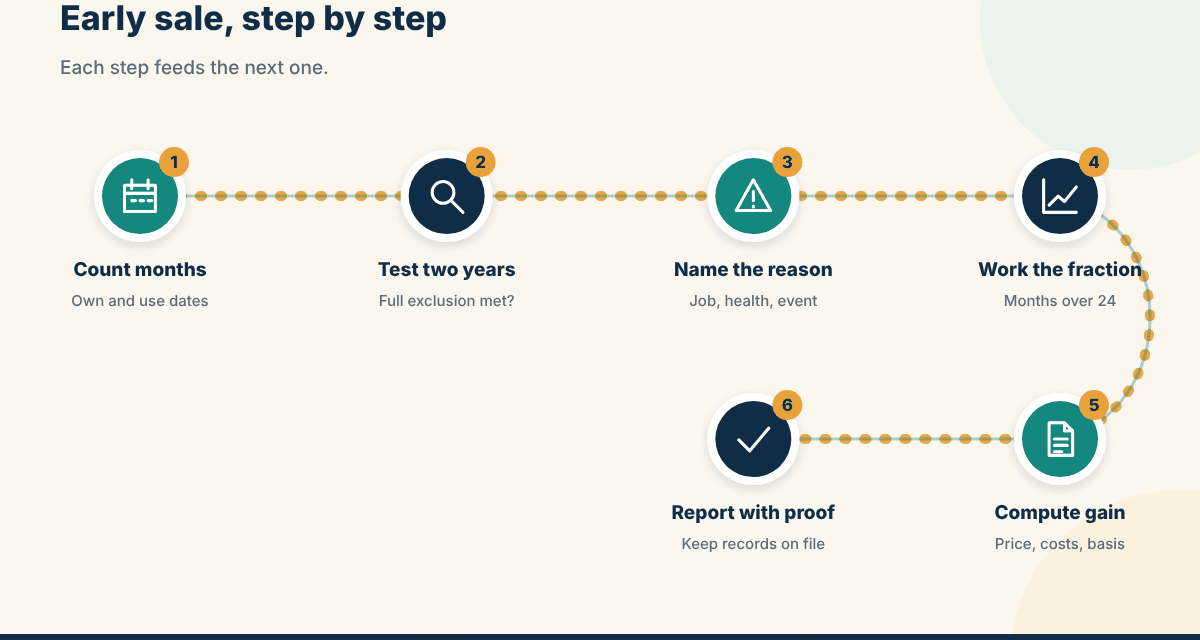
The roadmap above shows the order we will follow: count the months, test whether the two-year rule is already met, name the reason, work the fraction, compute the gain and report it with proof on file. Each step feeds the next, so skipping ahead tends to produce numbers you will have to redo.
Start with the home sale partial exclusion two years question
Before you apply any rule, it helps to define the exact question you are trying to answer. A seller who says “I sold early, do I owe tax?” has asked four different questions at once: did I own and use the home long enough, was there a qualifying reason, how big is my gain, and what limit applies. Pulling those apart is half the work.
A home sale partial exclusion two years claim is also misunderstood in a few predictable ways. Some sellers think it is automatic, as if everyone who leaves early gets prorated. Others think it requires a hardship, when the listed reasons include an ordinary job change. And some expect an advance approval. In general, the home sale partial exclusion two years calculation is worked out when you prepare your return for the year of the sale, not cleared beforehand, which is why the records you keep now matter later.
The federal rule for a main home is built around two tests. You must have owned the home for at least two years and used it as your main home for at least two years during the five years that end on the sale date. The two years do not have to be consecutive, and the ownership and use periods do not have to be the same two years, though in a typical sale they overlap almost completely.
Count your ownership and use months before anything else
Ownership and use are separate ideas. Ownership is about holding title. Use is about actually living there as your main home. Short absences, such as a vacation or a stretch of travel, usually count as time of use, while renting the house out or leaving it empty for long periods needs a closer look. Start by writing down two dates: when you became an owner and when you started living there as your main home.
Then write the sale date, which for most sellers is the closing date, not the date the contract was signed. Count backward five years from that sale date and mark the stretches in that window when you both owned and lived in the house. If those stretches add up to at least two years, you have probably met the full tests, and the home sale partial exclusion two years question may not apply to you at all.
Evidence to gather: dates, deeds and proof of where you lived
Gather the recorded deed or the closing statement from your purchase, because it shows when you became an owner. For use, collect documents that show a consistent address: driver’s license or state ID, vehicle registration, utility bills, voter registration, bank and credit card statements, and tax returns filed from that address. No single document is magic. Together they tell a story that is easy to follow.
If you moved in later than you closed, for example because of renovations, note the real move-in date and keep something that supports it, such as the first utility bill in your name or a contractor’s completion notice. If you moved out before the sale, record that date too. The reduced fraction relies on how long you actually owned and lived there, so a vague memory of “about a year” is not enough once numbers are on the table.
A scenario with a gap, an exception, and your next step
Picture an owner who bought a house, lived in it for ten months, rented it to a tenant for six months while deciding what to do, then moved back in for four months before listing. Illustrative round numbers only: that is fourteen months of use in total, but the rental stretch raises other questions, including depreciation and whether the rental affects the gain calculation.
The exception to watch for is exactly that kind of mixed history. A house that spent part of its life as a rental can carry tax consequences that survive even a full exclusion. The next step is to build a dated timeline of ownership, use and rental, then read our article on selling a former rental home and bring the timeline to a tax professional rather than guessing which months count.
See where a partial exclusion fits among the other outcomes
Selling a home leaves you with one of a few outcomes for tax purposes. You may qualify for the full exclusion, you may qualify for a reduced one, you may owe tax on the entire gain, or you may have no taxable gain at all because the house sold for less than your adjusted basis. The home sale partial exclusion two years rule lives in the second bucket, and it matters most when your gain is larger than the reduced limit would cover.
That last point deserves a pause. If your gain is small, you may owe nothing even without any exclusion. If your gain is very large, even the full exclusion may not cover it. The home sale partial exclusion two years rule is most valuable in the middle: sellers whose gain would fit inside a full exclusion but not inside a prorated one, and who still have a clean qualifying reason.
Evidence to gather: the numbers behind your expected gain
Taxable gain is not your sale price minus what you paid. The rough structure is the amount realized, which is the selling price less selling expenses such as agent fees and closing costs you paid as the seller, minus your adjusted basis, which starts with what you paid and moves with certain improvements and other adjustments. IRS Publication 523 walks through the structure, and the page on selling your home is the right place to confirm current wording.
Pull the final settlement statement from your purchase, receipts for permanent improvements, and a draft of your expected seller costs. Our guide to selling costs and capital gain explains which expenses typically reduce the amount realized. You do not need a perfect number yet. You need a reasonable range so you can tell whether a reduced exclusion is likely to matter.
Here is a short worked picture, again with round numbers made up for illustration. Suppose a house sells for $420,000, selling expenses are $25,000, and adjusted basis is $235,000. The amount realized is $395,000 and the gain is $160,000. Whether any of that is taxable depends on the limit that applies to you, which is what the rest of this guide helps you size.
Notice what that picture leaves out: your mortgage balance. In any home sale partial exclusion two years calculation, the loan payoff stays outside the gain. Paying off a loan changes how much cash you receive at closing, but it does not change the taxable gain. Sellers sometimes assume they cannot owe tax because they walked away with little cash. That is a cash-flow fact, not a tax fact, and the two can point in opposite directions.
A scenario with a loss, an exception, and your next step
Consider a seller who bought near a market peak, relocated within fourteen months, and sold for less than the adjusted basis. Illustratively, the amount realized comes out lower than basis. For a personal main home, a loss on the sale is generally not deductible, so there is usually no exclusion to claim and nothing to report as a gain, though you should still confirm with a tax professional whether any form was triggered.
The exception is a sale of a home that was partly or wholly rental or business property, where different loss rules can apply. The next step is simple: calculate the gain or loss honestly before you worry about the exclusion. If the result is a loss on a pure main home, the home sale partial exclusion two years question is moot, and your energy is better spent on the closing statement and the move itself.
The picture below puts the two outcomes side by side, because the cleanest way to feel the difference between a full and a partial exclusion is to see what each one requires.
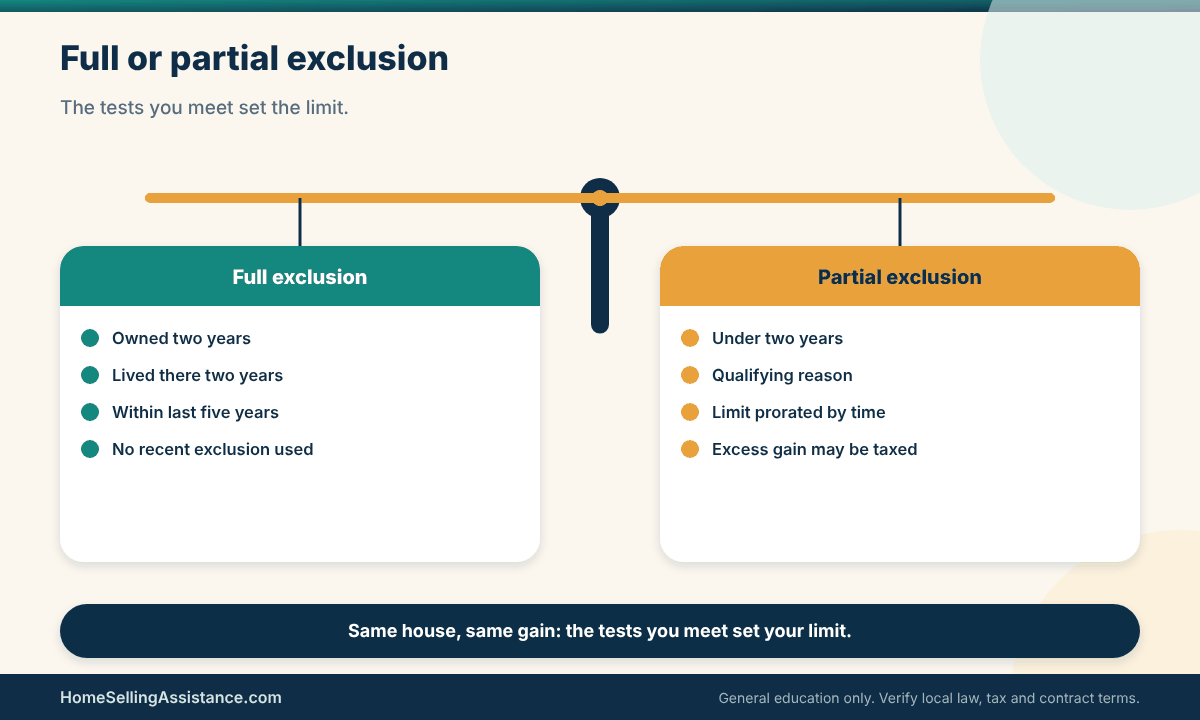
Read the comparison as a checklist of tests rather than a verdict. Meeting every item on the left side means the full limit is probably available. Missing the time test but holding a qualifying reason on the right side means the home sale partial exclusion two years route is worth examining. Missing both is a different conversation, and an early one with a tax professional is cheaper than a late one.
Use current IRS rules to size the reduced limit
Once you know you fall short of two years, the home sale partial exclusion two years math becomes a question of how much of the usual limit survives. The rule is proportional. The reduced maximum is the usual maximum, $250,000 for a single filer or $500,000 for qualifying joint filers, multiplied by a fraction. The fraction compares the shorter of two periods with two years. Everything else in this section is a way of getting those two numbers right.
Timing deserves a word here, because the sale date feeds the fraction. If you are eleven months into ownership, a closing that slips a few weeks or lands a few weeks sooner changes the numerator. Our article on a flexible closing date for sellers explains how dates get negotiated. A date that moves the fraction is a tax question as well as a scheduling one, so a home sale partial exclusion two years scenario is a fair reason to ask your tax professional before agreeing to a closing date.
Do not hold a house off the market for tax reasons alone, though. A home sale partial exclusion two years benefit is only one input. Mortgage payments, taxes, insurance and a changing market can outweigh the benefit, so weigh the home sale partial exclusion two years effect against real carrying costs.
Tax rules get updated, forms get renumbered and IRS wording shifts. Treat this article on the home sale partial exclusion two years rule as a map and the current IRS publication as the territory. If anything here differs from the latest instructions, the instructions win, and a licensed tax professional can tell you how they apply to your return.
What records and arithmetic support a home sale partial exclusion two years claim
The fraction has a numerator and a denominator. The denominator is two years, which can be stated as 24 months or 730 days. The numerator is the shorter of the time you owned and used the home as your main home, or the time since you last used the exclusion on a different home, if you did within the previous two years. That second branch surprises people, so we will come back to it.
Multiply the fraction by the usual maximum and you have the reduced limit in a home sale partial exclusion two years case. Compare that limit with your gain. If the gain is lower, none of it is taxed under the exclusion. If the gain is higher, the excess is generally reported on your return, and how it is taxed depends on how long you held the home and on your overall tax picture, which is a question for a professional rather than a rule of thumb.
The table below lays out the main inputs as a money matrix. Use it as a worksheet: each row names an input, where the assumption usually comes from, how it affects cash or tax, how uncertain it tends to be, and which document verifies it.
| Input | Assumption or source | Cash-flow or tax effect | Uncertainty | Verification document |
|---|---|---|---|---|
| Months owned | Date you took title | Sets the numerator if shorter | Low once deed is found | Deed, purchase closing statement |
| Months used as main home | Move-in and move-out dates | May cap the fraction | Medium if dates are fuzzy | Utility bills, license, tax returns |
| Amount realized | Sale price less selling costs | Starts the gain calculation | Medium until closing | Final settlement statement |
| Adjusted basis | Purchase cost plus qualifying improvements | Lower basis raises gain | Medium to high | Receipts, permits, IRS basis rules |
| Prior exclusion use | Any other home sold in the last two years | May shrink the fraction | Low if you remember | Prior-year return, prior closing papers |
| Qualifying reason | Job, health or unforeseen event | Allows a reduced limit at all | High, fact driven | Employer letter, doctor note, event records |
Here is how the matrix reads for a home sale partial exclusion two years case. Suppose the first two rows show fifteen months of ownership and fourteen months of use. The shorter period is fourteen months, so the fraction is fourteen over twenty-four, a little under six tenths. Applied to a $250,000 maximum, the reduced limit is roughly $146,000. That figure is an illustration of the arithmetic, not a forecast for any house.
To use the matrix, fill in the rows in order. The first two rows give you the fraction. The next two give you the gain. The last two decide whether the reduced exclusion is available and whether the fraction needs trimming. Where the uncertainty column says medium or high, put the extra effort there, because that is where numbers shift when someone double-checks them.
Evidence to gather: the fraction, the days and the gain
Write the fraction in two forms, months and days, and see whether they agree closely. Months are easier to talk about, days are more exact, and IRS guidance allows either approach in general. A seller who counts a partial month as a full month may overstate the fraction, so pick one method and apply it consistently. Keep the worksheet with your tax records.
For the gain side, get your records in order early. Basis is the figure people argue about the most. If you made permanent upgrades, collect the invoices and proof of payment, and read our guide to home improvements and cost basis to see which kinds of spending tend to count and which are treated as routine maintenance. The IRS explains the underlying idea in Publication 551 on basis, and our article on adjusted basis in a home sale translates it into plainer language.
Finally, collect the settlement statement from the sale itself once it exists. Our walkthrough of the seller closing statement shows where the selling expenses appear. Costs you paid as the seller generally reduce the amount realized, so a statement with a clear itemization can lower the gain you are trying to shield.

The graphic above shows the gain math as a chain: the sale price loses selling costs and adjusted basis, then the reduced exclusion, and what is left is the part that could be taxable. The bars are drawn to show structure, not scale, so use your own numbers rather than reading anything off the picture.
A home sale partial exclusion two years scenario with real arithmetic, a catch, and your next step
Take the earlier illustration. The gain is $160,000. A single seller owned and used the home for twelve months before a job transfer, and for this example we assume the new workplace qualifies under the employment rule. Twelve months over twenty-four is one half. One half of $250,000 is $125,000. The gain of $160,000 minus the reduced exclusion of $125,000 leaves $35,000 that could be taxable.
Now the catch. Suppose that same seller had sold a different home eight months before moving into this one and claimed the exclusion on it. The look-back branch can shorten the numerator, so the fraction might be smaller than one half. Again with round numbers: if the shorter period were eight months, the fraction would be eight over twenty-four, about one third, and the reduced limit would be about $83,000. The taxable piece would grow accordingly.
The next step for any seller in this position is to list every home sale in the past two years, even ones that felt routine, and to ask a tax professional how the look-back applies. For joint filers, each spouse’s own ownership, use and prior-sale history matters, so a couple with different histories should not assume the combined figure simply doubles.
Where the rules bend: exceptions and honest uncertainty
The qualifying reasons are not a free pass. IRS guidance describes three families: a change in place of employment, health, and unforeseen circumstances. Each has its own tests and its own examples, and each gives you a safe harbor in some situations and a facts-and-circumstances argument in others. A safe harbor is an explicit description that the IRS treats as meeting the test. Outside one, you are making a case.
For employment, the best-known safe harbor involves the new workplace being at least 50 miles farther from the old home than the old workplace was. For health, the sale generally needs to be tied to a diagnosis, cure, mitigation or treatment of a condition, often supported by a doctor’s recommendation. For unforeseen circumstances, the IRS lists specific events, which we cover below. Pubs and instructions can add detail, so read the current version rather than trusting memory, including ours.
The unforeseen-circumstances family is the one people misunderstand most, so it is worth spelling out in general terms. IRS guidance describes events such as the involuntary conversion of the home, a natural or man-made disaster, death, ending of employment in a way that qualifies for unemployment compensation, a change in employment status that leaves you unable to pay housing costs and reasonable basic living expenses, divorce or legal separation, and multiple births from the same pregnancy. These examples come from the IRS, not from us, and the current publication is the place to confirm the wording.
Notice what the list does not say. It does not say “a good offer,” “a bigger family someday” or “the market looked strong.” Preference, even strong preference, is generally not enough. If you are moving for work, our article on a job relocation and selling your house covers the practical side, and the relocation and downsizing category collects related guides.
Evidence to gather: the reason, in writing
Whatever the reason, write it down in plain words close to the time it happened. Then back it up. For a job change, that might be an offer letter, a transfer notice and a document showing the old and new work addresses. For health, a physician’s written recommendation that a change of residence is needed. For an unforeseen event, official records, such as a notice of job termination, a divorce decree or an insurer’s claim file after a disaster.
Dates matter as much as content. The event should line up logically with the decision to sell. A letter dated months after closing is a weak document. A letter, email or notice dated before you listed, showing that the change was already underway, is a strong one. If you can create a short factual timeline that connects the reason to the listing date, do it now.
If your reason is a job loss, read our companion piece on how to sell a house after job loss for the money side of that decision, and keep the termination papers together with the unemployment compensation paperwork, because eligibility for those benefits is part of how the rules describe that circumstance.
A scenario with a mixed motive, a caveat, and your next step
Imagine a couple who sells after fifteen months. They were already unhappy with the neighborhood, and then one spouse accepted a job in another state. Was the job the primary reason? The tax test asks for the primary reason, and facts such as when the job offer arrived, when they decided to list and what they told people at the time all count. A mixed motive is not disqualifying, but it makes the documents more important.
The caveat is that you cannot create a qualifying reason after the fact. If the move was mostly about preference and a job came along later as a convenient story, the argument is weak. The next step is an honest conversation, ideally with a tax professional, about which reason really drove the timing, and a decision about how to document it without embellishment.
Below is a decision map for the three reason families. It is not a form and it does not decide anything. Use it to figure out which evidence to start collecting and which questions to bring to your advisor.
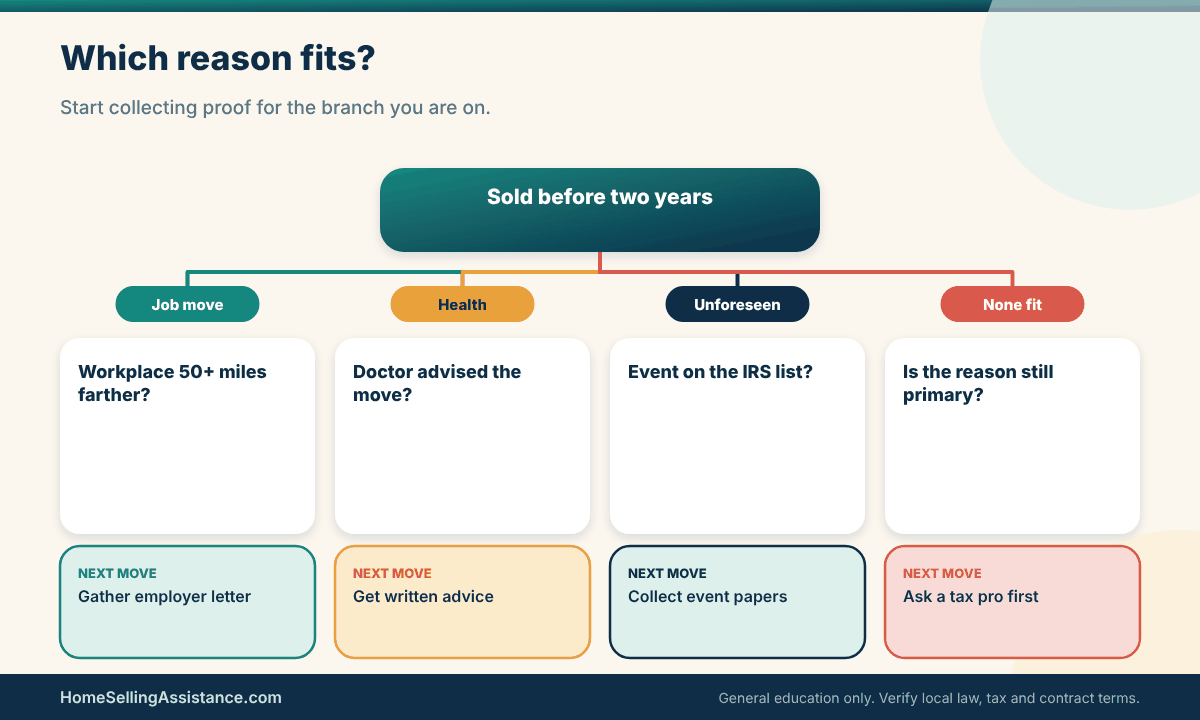
Two further wrinkles can sit on top of a home sale partial exclusion two years analysis. First, depreciation claimed on a home office or rental use after May 6, 1997 generally cannot be excluded, and periods of nonqualified use after 2008 can reduce the exclusion even for a seller who meets every other test.
Second, certain members of the uniformed services, the Foreign Service and the intelligence community can suspend the five-year test for a period of up to ten years, which is a separate rule from the reduced exclusion. Neither wrinkle is rare enough to ignore, and both are worth a line in your advisor questions.
If you land in the last branch, where no listed reason seems to fit, do not give up on the home sale partial exclusion two years analysis yet. Some situations fit the unforeseen-circumstances list in ways that are not obvious at first read, and some fit nowhere. A short consult can tell you which, and it costs far less than guessing wrong on a return.
Know when a home sale partial exclusion two years case needs a professional
Plenty of sellers can handle the first pass alone: count months, find the deed, estimate the gain. The hard part starts where facts overlap, such as a rental history, a divorce, two owners with different timelines or a reason that sits between two categories. In those cases a short, focused meeting with a CPA, enrolled agent or tax attorney tends to be cheaper than an amended return later.
Think of the professional as a second reader for your file, not as a rescue. In a home sale partial exclusion two years case, that second reader is often the person who spots the missing month or the weak document. The better your documents, the less time the meeting needs, and the sharper your questions, the more you get from it. This section covers what to ask, what to bring, and how to keep records after closing so the story survives a letter that arrives years later.
Questions worth bringing to a tax professional
A professional can check your fraction, read your documents, tell you whether your reason fits and prepare the return. They cannot invent a reason, and a good one will not try. If an advisor promises a particular result before seeing your papers, treat that as a warning sign. Ask about fees up front. A first call about a home sale partial exclusion two years question is often short, especially when you arrive with a packet.
A useful question is specific and answerable. “Do I owe tax?” is too broad for anyone to answer without opening your whole return. “My facts are these, I owned and used the home for fourteen months, my employer moved my position to a site that is roughly 60 miles farther from the house; does this fit the employment safe harbor, and how would you compute the fraction?” gives the advisor something to work with.
The scenario table below collects the situations we see most often and attaches a typical question to each. The effects shown are directional and use made-up round assumptions. They are meant to show how the pieces move, not to predict any return.
| Seller situation | Sale, loan or tax assumption | Estimated effect | Key risk | Professional question |
|---|---|---|---|---|
| Job transfer after 12 months | Gain of $160,000, single filer | Reduced limit near half of usual maximum | Workplace distance not documented | Does my transfer fit the employment test? |
| Doctor advises move after 9 months | Gain of $90,000, single filer | Reduced limit near three eighths of usual maximum | Letter does not tie move to treatment | Does this note support the health reason? |
| Layoff, forced sale at 16 months | Gain of $140,000, joint filers | Prorated limit may cover most of the gain | Benefit eligibility not shown | Which papers show the employment change qualifies? |
| Divorce, sale at 20 months | Gain of $200,000, two owners | Each owner’s history matters | Unclear who used the home and when | How do we compute each owner’s share? |
| Prior home sold 10 months earlier | Exclusion already used once | Fraction may shrink | Look-back overlooked | How does my earlier sale limit this one? |
| Preference move after 14 months | Gain of $120,000, no listed reason | Little or no exclusion expected | Weak story built after the fact | Is there any basis for a reduced limit at all? |
To use the table, find the row closest to your situation and read it across. The assumption column tells you which figures to prepare, the risk column tells you what a reviewer will probe first, and the last column is a ready-made opening question. If your situation matches no row, write your own version in the same five parts before you pick up the phone.
Evidence to bring: the packet that saves billable hours
A good packet fits in one folder. Put in your purchase closing statement, your draft or final sale statement, a one-page timeline of ownership, use, rentals and absences, copies of improvement receipts, the document that shows your qualifying reason, and prior-year returns if another home sale or a rental was involved. Add a short note listing every person who held title and every person who lived there.
Add one more page: your questions, in order of importance. Advisors appreciate that, and it keeps the meeting on the issues that move money. If you are separating from a spouse, our overview of divorce and home sale taxes covers the extra wrinkles, and IRS Publication 504 on divorced or separated individuals is the official reference.
A scenario with joint owners, a complication, and your next step
Imagine two unmarried co-owners who bought together, lived in the home for thirteen months and sold after one of them accepted a transfer. Only the transferred owner has the employment reason in the obvious sense. IRS guidance describes co-owners among the people whose circumstances can count, but each owner is still analyzed separately, and each reports their own share. Round numbers: if the gain is $100,000 split evenly, each owner is dealing with $50,000 and their own limit.
The complication is that shared title does not merge two sets of facts into one. The next step is for each owner to list their own facts and for both to ask the same advisor how the rules treat co-owners and household members. If one of you has passed away, read our guide on selling a house after a spouse dies and the official Publication 559 for survivors and executors, since a death can change both timing and the available rules.
Records to keep after closing and how long
One reporting basic belongs here. As a general matter described in IRS guidance, a sale whose entire gain is excludable does not need to be reported unless you receive a Form 1099-S, while a sale with taxable gain is reported on your return, typically on Form 8949 and Schedule D. Because a reduced limit can leave a taxable remainder, a home sale partial exclusion two years sale can easily end up reported. Confirm the current forms and instructions for your tax year.
Your tax return is the end of one process and the beginning of another, because the proof behind it may be asked for much later. The general idea in IRS guidance is to keep records that support an item on your return for as long as the period in which the IRS can assess tax, and for home sales, records that establish basis are typically worth keeping well beyond that, since basis matters at the next sale too.
Our dedicated article on home sale tax records goes deeper into what to keep and for how long. Here we focus on the records that matter specifically for an early sale, which tends to be audited, if at all, on one question: did you really have a qualifying reason, and did you compute the fraction correctly?
Evidence to keep: the closing file and the reason file
Create two folders and label them honestly. The closing file holds the sale statement, any Form 1099-S you receive, the contract, and your gain worksheet. The reason file holds everything that supports why you sold early: the employer letter, the medical recommendation, the notice that describes the unforeseen event, and your dated timeline. Keep digital copies and one backup in a separate place.
Do not rely on a portal that might close. Employers change systems, patient portals change vendors, and old emails disappear. Download the document, name it with the date and the topic, and store it with your return. The few minutes this takes are the cheapest insurance in this entire process, and the home sale partial exclusion two years analysis depends heavily on it.
A scenario with an audit letter, a surprise, and your next step
Picture a seller who claimed a reduced exclusion after a job move, then received a letter two years later asking about the basis for the claim. Illustratively, the letter asks for proof of the new workplace address and the old one. The surprise is that the seller’s employer had since been acquired, and the person who signed the original letter has left the company.
Because the seller kept a copy of the transfer notice, a pay statement showing the new work location and the original timeline, the response is straightforward. The next step for anyone in that position is to contact the tax professional who prepared the return, send copies rather than originals, and respond by the deadline in the letter. Silence is never a plan, and a short, organized reply usually reads better than a long one.
One last picture ties the records together. The checklist below groups what to keep into three sets: proof of ownership, proof of use and proof of the reason. Print it, check things off as you collect them, and put it on top of the folder.

Between the checklist and the folders, you now have the whole pattern: prove the ownership, prove the use, prove the reason, then compute carefully. If you want the full picture of how this fits with the rest of your return, our cornerstone guide on taxes when selling a home ties the pieces together, and the home sale taxes category lists every related article in one place.
A last practical point about the home sale partial exclusion two years rule: write down your assumptions as you go, including the ones that feel obvious. Months counted, dates used, reason named, costs included. When a number changes, you will know why, and when a professional reviews your home sale partial exclusion two years worksheet, the assumptions are already laid out for them to confirm or correct.
Quick scenario
Illustrative round numbers only. A single owner lived in a home for 18 months, then sold after a qualifying job transfer. Eighteen over twenty-four is three quarters, so the reduced limit would be three quarters of $250,000, or $187,500. If the gain were $150,000, the whole gain would fit under that limit. If it were $220,000, about $32,500 could be taxable. Your own facts, and a professional, decide what really applies.
Frequently asked questions about home sale partial exclusion two years
What is the home sale partial exclusion two years rule in simple terms?
The home sale partial exclusion two years rule is a reduced version of the main-home exclusion for sellers who did not own and use the home for a full two years. The reduction is a fraction of the usual limit based on how long you actually owned and lived there. It only applies when the primary reason for selling is a qualifying one, such as a job change, health need or unforeseen event. Anything above the reduced limit may be taxable.
Do I need a reason to claim a home sale partial exclusion two years exclusion?
Yes. Selling early because you simply wanted to is generally not enough. The IRS describes three families of reasons: a change in place of employment, health, and unforeseen circumstances. Each has its own tests, and the reason generally has to be the primary one behind the sale. Your documents are what show it.
How is the reduced limit calculated in a home sale partial exclusion two years case?
Take the shorter of your ownership period or your use period, express it as a fraction of two years, and multiply that fraction by the usual maximum for your filing situation. The two years can be written as 24 months or 730 days. If you used the exclusion on another home within the previous two years, that period can shorten the numerator. A tax professional can confirm how your dates line up.
Does the sale price or my cash at closing decide the tax?
No. Tax depends on gain, which is the amount realized minus adjusted basis. Amount realized is the price less selling expenses. Paying off a mortgage changes your cash at closing but does not change the gain, so a small check at closing does not mean there is no tax.
What if I sold at a loss?
For a personal main home, a loss on sale is generally not deductible, so there is usually no gain to exclude. That is why computing the gain honestly is the first step. If the home had rental or business use at any point, different rules can apply, and a professional can walk through them.
Can both spouses use a home sale partial exclusion two years claim on a joint return?
The rules look at each spouse’s own ownership, use and history, so the combined limit is not always simply double. A couple with identical facts may be in a simple position. Couples with different move-in dates, a prior sale or a rental period usually benefit from professional review. Bring both timelines to the meeting.
What documents should I keep for a home sale partial exclusion two years claim?
Keep the purchase and sale closing statements, a dated timeline of ownership and use, proof of residence such as bills and ID, improvement receipts, and the document that proves your reason. That might be an employer letter, a doctor’s note or official paperwork about the event. Store copies somewhere that will not disappear if a website or employer changes.
Will I get a Form 1099-S, and does that mean I owe tax?
A closing agent may send one, but receiving the form is not the same as owing tax. It reports the proceeds of the sale. Whether any gain is taxable depends on your basis, any exclusion, and the rules that apply to you, so use the form as a data point and not as a verdict.
Do state taxes follow the federal home sale partial exclusion two years treatment?
State rules vary, and some states follow the federal treatment closely while others differ in details. Check your state revenue department’s website or ask a local tax professional. Do not assume a federal outcome carries over unchanged.
When should I hire a tax professional instead of doing this myself?
Consider one before listing if you owned for under two years, if a rental period, divorce, co-owner or prior sale is involved, or if the reason for the move is not clearly on the IRS list. A short consult on your home sale partial exclusion two years question before you sign a contract costs far less than fixing a return after the fact.
Before you sign the sale contract
A home sale partial exclusion two years claim comes down to three things you can prepare in an afternoon: a dated timeline, an honest gain estimate and a written reason with proof. Do those first, then ask your questions while there is still time to change plans. This article is general education, not legal, tax or financial advice, and rules and facts differ for every seller, so confirm the details with current IRS guidance and a licensed professional before you act.