Choosing to buy house before selling current home means you are agreeing to hold two properties, and possibly two loans, for a stretch of time that nobody can promise you in advance, so the real question is not whether you like the new house but whether your finances can carry both of them if the old one takes longer to sell than you hope.
Plenty of people end up here for good reasons. The right house appears in a market where good houses move fast, a job or a school year sets a deadline, or a family simply does not want to live out of boxes and a rental for three months. Buying first can give you a calm, unhurried move, and that is a real benefit. It also puts the entire risk of the old sale on your shoulders, with no one else absorbing it. Keep that in mind whenever you weigh the decision to buy house before selling current home.
This article is about the money side of that choice. We will walk through the cash you can truly reach, the way lenders look at two payments, what a home equity line or a savings cushion really costs, and how to test the plan against a slow sale before you sign anything. If you want the full comparison of the two orders, our cornerstone guide on whether to sell first or buy first covers both sides, and our companion piece on how to sell your house before buying another looks at the opposite path.
One caution up front. Loan rules, closing customs, contingency lengths and tax treatment differ by lender, by state and by contract. Every dollar figure below is a round, illustrative number chosen to make the arithmetic easy to follow. None of it is a prediction for your house, a quote, or a recommendation, and a mortgage professional, a title company, an attorney or a tax adviser should check the details that apply to you. It is a small detail, yet it shapes how safely you can buy house before selling current home.
Key takeaways
- Count reachable cash, not paper equity. Equity in the old house only becomes spendable money after a sale closes, or through a loan that has its own cost, approval and risk.
- Plan for the slow sale, not the fast one. A plan to buy house before selling current home should still work if the old house sits for months longer than you expect.
- Ask how the lender counts both payments. Whether the old mortgage stays in your debt-to-income picture can decide what you qualify for, so get that answer in writing before you make offers.
- Price the whole bridge. Two mortgages, taxes, insurance, utilities, interest on borrowed down payment money and moving twice all belong in one honest number.
- Know what your home is securing. A line of credit against the old house is a lien on it, and a lender can change or freeze many lines, so do not treat it as guaranteed money.
- Write a fallback before you need one. Decide in advance what you will do, and by what date, if the sale slips, rather than deciding under pressure.
Start with the cash you can actually reach, not the equity you own
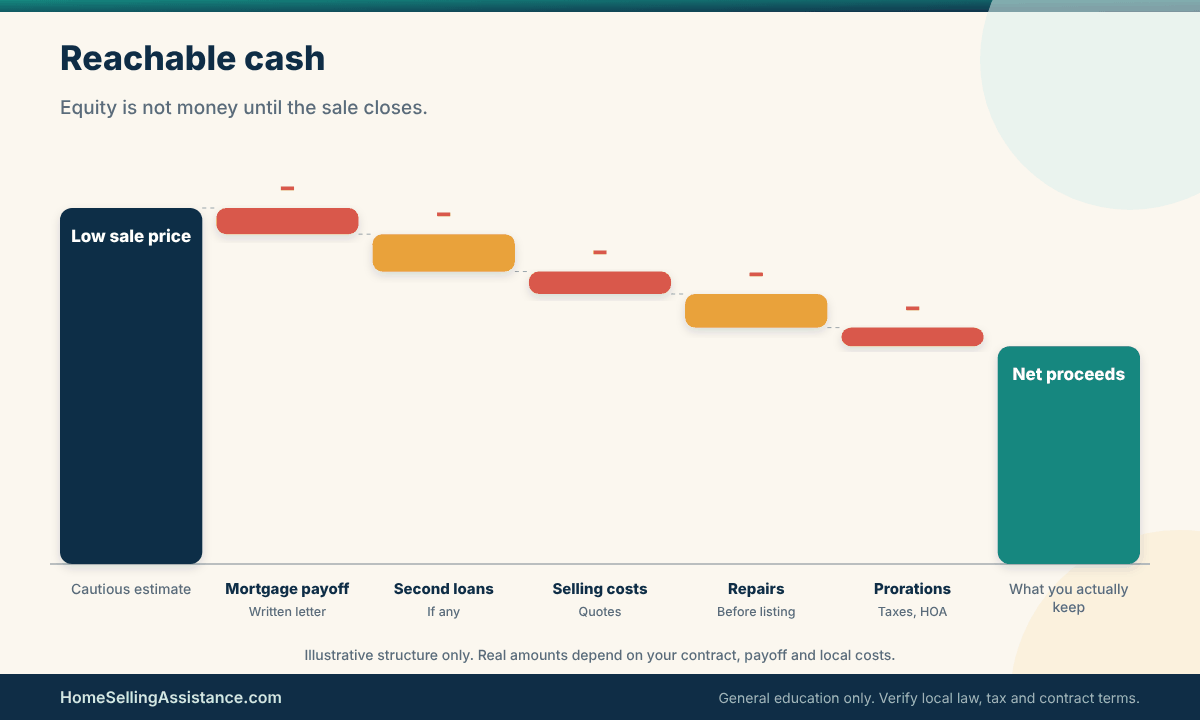
Sellers who buy first tend to say the same sentence: “We have plenty of equity.” It is usually true, and it is usually beside the point. Equity is a number on paper, the gap between what a home might sell for and what you owe. It is not a balance you can write a check against. The first job is to turn that paper figure into a short list of dollars you can reach, with dates attached.
The inputs behind a plan to buy house before selling current home
Every version of this plan rests on four inputs: what the old house is likely to sell for, what you owe on it, what it costs to sell, and what you can put toward the new purchase before the old sale closes. Each one has a range rather than a single value, and the honest approach is to work with the low end of the range first. Anyone who wants to buy house before selling current home benefits from settling this early.
Evidence to gather: payoff, value range and selling costs
Start with the payoff, because it is the only one of the four that is a hard number. Ask your servicer for a written payoff statement, which includes interest through a stated date, and note that the figure on your monthly statement is usually lower because it leaves out accrued interest and fees. If you have a second mortgage or a home equity line already, get that payoff too. People forget it more often than you would think.
For value, avoid a single estimate. Ask for comparable sales from a licensed agent or appraiser, look at a realistic low, middle and high range, and remember that a list price is a hope and a sold price is a fact. Our guide to home sale net proceeds shows how to move from a sale price to the check you might receive, and it is worth reading before you commit to any purchase. Households that buy house before selling current home are usually glad they asked this question first.
Selling costs come next. Compensation to agents is negotiable and has to be written into agreements, so ask for the actual terms rather than assuming a standard. Then add title and escrow charges, transfer taxes where your state or county has them, prorated property taxes, any HOA transfer fees, repairs you have agreed to make and the cost of getting the house ready to show. Local customs on who pays what vary a great deal, so a title company or attorney in your area can tell you what is normal where you live.
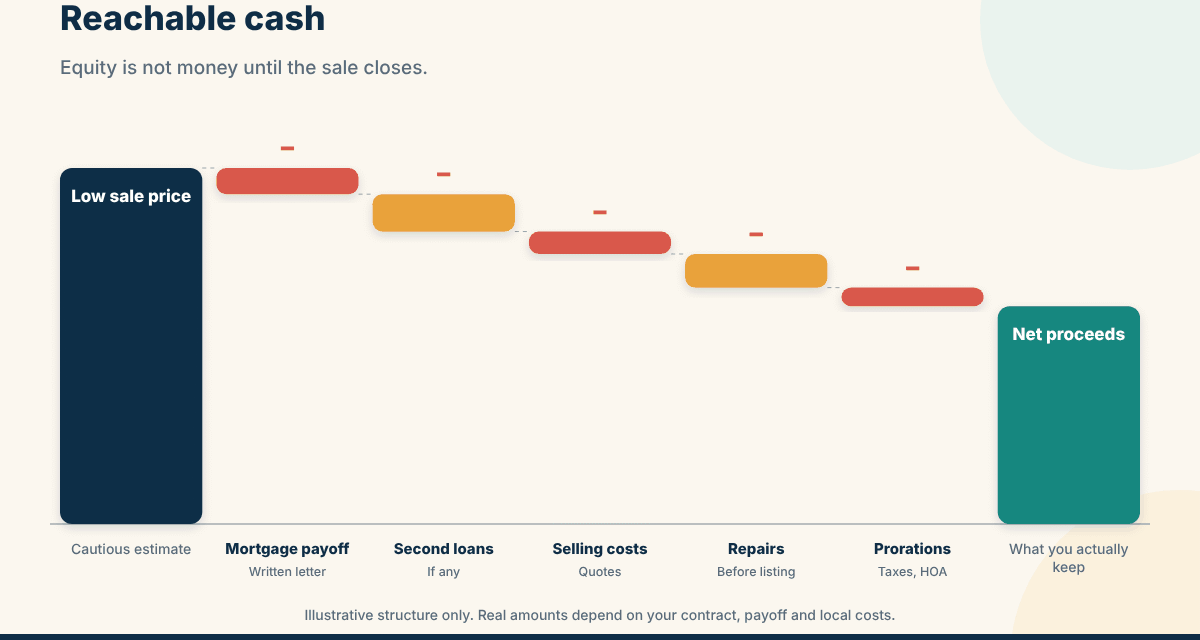
Finally, subtract all of it from the low end of your value range. What is left is a cautious estimate of net proceeds. Treat that figure as the ceiling on what the old house can fund, and treat anything above it as a pleasant surprise rather than something to spend. If the cautious figure still supports your plan, you are building on solid ground. If it only works at the optimistic end, you have learned something important before spending a dime. This is where a plan to buy house before selling current home either holds together or starts to wobble.
A scenario, an exception, and your next step on inputs
Picture a couple whose old house might sell for somewhere between a lower and a higher figure, with a mortgage payoff comfortably below both. On paper they have a large cushion. But their payoff statement shows a second loan they had half forgotten, a line they used for a kitchen project years ago, and the first quote for selling costs came in higher than they assumed because their county charges a transfer tax. Their cautious net proceeds are noticeably smaller than the number in their heads.
That is the usual exception: the total is rarely as large as it feels. Another common one is a house that needs work before it will show well. If the repairs have to be paid before the sale closes, they come out of the same cash you were hoping to use as a down payment, and that is worth pricing early. Our article on mortgage payoff when selling a house explains how the payoff process works, including why a stale statement can mislead you.
Treat it as a standing check each time you revisit the idea to buy house before selling current home.
If you plan to buy house before selling current home, your next step is simple and a little dull. Build a one-page sheet with four lines for the cautious case: low sale price, total payoff, total selling costs, and the result. Add a fifth line showing how much of that result you could safely call spendable only after closing. Keep the sheet updated as real quotes replace guesses, and bring it to every conversation with a lender or agent. It keeps everyone, including you, honest.
Timing and liquidity: when the money arrives and when it is needed
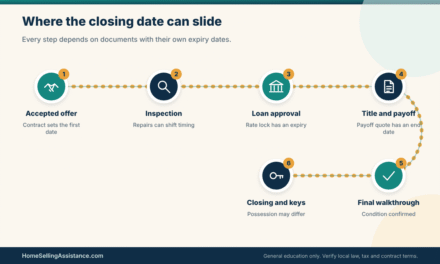
Even a very profitable sale does not help you if the money lands after the bill is due. Timing is where plans to buy first most often wobble, because the new purchase has hard dates and the old sale has soft ones. Your task is to line the two calendars up and look hard at the gap between them. Few things matter more if you intend to buy house before selling current home.
Evidence to gather: contract dates, lender rules and reserves
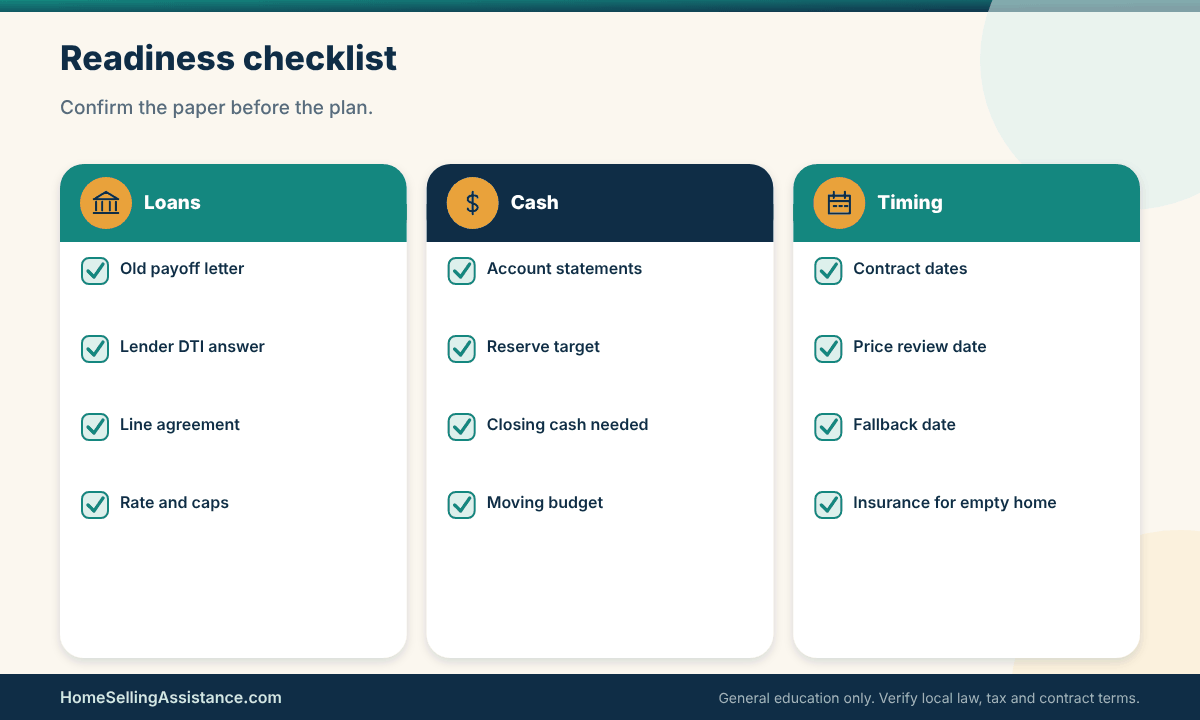
Begin with the new purchase contract, because it holds the dates you cannot move. Note the earnest money deadline, the end of any inspection period, the financing deadline, the appraisal timeline and the closing date. Each one is a point at which cash or a commitment is required. If you can still shape the contract, ask whether a slightly longer closing window is available, which our piece on a flexible closing date explores from the seller’s side.
Then gather the lender’s rules. Ask your mortgage professional, in plain words, how they will treat the old mortgage when they calculate your debt-to-income ratio. Some situations allow the old payment to be set aside once there is a signed sale contract; others do not until closing. The answer depends on the lender, the loan type and the documents you can provide, so ask for it in writing rather than relying on a phone call. Put differently, the cost of choosing to buy house before selling current home is mostly a cost of time.
Next, list your reserves. Reserves are the liquid funds left after the down payment and closing costs on the new home, and lenders often ask to see some. Separate the money in checking and savings from money inside retirement or investment accounts, because the second kind can carry taxes, penalties or market swings if you pull it out at the wrong time. We are not giving advice on those accounts here, only pointing out that they are not the same as cash.
Finally, write down the cost of waiting. Take the monthly total of both housing payments, taxes, insurance, utilities and upkeep, and multiply by one month, three months and six months. Seeing those three figures in a row makes the risk concrete. It also shows you early whether a six-month delay is something you could absorb or something that would force a hard decision. That habit protects you whether or not you finally buy house before selling current home.
A scenario where the dates drift
Imagine a buyer who closes on the new house in the first week of a month, with the old house listed two weeks earlier. The plan assumed a sale within sixty days. At day forty an offer arrives, but the buyer’s financing contingency runs three more weeks, and the closing date lands about a month later than the original hope. Nobody did anything wrong. The calendar simply stretched, which calendars do.
For that household the extra month meant another full set of payments and utilities on a house they were not living in. If they had run the cost-of-waiting figures beforehand, the month would have been a known item. Because they had not, it landed as a surprise, and it arrived just as they were paying for movers and furniture. Sellers who buy house before selling current home tend to feel this point most in the second and third month.
The practical lesson is to build slack into the plan and to make it visible. Choose a date by which you hope the old house will be under contract, and a later date by which it must be, and write both down. Then decide what you will do if the later date arrives without a contract: lower the price, adjust the terms, rent the house, or draw on a reserve. A related read is our guide to temporary housing between selling and buying, which covers the opposite situation but shares the same timing logic.
The following table collects the main money inputs in one place. Use it as a worksheet: for each row, note where the number came from, how it changes your cash flow, how uncertain it is, and which document would confirm it. Rows with high uncertainty and no confirming document are the ones to fix first. Write it down, because a plan to buy house before selling current home runs on specifics rather than hopes.
| Input | Assumption or source | Cash-flow or tax effect | Uncertainty | Verify with |
|---|---|---|---|---|
| Old mortgage payoff | Servicer payoff statement | Reduces proceeds dollar for dollar | Low, but changes daily | Written payoff letter |
| Expected sale price | Low end of comparable range | Sets ceiling on funds from the sale | High | Agent or appraiser comparables |
| Selling costs | Written quotes and local custom | Lowers net proceeds at closing | Medium | Listing terms, title estimate |
| Two housing payments | Both loans, taxes, insurance, utilities | Monthly drain until the sale closes | Medium, depends on timeline | Current statements and bills |
| Home equity line draw | Lender approval and variable rate | Adds a payment and a lien | High, terms can change | Loan agreement and rate terms |
| Cash reserves | Bank balances after closing costs | Absorbs delays, may be tapped | Low to medium | Recent account statements |
| Possible taxes | Home sale rules and your records | May reduce what you keep | Depends on your facts | IRS Publication 523, tax adviser |
Read the table from the bottom up if you are short on time. Taxes and reserves tell you what you can afford to lose, and the line of credit and the second payment tell you how fast a delay becomes expensive. Everything above them is arithmetic that real documents will settle.
For the tax row in particular, the IRS explains the main federal rules for home sales in Publication 523, and our own article on the home sale capital gains exclusion gives a plain-language overview of how those rules usually work. Lenders, agents and title companies will each look at this differently when you buy house before selling current home.
Compare the total financial risk of buying first
Once the inputs are on paper, the next step is to price the whole arrangement and compare it with the alternatives. A plan to buy house before selling current home looks affordable when you only count the extra mortgage payment. It looks different when you count everything that quietly piles up around it, and different again when you ask what happens if the sale stalls.
Fees, credits, carrying cost, financing and taxes in one view
The cleanest way to compare is to build a single monthly and total cost for the overlap period. That means every item that exists only because you own two homes at once, set next to any credits or savings the plan brings you. The goal is not a perfect forecast. It is a figure you have looked at squarely before you commit. It is easy to skip, and skipping it is how a manageable choice to buy house before selling current home turns stressful.
Evidence to gather: quotes and statements for every line
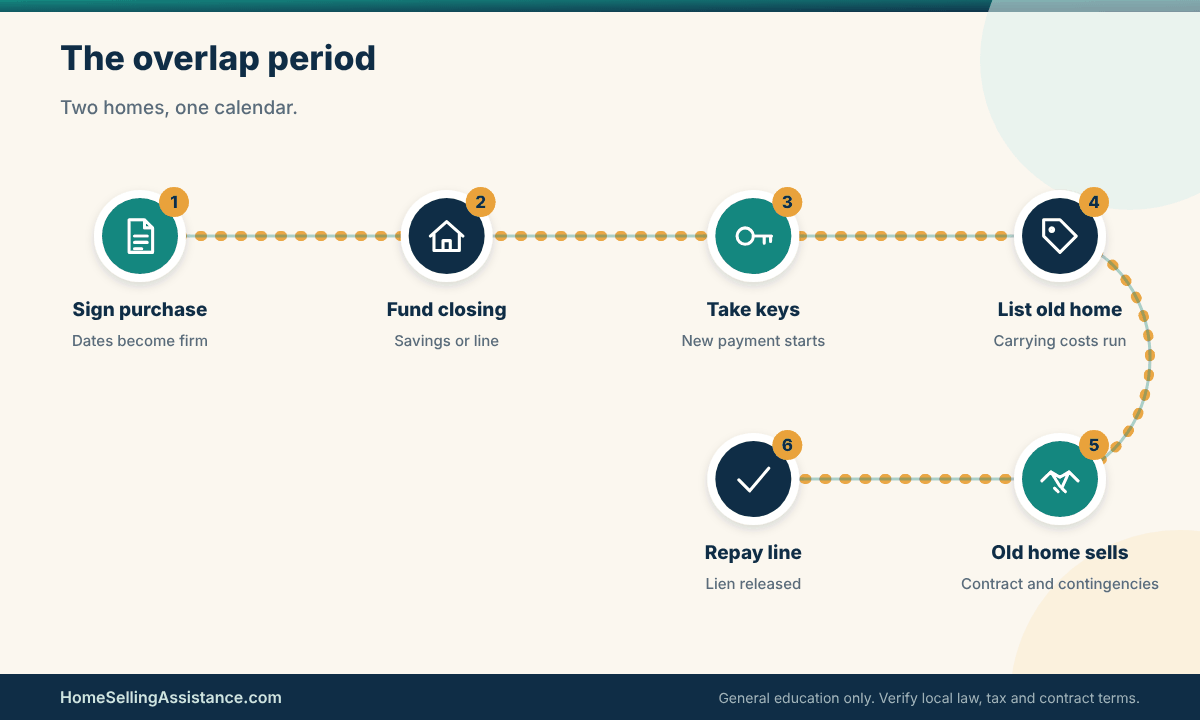
Start with the carrying costs on the old house, because they continue while it is on the market. Pull the latest mortgage statement, the property tax bill, the homeowner’s insurance premium, the utility bills, lawn or snow service, and any HOA dues. Insurance deserves its own question: many policies change their terms when a home sits vacant for a stretch, so ask your insurer what applies once you move out, and get the answer in writing.
Then collect the same list for the new house, adding the closing costs on the purchase. Your lender provides a loan estimate that itemizes lender fees, third-party services, prepaid interest, taxes and insurance, and the figure for cash needed at closing. The Consumer Financial Protection Bureau explains how to read those forms on its site, consumerfinance.gov, and reading them slowly is time well spent. The same logic applies however large or small your plan to buy house before selling current home looks on paper.
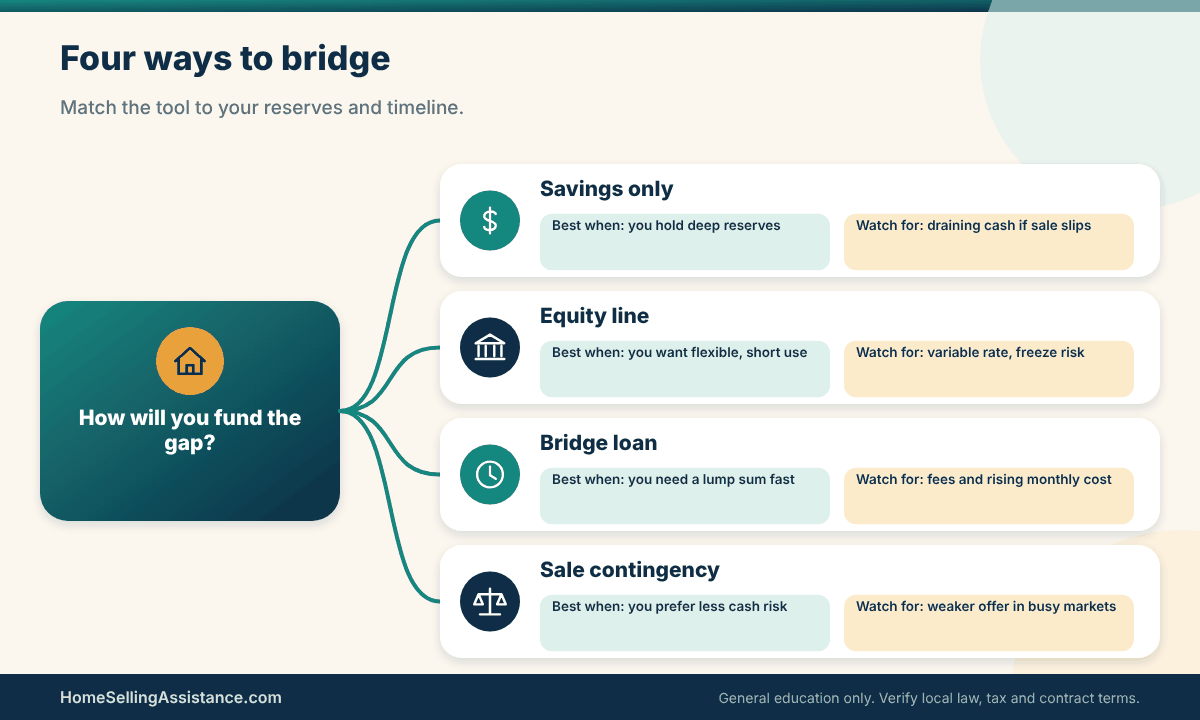
Financing costs for the bridge itself come next. If you intend to use a home equity line, ask for the rate type, the index it follows if variable, any annual or early-closure fees, the draw period and the repayment terms. If you are considering a short-term bridge loan instead, our guide to a bridge loan for buying before selling goes through the fees, qualification and repayment questions in detail. Whichever you choose, ask for the total cost of borrowing over the number of months you realistically expect to carry it.
Finally, set aside a line for taxes. For most people who have lived in the old house as a main home, the federal exclusion described in IRS Publication 523 covers a large share of any gain, subject to ownership and use tests. But the details turn on your own history, such as how long you lived there, whether any part was rented, and what improvements you made. We cannot calculate that for you, and your own records and a tax professional can.
If you buy house before selling current home, this is one of the first places to build in slack.
Add the lines up for one month, then multiply by the number of months in your cautious timeline. Subtract any real credits, such as a seller credit toward your closing costs on the new house if you negotiated one. The remainder is your true cost of buying first. Compare it with the cost of the alternative you are considering, whether that is a rental stay, a longer closing, or a contingent offer.
Scenario: the cheap-looking loan that cost more
Consider a buyer who chooses a home equity line because the opening rate looks lower than other options. They draw most of it to cover the down payment on the new house. Three months pass, the sale takes longer than planned, and the rate on the line, which moves with an index, edges upward. Because they borrowed a large amount and made interest-only payments during the draw period, the balance is exactly as big as the day they drew it.
None of this means you should avoid the choice to buy house before selling current home, only that you should price it honestly.
Nothing dramatic happened here. The line performed as written. The surprise was in how the pieces added up: the loan payment, the old mortgage, the new mortgage and a cluster of fees they had not totaled. A tidy table before borrowing would have shown them how thin the margin was.
The exception worth knowing is that a line is sometimes the cheapest tool because it is so short-lived. If the old house sells quickly and the balance is repaid from proceeds at closing, the total interest can be modest. The same loan that is a bargain over three weeks can be an expense over five months. That is why the timeline assumption matters more than the rate you see on the first page. Neighbors may tell you it worked out for them, but each decision to buy house before selling current home stands on its own numbers.
Before you buy house before selling current home, your next step is to ask each potential lender for the all-in cost at two durations: a quick sale and a slow one. If a lender will not help you model that, treat it as a signal, and compare how clearly each one answers. It is also sensible to ask whether the old mortgage lender or the new one has any rule about borrowing against the home you are trying to sell.
The effect of mortgage rates on home sellers is another useful backdrop, because a rate rise changes both your borrowing cost and your buyers’ purchasing power.
Shortfall, rate, fallback and the home as collateral
Every financing plan has a way of failing. The skill is in naming that failure in advance and deciding what you would do about it. For buyers who plan to buy house before selling current home, the failure modes tend to fall into four groups: a shortfall of cash, a rise in borrowing cost, a delay in the sale, and the loss of flexibility that comes from pledging the house you are trying to sell. Remember that your contracts, not general advice, control what happens when you buy house before selling current home.
Evidence to gather: line terms and a written fallback
Begin with the exact wording of any borrowing agreement. A home equity line is secured by the house, which means the lender holds a lien on it. That lien has to be paid off at closing before a buyer receives clear title, and the title company will request a payoff letter and a release. Make sure you understand who is responsible for that step and how long it takes, because delays here can slow your closing.
Ask whether the lender can freeze or reduce the line, and under what circumstances. Many agreements allow the lender to do so if the value of the home falls significantly or if your financial situation changes. We are not saying it will happen, only that you should read that clause and not assume the full amount will always be available. If your plan depends on a draw that could be frozen, it is a fragile plan. It helps to revisit this point weekly while you buy house before selling current home and the old listing is live.
Check the rate structure next. Variable rates move with a benchmark, and the agreement states how often they adjust and whether a cap applies. Fixed-rate options and fixed-rate conversion features exist on some products, usually with their own fees. Whichever you choose, translate it into a monthly payment at a rate noticeably higher than today’s, and see whether you could still pay it comfortably.
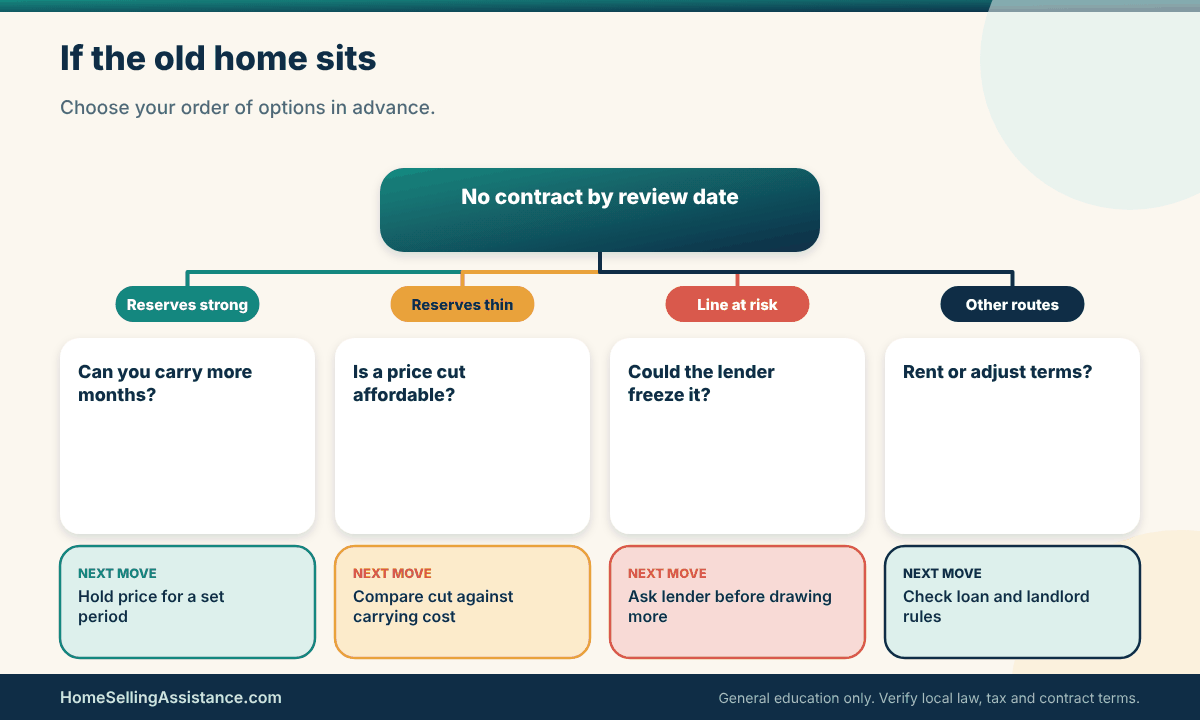
Then write the fallback. A useful fallback is a short, dated note, not a vague intention. It might read: “If the old house is not under contract by this date, we reduce the price by this amount, review the listing terms, and consider renting it or using these reserves.” The specific numbers are yours to choose. What matters is that the decision was made calmly, on a day when no one was pressuring you. A calm, written answer here makes the plan to buy house before selling current home far easier to defend later.
Last, keep a record of who to call. Your mortgage professional, your agent, your title company, an attorney if your state uses one, and a tax adviser each hold a piece of the picture. Nonprofit housing counselors approved by HUD can also help you think through a plan that feels stretched, and you can find one through the HUD counselor search. Asking for a second opinion is a sign of care, not weakness.
Scenario: the sale that slips two months
Take a household that bought first, using savings for the down payment and a modest line for the rest. They listed the old house at a price their agent supported. After several weeks without a strong offer, they faced the question every seller in that spot faces: hold the price or lower it. Each week of waiting cost them two sets of housing expenses, and the longer it ran, the more the numbers pushed them toward a cut. Professionals can check this quickly, and it costs little compared with the stakes of deciding to buy house before selling current home.
There is no single right answer in a situation like this, and we would be wary of anyone who claims one. A price cut might attract a buyer sooner, but it also lowers the proceeds that were meant to repay the line. Waiting might bring a better offer, or it might simply drain reserves. What helps is having the dated fallback in advance, so the choice is made against a plan rather than against a rising sense of panic.
An exception to keep in mind is the buyer with a financing problem. A sale that goes under contract and then collapses sends you back to the start with weeks lost. Our article on home sale contingencies from the seller’s side explains how financing, inspection and appraisal clauses can reopen a deal, and our cornerstone guide shows how the whole sell-first or buy-first decision fits together. That is the practical heart of any plan to buy house before selling current home.
If you mean to buy house before selling current home, your next step is to run the slow-sale test on paper today. Add two extra months of carrying costs to your plan, then ask whether you would still be comfortable. If the answer is a clear yes, you have real margin. If the answer is a hesitant maybe, that hesitation is the information you need, and it is much cheaper to hear it now than after you have signed.
Use scenarios with explicit assumptions before you buy house before selling current home
A scenario is only useful if its assumptions are written where you can challenge them. The examples in this section use round, invented numbers so the arithmetic is easy to follow. They are illustrations of method, not benchmarks, quotes or predictions, and your own figures will differ. Swap in your documents and rerun the steps. Honest arithmetic on this point separates a sound plan to buy house before selling current home from a hopeful one.
A worked example with round, illustrative numbers
Suppose a household wants to buy house before selling current home and has gathered cautious numbers. We will walk through the assumptions first, then the monthly cost of the overlap, then what it implies for the plan. Every figure here is made up for the exercise. It also explains why timing, not price alone, drives the risk when you buy house before selling current home.
Evidence behind each assumption
Assume the old house is expected to sell for a low-end figure of 400,000 dollars. The payoff statement shows 200,000 dollars owed, and the seller’s written estimate of selling costs, covering agent compensation, title, escrow, transfer charges and prorations, comes to 28,000 dollars. Cautious net proceeds are therefore 172,000 dollars. Each of those inputs maps to a document: comparable sales, a payoff letter, a listing agreement and a title estimate.
Assume the new house costs 450,000 dollars and the household plans to put 90,000 dollars down. They hold 60,000 dollars in savings they are willing to use and plan to borrow 30,000 dollars through a home equity line on the old house. After closing costs on the purchase, they expect to keep 25,000 dollars in reserve. The lender’s loan estimate and the account statements back up those numbers. The lesson carries over to nearly every version of the choice to buy house before selling current home.
Assume the old house costs 2,200 dollars a month to carry, counting mortgage, taxes and insurance, plus 300 dollars for utilities and upkeep while it sits empty. Assume the interest on the line is 200 dollars a month at the illustrative rate. That makes the extra monthly cost of the overlap 2,700 dollars. Their new mortgage payment is real, but it replaces the housing cost they would have had anyway, so it is not counted as an extra in this exercise.
Notice what we did not assume: no appreciation, no price spike, no offer above list. The example uses the low end of value and the high end of cost, which is the habit we recommend. If the plan works under those pessimistic settings, any better outcome is a bonus. If it only works under cheerful ones, the example has done its job by showing you. Revisit the figure whenever a quote, a rate or a date changes while you plan to buy house before selling current home.
The worked case, in plain terms, is a household that can cover a sale delay of about nine months out of reserves alone, since 25,000 divided by 2,700 is a little over nine. That sounds comfortable until you notice how much of the reserve is already earmarked for moving and repairs. Reserves are a shock absorber, and a shock absorber that is already compressed does not absorb much.
What changes if the example does not match you
Change one assumption at a time to see how much weight each one carries. If the old house costs 3,500 dollars a month to carry instead of 2,500, the same reserve lasts closer to six months. If you skip the line and use more savings, the interest cost disappears but your reserve shrinks. If the old house is a condo with HOA dues, add those dues; if it is in a cold climate, add heating for a vacant house.
This is the sort of detail that decides whether buying first feels calm or frantic, and it belongs in any plan to buy house before selling current home.
Also consider the exceptions that make an example misleading. If the old mortgage has a prepayment penalty, the payoff may be higher than the statement balance. If you are selling in a state where a seller must pay a transfer tax, the costs rise. If you have owned the old house a short time, your net proceeds may be thin, because costs of selling take a larger bite out of a small equity cushion. Our guide to seller closing costs lists the categories to ask about.
And think about the structure of the deal. A seller who negotiates a longer closing on the new house, or who arranges to stay in the old home after selling it, changes the whole calculation. Our articles on a rent-back agreement after closing and on move-out date versus closing date describe how those arrangements can shift the overlap, and sometimes shrink it. People who decide to buy house before selling current home often underestimate this until they see it in a column of numbers.
Your next step is to write down your own version of this example on a single page, with every assumption labeled by the document that supports it. Where a document does not exist yet, mark the line as a guess and decide who can supply the real number. That one page will make conversations with your lender and agent far more productive, and it will make it easier to spot when advice fits your situation and when it does not.
The table below shows several common seller situations side by side. It is meant to help you find the one closest to yours, see the main risk, and write down a useful question for a professional. Do not read the effect column as a forecast; it describes the direction of the impact under the stated assumption. Keep a copy of the supporting document with your notes on the choice to buy house before selling current home.
| Seller situation | Sale, loan or tax assumption | Estimated effect | Key risk | Question for a professional |
|---|---|---|---|---|
| Strong savings, no borrowing | Down payment paid from cash | Simple, no new lien | Reserves drain if sale slips | How much cash should stay liquid? |
| Equity line on old home | Variable rate, draw during overlap | Extra payment, repaid at closing | Line frozen or rate rises | Can the lender reduce the line? |
| Two mortgages carried | Both payments counted by lender | Higher debt-to-income picture | May reduce approval amount | When can the old payment be excluded? |
| Home sale contingency | Purchase depends on old sale | Less cash risk for you | Seller may prefer cleaner offers | Will this weaken my offer here? |
| Short-term bridge loan | Fees plus interest, short term | Fast access to equity | Costs rise with every month | What is the total cost at six months? |
| Old house needs repairs | Work done before listing | Cash needed up front | Costs exceed estimate | Which repairs affect price most? |
To use the table, find your row and read left to right until you reach the key risk. Then ask whether you have a plan for that risk written down. If you sit between two rows, which is common, borrow the questions from both. The goal is not to match yourself to a label but to arrive at your next phone call with a sharper question than “Is this a good idea?” Your own contract and loan documents always control, and the broader choice between the two orders is covered in our sell-first or buy-first guide.
Sensitivity and break-even: how far can the plan bend?
A plan is only as strong as the changes it can survive. Sensitivity work means moving one variable at a time, a sale price, a number of months, a rate, and watching the effect on your reserve. Break-even work asks the sharper question: at what point does the plan stop working? Both are simple enough to do with a calculator and a notepad. It is a fair question to put to every professional you speak with about plans to buy house before selling current home.
How to run the break-even check yourself
Start with your reserve, the cash you would still hold after closing on the new house and paying any known moving or repair costs. Divide it by your monthly overlap cost. The result is the number of months you could carry both homes before the reserve is gone. In our example, that is a bit over nine months, but the household should treat a lower number as the real limit, because you do not want to reach zero.
Next, run the price side. Take the cautious net proceeds and subtract the amount you plan to repay from borrowing, such as the line balance. The difference is the cushion you would have left from the sale. In the example, 172,000 minus 30,000 leaves 142,000 dollars. A price cut of a given size reduces that cushion by the same amount, so you can see how much room you have before you would be unable to repay the line. That is why we keep returning to the cautious case when the goal is to buy house before selling current home.
Then combine them. A slow sale usually brings pressure to cut the price, so look at a case where you lose both months and dollars. If the sale takes six months and you reduce the price by 20,000 dollars, the reserve is reduced by about 16,200 dollars of carrying costs and the proceeds by 20,000. Check each figure against the limit you set earlier. The point is not to predict that outcome but to know where it lands.
Finally, set a trigger. A break-even check is only useful if it changes your behavior. Choose the number of months at which you will review the price, and the number at which you will start the fallback. Writing these triggers down makes them easier to follow, because by then the stress of a long listing will be pulling in the other direction. Whatever the final call, being clear on this lets you buy house before selling current home, or choose another order, with open eyes.
Scenario: the price cut and the decision date
Let us return to our household, now at month four with no contract. Their agent suggests a price reduction. The couple look at the numbers they prepared: carrying costs to date total 10,800 dollars, the reserve has dropped accordingly, and a cut of 10,000 dollars would still leave the net proceeds comfortably above the line balance. The cut is painful but affordable, and it fits the plan they wrote months earlier.
Compare that with a household that never ran the check. At the same point they feel the pressure but have no reference. They either refuse to cut, because the number feels like a loss, or cut too much, because they want it over. Neither choice is irrational, but both are made in the dark. The first household did not necessarily sell for more; they simply knew what each decision cost. Seen this way, the decision to buy house before selling current home is a series of small, checkable steps.
The exception to watch for is a market shift. If local conditions change, such as more homes listed nearby or a sudden rise in borrowing costs, your assumptions may stop holding. Review the plan when the news changes, not only when the calendar says to. If your adviser says the old price is no longer supported, treat that as new information and rerun the numbers. Our guide to the home selling timeline can help you see where the slow points tend to appear.
Your next step is to put your own triggers in writing, share them with whoever helps you sell, and ask them to hold you to it. A plan that survives a pessimistic month is a plan you can live with. If it does not survive, you have not failed; you have learned that a different order, such as selling first or negotiating a contingent offer, may suit you better, and you learned it before signing. You can reuse this step each time you reconsider whether to buy house before selling current home.
Frequently asked questions about buy house before selling current home
Is it risky to buy house before selling current home?
It carries more financial risk than selling first, because the cost of any delay falls on you. The risk is manageable for households with real reserves and a plan for a slow sale, and heavy for those who would be stretched by even two months of overlap. The honest test is whether you could still sleep well if the old house sat for six extra months. If not, look at the other orders before you commit.
Will a lender count my old mortgage when I apply for the new one?
Often yes, unless you can document that the old payment will go away, for example with a signed sale contract. Rules differ by lender and loan type, so do not assume. Ask your mortgage professional how they treat the old payment, what documents they would need, and whether the answer changes if the sale has not yet closed. Get the response in writing.
Can I use a home equity line to pay the down payment on the new home?
Many people do, and it can work well when the old house sells quickly. The line is secured by the house you are selling, it usually has a variable rate, and the lender may be able to reduce or freeze it under certain conditions. Read the agreement and test the payment at a higher rate. Also ask how the lien will be released at closing.
What is the difference between a HELOC and a bridge loan?
A line of credit is a revolving loan you can draw on as needed, while a bridge loan is a short-term loan designed to cover the gap until the old house sells. Fees, rates, qualification and repayment terms differ a lot between products and lenders. Our article on the bridge loan for buying before selling compares the questions to ask. Ask each lender for the total cost at a short and a long timeline.
Should I make an offer that depends on selling my current home?
A sale contingency reduces your cash risk, but sellers in busy markets may favor offers without one, so it can weaken your position. Whether it is wise depends on local conditions and on how the other seller views it. Our guide to buying with a home sale contingency goes through the timing of two contracts. A local agent or attorney can tell you how common these clauses are in your area.
How much cash should I keep in reserve?
There is no universal figure, and anyone quoting one is guessing. A useful method is to total your monthly overlap costs and multiply by the number of months you could stand to carry both homes in a slow sale. Then keep that amount available without borrowing, in addition to the down payment and closing costs. Your lender may also require a minimum, so ask early.
Do I owe tax when I sell the old house after buying the new one?
It depends on your facts. Federal rules can exclude a significant amount of gain on a main home if you meet ownership and use tests, but they have conditions, and state taxes can differ. The IRS describes the federal framework in Publication 523. Because your records and timing matter, a tax professional is the right person to confirm how the rules apply to you.
What if the old house has not sold when I need to close on the new one?
That is the situation your fallback plan exists for. Options often include lowering the price, changing the listing terms, renting the house for a time, using reserves, or adjusting the new closing date if the contract allows. Each has costs and trade-offs. Decide your order of preference in advance, with dates, rather than in the week the problem appears.
Can I rent out the old house while it is for sale?
Sometimes, but it brings its own issues, including lease terms, landlord duties, insurance changes and showing access. Your mortgage may also have occupancy conditions, and a tenant can complicate a quick sale. If you consider this route, read our article on whether to sell or rent out your house, and check your loan terms and local landlord-tenant rules before you decide.
Where can I get neutral help thinking this through?
A HUD-approved housing counselor can review your budget and options, and your state’s real estate commission, a local attorney and your title company can speak to local rules. The Consumer Financial Protection Bureau also publishes plain-language material on mortgages and closing costs. Be careful with anyone who pushes you toward one answer before looking at your numbers.
Before you decide
The decision to buy house before selling current home is neither reckless nor automatically wise. It is a trade of convenience for risk, and the trade is good only when your cash, your lender’s rules and your fallback plan can carry you through a slower sale than you expect. Gather the documents, test the pessimistic case, write your triggers down, and keep asking questions until the numbers make sense to you. This article is general education, not legal, tax or financial advice, and a qualified professional should review your specific situation before you sign.