When a buyer financing fell through seller situation lands in your inbox, usually as a short, apologetic email from your agent or a terse message from the buyer’s lender, the first few days matter more than most sellers realize. The decisions you make in that window, about the contract, the earnest money deposit, any backup offer and whether to put the house back on the market, can shape how much time and money you lose.
The news rarely arrives at a convenient moment. Often you have already packed boxes, lined up a mover, or signed a contract on the next home. A sale that looked finished two weeks ago suddenly has a hole in it, and the people around you start using words like “default,” “release,” “extension” and “back on market” as if you should already know what each one commits you to.
This guide slows that moment down. It walks through what a buyer financing fell through seller problem actually means in contract terms, who you need to call, what to write down, how to coordinate with the agents, lender and title company, and how to choose between continuing, amending, relisting or cancelling. It stays neutral on agents, attorneys, cash buyers and every other route, and it does not predict what your contract will say, because contracts and state rules differ.
One limit up front. Everything here is general education. Your purchase agreement, your state’s rules and the facts of your deal decide the outcome, so use this article to ask sharper questions of the professionals who can read your actual documents. It sits inside our wider library on home sale contingencies from the seller’s side, and you can browse the whole group under contingencies, inspections and appraisals.
Key takeaways
- Read the dates before the emotions. A buyer financing fell through seller event is only as serious, or as fixable, as the financing contingency dates, the loan commitment language and the default clause in your own contract.
- Do not touch the deposit on your own. Earnest money is normally held by a title company, escrow agent or broker, and release usually needs written instructions from both sides or a legal ruling.
- Ask for the reason in writing. A denied loan, a missed document deadline, a job change, a low appraisal and a lender delay lead to very different next steps.
- Keep your own paper trail. Save every notice, email and text, with dates, so you can show what happened if a dispute follows.
- Weigh the paths, not just the price. Extending, re-trading, calling a backup buyer, cancelling and relisting each cost time, and each carries its own risk.
- Get professional eyes on the contract. A real estate attorney or licensed agent in your state can read the actual language, which no general article can.
Protect your legal and financial position first when buyer financing fell through seller news arrives
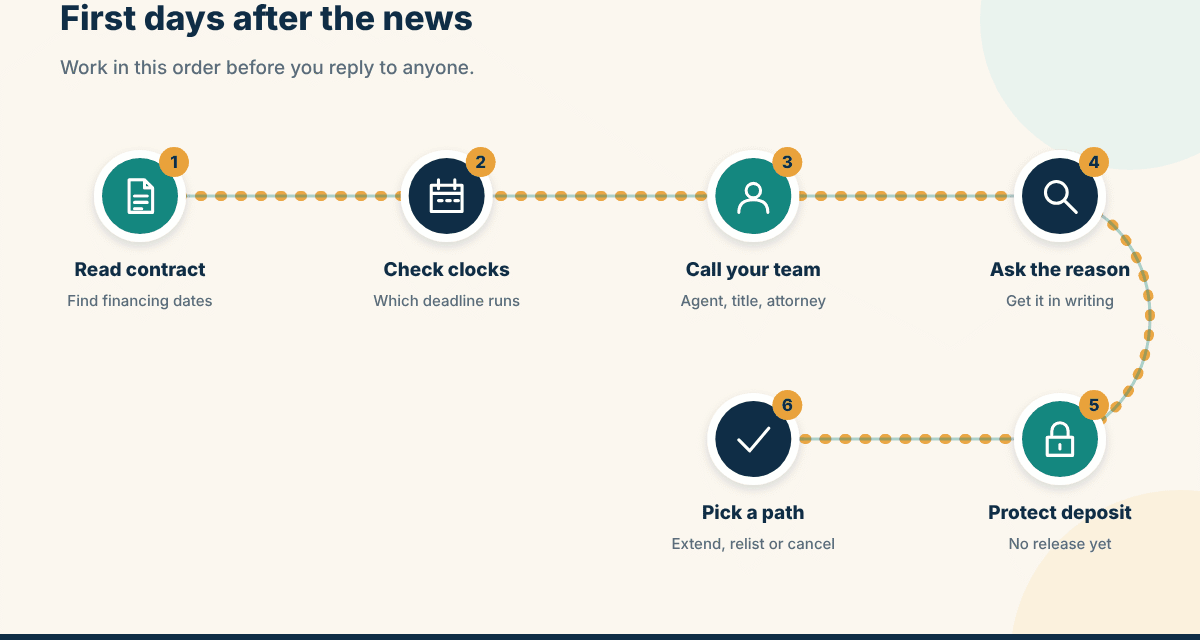
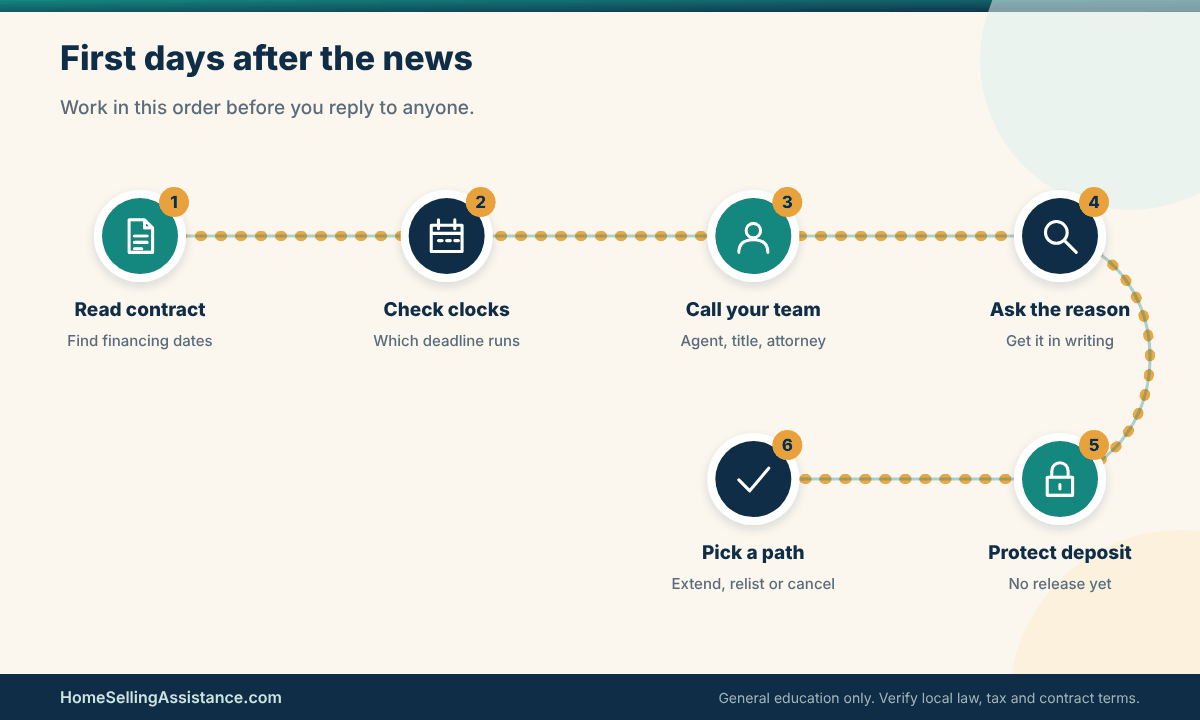
Before you reply to anyone, take a breath and treat the first twenty-four hours as a fact-finding period. Sellers who react quickly, whether by agreeing to a long extension, announcing the deal is dead, or demanding the deposit, often lock themselves into a position they would not have chosen after reading the contract. Nothing about a buyer financing fell through seller moment requires an instant answer to the buyer. It does require you to know which clock is running.
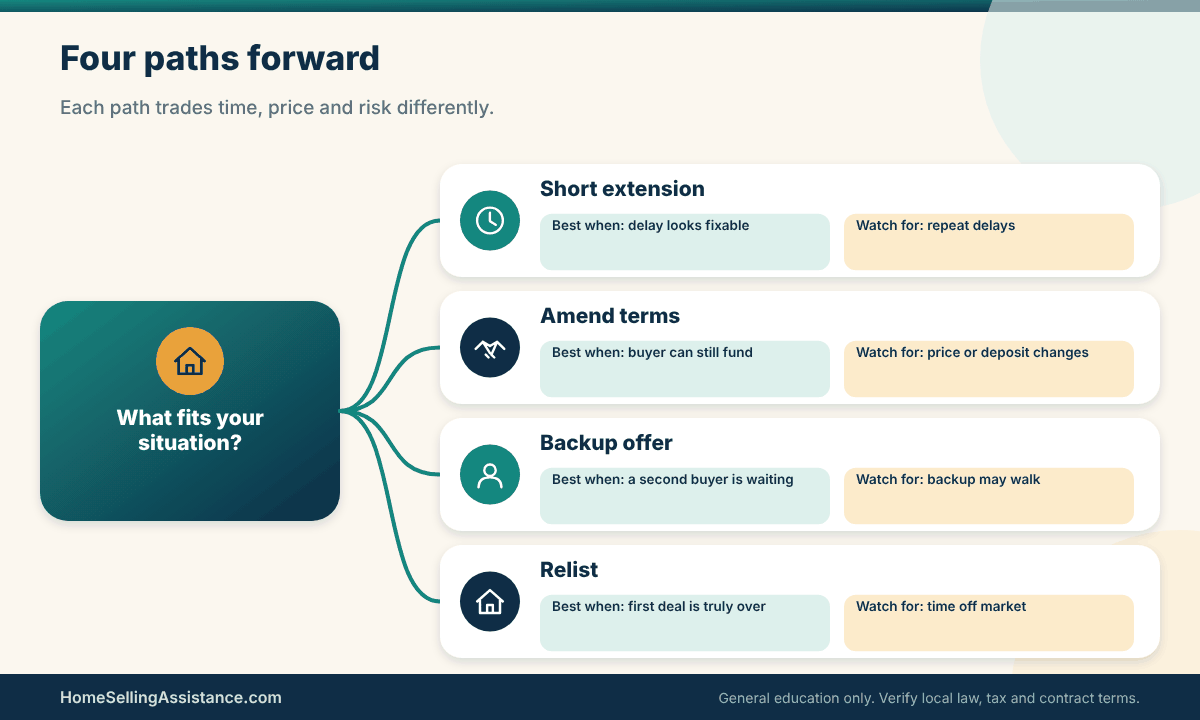
The picture below shows the usual order of decisions. It is a map, not a rule, because your contract may add steps or skip some.
Find the deadline that is actually running
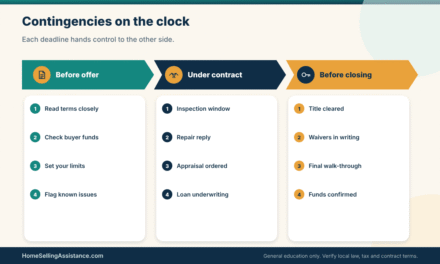
Almost every residential purchase contract contains a handful of dates that matter in a buyer financing fell through seller problem. These commonly include a deadline to apply for the loan, a deadline to deliver a loan commitment or approval, a financing contingency expiration, an appraisal deadline, and the closing date. Names and structures differ by state and by form, so the labels on your documents may not match what you read here. What matters is that you find your own versions of these dates and put them on one page.
Why does this come first in any buyer financing fell through seller case? Because the same phone call from a lender means different things depending on where you sit on the calendar. If the financing contingency is still open, the buyer may be allowed to walk away and recover the deposit. If it has expired and the buyer still cannot get funded, the buyer may be the one in breach, and the deposit question becomes live. A seller who skips this step can get either situation backwards.
Also look for dates that quietly favor you. Some contracts let the seller send a notice that demands proof of financing by a certain day, and if the buyer cannot provide it the seller may gain the right to cancel. Others require written notice before any default is declared, with a cure period measured in days. If your contract has a notice-and-cure clause, a premature termination letter from you might itself be a misstep.
Evidence to gather: the contract pages that control this moment
For a buyer financing fell through seller review, pull the signed purchase agreement and every addendum, amendment and counteroffer, because the final version is often spread across several documents. Highlight the financing contingency paragraph, the loan commitment or approval language, the definition of default, the earnest money clause, any “time is of the essence” language, and the notice section that explains how and where written notices must be delivered.
Then compare the dates to a calendar. Count days exactly the way the contract does, since many forms specify calendar days, business days, or a specific time of day. A deadline that passes at 5 p.m. in one form may pass at midnight in another. If you are not sure how to count, ask your agent or attorney to confirm in writing rather than guessing.
Finally, check whether the buyer has delivered anything you may have forgotten about: a pre-approval letter with the offer, a loan estimate, a mid-process approval, or a clear-to-close notice. These documents show how far the financing had progressed and whether the stated reason for the collapse matches the paper trail.
A scenario, an exception, and your next step on the clock
Here is an illustrative case with round numbers. Suppose your contract says the buyer must deliver a loan commitment within 30 days of acceptance, and the closing date is day 45. On day 28 the buyer’s agent tells yours the lender “can’t move forward.” If the commitment deadline has not arrived, the buyer probably still holds a contingency right and may ask to cancel or to extend while trying another lender.
Now change one fact. Suppose the commitment deadline was day 20 and the buyer never asked for more time or delivered a notice. The contingency may have lapsed, which could change the deposit analysis. The exception is that some contracts treat silence as continuing the deadline until a notice is sent, or let the buyer cancel any time before closing for loan reasons.
Your next step in either version is the same: ask your agent or attorney to read the clause and tell you in writing what each side may do today. Do not announce a conclusion to the buyer until you have that answer.
Work out who must be contacted, and in what order
A buyer financing fell through seller problem touches more people than most sellers expect, and the order in which you contact them has consequences. The goal is to tell the right people the right thing without creating a record that contradicts your contract position. If you are working with a listing agent, that person is usually your first call, since they hold the transaction file and often have the practical relationships with the buyer’s agent and the title company.
Next, think about who else needs to know in a buyer financing fell through seller case, because of their own deadlines. Your own lender, if you are buying a replacement home, may have a rate lock or closing date that depends on this sale. The title company or closing attorney needs to know the file’s status so they do not keep ordering payoffs and scheduling signings. A moving company, utility transfers and tenants or occupants may also need updates, but those can wait until you know the path forward.
People who do not need to hear anything yet include neighbors, social media followers and anyone who might repeat half-facts to the buyer’s side. A rumor that the buyer “couldn’t qualify” can create friction you do not need, particularly if the loan problem turns out to be a paperwork delay.
For a related deadline walkthrough, see our guide to the financing contingency from the seller’s chair, which explains how those clauses are commonly built.
Evidence to gather: contact list and authority
Build a one-page contact sheet for the buyer financing fell through seller file before you start calling. List your listing agent and their brokerage, the buyer’s agent, the loan officer’s name and company if you have it, the title or escrow officer, the closing attorney if your state uses one, and the holder of the earnest money. Note each person’s role, phone and email, and who is allowed to speak for whom.
Pay attention to authority. A loan officer can usually talk to the buyer and the buyer’s agent but may be restricted from discussing the borrower’s file with you directly, because of privacy rules. A title company can confirm that a deposit was received and where it sits, but cannot decide who is entitled to it. Knowing these limits saves you from chasing answers from people who are not allowed to give them.
If you are selling without an agent, add one more name: a real estate attorney or a title professional you trust, since you will be relying on them to read the contract language that an agent would normally interpret.
A scenario, an exception, and your next step on communication
Imagine the buyer’s agent calls you directly, bypassing your agent, to ask whether you will “just waive the financing deadline so we can keep trying.” If you represent yourself, this is a fair question that deserves a considered answer, not an on-the-spot yes. If you have an agent, politely route the conversation back to them so nothing is agreed informally.
The exception is when your agent is unreachable and a deadline is close. In that case, write a short email to the buyer’s agent confirming only that you received the request and will respond by a stated time, and copy your agent. That keeps the record clean without committing you to anything.
Your next step is to write down what you were told, who said it and when, then send a brief written acknowledgment so your version of events is on the record.
Stabilize the transaction while the buyer financing fell through seller question is open
Once you know which dates are running and who needs to hear from you, the next job is to keep the situation from getting worse. Stabilizing does not mean saving the deal at any cost. It means preserving your options, so that whichever path you pick later, you are not forced into it by missing paperwork, a lapsed insurance policy or a misunderstanding about the deposit. A calm, documented approach to a buyer financing fell through seller problem tends to age better than a hurried one.
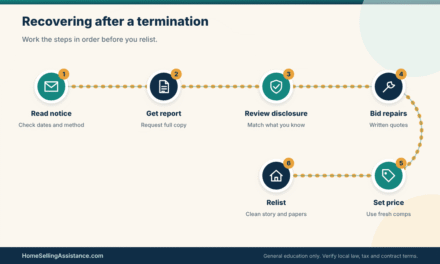
The checklist graphic below gathers the records most sellers want in hand during this stage.

Document everything and limit further loss
Start a single folder, paper or digital, for this buyer financing fell through seller transaction. Anything related to the financing failure goes in it: the contract and addenda, notices, emails, text screenshots, call notes with dates, and any documents from the lender or title company. Sellers who do this on day one are usually glad they did, because disputes about who said what tend to arrive weeks later, when memories have softened.
Limiting further loss has a practical side in a buyer financing fell through seller case too. While the contract is in limbo, your home may be sitting off the market, unshowable under the terms of the agreement, or both. Meanwhile the mortgage payment, insurance, utilities and taxes keep running. You may not be able to speed any of that up, but you can at least see the cost of each week and use it when weighing an extension against a relist.
Also confirm that your homeowners insurance is still in force and that you have kept the property in the condition described in the contract. If the buyer’s side later claims you changed something, you will want proof that you did not.
Evidence to gather: the paper trail that protects you
The most useful single item in a buyer financing fell through seller file is a dated timeline. Write one line per event: contract acceptance, loan application, appraisal ordered, appraisal delivered, each document the lender asked for, each notice sent or received, and the day you learned about the problem. A plain document is fine. A sequence you wrote while events were fresh is easier to rely on than a reconstruction made later.
Next, keep the actual communications rather than summaries of them. Export or screenshot text messages, save email threads in full, and ask your agent to forward anything that came through their system. If a phone call produced news, send a brief follow-up email, something like “Thanks for the call today; to confirm, you told me the lender has not issued a commitment as of this morning,” so there is a written record.
Finally, ask for third-party documents. If the buyer says the loan was denied, a lender’s adverse action notice or a written status from the loan officer is stronger than a relayed comment. You may not be entitled to see the borrower’s private file, but the contract may require the buyer to provide written evidence when asserting a financing contingency.
A scenario, an exception, and your next step on records
Consider a seller, call her Maria, who hears by phone that the buyers “are having trouble with their income documents.” Maria writes down the date and the name of the caller, then emails her agent a two-line summary the same afternoon. Three weeks later the buyers claim they told her they were cancelling that day. Her dated note and email contradict that claim.
The exception is that written notes help only when they are accurate, so avoid guessing at motives. Record what was said, not what you believe it meant.
Your next step is to start the timeline today, even if it is only five lines long, and to add to it whenever something changes.
Coordinate the buyer, agents, servicer, title company and attorney
In a buyer financing fell through seller case, several parties hold pieces of the answer. The buyer’s lender knows why the loan stalled. The buyer’s agent knows what the buyer intends. Your agent knows your contract and local practice. The title or escrow company holds the deposit and the closing file. If your state uses closing attorneys, they may handle the contract questions directly. Your job is to get these people to share facts in writing and to avoid being the sole go-between.
Resist the temptation to contact the buyer’s lender yourself with pressure or accusations. Lenders usually will not discuss a borrower’s file with a seller, and a pushy call can sour a deal that might still be rescued. Instead, ask your agent to request a written status through the buyer’s agent: is the loan denied, delayed, awaiting documents, or being moved to another lender?
If you have a mortgage on your own home, tell your servicer only what you need to, such as a changed closing date if a payoff statement was already ordered. Payoff quotes expire, and a new date may mean a new figure. Our guide to a mortgage payoff when selling a house explains how those quotes and per-day interest generally work.
Evidence to gather: what each party can confirm
In a buyer financing fell through seller file, think of each party as a source with a specific kind of knowledge. The title company can confirm whether earnest money arrived, in what amount, and any instructions on file. The lender, through the buyer, can confirm the loan status. Your agent can confirm what the contract says and how local brokers usually handle similar disputes. The attorney, if you hire one, can tell you what your rights and risks are under your state’s law.
Ask each source for confirmation in writing, and keep requests narrow. “Please confirm the date and amount of the earnest money deposit” gets a clean answer. “What do you think is going on?” invites opinion and gossip.
If any of them gives you information that conflicts with another party, do not pick a side. Write down both versions and ask your attorney or agent which document controls. Conflicts are common in the first week and often resolve once someone produces the paper.
A scenario, an exception, and your next step on coordination
Suppose the buyer’s agent writes, “My clients will cancel and want the deposit back today.” Your next step is not to say yes or no. Forward the message to your agent or attorney and ask what the contract requires before a release. The title company will usually insist on both parties’ signatures or a court order, so a verbal agreement will not move the money anyway.
The exception is when the contract clearly entitles the buyer to a refund, for example when a financing contingency was still open and the buyer gave proper written notice. In that case, resisting may only add delay and legal cost. Still, have a professional confirm that reading before you sign any release.
In any buyer financing fell through seller dispute, your next step is to ask for the contract-based answer from a professional, and to sign nothing until you have it. Our overview of what to do when a deal falls through after inspection uses the same sign-nothing-first rhythm and may help you compare the two situations.
A simple way to keep this stage under control is to hold a short status call with your agent twice a week, with a written summary afterward. It sounds formal, but it prevents the common pattern where each person assumes someone else has already asked the key question.
Choose a next path after a buyer financing fell through seller event
With dates confirmed, people informed and records started, you reach the real decision. In broad terms you can continue with the same buyer, amend the contract, relist the house, cancel the agreement, or, in unusual cases, seek formal relief through a lawyer or a court. None of these is automatically the right answer. The best choice for a buyer financing fell through seller case depends on why the loan failed, how much time and money you have, and what your contract allows.
The fallback tree below sketches the branching logic. Treat it as a conversation starter with your agent or attorney, not as a ruling.
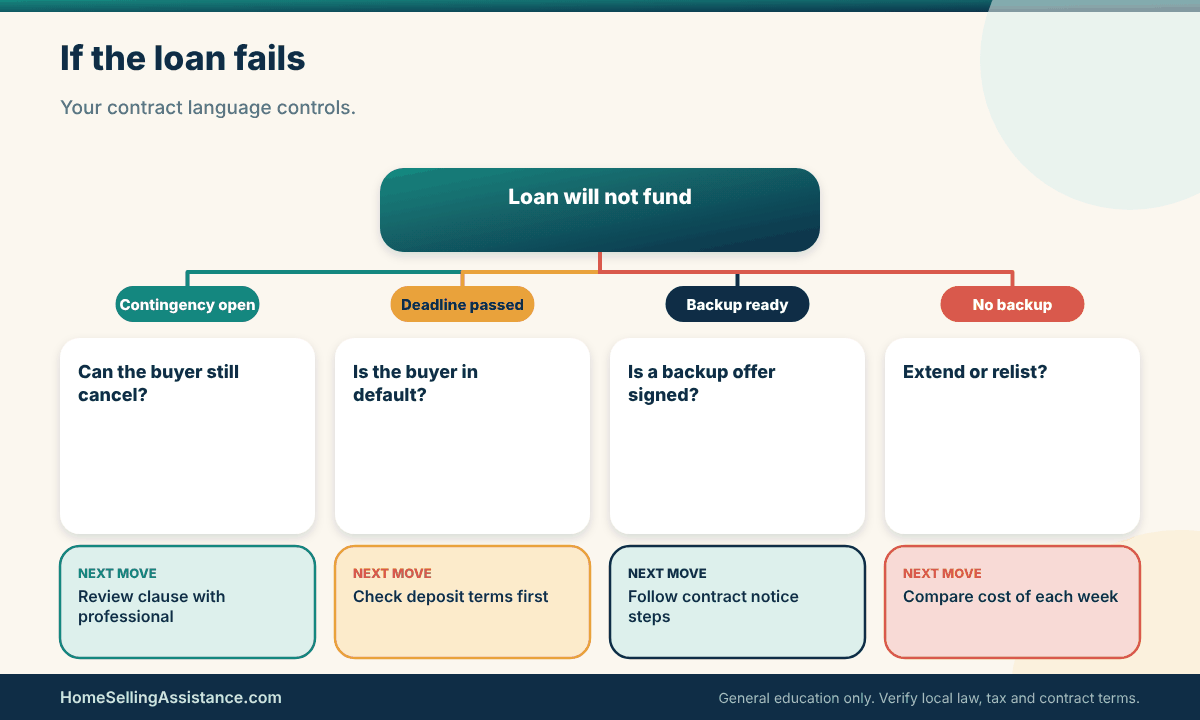
Continue, amend, relist, cancel or seek relief
Start with the cause of the buyer financing fell through seller problem, because it points toward the likely path. A lender delay or a missing document is often fixable, and a short written extension may be a sensible trade. A loan denial based on the buyer’s credit or income is a different story, since another lender may reach the same conclusion. A low appraisal is a separate problem with its own tools, covered in our guide to low appraisal options for sellers, and it often shows up disguised as a financing failure.
Continuing means you keep the contract alive, perhaps with the buyer switching lenders or supplying documents. Amending means you sign a written change: a new closing date, a new contingency deadline, a price adjustment or a larger deposit. Relisting means the contract ends, by mutual release or by a proper termination, and the house returns to the market. Seeking relief means asking a court or an arbitrator to decide who owes what, which is slow, uncertain and usually a last resort.
In a buyer financing fell through seller case, each path has a time cost you can estimate and a risk cost that is harder to price. An extension keeps you off the market for longer, but a relist means new showings, new negotiation and possibly a lower or higher price. Neither is cheaper in every case.
The matrix below turns the safety side of this decision into something you can scan. It lists claims and requests you may hear in the days after a financing problem, what to check, and how to respond. Use it with your agent or attorney, and remember that some of these requests come from real parties and some from scammers who watch for transactions in trouble.
| Threat or claim | Evidence to check | Safe action | Never share | Escalation |
|---|---|---|---|---|
| “The loan was denied, release my deposit today” | Contract financing clause, written lender notice, dates | Forward to agent or attorney, request written proof | Signed release before review | Real estate attorney, title company |
| Email with new wire instructions for a deposit or refund | Call title company on a number you already had | Confirm by phone, never by reply | Bank account and routing details | Title company, then report to IC3 |
| “Sign this extension now or we walk” | Whether the current deadline has actually passed | Ask for the draft in writing, take a day | Verbal agreement to new terms | Listing agent, attorney |
| Buyer proposes a lower price after the lender “re-priced” | Appraisal report, loan estimate, comparable sales | Compare with relisting risk, then counter in writing | Your bottom-line number | Agent or attorney |
| Unknown caller claims to be the buyer’s lender | Lender name on loan documents, buyer’s agent | Ask the buyer’s agent to confirm contact | Social Security number, payoff data | Buyer’s agent, then your attorney |
| Pressure to hand over keys or allow early occupancy | Contract possession terms, funding status | Decline until funds are recorded | Keys, garage codes, lockbox access | Attorney before any occupancy agreement |
How to use the matrix: find the row closest to what you are hearing, confirm the facts from the column labeled evidence, and take the safe action before anything else. The “never share” column is deliberately blunt. Bank details, identity numbers and keys should not leave your hands because someone is in a hurry.
If a request feels off, our guide to home sale fraud and seller safety goes deeper on wire fraud and impersonation, and the FTC’s consumer site offers general scam-reporting guidance.
Evidence to gather: what supports each path
For each buyer financing fell through seller path, collect the papers that would support it. If you are leaning toward continuing, you need the lender’s new timeline in writing, a list of outstanding items and a realistic closing date. If you are leaning toward amending, you need the exact language the buyer proposes and a copy of any appraisal or lender communication that justifies a change.
For relisting, gather comparable sales again. Prices may have moved since you accepted the offer, and a listing agent will likely want updated comps. You may also need to check whether the contract requires a written termination or release before you can legally accept another offer. Our guide on handling multiple offers as a seller covers how to compare offers once the property is available again.
For cancelling or seeking relief, the evidence is your timeline, notices and the contract’s default and remedy provisions. Dispute resolution clauses sometimes require mediation or arbitration before a lawsuit, and some contracts limit the seller’s remedy to keeping the deposit. Only an attorney who reads your documents can tell you which applies.
A scenario, an exception, and your next step on the path
Imagine a lender delay caused by a missing document. The buyers expect to fix it within a week, and your closing date is ten days out. A short written extension of, say, seven days might preserve a good deal, provided it states the new dates, confirms the deposit stays in place, and does not waive your rights if the buyer misses it again.
The exception is a repeat pattern. If this is the second extension request, or the buyer’s explanations keep shifting, the odds that another extension works may be lower, and many sellers weigh a hard final deadline or a switch to a backup offer.
Your next step is to ask your agent or attorney to draft or review any amendment before you sign, and to include a clear sentence about what happens if the new deadline is missed.
Records and deadlines to retain: the deposit, the backup offer and the buyer financing fell through seller file
Two items shape every buyer financing fell through seller path: the earnest money deposit and any backup offer. The deposit shows the buyer’s stake in the deal. Whether you may keep it, must return it or must split it depends on the contract and on why the transaction failed. Sellers sometimes assume a failed loan means they keep the money, and buyers sometimes assume it means they get it all back. Both assumptions can be wrong.
A backup offer is a second contract-in-waiting. Many forms let a seller accept an offer that sits behind the first, becoming active only if the first one fails. If you have one, read its terms carefully, since the backup buyer may have their own deadlines to leave and their own right to walk away if the wait gets long. If you do not have one, relisting becomes the main alternative.
The scenario table below shows several common situations in a compact form, with the warning sign, the safest way to verify, how a seller might respond and which record to keep. As with the earlier matrix, it is educational and not a prediction of what your contract says.
| Situation | Warning sign | Verification channel | Seller response | Record to preserve |
|---|---|---|---|---|
| Lender asks for more documents, closing close | Buyer vague about what is missing | Buyer’s agent, written status request | Offer a short written extension with conditions | Extension draft, document request list |
| Loan denied before contingency expires | Cancellation notice arrives without lender proof | Contract clause, attorney review | Request written evidence, review release terms | Notice, denial letter, timeline |
| Contingency expired, buyer still cannot fund | Buyer asks for deposit back anyway | Title company, contract default terms | Consult attorney before any release | Contract pages, deposit receipt |
| Low appraisal blocks the loan amount | Buyer asks for price cut at the last minute | Appraisal copy, lender confirmation | Weigh price change against relisting | Appraisal report, counter-offer |
| Backup offer on file | Backup buyer’s deadline approaching | Listing agent, backup contract terms | Follow contract notice steps in order | Backup contract, written notices |
| Buyer disappears after financing problem | No replies, calls unreturned | Buyer’s agent, title company | Send formal written notice per contract | Delivery proof, call log |
Use the table after you have confirmed the facts, not before. Find the row that fits, note the warning sign you can verify and follow the channel listed rather than whoever called you first. The right-hand column is easy to neglect and often matters most months later.
Evidence to gather: the deposit and backup paperwork
For the deposit in a buyer financing fell through seller case, locate the earnest money receipt, the escrow or title instructions and the contract paragraph that says who gets the money in each failure scenario. Some forms give the seller the deposit after a buyer default, some require a written release signed by both sides, and some route disputes to a neutral process. Your state’s rules may also limit how long a holder can keep funds in dispute.
For a backup offer, read the addendum or the contract itself and note the trigger that moves it into first position, the notice requirements and any deadline by which the backup buyer can withdraw. Confirm that the backup buyer’s financing looks different from the first, since you do not want to repeat the same failure.
If you have no backup, ask your agent how quickly a relist could happen and whether any showing or photo costs would have to be repeated. That helps you compare it fairly with a short extension.
A scenario, an exception, and your next step on deposits
In a typical buyer financing fell through seller example, consider a seller whose contract says the deposit goes to the seller if the buyer defaults after the financing contingency has expired. The buyer’s lender denies the loan after that date. The seller feels entitled to the money, but the buyer’s side argues the contingency was extended by email. The title company will likely hold the funds until both sides sign or a legal process decides.
The exception is that some states or forms cap or reshape seller remedies, and a court may consider whether the seller’s own conduct contributed. Courts also tend to look at what the documents actually say, rather than at what the parties remember.
Your next step is to ask a real estate attorney to read the deposit clause and your timeline, then decide whether a negotiated split or a firm demand is the better practical outcome.
Whichever path you choose, the buyer financing fell through seller file does not stop mattering the day you sign an amendment or accept a new offer. Questions about the deposit, the disclosures you made, the condition of the property and the reason the first contract ended can surface months later, from a new buyer, an insurer or the first buyer’s lawyer. A tidy file is cheap insurance against all of them.
The checklist below rounds up what is worth keeping. After it, we explain how long people commonly hold these papers and why there is no single universal answer.

As a rule of thumb, keep the transaction file for at least as long as any limitation period that could apply to a dispute, and keep tax-related records for as long as you may need them to support your reporting. Those periods differ by state and by the type of claim, and tax record guidance is published by the IRS, so ask your attorney or tax professional what applies to you instead of relying on a number from a blog.
If a buyer financing fell through seller file ever feeds a tax question, such as claiming the home sale exclusion or proving your basis, remember that a failed contract can still leave records worth saving, such as repair receipts and improvement invoices. The IRS guide to selling your home explains the general framework, though your own facts still decide the outcome.
Money questions linger in a buyer financing fell through seller case too. A failed sale can leave you with carrying costs, a missed rate lock or a double mortgage payment, and those are easier to discuss with a lender or advisor when you can show dates and amounts. Our overview of seller closing costs helps you see which charges belong to a closed sale and which may simply disappear when a contract ends.
For the buyer’s side of the same problem, the Consumer Financial Protection Bureau publishes plain-language mortgage material that can help you understand what a lender’s denial or delay actually involves. You are not the borrower, but understanding the process makes the buyer’s explanations easier to test.
For a buyer financing fell through seller file, most people do not need an elaborate system. One folder, named by property address and date, with these items inside: the original listing agreement if you have one, the signed contract and every amendment, the disclosures you gave, all notices and emails about the financing problem, deposit receipts and any release forms, and your timeline. Copy it somewhere safe, such as a second drive or a cloud folder you control.
Mark your calendar for two kinds of dates: those inside the contract, which will pass quickly, and those afterward, such as the date you may owe a report to a lender, tax professional or insurer. You can set reminders on your phone for each. When a date passes, note what happened in your timeline so the file tells a complete story.
Finally, decide in advance who gets a copy. Your attorney and, if you use one, your agent should have the full set. Anyone else, including a prospective new buyer, normally gets only what the law and your contract require. Disclosure duties can be strict, and the underlying reason for a lost sale sometimes triggers questions about what you must reveal next time, so ask a professional before volunteering the story to a new buyer.
A last practical note: when the sale resumes with a new buyer, ask your agent or attorney whether the old buyer’s inspection findings, appraisal or other reports have to be mentioned. Rules differ widely, and some states expect sellers to share known material facts regardless of where they came from. Better to ask first than to learn about the rule after the second contract is signed.
Frequently asked questions about buyer financing fell through seller situations
If my buyer’s loan was denied, do I automatically keep the earnest money?
No. In a buyer financing fell through seller dispute, the answer depends on the contract, the date the problem arose and the exact reason for the denial. If a financing contingency was still open, the buyer may be entitled to a refund. If it had expired, the contract’s default and deposit clauses decide. The holder of the funds usually needs signed instructions from both sides or a legal ruling, so plan on professional review.
How quickly should I respond when I hear the loan is in trouble?
Acknowledge the message promptly, but hold off on agreeing to anything until you have read your contract. A short note saying you received the news and will reply by a set time is usually enough. A buyer financing fell through seller moment feels urgent, yet most of its real deadlines are written in the contract and can be checked within a day with your agent or attorney.
Should I agree to an extension?
Sometimes, and sometimes not. Compare the likely cause of the delay, how much time you are asking for, and what relisting would cost you in time and uncertainty. If you do extend, put the new dates in a signed written amendment, say that the deposit stays in place, and avoid waiving rights you may need later. A buyer financing fell through seller extension should have an end date and a stated consequence.
Can I accept another offer while the first contract is still active?
Often only as a backup, and only if your contract and state rules allow it. Accepting a second offer as a primary contract while the first is alive can expose you to claims from the first buyer. Before taking any step in a buyer financing fell through seller situation, ask whether a written termination, release or backup addendum is required.
What is a backup offer, and does it help here?
A backup offer is a second contract that moves into first position if the first one fails under its terms. It can shorten your time off the market after a financing collapse. Read the backup buyer’s deadlines carefully, because they may have the right to leave if the wait runs long, and confirm their financing looks stronger than the first buyer’s.
Is a low appraisal the same as financing falling through?
Not exactly, though the two overlap. A low appraisal can reduce the loan amount a lender will approve, which leaves a gap the buyer must fill or the parties must renegotiate. If you suspect that was the cause behind your buyer financing fell through seller problem, read our guide on appraisal gaps from the seller’s side and ask for the appraisal in writing.
Do I need an attorney, or is my agent enough?
Agents know local forms and practice, but they usually cannot give legal advice about your rights or about default and damages. Many sellers add an attorney when a deposit is contested, when a buyer threatens a claim or when the contract is unclear. A buyer financing fell through seller dispute that involves a large deposit is a common time to ask for a short paid consultation.
What if the buyer simply stops responding?
Document every attempt to reach them, then ask your agent or attorney to send a formal notice using the delivery method your contract specifies. Silence can be a form of default, but your remedies depend on the notice and cure provisions. In a buyer financing fell through seller case with a silent buyer, avoid improvising your own ultimatum, since an incorrect notice can undermine your position.
Could the failed financing be a scam?
It can be. Fraudsters sometimes send fake lender messages or altered wire instructions when a transaction is in motion. Confirm any change of payment or deposit instructions by calling a number you already had on file, never one in the email. If a buyer financing fell through seller thread suddenly includes new bank details, stop and verify, then report suspected fraud through the FBI’s IC3.
When should I relist the house?
Relist once the first contract has ended properly, by release or valid termination, or when your professional confirms you may accept backup offers. The question in a buyer financing fell through seller case is not whether to relist but whether the first deal can still close within a time you can live with. Updated comparable sales and a clear disclosure plan help the relaunch go smoothly.
Before you decide
A buyer financing fell through seller moment can feel like a personal setback, yet most of the steps are procedural: read the dates, ask for written facts, protect the deposit, keep your records and pick a path you can defend. Take those steps in that order, and bring a licensed agent or attorney in when the contract language or the money gets complicated. This article is general education, not legal, tax or financial advice, and your documents and state rules decide your actual rights.