Every financing contingency seller eventually learns the same thing: an accepted offer that depends on a mortgage is not a finished sale, it is a sale with a clock running and a lender holding part of the key.
The financing contingency is a short clause with a lot of weight. It usually says that the buyer may cancel and get the earnest money back if they cannot secure a loan on the terms described in the contract by a stated date. That sounds simple until you notice how many moving parts hide inside it: an application deadline, an approval deadline, an appraisal that the lender orders, a list of conditions from an underwriter you will never meet, and a closing date that everyone hopes will not move.
This article is written for the person on the selling side of that clause. We will walk through what the wording typically does, who holds which right, which dates matter, what you can reasonably ask for, and what tends to happen when a loan stalls. We will also stay honest about the limits.
Contracts, forms and local customs differ from state to state, and sometimes from one county to the next, so you will see us point you back to the actual document in front of you. For the wider family of conditions that can appear in a contract, start with our home sale contingencies guide.
Why does the financing contingency seller question deserve its own article? Because the risk is lopsided. The buyer has the cancellation right, the lender has the timeline and the seller has a home that is off the market in the meantime. A financing contingency seller who understands the clause can price that risk, ask for the right protections and respond calmly when the loan hits a snag.
Nothing here replaces a conversation with a licensed professional who has read your contract. What it can do is help you show up to that conversation with better questions, a clearer calendar and fewer unpleasant surprises.
Key takeaways
- Read the clause itself. Your purchase agreement, not a general article, decides what the buyer must do and by when.
- Build a date calendar on day one. Application, appraisal, approval, contingency removal and closing dates often sit in different parts of the contract.
- Silence is not always safe. Some contracts treat a missed notice as satisfaction of the contingency, others as the opposite, so check which way yours leans.
- Ask for evidence, not reassurance. A lender letter, proof of an application and written status updates beat verbal comfort.
- Extensions and releases belong in writing. A handshake extension can leave your earnest money and backup-offer rights unclear.
- Escalate early. Bring in your agent, a real estate attorney or the title company before a deadline passes, not after.
Reading the financing contingency seller clause: what the contract actually says
Before you can manage a loan-related deadline, you have to know where it lives. In many purchase agreements the financing contingency is not one paragraph but several pieces spread across the form: a line in the price and terms section, a loan-type checkbox, a date table near the top, a boilerplate paragraph further back, and sometimes an addendum that overrides all of it. The first job for any financing contingency seller is simply to find every piece and read them together.
A financing contingency seller who skips this step usually ends up reading the contract for the first time in the middle of a crisis. Reading it now, when nothing is wrong, is cheaper and calmer.
Think of this as a scavenger hunt with a calendar at the end. You are looking for who may do what, by when, and what happens if they do not.
Who holds the right to walk away, and who holds the duty to act
In a typical financed purchase, the buyer holds the contingency right. It exists to protect the buyer from losing earnest money if a lender declines the loan. That means the buyer decides, within the contract language, whether the condition has been met, waived or failed. As the seller, you generally do not get to declare the contingency satisfied on the buyer’s behalf, and you usually cannot cancel just because you feel nervous about the lender.
What you often do have are indirect tools. Many forms require the buyer to apply for the loan within a set number of days, to pursue it in good faith, and to share evidence of progress if you ask. Some forms let the seller send a written notice when a deadline is missed. Others say nothing and leave the seller waiting. Which version you have is a matter of reading, not guessing.
The duty to act belongs to several people at once. The buyer must supply documents to the lender. The lender must underwrite and order the appraisal. The agents must keep the paper trail moving. You must stay reachable and cooperative when the appraiser needs access. If any link in that chain goes quiet, the contract date does not pause on its own.
Evidence to gather: the clauses, dates and names you need on one page
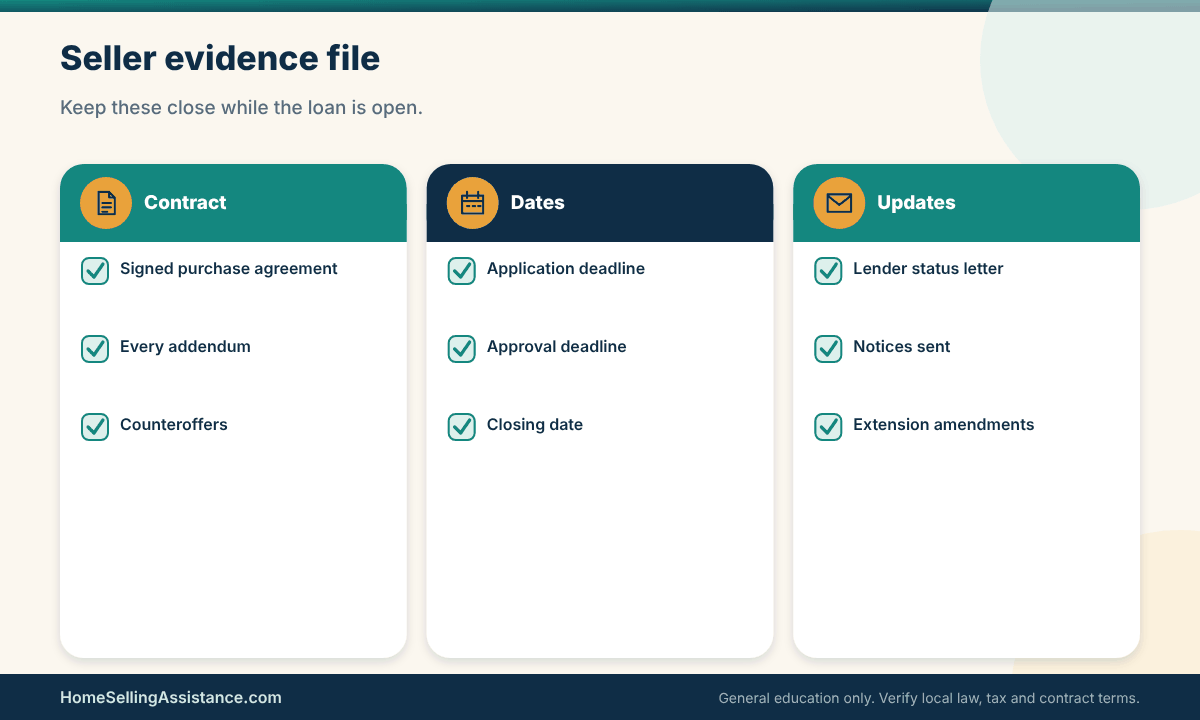
Print or save the full contract, every addendum and every counteroffer. Then make a single page, by hand if you like, listing five things. First, the exact words of the financing contingency, copied word for word. Second, the loan type and key terms the contract describes, such as the loan program, the down payment and any stated interest-rate limit. Third, every date connected to the loan. Fourth, who must send notices and how, since many contracts specify written notice by a named method. Fifth, the names and contact details of the buyer’s loan officer and your closing agent.
If the contract references a lender’s pre-approval letter, find that letter in your file. Note its date and what it actually says. A pre-approval is usually based on a lender’s review of information the buyer reported, and it is not the same thing as final loan approval. Seeing the difference on paper early helps you read later status updates with the right level of confidence.
Finally, highlight anything that sounds like a time limit measured in days instead of a calendar date. Those clauses count from a trigger event, often the day the contract was signed or delivered, and miscounting them is one of the most common ways people lose a right they thought they had.
A scenario, an exception, and your next step on buyer rights
Here is an illustrative example with round numbers. You accept an offer on a Friday. The contract says the buyer will apply for the loan within a handful of days and will deliver written loan approval by a stated date a few weeks later. Nothing in the form mentions what you may do if the application is late. A week passes and you hear nothing from the buyer’s side.
The exception is that some forms or local addenda do give the seller a written-notice remedy for a late application, and some states or markets have customary notices that agents send as a matter of routine. If yours does, your agent can send it. If it does not, you still have a reasonable next step: a polite written request, through the agents, for confirmation that the application was submitted and the appraisal has been ordered.
That request costs nothing and creates a record. If the situation later turns into a dispute, a dated message asking for status carries more weight than a recollection that you were worried. If anything in the contract is unclear, this is the moment to ask an attorney or your agent what the clause means before the deadline arrives.
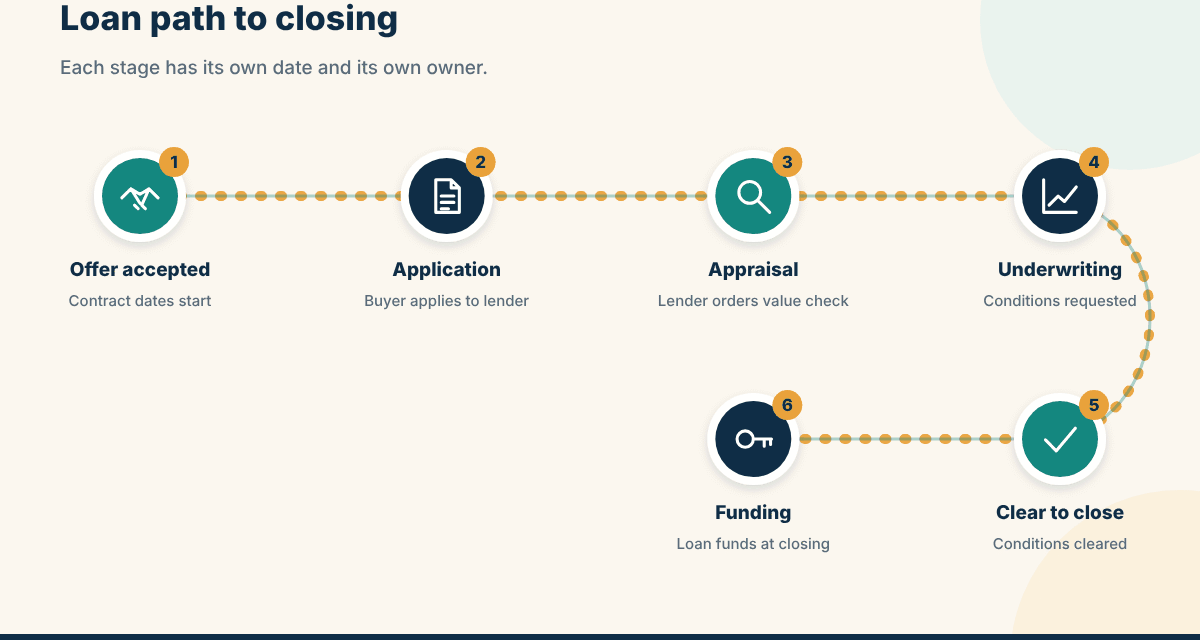
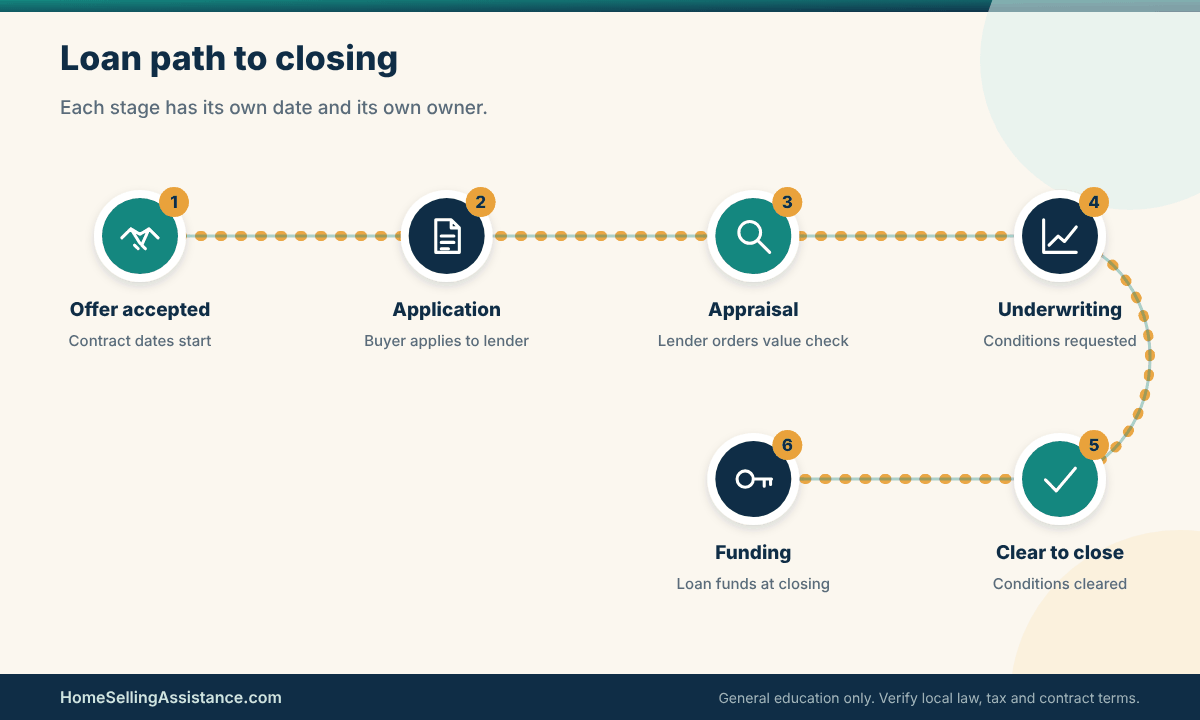
The roadmap below shows the usual path a mortgage takes between acceptance and closing, so you can see where each of those dates tends to fall.
The deadlines, the amounts and the remedy that follow a missed date
If the first half of the clause tells you who acts, the second half tells you what is at stake. Money and time are the two currencies here. Money usually means the buyer’s earnest money deposit, which a neutral holder such as a title company, an escrow agent or a brokerage trust account keeps until the contract says where it goes. Time means the handful of dates that decide whether the contingency is still alive.
The broader picture of contingencies is covered in our guide to home sale contingencies for sellers. Here we stay focused on the lending piece, because it has a few quirks the others do not.
A practical financing contingency seller habit is to read the clause the way a lender would: what must be delivered, by whom, and by when. The financing contingency seller clause rewards that kind of literal reading, because courts and escrow holders tend to look at the words and the paper trail rather than at what people meant to say in a hurried phone call.
One quirk is that the loan deadline and the closing date are cousins, not twins. A buyer can have a perfectly valid financing contingency that expires well before closing, which means the loan might still be in underwriting after the buyer has technically lost the right to cancel for financing reasons. Another contract can keep the contingency open until the lender actually funds. Reading the word “approval” carefully, and noticing whether it means conditional approval, final commitment or funding, tells you which kind you signed.
Evidence to gather: the calendar you build from the contract
Turn the contract into a dated calendar with at least these entries: the effective date, the loan application deadline, the appraisal deadline if there is one, the financing contingency deadline, any inspection or other contingency dates that interact with the loan, the closing date and the possession date. Next to each, write whether the contract counts in calendar days or business days, and whether a weekend or holiday pushes the date forward or backward. Forms differ on that detail and it matters.
Then, as a financing contingency seller, add a column for “who gives notice to whom.” Some contracts require the buyer to deliver a written notice of satisfaction or removal by the deadline. Others require a written notice of termination if the buyer wants out. Others say that failing to act means the contingency is considered met. These are different legal setups with different traps, and you want to know which one you are living in.
For a financing contingency seller, the notice method is just as important as the date. A message sent by the wrong method, or to the wrong person, may not count as notice at all. Ask your agent which method the contract names, and use exactly that one for anything that matters.
If your contract expresses the deadline as an hour of the day in a particular time zone, record that too. A remote buyer or a lender in another part of the country can easily forget that detail, and it is cheaper to notice it now than to argue about it later.
Scenario: the loan deadline lands on a Sunday
Suppose the approval deadline in your contract falls on a Sunday. The lender’s underwriting team works mostly on weekdays. The buyer’s agent says they will send the approval on Monday. Is the contingency still alive? The honest answer is that it depends on whether your contract has a clause that rolls weekend and holiday deadlines to the next business day, and on how the form defines a business day.
Some forms roll the date forward automatically. Some do not. Some count the date strictly as written. Do not assume. Ask your agent to point to the exact sentence that governs the situation, and ask for a short written confirmation from both agents about how the date will be treated.
The exception worth knowing is that if both sides agree to treat the deadline a certain way, the agreement should be documented in an amendment or extension signed by everyone who signed the original contract. A text message saying “Monday is fine” is better than nothing, but a signed amendment is better still. Your next step is to ask for that amendment the same day the question comes up.
The table below pulls the main issues into one place. Use it as a prompt for your own reading rather than as a legal conclusion, since the controlling document and the local rules are the parts that change the most.
| Issue | Controlling document | Seller obligation or choice | Typical timing | Verify locally with |
|---|---|---|---|---|
| Loan application | Purchase agreement and addenda | Ask for written confirmation of submission | Often within days of acceptance | Your agent or attorney |
| Appraisal access | Contract and lender request | Allow reasonable entry on notice | Usually early in underwriting | Listing agent |
| Approval deadline | Financing contingency clause | Track the date and notice method | Fixed date or day count | Attorney, agent or title company |
| Extension request | Signed amendment | Choose to grant, limit or decline | Before the deadline passes | Attorney or agent |
| Earnest money release | Contract plus holder’s rules | Sign a release only after review | After termination or dispute | Escrow or title holder |
| Backup offer | Backup addendum | Accept in writing, with limits | While the first contract is live | Agent or attorney |
To use the matrix, copy the first column onto your calendar page and fill in the other four from your own paperwork. Where a cell in your version stays blank, you have found a question to ask. Where two documents seem to disagree, ask which one controls before the deadline gets close, because the answer is rarely obvious from the form alone.
The picture below turns the evidence pages from this section into a short checklist you can keep beside the contract and tick off as papers arrive.
Modeling the outcomes a financing contingency seller can face
Once you know what the clause says, the useful question becomes: what are the realistic ways this plays out? Thinking in outcomes keeps you from reacting emotionally to every email from the lender. It also helps you decide in advance what you will accept, what you will ask for and where you will stop.
Broadly, a financed sale ends one of three ways. The loan is approved and the contingency is removed or satisfied. The loan is delayed, and the parties talk about more time. Or the loan fails or the deadline passes, and the question becomes whether the buyer may cancel, whether you may, and who gets the deposit. We will take the smooth path first and the rough ones second. If you want a deeper look at what follows a collapsed loan, our article on what to do when buyer financing fell through covers that stage in detail.
When the loan is approved and the contingency is satisfied
Put simply, a financing contingency seller wants the clause to end quietly, with a signed removal and a lender that is ready to fund. This section explains what that quiet ending looks like and what to confirm so it really is the end.
Most financed sales that reach this point go on to close, though nothing guarantees it and delays still happen. When the buyer’s lender issues final approval, the practical effect on a financing contingency seller is relief, but not yet certainty. A signed removal or satisfaction form changes the legal position, because it usually ends the buyer’s right to cancel on financing grounds. It does not erase every other contingency, and it does not change the fact that money still has to move on closing day.
So treat satisfaction as a milestone, not a finish line. Update your calendar, confirm which contingencies remain open, and keep your own side of the file moving: payoff request, utilities, access for the final walk-through and any repairs you agreed to make.
Evidence to gather: what clear-to-close really looks like
Lenders use different phrases for different stages, and agents sometimes use them loosely. A useful way to keep them straight is to picture a ladder. The bottom rung is a pre-qualification or pre-approval, which rests largely on information the buyer provided. Next comes an application with disclosures, then underwriting, where a person reviews income, assets, credit and the property. After that, a conditional approval often arrives with a list of items the buyer still has to deliver.
Then the conditions are cleared, and the lender issues what is commonly called a clear to close. Final loan documents come next, followed by signing and funding.
When you ask for evidence, ask for it in terms of that ladder. A short written statement from the lender or loan officer, or from the buyer’s agent quoting the lender, saying that the appraisal is complete, that underwriting has issued approval and that conditions are cleared, is far more meaningful than a general “it’s going great.”
Each rung of the ladder matters to a financing contingency seller in a different way. Early rungs say little about the final outcome. Later rungs say a lot. If you only ever hear about the bottom rung, the financing contingency seller risk is still mostly intact, no matter how friendly the messages sound.
Be reasonable about privacy. You are entitled to know where the transaction stands. You are generally not entitled to the buyer’s tax returns, bank statements or credit report, and you should not ask for them. A status letter from the lender gives you what you need without the personal detail.
Scenario: approval arrives with a condition that touches the property
Imagine the lender approves the loan, subject to a condition about the home. It might be a repair the appraiser noted, proof that a well or septic system meets a standard, a roof certification, or confirmation that a permit was closed. These conditions are not unusual, and some loan programs have minimum property standards that the appraiser must check.
The exception for a financing contingency seller is that the buyer and seller may disagree over who pays. Your contract may already say something about lender-required repairs, but many forms are silent or vague. In that case the fix becomes a negotiation, and you have choices: do the work, offer a credit, split the cost, or decline and let the buyer decide whether to proceed. Each choice has consequences for timing and for the price you net.
Your next step is to ask the agents to get the exact wording of the lender’s condition in writing, then get a contractor quote or inspection if one is needed. Our guide to the inspection contingency from the seller’s side explains how to evaluate repair requests, and much of that reasoning transfers to lender-driven repairs. Put whatever you agree in an amendment before you spend money.
The same logic applies to any other cost the lender’s condition triggers. A financing contingency seller who gets the figures in writing before agreeing to anything keeps the negotiation about numbers and not about memory.
There is one more trap worth naming. If you agree to a credit at closing, ask the lender whether the amount is allowed under the loan program. Lenders can limit seller contributions, and a credit that looks fine on paper may need to be restructured. Your agent or the closing agent can usually find this out quickly if asked early.
When the loan stalls, a deadline is missed or the contingency is waived
This is the part of the story people dread, and it is also where the contract does most of its work. A stalled loan can mean a slow underwriter, a missing document, an appraisal that came in below the price, a change in the buyer’s job or finances, or a lender that simply is not prioritizing the file. From where you sit, the cause matters less than the position the contract puts you in.
For a financing contingency seller, the stalled-loan scenario is less a disaster than a test of preparation. The sellers who handle it best usually did three things early: they knew the dates, they asked for written status updates and they had a plan for a backup offer or a short extension. None of that prevents a failed loan. It does keep a financing contingency seller from making rushed choices.
Waiver is the other branch. Buyers sometimes remove the financing contingency to make an offer more attractive, or agree to remove it on a date to keep the deal alive. Doing so shifts risk toward the buyer, who may lose the deposit if the loan then fails. It does not guarantee that the buyer will close, so a waived contingency is a reason to feel better, not a reason to stop paying attention.
The decision tree below shows four common positions a seller can be in when the loan is not finished on time, along with the next move for each. Which branch you are on depends on the date, the contract and what the buyer’s side has put in writing.

Evidence to gather: the paper trail that protects a deposit dispute
If a financing problem starts to look like a dispute, your position depends heavily on records. Save every email and text between the agents. Keep dated notes of phone calls, including who said what. Save any notices you sent or received, with proof of delivery in the method the contract requires. Keep copies of the lender status letters, the appraisal notice if it was shared and any amendment, signed or unsigned.
Also look at what the buyer actually did and when. Did they apply by the deadline? Did they deliver the documents the lender asked for? Did they request an extension before the date or only after it passed? Some contracts treat a buyer’s failure to pursue the loan in good faith differently from a good-faith loan denial, and that difference can affect who is entitled to the earnest money. We are not telling you how a court would see it. We are telling you that these facts tend to matter, so write them down while they are fresh.
That record is the financing contingency seller’s best friend if a deposit disagreement ever reaches an escrow holder, a mediator or a court. It also keeps your own memory honest, which is useful when emotions are running high.
Remember, too, that neither agent is a judge. If both sides sign a release, the holder can usually follow it. If they do not, many holders will keep the deposit in place until the parties agree or a legal process decides. That is one reason a calm, documented approach tends to work better than an angry one. For a clearer view of how other deadlines can unravel a deal, see what happens when a deal falls through after inspection.
Scenario: the lender asks for more time and the buyer wants a short extension
Take an illustrative case. The contingency deadline is Friday. On Wednesday, the buyer’s agent writes that the lender needs a few more business days because the appraisal was delayed. The buyer asks you to extend the contingency date. You have to decide whether to say yes, say yes with conditions or say no.
The exception to keep in mind is that a no can be completely reasonable. If you have a backup offer, a firm move date or reason to doubt the loan, you may prefer to let the contract run as written. A yes can also be reasonable, especially if the delay is outside the buyer’s control and the buyer has otherwise been responsive.
If you do extend, a financing contingency seller can consider conditions that your agent or attorney can draft: a firm new date, a requirement that the buyer deliver the lender’s written status update by a mid-point, and clarity that all other dates stay the same unless changed in writing. Put it in a signed amendment. Your next step is to ask your agent whether the extension affects any backup-offer notice rights, since some backup addenda are tied to specific dates. If you weigh a cash buyer instead, our overview of a cash offer for a house compares the trade-offs.
The table is meant to help a financing contingency seller see patterns. Most loan problems fall into a few families, and each family has a known first move, which is usually to ask for something in writing and to check the clause before replying.
Not every situation fits neatly into a single branch, so the next table maps common situations to the choices you have, what each one risks and where to look first. Think of it as a menu of questions rather than an answer key.
| Situation | Seller options | Main risk | Document to review | Escalate to |
|---|---|---|---|---|
| Lender needs more time | Grant, limit or decline an extension | Lost momentum or lost backup buyer | Contingency clause and dates | Agent, then attorney |
| Appraisal below price | Renegotiate, split gap, or hold firm | Buyer cancels under contingency | Appraisal clause and lender notice | Agent or attorney |
| Loan denied in writing | Agree to release or ask for proof | Deposit disagreement | Denial letter and notice rules | Attorney or escrow holder |
| Deadline passes silently | Seek written status or notice | Unclear whether contingency ended | Deemed-satisfied language | Attorney |
| Buyer waives contingency | Confirm waiver in writing | Buyer may still be unable to close | Waiver or removal form | Agent |
| Buyer stops responding | Send written notice if allowed | Delays, missed move date | Default and notice clauses | Attorney |
When you use this table, start with the left column and find the row that looks most like your situation. Then pull the document named in the fourth column and read what it says before you act. If the rule is unclear, or the dollar amount is large, the last column tells you who to call. A related page on a lender-side surprise is our piece on the appraisal gap from the seller’s perspective, which often shows up inside the same loan timeline.
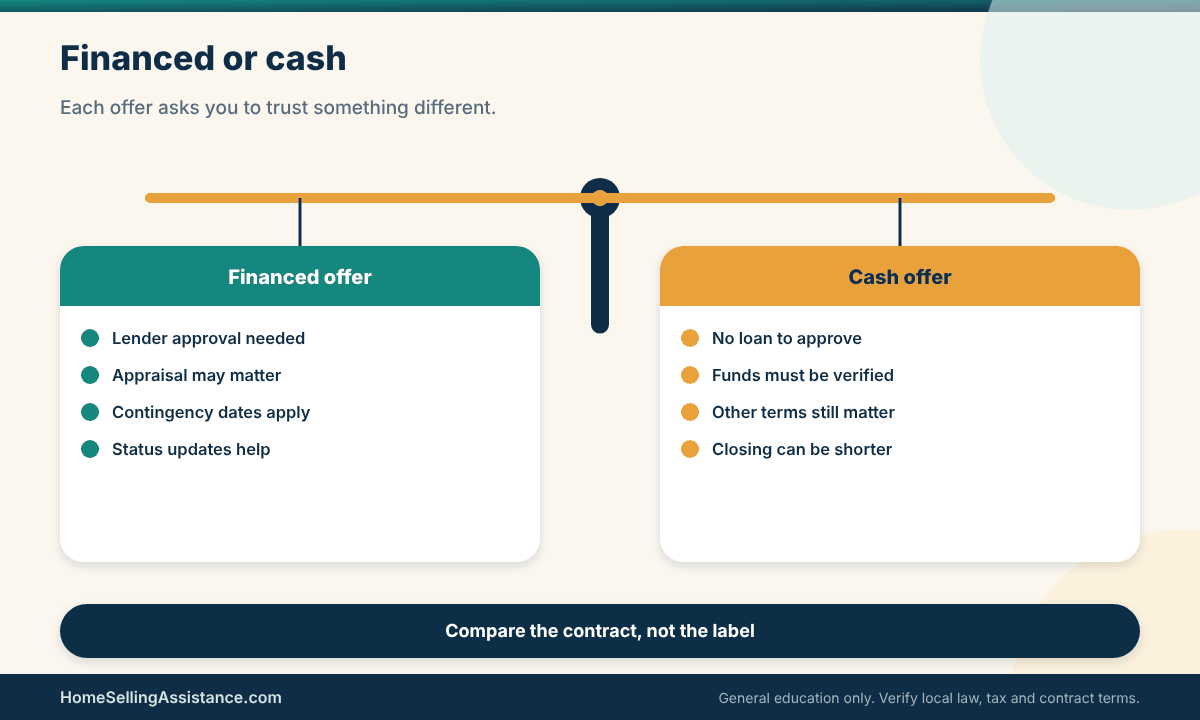
It also helps to compare financed offers with offers that do not depend on a loan. The scale below sets the two side by side, so you can see what each offer type asks you to trust.
Controlling financing contingency seller risk in writing
You cannot control a lender. You can control what you ask for before you accept an offer, how you respond when something shifts and whether the answers end up on paper. Most of the real protection in a financed sale is not clever, it is dull: clear dates, clear notices, clear documents and a habit of confirming everything in writing.
That work begins before signing. Once the ink is dry, you are mostly choosing among the options the contract left you. If you are still comparing offers, our walkthrough on how to evaluate a home offer as a seller shows how financing terms fit into the larger picture, and our contingencies, inspections and appraisals section collects related reading.
Questions a financing contingency seller should ask before signing
A financing contingency seller who asks good questions before signing usually has an easier time afterward. The goal is not to interrogate anyone. It is to understand the offer well enough to price its risk.
Good questions are specific and answerable. They are also neutral, which matters for fairness. Evaluate every buyer on objective financial and contract terms, applied the same way each time, and never on who the buyer is. Federal fair housing rules prohibit treating people differently based on protected characteristics, and the HUD fair housing resources explain those rules in plain language.
Think of your questions as falling into three groups: strength of the financing, length of the contingency and the cost of delay. The answers will not make a loan certain. They will tell you how much uncertainty you are being asked to carry, and whether the price or terms reflect it.
Evidence to gather: what to request from the buyer’s side with the offer
With a financed offer, it is common to ask for a current pre-approval or lender letter, and your agent can tell you what is customary where you live. Read the letter for the loan program, the amount, the date and whether it mentions verification of income and assets, or only a preliminary review. Ask whether the buyer has already chosen a lender, and whether that lender has seen the contract. Ask who will order the appraisal and when.
Next, look at the contingency terms, not just the price. How many days does the buyer want for approval? Is the down payment large relative to the price, small or somewhere in between? Does the buyer need to sell another home first? If the offer depends on a separate sale, the risk multiplies, and our explainer on the home sale contingency from the seller’s perspective shows how to weigh it.
The financing contingency seller checklist at this stage is short: the lender’s name and letter, the contingency length, the deposit and the backup-offer rules. If any of those is missing, treat the gap as a question rather than a reason to panic.
Finally, ask what protects you if the buyer cannot close. That includes the size and timing of earnest money, the extent of the buyer’s own disclosures about funds and whether the contract lets you keep marketing the property for backup offers. Not every request will be accepted, and a thoughtful buyer’s agent will not be surprised by them.
A word of caution on payment instructions. Closing-related email scams exist, and the Consumer Financial Protection Bureau and the FTC consumer site both publish warnings about wire and impersonation fraud. Confirm any change in who receives funds by calling a number you already trust, never one from the message.
Scenario: two offers, one with a short contingency and one with a long one
Picture two offers with the same price. The first has a short financing contingency and a buyer who already has the lender reviewing documents. The second has a longer contingency, a smaller deposit and a buyer who has not chosen a lender. Naturally, the first looks safer. But suppose the second buyer’s price is slightly higher in exchange for the extra time, and you are not under pressure to move quickly.
The exception to the instinct to pick the “safer” one is that you may have a backup plan, a flexible move date or a strong reason to prefer certainty over a marginally higher price. Your own situation decides. A seller who has to close by a hard date for a purchase elsewhere may reasonably weigh timing more heavily than someone with no deadline.
The financing contingency seller trade-off between price and certainty has no universal answer. Some sellers value a higher number, others value speed or a clean timeline, and both can be reasonable.
Your next step is to write your priorities down before you compare offers: the minimum price you would accept, the latest closing date you can live with and the amount of uncertainty you can tolerate. Then compare each offer to that list, not to each other. If one offer is cash or has a very short loan period, you may also look at how seller closing costs change the numbers you actually take home.
When to call an attorney, your agent or the title company
Not every wrinkle needs a lawyer, and not every question belongs with your agent. A useful rule of thumb is to match the question to the person who is trained and licensed to answer it. Your agent knows the forms, the local customs and the other side’s agent. A real estate attorney, where one is available or customary, can interpret the contract and advise on your legal rights. The title or escrow company holds deposits, prepares closing documents and follows the contract’s instructions on money.
The financing contingency seller who knows whom to call, and when, tends to lose less time. Keep the phone numbers for your agent, your attorney if you have one and your closing agent in one place from day one.
State practice differs. In some places attorneys routinely run closings, in others title companies do, and agents handle the contract forms in most. Your state real estate commission, your state bar’s referral service or your closing agent can tell you what is normal where you live.
Evidence to gather: documents to hand over when you ask for help
If you reach out to a professional, make it easy for them to help you quickly. Send the complete contract with all addenda, the counteroffers, the calendar page you built and any notices sent or received. Add a short written timeline of what happened, in plain language, with dates. Include any lender or appraisal communications you have seen. Mark the deadlines that are closest.
It also helps to list what you want to know, in order. For example: whether the contingency has expired, whether a particular notice was valid, whether you may accept a backup offer, whether the buyer is in default and what the deposit holder will need to release money. A short, ordered list tends to produce a short, useful answer.
Every financing contingency seller question is easier to answer with a clean file. If the file is messy, ask for help organizing it before you ask for legal conclusions.
Keep the tone of your outreach factual. Professionals sometimes receive messages written in anger, and the key facts get buried. If a dispute is already heated, a calm summary will serve you better than a long message full of accusations.
A scenario, an exception, and your next step when a notice is due
Imagine a buyer’s agent sends a message saying the buyer is “terminating due to financing” and asks you to sign a release of earnest money. The lender has not sent anything in writing. Your agent thinks the contingency may have expired the day before.
The exception is that you might be wrong about the date, or that your contract may let the buyer cancel with a particular kind of notice that this one satisfies. Equally, the buyer may have a legitimate loan denial that qualifies for a refund. You do not know yet, and neither does the agent who is guessing.
The wise next step is to pause before signing anything. Ask for the lender’s written denial or status, ask your agent to cite the contract clause that applies and, if the deposit is significant or the answer is not clear, speak with a real estate attorney the same day.
Signing a release is usually a final step. You can always sign it later, but you can rarely undo it. Our overview of how home sale contingencies work and our guide to low appraisal options for sellers are two good follow-ups if the lender’s concern involves value. Fraud warnings are collected in our home sale fraud and seller safety guide, and the FBI’s Internet Crime Complaint Center accepts reports of internet-based scams.
The last picture lays out three practical routes when a loan runs late and compares what each one asks of you.

Quick scenario
Illustrative only: your contract lists an approval date of the 20th. On the 18th, the buyer’s agent says the lender is waiting on one document. You ask for a short written status from the loan officer, confirm in writing that the date stays the 20th unless a signed amendment says otherwise, and put the 21st on your calendar as the day to call your agent if nothing has arrived. The loan may or may not be approved, but you have a record and a plan.
Frequently asked questions about financing contingency seller issues
What is a financing contingency in plain terms?
For a financing contingency seller, the clause is simply a condition that lets the buyer cancel and usually recover their earnest money if they cannot obtain the loan described in the contract by a stated deadline. The exact wording, notice rules and deadlines come from your purchase agreement and any addenda. Read yours rather than relying on a general description, because forms vary by state and by local practice.
Can a seller cancel because the buyer’s loan is slow?
A financing contingency seller often cannot cancel on that basis alone, unless the contract gives the seller a termination right after a missed deadline or a written notice. Some forms do and some do not. Ask your agent or an attorney to point to the exact clause, and do not send a termination notice until you know it fits the contract.
How is a pre-approval different from final approval?
For a financing contingency seller, a pre-approval is generally an early lender review based largely on information the buyer provides, so it can change. Final approval typically comes after underwriting reviews the buyer’s documents and the property, and after the lender clears its conditions. A clear to close is a stronger signal still, though funding has to happen before the sale is truly done.
What happens if the financing contingency deadline passes?
A financing contingency seller should start with the contract. Some forms treat a missed deadline as meaning the contingency is satisfied and the buyer is now exposed. Others require a written notice from the buyer either way. Others allow the seller to send a notice to the buyer. Check which model your agreement uses and keep copies of everything sent.
Should I agree to extend the loan deadline?
An extension is the financing contingency seller’s choice, and the right answer depends on your situation. A short extension with a firm date, a written status requirement and a signed amendment can be a reasonable middle path. Declining may be sensible if you have a backup offer or a firm move date. Ask your agent how an extension would affect any backup rights.
Who gets the earnest money if the loan fails?
The contract answers that for any financing contingency seller, along with the holder’s own rules. When the buyer cancels properly under the contingency, the deposit is often returned to the buyer. When the buyer defaults, the seller may have a claim, subject to the contract. If the parties disagree, the holder may keep the money in place until they sign a release or a legal process decides.
Can I ask the buyer for bank statements or credit reports?
A financing contingency seller generally cannot demand them and probably should not. A lender letter and written status updates usually tell you what you need without exposing private financial details. If you want additional comfort, ask your agent what proof of funds is customary where you live, and apply the same standard to every buyer.
Does a cash offer remove this risk?
A cash offer takes away the loan-related risk for a financing contingency seller, but not every risk. Cash buyers still need funds available at closing, and verification matters. Cash offers sometimes come with other trade-offs, such as a different price or terms. Compare them on the contract, not the label, and ask for proof of funds in a form your agent or the closing agent can verify.
Is the appraisal part of the financing contingency?
Sometimes. For a financing contingency seller, the appraisal may sit apart or inside the clause. In many contracts the appraisal has its own contingency, in others it is folded into the financing clause, and the effect on a financing contingency seller can be quite different. A low appraisal can lead to renegotiation or cancellation depending on the wording. Read both clauses together and ask which one controls.
When should I talk to a lawyer?
A financing contingency seller should consider it when a notice is due, a deposit is at stake, a buyer wants to cancel or you are unsure whether a deadline has passed. A short consultation before you sign a release or send a termination can prevent a costly misstep. Your state bar’s referral service or your closing agent can point you toward local counsel.
Before you move on
A financing contingency seller does best with a clear calendar, written confirmations and a short list of people to call. Read your own contract, ask for evidence rather than reassurance and keep every extension or release in writing. This article is general education, not legal, tax or financial advice, and it cannot account for your state, your forms or your facts. Check the details with your agent, a licensed real estate attorney or your title company before you act.