A fair house buyout vs sell divorce comparison starts with an uncomfortable fact: the house is usually the largest asset you share, the largest debt you share, and the place where somebody’s daily life happens, all at once.
That is why the question feels heavier than a normal housing decision. One path, a buyout, means one spouse keeps the home, refinances or otherwise takes over the loan, and pays the other spouse for their share of the equity. The other path means the house goes on the market, a stranger buys it, the mortgage is paid off at closing, and what is left gets divided under your agreement or court order.
Neither side of a house buyout vs sell divorce choice is automatically smarter. A buyout can protect a child’s routine and avoid listing costs, yet it depends on a lender saying yes. A sale can finish the financial tie in one closing, yet it asks you to prepare, show and hand over a home during one of the hardest seasons of your life.
This guide walks through how each route actually works, where the money and risk sit, and how to read your own situation without being pushed toward a default. It sits inside our broader library on divorce and co-owned home sales, and it pairs well with the cornerstone article on selling a house during divorce.
Throughout, we use the phrase house buyout vs sell divorce to mean the whole comparison, not just the price. A house buyout vs sell divorce review should cover the loan, the deed, the tax basis, the calendar and the emotional load, because a plan that wins on one of those and fails on another is not really a win.
A note on numbers before we start. Any dollar figure you see below is a round, illustrative example meant to show the arithmetic. It is not a prediction about your home. Divorce law, property division rules, lender requirements and closing customs vary by state and by contract, so treat this as general education and bring the specifics to your attorney, lender and tax professional.
Key takeaways
- A house buyout vs sell divorce decision is one question asked two ways. Who ends up owning the house, who stays on the loan, and how does the equity get divided?
- A buyout lives or dies on qualification. The spouse keeping the home generally has to qualify alone, and removing the other name from the mortgage is a separate step from changing the deed.
- A sale lives or dies on net proceeds and timing. Selling costs, payoff, repairs and the contract calendar decide what is left to divide.
- Paper equity and cash equity are different numbers. A buyout is often priced on value minus payoff, while a sale is priced on what remains after real costs.
- Tax and legal details change the answer. Transfers between spouses and the home-sale exclusion have specific rules, so confirm them with a professional.
- Scenarios beat slogans. In a house buyout vs sell divorce choice, the fact pattern, not a universal rule, tells you which route fits.
What a house buyout vs sell divorce choice is really trying to solve
Before comparing anything, it helps to name the three problems both options have to solve. First, ownership: whose name is on the deed when everything is finished. Second, liability: whose name is on the mortgage, because a deed and a loan are two different documents. Third, money: how the equity, the debts and the costs get divided so both people can start separate households.
Think of it as three separate files in one folder. The deed file proves ownership. The loan file proves who owes the bank. The money file shows who gets what. A house buyout vs sell divorce plan that tidies up only two of the three files tends to come back later as a dispute, often at an awkward moment such as a refinance or a resale.
A good house buyout vs sell divorce analysis keeps those three problems visible. People often argue about the house as if it were one decision, when it is really a bundle of smaller ones, and each option bundles them differently.
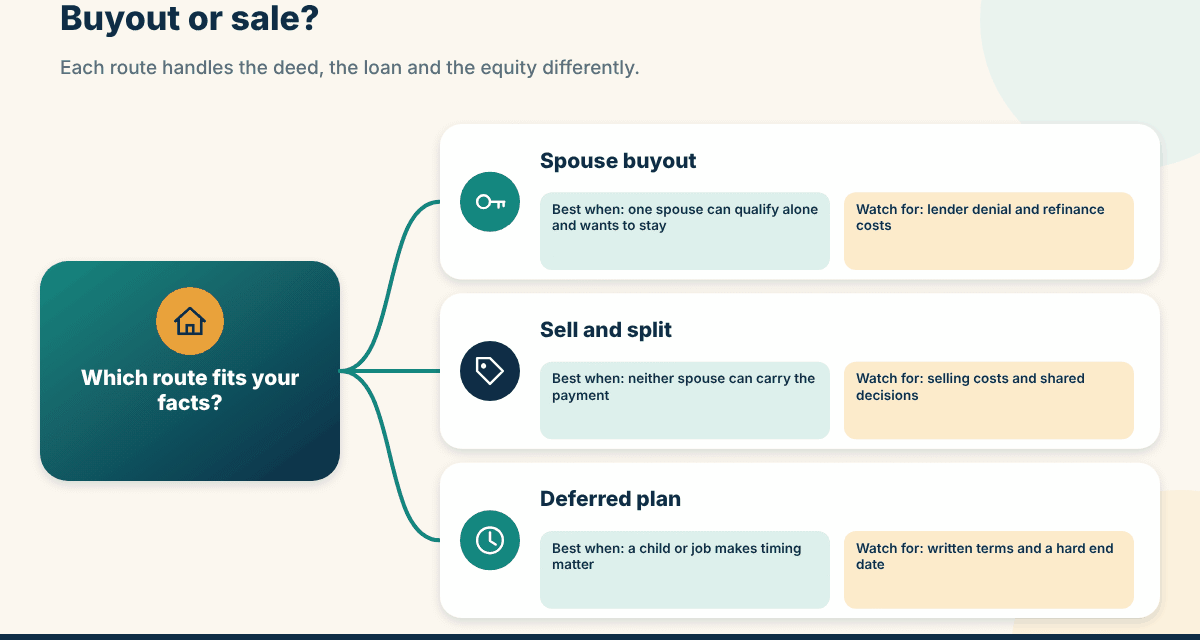
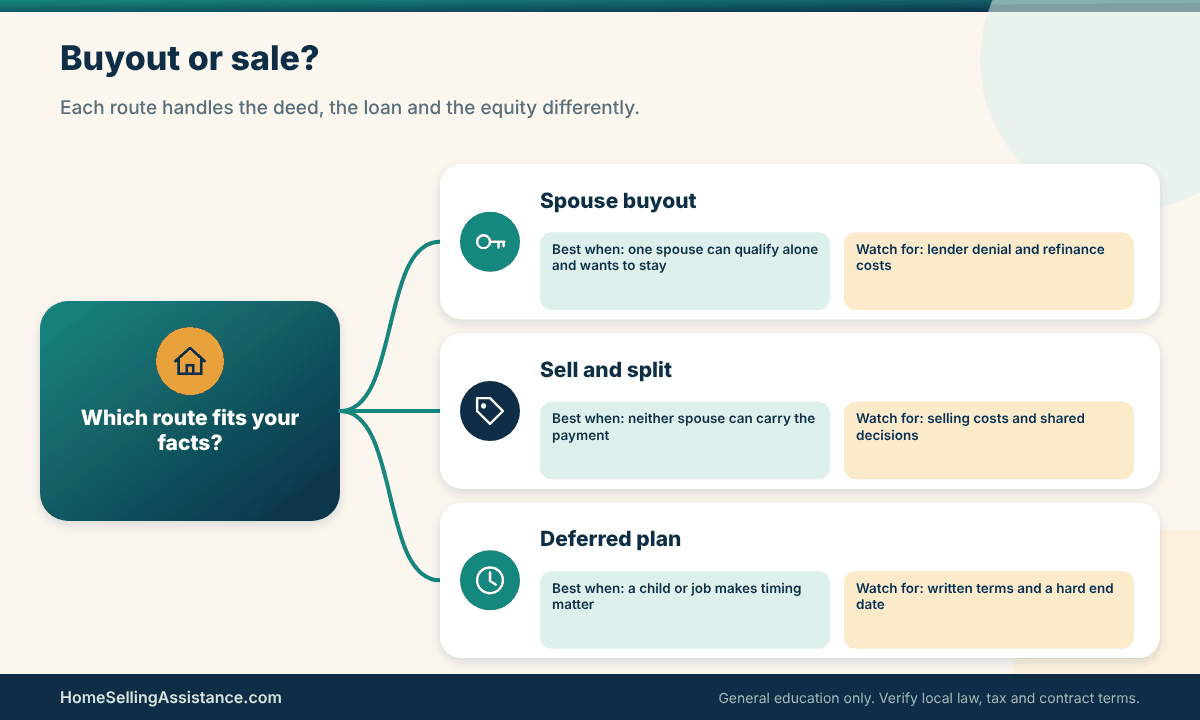
The picture below puts the two routes side by side as a fork, with the situations each tends to suit and the thing to watch on each side.
How a buyout works when one spouse keeps the home
In a buyout, one spouse becomes the sole owner. The other spouse signs a deed transferring their interest, usually at the same time as, or after, they receive payment. The spouse who keeps the home then deals with the loan, because the original mortgage may still carry both names even after the deed changes. Lenders generally want the person keeping the house to qualify on their own income, credit and debts, which often means a refinance into a new loan in one name.
The payment to the departing spouse can come from several places. Some people use a cash-out refinance, where the new loan is larger than the old payoff and the difference funds the buyout. Others use savings, trade other assets such as retirement accounts or a vehicle in a negotiated settlement, or agree to a structured payout over time. Each of those has its own legal and tax wrinkles, which is why a settlement agreement should be drafted, not improvised.
If you want to see how the arithmetic usually runs, our companion piece on the divorce house buyout calculation goes line by line.
Because the keeping spouse is often also a parent managing a new budget, we suggest running the house buyout vs sell divorce numbers for the first twelve months after the decree, including insurance, taxes, maintenance and a repair reserve, not only the mortgage payment. Many buyouts look comfortable on a spreadsheet and tight in the month the water heater fails.
Evidence to gather: value, payoff, and the equity number
A buyout starts with two figures you can document. The first is the home’s value, and the second is the payoff on every lien. Value can come from a licensed appraiser, a comparative market analysis from an agent, or both; spouses who distrust each other often agree to use a neutral appraiser and split the fee. Our explainer on how to price a house to sell shows how comparable sales are chosen and adjusted, which is the same logic an appraiser uses.
The payoff comes from the loan servicer, not from your monthly statement. A payoff letter includes interest to a specific date, and a home equity line of credit or second mortgage needs its own letter. Subtract all payoffs from the value and you have what we will call paper equity.
Here is an illustrative example. Say the agreed value is $400,000, the first mortgage payoff is $220,000, and there is no second lien. Paper equity is $180,000. If your state and your agreement call for an even split of that equity, the departing spouse’s share would be $90,000. Real agreements often adjust that figure for contributions, separate property, debts or other trades, so the even split is only a teaching number.
Also gather the recorded deed, the most recent property tax bill, homeowner’s insurance details, and any HOA statement, because the buyout agreement should say who is responsible for each after the transfer.
Disagreements about value are common in any house buyout vs sell divorce situation, because the spouse keeping the home benefits from a lower number and the spouse leaving benefits from a higher one. A neutral appraiser hired jointly, with the report shared with both attorneys, removes most of that tension. If values still diverge, some agreements average two appraisals; whether that works depends on your documents and your state.
A scenario, an exception, and your next step for buyouts
Picture two spouses with a seven-year-old, a mortgage in both names, and one parent whose job is steady and whose credit is strong. The parent who wants to stay asks whether a buyout is realistic. The honest first step is not to pick a price. It is to ask a lender, or two, for a written pre-qualification based on that parent’s income alone, with any support payments handled the way the lender’s guidelines treat them.
An exception worth knowing: even when the numbers work, some loans have features that complicate a transfer. A low rate on the existing loan can feel valuable, and a refinance to a current rate may change the monthly payment a lot in either direction. Some government-backed or older loans have assumption options that let a qualifying person take over the existing terms, but availability and process depend on the specific loan and servicer.
Your next step in a house buyout vs sell divorce choice, in plain terms: get a lender’s written read on whether the keeping spouse qualifies alone, before either of you commits to a number or a timeline.
How selling the house and splitting the proceeds works
In a sale, the house is listed or otherwise marketed, a buyer signs a contract, and the sale closes through a title company, escrow company or attorney, depending on your state. At closing the mortgage is paid off, costs are paid, and the remaining money is distributed according to your divorce agreement, a court order, or an escrow instruction signed by both of you. Both names generally need to sign, which means cooperation is part of the process even if everything else is strained.
The key difference from a buyout is that the market decides the price. You do not need to agree on a number, only on how to price the listing, and then a buyer’s offer sets the value for you. That can lower the argument, though it can also bring new arguments about which offer to accept and when to cut the price. Our article on listing a home during divorce covers how couples can set up decision rules for that.
A sale also changes the timing of the payout in a way that matters in a house buyout vs sell divorce comparison. In a buyout the departing spouse is paid at the refinance closing or on a date written in the agreement. In a sale the payment arrives only when the buyer funds, which can be later than hoped if the contract has contingencies.
Evidence to gather: net proceeds, payoff, and timeline
For a sale, the number that matters is not equity, it is net proceeds. Start with a realistic sale price range, then subtract the mortgage payoff, broker compensation if you use an agent (compensation is negotiable and must be put in writing), title and escrow charges, transfer or recording taxes where they apply, prorated property taxes, any HOA fees, and likely repair credits. The seller side of that list is explained in our guide to home sale net proceeds.
Continuing the illustrative example, a $400,000 sale with a $220,000 payoff leaves $180,000 before costs. If total selling costs came to a round $28,000, net proceeds would be $152,000, or $76,000 each under an even split. That is $14,000 less per person than the paper-equity version, which is exactly why the same house can feel like two different assets depending on the route.
Ask a title company or closing attorney for an estimated seller statement before you decide, and keep a calendar of the likely timeline, because carrying costs continue until closing.
Sale-side numbers need the same neutrality. If one spouse picks the agent and the price, the other may suspect the house buyout vs sell divorce result was shaped to favor them. Interviewing agents together, or letting each of you ask for an opinion of value and then comparing them, builds trust cheaply. Keep copies of every written estimate you receive.
A scenario, an exception, and your next step for a sale
Imagine a couple with modest equity, two incomes that would not support the current payment for either of them alone, and no child tied to the school district. For them, a sale may be the cleanest way to turn a shared asset into two separate fresh starts, because nobody has to qualify for a loan they cannot carry.
The exception is a house with problems. A roof near the end of its life, an unpermitted addition or a title issue can slow a sale, and in a divorce those delays are costly in both money and stress. Our overview of the home selling timeline shows how long each stage can run, and where delays usually appear.
Your next step in the house buyout vs sell divorce process: request a written estimate of net proceeds from a local professional, so both of you are arguing about the same number.
Comparing the trade-offs of a house buyout vs sell divorce path
Once the mechanics are clear, the useful question becomes what each route costs you in money, time, control and risk. A fair house buyout vs sell divorce comparison avoids two traps. One trap is treating the buyout as free because no agent is involved. The other is treating a sale as safe because the market sets the price. Both routes have costs; they just show up in different places and at different moments.
The table below is a decision matrix you can fill in with your own quotes. We wrote the cells as prompts, not verdicts, so read across each row and replace the generic language with documents from your lender, title company and attorney.
| Factor | Buyout (one spouse keeps) | Sell and split | Check before choosing |
|---|---|---|---|
| Price and net proceeds | Agreed or appraised value minus payoff; no sale commission | Market price minus payoff and selling costs | Appraisal, payoff letters, estimated seller statement |
| Time | Set by lender timeline and appraisal | Set by prep, market, contract and closing | Lender estimate, local days-on-market, court deadlines |
| Contingencies | Mainly the keeping spouse’s financing and appraisal | Buyer’s financing, inspection and appraisal terms | Loan commitment; contract contingency dates |
| Workload | Paperwork, refinance, deed, possible asset trades | Cleaning, repairs, showings, negotiation, move-out | Who handles each task, and by when |
| Execution risk | Loan denial, appraisal gap, delayed release from debt | Buyer falls through, price cuts, carrying costs | Backup plan for each; written agreement terms |
| Control and flexibility | High for the keeping spouse; low for the leaving spouse until paid | Shared decisions until closing | Decision rules for price and offers |
Use the matrix as a conversation tool. If the two of you can fill in the third column with real documents, you have turned an emotional argument into a short list of facts. If one column is mostly blank, that blank is your next task.
Notice what the matrix does not say. It does not say the buyout is cheaper or the sale is faster. In a real house buyout vs sell divorce comparison, either can be cheaper or faster depending on the lender, the market, the condition of the home and how quickly the two of you make decisions. The matrix keeps you honest by forcing each claim to point at a document.
Net money, time, control, contingencies, and workload
In a house buyout vs sell divorce comparison, money comes first because it is the part that most affects whether either of you can afford a next home. The headline in a buyout is that the departing spouse receives a number agreed in the settlement, while the keeping spouse avoids marketing and sale costs but takes on a new loan and its closing costs. A refinance has its own charges, such as lender fees, an appraisal, title work and recording costs, and the new interest rate may be better or worse than the old one.
The headline in a sale is that costs come out of the proceeds and risk is shared. Price is set by buyers, not negotiated between spouses, which can be a relief when trust is low. The cost is that nobody keeps the home.
Time and workload run in opposite patterns. A buyout front-loads effort in documents and underwriting, then ends with a quiet closing. A sale front-loads effort in preparation and showings, then ends with a handover to the buyer. For a related look at how timing can stretch, see how long it takes to sell a house.
Contingencies deserve their own mention because they are where surprises hide. In a sale, the buyer’s contract may let them back out if the inspection reveals a problem, if their financing fails or if the appraisal is low, each within the dates written into the contract. In a buyout, similar conditions sit in your own agreement and in the lender’s commitment letter. Read both with the same care, because a house buyout vs sell divorce plan that ignores conditions is a plan with unknown exits.
Evidence to gather: a side-by-side net worksheet
Build a two-column worksheet on one page. In column one, list what each spouse would walk away with under a buyout: the settlement payment, any asset trades at their agreed value, and the debts each takes on. In column two, list what each would walk away with under a sale: the share of net proceeds, plus the costs of moving and temporary housing that a sale often forces earlier.
Use the same value for the house in both columns, or the comparison will not be fair. If you picked a buyout value of $400,000, use $400,000 as the likely sale price too, then show the selling costs separately so you can see how sensitive the result is. You can run the sale column at a few round prices, perhaps $380,000, $400,000 and $420,000, to see how much a price swing moves the result.
Do not forget the line items that spouses often leave out: the keeping spouse’s refinance costs, the departing spouse’s future housing deposit, any prepayment or recording fees, and tax questions on either route. Our guide to seller closing costs explains which charges usually fall on the seller in a standard sale.
The picture below shows how a sale price shrinks into net proceeds, using the same kinds of line items you would pencil into the worksheet.

When the numbers move: a mini scenario
Take the earlier example. Paper equity was $180,000, split to $90,000 each. Suppose the keeping spouse refinances and pays closing costs of a round $6,000 on the new loan, and the settlement says each spouse shares those equally. The departing spouse might still receive $90,000 less $3,000, or $87,000, while the keeping spouse’s real cost of staying is higher than the $90,000 alone suggests.
Now suppose the sale route sells at $390,000 instead of $400,000 after a price reduction. Equity drops by $10,000 before any selling costs, and each spouse’s share of net proceeds falls further. The point is not which total is bigger. The point is that a buyout puts certainty on paper early, while a sale puts uncertainty into the price until the contract is signed.
For the spouse who needs the lump sum quickly, such as to rent a new place, the speed and certainty of a buyout payment can matter more than a slightly higher expected sale figure. For the spouse who is cash-rich and house-poor, the opposite may hold. Your numbers decide, and a calculator cannot replace an advisor looking at your full financial picture.
Legal, financing, execution, market-exposure, and fallback risk
In a house buyout vs sell divorce choice, risk is where the two options differ most, and where people most often underestimate. In a buyout, the risk concentrates in a single approval. If the lender declines the refinance, or the appraisal comes in below the value you both agreed on, the plan can stall or collapse. Time pressure from a court schedule or a separate lease can make that stall expensive.
In a sale, the risk is spread across more parties. A buyer’s financing can fall through, an inspection can open a negotiation, an appraisal can come in low, and the market can shift between listing and closing. You also carry the home during the sale, so mortgage payments, insurance, utilities and upkeep continue. Our article on selling a house with a mortgage explains how the payoff works at closing.
Legal risk sits on both routes. How property is divided, whether the home is treated as marital or separate property, when a spouse’s signature is required, and which court approvals apply all vary by state. That is a job for your family law attorney, not a general article.
Market exposure is the quiet risk in a house buyout vs sell divorce plan. A buyout locks the value on the day of the agreement, so if prices later rise the departing spouse may feel shortchanged, and if they fall the keeping spouse may. A sale accepts today’s market in full. Neither is wrong; each simply decides who carries the price risk, and that is worth deciding on purpose.
Evidence to gather: lender, decree, and title documents
Three document families protect you here. From the lender, you want a written pre-qualification or loan estimate for the keeping spouse, the current payoff letter, and a plain answer on whether a release of liability for the departing spouse is part of the deal. From the legal side, you want the settlement agreement or draft decree, any temporary orders that limit selling or encumbering the home, and confirmation of who must sign what. From title, you want a title report or commitment showing every owner of record and every lien.
The title report is the one most people skip, and it is the one that can reveal an old judgment, a second mortgage or a name on the deed nobody remembered. Our overview of mortgage payoff when selling a house shows why payoff letters need updated figures.
If you have any doubt about the accuracy of what someone tells you about loan assumptions, tax effects or court approvals, ask for it in writing from the lender, the attorney or the tax professional. Verbal reassurance is not a document.
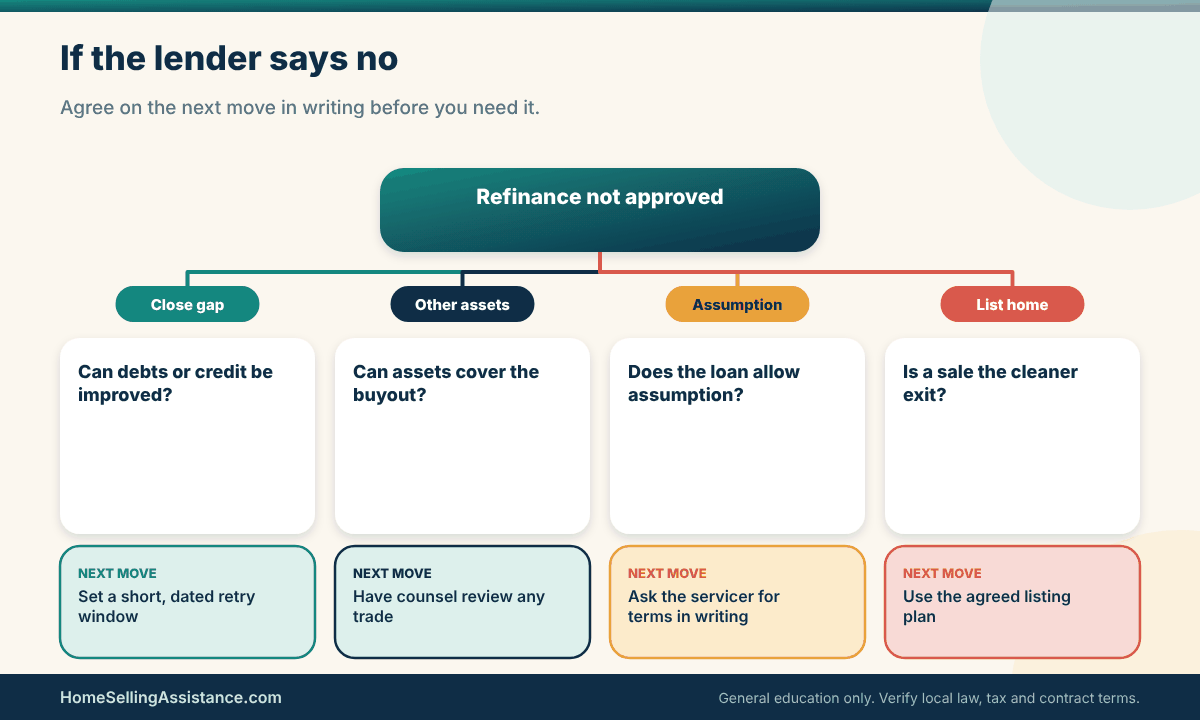
Plan B: what happens if the first route stalls
A sensible house buyout vs sell divorce plan names the fallback before the first route begins. If the buyout is the first choice, the agreement can say that if the keeping spouse does not obtain loan approval by a certain date, the house is listed with an agreed agent at an agreed price range. That single sentence turns a possible standoff into a timetable.
If the sale is the first choice, the fallback might say that if no acceptable offer is received within a set number of weeks, the parties will revisit the price, or one of them may have the option to buy out the other at the then-current appraised value. Courts and attorneys often welcome this kind of structure because it reduces repeat disputes.
Fallbacks also protect relationships. When the house buyout vs sell divorce question has a written Plan B, a missed deadline becomes a cue to follow a script instead of a fresh argument. That single design choice often does more for peace than any clever pricing method.
The picture below maps one common fallback path, the situation where a lender does not approve the keeping spouse, so you can see the options before you need them.
Seller scenarios beat a universal winner for the house buyout vs sell divorce decision
People searching for a house buyout vs sell divorce answer often want a rule: always buy out, or always sell. We would love to hand you one, but honest experience says the right route depends on a handful of facts that differ from household to household. The facts that matter most are who can qualify for the loan, how much equity exists after real costs, whether children or work tie one spouse to the area, how well the two of you can still cooperate, and what the tax picture looks like.
The table below turns those facts into a scenario map. Each row describes a situation, the route that is often favored, the reason, the trade-off you accept, and the one fact that could flip the answer. Treat the second column of this house buyout vs sell divorce table as a starting hypothesis to test, not a recommendation.
| Situation | Route often favored | Reason | Trade-off | Fact that changes it |
|---|---|---|---|---|
| One spouse qualifies alone and wants to stay | Buyout | Stability; no sale costs | New loan, refinance costs | Lender approval and appraisal |
| Neither spouse can carry the payment | Sale | No one has to qualify | Both move; selling costs | Equity after costs |
| Thin equity after costs | Sale or deferred plan | Little to pay out in a buyout | May net little either way | Value and payoff accuracy |
| Low-rate existing loan | Buyout or assumption | Keeping existing terms may help | Needs servicer approval | Whether the loan allows it |
| High conflict, low trust | Sale with set rules | Market sets the price | Shared decisions until closing | Court-ordered terms |
| Large gain and long ownership | Either, after tax advice | Tax rules may affect each spouse | Outcome depends on facts | Basis, ownership, and use |
To use the table, find the row closest to your life, write down the route in column two, and then spend your effort on the final column. If the deciding fact is a lender answer, make the call. If it is an appraisal, order one. If it is a legal question, put it on your attorney’s list this week.
A few cautions apply when reading the scenario table. First, it is a map, not a diagnosis; real households blend several rows at once, such as thin equity and a low-rate loan. Second, the favored route may change as facts change, and a lender answer, an appraisal or a court order can flip the house buyout vs sell divorce answer in a week. Third, no row accounts for local law, so verify with your attorney before relying on any of them.
Scenario one: the spouse who qualifies alone and wants stability
Here is the situation in which a buyout tends to look strongest. One spouse has steady income, a manageable debt load and a credit profile a lender will accept. There are children whose school and friendships sit within walking distance, or a work location that would be hard to replace. The other spouse prefers a clean payout over a share of an uncertain sale price.
In that house buyout vs sell divorce picture, the buyout usually saves the marketing and showing effort, and the keeping spouse avoids the cost of finding and moving to another home. The departing spouse gets a defined number sooner than a sale might deliver. The price of that stability is a new loan, a new payment and a refinance bill, and the keeping spouse has to be honest about whether the budget still works once the second income is gone.
A practical test for this scenario: if the keeping spouse can name the monthly payment, show the income that supports it, and still describe a repair reserve, the buyout side of the house buyout vs sell divorce comparison is probably worth pursuing. If any of those three answers is vague, pause and rerun the numbers.
Evidence to gather: qualification, appraisal, and release of liability
Start with the lender. Ask for a written read on the keeping spouse’s ability to qualify alone. Lenders look at documented income, existing debts, credit history and the loan-to-value ratio on the new loan. How court-ordered support is treated, whether as income received or as an obligation paid, depends on the lender’s rules and on the paperwork, so ask the loan officer how it will be counted and ask for that in writing.
Next, order a reliable valuation. If the lender requires an appraisal for the refinance, use that to prevent two valuations from competing. A low appraisal changes the amount that can be borrowed, and that changes how much cash the keeping spouse can raise for the departing spouse. Our guide on mortgage options during a divorce home sale walks through how lenders view shared loans.
Finally, ask who is released from the old debt and when. A deed transfer alone does not remove a name from a mortgage. The departing spouse should confirm, in writing, that the old loan will be paid off or that the lender will release them, because as long as their name stays on the note, they remain liable for it.
Tax questions for the keeping spouse and the departing spouse
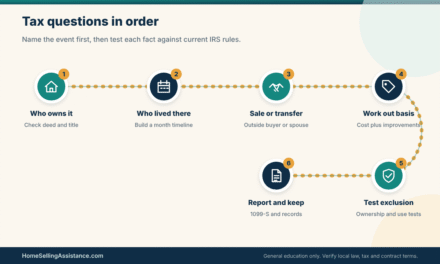
Federal tax rules treat many property transfers between spouses, or between former spouses when they are tied to the divorce, as non-taxable events. In that kind of transfer the spouse who receives the home generally takes over the other’s tax basis instead of getting a fresh one. The IRS explains the transfer rules in Publication 504 on divorced or separated individuals, and the basis rules in Publication 551.
The federal home-sale exclusion lets a qualifying single seller exclude up to $250,000 of gain and a qualifying joint filer up to $500,000, if the ownership and use tests are met, generally two of the last five years. After a divorce the exclusion is figured per person, and special rules can count time a spouse spent owning or using the home in certain divorce situations. Read Publication 523 on selling your home and ask a tax professional to apply it to your facts.
Our article on divorce home sale taxes goes deeper, and the library on home sale taxes collects related guides.
Nothing here promises a tax result. A buyout can look tax-free on the day of transfer and still hold a future tax bill inside the keeping spouse’s low basis.
Because tax rules interact with ownership dates and filing status, ask your tax professional two specific questions: what basis will the keeping spouse carry, and how would a later sale be taxed under current federal rules. Bringing those questions to the table early makes the house buyout vs sell divorce choice better informed. Our guide to adjusted basis in a home sale shows how basis is built.
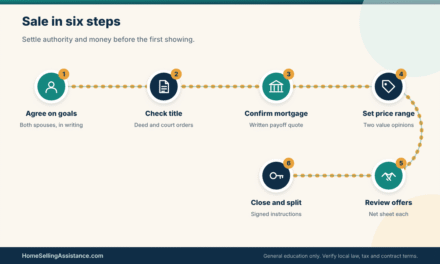
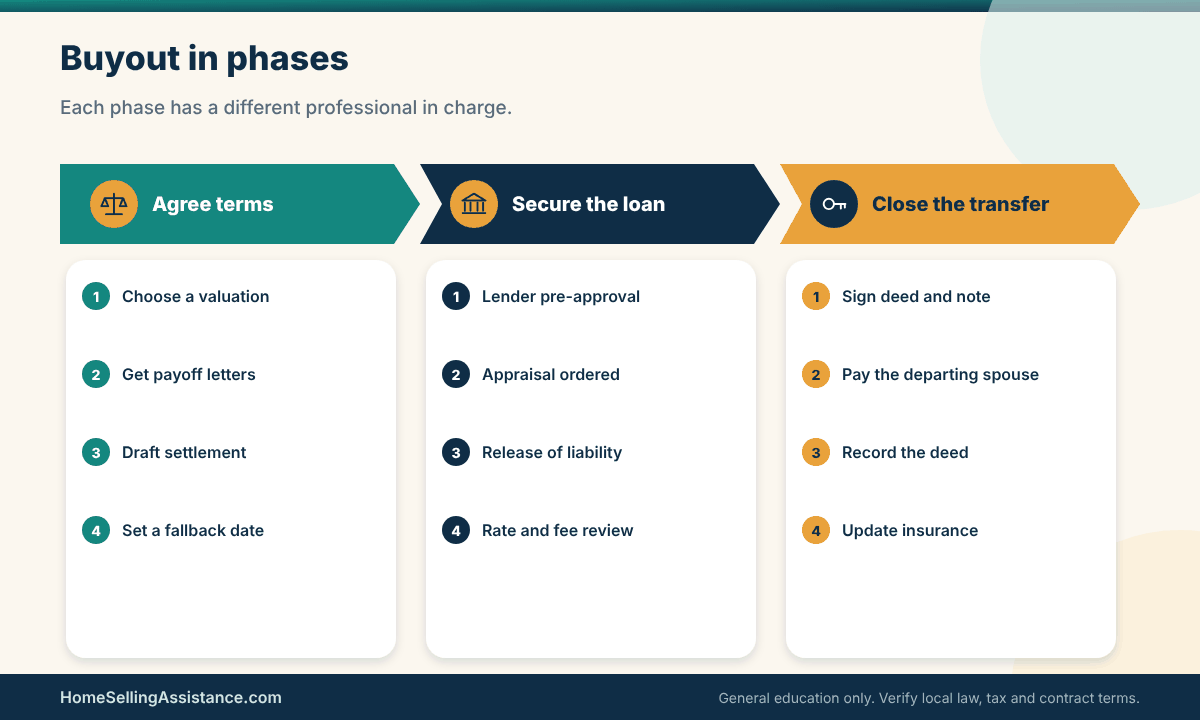
The sequence of steps in a buyout usually runs in a predictable order, and the picture below lays it out as phases so you can see where the lender, the court and the title company each step in.
Scenario two: when house buyout vs sell divorce math favors selling
Now flip the facts. Neither spouse earns enough to qualify alone for the existing payment, or one could qualify only by stretching the budget to a point that leaves no room for repairs, insurance increases or a lean month. Equity is modest once real selling and refinance costs are counted. The two of you want to stop sharing a financial tie as soon as practical.
In that house buyout vs sell divorce case, selling often wins on simplicity. At closing the loan is paid off, both names come off the debt, and the proceeds are divided under your agreement. Nobody is left holding a house they cannot afford or a promise to pay the other spouse that depends on a good year at work.
The cost is disruption and exposure to the market. You will have to prepare the home, accept showings, and decide together on offers. That is a lot to ask of two people who are already stretched, so agreeing on rules before the sign goes up is worth the effort.
Run the same practical test in reverse. If the sale side of the house buyout vs sell divorce comparison leaves each spouse with enough to rent or buy a modest next home, and the calendar fits court or lease deadlines, selling is probably workable. If the proceeds look too thin to fund a move, talk with a housing counselor and your attorney about options such as a delayed sale.
Evidence to gather: sale readiness, market data, and a written plan
Begin with a seller file: the recorded deed, the latest mortgage statement, a current payoff figure, property tax and insurance bills, HOA documents if any, warranties, and records of repairs. Our seller checklist before listing shows what buyers and title companies tend to ask for, and having it ready cuts days from the process.
Then collect market evidence. Ask one or two local agents for comparable sales and an opinion of value, and remember that agent compensation is negotiable and must be written down. Compare how they would price and prepare the home, not only their fee. If you sell without an agent, you will need to cover pricing, marketing and contract work yourself or with an attorney.
Finally, put the plan in writing. A short written plan can say who communicates with the agent, who is present for showings, what price range triggers a discussion, how repair requests will be handled, and what happens if the house is still unsold after a defined number of weeks. If you need a mutual rule for a spouse who refuses to cooperate, our piece on a co-owner who refuses to sell explains the general options.
Dividing proceeds, closing mechanics, and your next step
When the closing date arrives, the title company or closing attorney needs clear instructions about where the money goes. If your agreement states a split, both spouses can sign an instruction letter that tells the closing agent how to disburse the net proceeds. If the split is unresolved, some couples agree to leave the disputed amount in escrow until a court or agreement decides it, though practices vary by state and by company.
Our guide to dividing home sale proceeds in a divorce explains how those instructions are usually structured, including how debts, credits and prior payments can be accounted for.
On the tax side of a house buyout vs sell divorce plan, each spouse may use their own home-sale exclusion if they qualify, and the divorce can change how the ownership and use tests apply. If both of you plan to claim an exclusion, keep your closing statement, your records of improvements and the settlement documents in one folder. The article on the home sale capital gains exclusion explains the basics, and the guide to divorce capital gains on a house sale addresses the divorce-specific twists.
On the sale route of a house buyout vs sell divorce plan, your next step is to ask the title company for a preliminary closing statement and a copy of the payoff instructions, then check them against your settlement draft.
Some couples also consider a cash buyer to shorten a sale. A cash offer can reduce financing risk, yet it may come with a lower price or tighter terms, so compare it carefully using our article on cash offers versus financed offers. In a house buyout vs sell divorce comparison, a cash buyer is simply another version of the sale route, with its own trade-offs.
Quick scenario
Two spouses, one child, a $400,000 home, and a $220,000 mortgage. One spouse qualifies alone, but only just, and the refinance would raise the payment noticeably. The other spouse wants a payout in the next few months to rent a place. They test both paths on paper: the buyout shows a $90,000 payment to the leaving spouse before shared refinance costs, while a sale shows a smaller net after selling costs but ends the joint loan sooner.
They choose the buyout, with a written deadline: if the loan is not approved by an agreed date, the house is listed. The fallback made the first choice safer.
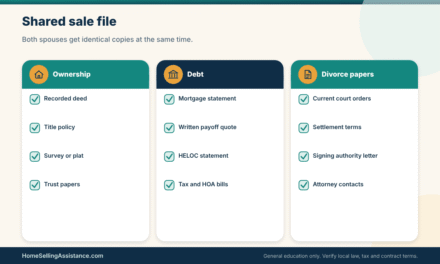
The last picture is a short document checklist that serves both routes. Keep it in a folder where both of you, or both attorneys, can reach it.

One more point deserves a plain statement. If there is any history of intimidation, controlling behavior or safety concerns between you, the housing decision should not be negotiated in a way that puts anyone at risk. Attorneys, courts and local advocates can arrange communication through counsel or other structures, and a sale or buyout can be run entirely through professionals. Housing counselors approved by HUD, listed through HUD’s counselor search, can also help you look at budgets and options for the next home.
Communication deserves a plan too. Many couples agree to a short written protocol: questions about the house go by email or a shared document, replies come within a set number of days, and urgent matters such as a leak or a missed payment have a named contact. A house buyout vs sell divorce process runs better when the small stuff has a rhythm.
Finally, whichever side of the house buyout vs sell divorce question you land on, resist the pressure to decide faster than the facts allow. A week spent confirming a lender’s answer or a payoff figure is cheap compared with a deal that falls apart after both of you have already moved on emotionally and logistically.
Frequently asked questions about house buyout vs sell divorce
Is a buyout or a sale better in a divorce?
Neither wins in every case. A house buyout vs sell divorce decision turns on whether the keeping spouse can qualify alone, how much equity remains after real costs, and how much you both value stability versus a clean break. Test both routes on paper with real quotes, then ask your attorney how your state’s property rules apply.
Can my spouse keep the house if we both signed the mortgage?
Often yes, but in any house buyout vs sell divorce plan the deed and the loan are separate problems. A spouse can usually become the sole owner by deed, yet the mortgage may still carry both names until it is refinanced, assumed with lender approval, or paid off. The departing spouse should get written confirmation of how and when they will be released from the debt.
How is the buyout amount figured?
In a buyout it is usually figured from the agreed value of the home minus every lien, then divided as your agreement, your state’s rules or a court order provides. Many couples adjust the figure for separate property, contributions, debts or trades. Our divorce house buyout calculation article shows a worked method, and a settlement should state the formula and the valuation date.
What if the lender will not approve the keeping spouse?
Then the house buyout vs sell divorce plan needs a fallback, which is why we suggest writing one in advance. Options might include adding time to improve the application, trading other assets, using a co-signer under advice, assuming the loan if allowed, or listing the home for sale. Each has trade-offs, and your attorney should review any agreement before you sign it.
Do we owe taxes if one spouse buys out the other?
Transfers between spouses, or between former spouses connected to the divorce, are generally not taxed at the moment of transfer under federal rules, but the receiving spouse usually takes the other’s basis. That can matter later when the home is sold. The IRS explains the details in Publication 504, and a tax professional should apply them to you.
Does selling during a divorce hurt the price?
Not by itself. Buyers care about condition, location, price and terms, and most do not know or care why you are selling. Stress can still show up as rushed prep or disputes over offers, which is why written decision rules help. Our article on listing a home during divorce covers how to keep a sale calm.
What if one of us refuses to sell or to sign?
Cooperation is normally required for a voluntary sale, and a temporary court order may also restrict what either spouse can do with the property. When a co-owner will not cooperate, the options depend on your state and may include court involvement. Read about the general paths in partition sale of a co-owned house, then speak with your attorney.
Can we sell now and split the money later?
Some couples do, by leaving the disputed proceeds with the title company or in an attorney’s trust account until an agreement or order decides the split. Whether that is permitted and how it works depends on the company, the state and your documents. Both spouses should sign clear written instructions, and neither should rely on a casual promise.
How do the house buyout vs sell divorce costs compare?
A sale usually carries broker compensation if you hire an agent, title and escrow charges, possible repair credits and carrying costs until closing. A buyout usually carries refinance costs, an appraisal, legal fees and possibly a higher or lower interest rate. Neither is free, so total both lists before deciding.
Who should I talk to first?
For a house buyout vs sell divorce question, start with a family law attorney in your state, because property rules and court approvals come first. Then speak with a lender about qualification, a tax professional about basis and exclusions, and a local agent or title company about value and costs. HUD-approved housing counselors can also help you review budgets and next steps.
Choosing between a buyout and a sale
The best house buyout vs sell divorce choice is the one that survives contact with real documents: a lender’s answer, a payoff letter, an estimated seller statement and a settlement your attorney has read. Work through those, decide who holds each fallback, and give yourselves a little room to adjust. This article is general education, not legal, tax or financial advice, and your state, your loan and your facts may change the answer. Keep going with our broader guide on selling a house during divorce.