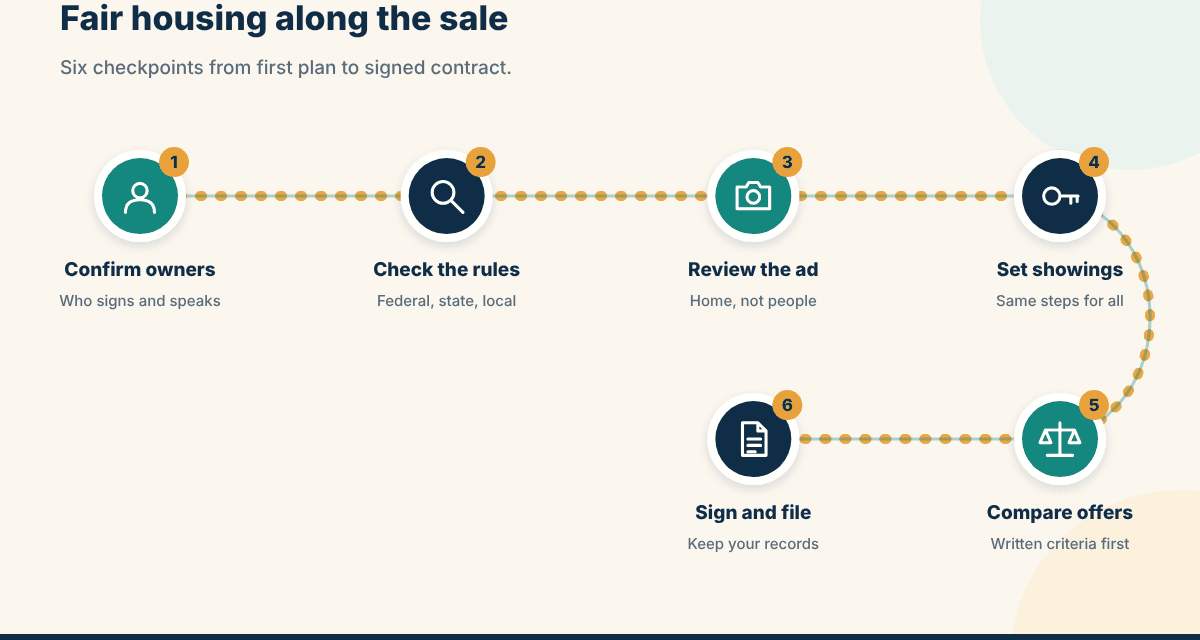
Every fair housing home seller question comes down to one habit: you decide how to market, show and sell your house using neutral business reasons, and you write those reasons down before emotions or assumptions enter the room.
Most owners never think about discrimination law until something small happens. A buyer’s agent mentions that a family with three kids is interested. A neighbor asks who “that couple” touring the house is. A listing draft says “perfect for a young professional” because it sounds cheerful. None of these moments feels like a legal event, yet each one is exactly where a fair housing home seller can drift into trouble without ever intending harm.
This guide is general education for any fair housing home seller in the United States. It explains what the federal Fair Housing Act covers, how advertising and offer decisions fit in, who is responsible when an agent writes the listing, and how to keep a simple paper trail that shows you treated every buyer the same way. It also explains where state and local rules add protections, because those differ more than most sellers expect.
We will stay neutral about whether you hire a listing agent, sell on your own or take a cash offer. Your fair housing home seller duties follow you into every one of those routes. For the wider paperwork picture, our cornerstone guide to seller disclosure requirements is a good companion, and the same disclosures and seller paperwork library covers the neighboring topics.

Key takeaways
- The federal law is broad. It covers race, color, religion, sex, familial status, national origin and disability in the sale of housing, and it applies to ads, showings, terms and offer decisions.
- Ads count as conduct. Listing words, photos and targeting choices can create a problem even when you would never turn anyone away in person.
- Neutral criteria protect everyone. Price, terms, financing strength, timing and documented risk are business reasons. Who a buyer is, or who they bring along, is not.
- State and local law can go further. Additional protected categories exist in many places, so verify your own state and city rules.
- Paper trails matter. A short record of how you compared offers and answered questions is your best everyday protection.
- Escalate early. If a complaint, a covenant or a tricky request appears, a fair housing attorney or your state agency is the right next call, not a guess.
Start with who owns the decision and which rules reach your sale
Before you worry about wording in an ad, settle two basic questions. Who actually makes decisions for this sale, and which layers of law sit on top of those decisions? A fair housing home seller who skips these questions often discovers the answers at the worst moment, such as when a co-owner disagrees with an offer choice or when a city ordinance turns out to protect a group the federal list does not mention.
This first section is about getting the foundation right. We cover the people and papers that control the sale, then the federal, state and local layers, and the narrow exemption that some sellers assume covers them.
Who owns the property, signs the contract and carries fair housing home seller duties
The duty not to discriminate attaches to the person selling, and also to everyone who acts for that person. If you list with an agent, the agent has their own obligations under licensing rules and federal law, but you are not off the hook just because someone else typed the ad. If you sell without an agent, every phone call, text and showing is yours alone. In both cases, the first practical task is to know exactly whose name is on the sale.
Ownership shapes more than signatures for a fair housing home seller. Where there are two spouses, three siblings who inherited together, a trust or an LLC, there are several people who may speak about the house, and each of them can say something careless. A single shared understanding of the ground rules keeps everyone consistent.
Evidence to gather: title, signers and anyone speaking for you
Start with the deed or your title paperwork to confirm who holds title and in what form. If a trust owns the home, find the trustee’s name and the trust certificate. For an estate, look for the letters or similar court document that show who has authority. Your state’s recorder or clerk of court, or a title company, can help you confirm this. We will not guess at the rules here because estate and trust authority differs by state.
Next, list every person who will talk to buyers or the public on your behalf: your listing agent and their assistants, a photographer, a stager, a family member who offers to show the house, and a neighbor who keeps an eye on things. These people are your informal spokespeople. You do not need a formal training session. A short message that says “we describe the house and the terms, never the people” is enough to set the tone.
Finally, collect the documents that control the sale itself. That means the listing agreement if you have one, the draft purchase contract form, any HOA or condominium governing documents, and any seller questionnaire your market uses. Our guide to the seller property questionnaire explains how that form fits in, and the real estate sales contract article shows which sections control offers and timing.
A scenario, an exception, and your next step when co-owners disagree
Picture two siblings who inherited a house. One wants to accept an offer that has the best terms. The other leans toward a buyer who “seems like the kind of family that belongs in the neighborhood.” That second reason is the kind of comment that becomes a problem if it is spoken aloud, written in a text or used to break a tie. The legitimate path is to compare offers on price, financing, contingencies, closing date and the strength of the buyer’s proof of funds.
There is an exception worth naming. A real disagreement about timing or risk is fine. One owner might need money by a certain date, and the other might accept a slower, cleaner closing. Those are business reasons that can be written down plainly. What cannot happen is a reason that depends on who the buyer is rather than what the offer says.
Your next step in a disagreement is simple, and it applies to any fair housing home seller group. Agree in writing, before you open any offers, on the criteria you will use and their order of importance. If the owners still cannot agree, a neutral mediator or an attorney who handles real estate can help. Nobody should be forced to pretend they have no preference. They only need to keep personal preferences about people out of the decision.
Federal baseline, state add-ons and local ordinances
Federal law gives every fair housing home seller the same starting list. The Fair Housing Act prohibits discrimination in the sale and rental of housing because of race, color, religion, sex, familial status, national origin and disability. HUD and the courts have applied the sex category to include sexual orientation and gender identity, though how those protections are enforced can shift with policy, court rulings and state law. That is exactly why you check current sources instead of relying on a list you read years ago.
On top of that baseline, many states and cities add categories. Some protect source of income, marital status, age, military or veteran status, or immigration-related characteristics. Others define familial status or disability more broadly. A HUD fair housing overview is the right place to see the federal list in HUD’s own words, and your state’s civil rights or human rights agency is the right place to see yours.
Where to confirm which protected classes apply in your state
Search for your state’s fair housing or human rights agency and read its page on housing. Most publish a plain-language list of protected characteristics, a description of what counts as discrimination in sales, and a complaint process. If you live in a city or county with its own human rights office, check there too. Local ordinances sometimes protect categories that the state does not.
Your state real estate commission is the second stop. It regulates licensees, and many commissions publish guidance on advertising and on fair housing training requirements for agents. If you work with an agent, ask which fair housing continuing education they have completed and how their brokerage reviews listing text. That is a normal question, and a professional will answer it without discomfort.
Your title company or closing attorney can also tell you whether any local wrinkles show up in your market. They see many transactions and know when a city has recently changed its rules. A fair housing home seller should not treat their answer as legal advice about a particular situation, but do treat it as a useful pointer toward the source you should read.
The owner-sold exemption and why it is narrower than people think
Some sellers have heard that the federal law exempts owners who sell without an agent. A narrow version of that idea exists. In general terms, the federal Act contains limited exemptions for certain single-family homes sold by an owner who does not own more than a small number of such homes, does not use a broker, and does not use discriminatory advertising. Those conditions are strict, and they have their own details, so reading the statute or asking an attorney is the only safe way to find out whether you even come close.
Even where a version of the exemption might apply, three problems remain. The ban on discriminatory advertising still applies. A separate federal civil rights law from the 1860s bars race discrimination in property transactions without these exemptions. And state or local law may have no such exemption at all. In practice, treating the exemption as a plan is a poor bet.
The best working assumption for a fair housing home seller is that you must follow fair housing rules in full, and that a conversation with an attorney is needed before anyone relies on an exemption. If you are considering a sale without an agent, our overview of for sale by owner explains what that route asks of you, and the FSBO and flat-fee MLS section goes further.
Turn fair housing home seller rules into a daily selling workflow
Rules on paper do not help until they become habits, and that is the whole point of a fair housing home seller routine. The useful way to think about a fair housing home seller workflow is as a handful of recurring moments: writing the listing, preparing the house, handling inquiries, scheduling showings, comparing offers and responding to the buyer’s side. At each moment there is a neutral way to act and a few easy mistakes.
The matrix below pulls together the issues that come up most often. Use it as a planning aid, not a legal map. The right-hand column is the most important one, because it tells you what to verify in your own state and contract.
| Issue | Controlling document or authority | Seller obligation or choice | Typical timing | Local verification |
|---|---|---|---|---|
| Listing text and photos | Federal Fair Housing Act; state advertising rules | Describe the home, not the buyer | Before going live; every edit | State commission advertising guidance |
| Who may tour or ask questions | Fair housing law; your showing instructions | Same process for every inquiry | From first inquiry onward | Local human rights office |
| Offer comparison | Purchase offers; your written criteria | Rank on price, terms, funds, timing | Before reviewing offers | Attorney or agent for local forms |
| Disability-related requests | Federal law; HUD guidance; state law | Respond to requests with care and advice | Within the contract timeline | HUD or state agency; attorney |
| HOA or covenant rules | Declaration, bylaws, recorded covenants | Know rules; do not enforce biased ones | Before listing; at resale packet request | County recorder; HOA manager |
| Complaint or inquiry received | HUD or state agency notice; counsel | Preserve records; stop discussing the buyer | As soon as notice arrives | Fair housing attorney |
Read the table from left to right for each moment in the sale. The first column names the situation. The second tells you which document or agency actually decides the question. The third shows what you are expected to do, and the last two columns point to the places where you confirm timing and local specifics. If a cell in the last column says “attorney,” that is not a sign of panic; it simply marks the issues where local law makes professional advice worth the cost.
Advertising, photos, showings and offer review steps
Advertising is where most fair housing home seller slip-ups live, partly because the federal rule is written broadly. The statute reaches any notice, statement or advertisement that suggests a preference or limitation based on a protected class. That includes the obvious, such as a line saying certain buyers are unwelcome, and the subtle, such as phrases that signal who would fit in. It also reaches images, so a collection of photos that always shows one kind of family can send a message you never meant.
The practical test is easy to remember. Describe the property, its features, its location facts and the terms of sale. Skip descriptions of the kind of person who would live there. Words like “ideal for a young couple,” “mature neighborhood,” “no kids” or “walking distance to church” can read as preferences, even when written with warmth. Describing a nearby park, a transit stop or a school’s name as a fact is generally treated differently from describing who would enjoy them.
Evidence to keep: listing text, showing logs and offer scorecards
Save a copy of every version of the listing description and photo set you publish, with dates. If an agent drafts it, ask for the final text and the places it was posted. This sounds fussy, but a dated copy answers the question “what did the ad say last March?” without anyone relying on memory.
Keep a simple showing log, as a careful fair housing home seller would: date, time, which agent or person came, and whether any special request was made, such as extra time or an accessibility accommodation. You are not profiling anyone. The log exists to show that every inquiry was handled by the same steps. If one buyer received a longer tour than another, the log should explain why in neutral terms, like a scheduling gap.
For offers, build a one-page scorecard before any offer arrives. Typical rows are price, financing type and proof of funds, down payment or cash on hand, contingencies, requested concessions, closing date, possession date and any unusual terms. Our guide to how to evaluate a home offer as a seller covers how those pieces trade off, and the same scorecard works whether you receive one offer or several.

A scenario with a neighbor, a buyer letter and a safe response
Imagine a neighbor stops you in the driveway and asks whether you would consider selling to “someone who will take care of the place, you know, a family like ours.” You are not obligated to give a speech. A calm, neutral reply works: “We are working with our agent and will review offers based on the terms.” It is polite, true and gives no opening to a conversation about who is acceptable.
Buyer letters are another common moment. Some buyers write personal notes describing their family, faith, job or background. Those letters can create a record that a decision was influenced by who the buyer is. Some agents and some states discourage them, and some will pass them along only if the seller has asked in writing. Ask your agent how they handle them. Many sellers simply tell their agent that they will not read personal letters and that all offers will be compared on terms alone.
If a letter reaches you anyway, you do not need to panic. Do not circulate it, do not discuss its content as a reason for or against the offer, and record your final decision against the same criteria you set earlier. If you are unsure, pause and call your attorney or agent before responding.
Handoffs to your agent, the buyer’s agent, title, the HOA and an attorney
A sale involves a surprising number of people, and each hand-off is a place where a biased remark or an uneven process can slip in. Your listing agent controls the marketing and often the showing logistics. The buyer’s agent represents someone else, but their questions and comments still land on you. Title companies and closing attorneys handle documents rather than preferences, though they may notice and flag problematic language in a contract or a recorded covenant.
HOAs and condominium boards deserve their own mention. They can require approvals, collect resale information and sometimes have rules about who may buy or occupy. Those rules are not exempt from fair housing law, even though they come from a private association. A fair housing home seller who runs into an unusual approval step should ask the board what the written criteria are and whether they are applied equally.
What to ask each professional in writing
With your listing agent, ask for the brokerage’s fair housing policy, who reviews listing text and how the team handles buyer letters. If you are choosing between agents, our guide to choosing a listing agent includes interview questions where this fits naturally. A short written reply gives you something to refer back to.
With the title company or closing attorney, ask whether any recorded covenants or deed restrictions contain language that restricts who can own or occupy the home. Older documents sometimes include outdated and unenforceable restrictions. Knowing about them in advance prevents an unpleasant surprise in the closing packet. Ask the same professional how to handle a buyer’s request for accessibility changes before closing, because that sometimes touches the contract.
With the HOA or property manager, ask for the current governing documents, the resale or transfer packet requirements, and the written approval criteria if any exist. Put your question by email, keep their reply, and share it with your agent. If the answers are vague or the process seems uneven, treat that as a signal to call an attorney rather than guessing.
When a complaint, a rude comment or an HOA rule changes the plan
Sometimes the problem arrives from outside, and a fair housing home seller needs a plan for that. A buyer’s agent might hint that they felt unwelcome at a showing. A neighbor might make an offensive comment at an open house. A letter from a state agency or a fair housing organization might land in your mailbox. Each of those events should change what you do next.
A fair housing home seller who receives a notice should stop talking about the buyer or the situation with anyone who is not an attorney or agent. Preserve every record, including texts and emails, and do not delete anything, even if it is embarrassing. Contact an attorney who handles fair housing or real estate law before you answer any agency letter. Agencies commonly work on fixed timelines, so an unanswered notice can cost you options.
If the issue is an HOA rule that seems discriminatory, write to the board and ask for the legal basis, then share the exchange with your attorney. You usually cannot fix a private association’s rules yourself, but you can avoid repeating them and you can document that you objected.
Build a fair housing home seller verification checklist
A checklist turns good intentions into something you can actually finish. The goal of a fair housing home seller checklist is not to prove perfection. It is to show, if anyone ever asks, that you looked up the rules, set neutral criteria and followed them. Think of it as the same discipline a fair housing home seller applies to a net proceeds estimate: gather the real documents, check them against current sources and write down what you found.
The scenario table below shows situations that tend to confuse sellers, with the options you usually have, the risk each carries and the place to escalate. It does not replace advice about your own facts, but it can help you spot when an everyday moment deserves a second opinion.
| Situation | Seller options | Main risk | Document to review | Escalation point |
|---|---|---|---|---|
| Draft ad describes the “perfect buyer” | Rewrite to describe the home only | Ad suggests a preference | Listing text and photo set | Agent’s broker; state commission |
| Buyer sends a personal letter | Decline to read; judge terms only | Decision appears tied to who the buyer is | Offer and your scorecard | Attorney if unsure |
| Two offers with similar terms | Apply written criteria; ask both for improvements | Uneven treatment between buyers | Both offers; counteroffer notes | Agent; attorney on dispute |
| Buyer with a disability asks for a change | Respond promptly, in writing; get advice | Refusal without review can raise liability | Contract; HUD guidance | Fair housing attorney |
| Old covenant contains biased wording | Disclose awareness; do not rely on it | Confusion at closing | Recorded covenant; title report | Title company; attorney |
| Agency or advocacy letter arrives | Stop discussing; preserve records | Missed response deadline | The letter itself; your files | Fair housing attorney |
To use this table, find the row closest to your situation, read the last column first and decide whether this is something you can handle with a neutral reply or something that needs a call. Notice how often the document to review is something you already have or can easily request. Most fair housing problems become easier when you can point to a dated record.
Official sources and recorded documents worth reading
A fair housing home seller may search the internet and trust whichever article ranks first, including this one. A better approach is to read the primary sources yourself, at least once. Federal information comes from HUD’s fair housing office. State information comes from your state’s civil rights or real estate agency. Local information comes from the city or county human rights office. Recorded documents come from the county recorder and from the title company that pulls them for you.
Industry groups publish useful material for a fair housing home seller as well. The National Association of Realtors maintains fair housing resources and a code of ethics that its members follow, though those are professional standards and do not replace the law. Treat them as helpful context, not as the final word about your rights or duties.
Reading HUD material, your state commission and the HOA covenants
Start with HUD’s fair housing pages and read the list of prohibited acts in sales, because every fair housing home seller works from that same list. You are looking for three things: the protected classes, the examples of discriminatory advertising and the complaint process. Then open your state agency’s housing page and look for categories that appear there but not at HUD. Write those down.
For the HOA, ask for the declaration of covenants, bylaws and any published rules. You do not have to read every line. Search for words that relate to who may buy, rent or occupy, age limits, family size or approval procedures. Some communities legitimately qualify as housing for older persons under federal rules, while others have wording that is simply outdated. If you find a term you cannot interpret, send it to your attorney rather than guessing at what it means.
If a HUD-approved housing counselor could help a buyer or another party you are working with, remember that HUD maintains a directory through its Find a Counselor tool. Counselors focus on housing finance and counseling, not on representing sellers, so use that resource for background rather than for legal answers.
Old restrictive covenants and what to do when you find one
A fair housing home seller may find that many deeds and subdivision plats from earlier decades contain restrictive covenants that excluded buyers based on race, religion or national origin. Courts have long held that such covenants cannot be enforced, and the federal Fair Housing Act prohibits using them. Yet the language may still sit in the recorded chain of title, which sometimes surprises sellers and buyers alike.
If your title search or HOA packet includes language like that, do not quote it in marketing and do not treat it as a rule. Tell your title company and agent, and ask how your state handles the recorded language. Some states have created processes to formally strike or disavow old discriminatory covenants, and the process, cost and forms vary. A local attorney or the county recorder’s office can explain the options.
The key point for a fair housing home seller is to avoid repeating or relying on the language. If a buyer asks about it, a short factual reply works: “That wording appears in an old recorded document and has no legal effect on this sale. Our title company can walk you through it.” Then confirm the facts with the title company so your statement is accurate.
What must be current before you sign: listing agreement, advertising and contract paperwork
Rules, forms and guidance move. A checklist you built last year may be missing a category your city added, and a listing template from an old transaction may carry phrases that would raise eyebrows today. The final stage of any fair housing home seller plan is a short, dated review right before the biggest commitments: signing a listing agreement, publishing the ad and accepting an offer.
For a fair housing home seller, paperwork is where promises become binding. A listing agreement defines who markets your home and how. A purchase contract defines who gets the house and on what terms. Both documents contain provisions that touch fair housing, even if the words are not obvious: nondiscrimination clauses, broker duties, advertising authority, disclosure forms and sometimes signature blocks that affirm you understand your obligations.
Read these documents with a pen, not at a skim. Mark any clause you do not understand and ask for a plain-language explanation. If an agent says “that’s standard,” ask where the standard comes from and whether your state requires the clause. Our article on the real estate sales contract from the seller’s side walks through the usual sections.
Checking the listing agreement and advertising authority
Look for the section that describes how the brokerage may advertise your home. It often gives the broker permission to publish photos, descriptions and sometimes virtual tours on many platforms. Ask to approve the text and photo set before it goes live, and ask whether the brokerage runs paid social media or targeted online ads. Targeting options that filter audiences by characteristics linked to protected classes have drawn scrutiny from regulators and courts, so the question is reasonable.
Check whether the agreement includes a nondiscrimination statement or refers to the brokerage’s fair housing policy. If not, you can still ask the agent to confirm in writing that they will follow federal, state and local fair housing law. Agents bound by licensing rules will usually say yes immediately.
If you plan to sell on your own, you take on the advertising yourself, including text on yard signs, online flat-fee MLS listings and social media posts. The same rules apply. Our listing agent and commissions section explains what agents and brokerages typically handle, which helps you see what you would be replacing.
Disclosure forms, buyer questions and consistent answers
Disclosure forms ask a fair housing home seller about the property, not about people. Keep it that way. If a form or a buyer asks about neighbors, crime or the character of the area, the safest reply is usually to point to public sources and avoid giving opinions that touch on who lives nearby. Some states have specific rules on what must or must not be disclosed, and some prohibit certain statements entirely.
Our guide on seller disclosure versus the inspection report explains how the two documents differ, and the lead paint disclosure article covers a federal form that involves buyers directly.
The federal lead-based paint disclosure is a good reminder of the principle. It applies to certain older homes and is given to every buyer in the same way. The EPA explains the rule on its real estate disclosure page. Equal treatment of buyers on required paperwork is not just good manners, it is how the rule works.
A fair housing home seller should keep a copy of every form given to each buyer and the date. If one buyer receives extra documents because they asked, offer the same extra documents to anyone else who asks. That consistency is easy to maintain when you track it from the beginning.
Equal treatment records for offers and negotiations
Offers are where a fair housing home seller meets disputes most often, because a seller’s choice produces a winner and a loser. The choice itself is legitimate. You are allowed to pick the offer that serves you best. What matters is the reason, and whether you can show that reason was tied to the offer rather than to the buyer’s identity. Our article on handling multiple offers explains the practical mechanics, and this section adds the equal treatment layer.
For a fair housing home seller, equal treatment is a process, not a feeling. It means the same information goes to every buyer, the same deadlines apply, the same questions are asked and the same standards judge the answers. It also means that if you improve terms for one buyer, such as extending a deadline, you offer the same opportunity to others when the situation is comparable.

Building a neutral offer scorecard before the first offer arrives
A fair housing home seller should pick criteria while nothing is on the table. Most sellers weigh price, certainty of closing, timing, contingencies, concessions and condition of the home as accepted. Decide which one matters most to you, and decide in advance how much extra price you would trade for a faster closing or a cleaner contract. Write it in a short note and share it with your agent.
When offers arrive, fill in the scorecard for each one, using the same rows. If a buyer’s financing is a loan, note the loan type and the lender’s pre-approval or proof-of-funds document. If it is cash, note the proof of funds. Do not add rows that describe the buyer’s family, background or lifestyle. If an agent offers such information, politely redirect: “Please just send us the terms.”
After the scorecard, write two or three sentences explaining your decision. This is the single most useful record you can keep. It should read something like “Offer B had the stronger financing documentation and a shorter inspection period, which fit our need to close before the end of the month.”
Counteroffers, questions and disability-related requests handled evenly
Counteroffers should follow the same logic as the first review. If you counter one buyer on price and ask for a shorter timeline, ask yourself whether you would make the same request of another buyer with similar terms. Our guide to counteroffer strategy covers the negotiation side, and the fair housing side is a quick check on consistency.
A fair housing home seller should give buyers answers of equal quality to the same questions. If one buyer asks about the roof and receives a full repair history, another buyer asking the same question should receive the same history. Our article on material defects in seller disclosures explains why consistent factual answers also protect you in a different way.
A request from a buyer with a disability, such as asking to install a ramp before closing or asking for extra time to measure doorways, deserves a thoughtful reply. Federal law has rules about reasonable accommodations and modifications that apply in many housing settings, but how they operate in a resale depends on facts and on state law. Respond promptly, in writing, and ask your attorney or agent how the request fits your contract before you answer yes or no. A dismissive reply with no explanation is the version that tends to cause problems.

The final pass before going live and before accepting
For a fair housing home seller, two moments deserve a last look. The first is just before the listing goes public, because that is when your words reach many people at once. The second is just before you accept an offer, because that is when your decision becomes a contract. Neither review takes long, but both are much easier when you have already built the scorecard and saved the ad text.
If something looks off at the last moment, pause. A listing can wait a day, and an offer response can wait a few hours within the contract deadline. A clear head is worth more than a quick answer, and a call to your attorney or agent costs less than a complaint.
A pre-publication read of the ad, photos and showing instructions
Before publishing, a fair housing home seller can read the listing text aloud and ask one question of every sentence: does this describe the home or the people? Remove adjectives that characterize residents. Check the photos for anything that might send a signal, such as religious items, family photographs or personal documents left in view. Staging helps a house look neutral, and our home staging guide explains how depersonalizing also helps most buyers imagine themselves in the space.
Review the showing instructions for the same consistency. Do they require the same notice, the same pre-approval steps and the same access for every buyer’s agent? If you ask for proof of funds, make sure the request applies to everyone. If you plan to be absent during showings, confirm that you are not asking the agent to screen visitors on any basis other than the neutral process you wrote.
Finally, check that your agent or helper knows how to handle awkward questions. A short script helps, such as “I can tell you about the house and the terms, and I can’t speak to the people.” Your listing agent will probably recognize this approach immediately.

The last review before you accept, counter or decline an offer
Before you respond to any offer, a fair housing home seller should pull out the scorecard and check three things. First, are all offers recorded using the same rows? Second, does your short explanation point to terms rather than people? Third, have you given every buyer the same opportunity to improve terms when it was reasonable to do so? If the answer to any is no, fix it before you respond.
Also confirm that the contract language you plan to sign matches your understanding. Look especially at special provisions or addenda that the buyer or agent added. If a clause surprises you, ask what it does and whether it belongs in a standard form in your state. Our easement and encroachment disclosure guide shows how unusual property facts get documented, which is useful when you review addenda about the land itself.
Last, save your decision record with the contract. If your attorney or closing company asks for a file later, you can hand over the scorecard, the listing text and the showing log in one folder. A fair housing home seller sometimes asks how long to keep records. Check your state’s rules for brokers and ask your attorney, because retention periods differ and we cannot give you a single answer here.
For safety around the sale itself, including scams that target sellers, see our guide on home sale fraud and seller safety. For the broader paperwork picture, return to the seller disclosure requirements cornerstone, and for how offers are weighed from scratch, the offers and negotiation section has more.
Quick scenario
A seller receives two offers within an hour of each other. One buyer’s agent mentions in passing that the buyers are a young couple expecting a baby. The seller’s agent replies, “Thanks, we are reviewing both offers on terms.” The seller fills in the scorecard for each offer, notes that Offer A has a larger down payment and a shorter closing date, and writes two sentences explaining the choice. If the decision is ever questioned, the record shows a neutral reason.
Frequently asked questions about fair housing home seller duties
Does a fair housing home seller have to follow the law if there is no agent involved?
Yes, in general, a fair housing home seller must comply even without an agent. The federal ban on discriminatory advertising applies to anyone who publishes an ad, and state and local rules often have no owner-only exemption at all. A narrow federal exemption exists for some owner sales, but it has strict conditions. Ask an attorney before relying on it, and assume the rules apply to you.
Who is protected under the federal Fair Housing Act?
For a fair housing home seller, the Act covers race, color, religion, sex, familial status, national origin and disability. HUD and courts have applied the sex category to include sexual orientation and gender identity, and enforcement details can change. Many states and cities add categories, so check your own state and local agencies for the current list.
Can I choose the highest offer even if it comes from a buyer I find less friendly?
You can choose the offer that serves your goals best, and price is a neutral reason. What you should avoid is using a protected characteristic as any part of the reason. Write down your criteria before reviewing offers, and base the decision on the terms. If friendliness is the only issue, it generally does not belong in the decision at all.
Are personal letters from buyers allowed?
They are not banned everywhere, but they can reveal protected information and create a record that the decision turned on it. Some agents and states discourage them. Ask your agent for their approach, and consider telling your agent that all offers will be judged on terms alone.
What words should I avoid in a listing description?
A fair housing home seller should avoid phrases that describe the type of person who would live there, such as references to family size, age, religion or background. Stick to the house, its features and the facts of its location. If you are not sure about a phrase, ask your agent’s broker or an attorney to review it before it goes live.
What if a buyer with a disability asks to modify the home before closing?
Respond in writing and promptly, and talk to your attorney or agent before you decide. Federal rules on accommodations and modifications exist, though their application to a resale depends on facts and state law. A thoughtful, documented reply is much safer than a quick refusal.
Does fair housing law affect who I let into an open house?
Yes. The process for entry should be the same for everyone who attends, and any safety steps, such as a sign-in sheet, should apply to all visitors. If you have a real safety concern, take it to your agent and handle it through a neutral procedure rather than a judgment about a person.
What should I do if I find a discriminatory covenant in my deed?
Do not repeat it in marketing or rely on it. Tell your title company and agent, and ask how your state handles the recorded wording. Some states offer processes to formally disavow such language, and an attorney or county recorder can explain what is available.
How long do buyers have to file a complaint?
Time limits depend on the forum. A HUD administrative complaint is generally subject to a one-year window from the alleged act, and court filings and state agencies have their own limits. Because the deadlines vary and can change, a fair housing attorney or your state agency should confirm the current ones.
Where can I get official help or more information?
A fair housing home seller can start with HUD’s fair housing office for the federal rules and your state’s civil rights or real estate agency for local ones. A real estate attorney can review your situation, and your title company can point you to recorded documents. These sources give better answers than any general article, including this one.
A calm way to finish
Being a careful fair housing home seller mostly means slowing down at four moments: writing the ad, setting your offer criteria, answering questions and writing down why you chose the offer you did. None of it is complicated, and all of it gets easier with a little preparation. This article is general education, not legal, tax or financial advice. Rules differ by state and city, so confirm the details with your state agency, your title company and a qualified attorney before you act.