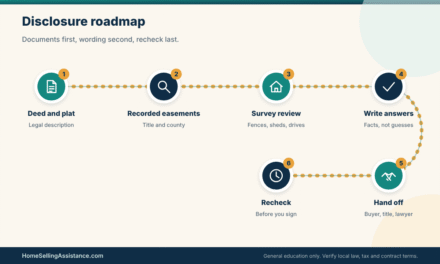
A seller property questionnaire looks like a harmless form until you reach question 14 and realize you are being asked to put in writing something you only half remember about a basement that got damp one spring, a fence a previous owner built, or a furnace repair that a handyman did for cash. This guide shows you how to answer each question with evidence instead of a shrug, and how to stay honest when the honest answer is “I do not know.”
Most sellers treat the form as paperwork to get through on the way to the real work of pricing and staging. That is understandable, and it is also where a surprising number of later disputes begin. A seller property questionnaire is usually signed by you, shared with buyers before or during the offer stage, and then folded into the contract file. Whatever you wrote becomes the baseline against which the buyer measures everything they later discover.
The good news is that answering well is mostly a matter of preparation, not legal skill. You gather the records that already exist, ask the people who know the house, decide how to word the gaps, and keep copies. A careful seller property questionnaire is rarely long on prose. It is long on dates, receipts, names and plain, specific statements that a stranger could check.
We are going to walk through the whole process in the order it actually happens: building your file before you open the form, answering in a sensible sequence, handling the moments when a buyer, an inspector or a title company contradicts your answers, and wrapping up with a clean paper trail. Nothing here replaces your own state’s form, your contract, or advice from a licensed professional. What it can do is make you a calmer, better-prepared signer.
Key takeaways
- Answer from records, not memory. A seller property questionnaire is only as reliable as the receipts, permits, reports and statements behind each answer.
- “I do not know” is a legitimate answer when it is true. What you cannot do is guess, minimize or leave a known problem off the page. Many forms provide a “no knowledge” or “unknown” option for exactly this reason.
- Forms and rules differ by state. Some states mandate a specific form, some allow “as is” disclaimers, and some leave the matter largely to contract. Check with your state real estate commission, a local attorney or your title company.
- Update when facts change. If something new happens after you sign, such as a leak, a failed inspection item or an insurance claim, ask how your state and contract expect you to correct the form.
- Keep every version. Dated copies of drafts, supporting documents and delivery proof are your best protection if a question arises years later.
Before the detail, one framing point. The seller property questionnaire is a statement of what you know, not a guarantee about the house. Buyers are still expected to inspect, ask questions and read the contract. Your job is accuracy within your own knowledge, delivered completely and on time. That framing takes a lot of pressure off, and it is the thread running through everything below.
Build the file for your seller property questionnaire first
The single most useful habit is to gather evidence before you read the first question. Sellers who open the seller property questionnaire cold tend to answer from the gut, then spend the next week second-guessing. Sellers who spend one weekend collecting documents usually fill the form out in under an hour and feel good about every line.
Think of this stage as building a small binder, physical or digital, that follows the house. Part of it comes from your own paper. Part comes from public sources. And part will be a short list of things you do not have yet, which is perfectly normal and gets its own treatment further down.
Documents, numbers, contacts, and deadlines
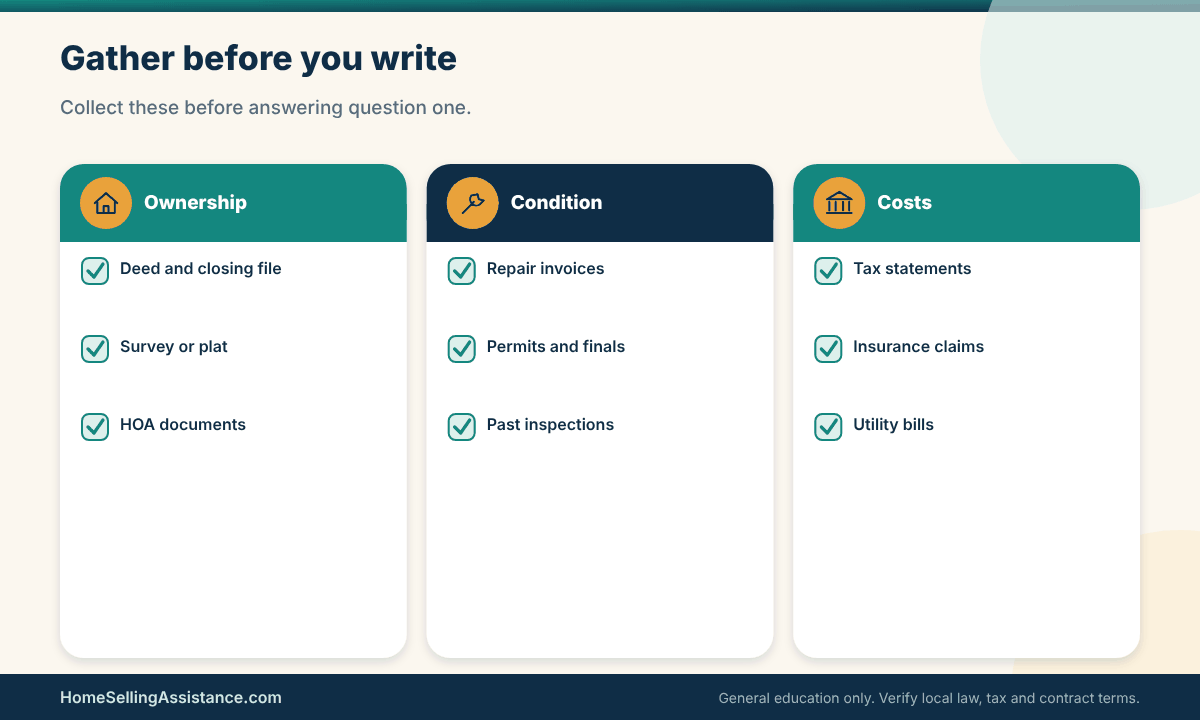
Start with what you own or can easily request. Typical sources include your purchase closing file, the deed, any title policy, the last two or three years of utility bills, property tax statements, homeowner insurance declarations, receipts and invoices from contractors, appliance manuals and warranties, past inspection reports, and any HOA or condominium documents. If a permit was ever pulled, the county or city building department usually keeps a record you can request.
Numbers matter more than adjectives. “The roof is fairly new” invites argument. “Roof replaced in the spring of 2019 by a licensed contractor, invoice attached” does not. Collect the year, the contractor’s name and a phone number or email where you can, plus any warranty paperwork that may transfer to the buyer. Contacts help too: your HOA manager, your insurance agent and your regular service providers can confirm dates you only half remember.
Deadlines are the third piece. Ask your listing agent, attorney or title company when the form is due. In some places it must be delivered before an offer is accepted, in others within a set number of days after, and in some it is optional or depends on the type of property. Your state real estate commission website usually publishes the rule, and your contract often adds its own timing. Write the due date on your calendar and treat it as firm.
Evidence to gather: records that back up each answer
Work through the form’s usual topics and attach a record to each. For the roof, collect the invoice or permit. For plumbing and electrical, gather any licensed contractor receipts. For water intrusion, find insurance claim letters, repair invoices or past inspection notes. For additions and finished spaces, look for permits and final inspection sign-offs. For boundaries and shared features, find the survey or plat, if you have one.
A helpful trick is to make a simple two-column list as you go: the question topic on the left, the document that supports your answer on the right. Where the right-hand column is blank, you have found a gap before the buyer did. That is a gift. It means you can decide how to word that answer calmly, instead of discovering the gap during a negotiation.
Keep originals safe and share copies. If a document is old, faded or handwritten, photograph or scan it right away. Digital copies named with the date and topic, such as “water-heater-invoice-2021,” will save you real frustration if you are asked for them months later and the paper has long since vanished.
A scenario, an exception, and your next step
Picture a seller, Dana, who bought her house nine years ago and remembers “some work” done on the back deck by the previous owner. The seller property questionnaire asks whether any additions or structural changes were made without permits. Dana does not know. She searches her closing file and finds nothing, then calls the city building department and learns that a deck permit was issued but never finalized.
That is an exception worth noticing: not “no permit” and not “permit complete,” but something in between. Dana’s next step is not to pick the most comfortable box. It is to describe the situation plainly in the space provided or in an attached note, and to ask her agent or attorney how local practice handles an open permit. Telling the whole story is almost always safer than choosing a tidy answer that is only partly true.
If you are in a state where the form is short and general, the same logic applies. Even when the form does not ask, you may still have separate legal duties around known material problems. Our guide to material defects and what sellers must disclose explains how that idea works in general terms.
Information still missing
Almost every seller ends up with a few blanks. Maybe the previous owner never gave you manuals, maybe a contractor has retired, maybe the HOA records are slow to arrive. None of that is a failure. The mistake is treating a blank as permission to guess. A blank is a to-do item with a name on it, and if it cannot be filled before the deadline, it becomes a carefully worded statement rather than an invented fact.
List each gap, who might hold the answer, and a realistic date by which you expect to hear back. Then decide, with your agent or attorney if you have one, which gaps are likely to matter to a buyer. A missing dishwasher manual is trivia. A missing record of a basement water repair is not. Spend your follow-up energy where a buyer’s decision could plausibly change.
Evidence to gather: how to chase down what you do not have
Start with the people closest to the information. Call the contractor, email the HOA manager, ask your insurance agent whether claims are noted in your file. Many companies keep job records for years. If you bought the house recently, your own agent or title company may still hold your closing documents and the prior seller’s disclosure form, which can be very informative about the house’s history.
Then try public sources. The county recorder or clerk can often provide recorded documents such as easements. The building department can show permits and inspection history. The tax assessor can confirm basic property details such as square footage and year built, although those records are not always accurate and should be treated as a clue rather than the final word.
If a records request will take longer than the questionnaire deadline allows, write down what you asked, to whom and on what date. That log becomes useful evidence of good faith. It also gives you an honest sentence to use on the form, something like “records requested from the city on this date, not yet received.”
A scenario, an exception, and your next step
Consider Marcus, who inherited a house from a relative and has never lived in it. The questionnaire asks about past flooding, pest treatment and roof leaks. Marcus honestly has no personal knowledge of any of it. The temptation is to tick “no” across the board, because “no problems” feels like the default.
That would convert silence into a claim. The better path is to use the form’s “unknown” or “no knowledge” option where it exists, and to say in a short note that he never occupied the property and is relying on the records he found. He can then pair that with a pre-listing inspection, which many sellers use to learn what they do not know. Our article on the pre-listing home inspection covers how that works and what it can and cannot tell you.
Estate and inherited sales have their own authority and paperwork questions, so executors and heirs should check with a probate attorney about who signs. The general point survives, though: answer for what you truly know, state plainly what you do not, and let documents fill the space between.
Answering the seller property questionnaire in a sensible order
With your file built, the form itself becomes much less intimidating. The order in which you work still matters, because some questions depend on others. If you decide how to describe a past leak first, your answers about the roof, the basement and the insurance history will all stay consistent. Contradictions between sections are one of the first things a careful buyer notices.
It also helps to know who else reads your answers. Beyond the buyer and their agent, a lender’s underwriter, an insurer or a title officer may see the paperwork, and each reads it with a different question in mind. The lender asks whether anything threatens the property as collateral, the insurer asks about claims and condition, and the title officer asks about ownership and recorded rights. A well-prepared seller property questionnaire answers all three audiences at once, because it sticks to dated, checkable facts.
That is why vague comfort language backfires. A statement like “everything works great” cannot be checked, so each reader has to decide how much to trust it. A statement like “furnace serviced each fall since 2020, invoices available” can be checked in a minute. Specificity is not about burying readers in detail. It is about giving the people who rely on your seller property questionnaire something solid to hold.
Read the entire form once without writing anything. Mark every question where your evidence is strong, where it is thin, and where you simply have no knowledge. Then answer the strong ones first, because they build momentum, and return to the thin ones with a clear head and the right person on the phone.
Early action and decision points
The first decision is who is helping you. In many transactions your listing agent supplies the form and reviews it for completeness. In a sale without an agent, a title company, an attorney or a state association form may do that job. Whoever it is, remember that the signature, and the statements above it, belong to you. Agents and attorneys can explain what a question means, but they cannot know your house better than you do.
The second decision is timing. Completing your seller property questionnaire before the property is listed lets buyers and their agents see it up front, which often reduces surprises and awkward renegotiation. Waiting until you have an offer can feel like less work, yet it compresses everything into a few anxious days. Some states require delivery at a particular moment, so check before you choose.
Here is how the stages typically line up. This table is a general workflow; your state, contract and local custom set the real deadlines, so treat the timing column as a reminder to ask rather than as a rule.
| Stage or symptom | Information to gather | Action | Decision deadline | Next handoff |
|---|---|---|---|---|
| Form received, unread | Required form type and rules for your state | Read once, mark strong and weak answers | Before listing, or per contract | Agent, attorney or title company |
| Water or moisture history | Repair invoices, claim letters, inspection notes | Describe dates, cause and fix in plain words | Before first draft is final | Contractor or insurer for confirmation |
| Past remodel or addition | Permits, final sign-offs, contractor names | Attach records or state what is missing | Before buyers see the form | Building department, if records unclear |
| HOA or shared features | Dues, assessments, rules, resale documents | Request the HOA packet early | Allow time for HOA response | HOA manager, then buyer’s agent |
| Unknown answer | Log of who you asked and when | Mark unknown, add a short factual note | Before signing | Agent or attorney for wording check |
| New fact after signing | Date, description and any paperwork | Ask how to update or amend in writing | Promptly, before closing | Buyer’s agent, title or closing attorney |
To use the table, find the row that matches where you are stuck and read across. The middle columns tell you what to collect and do, and the last two tell you how soon to decide and who needs to hear about it. If a row does not fit your situation, the pattern still works: gather, act, set a deadline, hand off.
Wording deserves its own moment, because the same fact can be written well or badly. A clean answer on a seller property questionnaire has four parts: what happened, when, who dealt with it, and what record exists. “Basement seep after heavy rain in the spring of 2018, drainage swale regraded by a local landscaper, receipt attached” says all four in one line. “Minor issue, fixed” says none of them and invites follow-up questions.
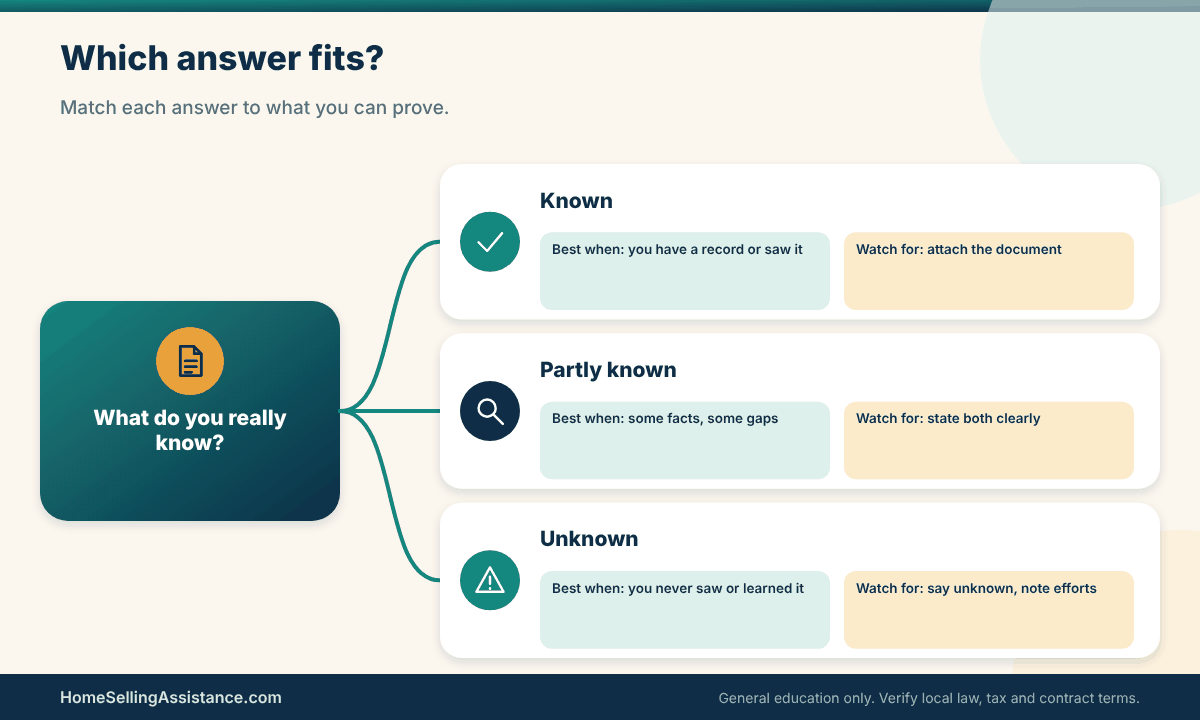
Avoid adjectives that sound like opinions. Words such as “minor,” “cosmetic,” “old but fine” and “never an issue” are judgments, and a buyer or inspector may judge differently. Facts travel better than feelings. Likewise, avoid absolutes like “never” and “always” unless you lived there the whole time and truly know. “None that I am aware of” is a precise, honest phrase for something you have not observed, and it is not an evasion when it is true.
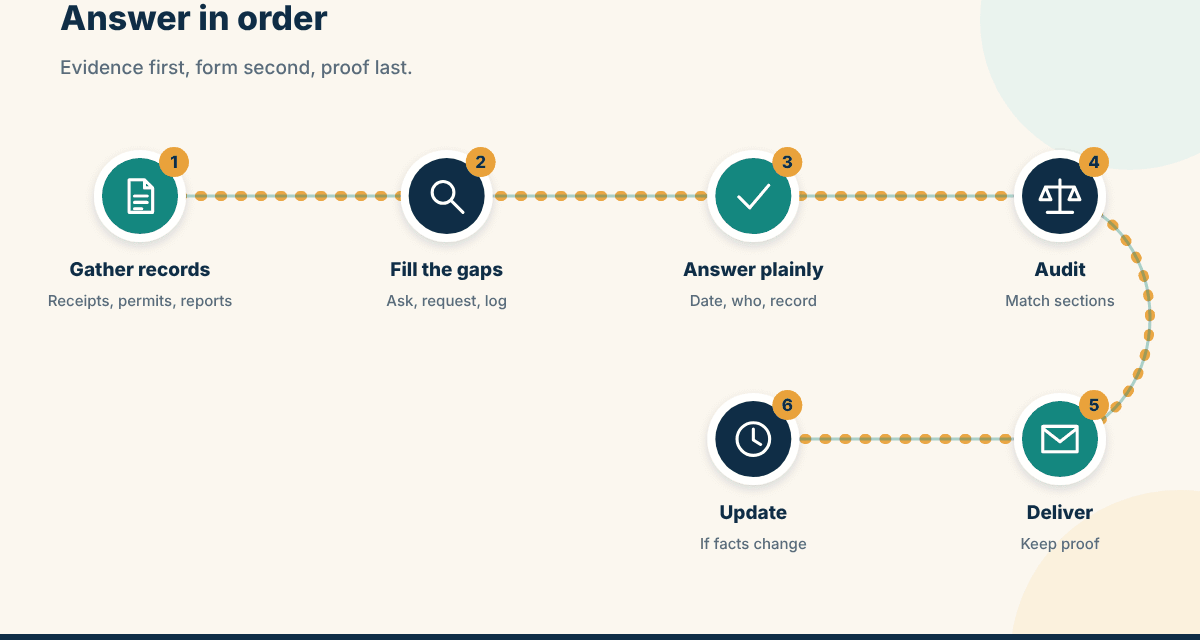
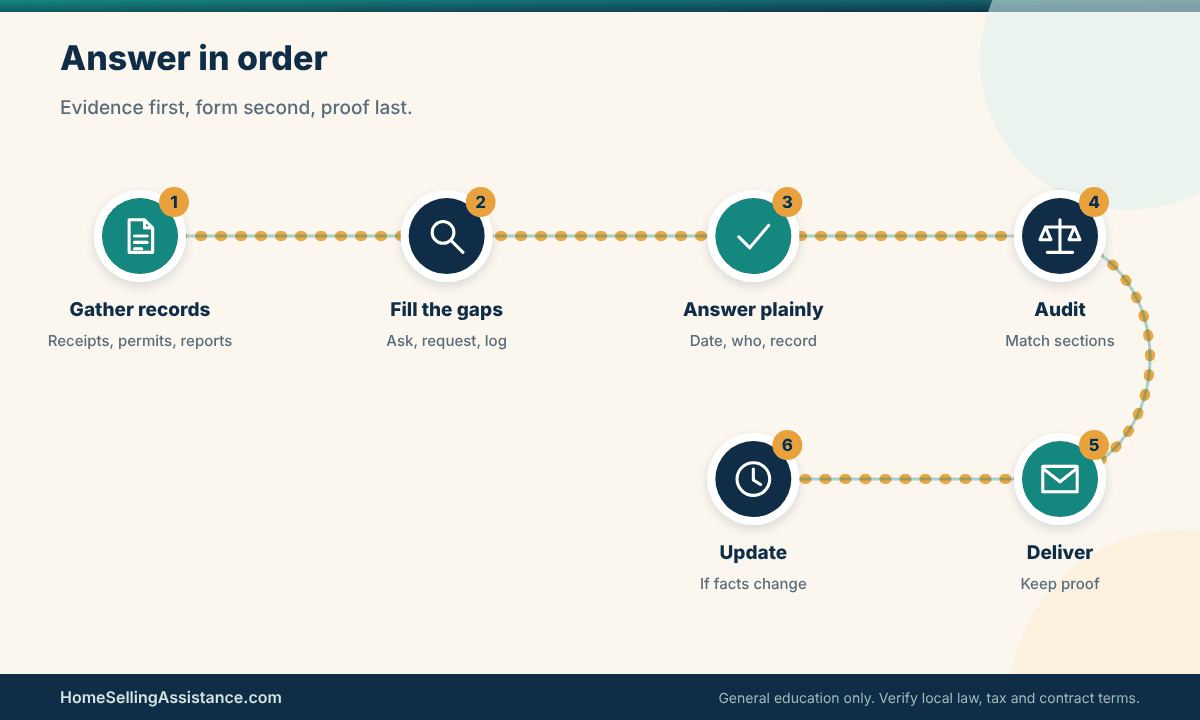
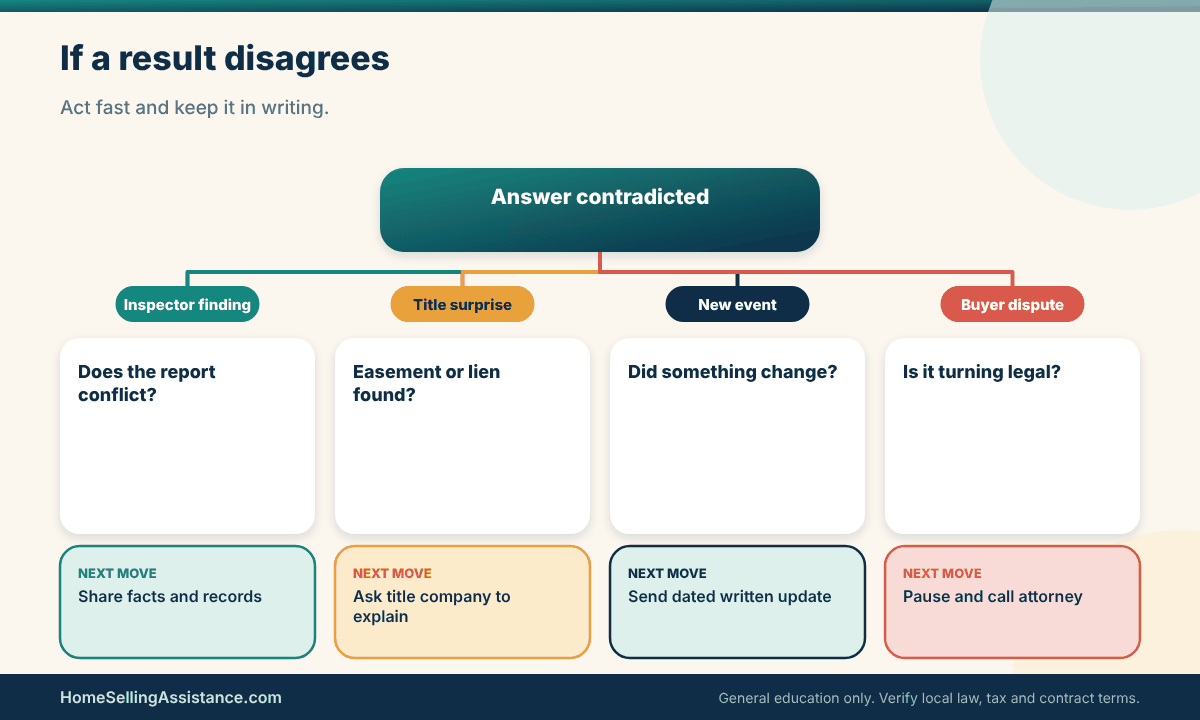
When you need to say you do not know, say it once, clearly, and add what you did to find out. A line such as “Unknown. Purchased in 2016; prior owner’s disclosure did not address this item” is better than a blank, better than a shrug and far better than a guess. Our picture below shows the order most sellers find easiest, from gathering through delivery and follow-up.
One more practical point. If a question is unclear, ask the person who provided the form what it means rather than choosing the interpretation that favors you. Sellers sometimes read “known defects” as “defects I consider serious,” when the form means “anything you are aware of.” If in doubt, ask your agent, attorney or the agency that publishes the form, and make a note of the answer you received.
Evidence to gather: what to check before you sign anything
Before signing, put the finished draft next to your supporting file and do a short audit. For every “yes” answer, is there a description a buyer could understand and, ideally, a document that backs it up? For every “no” answer, is that “no” based on knowledge or on assumption? A true “no” means you actively know there is no such issue. If you simply have not checked, “unknown” is more honest.
Check consistency across every section of the seller property questionnaire. If the plumbing section says there were no leaks, the water damage section should not mention a plumbing repair. If the form says no renovations, your attached receipts should not show a kitchen remodel. Small mismatches look careless at best, and a buyer’s attorney may read them as evasive at worst.
Finally, confirm that you are using the right seller property questionnaire. States with required forms usually publish them through the state real estate commission or an official association. If you are unsure, ask your title company, which sees many transactions in your area and will know the local expectation. Using an outdated or generic form when a particular one is required can create its own problems.
A scenario, an exception, and your next step
Take Priya, who is selling a townhouse with a small, finished loft she suspects was added by the builder as an option. The seller property questionnaire asks about unpermitted additions. She has no permit in her file and the HOA documents are silent. She is tempted to answer “no” because the builder presumably handled everything.
Her better move is to ask the building department and the HOA whether the loft appears in the original plans. If the answer comes back clear, she can say so and cite the source. If it comes back unclear, she can mark the answer as unknown and add a note describing her efforts. Either path is defensible. Guessing in the buyer’s favor and guessing in her own are equally risky.
For sellers who suspect work was done without permission from the city, we cover the wider issue in selling a house with unpermitted work, including why the seller property questionnaire is often just the first place the problem surfaces.
Handoffs, negotiations, and contingencies
Once the form leaves your hands, it starts moving. It goes to your agent or attorney, to the buyer and their agent, often to the buyer’s inspector, and eventually into the contract file. Each handoff is a chance for a small misunderstanding, so keep delivery clean: send it in a way that creates a record, such as an e-signature platform or email with a confirmation, and keep the timestamp.
Buyers often respond with questions. Treat those as normal and answer them in writing, using the same standard you used on the form: specific, documented, and honest about limits. A buyer who asks “when was the sump pump installed?” is not accusing you of anything. They are trying to understand the house, and a prompt, clear reply usually builds trust.
Contingencies come in as the contract takes shape. Many contracts give the buyer a window to inspect, review disclosures and negotiate repairs or credits. How your answers interact with that window is worth understanding. Our overview of home sale contingencies from the seller’s side explains the common types and the decisions each one creates.
Evidence to gather: what the buyer side will compare against
Expect the buyer’s inspector, appraiser and title company to produce information that you did not write. An inspection report may note staining that the buyer wants explained. A title search may reveal an easement you never mentioned. An appraiser may flag an unpermitted room. Each of those becomes a comparison point against your questionnaire.
You can prepare for this by reading your own seller property questionnaire the way a skeptical stranger would. Ask where an inspector would look, what a title search is likely to show, and which answers would fall apart if one document turned up. Where a gap exists, a short clarification now is far cheaper than a corrected statement later. Our guide to how a seller disclosure differs from an inspection report clears up which document says what.
Keep a simple log of every buyer question and your reply. If negotiations become tense, that log shows a pattern of cooperation, and it saves you from relying on memory about who said what, and when.
A scenario, an exception, and your next step
Imagine an inspector finds old water staining on a basement wall. Your seller property questionnaire said “no known water intrusion.” You remember a single minor seep after a heavy storm seven years ago, which was fixed with a small drainage adjustment, and you honestly did not think of it as a problem. The buyer now asks you to explain the discrepancy.
The strongest response is prompt, calm and factual. Tell them what you remember, provide any record you have, and tell your agent or attorney immediately so the form can be corrected or supplemented in writing if that is appropriate in your state. Do not argue about whether the issue “counts” as material. Let the facts and the paperwork do the talking, then follow whatever amendment process your contract describes.
An honest correction made early nearly always looks better than a defensive explanation made late. Most buyers can accept an old, fixed, well-documented issue. What they find hard to forgive is feeling surprised.
Close the loop on your seller property questionnaire
The last stretch of the sale is where careful sellers quietly separate themselves from hurried ones. Closing day is busy, the buyer is eager, and everyone assumes the paperwork is settled. This is exactly the moment to confirm that what was said on the form, what was promised in the contract and what the final walkthrough shows all line up.
It is also the moment to make sure nothing important lives only in a phone call or a text thread. A seller property questionnaire is a written record, so any change, clarification or agreement connected to it should end up in writing too, delivered in a way you can prove.
What to confirm in writing
Think of three kinds of written confirmation around a seller property questionnaire. First, the form itself: signed, dated, complete and delivered, with proof of delivery. Second, any updates, such as a corrected answer, an attached note or a supplement describing a new event. Third, any agreement that grows out of the form, like a repair credit, a repair completed by a licensed contractor, or a buyer’s acknowledgment that they reviewed a document.
Verbal assurances are the weakest link. If your agent says “the buyer is fine with that” about a disclosed issue, ask for the acknowledgment in an email or an addendum. If a buyer says they will accept a house with a known drainage quirk, the contract or a signed addendum is where that acceptance belongs. This is not about distrust. It is about preventing two honest people from remembering one conversation differently.
Use this second table as a quick check on common issues. It pairs each one with the evidence you hold, the input you may need from others, the risk of getting it wrong and a sensible fallback.
| Issue | Seller evidence | Buyer, agent or title input | Risk if unclear | Fallback |
|---|---|---|---|---|
| Past leak or damp area | Repair invoices, claim letters | Inspector’s moisture findings | Answer contradicted by report | Supplement the form in writing |
| Open or missing permit | Permit search results, final sign-off | Title or appraisal notes | Delay, credit request or loan issue | Disclose status, ask attorney about options |
| Boundary or easement question | Survey, plat, recorded documents | Title search results | Buyer surprise after closing | Disclose what you know, state what you do not |
| HOA fees or assessments | Dues statements, HOA packet | HOA manager, title company | Wrong figures on the form | Cite the HOA document, not memory |
| Appliance or system age | Receipts, serial plate photos | Inspector’s age estimate | Disagreement over “newer” claims | Give install year or say unknown |
| Change after signing | Dated photos, repair paperwork | Buyer’s agent, closing attorney | Stale form at closing | Deliver written update with proof |
Read it by picking the row closest to your worry and following it left to right. The fallback column is deliberately modest. It is a prompt for a conversation with your agent, attorney or title company, not a ruling on how your state handles the issue.
Before moving on, it helps to name the mistakes that turn up most often when sellers complete a seller property questionnaire. The first is answering from memory when a record exists. Memory softens, and it tends to soften in the seller’s favor without any bad intent. The second is answering “no” to everything because it feels safe, when “unknown” would be true. The third is treating the form as separate from the rest of the file, so that the seller property questionnaire says one thing and the listing description, the inspection reply or an email says another.
Other common slips are quieter. Sellers forget to mention that a problem was fixed, which makes a resolved issue look like an unresolved one. They write over each other when two co-owners fill in the form separately, producing answers that do not match. They also let a friend or relative “help” by answering questions about a house they have never lived in. If you share ownership, agree on one set of answers, check them against the records, and have every owner review the final draft before signing.
Federal rules sit alongside state ones, and sellers of older homes should know about at least one. For houses built before 1978, a separate federal lead-based paint disclosure applies, which the EPA explains on its real estate disclosure page. That is distinct from a general questionnaire, but the two often travel together, and our guide to lead paint disclosure for sellers walks through how the pieces fit.
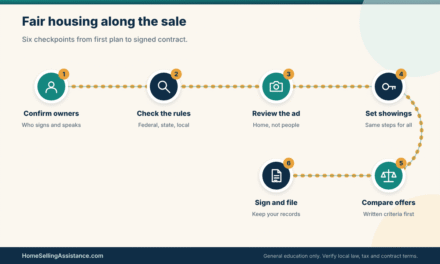
Fair housing is worth a short note too. Your seller property questionnaire answers, and anything you say while explaining them, should describe the property and its history, not the people who may live near it or who you imagine would buy it. Questions about neighborhood character can wander into territory you should avoid. HUD publishes guidance on its fair housing and equal opportunity pages, and our article on fair housing for home sellers goes further.
Quick scenario
Two siblings sell their late parents’ house. One answers the roof question “replaced recently” because she remembers a contractor visiting. The other answers “unknown” because he never saw an invoice. Their drafts disagree. After a short phone call to the roofer, they learn the work was a repair to one slope, not a replacement, and they agree on a single sentence with a date and a copy of the invoice. A five-minute call replaced two conflicting guesses with one clear fact.
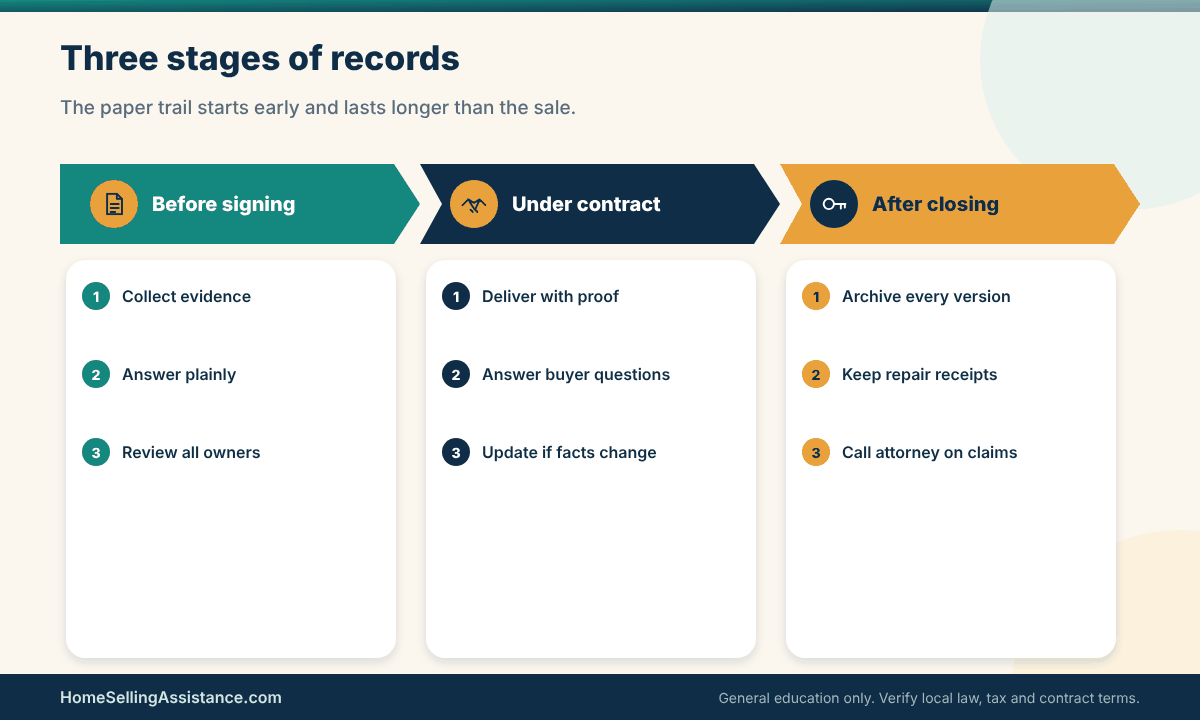
The picture above sums up the rhythm: collect, verify, state plainly, deliver, and keep the proof. Everything after this point is about confirming that the rhythm held through closing and afterward.
Evidence to gather: the final paper trail before closing
About a week before closing, assemble a short final folder. It should contain the signed form, any supplements, the delivery confirmations, the key supporting documents and any written agreements about repairs or credits. If repairs were agreed, collect the invoices, any warranty and, where relevant, proof that permits were closed.
Check the dates. A form signed three months before closing may be perfectly fine, but if anything has changed since, such as a storm, a repair or a new insurance claim, you should ask how your state and contract expect that to be handled. Some jurisdictions require an update, some leave it to the contract, and some expect you to tell the buyer promptly regardless of whether a form is in play.
Also confirm that the buyer’s side has actually received what you sent. An email stuck in a spam folder is a very ordinary way for a disclosure dispute to start. A quick message asking the buyer’s agent to confirm receipt costs nothing and closes the loop in a way that is hard to argue with later.
A scenario, an exception, and your next step
Suppose Elena signed her form in March and went under contract in April. In May, a windstorm tears off a section of fence and a branch punctures a corner of the garage roof. She patches it temporarily and files an insurance claim. Her form, signed before the storm, says nothing about roof damage or claims.
Elena does not need to panic, but she does need to act. She tells her agent the same day, asks how the contract treats changes in condition before closing, and delivers a short written update with photos and the claim number. The buyer may ask for a repair, a credit or an extension, and that is a negotiation, not a catastrophe. What would hurt is the buyer finding the damage at the walkthrough with nobody having said a word.
In some sales, a lender or insurer may also care about open claims, so ask your title company and your insurance agent how to handle the paperwork. The aim is simple: no important fact should reach the buyer by accident.
A last habit worth building is a short read-aloud test. Before you sign, read each answer on your seller property questionnaire out loud as if you were explaining it to the buyer at your kitchen table. If a sentence makes you wince, rewrite it until you could say it with a straight face and a receipt in your hand. If a sentence is longer than the facts justify, trim it. The goal is a document that sounds like you on your most careful day.
Many sellers also find it useful to have one person who did not write the answers read them cold. A friend, a relative or your agent can tell you quickly where a seller property questionnaire is confusing, where two answers seem to disagree and where a missing date leaves a question hanging. Fifteen minutes of fresh eyes catches mistakes that hours of rereading never will, and it costs nothing but a favor.
Keep in mind that the point of all this care is not to make the house sound perfect. Buyers expect an older roof, a quirky basement or a well-used kitchen. They are far more comfortable with an honest, well-documented seller property questionnaire that shows a few ordinary flaws than with one that claims there are none. Believability is worth more than polish, and it tends to support smoother negotiations because the buyer already trusts your account.
Records and follow-up after closing
After the keys change hands, it is tempting to throw the folder in a drawer and never look at it again. Resist that for a while. Disputes over disclosures, when they happen, can arrive months or years later, and the sellers who handle them calmly are almost always the ones who kept good records. How long to keep them depends on your state, your situation and your advisors, so treat any single number you read online with caution.
Records from your seller property questionnaire serve a second purpose that has nothing to do with disclosure. The same receipts that support your questionnaire answers may also help when you figure out your home’s cost basis for taxes. Our article on home sale tax records explains what to hold on to and why, and the IRS has general information in Publication 523 on selling your home.
Finally, think about the hand-off to the next chapter. If the buyer contacts you after closing with a question about the house, such as where a shutoff valve is or who installed the gutters, a friendly, factual reply is both kind and sensible. If the question starts to sound like a claim, stop, keep copies and speak with an attorney before replying in detail.
Evidence to gather: what to archive and where
Create one folder, digital with a backup if possible, for the sale. Include the signed seller property questionnaire and every version, supporting documents, delivery confirmations, the contract and addenda, the final closing statement, inspection reports you received, repair invoices and a dated list of questions the buyer asked and your answers. Add the walkthrough record if you have one.
Name files in a way a stranger could understand. “Questionnaire-signed-2026-03-12” is helpful. “Scan0042” is not. If you stored anything in an email account you may close or in a cloud service you may stop paying for, export it. A surprising amount of important paperwork vanishes because it lived on an old phone.
Ask your attorney, title company or tax professional how long to keep each category. Their answers may differ, because disclosure risk, tax records and contract records can follow different clocks. Until you have those answers, keeping everything is the cheap, safe default.
A scenario, an exception, and your next step
Imagine a seller who receives a letter fourteen months after closing. The new owners say they found a past repair behind a wall that was not mentioned. The seller’s first instinct is to call the buyers and explain, which feels neighborly and quick. That instinct is understandable, and it is also the moment to slow down.
A better first step is to pull the folder. Does the seller property questionnaire address the area? Was the repair documented? Was a supplement delivered? Then contact an attorney, share the folder and let them guide the reply. Even sellers who did everything right should not improvise legal responses.
If the folder shows an honest answer, a clear record and prompt cooperation, the seller is in a much stronger position than one who relies on memory. Most of the value of good records is invisible, because the disputes they prevent never happen.
Frequently asked questions about seller property questionnaire
Do I have to complete a seller property questionnaire?
It depends on your state, your type of property and sometimes your contract. Some states require a specific disclosure form, some allow sellers to decline in return for an “as is” sale, and some leave it to negotiation. Your state real estate commission, a local attorney or your title company can tell you what applies. Our overview of seller disclosure requirements explains the general landscape.
What if I truly do not know the answer to a question on the seller property questionnaire?
Say so. Use the “unknown” or “no knowledge” option if the form has one, and add a brief note describing what you checked. A sincere “I do not know” backed by a few attempts to find out is honest and defensible. A guess, in either direction, is not.
Can I fill out a seller property questionnaire myself, or should my agent do it?
You can usually complete it yourself, and in many sales your agent or attorney will review it for completeness. Remember that your signature carries the statements, because only you know what you have seen. Professionals can explain wording, but they should not answer factual questions on your behalf without you checking the answers.
Is a seller property questionnaire the same as a home inspection?
No. The questionnaire records what you know about the property’s history and condition, while an inspection reports what a trained inspector observes on a particular day. They complement each other, and a mismatch between them is what tends to start negotiations. Our guide to seller disclosures versus inspection reports compares them in more detail.
What if I discover a problem after I have signed the seller property questionnaire?
Tell your agent or attorney promptly and ask how your state and contract expect updates to be handled. Some places require a written amendment, and others expect notice through the contract process. Delivering a dated, written update with any supporting documents is generally better than staying silent. Waiting until the walkthrough tends to make a small issue look like a hidden one.
Do repairs I paid for belong on a seller property questionnaire?
Many forms ask about past repairs, especially for water, structure, roof, plumbing, electrical and heating or cooling systems. A repair that was done well and documented usually reads as a positive, because it shows you took care of the house. Describe what was done, when and by whom, and attach the receipt if you have it. Leaving out a repair that the form asks about is the part that causes trouble.
What if the previous owner never told me about a problem?
Your questionnaire covers your own knowledge, so you generally answer based on what you know and what the records show. If the previous owner’s disclosure exists, it can help you recall the history. If you suspect something, such as work done without permits, it is wise to check with the building department and ask a professional how to word it. Our article on material defects in seller disclosures gives more context.
Does an “as is” sale mean I can skip the seller property questionnaire?
Not necessarily. In many places, selling as is changes who is expected to pay for repairs, but it does not automatically erase duties to disclose known material problems. Rules vary by state, and the exact contract language matters. If you plan to sell as is, speak with a local attorney or your agent about what the form and your state still require.
Should I update my seller property questionnaire if I make repairs before closing?
If repairs change the facts the form describes, ask how to document the change. A brief written update with the invoice or permit closeout is often a sensible approach, and it can strengthen your credibility with the buyer. Check your contract for any timing or notice requirements. The same logic applies to new problems that appear between signing and closing.
How long should I keep my completed seller property questionnaire?
There is no single number that suits everyone, since disclosure disputes, tax records and contract records can follow different timelines. Your attorney, title company or tax professional can suggest a reasonable period for your state and circumstances. Until you hear back, keeping the signed form, every version and all supporting records is a simple and low-cost precaution.
Answer carefully, then keep the proof
A seller property questionnaire rewards patience far more than cleverness. Gather the records, answer in plain words, say “unknown” when that is the truth, deliver in a way you can prove and keep every version. If you want the wider picture, our guide to seller disclosure requirements and the disclosures and seller paperwork section go deeper. This article is general education, not legal, tax or financial advice; rules differ by state, so confirm details with your state real estate commission, a licensed attorney or your title company.