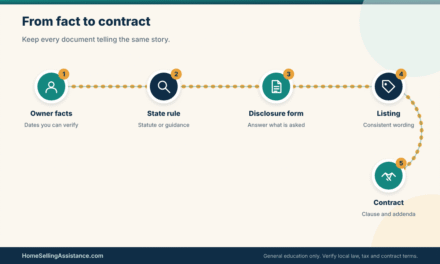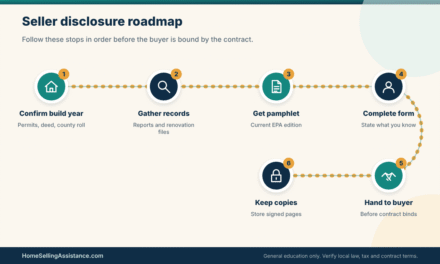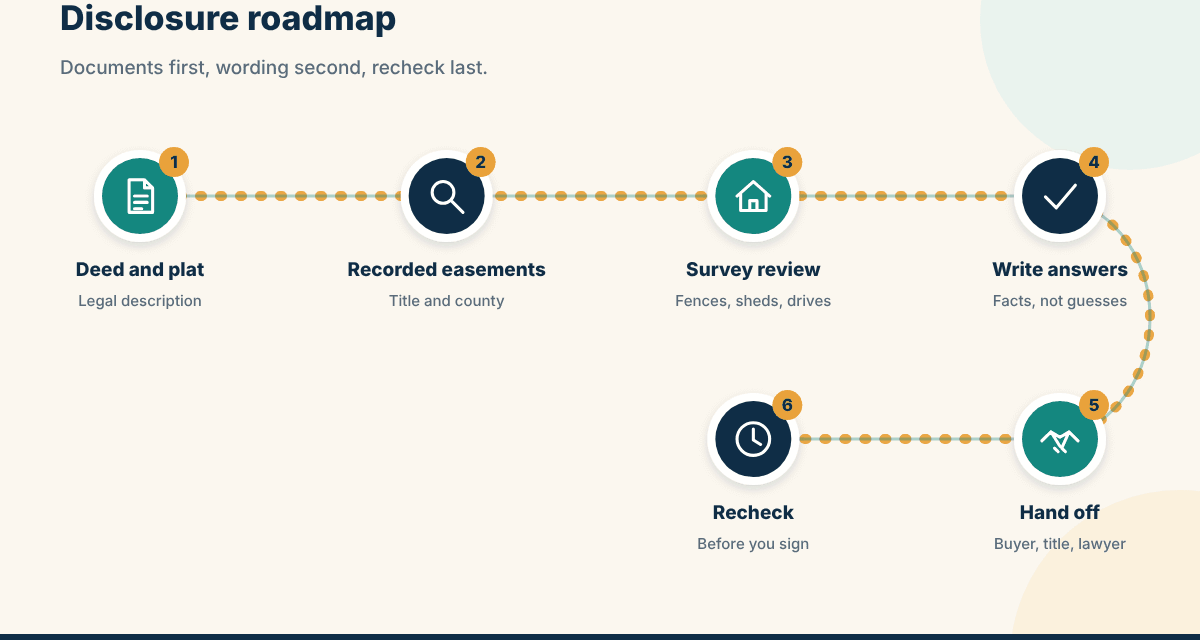
An easement encroachment seller disclosure is the part of your listing paperwork where you tell a buyer, in writing, what you know about other people’s rights over your land and about anything that crosses a property line, and doing it well starts weeks before the first showing, with documents rather than opinions.
Most sellers have never thought about their lot lines in any serious way. The fence was there when you bought the house. The utility company has a green box in the corner of the yard. The neighbor’s driveway might curve a foot or two onto your side, but it has looked like that for fifteen years and nobody has complained.
Then a buyer’s surveyor shows up with a tripod and an orange flag, and suddenly a quiet arrangement becomes a contract problem with a deadline attached. A sound easement encroachment seller disclosure is the way you replace that vague comfort with facts.
The good news is that boundary, easement and encroachment questions are some of the most solvable problems in a home sale, provided they surface early. A recorded easement that you knew about and explained up front rarely scares a buyer. An unexplained one that appears in a title commitment ten days before closing can sour a deal, because by then everyone is tired and nobody is sure what else you forgot to mention. That is the whole case for treating the easement encroachment seller disclosure as early homework.
This guide walks through what these terms mean in plain language, how to work out who actually owns and controls the land, what to gather before you list, how to word your answers on a disclosure form, and what to hand to the buyer, the title company and your attorney. It sits inside our wider library on seller disclosure requirements, and it stays general on purpose.
Disclosure duties, survey customs and the legal effect of long-standing boundary use differ from state to state, so we will point you to the places where you can check the rules yourself instead of guessing.
Key takeaways
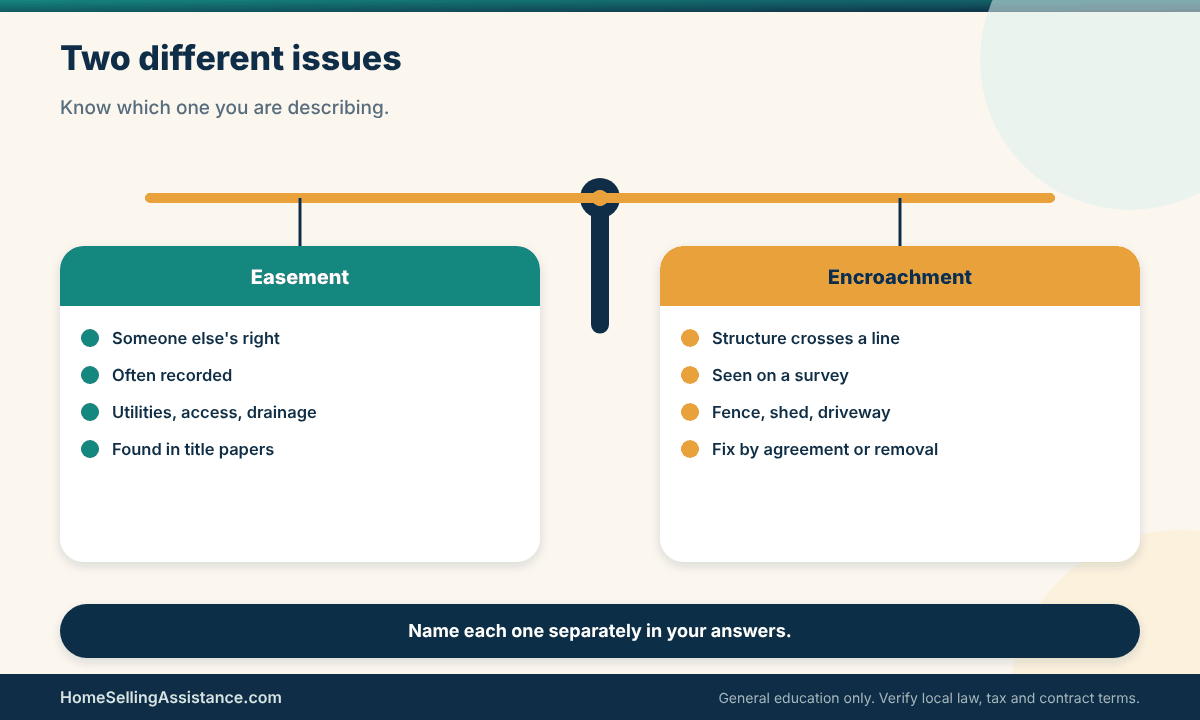
- Know the three words. A boundary is where your land legally ends, an easement is someone else’s right to use part of it, and an encroachment is something built across a line. They are related but they are not the same problem.
- Documents beat memory. Your deed, any survey, the recorded plat and the recorded easements tell you more than neighborhood folklore, so pull them before you fill out any form.
- Disclose what you actually know. An easement encroachment seller disclosure should be accurate, specific and attached to evidence, not vague and not a guess about the law.
- State rules differ. No single national rule tells you how much to say, so check your state real estate commission, a local attorney or your title company before you sign anything.
- Plan the handoff. The buyer, the lender, the title company and sometimes an HOA or neighbor all touch these issues, and each needs the right paper at the right time.
- Re-check before signing. Surveys age, fences move and neighbors change their minds, so confirm that every statement is still true on the day you commit to it.
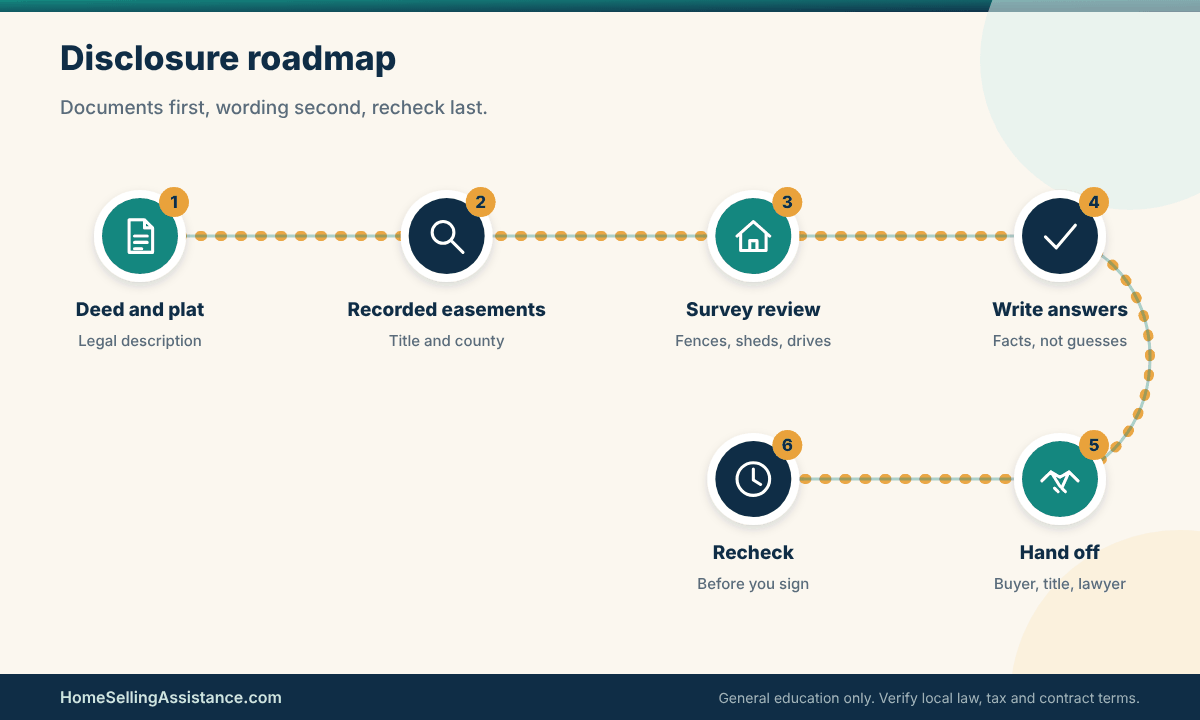
Start an easement encroachment seller disclosure with ownership and jurisdiction
Before you can describe a problem, you need to know whose land you are talking about and which rules apply to it. That sounds obvious until you realize how many sellers are not certain exactly what they own. Some assume the fence marks the line. Others assume their lot includes the strip of lawn between the sidewalk and the street, which in many places belongs to the public or is subject to a public right of way. A careful easement encroachment seller disclosure begins by replacing assumptions with a short list of verified facts.
Two questions come first. Who has the legal authority to sign the disclosure and the sales contract, and which recorded documents define the land and the rights attached to it? After that comes the jurisdiction question: which federal, state and local rules shape what you must say and how you must say it? We take them in that order, because the first answer often changes the second.
Whose name is on the deed, and which papers control the land
Start with the deed that put the property in your name. It carries the legal description, which is the formal wording that defines the lot, sometimes by lot and block in a recorded subdivision and sometimes by older measurements called metes and bounds. The street address is not part of that description.
If the people signing the sale contract are not the same people named on the deed, because of a death, a divorce or a trust, you may need extra paperwork before any disclosure carries weight. Every later line of an easement encroachment seller disclosure traces back to that description.
Beyond the deed, several other documents can control what you may say. A recorded plat is the map filed with the county when the subdivision was created, and it often shows utility easements along lot lines. A survey is a measured drawing prepared by a licensed surveyor. Recorded easement agreements, covenants and declarations may grant or limit rights that never appear on the deed you were handed at closing. And if you belong to an HOA or condominium association, its governing documents can add rules about fences, sheds and common areas.
Different documents answer different questions, which is why sellers get tangled. The deed tells you what was conveyed to you. The plat tells you how the subdivision was laid out. A survey tells you where things physically sit today. Only the recorded easements tell you who else may walk, drive or run pipes across your yard. None of them substitutes for the others, and an older document does not automatically beat a newer one.
If two papers appear to disagree, that disagreement is itself something to raise with a title professional or attorney rather than settle on your own. If you own in an association, our guide on selling a house with an HOA explains how those governing documents enter the sale. Keep that division in mind as you assemble your easement encroachment seller disclosure.
Evidence to gather: deed, plat, survey, and recorded easements
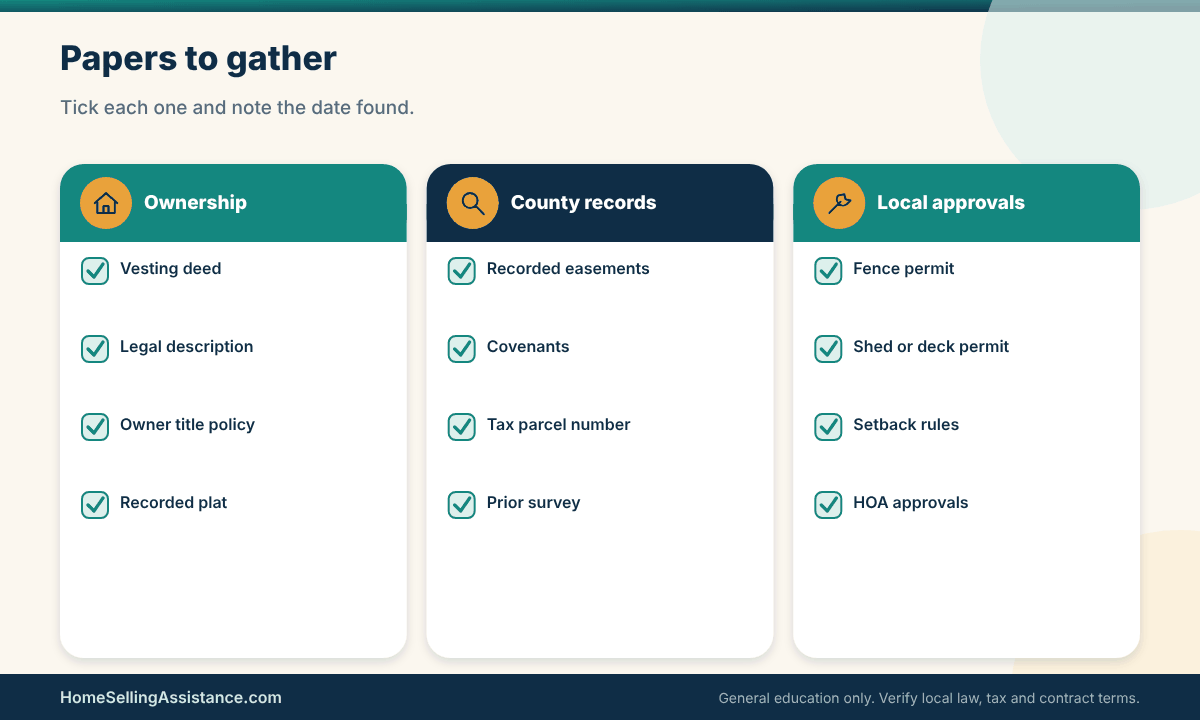
Build a small folder and label each piece by what it proves. Start with your vesting deed and the legal description. Add the owner’s title policy you received at your own closing, if you still have it, because its exceptions list names easements the title company noticed back then. Pull the recorded plat from the county recorder or register of deeds, which often posts images online or will provide copies for a small fee. Add any survey you were given and the date it was made. The folder becomes the backbone of your easement encroachment seller disclosure.
Then look for recorded easements separately. The title commitment or title policy usually lists them by recording number, which lets you request the actual instrument instead of relying on a one-line summary. Read the grant language itself. Does it say who holds the right, what the right allows, how wide the strip is, and whether anyone must maintain it? A utility easement for overhead lines is a very different thing from an access easement that lets a neighbor drive across your yard every day.
Finally, collect your own history. Permits for the fence, shed, deck or driveway. Photos showing when those things were built. Any letters or emails with neighbors about the line. Receipts from the contractor who installed the fence. None of these decide who owns what, but they let you describe the situation honestly and give your attorney a starting point if a dispute develops.
A scenario: the shared driveway nobody wrote down
Imagine two neighboring houses that have shared a single driveway for twenty years. The pavement straddles the property line, and both families park on their own side and use the whole width to back out. Nothing has ever been signed. You assume it is fine because it has always worked, and you leave the question blank on the disclosure form.
The buyer’s survey then shows the driveway sitting partly on the neighbor’s lot. Is it an informal permission that the neighbor can end at will? A recorded easement that you never noticed? Something the law of your state might treat as a right created by long use?
Those are three very different answers, and nobody can give you the right one from a kitchen table. In this illustrative case, the practical next step is to pull the recorded documents, ask the title company what its search found, and talk with a local real estate attorney about whether a written shared-driveway agreement could be signed and recorded before closing. Disclosing the situation plainly, with that plan, is usually easier on a deal than a surprise.
Federal, state, and local layers of disclosure
Sellers often ask which law requires them to disclose an easement or a boundary problem. The honest answer is that there is no single national rule for it. Federal disclosure rules in home sales are narrow and specific, with the EPA’s lead-based paint requirement for older homes being the best-known example. You can read about that rule in our guide to lead paint disclosure for sellers. Easements and encroachments are not covered by a general federal checklist. The practical consequence is that your easement encroachment seller disclosure should follow your own state’s form, not a national template.
The real rules live at the state level, and then the county and city add their own layers. Some states require sellers to complete a standard property disclosure form, and many of those forms contain questions about easements, shared structures, boundary disputes or encroachments. Other states lean more heavily on the buyer’s own inspection and survey, and give sellers less to complete but still prohibit lying or hiding known problems. Local governments add zoning setbacks, rights of way and permit records that affect where structures may sit.
Federal influence still shows up indirectly. Lenders have their own underwriting standards, and an appraiser or underwriter who sees a structure over a line may ask for a survey, an agreement or title insurance coverage before the loan moves forward. Those are private and program requirements rather than disclosure laws, but they can affect your timeline just as much.
Where to read your state’s rules without guessing
Start with your state real estate commission or the equivalent regulator. Most publish the standard disclosure form, consumer guides and agent license rules on a public website, and the form itself will show whether easements and encroachments are asked about by name. Next, look for your state’s statute on seller property disclosure if one exists. A local real estate attorney can tell you quickly whether your state treats disclosure as mandatory, optional or limited by an as-is clause. Bring what you find to the conversation about your easement encroachment seller disclosure.
Your county recorder or register of deeds can show what has actually been recorded against the property. Your city or county planning and zoning office can tell you about setbacks and public rights of way. And the title company handling your sale can explain how its local search handles easements. Our overview of the disclosures and seller paperwork library collects related guides, and the national association’s site at NAR offers general consumer education, though it cannot tell you what your state requires.
An exception: when the form is silent but the duty is not
Here is a trap that catches careful people. Your state’s form might not contain a question about boundary disputes at all. A seller reads that, relaxes, and says nothing about the neighbor’s written threat to sue over the fence. In many places, the duty to avoid misrepresentation does not depend on whether the form asked the exact question. Concealing a known, serious problem, or answering a related question in a misleading way, can create exposure that a missing form line does not erase.
The reverse can also be true. Some states give sellers more protection when they use an as-is clause, and others limit that protection. Because the answer depends on local statutes and case law, this is a moment for an attorney, not for a guess. A reasonable next step is to write down what you know, in plain sentences, and ask your attorney or agent how your state expects that knowledge to be handled. Our comparison of a seller disclosure versus an inspection report shows how those two documents divide the work.
It helps to picture who will read your answers. A buyer reads an easement encroachment seller disclosure looking for limits on what they can do with the yard: a pool, a shed, a new fence, an addition. A lender reads it looking for anything that clouds title. An attorney reads it looking for statements that could later be called misleading. If your wording works for all three readers, it is probably clear enough.
Jurisdiction also decides who else may need to see it. In some states a licensed agent has their own duty to pass along material facts they know, which means a boundary problem you mention to your agent can become part of what they must tell the buyer. In attorney-driven states, the lawyer may prepare the contract language about surveys and title exceptions. Ask early who handles what, so that your easement encroachment seller disclosure is not written twice in two different ways.
Turn the easement encroachment seller disclosure into a seller workflow
Knowing the rules is half the job. The other half is a sequence of small actions that gets accurate information onto the right page, into the right hands, before the buyer’s deadlines start running. Treat the easement encroachment seller disclosure as a mini project with a start, a middle and a handoff, instead of a form you complete in ten minutes at the kitchen counter on listing day. Done early, the easement encroachment seller disclosure becomes a routine part of listing prep.
The matrix below shows the most common boundary-related issues side by side. It is a map of questions to ask, not a legal ruling. Each row names the issue, the document or authority that usually controls it, what you as the seller generally must do or may choose to do, when it tends to matter, and where you check locally. Cell contents stay general because deadlines and duties depend on your contract and your state.
| Issue | Controlling document or authority | Seller obligation or choice | Typical deadline | Local verification |
|---|---|---|---|---|
| Recorded utility easement | Plat or recorded easement instrument | Disclose if the form asks; share the recording number | Before or with the listing packet | County recorder, title commitment |
| Shared driveway or access | Recorded agreement, deed, or survey | Describe use; consider a written agreement | Before the buyer’s review period ends | Local attorney, title company |
| Fence off the line | Survey and deed legal description | Disclose known position; do not claim the fence is the line | At disclosure and again if a survey changes it | Surveyor, local attorney |
| Neighbor’s structure on your lot | Survey, title exceptions | Disclose what you know; avoid guessing about legal effect | Promptly once known | Attorney, title company |
| Your structure on a neighbor’s lot or easement | Survey, permit record, setback rules | Disclose; consider an agreement, removal or title coverage | As early as possible | Planning office, attorney |
| HOA or common-area line | Declaration, plat, association rules | Disclose and request association documents | Per contract and association timeline | Association manager, attorney |
Use the table as a prompt for your own folder. For each row that applies to your property, write down the document you hold, the document you still need and the person you will call. The “typical deadline” column is deliberately loose, because the real dates sit in your listing agreement and your purchase contract. If any row feels uncomfortable, that is usually the one to take to an attorney first. That list is the raw material of your easement encroachment seller disclosure.
Writing the easement encroachment seller disclosure, step by step
Disclosure forms ask short questions, but every easement encroachment seller disclosure answer carries weight. A line that reads “any easements or encroachments?” invites a quick yes or no, and sellers who answer fast tend to answer from memory. A better habit is to slow down, check your folder, and let the documents shape the wording. If you are using a state form, read the instructions printed on it. If you have a longer property questionnaire from your agent, our guide to the seller property questionnaire explains how those fit together.
Describe facts, not conclusions. “The county plat shows a ten-foot utility easement along the rear lot line” is a fact. “The easement is not a problem” is a conclusion you may not be qualified to reach. “I am aware that the fence along the east side may not follow the property line; I have not had a survey done” is honest about what you know and what you do not. Specific, modest statements protect you better than broad reassurance. That habit keeps an easement encroachment seller disclosure credible.
Keep your knowledge standard in mind. Many disclosure rules turn on what a seller actually knows rather than what could be discovered. That does not give you permission to avoid learning. If you suspect a problem, getting the facts is usually better than staying carefully ignorant, because a buyer’s survey will find it anyway.
Evidence to attach: photos, letters, and agreements
Attachments turn a vague line into a clear record. If a recorded easement affects the property, attach a copy of the instrument or at least the recording number. If the fence or driveway sits near the line, attach the survey, with its date visible. If a neighbor once agreed in writing that a shared driveway could stay, attach that note, and if you only have a verbal understanding, say so plainly. Attachments are what make an easement encroachment seller disclosure verifiable.
Photos help in specific ways. A dated photo of a boundary marker, a fence corner or a utility box tells the reader what you saw. Do not annotate photos with legal opinions. Just label them with the location and the date. If the issue involves a structure built without a permit, such as a shed or deck that sits close to the line, our guide on selling a house with unpermitted work explains how that second layer of disclosure works.
Finally, keep copies of everything you send. When a buyer later claims they were not told, a dated packet showing what you provided and when is the strongest plain-language record you can have. Keep that packet with the rest of your easement encroachment seller disclosure records.
A scenario: the fence that was always there
Suppose you bought your house eleven years ago and the wooden fence was already standing. You never had a survey. The disclosure form asks whether you know of any boundary line disputes or encroachments. You have no dispute, so you are tempted to write “no” and move on.
Consider the more careful version of the answer. “No known dispute with neighbors. The fence along the north side was in place when I purchased and I do not know whether it follows the recorded lot line; no survey was done during my ownership.” That sentence does not admit a defect, and it does not claim certainty either. It tells the buyer what you know and gives them a fair prompt to order a survey if they care.
If the survey later shows the fence is a foot off, the buyer has been warned, and the conversation moves to options instead of accusations. Your attorney or agent can tell you whether your state’s form wants more or less detail than that. Notice how little drama a clear easement encroachment seller disclosure actually needs.
Handing the issue to the buyer, the title company, and your attorney
Once your easement encroachment seller disclosure is written, the next job is the handoff. Several people look at boundary and easement matters from different angles, and each one wants different paperwork. The buyer wants clarity about what they are purchasing and what limits come with it. The lender and its underwriter want a clean enough title and a property whose structures sit where they should. The title company wants to see recorded documents and decide what it will insure. And your attorney, if you have one, wants to know about anything that might turn into a dispute.
Timing is the quiet variable. Many contracts give the buyer a review or due diligence window in which they can order a survey and object to title matters. If your easement encroachment seller disclosure arrives late, that window may already be running, and a problem found by the buyer’s own surveyor feels very different from a problem you mentioned in the listing packet. Early disclosure shifts the question from “what else are they hiding?” to “how do we handle this?” Our overview of the real estate sales contract from the seller’s side covers where those windows usually sit.
What the title commitment and survey will reveal
A title company starts with a search of the public record and produces a commitment or a preliminary report. It lists what it will insure and what it excludes or takes exception to, and recorded easements, restrictive covenants and sometimes visible encroachments appear on that list. Read it line by line when you receive it. Our guide to the title search in a home sale explains the process and why sellers should request their copy early rather than wait for the buyer’s.
A survey shows something the title search cannot, which is the physical reality on the ground. It can reveal a fence that wanders, a shed that straddles a line, an eave that overhangs, or a driveway that wanders onto the next lot. Some title companies will remove or soften the standard survey exception if they receive a current survey and, in some cases, an affidavit from the seller. Whether that is available, and what it costs, depends on the company and the state, so ask the title officer directly instead of assuming.
Not all surveys are the same. A full boundary survey stakes the corners and shows improvements. A shorter location or mortgage inspection survey may only confirm that buildings sit within the lot. Ask the surveyor and your title company which type your buyer’s lender and the title policy will accept.
A scenario: the buyer’s survey finds the shed over the line
Picture an accepted offer, a buyer’s survey and a phone call from your agent. The survey shows that your garden shed sits partly on the neighbor’s lot by an amount the surveyor can state to the inch. The buyer asks what you plan to do about it. This is stressful, but it is also a common situation with several paths.
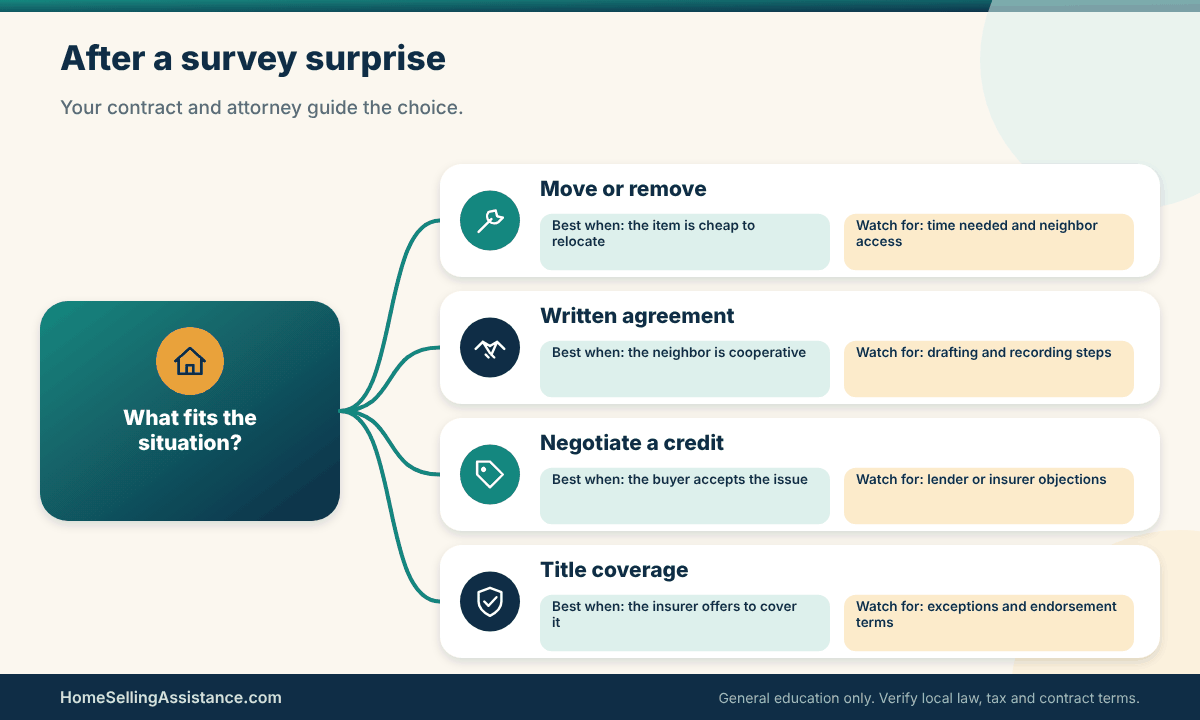
The paths usually look like this. You can move or remove the shed, which may be the fastest fix. You can ask the neighbor whether they would sign a written agreement acknowledging the shed’s location, ideally one your attorney drafts and the county records. You can offer the buyer a credit or other concession if the structure has little value. Or you can ask the title company whether it will insure over the issue. Each option carries its own risks and costs, and none is a promise of a particular result. The scenario table below lays out the logic.
| Situation | Seller options | Main risk | Document to review | Escalation point |
|---|---|---|---|---|
| Buyer’s survey shows your shed over the line | Move it, seek a neighbor agreement, negotiate a credit | Delay or buyer cancellation within contract terms | Survey, contract review period | Real estate attorney |
| Neighbor’s fence sits inside your lot | Disclose, ask neighbor for a written acknowledgment | A buyer inheriting a dispute | Survey, deed description | Attorney or surveyor |
| Title commitment lists a recorded access easement | Share the instrument, explain actual use | Buyer misreading the easement’s scope | Recorded easement, title commitment | Title officer |
| Neighbor claims a right from long use | Stop guessing; document facts and consult counsel | Legal claim affecting marketability | Letters, photos, permits | Attorney before replying |
| HOA says a structure violates its rules | Request written violation notice and cure options | Closing delay or association fees | Declaration, architectural approvals | Association manager, attorney |
| Survey contradicts the older plat or deed | Ask surveyor and title company to reconcile | Insurer excepting the discrepancy | Plat, deed, current survey | Surveyor, attorney |
Read the table from left to right. Find the row that resembles your situation, note the document it points to, and gather that document first. Then notice the last column. If your issue lands in the escalation column, treat that as the moment to stop improvising and make an appointment. A short consultation before you reply to the buyer, a neighbor or an association is often far cheaper than repairing an unhelpful email afterward. The table works best as a companion to your easement encroachment seller disclosure, not a replacement for it.
One more habit pays off at this stage: keep a short log. Each time you send a document, speak to a surveyor, hear from a neighbor or receive a title update, write a one-line entry with the date. The log is not a legal filing. It simply lets you answer “when did you first know?” with a calm, accurate sentence, which matters because a good easement encroachment seller disclosure is as much about timing as about wording.
Also remember that your agent, if you have one, is a coordinator rather than a surveyor or a lawyer. A good agent can tell you what is customary locally, remind you of contract dates and pass documents along. They cannot decide the legal meaning of a recorded easement or promise how a neighbor will react. If your easement encroachment seller disclosure touches a question like that, ask your agent who the right specialist is and let them schedule the call.
Build a verification checklist for your easement encroachment seller disclosure
A good checklist does one thing: it separates what you believe from what you have confirmed. Everything in an easement encroachment seller disclosure should land in one of those two piles, and the form should say which. A seller who writes “the survey dated last spring shows the fence two feet inside the line” is on firm ground. A seller who writes “I think the fence is on the line” is reporting a belief, and the buyer is entitled to treat it that way.
The checklist in this section has two parts. The first is where to find official and recorded sources, so you are not leaning on hearsay. The second is a short list of items that must be current at the moment you sign, because boundary facts have a way of changing quietly between the day you listed and the day you accepted an offer. Think of it as a pre-flight routine, not a legal test. Used well, it keeps your easement encroachment seller disclosure honest about what is confirmed.
A caution first. A checklist for an easement encroachment seller disclosure helps you organize facts, but it cannot decide what those facts mean. Whether an easement limits a buyer’s plans, whether a long-used strip of land has become someone’s legal right, and whether a structure violates local rules are legal questions whose answers vary. When a fact falls on the line between “I know” and “I think,” that is your signal to ask a professional.
Official sources and recorded documents to pull
The most reliable sources are the ones you can cite by number. A recorded document carries a book and page or an instrument number, a date and a county, which means anyone can look it up and see the same words. An informal note from a neighbor or a sketch on the back of an envelope may be useful context, but it cannot stand in for the record. As a rule, whenever you can replace a memory with a recording number, do it. Those numbers belong in your easement encroachment seller disclosure wherever you can supply them.
Where those numbers come from varies a little by county. Many county recorders let you search by owner name or parcel number and view images online. Others require a visit or a request through a title company. Assessor and GIS maps can help you visualize a parcel, but they are usually not survey-grade, and most disclaim any use as a legal boundary. Use them to orient yourself, then confirm with a survey or the recorded plat. For land with unusual features, such as large parcels, wells, private roads or shared drives, see our guide on selling a rural home.
Evidence to gather: county records, plats, and permits
Create a simple list and tick each item as you collect it. First, the recorded deed into your name and the legal description it contains. Second, the recorded plat or map for your subdivision or condominium. Third, every recorded easement, covenant or declaration that touches the parcel, which you can usually trace from the title policy or commitment. Fourth, the most recent survey in your possession, with the surveyor’s name and the date.
Fifth, any local permit records for fences, sheds, decks, driveways, additions or retaining walls. Your city or county building department can often tell you whether a permit exists, and some jurisdictions have rules on how close structures may sit to a property line. Sixth, property tax records showing the parcel number, which makes every other search easier. Seventh, any correspondence with neighbors, utilities or associations about the line, a shared structure or an access right.
If an item does not exist, write “none located” next to it with the date you looked. That small note shows that you searched, which is better than a blank space that could mean anything. Small notes like that make an easement encroachment seller disclosure easier to defend later.
A scenario: the easement hiding in an old subdivision plat
Imagine a seller who is certain the property has no easements. They have lived in the house for nearly twenty years and have never seen a utility crew. The deed does not mention any. They answer “no” on the disclosure form with a clear conscience. A careless easement encroachment seller disclosure often starts with exactly that kind of certainty.
The plat, though, tells a different story. When the subdivision was recorded decades ago, the developer drew a narrow strip along the back of every lot labeled as a drainage and utility easement. The seller’s new deck sits over part of it. Nobody has ever objected, but the right exists on paper and the buyer’s title commitment lists it.
In this illustrative case, the seller’s mistake was not dishonesty but a gap in checking. The cure is to read the plat before answering, mention the easement and the deck honestly, ask the local utility or the municipality whether the deck is a problem, and let the attorney or title officer explain what happens next. A twenty-minute check at the recorder’s office would have turned a surprise into a routine line item.
What must be current before signing
Boundary information has a shelf life. A survey from a decade ago may not show the fence, pool or addition built since. An easement that did not exist when you bought could have been recorded by a utility or a neighbor. A neighbor who was friendly in spring may be less so by autumn. So before you sign a disclosure or a contract, the question to ask yourself is not just “is this accurate?” but “is this accurate today?” Each of those changes can make an old easement encroachment seller disclosure inaccurate.
Currency matters most at three moments: when you finish the disclosure, when you accept an offer, and just before closing. Many disclosure forms are meant to be updated if something changes after you complete them, and many contracts include a duty to tell the buyer about new material facts before closing. How strict that duty is depends on your state and your contract, so ask your attorney or agent how updates must be delivered and in what form. Our broader guide to material defects and seller disclosure covers the same updating habit for other issues.
Re-checking facts after a contract is accepted
Once you are under contract, the clock speeds up. Re-read your own easement encroachment seller disclosure with fresh eyes and compare it to what the title commitment and survey now show. Did the buyer’s surveyor identify anything you did not mention? Did a neighbor build, remove or relocate something? Has the county recorded any new document against the parcel since your search? A quick call to the title officer or a fresh recorder search usually answers the last question. Update the easement encroachment seller disclosure if the answers differ.
Check also the practical items that sit beside boundaries. Are the corners still marked, or did a landscaping crew pull a stake? Does the fence still stand where the survey says it did? Has a utility company posted notices about work in an easement? If so, tell your agent or attorney right away and let them decide how to update the buyer.
Finally, confirm that every attachment you provided still reflects the current situation. An outdated survey or agreement can mislead as much as a missing one, so replace anything that has changed rather than letting it quietly go stale.
A scenario: the neighbor who raises a claim mid-escrow
Now picture a calmer deal that suddenly turns tense. Two weeks before closing, a neighbor sends you a text saying they believe part of your backyard is theirs and they plan to talk to a lawyer. The buyer knows nothing yet. What do you do?
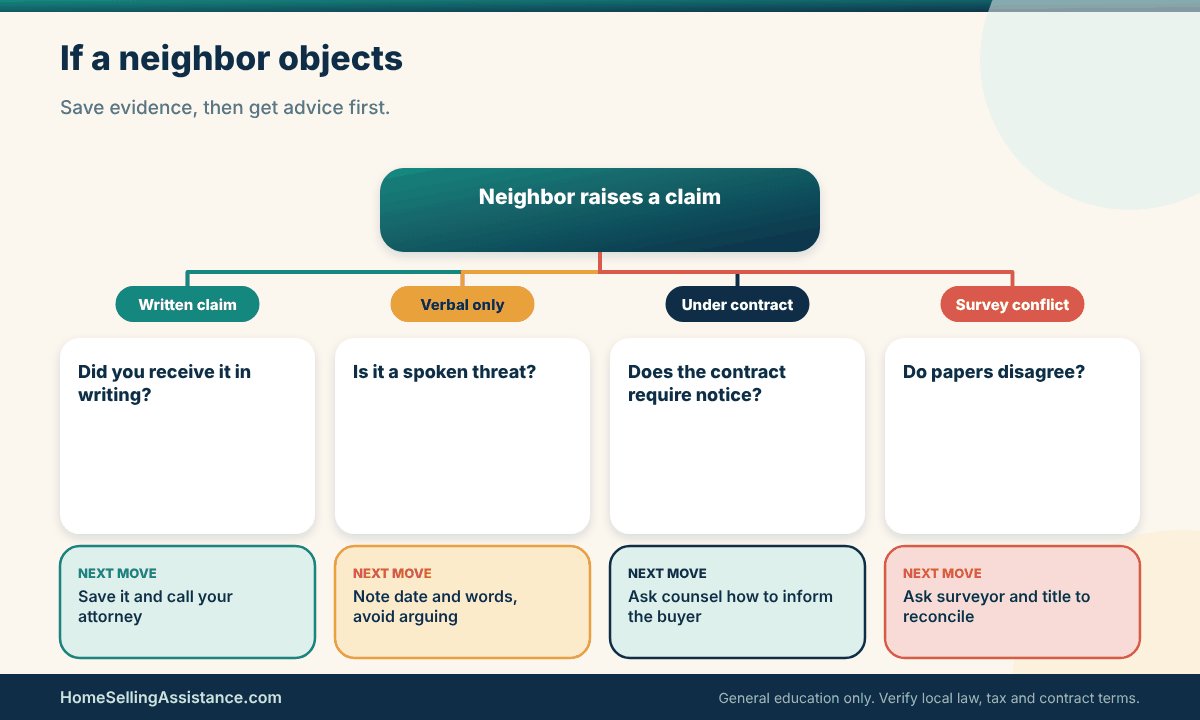
The instinct to argue or to ignore the message is understandable and usually unhelpful. The more careful sequence is to save the message, avoid arguing in writing, and call your attorney before replying to anyone. Then review your contract to see what it says about telling the buyer of new material facts, and ask your agent or attorney how and when to inform the buyer.
Whether the claim has any legal merit is a question for the attorney and perhaps a surveyor. What you can control is speed and honesty. A buyer who hears about a neighbor’s claim from you, with a plan attached, has more reason to stay at the table than one who hears about it from the neighbor. Whatever you decide, your easement encroachment seller disclosure and your actions should tell the same story.
Some sellers like to turn the verification checklist into a one-page cover sheet that sits at the front of the listing packet. It lists each document, the date it was obtained and where the buyer can find it. A cover sheet like that makes your easement encroachment seller disclosure easier to read, and it shows the buyer’s agent that you took the subject seriously. It also gives you a fast way to see what is still missing before the first showing.
If you are working with an attorney, ask how they want the final packet assembled and whether they would like to review the easement encroachment seller disclosure before it goes out. Many will do that in a brief, limited engagement. The cost of that review is usually small compared with the cost of a dispute, though it varies by region and by the complexity of your property.
Treat the checklist as a living tool. Each time a fact changes, update the cover sheet, replace the outdated attachment and note the date. When you reach the signing table, you should be able to point to one clean version of your easement encroachment seller disclosure and say, with a straight face, that every line in it is something you checked.
Quick scenario
A seller lists a house with a chain-link fence on the west side. Before listing, the seller orders a survey, learns the fence sits a short distance onto the neighbor’s lot, and asks the neighbor to sign a brief acknowledgment drafted by an attorney. The seller then discloses the survey, the acknowledgment and the fence’s position in the listing packet. This is an illustration, not a prediction. The point is that the issue arrived at the buyer’s desk with a document and a plan instead of as a late surprise.
Frequently asked questions about easement encroachment seller disclosure
Do I have to mention an easement if it is already in the public record?
Many states and forms ask about easements whether or not they are recorded, and a buyer’s title commitment will list them anyway. Mentioning a recorded easement yourself costs very little and shows good faith. Whether your state treats a recorded easement as already disclosed by the public record is a legal question, so ask a local attorney or your title company instead of relying on that assumption in an easement encroachment seller disclosure.
What is the difference between an easement and an encroachment?
An easement is a right that someone else holds to use part of your land for a defined purpose, such as running utility lines or crossing to reach a road. An encroachment is a physical intrusion, such as a fence, wall or roof edge that crosses a boundary line. An easement is a right on paper, while an encroachment is a fact on the ground, though the two can overlap when something is built inside an easement strip.
Can I just say the property is sold as-is and skip the details?
An as-is clause may limit what a buyer can demand after closing, but how far it protects you depends on your state and the contract wording. In many places it does not excuse a seller from truthfully answering a disclosure form or from hiding a known serious defect. Treat as-is language as one tool among several and ask your attorney what it covers locally before leaning on it.
Should I order a survey before I list?
A current survey can answer questions about fences, sheds, driveways and corners before a buyer asks them, and it gives you something concrete to attach. It also costs money and may reveal a problem you would rather not know about. Many sellers still prefer to know first, because discovering an issue on your own timeline usually leaves more options. Your agent or title company can tell you whether a survey is customary where you live.
What if my neighbor and I have an informal agreement about a fence or driveway?
Informal arrangements are common, and they are also fragile, since a new owner on either side may not honor them. Disclose the arrangement honestly and say that it is informal. If you can, ask your attorney whether a written agreement, signed by both owners and possibly recorded, is available in your state. A written and recorded paper gives a buyer something firmer than a handshake.
Will an encroachment stop my sale?
Not necessarily. Many encroachments are minor and get resolved through a neighbor agreement, a small price concession, removal of a structure or title insurance coverage. Others can complicate financing or marketability, especially if a lender or insurer objects. No one can promise a result in advance, which is why early discovery and a professional opinion matter more than a hopeful guess.
Does title insurance protect me from boundary problems?
An owner’s policy covers certain title defects listed in its terms, and it usually excludes matters that appear as exceptions, which often include easements of record and anything a current survey would show. Coverage differs by policy, endorsement and state. Read the exceptions in your own commitment, and ask the title officer to explain in plain words what is and is not covered.
Who pays for a survey or for fixing an encroachment?
The purchase contract usually decides who orders and pays for a survey, and local custom fills the gaps. Fixing an encroachment, whether by moving a structure, recording an agreement or negotiating a credit, is typically a negotiation between buyer and seller, sometimes with a neighbor involved. Check your contract and ask your agent or attorney how costs are commonly handled in your area.
What if I truly do not know whether something crosses the line?
Say so, in plain words. A statement such as “I do not know whether the fence follows the lot line; no survey has been done” is honest and specific. If you suspect a problem, learning the facts is usually wiser than staying uncertain, because a buyer’s survey may reveal it anyway. Your attorney can help you word the answer for your state’s form.
Where can I check what is recorded against my property?
Start with the county recorder or register of deeds, which holds deeds, plats and recorded easements. Your title company can pull the same records and explain them. For general consumer information on closings and paperwork, the Consumer Financial Protection Bureau publishes plain-language resources, though local recording rules still decide how to find a specific instrument.
Before you list
A clear easement encroachment seller disclosure does not need to be dramatic. It needs documents, plain sentences and a plan for what happens when someone asks a follow-up question. Gather the deed, plat, survey and recorded easements, write down what you know and what you do not, and hand the right pieces to the buyer, title company and attorney in time for them to act. This article is general education, not legal, tax or financial advice, and rules differ by state and county, so confirm the details with a licensed professional where you live.