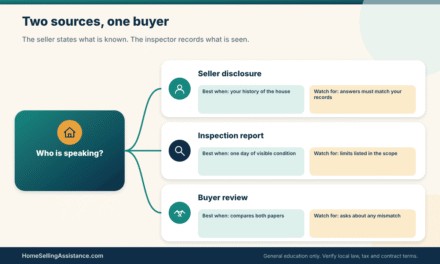
A good material defects seller disclosure starts with a simple idea that many sellers resist at first: the buyer is entitled to a fair picture of the problems you actually know about, and the contract word “as-is” does not turn that duty into permission to stay quiet.
Most people who sell a house are not hiding anything. They are tired of a leaky window, a slow drain or a crack that has been there since the last owner, and they honestly wonder whether any of it “counts.” That uncertainty is where trouble starts. A seller who guesses wrong, or who decides that silence is safer than a clumsy sentence on a form, can end up in a dispute long after the keys have changed hands.
This guide explains how a material defects seller disclosure works in plain terms: what makes a problem “material,” why the rules differ so much from one state to the next, how an as-is clause really behaves, and how to build a paper trail that protects you and treats the buyer fairly. It sits inside our wider library on seller disclosure requirements, and it stays at the level of general education rather than legal advice about your particular house.
Two honest notes before we start. First, disclosure law is local. Statutes, standard forms, attorney involvement and the remedies available to an unhappy buyer all vary by state and sometimes by county, so we will keep telling you how to check rather than pretending one rule fits everyone. Second, any dollar figure you see here is a round, illustrative number meant to show how the thinking works, not a prediction about your sale.
Key takeaways
- Knowledge is the center of the duty. A material defects seller disclosure is mostly about what you know, not what an inspector might someday find.
- “As-is” changes repair expectations, not honesty. It usually tells the buyer you will not fix things, but it rarely erases a duty to reveal known serious problems.
- Your state sets the format. Some states require a detailed statutory form, some a short one, and some leave much to contract law and local custom.
- Write facts, not spin. Dates, locations, who repaired what and what paperwork exists are safer and more useful than vague reassurance.
- Keep the paper trail. Delivery dates, signed acknowledgments and repair records are your best evidence if a question comes up later.
- Update before you sign. A form completed in March can be wrong by June, so recheck it before the contract and again before closing.

Who signs, what controls, and which rules shape a material defects seller disclosure
Before you describe a single crack or stain, you need to settle three quieter questions: who is legally selling, which document is the official place to disclose, and which level of law is in charge. Skipping these is the most common reason a well-meant material defects seller disclosure turns out to be incomplete or unsigned by the right person.
Who owns the house, who signs, and which document controls
The person (or people) who hold title are the sellers, and they are the ones whose knowledge counts. If your name is on the deed, the questions on the material defects seller disclosure form are addressed to you, even if a relative, a property manager or a former tenant knows more about the house than you do. The deed, not the utility bill or the mortgage statement, tells you who is on the hook.
Several documents can carry the disclosure. In some places it is a statutory form that the legislature wrote. In others it is a form produced by a state or local association of real estate professionals, or a short addendum to the purchase contract. The listing agreement and the sales contract usually say which form the parties will use and when it must be delivered, so read them side by side rather than relying on memory.
Evidence to gather: deed, listing agreement, and the state form
Start with the recorded deed to confirm exactly whose names appear and how title is held. Then pull the listing agreement and any draft contract, and look for language about material defects seller disclosure delivery, inspection rights and what the buyer may do if the form is late. Finally, find the current official form for your state. Your state real estate commission, a title company or a real estate attorney can tell you where the current version lives.
If the property sits in a community with an association, add the association’s governing documents to the pile, because they often impose separate disclosure or resale certificate requirements. Treat these as a package: deed for authority, contract for timing, form for content. When one of the three is missing or out of date, pause and fix it before you answer a single question.
A quick word on estates and trusts. When a property is held in a trust or sold by an executor, the person who signs may be a trustee or personal representative rather than an individual owner, and some states excuse or modify disclosure duties for fiduciaries who never lived in the home. Whether yours does is a state question, so ask the attorney handling the estate rather than assuming.
A scenario, an exception, and your next step: co-owners who disagree
Imagine two siblings who inherited a house together. One lived there for years and knows the basement floods after heavy rain. The other lives three states away and has seen the house twice. The form arrives, and the distant sibling wants to check “no known problems” because, personally, none are known. That feels honest, yet the sibling who knows about the flooding is also a seller, and the buyer is dealing with both of them together.
The safer path is to treat the knowledge of every seller as the knowledge the form is asking about, or at least to make sure the form reflects what the group knows. The next step is a short call, a written list of what each sibling knows, and one answer that everyone can stand behind. If the siblings cannot agree on the wording, that is a good moment to ask a real estate attorney, not to let one person fill it out alone.
Federal baseline versus state and local requirements
Federal law sets a short floor for residential sales, and nearly everything else about a material defects seller disclosure is decided closer to home. The best-known federal rule is the lead-based paint disclosure for homes built before 1978, which requires sellers to share what they know about lead hazards and provide an approved pamphlet. The EPA real estate disclosure page explains it, and our guide to lead paint disclosure for sellers covers the practical steps.
Outside that rule, most of the obligations come from state statutes, court decisions and the contract itself. Some states require a detailed checklist signed by the seller. Others require only that sellers not conceal serious problems that a buyer could not reasonably discover. A few lean on older ideas that buyers are responsible for their own inspections, with exceptions for fraud. Cities and counties may add point-of-sale rules about things such as sewer laterals, smoke detectors or permits.
Evidence to gather: what federal rules cover and what they leave out
For federal items, check the construction year of the house and the EPA materials. For everything else, the first stop is your state real estate commission, which often publishes the required form and a plain-language summary. Next, look at the county or city website for local point-of-sale requirements. If the language is dense, a local real estate attorney can confirm in a short consultation what applies without turning it into a long engagement.
It also helps to separate three categories in your own notes. The first is items that a rule specifically names, such as lead paint for older homes. The second is items the state form asks about, such as roof leaks, water intrusion, structural movement or pests. The third is everything else you know that a reasonable buyer would care about, which may fall under the general duty not to mislead even if no question asks about it.
A related point: fair housing rules apply to how you talk about a property and its surroundings. A material defects seller disclosure should describe conditions of the house, never the kind of people who live nearby or any protected characteristic. The HUD fair housing resources explain the basics.
A scenario, an exception, and your next step: a state with a form and a state without
Picture one seller in a state with a long statutory form and another in a state where the standard is mostly contract and case law. The first seller has a clear checklist that prompts memory: roof, plumbing, electrical, drainage, pests, additions. The second seller has no prompts, and may wrongly conclude there is nothing to say. Yet in many places the second seller can still face claims if a known serious problem was hidden or misdescribed.
The practical lesson is to use a checklist even when you are not required to. If your state does not mandate a form, ask a local agent or attorney whether a customary form exists and use it voluntarily. Your next step is to write down every issue you know about by system, then compare the list with whatever form or addendum your contract calls for.
For a deeper look at how the official questionnaire fits with other paperwork, see our guide to the seller property questionnaire.
Turning your duties into a seller workflow for material defects seller disclosure
Once you know who signs and which rules apply, the work becomes practical. You decide what belongs on the page, you choose words that are accurate rather than defensive, you deliver the form on time, and you keep proof. The next picture shows the flow from first memory to final update, and the table after it lines up the common issues with the document that usually controls each one.

The table below is a general matrix, not a legal map of your state. Use it to see which questions to ask locally. Each row names an issue, the document or authority that tends to control it, what the seller usually has to do or may choose to do, the timing to look for, and where you verify the answer.
| Issue | Controlling document or authority | Seller duty or choice | Typical timing | Verify locally with |
|---|---|---|---|---|
| Water intrusion or past flooding | State form or contract addendum | Describe what you know, repairs and dates | Before or at contract | State commission, attorney |
| Roof leaks and repairs | State form, repair receipts | Disclose known leaks and who fixed them | Before or at contract | Agent, roofing invoices |
| Lead paint, pre-1978 home | Federal EPA rule | Share known hazards, give pamphlet, sign | Before buyer is bound | EPA page, title company |
| Unpermitted work | Local permit records | Disclose what you know; avoid guessing | Before or at contract | City or county permit office |
| Structural or foundation movement | State form, engineer reports | Disclose known movement and any reports | Before or at contract | Attorney, licensed engineer |
| Septic, well or sewer issues | Local health department rules | Disclose known failures and tests | Often tied to sale | County health office |
How to use the matrix: pick the rows that match what you actually know about the house, then call or visit the “verify locally” source for each. If a row points to a deadline, put it in your calendar. The matrix cannot tell you what your state requires, but it shows you the right questions to bring to an attorney or a title officer.
Deciding what to disclose, and how to say it
It helps to picture a material defects seller disclosure as a conversation carried out on paper. The buyer cannot ask you about the sound the furnace makes at night or the way the back bedroom smells after rain, so the form speaks for them. When you answer as if the buyer were sitting beside you, the answers tend to get more specific and more honest, and a good material defects seller disclosure usually reads that way.
Many sellers also underestimate how much a clear material defects seller disclosure can help their own position. A buyer who has read about the old repair and the receipt behind it walks into the inspection looking for confirmation, not a surprise. That mindset tends to produce shorter repair lists, calmer negotiations and fewer late cancellations, although nothing guarantees how any buyer will react.
The question every seller asks about a material defects seller disclosure is whether a particular problem is “material.” There is no single national definition, and states use different phrases, but the common thread is easy to grasp. A defect is material when it would matter to a reasonable buyer in deciding whether to buy or what to pay. Safety hazards, structural problems, water damage, failing systems and legal limits on use tend to land in that group.
The other half of the test is knowledge. A material defects seller disclosure generally asks what you actually know, not what an expert might discover with a moisture meter. That does not give you license to look away on purpose. Deliberate blindness, such as refusing to open a crawl space you suspect is damp, can be treated by a court as knowledge in some situations.
How to test a problem: knowledge, materiality, and visibility
A three-question test helps. First, do you know about it? If yes, write it down. Second, could it affect safety, structure, habitability, systems or value in a way a buyer would care about? If yes, treat it as material until a professional tells you otherwise. Third, could the buyer easily see it during an ordinary walkthrough? Visibility matters in some states, but you should not rely on it. A stain a buyer can see is still best described honestly.
Cosmetic items are the usual gray area. A scuffed floor is not a material defects seller disclosure problem; a stain on a ceiling that you know came from a roof leak is, because the stain points to a deeper issue. When you cannot tell, the cost of a clear sentence is small and the cost of omission can be large. Our guide on seller disclosure versus an inspection report explains why the two documents answer different questions.
Choose words that carry facts. “Basement took on about an inch of water in a heavy storm two springs ago; a drain tile company installed a sump pump the same summer; receipt attached” is far better than “minor moisture, fixed.” The first sentence gives the buyer something to verify and shows that you acted. The second sounds like a seller hoping the buyer will not ask follow-up questions.
Avoid minimizing adjectives such as “minor,” “small” or “cosmetic” unless a professional has said so in writing. Avoid guarantees such as “will never leak again.” Avoid opinions about causes you have not confirmed. Stick to what you saw, when you saw it, what was done and what documents exist. That approach is accurate, easier to defend and kinder to a buyer who is trying to decide with incomplete information.
As-is language: what it changes and what it leaves alone
An as-is clause usually tells the buyer that you do not plan to make repairs or give credits for conditions, and that the buyer accepts the property in its present condition. That is a legitimate and common choice, and it can reduce friction over small repair requests. Our deeper guide on how to sell a house as-is covers the negotiation side.
What the clause typically does not do is cancel a duty to reveal known material defects, or protect a seller who actively conceals a problem or lies about it. In many states the law treats concealment and misrepresentation separately from the repair question. In other words, “as-is” can mean “I will not fix it,” but it does not mean “I will not tell you.” Whether a given clause also limits the buyer’s remedies is a contract and state-law question to take to an attorney.
Think of it as two different dials. One dial controls repairs: fix everything, fix some things, or fix nothing. The other dial controls information: tell everything you know that matters. Sellers can turn the repair dial all the way down and still be fully honest. They cannot turn the information dial down to zero without risk. That distinction is the heart of the phrase “as-is is not silence.”
One more practical point: an as-is sale often makes a material defects seller disclosure more important, not less. A buyer who knows you will not negotiate repairs will rely more heavily on the information you provide to price the house and plan their inspection. A clear material defects seller disclosure also helps an as-is deal survive the inspection period, because fewer surprises means fewer reasons to walk away or demand concessions.
Next, a short example of how a seller might handle the hardest version of this question, a serious defect in a house sold as-is. We will look at it again in the verification section, because documents are what keep this kind of sale calm.
A seller owns a small lake cabin whose septic tank has failed a pumper’s check and needs replacement. The seller does not want to pay for a new system and plans an as-is sale at a lower price.
The honest route is to disclose the failed check in writing, attach the pumper’s report if one exists, price the cabin with the problem in mind, and let the buyer choose. The dishonest route is to say nothing and hope the buyer’s inspector misses it. The first route may attract a smaller group of buyers, but it keeps the seller on solid ground. Local health departments often have their own rules for septic systems at sale, so ask the county office what applies.
Handing the disclosure to buyers, title companies, HOAs, and attorneys
A material defects seller disclosure that sits in a folder on your kitchen table protects no one. The handoff is where the paperwork becomes real: the buyer receives it, the agents or attorneys log it, the title company sees what it needs, and any association with its own paperwork is kept in the loop. Each party has a different job, and mixing them up causes most of the late-stage confusion.
Timing is the first thing to confirm. Some states require delivery before the buyer signs a contract. Others allow delivery within a number of days after signing and give the buyer a right to cancel if the form is late or reveals something new. Because the clock can start at different moments, ask your agent, attorney or state commission when your deadline starts, and then deliver earlier than the minimum when you can.
Evidence to gather: receipts, dates, and signed acknowledgments
Think of the paper trail as three layers. The first layer is the material defects seller disclosure itself, signed and dated, with the version number or form date visible. The second is proof of delivery: an email with a time stamp, a transaction platform log or a signed receipt. The third is supporting documents for any statement you made, such as repair invoices, permit finals, engineer letters or warranty cards.
Keep a simple folder, paper or digital, with those three layers for the life of the sale and for as long afterward as a lawyer or your state’s record guidance suggests. Many sellers keep closing records for years because tax questions and warranty claims can appear later. If a buyer ever says “you never told us,” a dated delivery record and signed acknowledgment answer the question quickly and without drama.
When you disclose through an agent, ask to see the final version that went to the buyer, not just your draft. Small edits made along the way can change meaning, and the signed copy is the one that matters. If you are selling without an agent, a title company or attorney may be willing to receive and log the material defects seller disclosure as part of the file. Our guide on selling by owner covers the paperwork a self-represented seller should expect.
If you work with an agent, ask how the brokerage handles a material defects seller disclosure inside its transaction system. Some brokerages upload the signed form to a shared portal and email the buyer a link; others send a PDF. Either way, make sure you can see the portal log or the email, because a material defects seller disclosure is only helpful if you can later show that it was delivered, opened and acknowledged.
Sellers who handle their own paperwork should ask a title company or attorney whether a material defects seller disclosure can be attached to the contract as an exhibit. Doing so ties the form to the agreement itself, which can reduce arguments about which version the buyer saw. Whether that step is customary depends on your state, so ask before you improvise.
A scenario, an exception, and your next step: a defect found after delivery
Say you delivered the form in April, accepted an offer in May, and in the second week before closing a plumber tells you the main drain line is cracked under the driveway. You did not know in April. The material defects seller disclosure was accurate when you signed it. Does that settle things? Not necessarily. Many forms and contracts expect sellers to update the buyer when new information arises before closing, and some states require it.
Your next step is to stop and put the new information in writing: what you learned, from whom, and what documents exist. Send it through your agent or attorney, and ask how your contract treats updates. The buyer may accept it, negotiate a credit or repair, or in some contracts cancel. None of those outcomes is pleasant, but each is better than a buyer discovering the problem after moving in and concluding you hid it.
This is the place to talk about a related, emotionally loaded item. Some states require or limit disclosure of events like a death on the property, and others say nothing. That is a separate topic with its own rules, covered in our article on death in a house and seller disclosure.
Questions to ask each professional before you hand off the form.
Different professionals answer different questions, and it saves time to know which is which. The scenario table below pairs common situations with the options a seller may have, the risk each carries, the document to review, and the point at which you should escalate to an attorney. Read it as a conversation starter, because state law and your contract decide the details.
| Situation | Seller options | Main risk | Document to review | Escalate when |
|---|---|---|---|---|
| Known leak, repaired last year | Disclose with date, vendor and receipt | Omission looks like concealment | Repair invoice, state form | Repair was done without a permit |
| Foundation crack, cause unclear | Disclose; offer engineer report access | Guessing the cause | Engineer letter, contract | Buyer threatens to cancel |
| Unpermitted finished basement | Disclose what you know; check permit office | Local penalties, insurance gaps | Permit file, survey | City orders corrections |
| Pest damage found at inspection | Credit, repair, or price change | Dispute over scope and cost | Pest report, contract | Report conflicts with your form |
| Defect learned after contract | Update buyer in writing | Claim of late or hidden disclosure | Updated form, contract | Deadline or cancel right is unclear |
| Inherited home, little history | Disclose limits of knowledge honestly | Assuming “unknown” ends the duty | Estate papers, state rules | Fiduciary duties are unclear |
To use the scenario table, find the row closest to your situation and read across. The “escalate when” column is the part sellers skip, and it is the most useful. If your situation lands on that trigger, a short call with a real estate attorney, rather than an extended text thread with your agent and the buyer’s agent, is usually the better use of time.
A few questions are worth asking in every sale. Ask your agent or attorney which form your state expects and who delivers it. Ask the title company whether any recorded documents, liens or easements might make your statements incomplete. Ask the association, if there is one, for its resale package and any pending assessments. Ask your insurer whether past claims matter for the form. Our guide to easements and encroachments explains why title information belongs in the same conversation.

One more scenario: the agent who says “just leave it off.”
Occasionally a seller hears advice like “don’t mention that old stain, nobody will ask.” Maybe it comes from a friend, maybe from a well-meaning professional trying to avoid an awkward conversation. Treat it as a flag. Agents are licensed and generally bound by honesty and material defects seller disclosure standards to the buyer, and in many states an agent who knows of a material problem cannot help hide it. Even where the exact rule differs, advice to omit a known defect puts the risk on you.
Your next step is not to argue. Ask for the advice in writing, or ask which statute, rule or contract clause supports it. If the answer is vague, speak with a real estate attorney or contact your state real estate commission to learn what the rules say. You can still disagree about pricing or strategy without compromising honesty. Many sellers find that the best agents welcome a clear material defects seller disclosure because it protects the transaction as well as the seller.
Associations are a separate handoff. If the house is part of an HOA or condominium, there may be a resale certificate, a statement of assessments and a list of violations or open projects that the association must provide on request. Our guide to selling a house with an HOA walks through that process. A buyer reading both documents together may notice if your material defects seller disclosure says “no known issues” but the association file lists a roof assessment, so make sure the two tell a consistent story.
Build a verification checklist for your material defects seller disclosure
Memory is a poor witness. Sellers who rely on what they recall about a ten-year-old repair often get dates or details wrong, and a confident mistake can be worse than an honest “I am not sure.” A verification checklist replaces recollection with records. It also forces useful questions: who did the work, when, with what permit, and where is the paper that proves it?
The picture below shows a simple document checklist grouped into ownership, condition and compliance records. Use it as a starting point, then add items that fit your house, such as well tests for rural properties or association letters for condominiums.

Each item on the checklist should map to a sentence in your material defects seller disclosure, and each sentence should map to a document. If you cannot connect a statement to a record, either find the record or soften the statement to what you actually know. That small discipline makes a material defects seller disclosure more reliable than any form filled out from memory in a single sitting.
A good habit is to complete a first draft, then sit with the folder and walk through every answer. Ask yourself where the proof lives. If a roofer fixed a leak, find the invoice. If a plumber replaced a line, find the receipt. If you cannot, note who did the work and approximately when. A material defects seller disclosure built this way gives buyers something solid to check and gives you something solid to point to.
Official sources and recorded documents
An official source is a record kept by someone with no stake in your sale: a county recorder, a permit office, a health department, a court clerk or a state agency. These sources do not argue, and they do not forget. When your statement on a material defects seller disclosure matches an official record, you are in a strong position. When it conflicts, you have found a problem while it is still cheap to fix.
Recorded documents deserve special attention because they can bind the property no matter what you remember. Deeds, easements, liens, covenants and certain court orders appear in the county records. A title company can search them for you as part of the sale, and many sellers order a preliminary title report early so surprises appear before the buyer sees them. Our cluster guide on what sellers must disclose shows where these items fit.
Evidence to gather: permits, recorded documents, and public files
Start with the permit history. Many city and county offices let you search by address, and some will answer a records request by email. Look for permits tied to additions, finished basements, decks, roofs, electrical panels, water heaters and major plumbing work. Note whether each permit was closed or finaled. A permit that was opened and never finished is a very common surprise, and a buyer’s inspector or lender may find it.
Next, request or download your recorded deed and look for easements, shared driveway agreements or restrictions. Check the property tax record for the stated square footage, bedroom count and improvements, because mismatches can hint at unpermitted work. If you ever received a code violation notice, a municipal inspection letter, a sewer lateral certificate or a health department test, add those to the folder.
Insurance records belong here too. A claim history for water, fire or wind damage can show events you have forgotten, and some forms ask directly about past claims. If you have an old inspection report from when you bought the house, read it again. It may list conditions you were told about then, and that earlier knowledge can matter now. Our guide to a pre-listing home inspection explains how a fresh report compares with an old one.
A scenario, an exception, and your next step: the permit that was never closed
A seller finished a basement fifteen years ago with a contractor who said he would handle the permit. The seller never saw the final inspection sign-off and assumed all was well. A records check now shows the permit was opened and then left unresolved. What should the material defects seller disclosure say? The truthful statement is that a permit was opened and the file does not show a final inspection, plus what the seller knows about who did the work.
The next step depends on local rules. Some offices allow a permit to be reopened and finaled, sometimes with an inspection and fees. Others handle old work differently. Ask the permit office what is possible, and talk with an attorney or your agent about whether to resolve it before listing or disclose and let the buyer decide. Our article on selling a house with unpermitted work goes deeper into those choices.
Whatever you decide, avoid guessing. “I believe all work was permitted” is risky when you have not checked. “I have not verified permit status for the basement finish; the contractor handled it” is accurate and invites the buyer to look, which is the point of disclosure.
What must be current before you sign
A material defects seller disclosure is a snapshot, and snapshots age. The form you completed when you first thought about selling may not reflect the storm that came through in the fall, the repair you finished in the spring or the new report from an inspector the buyer hired. Before you sign anything binding, and again before closing, review each answer and ask whether it is still true today.
Think about the moments that matter: before you list, before you sign a contract, after any inspection, and in the days before closing. At each one, a short review can catch changes. Sellers who treat these as routine checkpoints rarely get caught off guard, because they never rely on a form that has drifted away from the facts.
Updates to make before every signature
Before you sign the contract, confirm that the material defects seller disclosure version matches the one your state or contract requires, that every question is answered, and that no answer says “unknown” when a quick call or record check could settle it. Confirm that attached documents are current, such as repair invoices and warranty cards. Make sure every seller who holds title has reviewed and signed the form.
Before closing, ask whether anything has changed since delivery: new leaks, appliance failures, pest findings, neighbor disputes, code notices or association assessments. Many contracts expect updates, and some give the buyer a right to react. Our overview of home sale contingencies shows how those rights fit into the timeline.
Check the dates on every report you cite. A moisture report from three years ago is evidence of history, not a statement about today. If you rely on an older document, say so plainly: “Report dated three years ago; no new testing since.” That wording is honest and keeps the buyer from assuming the report is fresh.
A scenario, an exception, and your next step: the inspection that changes your answers
A buyer’s inspector finds signs of past moisture in the attic that the seller has never noticed. The seller’s form said “no known roof problems,” and that was true. Does the seller now need to do anything? The seller now has new information. Ignoring it, or saying it was always unknown, would not match the spirit of disclosure, and many contracts and states expect sellers to respond to what inspections reveal.
The sensible step is to read the inspection report carefully, talk with your agent or attorney, and decide whether to amend the form, offer a repair or credit, or ask a roofer for an opinion. The buyer’s inspection is not a substitute for your disclosure, and your material defects seller disclosure is not a substitute for their inspection. They work best together, and they reduce arguments about who knew what.
For sellers who want to prepare before listing, our guide to repairs before selling a house compares fixing, crediting and disclosing, and our disclosures and seller paperwork library collects the rest of the related reading in one place.

The last picture shows a fallback path if a defect surfaces late. It is a simple tree, not a legal script. The branches ask the questions a calm seller asks in order: did I know, is it covered by my disclosure, does the contract give the buyer a right to respond, and who do I call. A map like this does not remove stress, but it prevents the panic response of ignoring the problem or arguing about it by text.
Finally, remember fairness. A thorough material defects seller disclosure treats every buyer the same way. Do not tailor honesty to who you think the buyer is, and never describe the neighborhood in terms that touch protected characteristics. If you want to read more on this side of the process, see our guide to fair housing for home sellers. For market context on how sellers and buyers behave, the National Association of Realtors publishes consumer information, though it will not tell you what your state requires.
Quick scenario
A seller remembers a roof leak over the garage that a handyman patched six years ago. It has been dry since. The seller wonders whether to mention it. The safer habit is to include it with the approximate date, who repaired it and any receipt, and to say that no leaks have appeared since. A buyer reading that sentence sees honesty and a documented fix, and the seller has a dated record showing the issue was shared.
Frequently asked questions about material defects seller disclosure
What counts as a material defect when I sell my house?
A material defect is generally a problem that would matter to a reasonable buyer deciding whether to buy or what to pay. Safety hazards, structural trouble, water intrusion, failing major systems and legal limits on use are typical examples. The exact definition varies by state, and a form may use different words. When you are unsure, describing the facts is usually safer than deciding on your own that something does not count.
Does selling as-is mean I do not have to disclose problems?
Usually not. An as-is clause mostly tells the buyer that you will not make repairs or give credits. In many states, a duty to reveal known material defects and a ban on concealment or misrepresentation still apply. Ask a real estate attorney how your state treats as-is language, because remedies and wording differ.
Do I have to disclose a problem I already fixed?
Often yes, in some form. Many state forms ask about past problems as well as current ones, and a repaired leak can still matter to a buyer. A short statement with the date, the repair and a receipt shows that you acted and gives the buyer something to verify. Check your state form to see how far back it asks you to look.
What if I truly do not know about a defect?
Disclosure generally focuses on what you actually know, so a problem hidden inside a wall that you never suspected may not be something you were required to report. That said, willful blindness, such as avoiding an obvious check, can be treated as knowledge in some situations. If you have never looked at a part of the house, say so rather than guessing. Honest uncertainty is better than a confident but unchecked statement.
Is a seller disclosure the same as a home inspection?
No. A seller disclosure records what you know about the house. An inspection is a professional examination by someone hired by the buyer, or sometimes by you before listing. Each answers a different question, and one does not replace the other. Our comparison of disclosure and inspection documents explains how they work together.
When do I have to give the material defects seller disclosure to the buyer?
The timing depends on state law and your contract. Some places require delivery before the buyer signs; others allow it within a set number of days after signing and give the buyer a cancellation right if it is late. Ask your agent, attorney or state real estate commission when your clock starts. Delivering early is usually the safer choice.
What should I do if I discover a defect after delivering the form?
Put what you learned in writing, gather any supporting records and tell your agent or attorney quickly. Many contracts and states expect sellers to update the buyer before closing, and the buyer may have options in response. Handling it openly is usually better than hoping nobody notices. Ask about your contract’s specific rules for updates.
Can a buyer sue after closing over a defect I did not disclose?
In some situations, yes. Buyers may bring claims based on concealment, misrepresentation or a breach of a statutory material defects seller disclosure duty, and the available remedies vary by state and contract. We cannot say whether a claim would succeed in any case. A dated, honest material defects seller disclosure with supporting documents is the best general protection.
Who can I ask about the rules in my state?
Start with your state real estate commission, which often publishes the required form and consumer guidance. A local real estate attorney can explain how the rules apply to your facts, and a title company can help with recorded documents. Your listing agent can describe common local practice, though agents are not a substitute for legal advice. Keep your questions specific and bring your documents.
A fair picture protects everyone
A well-prepared material defects seller disclosure is not a confession; it is a record that you were straightforward when it mattered. Write facts, keep your receipts, update when things change and ask local professionals the questions this guide could only point toward. This article is general education, not legal, tax or financial advice, and your state rules and contract decide what applies to you.