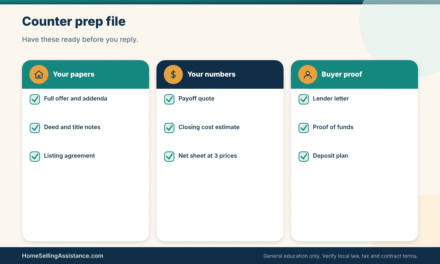
The highest vs best offer house question comes up the moment two or more buyers show interest, and the honest answer is that the biggest number on the page and the offer most likely to put money in your account are often two different documents.
Most sellers feel a strong pull toward the top price. It is easy to compare, easy to explain to family, and it feels like proof that you did well. Yet price is only one line in a contract that also contains a financing path, a set of contingencies, a deposit, a closing date, a possession date and a list of things the buyer expects you to pay for or fix.
Two offers can look a long way apart on the first page and end up almost identical once you add the credits, the repair requests, the extra weeks of carrying costs and the chance that one of them never closes. Likewise, a slightly lower offer with a strong lender letter, a firm deposit and few conditions can leave you better off than a headline winner that unravels in week three.
This guide is part of our library on offers, and it builds on our cornerstone article on how to evaluate a home offer as a seller. Here we narrow the lens to one decision: when you hold competing offers, how do you decide between the highest number and the best overall package? We will look at what each option really contains, compare them on net proceeds, time, control and risk, and then walk through seller situations where the answer changes.
A note on limits. This is general education, not advice about your specific contract. Deposit customs, contingency lengths, attorney roles and disclosure rules vary by state, county and local practice. Every dollar figure below is an illustrative round number meant to show the arithmetic, never a prediction about your house or your market.
Key takeaways
- The headline price is only one term. Financing type, contingencies, deposit, timeline and requested credits all change what the highest vs best offer house comparison really looks like once you run the numbers.
- Compare offers on expected net, not on price. Subtract credits, repair requests, carrying costs and fees from each offer, then weigh the result against how likely each buyer is to actually close.
- Certainty has a dollar value. A deal that falls apart costs you time on the market, a possible price reset and a second round of showings, so a modest premium for a reliable buyer can be rational.
- Ask for proof, not promises. Lender letters, proof of funds, deposit terms and appraisal plans turn a buyer’s claims into facts you can weigh.
- Your situation sets the answer. A fixed move date, an equity cushion, a probate timeline or a next-home purchase can each tip the choice, so there is no universal winner.
- Use a short written process. A clear deadline, equal information to every buyer and a written record keep you fair, protect you from pressure and help you stay consistent with fair housing rules.
What the highest vs best offer house question is really asking
When agents and sellers talk about “highest and best,” they usually mean a request sent to all competing buyers, asking each to put forward their strongest terms by a set deadline. That phrase is a procedure. The question we are answering is different, and it comes afterward: once the strongest terms are on the table, do you pick the highest price or the best package?
In a highest vs best offer house decision, the two options are trying to solve different problems. The highest-price route tries to maximize the number that appears on the closing statement. The best-package route tries to maximize the chance that a sale actually closes on terms you can live with. Most of the time those goals overlap, and the choice is easy. The cases worth studying are the ones where they pull apart.

The picture above shows the fork most sellers face in a highest vs best offer house decision. On one side sits the offer with the largest purchase price. On the other sits the offer whose financing, conditions, deposit and timing look cleanest. Notice that neither branch is labelled right or wrong. Each one fits a particular seller, and the rest of this section explains what you are really choosing when you walk down either path.
Reading the highest offer: what the number on top actually contains
A purchase price is a promise to pay a certain amount if every condition in the contract is met and every step goes to plan. That qualifier matters. A high price attached to a long list of conditions is a bundle of options in the buyer’s hands, and each option is a place where the price can shrink or the deal can end.
Consider how a high number sometimes arises. A buyer may bid aggressively because they plan to renegotiate after the inspection. A buyer may be counting on an appraisal that will not support the price and plan to ask you to cover the gap. A buyer may have a home of their own to sell first. None of these buyers is acting in bad faith, and plenty of them will close. But each one is carrying a risk that you would be absorbing.
The opposite can also be true. Some high offers come from well-qualified buyers who simply want the house more than anyone else does and have the resources to back it up. In any highest vs best offer house comparison, the goal is not to distrust the top bid. The goal is to read it the way an underwriter reads a loan file: look at the whole thing, find the assumptions and decide which ones you are comfortable with.
Evidence to gather: every term behind the headline price
Start your highest vs best offer house review by turning each offer into a plain list of terms. For the highest bid, write down the purchase price, the type of financing, the down payment, any seller credits requested, the deposit amount and when it is due, each contingency and its length, the proposed closing date, the possession date and any personal property the buyer wants included.
Then check the pieces that are easy to overlook. Does the offer include a request for the seller to pay part of the buyer’s closing costs? Is there an appraisal contingency, and does it say what happens if the value comes in low? Does the buyer have a home to sell? Is the earnest money held by a neutral party, and is it described as refundable under any circumstances? Our guide to earnest money from the seller’s side explains how deposits work and why the contract language matters more than the dollar amount.
Next, ask the agent or the buyer for documents. A pre-approval letter is useful but weak, because it often rests on unverified information. A letter that says the lender has reviewed income, assets and credit, and has issued an underwriting-level approval, is stronger. For cash buyers, ask for a recent statement or a letter from a financial institution showing funds that are available and sufficient. Treat any refusal to share the basics as information.
Finally, put a date next to every deadline in your highest vs best offer house worksheet. A short inspection period with a clear scope is easier to plan around than a vague one. A closing date that falls after your own purchase or move can create expensive overlap. Time lines up with money in a seller’s budget, and the articles in our offers and negotiation category return to that point often.
A scenario and your next step when the top number looks too good
Imagine you receive three offers on a house you have listed at an illustrative round figure of 400,000. One buyer offers 425,000 with a thin deposit, a financing contingency, an appraisal contingency, a request for 8,000 in closing help and a closing date seven weeks out. Another offers 415,000 with a larger deposit and a strong lender letter. The third offers 410,000 in cash with a short inspection window.
The first offer is highest by 10,000 over the second. After the requested closing help, its price advantage shrinks to 2,000. If the appraisal comes in below contract price and the buyer asks you to reduce, the advantage may vanish or turn negative. It could still be the right choice, but only if you believe the appraisal will support the price and the buyer’s financing is solid.
In this highest vs best offer house example, your next step is not to reject the top offer. It is to ask its buyer questions. Can the buyer shorten the contingency periods? Will they increase the deposit? Will they agree to cover an appraisal shortfall up to a stated amount? Their answers will tell you whether the top number is a firm commitment or an opening move. If the answers are vague, treat the headline price as softer than it looks.
Reading the best offer: the package that is most likely to close
“Best” is a loaded word, because it sounds like a judgment of quality when it really means fit. In this context the best offer is the one that scores well on the things you care about: a reliable path to closing, a timeline that matches your plans, fewer places where the deal can be reopened and an acceptable net amount.
That does not mean the lowest-risk offer is automatically the lowest-priced. Sometimes the best package is also the highest. Sometimes it trails by a modest amount. And sometimes the price gap is large enough that no amount of tidiness can justify it. Your task is to find where the premium for certainty stops being reasonable for you, a line that depends on your finances, your next move and your tolerance for delay.
In a highest vs best offer house choice, sellers often misjudge the cost of a failed deal because it feels like a pause rather than a loss. In reality, a buyer who walks away after several weeks leaves you with a house that has been on the market longer, a record that it went under contract and fell through, and the cost of keeping the home ready for showings. Nothing here is certain to hurt, but the risk is real enough to price in.
Evidence to gather: proof behind each buyer’s promises
For a buyer who calls themselves strong, ask the agent to show what strong means. If the buyer is using a mortgage, request a lender letter that confirms underwriting review, plus a statement of how much cash the buyer is bringing beyond the down payment. The consumer protection site of the Consumer Financial Protection Bureau explains how mortgage underwriting generally works, which helps you read what a lender letter does and does not promise.
Ask about the appraisal plan. A buyer who can pay some amount over a low appraisal in cash is more resilient than one who cannot. Our article on the appraisal gap from the seller’s side covers the options in detail, and you will see why a modest, clearly written gap commitment can be worth more than a bigger price with no backup.
Look at the deposit as evidence of commitment. A larger deposit held by a neutral party, with limited conditions for its return, tells you the buyer has something to lose. Check the timing too: a deposit due within a few days is more meaningful than one due later. Local custom varies, so ask your agent or attorney what is typical in your area and what the form contract says about default.
Finally, ask how the buyer’s inspection will work. Some buyers inspect first and negotiate later. Others waive certain rights or limit the scope to major defects. You are allowed to prefer either style, but you should know which one you are getting before you sign. The point of this highest vs best offer house evidence file is simple: every claim in an offer should have something behind it that you can see.
A scenario and an exception where best means lower
Picture a highest vs best offer house contest between two buyers for the same house. Buyer one offers an illustrative 20,000 above buyer two but has a home to sell, a 60-day financing contingency and a thin deposit. Buyer two offers the lower price with a verified lender approval, a larger deposit and a 14-day inspection window. If you must close by a specific date to buy your next home, buyer two may be the only offer that fits.
The exception comes when the price gap is wide. If the gap grew to a large number, you would want to compare it against what a failure could cost. A seller with time, equity and no fixed date might reasonably accept buyer one’s risk for the extra money, perhaps by asking for a stronger deposit or a shorter contingency in exchange.
Your next step in a highest vs best offer house standoff is to ask the lower bidder whether they can improve price or terms. A good agent can often move both buyers toward a stronger position by asking for one specific improvement from each. If you want a closer look at how that dialogue works, our guide to counteroffer strategy for sellers walks through what to change, what to hold and how to keep the conversation civil.
Comparing highest vs best offer house terms side by side
Once you understand what each option contains, you need a fair way to run the highest vs best offer house comparison. The trap here is comparing on the one dimension that is easiest to see. A good comparison puts price, time, control, conditions and workload on the same page, and then adds a probability for each offer: how likely is it that this one closes on these terms?
You do not need statistics for that last step. You need an honest read of the buyer’s financing, their deposit, their contingencies and your own market. Your listing agent, or an attorney in states where attorneys run the contract process, can help you judge the odds, though the final call is yours.
The first half of this section covers what you gain or lose on money, time and control. The second half covers legal and financing risk and what to do if the deal wobbles. Together they give you a highest vs best offer house framework you can reuse any time two offers differ in more than price.
Net proceeds, timing, control, contingencies and your own workload
Net proceeds are what you keep after the mortgage payoff, closing costs, fees, credits, prorations and any taxes. Timing is how long you carry the house and when you can access the money. Control is how much of the process stays in your hands once the contract is signed. Contingencies are the exits in the contract. Workload is the effort you personally spend on showings, repairs and paperwork.
These five things pull against each other in every highest vs best offer house decision. A fast, simple closing often comes with a lower price. A high price often comes with more conditions and more work. A buyer who asks for few contingencies gives you control, but may expect a discount in exchange. Seeing the trade in one place stops you from optimizing the wrong thing.
The table below lays out a decision matrix you can fill in for your own offers. We have used common patterns rather than numbers, because the right values depend on your contracts. Read across each row to see how the highest-price offer and the best-package offer typically differ, then read the last columns to learn what to check before you rely on either one.
| Factor | Highest-price offer | Best-package offer | What to verify | Execution risk if wrong |
|---|---|---|---|---|
| Price and net proceeds | Top number, often with credits or gap requests | Slightly lower, fewer deductions | Net sheet for each offer | Paper gain disappears at closing |
| Time to close | May run longer with sale or long financing | Often shorter or matched to your date | Closing and possession dates | Extra carrying costs, overlap with next home |
| Contingencies | More conditions, longer windows | Fewer, shorter, clearly scoped | Each deadline and exit right | Buyer can walk or reopen price |
| Deposit | Smaller or later in some cases | Larger, due quickly, held neutrally | Amount, due date, release terms | Little at stake if buyer defaults |
| Financing proof | Basic pre-approval | Underwriting-level letter or verified funds | Lender letter, statements | Loan denial late in the process |
| Seller workload | More negotiation and monitoring | Lighter, steadier | Repair scope, communication plan | Burnout, missed deadlines |
To use the matrix, copy it onto a sheet and fill in each cell for your real offers. Where the highest-price column wins on one row and loses on three, you are looking at a price advantage that comes with costs. Where it wins or ties on most rows, the choice is easy. The rows that deserve extra attention are the ones tied to your personal plans, such as closing date and possession.
How to run the net-sheet math on each offer
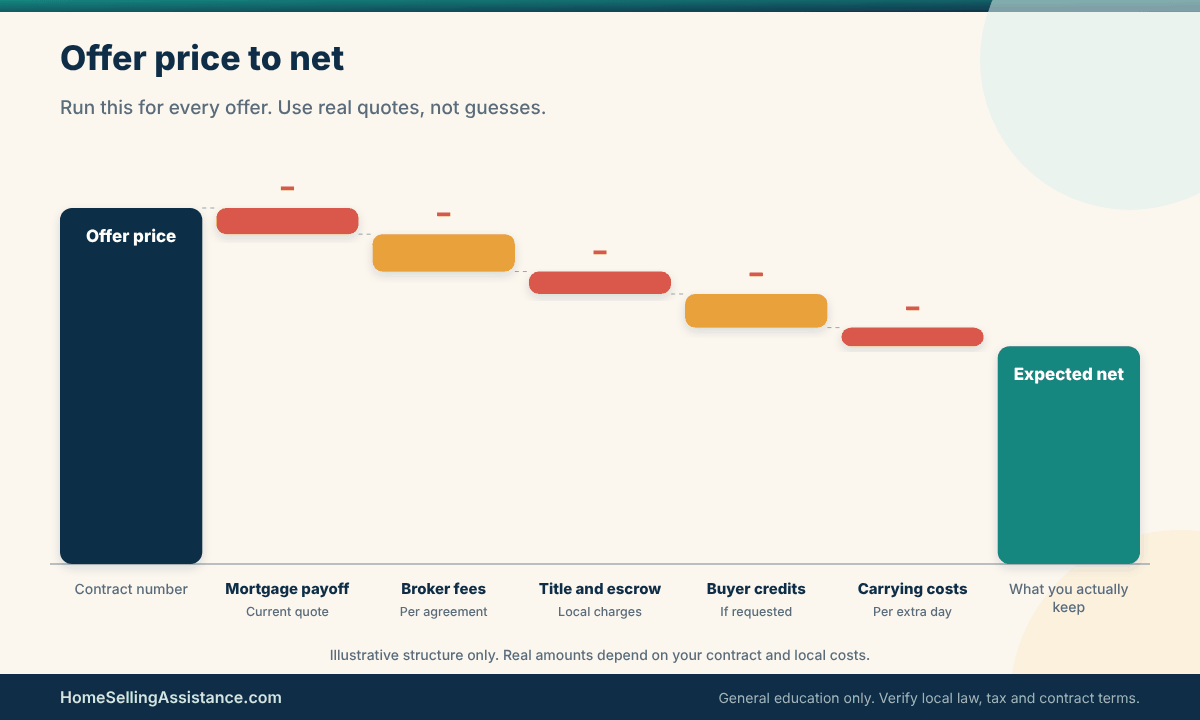
For a sound highest vs best offer house comparison, take each offer and build a simple net sheet. Start with the purchase price. Subtract your mortgage payoff, using a current payoff quote rather than your statement balance. Subtract the commission or fees you have agreed to, which should come straight from your written agreements. Subtract title, escrow and transfer charges as estimated by a title company or closing attorney in your area.
Then subtract what each offer specifically asks of you: requested credits, a repair allowance, a home warranty if you agree to one, and any proration differences caused by the closing date. Add or subtract the cost of carrying the house until closing, including mortgage interest, taxes, insurance and utilities, since a later closing means more of each.
Our guide to seller closing costs breaks down the usual line items, and the picture below shows how a sale price turns into net proceeds. Keep in mind that the waterfall is a structure, not a promise. Real amounts depend on your payoff, your agreements and local charges, so build yours from actual quotes.
Here is an illustrative comparison using round figures. Offer A is 430,000 with 9,000 in requested credits and a closing 45 days out. Offer B is 422,000 with no credits and a closing 25 days out. Suppose carrying costs run about 150 a day for illustration. Offer A nets 421,000 before carrying costs, minus an extra 20 days at 150, which is 3,000. That leaves roughly 418,000 against Offer B’s 422,000.
In that example the lower headline wins by about 4,000 before any risk adjustment. If Offer A’s buyer then asks for a price reduction after an inspection, the gap grows. If Offer B’s buyer fails to close, the picture flips. The point of this highest vs best offer house exercise is not to name a winner but to put both offers into the same units so that the risk conversation is about real money.
A scenario and the next step when the nets are close
In a highest vs best offer house comparison, the net sheets sometimes come out within a small amount of each other. That happens often, and it is useful information. When the money is nearly equal, the decision shifts to the other columns of the matrix: which buyer is more likely to close, which timeline fits you, and which contract asks less of your time and patience.
Imagine two offers that net within a couple of thousand dollars. One buyer has a clean financing path and a short inspection window. The other has a longer list of conditions but is slightly higher. In that situation many sellers choose the cleaner package, since the tiny price advantage does not compensate for the added chance of delay.
In a highest vs best offer house tie, your next step when nets are close is to ask each buyer for a single improvement. You might ask the higher bidder to shorten a contingency, or the cleaner bidder to raise the deposit or the price modestly. Keep the requests specific and equal in spirit. If you are curious how credits and closing help factor into these conversations, our article on seller concessions in a home sale explains how they work and when they make sense.
Legal, financing, execution, market-exposure and fallback risk behind each package
Risk in a highest vs best offer house decision comes from several sources, and it helps to name them. Legal risk is about the contract itself: unclear wording, missing addenda, a deposit clause that does not match local rules, or a buyer who asks you to give up rights you would normally keep. Financing risk is about whether the money will actually arrive. Execution risk is about whether each step happens on time.
Market-exposure risk is the cost of going back out to buyers if the deal fails. In a hot market that cost may be small. In a slow one it may be large, because a house that has already been under contract can look tainted to buyers, even when the reasons were routine. Fallback risk is whether you have a plan, such as a backup offer, if things go wrong.
You cannot remove these highest vs best offer house risks, but you can see them in advance and choose the one you are most comfortable carrying. A high price from a buyer with a thin financing story and no backup plan gives you a lot of market-exposure risk. A lower price from a buyer with strong proof and a backup in the wings gives you less. Each seller prices that difference differently.
Evidence to gather: lender letters, proof of funds and deposit terms
In a highest vs best offer house review of financed offers, the strongest evidence is a letter from a lender that states the type of approval, the loan amount and the conditions left to satisfy. A letter that lists many open items is weaker than one that lists few. If the buyer is using a program with specific property requirements, ask your agent whether the house is likely to meet them, because a property that fails a condition can stall an otherwise strong buyer.
For cash offers, the evidence is proof of funds in the buyer’s name or the name of the entity making the purchase. Be careful about documents that are easy to fake and about requests to send money or personal information in unusual ways. The Federal Trade Commission’s consumer advice pages describe common scams, and our guide on cash offers versus financed offers compares how each path behaves under stress.
For deposits, read the contract language. Who holds the money, when is it due, and under what conditions can the buyer get it back? Some contracts treat the deposit as the seller’s sole remedy if the buyer defaults, while others allow more. Rules vary by state, so ask your agent, a local attorney or your state real estate commission what the standard form says rather than assuming.
Finally, collect any addenda before you settle the highest vs best offer house question. A sale-of-home contingency, a rent-back request, a request for personal property or a special inspection clause can all change the risk profile in ways the first page does not show. Read every attached page before you decide, and if a term is unclear, ask for it to be rewritten in plain words. A confusing clause tends to become an argument later.
A scenario, an exception and a fallback plan
In a highest vs best offer house scenario, suppose you choose the cleaner, slightly lower offer and, three weeks later, the buyer’s lender finds a problem with the property. What happens next depends on the contract. If a financing contingency is active, the buyer may be entitled to leave with the deposit. If it has expired, the deposit terms may matter. This is why we suggest reading the default and remedy language before you accept.
An exception worth knowing: some sellers accept a more conditional offer because the buyer has agreed to a larger deposit that becomes non-refundable after a short window. That structure can reduce risk even when the price is higher. The details vary, so ask a professional who knows your local forms to explain what the language actually does.
The best fallback plan is a backup buyer. If you keep a second offer alive in writing, you can move quickly if the first falls apart. Our guide to the backup offer for sellers explains how to set one up and what to say to each side. If the first buyer’s loan is the issue, the article on what to do when buyer financing falls through picks up from there.
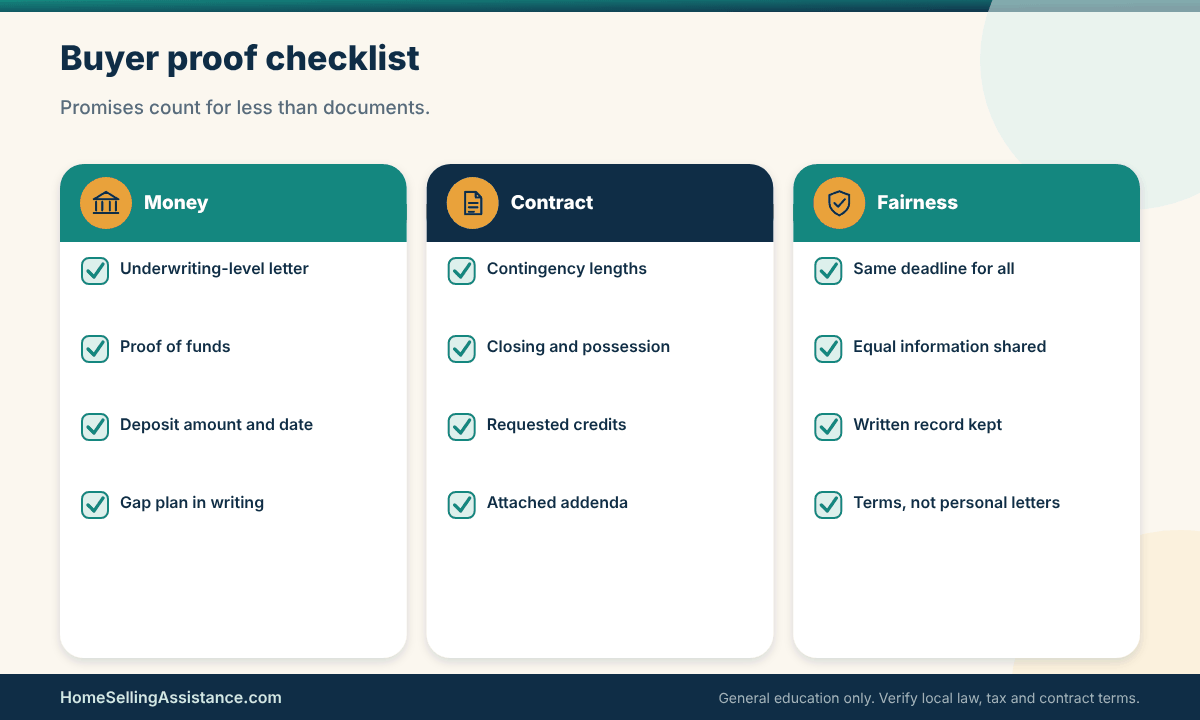
The checklist above, a useful tool for any highest vs best offer house decision, summarizes the documents worth gathering from every serious buyer before you decide. Treat it as a minimum, not a maximum. If one buyer provides everything and another provides half, that difference is itself part of your comparison, and you are free to give it weight.
Choosing between highest vs best offer house outcomes by seller scenario
By now it should be clear that no single rule settles the highest vs best offer house decision. A price premium that is sensible for one seller is reckless for another. What changes the answer is not the buyers, it is you: your deadline, your cushion, your next purchase, your tolerance for uncertainty and the condition of the house.
Before you apply a scenario, set up a fair highest vs best offer house process. Tell every buyer’s agent the same thing: the deadline for final terms, what you will consider, and how you will respond. Share information equally, because giving one buyer extra details about a competing bid can create trouble. Keep the written record of what each side was told.
Fairness also has a legal side. Federal fair housing law prohibits treating buyers differently because of protected characteristics, and the HUD fair housing pages explain what that means in practice. Judge offers on price, terms and proof, not on who the buyer is. Be cautious with personal letters from buyers, since they can pull your decision toward information you should not consider.
The table below collects several common highest vs best offer house situations. Each row names the situation, the route that usually fits, the reason, the trade-off and the one fact that could flip the choice. Use it as a prompt for your own thinking and a way to check whether your instinct matches your circumstances. It is not a rulebook, and your own agent or attorney knows details that a table cannot.
| Situation | Route favored | Reason | Trade-off | Fact that changes the choice |
|---|---|---|---|---|
| Fixed move or purchase date | Best package | Timing and certainty protect your next step | May accept a lower price | Buyer can match your date at a higher price |
| Large equity cushion, flexible schedule | Often highest price | You can absorb delay if a deal fails | More waiting and possible re-listing | Buyer has no financing proof |
| Probate or estate sale | Best package | Clean paperwork and fewer reopeners reduce delay | Possible price give-up | Court approval steps and their timing |
| Home needs repairs, sold close to as-is | Depends on inspection terms | A high price may erode after inspection | Cleaner buyer may offer less | Scope and length of inspection window |
| Hot market, many comparable buyers | Highest price, with firm terms | Backup buyers are easier to find | Fast decisions needed | Appraisal risk at a high price |
| Slow market, few showings | Best package | A failed deal is costly to replace | Smaller headline number | A backup offer already in hand |
Read across a row that resembles your situation, then read the last column twice. That column tells you which fact to confirm before you commit. Many sellers find that one missing piece of information, like an appraisal plan or a court timeline, settles a choice that felt impossible a day earlier.
Scenario one: the seller who must close by a fixed date
In a highest vs best offer house contest, this seller has a date they cannot easily move. Perhaps they are buying a new home with a closing already scheduled, or a job start, a lease ending or a school year sets the pace. For them, an offer that closes late can cause real harm, from paying two housing costs to losing the home they are buying.
The best-package route usually fits this highest vs best offer house case because it protects the one asset this seller cannot replace: time. A buyer who can close inside the window, with financing that is already well along, is worth more than a higher number with a long contingency period. Our article on flexible closing dates for sellers covers how to build in room, and why a little slack often matters more than a tidy calendar.
This does not mean accepting the lowest bid. It means asking each buyer to commit to the date in writing and to describe what happens if the date slips. A buyer who will pay a daily amount for delays, or accept a firm outside date, signals confidence. A buyer who cannot meet your date is simply not a candidate, no matter how attractive the price looks.
Evidence to gather: your own deadline, costs and cushion
For this scenario the evidence starts with you. Write down your fixed date and why it is fixed. Identify what happens if the sale closes a week late, two weeks late or a month late. Can you extend your own purchase, rent back from the buyer or arrange short-term housing? Each of those has a price tag, and knowing it lets you compare offers on what delay really costs you.
Next, gather the buyers’ dates. Compare each closing date and each contingency expiry, and look at what the contract says about extensions. Who can ask for more time, and for how long? Some forms allow one party to extend without the other’s consent in limited cases, while others do not. Your agent or attorney can tell you what your local form says.
Then look at the practical steps that decide whether a date holds. Has the buyer’s lender ordered the appraisal? Has the buyer chosen a title company? Is the house itself likely to meet the lender’s requirements? If you suspect a condition problem, such as a roof near the end of its life, discuss it up front with your agent. Surprises at week four are the main enemy of a fixed date.
Finally, price in a safety margin. If your next closing is on the fifteenth, you want your sale to close well before it, not on the same day. Sellers who plan a few days of buffer find that small hiccups do not become emergencies. A buffer costs little when planned and a lot when improvised.
A scenario, an exception and your next step for the date-driven seller
Take an illustrative seller who has an offer of 405,000 from a buyer with strong financing and a closing in 28 days, and another at 418,000 from a buyer who needs 55 days and has a sale-of-home contingency. If the seller must close their own purchase in five weeks, the second offer is unusable unless the buyer changes terms.
The exception arises if the seller can move their own date. Perhaps the next seller agrees to wait, or a rent-back can bridge a few weeks. Then the higher offer might fit after all, and the extra 13,000 may be worth chasing. The key is to learn what flexibility exists before choosing, not after.
Your next step is a short, honest call with your agent: can the higher buyer cut the timeline or drop the sale contingency, and can your own contract stretch? If you keep the clean offer, also ask whether you can counter slightly upward without losing it. The offer expiration article explains how deadlines and responses interact, which helps you manage two buyers without letting either one lapse.
Scenario two: the seller with equity cushion and time to spare
This seller owns the house with a large amount of equity, has no fixed date and can live with some delay. Maybe the next home is already bought, or they are not moving soon, or they are comfortable renting in the meantime. For them, the downside of a failed deal is a delay, not a disaster.
That cushion changes the highest vs best offer house arithmetic. The cost of a deal falling apart is lower, so a higher price with more risk can be a reasonable bet. The seller still wants to protect themselves, and there are ways to do it: a larger deposit, a shorter contingency window or a clear outside date. These tools let them reach for the higher number without leaving the door wide open.
Comfort with risk is personal, and it is fine to be cautious even with a cushion. Some sellers simply prefer a steady process and are happy to give up some price for peace of mind. What matters is that the choice is deliberate, based on facts about the buyers rather than on a feeling that the top number must be the right one.
Evidence to gather: market depth, buyer proof and your backup options
Start with the market for your highest vs best offer house choice. Ask your agent how many showings and how many offers the house has attracted, how long similar homes have taken to sell, and how buyers have responded to price reductions in your area. The National Association of Realtors publishes national housing data, but remember that national numbers are context, not a local forecast.
Then gather proof from the higher bidder in your highest vs best offer house comparison. If you are going to take on more risk for more money, you want the evidence to be as solid as possible. That means a lender letter with underwriting review, a statement on how an appraisal shortfall would be handled and a deposit that is meaningful and quickly due. A buyer who supplies these without fuss is easier to trust.
Look at your backup options too. Do you have a second buyer who would step in if the first fails? A backup lowers the cost of risk and lets you accept a more ambitious offer. Our guide to a multiple offers situation explains how to manage several buyers without breaking trust, and why clear communication keeps backup interest alive.
Finally, understand your carrying costs and your tolerance. Estimate what each month of delay costs, then compare that to the price premium. If a 12,000 premium would be wiped out by roughly three months of carrying costs and re-listing expenses, you can see how much delay you can afford before the extra money stops being worth it.
A scenario, an exception and your next step for the cushioned seller
Imagine a seller with two offers: 440,000 from a buyer with a verified lender letter and a modest appraisal plan, and 428,000 from a cash buyer with a short timeline. The seller has no deadline and plenty of equity. The higher offer carries a financing contingency and a 21-day inspection period, but the buyer has agreed to a larger deposit.
For this seller, the highest vs best offer house answer leans toward the higher offer, which is attractive. The extra 12,000 is meaningful and the risks have been reduced by the deposit and the lender proof. The exception is if the inspection turns up a significant issue, since the buyer’s right to renegotiate could close the gap quickly. The seller can prepare by sharing known issues early and by pricing repairs ahead of time.
The next step is to accept the higher offer while keeping the cash buyer warm as a backup, if the contract and local rules allow it. Ask your agent how to word the backup so that it is clearly secondary. If the first deal falters, you can move fast, and the early inspection conversation will already have set expectations. Our article on escalation clauses is also useful if a buyer’s offer includes an automatic increase and you need to understand what proof to ask for.

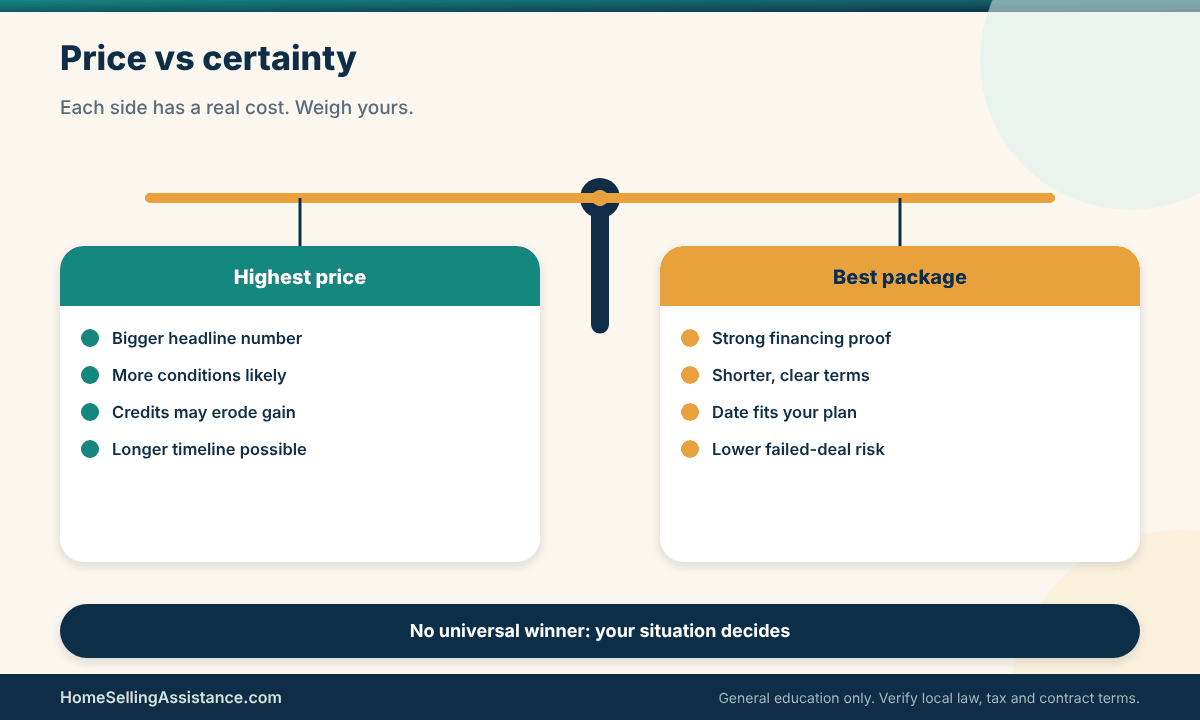
The last picture shows the fallback logic for a highest vs best offer house deal that stalls. Notice that the most reliable fallback is the one you prepared before you needed it: a backup buyer, a clear contract deadline and a record of what each side agreed. Sellers who keep those three things on hand rarely feel cornered, even when the first plan fails.
Before you decide, check the mortgage side one more time. If a buyer relies on a loan, a quick review of the financing contingency guide tells you what the buyer’s exit rights usually look like and which questions to ask. And if you are comparing a cash route with a traditional one, our overview of a cash offer for a house covers the main trade-offs.
Last, in any highest vs best offer house decision, trust your own definition of “best.” It can be the highest price, the fastest closing, the calmest process or a balance of all three. What matters is that you decide on purpose, with the facts in front of you, and that you write the reasons down. A decision you can explain is a decision you are less likely to regret.
Quick scenario
Highest vs best offer house example: two buyers, one clear difference. The higher offer is 10,000 above the other but asks for 7,000 in credits and has a 45-day closing. The lower offer asks for nothing and closes in 25 days. On paper the gap is 10,000. After credits and 20 extra days of carrying costs at an illustrative 150 a day, the higher offer is about 3,000 behind before any risk is counted.
Frequently asked questions about highest vs best offer house decisions
What does “highest and best” mean when a seller asks for it?
It is a request to every interested buyer to submit their strongest price and terms by a stated deadline. It is a process step, not a promise to take the top bid. After the responses arrive, you still decide whether the highest vs best offer house question points toward price or toward the cleanest package.
Do I have to accept the highest offer?
In general, no. A seller may choose any offer or none, subject to the contract rules in their state and any obligations in their listing agreement. Many sellers settle a highest vs best offer house choice with a lower price and better terms, as long as the decision is based on legitimate factors like financing, timing and certainty and not on a buyer’s protected characteristics.
How much is certainty worth?
There is no universal figure for a highest vs best offer house choice, and anyone quoting one is guessing. A useful way to think about it is to estimate what a failed deal would cost you in carrying costs, lost time and a possible price reset, then compare that to the premium the riskier buyer offers. Your own numbers and your market decide the answer.
Is a cash offer always the best offer?
Not always. Cash can remove financing and appraisal risk, which is valuable, but the price may be lower and proof of funds still needs to be checked. A well-supported financed offer can be as reliable as a weak cash one. Compare the evidence behind each rather than the label.
Can I ask buyers to improve their offers after I receive them?
Yes, typically through a counteroffer or a request for final terms. Keep your requests specific, such as a larger deposit, a shorter contingency or a modest price move. Be consistent in what you tell each side, and keep a written record. Your agent or attorney can advise on how to word it under your state’s rules.
What if the higher buyer has an appraisal contingency?
An appraisal contingency generally lets the buyer renegotiate or leave if the appraised value is below the price, depending on the contract. Ask how the buyer would handle a shortfall, and whether they will commit to covering a stated amount. A written plan makes the high number more believable.
Should I keep a backup offer?
Many sellers do, because a backup can shorten the time it takes to recover if the first deal fails. The contract needs to clearly mark the backup as secondary, and local practice varies. Ask your agent or attorney how backup language works where you live before relying on it.
Are buyer letters about why they love the house helpful?
They can create risk. Personal letters may reveal information about a buyer’s family or background that you should not use to decide, and fair housing rules apply. Many agents advise sellers to focus on the written terms and to decline personal letters. HUD’s fair housing resources explain the principles.
Who can help me compare the offers?
Your listing agent, a real estate attorney in states where they handle contracts, and a title or escrow company can each help with different parts. A tax professional can speak to your own tax position. This article is general education, so ask the professionals for guidance that fits your facts.
Deciding on purpose
The highest vs best offer house decision gets easier when you stop asking which number is biggest and start asking which sale is most likely to close on terms you can live with. Gather proof, run the net sheet, weigh your own deadline and cushion, and write down why you chose what you chose. For the broader picture, return to our guide on how to evaluate a home offer as a seller. This article is general education, not legal, tax or financial advice, so check your contract and local rules with a licensed professional before you sign.