Figuring out how to divide home sale proceeds divorce couples agree on is rarely a math problem; it is a paperwork and sequencing problem that happens to involve math. The house sells, a closing agent holds a pile of money, and two people who are no longer making decisions together have to tell that agent, in writing, exactly where every dollar goes.
Most of the pain shows up in the final week. A payoff letter is larger than expected, a lien nobody remembered appears on the title report, or the settlement agreement says “split equally” without saying equally of what. By then the buyer is waiting, the lender’s clock is running, and nobody feels generous.
This article is about the gap between a signed divorce agreement and a closing statement that actually matches it. We will look at the documents that control the split, the deductions that come off the top, how escrow holdbacks work, and what to put in the closing instructions so the title or escrow company can follow them without guessing. We stay neutral on agents, attorneys, mediators and sale routes, because the right mix depends on your state and your situation.
One boundary up front. This is general education. Divorce property division, community property versus equitable distribution, and the treatment of premarital equity are decided by state law and by the court or agreement that governs your case. For the bigger picture of ownership, court orders and pricing, our guide to selling a house during divorce covers the foundation, and this page picks up where the sale price and the split meet at the closing table.
Key takeaways
- The decree or agreement controls, not the closing statement. A closing agent follows written instructions signed by the people entitled to the money, so the instructions must match your legal documents.
- “Net proceeds” is a defined term only if you define it. Say which costs, liens, credits and holdbacks are deducted before the split, and in what order.
- Payoffs and liens come first. The mortgage payoff, any second loan or line of credit, and recorded liens are paid from the sale before either spouse receives anything.
- Unequal splits need arithmetic written down. If one person gets a fixed dollar amount first, or reimbursement for a past payment, the agreement should show the formula and an example.
- Escrow holdbacks are normal and should be pre-assigned. Decide in advance who receives any leftover held funds and who absorbs a shortfall.
- Keep the closing file. The final settlement statement, payoff letters and wire confirmations support tax reporting, later disputes and any follow-up with your lawyers.
Start with the paper trail that lets you divide home sale proceeds divorce terms support
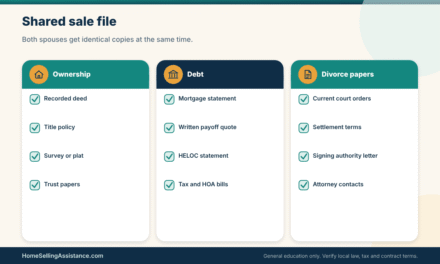
Before anyone lists the house, gather the documents that decide who gets what. It sounds dull, and it is, but a single missing page can freeze a closing. Closing agents are cautious by design. They will not release money to one spouse on a verbal understanding, and they should not.
Think of this section as building the file your lawyers, your agent and the title company will all draw from. The more complete it is before an offer arrives, the fewer surprises can show up between acceptance and closing day. Every couple who must divide home sale proceeds divorce lawyers will recognize shares one habit: they collected documents before they argued about numbers.
Decree, deed, payoff, and tax numbers
Four groups of documents carry most of the weight. First, the legal instrument that divides the property: a signed marital settlement agreement, a stipulated judgment, a court order, or, for couples not yet in court, a written separation or sale agreement. Second, the deed and any title paperwork showing how ownership is held. Third, lender statements. Fourth, tax and carrying-cost records.
Pull each one and read the sentences that mention the house, the sale, the proceeds and the timing. Highlight anything that depends on a number you do not have yet, such as “after payment of the first mortgage” or “less each party’s share of repairs.” Those phrases are where disagreements hide. If you read nothing else before you divide home sale proceeds divorce paperwork will answer most questions in these sentences.
Evidence to gather: the agreement, the payoff letter, and the tax bill
Start with the divorce paperwork. Look for the clause that says whether the house must be sold, who controls the listing, who chooses the agent, and how proceeds are distributed. Note whether the document uses terms like gross proceeds, net proceeds, or equity, because they mean different things. If the language is vague, ask your attorney or mediator to clarify before listing rather than after the offer. The clause that lets you divide home sale proceeds divorce courts will enforce is usually short, so read it twice.
Next, request an official payoff statement from every lender with a loan secured by the home. A monthly statement balance is not a payoff figure, because it leaves out accrued interest and fees. The title or escrow company will order its own payoff demand, but your early copy shows whether the number is in the neighborhood you expect. Our explainer on how a mortgage payoff works when selling a house walks through what the figure includes.
Finally, collect the most recent property tax bill, any HOA statements, and records of who has been paying the mortgage, taxes and insurance since separation. If your agreement reimburses one spouse for payments made after a certain date, those records become the proof. Screenshots of bank transfers help, but monthly statements are cleaner. Strong records make it far easier to divide home sale proceeds divorce reimbursements included, without relying on memory.
Also confirm the deed. It tells you whether title is held by one spouse, both spouses, or a trust, and whether anyone else is named. If a name on the deed does not match the people in the divorce, the closing agent will need to resolve that before the sale can close, and the answer comes from your attorney and the title company, not from a guess. Title questions are the first thing a closer checks before agreeing to divide home sale proceeds divorce instructions request.

A scenario: the decree says equal split, the numbers say otherwise
Here is an illustrative case with round numbers. A couple agrees the home sells for $400,000 and the decree says “proceeds divided equally.” The first mortgage payoff is $240,000. A home equity line of credit, which one spouse used for a business, carries $30,000. Then come the closing charges and any agent compensation under the listing agreement, which we will call $28,000 for the example.
If the agreement meant “equally after the mortgage only,” the pot is $160,000 and each gets $80,000, but the line of credit still has to be paid at closing because it is recorded against the house. So the closing agent pays $30,000 to that lender and the costs come out too, leaving $102,000 to share. Each person gets $51,000, unless the agreement says the spouse who borrowed the line of credit bears it personally.
The lesson is not the arithmetic. It is that three reasonable readings of “equal” produce three different checks. Settle the reading while you are still cooperating. A short email exchange between attorneys, confirming the order of deductions, costs far less than a post-closing motion to interpret the decree. That is why the wording used to divide home sale proceeds divorce documents contain deserves a second look.
The questions your file cannot answer yet
Even a well-organized file has holes. Some are unknowable until the market responds, like the sale price. Others are knowable but nobody has asked: Is there a lien from an old contractor? Does the HOA have an unpaid special assessment? Did anyone take out a loan against the property that the other spouse does not remember?
The goal of this stage is not to answer every question. It is to list them honestly, assign each to a person who will find the answer, and put a date next to it. A list of open items with names and dates beats a vague sense that things are probably fine. A good list helps you divide home sale proceeds divorce settlements anticipate, rather than discover problems at closing.
Evidence to gather: liens, credits, and who paid what
A title search reveals recorded liens and encumbrances, and ordering a preliminary title report early is one of the cheapest ways to avoid a late surprise. Sellers sometimes wait for the buyer’s title company to order it, which means problems surface after the contract is signed. If you want a refresher, our page on the seller title search explains what turns up and who typically orders it.
Common items include second mortgages and lines of credit, unpaid property taxes, HOA or condo assessments, judgment liens against either spouse, tax liens, mechanic’s liens, and sometimes child support or spousal support liens where local law allows them to attach to real property. Whether a particular obligation becomes a lien on the house depends on your state and on what has been recorded, so ask the title company to explain what they actually see.
Credits are the other half. Maybe one spouse put a large sum into a new roof after separation. Maybe the other made every mortgage payment for a year. Whether those amounts are credited back is a matter for your agreement or the court, and the evidence is receipts, bank records and contractor invoices. Gather them before the sale, because gathering after closing means arguing from memory. Reimbursements are often the least documented part of any attempt to divide home sale proceeds divorce teams handle.
A scenario: the forgotten second loan
Imagine one spouse opened a home equity line years ago and drew on it quietly. Nobody mentions it during negotiation, and the divorce agreement refers only to “the mortgage.” At the preliminary title stage, the report lists a second recorded lien. Now the sale cannot close until that lender receives a payoff, which reduces everyone’s proceeds.
The right move is not to hide it and not to panic. Share the report with both attorneys the day it arrives, ask the lender for a payoff figure, and have counsel decide whether the agreement allocates that debt to the spouse who incurred it. Handled in week one, this is a negotiation.
Discovered at the closing table, it is a crisis that can delay or cancel the sale, so the early title report earns its small fee many times over. Surprises like this are why a careful plan to divide home sale proceeds divorce attorneys can support begins before the first showing.
Quick scenario
Two spouses agree to list in spring. Before signing the listing agreement, each sends the other a one-page list titled “what I think comes off the top,” covering loans, taxes, repairs and fees. The lists differ by one item: a past-due HOA assessment. Finding that gap in April costs one phone call. Finding it at closing in June would have cost a week and a tense conversation.
Walk the sale in order, from listing to the wire
A sale has a rhythm. Decisions made at listing time echo through the contract, the title work and the closing statement. When two people are separating, those echoes are louder, because each decision can quietly shift who ends up with more money. The rhythm matters because you cannot divide home sale proceeds divorce couples disagree about until the numbers are real.
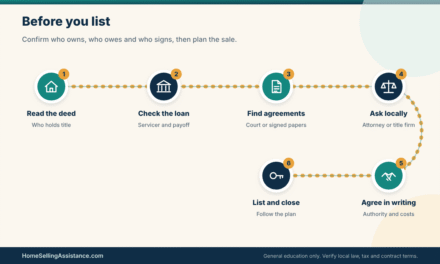
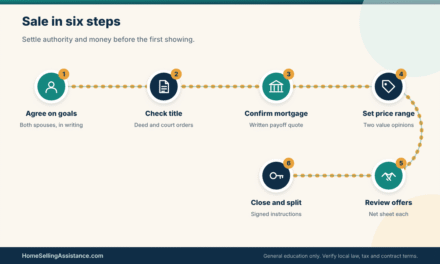
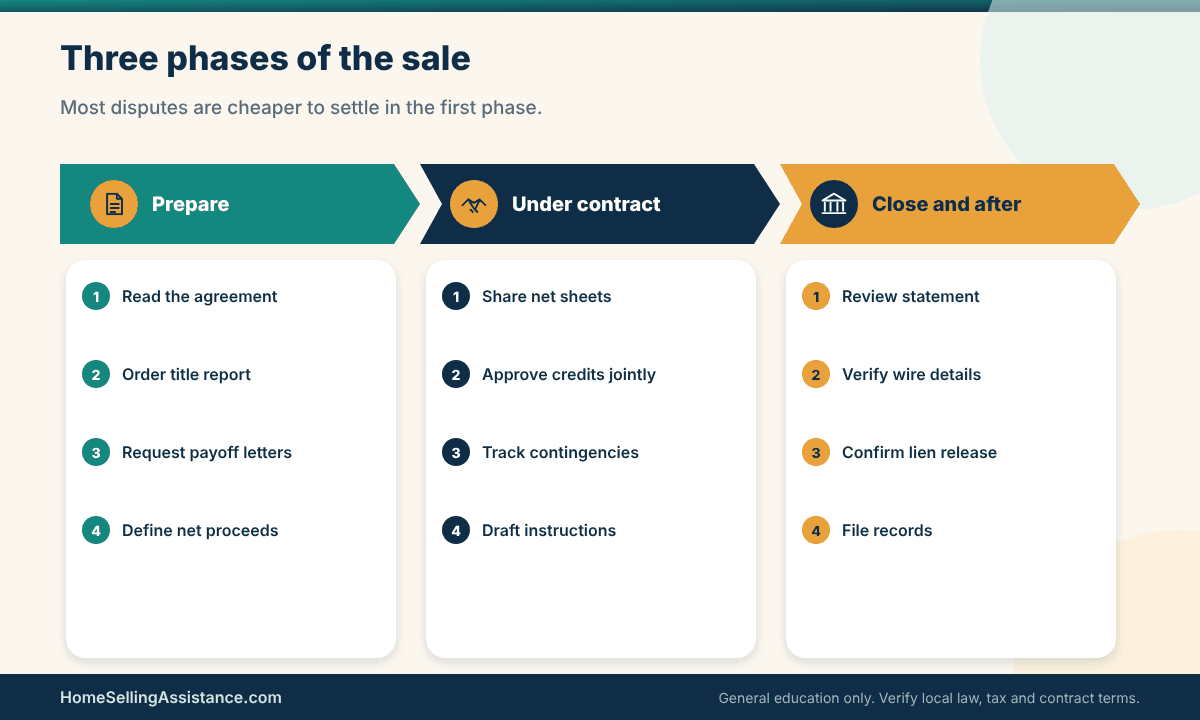
Rather than treating the sale as one event, treat it as a chain of handoffs. At each link, ask what information moves, who must approve it, and what happens if the approval does not arrive. The table below puts that chain in one place before we look at the details. Doing it this way helps when the goal is to divide home sale proceeds divorce attorneys can verify.
Use the first table as a workflow map. The stage column tells you where you are, the information column tells you what to collect, and the deadline column reminds you that most steps have a clock attached, either from the contract or from your own agreement. Treat the sample timing as a starting point, because contracts, lenders and courts set the real dates.
| Stage | Information to gather | Action | Decision deadline | Next handoff |
|---|---|---|---|---|
| Before listing | Agreement, deed, lender statements, tax bill | Confirm who signs the listing and how “net” is defined | Before the listing agreement is signed | Attorneys to listing agent |
| Early title review | Preliminary title report, lien list | Request payoffs, assign each debt to a person | Within the first days of listing | Title company to both attorneys |
| Offer review | Estimated net sheet at each offer price | Both spouses compare the sheet to the agreement | The offer’s response deadline | Agent to both spouses |
| Under contract | Inspection credits, repair asks, escrow terms | Decide who pays credits and who approves them | Contract contingency dates | Spouses to buyer’s agent |
| Closing instructions | Wire details, payoff letters, split formula | Sign joint written instructions for the closer | Several days before closing | Attorneys to title or escrow |
| Final statement review | Draft settlement statement | Tie each line to the agreement and the payoffs | The day before signing | Closer to both spouses |
| Disbursement | Verified bank details for each spouse | Confirm wires by phone with a known number | Day of closing | Title company to banks |
Read across a row to see the whole job for that stage. If you cannot fill in a cell, that is your task list. The most common empty cell is the third one in the first row: nobody has defined “net,” which sends everyone back to the lawyers during a week when the buyer expects quick answers. If you need to divide home sale proceeds divorce by stage, the table shows which handoff is next.
Early decisions that shape how you divide home sale proceeds divorce lawyers must later enforce
The early decisions are who runs the sale, who signs, how the listing price is set, and how offers are approved. These look like logistics, but they decide whether the closing instructions will be simple or contentious. A clean structure at the start means the end of the process mostly consists of arithmetic.
Consider a rule many couples adopt: both spouses must approve any accepted offer in writing, and each sees the same net sheet. It prevents the situation where one person agrees to a lower price or heavier credits without the other knowing. It also makes the later split easier to defend, because both saw the numbers at the time. A shared approval rule makes it easier to divide home sale proceeds divorce attorneys later review, because nothing was decided in secret.
Evidence to gather: net sheets, comparables, and the listing agreement
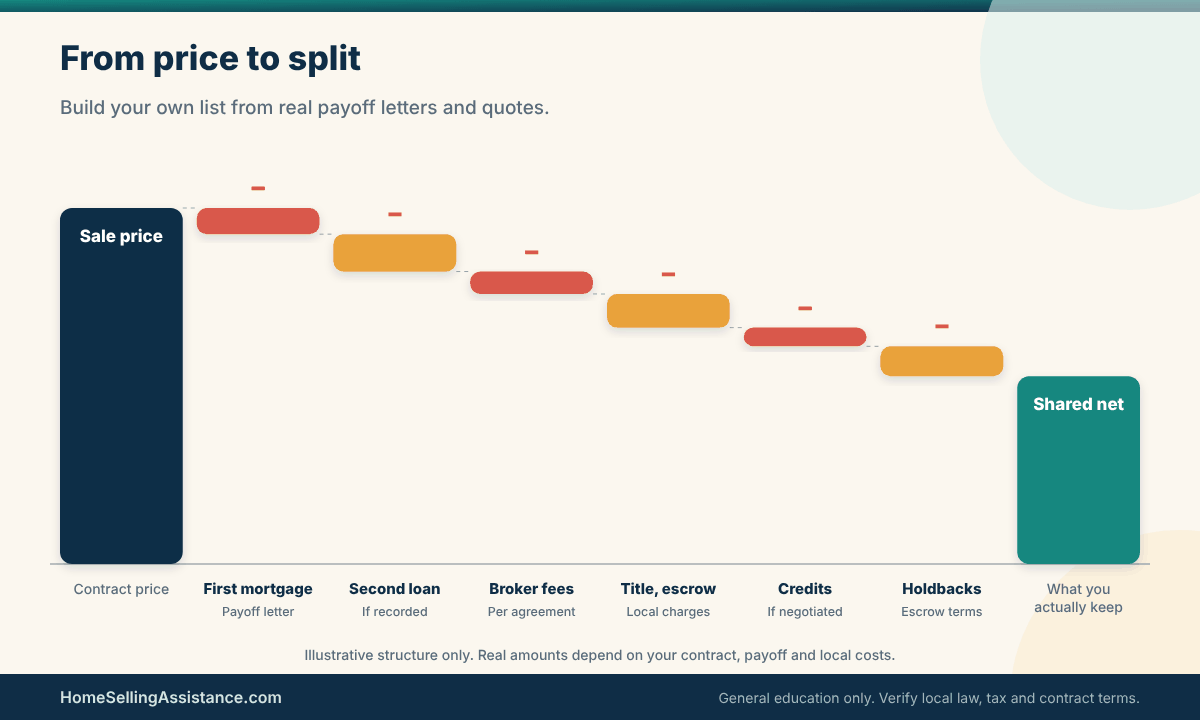
Ask your listing agent for an estimated net sheet at several possible prices. A net sheet is an estimate of costs and deductions, so it should list the mortgage payoff, agent compensation as written in the listing agreement, title and escrow charges, transfer or recording items where they apply, prorated taxes and any HOA charges.
Compensation to brokers is negotiable and must be spelled out in writing, so the net sheet should match whatever your listing agreement actually says rather than a rule of thumb. A net sheet is the working tool you use to divide home sale proceeds divorce terms call for, at each possible price.
For pricing evidence, rely on recent local comparable sales and active competing listings rather than national averages, which are context at best. Both spouses should see the same comparables. If you disagree about price, agree on a method first, such as following the agent’s analysis or ordering an independent appraisal, and only then argue about the number. Our guide to listing a home during divorce covers how couples set pricing and showing rules.
Read the listing agreement for term length, who may terminate it, and what happens if one spouse wants to withdraw. A long exclusive term signed by only one spouse can create a standoff. If you are not sure who has authority to sign, ask your attorney before the agent starts marketing, because a listing signed by the wrong person can complicate everything downstream. A listing signed by the wrong person can derail an otherwise sensible plan to divide home sale proceeds divorce lawyers drafted.
A scenario, an exception, and your next step
Picture a couple who cannot agree on price. One wants to list high and wait; the other needs liquidity soon. Their agreement says the house must be sold but is silent on price reductions. Without a rule, every reduction becomes an argument, and each week of delay shifts carrying costs onto whoever pays the mortgage.
A practical fix is a written pricing protocol: an initial list price based on the agent’s comparable analysis, a review date, a pre-agreed reduction step if there is no offer by that date, and a statement of who bears carrying costs in the meantime. This is a negotiation tool, not legal advice, and your attorneys should shape the wording. The exception is a court-ordered sale, where the order itself may set the price method, so check it first.
Written protocols keep the sale on track so you can divide home sale proceeds divorce agreements describe, not argue about weekly price changes.
The next step is simple. Put the protocol in an email both attorneys can confirm, and attach it to the listing file. It costs an hour now and prevents a weekly negotiation later.
Handoffs between agent, title company, and both lawyers
Once a contract is signed, information moves between more people: the listing agent, the buyer’s agent, the title or escrow officer, the lender, and two attorneys or one mediator. Each handoff is a chance for a number to get changed, a deadline to get missed, or a message to get lost. Appoint one person to be the point of contact for scheduling, and have all money instructions go through attorneys or in a document both spouses sign.
Who is the closer? In some states a title or escrow company handles the closing and disbursement; in others a real estate attorney does. The mechanics of who holds the money, how long it is held and what documents release it differ, so ask early who your closer is and request their standard disbursement and wire process in writing. The closer is the person who will actually divide home sale proceeds divorce instructions specify, so their process matters.
Evidence to gather: escrow terms, holdbacks, and contingency dates
Read the purchase contract for three kinds of terms that change what lands in the account. First, earnest money: held by the closer or broker, it is normally credited to the buyer at closing, but it matters if the deal falls apart. Second, contingency dates for inspection, financing and appraisal, since a late repair credit shrinks the pot. Third, any provision for holdbacks, such as repairs completed after closing or a final utility bill.
A holdback is money kept in escrow after closing to cover a specific item. It might be a small amount for a final tax bill, or a larger amount while a repair is finished. Ask in writing how much is held, why, how long, and who gets the leftover. If the agreement says nothing, both spouses should confirm in advance who receives any released balance, so nobody discovers a surprise check payable to one name.
Holdbacks change the timing when you divide home sale proceeds divorce agreements cover, so plan for a second, smaller payment.
If a buyer asks for a repair credit during the inspection period, treat it like any other deduction from the shared pot unless your agreement assigns it differently. Our overview of home sale net proceeds shows how credits flow into the bottom line, and the seller-side logic applies whether or not you are divorcing.
A scenario, an exception, and your next step for the middle of the deal
Suppose the buyer’s inspection turns up a roof problem and the buyer’s agent asks for a credit. The spouse living in the house wants to accept quickly to keep the deal alive. The other spouse suspects the request is inflated. The agreement does not mention repair credits.
The fair process is boring on purpose. Ask for the inspection report and a contractor estimate, discuss a counteroffer through the agent, and have both spouses sign any amendment to the contract. If the spouses disagree and the agreement is silent, counsel may need to resolve it, and the contract’s response deadline does not pause for that.
So agree ahead of time on a decision rule, for instance that credits under a stated amount can be approved by either spouse and anything larger needs both signatures. Boring is good when the goal is to divide home sale proceeds divorce teams can defend later.
The exception is a lender-driven repair, where the buyer’s loan requires work before closing. That kind of item may be non-negotiable for the buyer, so the conversation shifts from whether to who completes it, and at whose cost. The next step is to talk to your attorney and the agent the same day the request arrives.
Quick scenario
A buyer’s lender requires proof that a past permit was finalized. One spouse knows where the paperwork is; the other does not. The first spouse delays two days because of a disagreement about something unrelated. The buyer’s deadline passes. A simple rule helps: any document needed to keep the deal on track gets sent to both attorneys within a day, whatever else is unresolved.
Close the loop on every dollar
The last stretch is where intentions become wire transfers. Everything you decided earlier gets translated into one document, the settlement statement, and one set of instructions telling the closer where each payment goes. If those two documents disagree with your agreement, the closer cannot choose between them for you.
That is why this section is the longest in practice, even though it covers only a few days. A careful review at this point is the last inexpensive chance to fix an error. After funds are disbursed, correcting a mistake means asking someone to return money, and that conversation is hard between people already in conflict. It is where you actually divide home sale proceeds divorce documents allow, so it deserves patience.
Written instructions that tell the closer how to divide home sale proceeds divorce agreements describe
Closing agents typically ask for a signed document, often called disbursement or closing instructions, that identifies who receives the seller’s net funds, in what amounts, and by what method. In a divorce sale, those instructions should mirror the agreement exactly and should be signed by both spouses, or by authorized representatives where the law and the closer allow it.
Good instructions are specific. They name each payee, state the amount or the formula, give the method (wire, cashier’s check), and say what happens to any leftover or late-arriving funds. They also say what happens if the final number differs from the estimate, because it often does by a little. A sentence like “any difference is divided in the same proportions as the main distribution” prevents a small argument over a small amount.
Specific instructions are the best way to divide home sale proceeds divorce closers can process without calling each spouse.
Before the instructions are signed, each spouse should verify their own bank details through a trusted channel. Closing wire fraud is real and costly, and divorcing couples are not immune. The Consumer Financial Protection Bureau publishes plain-language material on closing scams, and victims can report wire fraud to the FBI’s Internet Crime Complaint Center. Never change wire details based on an email, even one that looks like it came from your own lawyer. Fraud prevention belongs in any plan to divide home sale proceeds divorce couples can trust.
Evidence to gather: the draft settlement statement and the payoff letters
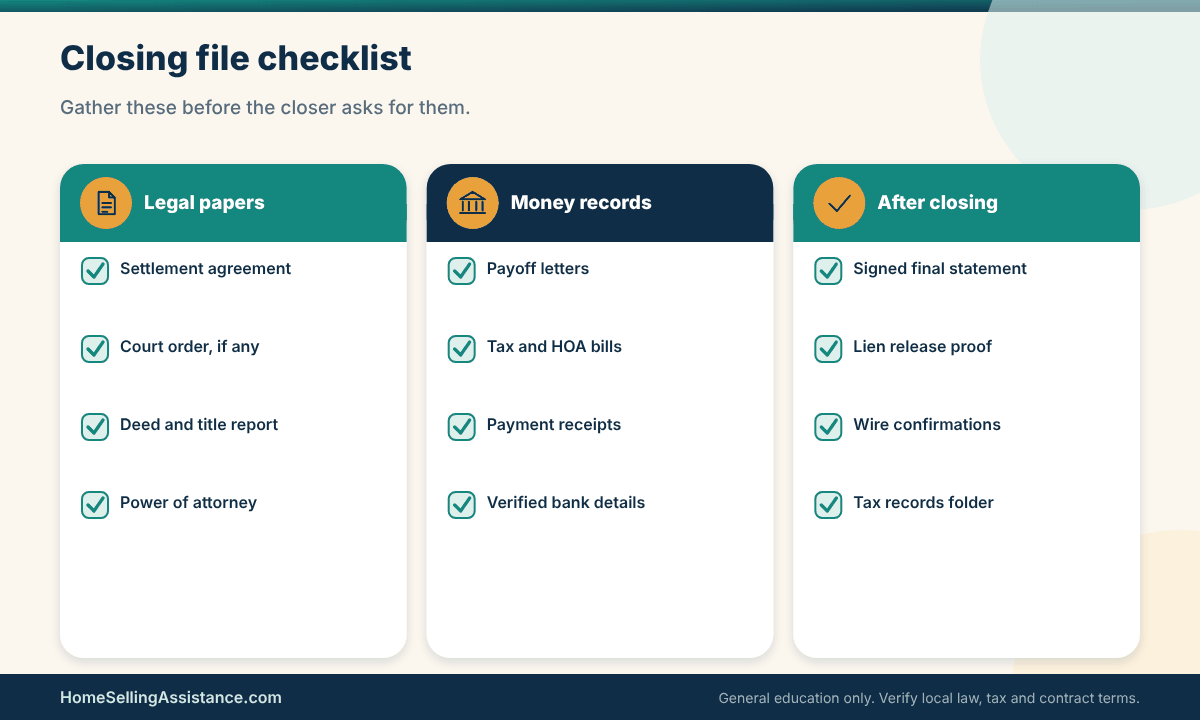
Ask the closer for a draft settlement statement as early as they will provide it, ideally a few days before closing, and compare it to the contract and the agreement line by line. Our page on the seller closing statement explains the format, and the main thing to look for is that every deduction has a document behind it.
On the seller side, expect to see the sale price, the payoff of each loan, any agent compensation and other fees as agreed in writing, title and escrow charges, taxes and HOA proration, credits to the buyer, and the net due to the seller. Then compare the net to the sum of what your agreement says each person receives. If there is a gap, find out which line explains it before signing anything.
Only after the statement is verified can you divide home sale proceeds divorce agreements require, with confidence in the net figure.
Match every payoff on the statement to a payoff letter, and check that the per-day interest figure matches the actual closing date. If closing slips by a few days, the payoff increases slightly, and the closer should update it. Confirm that payoffs to second lenders include a lien release or a satisfaction document after payment, since that is what removes the loan from the record.
The second table below is a transaction check table. It lists the issues that most often distort a divorce closing, what evidence you should hold for each, who else at the table can help, the risk if you skip it, and a sensible fallback. Use it the week before closing as a final inspection of your own preparation.
| Issue | Seller evidence | Buyer, agent or title input | Risk if skipped | Fallback |
|---|---|---|---|---|
| Mortgage payoff differs from estimate | Lender payoff letter with per-day interest | Title company’s payoff demand | Shortfall reduces both shares | Update the split formula before signing |
| Unexpected lien on title | Preliminary title report, lien documents | Title officer explains how to clear it | Closing delayed or cancelled | Pay from proceeds with written consent, or escrow a payoff |
| Agreement says “equal” but is unclear | Signed agreement and attorney confirmation | Closer asks for explicit amounts | Closer refuses to disburse | Joint written clarification from counsel |
| Holdback or repair escrow | Contract clause, written escrow terms | Buyer’s agent and closer confirm release terms | Leftover goes to the wrong person | Name the recipient in the instructions |
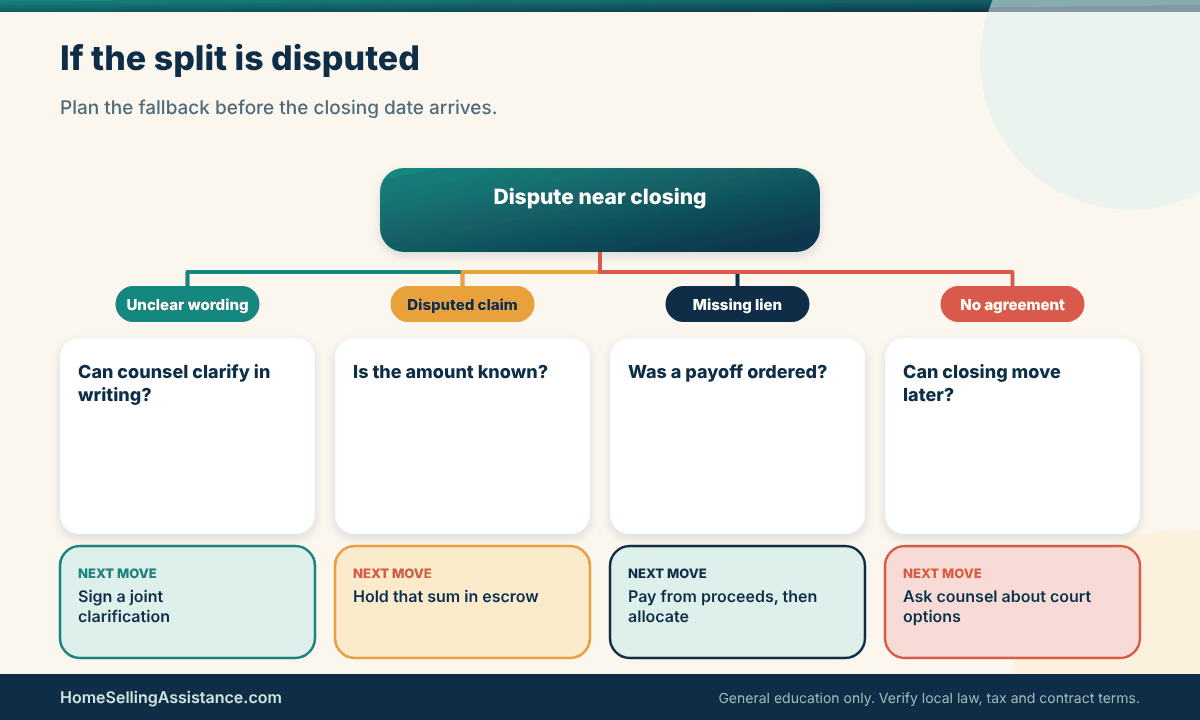
| Reimbursement claims for past payments | Bank statements, receipts, invoices | Closer needs the credit amount in writing | Dispute after funds are gone | Hold a disputed sum in escrow until resolved |
| One spouse unavailable to sign | Power of attorney or court order, if any | Closer reviews documents in advance | Missed closing date | Counsel arranges remote or earlier signing |
| Wire details altered by a fraudster | Bank details confirmed by phone | Closer calls a verified number | Money sent to the wrong account | Report to the bank and authorities immediately |
The pattern across the rows is that most fallbacks involve either escrow or a joint written statement. Both are cheap compared with a dispute after money has moved. If a row applies to you and the fallback column is not in place yet, treat it as a task for this week and give it a name and a date. Each row is a small way the effort to divide home sale proceeds divorce couples attempt can go wrong.
A scenario, an exception, and your next step for the instructions
Imagine the settlement statement shows $118,000 due to the sellers, and the agreement says the spouse who stayed in the home receives the first $20,000 as reimbursement for earlier payments, with the rest split equally. The instruction should therefore read as a formula: $20,000 to the first spouse, then $49,000 each. If the final number moves to $116,500 the day before closing, the formula still works: $20,000 first, then $48,250 each.
Without a formula, the closer sees only a number and asks which of several arithmetic paths to follow. That is the moment a delay starts. With a formula, a late change is a recalculation. A formula lets the closer divide home sale proceeds divorce instructions describe even when the final number moves.
An exception worth knowing about: some agreements assign a particular debt, such as a credit card or a tax obligation, to be paid from sale proceeds. If so, the closer may need a payoff letter and a payee address for that obligation, which is not the same as a lien on the house. Ask your attorney whether paying it through closing is allowed and how it is documented, then add it to the instructions.
Signing logistics deserve their own planning, so treat them as part of the written instructions. If one spouse has moved to another state, a mobile notary or a remote closing option may be available, depending on the state and the closer. Documents that need notarization have to be signed in the right form, with the right identification, so ask which pages are involved well before the signing date. Logistics are part of how you divide home sale proceeds divorce agreements envision, because an unsigned page stops the money.
Power of attorney is another option, but it has to be accepted by the title company and, in many cases, by the buyer’s lender, and it may need to be recorded. It is not something to arrange in the last week. If you think you may need it, start with your attorney early and ask the title company whether they will accept the draft. Whether a power of attorney can be used to divide home sale proceeds divorce closers accept is a question for the title company.
Ask the closer for a list of everything each seller must bring or sign. It usually includes government identification, the deed or title information, a forwarding address, and bank details for disbursement. If a spouse is acting under a power of attorney or a court order, the closer will want copies reviewed in advance.
If the sale is happening under a court order, ask your attorney whether the order requires court approval of the final distribution, or whether a signed agreement between spouses is enough. Court involvement changes timing, and you will want to know before you accept a closing date that ignores it. Rules differ widely from state to state and from county to county. Court involvement can slow the step where you divide home sale proceeds divorce orders require, so ask early.
Take a case where one spouse has relocated for work and cannot travel on the closing date. A couple of days before closing, the title company says remote notarization is not available for this transaction, and the only option is a signing near the other spouse’s new home.
The best prevention is a question asked in week one: “How do out-of-town sellers sign here?” Closers have standard answers, which may include mailing documents to a local notary or using a signing service. If the answer is not workable, move the closing date early enough that everyone can sign calmly. A new date is annoying; a rushed signing with missing pages is worse. Asking early keeps the plan to divide home sale proceeds divorce schedules support from collapsing over a signature.
Records and follow-up after the money moves
Closing day feels like an ending, but a few loose ends remain. Funds have to arrive and be confirmed, lien releases have to be recorded, utilities and insurance have to be closed out, and tax records need to be filed somewhere you can find them in a year. Treat the first month after closing as a short cleanup project with its own list. Some tasks continue after you divide home sale proceeds divorce documents covered, such as confirming releases.
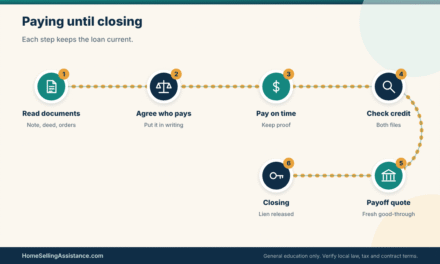
This is also when many couples stop talking to each other, which is understandable, but a few shared tasks still need an owner. Agree on who will collect the final documents from the title company, who will confirm that the mortgage was released, and how copies reach both sides.
Evidence to gather: the final statement, release documents, and bank confirmations
Ask the closer for the final signed settlement statement and a disbursement summary showing every payment made. Save both as PDFs and keep a paper copy somewhere safe. If the sale ever gets questioned by a lender, a court, or a tax authority, this is the document that shows what actually happened, not the estimate you looked at last week. The final statement proves how you chose to divide home sale proceeds divorce terms required.
Within a reasonable time, confirm that each loan paid at closing was released. Lenders generally issue a satisfaction or release, and in many places it is recorded with the county. Timelines differ, so ask the title company what to expect and when. If nothing shows up, the county recorder’s office can tell you whether a release is on file. A lingering lien on a house you no longer own is more nuisance than disaster, but it is far easier to fix early.
Check your bank accounts against the instructions. Each spouse should confirm the exact amount received and tell the other, or their attorney, in writing. If the amount differs from the formula, raise it immediately. Many closers will help trace a discrepancy while the file is fresh, and the title company’s own accounting may explain a small gap, such as a final fee or a refund of excess escrow.
For more on timing, see our explainer on when a seller gets paid after closing. Comparing deposits to the formula confirms that you were able to divide home sale proceeds divorce lawyers approved.
Finally, keep a short log of everything you did and when: who you emailed, what you were told, which documents you received. It sounds excessive until a year later, when the details have blurred and someone asks what the closer said about the holdback.
A scenario, an exception, and your next step for the year after
Consider a couple whose closing included a holdback of a modest sum for a repair the buyer wanted finished after closing. The instructions said the leftover would be split equally. Three months later, the buyer’s contractor completes the work for less than the holdback, and the title company issues the remainder.
Because the instructions named both spouses as equal recipients, the closer sends two checks, and nobody argues. In a different version, where the instructions were silent, the closer might issue one check to whichever seller they have on file, and the other spouse learns about it from a statement. The cost of that gap is not money; it is a fresh round of mistrust. Put the leftover rule in writing before closing.
Taxes are the other follow-up. How a sale is reported, and whether any gain is excluded, depends on your facts, such as ownership and use tests, your basis, and your filing status in the year of sale. The IRS explains the rules in Publication 523, Selling Your Home, and rules for property transfers between spouses or because of divorce appear in Publication 504.
Our overview of home sale taxes in a divorce and the piece on capital gains when you sell a house in a divorce explain the questions to bring to a tax professional. Tax reporting is a separate question from how you divide home sale proceeds divorce settlements specify, and it needs its own professional review.
Whether you qualify for the federal home sale exclusion is a fact-specific question. The general rule is that the exclusion is up to $250,000 for a single filer and up to $500,000 for joint filers meeting the requirements, based on owning and using the home as a main home for two of the last five years. Divorce can change how those tests apply to each person, so ask a tax professional and read the IRS publication rather than assuming.
Keep records that support your basis too. The closing statement from your original purchase, receipts for major improvements, and the closing statement from this sale all belong in one folder. Our guide to home sale tax records lists what to keep and for how long, and the IRS covers adjusting basis in Publication 551. Good records also make it easier to explain how you did divide home sale proceeds divorce years after the sale.
Quick scenario
Eight months after closing, one spouse is asked by a tax preparer for the original purchase closing statement and receipts for a kitchen renovation. Because both spouses kept a copy of the final statement and a folder of improvement receipts, a ten-minute email solves it. Without the folder, the same request becomes a search through old boxes and bank records.
The sections above cover the standard path. A few friction points deserve extra attention because they appear again and again in divorce sales, and each one has a quiet way of becoming expensive.
One is the alternative to selling: a buyout. If one spouse keeps the house, there is no closing table where the money is split, and the math changes into refinancing and equity calculations. Our pages on buyout versus selling in a divorce and how a divorce house buyout is calculated compare these paths, and the choice between them affects how sale proceeds are even defined. A buyout removes the closing table, so there is nothing left to divide home sale proceeds divorce style, only equity to calculate.
Another is the spouse who stops cooperating. If one person refuses to sign the listing, accept a reasonable offer, or attend closing, the sale can stall. The remedies belong to the courts and vary by state, and our overview of what happens when a co-owner refuses to sell and the page on a partition sale of a co-owned house explain the general idea without promising any particular outcome.
Cooperation is what lets you divide home sale proceeds divorce plans depend on, and when it ends, the court becomes involved.
A third is the mortgage itself. If the loan is in one name and both are on the deed, or the reverse, closing and payoff logistics get more complicated, and so does the question of who is liable if the sale falls through. See how the mortgage works during a divorce home sale for those details, and our broader guide to selling a house during divorce for the legal and ownership background.
The loan structure often decides how fast you can divide home sale proceeds divorce files assume, because the payoff must come first.
If money is tight and you are worried about a missed payment, a HUD-approved counselor can talk through options at no cost to you. HUD maintains a directory at hud.gov/findacounselor, and counselors are a useful neutral voice when emotions are running high.
Finally, remember the practical side of fairness. A written agreement that both sides understand is better than a clever one that only one side can follow. When the formula is simple, the closer can apply it, the attorneys can check it, and both of you can leave the closing table confident that the numbers are right. In short, to divide home sale proceeds divorce plans should be simple enough for the closer to apply.
For broader context on costs and categories that reduce your check, the closing cost topic hub at closing costs and net proceeds collects related guides, and the divorce and co-owned homes hub gathers the rest of this cluster. One more practical resource, if a lien surprises you, is our page on selling a house with a lien. These hubs help when you want to divide home sale proceeds divorce costs included, with more detail on each deduction.
Frequently asked questions about divide home sale proceeds divorce
Who decides how to divide home sale proceeds divorce couples cannot agree on?
If you have a signed settlement agreement or a court order, that document decides. If you do not, the answer comes from negotiation, mediation, or a judge applying your state’s property rules. A closing agent will not pick a side, so unresolved disputes often end with funds held in escrow until the spouses or the court give instructions. An attorney in your state can explain which rules apply to your case.
Do the mortgage and liens come out before the split?
Generally, yes. Loans secured by the house must be paid off at closing to give the buyer clear title, so the payoff comes out of the sale money before the sellers receive a net amount. Recorded liens usually have to be cleared the same way. Whether a particular debt is shared or belongs to one spouse is a separate question that your agreement should answer.
What does “net proceeds” mean in a divorce agreement?
It means whatever the document defines it to mean, which is why the definition matters. In everyday real estate use, net proceeds are the sale price minus payoffs, fees, credits and prorations. A divorce agreement may also subtract repair costs, reimbursements or a fixed payment to one spouse first. If your paperwork leaves the term undefined, ask your attorney or mediator to clarify before listing.
Can the closing agent split the money for us without instructions?
Usually not. Title and escrow companies follow written instructions signed by the people entitled to the funds, and many will not disburse in a way that conflicts with the contract or a court order. If the instructions are unclear or the spouses disagree, the closer may hold the money. Providing clear, signed instructions in advance is the simplest way to avoid that.
What happens to money held in escrow after closing?
It depends on why it is held. A holdback for a repair or a final bill is released when the condition is met, according to the escrow terms in the contract or a separate escrow agreement. Any leftover goes to whoever the documents name. If nobody is named, the closer may need both spouses to agree in writing, so name the recipient in advance.
Can one spouse be reimbursed for payments made after separation?
Sometimes. It depends on your agreement, your state’s rules and the evidence, such as bank statements and receipts. Reimbursement claims are usually handled by the attorneys or the court, and the closer needs a clear amount in writing to pay one. If a claim is disputed, the parties can agree to hold a stated sum in escrow until it is resolved.
Will I owe taxes on my share of the sale?
That depends on your facts, including your basis, how long you owned and lived in the home, your filing status and any exclusion that applies. The IRS explains the rules in its publications on selling a home and on divorce. Do not assume the full exclusion applies without checking, and talk to a tax professional about your own numbers.
How long does it take to receive my share after closing?
Timing varies by state, closer and method. In many transactions funds are disbursed on the closing day or shortly after the deed is recorded, while others take longer, particularly if there are holdbacks or recording delays. Ask your closer what their usual timeline is and which payment methods they use. Do not plan around a specific date until they confirm it.
What if one spouse will not sign the closing instructions?
The sale may stall, and the closer will likely hold the funds. Options such as mediation, a court motion or a court-ordered sale exist in many places, but they take time and vary by state. Your attorney can explain what is available, and our articles on co-owners who refuse to sell and partition sales describe the general process.
How do I protect myself from wire fraud at closing?
Confirm your bank details by phone using a number you already trust, never one from an email. Be suspicious of any last-minute change to wiring instructions, even if it looks like it came from your lawyer or title company. If you suspect fraud, call your bank right away and report it to the authorities. The FTC and CFPB have consumer guidance on closing scams.
Before you sign the closing instructions
Dividing sale money after a separation is mostly about making sure the paper matches the promise. If you divide home sale proceeds divorce documents describe, using clear definitions, written formulas and verified wire details, the closing table becomes a place to confirm decisions rather than make new ones. This article is general education, not legal, tax or financial advice. Your state’s rules and your own documents decide the outcome, so ask a family law attorney, the closer and a tax professional about your facts.