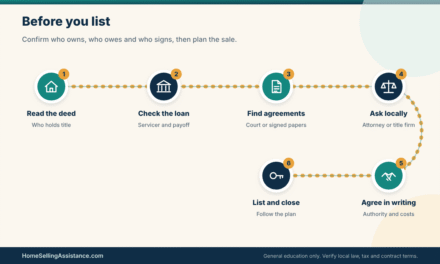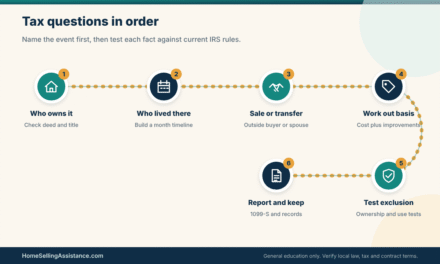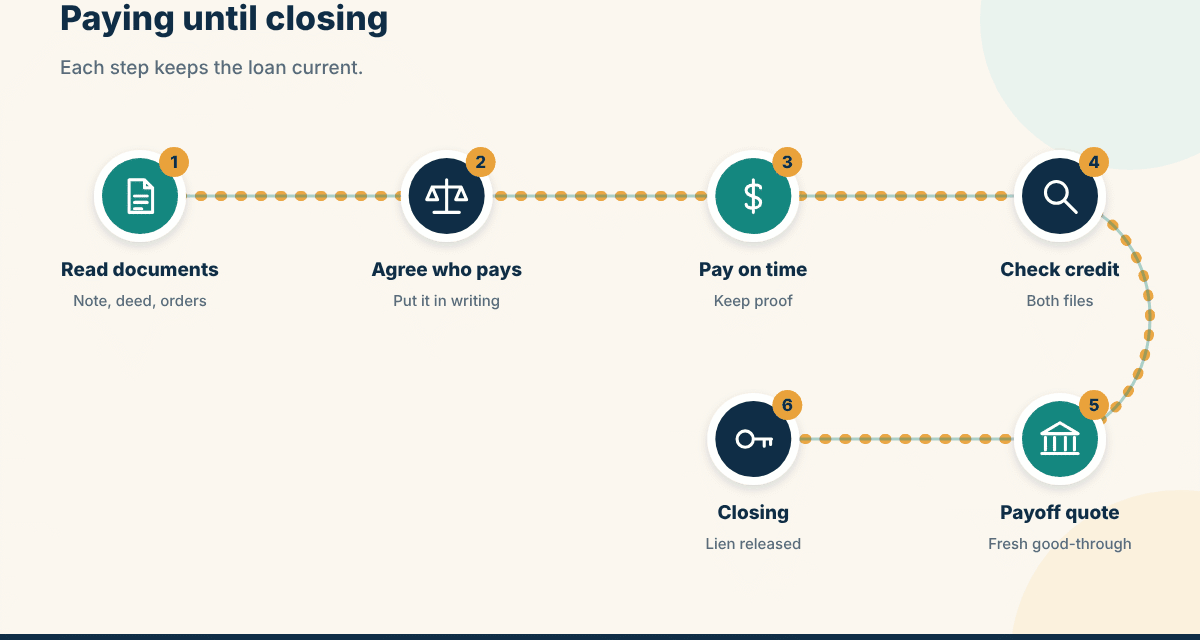
Figuring out the mortgage during divorce home sale period is mostly a question of keeping a monthly bill paid, a credit file clean and a paper trail honest while two people who no longer share a household still share one loan. The lender does not care who moved out, who earns more, or what a mediator sketched on a napkin. It cares that the payment arrives on time, every month, until the payoff wire lands at closing.
That gap between what the couple agrees and what the lender requires is where most mortgage during divorce home sale trouble starts. A spouse who moved out may assume the other one is paying. The spouse who stayed may assume the payments are a shared expense and wait for a refund of half. Meanwhile the servicer sees one loan, two borrowers and a payment that is either on time or late, and it reports the result to both credit files.
This article explains who is responsible for the mortgage during divorce home sale planning, how agreements and court orders fit around the loan instead of replacing it, what credit risk looks like in practice, and how to keep the payment current until a buyer’s funds pay the loan off. It is general education, not legal advice. Divorce law, community property rules, temporary orders and recording practices differ by state and sometimes by county, so each section ends with a way to verify the point locally.
If you want the broader picture of how a sale fits into a split, start with our guide to selling a house during divorce, then come back here for the monthly-payment mechanics.

Key takeaways
- The loan contract comes first. A divorce decree or settlement agreement binds the spouses to each other, but it generally does not change what the lender can expect from each borrower on the note.
- Both credit files are exposed. A late payment on a joint mortgage can show up for both people, no matter who was supposed to pay under the family agreement.
- Put the payment plan in writing early. A temporary order, a signed interim agreement or a written email chain that names who pays principal, interest, taxes and insurance beats a verbal understanding.
- Track who pays what. Reimbursement and credit claims at the final settlement usually depend on records, so keep bank statements and servicer receipts.
- Talk to the servicer before a payment is missed. Hardship options, authorized third-party contacts and payoff quotes all start with the borrowers on the loan.
- Verify locally. Courts, recorders and title companies differ, so confirm requirements with your attorney, your title company and official sources before you sign.
Mortgage during divorce home sale: start with the loan, the deed, and the order
Before anyone argues about fairness, spend an hour assembling the three layers of paper that govern the house. The first layer is the mortgage note and security instrument, which describe who promised to repay and what the lender can do if payments stop. The second is the deed, which shows who owns the property. The third is whatever court paperwork exists, from a temporary order to a final decree. These three documents often point in different directions, and a clear mortgage during divorce home sale plan begins by reading them side by side.
Who owns the home, who signed the loan, and which document controls
Ownership and debt are separate questions. A person can be on the deed but not on the loan, on the loan but not the deed, or on both. Each combination changes what that person can do and what they risk. Lenders also treat the borrower list as the final word on who is responsible for repayment, even when a court later assigns the payment to someone else. That is why reading the actual documents matters more than relying on how each spouse remembers the purchase.
Evidence to gather: the note, the deed, and the latest statement
Start with the most recent mortgage statement. It lists the servicer, the borrower names, the principal balance, the escrow amount if there is one, the due date and the grace period. Then pull the recorded deed from the county recorder or your closing file to see how title is held. Finally, find the original note or closing package. If you cannot find a document, the servicer can usually provide copies to a borrower, and the recorder’s office can provide the deed.
Look for small mismatches. Names spelled differently, a spouse who signed the deed but not the note, or a deed that was changed after a refinance can all matter later. For any mortgage during divorce home sale, write a one-page summary listing each borrower, each owner of record, the servicer’s name and the loan number. It sounds basic, yet that single page keeps every later conversation, with the attorney, the servicer and the title company, grounded in the same facts.
A scenario, an exception, and your next step on who is liable
Picture a couple who bought a house together, then divorced, with the decree saying the husband will pay the mortgage until sale. They are both still on the note. If he misses two payments, the servicer will contact both borrowers and may report the delinquency on both credit files. The decree gives the wife a claim against him, but it does not stop the lender or the credit bureaus.
An exception arises when only one spouse signed the note, for example because the other had weaker credit at purchase. That spouse may still be on the deed, which means a lien can attach to the property even if the credit file stays clear. Your next step in a mortgage during divorce home sale is simple: confirm in writing, with an attorney if possible, who is liable on the note, who holds title, and which order currently assigns the payment.
Federal rules, state divorce law, and what the lender actually requires
Three sources of rules overlap in every mortgage during divorce home sale. Federal law sets some baseline protections around mortgage servicing, disclosures and certain loan transfers between spouses. State law decides how marital property is classified, how temporary orders work and what a court can order before a sale. The lender’s contract sits underneath both and controls what the servicer will do with your loan. A spouse who knows which layer answers which question avoids a lot of wasted phone calls.
Source to check: federal servicing rules and your state’s divorce statutes
The Consumer Financial Protection Bureau publishes plain-language material on mortgage servicing, including how servicers must respond to borrowers who are struggling to pay, and you can browse it at the CFPB site. For divorce-specific rules, the best source is your state’s court system website, which usually posts self-help forms and explains temporary orders, and a local family law attorney who practices in your county.
Be careful with generic checklists found online. Whether a house is treated as community property, as marital property subject to equitable division, or as separate property depends on the state and on how title was acquired. Those labels affect who may be asked to cover the payment and how contributions are credited later. Treat any national summary of mortgage during divorce home sale rules as a vocabulary lesson, then confirm the rule that applies where the house sits.
A scenario, an exception, and your next step on lender requirements
Imagine a spouse who receives the home in the settlement and wants the other off the loan. The settlement says so, but the lender never agreed to release anyone. Releasing a borrower typically takes a refinance into one name or a formal assumption approved by the lender, and federal law has some protections around transfers between spouses that the servicer may need to review. None of that happens just because a decree says it should.
An exception is a decree that orders the house sold. Then the question is not who keeps the loan but who keeps it paid until payoff. Your next step is to ask the servicer, in writing, what documentation it requires to discuss the account with a former spouse or an attorney, and to ask the court clerk or your attorney whether any local rule limits changes to the loan before the sale.
The matrix below compares the main questions a seller faces, the document that usually controls each one, and how to verify it. Use it as a conversation starter with your attorney, not as a rulebook.
| Issue | Controlling document or authority | Seller obligation or choice | Typical timing | Local verification |
|---|---|---|---|---|
| Who owes the lender | Mortgage note and servicer records | Every borrower on the note stays responsible for the payment | Until payoff or formal release | Servicer in writing; attorney |
| Who owns the property | Recorded deed | Owners generally must sign the sale documents | Check before listing | County recorder; title company |
| Who pays before sale | Temporary order or written agreement | Follow the order and keep proof of each payment | Monthly due date | Court clerk; family law attorney |
| Release of a borrower | Lender approval through refinance or assumption | Request in writing, expect underwriting | Lender-set review period | Servicer; mortgage professional |
| Payment shortfall or hardship | Servicer loss mitigation process | Contact the servicer before missing a payment | As early as possible | Servicer; HUD-approved counselor |
| Credit reporting | Servicer reports to the bureaus | Monitor both files during the sale | Monthly | Free annual credit reports |
To use the mortgage during divorce home sale table, fill in the rightmost column with a name and phone number for each row. If you cannot name the person who will answer a question, that is the row to work on first. Seeing the blank spaces early helps a couple divide the research so neither person feels they are doing all of it.
It helps to remember why the mortgage during divorce home sale question feels heavier than an ordinary bill. The payment is large, it is tied to a house that two people are emotionally invested in, and the consequences of a mistake fall on both of them for years. A single mortgage during divorce home sale misstep, such as a payment sent late or a statement ignored, can affect a credit file long after the divorce papers are signed and the boxes are unpacked.
For that reason, many attorneys and mediators begin the mortgage during divorce home sale conversation by asking one blunt question: if nothing else changes, who will make the next three payments? The answer reveals whether the family has a plan or only an intention. If the answer is vague, the first job is to make it specific, with names, accounts, dates and a backup if the plan fails.
Keep in mind that the sale itself is often the cleanest solution to the payment problem. Once a buyer’s funds pay off the loan, the monthly obligation disappears and both credit files stop depending on the other person’s habits. The rest of this guide is about getting safely to that day without letting the loan become a second dispute on top of the first.
Turning a mortgage during divorce home sale plan into a weekly routine
Once you know what the documents say, the work becomes practical. Someone has to send the payment, someone has to watch the escrow account, and someone has to tell the servicer and the listing agent when circumstances change. A good routine is boring on purpose. It names one person who pays, one person who verifies, and a date each month when both look at the same statement.
For a mortgage during divorce home sale, couples usually choose among a handful of arrangements for the months before closing, and each one shifts risk differently. The picture below lays out four common paths and what each one asks of you.

Written agreements, notices, and the paper that keeps both people protected
Informal promises are the weakest link in any mortgage during divorce home sale arrangement, and a mortgage during divorce home sale can last longer than anyone predicts. A text that says “I’ll cover it until we sell” is better than nothing, but it rarely says what happens if the sale takes six months longer than expected, if the roof needs a repair, or if the paying spouse loses income. Written terms do not have to be fancy. They do have to be specific enough that a judge, a mediator or a stranger could tell what was agreed.
Documents to put in place: a payment memo and a shared folder
A short payment memo should list the loan number, the monthly total, the due date, who pays from which account, how the other person will see proof, and what happens if a payment is late. It should also say who covers property taxes, homeowner’s insurance and routine upkeep, because those items often sit outside the mortgage payment or inside an escrow account that adjusts once a year. If the divorce is already in court, ask your attorney whether the memo should be filed or turned into a stipulated order.
Create a shared folder, digital or paper, with every servicer statement, proof of payment, insurance notice and tax bill. When the final division of the sale proceeds is negotiated, a clean folder turns an argument about memory into a simple review of facts. Keep it neutral. Resist the temptation to add commentary or screenshots of arguments, which tend to inflame things.
A scenario, an exception, and your next step on notices
Suppose one spouse moved out and the other stays in the house and pays. A year-end escrow analysis arrives showing the payment will increase next month. If the notice goes only to the old mailing address, the payer may be surprised by a short payment and a late fee. The fix is to confirm each borrower’s mailing address and email with the servicer and to ask for online access for both borrowers where the servicer allows it.
An exception comes up when the relationship is hostile or there is a safety concern. In that case, communication through attorneys, a mediator or a neutral third party is reasonable, and nothing in this article should override a protective order or personal safety plan. Your next step is to choose one communication channel for payment matters and stick to it, whether that is a shared email address, a family-law app or attorney-to-attorney letters.
Credit, hardship, and who gets repaid
Credit damage is the quiet cost of an unmanaged mortgage during divorce home sale timelines. A joint loan appears on both credit reports, and a late payment is generally reported against every borrower listed. That can affect the next mortgage, an apartment application or even insurance pricing in some places. The risk is not theoretical, and it does not depend on who was supposed to make the payment under the family agreement.
What to document: payment history, credit reports, and servicer notes
For a mortgage during divorce home sale, pull your free credit reports and check the mortgage tradeline for payment status and balance. Do it before the listing, then again every few months until the sale closes. Write down the date, time and name of every servicer call, and follow important calls with an email or secure message so there is a record. Servicers handle large volumes, and a clear record helps if you later need to dispute a late mark that was wrongly reported.
If you plan to apply for a new mortgage right after the sale, tell your loan officer early that a joint loan is still open. They can explain how the payment history and the eventual payoff will be viewed. They cannot promise approval, and neither can this article, but an early heads-up avoids a surprise when underwriting reviews the divorce paperwork and the open obligation.
A scenario, an exception, and your next step on hardship
Say the paying spouse’s income drops after a layoff. The temptation is to quietly skip a payment and catch up later. A better move is to call the servicer while the loan is still current and ask about hardship options, which may include a repayment plan, a temporary reduction or forbearance, depending on the investor and the loan type. These options are not guaranteed, and each has consequences for the balance and the credit file, so ask how each would be reported.
An exception is a loan that is already behind. Foreclosure timelines differ by state and by loan, and some states use judicial processes that add months while others move faster. Your next step is to contact a HUD-approved housing counselor, who can explain options at no cost, and to read our overview of selling before a foreclosure moves forward.
Think of the mortgage during divorce home sale routine as a small shared project with two owners. One person is responsible for sending the money, the other for checking that it arrived, and both are responsible for raising problems quickly. Couples who divide the work this way tend to stay out of trouble, because each person can see the other doing their part and nobody has to rely on trust alone.
It also helps to separate the payment itself from the emotions around it. A mortgage during divorce home sale routine works best when the conversation is limited to facts: the amount due, the date, the confirmation number and the next step. Save the harder discussions about fairness and division for the mediator or the attorneys, where they belong.
Money flows deserve their own picture. During the pre-sale months, payments reduce the loan balance a little and come out of somebody’s pocket, while the closing statement later turns the sale price into a net figure. The graphic below uses round, illustrative numbers to show the build-down from a sale price to proceeds.
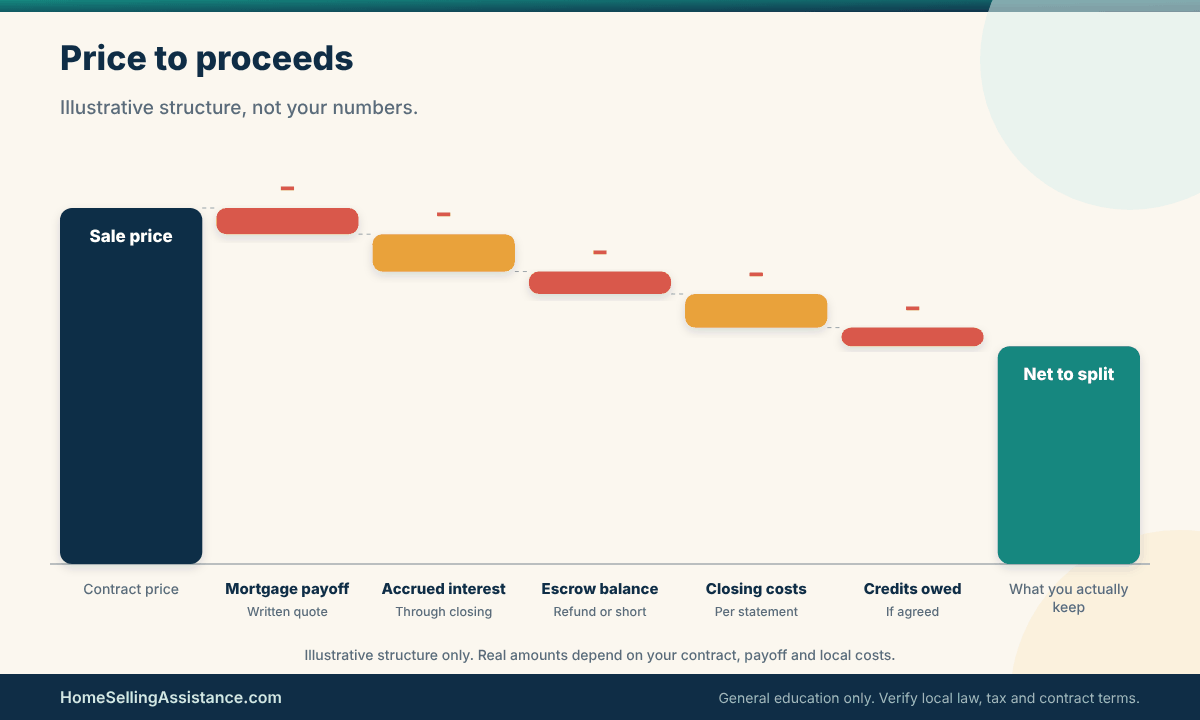
Because every mortgage during divorce home sale is different, your numbers will not match this picture. The point is to see which items sit between the sale price and the check. For a deeper walk through those line items, see how home sale net proceeds are estimated and why a payoff quote differs from the balance on your last statement.
The pre-sale months produce two questions that end up in negotiation. First, who paid what, and does the other person owe a credit when the proceeds are divided? Second, how does the sale itself pay off the loan and close the account? Both depend on the same documents, so the best approach is to build the answers as you go rather than reconstruct them at the end.
Reimbursement, credits, and how payments are counted at settlement.
In a mortgage during divorce home sale, many couples assume that whoever pays the mortgage before closing gets repaid from the proceeds. Sometimes that is exactly what the settlement says. Sometimes it is offset by the benefit of living in the house, by support payments, or by an agreement that the payer simply absorbs the cost. A court or mediator may weigh these differently. What matters for your mortgage during divorce home sale planning is that the treatment is written down before the money moves, not discovered afterward.
Calculation to run: an illustrative principal and interest split.
Here is an illustration with round numbers only. Suppose a monthly payment of 2,000 dollars includes about 1,500 of interest and 500 of principal, and the sale closes after six months. The payer spent 12,000 dollars in total, of which 3,000 reduced the loan balance and 9,000 was interest. Some agreements treat only the principal reduction as a credit, on the logic that interest is the cost of using the house. Others split the whole amount differently. Neither approach is universal.
Taxes, insurance and repairs deserve the same treatment in the plan. Property taxes and insurance are often paid through escrow with the mortgage payment, which blurs the numbers, so ask the servicer for an escrow statement. Do not treat this example as a formula for your case. Its job is to show why a clear definition of “credit” matters before the first payment is made.
A scenario, an exception, and your next step on credits.
Imagine a husband who paid the entire mortgage for eight months while his wife lived in the house and paid utilities. Each of them believes the other owes a credit. Without written terms, they may spend more on lawyers than the dispute is worth. With a one-page memo agreed at the start, the discussion at closing is arithmetic, not a fight.
An exception exists when a court has already issued a temporary order directing who pays. In that case the order usually frames how contributions are treated, and you should ask your attorney whether any credit can be claimed at all. For more on dividing what is left after closing, read our guide on how to divide home sale proceeds in a divorce. Your next step is to ask your attorney whether payments made before the final decree are recoverable in your state.
Choosing between selling, buying out, and keeping the loan going.
The mortgage during divorce home sale payment is also a clue to the bigger decision. A spouse who cannot comfortably carry the loan alone is, in practice, telling you something about whether a buyout is realistic. A spouse who can may prefer to keep the house, in which case the sale is off the table and the question becomes how to remove the other borrower from the loan. Each path has its own timeline, costs and credit effects.
Option to compare: sale, buyout by refinance, or assumption.
In a mortgage during divorce home sale, a sale pays off the loan from proceeds and ends everyone’s liability when the lender records the satisfaction. A buyout by refinance replaces the old loan with a new one in the keeping spouse’s name, which requires that spouse to qualify on current rates and income. An assumption lets one borrower take over the existing loan, but only if the lender and loan type allow it and approve the person. See our comparison of a house buyout versus a sale in divorce for the trade-offs.
No option is automatically better. A refinance may raise or lower the monthly payment depending on rates at the time, and an assumption may preserve an older interest rate but depends on lender policy. A sale gives a clean break but adds closing costs and the need to find new housing. Ask a mortgage professional what the keeping spouse would actually qualify for, using real documents and not guesses.
A scenario, an exception, and your next step on the buyout decision.
Consider a spouse who wants to stay but earns less than the payment requires for a refinance. Waiting, hoping income will rise, keeps both borrowers on the loan while the market and interest rates keep moving. Setting a decision date, for example sixty days after a lender pre-review, keeps the question from drifting.
An exception arises if the house has little or negative equity. Then a sale may not generate enough to pay the loan and costs, and the lender must agree to any shortfall arrangement. Our article on selling a house with an underwater mortgage explains the options. Your next step is to request a payoff quote and a current value opinion, and compare both before choosing a path.
The next table turns common mortgage during divorce home sale situations into a comparison of options, risks and documents. It is useful for a first meeting with an attorney or mediator because it lets you say, “We are in the second row,” and move quickly into specifics.
| Situation | Seller options | Main risk | Document to review | Escalation point |
|---|---|---|---|---|
| One spouse stays and pays | Written payment memo; shared proof of payment | Disputes over credits at closing | Servicer statements; bank records | Mediator or attorney |
| Both split the payment | Autopay from a joint account or two scheduled transfers | One transfer fails and the payment is late | Payment schedule; account alerts | Servicer if a payment misses |
| Payer loses income | Ask about hardship options; consider an early sale | Delinquency on both credit files | Loss mitigation notices | HUD counselor; attorney |
| Temporary order assigns payment | Follow the order; keep a payment log | Contempt or credit claims if ignored | Signed order and docket entries | Family law attorney |
| Spouse wants to keep the house | Refinance or assumption with lender approval | Being unable to qualify; both stay liable meanwhile | Pre-qualification letter; decree terms | Mortgage professional |
| Little or no equity | Lender-approved short payoff or temporary hold | Cash needed at closing; credit effects | Payoff quote; value opinion | Housing counselor; attorney |
After you read across a row, circle the escalation point and schedule that call. Many sellers treat the last column as an emergency exit, but it works better as a planned stop. An attorney consulted before a problem is usually cheaper than one hired after a missed payment or a deadline passes.
One more point about the mortgage during divorce home sale decision: timing interacts with the real estate market. If the house is expected to sell quickly, carrying the loan for a few months is a modest task. If the local market is slow, the same plan can stretch for many more payments than anyone expected. Ask your listing professional for a realistic range of time on the market, and build the payment plan around the slower end of that range rather than the hopeful end.
Finally, remember that a mortgage during divorce home sale plan is not a permanent contract. It can be revised if income changes, if the house sells sooner or later than planned, or if one spouse decides to keep the property. What matters is that both people agree to any revision in writing, and that the lender is told whenever a change affects who is on the loan.
A mortgage during divorce home sale verification checklist
By the time a buyer signs, several outside parties will touch your file: the title company, the buyer’s lender, possibly a court and your own attorneys. Each one asks for proof, and each one can slow the closing if the proof is missing or out of date. A verification checklist is how you stay ahead of them during any mortgage during divorce home sale. The graphic below groups the documents most often requested when a mortgage during divorce home sale plan reaches the contract stage.

Official sources and recorded documents that settle the facts
The strongest evidence is whatever sits in an official record or comes straight from the entity that holds the facts. A recorded deed beats a copy in a drawer. A payoff statement dated this week beats a balance from last month’s bill. A signed and filed order beats a draft that two lawyers exchanged. Prefer the source that cannot be argued with, and ask for it early because county offices, servicers and courts all work at their own pace.
Official source to request: payoff statement, recorded deed, filed order
Ask the servicer for a written payoff statement that shows a good-through date and a per-day interest figure. Request a copy of the recorded deed and any recorded liens from the county recorder or through the title company. If a court has issued temporary or final orders, get a file-stamped copy from the clerk. These three documents answer how much is owed, who owns the property and what the court has said, which are the questions every closing starts with.
Compare them against each other. If the payoff is higher than expected, find out whether escrow shortages, late fees or an unpaid insurance premium were added. If the deed lists a name that does not match the decree, ask the title company how it plans to handle it. Our primer on mortgage payoff when selling a house explains why payoff figures change from day to day.
A scenario, an exception, and your next step on records
A couple lists the house with a payoff estimate pulled from an online account. At contract, the title company’s official payoff comes in several thousand dollars higher because a deferred escrow shortage was added after a tax bill increase. Nobody did anything wrong, but the margin in the plan vanished. Updated figures at the start would have prevented the surprise.
An exception exists when a home equity line or a second lien is also recorded against the property. Those debts have their own servicers and payoff steps. Your next step is to order a title search early, or ask your listing professional to, so every recorded lien is known before the buyer’s lender discovers it. For the broader process, see our guide to the title search in a home sale.
What must be current before you sign and close
In a mortgage during divorce home sale, documents go stale. Insurance renews, tax bills change, a servicer transfers a loan, a spouse moves and forgets to update an address. The weeks between contract and closing are when these small changes cause large delays. Think of the final stretch as a currency check: for each item, can you say exactly when it was last confirmed, and by whom?
Items to refresh: the payoff, the insurance, the contact details
For a mortgage during divorce home sale, refresh the payoff close to the closing date and ask the title company to confirm it directly with the servicer. Confirm that the homeowner’s insurance is active and that the policy lists the correct mortgagee, because a lapse can lead to force-placed coverage that is costly. Update contact information with the servicer, the title company and the listing professional so wire instructions and notices reach the right person.
Always confirm wiring details by phone using a number you already trust, since payoff and wire fraud is a real problem and the FBI’s Internet Crime Complaint Center collects reports of it.
Also confirm who will attend or sign for each owner. Some title companies allow signing by mail or through a notary at a different location when one spouse has moved far away. Ask early, because mailed signature packages need time, and notarization rules vary by state and by company policy.
A scenario, an exception, and your next step before closing
Take a closing set for Friday. On Wednesday, the paying spouse notices that the mortgage autopay failed because the old bank account was closed. The payment is one day past the grace period. A call to the servicer, a same-day payment and a written request to waive the late fee may fix it, though outcomes vary. The cleaner approach is to check the autopay and the account balance each week during the final month.
An exception is a sale that closes before the next payment date. Even then, the payoff includes interest through the closing date, and a payment made just before closing might be applied in a way that confuses the figure. Ask the title company how to handle the last payment, and do not skip a payment that falls due before funding unless the servicer and title company say so in writing.
Not every mortgage during divorce home sale plan survives contact with the real world. The decision tree below helps you decide what to do if a payment is at risk during the sale, and who to call first for each branch.
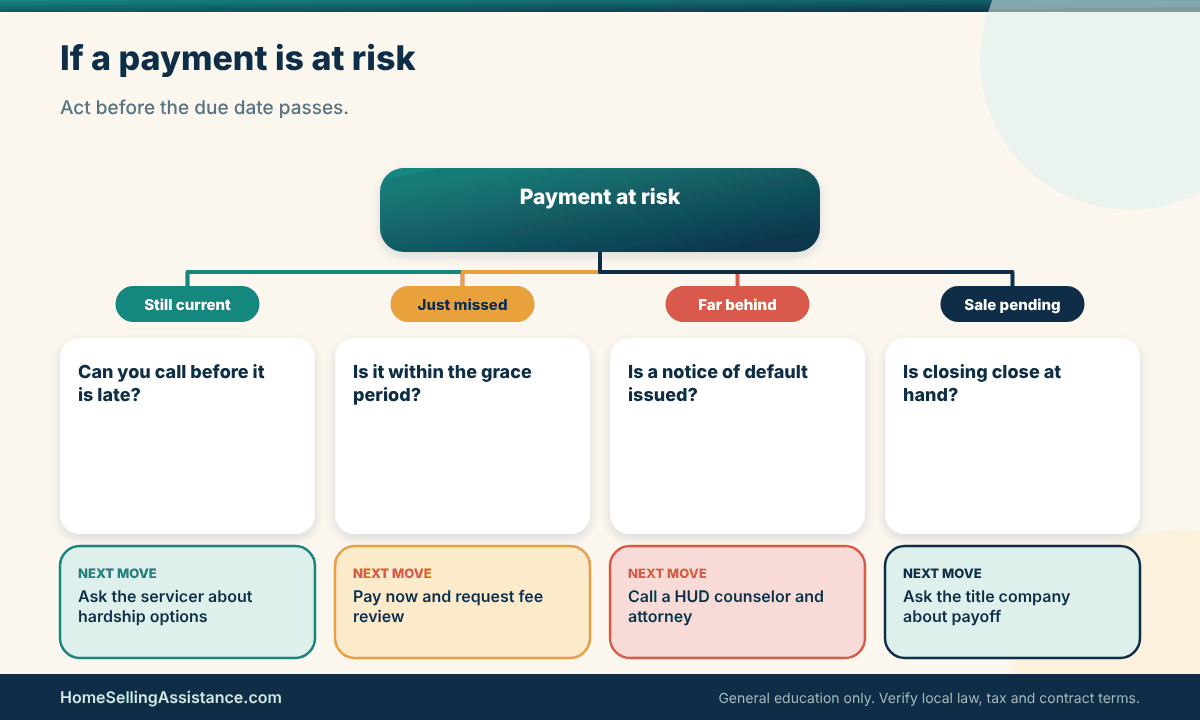
Each branch assumes you act early. The earlier the call, the more options remain open. For the overall legal and emotional framework around a divorce sale, return to our full guide to selling during divorce, and browse the divorce and co-owned homes category for related reading.
Tax questions also arise around the sale, especially who may claim the home sale exclusion and how a transfer between spouses is treated. The IRS publishes Publication 504 for divorced or separated individuals, and our article on divorce and home sale taxes gives an overview. Confirm specifics with a qualified tax professional, since this site cannot provide tax advice.
Quick scenario
A couple agrees in writing that one spouse pays the mortgage until closing and that the other spouse gets a credit for half of any principal paid from separate funds. They share a folder, check the statement together on the first of each month and set a calendar reminder to refresh the payoff ten days before closing. Their closing is dull, which is exactly the goal.
A few habits separate the sellers who finish smoothly from those who scramble. They are not clever. They are simply consistent, and they can be adopted by any couple regardless of how much they still trust each other.
First, agree on a script for the servicer. When you call, say who you are, confirm the loan number, and ask three things: what the exact amount due is, what the grace period is, and what the servicer needs to talk to a co-borrower, an attorney or a title company. Servicers often limit what they can discuss with anyone not on the loan, so a signed authorization can save weeks. Ask them to note the account that the home is being sold, and ask whether any hold or special handling applies to the payoff.
Second, keep a short list of common mistakes where everyone can see it. A paying spouse sends an amount rounded down to the nearest hundred and leaves the payment short. A couple closes an old joint bank account without moving the autopay. A spouse forwards a payoff letter that has expired. An email chain about wire instructions is trusted without a phone call. A temporary order is read as final, or a final decree as permission to ignore the lender. Naming these ahead of time makes them easier to spot.
Third, plan for the in-between weeks. A mortgage during divorce home sale timeline often includes a stretch after the house is under contract but before funds move, and that is when small stresses build. Buyers may request repairs, an appraisal may take longer than expected, and the closing date may slide. Each slide means another payment, so build a cushion in the payment plan for at least one extra month beyond the target date.
Fourth, in any mortgage during divorce home sale, treat the house as a shared responsibility even if one person lives there. Utilities, lawn care, insurance claims and showing readiness all cost money and time. If a pipe bursts, both owners have an interest in a prompt repair, and a short written note about who authorizes spending up to a set amount helps. Our guide to listing a home during a divorce covers showing schedules, access and the awkward logistics of a house that is still someone’s home.
Finally, keep the larger goal in view. The aim is not to win each monthly skirmish but to reach closing with a clean payoff, a clean credit file and a clear split of proceeds. The couples who treat the sale as a joint project with a deadline tend to spend less on lawyers and keep more for the next chapter. That does not mean giving in on things that matter. It means choosing which disagreements are worth the cost.
Separation without a divorce filing creates a version of the same puzzle, since there may be no court order at all and the spouses are still married. Our article on selling a house while separated describes how that changes the paperwork. And if one owner will not cooperate, what happens when a co-owner refuses to sell explains the general options and why courts get involved only as a last resort.
As a last check, read your own plan out loud. If you can explain the mortgage during divorce home sale arrangement in a few sentences, naming who pays, who verifies, which documents are current and who to call when something goes wrong, you probably have a workable plan. If you stumble, the stumbling point is where to focus before the listing goes live.
Many sellers also find it useful to schedule a short review with their attorney after the contract is signed. The review is a chance to confirm that the mortgage during divorce home sale terms still match the orders, that the closing date fits court deadlines, and that no new lien or notice has been filed. A half hour here is cheap insurance against a delayed or cancelled closing.
Frequently asked questions about mortgage during divorce home sale
Who has to pay the mortgage during divorce home sale proceedings before the house sells?
The lender holds every borrower on the note responsible, so the servicer will look to both of you for payment. Between the spouses, a temporary order, a written agreement or the court’s later decision may assign the payment to one person. Those documents bind the spouses to each other but do not usually bind the lender. Ask your attorney which order applies to you and keep proof of every payment.
Does my divorce decree remove my ex from the mortgage?
In a mortgage during divorce home sale, generally no. A decree can say who must pay and who gets the house, yet the loan stays in place until it is paid off, refinanced or formally assumed with the lender’s approval. Until then, both borrowers can be contacted by the servicer and both credit files may reflect the account. Ask the servicer in writing what it needs to release a borrower.
Will a missed payment hurt both of our credit scores?
It can. A joint mortgage typically appears on every borrower’s credit report, and a late payment is generally reported against each name on the loan. Which score drops, and by how much, depends on the scoring model and your overall history. Checking your reports every few months during the sale lets you catch problems early and dispute errors.
Can the spouse who moved out stop paying?
Moving out does not end responsibility to the lender, and it may not end responsibility to the other spouse either. A court order or agreement might require continued contributions. Stopping payments without an agreement can lead to a delinquency that harms both credit files and complicates the sale. Discuss any change with an attorney before acting.
Can I get reimbursed for mortgage payments I made before the sale?
For a mortgage during divorce home sale, the answer is a cautious “sometimes.” Sometimes. Whether and how payments are credited depends on state law, the court’s orders and what the spouses agree to in writing. Some agreements credit principal reduction only, others split total payments, and others treat the payments as a cost of living in the house. Keep records and ask your attorney how your state tends to treat the question.
What if I cannot afford the payment until the house sells?
A mortgage during divorce home sale can strain one income, so act early. Call the servicer before you miss a payment and ask about hardship options, which vary by loan and investor. A HUD-approved housing counselor can explain choices without charge. You might also consider whether a faster sale, a buyout or a different arrangement for the payment makes sense, and talk to your attorney about whether a court order can adjust who pays.
Does the sale have to wait until the divorce is final?
A mortgage during divorce home sale can proceed before the decree in some places. Not necessarily. Some couples sell during the case, with either a written agreement or court approval, while others wait for the final decree. The answer depends on your state, the court’s local rules and any orders limiting property transfers. Ask your attorney and the title company before signing a listing agreement.
Can a lender call the loan due if the house transfers between spouses?
Federal law offers some protection against due-on-sale enforcement in certain transfers between spouses, but the details depend on the property, the loan and the circumstances. Do not assume a quitclaim deed is harmless. Before any transfer, ask your attorney and the servicer how the transfer would be treated and whether the lender needs notice.
How do I make sure the loan is actually paid off at closing?
The title company or closing agent orders a payoff statement, sends the funds at closing and later confirms that the servicer releases the lien. Ask for a copy of the final closing statement and watch for the satisfaction of mortgage to be recorded. If it does not appear within the period your state sets, contact the title company and the servicer.
Which professionals should I talk to about the mortgage during divorce home sale decisions?
A family law attorney can explain orders and agreements. A title company or closing attorney handles the payoff and signatures. A mortgage professional can say what a refinance might require, and a tax professional can address the sale’s tax effects. A HUD-approved counselor helps if payments are at risk. Each answers a different piece of the puzzle.
Before you move on
A calm plan for the mortgage during divorce home sale process comes down to three habits: know whose names are on the loan and the deed, write down who pays what, and confirm every figure with an official source before you sign. Do those and the monthly payment stops being a battleground and becomes a task on a list. This article is general education, not legal, tax or financial advice. Divorce and closing rules vary by state, so talk with a licensed attorney, your title company and, where payments are at risk, a HUD-approved counselor about your own situation.