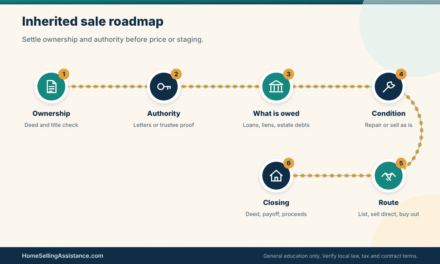
Dealing with an inherited house with mortgage debt attached feels like being handed two problems at once: a property you did not plan to own and a loan you did not sign, both arriving during a stretch of life when most people are barely keeping up with funeral arrangements and phone calls.
The good news is that the loan follows a fairly predictable set of rules. The lender holds a lien on the house, the debt is a claim against the estate, and nothing about the situation forces a rushed decision in the first week. The less comfortable news is that the monthly clock does not stop. Interest keeps accruing, taxes and insurance keep coming due, and a servicer that has not heard from anyone with authority will eventually start sending the kind of letters nobody wants to open.
This guide is written for the person who has just become responsible, formally or informally, for an inherited house with mortgage balance still outstanding. We cover who the servicer will talk to, who pays what while the estate is open, how a payoff works at closing, what changes when the loan is larger than the home is worth, and how to run the numbers before you decide to sell, keep or hand the property back.
If you want the wider picture first, our cornerstone guide on selling an inherited house covers the entire path from the first phone call to the final distribution.
A caution that applies to every paragraph below. Probate procedure, successor rights, lender notice periods and tax treatment differ by state and by loan type. Every dollar figure in this article is a round illustrative number used to show how the arithmetic works. Treat it as a way of thinking, and confirm the real figures with your servicer, the estate’s attorney and a tax professional.
Key takeaways
- The loan does not vanish at death. The lien stays on the property, so an inherited house with mortgage debt must be paid, assumed, refinanced or sold before anyone receives clean ownership.
- Heirs are not automatically personally liable. The debt is generally a claim against the estate unless a person co-signed or assumed the note, but state law and your own paperwork decide the details.
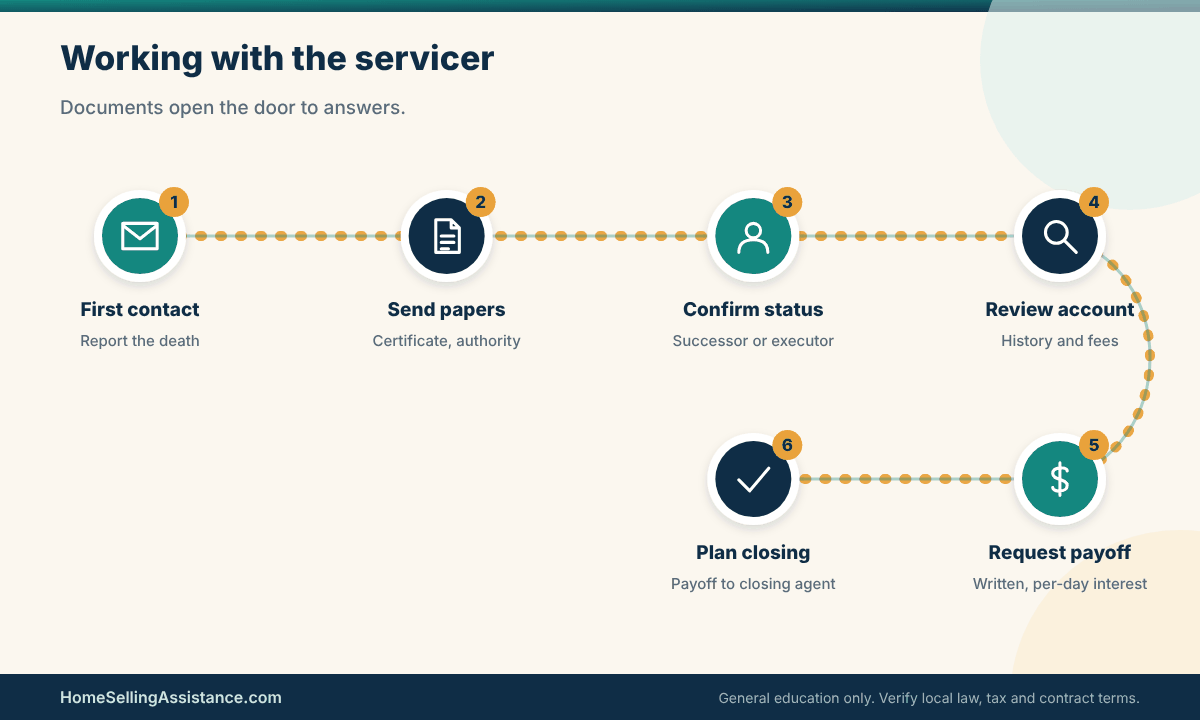
- Servicers want proof of authority. Expect to send a death certificate and court or successor documents before anyone can discuss the loan with you.
- Carrying costs shrink your net. Every extra month of payments, taxes, insurance and upkeep comes out of what the heirs eventually receive, so timing is a financial input, not an afterthought.
- Test your plan with a sensitivity check. Compare price, speed and carrying cost side by side before you accept an offer or turn one down.
- Underwater loans need an early lawyer. When the payoff exceeds the likely sale price, options narrow quickly and the lender’s consent usually becomes part of the plan.
Start with cash flow and net proceeds for an inherited house with mortgage
Before you talk about listing prices, put the money on one page. Sellers in this situation tend to start with the question “what is the house worth?” and skip the more useful one: “what will actually be left after the loan and the costs are settled?” An inherited house with mortgage debt can look valuable on paper and still leave little for the heirs once the payoff, a few months of carrying costs and the closing charges are subtracted.
This section lays out the inputs you need and the timing pressure that sits behind them. Think of it as the groundwork that makes every later decision, from choosing an agent to accepting a cash offer, much easier to judge. Our broader article on home sale net proceeds explains the general method for any seller, and what follows adapts it to an estate.
The sale price, equity, payoff and cost inputs that drive the result
Four numbers decide most of the outcome for an inherited house with mortgage: a realistic sale price, the loan payoff, the cost of selling, and the cost of holding the property until it sells. Everything else is a refinement. The trouble is that each of these is easy to guess at and hard to know, so it helps to see where each one comes from and how far it can drift.
Evidence to gather: payoff statement, valuation, costs and holding expenses
Start with the payoff on your inherited house with mortgage. A monthly statement shows a principal balance, but that is not the payoff. The payoff figure includes accrued interest through a specific date, and sometimes escrow shortages, late fees or property inspection charges that the servicer added while the account was unattended. You request it in writing from the servicer, and the response is usually good for only a short window of days. Ask for a payoff quote with a daily interest figure so you can adjust it if closing slides.
Next, get a value you can defend. A broker price opinion or a comparative market analysis from a local agent is usually the quickest starting point, and a formal appraisal from a licensed appraiser can be worth the fee when heirs disagree or when a court needs a number. Our guide to CMA versus appraisal explains how those differ and when each carries weight.
Then list the holding costs: loan payment, property tax, homeowner insurance, utilities kept on for safety, lawn or snow service, and any HOA dues. Add them for a typical month. Finally, ask a title company or closing attorney for an estimate of seller-side closing charges, which vary by state and by who customarily pays what.
A last piece of evidence is easy to forget: the home’s condition. A vacant house that has sat for a while may need basic repairs before any buyer will finance it, and those costs belong in the same one-page summary.
One more document deserves a place in the folder: the servicer’s own account history. It shows when the last payment posted, whether any fees were added after the death, and what notices were mailed to the property address. In a typical inherited house with mortgage file, the history explains most of the surprises that appear on the payoff letter, and it gives you something concrete to point to if a charge looks wrong.
Ask about successor-in-interest procedures at the same time. Servicers are expected to have a process for confirming who stands in the borrower’s place, and the process usually starts with a death certificate and a document showing your connection to the home, such as a will, a deed or court letters. Once the servicer confirms you, it can generally discuss the account with you, which makes every later question about an inherited house with mortgage balance easier to answer.
A scenario, an exception, and your next step on the numbers
Picture two siblings who inherit their mother’s house. A local agent’s opinion puts the likely sale price near a round $300,000 (an illustrative number), and the servicer’s statement shows a principal balance of roughly $180,000. The siblings assume they will clear about $120,000 and plan a down payment on another property around it. Then the written payoff arrives showing an extra few thousand dollars of accrued interest and an escrow advance, and the agent mentions that selling costs, repairs and a few months of carrying costs will take another sizable bite.
The exception worth knowing is a house with unusual features, such as a manufactured home on leased land or a property with a second lien or home equity line. In those cases the payoff list is longer and the sale price is harder to estimate, so the one-page summary needs extra rows. Our article on selling a house with a lien shows how additional claims on title are handled at closing.
Your next step is plain. Put the four inputs in a small worksheet, mark each as confirmed or estimated, and replace estimates with documents as they arrive. Share that sheet with your co-heirs, so that nobody is working from a different assumption about how much cash this sale will produce.
A final word on this first section. Many heirs treat the inputs as a one-time exercise, but an inherited house with mortgage debt changes week by week. The payoff moves with interest, bills arrive in unpredictable order, and offers change the sale price assumption. Revisit the worksheet whenever a new document lands, and date each version so the family can see how the picture evolved and why a decision made in March looked different from one made in June.
Timing and liquidity limits that shape what you can afford to wait for
Money is only half of it. The other half is who can pay the bills while the house sits in limbo. Estates frequently have plenty of equity and very little cash, and that mismatch decides whether you can wait for the best offer or need a faster, tidier sale.
Calendar and cash evidence: statements, bank balance and court timing
Look for a bank account that belongs to the estate. Before a personal representative is appointed, there is often no account the estate can legally use, and the late owner’s personal account may be frozen or restricted after death. Without a legal way to pay, the mortgage can slip behind even when money exists somewhere. The practical evidence to collect is the date of the last payment, the servicer’s grace and delinquency timeline, and the court’s expected schedule for appointing a fiduciary.
Court timing varies enormously. Some counties issue letters within weeks, while others take months, and informal or small-estate procedures can shorten the path in some states. Your state’s probate court website or the clerk’s office can describe the typical process, and an estate attorney can tell you how it plays out locally. Our guide for an executor selling a house goes through the authority an executor needs before signing a listing agreement.
The final calendar item is the servicer’s own communication. Ask what happens if a payment is missed, how many days pass before a notice, and whether the servicer will note the account as a successor-in-interest file while documents are pending.
Timing pressure also affects how you talk to buyers. A seller who must close quickly because an inherited house with mortgage payments are draining the estate will behave differently from one who can wait, and experienced buyers can often sense which one they face. You do not need to hide the situation, but you should decide your limits privately beforehand, so that urgency never turns into accepting the first low offer simply to stop the monthly bleeding.
It also helps to separate what is urgent from what only feels urgent. The next payment date is real. A relative’s opinion that the house must be listed this weekend is not. Ask the estate’s attorney to name the two or three deadlines that truly matter for your inherited house with mortgage file, and ignore the rest until those are handled.
A scenario and next step when cash runs short
Suppose the estate has equity but no spendable cash, and the loan payment is due in two weeks. One option is for an heir to advance the payment from personal funds and keep every receipt, with a written note among the family that the estate will reimburse it once an account exists. That arrangement is common, but it should be written down, and the estate’s attorney should confirm it is acceptable in your state.
Another option is to ask the servicer whether a short-term payment arrangement is available while the court process moves forward. Servicers differ widely in how they respond, and some will only talk once they receive proof of the death and of your connection to the borrower.
The exception is a household where an heir is already living in the home and paying the loan from their own income. That usually keeps the account current, but it can create questions later about credit for payments, so keep the records. Your next step is to write down the three dates that matter: the next payment due date, the earliest likely court appointment date, and the date on which cash would run out.
Compare the total financial risk of keeping, selling or surrendering the property
Once the basic inputs are on paper, the next job is to look at risk instead of just price. Two plans that produce the same estimated check can carry very different chances of going wrong. One may depend on a buyer’s financing holding together, while another may depend on the estate staying current on payments for half a year.
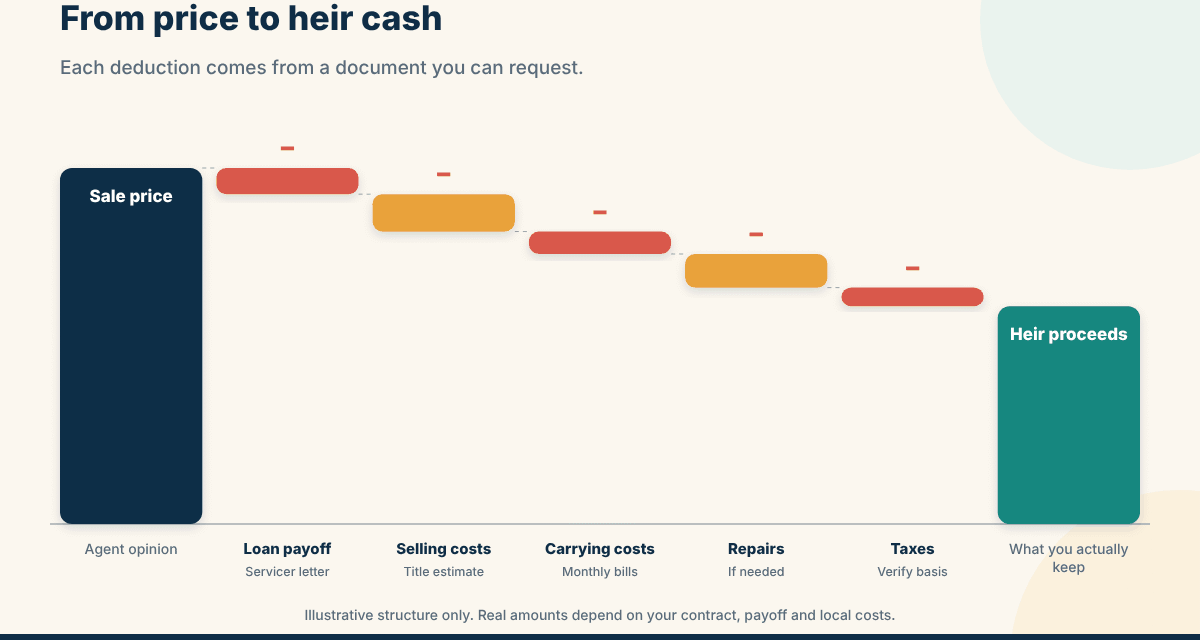
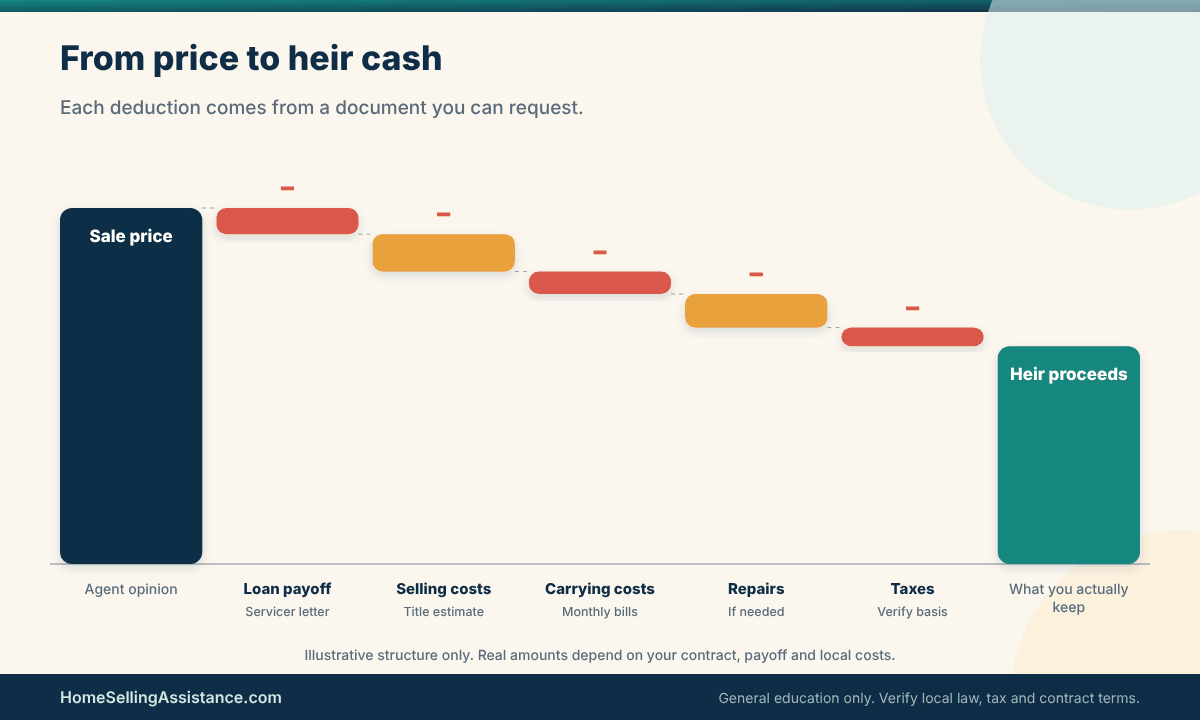
The picture below shows the typical path from a sale price down to what the heirs receive, so you can see which deductions are firm and which are open to negotiation. Use it as a map of where an inherited house with mortgage debt tends to lose money, and then check each step against your own documents.
Fees, credits, carrying cost, financing and tax effects on the final check
Most heirs underestimate the combined weight of small items on an inherited house with mortgage. A servicer’s fee here, a prorated tax bill there, a few months of utilities and a repair credit for a buyer can add up to a figure that rivals a full year of ordinary household bills. None of them is dramatic alone. Together they can decide whether the sale feels like a relief or a disappointment.
The table below organizes the main money inputs so you can see where each number comes from, what it does to cash flow, how uncertain it is and which document settles the question. Read across a row to understand one input, and read down the uncertainty column to see which items deserve a phone call first.
| Input | Assumption or source | Cash-flow or tax effect | Uncertainty | Verification document |
|---|---|---|---|---|
| Sale price | Agent opinion or appraisal | Sets gross proceeds | High until under contract | Signed purchase contract |
| Loan payoff | Servicer written quote | First deduction at closing | Moderate; changes daily | Payoff letter with per-day interest |
| Selling costs | Agent, title and attorney estimates | Reduces net proceeds | Moderate; varies by state | Draft closing statement |
| Holding costs | Monthly tax, insurance, utilities, upkeep | Grows with each month unsold | Depends on time to close | Bills, escrow statement, receipts |
| Repairs or credits | Inspection findings | Reduces proceeds or price | High until inspection | Inspection report and addendum |
| Tax basis | Value at date of death | May limit taxable gain | Depends on documentation | Date-of-death valuation |
To use the matrix, copy it into your own worksheet and replace each cell with a real number and a date. Anything still marked “estimate” after the first couple of weeks is a task, and the right-hand column tells you whom to ask. If you are unsure how basis works for inherited property, our guide on inherited house cost basis explains the idea in plain terms.
Documents behind each fee: payoff letter, escrow statement and closing estimate
The payoff letter and the escrow statement are the two documents that most often surprise heirs. The payoff letter lists the amount needed to release the lien on a specific date. The escrow statement shows what the servicer has collected and paid for taxes and insurance, and whether the account is short. If the servicer advanced money for a tax bill or an insurance renewal after the borrower died, that advance can show up as part of what you owe.
Ask the title company or closing attorney for a preliminary settlement statement early. It will show seller charges such as recording fees, transfer taxes where they apply, title and escrow fees, and any proration of taxes. These items vary by state and county, which is why a statewide rule of thumb is not reliable. Our article on the seller closing statement walks through how to read one line by line.
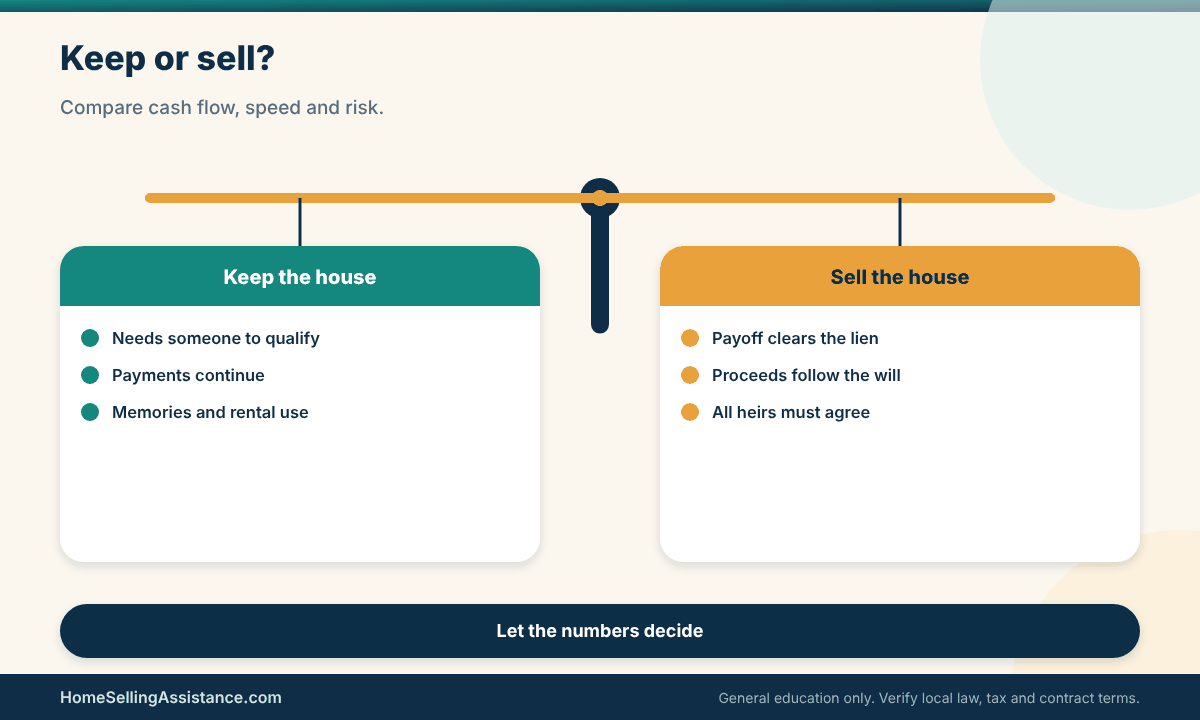
For an estate, the closing agent will also want to see the personal representative’s authority, which usually means certified letters from the court. Ask early what exact form they require and how recent the certification must be, because that detail can delay a closing by days.
Keep a simple ledger as well. Record each payment on the loan, each tax bill, each insurance premium and each repair, with the date and who paid it. If an heir advances money, the ledger shows how much. If the estate later reimburses that person, the ledger shows what was repaid. Clean records make an inherited house with mortgage debt far easier to account for when the court, a co-heir or the tax preparer asks questions months afterwards.
A scenario, an exception and a next step on carrying costs and taxes
Imagine an estate where the loan payment and escrow total a round $1,600 a month, with another $500 a month in utilities, lawn care and insurance upkeep, for an illustrative $2,100 monthly carrying cost. If the house takes two months to sell, the estate absorbs about $4,200. If it takes six months, the figure is about $12,600. Same house, same price, very different outcome.
An important exception involves the tax side. Property inherited from a person who has died generally receives a new tax basis tied to its value at the date of death, which can reduce or even eliminate taxable gain on a prompt sale. But the rule has details, and it depends on how the property was owned. Read IRS Publication 551 on basis and talk to a tax professional before assuming a result.
Your next step is to ask the estate’s attorney or tax preparer whether a date-of-death valuation is needed, and to order one if so. The sooner it exists, the easier every later conversation becomes. For a deeper look at the tax side, see our guide to inherited home sale taxes.
Insurance deserves its own paragraph. A homeowner policy written for an occupied house may limit or exclude coverage once the property has been vacant for a stretch, and policies differ on how long that stretch is. If the owner has died, call the insurance company, report the situation honestly and ask what the policy requires now. Lenders also expect coverage to stay in place, and a lapse can lead the servicer to buy expensive coverage on its own and bill the account.
A vacant house also invites ordinary problems such as frozen pipes, a leaking roof or a break-in, each of which adds cost to an inherited house with mortgage balance that is already tying up cash. Our guides on selling a vacant house and vacant home security list practical steps that protect both the property and the estate while a sale is pending.
Shortfall, rate, fallback and home-collateral risks if the plan slips
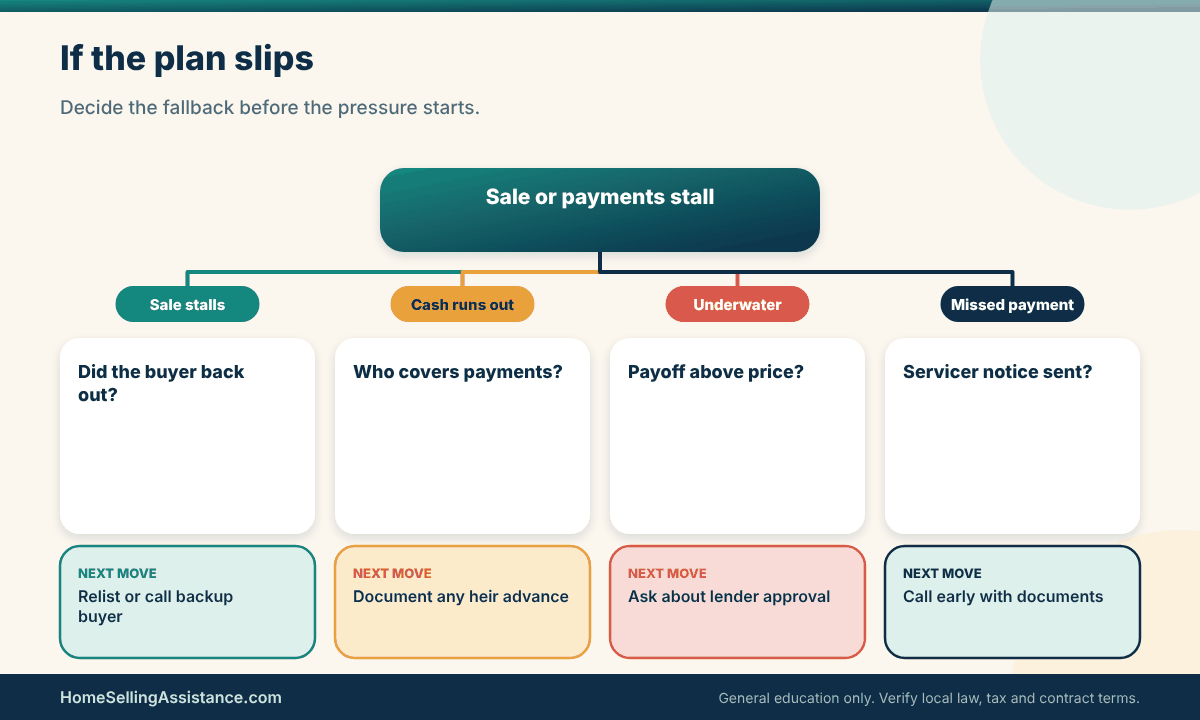
Sales fall through, and an inherited house with mortgage is no exception. Buyers lose financing, inspections reveal expensive problems, and probate hearings get rescheduled. For a typical seller, a failed deal costs time. For an estate carrying a mortgage, it costs time plus another round of monthly payments, so the question “what is plan B?” belongs in the early planning, not the panic phase.
The word collateral matters here. The house secures the loan, which means the lender’s remedy for nonpayment is the property itself. That is the core of the risk, and it is also the reason heirs who never signed the note are usually not chased personally for the balance, though state law and the facts decide.
Risk evidence to review: loan terms, rate type, due-on-sale rules and servicing history
Pull the original loan paperwork if it exists, or ask the servicer for the loan type and terms. A fixed-rate loan is predictable. An adjustable-rate loan can reset during the months you spend settling the estate, which changes the carrying cost mid-plan. A government-insured loan, a reverse mortgage and a home equity line each come with their own notice rules and timelines, so identify which one you are dealing with early.
Many heirs of an inherited house with mortgage worry that the lender can demand the whole balance at once because ownership changed. Federal law generally restricts lenders from enforcing a due-on-sale clause when a residence passes to a relative after the borrower’s death, and federal servicing rules give confirmed successors in interest certain protections. Details still depend on the loan and the heir’s relationship, so ask the servicer how it treats successors and request its answer in writing.
The consumer agency publishes plain-language material on the topic at the Consumer Financial Protection Bureau, and a HUD-approved counselor can talk through your options at no cost. You can find one through HUD’s housing counselor search.
Reverse mortgages follow different rules from ordinary loans. In general, the balance becomes due after the last borrower dies, and heirs are given a limited period to sell, pay off or otherwise resolve it, with some lenders allowing extensions when a sale is under way. The balance can grow over time because interest is added rather than paid. If the late owner had one, an inherited house with mortgage of this type needs a quick call to the servicer and a conversation with a HUD-approved counselor about deadlines.
Rate type matters in a quieter way too. If the loan carries a low fixed rate, the monthly cost of holding the property may be modest, and that can justify more patience. If the rate is high or adjustable, speed tends to matter more. Either way, an inherited house with mortgage debt is not just a price question. It is also a question of how much each month of waiting costs you and whether the answer is stable.
A scenario, an exception and a next step if the sale stalls or the loan is underwater
Take an estate that accepts an offer, only to have the buyer’s financing fall through after six weeks. The estate has paid another round of carrying costs and has to relist. This is where a written fallback plan helps: a backup offer if the contract allows one, a clear decision about how long to wait before reducing price, and a pre-agreed limit on how many months of payments the heirs will fund personally.
The sharper exception is an underwater loan, where the payoff exceeds what the house can likely sell for. In that case the estate may need lender approval to sell for less than is owed, which is known as a short sale, or the heirs may decide the property is not worth keeping and work with the estate’s attorney on how to handle the claim. Outcomes depend on state law and the lender’s response, and nobody can promise a result. Our guide to selling a house with an underwater mortgage explains the concepts in more depth.
The next step is to get a written statement of the likely payoff, a value opinion and the estate’s attorney on the same call. Together they show quickly whether you are in the comfortable zone, the tight zone or the underwater zone, and each zone leads to a different set of decisions.
Use scenarios with explicit assumptions before you decide
Numbers without assumptions are just opinions in disguise. The most reliable way to decide what to do with an inherited house with mortgage debt is to write down a few plausible scenarios, state every assumption openly, and let the arithmetic show which choice holds up when the facts shift a little.
The table below compares common situations side by side. It is not a prediction for your property. It is a thinking tool: find the row that looks most like your own, read the key risk, and use the last column as a list of questions for the professional you hire. Our inherited homes and probate library has deeper articles on several of these paths.
| Seller situation | Sale, loan or tax assumption | Estimated effect | Key risk | Professional question |
|---|---|---|---|---|
| Strong equity, estate has cash | Price well above payoff; estate pays carrying costs | Heirs can wait for a good offer | Drifting into months of extra costs | How long should we test the market? |
| Strong equity, no estate cash | Heir advances payments with written note | Net lowered by advanced costs | Disputes over reimbursement | How do we document the advances? |
| Thin equity | Payoff close to expected price | Little left after selling costs | Price drop wipes out proceeds | What is our break-even price? |
| Underwater loan | Payoff exceeds likely price | Estate may owe a shortfall | Lender consent and deficiency claim | Can the lender accept less than owed? |
| Heir wants to keep the house | Heir qualifies to refinance or assume | Payment continues in heir’s name | Heir cannot qualify on income | What are the successor options? |
| Reverse mortgage on the home | Loan due after last borrower dies | Limited time to sell or pay off | Deadline passes without a plan | What deadlines apply and can they extend? |
To use the scenario table, circle the row nearest to yours, then write your own version of each cell with real figures. The strongest signal is usually the key-risk column, because it tells you what to protect first. If your situation straddles two rows, treat the harsher one as your planning case.
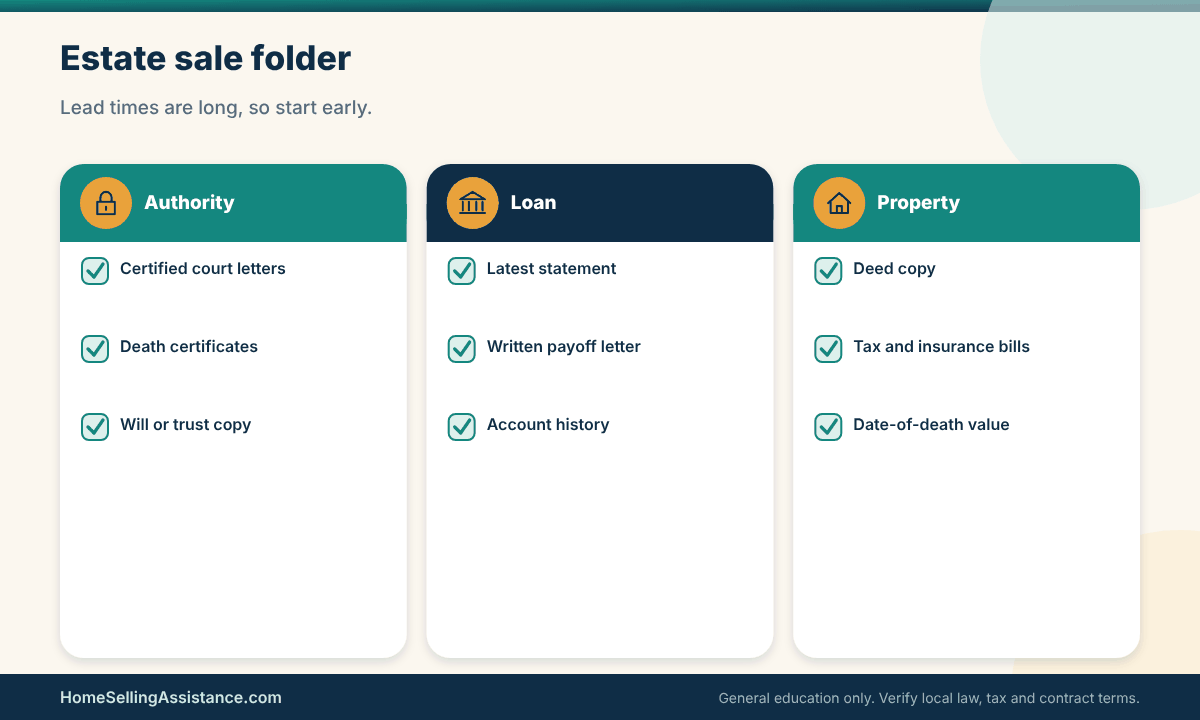
Before the example, a short word on the choice between keeping and selling. Some heirs want to keep the property because it holds memories or because it would make a good home or rental. Keeping an inherited house with mortgage debt means someone must qualify, in the servicer’s eyes, to carry the payment, or the loan must be refinanced into a new name. That depends on income, credit and the loan type, and it is worth a direct conversation with the servicer and, if needed, a lender who handles successor situations.
Selling is simpler in one sense. The payoff clears the lien, the proceeds go to the estate, and each heir’s share follows the will or state law. It is more complicated in another, because every heir must agree on price, timing and who signs. Neither path is better in general. The right one is whichever the numbers, the family and the loan terms allow, and the worksheet is what lets you compare the two honestly.
A worked example with every assumption on the page
Here is one example from start to finish. Every figure is a round illustration chosen to make the arithmetic easy to follow, so please do not read them as typical prices, fees or timelines. Your house, your lender and your state will differ, and the point is the method rather than the numbers.
Two heirs receive an inherited house with mortgage. A local agent’s opinion suggests it could sell for about $300,000. The servicer’s written payoff for the expected closing date is $185,000. Selling costs, including agent compensation, title and escrow fees and transfer charges, are assumed at $24,000 as a placeholder. The estate expects to carry the house for five months at $2,400 a month.
Calculation and evidence: building the net figure line by line
Start at the top of the worksheet for this inherited house with mortgage. Sale price of $300,000, minus the $185,000 payoff, leaves $115,000. Subtract the $24,000 of selling costs and you are at $91,000. Subtract the carrying costs of five months at $2,400, which is $12,000, and the estimated net is $79,000. Split between two heirs equally, that is $39,500 each, before any tax, attorney or executor charges that may apply to the estate.
Every line has a source you can name. The sale price comes from the agent’s opinion until a contract exists. The payoff comes from the servicer’s letter. The selling costs come from a title company or closing attorney estimate, and the carrying costs come from actual bills. As each estimate is replaced with a document, the confidence in the final figure rises.
Notice what the calculation leaves out on purpose. It leaves out repairs, because the heirs decided to sell as-is for this example, and it leaves out estate administration costs such as court fees, because those vary widely. In a real plan, add rows for both, even if the amounts are placeholders. A blank row is invisible, while a placeholder at least reminds you to ask. If you want help thinking about as-is trade-offs, read about selling an inherited house as-is versus repairing it.
One practical safeguard is a written summary of what each heir understands. After a family call, send a short message that lists the decisions made and the numbers used. This habit protects relationships as well as money. When an inherited house with mortgage debt is shared among relatives, memories of who agreed to what fade quickly, and a dated summary avoids the kind of dispute that can cost more than the house itself.
A scenario, an exception and a next step when the heirs disagree on the figure
Imagine one heir of an inherited house with mortgage believes the house should list higher and wait, while the other wants a quick sale to stop the monthly drain. Both are being reasonable, and the worksheet can referee. Run the calculation twice, once with a higher price and a longer holding period, once with a lower price and a shorter one, and compare the nets. Sometimes the difference is small enough that speed wins, and sometimes it is large enough that patience is justified.
An exception arises when the heirs do not own equal shares. A will or the state’s intestacy rules may split ownership unevenly, and that changes each person’s cut without changing the total. Another exception is a house with several co-owners where one person simply refuses to sell. Our article on multiple heirs selling an inherited house covers how those disagreements are usually handled.
Your next step is to circulate the worksheet with its assumptions highlighted, and ask each heir to challenge one number rather than the whole plan. Disagreements shrink when they are about specific figures instead of general feelings.
Heirs sometimes ask whether to make improvements before listing, hoping the house will bring more. With an inherited house with mortgage balance, every repair dollar and every extra month of work is paid before the heirs see a cent, so the bar is higher than for a seller with spare cash. A modest cleanup and a clear disclosure often matter more than a major renovation. Our guide on inherited house cleanout before sale covers what to do first.
Professional help is worth its cost in this situation, though not for every task. An estate attorney is usually the right person for authority, deadlines and distributions. A tax professional answers basis and reporting questions. A real estate agent or broker prices and markets the property, and a HUD-approved counselor can explain lender options at no charge. For an inherited house with mortgage debt, asking each professional one specific question is better than asking one person everything.
A sensitivity and break-even check on price, speed and carrying cost
A single estimate for an inherited house with mortgage hides how fragile it is. Sensitivity analysis is just a fancy name for asking “what if” in a structured way: what if the price comes in lower, what if closing takes longer, what if the payoff is higher than quoted? A handful of what-ifs will tell you which assumption matters most.
For most estates holding an inherited house with mortgage, that assumption is time. Price gets the attention, but time is the lever that quietly drains the account every month until the lien is released. Looking at both together is how you avoid over-optimizing one at the cost of the other.
Calculation and evidence: price, speed and the break-even point
Use the same illustration. Suppose two offers arrive. Offer A is $290,000 and is expected to close in two months, so carrying costs are $4,800. Offer B is $300,000 but is expected to take six months because of a buyer’s contingency, so carrying costs are $14,400. To keep the comparison simple, assume selling costs of roughly $23,000 for A and $24,000 for B and the same $185,000 payoff for both.
Offer A nets $290,000 minus $185,000, minus $23,000, minus $4,800, which is $77,200. Offer B nets $300,000 minus $185,000, minus $24,000, minus $14,400, which is $76,600. The slower, higher offer produces slightly less cash, and it carries more risk because a deal that takes six months has more time to fall apart.
The break-even question is: how much higher must a slower offer be to match a faster one? In this example, B would need to be several hundred dollars higher to tie, and more to compensate for added risk. Build the same table for your own offers and the answer will usually jump out. Our guide on how to evaluate a home offer offers a broader checklist for comparing terms beyond price.
Sensitivity checks work in both directions. Try lowering the sale price by an illustrative $20,000 in the original example and the net falls from $79,000 to $59,000, which is a loss of one-quarter of the heirs’ expected cash from a price change of under seven percent. Try stretching the hold by two more months at $2,400 and the net falls another $4,800. These what-ifs show that an inherited house with mortgage debt is more sensitive to price than a quick glance suggests, because the payoff stays fixed while the price moves.
The takeaway is not to panic but to know your floor. Ask the agent, the closing agent and the servicer to help you define the lowest price at which the sale still covers the payoff, the selling costs and the carrying costs with a cushion left over. That floor is your break-even price, and any offer below it needs special thought, possibly lender involvement and legal advice.
A scenario, an exception and a next step when the numbers are too close to call
When the nets are nearly equal, other factors should break the tie. Which buyer has verified funds? Which offer has fewer contingencies? Which closing date matches the court’s calendar for the personal representative’s authority? A cash offer with a short inspection window may be worth a bit less on paper and still be the safer plan. For comparison, see our article on cash offers versus financed offers.
An exception to watch is a payoff that rises while you wait. If the loan is adjustable, or if the servicer adds fees to an account it considers neglected, the payoff can creep up and quietly erode the comparison. Recheck the payoff every time a closing date moves, and ask for the daily interest figure so you can adjust on your own.
Your next step is to put the break-even rule on paper before offers arrive. For example, you might write that you will accept up to a certain price gap for a faster close, but no more. A rule decided in a calm moment is much easier to follow when an offer is sitting in your inbox with a deadline.
The checklist in the next illustration collects the documents most closings of this kind require. Gather them before listing, because each one has a lead time that is out of your hands. Certified court letters take time to obtain, the death certificate may need several certified copies, and the servicer’s response to a payoff request can take days. A complete folder is the cheapest way to avoid a delayed closing on an inherited house with mortgage debt.
Finally, keep communication tidy. Use one email thread for the family, one folder for documents and one person as the point of contact with the servicer, the agent and the closing agent. Many problems with an inherited house with mortgage balance come not from the loan itself but from mixed messages between relatives, so a simple routine for sharing updates is worth more than it sounds.
If you remember only one habit from this guide, make it the written worksheet. A page that lists the payoff, the value, the costs and the dates turns a stressful inherited house with mortgage situation into a series of small, answerable questions. It will not remove the grief, but it keeps the money side from adding avoidable mistakes to an already hard season.
Quick scenario
A daughter inherits her father’s home and wants to keep it. The loan is in his name only. She calls the servicer, sends the death certificate and her proof of relationship, and asks to be treated as a successor in interest. The servicer confirms her status in writing, and she then compares two plans: assuming or refinancing the loan, or selling. She asks the estate’s attorney whether anything in the will or state law affects her choice. Only after the written answers arrive does she decide, and she keeps copies of every letter.
Whichever route you choose for an inherited house with mortgage, remember how scams find grieving families. A stranger who offers to “take over” the payments, asks you to sign over the deed or wants an upfront fee to “stop foreclosure” deserves skepticism. Read our guide on foreclosure rescue scams, and if money is requested by wire at closing, confirm instructions by phone using a number you found yourself. The Federal Trade Commission’s consumer site publishes current warnings, and our piece on real estate wire fraud explains how those schemes work.
Frequently asked questions about inherited house with mortgage
Do I have to pay the mortgage if I inherit a house?
Not automatically for an inherited house with mortgage debt. If you did not sign the loan, the debt is generally a claim against the estate rather than your personal obligation, but the lien stays on the house. That means someone has to keep the loan current, or the lender may eventually foreclose on the property. Whether you are personally responsible depends on what you signed, state law and how the property passes, so ask the estate’s attorney.
Can the lender demand full payment because the owner died?
For an inherited house with mortgage, federal law generally limits a lender’s ability to call the loan due solely because a home passed to a relative after a borrower’s death. Some loan types, such as reverse mortgages, work differently. Ask the servicer how it treats your situation and request the answer in writing. A HUD-approved counselor can also explain what to expect.
Who can talk to the servicer about an inherited house with mortgage debt?
Usually the personal representative named by the court, or a person the servicer confirms as a successor in interest. Servicers often ask for a death certificate and proof of your connection to the property or the borrower. Expect some back and forth, and keep notes with dates, names and reference numbers for each call.
What happens if no one pays the mortgage while probate is pending?
On an inherited house with mortgage, the account becomes delinquent, late fees may be added and the servicer can eventually begin foreclosure under its normal timeline and state law. Contact the servicer early, even before you have court authority, and tell them what you are doing. Early communication gives you more options than silence does.
Can I sell the house before the estate is settled?
With an inherited house with mortgage, often yes, but only someone with legal authority can sign the listing and sale documents, and the timing depends on the court and the state. Some states allow an executor to sell without further court approval, while others require a hearing. Our article on selling an inherited house before probate explains the main variations.
How is the mortgage paid off when the house sells?
When an inherited house with mortgage is sold, the closing agent requests a payoff letter from the servicer, deducts that amount from the sale price at closing and sends it directly to the lender. The remaining proceeds go to the estate, to be distributed under the will or state law. Our guide to mortgage payoff when selling a house shows the sequence.
What if the loan is bigger than the house is worth?
Options may include a short sale with lender approval, negotiating with the servicer or letting the property go, and the right choice depends on state law and the loan. Do not sign anything promising to cover the shortfall personally before an attorney reviews it. Lender responses vary, so no outcome can be promised in advance.
Do I owe taxes when I sell an inherited house with mortgage debt?
Inherited property generally receives a basis tied to its value at the date of death, which can reduce taxable gain on a prompt sale. The rules have exceptions and depend on ownership and timing. Read the IRS material on basis and talk with a tax professional before you rely on any result.
Can an heir move in and keep making payments?
Sometimes. An heir can often keep the account current while the estate is settled, but the servicer may not formally recognize them until documents are provided. Keep records of every payment, and ask the attorney how the estate will credit those payments later.
Before you decide
An inherited house with mortgage debt rewards patience with paperwork and punctuality with money. Gather the payoff, the value opinion and the authority documents, write your assumptions where everyone can see them, and compare plans on net cash and risk instead of price alone. This article is general education, not legal, tax or financial advice, so confirm the details with the estate’s attorney, a tax professional and your servicer before you sign anything.